1. INTRODUCTION
Underwater positioning is the basis of many marine development activities (Ballu et al., Reference Ballu, Ammann, Pot, Viron, Sasagawa and Reverdin2009; Ikuta et al., Reference Ikuta, Tadokoro, Ando, Okuda, Sugimoto and Takatani2008; Niess, Reference Niess2005). Acoustic positioning systems, such as Ultra Short Baseline (USBL), Short Baseline (SBL), Long Baseline (LBL) and Global Navigation Satellite System Intelligent Buoys (GIB) systems (Vickery, Reference Vickery1998; Thomas, Reference Thomas1998; Chen, Reference Chen2013) are widely used, due to the good acoustic propagation characteristics of seawater. USBL uses Time Of Arrival (TOA) and Angle Of Arrival (AOA) to position a target, which is operationally simple but has low accuracy. SBL, LBL and GIB systems all use TOA for distance intersection positioning, and the difference between them lies in the layout of the acoustic array. The acoustic array of a GIB system consists of a series of surface buoys whose exact location can be provided by a Global Navigation Satellite System (GNSS), which makes the GIB system advantageous in both operation and accuracy (Alcocer et al., Reference Alcocer, Oliveira and Pascoal2006; Desset et al., Reference Desset, Damus, Morash and Bechaz2003).
With the increasing maturity of underwater acoustic technology, measurement errors caused by system hardware have been effectively controlled and eliminated. At present, the main factor that restricts the accuracy of underwater acoustic positioning is refraction artefacts caused by the vertical changes of sound speed (Xu et al., Reference Xu, Ando and Tadokoro2005). When Sound Speed Profile (SSP) and incident beam angles have been measured, the refraction correction method is the direct way to remove refraction artefacts (Kammerer, Reference Kammerer2000). However, those TOA positioning systems do not measure incident beam angles in real time, making it difficult to directly use the existing refraction correction method.
In addition, refraction artefacts can be eliminated by optimised localisation algorithms. For example, Xu et al. (Reference Xu, Ando and Tadokoro2005) developed new data processing strategies for quantifying crustal deformation at the ocean floor: single- and double-difference methods. Yang et al. (Reference Yang, Lu, Li, Han and Zheng2011) presented a new method of positioning underwater static objects, in which the ranging errors follow a quadratic relationship with the travel time of acoustic signals. However, these methods are difficult to apply to underwater dynamic positioning because of the lack of redundant observations.
This paper focuses on the problem of refraction correction in dynamic underwater positioning. An Equivalent Sound Speed (ESS) iteration method is proposed to eliminate the positioning error caused by refraction artefacts when SSP has been collected in a TOA-GIB system. Then, a TOA/AOA-GIB system without real-time SSP is proposed to estimate target position and ESS gradient as unknown parameters. Finally, the ESS iteration method and the TOA/AOA-GIB system are verified by simulation experiments.
2. ESS ITERATION METHOD OF TOA-GIB SYSTEM
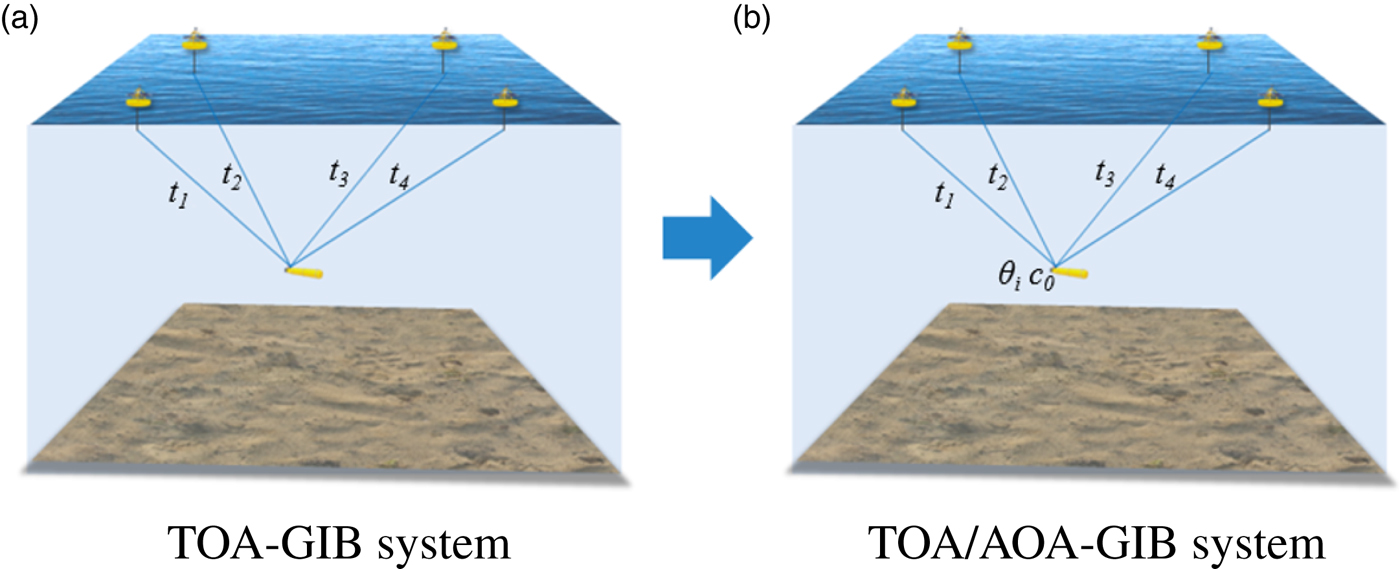
As shown in Figure 1(a), a TOA-GIB system consists of a set of surface buoys (reference points) with GNSS receivers, submerged hydrophones, and radio modems. The hydrophones receive the acoustic impulses emitted periodically by a synchronised pinger installed on the underwater target and the TOA is recorded and sent in real time through the radio link to a control unit. Because position estimates are only available at the control unit, this system is naturally suited for tracking applications.
TOA-GIB system.

The coordinates of reference points (x i, y i, z i) (i = 1, 2, … n) can be provided by GNSS, where i stands for the reference point number. The system measures the travel time of acoustic signals t i from the reference points to the target. Suppose sound speed c is constant, the distances between the reference points and the target are ρi = ct i. Let the target coordinates be (x t, y t, z t), then the observation equation is given as
 $$\rho_i = \sqrt{\lpar x_1 - x_i\rpar ^{2} + \lpar y_{i} - y_{i}\rpar ^{2} + \lpar z_i - z_i\rpar ^{2}} $$
The target coordinates (x t, y t, z t) can be obtained by least square solution of Equation (1). However, refraction artefacts caused by the variation of sound speed c in a vertical direction will lead to a large positioning deviation.
2.1. Refraction correction
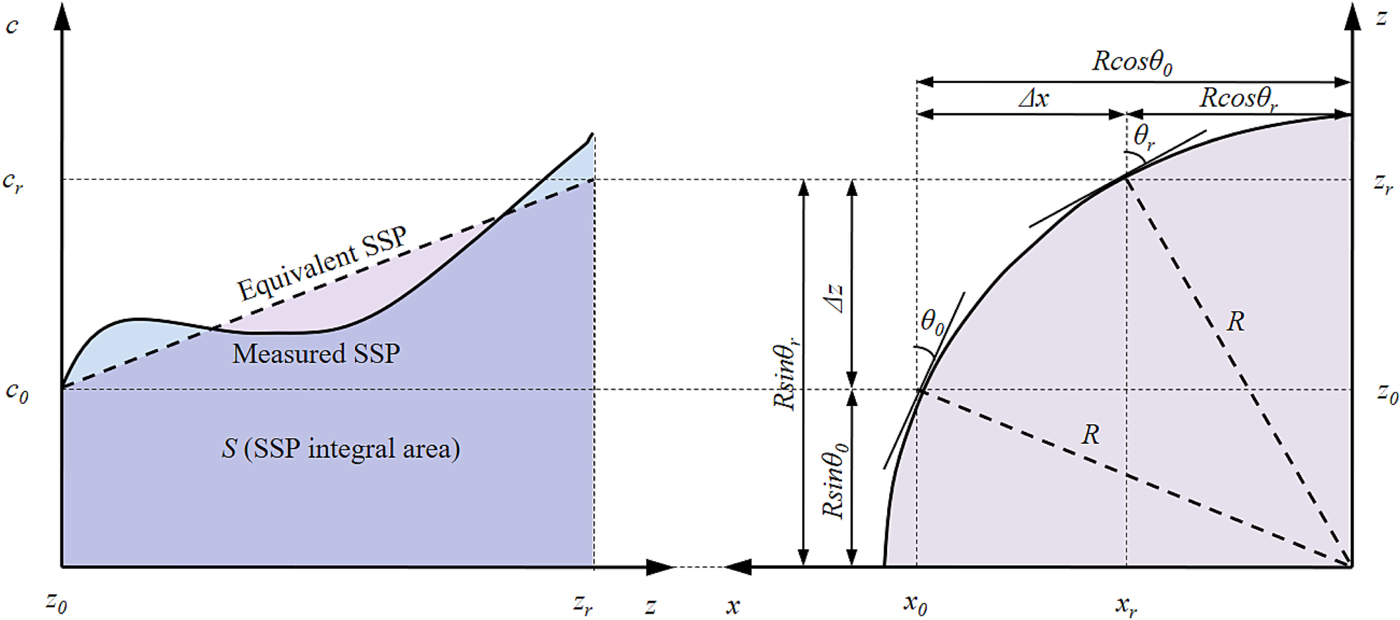
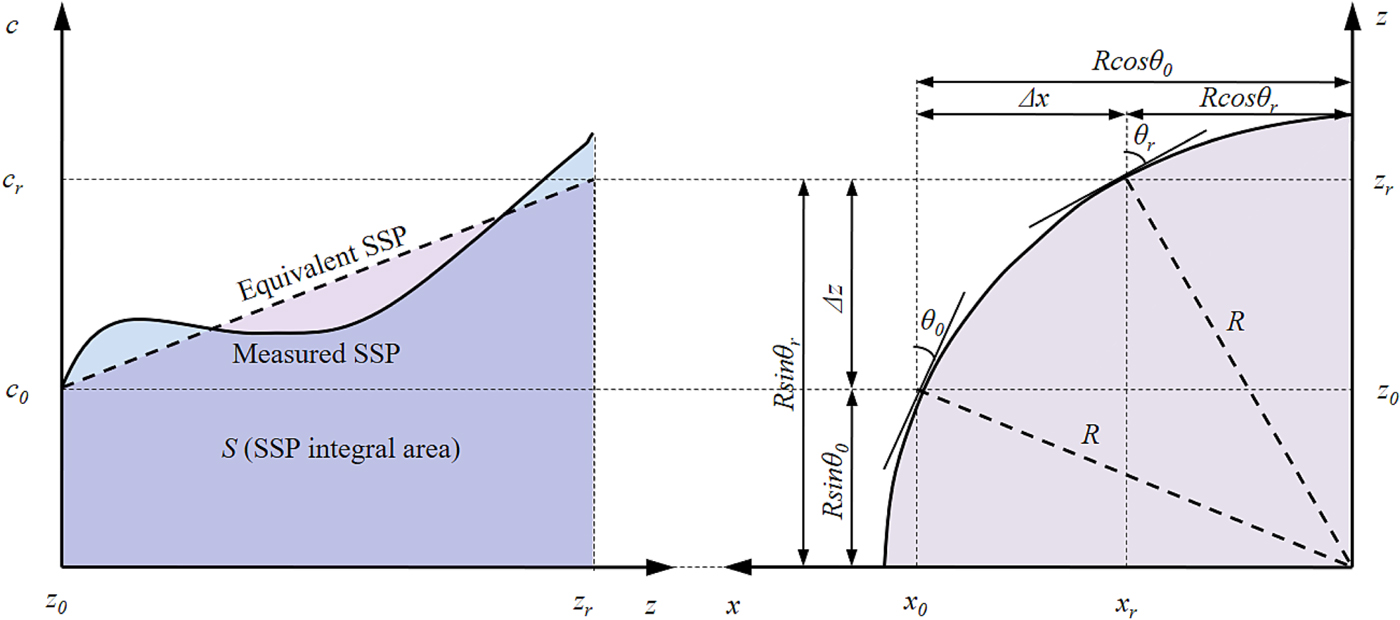
As shown in Figure 2, according to the ESS method (Geng and Zielinski, Reference Geng and Zielinski1999), let the SSP integral area between water depth z 0 and z r be S and c 0, c r are the sound speeds at depths of z 0, z r. The ESS gradient g is given as
Equivalent sound speed method.
 $$\eqalign{g &= \lpar c_r - c_0\rpar /\lpar z_r - z_0\rpar \cr &= 2S/\lpar z_r - z_0\rpar ^2 - 2c_0/\lpar z_r - z_0\rpar } $$
The acoustic path in the constant gradient sound speed layer is a circular arc with radius R = 1/pg, the Snell constant p is given as (Kammerer, Reference Kammerer2000)
 $$p = \sin \theta_0/c_0 = \sin \theta_r/c_r $$
where θ 0 is the incident beam angle, and the emergent beam angle θ r is (Lu et al., Reference Lu, Bian, Huang and Zhai2012)
 $$\theta_r = 2 \arctan [ e^{tg} \tan \lpar \theta_{0}/2\rpar ] $$
The vertical distance Δ z and the plane distance Δ x are given as follows
 $$\Delta x = R\lpar \cos \theta_0 - \cos \theta_r\rpar $$
 $$\Delta z = R\lpar \sin \theta_r - \sin \theta_0\rpar $$
The distance after refraction correction can be given by ρ 2 = Δz 2 + Δx 2. Obviously, the premise of the ESS method is that the incident beam angle θ 0 is known. However, the scalar hydrophone of a TOA-GIB system can only measure travel time of acoustic signals, so this refraction correction method cannot be directly applied to a TOA-GIB system.
2.2. ESS iteration method
Although a TOA-GIB system does not measure the incident beam angle θ 0, when the ESS gradient g, the travel time t and the target depth z 0 are known, a new equation can be obtained by substituting Equation (3) into Equation (4):
 $$\tan [ \arcsin \lpar c_r \sin \theta_0/c_0\rpar /2] = e^{tg} \tan \lpar \theta_0/2\rpar $$
In Equation (7), the incident beam angle θ 0 is an unknown parameter and can be solved by the Newton iteration method.
The positioning calculation procedure of the ESS iteration method is as follows:
(1) Calculate the initial distance
 $\rho_{i}^{0} = c^{\prime}t_{i}$, where c ′ is the approximation of sound speed which can be obtained from the measured SSP;
(2) Substitute the distance
$\rho_{i}^{0}$ and the reference point coordinates (x i, y i, z i) into Equation (1) to calculate the target approximate coordinates (x t, y t, z t);(3) Calculate the ESS gradient g i with Equation (2);
(4) Substitute the ESS gradient g i, the travel time t i into Equation (7), to calculate the incident beam angle θ 0i;
(5) Substitute the incident beam angle θ 0i, the ESS gradient g i and the travel time t i into Equations (3) ~ (6), to calculate the corrected distance ρi;
(6) Repeat steps (2)–(5) until the change of target coordinates is less than the threshold εp.


3. TOA/AOA-GIB SYSTEM
An ESS iteration method for a TOA-GIB system when the SSP is real-time and accurate is presented in Section 2. However, to derive real-time SSP information, an underway-profiling instrument is needed (Clarke et al., Reference Clarke, Lamplugh and Kammerer2000). In most cases, it is of considerable inconvenience and high cost for an Autonomous Underwater Vehicle (AUV) to operate in underwater environments equipped with such an underway-profiling instrument (Zhang et al., Reference Zhang, Li, Zhao and Rizos2016). To achieve high precision underwater dynamic positioning without a real-time SSP, an assumption is proposed: If the incident beam angles θ 0i and the real-time sound speed c 0 are measured, can the accurate estimation of the target position and the ESS gradient be achieved by iteration computation?
As shown in Figure 1(b), a TOA/AOA-GIB system is designed based on this assumption. The surface-buoys (reference points) are equipped with GNSS receivers and submerged transponders. A transceiver installed on the underwater target sends out the interrogation and receives the reply from the transponders. The vector hydrophone (Nehorai and Paldi, Reference Nehorai and Paldi1994; Tichavsky et al., Reference Tichavsky, Wong and Zoltowski2001) of the transceiver records the incident beam angles θ 0i and the time of arrival t i. The positions of the buoys are also available by coding within the acoustic emission pattern. A micro sound speed meter mounted on the transceiver is used to measure the real-time sound speed c 0. Unlike in a TOA-GIB system, the data position information is available at the control unit of the underwater platform, and therefore, the system can be directly used for navigation.
Since the heave of surface buoys caused by waves is usually very small compared to the target depth, it can be considered that the ESS gradients g i between different reference points and the target are approximately the same, that is, g i = g. Therefore, the target position (x t, y t, z t) and the ESS gradient g can be estimated as unknown parameters. To calculate g, a new equation can be obtained by substituting Equation (4) into Equation (5):
 $$p\Delta xg + \cos [ 2\arctan \lpar e^{tg} \tan \lpar \theta_0/2\rpar \rpar ] - \cos \theta_0 = 0 $$
If we linearize Equation (8), and the error equation is given as follows
 $$V = AX - L $$
where A = [a 1 a 2 · · · a n] T, L = [l 1 l 2 · · · l n] T, and a i, l i are given as follows
 $$a_i = p_i \Delta x_i - \displaystyle{{2t_i e^{t_i g} \tan \lpar \theta_{0i}/2\rpar }\over{1 + \lpar e^{t_i g} \tan \lpar \theta_{0i}/2\rpar \rpar ^2}} \sin [ 2\arctan \lpar e^{t_i g} \tan \lpar \theta_{0i}/2\rpar \rpar ] $$
 $$l_i = \cos \theta_{0i} - p_i \Delta x_i g - \cos [ 2\arctan \lpar e^{t_i g} \tan \lpar \theta_{0i}/2\rpar \rpar ] $$
The least square solution of Equation (8) is:
 $$X = \lpar A^{T}\ A\rpar ^{-1}\ A^{T}\ L $$
The positioning calculation procedure of the TOA/AOA-GIB system is:
(1) Calculate the initial distance
$\rho_{i}^{0} = c^{\prime}t_{i}$, where t i is measured by the vector hydrophone, and c 0 is measured by the micro sound speed meter;(2) Substitute the distance
$\rho_{i}^{0}$ and the reference point coordinates (x i, y i, z i) into Equation (1) to calculate the approximate target coordinates (x t, y t, z t);(3) Substitute the incident beam angle θ 0i, the travel time t i and the sound speed c 0 into Equations (8) ~ (12), to calculate the approximate ESS gradient g;
(4) Substitute the incident beam angle θ 0i, the ESS gradient g and the travel time t i into Equations (3) ~ (6), to calculate the corrected distance ρi;
(5) Repeat steps (2)–(4) until the change of target coordinate is less than the threshold εp.


4. EXPERIMENT AND ANALYSIS
An experiment was designed to verify the ESS iteration method and the TOA/AOA-GIB system. The major purpose of this experiment was twofold: (1) The SSPs collected in the South China Sea are used for a positioning simulation. It is assumed that one of the SSPs is the real-time SSP, and the other SSPs are non-real-time SSPs. The ESS iteration method is used to eliminate the influence of refraction artefacts, to verify the calculation accuracy of the ESS iteration method, and to test the effect of the temporal and spatial variation of the SSP on the positioning accuracy. (2) The TOA/AOA-GIB system is used for the positioning simulation to verify whether the novel system can eliminate the systematic error due to the non-real-time SSP, and the influence of the incident beam angle error on the positioning accuracy is tested.
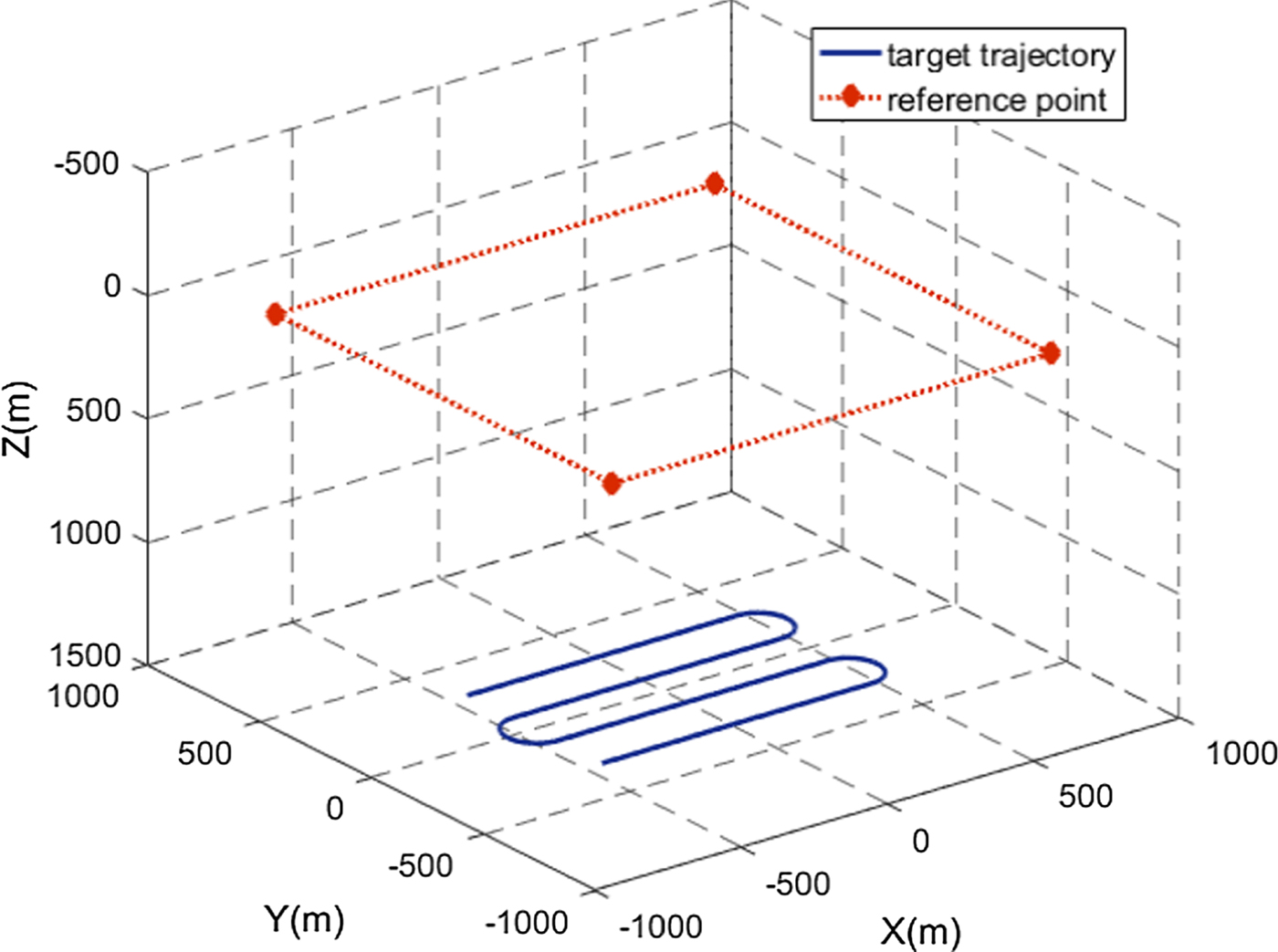
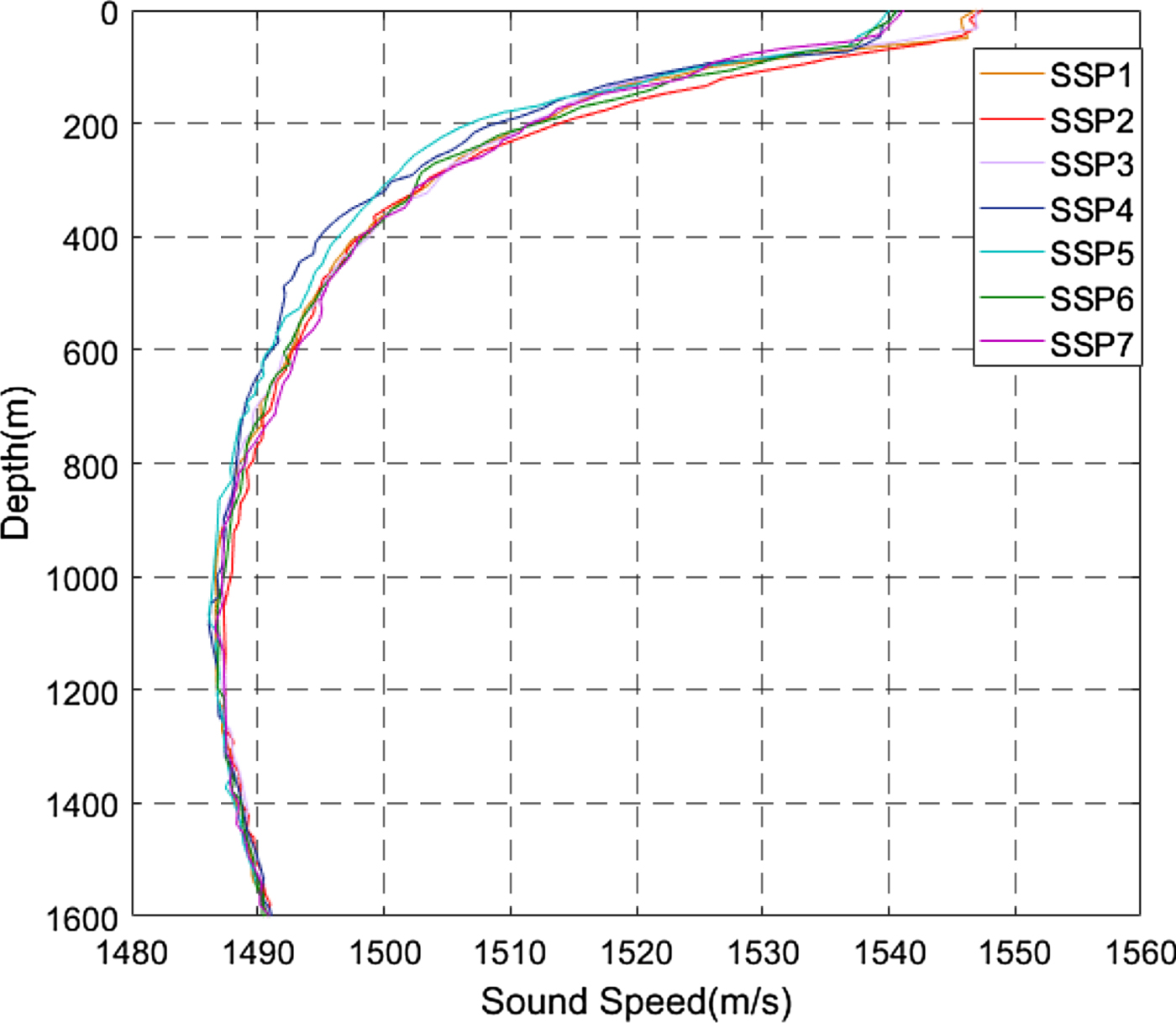
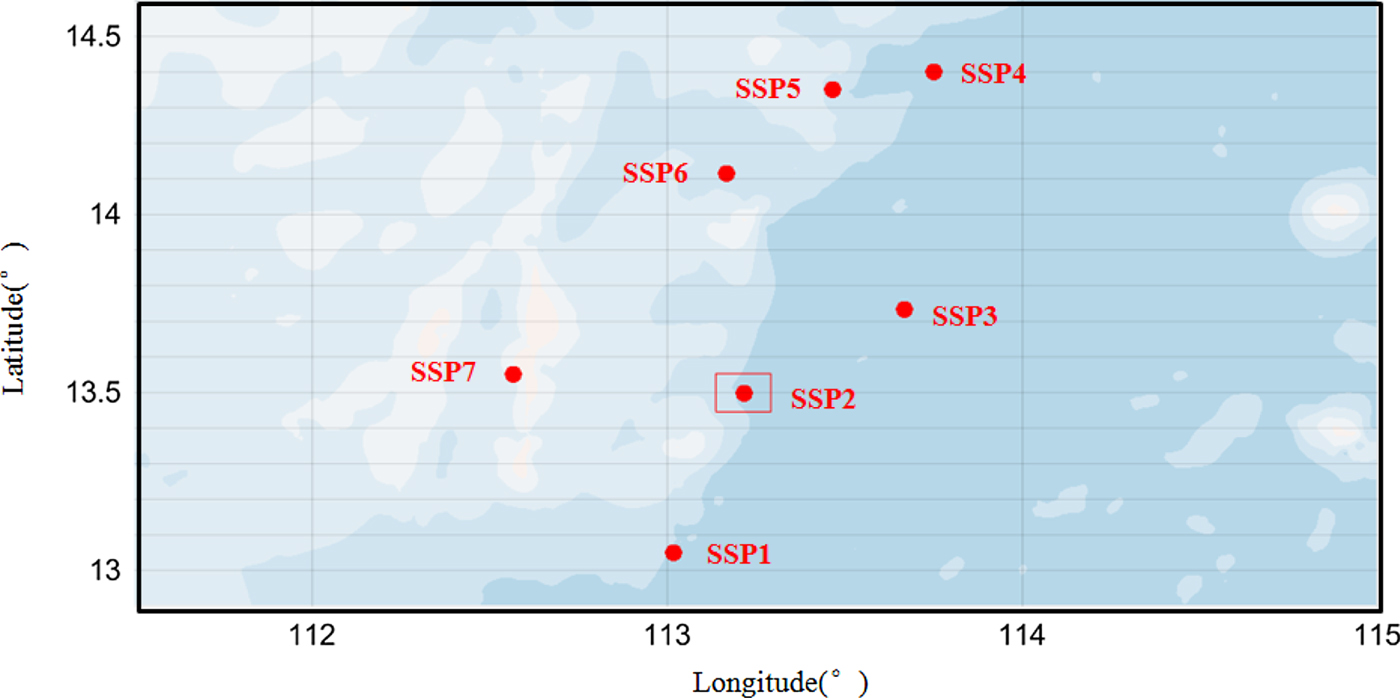
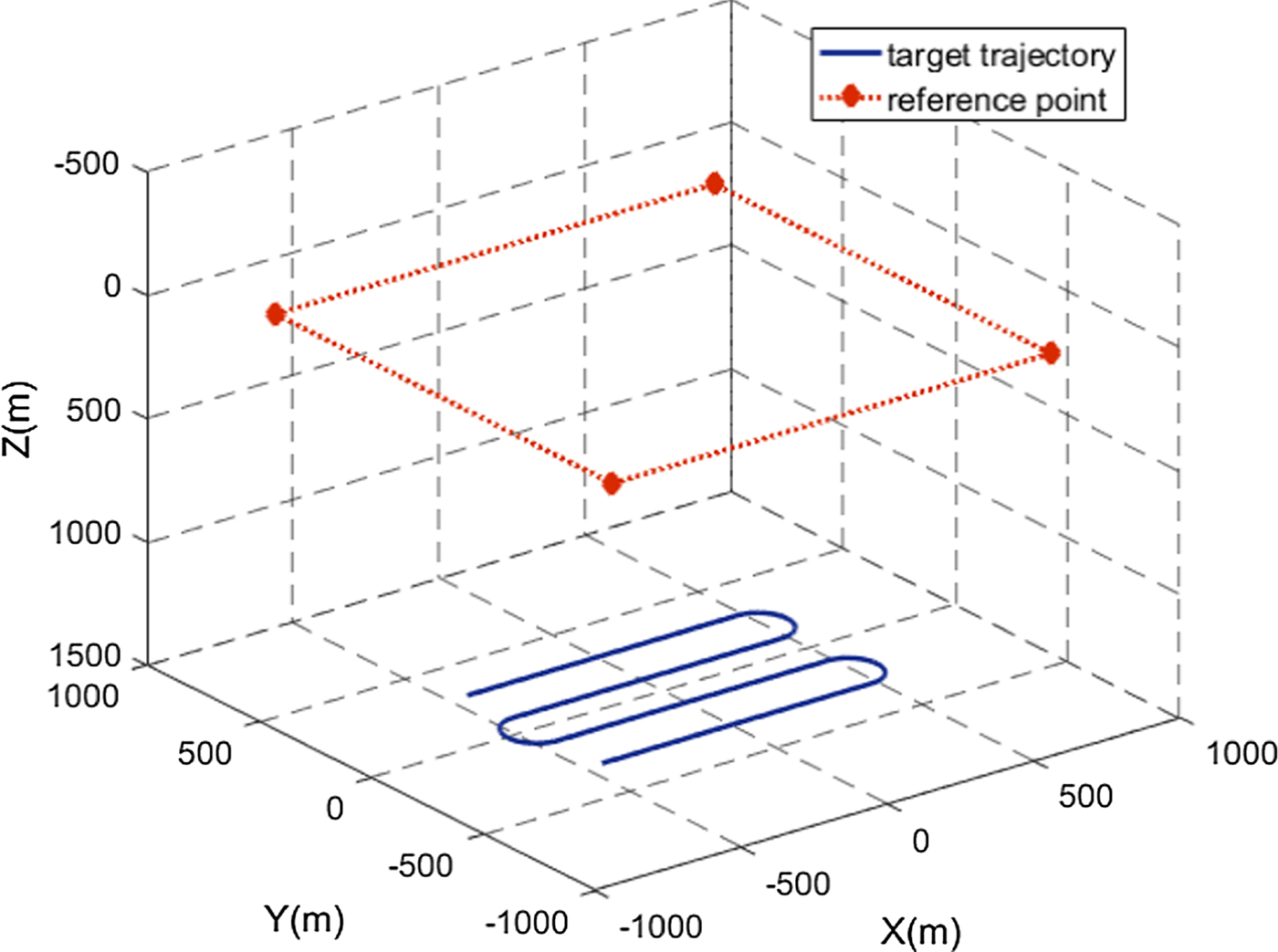
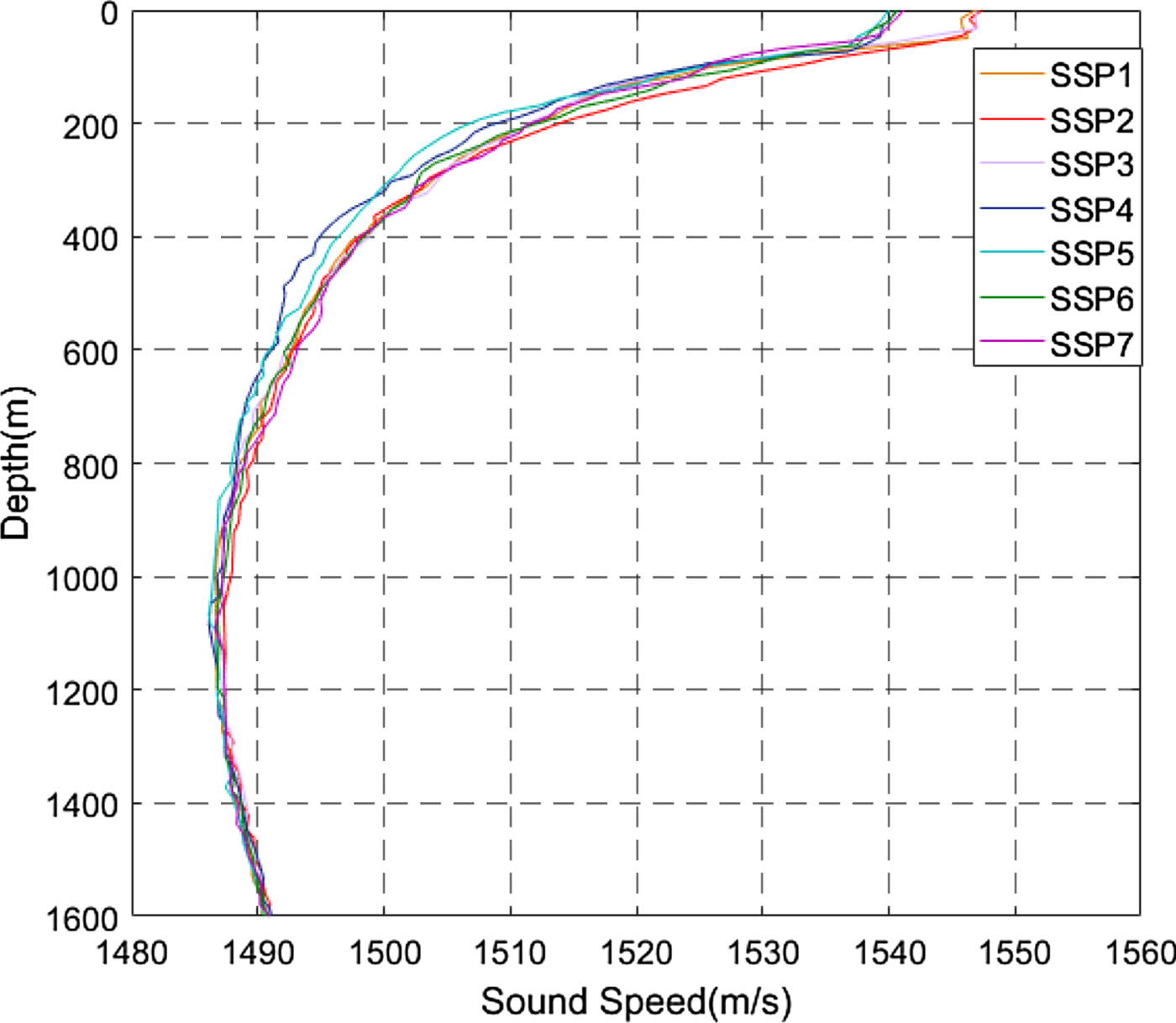
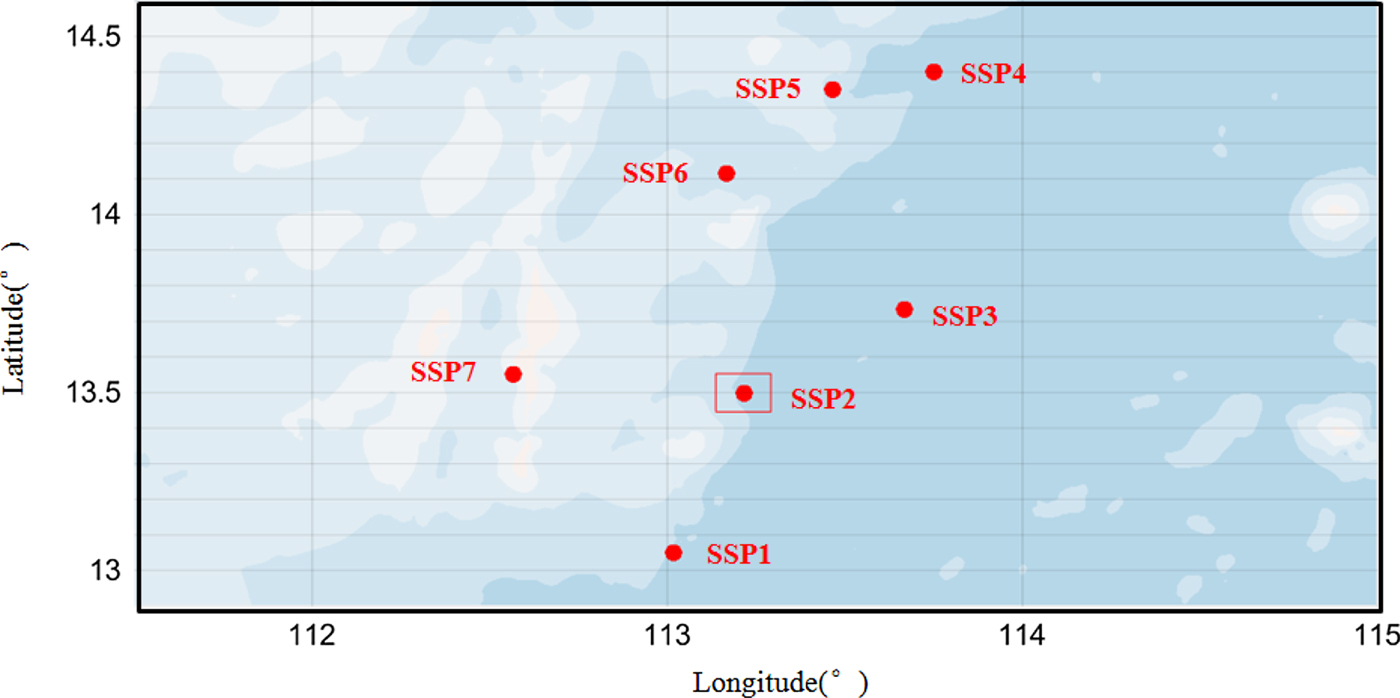
As shown in Figure 3, the reference points are laid in a square with sides of length 1,500 m. The underwater target moves along the S-shaped route at a depth of z = 1, 500 m. As shown in Figures 4 and 5, a set of SSPs are collected in the South China Sea. SSP2 is assumed to be an accurate real-time speed profile. Suppose the random heaves of reference points are less than 5 m. The random error of the travel time is assumed to be Δt = 10 μs, and the random error of reference point coordinates are assumed to be ΔP x = 0·1 m, ΔP y = 0·1 m, ΔP z = 0·1 m. In addition, the random error of sound speed is Δc 0 = 0·02 m/s, and the random error of incident beam angle is Δθ 0. Standard deviation is used as an indicator of calculated results:
 $$\sigma = \sqrt{\sum\limits_{i = 1}^{n} \lpar \beta_e - \beta\rpar ^{2}/n} $$
where βe is the estimation of the parameter, and β is the true value of the parameter.
Reference points and target trajectory.
Sound speed profile.
Distribution of sound speed profile.
4.1. Experiment results
The experiment was divided into two steps. First, using the ESS iteration correction method, the target coordinates are calculated.  $\sigma_{Ph}^{e}$ and
 $\sigma_{Pv}^{e}$ represent the standard deviations of the target plane coordinates and the vertical coordinate, respectively.
 $\sigma_{\theta 0}^{e}$ and
 $\sigma_{g}^{e}$ are the standard deviations of the incident beam angle and the ESS gradient, respectively. Then, the TOA/AOA-GIB system is used to discover the target location.
 $\sigma_{Ph}^{s}$,
 $\sigma_{Pv}^{s}$,
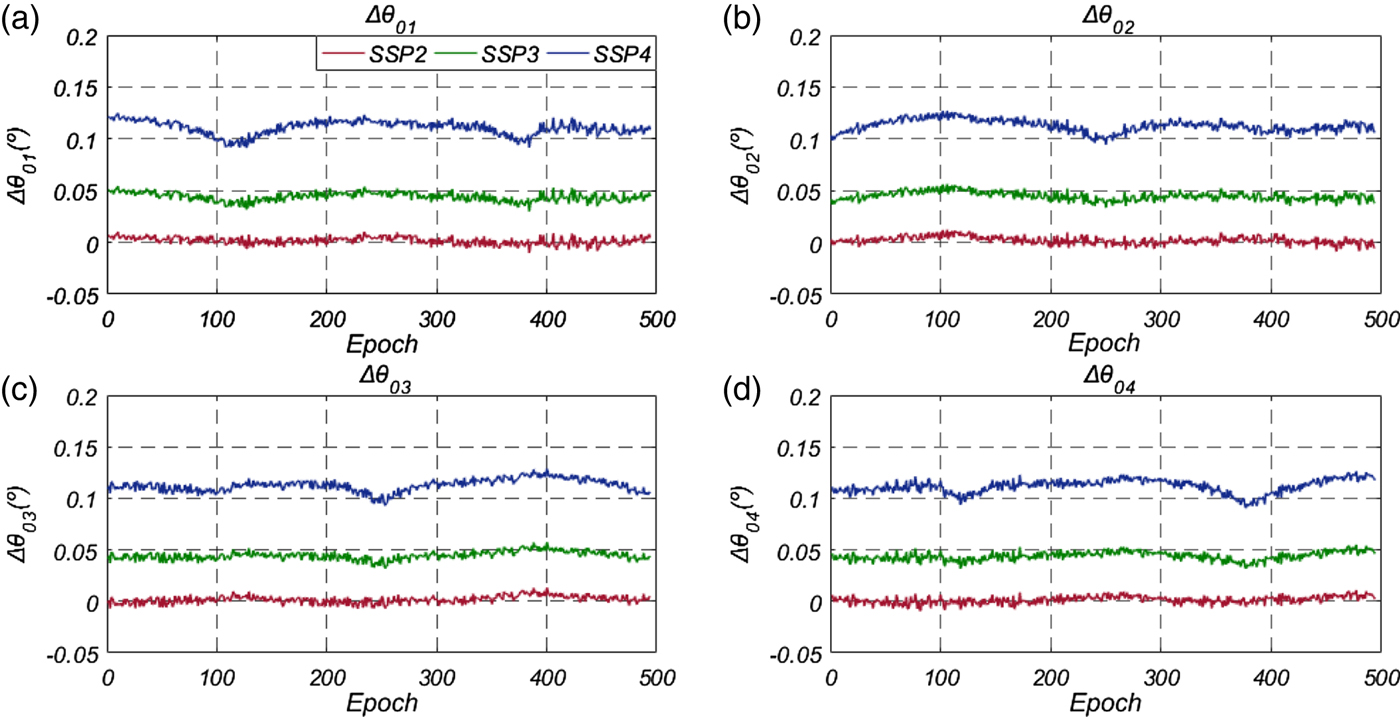
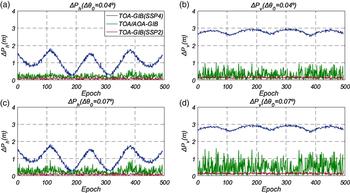
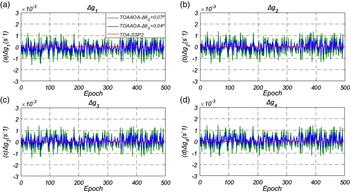
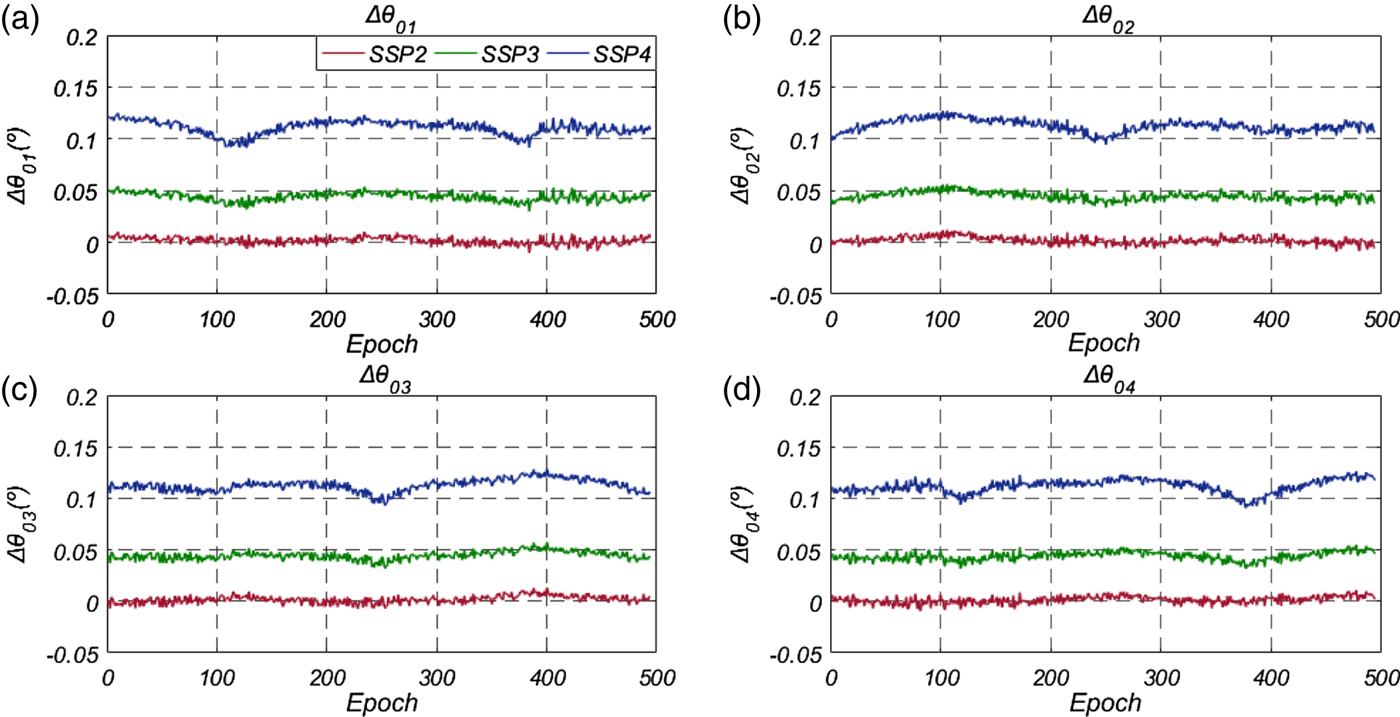
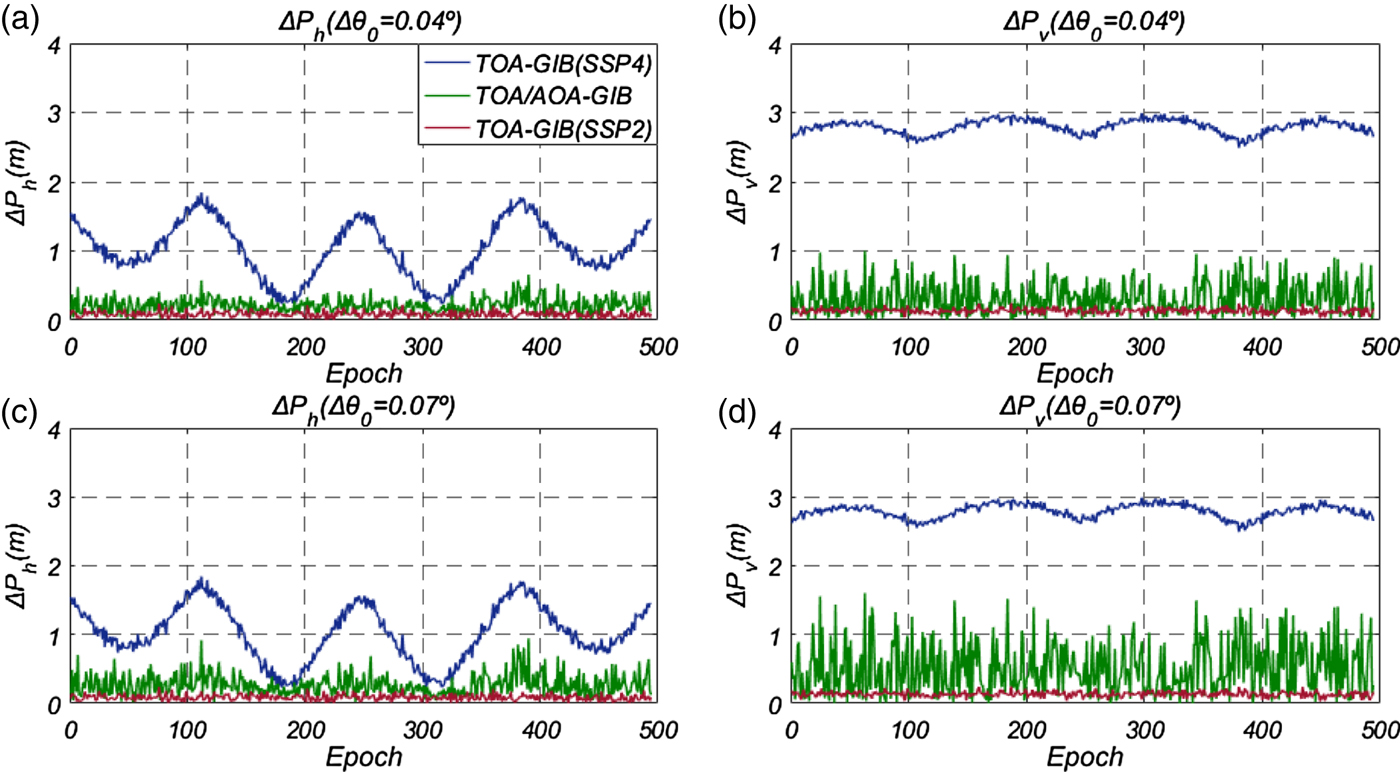
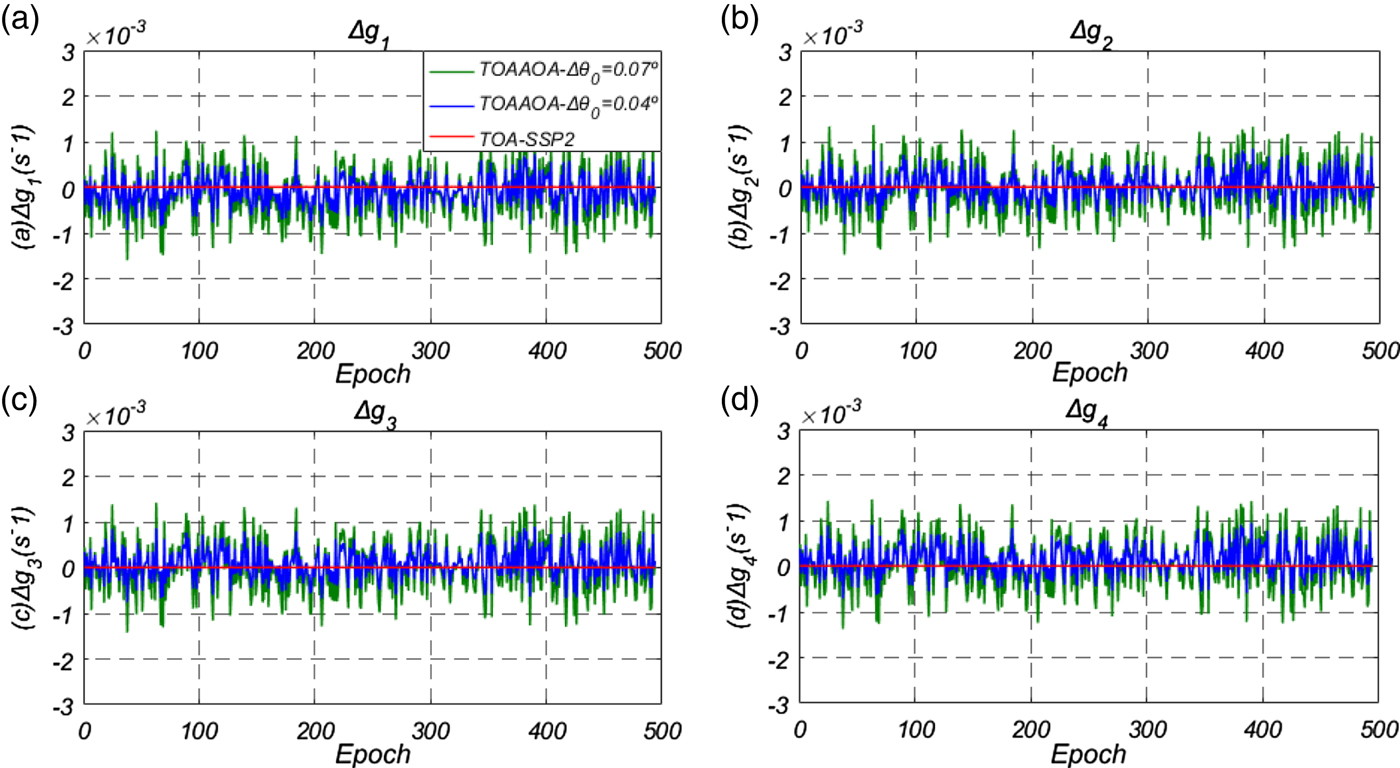
 $\sigma_{g}^{s}$ represent the standard deviations of the target plane coordinate, the vertical coordinate, and the ESS gradient. Statistical results of standard deviations are shown in Tables 1 and 2. Error curves of the incident beam angle, the target coordinates and the ESS gradient are shown in Figures 6, 7 and 8.
Beam incident angle error curves ((a) Δ θ 01; (b) Δ θ 02; (c) Δ θ 03; (d) Δ θ 04).
Target coordinate error curves ((a) Δ P h (Δ θ 0 = 0·04°); (b) Δ P v (Δ θ 0 = 0·04°); (c) Δ P h (Δ θ 0 = 0·07°); (d) Δ P v (Δ θ 0 = 0·07°)).
ESS gradient error curves ((a) Δ g 1; (b) Δ g 2; (c) Δ g 3; (d) Δ g 4).
Standard deviation of target coordinate (the ESS iteration method).

Standard deviation of target coordinate (the TOA/AOA-GIB system).

4.2. Experiment analysis
As shown in Table 1, when the ESS iteration method with SSP2 is used for the positioning calculation,  $\sigma_{Ph}^{e}$ and
 $\sigma_{Pv}^{e}$ are all decimetre-scale, which indicates that the ESS iteration method can use a real-time and exact SSP to eliminate the influence of refraction artefacts. However, as shown in Figures 6 and 7, when the SSP is inaccurate, there are systematic errors in both the incident beam angle and the target coordinates. Therefore, the real-time SSP is very important for high precision underwater positioning and navigation.
As shown in Table 2 and Figures 7 and 8, systematic errors are effectively suppressed in the TOA/AOA-GIB system. Although the positioning accuracy becomes worse with the increase of Δθ 0, when Δθ 0 is 0·1°, the standard deviation between the coordinates in the TOA/AOA-GIB system is at the decimetre level, which is better than 0·07% of water depth. Therefore, the TOA/AOA-GIB system can achieve high-precision dynamic positioning, with a sound speed sensor reading c 0, but without a real-time SSP.
5. CONCLUSION
Since incident beam angles are not measured in the TOA-GIB system, commonly used refraction correction methods are no longer applicable; thus, an ESS iteration method is proposed to reduce the influence of refraction artefacts. On this basis, a TOA/AOA-GIB system for high precision dynamic positioning is proposed, in which incident beam angles are used as observations to calculate target coordinates and ESS gradient. Experimental results show that the positioning accuracy of the TOA/AOA-GIB system is better than 0·07% of water depth when the angle measurement accuracy is better than 0·1°. Since this is comparable with the angle measurement accuracy of USBL (0·1°), it is considered that the TOA/AOA-GIB system has certain research value and practical significance.
ACKNOWLEDGMENTS
This work is supported by National Key R&D Program of China (grant Nos. 2016YFB0501700, 2016YFB0501705) and Shandong Provincial Key R&D Program (grant No. 2018GHY115002).