Introduction
Digestibility coefficient is an important tool for livestock production, since it is closely related to nutrient utilization, as well as intake and performance (Patterson et al., Reference Patterson, Adams, Klopfenstein and Lardy2006). However, in vivo trials to evaluate apparent digestibility are usually time-consuming, laborious, costly and require a large number of animals to ensure repeatability (Stern et al., Reference Stern, Bach and Calsamiglia1997). Moreover, in recent years, the scientific community has been under pressure to reduce animals' usage in research projects. Thus, alternative methods have been developed to determine accurate results that can be correlated with in vivo digestibility, such as in situ and in vitro evaluations (Tilley and Terry, Reference Tilley and Terry1963; Nocek, Reference Nocek1988). In in situ methods, samples are weighed into nylon bags and incubated in cannulated animals receiving a standard diet (Nocek, Reference Nocek1988). The porosity of these bags allows colonization by microorganisms and further sample degradation. On the other hand, in vitro methods may utilize ruminal fluid from cannulated animals to estimate degradation by sample incubation under laboratory conditions (Tilley and Terry, Reference Tilley and Terry1963; Weiss, Reference Weiss and Fahey1994). Results from these techniques can be obtained faster and with lower costs, labour and animals usage than those from in vivo trials, since it is possible to incubate several bags with different diets using rumen inoculum from the same animal.
Research has been done using in situ (Rymer and Givens, Reference Rymer and Givens2002; Gosselink et al., Reference Gosselink, Dulphy, Poncet, Jailler, Tamminga and Cone2004; Chaudhry and Mohamed, Reference Chaudhry and Mohamed2011; Krizsan et al., Reference Krizsan, Nyholm, Nousiainen, Südekum and Huhtanen2012; Holt et al., Reference Holt, Yang, Creech, Eun and Young2016) and in vitro (NRC, 2001; Gosselink et al., Reference Gosselink, Dulphy, Poncet, Jailler, Tamminga and Cone2004; Chaudhry and Mohamed, Reference Chaudhry and Mohamed2011; Krizsan et al., Reference Krizsan, Nyholm, Nousiainen, Südekum and Huhtanen2012; Stalker et al., Reference Stalker, Lorenz, Ahern and Klopfenstein2013; Ferraretto et al., Reference Ferraretto, Fredin and Shaver2015; Lopes et al., Reference Lopes, Ruh and Combs2015) methods on the determination of feed digestibility in ruminants. However, most studies have evaluated individual feeds and not total mixed diets. Moreover, different recommended times of incubation have been proposed among studies (López, Reference López, Dijkstra, Forbes and France2005). The time of incubation might differ depending on diet composition, since different feedstuffs have different degradation parameters in the rumen, such as water-soluble fraction (A), potentially degradable water-insoluble fraction (B) and degradation rate of fraction B (kd). Thus, utilizing these parameters might allow the proposal of a single equation to predict the digestibility of diets with different forage content. Although the effective degradability can be correlated with in vivo digestibility, the passage rate needs to be estimated to do so, which is a limitation. Thus, the use of degradation parameters might allow the in vivo digestibility estimation without passage rate utilization. However, few studies correlate the degradation parameters of in situ and in vitro methods with the ideal incubation time to reach in vivo digestibility.
We hypothesized that equations estimated from ruminal parameters developed using in situ and in vitro incubations with multiple time points could produce results that mimic in vivo digestibility of diets with different forage neutral detergent fibre (fNDF) levels. Therefore, the objective of this meta-analysis study was to develop and validate equations estimated from in situ and in vitro methods to predict in vivo organic matter (OM) ruminal digestibility of diets for ruminants.
Materials and methods
This study compiled data from seven experiments (six for equations development and one for validation) previously carried out at the Universidade Federal de Viçosa, Viçosa, Minas Gerais, Brazil.
In vivo, in situ, and in vitro trials
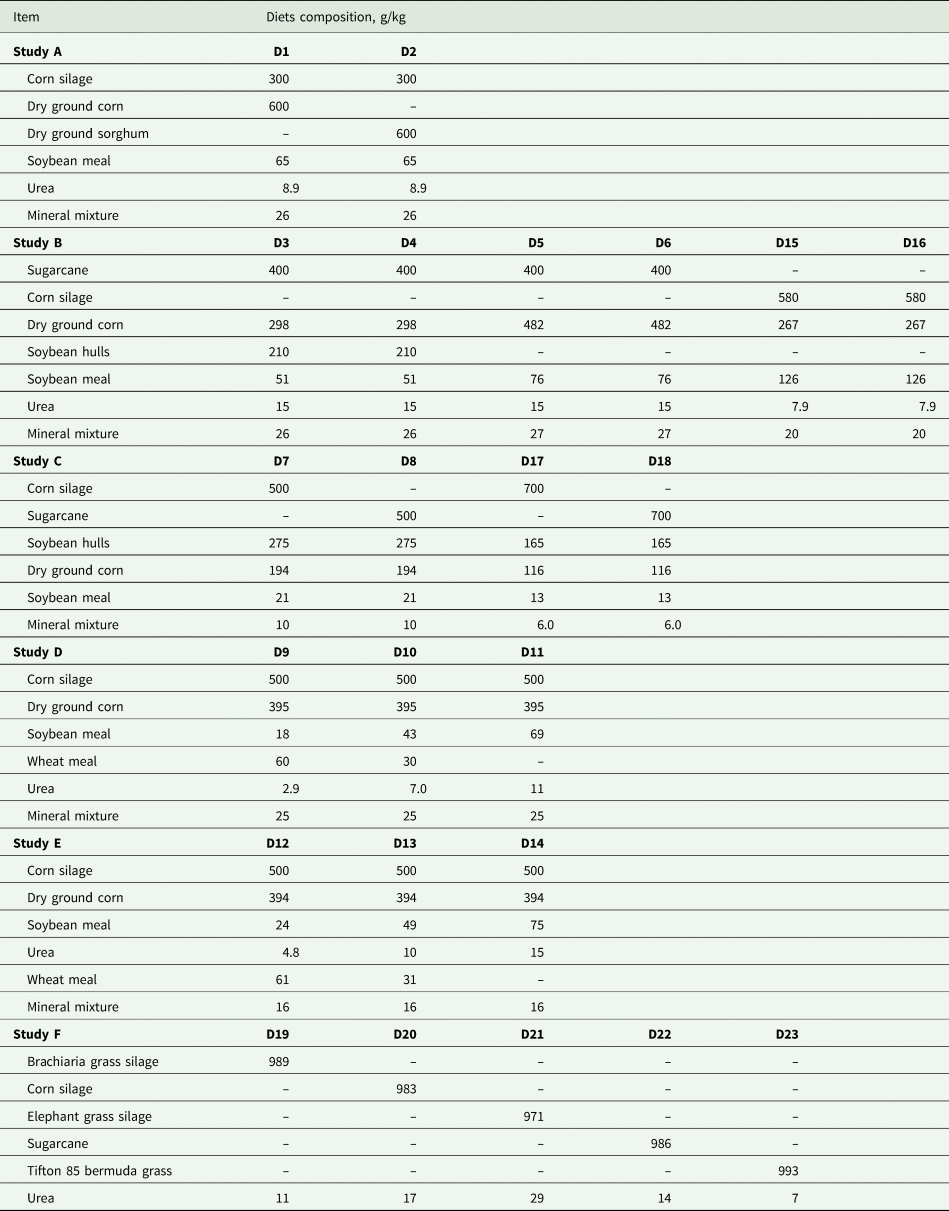
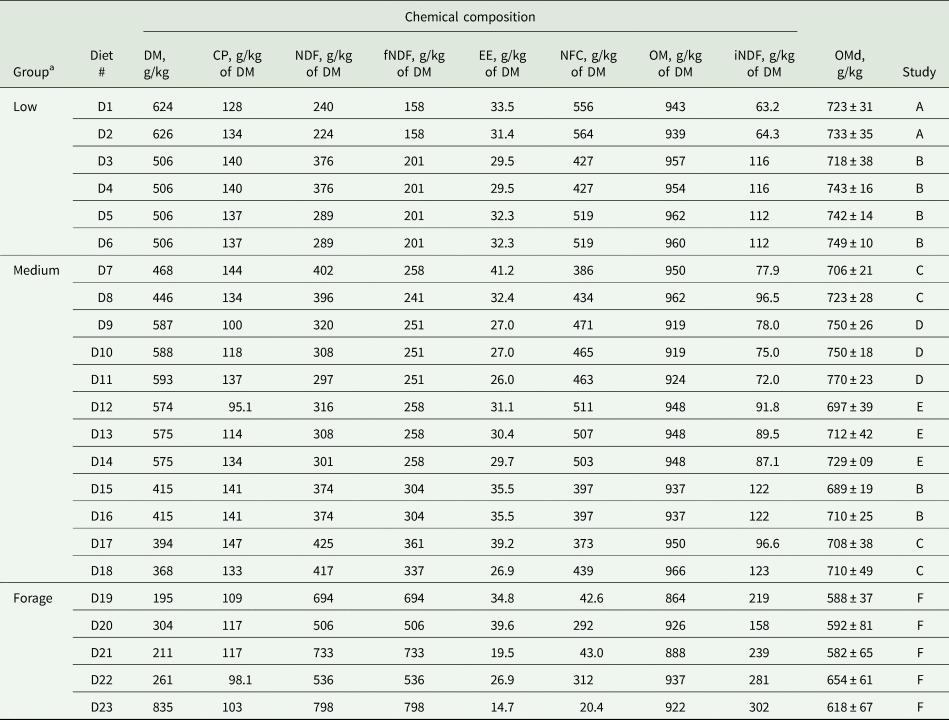
Efforts were made to minimize the sources of variations among experiments by using the same cannulated animals for both in situ incubations and ruminal fluid collection for in vitro incubations. All studies (A, B, C, D, E and F) had in vivo and in situ evaluation. However, all diets from study B were not submitted to the in vitro evaluation. Ingredient proportion and chemical composition of the 23 experimental diets and in vivo OM digestibility are presented in Tables 1 and 2.
Composition of the 23 experimental diets used to develop in vivo apparent digestibility and in situ and in vitro ruminal degradation parameters

Chemical composition of the 23 experimental diets used to develop in vivo apparent digestibility, and in vivo OM digestibility

DM, dry matter; CP, crude protein; NDF, neutral detergent fibre; EE, ether extract; NFC, non-fibre carbohydrates; OM, organic matter; fNDF, forage neutral detergent fibre; iNDF, indigestible neutral detergent fibre; OMd, in vivo organic matter apparent digestibility.
a Low (below 250 g/kg of fNDF), Medium (from 250 to 500 g/kg of fNDF) and Forage (only fNDF).
In vivo trials were performed using Nellore bulls [A (n = 10); B (n = 42); C (n = 16); D (n = 18); E (n = 15); and F (n = 25)], which were kept in individual pens equipped with water and feed troughs. For all studies, animals were fed twice daily, allowing for up to 10% refusals. Feeds and refusals were daily sampled. Total faeces collection was performed during three consecutive days to estimate dietary constituents' digestibility (Mezzomo et al., Reference Mezzomo, Paulino, Detmann, Valadares Filho, Paulino, Monnerat, Duarte, Silva and Moura2011; Benedeti et al., Reference Benedeti, Paulino, Marcondes, Valadares Filho, Martins, Lisboa, Silva, Teixeira and Duarte2014). Feed, refusals and faeces samples were oven-dried (55°C), grounded in a knife mill using 2 and 1 mm screens sequentially, and were packed for further laboratory analyses.
Regarding in situ evaluation, three cannulated bulls were used for the incubation of the bags and all ingredients were previously ground through a 2 mm screen (Wiley mill; Thomson Scientific Inc., Philadelphia, PA, USA) for all studies. Diets were individually weighed into Nylon bags (Sefar Nitex, Switzerland; 50 μm porosity, 400 cm2 surface area) and incubated in each animal. The bag surface area to mass ratio was 15 mg/cm2. Incubation times were: 0, 2, 4, 8, 16, 24, 48, 72 and 96 h. The number of bags varied as a function of incubation time to guarantee enough residual samples after incubation (i.e. more bags per sample were incubated for the longer incubation times relative to shorter incubation times). Samples were incubated in the rumen by attaching the bags to a steel chain with a weight at the end to allow for continual immersion within ruminal contents. Bags were placed into the rumen in the reverse order of incubation hours so that all bags were removed at the same time for washing.
After the incubation period, bags were washed by hand with running cold tap water and the end-point for washing was when the rinsing water was clear. The 0 h bags were not incubated in the rumen, but they were rinsed in running water with the incubated bags. Samples were oven-dried at 55°C for 72 h. After drying, bags were placed in an oven at 105°C for 2 h and weighed. Residues of each diet were removed from nylon bags and placed in a labelled plastic bag to obtain a sample of each diet per animal/incubation time. Residual samples in the bags of different time points were used to estimate the parameters of ruminal degradation.
As regards in vitro evaluation, ingredients were ground to pass through a 1 mm screen (Wiley mill; Thomson Scientific Inc.). One system of four 4 litre digestion vessels (TE-150; Tecnal Lab®, Piracicaba, SP, Brazil), equipped for slow rotation and with a temperature controller was used in four consecutive 96 h fermentation batches with eight different time points: 0, 3, 6, 12, 24, 48, 72 and 96 h. Ruminal fluid was collected from three rumen cannulated bulls 2 h post-feeding, immediately filtered through four layers of cheesecloth and kept into pre-warmed thermal containers and transported to the laboratory. Furthermore, approximately 200 g of rumen solid particles were also added to the containers. For the inoculum preparation, the rumen content was blended for 2 min, followed by filtering through four layers of cheesecloth (Holden, Reference Holden1999; Benedeti et al., Reference Benedeti, Fonseca, Shenkoru, Marcondes, Paula, Silva and Faciola2018a). The buffer mineral solution was prepared following the equipment manual and the pH was adjusted to 6.8 when needed (Holden, Reference Holden1999). After preparation, 1600 ml of buffer solution was added in each vessel, which was placed into TE-150 incubator and kept at 39°C for 30 min. Then, 400 ml of rumen inoculum was added in each vessel under anaerobic conditions. Diet samples were weighed (0.5 g/bag) into filter bags (F57, Ankom technology, Macedon, NY, USA), which were heat-sealed and placed into the digestion vessels. For each incubation, each vessel received three bags of one of the diets/time point plus two bags with no samples (blanks), and 2000 ml of rumen/buffer solution. After inoculation, vessels were closed and then placed into the incubator with a temperature at 39°C for 96 h. At the end of each incubation time point, the bags were rinsed with cold water and oven-dried at 55°C for 72 h. Residual samples in the bags of different time points were used to estimate the parameters of ruminal degradation.
All ingredients used in these studies were ground to pass through a 1 mm screen (Wiley mill; Thomson Scientific Inc.) for laboratory analysis of all studies. Samples were analysed for dry matter (DM; method G-003/1), ash (method M-001/1), crude protein (method N-001/1) and ether extract (method G-005/1) according to Detmann et al. (Reference Detmann, Souza, Valadares Filho, Queiroz, Berchielli, Saliba, Cabral, Pina, Ladeira and Azevedo2012). The OM was calculated as the difference between DM and ash contents. In situ and in vitro trial residues and faecal samples were analysed for final DM and OM.
For in situ and in vitro evaluations, the OM degradation profiles were estimated using the Ørskov and McDonald (Reference Ørskov and McDonald1979) asymptotic function:

where:
Y t = fraction degraded in time ‘t’, g/kg; A = water-soluble fraction, g/kg; B = potentially degradable water-insoluble fraction, g/kg; kd = degradation rate of fraction B, h−1; t = time, h.
Estimated times for the in situ and in vitro incubations of OM to access the in vivo digestibility were obtained by the following equation:

where: t = estimated time; A = water-soluble fraction, g/kg; B = potentially degradable water-insoluble fraction, g/kg; kd = degradation rate of fraction B, h−1.
All statistical procedures were carried out using SAS 9.3 PROC MIXED for Windows (Statistical Analysis System Institute, Inc., Cary, NC, USA) with α = 0.05. Degrees of freedom denominator was estimated using the Kenward and Roger (Reference Kenward and Roger1997) method.
Meta-analysis
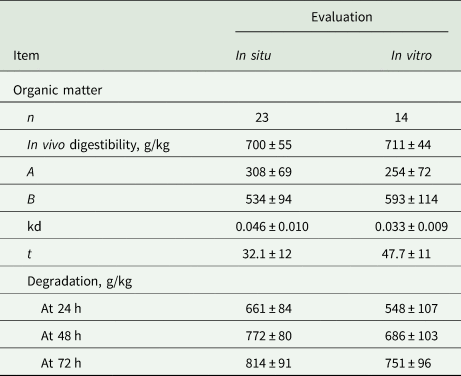
A multi-study analysis was performed using data obtained from the 23 different beef cattle diets evaluated in the six experiments cited above. Collected information included in vivo digestibility of OM; in situ and in vitro degradation parameters (A, B and kd) of OM (Table 3).
Descriptive statistics of the data used to develop and evaluate models to predict in vivo digestibility of dry matter and organic matter

A, water-soluble fraction, g/kg; B, potentially degradable water-insoluble fraction, g/kg; kd, degradation rate of fraction B, h−1; t, estimated time for in situ and in vitro incubations to access in vivo digestibility, h.
Regarding forage NDF levels' analysis, diets were arranged in three groups, according to their fNDF level: Low (below 250 g/kg of fNDF), Medium (from 250 to 500 g/kg of fNDF) and Forage (only fNDF). The values of estimated times for in situ and in vitro incubations to access in vivo digestibility of OM were evaluated using a mixed model including the random effect of study and the fixed effect of fNDF level (Low, Medium and Forage). Least-squares means were contrasted using the Tukey–Kramer test. A significance level of 5% was assumed. Furthermore, the values of apparent digestibility of OM (from in vivo trials) were subtracted from in situ and in vitro degradation at 24, 48 and 72 h of incubation. Then, differences between degradation (in situ and in vitro) at each of these time points and in vivo digestibility were analysed using the same previously described mixed model. Here, confidence levels of 95% based upon normal assumptions [mean ± (1.96 × standard error)] were used to identify if the means were different from zero. These analyses were performed with the MIXED procedure in SAS 9.4 (Statistical Analysis System Institute, Inc.).
Diets were not arranged by fNDF levels for equations development. A multiple stepwise regression was carried out for all the data using in vivo OM digestibility as dependent variables, whereas independent variables included in situ and in vitro degradation parameters (A, B and kd) previously described. These analyses were performed with the REG procedure in SAS 9.4 (Statistical Analysis System Institute, Inc.) assuming a significance level of 5%.
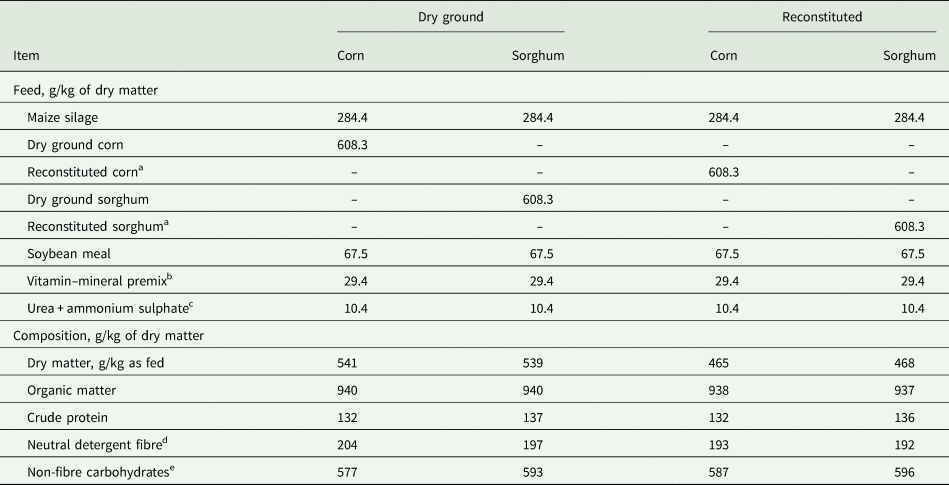
Equation validation was performed using data from a seventh experiment (n = 14 and 15 for in vitro and in situ, respectively) that had the same in vivo, in situ and in vitro methods as previous studies. Results from this experiment were not included in the database used to adjust tested equations. Table 4 provides the composition of diets utilized in this experiment.
Feeds composition of experimental diets of the validation study

a Ground corn and sorghum were moisturized (until dry matter reach 640 g/kg) and ensiled for 90 days to form the reconstituted grains (Benedeti et al., Reference Benedeti, Silva, Pacheco, Serão, Carvalho Filho, Lopes, Marcondes, Mantovani, Valadares Filho, Detmann and Duarte2018b).
b Premix guarantees (per kg of DM): 200–220 g of Ca, 10 mg of Co (Min), 500 mg of Cu (Min), 22 g of S (Min), 333 mg of Fe (Min), 178.41 mg of F (Max), 10 g of P (Min), 25 mg of I (Min), 17 g of Mg (Min), 1500 mg of Mn (Min), 1100 mg of monensin, 100 × 109 CFU of Saccharomyces cerevisiae (Min), 6.6 mg of Se (Min), 50 g of Na (Min), 100 000 IU of vitamin A (Min), 13 000 IU of vitamin D3 (Min), 150 IU of vitamin E (Min) and 2000 mg of Zn (Min).
c Urea + ammonium sulphate in a 9:1 ratio.
d Neutral detergent fibre corrected for residual ash and residual nitrogenous compounds.
e Non-fibre carbohydrates = 100 − [(crude protein–crude protein from urea + urea) + neutral detergent fibre + ether extract + ash].
Digestibility values of OM estimated by the equations proposed were compared with the observed values using the following regression model:

where X is the predicted value; Y is the observed value; β 0 is the intercept of the equation; and β 1 is the slope of the equation. Regression was evaluated according to the following statistical hypotheses (Mayer et al., Reference Mayer, Stuart and Swain1994):

If the null hypothesis was not rejected, it could be concluded that equations accurately estimate the apparent digestibility of OM. Slope and intercept were separately evaluated to observe where equations have possible errors. Estimates were evaluated using the estimated value of the mean square error of prediction and its components (Bibby and Toutenburg, Reference Bibby and Toutenburg1977):

where X are the predicted values; Y are the observed values; MSEP is the mean squared error of prediction; SB is the squared bias; MaF is the component relative to the magnitude of random fluctuation; MoF is the component relative to the model of random fluctuation; sX and sY are the standard deviations of predicted and observed values, respectively; and R is the Pearson linear correlation between predicted and observed values.
For all variance and covariance calculations, total number of observations was used as a divisor since it was a prediction error estimate (Kobayashi and Salam, Reference Kobayashi and Salam2000). Prediction of efficiency was determined by estimating the correlation and concordance coefficient (CCC) or reproducibility index described by Tedeschi (Reference Tedeschi2006). Validation analyses were performed with the Model Evaluation System [MES; version 3.1.16 (Tedeschi, Reference Tedeschi2006)] and significance was established at α = 0.05.
Results
Forage NDF levels' analysis
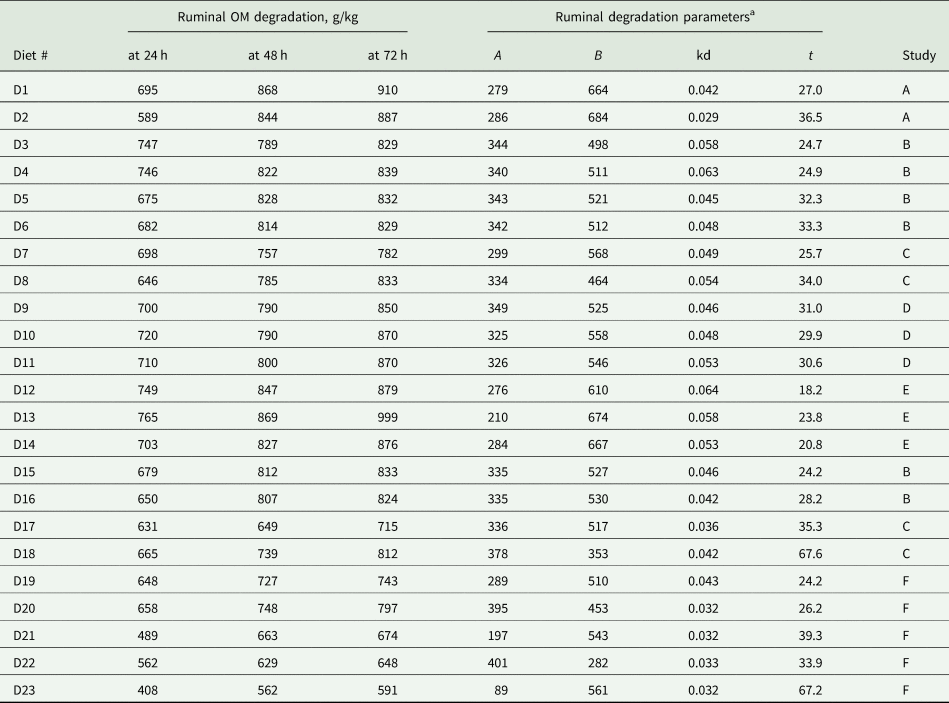
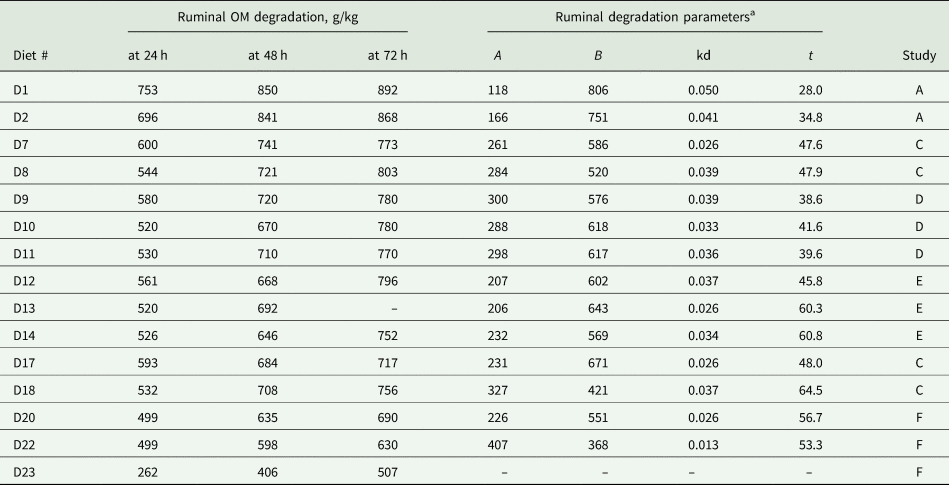
Ruminal degradation parameters and ruminal degradation of OM at 24, 48 and 72 h are presented in Tables 5 and 6, respectively for in situ and in vitro trials. For certain diets, the models utilized did not converge due to different degradation responses. Thus, they were not adopted in this case. Regarding both methods, Low group had lower (P < 0.01) incubation time to access OM in vivo digestibility, compared to Medium and Forage.
In situ ruminal degradation of organic matter (OM) at different time points and ruminal degradation parameters estimated from in situ incubations

a A = water-soluble fraction, g/kg; B = potentially degradable water-insoluble fraction, g/kg; kd = degradation rate of fraction B, h−1; t = estimated time for in situ incubation to access in vivo digestibility, h.
In vitro ruminal degradation of organic matter (OM) at different time points and ruminal degradation parameters estimated from in vitro incubations

a A = water-soluble fraction, g/kg; B = potentially degradable water-insoluble fraction, g/kg; kd = degradation rate of fraction B, h−1; t = estimated time for in vitro incubation to access in vivo digestibility.
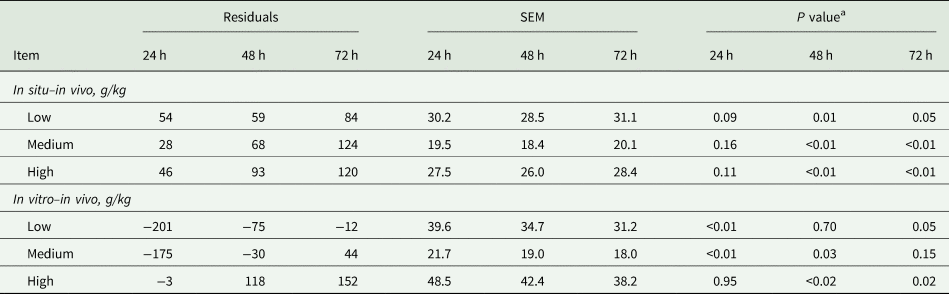
Results for residuals (in situ and in vitro degradation minus in vivo digestibility of OM) are presented in Table 7. Considering in situ v. in vivo evaluation, OM residuals at 48 and 72 h were positive and different from 0 (P < 0.01), but similar at 24 h (P > 0.05) for all fNDF levels. With regard to in vitro minus in vivo evaluation, Forage group displayed negative residuals for OM that were different from 0 (P < 0.01) at 24 and 48 h, but similar to 0 at 72 h (P > 0.05). Regarding Medium fNDF diets, in vitro minus in vivo OM residuals negatively differed from 0 at 24 h (P < 0.01), were similar at 48 h (P > 0.05) and positively differed from 0 at 72 h (P < 0.01). With respect to Low fNDF diets, residuals of OM did not differ from 0 at 24 h (P > 0.05), but positively differed from 0 at 48 and 72 h (P < 0.01).
Differences between in situ and in vitro degradation (at 24, 48 and 72 h of incubation) and in vivo digestibility of organic matter (OM)

a Values are significantly different from 0 (P ⩽ 0.05) with 95% confidence interval based on normal assumptions [mean ± (1.96 × standard error)] (Casella and Berger, Reference Casella and Berger2002).
Equations development
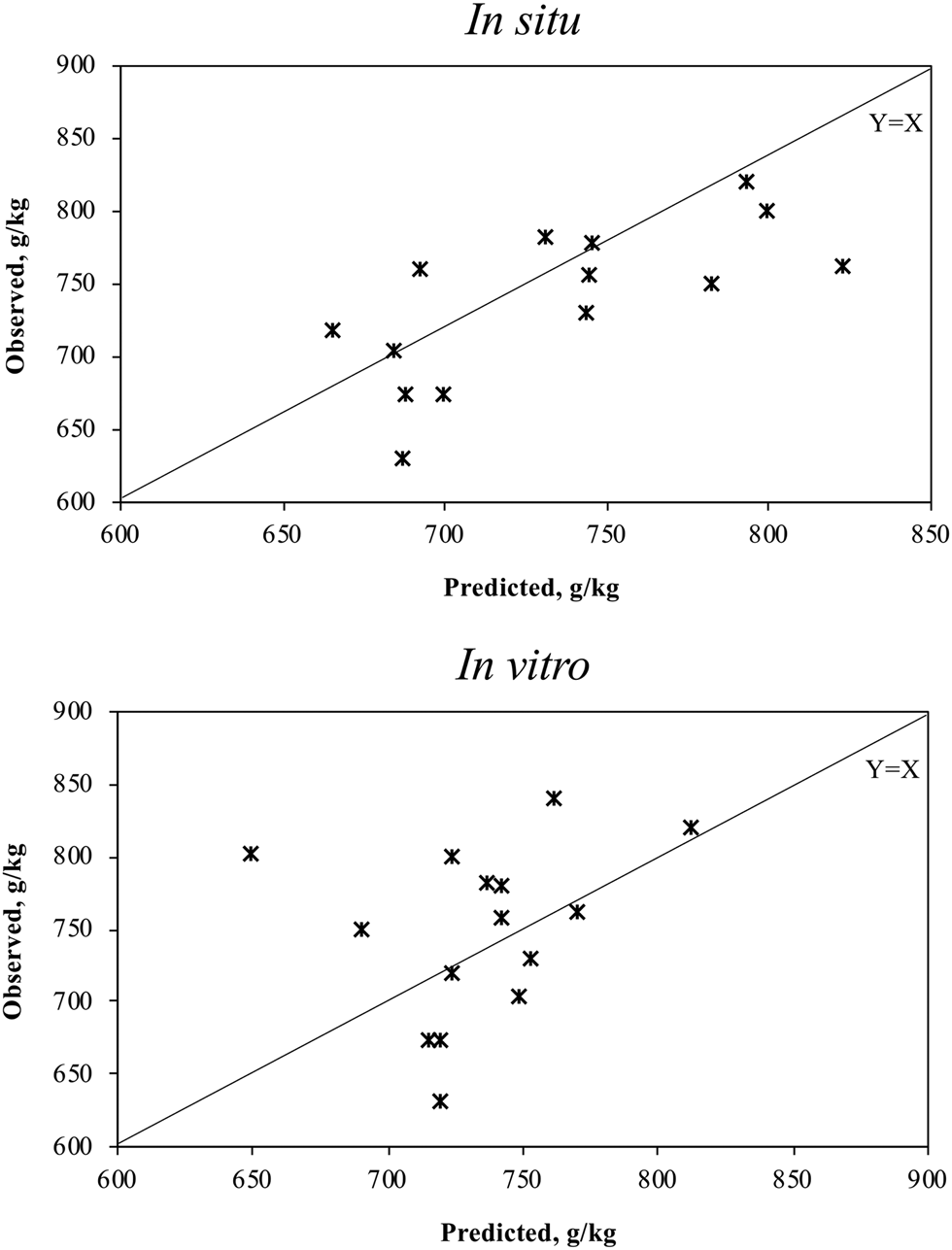
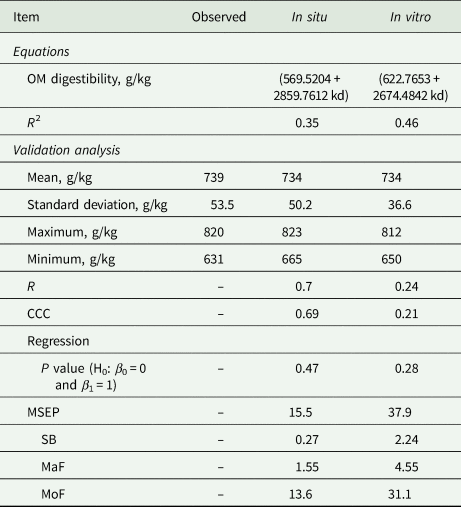
Figure 1 presents the comparison between observed and predicted OM digestibility values analysed in the validation study. Stepwise regression results of digestibility assays showed that kd contributed significantly in most of the algorithms derived to predict in vivo digestibility (Table 8). Furthermore, kd was the only significant parameter (P < 0.05) for the estimation of OM in vivo digestibility from both in situ and in vitro assays. Equations developed from both in vitro and in situ incubations accurately estimated in vivo digestibility of OM (P > 0.05). Validation analysis showed that CCC was farther from 1.0 and MSEP was lower for in vitro equations than for those for in situ equations.
Relationship among observed and predicted (in situ and in vitro) organic matter digestibility values.

Developed equations and mean and descriptive statistic of the relationship among the observed (in vivo) and predicted (in situ and in vitro) values of organic matter (OM) digestibility

R, determination coefficient; CCC, correlation and concordance coefficient; MSEP, mean square error of prediction; SB, squared bias; MaF, magnitude of random fluctuation; MoF, model of random fluctuation; kd, degradation rate of potentially degradable water-insoluble fraction, h−1.
Discussion
Forage NDF levels' analysis
Reports regarding nutrient utilization from feedstuffs are important to improve diet formulation and animal performance. Moreover, alternative methods (in situ and in vitro) on the determination of feed digestibility in ruminants have been developed to obtain faster results, with lower costs, labour and animal usage (Nocek, Reference Nocek1988). However, most of the studies have evaluated individual feeds (mostly forages) and proposed that times of incubation have been conflicting (Stern et al., Reference Stern, Bach and Calsamiglia1997; López, Reference López, Dijkstra, Forbes and France2005; Krizsan et al., Reference Krizsan, Nyholm, Nousiainen, Südekum and Huhtanen2012; Stalker et al., Reference Stalker, Lorenz, Ahern and Klopfenstein2013). Because fibre is known to be the slowly degradable or undegradable fraction of feedstuffs (Mertens, Reference Mertens2015), diets with different forage content might differ in degradation pattern and incubation times. Thus, we hypothesized that performing in situ and in vitro methods, Low fNDF diets present lower incubation times to reach in vivo digestibility than fNDF diets. Contrary to our hypothesis, in situ incubation times were similar among diets, regardless of fNDF levels. Moreover, OM digestibility was overestimated from 48 h of incubation by the in situ method used in the experiments evaluated here. Thus, it seems that because of feed grinding, rapid microbial colonization occurred, which allowed a fast and similar degradation of diets, regardless of fNDF level.
On the other hand, the lower fNDF required less time to mimic in vivo OM digestibility. Furthermore, OM diets digestibility might be under or overestimated at different time points, depending on fNDF level. For example, 48 h incubation time was good for digestibility determination of Medium diets, however underestimates digestibility for Forage and overestimates digestibility for Low diets. The lack of relationship between in vitro and in situ results for OM digestibility might be related with the low rumen inoculum amount used in the former method, resulting in greater lag time, especially in diets with high forage. Nevertheless, the different estimated incubation times among methods and diet components suggests that more than a single time point incubation should be used to develop equations to predict in vivo digestibility. Others also have suggested that the use of a single time point might not be satisfactory when using in vitro methods (Lopes et al., Reference Lopes, Ruh and Combs2015). In summary, 24 h incubation was suitable for in situ methods to estimate in vivo OM digestibility, regardless of fNDF level. On the other hand, in vitro suitable results were obtained at 24, 48 and 72 for Low, Medium and Forage groups, respectively.
Equations development
To develop equations that correctly estimate in vivo digestibility of diets, we utilized ruminal degradation parameters (A, B and kd) estimated from in situ and in vitro studies that have performed incubations with multiple time points. From these parameters, kd is the one associated with the degradation rate of the slowly degradable feedstuff fraction in the rumen, such as fibre components (Ørskov and McDonald, Reference Ørskov and McDonald1979). Thus, equations that utilize this parameter might correctly estimate in vivo digestibility, regardless of forage content, which may allow the proposal of a single equation that may be used for diets with different fNDF levels. Indeed, kd was the only variable that significantly contributed to all equations that estimate OM digestibility. Therefore, two equations (one for each method) are proposed here to estimate in vivo digestibility of OM of beef cattle diets.
To validate proposed equations, we tested them using data from an independent study that was performed by using diets composed of 19.2, 19.3, 19.7, and 20.4% of NDF content (DM basis). As expected, equations estimated from both in situ and in vitro methods were appropriate to predict in vivo digestibility of OM. Validation tests have demonstrated that equations that estimate these variables from in situ incubations were more accurate and precise than those from in vitro incubations, since equations from the former method had greater CCC and lower MSEP. These are parameters that indicate the model's efficiency and reproducibility (Tedeschi, Reference Tedeschi2006). Thus, models have better accuracy and precision when CCC is closer to 1.0. Furthermore, a lower MSEP is better, since it can indicate model errors associated with SB or errors related to the high dispersion of data around the mean or systematic errors concerning predicted curve direction. Thus, equations from both methods estimate digestibility correctly for both intercept and slope. In vitro equations presented the largest SB, which might mean that they had a smaller capacity to simulate variation around the mean than in situ equations. However, it is important to emphasize that R 2 values observed in the stepwise regression were not high for both equations, which may be applied to the high variation of the composition of the diets. On the other hand, R 2 needs to be analysed together with other variables in a statistical model (such as these commented above) to indicate the correctness of the regression model. Therefore, the equations proposed here (from both methods) can be considered adequate to estimate in vivo digestibility of OM due to their good precision and accuracy.
In summary, the current study results indicate that more than a single time point incubation should be used to develop equations to predict in vivo digestibility of diets with different forage levels. However, incubation times of 24 h may be adequate to estimate in vivo OM digestibility from in situ method. Furthermore, incubation times to estimate in vivo OM digestibility from the in vitro method might depend on fNDF levels and, for this study, suitable results were obtained at 24, 48 and 72 for Low, Medium and Forage groups, respectively.
Despite both developed equations have been validated by using data from an independent experiment, the in situ results were more precise and accurate (Greater CCC, and Lower MSEP and SB), compared to in vitro results. However, the NDF levels (from 19.2 to 20%, on a DM basis) of diets used in the validation study can be considered low, thus it would be recommended to test the efficacy of these equations on the OM digestibility estimation of diets with high fibre content. Nevertheless, in situ and in vitro equations developed to estimate OM digestibility exhibit both precision and accuracy and they represent an important advance in the prediction of in vivo digestibility.
Financial support
The authors would like to thank the Conselho Nacional de Desenvolvimento Científico e Tecnológico (CNPq, Brazil), the Instituto Nacional de Ciência e Tecnologia de Ciência Animal (INCT-CA, Brazil), Coordenação de Aperfeiçoamento de Pessoal de Nível Superior (CAPES, Brazil) and the Fundação de Apoio à Pesquisa de Minas Gerais (FAPEMIG, Brazil) for financial support. The funding agencies had no role in the study design, data collection, analyses, decision to publish or preparation of the manuscript.
Conflict of interest
The authors have declared no conflict of interests in the funding, planning, design, conduction, analyses and interpretation of the present study.
Ethical standards
Care and handling of all experimental animals were conducted under protocols approved by the Institutional Animal Care and Use Committee of the Universidade Federal de Viçosa (protocol numbers 95/2014, 96/2014, 17/2015, 18/2015, 42/2016 and 59/2016).