



1. Introduction
In this note, we demonstrate the applicability and effectiveness of a recently developed approach (Clamond Reference Clamond2013; Clamond & Constantin Reference Clamond and Constantin2013) to the recovery of nonlinear water waves from pressure measurements by proving that it is applicable to the celebrated extreme Stokes wave. The presence of a stagnation point at the wave crest presents a significant impediment to the analysis of the Stokes wave of ‘greatest height’. Our aim here is to prove, in this extreme setting, the convergence of iterative reconstruction schemes for the wave-amplitude and the wave-surface profile; this illustrates the strength and robustness of this wave-surface profile recovery method.
The reconstruction of the water-wave surface profile from bottom pressure measurements is an important issue for marine engineering applications, but corresponds to a difficult mathematical problem. From the viewpoint of the qualitative modelling of water waves, the pressure plays an important role in establishing various properties of travelling waves (Constantin & Strauss Reference Constantin and Strauss2010; Henry Reference Henry2011; Lyons Reference Lyons2016). Measuring the surface of water waves directly is extremely difficult and costly, particularly in the ocean, so a commonly employed alternative is to calculate the free-surface profile of water waves by way of the so-called pressure transfer function, which recovers the free-surface elevation using measurements from submerged pressure transducers. The key to the success of this approach is in the derivation of a suitable candidate for the pressure transfer function, an issue which is the subject of a large body of experimental and theoretical research (Bishop & Donelan Reference Bishop and Donelan1987; Tsai et al. Reference Tsai, Huang, Young, Lin and Li2005). Until recent years, most studies were based on a linear transfer function (Escher & Schlurmann Reference Escher and Schlurmann2008), primarily due to the intractability of the nonlinear governing equations, and even then for irrotational waves (cf. Henry & Thomas (Reference Henry and Thomas2018) for linear, and weakly nonlinear, recovery formulae for waves with vorticity). However, the inadequacy of linear formulae for waves of even moderate amplitude is well known (Bishop & Donelan Reference Bishop and Donelan1987; Tsai et al. Reference Tsai, Huang, Young, Lin and Li2005), hence the importance of taking into account nonlinear effects.
In Constantin (Reference Constantin2012b) and Oliveras et al. (Reference Oliveras, Vasan, Deconinck and Henderson2012), various nonlinear non-local equations relating the dynamic pressure on the bed and the wave profile were obtained without approximation from the governing equations using different approaches; however, these formulae are quite entangled and not very transparent. This is a significant impediment in the pursuit of practical applications, and alternative approaches have focussed on the reconstruction of nonlinear water waves in approximate intermediate- and shallow-water regimes (Bonneton & Lannes Reference Bonneton and Lannes2017). Recently, new exact tractable relations were derived which allow a straightforward numerical procedure for deriving the free surface from the pressure at the bed (Clamond & Constantin Reference Clamond and Constantin2013). This surface reconstruction procedure requires the numerical resolution of an ordinary differential equation (ODE), and, in Clamond (Reference Clamond2013), it was shown that it is possible to solve this ODE analytically by recasting it in terms of an implicit functional equation. The approach of Clamond (Reference Clamond2013) and Clamond & Constantin (Reference Clamond and Constantin2013) is quite unique in that it works directly with nonlinear waves in the physical plane, as opposed to transforming to a conformal plane, and instead obtains recovery formulae through the manipulation of holomorphic mappings of the physical variables. The directness of this approach offers a number of advantages, and we demonstrate the efficacy and immediate applicability of this approach, both from a theoretical and practical viewpoint, by applying it to the wave-profile recovery problem for Stokes extreme wave, or wave of greatest height.
The wave of greatest height was postulated to exist by Stokes (Reference Stokes1880), who used formal arguments to obtain it as the limit of smooth periodic travelling waves. Remarkably, the existence of the extreme-wave solution with a stagnation point at the crest, along with many important qualitative features (such as convexity, the existence of an angular crest with inner angle  $2{\rm \pi} /3$) were rigorously proven only in recent decades (cf. Buffoni & Toland (Reference Buffoni and Toland2003), Constantin (Reference Constantin and Constantin2016) and Toland (Reference Toland1996) for surveys of the rigorous analysis of Stokes waves). Also, physical properties of the extreme Stokes wave are not obviously transparent: although it is the Stokes wave of greatest height, it is not the most energetic, or fastest, Stokes wave (Schwartz & Fenton Reference Schwartz and Fenton1982). While the rigorous mathematical analysis of nonlinear Stokes waves is already technically challenging for regular (smooth) waves, this is particularly so for the Stokes wave of greatest height, which is impervious to standard analytical methods due to the presence of a stagnation point at the wave crest. A commonly employed approach for the extreme Stokes wave is to use continuation arguments which assume that the extreme wave is a uniform limit of smooth (‘almost extreme’) Stokes waves (Toland Reference Toland1996; Buffoni & Toland Reference Buffoni and Toland2003; Constantin Reference Constantin2012a; Lyons Reference Lyons2016). Due to the direct nature of the pressure-surface recovery approach developed in Clamond (Reference Clamond2013), we do not need to employ convoluted continuation arguments in our analysis. This illustrates the robustness and applicability of the reconstruction method of Clamond (Reference Clamond2013), which does not invoke intermediate conformal changes of variables, and which accordingly offers potential for further development towards capturing more physically complex scenarios, such as the recovery of nonlinear rotational water waves. For extreme and near-extreme waves, the advantage of working in the physical plane, instead of the conformal one, is outlined in Clamond (Reference Clamond2018); the present paper provides further support to this claim.
The paper is presented as follow. In § 2, we present the framework for the water-wave problem we address, while in § 3 we recall salient features of Stokes extreme wave (in so doing, we derive relations (3.2) and (3.6) which, to the best of our knowledge, have not previously appeared in the literature). In § 4, the surface-profile recovery procedures derived in Clamond (Reference Clamond2013) and Clamond & Constantin (Reference Clamond and Constantin2013) are presented, and the applicability of these to the extreme Stokes wave is addressed in § 5. The note is concluded in § 6.
2. Preliminaries
We consider two-dimensional periodic travelling waves propagating on the surface of an incompressible inviscid fluid under the restoring force of gravity. The wave is periodic in the  $x$-direction, with period
 $L$, and the wavenumber is given by
 $k=2{\rm \pi} /L$. Obviously, aperiodic waves are obtained letting
 $k\to 0$. Thus, discussing periodic waves (for simplicity) is not a limitation for our purpose here. If
 $(X,Y)$ denotes horizontal and vertical coordinates in a fixed reference frame, with
 $(U,V)$ the respective velocity field, then the travelling wave hypothesis implies a functional dependence on the variables of the form
 $(X-ct,Y)$ (t the time): the Galilean change of variables
 \begin{equation} x=X-ct, \quad y=Y, \quad u=U-c, \quad v=V, \end{equation}
transforms to a reference frame where the fluid motion is steady, with the resulting velocity field in the frame moving with the wave given by  $(u,v)$. The wave phase velocity
 $c$ is an arbitrary constant as long as we have not defined what we mean by ‘fixed frame of reference’. If it is the frame where the horizontal velocity has zero mean at bottom (which corresponds to Stokes’ first definition of the wave speed), the wave phase velocity
 $c$ is such that
 $\left \langle U_{b}\right \rangle =0$ in the fixed frame, that is
 $\left \langle u_{b}\right \rangle =-c$ in the frame of reference moving with the wave. Here
 $\left \langle \boldsymbol {\cdot } \right \rangle$ is the Eulerian average operator over one wavelength and, in what follows, the subscripts ‘
 ${s}$’ and ‘
 ${b}$’ denote the restrictions to the free surface and at the bed, respectively. Note that
 $c>0$ if the wave travels toward the increasing
 $x$-direction; a choice that can always be made without loss of generality. Many other definitions of
 $c$ can of course be made, with resulting consequences for the Bernoulli constant, and the gauge condition for the velocity potential, for instance (cf. Clamond (Reference Clamond2017) for discussions on this, and related matters).
The horizontal bottom is located at  $y=-d$, and the free surface is described by
 $y=\eta (x)$: since these boundaries are impermeable and steady, we have
 ${v}_{s} = \eta _x/{u}_{s}$ (with
 $\eta _x = {\rm d} \eta /{\rm d}\kern0.7pt x$) and
 ${v}_{b} = 0$. The mean water level is located at
 $y=0$, which implies that
 $\left \langle \eta \right \rangle =0$ for the (
 $2{\rm \pi} /k$)-periodic wave profile
 $\eta$, that is
 \begin{equation} \left\langle \eta \right\rangle\, \stackrel{\rm def}{=}\, \frac{k}{2\,{\rm \pi}}\int_{-{{\rm \pi}/k}}^{{{\rm \pi}/k}}\eta(x)\, {\rm d}\kern0.7pt x= 0. \end{equation}
The local spin or rotation of an infinitesimal fluid element is measured by the vorticity, which is expressed by  $\omega =u_y-v_x$ for two-dimensional motion. An inherent property of inviscid flows is that the vorticity of a given fluid element is preserved by the resultant fluid motion (Constantin Reference Constantin2011), and, accordingly, a fluid mass which is initially irrotational will remain so for all further times. Therefore, assuming irrotational motion,
 $u_y=v_x$, allied to the incompressibility condition
 $\boldsymbol {\nabla } \boldsymbol {\cdot } (u,v)=0$, enables us to define a velocity potential,
 $\phi (x,y)$, and stream function,
 $\psi (x,y)$, respectively, such that
 $u = \phi _x = \psi _y$ and
 $v = \phi _y = -\psi _x$. It follows that the complex potential, defined by
 $f(z) = \phi (x,y)+{\rm i}\psi (x,y)$, and the complex velocity,
 $w={\rm d} f/{\rm d} z = u-{\rm i} v$, are holomorphic functions of the complex abscissa
 $z=x+{\rm i} y$ (where
 ${\rm i}^2=-1$). The stream function
 $\psi = \operatorname {Im}\{\,f\}$ is constant at
 $y=-d$ and at
 $y=\eta$ since these boundaries are impermeable and steady; hence,
 $f(z)$ represents a conformal mapping from the fluid domain to a fixed rectangle, the so-called conformal plane, once the non-stagnation condition (for some
 $\epsilon<0$)
 \begin{equation} u(x,y) \leqslant \epsilon<0 \end{equation}
holds throughout the fluid domain. The equation of motion is given by the Euler equation which, for irrotational fluid, can be expressed in terms of the following Bernoulli condition
 \begin{equation} 2p + 2gy + u^2 + v^2= B, \quad x \in \mathbb{R},-d \leqslant y \leqslant \eta, \end{equation}
where g is the acceleration due to gravity,  $B$ is the Bernoulli constant, and
 $p=p(x,y)$ is the pressure (relative to the atmospheric pressure) divided by the (constant) density. At the free surface, surface tension is neglected and the pressure is zero,
 ${p}_{s} = 0$. From (2.2) and (2.4), we get
 \begin{equation} B=\left\langle u_{s}^{2} + v_{s}^{2} \right\rangle = \left\langle u_{b}^{2} \right\rangle > 0, \end{equation}
where the second equality in (2.5) follows from an application of the divergence theorem applied to the vector field  $(-2uv,u^2-v^2)$, cf. Clamond & Constantin (Reference Clamond and Constantin2013). Note that
 $B=c^2$ in deep water (
 $d\to \infty$), and for solitary waves (
 $k\to 0$), since in these settings
 $(u,v)\to (-c,0)$ as
 $y\to -\infty$, and
 $|x|\rightarrow \infty$, respectively. Finally we observe that relations (2.4) and (2.5) yield
 \begin{equation} \left\langle {\mathscr{p}} \right\rangle = gd, \end{equation}
where  ${\mathscr {p}}(x)\stackrel {\rm def}{=}p(x,-d)={p}_{b}(x)$ is the pressure at the bed. This is a useful formula for determining the mean fluid depth
 $d$ from pressure measurements at the flat bed.
3. Stokes extreme wave
In this paper, by ‘Stokes wave’ we mean a periodic, irrotational water wave, with a strictly monotone symmetric free-surface profile – increasing from trough-to-crest and decreasing from crest-to-trough – which moves with a constant speed and with a constant form over a body of water on a flat bed. For such waves, the functions  $u$,
 $\eta$,
 $p$ are even functions and
 $v$ is an odd function with respect to the
 $x$-variable; we assume the wave crest is located at
 $x=0$, and the wave troughs are located at
 $x={\pm }{\rm \pi} /k$. It was shown by Stokes (Reference Stokes1880), using formal methods, that regular wave solutions exist for which the strict inequality (2.3) holds throughout the fluid domain. Given this inequality, it can be rigorously proven that a continuously differentiable free surface must a priori be a symmetric, real-analytic graph of a function: surveys of rigorous analytical results for Stokes waves can be found in Buffoni & Toland (Reference Buffoni and Toland2003), Constantin (Reference Constantin2011), Constantin (Reference Constantin and Constantin2016) and Toland (Reference Toland1996).
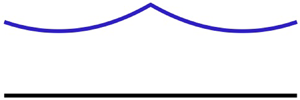
Stokes also posited, using heuristic arguments, that a limiting wave solution exists for which (2.3) fails and the equality  $u=0$ is attained precisely at the wave crest, with the associated breakdown in regularity of the wave profile at the crest manifested in the form of an angular point which has a containing angle of
 $2{\rm \pi} /3$. In the conformal plane, the curve
 $\eta (\phi )$ presents a cusp at the crest where
 $\eta \propto |\phi |^{2/3}$ locally, while in the physical plane the curve
 $\eta (x)$ presents an angular point where
 $\eta \propto |x|$ locally. The existence of Stokes waves is rigorously established by way of highly technical bifurcation-theory methods and, indeed, it was only in recent decades that a number of fundamental questions concerning the existence of an extreme Stokes wave, and properties of the associated wave profile, were rigorously settled (cf. Toland Reference Toland1996; Buffoni & Toland Reference Buffoni and Toland2003; Constantin Reference Constantin and Constantin2016). For this limiting wave ‘of greatest height’, or extreme Stokes wave, it can be shown that the free surface is real-analytic everywhere except for the stagnation point at the crest, where it is merely continuous. We note that the wave crest is an ‘apparent’ stagnation point, with fluid particles only coming to rest there instantaneously, cf. Constantin (Reference Constantin2012a).
All technical complications arising in the rigorous analysis of extreme Stokes waves essentially stem from the lack of regularity at the stagnation point, with the primary impediment being a breakdown in the conformality of the mapping  $f(z)$ due to the failure of condition (2.3) at the wave crest. Nevertheless, a detailed asymptotic description of the wave profile, and velocity field, in the neighbourhood of the wave crest is possible. This work originated with Stokes (Reference Stokes1880), who postulated that the wave of maximum amplitude has an included crest angle of
 $2{\rm \pi} /3$, the crest being a stagnation point which, in the conformal plane, has a power
 $2/3$ singularity. It was shown by Grant (Reference Grant1973) that higher-order expansions in the vicinity of the crest involve non-algebraic powers (see also Norman Reference Norman1974); this work was placed on a rigorous footing in Amick & Fraenkel (Reference Amick and Fraenkel1987) and McLeod (Reference McLeod1987). Performing the same local analysis (around the crest at
 $x = 0$ where
 $\eta = a$) in the physical plane, one obtains after some algebra
 \begin{gather} \eta =a - 3^{-1/2}\,|x| + \beta\kappa^{\nu-1}|x|^{\nu} + O\left(|x|^{2\nu-1}\right), \end{gather}
 \begin{gather}w^2 = g(a+{\rm i} z) + 2^{-\nu}\sqrt{3^{1+\nu}/(1+\nu+\nu^2)}\beta g\kappa^{\nu-1} (a+{\rm i} z)^{\nu} + O \left((a+{\rm i} z)^{2\nu-1}\right), \end{gather}
where  $\beta$ is a strictly positive (dimensionless) constant (McLeod Reference McLeod1987),
 $\kappa$ is a (freely choosable) characteristic wavenumber (e.g.
 $\kappa =k$ or
 $\kappa =g/B$) and
 $\nu \approx 2.20401861065003478$ is the smallest positive root of the transcendental equation (Grant Reference Grant1973)
 \begin{equation} \sqrt{3} \tan (\tfrac{1}{3}\nu{\rm \pi}) = -1- 2 \nu^{-1}. \end{equation}
The next positive root of (3.3) is  $\nu _2\approx 5.36>2\nu -1$. There are an infinite number of real positive roots
 $\nu _j$ of (3.3) such that
 $\nu _j\sim 3j-1/2-\sqrt {3}/2{\rm \pi} j$ as
 $j\to \infty$. There are also two complex roots, approximately
 $-1/2\pm {\rm i}\times 1.0714$, that do not appear in the extreme wave (as they would yield an unbounded free surface); they do play a role in near extreme waves, however (Longuet-Higgins & Fox Reference Longuet-Higgins and Fox1977).
In order to derive expression (3.2), we use – cf. equation (3.3) in Clamond & Constantin (Reference Clamond and Constantin2013) – the relation
 \begin{equation} w_{s}^{2}= 2g(a-\eta)(1-{\rm i}\eta_x)/(1+{\rm i}\eta_x), \end{equation}
and taking  $\eta$ of the form (3.1), for some
 $\nu >1$, (3.4) yields
 \begin{equation} \frac{w_{s}^{2}}{g}= \frac{|x|}{\sqrt{3}} + {\rm i} x + \beta |\kappa x|^{\nu-1} \frac{(3\nu-2) |x| - {\rm i} (\nu+2) \sqrt{3} x}{2} + O \left(|x|^{2\nu-1}\right). \end{equation}
Then, seeking a complex velocity of the form  $w^2=g(a+{\rm i} z)+A(a+{\rm i} z)^{\nu }+O ((a+ {\rm i} z)^{2\nu -1})$, A being unknown, comparison with (3.5) leads to
 $A$ as defined by (3.2) and the relation (3.3). Note the simplicity of this approximation, in particular the leading approximation for
 $w^2\approx g(a+{\rm i} z)$, which yields at once (from the Bernoulli equation) the following approximation for the pressure near the wave crest:
 \begin{equation} p(x,y) \approx g (a-y)- \tfrac{1}{2} g \sqrt{x^2 + (a-y)^2}. \end{equation}
This relation will play an important role in § 5 below. To the best of our knowledge, relations (3.2) and (3.6) have not appeared before in the literature. A study of the qualitative behaviour of the velocity field for the extreme Stokes wave near the wave crest has been explored in Constantin (Reference Constantin2012a), where it is shown that the velocity field exhibits the limiting behaviours
 \begin{equation} \lim_{x\to 0} |x|^{-1} u^2(x,\eta(x)) = \tfrac{1}{2} 3^{1/2}g, \quad \lim_{x\to 0} |x|^{-1} v^2(x,\eta(x)) = \tfrac{1}{2} 3^{-1/2}g, \end{equation}
which accord with the limits given by (3.2) and (3.5).
On the crest line  $x=0$ (i.e. for
 $\operatorname {Re}\{z\}=0$ and
 $\operatorname {Im}\{z\}\leqslant a$), we have
 $\operatorname {Re}\{w^2\}=u^2\geqslant 0$ and
 $\operatorname {Im}\{w^2\}=0$; the relation (3.2) then implies at once that
 $\beta$ is necessarily positive. This result was first obtained by McLeod (Reference McLeod1987) with much more convoluted arguments. However, McLeod (Reference McLeod1987) also proved that
 $\beta \neq 0$, the possibility
 $\beta =0$ being not easily ruled out here (that would require more than just a local analysis around the crest). From the inequality
 $\beta >0$, the semi-derivatives at the crest are given by
 \begin{equation} \lim_{x\to0^{\pm}} \eta_{x} = {\mp}3^{-1/2}, \quad \lim_{x\to0^{\pm}} \eta_{xx} = 0^{+}, \quad \lim_{x\to0^{\pm}} \eta_{xxx} = {\pm}\infty, \end{equation}
in comparison with the corresponding semi-derivatives in the conformal plane (where, for example,  $\eta _{\phi }$ is infinite at the crest since
 $\eta \propto |\phi |^{2/3}$ locally).
4. Wave surface recovery: regular waves
The function  ${\mathscr {P}}$ defined by
 \begin{equation} {\mathscr{P}}(z)\, \stackrel{\rm def}{=}\, \tfrac{1}{2} B + gd- \tfrac{1}{2} w^2(z)= \tfrac{1}{2} B + gd- \tfrac{1}{2} (u^2-v^2) + {\rm i} u v, \end{equation}
is holomorphic, and its restriction at the flat bed coincides with the real-valued function  ${\mathscr {p}}(x)$, since
 ${{\mathscr {P}}}_{b} = {\mathscr {P}}(x-{\rm i}d) = g/d+(B-u_{b}^{2})/2 = {\mathscr {p}}(x)$. Accordingly
 ${\mathscr {P}}(z) = {\mathscr {p}}(z+{\rm i}d)$ and, since
 $p$ is not a harmonic function (Constantin & Strauss Reference Constantin and Strauss2010; Constantin Reference Constantin2011; Henry Reference Henry2011), the flat bed is the only location where
 ${\mathscr {p}}$ coincides with
 $\operatorname {Re}{\mathscr {P}}$. It can be shown (cf. Clamond Reference Clamond2013; Clamond & Constantin Reference Clamond and Constantin2013) that
 \begin{equation} g \eta (1-{\rm i} \eta_x) + {\rm i} B \eta_x= ({{\mathscr{P}}}_{s}- gd) (1+{\rm i} \eta_x), \end{equation}
with  ${{\mathscr {P}}}_{s} = {\mathscr {P}}({z}_{s}) = {\mathscr {P}}(x+{\rm i}\eta (x))$. The real and imaginary parts of (4.2) give the two equations
 \begin{gather} g \eta+ \operatorname{Re}\{{\mathscr{P}}_{s}\}- gd- \eta_x \operatorname{Im}\{{\mathscr{P}}_{s}\}= \tfrac{1}{2}(B - u_{s}^{2}-v_{s}^{2}), \end{gather}
 \begin{gather}(B- g\eta) \eta_x+ (\operatorname{Re}\{\mathscr{P}_{s}\}-gd) \eta_x + \operatorname{Im}\{\mathscr{P}_{s}\}= \tfrac{1}{2} (B + u_{s}^{2} + v_{s}^{2}) \eta_x. \end{gather}
where the second equalities are obtained using (4.1) and  ${v}_{s} = \eta _x/{u}_{s}$. From the viewpoint of determining the wave amplitude
 $a$, for regular Stokes waves we have
 $\eta _x(0)=0$ at the crest
 $z={\rm i} \eta (0)={\rm i} a$, and so (4.3) reduces to a simple implicit equation which can be iteratively solved to find the amplitude
 $a$ as solution of the equation
 \begin{equation} a= g^{-1}\,\operatorname{Re}\{\mathscr{P}({\rm i} a)\}- d. \end{equation}
The convergence of fixed-point iterations of (4.5) was studied in Clamond & Constantin (Reference Clamond and Constantin2013) considering the functional iterations (convergent for all regular waves)
 \begin{equation} y = \hat{F}(y)\, \stackrel{\rm def}{=}\, y + g^{-1}p(0,y) = g^{-1}\operatorname{Re}\{\mathscr{P}({\rm i} y)\}- d. \end{equation}
With the wave amplitude  $a$ so determined,
 $\eta$ can subsequently be obtained by re-expressing (4.4) as the ordinary differential equation (Clamond & Constantin Reference Clamond and Constantin2013)
 \begin{equation} \eta_x= \operatorname{Im}\{\mathscr{P}_{s}\}/\left(B- g\eta- \operatorname{Re}\{\mathscr{P}_{s}\} + gd\right), \end{equation}
with initial data  $\eta (0)=a$, which can iteratively be solved. In Clamond & Constantin (Reference Clamond and Constantin2013), it was rigorously proven that these recovery procedures converge.
An alternative, more direct approach to the wave-profile recovery problem was instigated in Clamond (Reference Clamond2013) by considering the holomorphic function  $\mathscr {Q}$ defined by
 \begin{equation} \mathscr{Q}(z)\, \stackrel{\rm def}{=}\, \int_{z_0}^z\left[\mathscr{P}(z') - gd\right]{\rm d} z' = \int_{z_0}^z\tfrac{1}{2}[B - w(z')^2]\,{\rm d} z', \end{equation}
where  $z_0$ is an arbitrary constant. Taking, as in Clamond (Reference Clamond2013),
 $z_0={\rm i} a$ at the origin of the free surface, and integrating along the surface, leads to the expression
 \begin{equation} {\mathscr{Q}}_{s}(x)= \int_0^xg \eta(x')\,{\rm d}\kern0.7pt x' + {\rm i}\left[\eta(x) - a\right][B - \tfrac{1}{2} g a - \tfrac{1}{2} g \eta(x)]. \end{equation}
The imaginary part of (4.9) yields an implicit relation defining  $\eta$ of the form
 \begin{equation} \eta= g^{-1}\left[B- \sqrt{(B-ga)^2- 2g \operatorname{Im}\{\mathscr{Q}_{s}\}}\right], \end{equation}
which is a local algebraic (i.e. neither differential nor integral) equation for the free surface  $\eta$, and it is easily shown that (4.10) is an exact implicit solution of (4.7). An explicit expression for
 $\eta$ can be obtained numerically via fixed-point iterations, whose convergence is determined as follows. We define functional iterations (for
 $y\in [-d,\eta (x)]$)
 \begin{equation} y= F(y)\, \stackrel{\rm def}{=}\, g^{-1}\left[B- \sqrt{(B-ga)^2- 2 g \operatorname{Im}\{{\mathscr{Q}}(x+{\rm i} y)\}}\right], \end{equation}
for a known holomorphic function  ${\mathscr {Q}}$ at a fixed abscissa
 $x$ and for a given
 $B$. Iterations of (4.11) converge if we can show that
 $F$ is a contraction, that is, if
 $-1<F_y<1$. The definition of
 $F$ gives
 \begin{equation} F_y = \frac{\left[\operatorname{Im}\{{\mathscr{Q}}\}\right]_y} {\sqrt{(B-ga)^2- 2 g \operatorname{Im}\{{\mathscr{Q}}\}}} = \frac{p + g y + v^2}{B- g y} = \frac{p + g y + v^2}{2 p + g y + u^2 + v^2}, \end{equation}
where we have used definitions (4.1), (4.8) and the Bernoulli equation (2.4). The lower bound  $F_y>-1$ yields the inequality
 $p+v^2+B>0$ that is obviously always satisfied. The upper bound for contraction condition
 $F_y<1$ yields the inequality
 $p+u^2>0$ that is always satisfied when (2.3) holds. Therefore, for regular Stokes waves,
 $F$ is a contraction everywhere in the bulk and at the free surface, and the iterations (4.11) converge to a unique solution.
Since  $F_y$ is independent of
 $a$ (and so independent of the choice of
 $z_0$ in the definition of
 $\mathscr {Q}$), the convergence proof for the iterations (4.11) is valid wherever
 $z_0$ is chosen in the fluid. Furthermore, the analysis above for the wave-profile recovery procedure is valid for all regular waves, periodic or not, with one or more crests and troughs per period, symmetric or not. It is not contingent on the waves being Stokes waves.
5. Wave surface recovery: extreme waves
The above considerations may breakdown for the extreme waves, where (2.3) fails to hold at the stagnation point at a wave crest. In this case, the wave crest located at  $(x,y)=(0,a)$ takes an angular form with containing angle
 $2{\rm \pi} /3$, with an asymptotic description provided by (3.1) (so in particular
 $\eta_x(0^{\pm})\neq 0$). The analysis of the previous section, see also (Clamond Reference Clamond2013; Clamond & Constantin Reference Clamond and Constantin2013), then needs to be refined.
5.1. Crest determination
The analysis of the functional iterations (4.11) assumes that the constants  $a$ and
 $B$ are known. This is fine for a mathematical proof, but not so for practical applications because
 $a$ and
 $B$ are generally unknown a priori. Since the crest of an extreme wave is a stagnation point where
 $u=v=p=0$, it follows directly from (2.4) that
 $B = 2ga$, so only
 $a$ remains to be determined before studying the iterations (4.11). The convergence of fixed-point iterations of (4.5) determining the wave amplitude for extreme waves, where
 $\eta _x\neq 0$ at the crest, was not addressed in Clamond & Constantin (Reference Clamond and Constantin2013); however, we remark that formula (4.5) is still applicable in this regime since
 $\operatorname {Im}\{\mathscr {P}_{s}\}=0$ along the crest line (where
 $v=v_y=0$): fixed-point iterations determined by relation (4.6) converge if
 $-1<\hat {F}_y<1$. At the crest of an extreme wave, employing the asymptotic relation (3.6) (which is valid in a neighbourhood of the crest), we can compute
 $\hat {F}_y=1+g^{-1} p_y(0,y)=1/2$, so it follows that the fixed-point iterations defined by (4.6) converge.
5.2. Remarks
(i) On the crest line of a Stokes wave, the inequality
 $-g\leqslant p_y<0$ holds: although the second inequality is physically quite intuitive, the rigorous proof of this fact for nonlinear waves relies on a fine technical analysis of harmonic functions for regular waves (Constantin & Strauss Reference Constantin and Strauss2010; Henry Reference Henry2011), with further complications needing to be addressed in the extreme-wave setting (Lyons Reference Lyons2016). These bounds are sharp with respect to the analytical methods being employed. In this context, it is interesting that the asymptotic approximation (3.6) yields that $p_y=-g/2<0$ at the crest of an extreme wave: one might be tempted to conjecture as to whether the inequality $-g\leqslant p_y\leqslant -g/2$ holds on the crest line of extreme waves and, perhaps, of regular Stokes waves which converge to the extreme wave by the standard limiting process (Toland Reference Toland1996; Constantin Reference Constantin2012a). As a caveat to the latter postulation, we note that many physical properties of the extreme Stokes wave are not obviously transparent; for instance, although it is the Stokes wave of greatest height, it is not the most energetic, fastest, or impulsive of the Stokes waves (Schwartz & Fenton Reference Schwartz and Fenton1982).
(ii) A further consequence of the relation
$p_y=-g/2$ at the crest of an extreme wave is that, since the relation $u_{s}\partial _x v_{s}=-p_y-g$ holds along the wave profile $y=\eta (x)$ for all Stokes waves, we must have $\partial _x v_{s}$ blowing up as $x\to 0$ since $u$ vanishes at the wave crest. It follows that $u_y=v_x$ must also blow up the wave crest: this can also be seen directly from setting $-p_y-g=-g/2$ in the second component of the Euler equation.(iii) A useful relation involving the wave profile, particularly in the context of Stokes extreme wave, is obtained by multiplying (4.4) by
$\eta _x$ and adding (4.3), from which one gets (after some elementary algebra):
(5.1)At the crest of an extreme wave, we have\begin{equation} g\eta=\operatorname{Re}\{\mathscr{P}_{\text{s}}\}-gd-
(B-2g\eta)\eta_x^{\,2} \left(1+\eta_x^{2}\right)^{-1}.\end{equation}$\eta _x\neq 0$ is finite, since the angular crest is not a cusp, and $B-2g\eta =0$, and so (5.1) reduces to relation (4.5) at the crest.


5.3. Surface determination
The convergence of the functional iterations (4.11) is proven above (see Clamond (Reference Clamond2013) for more details) everywhere except at an angular crest where  $F_y(a)=1$: this corresponds to a so-called positively neutral fixed point (Bair & Haesbroeck Reference Bair and Haesbroeck1997). To determine if the iterations converge where
 $F_y=1$, we can consider the second derivative of
 $F$:
 \begin{equation} F_{yy}= \frac{g F_y + p_y + g + 2 v v_y}{2 p + g y + u^2 + v^2}= \frac{g F_y + v v_y - u v_x}{B - g y}= \frac{g F_y + \operatorname{Im}\{w\,w_z\}}{B - g y}. \end{equation}
In order to estimate  $F_{yy}$ at angular crests, we use the expansions (3.1) and (3.2) to find that
 $F_{yy}=3/2a>0$ at the angular crests. Hence, the fixed point
 $y=a$ is monotonously semi-stable from below (Bair & Haesbroeck Reference Bair and Haesbroeck1997), which means that the iterations are convergent when the fixed point
 $y=a$ is approached from the fluid side
 $y<a$, and divergent when approached from above the surface
 $y>a$. For practical applications, this result suggests that basic fixed-point iterations of (4.10) converge very slowly in the vicinity of an angular crest. More sophisticated iterations (such as Newton and Levenberg–Marquardt methods) should then be used instead. It is not our purpose here to investigate these possibilities, however.
5.4. Trough determination
At the wave trough, where  $\eta =-b\leqslant 0$ and so
 $a+b$ is the total wave height, for all Stokes waves including the extreme wave, we have
 $\eta _x({\pm }{\rm \pi} /k)=0$. Equation (4.3) then reduces to the implicit equation
 \begin{equation} b= d- g^{-1}\operatorname{Re}\{\mathscr{P}(-{\rm i} b)\}. \end{equation}
In Clamond (Reference Clamond2013), presented numerical evidence suggests that iterations of (5.3) converge to  $b$; however, a mathematically rigorous proof of this result is still lacking. Indeed, as shown in Clamond (Reference Clamond2013), convergence is guaranteed if
 $-2g<p_y<0$ on the trough line
 $y\in [-d,-b]$. The upper bound is ensured by the inequality
 $p_y\leqslant -g$ on the trough line, which can be rigorously established for nonlinear Stokes waves of all amplitudes (Constantin Reference Constantin2006; Constantin & Strauss Reference Constantin and Strauss2010; Henry Reference Henry2011; Lyons Reference Lyons2016) by way of maximum principles, using the fact that the pressure distribution is a super-harmonic function with respect to the physical variables, cf. Constantin (Reference Constantin2011). However, a rigorous proof of the lower bound for
 $p_y$ is currently lacking, being unachievable by this approach. This is not a problem for extreme waves since
 $b$ can be computed without relying on (5.3). Indeed,
 $a$ being given by (4.5), the Bernoulli constant is
 $B=2ga$ and
 $b$ is obtained directly by computing (4.10) at a trough.
6. Conclusion
In this note, we illustrated the effectiveness of exact relations for the recovery of nonlinear free-surface wave profiles from pressure measurements at the bed, derived in Clamond (Reference Clamond2013) and Clamond & Constantin (Reference Clamond and Constantin2013), and in particular their applicability to the reconstruction of the extreme Stokes wave. The extreme Stokes wave possesses intrinsic mathematical complications even beyond the level exhibited by regular nonlinear waves, due to the presence of a stagnation point at the wave crest. There is a breakdown in regularity at the crest of an extreme Stokes wave, whereby the profile is no longer differentiable, but merely continuous: the sharp wave crest has an inner angle  $2{\rm \pi} /3$.
The relations introduced in Clamond (Reference Clamond2013) employ a relatively simple local formulation without derivatives and integrations, which allows for great scope in their practical application. The directness of the surface-reconstruction approach initiated in Clamond (Reference Clamond2013) is due to the fact that physical variables, and the physical plane, are used throughout: intermediate conformal transformations are not invoked. The holomorphic function  $\mathscr {Q}$ allows a reformulation of the problem into a simplified, but still exact, form.
The convergence of the involved fixed-point iterations, required for obtaining the surface explicitly, was examined for the case of limiting extreme waves. A local analysis suggests (semi-)convergence at angular crests, thereby offering an insight into the applicability of the reconstruction method in such an extreme case. Practical reconstructions of regular waves are demonstrated in Clamond (Reference Clamond2013) and Clamond & Constantin (Reference Clamond and Constantin2013) via numerical examples, so they do not need to be reproduced here. An illustration for the extreme wave would require data (experimental or numerical) for the pressure at the seabed, that are not available. Beside the possible reconstruction of the extreme wave, one of our goals here is to illustrate the usefulness of working in the physical plane, since we could gain theoretical insights with only elementary mathematical tools, in addition to a practically useful method.
It is hoped that the demonstrated robustness of this wave-surface reconstruction approach will prove useful in treating other water-wave problems. For instance, the inclusion of surface tensions could be considered, though one will end up with differential equations instead of algebraic expressions. The recovery of fully nonlinear rotational water-wave profiles from pressure measurements has hitherto proven unattainable (although explicit surface-profile recovery formulae for linear, and weakly nonlinear, rotational water waves were derived in Henry & Thomas Reference Henry and Thomas2018). This will be the subject of future investigations. Note that, in addition to the extra inherent mathematical complications, these generalisations feature additional physical quantities that cannot all be determined by the bottom pressure alone: accordingly, some further physical information would be necessarily required for their determination.
Acknowledgements
D. C. acknowledges the support of the Université Côte d'Azur under the research grant Paul Montel Chair 2019. D. H. acknowledges the support of the Science Foundation Ireland (SFI) under the research grant 13/CDA/2117.
Declaration of interests
The authors report no conflict of interest.


