Introduction
Low serum BDNF levels are linked to depression and Alzheimer's dementia in old age (Laske et al., Reference Laske2006; Sen et al., Reference Sen, Duman and Sanacora2008). The interpretation of serum BDNF levels in depression is complex, with serum BDNF levels being influenced by smoking status, food and alcohol intake, time of blood withdrawal, storage, age, gender, and urbanicity (Bus et al., Reference Bus2011). The claim that low BDNF levels are a peripheral manifestation of depression was recently shown to be less robust than was previously assumed, possibly due to a large degree of heterogeneity in outcome variables, underpowered study designs, and publication bias (Molendijk et al., Reference Molendijk, Spinhoven, Polak, Bus, Penninx and Elzinga2014). It is now suggested that BDNF is possibly more related to stress, lack of exercise, medication or cognitive functioning accompanying depression (Molendijk et al., Reference Molendijk2010; Bus et al., Reference Bus2011; Molendijk et al., Reference Molendijk, Spinhoven, Polak, Bus, Penninx and Elzinga2014).
In previous studies, low BDNF was linked to cognitive decline in healthy elderly (Erickson et al., Reference Erickson2010), patients with mild cognitive impairment (MCI) (Peng et al., Reference Peng, Wuu, Mufson and Fahnestock2005; Shimada et al., Reference Shimada2014) and Alzheimer's patients (Laske et al., Reference Laske2010), and was associated with brain atrophy (Laske et al., Reference Laske2006; Driscoll et al., Reference Driscoll2012). A large community-based cohort study recently showed that dementia-free individuals with higher serum BDNF levels were less likely to develop dementia and Alzheimer's disease after follow-up for up to ten years (Weinstein et al., Reference Weinstein2014). However, the longitudinal association between BDNF and cognitive functions is not supported by all studies among cognitively normal older adults (Driscoll et al., Reference Driscoll2012; Nettiksimmons et al., Reference Nettiksimmons, Simonsick, Harris, Satterfield, Rosano and Yaffe2014).
Few studies have focused on the relationship between serum BDNF and cognitive functioning in depressed patients, and most of those that have were done in younger adults (Oral et al., Reference Oral, Canpolat, Yildirim, Gulec, Aliyev and Aydin2012) or bipolar patients (Kapczinski et al., Reference Kapczinski2010). These studies showed no significant correlation between serum BDNF and overall cognitive functioning in younger adult depressed patients.
Diniz et al. reported results in older patients who, following remission of depression, were randomized to donepezil or placebo treatment, in order to evaluate the effectiveness of the former in preventing depressive episode recurrence during a two-year follow-up period (Diniz et al., Reference Diniz2013). The results showed the same BDNF levels in older remitted depressed patients without cognitive decline or MCI and never depressed, cognitively normal controls (Diniz et al., Reference Diniz2013).
To our knowledge, no studies have examined BDNF serum levels in older depressed patients with cognitive impairment, without diagnosed dementia. Cognitive impairment in depressed elderly is common (Korten et al., Reference Korten2014) and after remission cognitive functions do not always improve to levels seen in non-depressed participants (Butters et al., Reference Butters2000; Bhalla et al., Reference Bhalla2006). Because the underlying mechanisms of cognitive impairment in late-life depression are still not well understood, it is important to explore possible mutual pathways of depression and cognitive impairment in older persons. We hypothesized that serum BDNF levels are lower in depressed elderly with poor cognitive performance with respect to working memory, speed of information processing, and episodic memory, compared to depressed elderly without cognitive impairment and non-depressed controls.
Methods
Study sample
The sample comprised 378 depressed persons and 132 non-depressed controls who were participating in a large prospective study on late-life depression, namely the Netherlands Study on Depression in Older Persons (NESDO; http://nesdo.amstad.nl) (Comijs et al., Reference Comijs2011). The participants were recruited from mental healthcare institutes (86.2% of the depressed persons) and general practices. The non-depressed persons were recruited from general practices and were included when no lifetime diagnosis of depression was present. Exclusion criteria for both groups were a clinical diagnosis of dementia, psychotic disorder, obsessive compulsive disorder or bipolar disorder (all based on the clinical judgment of the general practitioner or an old-age psychiatrist), a Mini-Mental State Examination score (MMSE) below 18 (out of 30 points) and insufficient command of the Dutch language. The baseline assessment included written questionnaires, interviews, a medical examination, cognitive tests, and collection of blood. The ethical review boards of the participating institutes approved the study. All participants gave informed consent after being given oral and written information about the study.
Measurements
Psychiatric diagnoses
Depressive disorder, dysthymia and comorbid anxiety disorders according to the DSM-IV-R criteria (APA, 2000) were assessed with the Composite International Diagnostic Interview (CIDI; WHO version 2.1; life-time version (Wittchen et al., Reference Wittchen, Robins, Cottler, Sartorius, Burke and Regier1991)).
Severity of depression was measured with the Inventory of Depressive Symptoms (IDS) (Rush et al., Reference Rush, Gullion, Basco, Jarrett and Trivedi1996), a self-report questionnaire. Psychotropic medication used daily in the previous week was determined by inspection of the medication containers.
Cognitive functioning
Global cognitive functioning was assessed with the MMSE (Folstein et al., Reference Folstein, Folstein and Mchugh1975).
Episodic memory was assessed with the 10-Word Test, a modified version of the auditory verbal learning test (Rey, Reference Rey1964). Immediate (range 0–50) and delayed recall scores (range 0–10) were included in the analyses.
Processing speed was assessed with cards I and II of the abbreviated (four-line) version of the Stroop color-word test (Stroop, Reference Stroop1935; Klein et al., Reference Klein, Ponds, Houx and Jolles1997). The time a person needed to read the words or name the colors was included as a measure of processing speed.
Interference control was assessed with the interference score of the abbreviated version of the Stroop color-word test. This score was calculated by the following formula: (tIII −0.5 * (tI + tII)) / (0.5 * (tI + tII)) (t = time in seconds) (Klein et al., Reference Klein, Ponds, Houx and Jolles1997).
Working memory was assessed with the subtest digit span from the Wechsler Adult Intelligence Scale (Wechsler, Reference Wechsler1958). The total number of correct digits both forwards (range 0–12) and backwards (range 0–10) was used; a higher score indicates better performance.
Brain derived neurotrophic factor
Fifty millilitres of blood were withdrawn by the interviewer into vacuum tubes between 07.30 and 09.30 after an overnight fast. Following blood collection, serum was separated within one hour and stored at –80 °C until it was assayed. BDNF protein levels were measured using the Emax ImmunoAssay system from Promega according to the manufacturer's protocol (Madison, WI, USA), in one laboratory (Maastricht University) by one technician who was blind to diagnoses. The intra- and inter-assay coefficients of variation were found to be within 3% and 9%, respectively. In the present sample, serum BDNF levels were normally distributed (skewness = 0.71; kurtosis = 0.61).
Statistical analysis
Differences in demographics and clinical characteristics between depressed and non-depressed older adults were compared by using χ 2 analysis for dichotomous variables, Student's t-tests for normally distributed variables and Mann–Whitney U tests for non-normally distributed variables.
The scores on the Stroop task were transformed (1/(Stroop card I), 1/(Stroop card II), LN(Stroop interference score)) to obtain a near-normal distribution. To observe whether the separate cognitive tasks covered the separate cognitive domains, an exploratory factor analysis was performed on the seven cognitive measures (immediate recall, delayed recall, Stroop I, Stroop II, interference Stroop, digit span forwards, and digit span backwards) (Korten et al., Reference Korten2014). We used oblique rotation (promax) because the final factors were expected to be intercorrelated. Factors were extracted on the basis of high primary loadings on one factor, lower loadings on the other factors, differences between factor loadings at least 0.20, eigenvalues (>0.7) (Jolliffe, Reference Jolliffe1972), observation of the scree plot and interpretability of the factors. Z-scores from the separate cognitive tasks (except for the MMSE) were calculated, and the mean z-scores of the cognitive tasks representing one cognitive domain were computed (Korten et al., Reference Korten2014). Participants were excluded when one of the tasks representing one domain was missing. Cognitive impairment was defined as a z-score more than 1.5 SD below the mean. The z-scores showed normal distribution.
First, we examined the association between BDNF levels (ng/ml) and total cognition and each cognitive domain (memory, speed, working memory, and interference) among all patients by five separate linear regression analyses adjusted for relevant confounders. We also investigated whether the interaction between BDNF level (ng/ml) and depression status (yes/no) influences this association.
Subsequently, ANCOVA was performed to compare BDNF serum levels in three groups (depression with cognitive impairment, depression without cognitive impairment, and non-depressed controls). Next, correlations between the potential confounders and the outcome and independent variables were computed. When the potential confounders correlated with both the outcome and the independent variables and when they changed the strength association between BDNF and cognition by more than 10% in one of the models, we considered them confounders in all analyses. All analyses were carried out using the Statistical Package for the Social Sciences (SPSS) version 20.0 (Inc. Chicago).
Potential confounders
Potential confounders were socio-demographics, sampling variables, season of blood withdrawal according to the equinox (dummies for autumn, winter and spring, with summer as the reference category), lifestyle variables, depression characteristics (symptoms, age at onset, any type of antidepressant) and physical diseases. Socio-demographic characteristics included age, gender, and educational level (years of education). Fasting blood withdrawal (yes/no) and duration of serum storage (over three years or not) were the sampling variables. As lifestyle characteristics, we included smoking, use of alcohol, body mass index (BMI), and physical activity. Smoking was defined as currently smoking (yes/no). The use of alcohol was assessed with the Alcohol Use Disorder Identification Test (AUDIT; Saunders et al., Reference Saunders, Aasland, Babor, de la Fuente and Grant1993). Physical activity in the past week was assessed with the short form (eight items) of the International Physical Activities Questionnaire (IPAQ; Craig et al., Reference Craig2003). Psychometric properties of the short version of the IPAQ are acceptable. The number of chronic diseases was assessed with previously used self-report questions about the presence of the following chronic diseases or disease events: cardiac disease (including myocardial infarction), peripheral atherosclerosis, stroke, diabetes mellitus, COPD (asthma, chronic bronchitis or pulmonary emphysema), arthritis (rheumatoid arthritis or osteoarthritis), and cancer. The accuracy of self-reports of these diseases was shown to be adequate and independent of cognitive impairment compared to data obtained from general practitioners (Kriegsman et al., Reference Kriegsman, Penninx, Van Eijk, Boeke and Deeg1996). Variables were included as confounders when they were correlated with both the dependent and the independent variables and when they changed the strength association between BDNF and cognition by more than 10%.
Results
Sample characteristics
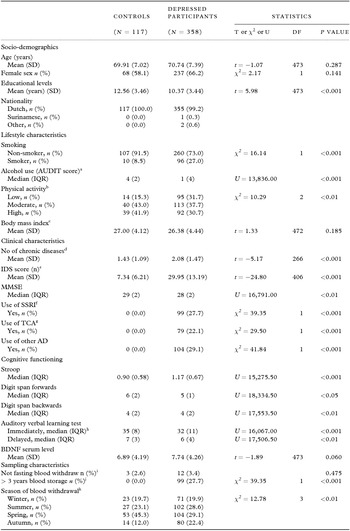
Of the 510 participants, 32 were excluded from the analysis because their BDNF levels were missing, and 3 non-depressed controls were excluded because they were using an antidepressant, which would have confounded the control group. BDNF levels were therefore available from 475 participants (93.1%), i.e. 117 non-depressed controls and 358 depressed patients. The excluded participants (n = 35) did not differ from included participants with respect to age (70.6 (7.8) vs. 70.6 (7.3); t = 0.016, df = 508, p = 0.99), gender (25 (73.5%) vs. 30.6 (64.3%) females; χ2 = 0.82, df = 1, p = 0.37), educational level (11.4 (3.6) vs. 10.9 (3.6) years; t = 0.79, df = 508, p = 0.43) and severity of depressive symptoms based on the IDS sum score (24.1 (13.9) vs. 24.4 (15.3); t = − 0.11, df = 500, p = 0.91). Table 1 presents the demographic and clinical characteristics of the study population by depression status (n = 475).
Characteristics of study sample

aControls n = 113, Depressed n = 353.
bControls n = 93, Depressed n = 300.
cControls n = 117, Depressed n = 357.
dControls n = 117, Depressed n = 357.
eControls n = 114, Depressed n = 353.
fControls n = 117, Depressed n = 357.
gControls n = 117, Depressed n = 357.
hTotal score on 5 times the 10-words test.
iControls n = 115, Depressed n = 353.
jControls = 117, Depressed = 357.
kControls n = 117, Depressed n = 357.
Cognitive functioning and BDNF serum levels
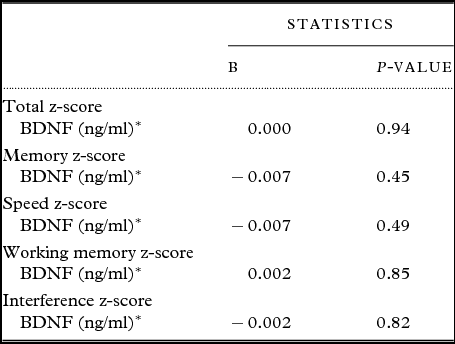
We first tested the linear association between BDNF level (ng/ml, independent variable) and cognition (total cognition and the four cognitive domains as the dependent variables) in five different multivariate linear regression models (Table 2). After establishing whether various variables were confounders, we included them in the models (age, education, depression diagnosis (yes/no), use of SSRI (yes/no), and season of blood withdrawal, with summer as the reference category). No significant associations were found between BDNF level (ng/ml) and total cognition or any of the four cognitive domains tested for both the depressed patients and the controls. We subsequently tested the interaction terms between BDNF levels (ng/ml) and depression diagnosis (yes/no) in the fully adjusted models. None of them was significant, suggesting that the outcomes were the same in the depressed and the non-depressed group.
Multivariate linear regression analyses between BDNF levels (ng/ml) and cognition

Note. *Adjusted for age, education, depression diagnosis (yes/no), use of SSRI (yes/no), and season of blood withdrawal according to the equinox (dummies for autumn, winter, and spring, with summer as the reference category).
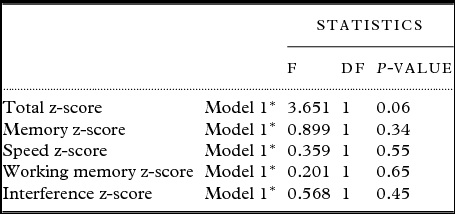
Next, the ANCOVAs adjusted for relevant covariates showed no differences in BDNF levels between controls and depressed patients with or without cognitive impairment (based on total z-score) (Table 3). The same ANCOVAs were conducted with cognitive functioning based on the separate cognitive domains, memory, processing speed, working memory, and interference. The results showed no differences in BDNF levels between controls and depressed patients with or without cognitive impairment in the specific domains.
ANCOVAs for cognitive functioning and BDNF levels (ng/ml)

Note. *Adjusted for age, education, depression diagnosis (yes/no), use of SSRI (yes/no), and season of blood withdrawal according to the equinox (dummies for autumn, winter, and spring, with summer as the reference category).
Discussion
Contrary to findings in healthy elderly and Alzheimer's patients, we did not find BDNF serum levels to be different in depressed older patients with or without cognitive impairment. However, the relationship between BDNF and cognitive functions is not supported by all studies among older adults (Ziegenhorn et al., Reference Ziegenhorn2007; Driscoll et al., Reference Driscoll2012; Nettiksimmons et al., Reference Nettiksimmons, Simonsick, Harris, Satterfield, Rosano and Yaffe2014). Given that BDNF serum levels in the elderly have not been extensively studied, discrepancies between studies may reflect methodological differences with respect to, for instance, sampling variables. Taken together with our previous finding that BDNF serum levels are not associated with depression or depressive symptom severity in this cohort of older depressed patients (van der Meij et al., Reference Van der Meij, Comijs, Dols, Janzing and Oude Voshaar2014), alternative explanations are warranted.
BDNF serum levels in depressed patients generally range from 9.5 to 27.7 μg/ml (Sen et al., Reference Sen, Duman and Sanacora2008), whereas we report a mean BDNF serum level of 7.74 ng/ml in depressed older patients, indicating that BDNF serum levels may be substantially lower in the elderly. Previous studies among older persons have shown BDNF levels ranging from 0.016 to 23.02 ng/ml (Ziegenhorn et al., Reference Ziegenhorn2007; Bus et al., Reference Bus2011; Diniz et al., Reference Diniz2013). Diniz et al. reported a decline in BDNF levels in a sample consisting of older remitted depressed patients with or without cognitive impairment and controls after two years of follow-up, suggesting that aging is an important factor in the decline of BDNF levels (Diniz et al., Reference Diniz2013).
As BDNF serum levels decline with age, the impact of BDNF on depression and cognitive symptoms may be limited and a considerable decrease may only be observable in older patients with an advanced stage of cognitive decline or severe depression, for example in dementia patients (Laske et al., Reference Laske2006) and in bipolar depression (Kapczinski et al., Reference Kapczinski2010). As BDNF is essential for the survival and functioning of neurons, its levels may remain normal in stages of disease where remission is achievable. Lower BDNF serum levels have been associated with age-related white matter atrophy (Driscoll et al., Reference Driscoll2012) and age-related decline in hippocampal volume (Erickson et al., Reference Erickson2010), but not with cognitive functioning in healthy elderly, possibly indicating that BDNF is more related to brain atrophy than to cognition. In our patients, cognitive decline may have been at an earlier stage than the point at which the BDNF compensatory repair mechanism is triggered in early neurodegeneration. This is in line with findings that BDNF serum concentrations depend on the stage of Alzheimer's disease (Laske et al., Reference Laske2006). Furthermore, BDNF is associated with use of antidepressants rather than symptom severity, suggesting a relation with remission.
The strengths of this study include the large sample size, the participation of depressive patients according to DSM-IV criteria (APA, 2000), and a wide range of depression severity and information about four cognitive domains. Other strengths are the inclusion of a never-depressed comparison group and the ability to control for multiple potential confounders. Persons who were suspected of having dementia or who had an MMSE score below 18 were excluded. We chose this relatively low cut-off point because we did not want to exclude patients with depression and cognitive impairment related to depression. Nevertheless, some persons with early dementia while depressed may have been included, because a dementia diagnosis is sometimes difficult to establish when people are severely depressed. Another possible weakness is that due to the cross-sectional design, we were not able to study whether low BDNF levels predict faster cognitive decline in older depressed persons.
To our knowledge this is the first large study on the association between BDNF and various cognitive domains in older depressed patients. Our results show that BDNF serum levels in this cohort of older depressed patients and controls are not related to cognitive functioning.
Conflict of interest
None.
Description of authors’ roles
H.C. Comijs contributed to the conception, design, and supervision of the data collection. A. Dols designed the study and wrote the first draft of this paper. C.S. Thesing undertook the analyses. A. Dols and H.C. Comijs assisted with the analyses. F. Bouckaert, R.C. Oude Voshaar, M.L. Stek, and H.C. Comijs contributed to revising the paper critically for important intellectual content. All authors contributed to and have approved the final manuscript.
Acknowledgments
The infrastructure for NESDO is funded through the Fonds NutsOhra, Stichting tot Steun VCVGZ, NARSAD and The Brain and Behaviour Research Fund, and the participating universities and mental healthcare organizations (VU University Medical Center, Leiden University Medical Center, University Medical Center Groningen, Radboud University Nijmegen Medical Center, and GGZ inGeest, GGNet, GGZ Nijmegen, GGZ Rivierduinen, Lentis, and Parnassia). The authors maintained full independence in the conduct of this work. The sponsors had no role in design, methods, participant recruitment, data collections, analysis or preparation of the manuscript. The authors have no financial or any other kind of personal conflicts with this paper. R.C. Oude Voshaar is a research fellow of the Dutch Scientific Organization (ZonMW) (research grant 90700231).