
I. INTRODUCTION
Owing to their light weight, good corrosion resistance, and deformation properties, aluminum alloys and its composites are the most abundantly used nonferrous structural materials in aerospace, ground transportation, and military industry. Reference Wang, Qu, Scudino, Sun, Prashanth, Louzguine-Luzgin, Chen, Zhang and Eckert1 Meanwhile, carbon nanotubes (CNTs) possess extraordinary mechanical, thermal, and electrical properties. Reference Bakshi, Lahiri and Agarwal2,Reference Teng, Li, Yuan, Zhang, Xi, Li, Bao and Zhu3 Their density is just 1.2–1.8 g/cm3, but their tensile strength is one hundred times as high as that of high strength steel. Additionally, it has high aspect ratio, ultra-high specific modulus, Reference Agarwal, Bakshi and Lahiri4–Reference Salvetat, Bonard, Thomson, Kulik, Forró, Benoit and Zuppiroli7 flexibility, Reference Iijima, Brabec, Maiti and Bernholc8 and low coefficient of thermal expansion. Thus, all of these unimaginable characteristics render carbon nanotubes an ideal reinforcement for aluminum matrix composites, Reference Ajayan and Tour9,Reference Moghadam, Omrani, Menezes and Rohatgi10 which offers an efficient approach to meet the special demands of various industries, such as aerospace and automotive materials. Reference Bakshi, Lahiri and Agarwal2
Some researchers have explored the effects of CNTs addition on the mechanical properties of final composites. Kwon et al. Reference Kwon, Lee, Kim, Lee, Seo and Leparoux11 mixed MWCNTs with pure aluminum powders by mechanical ball milling, and then produced MWCNTs/Al composites by vacuum hot pressing. Park et al. Reference Park, Dong and Lee12 investigated the effects of CNTs addition on the mechanical properties and a 60 and 23% increase in yield strength and tensile strength were observed for 0.2 wt% CNTs content. Similarly, Bradbury et al. Reference Bradbury, Gomon, Kollo, Kwon and Leparoux13 prepared the composites with various CNTs addition of 1–9 wt% by ball milling and then hot pressing, and the composite attained the highest hardness when the CNTs addition was 6 wt%.
However, apart from the CNTs addition, specific sintering parameters like sintering time and temperature also significantly influence the mechanical properties of the final composites prepared by powder metallurgy method. Van Trinh et al. Reference Trinh Pham, Bui, Tran, Nguyen, Le, Than, Nguyen, Doan and Phan14 studied the effects of sintering temperature on the mechanical properties of Cu/CNTs nanocomposites prepared via a powder metallurgy method. It was revealed that the density and hardness simultaneously changed with the sintering temperature and the optimal sintering temperature was determined to be 1173 K at which the composite obtained the best reinforcement. Studies focused on the effects of sintering parameters on microstructure and mechanical properties of CNTs reinforced aluminum matrix composites, however, were relatively insufficient.
Hence, the purpose of this work is to explore the relatively proper sintering time and temperature and finally to achieve an optimal enhancement in mechanical properties.
II. EXPERIMENTAL
A. Raw materials
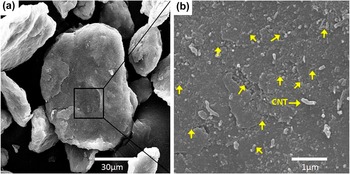
High purity aluminum powders and MWCNTs were used as raw materials and their morphology are shown in Fig. 1. High purity aluminum powders having 99.95% purity with an average spherical particle size of 25 μm serve as matrix purchased from Shanghai Aladdin biochemical Polytron Technologies Inc. MWCNTs as reinforced phase (Shenzhen Nanotech Port Co. Ltd) have an average diameter of 20 nm–40 nm with a length of 2 μm. Its purity and density are over 95% and about 1.8 g/cm3, respectively. As shown in Fig. 1(b), MWCNTs almost entangles together.
SEM images of the raw materials: (a) aluminum powders, and (b) MWCNTs.

B. Preparation of composites
The raw materials were mixed with GCr15 steel balls in the glove box with argon atmosphere, and then processed by high energy ball milling at room temperature. Specifically, the mass fraction of MWCNTs was 2%. The ball-to-powder weight ratio (BPR) was 10:1. Besides, the rotate speed of ball mill was 150 rpm and the ball milling time was 2 h. Subsequently, the composite powders were cold pressed to cylinder with the diameter of 28 mm and the height of about 15 mm at the pressure of 30 MPa for the holding time of 10 min. And then, the composites were sintered at 773 K–923 K for 4 h and at 863 K for 2 h–6 h, respectively. Finally, these sintered cylinders were hot-extruded to composite rods at 803 K with an applied pressure of 735 MPa and an extruding ratio of 36:1.
C. Characterization
The powder morphologies, MWCNTs distribution, microstructure, and tensile fracture surfaces of aluminum matrix were determined by the scanning electron microscope (QUANTA200, FEI Company, Amsterdam, The Netherlands) or field emission scanning electron microscopy (Nova Nano SEM 450, FEI Company, Hillsboro, Oregon). The phase analysis of composite powders and MWCNTs/Al composites were performed by x-ray diffraction (D/Max 2400, Rigaku Corporation, Tokyo, Japan) with Cu Kα radiation (λ = 1.54056 Å, 40 kV and 30 mA) and an image plate detector over the 2θ range of 35–90° at 5°/min. The tensile strength, yield strength, and elongation of composites were acquired by tensile test carried out by Shimadzu electronic universal material testing machine (AG-X 100KN, Shimadzu Corporation, Kyoto, Japan). For the tensile testing, Reference Hao, Zhang, Zheng, Zhang, Ameyama and Chao-Li15 all of the samples were cut and polished into dog-bone-shaped specimens with the length of 52 mm and the cross section of 2 × 3 mm. The operation of the testing machine was computer-controlled and the digital data of load and displacement from the gage section were recorded. Tensile specimens were tested at the strain rate of 1.0 × 10⁻⁴ s−1. Density of composites was measured by Archimedes' law according to ISO3369:1975. The microhardness values were attained from the microhardness tester (XH-1) with a load of 20 g, a loading speed of 0.2 mm/min and a dwell time of 15 s. At least five measurements were performed for each sample.
III. RESULTS AND DISCUSSION
A. Morphologies of MWCNTs/Al composite powders
Figure 2 is the SEM images of MWCNTs/Al composite powders ball-milled for 2 h. As shown in Fig. 2(a), MWCNTs and the spherical aluminum particles gradually become composite sheets. In addition, the particle size is no longer uniform, and a small increase in the average particle size can also be observed. Figure 2(b) is the SEM micrograph at a high magnification, which depicts a relatively compact layered structure on the surface of composite particles. Meanwhile, a few short MWCNTs are relatively uniformly distributed on the particle surface.
SEM images of MWCNTs/A1 composite powders: (a) low magnification, and (b) high magnification.

In the procedure of high energy ball milling, the repeated impacts on the powder mixture among the balls and between the ball and the container wall would lead to deformation, fracture, and cold welding of aluminum particles as well as entrapment of MWCNTs within particles. After ball milling for 2 h, a multi-layer structure had been attained, which resulted in an increase of the particle size. The discrepancy of particles size mainly derives from the difference of welding degree of the fragmentized particles. By means of high energy ball milling, the spherical aluminum particles became sheets, which contribute to a better bonding with MWCNTs. Furthermore, most MWCNTs clusters had been broken and relatively well dispersed in the aluminum matrix, which may achieve the reinforced advantages of MWCNTs and produce high-performance composites. Reference Pérez-Bustamante, Estrada-Guel, Antúnez-Flores, Miki-Yoshida, Ferreira and Martínez-Sánchez16,Reference Liu, Xu, Xiao, Xue, Wang and Ma17
B. Phase analysis of MWCNTs/Al composite powders
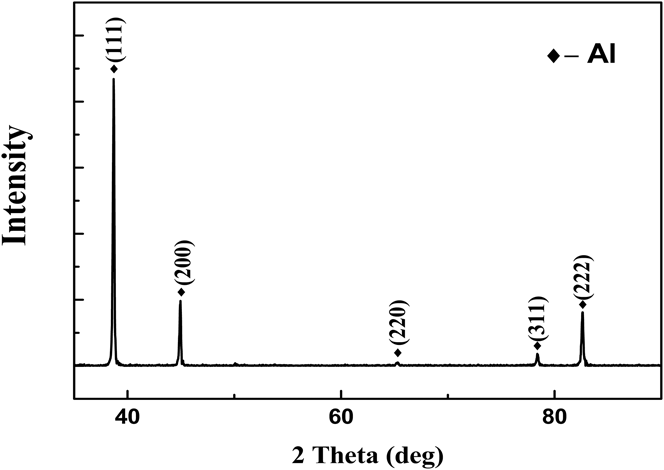
Figure 3 presents the XRD patterns of MWCNTs/Al composite powders ball milled for 2 h. It indicates that the phase of composite powders is aluminum, and no diffraction peak of MWCNTs is found. In this study, only 2 wt% MWCNTs was used which is near the detection limit of XRD. Meanwhile, as seen from the SEM images, nearly all MWCNTs have been dispersed and wrapped into the composite particles and only a few short tips of MWCNTs is exposed to the surface of composite particles. Due to these reasons, the existence of MWCNTs can't be detected by XRD. Chandran et al. Reference Chandran, Sirimuvva, Nayan, Shukla, Murty, Pramod, Sharma and Bakshi18 drew a similar conclusion from the peaks of only aluminum and silicon in the XRD patterns. Additionally, the sole aluminum diffraction peaks manifests that the amount of alloying reaction and external pollution during the ball milling process is low, which at least below the detection limitation of XRD. It also agrees with the conclusion of Chandran et al. Reference Chandran, Sirimuvva, Nayan, Shukla, Murty, Pramod, Sharma and Bakshi18 that the amount of interface reaction is expected to be low just from the sole aluminum peaks and silicon peaks.
X-ray diffraction pattern of the MWCNTs/Al composite powders.

C. Effects of sintering parameters on the phase of MWCNTs/Al composites
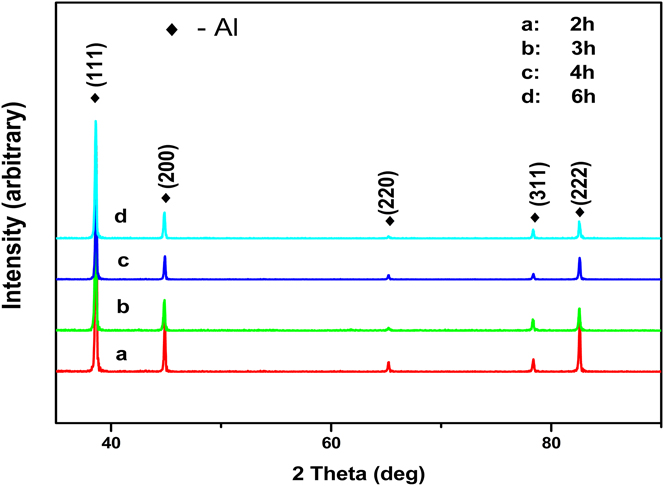
The XRD patterns of composite rods sintered at 833 K for 2, 3, 4 and 6 h are shown in Fig. 4. It indicates that the main phase of all the composites is Al. Notably, ball milling and sintering were carried out in argon atmosphere and vacuum, respectively. Hot extrusion was proceeded in the air which made it possible to produce little oxide like Al2O3. However, in terms of the XRD patterns, no Al2O3 peaks are found, which implies that the oxide is also not much enough to be detected by XRD.
X-Ray diffraction patterns of the MWCNTs/Al composite rods sintered at 833 K for different time.
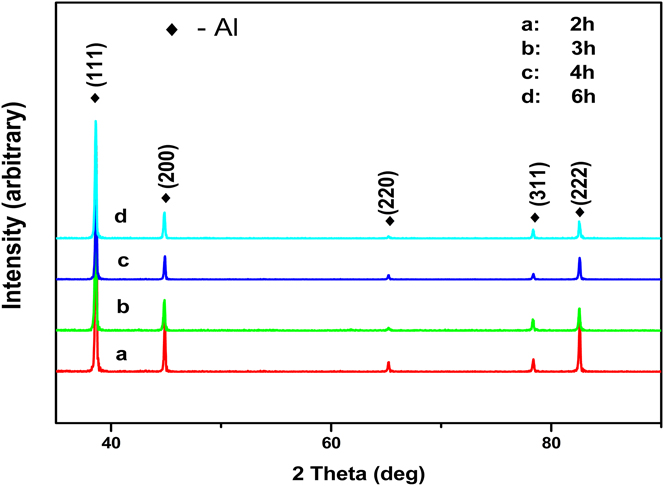
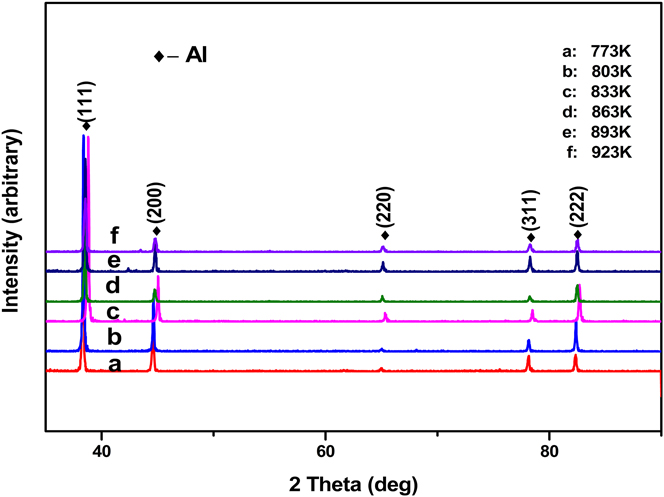
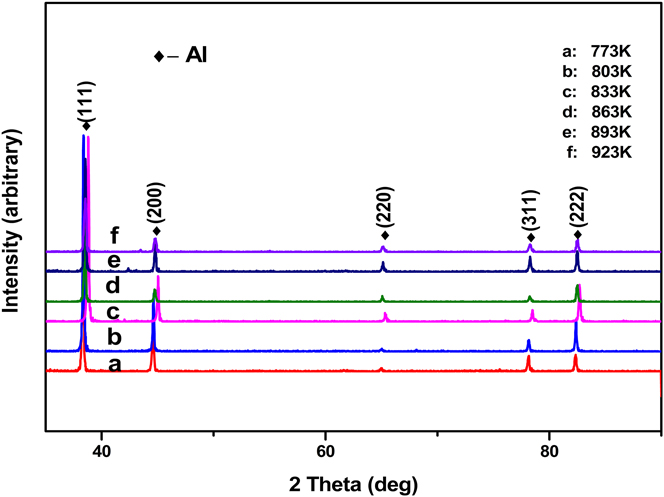
Figure 5 is the XRD patterns of composite rods sintered at 773, 803, 833, 863, 893, and 923 K for 4 h. Similarly, there are also only Al peaks in all XRD patterns. It is further confirmed that no severe oxidization and samples pollution happened during the experimental processes. In other words, the MWCNTs/Al composites sintered under different temperature nearly still remain their pristine phase of Al.
X-Ray diffraction patterns of the MWCNTs/Al composite rods sintered at different temperatures for 4 h.
D. Effects of sintering parameters on the microstructure of the MWCNTs/Al composites
Figure 6 shows the SEM micrographs of MWCNTs/Al composite rods sintered at 863 K for 2 and 4 h. Figure 7 is the SEM micrographs of MWCNTs/Al composite rods sintered at 773 and 923 K for 4 h. It is implied that, after cold pressing, vacuum sintering and hot extrusion, composite powders had been consolidated into compact composite rods. As seen from the SEM micrographs, they completely differ from the morphologies of original composite particles and realize metallurgical bond among powder particles. However, no MWCNT can be observed in these micrographs. It may be due to the MWCNTs were dispersed and wrapped into the Al matrix. Even after grinding, polishing and etching, they can't be observed by SEM in the composites samples. Meanwhile, little difference on microstructure is observed only by the SEM micrographs of Figs. 6 and 7. It may be speculated that the high temperature and stress of the hot extrusion overshadowed the discrepancy caused by different sintering process.
SEM micrographs of the MWCNTs/Al composite rods sintered at 863 K for: (a) 2 h, and (b) 4 h.

SEM micrographs of the MWCNTs/Al composite rods sintered for 4 h at: (a) 773 K, and (b) 923 K.

E. Effects of sintering parameters on the mechanical properties of the composites
1. Effects of sintering time on the density and microhardness of the agglomerates
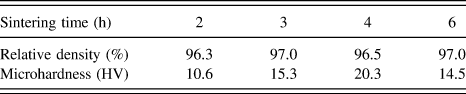
Table I shows the relative density and microhardness of the agglomerates sintered at 863 K for different time. The agglomerate with a sintering time of 4 h possesses better comprehensive mechanical properties, and the relative density and microhardness give the values of 96.5% and 20.3 HV, respectively. Upon sintering at high temperature about 863 K, the amplitude of each aluminum atom increases which lead to more opportunity to let separated aluminum atoms combine with each other and then to form bonding surface. Finally, the bonding surfaces gradually enlarge to be sintering neck. However, this process originally is driven by the diffusion of aluminum atoms. The formation of sintering neck makes the transformation of particles interface to grain interface, and these grain interface move to the interior particles, which finally lead to the consolidation of the composite powders. However, 4 h is regarded as the saturation value because of better comprehensive mechanical properties, and increasing sintering time don't contribute to strength enhancement in this experiment. The microhardness of agglomerate sintered for 6 h is lower than that of the agglomerate sintered for 4 h. Upon sintering, 6 h is commonly regarded as a long time, which led to the growth of the grain. Reference Mazaheri, Hassanzadeh-Tabrizi and Sadrnezhaad19 According to the theory of Hall–Petch, the strength of the material decreases with increasing the grain size. However, fine-grained strengthening is one of the main strengthening mechanisms for CNTs reinforced Al matrix composites prepared by ball milling. Reference Pérez-Bustamante, Estrada-Guel, Antúnez-Flores, Miki-Yoshida, Ferreira and Martínez-Sánchez16,Reference Pérez-Bustamante, Estrada-Guel, Amézaga-Madrid, Miki-Yoshida, Herrera-Ramírez and Martínez-Sánchez20 Hence, the composite agglomerate sintered for 6 h gets lower hardness.
Relative density and microhardness of the MWCNTs/Al agglomerates sintered at 863 K for different time.

2. Effects of sintering temperature on the density and microhardness of the agglomerates
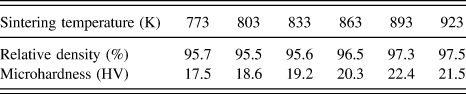
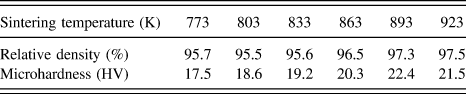
The relative density and microhardness of agglomerates sintered at different temperature for 4 h are listed in Table II. It shows that the relative density of agglomerates increase with increasing the sintering temperature, and the sample sintered at 923 K achieves the highest relative density of 97.5%. It is implied that the aluminum atoms fully diffused at the sintering temperature of 923 K, and the amounts and size of micro-pores were largely reduced and became stable. The microhardness also increases with increasing the sintering temperature below 893 K. However, at the sintering temperature of 893 K, the microhardness of the agglomerate is higher than that of the agglomerate sintered at 923 K. Hao et al. Reference Hao, Zhang, Zheng, Zhang, Ameyama and Chao-Li15 studied the effects of the sintering temperature on the hardness of Cu/CNTs nanocomposites prepared via a powder metallurgy method. They discovered the same evolution phenomenon that increasing the sintering temperature from 1173 to 1223 K led to a hardness reduction of 3 wt% CNTs/Al-2024 composites from 39.4 to 37.8 HB. Similarly, at a sintering temperature of 923 K, it could be speculated that grain growth occurred and led to lower hardness.
Relative density and microhardness of the MWCNTs/Al agglomerates sintered at different temperature for 4 h.
3. Effects of sintering time on the tensile mechanical properties of the composites
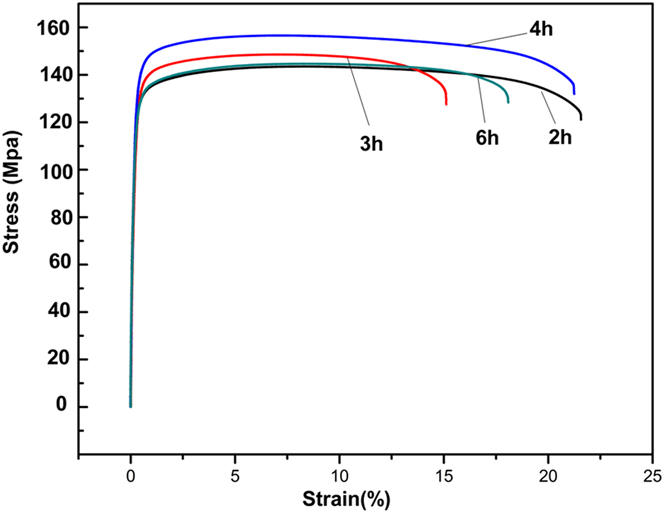
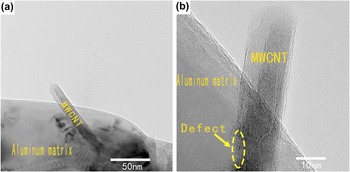
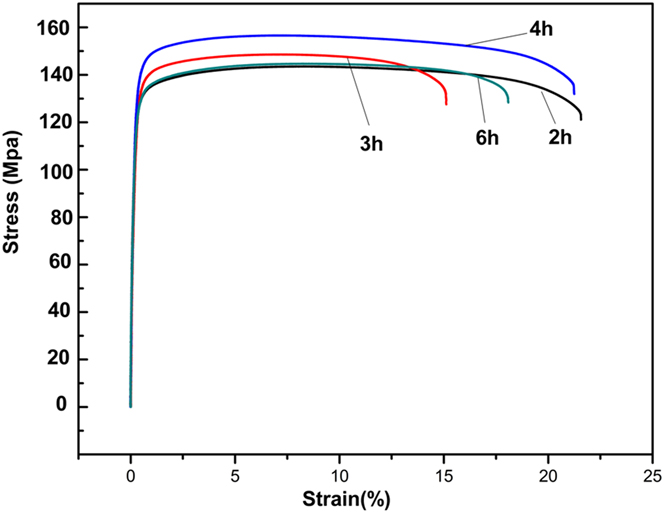
Figure 8 shows the tensile engineering stress–strain curves of the MWCNTs/Al composite rods sintered at 863 K for 2–6 h. The composite rod sintered at 863 K for 4 h obtained higher tensile strength of 156 MPa, which is twice more than that of annealed high purity aluminum (about 50 MPa), along with the elongation of 21%. And the tensile strength of this 2 wt% MWCNTs/Al composite is also much higher than that of pure Al (98.32 MPa) prepared by similar powder metallurgy route. Reference Sridhar and Narayanan21 Hence, 4 h was regarded as the optimal sintering time in this experiment. It can be explained as follows. During sintering, the growth of the necks at contact areas and the shrinkage of particles depended on the migration of Al atoms. Reference Trinh Pham, Bui, Tran, Nguyen, Le, Than, Nguyen, Doan and Phan14 Without enough time, the necks at the contact areas couldn't achieve well growth. Consequently, the interface bonding between composite particles or Al matrix and MWCNTs were not strong enough, and the micro-cracks would directly produce in the Al matrix or at the interface with weak bonding, which would hinder the efficient load transfer in the composites. As the sintering time was over 4 h, long time heating made it possible to produce too much interfacial carbide of Al4C3. However, Al4C3 is a brittle compound and too much Al4C3 will reduce the interfacial strength and then decrease the mechanical strength of the composite rods. Reference Ci, Ryu, Jin-Phillipp and Rühle22,Reference Pérez-Bustamante, Gómez-Esparza, Estrada-Guel, Miki-Yoshida, Licea-Jiménez, Pérez-García and Martínez-Sánchez23 Fig. 9 shows the TEM image of the MWCNTs/Al composite rod sintered at 863 K for 4 h. CNT was embedded into Al matrix in the procedure of preparation, and the defect occurred synchronously for the partial destroy of CNT structure. Al would react with the defects at the CNT/Al interface and generate a great deal of Al4C3 carbide if the sintering time increase to 6 h. Meanwhile, as mentioned above, sintering with a long time prompted the growth of the Al matrix grain, which also significantly reduced the strength, toughness, and elongation of the final composites.
Tensile engineering stress–strain curves of the MWCNTs/Al composites sintered at 863 K for different time.
TEM images of the MWCNTs/Al composite rod sintered at 863 K for 4 h: (a) low magnification, and (b) high magnification.

4. Effects of sintering temperature on the tensile mechanical properties of the composites
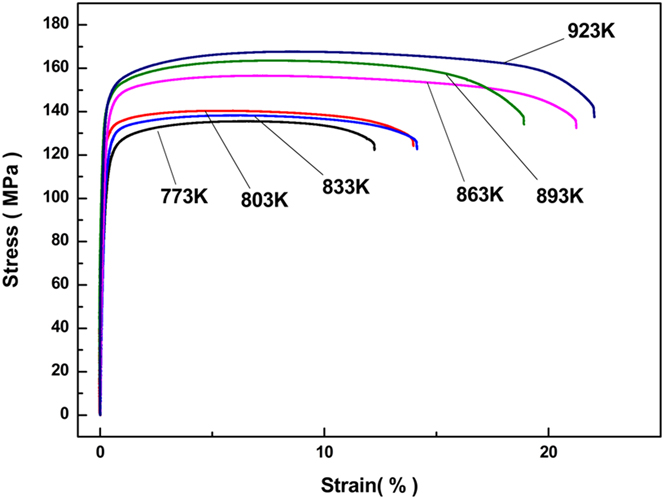
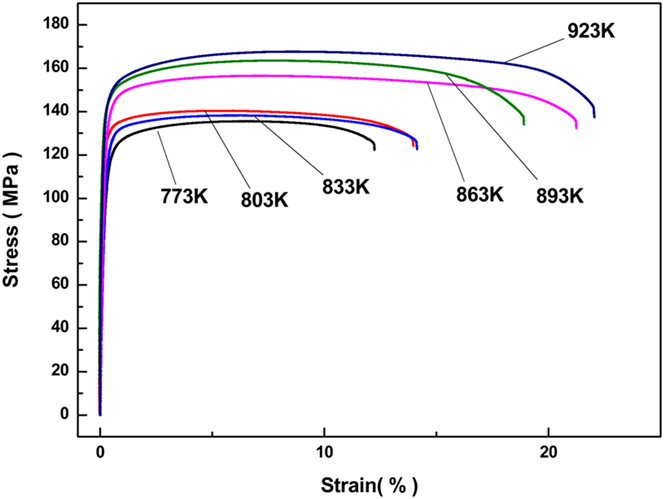
Figure 10 shows the engineering stress–strain curves of MWCNTs/Al composite rods sintered at 773–923 K for 4 h. Generally, both the strength and the elongation of the composites enhance with increasing sintering temperature. It is owing to that increasing sintering temperature can break up the oxide coating on the matrix powder surfaces and reduce the number of micro-pores. This surface oxidation phenomenon is well-known in aluminum and this layer has already been observed onto Al powder by Li et al. Reference Li, Jiang, Fan, Xu, Zhang, Chen and Humphries24 and Wang et al. Reference Wang, Georgarakis, Nakayama, Li, Tsarkov, Xie, Dudina, Louzguine-Luzgin and Yavari25 Housaer et al. Reference Housaer, Beclin, Touzin, Tingaud, Legris and Addad26 fabricated carbon nanotubes reinforced aluminum matrix composites by hot pressing. It revealed that higher the sintering temperatures, the oxide layer becomes easier to break due to its crystallization. Typically, the composite rod sintered at 923 K for 4 h presented the highest tensile strength of 167 MPa, which is three times more than that of annealed pure aluminum, along with an elongation of 22%. High sintering temperature leads to effective atom diffusion and probable interfacial reaction among particles, which help to form strong interfacial bonding and high density. The subsequent hot extrusion further consolidated the composite rods, which contributes to better mechanical properties.
Tensile engineering stress–strain curves of the MWCNTs/Al composites sintered at different temperature for 4 h.
F. Effects of sintering parameters on the fracture morphology of the MWCNTs/Al composites
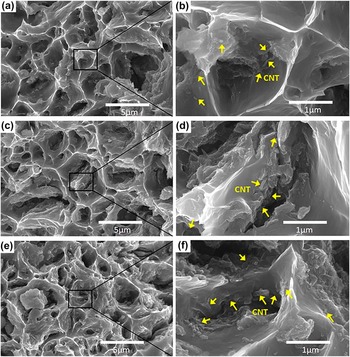
To evaluate the contribution of the interfacial boning to mechanical properties of the composites, the characteristic of the pulled-out CNTs in the fracture surface of composites, the agglomerated degree of CNTs cluster, and the distribution of dimples and micro-holes are regarded as indicators of the interface adhesion. Figure 11 presents the tensile fractographs of the composites sintered under different conditions. Note that the fractured surfaces of all composites are typical of ductile fractures. However, the lengths of pulled-out CNTs (marked by the yellow arrows) are about 300–600 nm in [Fig. 11(b)], 100–300 nm [Fig. 11(d)], and 50–150 nm [Fig. 11(f)], respectively. Meanwhile, a few agglomerated CNTs are observed in Fig. 11, which means 2 h ball milling is not enough to break all the CNTs clusters completely and disperse them into the matrix uniformly. By contrast, as seen from the micrographs at low magnification [Figs. 11(a), 11(c) and 11(e)], more intensive dimples and less micro-holes are generally observed in Fig. 11(e), while Fig. 11(a) shows large dimples and more micro-holes.
FESEM micrographs of the tensile fracture surfaces of the MWCNTs/Al composites: (a) sintered at 863 K for 2 h, (c) sintered at 863 K for 4 h, and (e) sintered at 893 K for 4 h, while (b), (d), and (f) are the enlarged images of the regions in (a), (c), and (e), respectively.

It is well known that the applied force can be transferred from the matrix to the CNTs by shear stress which develops along the CNTs-matrix interfaces. In this study, the lengths of the pulled-out CNTs are found to be respectively about 300–600 nm, 100–300 nm and 50–150 nm, which are smaller than the average length of 2000 nm. This means that most of the CNTs are embedded in the Al matrix, implying the interfacial bonding being strong between them. Reference Zhu, Zhao, Wu, Wang and Jiang27 The pulled-out CNTs result in the inadequate load transfer from the matrix to CNTs. Reference Choi, Shin and Bae28 Thus, for the composites sintered at 893 K for 4 h, only some short tips are observed in Fig. 11(f), which further reveals strong interface adhesion in the composites and load transfer may be the main strengthening mechanism. Meanwhile, dimples and micro-holes are also typical in the fractograph, and their distribution and size are symbols to estimate the tensile strength of the composite. The dense and relatively small dimples and the fewer micro-holes in Fig. 11(e) also indicate that the interfacial bonding of the composites sintered at 893 K for 4 h is stronger, while that of the composites sintered at 863 K for 2 h is relatively weak.
IV. CONCLUSION
-
(1) Most of the MWCNTs were uniformly dispersed into the Al matrix by using high energy ball milling for 2 h at 150 rpm. After cold pressing, vacuum sintering and hot extrusion, the MWCNTs/Al composites were fabricated successfully.
-
(2) Too short or too long sintering time, as well as too low temperature are detrimental to form strong bonding at the MWCNTs/Al interface. 4 h of holding time was regarded as the optimal time for the MWCNTs/Al composite sintered at 863 K which possessed higher tensile strength of 156 MPa, along with good elongation of 21%.
-
(3) The sintering parameters pointed to obtain the best reinforced effect of the MWCNTs was determined to be 923 K and 4 h, and the tensile strength and elongation of the composite prepared under this conditions reached to 167 MPa and 22%, respectively.
-
(4) CNTs' pulling out were observed obviously in the fractured surfaces, and load transfer may be the main strengthening mechanism.
ACKNOWLEDGMENT
The authors acknowledge professor Ming Xie at Kunming Institution of Precious Metals in China for technical assistance and Dr. Benxin Wu at Purdue University in the United States for helpful discussions. Additional financial supports provided by the Natural Science Foundation of Yunnan Provincial Science and Technology Department (grant 2014FC001 and 2011FB021), Natural Science Foundation of Kunming university of Science and Technology (grant KKSY201551036), Undergraduate Innovation and Entrepreneurship Training Program of Kunming university of Science and Technology (grant 201510674071), and National Natural Science Foundation of China (grant 51361017) are also gratefully acknowledged.