Insulin pens are a combined syringe and insulin system originally developed for outpatient use owing to portability and ease of use. Reusable and disposable pens are currently available and can be used multiple times, for a single person only, using a new needle with each injection. 1 , 2
Given potential backflow of blood into pen cartridges during injection, insulin pens should not be shared among patients. If pens are reused among multiple patients, there is risk for bloodborne pathogen (BBP) transmission, despite changing needles between uses. Biological material, including macrophages, epithelial cells, and red blood cells, has been found in needles and cartridges from diabetic patients.Reference Le Floch, Herbreteau, Lange and Perlemuter 3 – Reference Sonoki, Yoshinari and Iwase 5 However, no BBP transmission associated with insulin pen reuse on multiple patients has been documented. 1
Recently, advisories were issued by the Institute of Safe Medication Practices, US Food and Drug Administration, and Centers for Disease Control and Prevention against insulin pen reuse on multiple patients owing to the risk of hepatitis B virus (HBV), hepatitis C virus (HCV), and human immunodeficiency virus (HIV) transmission. 6 – 10 Similarly, the Department of Veterans Affairs (VA) notified providers about inappropriate use of multidose pen injectors (including insulin pens) and on February 4, 2013, use was prohibited on all VA inpatient care units except in rare circumstances. 1 , 11
Herein, we describe insulin pen reuse exposures at 2 VA medical centers prior to prohibition of insulin pen use in VA inpatient units. Our objective was to determine whether reuse of insulin pens among multiple patients resulted in transmission of bloodborne pathogens.
METHODS
Facility A
In October 2012, during monthly medication cart inspections on inpatient units, single-patient use insulin pens with no patient labels were discovered in medication carts. During interviews with nursing staff, several nurses acknowledged reusing insulin pens on multiple patients but used a new sterile needle for each injection. Owing to lack of labeling, it was unclear how long pens had been in the cart or how many patients had been exposed to each pen. Therefore, anyone receiving glargine insulin by insulin pen (only insulin type given by pen in this inpatient setting) was considered at risk and included in our investigation. Insulin pen use at this facility was discontinued in December 2012. 1
Facility B
In January 2013, a national VA review of insulin pen practices was initiated after identification of the Facility A incident. Despite having insulin pens labeled with individual patient information and bar-coded medication administration data, a licensed practical nurse working in a VA Community Living Center reported she reused insulin pens between Community Living Center residents. Additionally, a registered nurse was identified as having reused insulin pens between patients on an inpatient unit. Both nurses reported changing needles between patients but it was unclear how long this practice may have occurred. Therefore, anyone receiving insulin via pen in both Community Living Center and acute care units was considered at risk and included in our investigation. The facility took immediate action and discontinued use as of January 10, 2013. 12
Internal VA review board/subject matter expert panels determined that epidemiologic investigations were warranted. In February 2013, patients at risk from both facilities were identified, and a lookback investigation was initiated. At-risk patients included inpatients receiving glargine insulin from Lantus SoloSTAR pens from October 19, 2010, through December 31, 2012, at facility A and Community Living Center and acute care inpatients receiving insulin from Lantus SoloSTAR pens, Detemir Flexpens, and Novolog Flexpens from October 5, 2010, through January 10, 2013, at Facility B, and were identified using VA’s electronic health record and Corporate Data Warehouse bar-coded medication administration data. Date ranges for patient identification included start of insulin pen usage in these facilities and continued past the time of discontinuation to ensure all potential exposure patients were identified. Facilities notified patients of their possible exposure; the patients were then offered and verbally consented to BBP testing for HBV, HCV, and HIV. Patients whose potential exposure occurred less than 6 months before time of testing were requested to return for repeat testing. Laboratory and clinical data for exposed patients were reviewed to determine pre–insulin pen exposure serologic status for HBV, HCV, and HIV infection and confirmation of insulin receipt using an insulin pen. Records from all VA facilities visited by patients were reviewed, going back as far as electronic health record documentation was available along with available Department of Defense and civilian medical records in VA’s electronic health record. Since the goal was to assess BBP infection transmission risk among individuals exposed to reused insulin pens, it was considered an urgent public health investigation and did not require VA or facility institutional review board approval. 13
Case (“newly identified”) patients were defined as having positive post–insulin pen exposure serologic test results for HBV (hepatitis B surface antigen [HbsAg] or core total antibody [HbcAb] positive), HCV (HCV antibody [HCV Ab] positive with confirmatory antibody testing with alternative assays) or HIV (HIV-1 antibody [HIV Ab] and Western blot positive) infection, had been an inpatient at the facility during the defined period, and had either negative or no serologic testing documented in VA’s electronic health record prior to insulin pen exposure. Potential proximate (“previously infected”) patients were those with positive pre–insulin pen administration serologic test result(s) for 1 or more viruses available or who were known to be chronically infected with HBV, HCV, or HIV and received insulin via an insulin pen while an inpatient during the defined period. Case patients were not temporally matched with specific potential proximate patients since it was unclear how long unlabeled insulin pens had been in medication carts or which patients were exposed to which pens.
Viral serologic testing was performed at each facility and in some cases additional testing was conducted at VA’s Public Health Reference Laboratory in Palo Alto, California. HBV testing included HbsAg, HbcAb, hepatitis B surface antibody, and when indicated, HBV viral load testing. HCV testing included HCV Ab, and when initial screen was positive, a confirmatory antibody test with an alternative antibody assay, HCV viral load, and genotype testing. HIV testing included HIV 1/2 Ab, and when indicated, HIV-1 confirmatory Western blot and HIV-1 viral load (Online Table 1).
Background inpatient and outpatient seroprevalence for HIV, HBV, and HCV infection at each facility from January 1, 2010, through May 28, 2014, was obtained from the VA Healthcare Associated Infection and Influenza Surveillance System, which contains national VA patient infectious diseases–related laboratory results. Unique patients were used for calculation purposes and exposed cohort patients were included within the total number of unique patients tested. Fisher exact statistics comparing cohort and facility background seroprevalence were calculated under the null hypothesis that standardized morbidity ratios of observed (cohort) versus expected (based on facility) counts were 1 if there was no significant difference. Calculations were conducted using OpenEpi, version 3, and were considered significantly different at P<.05.Reference Sullivan, Dean and Soe 14
For patients with sufficient HCV viral load present, single-genome sequencing of the HCV envelope E1-E2 gene region (300 base pairs) was performed to assess relatedness of viral strains from patients with chronic and incident HCV infection.Reference Bukh, Miller and Purcell 15 , Reference Kato 16 Briefly, all laboratory investigations were performed using established methods and rigorous quality control procedures, as described previously.Reference Cody, Nainan and Garfein 17 – Reference Thompson, Hellinger and Kay 21 Extracted plasma HCV RNA was reverse transcribed with random primers, diluted, and amplified by nested polymerase chain reaction. Following capillary electrophoresis analysis, only amplicons generated at cDNA dilutions where only 1 of every 3 reactions was positive (thus considered to arise from a single genome) were subsequently sequenced bidirectionally. During sequence assembly, any reactions showing evidence of mixtures at any nucleotide position were discarded. Pairwise analysis of nucleotide sequences (>20 per patient) and phylogenetic tree construction (using Geneious, version 7.1.3, software) were used to evaluate genetic relatedness between newly infected, proximal, and reference patient strains. Trees were created using Kimura 2-parameter distance matrix with 1,000 bootstrap replicates. Patient strains demonstrating less than 5% difference in nucleotide sequence were considered possibly related.
RESULTS
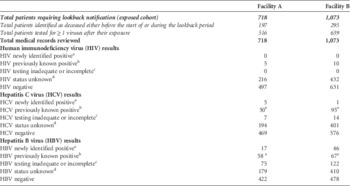
HBV, HCV, and HIV seropositivity prevalence for all patients at facilities A and B and exposed cohort patients is reported in Table 1. Among cohort patients with postexposure testing, comparisons with facility prevalence were lower for HBsAg at facility A (0 positive cohort patients vs 4.5 expected on the basis of facility prevalence [P=.02]), and lower with borderline statistical significance at facility B (2 positive cohort patients vs 7.1 expected [P=.056]). HIV-1 Ab positivity was no different at facility A (2 cohort patients vs 1.64 expected [P=.98]), but higher at facility B (8 cohort patients vs 3.2 expected [P=.034]). HCV Ab positivity in the exposed cohort was higher than expected at both facilities (41 vs 25.4 expected at facility A [P=.005], 59 vs 33.6 expected at facility B [P<.001]).
Seroprevalence for HIV, HBV, and HCV at Facilities A and B from January 1, 2010, Through May 28, 2014, for the General Facility and Exposed Cohort Patients With Postexposure Testing

NOTE. An ellipsis means expected count not applicable to facility. denom, denominator; HbsAg, hepatitis B surface antigen; HBV, hepatitis B virus; HCV, hepatitis C virus; HCV Ab, HCV antibody; HIV, human immunodeficiency virus; HIV Ab, HIV antibody; obs, observed.
a Expected counts were calculated as (observed facility/denominator facility) × exposed cohort denominator.
b Cohort patients are included within the total facility unique patients tested since some cohort patients may also have been tested as part of routine patient care.
A total of 718 and 1,073 patients were included in facility A and B investigations, respectively. One patient was exposed at both facilities. Two hundred eighty-three previously known infections among 212 unique patients in the exposed cohort were identified at both facilities (15 HIV-1, 144 HCV, and 124 HBV) (Table 2). The one patient who was part of both cohorts was previously known to be positive for HBV and HCV, and he was counted once in the total cohort. Of known positive patients, many were coinfected (56 with HBV/HCV, 5 with HBV/HCV/HIV, 4 with HBV/HIV, and 1 with HCV/HIV). Sixty-eight viral infections among 67 patients were newly identified (1 patient had HBV and HCV) (Online Figures 1 and 2). This newly identified group was overwhelming male (65 [97%] of 67) and the median (range) age was 66 (39–94) years (Online Table 2).
Type of Viral Infection at Facilities A and B

NOTE. Individual patients may be counted in several categories more than once, therefore total numbers in table will not add up to the total number tested nor the total number in exposed cohort. Table includes all postexposure results gathered from medical record review including viral test results from routine care as well as lookback test results.
a Newly identified positive indicates patients were newly identified positive after the time of the insulin exposure with one of the following positive tests: hepatitis B surface antigen (HBsAg) or HBV viral load or hepatitis B core antibody (HBcAb) alone or HBcAb AND hepatitis B surface antibody (HBsAb); HCV antibody (HCV Ab) with confirmatory testing or HCV viral load; or HIV antibody (HIV Ab) with confirmatory testing or HIV viral load).
b Known positive indicates patients were identified by medical history or laboratory testing to have a positive test (HBsAg or HBV viral load or HBcAb alone or HBcAb AND HBsAb; HCV Ab with confirmatory testing or HCV viral load; or HIV Ab with confirmatory testing or HIV viral load) before the time of their exposure.
c Inadequate indicates testing results are not sufficient to make a determination of their lookback status—for example, a patient with positive HIV or HCV Ab results, but confirmatory testing was not performed. Incomplete indicates that specific tests were not ordered or not performed that were necessary in determining potential epidemiologic linkages as required for completion of the lookback investigation—for example, a patient with a positive HCV Ab result and positive HCV Ab confirmation, but no HCV viral load testing or genotyping performed.
d Unknown indicates patient was deceased, lost to follow-up, or refused testing (ie, patient will never be tested).
e One patient was previously known to be positive for HBV and HCV and was exposed at both facilities. Patient is listed here for both facilities.
No new HIV-infected patients were identified at either facility. Of 63 newly identified HBV infections (either HBsAg or HBcAb positive), none at either facility had HBV DNA levels equal to or greater than 500 copies/mL; therefore, further valid HBV genetic testing could not be performed. We identified 6 new HCV viremic case patients (5 and 1 at facilities A and B, respectively), in addition to 45 proximate patients (40 unique patients; 5 patients were positive for >1 genotype) with HCV viremia (41 and 4 at facilities A and B, respectively). Only 3 case patients (2 and 1 at facilities A and B, respectively) and 19 proximate patients (17 and 2 at facilities A and B, respectively) had samples available and sufficient HCV viral load for strain relatedness testing.
At facility A, 23 strains that underwent molecular fingerprinting included 13 HCV genotype 1a (HCV-1a) patients: 10 previously HCV-infected, 1 newly found to be infected, and 2 epidemiologically unrelated patients; and 10 HCV genotype 1b (HCV-1b) infected patients: 7 previously HCV-infected, 1 newly found to be infected, and 2 epidemiologically unrelated patients. At facility B, 1 newly identified HCV genotype 2b (HCV-2b) patient was compared with sequences from 2 patients previously HCV-2b infected, as well as 2 epidemiologically unrelated HCV-2b strains and 1 epidemiologically unrelated HCV genotype 2a (HCV-2a) strain.
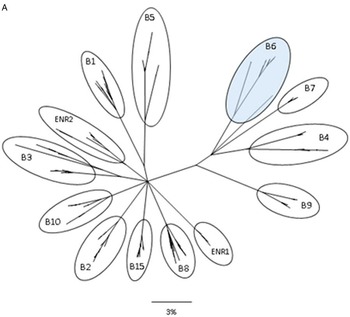
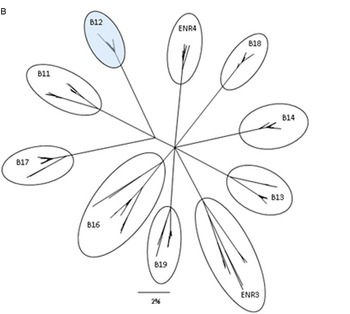
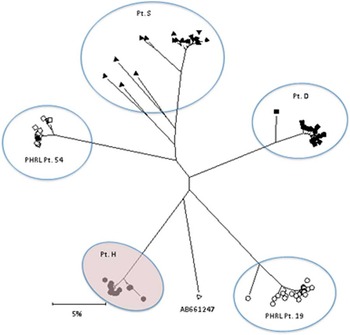
Median E1-E2 nucleotide differences between all patients harboring HCV-1a and HCV-1b, including newly identified HCV-infected patients, were 10.6% to 22.6% for facility A patients, indicating nonrelatedness between facility A analyzed patient strains (Online Tables 3 and 4). Figures 1A and 1B present phylogenetic analyses displaying relationships between all sequences determined for facility A. All HCV sequences from each particular patient were very closely related to sequences obtained from that specific strain and significantly distant from all sequences from all other patients, indicating nonrelatedness for facility A. Median E1-E2 nucleotide differences for HCV-2b strains for facility B were 20.3% to 24.0%, indicating nonrelatedness between patient strains analyzed (Figure 2; Online Table 5).
Hepatitis C virus (HCV) genetic fingerprinting results for genotype 1a from site A. Phylogenetic tree of genotype 1a HCV E1/E2 sequences from 1 case patient (B6, shaded), 10 proximal patients (B1-5, B7-10, and B15), and 2 non-related reference patients (ENR1-2) from site A. Single genome sequences (average of 20 sequences per sample, range 10–24 sequences) were aligned with MUSCLE, and a neighbor-joining tree was created using Geneious, employing a Jukes-Cantor distance model with 1000 bootstrap replications. Scale bar represents percent nucleotide variability.

Hepatitis C virus (HCV) genetic fingerprinting results for genotype 1b from site A. Phylogenetic tree of genotype 1b HCV E1/E2 sequences from 1 case patient (B12, shaded), 7 proximal patients (B11, B13-14, and B16-19), and 2 non-related patients (ENR3-4) from site A. Single genome sequences (average of 22 sequences per sample, range 21–24 sequences) were aligned with MUSCLE, and a neighbor-joining tree was created using Geneious, employing a Jukes-Cantor distance model with 1000 bootstrap replications. Scale bar represents percent nucleotide variability.

Hepatitis C virus (HCV) genetic fingerprinting results for genotype 2b from site B. Phylogenetic tree of genotype 2b HCV E1/E2 sequences from 1 case patient (Patient H, shaded), 2 proximate patients (Patient S and Patient D), and 3 non-related patients (PHRL patient 19 and 54 and AB661247 [a HCV genotype 2a sequence obtained from Genbank to serve as the root for the phylogenetic tree]). Single genome sequences (20–23 sequences per patient) were aligned with MUSCLE, and a neighbor-joining tree was created with MEGA software employing a Kimura 2-parameter distance model with 1000 bootstrap replications. Scale bar represents genetic distance (percent substitutions per nucleotide site).

DISCUSSION
In 1,155 tested patients, our findings suggest exposure to reused insulin pens did not result in documented viral transmission, in those patients among whom viral genetic analysis could be performed. No newly HIV-infected patients were identified among 1,137 patients tested (63.5% of 1,791 exposed). There were 63 newly identified patients with HBV infection among 1,126 patients tested (62.9% of 1,791 exposed). We do not know how long these patients may have been infected with HBV prior to this investigation. In addition, no patients had sufficient HBV viral load for genetic testing to be accurately performed, so unfortunately HBV transmission cannot be ruled out. Although 6 patients were newly diagnosed with HCV infection among 1,144 patients tested (63.9% of 1,791 exposed), only 3 patients had detectable viremia and sample available for genetic fingerprint analysis and no linkages between HCV strains were found. Background seroprevalence differences could be attributed to patients undergoing laboratory testing outside of their primary VA facility, which would not have been captured in our facility seroprevalence calculations. Although, in aggregate, our findings do not provide evidence of viral transmission, we cannot definitively exclude the possibility that transmission of HBV or HCV occurred as a result of insulin pen reuse because samples on all case and proximate patients were unavailable for testing.
Insulin pen reuse among multiple patients is not unique to VA. US military researchers recently reported a similar incident where insulin pens were reused on multiple patients, with new sterile needles after each injection. Similar to our results, they found newly diagnosed patients with HBV (3) or HCV (28) infection in more than 1,500 patients although no evidence of viral transmission using partial HCV genome sequencing of nonstructural 5b and core envelope 1 regions was found.Reference Hakre, Upshaw Combs and Sanders Buell 22 From 2007 to 2013, several facilities reported insulin pen reuse on multiple patients. 23 – 28 However, other than notifying patients and offering BBP testing, it does not appear that these facilities performed lookback investigations similar to our study.
There are limitations of our investigation giving rise to general recommendations for investigations such as this one. Earlier involvement of VA public health experts in the investigation could have facilitated planning, procedures, and execution, ensuring uniform specimen protocols, documentation that testing occurred, and sample being stored on all patients for confirmatory testing or molecular fingerprinting. Additionally, had insulin pens been available, BBP testing of pen cartridge contents could have been performed, complementing VA Office of the Inspector General assessments in the field. 1 Since little evidence exists describing the significance of residual infectious bioburden when insulin pens are reused, having this equipment available for microbiologic analyses could have potentially better informed the decisions on the risk of these exposures. Patients were often difficult to find and notify and some were reluctant to undergo testing. Lengthy time intervals between occurrence and recognition of the problem led to large patient numbers being involved in the lookback, more than 25% of whom were deceased by the time the lookback was initiated and therefore could not be tested. Despite current BBP virus screening recommendations in the VA and from the US Preventive Services Task Force, prior BBP testing in our lookback populations even in patients already known to be positive for 1 BBP was incomplete. 29 , 30 Absence of documented pre-exposure serologic testing in many individuals made positive postexposure test results difficult to interpret, and adherence to BBP virus screening recommendations should be encouraged. Recent improvement in HIV and HCV serotesting rates has been noted in the VA and is encouraging news.Reference Czarnogorski, Halloran Cns and Pedati 31 , Reference Backus, Belperio, Loomis and Mole 32
Despite challenges, these investigations were important in determining BBP transmission risk resulting from insulin pen reuse. Our investigation found that insulin pen reuse did not result in transmission among patients who had viral genetic analysis performed.
ACKNOWLEDGMENTS
Financial support. The VA.
Potential conflicts of interest. All authors report no conflicts of interest relevant to this article.
SUPPLEMENTARY MATERIAL
To view supplementary material for this article, please visit http://dx.doi.org/10.1017/ice.2015.165