Introduction
“This is a splendid find. It is the most beautiful Neanderthal type that I know of.” It is June 1886, and in the Belgian city of Liège, Julien Fraipont, the 29-year-old research assistant of zoology, has just seen two fossil skulls from the cave site of Spy. They were unearthed days before, some 70 kilometers west of his hometown Liège. At a time when the taxonomic status of the Neanderthal was still a matter of vehement debate, partly due to the very limited number of fossils available (Rock forthcoming), partly due to the controversy surrounding Darwin's ideas (de Bont Reference de Bont2008), Fraipont immediately realized that these two well-preserved specimens would constitute a major step forward in the emerging field of human paleontology. Crucial questions about “the Neanderthal race” were going to be answered once and for all, and new light would be shed on its anatomy, gait, appearance, and place in human evolution. Yet writing to the discoverer Marcel de Puydt, a local lawyer and amateur archaeologist with whom he had been in contact previously, Fraipont concluded his enthusiastic letter with a curious remark: “I would recommend that you do not make too much noise about this discovery.”Footnote 1
How strange that an ambitious young scholar like Fraipont at once recognized the European importance of the find, while simultaneously requiring discretion about it. Did he not want to share this exceptional discovery straightaway? Did the colleagues abroad not need to be informed? No, not yet. The fossil had first to be studied by himself. “I really hope you will want to charge me with the anthropological description of this piece,” he wrote. He gently offered his services and went on at length to establish his academic credentials for the job:
I have been involved with this type of research for 3 years. I've studied in the great prehistoric museums of Paris, Germany and Copenhague. In Liège I possess all the instruments that are needed for measuring etc which I have ordered 2 years ago from the Institut d'antropologie in Paris. Mr Dewalque [the Liège professor of geology] has entrusted me with a similar job for the fossils of Sprimont, which I have completed to his entire satisfaction.
Clearly, the secrecy that Fraipont asked for was not meant to be permanent, but temporary: just the amount of time needed for him to study the skulls. It seems as if he first wanted to establish a firm link between the Spy fossils and his own name, before these fossils could start their public life.
Luckily for Fraipont, de Puydt's answer was positive on both accounts: he “very gladly” authorized Fraipont to study the skulls, and he guaranteed his confidentiality. The tone was amiable: “You don't need to recommend me not to unveil our discovery. Max [Lohest, their mutual friend and research assistant of geology] always says that I don't have a scientific mind because I like too much to keep from others what I have come to learn myself.”Footnote 2 A truly scholarly mind, the amateur archaeologist realized, had to be a communicative one. Archaeologists and human paleontologists like himself who were inclined to shelter their findings from others could never contribute to the field. Discretion may be necessary in the immediate aftermath of an important discovery, but eventually a certain amount of openness had to be given. And this is what Fraipont intended.
The practice of science always entails a process of communication, de Puydt had to admit. In recent years much scholarly attention has been paid to the verbal component of this scientific communication. Since the linguistic turn, historians, philosophers and sociologists of science have come to appreciate the role of language in the transfer of knowledge. The language of science, even in technical treatises among peers, has turned out to be highly tainted by its cultural, political, and historical contexts. Theories of (human) evolution, for instance, appeared to echo the plot lines of contemporary novels (Beer Reference Beer1983) or the narrative structures of folk tales (Landau Reference Landau1991). Rhetoric was no longer treated as just a vehicle of scientific truth, but as an inherent aspect of the processes that lead to the establishment of truth (Latour and Woolgar Reference Latour and Woolgar1979; Gross Reference Gross1990; Lenoir Reference Lenoir1998; Ceccarelli Reference Ceccarelli2001).
Similarly, non-textual forms of rhetoric have been extensively analyzed, particularly in popular representations of scientific knowledge. A great deal of research has been undertaken to find out how museums and popular illustrations communicate both academic findings and ideological constructs to the public at large. This held true for both drawings of early human ancestors (Moser Reference Moser1998) as well as displays and showcases in anthropological and natural history museums (Stocking Reference Stocking1985; Findlen Reference Findlen1996; Yanni Reference Yanni2005).
Innovative research in the social studies of science has succeeded in penetrating even deeper into the fabric of science. Well beyond verbal rhetoric or public representations, even strictly technical illustrations have turned out to be highly rhetorical, as they were implicated in all sorts of processes of persuasion. This was first revealed in Rudwick's seminal article on the visual language of geology (Reference Rudwick1976), and later became apparent in other fields as well. In human paleontology, for instance, Victorian drawings of the Neanderthal skull, no matter how “objective,” were instrumental in reproducing and distributing the idea of behavioral primitiveness (Van Reybrouck Reference Van Reybrouck1998). In prehistoric archaeology, the depiction of flints as items belonging to natural series comparable to fossil mollusks stimulated the appearance of a taxonomic approach in nineteenth-century French prehistory (Lewuillon Reference Lewuillon2002). This social perspective has also been applied in the study of scientific instruments and how they are responsible for creating empirical objects (Shapin and Schaffer Reference Shapin and Schaffer1985; Podgorny Reference Podgorny2005).
In this paper we plan to move yet one step further. Rhetoric, we hold, is not limited to the linguistic dimension of science, nor to its popular representations. It does not stop at the level of scientific illustrations either. Indeed, we contend that it imbues the very empirical evidence that scientists deal with and which they generally pretend to be neutral. The world in which scholars act and work is a profoundly material world and this structures the cognitive and textual output of their research. More than illustrative of socio-scientific practices, we believe that the material culture of any discipline plays a crucially argumentative role. Scholars, like other social agents, think with objects.
The related disciplines of prehistoric archaeology and human paleontology are cases in point. Here, researchers do not just dig and interpret data, but show them to colleagues, trade them with research institutions, lock them away, sell them. Fraipont desperately wanted to study the Spy fossils, but asked de Puydt to keep quiet about his discoveries. These data are not just relevant at the level of manufacturing scientific ideas (through the usual processes of empirical inference), but also relevant in marketing them. This is what the present article sets out to explore. By focusing on Belgian archaeology and paleoanthropology between 1880 and 1920, we want to study how concrete archaeological and paleoanthropological data function in the trade of scientific theories.
To understand that process, we introduce the concept of material rhetoric. By material rhetoric, we understand the regime of material practices that scholars deploy to accompany traditional, verbal, and pictorial rhetoric with which they distribute their theories and ideas. Making casts, selling artefacts, trading reference collections, exchanging specimens, labeling objects, and displaying finds are the tricks and tropes of this non-discursive, material form of rhetoric. If rhetoric is the art of public communication with the aim of convincing bystanders, the history of archaeology may show how props are as important as words in this art.
Theories and objects
In the second half of the nineteenth century, a number of Belgian scholars contributed substantially to the nascent fields of prehistoric archaeology and paleoanthropology. In the wake of Schmerling's seminal work on quaternary zoology in the 1830s, the following research initiatives made the country's prehistoric record fairly incontournable on the international scene: the discovery of the La Naulette mandible by Dupont in 1865; Dupont's revision of Christy and Lartet's chronology in 1872; the discovery and analysis of the Spy Neanderthals by Fraipont, de Puydt, and Lohest in 1886; and Rutot's position in the eolith debate from 1896 on. Obviously, Belgian scholarship never had the means nor the proportions of scholarship in Germany and France at the time, but it was nonetheless regarded as an important player in the field – a position reflected by the fact that the International Congress of Prehistoric Anthropology and Archaeology was organized twice in Brussels (in 1872 and 1935).
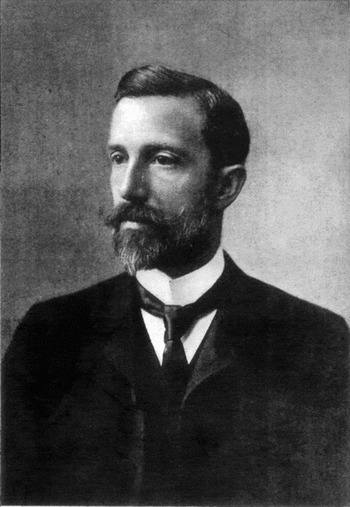
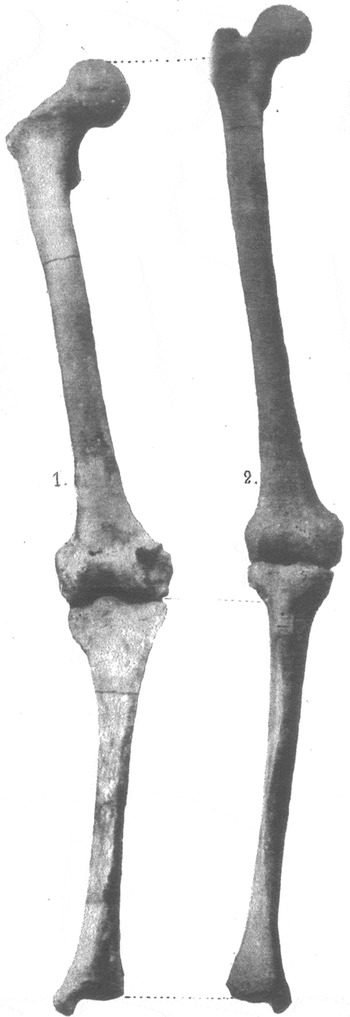
This paper compares the material rhetoric invoked by two Belgian scholars. One of them was the already-mentioned Liège-based professor of zoology Julien Fraipont (1857–1910), a versatile and highly respected researcher who had published articles about geology, paleontology, and natural philosophy and who would end his rich academic career (but fairly short life) as the rector of the University of Liège (fig. 1). His most notable claim to fame, however, remained the detailed anatomical study of the two Neanderthal skeletons found at the cave-site of Spy in 1886 – a research project to which he dedicated himself in his early thirties after de Puydt had granted him permission to analyze the fossils (Rock forthcoming). Fraipont's publications were not only essential in confirming the Neanderthals’ status as a distinct fossil group (which was disputed since the discovery in the German Neanderthal in 1856), they were also responsible for highlighting one particular trait of the assumed primitive anatomy, namely the Neanderthal's supposed bent knees (fig. 2). Before him, some scholars had already suggested that the Neanderthal's stance must have been less upright than ours. Indeed, the curved femur of the 1856 fossil had led some authors to believe that the Neanderthal had walked with protruding knees.Footnote 3 Yet the evidence which Fraipont marshalled was of a different nature: minutely comparing the knees and legs of humans and great apes with the Spy fossils, he was struck by the slight curvation of the Neanderthal femur, its strongly developed underside, but most importantly the reclined position of the tibia's head. This convinced him that “as to their upright stance, the thigh and the lower leg must have been considerably folded, one on the other, thus forming an obtuse angle opening towards the rear” (Fraipont Reference Fraipont1891, 337). Today, however, Neanderthal experts seem to agree that the strongly built bones do not indicate “that the Neanderthals had a bent-kneed and apelike posture,” as a recent textbook has it (Stringer and Gamble Reference Stringer and Gamble1993, 94). “The specter of the shuffling, bent-kneed Neandertal [has] faded undramatically away,” according to others (Trinkaus and Shipman Reference Trinkaus and Shipman1993, 368).
Portrait of Julien Fraipont (Fourmarier Reference Fourmarier1913–1914, B336).

Frontal view of a Neanderthal knee (1), which Fraipont and Lohest composed of a left tibia and a right femur found at the site of Spy. It is compared to the knee (2) of “a modern inhabitant of Liège of average height (1m70).” Photograph by G. Oury and Ch. Mathien, phototype by Hammers (Fraipont and Lohest Reference Fraipont and Lohest1887, 757 and plate XX).

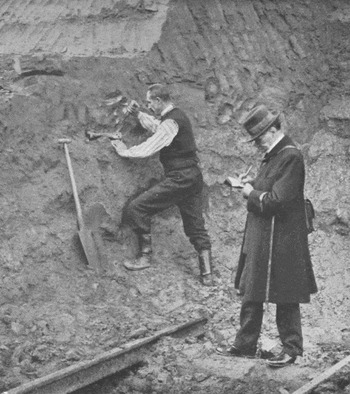
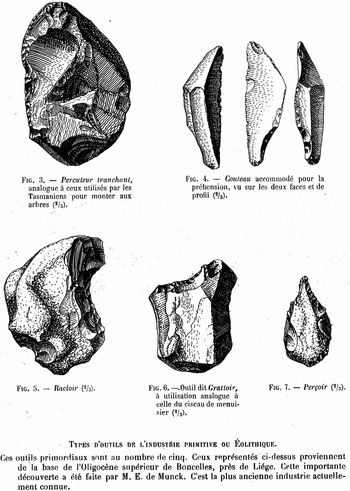
A second important figure for understanding the material rhetoric of prehistoric archaeology was Aimé Rutot (1847–1933), a civil engineer who had been involved with establishing the geological map of Belgium and had become curator at the Brussels Natural History Museum (fig. 3). Less canonized today as a pioneer of Belgian archaeology, for decades he was the country's – and at a given point even the world's – most outspoken proponent of the eolith theory. This theory held that rudely chipped stones from very old, geological strata (Tertiary and early Quaternary) were undisputable, manmade artifacts (eoliths), suggesting that humanity must already have been around in times much earlier than commonly assumed (Grayson Reference Grayson, Meltzer and Fowler1986; de Bont Reference de Bont2003) (fig. 4). His place in the relative periphery of today's pantheon of scientific achievements is largely due to the fact that the eolith theory has since been completely discarded, although it still has some appeal in more esoteric circles (Cremo and Thompson Reference Cremo and Thompson1993). In fact, it was already quite marginalized in the French-speaking tradition when Rutot picked it up around 1900. There had been quite some controversy concerning eoliths in the 1860s and 1870s with the excavation of Tertiary flints at Thenay (Eure-et-Loire) by Louis Bourgeois, but after 1880 these “implements” were primarily regarded as natural products rather than artifacts. When Rutot injected new blood into the old veins, the eolith theory received some renewed support internationally, but it was increasingly criticized. By the second quarter of the twentieth century the eolith theory was dismissed by mainstream Paleolithic archaeology, in spite of Rutot's efforts.
Manual and intellectual labor. Aimé Rutot (at the right) posing at an excavation (Gilson Reference Gilson1914, 21).

Five “types of tools from the primitive or Eolithic industry.” The depicted eoliths were found at the site of Boncelles (Rutot Reference Rutot1919, 13).

Though Fraipont's “knee theory” and Rutot's “eolith theory” are no longer popular today, our focus on them does not entail a value judgment about their relative merits, validity, or plausibility. If we have chosen theories which have been proven wrong, or rather, which today's scholars no longer believe to be true, it is simply because the mechanisms of material rhetoric are so much more apparent during moments of controversy (Latour Reference Latour1987). “False” theories are interesting, not because they have turned out to be “wrong,” but because they are so good at revealing the procedures of actual scientific praxis. The same mechanisms will undoubtedly be at work in the processes of manufacturing and marketing successful theories, but once they have become solidified “truths,” it becomes harder to look back at the social conditions that helped to consolidate those theories.
If Fraipont and Rutot both had theories that they wanted to get accepted by the scientific community, the empirical foundation of each was remarkably different. Fraipont's knee theory was essentially based on the morphological study of one right femur and two left tibiae (one of them fragmented) which he measured and compared with a few dozen long bones from modern populations. Rutot's eolith theory, on the other hand, was adumbrated by a sheer endless influx of artifacts, coming from excavations at Belgian sites like Mesvin, Reutel and Boncelles. Whereas Fraipont had only two skeletons at his disposal, Rutot's claims rested on several hundreds of eoliths. This discrepancy in empirical basis was of course not restricted to these two scholars alone; it may even be called a founding characteristic of Palaeolithic research that one has “lots of stones and very few bones.” Few scientific fields struggle indeed with such extreme empirical contrasts in the nature of their formal object as Palaeolithic archaeology where the core data are either abundant or utterly rare. Clearly, these radically different types of dataset not only structure the production of respective theories, but also structure their promotion.
Marketing theories
Since the academic field is a socio-economic field like any other, scientific theories can be regarded as a particular type of commodity which need to be crafted in processes of invention or discovery, and also need to be promoted and distributed (Bourdieu Reference Bourdieu1984). A successful theory is not so much one that contains valuable claims, but above all one that has mobilized a large and reliable number of individuals and institutions to believe that the theory contains valuable claims (Van Reybrouck Reference Van Reybrouck2002). When we say that we “buy” an argument, we somehow seem to admit, on the level of metaphorical speech, that such ostensibly separate realms as economics and rhetoric do have something in common. The dissemination of scientific ideas requires indeed the deployment of a rhetorical strategy, not unlike that of economic marketing.
In Belgian archaeology around the turn of the century, both Fraipont and Rutot tried to spread their ideas by offering their scientific “clients” direct contact with the objects they were studying. They hoped this would make their theories more cogent in scholarly circles. Because of the quantitative dissimilarity in their research data, however, the two scientists had to develop very different strategies of material rhetoric.
The uniqueness of Fraipont's Neanderthal fossils limited the possibilities for him to expose his precious find to large audiences. Initially, the only group to get directly in touch with the Spy bones was the scientific gathering at the International Congress of Prehistoric Anthropology and Archaeology of Paris in 1889. Here, Fraipont would display the original Neanderthal remains and the attending scientists were given the opportunity of closely analyzing the material themselves. With the help of wax, they could make their own reconstructions with the skull fragments, while the original tibia could equally be studied in detail. Several internationally renowned anatomists and anthropologists, such as Léon Manouvrier, Paul Topinard, and Rudolph Virchow, participated in this collective study. After the practical session, Fraipont set forth his hypothesis of the simian features of the Neanderthal in a lecture. Again the original bones played a central role, as Fraipont was convinced that a “visual demonstration” would “reach further than long descriptions” (Fraipont Reference Fraipont1891, 322). By personally showing his listeners which parts of the tibia accounted for the bent knees, he hoped the congress delegates would be readily convinced by his theory. After the congress, Fraipont returned his “crown jewels” to his geological laboratory in Liège, where the bones would be locked away for decades to come.
Rutot, whose stock of eoliths was virtually inexhaustible, did not have to gather the scientists around his finds; he could spread the implements themselves. And he did so in a very efficient way. Through the trading facilities of Louis Exteens, a Brussels merchant in antiquities, he could supply scientists virtually anywhere in the western world with series of eoliths. Because the presumed tools were found with great regularity, there was no need for stinginess. Not only researchers, but also professors in need of illustrative material, presidents of local archaeological societies, veterinarians, or even school teachers, pharmacists, and painters with an interest in prehistory could receive specimens. More importantly, Rutot also used his contacts as a curator to share his eoliths with other natural history museums. In this way, his material not only reached various curators – who were often important scientists – but also a broad audience of museum visitors.Footnote 4 At the moment when Rutot grew into one of the main figures of the eolith controversy, he also became a leading man of the “eolith trade.” According to the Swedish archaeologist Gunnar Andersson, he was nothing less than the Eolithen-Urquelle, the primal source for eoliths.Footnote 5
Precisely because of the abundance of his material, Rutot at first sight seems to have been rhetorically advantaged in the socio-economics of the scientific field. He could easily bring a diverse and extensive group of people into direct and prolonged contact with the original stones, while Fraipont's bones only reached some tens of congress delegates during one particular session at a conference. Yet in the light of securing a well-monitored marketing, it is crucially important to realize that what Rutot gained in reach he simultaneously lost in control. The recipients of eoliths, scattered around the world, had to study the stones in Rutot's absence. They could observe the presumed artifacts, question their features, and doubt the excavator's interpretation with impunity. Fraipont, on the other hand, was physically present to convince his fellow scientists of his interpretation of the Neanderthal knee. The uniqueness of the Spy fossils closely tied them to their spokesman, who was always there to counter objections against his theories. Rutot's eoliths, by contrast, could start a life of their own and in this way escaped his powers of control.
Starting with quantitative differences in “evidence,” Rutot and Fraipont developed radically divergent strategies of material rhetoric. Both proved to have their pros and cons: Fraipont could carefully monitor his audience, though the size of it was consequently limited; whereas Rutot could reach a much wider public, but risked losing control over his potential followers. To strengthen their position in the scientific debates they were involved with, the advantages of each strategy had to be fully exploited, while the disadvantages had to be minimized.
Reach and control
Fraipont's strategy was based on selectivity. If the Spy fossils were shown to only a small group of individuals, Fraipont knew that each one of them excelled in scientific capital. With the audience at the Parisian Congress of 1889, he could reach almost everybody who was of importance to get his theory accepted in the relevant scientific community at the time. His was clearly a marketing strategy that targeted the elite, i.e. the fairly limited number of individuals with high academic resources. Access to the fossil bones was a privilege granted to only those with sufficient status. For an earlier lecture at the Royal Academy of Belgium in 1886, images of the fossils were deemed to be sufficient to illustrate Fraipont's theories (Fraipont and Lohest Reference Fraipont and Lohest1886). Although the Academy embodied the most prestigious scientific assembly of the country, there were hardly any Academy members with some expertise, let alone reputation in the domain of palaeoanthropology. The validation of Fraipont's Neanderthal theory could therefore not be acquired at the national level; the only place of strategic significance was an international forum of specialists. By thus sharing his find, Fraipont not only gave leading anthropologists a preferential treatment, but also strengthened his personal ties with them, and thus enlarged his own status as a scholar.
The position of Fraipont's theory was further consolidated by individual visits of foreign anthropologists to Liège. Prior to the Paris congress, Fraipont had welcomed Hermann Schaaffhausen, Rudolf Virchow, and Paul Topinard into his laboratory. In tête-à-tête conversations, the particularities of the original bones were discussed. This confidential context provided Fraipont with the optimal yield. He could personally convince his visitors and incorporate their remarks in his general theory. In his publications, Fraipont did not refrain from referring to the suggestions that authoritative scientists had given him during their “recent trip[s] to Liège.”Footnote 6 And authoritative they were. Schaaffhausen, anatomy professor in Bonn, was the first to scientifically describe Neanderthal remains; Virchow, was no less than the founder of modern pathology and a mandarin in Germany's intellectual culture; and finally Topinard was one of the leading men at the Parisian École d'Anthropologie as well as the director of the prominent Revue d'Anthropologie. When Topinard, shortly after his visit to Liège, was displaced from his position in the École by the group of political radicals around de Mortillet, Fraipont would also give the latter a hearty welcome in his laboratory for a study of the Spy remains (de Mortillet Reference de Mortillet1891; Joy Reference Joy, Oldroyd and Langham1983). Even if the number of visits stayed very limited, their impact was profound. The high threshold for studying the original fossilized bones, a phenomenon that still characterizes palaeoanthropology, only stressed the mutually interdependent importance of the fossil, the visitors, and the proprietor.
Fraipont's publication strategies were perfectly in line with his targeted material rhetoric. Besides the printed version of his congress lectures, he published only two articles in which he developed his theory on the Neanderthal knees, both in internationally reputed journals: Archives de Biologie (Reference Fraipont and Lohest1887) and Revue d'Anthropologie (Reference Fraipont1888). Unlike Rutot, who in less than two decades wrote several hundreds of articles on eoliths in a wide array of journals – an abundance that took his colleagues’ “breath away”Footnote 7 –, Fraipont defended his theory for only a small group of influential specialists whom he wanted to convince.
Producing and dispersing casts of the Spy fossil could have been an alternative way of disseminating ideas, but Fraipont never fully exploited this tactic as it implied an obvious loss of control. His son Charles, an anthropologist as well, would later testify that the number of casts that was actually produced, had always remained very limited.Footnote 8 Again Fraipont père had shown his selectivity. On the one hand, very prestigious institutions, such as the Parisian Société d'Anthropologie or the Laboratoire d'Anthropologie, would automatically receive a cast from the Liège collection (de Beaufort Reference de Beaufort1888). On the other hand, casts were sent only to people who could offer valuable specimens for the Liège museum in return. The president of the Natural History Museum of Brussels for example, Édouard Dupont, exchanged a cast of the Neanderthal jaw of La Naulette for the Spy copies, while Eugène Dubois was asked for replicas of his Pithecanthropus fossils.Footnote 9 Similarly, the French physician René Collignon could only get a cast if he had something interesting in exchange.Footnote 10 These semi-official exchanges helped to strengthen the international network of experts, while at the same time keeping lay people out. When Charles Fraipont heard that casts exchanged with scholars in Germany had been sold, he was clearly upset. And when he heard that certain British scholars had sold recasts, i.e. casts of the cast, “without permission or guarantee,” he actually wanted to prosecute them.Footnote 11 Unlike Rutot's eoliths, the Spy casts circulated in much smaller, but privileged circles where the connections between giver and receiver were much more intimate and not diminished by monetary transactions. In the anthropology of exchange, it is commonly known that paying money ritually depersonalizes the objects from their previous owner, i.e. the seller, and transfers them to a new sphere, that of the owner. By not accepting money for the casts, Fraipont successfully turned them into “inalienable possessions,” that is, goods which after they have been exchanged continue to echo the original owner (Weiner Reference Weiner1992). As a consequence of this process of “keeping-while-giving,” Fraipont's social position in the exchange network was not impoverished but enriched. Yet when some disloyal recipients transferred their cast from the circuit of exchange to that of trade, they effectively made them disappear into an ocean of mercantile transactions and uncontrollable consumers.
Rutot, who had not shown the least selectivity in the distribution of his eoliths, was of course structurally confronted with this type of problem. As he had to secure a certain degree of control over the interpretation of the abundant material he was dispersing, he evidently made sure that he never sent just flints. Instead, he would always make a convincing selection, properly divided into his own subcategories – complete with scientific labels carrying his terminology. Furthermore he systematically included in the package his latest articles on the subject, which would effectively serve as a manual for interpreting his material. These publications usually also contained very detailed refutations of his opponents’ objections, as if he wanted to supply his customers with a post-purchase troubleshooting section as well.Footnote 12 More than just stones, Rutot was sending out ideas, his ideas in particular. His theory was quite literally “materialized” in his shipments which sought to convince scientists and amateurs of the human origin of his flints and to make curators incorporate his ideas in their museum displays. While his economy was one of cargoed evidence, he was at great pains to inject the traded goods with his own views. His eoliths were at the same time commercialized products and publicity material for his theories.
However, aware of the dangers of this intellectual and material dispersion, Rutot urged his colleagues not to base their judgment on only the specimens they had received. At the International Congress of Prehistoric Anthropology and Archaeology of 1906 he was very clear in this respect. He stated that “to study the eolith question, one has to come to Brussels,” and therefore he invited all congress attendants to come and analyze “the well-chosen material,” that was gathered in his museum (Verneau Reference Verneau1906, 118). Two years earlier, he had already stressed that nobody who had visited his collections remained an opponent of his theories (Rutot Reference Rutot1904). Many archaeologists actually accepted Rutot's invitation who, characteristically, would put a lot of effort into their reception. He enthusiastically lectured in front of his well-arranged museum collections and often even received his guests at home. In letters of thanks his correspondents usually praised Rutot's “perfect courtesy” and the “charming hospitalities” of his wife, and added that they came to see “the full strength of his arguments.”Footnote 13 As was the case with Fraipont's ideas on the Neanderthal knee, these personal contacts seemed to improve the status of Rutot's eolithic theory. In his ultimate preference for guided tours over shipped specimens, one can see a forceful attempt at reasserting control over his potential adherents – and over his “orphaned” evidence.
Unlike Fraipont, Rutot was much more reluctant to combine the personal contacts at his museum with “public” displays of his material in congresses. In 1909 Marcel de Puydt, co-discoverer of Spy, had to urge him to present his most important specimens to the international audience of the Congress of the Belgian Federation of Archaeology and History. De Puydt, as the co-organizer, stressed that “a solicitor, too, would transport the originals of his documents if he needs to.”Footnote 14 But Rutot generally preferred the firm ground of his own museum and sites to the more unstable tribune of a congress. A large party of conference delegates would therefore go to the site of Boncelles in order to study the facts in situ (Lohest, Julin, and Rutot Reference Lohest, Julin and Rutot1925). On another occasion, his adherents would even organize an excursion from a congress in Cologne to his museum in Brussels, so that the “eolithic question” could be dealt with in ideal circumstances.Footnote 15 When such detours proved impossible, Rutot himself would defend his case to the congresses, but even then he systematically targeted broad rather than specialist audiences. In the distribution of his stones, in his museum exhibitions, in his presence at different kinds of congresses and in his hundreds of publications, Rutot sought to mobilize the amateur as well as the specialist. While Fraipont wanted to get his theory accepted by carefully targeting a small, but powerful audience, bound to him through exclusive exchange relations, Rutot tried to reach the same goal through omnipresence, bulk-marketing, and extensive customer support.
Results
How effective were Fraipont and Rutot with their choice of material rhetoric? Did people “buy” their theories? And what were the relative merits of each form of rhetoric? Fraipont, as may be expected, was quite successful in convincing a number of international experts. In a re-analysis of the fossil bones from Neanderthal, Schaaffhausen immediately extrapolated from the Spy findings as to the “imperfect gait” of the Neanderthal race (Schaaffhausen Reference Schaaffhausen1888, 39). Though the tibia was missing from the German specimen, the Spy-like morphology of the femur permitted such analogical reasoning. The Frenchmen Paul Topinard and René Collignon were equally convinced that the importance of the tibia and the femur of the Spy fossils “should not be underestimated” (Collignon Reference Collignon1887, 742). Collignon, in particular, had already argued that in Quaternary times, people did not walk properly upright (Collignon Reference Collignon1880). And Gabriel de Mortillet readily accepted the idea that the Neanderthal legs were “proportionally less long and more bent, so that his gait was less upright than contemporary man's, but more closely akin to that of the great apes” (de Mortillet Reference de Mortillet1891, 204–5).
Yet in 1890 Léon Manouvrier, professor of physical anthropology at the Ecole d'Anthropologie in Paris, who had already expressed his doubts at the International Congress of Prehistoric Anthropology and Archaeology, published an extensive article in the Mémoires de la Société d'Anthropologie de Paris in which he disputed Fraipont's reconstructions (Manouvrier Reference Manouvrier1890). The gist of Fraipont's bent-knee argument rested predominantly on the backwards inclination of the head of the tibia, the so-called tibial plateau which he had measured in great apes, modern humans and the Spy fossils. Manouvrier objected to Fraipont's choice of measures: what he had measured was undoubtedly correct, but not particularly relevant from the point of view of body mechanics. Fraipont's evidence was not disputed, but rather the validity of the deductions he drew from them. Manouvrier proposed an alternative criterion that was based more on the functional physiology of the shinbone than its apparent morphology and he took new measures on a varied dataset comprising prehistoric, ethnographic, contemporary, and anthropoid skeletons. It thus turned out that the Neanderthal was more closely related to contemporary humans than to great apes. The features on the tibia did not so much indicate that the Neanderthal had had bent knees, but that he had just walked with “flexed legs,” very much like “soldiers, farmers, mountaineers, rural postmen and professional hunters” who were used to walking the rough terrain of the French countryside (Manouvrier Reference Manouvrier1890, 256). Leaving aside the sometimes amusing technicalities of his argument, it is important to note that Manouvrier had obtained his evidence from measurements taken from a cast of the Spy fossils. No matter how much Fraipont had sought to control the distribution of his evidence, his tactics were never watertight and allowed the emergence of a counterposition. Indeed, Manouvrier could only become a dissenting voice of importance thanks to the casts Fraipont had sent to the Laboratoire d'Anthropologie. Without them, his entire article would have crumbled. But now Fraipont (Reference Fraipont1896, 74) had to admit that his interpretation had been “much criticized” by Manouvrier. De Mortillet (Reference de Mortillet and de Mortillet1900, 290), who had once supported Fraipont without reservations, saw himself obliged to insert Manouvrier's alternative viewpoint in later editions of his textbook La préhistoire. And Boule (Reference Boule1923, 221), who in the early 1920s wrote the first large synthesis of prehistory since de Mortillet, also mentioned Manouvrier's work alongside Fraipont's. Though exchanging casts could reinforce one's social-scientific position, at the same time it entailed the danger of dissent.Footnote 16 Dissent from which Fraipont, however, was eventually rescued. Boule's (Reference Boule1923, 226) own work on the La Chapelle-aux-Saints fossil (which stressed the apelike features of the Neanderthal) convinced him that Fraipont originally had been right: Neanderthals had had slightly bent legs and, by nature rather than habit, never did walk completely upright. So influential was this view that it went unchallenged for almost four decades; it was only in 1957 that re-analysis questioned that long-standing orthodoxy (Straus and Cave Reference Straus and Cave1957). If the success of a theory can be read from the number of its adherents and the duration of its popularity, Fraipont's theory which influenced the consensus view of Neanderthal gait and stance for more than half a century must be called a considerable success.
Aimé Rutot, too, seemed to have enjoyed a fair degree of academic success with his eoliths, to the point that some even called him “the godfather, if not the father himself” of the eolith question.Footnote 17 Several museums such as the Peabody Museum at Yale and the British Museum in London integrated Rutot's classification and terminology, while teaching institutions like the Belgian adult education centers or the University of Texas in Austin taught about eoliths. Key personalities such as Hermann Klaatsch, professor of anatomy at the university of Heidelberg, and Louis Capitan, French archaeologist and professor at the École d'Anthropologie, would also become “rutotianized,” to use the expression coined by Salomon Reinach.Footnote 18 The group of converts became a sizeable, worldwide community.Footnote 19 In his home country, Rutot received the highest institutional recognition when he became a member of the Royal Academy of Sciences and acceded to the Leopold's Order, a highly select royal society for individuals with lifetime achievements in Belgium.
However, his heterogeneous group of followers also contained elements whose “support” discredited the entire eolith theory. When Florentino Ameghino, a controversial Italo-Argentinian fossil collector, declared that following Rutot's yardsticks, he had found “pre-eoliths” in Patagonia of all places – a region positively regarded as “empty” during Tertiary times – it did not do much good to support the eolith question.Footnote 20 The whole debate became even more ridiculous with fanatics like George Jousset de Bellesme (Reference Jousset de Bellesme1912) claiming that even lemurs had been observed to fashion eoliths. Its eventual linkage with the racist evolutionism of Klaatsch and Sergi also put the eolith controversy into an ideological focus with which not everybody in the discipline wanted to sympathize. Clearly, the hodgepodge of Rutot proponents, which resulted directly from his material rhetoric, was sometimes more of a hindrance than a support to his theory. While Fraipont successfully operated in the inner circle of international scholarly research, Rutot operated almost exclusively in the periphery. In the absence of formal recognition by the academic inner circle, Rutot's popular appeal at the fringes of science became suspicious and even detrimental to his academic reputation.
Two events were of crucial importance in undermining Rutot's credibility, and in both cases the material rhetoric was central. In 1905, André Laville, professor at the Ecole des Mines, invited the influential Toulousian archaeologist Émile de Cartailhac together with Boule and their young German colleague Hugo Obermaier to the cement factory at Mantes for a scientific excursion. Laville showed his visitors how extracted chalk, still containing some flints, was mixed with water in huge mechanically rotated vats. Afterwards, the flints were removed and heaped for later use in the production of concrete. Certain flints in the piles, Laville argued, were hardly distinguishable from the eoliths Rutot had previously sent him. The archaeologists gathered in Mantes easily found all the different types of “tools” that Rutot discerned. They were not made by a precursor of man, but by the non-reflexive mechanical force of a machine. Laville (Reference Laville1905) published a short and often overlooked note on his findings, but Boule, who had already boycotted an eolith session at a congress,Footnote 21 caused a scientific upheaval with his article in L'Anthropologie. He claimed that the “dynamic movement” of the water in the vats of the Mantes factory was perfectly comparable to that in a normal river like the Rhone (Boule Reference Boule1905). Rutot's theories therefore were considered imprudent at best.
Though Rutot syllogistically replied that machines are manmade so that the Mantes specimens were manmade as well, this meant a serious blow to the theory. The eoliths which he had described, exhibited, and shipped to all corners of the world were meant to serve as “spokespersons” for all eoliths. The fakes from Mantes, however, showed that these spokespersons were only poor representatives of the rank and the file of their kind. Indeed, in the universe of Tertiary artifacts which Rutot's well-chosen pieces were supposed to represent, these cement factory “implements” were downright dissidents which did not obey their officially appointed delegates. What the Mantes episode made clear was that Rutot's empirical basis was at least as heterogeneous as his clan of supporters, a heterogeneity which went far beyond his powers of control.Footnote 22 Rutot's social and empirical network turned out to be a loosely assembled conglomerate of sympathizing supporters, fanatic, if marginal proponents, racist scholars, enigmatic implements, tool-making lemurs and factory-produced prehistoric artifacts.
An even more damning blow was unkindly delivered by abbé Breuil (Reference Breuil1910). During his prehistoric excavations at Belle-Assise (Oise), he had discovered rudely chipped flints at the bottom of his stratigraphy in an Eocene layer, i.e. from a period indisputably predating the arrival of humanity in Western Europe. Despite their sometimes stunning appearance, these stones resulted “exclusively from compressions in the interior of the soil” (Breuil Reference Breuil1910, 403). Breuil took it as a fine opportunity to challenge the eolith theory and sent them to Rutot for advice. Rutot, undoubtedly pleased that so great an authority finally recognized his competence, studied the artifacts diligently and wrote to Breuil that they were indeed authentic, manmade eoliths, specifying to which type and facies each of them belonged. Breuil (ibid., 405) triumphantly published his little experiment in L'Anthropologie and quoted Rutot's determinations not without gusto (“a drill or a hand-axe,” “a very nice scraper, very well used and retouched,” etc.). Like the counterfactuals from the cement factory, Breuil's Eocene examples constituted a crucial test for the eolith theory. They also turned out to be empirical dissidents which further undermined Rutot's assertions. Spreading stones to all corners of the world may originally have strengthened the eolith case, but at the same time it allowed skeptics to come up with counterexamples which looked real but were simply industrial or geological in origin.
Once Boule and Breuil turned their backs on Rutot, the fate of the eolith theory was pretty much sealed. Of course, it didn't help that Rutot reacted vehemently, to the point of becoming aggressive (de Bont Reference de Bont2003), but in the wider scheme of things, his fall from grace was caused as much by the dangers of his material rhetoric as by his sudden neglect of academic etiquette. Boule and Breuil, on the other hand, came out victorious. Given their high academic prestige and the solid reputation of L'Anthropologie, they succeeded in marshalling an audience that was more unanimous and academically accredited than Rutot's cobbled-together network had ever been. His eoliths were thus effectively expelled from the inner circle of prehistoric research. They disappeared from museums and reference collections, and in the Brussels museum for natural history, once the hub of eolithic activities, they were removed from view, and remain in the dark to this day.
Conclusion
The material rhetoric which Julien Fraipont and Aimé Rutot developed in their discussion of Neanderthals and eoliths formed an integral part of their argumentative arsenal. Yet the mechanisms at work here are not limited to these two scholars alone, nor just to the Belgian prehistoric archaeology and human palaeontology of a century ago. Indeed, the particularities of their life and work do reveal some broader patterns inherent in the practice of science. In every debate, it seems, any of the participants may be vulnerable. Fraipont was attacked by Manouvrier, but eventually rescued by Boule. Rutot was overruled by Boule and Breuil, but could not escape at all. Vulnerability is the price one pays for potential success. Whoever strives for academic recognition, agrees to participate in a process of public communication – he or she enters the arena, so to speak, where honor can be gained or lost. The ultimate way of controlling one's theory, that is, of reducing the degree of vulnerability to zero, would require keeping the finds to oneself without any communication. This is by far the safest, if most fruitless option.
The opposite of this safe strategy implies an awareness of the risks involved in the struggle for authority. Distributing ideas is an essential prerequisite for academic recognition, even if such distribution automatically entails the dangers of dissent. One way of limiting this danger is by including the very data on which the theory is based with the theory itself. Allowing your potential adherents to virtually witness or even replicate your processes of inference, gives a forceful weight to your conclusions. When Rutot shipped his eoliths and his articles to possible converts, he seems to have been saying: do try this at home. When Fraipont let his colleagues play with wax to reconstruct the Spy skull or take new measurements on his casts, he encouraged a Do-It-Yourself-type of palaeoanthropology. Students of prehistory in fact distribute evidence in the way that historians use footnotes: these are devices to check the asserted claims for oneself. This, of course, takes nerve, since the openness to independent verification also brings with it the danger of public refutation. Efficient rhetoric, however, is the art of convincing one's audience. Efficient material rhetoric is the art of inserting objects into this communication process. Successful scholars are those who find the right balance between the extremes of reach and control. They do open up their sources, so that other players in the field can hear them. Yet at the same time, they still manage to control their evidence, in order to make sure that it still speaks in their name. Efficient material rhetoric is the art of letting objects speak for themselves as well as for you.
Abbreviations of archival fonds
MCL: Musée Curtius, Liège, Belgium
NAA: National Anthropological Archives, Smithsonian Institution, USA
NNM: Nationaal Natuurhistorisch Museum, Leiden, the Netherlands
RBINS: Royal Belgian Institute of Natural Sciences, Brussels, Belgium