Complex regional pain syndrome type I (CRPS-I) is a chronic pain condition affecting one of the limbs, without peripheral nerve injury, and usually after an injury or trauma. In addition to persistent pain, disproportionate in severity to any underlying observable pathology, other signs and symptoms may occur. These include allodynia, profound sweating, abnormal vascular reactivity, and functional impairment (Reference Bruehl, Harden and Galer1). Despite the many available medical treatments, there is a critical lack of high quality evidence for the effectiveness of most treatments (Reference O'Connell, Wand and McAuley2). Especially in chronic CRPS-I, there is no treatment that guarantees cure or complete pain relief.
As a consequence, individuals continue to receive intensive medical care, and they continue to suffer from extensive limitations in daily life activities and social participation (Reference Sharma, Agarwal and Broatch3;Reference Geertzen, Dijkstra and Groothoff4). This ongoing healthcare usage is expensive for patients and society. Productivity losses due to CRPS-I (Reference Sharma, Agarwal and Broatch3;Reference Geertzen, Dijkstra and Groothoff4) seem to have an even higher economic impact. Several studies reporting on work-related disability rates (Reference Sandroni, Benrud-Larson and McClelland5–Reference Kemler and Furnee7) showed percentages of individuals completely unable to work varying between four (Reference Sandroni, Benrud-Larson and McClelland5) (United States) and thirty-one (Reference de Mos, de Bruijn and Huygen6) (the Netherlands). A large percentage of individuals with CRPS-I are unable to perform household activities as well, resulting in dependence on domestic care (Reference Kemler and Furnee7).
Pain-related fear (PRF) has been identified as a predictor of poor outcome in CRPS-I (Reference Bean, Johnson and Heiss-Dunlop8). PRF has been consistently associated with more severe disability (Reference Zale, Lange and Fields9), and predicts the progression of disability over time (Reference Zale and Ditre10). Exposure in vivo (EXP) is a cognitive-behavioral treatment that specifically targets PRF. Studies have shown that EXP not only reduces PRF, but also improves daily life functioning (Reference Vlaeyen, Morley and Linton11). A recent randomized controlled trial (RCT) (n = 46) showed that EXP is more successful in reducing disability than the pain-contingent physical therapy (PPT) recommended by the previous Dutch Guidelines (Reference den Hollander, Goossens and de Jong12) for CRPS-I patients with elevated levels of PRF. Six months after EXP, 94 percent of participants reported a reliable improvement in disability; in PPT this was only 18 percent. EXP was also superior in reducing pain intensity, perceived harmfulness of activities, and pain catastrophizing, and in increasing quality of life (QoL) (Reference den Hollander, Goossens and de Jong12). A remaining question is whether the application of EXP is also good value for money from a societal perspective. A positive economic evaluation would further support EXP. Therefore, we used data from the aforementioned RCT to examine the cost-effectiveness (CEA) and cost-utility (CUA) of EXP compared with PPT, in individuals with chronic CRPS-I and elevated levels of PRF.
METHODS
Study Design and Participants
This economic evaluation uses data derived from a previously published RCT (Reference den Hollander, Goossens and de Jong12) comparing the effects of EXP with PPT. The evaluation consists of a cost-effectiveness analysis and a cost-utility analysis, performed from a societal perspective with a time horizon of 6 months after completion of treatment. Individuals were included if they were between 18 and 65 years old. A physiatrist enrolled participants, after having confirmed the diagnosis of CRPS-I using the IASP Orlando criteria. Individuals had to report disability despite former treatment, and at least moderate levels of perceived harmfulness of activities, established with the Photograph Series of Daily Life Activities (PHODA score ≥ 34).
Exclusion criteria were: insufficient comprehension of the Dutch language, pregnancy, CRPS-I in both legs/both arms, generalized pain, dystonia, involvement in a litigation procedure regarding CRPS-I, and severe psychopathology. The Medical Ethics Committee of the University Hospital Maastricht (METC-azM reg.nr.20067) approved the study protocol, and the trial was registered (NCT00625976). All participants provided written informed consent. A predetermined and computer-generated randomization schedule, only accessible by one researcher, was used to allocate participants to EXP or PPT. Participants were informed about the allocated treatment during the first treatment session (Reference den Hollander, Goossens and de Jong12).
Interventions and Setting
We compared two active treatment approaches. EXP, a cognitive-behavioral intervention, widely applied to a variety of anxiety disorders (Reference Craske, Treanor and Conway13) was compared with PPT, the recommended physical therapy treatment according to the Dutch Guidelines for CRPS-I at the onset of the trial. Therapists were specifically trained to deliver treatment according to the protocols for either EXP or PPT. To prevent contamination, therapists who delivered EXP did not deliver PPT, and vice versa. Extensive treatment manuals were provided for each condition. All treatments were delivered in a tertiary care rehabilitation center. A physiatrist was responsible for medical examination and deciding whether to include patients for participation in rehabilitation, and provided supervision to the team (EXP) or physical therapist (PPT) that delivered the intervention.
Intervention: Exposure In Vivo (EXP)
EXP specifically aims at improving functional ability through the violation of negative expectations about the relation between movement and increase in signs and symptoms. In various chronic pain syndromes, for example, low-back pain (Reference Leeuw, Goossens and van Breukelen14), whiplash associated disorder (Reference de Jong, Vangronsveld and Peters15), and complaints of arm, neck, and shoulder (CANS) (Reference de Jong, Vlaeyen and van Eijsden16), EXP has been shown to be effective in reducing PRF and disability. EXP is characterized by systematic and repeated exposure to feared movements, activities and/or sensations to test and challenge the participants' catastrophic interpretations regarding these stimuli. EXP is described in detail elsewhere (Reference Vlaeyen, Morley and Linton11). A team consisting of a psychologist/behavioral therapist (PSY/BT) and an occupational or physical therapist (OT/PT), delivered EXP.
During each 1-hour session of EXP, both the PSY/BT and OT/PT assigned to the patient are present, working simultaneously and interdisciplinarily according to the protocol of EXP. In the first session, a cognitive-behavioral analysis of the pain problem is made. In the second session, the PHODA is used to reflect on specific catastrophic cognitions a patient might have about the activities shown in the pictures of the PHODA. In the third session, the therapists, while using the fear avoidance model, construct a personalized fear avoidance model with the patient. This model shows how the patient's cognitions/fears fuel the vicious circle of pain and disability. In the remaining sessions, the patient is exposed to movements, activities, and sensations of which the patient has fearful/catastrophic cognitions to test and correct these expectations. Next, the patient is stimulated to perform these activities in his or her daily life, for example, at home, work, and leisure. All therapists were specifically trained to deliver EXP.
Comparator: Pain-Contingent Physical Therapy (PPT)
In CRPS-I of less than 1 year, PPT was proven to be more effective in reducing pain, signs, and symptoms than an active control treatment with occupational therapy and a social-therapy control treatment (Reference Oerlemans, Oostendorp and de Boo17). PPT is a pain-contingent treatment protocol, aiming to increase control over pain and optimize coping with CRPS-I. After categorization of the individual's current level of control over pain (low, moderate or high), treatment may focus on extinguishing the source of ongoing pain by rest (locally), connective tissue massage, transcutaneous electric nerve stimulation (TENS), and pain-reducing exercises (directed to stimulate kinetic receptors type I and II). PPT also aims to improve skills by practicing compensatory activities with instructions regarding ergonomic positioning of the body. PPT was delivered by a physical therapist. Therapists received specific training to deliver PPT.
Data Collection
Demographics (age, gender, education level, employment status, and pain duration) were recorded before the start of treatment. Outcome measures (SF-36-PCS, PHODA) were collected electronically during four assessments at Maastricht University; twice at baseline (two identical premeasurements within 2 weeks before the start of treatment, a mean score being calculated), directly after completion of treatment (posttreatment) and 6 months after treatment (follow-up). Cost measures were completed from 4 weeks before baseline until 6 months after completion of treatment.
Cost Measures
To evaluate the economic consequences of treatment from a societal perspective, we assessed the intervention costs, other healthcare costs, patient and family costs, and productivity losses.
Intervention costs were based on the 17 hours of treatment that each patient received according to the protocol. Both treatments were delivered in a rehabilitation setting (with extensive facilities, e.g., therapeutic pool, different gyms, sports hall) under medical supervision of a physiatrist. In the Netherlands standardized costs prices are used for rehabilitation treatment. To calculate treatment costs for EXP and PPT, we used these standardized cost-prices as prescribed in the Dutch manual for cost-analysis in healthcare research (Reference Hakkaart-van Roijen, van der Linden and Bouwmans18). For EXP, we added the costs of a psychologist to this standardized rehabilitation price (SRP), to reflect the presence of two therapists working with one patient at the same time.
Other healthcare costs concerned all CRPS-I-related healthcare usage, including visits to the general practitioner, medical specialists, hospitalization, professional care, therapeutic consultations, prescribed and/or over-the-counter medication, and alternative healthcare. Patient and family costs included out-of-pocket costs, such as costs for home care, informal care, and additional expenses. Productivity losses were calculated based on days absent from paid and unpaid work due to CRPS-I.
Participants used a cost diary to register healthcare usage (except the intervention), help received from family and/or friends and productivity losses (Reference Goossens, Rutten-van Molken and Vlaeyen19). Participants completed this cost diary weekly (at home), starting from 4 weeks pretreatment until 6 months after completion of treatment. Every 4 weeks, the diaries had to be returned in a sealed coded return envelope. Research assistants contacted participants if they did not return their diaries on time.
Total costs were estimated using a bottom–up approach, where information on each element of service used was multiplied by an appropriate standardized unit cost and added up to arrive at an overall total cost (Reference Drummond, Sculpher and Torrance20). For the cost valuation, we used standardized cost-prices from the Dutch manual for cost-analysis in healthcare research (Reference Hakkaart-van Roijen, van der Linden and Bouwmans18). Costs for prescribed medication were calculated by multiplying the number of boxes that participants reported in their cost diary, with the price per box provided by the Dutch website www.medicijnkosten.nl. For over-the-counter medication, participants did not provide the number of boxes they used, so we calculated the costs for a standard unit of use as handled by the drugstore and pharmacy. Where medication prices for prescribed- or over-the-counter medication varied, the lowest cost price was used. Additional prescription charges for prescribed medication were also taken into account.
Travel expenses were calculated based on the standardized mean distance to a specific healthcare provider in the Netherlands, multiplied by standard cost-prices from the Dutch manual for cost-analysis in healthcare research (Reference Hakkaart-van Roijen, van der Linden and Bouwmans18). Cost-prices for alternative healthcare providers were derived from the ALASCA trial (Reference Moulaert, Goossens and Heijnders21), as well as CRPS-I-related activities and sports. We calculated prices of informal care using standardized cost prices based on general hourly wages (Reference Hakkaart-van Roijen, van der Linden and Bouwmans18). Additional expenses were determined using the costs participants recorded in their cost diaries; these expenses included orthopedic shoes, braces, wheelchair, voice-recognition software, and car adjustments.
To calculate productivity losses, we used a Human Capital Approach (Reference Koopmanschap and Rutten22), multiplying a standardized cost-price for mean productivity cost per hour per paid employee by the hours absent from work (Reference Hakkaart-van Roijen, van der Linden and Bouwmans18). All costs are presented in euros, using the 2015 price level. If necessary, prices were indexed to 2015 using rates from Statistics Netherlands.
Outcome Measures
For the cost-effectiveness of this economic evaluation, the physical component scale of the SF-36 was used as primary outcome (this differs from the primary outcome used in the RCT; because in the RCT, upper and lower extremity disability were measured separately with their own specific questionnaire, it was not possible to use these questionnaires to calculate overall economic consequences). The SF-36 is a generic QoL questionnaire, reflecting eight domains of perceived health. Higher scores reflect a better health-related QoL. A Dutch translation of the SF-36 was found to be reliable and valid (Reference Aaronson, Muller and Cohen23). Four domains (physical functioning, physical role limitation, bodily pain, general health perceptions) yield a physical health component scale (SF-36-PCS). The domains vitality, social functioning, emotional role limitations, and general mental health form a mental health component scale (SF-36-MCS).
These summary measures are supported by factor analyses (Reference Ware, Kosinski and Keller24). For the cost-utility analysis, we used quality-adjusted life-years (QALYs) as primary outcome. First, utilities were derived using an algorithm of the SF-6D, which transforms the health-related QoL preferences (SF-36) into generic utilities scores. Utilities are values assigned to a particular qualitative health status and are expressed on a scale from 0–1 (Reference Brazier, Roberts and Deverill25). Higher scores reflect a better health. QALYs were calculated using the derived utilities at the three measurement points multiplied by the amount of time spent in that health state (“area under the curve” method) (Reference Dolan26).
Statistical Analysis
An intention-to-treat principle was used. When both pretreatment assessments (SF-36 and PHODA) revealed no significant differences at baseline, the mean of both measurements was calculated. Participants who completed at least three cost diaries, as well as pre- and posttreatment measurement (for the main outcomes), were included in the economic analysis. In case of missing outcomes or cost diaries, we chose imputation of the individual mean. Because differences between participants were larger than differences within participants, we anticipated that this method would yield the most reliable estimate (Reference Hendriks, Al and Bleijlevens27). When follow-up measurement took place longer than 10 months after baseline measurement, actual data were standardized to capture the costs over a 10-month period of time.
When a main outcome (SF-36-PCS) was missing at follow-up measurement (6 months posttreatment), we used the last-observation-carried-forward method (e.g., posttreatment score was used as 6 months after treatment score). We checked whether dropout was selective by analyzing if any significant differences occurred at baseline between dropouts and completers for age, gender, educational level, duration of complaints, or health-related QoL (SF-36-PCS/MCS). Group differences were calculated using chi-squared tests (categorical variables: gender, education) and t-tests (continuous variables: age, duration of complaints, health-related QoL).
Outcomes on questionnaires were compared using t-tests in IBM SPSS Statistics version 22. Costs were compared using bootstraps (1,000 replications) with Microsoft Excel 2010 with mean difference and 95 percent confidence interval. Additionally, bootstrapping with Microsoft Excel 2010 was used to explore sample uncertainty (5,000 replications) around the incremental cost-effectiveness ratio (ICER). Nonparametric bootstrapping is a method based on random sampling with replacement based on the individual data of participants. The ICER is defined by the difference in costs between EXP and PPT, divided by the difference in their effect. Cost-effectiveness analyses were performed by relating the mean total costs to the health-related QoL physical component (SF-36-PCS) score at 6 months after treatment.
A cost-utility analysis was performed by relating the mean total costs to the mean health-utility (QALY) scores of both groups. The bootstrapped ICERs were subsequently plotted in cost-effectiveness planes consisting of four quadrants. The southeast quadrant represents a more effective intervention that is less costly than usual care, the so-called dominant quadrant. The northwest quadrant represents inferiority: a costlier intervention that is also less effective. In the northeast quadrant, the ICER indicates the additional amount that must be paid to gain one unit of health, and ICERs below the ceiling ratio are considered to be cost-effective. In contrast, the ICER in the southeast quadrant indicates the savings gained for a one-unit loss of health. Subsequently, treatments with high ICERs are preferable to those with low ICERs (more money saved for the same loss of health) and only those treatments with ICERs above the ceiling ratio should be adopted.
Additionally, cost-effectiveness acceptability curves (CEACs) were constructed to show the probability that the intervention was cost-effective, given different ceiling ratios. Only treatments resulting in costs between €16,000 (for the lowest disease burden) and €80,000 (for the highest burden) per QALY are considered for reimbursement according recommendations of the Dutch Council for Public Health and Healthcare.
Sensitivity Analyses
Two sets of sensitivity analyses were performed to measure the robustness of the economic evaluation. Because several assumptions were made for the calculation of the costs, uncertainty could have been introduced in the analyses. The sensitivity analyses explore the impact of the assumptions on the results from changing the value of one parameter while keeping the values of all other parameters unchanged (Reference Drummond, Manca and Sculpher28). To improve generalizability to other healthcare settings, we first performed sensitivity analyses with different treatment costs, to reflect that EXP and PPT can be delivered in other healthcare settings against different treatment costs.
We performed one sensitivity analysis with the costs for rehabilitation (for EXP), versus a physical therapist in primary care (for PPT), because PPT can be delivered as a primary care intervention. In the second sensitivity analysis, we used the costs for rehabilitation plus an extra psychologist (EXP) versus a physical therapist in primary care for PPT, to capture the maximum contrast in treatment costs between PPT (when delivered as primary care) and EXP (delivered as an interdisciplinary treatment simultaneously delivered by a psychologist and a PT/OT). In the second set of sensitivity analyses, we used data from the complete cases only. A case was considered complete when a participant had completed a minimum of eight cost diaries.
RESULTS
Participants and Comparability
Forty-six individuals were included: twenty-three participants were randomized to each condition. The CONSORT flow chart, including number of dropouts per phase with reasons is presented elsewhere (Reference den Hollander, Goossens and de Jong12). Three participants dropped out between allocation and start of treatment (one EXP, two PPT), and five during treatment (three EXP, two PPT). These participants did not complete posttreatment measurements nor did they complete enough diaries to be included in the economic analysis. Baseline characteristics (age, gender, level of education, pain duration, and health-related QoL) of those who dropped out did not significantly differ from participants who completed participation in the study (all p > .10, data not presented).
Thirty-eight participants were included in the economic analysis (nineteen EXP, nineteen PPT). The mean number of diaries completed did not significantly differ between conditions; EXP 10.11 (SD 3.38) and PPT 10.00 (SD 2.75), mean difference 0.105 (confidence interval [CI], −1.92 to 2.13). We imputed data (last-observation-carried-forward method) for participants (n = 3) whose main outcomes were missing at 6 months posttreatment measurement.
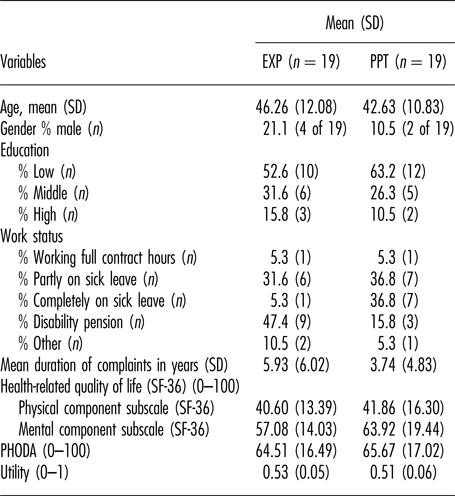
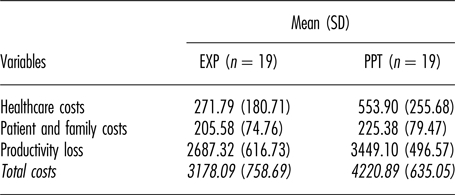
The mean age of the thirty-eight participants was 44.4 years (SD = 11.47); 84 percent were women. At the start of the study, two participants worked their regular contract hours, twenty-one participants were on sick leave (eight completely, thirteen partly), twelve received disability pension, one studied, and two were unemployed (not due to CRPS-I). The mean duration of CRPS-I was 5.1 years (SD = 5.45). Table 1 presents baseline characteristics and costs for EXP and PPT. Chi-squared tests revealed no significant differences between EXP and PPT regarding demographic variables. Independent samples t-tests showed no significant baseline differences between conditions for duration of complaints, PRF, and health-related QoL (all p > .10, results not reported). Table 2 presents baseline costs for EXP and PPT. Bootstrapping of the baseline costs revealed no significant differences between conditions before the start of treatment.
Mean (SD) in Demographic Characteristics, Duration of Complaints, and Disability at Baseline per Treatment Condition

CI, confidence interval; EXP, exposure in vivo; PHODA, Photographic Series of Daily Activities (a lower score indicates less perceived harmfulness of activities); PPT, pain-contingent physical therapy; SD, standard deviation; SF36, Short Form 36 (higher scores indicate a better health-related QoL).
Mean (SD) Cost Components (in EUR) per Treatment Condition over a 4-Week Baseline Period

EXP, exposure in vivo; PPT, pain-contingent physical therapy; SD, standard deviation.
Costs and Effects
After completion of treatment, EXP participants use significantly less prescribed (between group difference, −11.30; CI, −21.02 to −1.57) and over-the-counter medication (between group difference, −1.93; CI, −3.74 to −0.13) than PPT participants. Furthermore, EXP participants had, although not statistically significant, fewer visits to medical specialists, and regular visits (physical/occupational therapists and psychologists), as well as to alternative healthcare providers, compared with participants who received PPT. The number of visits to the general practitioner is in favor of PPT. No participants were hospitalized due to CRPS-I after EXP, whereas one was after PPT. After EXP, participants needed fewer hours of home care and domestic care, and significantly fewer hours of help from family (between group difference, −61.22; CI, −116.31 to −6.12). Participants receiving EXP were less absent from paid work, but more from usual activities and unpaid work than participants who received PPT, although these differences were not statistically significant.
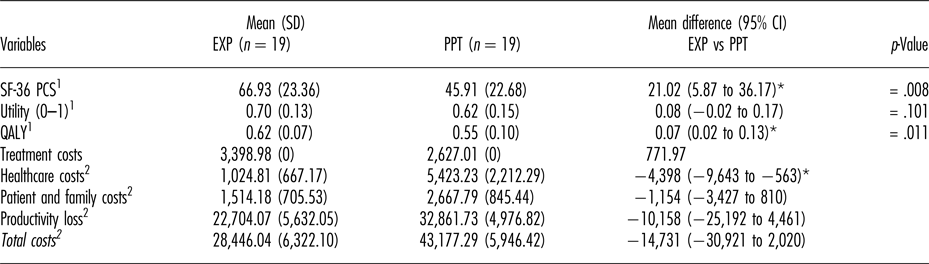
Supplementary Table 1 shows the mean resource usage per participant for EXP and PPT. Table 3 provides an overview of outcomes and the overall societal costs six months after completion of treatment for both conditions. Because pretreatment measures (SF-36-PCS and MCS) revealed no significant differences at baseline, a mean score was calculated. At the follow-up measurement 6 months after treatment, participants receiving EXP showed significantly higher scores on the physical component scale of the SF-36 and a higher QALY compared with participants receiving PPT (Table 3). The utility score was in favor of EXP, but the difference with PPT was not significant. Participants who received EXP had significantly lower healthcare costs than participants receiving PPT (Table 3). Costs for productivity loss, as well as patient and family costs, were in favor of EXP, although the differences were not significant.
Mean Scores at 6 Months Follow-up for Mean Outcome Variables and Total Costs (EUR) over Treatment- and Follow-up Period

¹ Difference in mean (95% confidence interval) derived with independent samples t-test.
2 Difference in mean (95% confidence interval) derived with bootstrapping (1000 replications).
* significanlty indicates significant finding * = sig.
CI, confidence interval; EXP, exposure in vivo; PPT, pain-contingent physical therapy; QALY, quality-adjusted life-year (a higher score indicates a higher quality adjusted life year); SD, standard deviation; SF-36 PCS, Short Form-36 Physical Component Scale (a higher score indicates better physical health-related quality of life).
Overall, the total societal costs for participants receiving EXP were lower than for participants receiving PPT (€28,446 vs. €43,177), but bootstrap replications revealed no significant differences between the groups. Productivity loss was the main source of costs in both groups and accounted for approximately 77 percent of the total costs (EXP 80 percent, PPT 76 percent).
Cost-Utility and Cost-Effectiveness Planes and CEACs
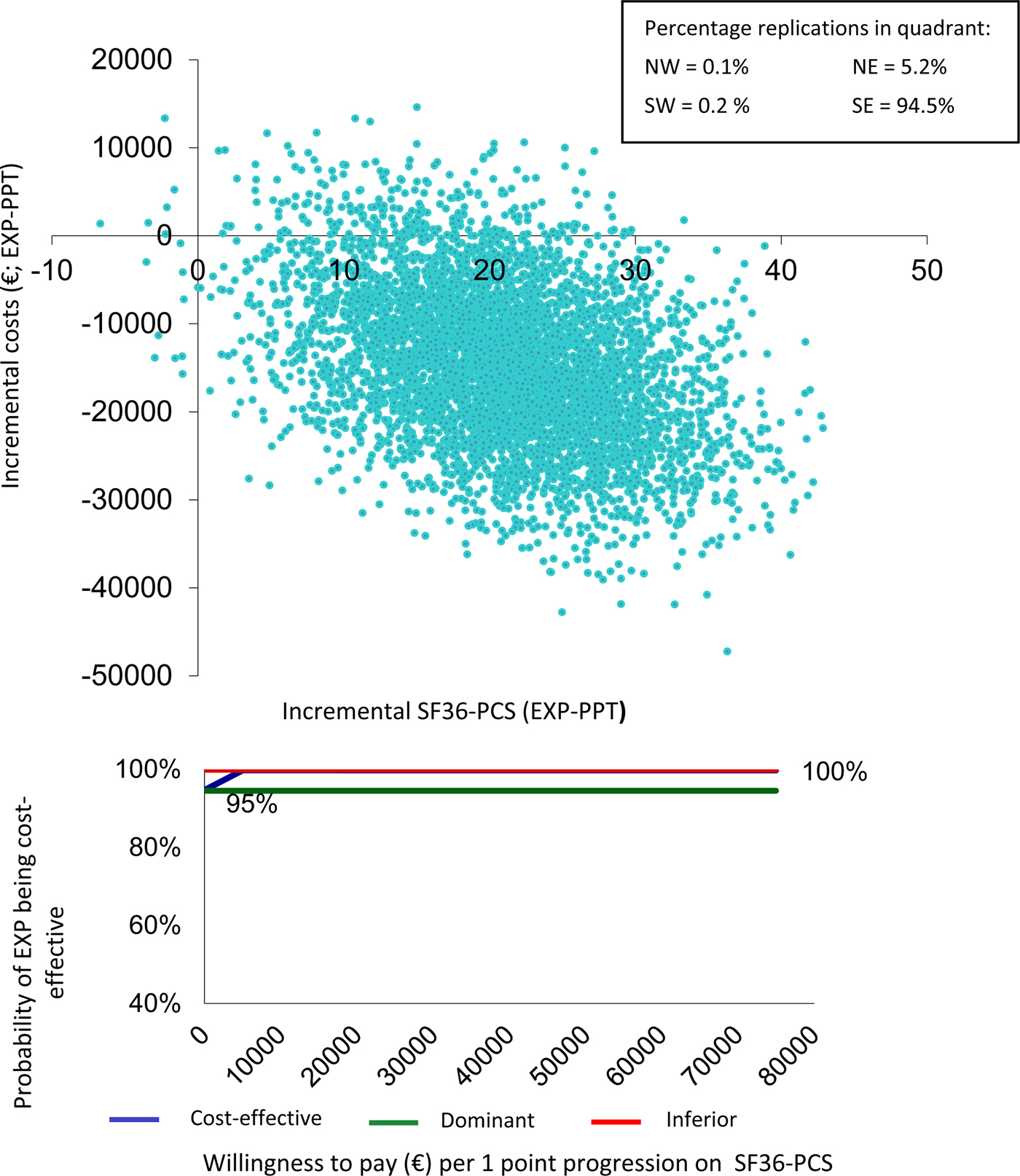
EXP resulted in a larger health benefit (26.33 points improvement on SF-36 PCS from pre- to posttreatment) than PPT (4.05 points), and, although treatment costs for EXP were higher than for PPT (€3399 vs. €2627, difference €772), the total societal costs six months after treatment clearly favored EXP. Figure 1 shows the cost-effectiveness plane (5,000 bootstrap replications) and CEAC for the SF-36 PCS. EXP clearly resulted in a better outcome than PPT: 99.7 percent of the bootstrapped cost-effect pairs are located in the eastern part of the plane, implicating higher effects. The majority of these pairs (94.5 percent) is located in the southeast quadrant, indicating not only higher effects, but also lower costs. The north-east quadrant contains the remaining 5.2 percent of the replications, indicating higher effects but higher costs.
Cost-effectiveness plane and cost-effectiveness acceptability curve for SF-36-PCS for EXP (delivered as rehabilitation in tertiary care with additional costs for psychologist) versus PPT (delivered as rehabilitation in tertiary care). EXP, exposure in vivo; NE, northeast; NW, northwest; PPT, pain-contingent physical therapy; SE, southeast; SF-36-PCS, Short Form 36-Physical Component Scale; SW, southwest.

The CEAC, based on 1-point improvement on the SF-36 PCS, shows that the probability of the intervention being cost-effective is 100 percent. To gain 1 additional unit on the SF-36 PCS, it does not matter if the highest (€80,000) or lowest (€16,000) threshold value is chosen: EXP is more cost-effective than PPT. Supplementary Figure 1 shows the cost-effectiveness plane (5,000 bootstrap replications) and the CEAC for the QALY. EXP resulted in a greater health benefit than PPT: 99.7 percent of the bootstrapped ICERs are located in the eastern part of the plane, implicating higher effects. The majority of the ICERs (95.1 percent) lies in the southeast quadrant, indicating higher effects with lower costs. The northeast quadrant contains the remaining 4.6 percent of the replications, indicating higher effects but higher costs. The probability of the intervention being cost-effective ranges between 95 percent and 98 percent, depending on the threshold value of €16,000 and €80,000, respectively.
Sensitivity Analyses
Two sets of sensitivity analyses were performed: one with different treatment costs (recognizing that both EXP and PPT can be delivered in various healthcare settings leading to different cost-prices for treatment) and one with the complete cases only.
Sensitivity Analysis with Different Treatment Costs
In the first sensitivity analysis, the cost-utility analysis (QALY) was repeated using different intervention costs for PPT and EXP. In the first analysis, the reference cost for physical therapy in primary care in the Netherlands was used (PPT: €1,133.22), and compared with the reference price for rehabilitation treatment (EXP: €2,627.01). Again, the dominance of EXP (less disability at lower costs) was shown in 94.8 percent of the replications (southeast quadrant). In 5.1 percent of the replications, EXP is more effective, but against higher costs (northeast quadrant). The cost-effectiveness plane with CEAC is shown in Supplementary Figure 2.
In the second analysis, the reference cost for physical therapy in primary care was used again for PPT (€1,133.22). For EXP, we now used the reference cost for rehabilitation with additional costs for a psychologist (€3,398.98). Still, 93.8 percent of the ICERs are located in the southeast quadrant, with 6 percent in the northeast quadrant. For the cost-effectiveness plane with CEAC, see Supplementary Figure 3.
Sensitivity Analysis with Complete Cases Only
In the complete case analysis, we considered participants who had completed at least eight diaries as complete cases (two EXP and four PPT participants were hence excluded) and repeated the cost-utility analysis (QALY). As in our primary analysis, we first used the SRP for PPT and SRP plus additional costs for a psychologist for EXP (Supplementary Figure 4). For the complete cases, 83.2 percent of the ICERs are located in the southeast quadrant, and 15.8 percent in the northeast quadrant. In 0.8 percent of the bootstraps, EXP was inferior. For the cost-effectiveness plane with CEAC, see Supplementary Figure 4. When the contrast between the costs for EXP versus PPT is maximized (costs for a primary care physical therapist versus SRP plus additional costs for a psychologist), 77.9 percent of the ICERs are located in the southeast quadrant, and 20.9 percent in the northeast quadrant. In 1 percent of the bootstraps, EXP was inferior. The cost-effectiveness plane with CEAC is shown in Supplementary Figure 5.
DISCUSSION
This economic analysis supports previous findings (Reference den Hollander, Goossens and de Jong12) that EXP seems superior to pain-contingent physiotherapy. EXP not only resulted in a greater improvement in physical health-related QoL and QALYs than PPT, EXP also seems to reduce societal costs six months after completion of treatment. This despite initially higher treatment costs due to the additional costs of a psychologist. After EXP, healthcare costs were significantly lower than after PPT. Participants used significantly less prescribed and over-the-counter medication after EXP, and needed significantly less informal care. In 95 percent of the bootstrap replications, EXP was more effective and had lower costs.
In CRPS-I, no other studies on the cost-effectiveness of rehabilitation are available. The cost-effectiveness of EXP was previously evaluated in a study comparing EXP with graded activity (GA) for individuals with low back pain (29). EXP was the preferred treatment regarding societal costs, but less convincing than in the current study, possibly because the contrast between EXP and GA, two biopsychosocial interventions, is less pronounced than between EXP and PPT, which has a biomedical focus.
We can explain the positive findings of lower costs for the individuals treated by EXP in two ways: the resumption of activities and the decrease in pain experience (Reference den Hollander, Goossens and de Jong12). First, EXP aims to specifically violate dysfunctional ideas about negative consequences of performing movements and activities. During EXP, individuals are exposed to the full range of activities they used to perform before the onset of CRPS-I, including work-related activities. EXP hereby facilitates and stimulates the resumption of personally relevant activities. When individuals resume self-care and household activities, they become less dependent upon professional care and need less help from their significant others.
The resumption of activities might also explain the positive findings for EXP on societal costs, because individuals are more able to return to work. Second, although EXP does not primarily focus on pain reduction, EXP did have pain-reducing effects (Reference den Hollander, Goossens and de Jong12;Reference Leeuw, Goossens and van Breukelen30;Reference de Jong, Vlaeyen and Onghena31). The current study extends these findings by showing that participants actually take less medication after EXP. An additional effect might be that, when individuals decrease their use of complex pain medication, they need fewer visits to their pain specialist. Actual pain reduction is probably not the only explanation for the decrease in medication use. By the violation of catastrophic assumptions and the reduction in fear, EXP aims to decrease the threat value of pain (Reference den Hollander, de Jong and Volders32). As individuals catastrophize less about pain, signs, and symptoms after EXP, they may turn to their general practitioner when they do have CRPS-related questions, instead of turning to more expensive medical specialists, as is shown in our sample.
Participants receiving EXP had fewer hours of work absence than participants receiving PPT. At baseline, the number of participants working or being partly on sick leave was comparable over different conditions. In PPT, more individuals were on complete sick leave, whereas more EXP participants were already receiving a disability pension. In the Netherlands, only individuals on sick leave have the possibility of resuming work, because they are still under contract with their employer. Individuals on disability pension are paid by the government and are no longer employed: in consequence, they cannot just restart work even if willing and able to. Thus, EXP participants had less opportunity to improve on this outcome measure than PPT participants. It suggests that over time, the effect for EXP might even increase, as individuals with a disability pension regard themselves as being able to work again, or when the system establishes that they no longer need a disability pension and provides possibilities to resume work.
Kemler and Furnee (2002) showed that not only individuals with CRPS-I lose their jobs or decrease their working hours, but also that, for males with CRPS-I, spouses increased their working hours significantly (Reference Kemler and Furnee7). This again highlights the importance of performing a full economic analysis, including patient-related costs and indirect costs, instead of just comparing treatment costs that cannot make valid claims for financial benefits to society. Because societal costs due to work loss in participants were found to be 77 percent of the total economic costs, in line with cost-effectiveness studies in other chronic pain syndromes (Reference Goossens, de Kinderen and Leeuw29), treatments reducing work absenteeism are likely to have an enormous positive impact.
First, for individuals with CRPS-I, we showed that the value of EXP is that patients will reduce their use of medication and need less informal care. For healthcare insurance companies, EXP is shown to be good value for money, because the initial higher treatment costs clearly pay off in the long run through the reduction of medication and interventions, putting less burden on the total budget. For society in general, EXP enabled patients to stay at work and reduced the costs for work-disability. Policymakers should consider adopting EXP in (inter-)national guidelines for CRPS-I, because this specific protocol of EXP is shown to be effective and cost-effective.
Second, we performed sensitivity analyses to increase generalizability to other healthcare systems than the Dutch, by using different treatment costs reflecting different settings where treatment could be delivered. These sensitivity analyses yielded almost the same results, indicating that the effect is robust and not dependent on relatively small changes in initial treatment costs. Even with the maximal contrast in costs between treatments, primary care physical therapy against rehabilitation with additional costs for a psychologist, EXP remains the preferred treatment. To further reduce the costs of EXP, it would be worthwhile to investigate if it is possible to accomplish comparable effects in primary health care.
Several weaknesses have to be mentioned as well. First, we would have preferred to use disability as our primary outcome, as we did in the previously published RCT. However, because disability was measured for upper (n = 27) and lower limb (n = 11) CRPS-I separately, this would have resulted in very low power. Because studies are not powered for economic evaluations primarily, statistical power is always low, and we did not want to increase this problem even further. Instead, we chose the Physical Component Scale of the SF-36 as our primary measure of effect, reflecting a combination of disability and pain experience. This choice was justified by high correlations of the formerly used changes on the disability measures with changes in the SF-36 Physical Component Scale (−0.79 for both measures).
Second, participants did not always complete their cost diaries conscientiously, resulting in missing data. This forced us to impute data. We choose the most stringent procedure, imputation of the treatment mean (Reference Hendriks, Al and Bleijlevens27). Because the percentage of missing data did not differ between conditions, this should have affected outcomes in both conditions equally. Additionally, a sensitivity analysis showed that even when only complete datasets were used, EXP still is more effective against lower cost than PPT (83 percent and 78 percent, respectively, depending on the treatment costs used).
Third, generalizability of our results to other countries might be limited, due to our use of a pain-contingent comparator (PPT), which might not be recommended by guidelines in other countries, as it was in the Netherlands. Future research is needed to draw conclusions about (cost-) effectiveness of EXP against other physiotherapeutic approaches, which may also incorporate principles that are more compatible with EXP and would thus decrease the contrast between treatments. Furthermore, costs are calculated based on the Dutch healthcare system. With our sensitivity analyses, we contrasted different healthcare settings where treatments could be delivered. Nevertheless, with the current contrast between EXP and PPT, we cannot draw conclusions about the cost-effectiveness of EXP against other biopsychosocial approaches in CRPS-I.
In conclusion, earlier findings on the effectiveness of EXP (Reference den Hollander, Goossens and de Jong12) are now corroborated with positive findings on its cost-effectiveness using a societal perspective, although the sample size of the trial was relatively small. The initial higher costs for EXP paid off in a significant long-term reduction of costs for healthcare consumption and a tendency to reduced costs for work absenteeism. Furthermore, participants needed less help from relatives after EXP. This would justify EXP being mentioned as a viable treatment in national and international guidelines for CRPS-I patients with PRF. Future research may replicate our findings in countries with different healthcare systems than the Netherlands, as well as with other comparator treatments.
SUPPLEMENTARY MATERIAL
The supplementary material for this article can be found at https://doi.org/10.1017/S0266462318000429
Supplementary Table 1: https://doi.org/10.1017/S0266462318000429
Supplementary Figure 1: https://doi.org/10.1017/S0266462318000429
Supplementary Figure 2: https://doi.org/10.1017/S0266462318000429
Supplementary Figure 3: https://doi.org/10.1017/S0266462318000429
Supplementary Figure 4: https://doi.org/10.1017/S0266462318000429
Supplementary Figure 5: https://doi.org/10.1017/S0266462318000429
CONFLICTS OF INTEREST
The authors have nothing to disclose.