Introduction
Predatory drill holes in marine shells provide information about ecological interaction and help make predation-related hypotheses (e.g., escalation) testable by applying detailed statistical analyses. The study of drilling predation in extant and extinct taxa, therefore, forms the focus of many research papers (Vermeij, Reference Vermeij1977, Reference Vermeij1987; Kelley and Hansen, Reference Kelley and Hansen1993; Harper, Reference Harper1994; Kardon, Reference Kardon1998; Dietl and Kelley, Reference Dietl and Kelley2002, Reference Dietl and Kelley2006; Kowalewski, Reference Kowalewski, Kowalewski and Kelley2002; Mondal et al., Reference Mondal, Bardan and Sarkar2010, Reference Mondal, Goswami and Bardhan2017, Reference Mondal, Chakraborty and Paul2019a, Reference Mondal, Maitra, Bose, Goswami, Bardhan and Mallickb; Bardhan et al., Reference Bardhan, Chattopadhyay, Mondal, Das, Mallick, Chanda and Roy2012, Reference Bardhan, Mallick and Das2014; Das et al., Reference Das, Mondal and Bardhan2014; Mallick et al., Reference Mallick, Bardhan, Das, Paul and Goswami2014; Pahari et al., Reference Pahari, Mondal, Bardhan, Sarkar, Saha and Buragohain2016; Sarkar et al., Reference Sarkar, Bardhan, Mondal, Das, Pahari, Buragohain and Saha2016; Anderson et al., Reference Anderson, Hendy, Johnson and Allmon2017; Klompmaker et al., Reference Klompmaker, Kowalewski, Huntley and Finnegan2017, Reference Klompmaker, Kelley, Chattopadhyay, Clements, Huntley and Kowalewski2019; among others).
Drilling predation evolved in association with the rise of metazoans, and drill holes have been reported from as early as Neoproterozoic–Early Paleozoic times (Bengtson and Zhao, Reference Bengtson and Zhao1992; Morris and Bengtson, Reference Morris and Bengtson1994; Hua et al., Reference Hua, Pratt and Zhang2003; Huntley and Kowalewski, Reference Huntley and Kowalewski2007; Porter, Reference Porter2016). The Paleozoic drill holes were of various types, and some were possibly made by gastropod predators (platyceratid gastropods; Kowalewski et al., Reference Kowalewski, Dulai and Fürsich1998; Kowalewski, Reference Kowalewski, Kowalewski and Kelley2002; Klompmaker et al., Reference Klompmaker, Nützel and Kaim2016) as well as by unknown taxa, including parasites (Morris and Bengtson, Reference Morris and Bengtson1994; Klompmaker et al., Reference Klompmaker, Nützel and Kaim2016). Late Paleozoic and early Mesozoic drill holes were sometimes naticid-like (Klompmaker et al., Reference Klompmaker, Kowalewski, Huntley and Finnegan2017), but their creators remain equivocal since no naticid body fossils co-occur with the drilled taxa. There are several reports of drilled bivalve and brachiopod shells from the Mesozoic, where the shape of the drill holes resembles those made by naticid predators (i.e., circular outline, parabolic walls; resembling ichnospecies Oichnus paraboloides Bromley, Reference Bromley1981). The Late Triassic Cassian Formation of Italy contains shells of bivalves (Koken, Reference Koken1892; Fürsich and Jablonski, Reference Fürsich and Jablonski1984; Zardini, Reference Zardini1985) and brachiopods (Klompmaker et al., Reference Klompmaker, Nützel and Kaim2016) with the characteristic paraboloid drill holes such as those commonly made by naticids. Many workers attributed these drill holes to various gastropod genera such as Natiria de Koninck, Reference De Koninck1881 or Naticopsis M'Coy, Reference M'Coy1844, Amauropsis Mörch, Reference Mörch and Rink1857, and Ampullina Férussac, Reference Férussac1822, which were later found to be unrelated to true naticids (Kabat, Reference Kabat1991; Bandel, Reference Bandel1992, Reference Bandel1993, Reference Bandel1996, Reference Bandel1999; Bardhan et al., Reference Bardhan, Chattopadhyay, Mondal, Das, Mallick, Chanda and Roy2012; Hausmann and Nützel, Reference Hausmann and Nützel2015; Das et al., Reference Das, Mondal, Saha, Bardhan and Saha2019). Kase and Ishikawa (Reference Kase and Ishikawa2003) provided evidence for the herbivorous feeding habit of Recent ampullinid gastropods. Recently, Klompmaker et al. (Reference Klompmaker, Nützel and Kaim2016) suggested that the Cassian drill holes may have been made by predatory drillers; however, they did not rule out parasitism.
The two gastropod groups (naticids and muricids), which are mainly responsible for drilling predation, were previously believed to have evolved in the Early Cretaceous (Taylor, Reference Taylor1970; Adegoke and Tevesz, Reference Adegoke and Tevesz1974; Vermeij and Dudley, Reference Vermeij and Dudley1982; Taylor et al., Reference Taylor, Cleevely and Morris1983; Arua and Hoque, Reference Arua and Hoque1989; Kelley and Hansen, Reference Kelley and Hansen2006; Harries and Schopf, Reference Harries and Schopf2007; Klompmaker et al., Reference Klompmaker, Nützel and Kaim2016; and many others). Recently, naticids were reported from the Late Jurassic (Oxfordian) of India (Das et al., Reference Das, Mondal, Saha, Bardhan and Saha2019).
Kowalewski et al. (Reference Kowalewski, Dulai and Fürsich1998) described three major phases of drilling history in the fossil record. In the Paleozoic phase, predation intensities were low to moderate and victims were mainly sessile benthic taxa, including brachiopods (see also Klompmaker et al., Reference Klompmaker, Kowalewski, Huntley and Finnegan2017). Predation intensity reached a Paleozoic peak during the Ordovician (Huntley and Kowalewski, Reference Huntley and Kowalewski2007). The Mesozoic phase was marked by a lull with rare, facultative drilling events (Fürsich and Jablonski, Reference Fürsich and Jablonski1984; but see Vermeij, Reference Vermeij1977, Reference Vermeij1987). The Cenozoic phase led to the high drilling intensities (DIs) on molluscan prey (Carriker and Yochelson, Reference Carriker and Yochelson1968; Kelley and Hansen, Reference Kelley and Hansen1993, Reference Kelley and Hansen1996, Reference Kelley and Hansen2006), which continue to be observed in modern marine environments, on a variety of taxa (Dudley and Vermeij, Reference Dudley and Vermeij1978; Boucher, Reference Boucher1986; Vermeij, Reference Vermeij1987; Mondal et al., Reference Mondal, Bardan and Sarkar2010; Paul et al., Reference Paul, Das, Bardhan and Mondal2013; Chattopadhyay et al., Reference Chattopadhyay, Zuschin and Tomašových2014; Das et al., Reference Das, Mondal and Bardhan2014; Klompmaker et al., Reference Klompmaker, Portell, Lad and Kowalewski2015; Pahari et al., Reference Pahari, Mondal, Bardhan, Sarkar, Saha and Buragohain2016; Saha et al., Reference Saha, Mondal, Bardhan, Mallick, Pahari, Sarkar, Buragohain, Das, Goswami and Dutta2016; Sarkar et al., Reference Sarkar, Bardhan, Mondal, Das, Pahari, Buragohain and Saha2016; Mondal et al., Reference Mondal, Chakraborty and Paul2019a, Reference Mondal, Maitra, Bose, Goswami, Bardhan and Mallickb; among others).
Harper et al. (Reference Harper, Forsythe and Palmer1998) and Harper and Wharton (Reference Harper and Wharton2000) reported typical naticid-like drill holes in brachiopod shells from the Jurassic and the Early Cretaceous of the United Kingdom and Ireland. The DI sometimes attained modern values (>20%). Bardhan et al. (Reference Bardhan, Chattopadhyay, Mondal, Das, Mallick, Chanda and Roy2012) also recorded naticid drill holes on astartids (Neocrassina Fischer, Reference Fischer1887) and other bivalves from the Upper Jurassic (Oxfordian) of Kutch, western India. At 30%, the DI was the highest ever recorded from the Mesozoic. They also found several coeval naticid-like taxa (e.g., Ampullina Férussac, Reference Férussac1822 and Ampullospira Harris, Reference Harris1897) but could not identify a specific driller.
Against this backdrop, we herein report naticid drill holes in shells from a molluscan assemblage from the Upper Jurassic beds of Kutch, where naticid body fossils are recorded together with various other gastropods and bivalves (Das et al., Reference Das, Mondal, Saha, Bardhan and Saha2019). The assemblage is dominated by turritellines (Das et al., Reference Das, Saha, Bardhan, Mallick and Allmon2018) and represents a turritelline-dominated assemblage (TDA) in the sense of Allmon (Reference Allmon2007; detailed discussion follows). In the present study, we record the oldest interaction between naticid predators and turritelline prey. In addition, the naticids show a rare case of cannibalism. Bivalve diversity mimics that of gastropods, and some bivalve taxa are also found to be drilled by naticid gastropods.
Many recent and fossil prey communities show typical aspects of the naticid predation. For example, naticids are prey-selective, and the data show that they select prey taxa in a manner that is consistent with the cost–benefit model of Kitchell et al. (Reference Kitchell, Boggs, Kitchell and Rice1981). Recent and Neogene naticids show a strong size and behavioral stereotypy while attacking their prey (Kelley, Reference Kelley1988; Kelley and Hansen, Reference Kelley and Hansen1993, Reference Kelley and Hansen1996, Reference Kelley and Hansen2006). Prey is commonly targeted based on size (a large predator would select large prey), and drill hole sites are restricted to particular areas within the shell. Many workers suggested that prey selectivity and behavioral stereotypy of naticids developed over time (Kelley, Reference Kelley1988). Certain Cretaceous and Paleogene examples of naticid predation show some of the aspects mentioned, whereas others lack such evidence. For the assessment of the supposedly oldest example of naticid–molluscan prey interaction from the Late Jurassic, we have set out the following objectives: (1) to estimate predator abundance, type of prey available, and impact of predation at the beginning on molluscan prey, DI on molluscan prey is recorded; (2) to understand the process and underlying causes of prey selection during the early history of naticid predation, variations of DI at family/subfamily levels are explored, and the function of ornamentation, shell thickness, and shape of prey shells are studied; (3) to evaluate prey response to drilling predation, prey effectiveness (PE) and multiple drill holes (MULT) are analyzed (both incomplete and multiple DIs provide information about a prey's passive responses to reduce mortality due to predation); (4) to understand the predatory behavior of the early naticids, size and site selectivity of drill holes are studied (it is suggested that stereotypy offers better manipulation by predators and the least passive resistance to drilling by prey); (5) to assess whether the recurrent association of turritelline/corbulid prey and naticid predators evolved during the Jurassic, its historical development is reviewed; (6) to understand whether and how the heavily preyed taxa responded to the sudden appearance of naticid predators, we study their evolutionary history.
Materials and methods
The present collection has been made from the Dhosa Oolite Member of the Chari Formation of Kutch, western India (Mitra et al., Reference Mitra, Bardhan and Bhattacharya1979; Fürsich and Pandey, Reference Fürsich and Pandey2003). The member is well time-constrained by ammonites (Mitra and Ghosh, Reference Mitra and Ghosh1979; Roy et al., Reference Roy, Bardhan, Das, Mondal and Mallick2012) and Oxfordian in age (Das et al., Reference Das, Saha, Bardhan, Mallick and Allmon2018). The Dhosa Oolite Member is a regionally persistent unit and is characterized by typically brown-colored oolitic limestone (Fürsich et al., Reference Fürsich, Oschmann, Singh and Jaitly1992). In the present section, the Dhosa Oolite Member consists of oolitic limestone, sandstone, and shale. Most of the studied specimens have been obtained from the shale in the upper part of the section, but several are from sandstone (for detailed stratigraphic and environmental information, see Das et al., Reference Das, Saha, Bardhan, Mallick and Allmon2018, Reference Das, Mondal, Saha, Bardhan and Saha2019).
A total of 11 samples were collected following both bulk-sampling and random-surface-sampling protocols (Kowalewski, Reference Kowalewski, Kowalewski and Kelley2002; Mallick et al., Reference Mallick, Bardhan, Paul, Mukherjee and Das2013; Das et al., Reference Das, Saha, Bardhan, Mallick and Allmon2018). Most of the specimens were found loose or weakly adhered to the rocks. Specimens were separated by hand and pincer from the sediment in the laboratory. For smaller specimens (<10 mm), ASTM (American Standard Test Sieve Series) sieves (numbers 5, 10, and 20) were used to separate them from larger ones and from the matrix. Drill hole morphology, including hole outline, hole wall, and presence of a boss in incomplete drill holes, were studied under stereo microscope (Magna vision, LENSEL L104CV) and scanning electron microscope (SEM).
Gastropods and bivalves were identified on the basis of the rich taxonomic literature available for the region (Kitchin, Reference Kitchin1903; Cox, Reference Cox1940; Mitra and Ghosh, Reference Mitra and Ghosh1979; Singh and Rai, Reference Singh and Rai1980; Jaitly et al., Reference Jaitly, Fürsich and Heinze1995; Allmon, Reference Allmon1996; Kanjilal, Reference Kanjilal1997; Das et al., Reference Das, Bardhan and Lahiri1999, Reference Das, Bardhan and Kase2005, Reference Das, Saha, Bardhan, Mallick and Allmon2018, Reference Das, Mondal, Saha, Bardhan and Saha2019; Fürsich et al., Reference Fürsich, Heinze and Jaitly2000; Alberti et al., Reference Alberti, Nützel, Fürsich and Pandey2013a). The molluscan assemblage includes 14,012 gastropods (approximately 90% of the total molluscan fauna) and 1,380 bivalve shells (9% of the total fauna). The gastropod community consists of 19 species in 10 families and represents a TDA. An assemblage is considered a TDA when turritelline gastropods make up at least 20% of the total molluscan assemblage or are two times as abundant as any other molluscan species present (Allmon, Reference Allmon2007). In this study, turritelline gastropods comprise 98% of the gastropod community and 89% of the total molluscan assemblage. The second-most abundant (n > 10 individuals; see Vermeij, Reference Vermeij1987; Kelley and Hansen, Reference Kelley and Hansen2006; Mallick et al., Reference Mallick, Bardhan, Paul, Mukherjee and Das2013) gastropod taxon is the Naticidae (n = 98; 0.7% of the gastropod community and 0.006% of the total molluscan assemblage). Other abundant gastropod families are Ampullinidae (n = 45; 0.32% of the gastropod community), Volutidae (n = 37; about 0.26%), Rissoidae (n = 36; about 0.26%), Cerithiopsidae (n = 30; 0.21%), and Scalidae (n = 22; 0.15%). The remaining gastropods are very rare (n < 10) and are excluded from further analysis.
Bivalves are less abundant, but equally diverse, and are represented by 19 species in 15 families. The abundant families (n > 10 shells; see Vermeij, Reference Vermeij1987; Vermeij et al., Reference Vermeij, Dudley and Zipser1989; Harper, Reference Harper1994; Kelley and Hansen, Reference Kelley and Hansen2006) in descending order are Nuculidae (n = 551 shells), Corbulidae (n = 516), Arcidae (n = 110.5), Nuculanidae (n = 93), Ostreidae (n = 43.5), Lucinidae (n = 20), and Polidevciidae (n = 14). Other ancillary taxa are bryozoans, corals, crinoids (represented by ossicles), ammonites, and belemnites, along with some unidentified broken fossils (about 1% of the total assemblage).
We recently described four turritelline species under a single genus Turritella sensu lato from the same assemblage (for details, see Das et al., Reference Das, Saha, Bardhan, Mallick and Allmon2018): Turritella jadavpuriensis Mitra and Ghosh, Reference Mitra and Ghosh1979 (75% of the turritelline shells), Turritella amitava Das et al., Reference Das, Saha, Bardhan, Mallick and Allmon2018 (15%), Turritella jhuraensis Mitra and Ghosh, Reference Mitra and Ghosh1979 (9%), and Turritella dhosaensis Das et al., Reference Das, Saha, Bardhan, Mallick and Allmon2018 (about 1%). Small and large turritelline shells occur together, with shells varying from 2 to 65 mm in height. Small specimens are indistinguishable from the early whorls of larger shells, indicating that they are juveniles, not a different species. The second-most abundant gastropod group comprises the naticid genera Gyrodes Conrad, Reference Conrad1860 (n = 76) and Euspira Agassiz in Sowerby, Reference Sowerby1837 (n = 22) (Das et al., Reference Das, Mondal, Saha, Bardhan and Saha2019).
The most abundant two bivalve species here are provisionally described (systematics in preparation) as Palaeonucula sp. (39% of the total bivalve community) and Indocorbula sp. (37%). Arcidae is represented by two species, Anadara sp. (n = 91.5) and Arca sp. (n = 19). Nuculanidae is also abundant and consists of one species, Nuculana juriana Cox, Reference Cox1940 (6.7% of the total bivalve community). Three other abundant families are Ostreidae, Lucinidae, and Polidevciidae, which are represented by one species each, Ostrea sp. (3.2% of the total bivalve community), Pterolucina sp. (1.5%), and Dacryoma lacryma Sowerby, Reference Sowerby1824 (1%), respectively. The remainder of the families are represented by a few specimens only (n < 10 shells) and hence are excluded from the study.
In many turritelline specimens, delicate apical parts have been preserved although protoconch are missing (Das et al., Reference Das, Saha, Bardhan, Mallick and Allmon2018). The presence of shells of varying sizes on the same bedding plane indicates that no taphonomic sorting occurred. Many bivalves (e.g., nuculids) are found articulated, and very thin-shelled bivalves (the right valves of Ostrea sp.) are also present. Some bivalve species occur with disarticulated valves (Anadara sp.); the ratio between right and left valves is close to one. These observations suggest weak taphonomic overprinting. Roy et al. (Reference Roy, Miller and LaBarbera1994) demonstrated that drilled bivalve shells were weaker to “point-load compression” than undrilled shells and would thus preferentially be fragmented and disappear from the assemblage. However, Kelley (Reference Kelley, Wisshak and Tapanila2008) from field observation on bivalves and Dyer et al. (Reference Dyer, Ellis, Molinaro and Leighton2018) from an experimental study demonstrated that the drilled shells were not always preferentially broken due to compaction (see also Klompmaker et al., Reference Klompmaker, Kelley, Chattopadhyay, Clements, Huntley and Kowalewski2019). Kelley (Reference Kelley, Wisshak and Tapanila2008) showed that the taphonomic conditions of drilled versus undrilled valves are not statistically significantly different. We thus also assume that drilled shells are not preferentially lost from the studied assemblage. Moreover, the host sediments are fine-grained sandstone and shale, indicating a relatively deep and calm environment below the storm wave base (Datta, Reference Datta1992; Alberti et al., Reference Alberti, Fürsich and Pandey2013b). In the following, we document several ecological parameters to understand the pattern of naticid predation during Late Jurassic time in Kutch.
Drilling intensity
We considered only complete or near-complete gastropod shells (with only minor apertural and/or apical breakage) and intact bivalve shells (both articulated and disarticulated) to assess DI at assemblage and taxon levels (family to species). For gastropods, DI is measured as the ratio between the shells with complete drill holes and the total number of shells (cf. Allmon et al., Reference Allmon, Nieh and Norris1990; Kowalewski, Reference Kowalewski, Kowalewski and Kelley2002; Kelley and Hansen, Reference Kelley and Hansen2006; Mallick et al., Reference Mallick, Bardhan, Das, Paul and Goswami2014) and is expressed as a percentage. For bivalves, DI is defined as the ratio between the total number of drilled valves and the total number of bivalve individuals (Bambach and Kowalewski, Reference Bambach and Kowalewski2000; Bardhan et al., Reference Bardhan, Chattopadhyay, Mondal, Das, Mallick, Chanda and Roy2012) and is expressed as a percentage. The total number of individuals (N) for bivalves can be calculated by the following equation: N = (RV + LV)/2 + A, where RV, LV, and A are the numbers of right, left, and articulated valves, respectively (Kowalewski, Reference Kowalewski, Kowalewski and Kelley2002; Harries and Schopf, Reference Harries and Schopf2007). Assemblage-level DI is analyzed separately for gastropods and bivalves and is calculated as the percentage of drilled individuals. Because DI may vary with prey size (Vermeij, Reference Vermeij1987; Allmon et al., Reference Allmon, Nieh and Norris1990; Paul et al., Reference Paul, Das, Bardhan and Mondal2013; Sarkar et al., Reference Sarkar, Bardhan, Mondal, Das, Pahari, Buragohain and Saha2016), DI is measured for different size classes within the turritelline species. Previous workers, including Paul et al. (Reference Paul, Das, Bardhan and Mondal2013) and Sarkar et al. (Reference Sarkar, Bardhan, Mondal, Das, Pahari, Buragohain and Saha2016), subdivided turritellines into two size classes with a cut-off at 4 cm shell height. The studied assemblage includes numerous small individuals (up to 2 mm). Therefore, to assess the full range of predation, we analyze DI in four size classes: (1) less than 20 mm, (2) 21 to 40 mm, (3) 41 to 60 mm, and (4) greater than 60 mm. No cut-offs were employed in bivalve species as they are mostly small.
Incomplete and multiple drilling intensities
Incomplete drill holes indicate the failure of the predator to enter into the prey shell's interior, and multiple drill holes indicate more than one predatory attack in a prey specimen (Vermeij, Reference Vermeij1987; Kelley et al., Reference Kelley, Hansen, Graham and Huntoon2001). A single naticid may attack the same prey several times if previous attempts were unsuccessful. Likewise, a naticid may attack a prey specimen that was previously unsuccessfully attacked by another naticid. For muricids, by contrast, multiple holes in a prey specimen generally indicate simultaneous attacks by several predators (Kelley et al., Reference Kelley, Hansen, Graham and Huntoon2001). The abundances of incomplete and multiple drill holes indicate the prey's passive resistance to reduce mortality due to predation (Kelley and Hansen, Reference Kelley and Hansen1993, Reference Kelley and Hansen1996; Kelley et al., Reference Kelley, Hansen, Graham and Huntoon2001). However, some workers (Ansell and Morton, Reference Ansell and Morton1987; Hutchings and Herbert, Reference Hutchings and Herbert2013) opposed this view. According to them, prey with incomplete drill holes may be consumed by smothering by large predators. Decreasing competition among predators may result in a decrease of incomplete drill hole intensity (Hutchings and Herbert, Reference Hutchings and Herbert2013; but for the opposite view, see Pahari et al., Reference Pahari, Mondal, Bardhan, Sarkar, Saha and Buragohain2016). We consider incomplete drill holes as unsuccessful drilling attempts, irrespective of their cause (see also Visaggi et al., Reference Visaggi, Dietl and Kelley2013). PE is defined as the number of incomplete drill holes divided by the total number of drill holes (Kelley and Hansen, Reference Kelley and Hansen1993; Mallick et al., Reference Mallick, Bardhan, Paul, Mukherjee and Das2013, Reference Mallick, Bardhan, Das, Paul and Goswami2014) and is expressed as a percentage. MULT is defined as the ratio between the number of drill holes that occur in multiply drilled specimens and the total number of drill holes (see Kelley and Hansen, Reference Kelley and Hansen1993; Mallick et al., Reference Mallick, Bardhan, Das, Paul and Goswami2014) and here is also expressed as a percentage. Both PE and MULT were measured separately for gastropods and bivalves at assemblage level and were also assessed at various taxon levels (family and species).
Behavioral stereotypy
Stereotypy of drilling predation means that drill holes are concentrated in a particular site or area on a gastropod or a bivalve shell. Stereotypy of successful predation is a measure for the efficiency of the naticid predators (Kelley and Hansen, Reference Kelley and Hansen1993, Reference Kelley and Hansen1996, Reference Kelley and Hansen2006). Several workers have suggested that preferred drill sites in gastropod shells represent the thinnest part of the shell, which offers the least resistance for drilling (Kitchell, Reference Kitchell, Nitecki and Kitchell1986; Allmon et al., Reference Allmon, Nieh and Norris1990). Therefore, we examine site selectivity in a vertical profile along the axis of coiling (following Allmon et al., Reference Allmon, Nieh and Norris1990; Hagadorn and Boyajian, Reference Hagadorn and Boyajian1997) for gastropod shells. Drill holes are plotted on a two-dimensional outline of the gastropod shell, representing an axial section (see the following). The positions of drill holes are plotted by measuring the distance from the apex, scaled to prey size (Goswami et al., Reference Goswami, Das, Bardhan and Paul2020). To depict the distribution of drill holes in the radial profile, a basal section has been constructed and divided into four quadrants where quadrants I and IV represent the apertural side, and quadrants II and III represent the abapertural side (see the following). According to Adegoke and Tevesz (Reference Adegoke and Tevesz1974), the radial distribution of naticid drill holes indicates whether the naticid predators attack their prey from the apertural or abapertural side. Site and size distribution of drill holes are studied for three turritelline species (T. jadavpuriensis, T. jhuraensis, and T. amitava) to understand the behavioral stereotypy of the Jurassic naticid predators. The other species, T. dhosaensis, represents fewer than 10 intact specimens and is excluded from the analysis. We plot outer drill hole diameter (ODD), which serves as a proxy for the predator size (Kitchell et al., Reference Kitchell, Boggs, Kitchell and Rice1981; Anderson et al., Reference Anderson, Geary, Nehm and Allmon1991) against maximum whorl height (MWH) of the prey shell to understand whether the naticids are size-selective.
For the bivalves, we draw nine-sector grids following Kelley (Reference Kelley1988) and Bardhan et al. (Reference Bardhan, Chattopadhyay, Mondal, Das, Mallick, Chanda and Roy2012) to evaluate whether there is any site preference of drill holes (see the following). The data have been standardized for sector size. The number of drill holes in each sector is counted and compared with other sectors to know whether the naticid predators prefer any particular sector for drilling. We consider that drill holes are randomly distributed throughout the shell as a null hypothesis to test site stereotypy. For valve selectivity, we study the occurrence of drill holes on each valve (right or left). The antero-posterior length of a bivalve shell (a proxy of the prey size) and the ODD (a proxy of the predator size) are measured and plotted in a binary diagram to evaluate the prey size preference of the predators.
Anti-predatory traits
Morphological characters such as shell ornamentation, shell thickness, and shell slenderness of gastropods, which resulted from evolutionary adaptation, are arguably the resistant characters against predation during the Cenozoic (Vermeij et al., Reference Vermeij, Zipser and Dudley1980; Signor, Reference Signor1985; Paul et al., Reference Paul, Das, Bardhan and Mondal2013; Sarkar et al., Reference Sarkar, Bardhan, Mondal, Das, Pahari, Buragohain and Saha2016). Ornamentation hinders the drilling process, and thick shells increase the drilling time; thus, more cost is involved, which makes the prey unprofitable. Slender shells having a low profile within the sediment escape notice of durophagous predators (Signor, Reference Signor1985). Sarkar et al. (Reference Sarkar, Bardhan, Mondal, Das, Pahari, Buragohain and Saha2016) observed lower DI in slender terebrid gastropod species than in inflated forms. Terebrids are equally high-spired like turritellines. To understand the prey's passive responses against drilling predation, shell ornamentation, degree of slenderness, and shell thickness are analyzed for the three turritelline species. All three species are highly variable with regard to shell shape; both inflated and slender variants exist. Therefore, we have recorded whether a specimen is slender or inflated and tested the role of shape in affecting drilling success. Shell slenderness in gastropods is defined as the ratio between shell diameter and shell length. In the “inflated” type, the ratio is greater than 0.35; in the “slender” variant, the ratio is less than 0.35 (see also Paul et al., Reference Paul, Das, Bardhan and Mondal2013). Allmon et al. (Reference Allmon, Nieh and Norris1990) divided prey shells into different defensive categories on the basis of sculptures to quantify the relationship between shell ornamentation and predation intensity. Later, Paul et al. (Reference Paul, Das, Bardhan and Mondal2013) expanded and modified this ornamental scheme on the basis of the strength and number of ribs present on turritelline species. Following Paul et al. (Reference Paul, Das, Bardhan and Mondal2013), we divided the turritelline species into two categories. Category 1 has four or more strong ribs, and category 2 has fewer than four strong ribs. We measured the DI from each category data.
The thickness of the shell has been measured in two ways. In the first method, we measured the thickness near the aperture of all drilled shells. In turritelline phylogeny, shell thickness is at its minimum near the aperture (Kabat, Reference Kabat1991). Thus, the thickness analysis at the aperture may not give any meaningful results. Therefore, we adopted a second method. Many specimens are broken and were excluded from the DI analyses. However, some of these also have drill holes (n = 421). We used these broken but drilled specimens to measure shell thickness at the drill hole sites, thus avoiding damage to the intact but drilled shells. This analysis provides information about the general thickness of shells in different areas, making it possible to test the hypothesis that naticid gastropods drill at the thinnest part of the shell (Allmon et al., Reference Allmon, Nieh and Norris1990). We also measured the whorl diameter of the broken shells at the drill sites.
Statistical analysis
A two-tailed chi-square test of independence is used for comparison of DIs across taxa. A two-tailed chi-square test of goodness of fit is used to understand the statistical significance of the site preference of drill holes. Prey size selectivity has been measured by using the different statistical tests (linear regression [least-square] and the correlation coefficient, Pearson's r). For all these analyses, statistical significance is measured against an α value of 0.05.
Repository and institutional abbreviation
All specimens are archived in the Museum of Geological Studies Unit, Indian Statistical Institute, Kolkata, India. Collection numbers consist of the prefix ISI/g/Jur/ for gastropods and ISI/b/Jur/ for bivalves followed by consecutive numbers.
Results
Predator identification
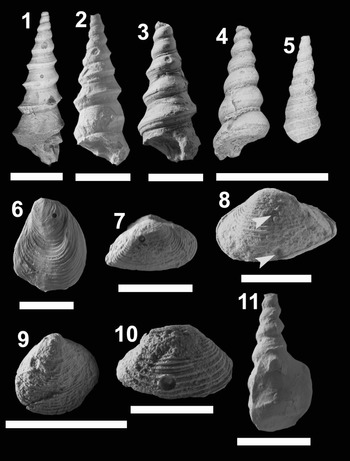
The nature of drill holes is circular in outline, with parabolic walls (ichnospecies Oichnus paraboloides Bromley, Reference Bromley1981). The drill holes are perpendicular to the shell surface and were made from the external side. They are thus recognized as naticid drill holes (Carriker and Yochelson, Reference Carriker and Yochelson1968; Dietl et al., Reference Dietl, Herbert and Vermeij2004; Daley et al., Reference Daley, Ostrowski and Geary2007; Mallick et al., Reference Mallick, Bardhan, Paul, Mukherjee and Das2013, Reference Mallick, Bardhan, Das, Paul and Goswami2014; Fig. 1.2, 1.3, 1.9). Small drill holes, when examined under the SEM, also show the typical naticid drill hole morphologies (Fig. 2.1–2.3). In some small bivalve shells, the drill holes appear to be cylindrical with straight-sided walls. Some of them, however, have centrally located boss (Fig. 1.6, 1.7). The presence of boss indicates that the driller was naticid, and straight-walled holes were because of thin shells.
(1–10) Naticid drill holes in turritelline gastropods and bivalves in the present molluscan assemblage. (1–3) Turritella jadavpuriensis (specimen nos. ISI/g/Jur/T 7, 105, 109): (1) shows multiple drill holes; (2, 3) show complete drill hole. (4) Turritella jhuraensis (specimen no. ISI/g/Jur/T 201). (5) Turritella amitava (specimen no. ISI/g/Jur/T 301) bearing complete naticid drill hole. (6) Ostrea sp. (specimen no. ISI/b/Jur/O 21) having incomplete drill hole. Note parallel-sided whole morphology, (7, 8, 10) Indocorbula sp. showing naticid drill holes. Note incomplete drill hole with a centrally located boss in (7) and (10) (specimen nos. ISI/b/Jur/I 11, 13); (8) (specimen no. ISI/b/Jur/b 16) contains multiple drill holes (arrows). (9) Palaeonucula sp. (specimen no. ISI/b/Jur/P 21) shows a complete drill hole. (11) Live epizoan (Oyster) attachment on T. jadavpuriensis (specimen no. ISI/g/Jur/T 151) indicating its epifaunal life mode. Scale bars = 1 cm.

(1–3) SEM photographs of naticid drill holes on turritelline shells. (1) Turritella jadavpuriensis (specimen no. ISI/g/Jur/T 154). (2) Turritella jhuraensis (specimen no. ISI/g/Jur/T 210). (3) Turritella amitava (specimen no. ISI/g/Jur/T 321). (4–6) Drill holes in Indocorbula sp. under the microscope. (4) Multiple drill holes in Indocorbula sp. (specimen no. ISI/b/Jur/I 101). Note shelf-like development of conchiolin layer within the drill hole (hollow arrow). Incomplete drill hole terminates at conchiolin base (solid arrow). (5) Multiple and complete drill holes in specimen no. ISI/b/Jur/I 103 showing shelf-like projected conchiolin layer. (6) An incomplete drill hole with a centrally located boss (specimen no. ISI/b/Jur/I 13). Bivalve specimens were deliberately not coated with magnesium oxide to show delicate features. (1–3) Scale bars = 300 μm; (4–6) Scale bars = 2 mm.

It is therefore argued that the drill holes in our samples were made by the naticid predators (see also Taylor et al., Reference Taylor, Cleevely and Morris1983; Allmon et al., Reference Allmon, Nieh and Norris1990 for similar inference). It is pertinent to mention that the present assemblage includes naticid body fossils that belong to two species of subfamilies Gyrodiniae and Polinicinae (Das et al., Reference Das, Mondal, Saha, Bardhan and Saha2019): Gyrodes mahalanobisi Das et al., Reference Das, Mondal, Saha, Bardhan and Saha2019, and Euspira jhuraensis Das et al., Reference Das, Mondal, Saha, Bardhan and Saha2019 (Fig. 3).
Predatory naticid gastropods (modified after Das et al., Reference Das, Mondal, Saha, Bardhan and Saha2019, figs. 1, 4, 7). (1, 2, 7) Euspira jhuraensis Das et al., Reference Das, Mondal, Saha, Bardhan and Saha2019 (specimen nos. ISI/g/Jur/N 77, 89). (3–6) Gyrodes mahalanobisi Das et al., Reference Das, Mondal, Saha, Bardhan and Saha2019 (specimen nos. ISI/g/Jur/N 1, 13). (5) Co-occurrence of naticid predator and turritelline prey. (6) Confamilial naticid drill hole (arrow) on G. mahalanobisi. (7) Showing oyster attachment on naticid shell. Scale bars = 1 cm.

Molluscan prey
We estimated DI within the gastropods and the bivalves at different taxonomic levels. The molluscan assemblage comprises 3,922 complete individuals of which 279 specimens are drilled; therefore, the assemblage level DI is 7.11.
Gastropod community
Nineteen species are represented by 2,542 individuals of which 215 specimens are drilled (DI = 8.46). Among seven abundant gastropod families, only the species of Turritellidae are drilled (DI = 9.49). One specimen of Naticidae, G. mahalanobisi shows a complete drill hole (DI = 1.32; Fig. 3.6; Table 1). Turritellidae is represented only by the subfamily Turritellinae. Among turritelline species, the DI ranges from 8.93 to 11.41 (Table 1). Only T. jadavpuriensis contains both incomplete and multiple drill holes. PE and MULT are 4.29 and 3.06, respectively (Table 1).
DIs for Turritellidae and Naticidae. PE and MULT occur only in Turritella jadavpuriensis. N = total number of individuals; D = total number of complete drilled specimens.

The DI data for different size classes of the turritelline species are shown in Table 2. T. jadavpuriensis, which ranges up to 6.5 cm in height, is drilled in every size class. However, the DIs do not show significantly different values (p > 0.05) except for the highest size interval, which is due to the low sample size (see Table 2). Two other species are smaller (<4 cm); their DIs are also low and do not differ significantly (p > 0.05) from the corresponding sizes of T. jadavpuriensis (Table 2).
DI in different size categories within turritelline species. Note Turritella jadavpuriensis, which ranges up to 6.5 cm in height, shows similar DI in different size classes. N = total number of individuals; D = total number of complete drilled individuals.

The vertical distribution of drill holes in three turritelline species is shown in Figure 4. It indicates that they are mainly restricted to the middle and lower part of the whorl height (p << 0.05 for all three turritelline species).
Schematic diagrams (not to scale) showing vertical distribution of drill holes on turritelline species. (1) Turritella jadavpuriensis. (2) Turritella jhuraensis. (3) Turritella amitava. Dots indicate drill holes at the apertural sides; circles indicate abapertural drill holes.

The radial distribution of drill holes is shown in Figure 5. For T. jadavpuriensis, the radial pattern shows significantly higher values toward the abapertural side (p << 0.05) whereas for other species, patterns do not show any bias toward the abapertural side (for T. jhuraensis, p = 0.30, and for T. amitava, p = 0.23).
Radial distribution of drill holes on different turritelline species. (1) Turritella jadavpuriensis. (2) Distribution of different quadrants in the radial system (after Allmon et al., Reference Allmon, Nieh and Norris1990; Mallick et al., Reference Mallick, Bardhan, Paul, Mukherjee and Das2013). (3) Turritella jhuraensis. (4) Turritella amitava. Note distribution of drill holes is more on abapertural side.

The relationship between prey size for all turritelline species and ODD is shown in Figure 6. Overall, turritelline species show a good correlation (r2 = 0.63; p << 0.05; Fig. 6.1). T. jadavpuriensis shows a significant positive correlation (r2 = 0.63; p << 0.05; Fig. 6.2) whereas the relationship is poor in T. jhuraensis (p = 0.06; Fig. 6.3) and T. amitava (p > 0.05; Fig. 6.4).
Bivariate plots of ODD versus turritelline prey size in: (1) all turritelline species; (2) Turritella jadavpuriensis; (3) Turritella jhuraensis; (4) Turritella amitava. Note strong correlation of predator size and prey size in T. jadavpuriensis.

Shell shape analysis reveals that in all turritelline species, inflated variants are far more in number (Table 3). However, DI in each variant of each species is more or less the same and is not statistically significantly different (p values are > 0.5).
Relationship between DI and shell geometry (i.e., degree of slenderness in different turritelline species). N = total number of individuals; D = total number of complete drilled individuals.

According to the present ornamental classification (see Materials and methods), T. jadavpuriensis belongs to category 1 (four or more strong ribs) whereas T. jhuraensis and T. amitava belong to category 2 (fewer than four strong ribs). T. jadavpuriensis has DI 8.93 and T. jhuraensis and T. amitava have DI values 11.41 and 10.45 respectively (Table 4). The differences of DIs between the strongly ornamented and the relatively weakly ornamented species, however, are not statistically significant (p = 0.15).
Relationship between DI and ornamental strength in different turritelline species. N = total number of individuals; D = total number of complete drilled individuals.

Shell thickness measured at the aperture of the drilled specimens is shown in Figure 7.1. The relation between apertural shell thickness and whorl diameter is very poor (r2 = 0.15; p << 0.05). The alternative method that is adopted here, to measure the thickness of the shell at the drilled-hole sites, also shows equally poor correlation (r2 = 0.27; p << 0.05; Fig. 7.2).
Bivariate distribution of whorl diameter and shell thickness in turritelline species. (1) Shell thickness at the apertural margin is plotted against maximum whorl diameter. (2) Shell thickness measured at the drill hole site is plotted against the diameter of the drilled whorl. In both cases, correlation is poor.

Bivalve community
Out of 1,380 individual bivalve shells, only 64 shells are drilled and the DI is 4.64, which is statistically significantly different from that of the gastropod community (p = 0.001). Among seven abundant bivalve families, five families are drilled, of which two families (Nuculidae and Corbulidae) are relatively frequently drilled (Table 5). DIs in the two most abundant bivalve species are 6.20 (Indocorbula sp.) and 4.72 (Palaeonucula sp.) (Table 5). Indocorbula sp. has 32 complete drill holes. Some of them show typical shelf-like projections within the holes, which indicate the presence of conchiolin layers (Fig. 2.4, 2.5; Harper, Reference Harper1994, fig. 3; Kardon, Reference Kardon1998, fig. 1.B). DIs of all species are shown in Table 5. Incomplete drill holes and MULT are present only in the two most abundant species (see Table 5). Incomplete drill holes in some specimens of Indocorbula sp. terminate at the conchiolin layers (Fig. 2.4). One incomplete drill hole is encountered in Ostrea sp. (Fig. 1.6).
Naticid drilling predation on species of different bivalve families. N = total number of individuals; D = total number of complete drilled individuals.

Naticid gastropods drill their bivalve prey on either of the two valves. In Palaeonucula sp. (all shells are articulated, n = 551), the numbers of drill holes on the left valve (n = 12; 2.18% of the left valves) and the right valve (n = 14; 2.54% of the right valves) are almost the same (p = 0.695). In Indocorbula sp., most of the shells are articulated (n = 504), and 24 valves are disarticulated, of which 17 are right and 7 are left. The number of drill holes on the right valve (n = 20; 3.84% of the right valves) and the left valve (n = 12; 2.35% of the left valves) are different, but the difference is not statistically significant (p = 0.157). Drill holes show scattered distributions on the shells of both Indocorbula sp. and Palaeonucula sp. In each case, there is no particular site preference within the nine-sector grid (p = 0.18 and 0.06, respectively; Fig. 8). Prey size and predator size show a significant positive correlation in Palaeonucula sp. (r2 = 0.61; p << 0.05; Fig. 9.1); however, it is very poor in Indocorbula sp. (r2 = 0.14; p > 0.05; Fig. 9.2).
Schematic diagrams (not to scale) showing distribution of drill holes on bivalve species in nine-sector grids. (1) Palaeonucula sp. (2) Indocorbula sp. Note random distribution of drill holes. Dots indicate drill holes in the right valve; circles indicate drill holes in the left valve.

Size selectivity of naticid predator on two bivalve species. (1) Palaeonucula sp. (2) Indocorbula sp. Note strong correlation between ODD and prey size in Palaeonucula sp. whereas it is poor in Indocorbula sp.

Discussion
Naticid predation on the gastropod community
This study documents one of the oldest interactions between naticid predators and molluscan prey. Our findings reveal that the present assemblage exhibits a TDA, while the overall DI in the turritelline gastropods is low (9.49). The other gastropod families are not drilled, although some of them are abundant. Technically, a taxon is considered to be abundant when it has at least 10 individuals in an assemblage (cf. Vermeij, Reference Vermeij1987). However, sample size is also accounted for in our study. Abundance of other prey gastropod families ranges from 0.15% to 0.32% of the entire gastropod community. While naticids are represented by only 0.71%, turritellines make up 98% of the gastropod community. Absence of drill holes in other prey taxa is expected as well since they are ecologically and statistically close to redundancy and overall DI on turritellines is low. Only one drill hole exists on the shell of a naticid species, Gyrodes mahalanobisi (Fig. 3.6). Confamilial naticid cannibalism appears to be infrequent in the beginning. Prey selectivity is highly stereotyped in the naticid predation strategy and is found in both extant and fossil assemblages (Edwards, Reference Edwards1974; Wiltse, Reference Wiltse1980; Kitchell et al., Reference Kitchell, Boggs, Kitchell and Rice1981; Kelley, Reference Kelley1988; and many others). In this study, turritellines were the obvious choice of naticid predators because they were practically the only available prey (Taylor et al., Reference Taylor, Cleevely and Morris1983), and the return of the maximum energy invested by the predators was satisfied (cf. Kitchell et al., Reference Kitchell, Boggs, Kitchell and Rice1981). Most of the drill holes in turritelline prey are confined within less than 4 cm of prey shells (91%; Table 2). T. jadavpuriensis is the only species whose height may range up to 6.5 cm. It shows similar DIs in different size classes (p = 0.665); even in the smaller group (up to 20 mm; drilled n = 114; DI = 9.20), DI is similar to that of the larger individuals (up to 60 mm; drilled n = 12; DI = 8.45). This selection for smaller shells is perhaps due to their sheer abundance.
PE and MULT in T. jadavpuriensis have low values (4.29 and 3.06, respectively) compared with most of the Cenozoic values (Kelley and Hansen, Reference Kelley and Hansen2006). In other turritelline species, PE and MULT have values of zero. Low PE and MULT might have resulted from less-abundant predators (Allmon et al., Reference Allmon, Nieh and Norris1990) or possibly from a poorer response of the earliest turritelline prey (cf. Vermeij and Dudley, Reference Vermeij and Dudley1982). In general, high values of PE and MULT suggest a prey's passive resistance to drilling predation (Kelley and Hansen, Reference Kelley and Hansen2006).
Stereotypy of predation on the gastropod prey
Vertical distributions of the drill holes in all three turritelline species show preference for the middle to lower part of the shell height (Fig. 4). Many workers have suggested a preference for site selectivity of drill holes on gastropod prey. According to them, this site preference relates to a predator's ability in selecting the thinnest part of the prey shell (Kitchell, Reference Kitchell, Nitecki and Kitchell1986; Allmon et al., Reference Allmon, Nieh and Norris1990; Hagadorn and Boyajian, Reference Hagadorn and Boyajian1997). Throughout their evolutionary history, the apertures of turritellines are thin-shelled, and this character thus seems phylogenetically constrained (Kabat, Reference Kabat1991). Moreover, apertural thickness does not change significantly during ontogeny (Fig. 7.1), and drill holes are not restricted near the apertural margin. Instead, they are restricted mainly to the two to four whorls above the aperture (p << 0.05 for all three turritelline species; Fig. 4). Another methodology of thickness measurement adopted here supports that the shell thickness outside the apertural region varies ontogenetically, and the presence of poor correlation suggests that predators did not target any particular site where shells are thin (Fig. 7.2). In many instances, naticids are highly stereotyped in site specificity (at the middle of the shell height) in turritelline gastropods (Kelley and Hansen, Reference Kelley and Hansen1996; Mallick et al., Reference Mallick, Bardhan, Paul, Mukherjee and Das2013; Paul et al., Reference Paul, Das, Bardhan and Mondal2013). The middle part of the shell coincides with the withdrawal limit of the soft parts of prey to avoid durophagy (Allmon et al., Reference Allmon, Nieh and Norris1990). Site stereotypy of naticid predation has been well established in Recent and Neogene fossil assemblages (Hoffman and Martinell, Reference Hoffman and Martinell1984; Kitchell, Reference Kitchell, Nitecki and Kitchell1986; Kelley, Reference Kelley1988; but see Kabat and Kohn, Reference Kabat and Kohn1986). This selective nature of siting was developed through evolutionary time (Kelley and Hansen, Reference Kelley and Hansen1993, Reference Kelley and Hansen1996, Reference Kelley and Hansen2006). However, the Late Cretaceous Ripley Formation in the USA and some Paleogene assemblages (Adegoke and Tevesz, Reference Adegoke and Tevesz1974) did not show close clustering of drill holes (Kitchell, Reference Kitchell, Nitecki and Kitchell1986; Kelley and Hansen, Reference Kelley and Hansen2006). The present specificity of the drilled sites supports the withdrawal hypothesis and indicates that naticids achieved this selectivity right from their early history of predation. The drill hole distributions in the radial quadrant system indicate a tendency toward the abapertural side, especially for T. jadavpuriensis (Fig. 5.1). For turritellines, abapertural side is mostly targeted when a prey tries to escape from predators by crawling over the sediment surface (Adegoke and Tevesz, Reference Adegoke and Tevesz1974; Allmon et al., Reference Allmon, Nieh and Norris1990; Paul et al., Reference Paul, Das, Bardhan and Mondal2013).
The overall correlation between the predator size (ODD as a proxy data) and the prey size (shell height) in turritelline gastropods is satisfactory when all species are considered (Fig. 6.1). It implies that the larger prey were consumed by the larger predators, thus satisfying the cost–benefit model of Kitchell et al. (Reference Kitchell, Boggs, Kitchell and Rice1981). This hypothesis of maximization of energy return is especially true when we consider T. jadavpuriensis alone, which is drilled more than other taxa (67% of the total turritelline drill holes). The correlation between the ODD and the prey size is equally robust (Fig. 6.2). Thus, a strong size correlation between the predators and the prey indicates successful drilling in prey taxa (Kelley and Hansen, Reference Kelley and Hansen1993, Reference Kelley and Hansen1996). However, the other two species do not show such a good correlation (Fig. 6.3, 6.4). The size selectivity is also an evolved “non-shell character” and can be traced back to the Late Cretaceous (Kitchell, Reference Kitchell, Nitecki and Kitchell1986; Kelley, Reference Kelley1988; Kelley and Hansen, Reference Kelley and Hansen1993, Reference Kelley and Hansen1996, Reference Kelley and Hansen2006). We trace this aspect of naticid predation back to their early appearance, at least in some of the targeted prey (Klompmaker et al., Reference Klompmaker, Kowalewski, Huntley and Finnegan2017).
Ornamentation and shell shape in the turritelline prey
The most ornamented species is T. jadavpuriensis (Fig. 1.1–1.3; Das et al., Reference Das, Saha, Bardhan, Mallick and Allmon2018, fig. 7). It is suggested that the ornamentation in turritelline gastropods deters drilling predation (Dudley and Vermeij, Reference Dudley and Vermeij1978; Paul et al., Reference Paul, Das, Bardhan and Mondal2013). Although supporting this general trend, Allmon et al. (Reference Allmon, Nieh and Norris1990) observed that the resulting outcome is not consistent when the most ornamented forms are singled out and studied separately. DIs in the highly ornamented and the less ornamented present turritelline species are not significantly different (p = 0.15; Table 4). This indicates that ornamentation failed to deter naticid predation during the Oxfordian (Allmon et al., Reference Allmon, Nieh and Norris1990; but for the opposite view, see Signor, Reference Signor1985; Paul et al., Reference Paul, Das, Bardhan and Mondal2013). Many turritelline species in their ontogeny have two distinct ecological regimes. In the early stage, they are mostly infaunal, whereas the adult individuals live mainly epifaunally (Waite and Strasser, Reference Waite and Strasser2011; Paul et al., Reference Paul, Das, Bardhan and Mondal2013). The strong ridge-like ornaments in the adult individuals of T. jadavpuriensis perhaps obstructed the easy penetration within sediments. Many larger shells of T. jadavpuriensis have the preferential oyster encrustation in the abapertural side (Fig. 1.11) indicating their epifaunal life mode, which facilitated the easy subjugation by the naticid predators. T. jadavpuriensis is robustly ornamented because it has a larger size. Strength of ornaments has a positive allometric relationship with size in the high-spired gastropod shells (Allmon et al., Reference Allmon, Nieh and Norris1990). Such “size effects” among many large turritelline species in the Paleocene were intricately sculptured and had low DI (Dudley and Vermeij, Reference Dudley and Vermeij1978). In the current study, a similar low value of DI is observed in the larger variants of T. jadavpuriensis (see also Allmon et al., Reference Allmon, Nieh and Norris1990 for other Paleocene species). Naticids usually hunt infaunally as evident from the fossil record as well as the Recent examples. However, some modern species have been reported to hunt both infaunally and epifaunally (Pahari et al., Reference Pahari, Mondal, Bardhan, Sarkar, Saha and Buragohain2016). Jurassic naticids were perhaps not exclusively infaunal hunters. Moreover, one specimen of epifaunal encruster, Ostrea sp., bears a naticid drill hole (Fig. 1.6).
Every turritelline species has both slender and inflated variants (Allmon, Reference Allmon2011). Effect of naticid drilling on turritelline prey on the basis of slenderness has been studied before (Signor, Reference Signor1985; Allmon et al., Reference Allmon, Nieh and Norris1990; Paul et al., Reference Paul, Das, Bardhan and Mondal2013). Signor (Reference Signor1985) found that slender species are less drilled than the robust species. Signor (Reference Signor1985) also argued that the evolution of slender shells helps keep a low profile of prey within sediment, thus evading detection by the predator, especially by the epifaunal calappid crabs and infaunal naticid drillers (see also Sarkar et al., Reference Sarkar, Bardhan, Mondal, Das, Pahari, Buragohain and Saha2016 for similar observations on terebrid gastropods). Nonetheless, in the present study, both slender and inflated variants are equally drilled for each species (Table 3; p > 0.05). This suggests that the profile of a shell did not make any difference to naticids that hunt infaunally and are not guided by vision.
Naticid predation on the bivalve community
Low DI values in all taxonomic levels of the molluscan prey can result from two different situations. Either it may indicate an absence of enough predators (Allmon et al., Reference Allmon, Nieh and Norris1990; Kardon, Reference Kardon1998; Sawyer and Zuschin, Reference Sawyer and Zuschin2011) or it may indicate a lack of efficiency of the predators. Failed drilling is rare or practically absent in a gastropod prey, which may indicate their vulnerability to drilling predation. Low DI in the bivalve population may suggest that the gastropods are also targeted (Casey et al., Reference Casey, Farrell, Dietl and Veilleux2015). In the present assemblage, the bivalves are less abundant than gastropods (9% of the total molluscan fauna), and their DIs range from 0.90 to 6.20. Corbulids and nuculids are the most targeted groups (DIs are 6.20 and 4.72, respectively; Table 5) because they are most abundant, but their DIs are significantly less than those of the turritelline prey (p << 0.05). The main reason for the overall low predation intensity in the bivalve community is perhaps the low abundance of the prey. It is already shown that the prey selection and the intensity of predation in gastropods depend on the prey abundance. In addition, the relatively high value of MULT in corbulids (see detailed discussion to follow) and moderately high value of PE in nuculids indicate that the bivalves defended well against predation. This is because corbulids have conchiolin layers and nuculids are mobile infauna. Many other bivalve species are relatively abundant but are not drilled; 67% of the specimens represent undrilled species (Supplementary Table 1). However, during the Cenozoic, they were heavily preyed upon by naticid predators (e.g., Arcidae, Lucinidae, and so on) (Kelley, Reference Kelley1988; Kelley and Hansen, Reference Kelley and Hansen1993, Reference Kelley and Hansen1996, Reference Kelley and Hansen2006). The lack of behavioral stereotypy, especially the site specificity in drilled bivalve species (e.g., in nuculids), also suggests that the naticid predators were not efficient (cf. Kelley and Hansen, Reference Kelley and Hansen1993, Reference Kelley and Hansen2006) at the beginning (details follow).
We also note that in the majority of the corbulid species (including the present species), the right valves are more attacked (Kelley, Reference Kelley1988; Kelley and Hansen, Reference Kelley and Hansen1993, Reference Kelley and Hansen1996; but see Morton, Reference Morton1990). This may be due to the larger surface area available to the right valve (Vermeij, Reference Vermeij1983; Harper, Reference Harper1994). The present species also has slight discordance in valve size (Fürsich et al., Reference Fürsich, Heinze and Jaitly2000). Thus, the preferential selection of the right valve over the left valve was established from the dawn of naticid predation.
Stereotypy of predation on the bivalve prey
In bivalves, the site selectivity of drill holes is very poor to absent (Fig. 8). Both experimental study (Kardon, Reference Kardon1998) and fossil data (Culotta, Reference Culotta1988; Kelley and Hansen, Reference Kelley and Hansen1993, Reference Kelley and Hansen1996, Reference Kelley and Hansen2006) have revealed that naticids struggled to penetrate the conchiolin layer present in corbulid valves. They abandoned the incomplete holes many times at conchiolin layers (Fig. 2.4, solid arrow) and resumed fresh attempts, which resulted in multiple drilled shells (Fig. 2.4, 2.5) and random distribution of drill holes (Fig. 8.2). In the present corbulid species, the MULT value is as high as 21.05 (Table 5). Nonspecificity of drill holes on corbulid bivalves is almost a rule (Kelley, Reference Kelley1988; Harper, Reference Harper1994). Nine-sector grid analysis demonstrates that the distribution of holes is random and thus supports the null hypothesis (p > 0.05). Therefore, it appears that the scattered pattern of drill holes on both valves of corbulids is a very ancient character of naticid predation. The lack of site selectivity in corbulids may indicate the difficulty of making complete holes for the primitive naticids; that they were inexperienced is also evident from the random distribution of drill holes in Palaeonucula sp. (Fig. 8.1).
In case of size selectivity, one species (Palaeonucula sp.) shows a good correlation between the prey size and the predator size (Fig. 9.1). In gastropods, one turritelline species (T. jadavpuriensis) also shows strong size selectivity (Fig. 6.2). It appears that the predators were yet to develop stereotyped behavior in prey size selection. The good size correlations in one bivalve and one gastropod species perhaps suggest that the process already began during the early stage of naticid predation.
Paleoecology of bivalves
Among the seven abundant bivalve families in the present assemblage (Supplementary Table 1), five are infauna. Of these five infaunal bivalves, two families, Corbulidae and Nuculidae (Table 5) were mostly targeted. Such preferential selection may be attributed to their vast abundance within the bivalve community. This is in line with the observations made by Taylor et al. (Reference Taylor, Cleevely and Morris1983), who noted that in the Albian (Early Cretaceous) Blackdown Greensand fauna, corbulids were most targeted because they were most abundant. Moreover, the preferential prey selection may be explained by the fact that the corbulids are very sluggish, shallow burrower to sessile infauna (Morton, Reference Morton1990; Anderson, Reference Anderson1992; Kelley and Hansen, Reference Kelley and Hansen1993; Harper, Reference Harper1994; Fürsich et al., Reference Fürsich, Heinze and Jaitly2000) and therefore are very prone to being captured by the naticid predators. Corbulid DIs are always high throughout space and time (De Cauwer, Reference De Cauwer1985; Anderson, Reference Anderson1992; Kelley and Hansen, Reference Kelley and Hansen2006; Supplementary Table 2). The temporal patterns of PE and MULT of naticid predation on corbulids always show high values (De Cauwer, Reference De Cauwer1985; Anderson, Reference Anderson1992; Kelley and Hansen, Reference Kelley and Hansen1993; Harper, Reference Harper1994; among many), even quite a high percentage of incomplete drill holes (22.22) was reported from the Early Cretaceous (Albian) Blackdown Greensand Formation (Harper, Reference Harper1994). This time interval was previously thought to be the beginning of naticid evolution. In addition, the Cenozoic history of incomplete corbulid drill holes is equally high (75%–100%; Harper, Reference Harper1994). Many workers have shown that the presence of a tough organic layer (i.e., conchiolin sheet) within the corbulid shell deters gastropod drilling. As a result, multiple attempts are abortive (Kelley, Reference Kelley1988; Kelley and Hansen, Reference Kelley and Hansen1993, Reference Kelley and Hansen1996; Harper, Reference Harper1994; but see Anderson, Reference Anderson1992). The percentages of incomplete drill holes in the right and the left valves of Indocorbula sp. are 4.76 and 0, respectively, and overall PE is 2.63. Once again, such low values may be because the species could not defend itself well from predation.
The other preferred bivalve prey is Palaeonucula sp., which is a deposit feeder. This species is a mobile infauna, but very small in size; antero-posterior length is less than 1 cm. Small size (but see Kelley and Hansen, Reference Kelley and Hansen1993) facilitated easy subjugation, and they were drilled by smaller naticids (Fig. 9.1). High abundance of Palaeonucula sp. also made them easily available to prey. Drill holes in other abundant families, such as Nuculanidae (represented by Nuculana juriana) and Lucinidae (represented Pterolucina sp.), are either absent or very rare (Supplementary Table 1). Nuculana juriana is streamlined and smooth and appears to be a very rapid burrower (cf. Stanley, Reference Stanley1970); it used to forage sediments for labial palp feeding and could quickly reburrow (Sander and Lalli, Reference Sander and Lalli1982; Kelley and Hansen, Reference Kelley and Hansen1993). Pterolucina sp. is perhaps a deep infaunal and slow-burrowing bivalve (Kelley, Reference Kelley1988; https://fossils.its.uiowa.edu/). Arcidae is also abundant and consists of two species. The most dominant species is Andara sp. (n = 91.5), which is large (maximum up to 4 cm), with a very thick shell and robust radial ornamentation. It is nearly circular in shell outline. All these suggest its shallow infaunal life habit (cf. Stanley, Reference Stanley1970; Kelley, Reference Kelley1988), but its large size and thick shell perhaps prevented naticid drilling. These ecological traits help the species resist predatory drilling attacks (Mallick et al., Reference Mallick, Bardhan, Das, Paul and Goswami2014). Besides, naticids are size-specific while targeting prey (Kelley, Reference Kelley1988; Kelley and Hansen, Reference Kelley and Hansen1993). One specimen of Arca sp. and two specimens of Ostrea sp. are also drilled. Arca sp. from its functional morphology (elongated shell with wide, flat venter) appears to be an epibyssate (cf. Stanley, Reference Stanley1970). Oysters are encrusted on the substrate or dead shells and therefore are very difficult to engulf by the naticid foot. For this reason, it is a rare happening, and there are very few reports of naticid drilling on oyster prey (Dietl, Reference Dietl2002; Chattopadhyay and Dutta, Reference Chattopadhyay and Dutta2013; Goswami et al., Reference Goswami, Das, Bardhan and Paul2020). Moreover, naticids live and hunt infaunally, while oysters are epifauna. They rarely meet because they are ecologically incompatible. A few attacks on epifaunal prey possibly indicate that naticids were yet to mature and specialized in choosing only infaunal prey.
Naticid evolution and infaunalization of prey
Previously, Bardhan et al. (Reference Bardhan, Chattopadhyay, Mondal, Das, Mallick, Chanda and Roy2012) described intense drilling predation on the astartid and other bivalves from a coeval section near Bhakri (7 km southeast of the present location; Das et al., Reference Das, Saha, Bardhan, Mallick and Allmon2018, fig. 1). Drill holes strongly resembled the paraboloid naticid holes, but Bardhan et al. (Reference Bardhan, Chattopadhyay, Mondal, Das, Mallick, Chanda and Roy2012) failed to discover any naticid body fossils. Therefore, they refrained from commenting on the purported driller. Now, we are certain that the drillers at Bhakri were also naticids, although the absence of their body fossils is still enigmatic and may be a taphonomic artefact. The molluscan-shell-inhabiting behavior of hermit crabs already evolved during the Mesozoic (Walker, Reference Walker1989; Fraaije, Reference Fraaije2003). They use gastropod shells as a protected shelter and can transport the host shell far away from the original molluscan habitat (Walker, Reference Walker1989, Reference Walker1994). This may be one of the reasons for not getting the naticid body fossils in the Bhakri assemblage. However, no hermit crabs or any evidence of their presence have been reported from the area. The high DI on the Bhakri bivalves (>30) and the low DI in the present location (bivalves, 4.64; gastropods, 8.50) suggest that from the early time of naticid predation, spatial variability was the rule. The spatial variability was well documented from many subsequent geological ages (Garton and Stickle, Reference Garton and Stickle1980; Vermeij, Reference Vermeij1980; Nebelsick and Kowalewski, Reference Nebelsick and Kowalewski1999; Hoffmeister and Kowalewski, Reference Hoffmeister and Kowalewski2001; Sawyer and Zuschin, Reference Sawyer and Zuschin2010, Reference Sawyer and Zuschin2011; Paul et al., Reference Paul, Das, Bardhan and Mondal2013; Chattopadhyay et al., Reference Chattopadhyay, Zuschin and Tomašových2014, Reference Chattopadhyay, Zuschin and Tomašových2015, Reference Chattopadhyay, Zuschin, Dominici and Sawyer2016; Huntley and Scarponi, Reference Huntley and Scarponi2015; Visaggi and Kelley, Reference Visaggi and Kelley2015; Sarkar et al., Reference Sarkar, Bardhan, Mondal, Das, Pahari, Buragohain and Saha2016; Mondal et al., Reference Mondal, Goswami and Bardhan2017, Reference Mondal, Chakraborty and Paul2019a). At Bhakri, the main prey was one astartid bivalve species, Neocrassina subdepressa Blake and Hudleston, Reference Blake and Huddleston1877, which was the most abundant. At Jhura, the two most abundant bivalve species are less drilled. In both cases, the preferred taxa were selected on the basis of availability. However, the genus Neocrassina was always vulnerable to drilling predation. Another species of Neocrassina in the Jurassic of the United Kingdom also showed a high DI value (>20; Harper et al., Reference Harper, Forsythe and Palmer1998). The variation of DI on bivalves in two adjacent localities may be due to the difference in the taxonomic composition of the prey (Hoffmeister and Kowalewski, Reference Hoffmeister and Kowalewski2001). In addition, the naticid predators may be different in these two areas. The difference in drill hole sizes (Fig. 10; Klompmaker et al., Reference Klompmaker, Nützel and Kaim2016) and the site selectivity in Bhakri (cf. Fig. 8 and Bardhan et al., Reference Bardhan, Chattopadhyay, Mondal, Das, Mallick, Chanda and Roy2012, fig. 6) indicate two different naticid populations.
Comparison of the relationship between length (antero-posterior length) of two bivalve assemblages and their predator size (ODD as a proxy). Solid black circles represent drill holes on Jhura bivalves whereas open circles represent drill holes on astartid bivalves from Bhakri locality. Two distinct clusters of drill hole distribution indicate two different naticid populations.

Many workers have suggested that drill holes in the Triassic Cassian Formation were made by naticid predators (Koken, Reference Koken1892; Fürsich and Jablonski, Reference Fürsich and Jablonski1984; Zardini, Reference Zardini1985). Klompmaker et al. (Reference Klompmaker, Nützel and Kaim2016) reported an exceptionally high rate of multiple and incomplete drill holes from the Cassian taxa that they tentatively ascribed to the predatory origin of drill holes. The present study provides the earliest evidence of the co-occurrence of naticid genera sensu stricto (Das et al., Reference Das, Mondal, Saha, Bardhan and Saha2019) and the naticid drill holes on prey taxa. The targeted prey (turritelline gastropods and corbulid and nuculid bivalves) are sluggish, and most of them are shallow infaunas (Kelley and Hansen, Reference Kelley and Hansen1993, Reference Kelley and Hansen1996; Harper, Reference Harper1994). From their earlier appearance, it seems that naticids target mostly the infaunal prey. Although some modern naticids hunt epifaunally in the intertidal regions (Savazzi and Reyment, Reference Savazzi and Reyment1989; Pahari et al., Reference Pahari, Mondal, Bardhan, Sarkar, Saha and Buragohain2016), this may be attributed to subsequent adaptation. The present discovery of naticids and their drill holes provides additional support for the Jurassic as the time of infaunalization of prey (Vermeij, Reference Vermeij1977; Harper, Reference Harper1994; Bardhan and Chattopadhyay, Reference Bardhan and Chattopadhyay2003). Rapid and great diversification of thick-shelled gastropods (Vermeij, Reference Vermeij1977; Taylor et al., Reference Taylor, Morris and Taylor1980, Reference Taylor, Cleevely and Morris1983) and bivalves (Stanley, Reference Stanley1968, Reference Stanley and Hallam1977) and their increased infaunalization took place in response to the Mesozoic marine revolution (MMR of Vermeij, Reference Vermeij1977, Reference Vermeij1987). According to Vermeij (Reference Vermeij1977), the simultaneous and sudden increase of many durophagous predators during the Jurassic exerted tremendous predation pressure on benthic marine communities. Predators were all epifaunas and indulged in visual hunting. Prey taxa thus adapted to diverse lines of defense, including infaunalization (for details, see Bardhan and Chattopadhyay, Reference Bardhan and Chattopadhyay2003). Naticids were not initially included within these predatory groups, but perhaps evolved as a result of the MMR and became infaunal predators to get access to the new kind of prey.
Evolution of the naticid–turritelline recurrent association
Due to their high fecundity rate (Fretter and Graham, Reference Fretter and Graham1962, Reference Fretter and Graham1981; Waite and Strasser, Reference Waite and Strasser2011), turritelline gastropods are found in great concentration in today's marine environment (Waite and Strasser, Reference Waite and Strasser2011; Paul et al., Reference Paul, Das, Bardhan and Mondal2013). Such dense populations are also reported in the fossil records of every geological age since the Cretaceous. They are described as a TDA or a turritelline-rich assemblage (TRA; Allmon, Reference Allmon2007). Allmon (Reference Allmon2007) reported 55 such TDAs through time besides many TRAs. Here we document and quantify the synecological relationship between turritelline prey and naticid predators. Our literature review revealed that many such turritelline-dominated assemblages/occurrences have prey–predator interactions with naticid gastropods in the fossil record (Supplementary Table 3). Furthermore, there are numerous cases of naticid drilling on the Recent turritellines (Paul et al., Reference Paul, Das, Bardhan and Mondal2013, appendix 1 and references therein). Through the ages, naticids target various prey taxa, including gastropods and bivalves. However, such recurrent association between other prey and naticid predators seldom exists other than the long history of naticid–corbulid and naticid–lucinid bivalve interactions (Kelley and Hansen, Reference Kelley and Hansen2006), which identified these three molluscan groups, especially turritellids (Allmon et al., Reference Allmon, Nieh and Norris1990), as “heavily preyed taxa through time” (Kelley and Hansen, Reference Kelley and Hansen1993, p. 372). Do the turritellids and naticids represent a recurrent association through space and time? One of the oldest occurrences of naticid–turritellid association speaks for some paleobiogeographic control. During the Jurassic, Kutch belonged to the southern hemisphere (Smith et al., Reference Smith, Smith and Funnell1994), and there are no adequate and convincing records of both taxa from the northern hemisphere except a possible Sininae naticid from the earliest Cretaceous of Spitsbergen, Svalbard (Kaim et al., Reference Kaim, Hryniewicz, Little and Nakrem2017). Jurassic gastropod assemblages of Kutch are now well studied, especially the Late Jurassic assemblages. Although gastropods show the Tethyan affinity at the genus level (Das, Reference Das2008), species are markedly endemic (Das, Reference Das2004, Reference Das2008), which makes Kutch a distinct subprovince within the Indo-Madagascan Faunal Province (Das, Reference Das2008). All the present turritelline species are found exclusively in Kutch, and the first encounter between them and naticids took place in Kutch. However, from the Cretaceous onward, both naticids and turritellids diversified and migrated toward the north. Turritelline gastropods, as mentioned early, are slow-moving or sedentary, shallow infaunal to epifaunal animals (Allmon et al., Reference Allmon, Nieh and Norris1990; Allmon, Reference Allmon2007; Waite and Strasser, Reference Waite and Strasser2011; Paul et al., Reference Paul, Das, Bardhan and Mondal2013) and therefore fall easy prey to mobile naticid predators (Kelley and Hansen, Reference Kelley and Hansen1993, Reference Kelley and Hansen1996, Reference Kelley and Hansen2006); the juveniles are especially very vulnerable (Mallick et al., Reference Mallick, Bardhan, Paul, Mukherjee and Das2013).
One of the fallouts of prey–predator interaction is the rapid evolution of both communities through “arms race” (Vermeij, Reference Vermeij1977, Reference Vermeij1983, Reference Vermeij1987; DeAngelis et al., Reference DeAngelis, Kitchell and Post1985; Kelley and Hansen, Reference Kelley and Hansen1993; Thompson, Reference Thompson1998). For example, Stanley (Reference Stanley1968) showed that many superfamilies of infaunal bivalves evolved in the early Mesozoic, and many gastropods underwent rapid diversification (Allmon et al., Reference Allmon, Nieh and Norris1990; Huntley and Kowalewski, Reference Huntley and Kowalewski2007). Turritelline gastropods do not show any sustained antipredatory morphological adaptation against naticid predation and maintained morphological stasis (Allmon et al., Reference Allmon, Nieh and Norris1990; Paul et al., Reference Paul, Das, Bardhan and Mondal2013; Das et al., Reference Das, Saha, Bardhan, Mallick and Allmon2018). Nonetheless, they show increasing prey effectiveness (i.e., the temporal increase of incomplete and multiple drill holes) over time (Kelley and Hansen, Reference Kelley and Hansen1993, Reference Kelley and Hansen1996, Reference Kelley and Hansen2006). The morphological characters in the most abundant T. jadavpuriensis are a robust shell and strong ornamentation (Fig. 1.1, 1.2; Das et al., Reference Das, Saha, Bardhan, Mallick and Allmon2018, fig. 7), but their adult counterparts are frequently attacked (Allmon et al., Reference Allmon, Nieh and Norris1990). Strong ornaments are found mostly in the large turritelline species and are perhaps the product of positive allometry with size. It appears that these traits have possibly evolved to avoid durophagy and could not deter the naticid drilling predation right from their early interactions (Dudley and Vermeij, Reference Dudley and Vermeij1978; Allmon et al., Reference Allmon, Nieh and Norris1990; Paul et al., Reference Paul, Das, Bardhan and Mondal2013). Moreover, turritellines provide ethological responses (behavioral and nonshell characters) rather than morphological adaptation against the naticid drilling (for details, see Vermeij et al., Reference Vermeij, Zipser and Dudley1980; Vermeij, Reference Vermeij1982; Allmon, Reference Allmon1988; Allmon et al., Reference Allmon, Nieh and Norris1990). In addition, the high mortality, especially of young individuals, is amply compensated by the high fecundity rate (“predator saturation by very large populations” of Allmon, Reference Allmon1988, p. 267; “mass occurrences of turritelline gastropods” of Nebelsick et al., Reference Nebelsick, Rasser, Höltke, Thompson and Bieg2020, p. 282). For these reasons, turritellines are one of the few marine gastropods that monopolized and dominated other molluscan fossil communities through ages (Price et al., Reference Price, Killingley and Berger1985; Cohen, Reference Cohen1989; Geary and Allmon, Reference Geary and Allmon1990; Waite et al., Reference Waite, Wetzel, Meyer and Strasser2008; Waite and Strasser, Reference Waite and Strasser2011) and are aptly termed as TDAs by Allmon (Reference Allmon2007). In the present assemblage, turritellines constitute 89% of the total molluscan fauna. Vermeij (Reference Vermeij1994) described several escalated traits within prey that minimize predation intensity. Turritellines have been suffering from drilling predation through millions of years, and any heavily preyed taxon, as the hypothesis of escalation may predict, should have developed antipredatory traits (Kelley and Hansen, Reference Kelley and Hansen1993). Some taxa even became extinct and were pushed to refugia perhaps because of the impact of predation. Interestingly, turritellines did not become extinct; they have near-global distribution (Dudley and Vermeij, Reference Dudley and Vermeij1978) and show stunning taxonomic diversity through ages (Allmon et al., Reference Allmon, Nieh and Norris1990; Allmon, Reference Allmon2007; Supplementary Table 3). Our research suggests the high reproductive rate guarantees the turritellines’ survival over an extended period of time. Rapid evolution, great diversity, and repeated occurrences of the TDAs in different species through ages support our assertion.
Evolution of conchiolin layers in corbulid bivalves
Naticid predators also have another preferred prey item: corbulid bivalves. Numerous cases of interaction between them, from different geological ages since the Cretaceous, have been documented by many workers (Kelley, Reference Kelley1988; Harper, Reference Harper1994; Kelley and Hansen, Reference Kelley and Hansen2006). We have listed about 100 such interactions where corbulid prey are abundant (n ≥ 10 shells; following Vermeij, Reference Vermeij1987; Harper, Reference Harper1994; Kelley and Hansen, Reference Kelley and Hansen2006; Supplementary Table 2). The present DI on corbulid species is low, but subsequent predation history shows high DIs in many instances (De Cauwer, Reference De Cauwer1985; Anderson, Reference Anderson1992). However, there is no temporal trend of increasing DI (Kardon, Reference Kardon1998; Supplementary Table 2). Like turritellines, corbulids occur as many monospecific assemblages (Hallam, Reference Hallam1976; Fürsich, Reference Fürsich1981; Harper, Reference Harper1994; Fürsich et al., Reference Fürsich, Heinze and Jaitly2000). Many corbulid fossils and Recent species are found in the nearshore to the marginal marine environments (perhaps refugia against predation; S. Mondal, personal communication, 2019) and are extremely tolerant of environmental fluctuation (Hallam, Reference Hallam1976; Fürsich, Reference Fürsich1981; Harper, Reference Harper1994; Fürsich et al., Reference Fürsich, Heinze and Jaitly2000). Because of the stressful environment (low oxygen content and fluctuating salinity; Lewy and Samtleben, Reference Lewy and Samtleben1979; Fürsich, Reference Fürsich1981; Anderson, Reference Anderson1992; Kardon, Reference Kardon1998; Fürsich et al., Reference Fürsich, Heinze and Jaitly2000), they encounter less competition and hence perhaps monopolize resources where they live.
It was previously believed that the naticids evolved during the late Early Cretaceous (Kollmann, Reference Kollmann1982; Taylor et al., Reference Taylor, Cleevely and Morris1983; Tracey et al., Reference Tracey, Todd, Erwin and Benton1993; Bandel, Reference Bandel1999; Kaim et al., Reference Kaim, Hryniewicz, Little and Nakrem2017; but see Das et al., Reference Das, Mondal, Saha, Bardhan and Saha2019) whereas corbulids evolved during the Late Jurassic (Kimmeridgian; Hallam, Reference Hallam1976; Harper, Reference Harper1994; Kardon, Reference Kardon1998). Our present field study claims that the naticid–corbulid interaction was already established during the Jurassic and has tremendous evolutionary significance. First, they constitute a recurring benthic association since the Late Jurassic (Oxfordian). Second, naticids are also abundant in nearshore, estuary environments (Savazzi and Reyment, Reference Savazzi and Reyment1989; Subba Rao et al., Reference Subba Rao, Surya Rao and Maitra1991, Reference Subba Rao, Dey and Barua1992; Sawyer and Zuschin, Reference Sawyer and Zuschin2011; Pahari et al., Reference Pahari, Mondal, Bardhan, Sarkar, Saha and Buragohain2016) where many corbulids thrive. Like turritellines, corbulids are very sluggish or sessile, shallow infaunal animals (Lewy and Samtleben, Reference Lewy and Samtleben1979; Kelley and Hansen, Reference Kelley and Hansen1993; Harper, Reference Harper1994; Kardon, Reference Kardon1998). Therefore, they are very vulnerable to naticid predation.
Corbulids have been experiencing predation pressure since the Jurassic, and they have evolved no effective external morphological traits that could minimize the predation intensity. Indocorbula sp. of the present study is ornamented (comarginal ridges; Fig. 1.10), but still shows many successful naticid drill holes (DI = 6.20). Many other species of corbulids were strongly ornamented and were highly drilled (De Cauwer. Reference De Cauwer1985; Anderson, Reference Anderson1992). Valve discordance in corbulids perhaps evolved to resist durophagous or peeling predators (Vermeij, Reference Vermeij1977, Reference Vermeij1987; Mondal et al., Reference Mondal, Harries, Paul and Herbert2014; Mondal and Harries, Reference Mondal and Harries2015), although tight valve closure could prevent the escape of chemical cues (P. Kelley, personal communication, 2020). Shells with unequal valves are ineffective against drilling. Many high DIs on corbulid bivalves have been reported from different regions and geological ages (Supplementary Table 2). One internal morphological character considered as functional to deter naticid predation is the presence of conchiolin layers in the microstructure of corbulid valves (Vermeij, Reference Vermeij1987; Kelley, Reference Kelley1988; Kelley and Hansen, Reference Kelley and Hansen1993; Harper, Reference Harper1994; Kardon, Reference Kardon1998). Conchiolin layer is an organic-rich layer found in many families of bivalves (Wilbur, Reference Wilbur, Wilbur and Yonge1964). It is distributed throughout the valve as a single layer or numerous layers, but less as continuous layers. It is a constructional morphological character (sensu Seilacher, Reference Seilacher1984), and the thickening of conchiolin layers in the corbulid microstructure is a classic example of a long-term evolutionary trend. Hence, it is consistent with the escalation hypothesis of |Vermeij (Reference Vermeij1987, Reference Vermeij1994).
Some workers have suggested that these conchiolin layers act as anti-naticid drilling characters either as adaptation (Harper, Reference Harper1994) or as exaptation (Kardon, Reference Kardon1998). Harper (Reference Harper1994) hypothesized that conchiolin layers in corbulids evolved only during the Cretaceous when naticid predation first took place. She claimed, therefore, that the evolution of conchiolin layers in corbulids was due to the adaptation against naticid drilling. It is difficult to accept her suggestions. First, the conchiolin layers already appeared during the Jurassic (Kardon, Reference Kardon1998, and the present study). Second, our analysis demonstrates that naticid–corbulid interaction already began at least during the Late Jurassic (Oxfordian). Kardon (Reference Kardon1998), however, suggested that the presence of conchiolin layers in corbulids is an exaptation (cf. Gould and Vrba, Reference Gould and Vrba1982) and acts as deterrence against the naticid drilling predation since the Cretaceous. She argued that the corbulids evolved in the Late Jurassic (Kimmeridgian) and the conchiolin layers were already present since their evolution. The conchiolin layers serve many functions right from the beginning, such as anticorrosion of the shell, enhancement of physical strength against durophagy, usefulness for hermetic sealing (tight closure of the valves), and others (Lewy and Samtleben, Reference Lewy and Samtleben1979; Anderson, Reference Anderson1992; Harper, Reference Harper1994). Their role as an antidrilling device has been exapted later, when the naticid came to target them during the late Early Cretaceous.
Our present argument about the already established existence of the interaction between Jurassic naticids and corbulids does not allow us to accept Kardon's hypothesis, either. In Kutch, the Jurassic corbulid species are diverse and abundant. They are represented by two genera, Corbulomima Vokes, Reference Vokes1945 and Indocorbula Fürsich et al., Reference Fürsich, Heinze and Jaitly2000, and range in age from the Bajocian to Callovian (Middle Jurassic) (Sowerby, Reference Sowerby1840; Cox, Reference Cox1940; Singh and Rai, Reference Singh and Rai1980; Kanjilal, Reference Kanjilal1997; Fürsich et al., Reference Fürsich, Heinze and Jaitly2000); we have now extended their range up to the Upper Jurassic (Oxfordian). The majority of the older species formed the monospecific assemblages and lived in the nearshore environment with highly reduced salinity (Fürsich et al., Reference Fürsich, Heinze and Jaitly2000). None of them has a ventral furrow inside the right valve, which proxies for the presence of the conchiolin layer (Harper, Reference Harper1994). Most of the present specimens are articulated. Therefore, the study of the presence of a comarginal ventral furrow in the right valve could not be successfully ascertained. However, the presence of successful naticid drill holes with the internal shelf-like morphology as well as incomplete drill hole with the flat base indicate the presence of a conchiolin layer in the present species (Fig. 2.4 [hollow arrow], 2.5; Harper, Reference Harper1994, fig. 3; Kardon, Reference Kardon1998, fig. 1). The question is how did the older corbulids adapt in a very hostile brachyhaline condition without the presence of the organic layer? Fürsich et al. (Reference Fürsich, Heinze and Jaitly2000) observed some evolutionary features that appeared before the development of conchiolin layers to adapt in such a stressful environment. For example, Indocorbula lyrata Sowerby, Reference Sowerby1840 (Bajocian to Callovian) shows high intraspecific variability with respect to shape and ornamentation. This dynamic morphological character state is a reflection of an “opportunistic lifestyle” in a very unstable environment. Besides, the tight closure of the valves is an essential prerequisite to stay in a hostile environmental condition. Here, the pre-Late Jurassic corbulids show a remarkable morphological innovation. Fürsich et al. (Reference Fürsich, Heinze and Jaitly2000) noted the “crenulated ventral margin of the left valve together with the transverse crenulations on the inside of the right valve served to tightly lock the valves, clearly an advantage during phases of adverse environment conditions” (p. 140). Tight closure of the valves (hermetic sealing; Lewy and Samtleben, Reference Lewy and Samtleben1979) was accomplished during the Oxfordian by the development of conchiolin layers in the ventral furrow by the present Indocorbula species, which perhaps evolved from I. lyrata (personal observation). We are not aware of any younger corbulid species that has ventral crenulation for adduction in both valves.
It appears that the oldest history of corbulids comes from Kutch (since Bajocian), and no attempts so far have been done to study the drilling predation on them. No workers have mentioned this interaction, but some of the published photographs are interesting. I. lyrata was described by both Singh and Rai (Reference Singh and Rai1980) and Fürsich et al. (Reference Fürsich, Heinze and Jaitly2000). Some of the specimens, especially those of the Callovian, appear to bear characteristic naticid (paraboloides) drill holes (Singh and Rai, Reference Singh and Rai1980, pl. 1, figs. 5, 9, 11b; Fürsich et al., Reference Fürsich, Heinze and Jaitly2000, pl. 17, figs.7a, 14a). One specimen even shows an incomplete drill hole with a centrally located boss (Singh and Rai, Reference Singh and Rai1980, pl. 1, fig. 3b). However, all these observations require physical verification of the types and other specimens and, furthermore, must include fresh collection from the field. If the Callovian drill holes are truly naticids in nature, then our claim of naticid appearance may be further pushed back down to the Callovian. In short, we suggest that conchiolin layers in corbulid shells only appeared during the Oxfordian in response to the evolution of predatory naticid gastropods. It is an example of adaptation. Conchiolin layers were later exapted for tight adduction of the valves and other uses.
There are many reports of naticid-like drill holes from other Mesozoic records of the world, but the presence of naticid body fossils is yet to be recorded from the Triassic to Middle Jurassic. Our study gives an account of naticid drill holes in corbulids from the Middle Jurassic of Kutch based on literature survey. Circumstantial evidence (e.g., the beveled drill holes and the infaunalization of prey) are ubiquitous in many Mesozoic fossil assemblages, and these suggest that the naticid radiation perhaps already took place as a part of the Mesozoic marine revolution. Allmon et al. (Reference Allmon, Nieh and Norris1990) long ago predicted the appearance of ornaments in turritellines in response to predation pressure during the Mesozoic revolution and anticipated the time of possible turritelline origin in the late Jurassic or Early Cretaceous (see also Merriam, Reference Merriam1941). Here we work on the interaction between turritellines and naticid gastropods from the Late Jurassic (see also Das et al., Reference Das, Saha, Bardhan, Mallick and Allmon2018). A future planned search may yield more evidence of drilling predation and naticid body fossils from the older fossil record.
Conclusions
Naticid gastropods, right from their early appearance, started predation on mollusks, especially on turritelline gastropods and corbulid bivalves. The Oxfordian fossil assemblage presented here is so far the oldest record of the paleoecological relationship between naticid gastropod predators and molluscan prey, where naticid body fossils and their typical paraboloid drill holes on prey shells occur side by side.
DI is relatively low, and the prey selection is opportunistic and based only on availability. The presence of size stereotypy of predation in some prey species suggests that the naticids evolved to maximize energy from the larger prey. Well-developed behavioral stereotypy with regard to the drill site on turritelline shells suggests that naticids were efficient in hunting.
Naticid cannibalism already started during the Late Jurassic but was occasional.
The selectivity of the two most abundant prey puts considerable predation pressure on them. This set the development of the longest (since the Late Jurassic) predator–prey recurrent association, which continues even today.
The two main prey taxa (turritelline gastropods and corbulid bivalves) evolved long-term escalated features for survival. Turritellines responded by developing a high fecundity rate. The TDA appeared as soon as the naticid–turritellines interaction began. This reproductive strategy is an example of a nonshell adaptation against predation. High mortality is compensated by the high birth rate. No other gastropod clade in the marine environment was capable of producing such a dominant pair in the geological record.
Evolution of conchiolin layers in corbulids helped to deter drilling predators. The concomitant appearance of the naticid predators and the development of conchiolin layers in the corbulids provide a good example of adaptation.
Acknowledgments
We acknowledge the Indian Statistical Institute, Kolkata, for financial and infrastructural facilities. S.S. thanks DST-INSPIRE (reference no.: DST/INSPIRE fellowship/IF160434) for providing funds to pursue the field and laboratory work. We all are very much thankful to S. Mukherjee, Department of Geological Sciences, Jadavpur University, for logistic support. We are also thankful to our lab mates S. Mallick, R. Dutta, and K. Bose for their help during the field and laboratory work. Two reviewers, P. Kelley and A. Kaim, and associate editor, S. Schneider, critically reviewed the manuscript and provided many valuable suggestions. S. Mondal, S. Paul, P. Goswami, S. Saha, and N. Ganguly read the manuscript. B. Chattopadhyay, a native English speaker and the daughter of K.C. Mitra, who first discovered the present turritelline assemblage, and N. Hughes, University of California, Riverside, critically read the grammatical aspects of the manuscript and vastly improved the quality of the language.
Data Availability Statement
Data available from the Dryad Digital Repository: https://doi.org/10.5061/dryad.nzs7h44qv.
Supplementary Table 1. List of all species of the present molluscan (gastropods and bivalves) assemblages and their state of preservation and drilling intensity.
Supplementary Table 2. Spatiotemporal data of naticid drilling predation on corbulid bivalves (n ≥ 20 valves) from all over the world.
Supplementary Table 3. Spatiotemporal data on abundant turritelline assemblages and naticid predation on them (if any) from the fossil record of the world.