Introduction
The Global Plan of Action for Animal Genetic Resources, adopted in Interlaken in 2007, and subsequently endorsed by all Food and Agriculture Organization of the United Nations (FAO) member countries and the European Union, states: “Understanding the diversity, distribution, basic characteristics, comparative performance and the current status of each country's animal genetic resources is essential for their efficient and sustainable use, development and conservation … without such information, some breed populations and unique characteristics they contain may decline significantly, or be lost, before their value is recognized and measures taken to conserve them” (FAO, 2007). In the words of a well-used saying in business “You can't manage what you don't measure”. The truth of this saying applies as much to animal genetic resources (AnGR) as it does to industrial processes, and is reflected in the words of the Global Plan of Action, which recommend: “complete national inventories, supported by periodic monitoring of trends and associated risks, is a basic requirement for the effective management of animal genetic resources”.
It is a serious concern that knowledge of the world's AnGR is extremely patchy and often unavailable to those who need it. This observation flags three challenges. First, there is an urgent need to conduct baseline surveys that document AnGR and the full range of their capacities. Second, it is necessary to establish, through effective monitoring schemes, how each of these resources is faring in a rapidly changing world. Third, knowledge obtained through surveys needs to be made widely available, particularly to decision-makers and livestock keepers. These challenges can best be met through the development and implementation of coherent national strategies for surveying and monitoring AnGR, although ad hoc surveying initiatives may also make worthwhile contributions to the knowledge base. A forthcoming guideline publication – one of a series being prepared by FAO in support of country-level implementation of the Global Plan of Action (FAO, 2009, 2010) – will address surveying and monitoring of AnGR. This paper, which draws on the draft version of the guidelines, focuses on describing the range of surveying tools that are available, their strengths and weaknesses and how they can be combined effectively.
Motivations for surveying and monitoring
There are a range of reasons for surveying and monitoring. Perhaps the most obvious are concerned with enhancing knowledge of a breed or a set of breeds: for example, their population size and structure and trends in these, geographical distribution, characteristics, performance and production environments. The importance of understanding the production environment should be emphasized as comparisons of performance among breeds are only useful if they take into account the conditions in which the animals produce. Documenting breeds that have not previously been recorded in national inventories may be another important objective. Other motivations for surveying and monitoring activities may include documenting the cultural aspects of livestock production and breed utilization, documenting indigenous knowledge, providing the information needed for strategic planning of livestock development in order to improve livelihoods, establishing priorities for conservation programmes and meeting international reporting obligations arising from the Convention of Biological Diversity.
A further and increasingly important reason for surveying is to identify and monitor threats to AnGR, particularly given the uncertainties associated with climate change and its potential effects on breeds' production environments. Threats include the prevalence and impact of diseases, both endemic diseases and emerging exotic diseases, and degradation of the environment, as well as a range of socio-economic factors. Proactive management, informed by monitoring of threats, will reduce the loss of AnGR diversity, whether or not the threats are prompted by climate change.
Surveying and monitoring strategies: an overview
A surveying and monitoring strategy will typically involve a baseline survey followed by a series of monitoring surveys. The baseline survey will generally aim to provide a thorough assessment of the targeted AnGR and cover many aspects of the production systems in which they are kept. The monitoring surveys may be more narrowly focused on population size and structure and other aspects of the production system that have potential to change rapidly, for example, a known threat. Thus, a monitoring strategy is a coordinated series of surveys that aims to identify trends over time, with the baseline survey serving as a reference point for subsequent surveys. However, as described in the text below, a full baseline survey in many cases will not be the first surveying activity undertaken, because cost-effective baseline surveys depend upon good design. Therefore, smaller, preliminary surveys to obtain the information needed for planning the baseline survey will often be required.
The development of a national surveying and monitoring strategy is an opportunity to identify national priorities for data collection and to explore the options for addressing these priorities in a cost-effective way. There are potential synergies with other data-gathering activities in the livestock sector and beyond, and these should be explored. Most usefully, a working group, comprising a wide range of stakeholders, should be brought together to develop the strategy. Key candidates for inclusion in the strategy working group include representatives of farmers' or livestock keepers' associations including, where relevant, indigenous and local people's organizations, breed societies, extension services, breeding companies, non-governmental organizations or research institutions with experience in gathering livestock-related data, public or private sector organizations involved in planning conservation programmes, and the national office of statistics and other public bodies that gather or utilize data from the relevant locations and production systems.
Planning and implementing a survey: an overview
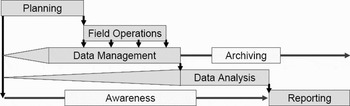
Managing an AnGR survey involves a series of activities: planning, awareness raising, field operations, data management, data analysis, data archiving and reporting of results (Figure 1). These will be described in detail in FAO's forthcoming surveying and monitoring guidelines. Points to be emphasized include the importance of considering data management and data analysis at an early stage in the planning process (well before the field operations begin). No element of the survey should be planned in isolation from the others. The plans for the field will need to be drawn up with the objectives for data analysis in mind, which in turn should be based on a realistic assessment of the resources available for the field work. It is also essential that sufficient attention and resources be devoted to data management. Failure to do so may undermine the whole survey effort. Also not to be overlooked are procedures for archiving data for the future. Legal and ethical issues related to the ownership of, and access to, the data need to be considered at an early stage in the planning; for example, in many countries there is legislation concerned with protecting personal information and legislation concerned with freedom of information, and hence, clarity in how these conflicting concerns apply to the different elements of the data from a proposed survey is essential.
Phases in the planning and implementation of a survey.

Another element that requires careful attention is the survey's communication strategy. Two phases of communication need to be planned for. The first of these phases is communication with stakeholders during the period before the field operations. This may, for example, involve bringing community leaders or other local stakeholders into the planning process, and the use of a range of communication channels (community meetings, leaflets, posters, radio, television etc.). The communication strategy must take into account the need to obtain the “prior informed consent” of those providing the data. The second phase is communicating the results of the survey promptly to all relevant stakeholders so that they can integrate the results into their work. The significance of the results to different stakeholder groups should be assessed. Appropriate channels for communicating with each of these groups should be identified. A wide range of media should be considered: face-to-face events, printed materials, audio, film, web-based communications etc. Reporting should not stop at this point. Surveys are being conducted for a purpose: to provide data that can be used to improve the sustainable management of AnGR in the areas surveyed. A workshop should be organized at which stakeholders can discuss the outcomes of the survey and plan any actions that need to be taken in response.
If the survey has been undertaken as an independent initiative (e.g. a university research project) rather than as part of a national strategy, it is important that the organizers of the survey communicate the outputs of the survey to the country's national coordinator for the Management of Animal Genetic Resources, so that inter alia the relevant data can be used to update national entries in the Domestic Animal Diversity Information System. Indeed, it is always important that national coordinators be informed in advance about plans for such surveys.
Tools for surveying
Surveys in which well-designed subsamples of holdings are visited (the so-called household surveys) are not the only type of surveys relevant to AnGR. Rather, there are a range of tools that can be used for surveying. Developing a surveying strategy requires decisions to be taken as to which tools to use and how they can best be combined to achieve the objectives that have been set, taking into account all the concrete circumstances in which the surveys will take place: technical capacity, the social structure of the rural communities being surveyed, the challenge posed by the rural landscape and − last but not least − funding. What follows is an examination of the strengths and weaknesses of some of the surveying tools that are available and of how they can be combined into an effective strategy.
Mapping expeditions
The term “mapping expedition” can be used to describe a set of journeys carried out, with little contact with local communities, for the purpose of obtaining rudimentary information on AnGR, such as the approximate geographical distribution of particular breeds and species. A mapping expedition may provide the information needed to design well-focused follow-up surveys that will use other methods. The strengths of mapping expeditions include speed and low cost. The main weakness is that only very limited knowledge of production systems and livestock-keeping communities is obtained.
Transects
In some locations, it may be possible to estimate the size of the animal population using transect methods, similar to those developed for surveying wildlife, in which trajectories are drawn a priori across the area targeted by the survey and then traversed. Counts are made of the animals observed along the transect, and complex statistical methods are then used to estimate numbers in the area as a whole. The observations made along the transect might be extended to include quantitative measurement of threats or indicators of threats (e.g. degradation of the grazing land).
Following a transect may involve little contact with the local community, but it may provide an opportunity to identify communities that can be targeted by follow-up surveying activities. Transect methods can only work quantitatively if the trajectories travelled along are representative of a wider area whose dimensions have been measured. Thus, meaningful outputs may only be obtainable in a small minority of production systems. These include systems in which a uniform production environment extends over a wide area (e.g. plains or bush-land) or systems that are “one-dimensional” (e.g. those that are only practised on river banks – in which case the trajectory can follow the river). It is more usual for livestock to be found in clusters associated with human settlements or particular geographical features (e.g. watering holes), and in such cases, to ensure representative sampling, it is more appropriate to sample the clusters in a manner analogous to the household sampling described below, rather than a transect.
The strengths of transect methods include speed, low cost and provide a means to estimate the population size. The weaknesses are that results provide little information on production systems, the associated communities and the causes behind the outcomes observed; limited applicability in the majority of production systems; and a lack of documented experience in their use to survey livestock (examples from the wildlife field include Peres, Reference Peres1999; Andriolo et al., Reference Andriolo, Piovezan, da Costa, Laake and Duarte2005; Ogutu et al., Reference Ogutu, Bhola, Piepho and Reid2006).
Aerial surveys
Aerial surveys can be thought of as airborne mapping expeditions and transects. As such, they suffer from a lack of contact with local livestock keepers. Aerial surveys can be relatively expensive because of the need for costly material resources (equipment, including air transport and cameras) and highly skilled personnel. They are appropriate only for sparsely populated and open landscapes such as those found in sub-Saharan Africa, Central Asia and parts of South America. Furthermore, the livestock need to be clearly visible from the air, which excludes small animals, such as rabbits and poultry, and housed animals (e.g. pigs in some systems). Despite these limitations, poor accessibility, unpredictable movements of pastoralists' herds and security uncertainties may justify the use of low-level aerial surveys as a means to estimate the population size and structure of livestock populations and their spatial and seasonal distributions. In some areas, such surveys may be the only realistic option for achieving systematic coverage and obtaining the data needed for comprehensive statistical analysis. Aerial surveys alone are likely to be insufficient to identify livestock populations by breed and will need to be combined with other tools for quantifying this aspect. However, aerial surveys may be an important component of surveying strategies in which other methods are used to overcome their deficiencies. Descriptions of the use of aerial methods to survey livestock can be found in Marriott and Wint (Reference Marriott and Wint1985) and Bourn et al. (Reference Bourn, Wint, Blench and Woolley1994). Further examples (involving wild and feral animals) are provided by Bayliss and Yeomans (Reference Bayliss and Yeomans1989) and Andriolo et al. (Reference Andriolo, Piovezan, da Costa, Laake and Duarte2005).
The strengths of aerial surveys include providing means to cover wide areas rapidly and to quantify livestock numbers. Weaknesses include the need for relatively expensive equipment and personnel; limited usefulness without the use of complementary methods; lack of opportunity to gain information on production systems, the associated livestock-keeping communities and the causes behind outcomes observed; and poor results if the landscapes are not open.
Household surveys
A household survey involves collecting data from a random sample of households (or holdings) chosen from among all households (or holdings) meeting a specific set of criteria. The larger is the sample as a fraction of the whole, the more accurate the survey will be as an estimator of the target group. Information is obtained via interviews, normally held face to face with household members. Such interviews are commonly based on a questionnaire, which may be more or less structured depending on the objectives and circumstances of the particular survey. With good design, household surveys allow good control over bias and precision, making them an optimal choice for baseline surveys. Examples of AnGR-focused household surveys include those described by Ayalew, van Dorland and Rowlands (Reference Ayalew, van Dorland and Rowlands2004), Rowlands et al. (Reference Rowlands, Nagda, Rege, Mhlanga, Dzama, Gandiya, Hamudikwanda, Makuza, Moyo, Matika, Nangomasha and Sikosana2003) and Zulu, Simoongwe and Zulu (Reference Zulu, Simoongwe and Zulu2003).
A good design for a household survey and associated questionnaires requires some basic prior knowledge of the production system being surveyed. For example, if the survey is intended to provide estimates of absolute numbers of animals, then it is necessary to have a good estimate of the total number of households from which the sample of households to be surveyed is drawn. A household survey may, therefore, have to be preceded by the use of other, more exploratory, tools. In some production systems, livestock-keeping households may be mobile or may split during parts of the year. Such factors have to be taken into account in the design of household surveys.
The strengths of household surveys include their flexibility for addressing a wide range of objectives; the relative ease with which data collected can be quantified, standardized and pooled compared to those obtained in other ways; good opportunities to minimize bias; the relative ease with which precision can be calibrated to match the remit; and providing opportunities to collect both quantitative and qualitative data, including some probing for more personal issues. The weaknesses include the large amount of time needed and the high cost.
Censuses
In a technical sense, a census is a household survey of wide scope and in which all qualifying households are interviewed. Most countries implement national agricultural censuses once every 10 years; they may also implement more specific livestock censuses (see for example Government of Pakistan, 2006). In some countries, the national censuses are based on sampling rather than on complete enumeration of the target populations. To date, very few national censuses have collected data at the level of the breed rather than the species. However, the inclusion of breed-wise data collection in censuses is an option that countries may wish to consider in the future.
Rapid appraisals
The term “rapid appraisal” is used here to describe data-collection activities that involve interaction with livestock keepers and/or other knowledgeable stakeholders, but are not based on formal sample-based surveys. Rapid appraisals are important alternatives to household surveys. They are normally field based, i.e. require visits to the communities targeted, and are multidisciplinary in nature (FAO, Reference Townsend1993). Field activities may be framed or complemented by the use of information drawn from secondary sources such as previous studies and reports, government statistics and records, maps of the area, research papers and historical texts (FAO, Reference Mariner and Paskin2000). Triangulation – the use of several sources in order to validate the data obtained – is a key characteristic of the approach.
Rapid appraisals involve the use of techniques that are intended to allow local people to “teach” outsiders about their livelihoods, their problems and their knowledge (FAO, Reference Townsend1993). Such techniques were among the main antecedents and building blocks of the “participatory” approaches to development that gained popularity during the 1990s. Adopting a more participatory approach can help to ensure that the data collected are interpreted correctly by the surveyors so that the social, cultural and agricultural significance of the data is understood. Furthermore, it increases the chances that the outcomes and the follow-up actions will benefit those that have supplied the data, and that support for the surveying process is built up, thus facilitating future surveys.
There are several reasons why rapid appraisal tools are likely to be important to a surveying and monitoring strategy and often to individual surveys. One of these is that household surveys are major undertakings in terms of organization and resources and may not always be possible. It is unlikely to be possible to repeat such surveys with sufficient frequency to monitor rapidly changing aspects of AnGR and their management. Moreover, a survey that focuses exclusively at the household level and obtains information only from individual livestock keepers may not be sufficient as a means to collect data on some important aspects of the production system – either because they require specialist knowledge (marketing opportunities, forthcoming policy changes or development initiatives, precise diagnosis of animal health problems etc.) or because dealing with them in individual interviews would be too time consuming or too constrained by the need for structured data that are easy to analyse. Another consideration may be that if households are treated in isolation from each other, there is little or no opportunity for communities to develop a sense of collective ownership of the surveying process or to assert their views regarding the outcomes of the survey and the actions arising from them.
While in some circumstances rapid appraisals may stand on their own, it will often be appropriate to use them in association with formal household surveys. As mentioned above, in order to be effective, a household survey may need to be preceded by activities that are more open ended and exploratory. Alternatively, rapid appraisal techniques may be used in parallel with a household survey in order to provide alternative perspectives and additional details. Another likely scenario is for a household survey to be followed, after some time has elapsed, by the use of rapid appraisal tools to investigate whether any significant changes have occurred – in other words for monitoring. Parallel use of a household survey with a rapid appraisal gives an opportunity to calibrate the rapid appraisal as a monitoring tool. If a country already has a sound baseline of data and information on most of its AnGR, monitoring using rapid appraisal techniques may be the main constituent of its surveying and monitoring strategy.
Rapid rural appraisals may include group meetings and the use of key informants. In the context of AnGR surveying and monitoring, breed societies (where they exist) are likely to be an important source of information. While breed societies with herd or flock books provide a relatively straightforward means of monitoring what is happening to specific breeds, this approach is not without its problems. For example, breed societies are non-governmental organizations, and for smaller breeds the decision-making and office work are often done on a voluntary basis. This may make communication difficult, and in some cases the society will not automatically provide information each time a request is made but will consider each request separately. Furthermore, breed societies are a special interest group, and while information on numbers is documented in the herd and flock books, these numbers may not represent the total population of a breed but instead reflect only those owned by livestock keepers who are sufficiently motivated to register. Societies may also be open to bias in minimizing threats to the breed and maximizing interest in the breed. In summary, breed societies are a valuable but imperfect asset for surveying and monitoring. A rapid rural appraisal should always seek to use triangulation to avoid biases, whereby several independent sources are used to provide a cross-validation on the emerging outcomes.
In summary, the strengths of rapid appraisals include speed relative to household surveys; low cost relative to household surveys; opportunities for greater involvement of the local communities who manage the AnGR; opportunities to investigate the causes behind the outcomes identified; and, in discussions unrestricted by predetermined questionnaires, the possibility of discovering new and surprising information. The weaknesses include greater difficulty in obtaining objective quantitative information than in household surveys; greater difficulty of standardizing and pooling data; and, in some cases, less opportunity for the surveyors to observe AnGR directly. Further information on the use of rapid and participatory appraisal techniques in livestock research can be found in the following publications: Kirsopp-Reed and Hinchcliffe (Reference Kirsopp-Reed and Hinchcliffe1994), FAO (Reference Mariner and Paskin2000), Conroy (Reference Conroy2001), LDG (2003), Conroy (Reference Conroy2005), Dorward et al. (Reference Dorward, Anderson, Nava, Pattison, Paz, Rushton and Sanchez Vera2005), FAO (2005) and LPPS and Köhler-Rollefson (Reference Köhler-Rollefson2005) and on the FAO Participation web site (www.fao.org/participation/).
Matching tools to objectives
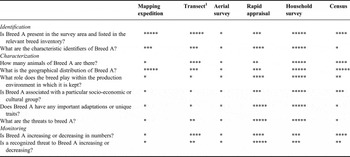
Not all tools will be suitable for answering all the questions addressed by a surveying and monitoring strategy or an individual survey. Table 1 gives an indication of the suitability of the various tools for answering different kinds of questions concerning AnGR.
An indication of the usefulness of tools to address objectives listed when used as a single strategy

Asterisk numbers indicate relative usefulness.
1Assuming a transect approach is feasible in the production environment.
Mixing tools: a perspective
During the early stages of a surveying and monitoring strategy, fundamental gaps in knowledge will need to be addressed. It is possible that at this point an aerial survey or a mapping expedition will provide a means to acquire a lot of valuable information. Rapid appraisals may also be useful during the early stages of the strategy as a means to obtain information on, inter alia, the roles of livestock and threats to AnGR; these appraisals may frame more detailed follow-up surveys. In discussing this point, Marsland et al. (Reference Marsland, Wilson, Abeyasekera and Kleih2001) quote the following concise summary from ABRMC (1989), which is highly relevant despite the very different setting of marketing: “Prior to any large-scale quantitative study particularly in a relatively unknown market, it is strongly recommended that a qualitative phase of research is initially conducted, the main purpose being to understand the vocabulary and language used by customers as well as understanding their motivations and attitudes towards given services, products and usage associations. The findings of the qualitative research provide invaluable input to the quantitative stage in terms of the line and tone of questioning, and of course the overall structure and content of the quantitative phase”. This emphasizes the benefits of using participatory approaches at an early stage when knowledge and understanding are vague.
Box 1. Maintaining continuity in surveying and monitoring outputs
The specific methods used to survey a particular area or production system may change over time as circumstances in the areas and production systems target change and as new techniques are developed. The shift from one method to another needs to be carefully managed in order to ensure comparability between older and newer data. It is important that at the time of the change, both the old and the new methods are used at the same time for at least two, preferably more, appraisals. This allows the old method to be “calibrated” against the new method, so that continuity of information can be maintained. The figure demonstrates the importance of calibration. A survey team has used an “old” method to count the number of animals during several rounds of surveying (the results are indicated by the empty circles in the figure). A decision is taken to introduce a new, more suitable, method of collecting data (results are indicated by the shaded circles). If the new method is introduced at time 4 (see the figure) with no preparation, the conclusion may be that a sharp drop in numbers has occurred (the solid line in the figure represents the official figures that would be reported by the survey team). Of course, it may be pointed out that the method has changed, but at best this will only lead to the conclusion that nothing is clear, leaving an uneasy fear that a drop has indeed occurred. Conversely, if the survey team had prepared for the change and used both methods at times 2 and 3, then it would be clear that the new method provides lower values than the old method and that the rate of change indicated by the two methods is very similar. In this case, it can be concluded that there has been no change in the population trend – perhaps even a slight increase in numbers. The change to a more suitable method has been implemented successfully. If the new method had only been used alongside the old method on one previous occasion, it would not have been possible to see both: (a) the new method tends to result in lower estimates of population size than the old method, and (b) the relative sensitivity of the new method to changes in population size compared to the old method.

Even though rapid appraisals may indicate trends and even numbers (e.g. by scaling answers from representatives at group meetings by the numbers they might represent), there are inadequacies and biases in these kinds of methods. Consequently, the results they produce may be very misleading for the purposes of planning. It is, therefore, highly recommendable that at some point a baseline household survey be undertaken. This will provide the opportunity for more comprehensive information gathering and to minimize biases. Findings that are reliably quantified with reasonable precision have greater impact – people sit up and take notice! The preliminary work using rapid appraisals should help with the design of the household survey. Moreover, if the rapid appraisals have been of a participatory nature, the planning may be smoother and communication easier.
Results from a baseline household survey will form a reference point for monitoring. It is, however, unlikely to be feasible to repeat household surveys at sufficiently short intervals to allow fully effective monitoring of changes in breed population size and structure. Rapid appraisals (including, where possible, obtaining information from breed societies) are therefore likely to be important components of the monitoring strategy. It is sensible to conduct rapid appraisals at the same time (or very close to the same time) as the household survey to enable an assessment of the reliability of the rapid appraisals. This has long-term benefits: first, it will offer an opportunity to change the protocols for the rapid appraisals to eliminate the worst errors; and second, because a relationship can be established between the rapid appraisal and a more formal survey, the monitoring programme will be able to use the cheaper rapid appraisal methods with greater confidence (see Box 1). Once in a while, however – say once every decade – a household survey is required to keep the calibration reliable.
Conclusions
Surveys are essential building blocks of effective national action to improve the management of AnGR and to meet international reporting obligations. Well-planned national surveying and monitoring strategies will help ensure that surveying efforts are coordinated and cost effective. A range of surveying tools is available to be drawn upon as part of surveying strategies or individual surveys. Tools should be selected to match data-gathering objectives, which in turn should aim to address gaps in knowledge and to track changes over time with sufficient accuracy to allow remedial measures to be taken when threats to AnGR diversity are identified. If the surveying tools used change over time, it is important that strategies account for the need to calibrate methods to ensure comparable results that can be used to provide an accurate indication of trends.
Even if no national surveying and monitoring strategy is yet in place, it is important that surveying initiatives do not take place in isolation. Relevant stakeholders, and in particular national coordinators for the management of AnGR, should be made aware of any proposed surveys, supplied with the outputs of the survey, and involved in the planning and implementation of any follow-up activities.
Acknowledgements
John A. Woolliams gratefully acknowledges funding from BBSRC in the United Kingdom. The authors are grateful for detailed discussions with the participants at the workshop on the development of surveying and monitoring guidelines held in Peebles, UK, in March 2009: Workneh Ayalew, Ilse Köhler-Rollefson, Oswald Matika, Siboniso Moyo and Hongjie Yang.