Sudden cardiac death continues to come into the spotlight and prevention is the focus of screening competitive athletes. In the United States, hypertrophic cardiomyopathy and coronary artery anomalies account for the leading two causes of sudden death in athletes.Reference Maron, Thompson and Ackerman 1 In a registry of athletes who had sudden cardiac death, 36% of patients were identified as having hypertrophic cardiomyopathy.Reference Maron, Thompson and Ackerman 1 Of the coronary anomalies resulting in sudden cardiac death, anomalous origin of the left main coronary artery from the right sinus of Valsalva represents the most common lesion.Reference Eckart, Scoville and Campbell 2 , Reference Virmani, Burke and Farb 3 Whereas left ventricular hypertrophy has been observed with anomalous origin of the coronary artery, the combination of hypertrophic cardiomyopathy and anomalous coronary origin is not commonly seen. We present a case of an anomalous origin of the left main from the right coronary sinus with associated gene-confirmed hypertrophic cardiomyopathy and review the literature regarding anomalous coronary origin and hypertrophic cardiomyopathy.
Case presentation
An 18-year-old boy presented to the emergency department for evaluation following a syncopal episode occurring the day before presentation. While exercising at the gym, he felt palpitations with associated lightheadedness and blurry vision. He then reportedly became unresponsive for ~10 minutes after which he regained consciousness without intervention. He was initially taken to an urgent care facility where computed tomography of the head and electroencephalogram were performed and were within normal limits. He was subsequently transferred to our institution for further work-up.
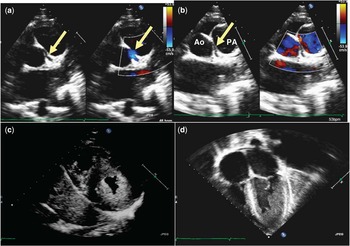
On further questioning, he reported a similar episode 9 months prior. In addition, he also had symptoms of lightheadedness and palpitations occurring consistently with exercise. His past medical history was notable for attention deficit hyperactivity disorder and oppositional defiant disorder. He was not on any medications. On physical examination, he was noted to have a systolic ejection murmur along the upper sternal border with normal vital signs. An electrocardiogram (Fig 1) revealed sinus bradycardia with marked sinus arrhythmia, left ventricular hypertrophy with strain pattern and ST-segment elevation in the anterior leads. Initial laboratory data revealed a normal basic metabolic profile, total creatine kinase of 748 U/L (34–147 U/L), CK-MB of 2.4 ng/ml (<1.7 ng/ml) and troponin I of <0.01 ng/ml (<0.01 ng/ml) [normal values in parentheses]. A two-dimensional echocardiogram (Fig 2) revealed an anomalous origin of the left main coronary artery from the right septal sinus of Valsalva with an intramural course in addition to apical hypertrophy.
Echocardiogram on presentation revealed sinus bradycardia with sinus arrhythmia, ST elevation in anterior leads and left ventricular hypertrophy with strain pattern.

Echocardiogram, pre-operative. ( a ) Anomalous origin of the left main coronary (see arrow) from the right aortic cusp in the parasternal short-axis view. ( b ) Intramural course of anomalous left coronary artery between the aorta and pulmonary artery. ( c ) Apical left ventricular hypertrophy in the parasternal short-axis view. ( d ) Apical left ventricular hypertrophy in the apical four-chamber view. Ao=aorta; PA=pulmonary artery.

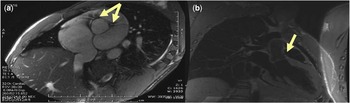
The patient was admitted to the general cardiology floor for monitoring and further work-up before surgical repair. Serial cardiac enzymes were negative and the patient remained symptom free during the pre-operative period. A cardiac magnetic resonance imaging study (Fig 3) was performed and confirmed the anomalous origin and likely intramural course of the left main coronary artery from the right coronary artery. In addition, there was mild concentric left ventricular hypertrophy, left ventricular apical hypertrophy, and late gadolinium enhancement in the anterior lateral papillary muscle suggestive of prior infarction versus fibrosis.
Magnetic resonance imaging, pre-operative. ( a ) Short-axis steady-state free-precession cardiac magnetic resonance imaging showing the origin and course of the left coronary artery from the right aortic cusp (see arrows). ( b ) Double inversion recovery cardiac magnetic resonance image demonstrating intramural course of left coronary artery between the aorta and the main pulmonary artery segment (see arrow) in a “pseudo” three-chamber view.

The patient underwent surgical repair with unroofing of the intramural portion of the left coronary artery and resuspension of the aortic valve commissure. He was treated with a β blocker in the post-operative period; however, the patient discontinued this medication on his own before his first outpatient visit. During that visit, he did not complain of any chest pain. Since then, the patient did not present for subsequent follow-up. Attempts have been made to contact the patient and his family, but he continues to be lost to follow-up. During his initial presentation, genetic testing was sent to evaluate for hypertrophic cardiomyopathy and ultimately the patient tested positive for a mutation associated with hypertrophic cardiomyopathy – MT-TK, a mitochondrial transfer-RNA. It is difficult to know whether his initial presenting symptoms were secondary to his coronary anomaly, hypertrophic cardiomyopathy, or both, as he has been lost to follow-up.
Discussion
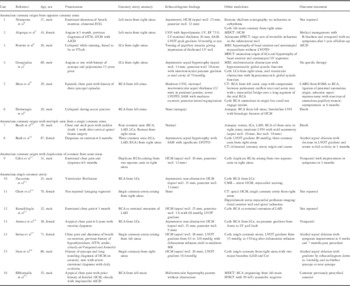
Screening for causes of sudden cardiac death remains a focus in young adults involved in competitive sports. We report a case of a teenager with both anomalous left coronary artery from the right coronary cusp and gene positive apical hypertrophic cardiomyopathy. Although there have been several reports of anomalous origin of the coronary artery and left ventricular hypertrophy, this is the first reported case of gene positive hypertrophic cardiomyopathy with anomalous left coronary artery from the right sinus of Valsalva (see Table 1). As summarised in Table 1, initial presentation with this combination of defects can occur at a variety of ages. Our case is currently the youngest of the reported cases of anomalous coronary origin and hypertrophic cardiomyopathy. Most cases were of a left coronary artery arising from the right coronary cusp; however, a variety of other combinations are present including right coronary artery from the left coronary cusp, single coronary variants and multiple coronary arteries arising from a single coronary ostium. The most commonly reported symptom leading to evaluation was chest pain and syncope. Diagnosis was initially made through echocardiography, which detected ventricular hypertrophy. Unlike our reported case, the coronary anomaly was usually diagnosed by additional studies including cardiac magnetic resonance imaging, cardiac computed tomography, and in one case autopsy. Management varied from medical management with β or calcium channel blockers, automatic implantable cardioverter defibrillator placement and/or surgical intervention.
Current reported cases of anomalous coronary origin and hypertrophic cardiomyopathy.

AICD=automatic implantable cardioverter defibrillator; CABG=coronary artery bypass grafting; Cath=cardiac catheterisation; CMR=cardiac magnetic resonance; CT=computed tomography; ECG=electrocardiogram; EF=ejection fraction; HCM=hypertrophic cardiomyopathy; HTN=hypertension; LAD=left anterior descending artery; LCx=left circumflex artery; LV=left ventricle; LVH=left ventricular hypertrophy; LVOT(O)=left ventricular outflow tract (obstruction); MDCT=multi-detector computed tomography; MR=mitral regurgitation; MRI=magnetic resonance imaging; RCA=right coronary artery; RIMA=right internal mammary artery; SAM=systolic anterior motion; SPECT=single-photon emission computed tomography; VTach=ventricular tachycardia.
Previous autopsy studies on patients with anomalous origin of a coronary artery have not reported the presence of ventricular hypertrophy, but further studies are needed to determine whether there is an association.Reference Basso, Maron, Corrado and Thiene 20 , Reference Maron, Doerer, Haas, Tierney and Mueller 21 It is possible that hypertrophy can develop over time because of changes seen with chronic ischaemia. In addition, hypertrophy may develop as a response to locally produced vasoactive peptides such as angiotensin II or endothelin 1.Reference Komuro 22 , Reference Yamazaki, Komuro and Kudoh 23
There may be a genetic correlation between anomalous coronary artery origin and hypertrophic cardiomyopathy that has been previously unrecognised. Given the apical hypertrophy seen on echocardiogram and magnetic resonance imaging in our case, gene testing was done to evaluate for inheritable causes of hypertrophic cardiomyopathy. The panel tests for 18 of the most common disease-causing mutations associated with hypertrophic cardiomyopathy. The MT-TK gene encodes a mitochondrial transfer-RNA responsible for inserting lysine into protein chains. 24 Mutations in the gene have been implicated in maternally inherited diabetes mellitus and deafness, myoclonic epilepsy, Leigh syndrome and cardiomyopathy – hypertrophic and dilated. 24 As a whole, mitochondrial gene defects leading to isolated hypertrophic cardiomyopathy are rare and according to Correlagen, a cardiogenetics testing group,<1% of cases of hypertrophic cardiomyopathy are due to a defect in the MT-TK gene.Reference Bindoff 25 , Reference Marin-Garcia and Goldenthal 26 In contrast to the published cases, our case is the first reported in the literature in which gene testing confirmed a mutation associated with hypertrophic cardiomyopathy in association with anomalous origin of a coronary artery.
This case again highlights the possible association between anomalous origins of the coronary arteries and hypertrophic cardiomyopathy. Although this case appears to be the first to report a specific gene mutation associated with hypertrophic cardiomyopathy, it is unclear whether the myocardial changes are reflective of the anomalous coronary origin, an underlying genetic abnormality, or the combination of both. Further research is needed to determine whether a true link exists between these two causes of sudden cardiac death.
Acknowledgement
The authors would like to thank Kohei Sumihara for his assistance in reference translation.
Financial Support
This research received no specific grant from any funding agency, commercial or not-for-profit sectors.
Conflicts of Interest
None.