Introduction
Migrant and ethnic minority populations have, approximately, a three-fold increased incidence of schizophrenia (Cantor-Graae & Selten, Reference Cantor-Graae and Selten2005; Cantor-Graae, Reference Cantor-Graae2007). In the UK, elevated rates of schizophrenia have been reported for Black and Minority Ethnic (BME) populations when compared with the majority White British population, with the highest rates for Black Caribbean, followed by Black African and then Asian groups (Fearon et al. Reference Fearon, Kirkbride, Morgan, Dazzan, Morgan, Lloyd, Hutchinson, Tarrant, Fung, Holloway, Mallett, Harrison, Leff, Jones and Murray2006). Ethnic disparities exist in treatment access, experiences and outcomes of schizophrenia, with disadvantages consistently reported for minority populations in Western countries (i.e. countries derived from and influenced by European cultures). UK research and policies have highlighted inequalities for ethnic minorities, including poorer engagement with services and professionals, more coercive care pathways, compulsory hospital admissions and involvement in the criminal justice system, higher doses of medication and inferior access to psychological therapies (Keating et al. Reference Keating, Robertson, McCulloch and Francis2002; Bhui et al. Reference Bhui, Stansfeld, Hull, Priebe, Mole and Feder2003; Department of Health, 2005; The Sainsbury Centre for Mental Health, 2006).
Current guidelines in the UK and USA (Dixon et al. Reference Dixon, Dickerson, Bellack, Bennett, Dickinson, Goldberg, Lehman, Tenhula, Calmes and Pasillas2010; National Institute for Health & Care Excellence, 2014) recommend cognitive behavioural therapy (CBT) and family intervention (FI) for schizophrenia based on meta-analytic evidence of effectiveness (Wykes et al. Reference Wykes, Steel, Everitt and Tarrier2008; Pharoah et al. Reference Pharoah, Mari, Rathbone and Wong2010). However, it is unclear whether the effectiveness of these interventions generalises across ethnic groups since ethnic minorities remain underrepresented in clinical trials of most psychological interventions (Hussain-Gambles et al. Reference Hussain-Gambles, Atkin and Leese2004; Brown et al. Reference Brown, Marshall, Bower, Woodham and Waheed2014; Waheed et al. Reference Waheed, Woodham, Hughes-Morley, Allen and Bower2015). It has been suggested that outcomes of psychosocial interventions are poorer for ethnic minorities than Caucasians (Bhugra et al. Reference Bhugra, Leff, Mallett, Der, Corridan and Rudge1997). This is perhaps not surprising given that most psychosocial interventions have been developed in the West (i.e. Europe or the USA) and are underpinned by Western cultural values.
Culture has been defined as ‘…the set of distinctive spiritual, material, intellectual and emotional features of society or a social group… it encompasses, in addition to art and literature, lifestyles, ways of living together, value systems, traditions and beliefs’ [United Nations Educational, Scientific and Cultural Organisation (UNESCO, 2001)]. There is evidence that people are more likely to seek help and engage with psychiatric and psychological treatment when their cultural beliefs and explanatory models are considered (Bhui & Bhugra, Reference Bhui and Bhugra2004; Rathod et al. Reference Rathod, Kingdon, Phiri and Gobbi2010; Carter et al. Reference Carter, Read, Pyle and Morrison2016). Therefore, to improve acceptability and effectiveness of treatment, there has been growing interest in adapting interventions in schizophrenia to be congruent with the cultural contexts and values of minority populations (e.g. Rathod et al. Reference Rathod, Phiri, Harris, Underwood, Thagadur, Padmanabi and Kingdon2013; Edge et al. Reference Edge, Degnan, Cotterill, Berry, Drake, Baker, Barrowclough, Hughes-Morley, Grey and Bhugra2016). Adaptation and evaluation of such interventions is also necessary to allow psychosocial treatment to be evidenced in majority populations in low and middle income countries’ (LMIC) (Feigin, Reference Feigin2016).
Systematic reviews of cultural-adaptations of psychosocial interventions for mental illness (Griner & Smith, Reference Griner and Smith2006; Huey & Polo, Reference Huey and Polo2008; Benish et al. Reference Benish, Quintana and Wampold2011; Smith et al. Reference Smith, Rodríguez and Bernal2011; Chowdhary et al. Reference Chowdhary, Jotheeswaran, Nadkarni, Hollon, King, Jordans, Rahman, Verdeli, Araya and Patel2014) find adapted interventions’ mean effect sizes for primary outcomes (0.41–0.72) comparable with non-adapted interventions in Western populations (e.g. 0.35–0.44; Wykes et al. Reference Wykes, Steel, Everitt and Tarrier2008). However, most systematic reviews have included diagnostically and ethnically mixed samples and not attempted to disentangle how far these factors shape interventions’ effects. Few have analysed the nature of cultural adaptations systematically to provide an empirically derived framework or model of adaptation. Without a framework to describe adaptation it is difficult to examine what type or degree of adaptation is efficacious.
Chowdhary et al. (Reference Chowdhary, Jotheeswaran, Nadkarni, Hollon, King, Jordans, Rahman, Verdeli, Araya and Patel2014) conducted a systematic review of 20 controlled trials of culturally adapted psychological treatments for depression, including CBT, interpersonal therapy, psychoeducation, problem-solving therapy and dynamic oriented therapy. They used a framework developed by Bernal & Sáez-Santiago (Reference Bernal and Sáez-Santiago2006) to describe adaptations, which were mostly within the language, therapist and context dimensions. They reported effect size (SMD) −0.72 for depressive symptoms but noted that the small number of studies, incompleteness of data and significant heterogeneity in context, interventions and study design prevented comparison of the degree or types of adaptations across different interventions.
Bhui et al. (Reference Bhui, Aslam, Palinski, McCabe, Johnson, Weich, Singh, Knapp, Ardino and Szczepura2015) reviewed 21 studies of various designs to identify adaptations in a wide range of interventions designed to improve therapeutic communications between BME patients and clinicians in psychiatric services. Thematic analyses classified adaptations somewhat broadly using Tseng's (Reference Tseng2001) framework, which includes ethnic matching, changes to structure and content, technical delivery or structure of therapy, working with social systems, and facilitating empowerment and engagement. Culturally-adapted psychotherapies, ethnographic and motivational assessment were found to be effective and preferred by patients and carers; and high quality trials’ efficacy for outcomes including symptoms and medication adherence were d = 0.18–0.75.
It is therefore clear that evidence-based psychosocial interventions for schizophrenia spectrum diagnoses, originally developed in the West, are an important element of therapy that require adaptation for both minority ethnic groups in Western countries; and for majority ethnic groups in non-Western countries. However, it is not clear to what extent these contrasting types of adaptation are successful, or even whether different types of adaptation and target ethnic groups are comparable. One obstacle to understanding adaptations’ importance in psychosocial interventions for schizophrenia is that none of the existing frameworks describing cultural adaptations (Tseng, Reference Tseng2001; Barrera & Castro, Reference Barrera and Castro2006; Bernal & Sáez-Santiago, Reference Bernal and Sáez-Santiago2006; Hwang, Reference Hwang2009) focus on interventions specific to this area. The review therefore had two aims: (1) to analyse inductively the nature of cultural-adaptations to psychosocial interventions and develop a framework describing the adaptations identified across controlled trials in schizophrenia; and (2) to assess the efficacy of adapted psychosocial interventions for schizophrenia spectrum diagnoses and examine the effect of differences between interventions, samples and other context and design features on outcome.
Methods
The review followed Preferred Reporting Items for Systematic Reviews and Meta-analyses (PRISMA) guidelines (Moher et al. Reference Moher, Liberati, Tetzlaff, Altman and Group2009).
Search strategy and study selection
On 3 March 2016 the lead author (AD) conducted an electronic database search of Ovid MEDLINE, EMBASE, PsycINFO and Web of Science. Databases were searched from inception. See A1 online Supplementary Material for search strategy. Two co-authors (AD and SB) independently screened the articles for eligibility using the following criteria:
Inclusion criteria
-
• Trials of any design evaluating a culturally adapted evidence-based psychosocial intervention (i.e. psychotherapies or interventions that address psychological and social factors to improve psychological and social functioning).
-
• Adaptations are made to the format, delivery or content of an existing Western intervention (i.e. influenced by European culture, including Europe, USA, Canada and Australia) to meet the cultural needs of a specific ethnic group or subculture (i.e. minority culture within a larger dominant culture).Trials evaluate interventions adapted for a minority ethnic population in a Western country or any non-Western population.
-
• Participants 18 years+ with a diagnosis of schizophrenia (DSMIV or ICD-10 F20-29: schizophreniform disorder, schizoaffective disorder, delusional disorder or psychosis not otherwise specified).
-
• At least one validated patient outcome measure to provide information on clinical effectiveness.
-
• Peer-reviewed published articles available in English.
Exclusion criteria
-
• Adaptations are generalised across multiple ethnic groups (and no findings available per group, despite author contact).
-
• Interventions without specific adaptations for culture; including assessment of an existing intervention in a different subculture or ethnic group without adaptation, direct translation only, or adapting for some other characteristic such as age or location (e.g. rural v. urban).
-
• A novel intervention developed specifically for a particular subculture or ethnic group without adaptation of an existing evidence-based intervention (derived from a Western model).
-
• Non-evaluative studies (e.g. literature reviews, qualitative studies, case studies).
Full text papers of potentially relevant articles were accessed and screened by two reviewers (AD and SB). Authors were contacted to request English versions of non-English citations and those that could not be accessed. Reference lists of full text articles and systematic literature reviews were screened to identify any additional papers not picked up in the search. Key experts were contacted with full reference lists to identify missing studies. All uncertainties or disagreements relating to eligibility of articles were resolved via discussion with the senior author (RD).
Data extraction
Descriptive characteristics of eligible studies were recorded in a data extraction spreadsheet. All adaptations described in the papers were extracted and summarised. Where there was limited information, corresponding authors were contacted and adaptations were extracted from any material they provided such as written summaries, protocol and treatment manuals. Sample size, means and standard deviations for symptom scores for adapted intervention(s) and control(s) at each time point (baseline and follow-up(s)) were recorded. Authors were contacted for unreported data to calculate effect sizes.
Analysis of cultural-adaptation
Our aim was to review the current literature on cultural adaptations in schizophrenia and provide a synthesis that was grounded in empirical work and evidence. Thematic analysis (Braun & Clarke, Reference Braun and Clarke2006) was applied inductively to the extracted and summarised data on adaptations to generate themes and subthemes emerging from the data. This therefore reflected current application in the field, rather than deductively applying an existing model or framework to the data. We used Braun and Clarke's six phased approach: (1) data familiarisation; (2) generating codes (identifying adaptations in most basic form); (3) searching for themes (identifying common areas of adaptation repeated across studies and combine into themes and subthemes); (4) reviewing themes; and (5) defining and naming themes.
Analysis of outcomes
Meta-analyses were conducted to examine the effects of culturally-adapted interventions on symptoms in schizophrenia. We focused on symptoms as this was the most commonly reported outcome, and assessed using reliable, validated and comparable scales. Only randomised controlled trials (RCTs) were included in the meta-analyses as they provide the most robust evidence of effectiveness (Concato et al. Reference Concato, Shah and Horwitz2000).
Meta-analyses were performed using Review Manager (version 5.3) software. Effect sizes were calculated using Hedge's (adjusted) g, which consists of the difference between the means of the adapted intervention v. the control group divided by the pooled standard deviation (corrected for sample size) and then further weighted for sample size (Hedges & Olkin, Reference Hedges and Olkin2014). 95% confidence intervals (CI) are presented.
Cochrane's risk of bias tool (Higgins et al. Reference Higgins, Altman, Gøtzsche, Jüni, Moher, Oxman, Savović, Schulz, Weeks and Sterne2011) was used to assess the quality of RCTs by rating the level of bias (unclear, low, high) across six domains: sequence generation, allocation concealment, blinding of outcome assessors, incomplete outcome data, selective outcome reporting, and other sources of bias. Four RAs independently assessed all the studies and the lead author (AD) made final decisions on discrepant ratings. Publication bias was explored by examination of funnel plots (Higgins & Green, Reference Higgins and Green2008) and there was evidence of slight asymmetry for positive symptoms (Egger et al. Reference Egger, Smith, Schneider and Minder1997). See online Supplementary for risk of bias assessments (A2) and funnel plots (A3).
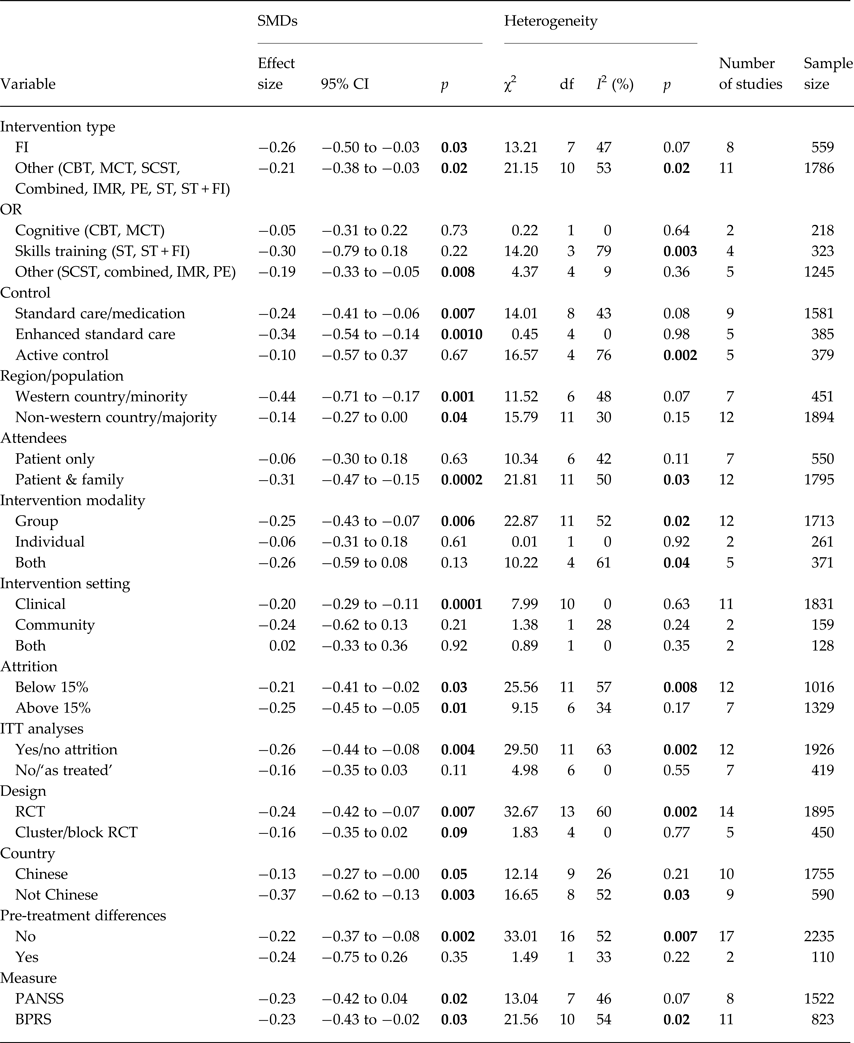
Heterogeneity of effects was assessed using I 2 tests (Higgins & Thompson, Reference Higgins and Thompson2002) and explored using sensitivity and subgroup analyses to see if any outliers, pre-treatment differences, or intervention or study characteristics biased the results (see Table 1 for list of variables in subgroup analyses). Given the expected and observed variation across studies, random effects models were applied as they provide conservative estimates adjusted for observed heterogeneity (Brockwell & Gordon, Reference Brockwell and Gordon2001; Kontopantelis & Reeves, Reference Kontopantelis and Reeves2010).
Subgroup analyses of RCTs of culturally-adapted interventions for schizophrenia (total symptoms; post-intervention; n = 19)

CBT, Cognitive Behavioural Therapy; MCT, Metacognitive Therapy; SCST, Social Cognitive Skills Training; IMR, Illness Management and Recovery Programme; PE, Psychoeducation; ST, Skills Training; FI, Family Intervention; ITT, intention to treat; RCT, randomised controlled trial; PANSS, Positive and Negative Symptom Scale; BPRS, Brief Psychiatric Rating Scale.
Bold values are significant at p < 0.05.
Results
Study characteristics
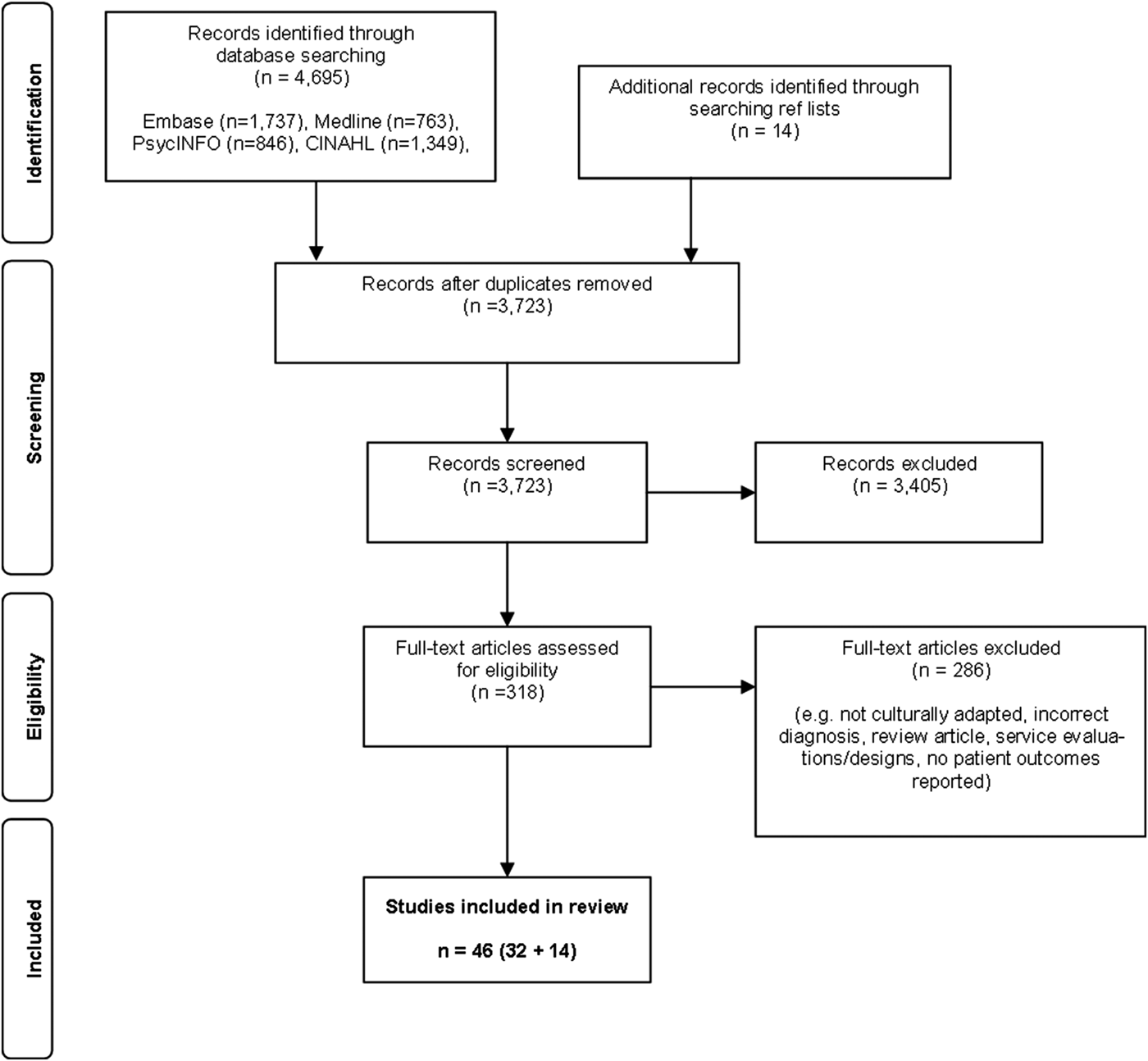
In total, 46 papers comprising 43 individual studies with 7828 participants were included; 31 simple RCTs, 12 cluster RCTs, one block RCT and two non-randomised pilot trials. Sample sizes ranged from six to 3082 with a mean of 182. See Fig. 1 for the PRISMA flow-chart and online Supplementary for Table A4 of descriptive characteristics of studies.
PRISMA flow diagram.

Intervention characteristics
Interventions were delivered in 13 different countries. The majority (74%, n = 34) were conducted in Asia (25 in China, two in each of Pakistan, Taiwan, India and one in each of Iran, Saudi Arabia and Malaysia). Nine studies (20%) were conducted in America (six in the USA; two in Mexico; and one in Brazil) and one study (2%) was conducted in each of Europe (Italy), Australia and Africa (Egypt). Most interventions (85%, n = 39) were adapted for a majority population with only seven studies (15%) adapted for a minority population.
Around half of the studies (54%, n = 25) were family interventions (FI) consisting of a psycho-educational or mutual support component. FIs varied across the studies in terms of their components and the evidence-based models they were adapted from. Twenty two studies (88%) included group FI sessions. In 12 (48%) studies, all of the sessions were designed for the family members and patients to attend together, in five (20%) patients attended at least part of the intervention (25–86% of the sessions), and in eight (32%) only family members were invited. Ten studies (22%) evaluated some form of cognitive therapy, consisting of three social cognitive skills training, one social cognitive remediation therapy, three cognitive behavioural therapies (CBT), two meta-cognitive training (MCT), and one integrated psychological therapy (IPT). Family members attended two of the CBT interventions; the remaining eight cognitive interventions were for patients only. Three studies (7%) were combined interventions comprising components adapted from multiple Western therapy manuals and theoretical frameworks. One of these was a combined psychosocial intervention that included family therapy sessions. The other two were symptom coping programmes for patients only. Five studies (11%) assessed social skills training (SST). Family members attended four of the SST interventions. Of the remaining interventions, two (4%) were illness management and recovery (IMR) programmes and one (2%) comprised a mindfulness-based psycho-education programme, both for patients only.
Over half of the interventions (59%, n = 27) were delivered in a clinical setting. Six were delivered in community settings and four delivered sessions in both clinical and community settings. Nine studies did not report intervention setting. Duration of interventions ranged from 3 weeks (Lin et al. Reference Lin, Chan, Shao, Lin, Shiau, Mueser, Huang and Wang2013) to 2 years (Zhang & Yan, Reference Zhang and Yan1993; Xiong et al. Reference Xiong, Phillips, Hu, Wang, Dai, Kleinman and Kleinman1994; Zhang et al. Reference Zhang, He, Gittelman, Wong and Yan1998; Carrà et al. Reference Carrà, Montomoli, Clerici and Cazzullo2007), with a mean of 8 months. The majority of the interventions were led by mental health professionals (80%, n = 37); five of these (all assessing group FIs) were co-facilitated by a family member participating in the study. Five studies did not specify therapist training.
Characteristics of the interventions are described in online Supplementary Table A5.
Cultural adaptations
A total of nine themes emerged from the data on adaptations. Details of the themes describing cultural-adaptations, with examples from the reviewed studies, are described in online Supplementary (Table A6).
Language
Language adaptations were reported in all 46 studies: translating the original intervention into the national language (e.g. Xiang et al. Reference Xiang, Ran and Li1994; Bradley et al. Reference Bradley, Couchman, Psych, Perlesz, Nguyen, Singh and Riess2006; Koolaee & Etemadi, Reference Koolaee and Etemadi2009; Kumar et al. Reference Kumar, Zia Ul Haq, Dubey, Dotivala, Veqar Siddiqui, Prakash, Abhishek and Nizamie2010), including local colloquialisms and idioms to improve cultural relevance and acceptability (Gohar et al. Reference Gohar, Hamdi, Lamis, Horan and Green2013; Habib et al. Reference Habib, Dawood, Kingdon and Naeem2015; Naeem et al. Reference Naeem, Saeed, Irfan, Kiran, Mehmood, Gul, Munshi, Ahmad, Kazmi and Husain2015; So et al. Reference So, Chan, Chong, Wong, Lo, Chung and Chan2015), and/or exchanging jargon for more culturally-appropriate words (e.g. replacing ‘module’ with ‘treatment areas’; Valencia et al. Reference Valencia, Rascon, Juarez, Escamilla, Saracco and Liberman2010; Naeem et al. Reference Naeem, Saeed, Irfan, Kiran, Mehmood, Gul, Munshi, Ahmad, Kazmi and Husain2015; So et al. Reference So, Chan, Chong, Wong, Lo, Chung and Chan2015).
Concepts and illness models
Most interventions (78%, n = 36) incorporated culturally appropriate presentations of concepts, with consideration of culture-specific belief systems, enhanced mental health stigma and low levels of education. This included working with alternatives to the ‘biopsychosocial’ model, including the attribution of mental illness to spiritual or supernatural agents (Razali et al. Reference Razali, Hasanah, Khan and Subramaniam2000; Kopelowicz et al. Reference Kopelowicz, Zarate, Wallace, Liberman, Lopez and Mintz2012), predestination and fate (Koolaee & Etemadi, Reference Koolaee and Etemadi2009), and an imbalance of yin and yang forces (Chan et al. Reference Chan, Yip, Tso, Cheng and Tam2009). Some studies reported the inclusion of spiritual factors in formulations and discussion of locally held beliefs in psychoeducation (e.g. Habib et al. Reference Habib, Dawood, Kingdon and Naeem2015; Naeem et al. Reference Naeem, Saeed, Irfan, Kiran, Mehmood, Gul, Munshi, Ahmad, Kazmi and Husain2015). Stigma was addressed by sharing personal stories and recovery narratives for normalisation, and holding group forums for participants to discuss concerns (Chien & Chan, Reference Chien and Chan2004; Chien, Reference Chien2008; Guo et al. Reference Guo, Zhai, Liu, Fang, Wang, Wang, Hu, Sun, Lv and Lu2010; Lin et al. Reference Lin, Chan, Shao, Lin, Shiau, Mueser, Huang and Wang2013). Due to varied understanding and experience of mental illness and low education levels in certain cultural contexts, adaptations were made to alter the complexity and amount of psychoeducation or therapy material provided to make it more manageable for patients and families (Patterson et al. Reference Patterson, Bucardo, McKibbin, Mausbach, Moore, Barrio, Goldman and Jeste2005; Zimmer et al. Reference Zimmer, Duncan, Laitano, Ferreira and Belmonte-de-Abreu2007; Kung et al. Reference Kung, Tseng, Wang, Hsu and Chen2012).
Family
Most individual interventions (76%, n = 35) were adapted to acknowledge the pivotal role of the family in patient's care and recovery, as well as culturally distinct family structures and processes. This included efforts to encourage families’ active and continued involvement throughout the intervention (Carrà et al. Reference Carrà, Montomoli, Clerici and Cazzullo2007; Habib et al. Reference Habib, Dawood, Kingdon and Naeem2015); e.g. offering additional sessions or informal home visits for family members and maintaining contact after treatment (Xiong et al. Reference Xiong, Phillips, Hu, Wang, Dai, Kleinman and Kleinman1994; Shin & Lukens, Reference Shin and Lukens2002; Bradley et al. Reference Bradley, Couchman, Psych, Perlesz, Nguyen, Singh and Riess2006; Kung et al. Reference Kung, Tseng, Wang, Hsu and Chen2012). Modifications to accommodate more interdependent family structures and higher value being put on familial responsibility than individualism (e.g. Li & Arthur, Reference Li and Arthur2005; Chien, Reference Chien2008) included involving family members in decision-making, assessing the needs of the family as a whole, and for example emphasising how medication adherence would benefit the family unit rather than the individual (Patterson et al. Reference Patterson, Bucardo, McKibbin, Mausbach, Moore, Barrio, Goldman and Jeste2005; Mausbach et al. Reference Mausbach, Bucardo, McKibbin, Goldman, Jeste, Patterson, Cardenas and Barrio2008; Kopelowicz et al. Reference Kopelowicz, Zarate, Wallace, Liberman, Lopez and Mintz2012). Further considerations included sensitivity to culture-specific roles and expectations, e.g. expecting younger members not to question their elders (Chien & Chan, Reference Chien and Chan2004; Koolaee & Etemadi, Reference Koolaee and Etemadi2009; Valencia et al. Reference Valencia, Rascon, Juarez, Escamilla, Saracco and Liberman2010).
Communication
Twenty two (48%) studies reported adaptations to integrate culturally-specific ways of communicating and learning. This included culturally-appropriate methods for dealing with conflict and problem solving, e.g. preference for reparative action rather than discussion in Chinese cultures (Chien & Chan, Reference Chien and Chan2004, Reference Chien and Chan2013; Chien, Reference Chien2008; Chien et al. Reference Chien, Thompson and Norman2008; Chien & Lee, Reference Chien and Lee2010) and replacing concepts of assertiveness and expression of individual needs in the West with mutual respect and avoidance of confrontation in more family dominant cultures (Patterson et al. Reference Patterson, Bucardo, McKibbin, Mausbach, Moore, Barrio, Goldman and Jeste2005; Kung et al. Reference Kung, Tseng, Wang, Hsu and Chen2012; Habib et al. Reference Habib, Dawood, Kingdon and Naeem2015). Considerations were made in relation to the disclosure of private information, due to the reluctance to openly discuss family matters (Chien & Chan, Reference Chien and Chan2013) or irrelevance of confidentiality in close-knit families (Valencia et al. Reference Valencia, Rascón, Juárez and Murow2007, Reference Valencia, Rascon, Juarez, Escamilla, Saracco and Liberman2010). Culturally appropriate teaching methods were also used; for example, encouraging collaboration and active participation in more passive cultures (Kopelowicz et al. Reference Kopelowicz, Zarate, Smith, Mintz and Liberman2003; Patterson et al. Reference Patterson, Bucardo, McKibbin, Mausbach, Moore, Barrio, Goldman and Jeste2005), and using practical rehearsals and visual aids (Shin & Lukens, Reference Shin and Lukens2002; Chien & Lee, Reference Chien and Lee2010).
Content
Twenty interventions (43%) made modifications to content. Content was added or removed from original manuals (Razali et al. Reference Razali, Hasanah, Khan and Subramaniam2000; Zimmer et al. Reference Zimmer, Duncan, Laitano, Ferreira and Belmonte-de-Abreu2007; Valencia et al. Reference Valencia, Rascon, Juarez, Escamilla, Saracco and Liberman2010; Gohar et al. Reference Gohar, Hamdi, Lamis, Horan and Green2013; So et al. Reference So, Chan, Chong, Wong, Lo, Chung and Chan2015) to improve cultural relevance (e.g. So et al. (Reference So, Chan, Chong, Wong, Lo, Chung and Chan2015) removed references to a conspiracy theory about a Western celebrity in meta-cognitive therapy for Chinese people) or feasibility (e.g. Valencia et al. (Reference Valencia, Rascon, Juarez, Escamilla, Saracco and Liberman2010) omitted video-assisted modelling social skills training from the Mexican version due to limited technology).
Cultural norms and practices
Adaptations were made to incorporate culture specific norms and practices in 31 (67%) studies. Interventions incorporated spiritual or religious practices and coping methods such as traditional healers, religious texts and prayer (Wahass & Kent, Reference Wahass and Kent1997; Bradley et al. Reference Bradley, Couchman, Psych, Perlesz, Nguyen, Singh and Riess2006; Habib et al. Reference Habib, Dawood, Kingdon and Naeem2015). Culturally relevant activities and scenarios were also integrated, e.g. Karaoke, Tai Chi and Mahjong (Mann & Chong, Reference Mann and Chong2004); Baduanjin relaxation exercises (Kung et al. Reference Kung, Tseng, Wang, Hsu and Chen2012); and traditional folk stories/characters in role plays, recordings and videos (Wahass & Kent, Reference Wahass and Kent1997; Lak et al. Reference Lak, Tsang, Kopelowicz and Liberman2010; Habib et al. Reference Habib, Dawood, Kingdon and Naeem2015). Recognising the social structures of certain cultures, additional efforts were made to incorporate community support through peer leaders, group meetings/workshops/seminars, and social gatherings outside of therapy (Xiang et al. Reference Xiang, Ran and Li1994; Ran et al. Reference Ran, Xiang, Chan, Leff, Simpson, Huang, Shan and Li2003; Chien & Lee, Reference Chien and Lee2010; Kung et al. Reference Kung, Tseng, Wang, Hsu and Chen2012).
Context and delivery
Almost half of the studies (48%, n = 22) reported adaptations to facilitate feasibility in specific cultural contexts. These involved addressing cultural norms or organisational barriers due to lack of commitment, funding or resources (Li & Arthur, Reference Li and Arthur2005; Kung et al. Reference Kung, Tseng, Wang, Hsu and Chen2012; Lin et al. Reference Lin, Chan, Shao, Lin, Shiau, Mueser, Huang and Wang2013). For example, delivering interventions at accessible locations where there are sufficient resources (e.g. Li & Arthur, Reference Li and Arthur2005; Carrà et al. Reference Carrà, Montomoli, Clerici and Cazzullo2007), offering flexibility in scheduling sessions (e.g. Guo et al. Reference Guo, Zhai, Liu, Fang, Wang, Wang, Hu, Sun, Lv and Lu2010; Habib et al. Reference Habib, Dawood, Kingdon and Naeem2015); changing the duration of treatment (e.g. Kung et al. Reference Kung, Tseng, Wang, Hsu and Chen2012; Lin et al. Reference Lin, Chan, Shao, Lin, Shiau, Mueser, Huang and Wang2013); seeing patients and family together or separately (e.g. Carrà et al. Reference Carrà, Montomoli, Clerici and Cazzullo2007; Kulhara et al. Reference Kulhara, Chakrabarti, Avasthi, Sharma and Sharma2009; Kung et al. Reference Kung, Tseng, Wang, Hsu and Chen2012); and the use of group v. individual interventions (e.g. Chien & Chan, Reference Chien and Chan2004; Chien & Thompson, Reference Chien and Thompson2013).
Therapeutic alliance
Adaptations to improve therapeutic alliance were present in 28% (n = 13) of studies. These included matching therapists and clients for ethnicity and other characteristics such as age, gender or language to enhance acceptability (e.g. Bradley et al. Reference Bradley, Couchman, Psych, Perlesz, Nguyen, Singh and Riess2006; Koolaee & Etemadi, Reference Koolaee and Etemadi2009). A few studies reported training or supervising therapists to improve cultural competency (Kopelowicz et al. Reference Kopelowicz, Zarate, Smith, Mintz and Liberman2003; Kopelowicz et al. Reference Kopelowicz, Zarate, Wallace, Liberman, Lopez and Mintz2012). Other studies reported modifications to build rapport, trust and engagement; e.g. therapists engaging in small talk and warm up activities before the intervention (Kopelowicz et al. Reference Kopelowicz, Zarate, Smith, Mintz and Liberman2003; Valencia et al. Reference Valencia, Rascon, Juarez, Escamilla, Saracco and Liberman2010; Wang et al. Reference Wang, Roberts, Xu, Cao, Yan and Jiang2013), and presenting appropriate forms of self-disclosure from their own lives to facilitate a more personalised therapeutic relationship (Valencia et al. Reference Valencia, Rascon, Juarez, Escamilla, Saracco and Liberman2010).
Treatment goals
These were modified in 13 studies (28%) to develop formulations that were realistic and congruent with cultural values. These involved developing shared goals to meet the needs of the family unit and managing expectations of different family members; for example, the tendency to expect immediate and practical help from close relatives in Chinese cultures (Chien & Chan, Reference Chien and Chan2004; Chien et al. Reference Chien, Chan and Thompson2006).
Efficacy
All but four RCTs (Chien et al. Reference Chien, Norman and Thompson2004; Carrà et al. Reference Carrà, Montomoli, Clerici and Cazzullo2007; Chien, Reference Chien2008; Wang et al. Reference Wang, Roberts, Xu, Cao, Yan and Jiang2013) evaluated the efficacy of culturally-adapted interventions against symptoms using validated scales, most often the Brief Psychiatric Rating Scale (BPRS) (Overall & Gorham, Reference Overall and Gorham1962) or the Positive and Negative Symptom Scale (PANSS) (Kay, Fizbein & Opler, Reference Kay, Fiszbein and Opler1987).
In total 31 of the 40 RCTs examining symptoms were two-armed trials. Six (Chien & Chan, Reference Chien and Chan2004, Reference Chien and Chan2013; Chien et al. Reference Chien, Chan and Thompson2006; Koolaee & Etemadi, Reference Koolaee and Etemadi2009; Lak et al. Reference Lak, Tsang, Kopelowicz and Liberman2010; Kopelowicz et al. Reference Kopelowicz, Zarate, Wallace, Liberman, Lopez and Mintz2012) comprised two adapted interventions and a third comparison group. Two of these reported results from the same trial (Chien & Chan, Reference Chien and Chan2004; Chien et al. Reference Chien, Chan and Thompson2006). Three trials (Ran et al. Reference Ran, Xiang, Chan, Leff, Simpson, Huang, Shan and Li2003; Mausbach et al. Reference Mausbach, Bucardo, McKibbin, Goldman, Jeste, Patterson, Cardenas and Barrio2008; Chien & Thompson, Reference Chien and Thompson2013) included one adapted intervention and two comparison groups.
Two studies (Mausbach et al. Reference Mausbach, Bucardo, McKibbin, Goldman, Jeste, Patterson, Cardenas and Barrio2008; Gohar et al. Reference Gohar, Hamdi, Lamis, Horan and Green2013) compared the adapted intervention to the non-adapted version of the same intervention in a particular context, the gold standard test of whether modifying for culture is more effective than not. Both studies found no significant between-group differences in efficacy. One (Mausbach et al. Reference Mausbach, Bucardo, McKibbin, Goldman, Jeste, Patterson, Cardenas and Barrio2008) was excluded from the meta-analysis because it included the same participants as an earlier study (Patterson et al. Reference Patterson, Bucardo, McKibbin, Mausbach, Moore, Barrio, Goldman and Jeste2005) and had inadequate random allocation methods. Ten RCTs (Zhang & Yan, Reference Zhang and Yan1993; Xiang et al. Reference Xiang, Ran and Li1994; Xiong et al. Reference Xiong, Phillips, Hu, Wang, Dai, Kleinman and Kleinman1994; Wahass & Kent, Reference Wahass and Kent1997; Zhang et al. Reference Zhang, He, Gittelman, Wong and Yan1998; Razali et al. Reference Razali, Hasanah, Khan and Subramaniam2000; Ran et al. Reference Ran, Xiang, Chan, Leff, Simpson, Huang, Shan and Li2003; Weng et al. Reference Weng, Xiang and Liberman2005; Mann & Chong, Reference Mann and Chong2004; Zimmer et al. Reference Zimmer, Duncan, Laitano, Ferreira and Belmonte-de-Abreu2007) were excluded because sufficient data to allow calculation of g were neither reported nor could be obtained from the authors.
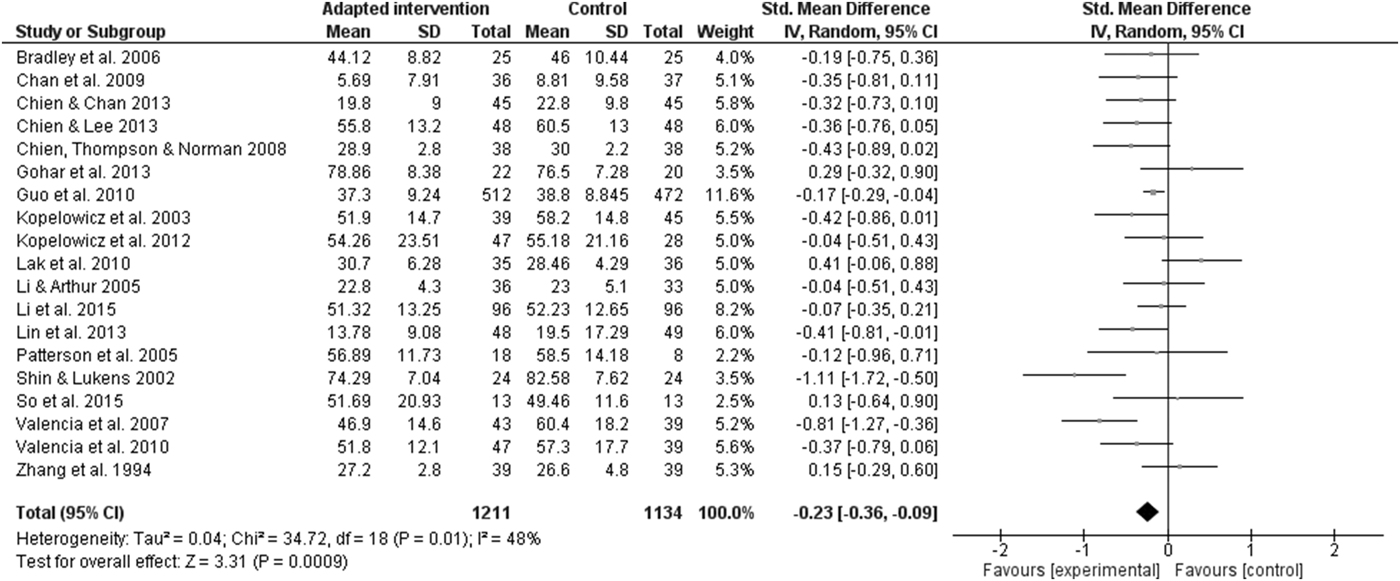
Therefore 29 studies were included in the meta-analyses on total, positive, negative and general symptoms. For forest plots, see Fig. 2 for total symptoms and online A7 Supplementary for positive, negative and general symptoms. See Table 1 for summary statistics for subgroup analyses for total symptoms and online A8 Supplementary for positive, negative and general symptoms.
Forest plot of effect of culturally-adapted psychosocial interventions compared with control on total symptom severity post-treatment.

Post treatment effects
Total symptoms
For the 19 RCTs (n = 2345) examining total symptom scores post-treatment (0–3 months), effect of the adapted intervention significantly exceeded that of control (g: −0.23, CI −0.36 to −0.09, p < 0.001), with moderate heterogeneity (χ2 = 34.72, df = 18, p < 0.001, I 2 = 48%) (Fig. 2). To explore what study parameters might moderate heterogeneity or efficacy, we divided these studies into various subgroups (Table 1). Distinguishing between studies of minorities in the West and adaptation to ethnic majorities in LMICs reduced overall heterogeneity (see I 2), efficacy being significantly greater in studies of minorities (CI for mean difference in g: −0.67 to −0.01, p = 0.044). Interventions attended by service users and family members were trend-significantly more efficacious than those attended by service users only (CI for mean difference in g: −0.66 to 0.01, p = 0.057). Distinguishing interventions by clinical setting (v. community) reduced heterogeneity (see I 2) without there being a significant difference in efficacy between groups. Other potential moderating variables neither significantly reduced I 2 in all subgroups, nor identified groups with significantly different efficacy.
Positive symptoms
In total, 16 studies (n = 1152) examined the effects of the adapted intervention on positive symptoms post-intervention (0–3 months). There was significant efficacy (g: −0.56, CI −0.86 to −0.26, p < 0.001), but substantial heterogeneity (χ2 = 86.99, df = 15, p < 0.001, I 2 = 83%). No potential moderators substantially reduced heterogeneity (I 2) across all subgroups but cluster randomised trials had significantly poorer efficacy than others (CI for mean difference in g: 0.25 to 1.12, p = 0.036); and Chinese studies had significantly poorer efficacy (CI for mean difference in g: −1.50 to −0.47, p = 0.018).
Negative symptoms
Twelve studies (n = 855) reported post-treatment effects on negative symptoms (g: −0.39, CI −0.63 to −0.15), with moderate heterogeneity (χ2 = 30.79, df = 11, p < 0.001, I 2 = 64%). Studies using standard care as a control were more efficacious than those using an active control (p = 0.076) or enhanced care (p = 0.042) and this reduced heterogeneity (I 2) in all groups. Dividing studies into family v. individual interventions reduced heterogeneity across all groups (difference in efficacy, p = 0.096).
General symptoms
Eight studies (n = 525) examining PANSS general symptoms post-treatment demonstrated significant effects of the adapted intervention v. standard care (g: −0.75, CI −1.21 to −0.29) and high heterogeneity (χ2 = 40.99, df = 7, p < 0.001, I 2 = 83%). Otherwise, distinguishing studies with more or less attrition than 15% reduced overall heterogeneity slightly (I 2 = 70% in each group). There were no significant differences between subgroups in efficacy.
Sensitivity analyses
To further examine the effect of methodology on outcome, we performed a range of additional planned sensitivity analyses.
Individual studies
For each symptomatic outcome, studies were removed individually to identify any difference to mean weighted effect size or heterogeneity. Most showed negligible effects. One positive outlier (Habib et al. Reference Habib, Dawood, Kingdon and Naeem2015) reduced the effect size and heterogeneity when removed from analyses of positive (g: −0.44 & I 2 = 77%), negative (g: −0.34 & I 2 = 60%) and general symptoms (g: −0.55 & I 2 = 63%), but findings remained significant in favour of the adapted intervention (p < 0.001). Removing two studies (Bradley et al. Reference Bradley, Couchman, Psych, Perlesz, Nguyen, Singh and Riess2006; Gohar et al. Reference Gohar, Hamdi, Lamis, Horan and Green2013) with highest risk of bias (i.e. open trial; ‘as treated’ analyses) increased efficacy for negative symptoms (g: −0.45 and 0.46) and positive symptoms (g: −0.61, Gohar et al. Reference Gohar, Hamdi, Lamis, Horan and Green2013). Excluding one study (So et al. Reference So, Chan, Chong, Wong, Lo, Chung and Chan2015) with pre-treatment differences and high attrition (>40%) increased the effect size for general symptoms (g: −0.87) and positive symptoms (g: −0.60).
Follow up assessments
Separate analyses were conducted at multiple follow-up points; each analysis included fewer studies (n ⩽ 6) than the post-treatment analyses. For total symptoms, the aggregated effect was significant at 3, 6, 12 and 18–24 months follow-up (g: 0.18 to 1.00), with significant and large heterogeneity at 18–24 months (I 2 = 79%). Meta-analyses for positive symptoms showed significant effects at 12 months (g: −0.33; CI −0.54 to −0.11) but not at 3, 6 or 15–18 months. Negative symptoms at 6 months follow-up showed significant improvement compared with controls (g: −0.27; CI –0.51 to −0.04) based on data from two studies. There was no significant heterogeneity for positive and negative symptoms at follow-up. Only one study assessed general symptoms at 6 months (Kopelowicz et al. Reference Kopelowicz, Zarate, Smith, Mintz and Liberman2003) (n = 84, g: −0.09, CI −0.52 to 0.34, p = 0.67).
Three armed trials
For three-armed trials with two adapted interventions and one control (Chien & Chan, Reference Chien and Chan2004, Reference Chien and Chan2013; Chien, Chan & Thompson, Reference Chien, Chan and Thompson2006; Koolaee & Etemadi, Reference Koolaee and Etemadi2009; Lak et al. Reference Lak, Tsang, Kopelowicz and Liberman2010; Kopelowicz et al. Reference Kopelowicz, Zarate, Wallace, Liberman, Lopez and Mintz2012), all effects remained significant in favour of the adapted intervention when the above analyses were repeated exchanging the adapted intervention of interest with the second adapted intervention. One trial (Chien & Thompson, Reference Chien and Thompson2013) had one adapted intervention and two comparator groups but there was no difference in effect depending on whether data from the active (psychoeducation) or standard care control was included.
Degree of adaptation
There was a significant correlation between greater number of adaptations and better total symptom efficacy (r = −0.49, p = 0.034). Regression confirmed that g improved 0.1 for each adaptation (B = −0.097, β = −0.487). Online A9 Supplementary details the adaptations for the reviewed studies.
Discussion
The present review and meta-analysis is the first to synthesise current evidence on the nature and effectiveness of culturally-adapted psychosocial interventions in schizophrenia. Thematic analyses of cultural-adaptations reported in each of the reviewed studies produced a framework that serves as a benchmark for future adaptations. It also provided an indication of the degree of adaptation for any given intervention, notwithstanding the caveat that not all adaptations are necessary or possible in different contexts.
We found considerable agreement regarding what constitutes cultural-adaptation. All studies reported adaptations to language. The majority made adaptations in the domains of concepts and illness models, cultural norms and practices, and family: considering explanatory models of illness, incorporating spiritual/religious activities, and acknowledging culture-specific familial structures (e.g. interdependent and hierarchical). Other common adaptations were to recognise different forms of communicating, learning and problem-solving, removal of culturally-irrelevant content, and changing aspects of delivery to recognise contextual barriers. Studies also made modifications to improve engagement and therapeutic alliance and develop shared treatment goals. As previously reported in relation to adapted treatments for depression (Chowdhary et al. Reference Chowdhary, Jotheeswaran, Nadkarni, Hollon, King, Jordans, Rahman, Verdeli, Araya and Patel2014), authors reported changes to delivery to improve acceptability and feasibility in specific cultural contexts, rather than the core components of the interventions, thus maintaining their underlying theoretical models.
Our meta-analysis demonstrated significant effects in favour of the adapted intervention at post-treatment and follow-up. Post-treatment effect sizes for symptomatic outcomes (total symptoms g: −0.23, positive g: −0.56, negative g: −0.39) were similar to those for non-adapted interventions (e.g. CBT: SMD positive = 0.37, negative = 0.44; Wykes et al. Reference Wykes, Steel, Everitt and Tarrier2008).
Seen as methodological quality can influence effect sizes (Tarrier & Wykes, Reference Tarrier and Wykes2004), for example, with large differences in results from meta-analyses including RCTs v. those with observational or quasi-experimental designs (Pfammatter et al. Reference Pfammatter, Junghan and Brenner2006), we restricted inclusion to studies with RCT designs, homogeneous ethnic groups and 100% schizophrenia samples. This may explain the more modest efficacy against total symptoms than in previous reviews of adapted interventions which included non-randomised trials and mixed ethnic and diagnostic samples (e.g. Griner & Smith, Reference Griner and Smith2006; Chowdhary et al. Reference Chowdhary, Jotheeswaran, Nadkarni, Hollon, King, Jordans, Rahman, Verdeli, Araya and Patel2014). Nonetheless, methodology still varied considerably, with differences in allocation (cluster/block, standard), control condition (standard care, active), and quality (e.g. ‘intention to treat’ analysis, blinding, attrition). Sensitivity analyses provided limited evidence that removal of individual trials with high risk of bias (i.e. pre-treatment differences, open trial and ‘as treated’ analyses) increased the effect size. Only two trials (Mausbach et al. Reference Mausbach, Bucardo, McKibbin, Goldman, Jeste, Patterson, Cardenas and Barrio2008; Gohar et al. Reference Gohar, Hamdi, Lamis, Horan and Green2013) compared adapted and non-adapted interventions, the gold standard test of whether adaptation improves efficacy. Neither found significant treatment differences for psychopathology; Mausbach et al. (Reference Mausbach, Bucardo, McKibbin, Goldman, Jeste, Patterson, Cardenas and Barrio2008) was excluded as it comprised the same sample as an earlier study (Patterson et al. Reference Patterson, Bucardo, McKibbin, Mausbach, Moore, Barrio, Goldman and Jeste2005) but had poor randomisation methods and Gohar et al. (Reference Gohar, Hamdi, Lamis, Horan and Green2013), though included, was an open trial. Moreover, few studies (n = 8) used active control conditions. We can therefore only conclude that adapting interventions for culture is more effective than usual care. Future studies using better designs, preferably three-armed RCTs, must be recommended to evaluate whether adapted interventions are more efficacious than standard care and their non-adapted equivalents.
To make a meta-analysis meaningful, one must assume that different interventions for a particular diagnosis have common elements that produce common efficacy in analogous populations. Where this is not the case, heterogeneity occurs and must be examined to reveal what processes influence outcome. The results showed that different types of interventions had generally similar efficacy, which suggests that each have common elements that may well be important to outcome even in diverse populations. However, there was substantial heterogeneity for each outcome, which is unsurprising given the diverse contexts and interventions (Higgins & Green, Reference Higgins and Green2008). Subgroup analyses showed that features of context (i.e. Chinese or not; ethnic minority/Western or majority/non-Western population), intervention (i.e. individual or family participation) and study design (i.e. randomisation method; control group) moderated outcome but were difficult to disentangle and there was limited evidence of a consistent pattern across symptomatic outcomes. The majority of studies were adapted for a majority population and were in Asian countries; with around half conducted in China. There was some evidence that studies of ethnic minorities in Western countries or outside China were more efficacious than studies of ethnic majority populations in non-Western countries or those in China. However, due to the small number of studies looking at minority populations, we were unable to examine efficacy of adaptations by ethnic minority group. Subgroup analyses also suggested that interventions attended by family members were more efficacious. Findings relating to differences in specific intervention models (e.g. CBT v. MCT) are inconclusive; though we attempted to examine intervention types in the subgroup analyses, categories were broad due to the limited number of studies available. Future trials should continue to test adapted interventions for specific ethnic or cultural populations with schizophrenia diagnoses to build on the current evidence base.
Limitations of this review include variation across studies in the quality of reporting of methodology. All papers reported some level of adaptation, but often poorly. Some authors did not respond to requests for additional information, which may have led to an incomplete picture of adaptation. Additionally, our empirically derived framework is based on adapted interventions reported in clinical trials. However, although beyond the scope of this review, it is worth noting that we reviewed our thematic framework against adaptations reported in non-evaluative studies that were generated from an initial broad search of the literature (with no restriction on design). Its application worked well, with no additional themes of adaptation identified. Some studies with incomplete statistical data were excluded from the meta-analyses, despite several attempts to contact authors. Poor reporting of methods in reviewed papers proved to be problematic for analysing overall risk of bias which meant we focused on three aspects of quality with the most variation (i.e. attrition, ’intention to treat’ analysis, pre-treatment differences) in our heterogeneity analyses. We did not include unpublished studies but funnel plots reassured us of not more than minimal positive bias for positive symptoms due to selective reporting. We focused on symptomatic outcome as this was the most commonly reported and consistently measured. However, this may not be the most appropriate or meaningful outcome for all psychosocial interventions. A limitation arises from the original studies that did not provide evidence as to how often symptomatic improvement was clinically significant. It is therefore unclear how criteria for such clinical significance translate across different cultures. Future studies should aim to measure the effects of adaptation on other patient outcomes, such as functioning and relapse. Another avenue for future research would be to consider caregiver outcomes and more qualitative data relating to the acceptability of culturally-adapted interventions to patients, carers and healthcare professionals.
Preliminary findings suggest that the greater the degree of cultural-adaptation the more efficacious the intervention. Although greater adaptation might correlate with unmeasured features of studies, such as quality of interventions or therapists, our framework may provide a useful heuristic model to guide clinicians and researchers in the development and reporting of adapted psychosocial interventions in schizophrenia. Our framework covers the nature of cultural adaptations. A fruitful avenue for future research is to review and develop guidelines relating to the process of cultural adaptation. This has recently been attempted in relation to depression (Chowdhary et al. Reference Chowdhary, Jotheeswaran, Nadkarni, Hollon, King, Jordans, Rahman, Verdeli, Araya and Patel2014) and suggests that the process of adapting interventions is systematic and reliable but that information is missing in published work. Methodology relating to the nature and process of adaptation requires better reporting in future studies.
Conclusion
The degree of similarity in the process of adaptation across different psychosocial interventions allowed generation of a common framework describing cultural-adaptation, which may be useful in developing and reporting future interventions. This was validated by the evidence that not only were adapted interventions more efficacious than usual care but also that degree of cultural adaptation was proportional to efficacy. There was substantial heterogeneity in outcome, with features of context, intervention and study design affecting efficacy that were often related and difficult to disentangle. There was insufficient evidence to conclude that culturally adapted interventions are more efficacious than unadapted ones. While improved efficacy is an important aim for interventions adapted for ethnic minorities, adaptation is a necessity for implementation in low to middle income countries. Future research warrants better designed controlled trials that compare adapted v. unadapted interventions, particularly in minority populations.
Supplementary material
The supplementary material for this article can be found at https://doi.org/10.1017/S0033291717002264.
Acknowledgements
This project was supported by the National Institute for Health Research (NIHR) Health Service and Delivery Research Programme (HS&DR) (D.E., project number: 12/5001/62). The views and opinions expressed herein are those of the authors and do not necessarily reflect those of the Health Service and Delivery Research Programme (HS&DR), NIHR, NHS or the Department of Health.
Declaration of Interest
None.