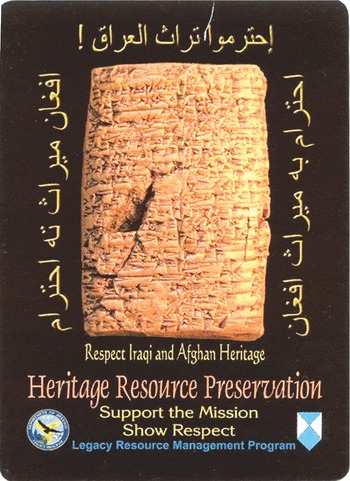
With the dust settling on Operation Iraqi Freedom in the spring of 2003, the U.S. Army 4th Psychological Operations Group developed for the occupation forces a special deck of playing cards that featured head shots of the most wanted Iraqi regime officials. Saddam Hussein figures prominently as the Ace of Spades. The experiment was repeated in the autumn of 2007, but this time the cards represented some of Iraq's and Afghanistan's archaeological sites (Figure 1).
Archaeological awareness playing card, verso. Copyright U.S. Army Installation Management Command. Reprinted with permission. [A color version of this figure can be viewed online at journals.cambridge.org/mes]

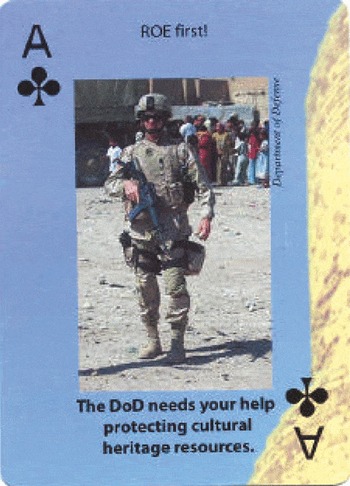
Part of the Department of Defense's Legacy Resource Management Program initiative to teach soldiers about handling sensitive archaeological materials and their value to local and international communities, the cards remind the troops that artifacts are not souvenirs and that archaeological sites should not be used for military emplacements, such as the construction of a helicopter pad on the ruins of Babylon in April 2003.Footnote 1 Each card weds an archaeological image with helpful information or an inspirational slogan: “Drive around—not over—archaeological sites”; “No graffiti! Defacing walls or ruins with spray paint or other materials is disrespectful and counterproductive to the Mission”; “When possible, fill sand bags with ‘clean’ earth—earth that is free of man-made objects, including broken pieces that may seem insignificant”; and “Helicopter rotor wash can damage archaeological sites. Locate your LZs [landing zones] a safe distance away from known sites.” Showing troops during military and recreational activities, the cards dramatize the central objective of the deck: in the words of Fort Drum's Cultural Resources Program Manager Dr. Laurie Rush, “to balance stewardship responsibility with mission support.”Footnote 2 The Ace of Clubs, for instance, interpellates the fighting man as a defender of both Iraq and Iraqi heritage. The caption reads, “The DoD [Department of Defense] needs your help protecting cultural heritage resources” (Figure 2). The soldier stands resolute and alone in the foreground. Civilians cluster behind a supply truck in the background.
Ace of Clubs. Copyright U.S. Army Installation Management Command. Reprinted with permission. [A color version of this figure can be viewed online at journals.cambridge.org/mes]

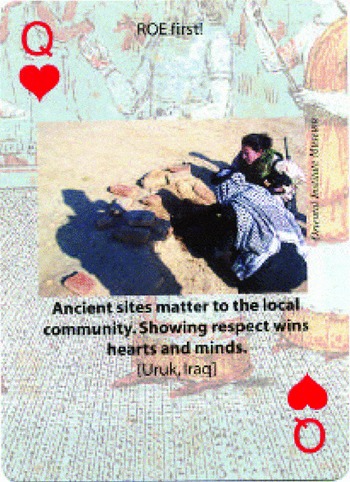
The cards' imagery is indicative of the fundamental shift in objectives between operations Desert Storm and Iraqi Freedom: protracted military occupation necessitates Iraqi cooperation and collaboration. The Queen of Hearts locates this objective firmly in the rhetoric of archaeological stewardship (Figure 3). Divested of her helmet but well armed, she is shown some inscribed bricks by a civilian whose back is turned to the camera. “Ancient sites matter to the local community. Showing respect wins hearts and minds.”
Queen of Hearts. Copyright U.S. Army Installation Management Command. Reprinted with permission. [A color version of this figure can be viewed online at journals.cambridge.org/mes]

Receiving the gift of antiquity from the faceless native, the Queen of Hearts emerges as the patron of the deck's core message: Iraq is the “Cradle of Civilization,” and its artifacts are the shared property of the West. Assuming a reverent stance before antiquity, soldiers now belong ideologically and culturally to the landscape they physically occupy. Another card advises the soldier, “Respect monuments whenever possible. They are part of our collective cultural history.” In another, a soldier addresses schoolchildren: “The main goal of archaeology is to understand the past—your past.” Scripture is even invoked: “Ancient Iraqi heritage is part of your heritage. It is believed that Jonah of the Bible is buried here [Nabi Yunis Mosque in Mosul, Iraq].” In several cases, American iconography overlies Iraq's. Guarding the Statue of Liberty, the Jack of Diamonds defends American values and interests in Iraq: “How would we feel if someone destroyed her torch?” The “torch of freedom”—a gift of political solidarity—is extended to the Iraqi people through archaeological stewardship. Drawn into a display of American republicanism, archaeology supports the larger mission objectives of implanting and protecting Iraq's nascent free-market democracy.
A related theme is theft, a sensitive issue in the wake of the infamous three-day looting and vandalism of the Iraq Museum in April 2003.Footnote 3 This episode was especially troubling for the archaeological community because the U.S. Department of Defense was urged by a leading group of archaeologists prior to the war to protect antiquities in major museums and archaeological sites from looting.Footnote 4 Clearly identified as “collateral damage” in military operations—“Museums are also victims of conflict and need protection when possible”—the cards are a tacit admission of culpability and a gesture of reconciliation. The Queen of Clubs, for instance, warns soldiers, “Remember! The buying and selling of antiquities is illegal and punishable under the Uniform Code of Military Justice.” We learn from the Eight of Diamonds that the “Joint Interagency Task Force recovered more than 5,000 artifacts stolen from the Iraq Museum. The Mask of Warka was recovered by the 812th MP [Military Police] Company.”
The cards carefully orchestrate this promise to value Iraq's cultural heritage during the occupation by appealing to the military values of protection, salvation, and heroism. Once at war against the “freedom-hating” dictator, the soldier/archaeologist remains behind to guard the cultural legacy she has liberated for the Iraqi people. A new weapon in the war against terror, archaeology is for the American military a platform for defending the economic and neoimperialist agendas fueling the mission to Iraq in the first place.Footnote 5
This is nothing new, for soldiers and archaeologists have dug into the same ground for over a century and a half. Consider a recent publication by archaeological historian Brian Fagan, Return to Babylon: Travelers, Archaeologists, and Monuments in Mesopotamia. A revision of his 1979 book, the publication is timely, he relates, because “recent archaeological catastrophes in Iraq have kindled renewed interest in the long history of Mesopotamian archaeology.” His justifications for the revised edition reveal much about the assumptions under which the book was published by a university press during the current occupation of Iraq. First, he defends the book's narrative format on the grounds that his is a “narrative of discovery, not of intellectual trends, which are of less interest to general audiences.” The second justification takes the form of a qualified apology, that Austen Henry Layard and Émile Botta, the first Europeans to begin large-scale excavation in Mesopotamia, “were appalling excavators by today's standards, but they placed the Assyrians firmly on the stage of world history.” Continuing the dramatic metaphor, Fagan ends his prefatory remarks by declaring, “This adventure story is replete with interesting characters, at present with a tragic ending but surely with hope for the future. The stage is set. Let the play begin!”Footnote 6
My intent here is not to question Return to Babylon as a source of information (nor, for that matter, the DoD's efforts to limit damage to Iraq's archaeological remains) but rather Fagan's assumption that archaeology is an inherently and unquestionably noble and humanizing activity. Fagan ironically displaces the very motives of his revision—the destruction of antiquities in wartime—into an adventure story. Contrary to his disclosure, intellectual trends are deeply entrenched in the narrative of discovery. Indeed, Fagan's plaintive conclusion that looters are “selling Iraq's birthright and the cultural heritage of all humankind, which we all should collectively hold in trust for generations as yet unborn,”Footnote 7 buries the complex and troubled history of East–West relations under the kind of comfortable humanist rhetoric adopted by the DoD for their playing-card initiative. As a cornerstone of Western culture (Jonah is “ours” too), Assyria is a world heritage site that we Westerners must be “trusted” to protect not only from our own bombs and LZs but also from the ignorance and greed of the Iraqi people/looters.
What often goes unnoticed or unsaid in the popular understanding of archaeological activity is that the times and spaces of excavations impart often contentious meanings onto objects displaced from the ground. So, too, the comfortable narrative archaeological history—with its focus on “great men” like Schliemann of Troy, Evans of Knossos, Layard of Nineveh, and Woolley of Ur—requires radical reexamination in light of the institutional and cultural discourses their protagonists consciously and unconsciously promoted.Footnote 8 Like the innocent image of Mesopotamia as the cradle of civilization and the 150-year-old program of “stewardship” it endorses, heroism is a mode of historical “emplotment” that erases the political motivations that threaten the very survival of the artifacts themselves.Footnote 9
Both the playing cards and Fagan's history bring up and quickly bury tensions between archaeology as a supposedly disinterested study and archaeology as a profoundly polemical activity that is often involved in the location of conflicting identities in particular spaces. In their 2004 volume, A Companion to Social Archaeology, Lynn Meskell and Robert Preucel argue that the Gulf wars “underscore the intensely political nature of the archaeological enterprise”; the U.S.-led military operation and the international outcry about looting and bombing of archaeological sites both express the entrenched view of the region as a precious repository of a world heritage “that requires control and management by Western experts and their respective governments.”Footnote 10 Sensitive questions about archaeologists' complicity with this paradigm of stewardship and their service of nationalist and imperialist agendas have never before been so widely circulated and theorized.Footnote 11 In Reclaiming a Plundered Past: Archaeology and Nation Building in Modern Iraq (2007), Magnus Bernhardsson in fact characterizes the history of Mesopotamia in military terms, claiming that the “battle over Iraq's historical artifacts was ultimately a struggle over Western involvement in the Middle East.”Footnote 12 Blending images of stewardship, humanitarianism, and militarism, the DoD's playing cards inherit a tradition of archaeological imperialism dating back to the European struggle for political influence in the failing Ottoman Empire.Footnote 13
In this essay I argue that the myth of archaeological stewardship needs to be historicized and problematized at its very birthplace. For the British, this begins with the myth of “Layard of Nineveh.” However, as Fagan's comments suggest, we are still reluctant to tarnish Layard's legacy with politics. For instance, Frederick Fales and Bernard Hickey published in 1987 a collection of essays composed by leading authorities on Layard, including British Museum archaeologists Richard Barnett, Julian Reade, and Dominique Collon; art historian Judy Rudoe; Layard biographer Gordon Waterfield; constitutional historian Kenneth Bourne; and diplomat Sir Ashley Clarke.Footnote 14 These essays constitute a watershed in Layard studies, for they represent the breadth of scholarly interest in Layard's career as an archaeologist, art collector, politician, and diplomat. However, the chronological rather than synchronic arrangement of the volume isolates these activities from each other. The collection is more an appreciation than a critical inquiry. More recently, Mogens Trolle Larsen's 1996 monograph, The Conquest of Assyria: Excavations in an Antique Land, nostalgically compares Layard to the vaunted Hollywood action-adventure star Indiana Jones.Footnote 15 Art historian Frederick Bohrer has, however, begun challenging this image by situating 19th-century archaeological aesthetics within Orientalist discourse. Published in the year of the Iraq invasion, his book Orientalism and Visual Culture, Imagining Mesopotamia in Nineteenth-Century Europe negotiates the complex processes whereby Europeans have transformed material objects into exotic subjects, a process that is complicit, he argues, with ethnological rationalizations of European informal imperialism in the Middle East.Footnote 16
I extend Bohrer's discussion by treating Layard himself as a rich site for unearthing the ideological work of Victorian archaeology within the politically charged atmosphere of “the Eastern Question.” The physical location of the Layard papers—the heterogeneous mass of private and official correspondence, reports, dispatches, and memoranda preserved in the vast imperial archives of the British Museum, British Library, and Foreign Office—demands their reading as imperialist documents. A careful inspection of the Layard archive reveals that archaeology was an important tool for gathering intelligence and establishing and defending English interests in the eastern Ottoman Empire. The figure of Layard as an archaeologist and, crucially, as an aspiring diplomat helped lay the foundations of Western stewardship that continues to divert attention away from the imperialist mission of maintaining political and economic authority in the cradle of civilization and control over its cultural (and natural) resources buried underground.Footnote 17
I conclude this genealogical analysis with a discussion of two memoranda Layard composed for the British Museum and the Foreign Office respectively. Each proposes a vast, unrealized, and unrealizable plan: the excavation of the entire Mesopotamian plain and the permanent “settlement” of its itinerant and supposedly indigent populations. Together these documents are important conceptual maps of the “Layard Enterprise,” for they locate archaeological desire and designs for economic and political hegemony within the same discursive space. This genealogical analysis of Layard is, then, also a genealogy of the DoD playing card initiative. By returning to the archives of “Layard of Nineveh” we can see that the figure of the archaeologist as adventurer, hero, and guardian of civilization has a long pedigree in the history of imperialism in Mesopotamia.
A LAYARD GENEALOGY
The origin of Layard's career in the East is familiar to readers of archaeological histories. Trained as a solicitor in his uncle's offices in London, Layard set out in 1839 for Ceylon with the intention of settling into the legal profession. The opportunity for travel arose when a family friend, Henry Mitford, proposed an overland journey through Palestine, Syria, Kurdistan, Persia, and Afghanistan en route to India and Ceylon. It was a risky plan, particularly since Persia had just broken off diplomatic ties with Britain over British troop movements along the border in their ongoing campaign to create a Central Asian buffer zone between India and Russia (this military and political posturing eventually erupted into the Anglo–Persian War of 1857).Footnote 18 In the summer of 1840, Layard made the fateful decision to part ways with Mitford, abandoning his legal pretensions for a two-year sojourn among the Bahktiyari tribes of the western Persian province of Khuzistan. In his book Assyrian Sculpture, the British Museum's former assistant director of Western Asiatic Antiquities Julian Reade sums up this phase of Layard's career in a single sentence: “After two years in some of the wildest parts of the Middle East, he became a roving agent attached to the embassy at Constantinople.”Footnote 19 What Reade means by a roving agent is intriguing but unclear. Rather than separate these two years from Layard's attachment to the embassy and, hence, from the archaeological activities that followed, I argue that these story lines are complementary within the “Great Game” of diplomacy and espionage in the East.Footnote 20
The opening passage of Layard's Nineveh and Its Remains (1849)—the runaway best seller that introduced ancient Assyria and its excavator to the British reading public on a mass scaleFootnote 21—is an apt place to begin unpacking the Layard Enterprise. Anxious to invest his wandering years as down payment for the archaeological payoff that followed, he casts himself as an aesthetically sensitive, intellectually curious, and ruggedly individualistic hero. Layard perpetuates the romantic myth of the intrepid archaeologist that enfolded his life story and propelled him into the Foreign Office:
During the autumn of 1839 and winter of 1840, I had been wandering through Asia Minor and Syria, scarcely leaving untrod one spot hallowed by tradition, or unvisited one ruin consecrated by history. I was accompanied by one no less curious and enthusiastic as myself. We were both equally careless of comfort and unmindful of danger. We rode alone; our arms were our only protection; a valise behind our saddles was our wardrobe. . . . Thus unembarrassed by needless luxuries, and uninfluenced by the opinions and prejudices of others, we mixed among the people, acquired without effort their manners, and enjoyed without alloy those emotions which scenes so novel, and spots so rich in varied association, cannot fail to produce.Footnote 22
This passage is a virtual compendium of the latent pleasures of British agency in the East, the simple pleasures of movement, the tingle of danger, the nostalgic yearnings for what has passed, the delight in going native, and the quasireligious experience of a pilgrimage to “hallowed” and “consecrated” lands. With this conventional expression of the traveler's freedom from civilization, Layard sows the seeds of that very civilization through archaeological knowledge of the terrain and ethnographic mastery of its inhabitants. Embedded in the syntax of Layard's prose are the tensions between adventure and political power that posed a very practical problem for Layard, who was at the time of composition only tangentially attached to the embassy as Ambassador Stratford Canning's personal assistant, the “roving agent” to whom Reade refers. The first page of Nineveh and Its Remains—dedicated to his patron Sir Stratford—begins the work of relating his archaeological mission within the political interests of the embassy for whom he labored and whose discourses he mastered but whose doors remained closed.
Published nearly half a century after he began excavations in 1845, Layard's Early Adventures in Persia, Susiana, and Babylonia, Including a Residence among the Bakhtiyari and Other Wild Tribes before the Discovery of Nineveh (1887)Footnote 23 affords valuable insights into the play of its author's career anxieties within the arena of English diplomacy in the East. Published in his retirement—after distinguished diplomatic service as under-secretary of foreign affairs and ambassador of Spain and Constantinople—the book is in part a memoir of a self-made man on the verge of entering into diplomacy, but a man remembered most fondly in his retirement as the discoverer of Nineveh. Tensions between adventure, scholarship, and colonial politics run throughout the book.
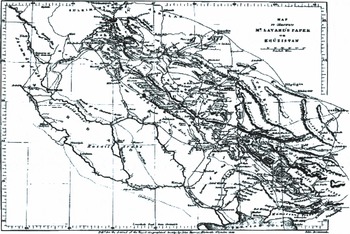
“A Map of Luristan &c. to Illustrate Sir A. Henry Layard's Travels,” from Early Adventures in Persia, Susiana, and Babylonia. [A color version of this figure can be viewed online at journals.cambridge.org/mes]

In Early Adventures, we see that Layard found in the comfortable Orientalist opposition of antique East and modern West a guiding image with which to promote British imperial interests. He was especially attracted to the idea of reinvigorating the ancient waterways of Mesopotamia as conduits for English commercial activity and political influence. Layard was keenly interested in the Euphrates Expedition of 1836, for example, a failed scheme to satisfy England's desire to find a Middle Eastern shortcut between English industry and India's raw materials and markets via the historic Euphrates River valley. The mission, under Captain Francis Chesney's command, involved constructing two paddle steamers, the eponymous Euphrates and Tigris, dragging them in sections across northern Syria and southern Turkey, and running the 1,400 miles of the Euphrates from Birecik to the Persian Gulf. The treacherous waters made the voyage impractical, and the Tigris and its crew of twenty-one men was lost in a tornado (the Suez Canal later proved to be the most practical shortcut to the Persian Gulf).Footnote 24
In the spring of 1841, Layard essentially picked up where the expedition left off by persuading the British political resident of Baghdad, Colonel James Taylor, to make an attempt at running the river Karun, a tributary of the Shatt al-ʿArab (the confluence of the Tigris and Euphrates), as far north as the ancient city of Shuster in northern Persia (see Figure 4). The Assyria managed to steam within a short distance of their destination. To Layard, this was proof of the viability of opening trade along these ancient imperial corridors. The enterprising English spirit, guided and informed by knowledge of the robust antiquity below ground, could revivify the Sick Man of Europe by reminding him of his rich heritage. Layard makes this claim emphatically in his Autobiography:
The unequalled position and resources of this region between the east and the west, with its great navigable rivers almost uniting the Mediterranean with the Persian Gulf and Indian Ocean, must, in the course of time, again render it as rich and populous as it was when it formed the most important portion of the Babylonian, Assyrian, and Persian Empires, and of the dominions of the Caliphs. But a great change must take place, and a considerable period of time must elapse, before the havoc and devastation caused by oppression, misgovernment, and neglect can be repaired. I trust that it may be the destiny of England to bring about that change, of such vast importance and of such incalculable benefit to peace, commerce, and civilisation.Footnote 25
Layard maps the Karun mission onto this imagined topography of degenerate East and civilized West, a liminal space from which to proclaim England's imperialist trinity of “peace, commerce, and civilisation.”
Layard's travels with the Bahktiari on the border province of Khuzistan also proved compelling to consular officials in Mesopotamia. Late in 1840 he began writing a report on his observations of Khuzistan, which he thought would be useful to the Foreign Office and of interest to the Royal Geographical Society, which ultimately published it.Footnote 26 Here is a clear instance of English informal imperialism at work, of the Layard Enterprise of simultaneously creating and communicating knowledge both scientifically and politically. The Foreign Office did indeed read Layard's report of tribal movements and geography of the region with great interest as old tensions between Turkey and Persia about control over access to the Persian Gulf were heating up for war, a situation aggravated by Persia's occupation of the Turkish town of Mohammerah (present-day Khorramshahr in Iran) and Turkey's renewed claims on Persian territory along the southern Euphrates (see Figure 4).Footnote 27 Colonel Taylor found in the knowledgeable traveler a trustworthy courier for sensitive dispatches on the issue. Early Adventures ends with this mission to the embassy in Constantinople and the fateful introduction to Ambassador Canning that would spark Layard's diplomatic and archaeological career.
The story of this encounter is illustrative of the barriers to diplomatic service that literally drove Layard underground. Presenting himself at the embassy, Layard was dispossessed of the documents and summarily dismissed by a “fashionably dressed young gentleman.”Footnote 28 Issues of class enter into the genealogy of Layard's rise to fame. He writes bitterly to the ambassador:
It was at Col. Taylor's particular request that I waited on your Excellency and that I undertook at much inconvenience a long hard journey for that purpose. . . . I had only flattered myself that I might have been able to afford your Excellency some information upon a frontier of the Turkish Empire . . . very little known to Europeans and in which I had dwelt for nearly two years. I still believe that that part of Turkish Persia offers a new field for the establishment of British interests and for British commercial enterprise and I will take the liberty of offering to your Excellency all the information of which I am possessed. . . .
I am sorry that my own folly at venturing within the . . . diplomatic aristocracy has compelled me to trouble your Excellency with what I fear may be considered a ridiculous complaint.Footnote 29
Canning found in the sunburned, travel-worn figure a useful tool for dirty work unbecoming of the diplomatic aristocracy. Layard's very identity as a private traveler and stranger to the Foreign Office was the perfect cover for Canning's covert intelligence operations. On the eastern front, Persia had advanced troops into Turkish-claimed territory along the Euphrates: Canning would make full use of Layard's knowledge of this region in the English mediation that was to soon follow.Footnote 30 However, he was of immediate use in the west, where revolts of Christian populations against Turkish authority were taking place in Serbia and Bosnia. It was “to be clearly understood,” Layard records in his autobiography, “that I was to have no official character or mission.”Footnote 31 Operating under the familiar disguise of an English traveler, Layard became a secret agent in the Great Game and full of hopes for earning a place in the embassy.Footnote 32
Layard's reports to Canning read like an espionage novel.Footnote 33 He was instructed in part to inquire into certain “secret societies” supported by Russian agents and to communicate with the leaders of the revolution in Belgrade who had overthrown the Russian-backed Prince Milosh. Canning saw in the populist movement a strong resistance to Russian influence in the Balkans and the best chance to promote liberal institutions sympathetic to Britain in Eastern Europe. Layard contacted members of the resistance and concluded that “if England were called upon to take any part in the affairs of Servia [sic], her true policy was to give her support to those who were struggling to obtain Liberal institutions.”Footnote 34 Layard was also convinced that England needed to confront Russia, which was threatening to “crush the popular party.”Footnote 35 Layard's identity on this mission changes from that of observer to actor by promoting an agenda that he thought flattering both to England and its ambassador. He reports on 20 September 1842 that
there appears to me to be a strong impression among the Pashas that Sir. S. C. is now more friendly in the Porte than other Ambassadors of other nations and I am firmly persuaded that the best informed of these Pashas look towards him for support in the dangers by which they are threatened. They cannot divest themselves of the idea, whatever I may say to the contrary, that I am traveling for pleasure and speak to me as if they meant the information they are conveying to be transmitted to his Excellency.Footnote 36
His thin disguise penetrated, Layard was now immured in nationalist politics and firmly attached to Canning's office and reputation. Layard maintains in his autobiography that he never abandoned his pretense of a private traveler and was “committing no act of indiscretion in acceding to the request of the Servian members of the Provisional Government that I would inform Sir Stratford Canning . . . of the ‘true state of affairs.’”Footnote 37 His cover blown, Layard was firmly attached to an ambassadorial mission. He was now a known quantity in the Foreign Office, a British agent whether the Foreign Office wanted to admit this or not. However, Layard was playing a dangerous game by assuming to act out the political will of Canning, a will that was directly opposed to that of his superior, Foreign Affairs Minister Lord Aberdeen, who, according to Layard, “was known to be very favourable to Russia.”Footnote 38 This tension kept Layard both within and without the office he desired to serve, having earned the trust and admiration of one and the suspicion of the other.
Despite these problems, Layard remained useful to Canning. He instructed Layard after his return from Serbia to draft a report on the Turco–Persian boundary.Footnote 39 His memorandum champions Canning's position of buttressing Turkey against a potential Persian–Russian alliance. His recommendations, founded on data gathered for his paper on Khuzistan and his voyage on the “Assyria” up the Karun, are protectionist in nature, for he regards the disputed Shatt al-ʿArab as “the military and commercial Key”Footnote 40 to the region. In this document Layard argues that Persia need not be given navigation rights over the Shatt al-ʿArab and control over the port of Mohammarah:Footnote 41 “It must be observed . . . that Persia altho' claiming Mohammarah has never hitherto asserted any right to the joint navigation of the Shat-al-Arab and I am persuaded that the Porte will not listen to their proposition.” Layard furthermore suggests that Mohammarah be made a free port, which would promote Arab settlement by providing an open market for their woolens. As I will contend, this was a major part of Layard's larger plan to bring the tribes of Mesopotamia into close economic and political relationship with England and India. He proposes a new era in trade with Arabs, “who will listen to the advice of Europeans,” a presumption that British liberalism is valued such that nomadic peoples will be induced to “settle and to cultivate” and be “beneficial to British commerce.”Footnote 42 As I will argue, Arab commerce and pacification are directly connected to the aims of the archaeological mission that followed in 1845.
Layard's recommendations also carry the political benefit of checkmating Russia. The issue of settling the border and its peoples into peaceful commerce dovetails into diplomatic issues of maintaining a balance of European powers that would ensure English dominance over the Persian Gulf and, hence, the trade route to India. Layard takes this one step further, suggesting that the port of Mohammarah be made a British protectorate, thus circumventing Russian “interference” altogether. Layard observes that
[a]t present Russia has no influence whatsoever in the provinces which are directly connected with Mohamarah [sic] . . . England on the contrary has at the moment very considerable political influence in all these provinces, an influence that . . . depends upon her commerce for its continual intercourse between the inhabitants of these provinces with India. . ..This influence must with proper precaution be maintained. . . . It might therefore be prudent to prevent Russia having any pretense for interference in that province.
Layard ends his report with perhaps the strongest recommendation: military occupation. For the “future relation of England with the two powers contending for this place must not be forgotten because [from] a military point of view it is one of the greatest importance. . . . Mohamarah commands the entrance to the rivers of Persia and of Turkey.”Footnote 43 Accepted by Canning, these recommendations were, however, rejected by the Foreign Office, which in consultation with Russian diplomats conceded the navigation rights of the Shatt al-ʿArab to Persia. The Foreign Office was, in Canning's view, pursuing a dangerous policy of Russian appeasement, a policy that would steer Britain and Turkey inexorably toward war.
Still an outsider to the diplomatic service for which he scribbled as “his Excellency's private Secretary,”Footnote 44 Layard's route to the Foreign Office lay in his rather more secondary interest in antiquities.Footnote 45 Canning, who was preparing to take a leave in England, hit upon a plan to keep his protégé attached to the embassy, albeit in an unofficial capacity. In his autobiography, Layard makes a very revealing statement about his career expectations at this juncture:
I was anxious to find some means of spending my time profitably, until he had been able . . . to obtain for me from Lord Aberdeen the permanent appointment in the Constantinople Embassy. . . . I, therefore, suggested to him that I might proceed to Mosul and continue the excavations in the Assyrian ruins, which M. Botta had now abandoned.Footnote 46
Directed from the embassy, the excavations were politically charged. For Layard, continuing political service meant once again going undercover and, this time, underground.
Canning's instructions to his agent typify Layard's tenuous relationship with the embassy and the broader agendas he continued to serve: “To keep me informed of his operations, and of any objects of sufficient interest and curiosity which he may see or discover”; “To keep clear of political and religious questions”; “To cultivate the goodwill of the Pashas and others of the Sultan's functionaries by all becoming means”; and, above all, “To bear in mind that his supposed character will be that of a traveller, fond of antiquities, of picturesque scenery, and of the manners peculiar to Asia.”Footnote 47 Layard was to behave like a representative of the English consulate in Mosul but to act outside of its jurisdiction. The intention of the excavations—locating and extracting artifacts—was to be hidden beneath a show of disinterested Orientalist research. However, why the secrecy? Layard and his superior had no official jurisdiction to dig. Sending Layard into the field under the cover of a pseudoscientific character, Canning masked the deeper intentions of the mission, to satisfy the ambassador's desire to own artifacts and to have another set of eyes surveying the pashalic of Mosul. He writes, “I described you [to the pasha] as a traveller fond of oriental scenery, ruins, and antiquities, without saying more of your particular object. Upon the whole I have thought it best for the present to help you in this manner, without risking an application for firmans and other authoritative aids. They will come later, I hope.”Footnote 48 Although ambassadorial “help” sounds much like abandonment, the cultural imperative underlying spying—the prerogative of the civilized nations to see, know, and control—infuses the very logic of Canning's dispatch, with its firm imperatives (“to keep me informed”), fine discriminations (“his character will be that of a traveller”), and elaborate qualifications (“cultivate goodwill . . . by all becoming means”).
As these instructions and the sheer mass of correspondence between Layard and diplomatic officials that followed suggest,Footnote 49 archaeology required a tremendous investment of political energy, energy enough to change inert stones into imperial trophies. Although the French had a year head start on the British, British interest drove up the ideological value of the artifacts. In response, France pressed the Porte in a vain effort to secure a monopoly.Footnote 50 In a letter to his uncle Benjamin Austen, Layard explains:
The French have shown a great deal of petty jealousy about Nimroud and our discoveries and have given me much trouble. . . . Their pretensions are extravagant and absurd. The Academie, on the discovery of Khorsabad, thought that they had wrestled from the hands of the English “le privilege de l'acquisition des antiquités Assyriennes,” as they announced in their report, and they are now considerably disappointed and very indignant. They want to claim Nineveh as their own.Footnote 51
Layard did indeed have much to protect, for he had struck a virtual mother lode of artifacts on the very first day of digging. It was impossible to keep such activity under wraps, however, so communications between Layard and Canning shifted fully into the realm of international politics.
The issue of transporting the artifacts and displaying them in London became an idée fixe in diplomatic circles. Layard writes to Canning in November 1845, “I think we might manage to transmit some sculptures to Europe as soon if not sooner than the French. This would be very important for our reputation.”Footnote 52 He in turn reports to Canning that Major Henry Rawlinson, the East India Company resident in Baghdad and a major player in the decipherment of Assyrian and Babylonian cuneiform,Footnote 53 was anxious to send a steamer to retrieve sculptures in the early spring of 1846, thus diverting commercial and military ships for scientific purposes. “In this case . . . the marbles, or such part of them as we could uncover by that time, would be in England by next Autumn, long before the French could transport theirs to France. This would be highly credible and give us the priority of European exhibition, which in these things is almost as important as the priority of discovery.”Footnote 54 This proved rather sanguine, for the Louvre opened its Nineveh Salon a year later, just as Layard's first consignment arrived in England.Footnote 55 Nonetheless, the artifacts remained for Rawlinson important signifiers within the great Eastern Question itself: “It grieves me ferociously to see the French monopolize the field, for the fruits of Botta's labors already achieved and still in the field, [sic] are not things to pass away in a day but will constitute a national glory in future ages, when perhaps the Turkish Empire that we are now struggling so hard to preserve shall be but a matter of history.”Footnote 56 In situ, the material culture of Assyria appears unfixed and even meaningless; displaced to the British Museum, it becomes a solid, lasting material signifier of Britain's diplomatic mission in the East.
In this climate of European possessiveness, Layard, like Rawlinson, appeals for direct official government intervention in the excavations. In a long letter to Canning, Layard observes,
Excavating in Assyria appears to me to be a work of a peculiar nature. It is one of those undertakings which . . . belongs exclusively to the government. . . . Before the French discovery of Khorsabad the antiquities of Assyria were completely unknown. The history of this remarkable country is a blank in the history of the world, and yet its connection with that of the Jews, the continued mention of the Assyrian Kings in the inspired writings, and the prominent part they played in the remotest periods, render it of the highest interest. . . . Your Excellency may remember the interest this remarkable discovery excited throughout Europe. When a second opportunity occurs, such as that furnished by Nimroud, it would indeed be a matter of deep regret if the English Government declined to undertake a work which would place additional materials in the hands of the learned of Europe, and would certainly lead to many important discoveries in Assyrian history.Footnote 57
In this appeal for support, the term “interest” assumes distinct yet complementary meanings. The government's immediate return on the investment is ownership of material Assyria, relics from the very origins of revealed religion and the English culture that the Foreign Office was struggling to export to the Ottomans and their subjects. In addition, by attracting government investment, Layard raised his own stakes in the operation by situating himself as a governmental, rather than rogue, agent in the East.
This nexus of appeals found favor with the trustees of the British Museum. In September 1846, Canning announced to Layard that the “British Museum undertakes Nimroud in your stead.”Footnote 58 The funds were, however, marginal: £2000, which was to pay Layard's salary, the transportation of marbles to Basra for embarkation to England, and the operation expenses, leaving less that £1000 to continue the work. Layard and his supporters thought this a paltry sum, barely enough to examine half the mound of Nimroud.Footnote 59 Canning, notwithstanding, advised Layard to “do your utmost, both for the time and for the money, to do yourself honour, and to satisfy the Trustees and the Public.”Footnote 60 This statement crystallizes the tenuous nature of Layard's part in the operations.
Entrance into the promised land of the Foreign Office lay in observing a policy of appeasement and continued personal sacrifice. The excavation instructions issued by the trustees to Canning underscores this problem for Layard:
While the Trustees calculate upon Mr. Layard's readiness to continue on their behalf the superintendence which he has undertaken on behalf of Sir. S. Canning, . . . they think it right towards Mr. Layard to state plainly, that when the now-contemplated operations in Kurdistan are brought to a close, it will be impossible for them to provide in any way for Mr. Layard's further employment, or to assist him in any objects he may then have in view. Footnote 61
Addressed in the third person, Layard is distanced grammatically from his very labor. Giving up his undercover status, he is exposed to a calculating institutional discrimination that renders him a servant, one who works on “behalf” of the government rather than for it. Officially an agent, Layard is without agency, a subject deferred with a pen stroke from Great Russell Street and, indeed, Whitehall, which duly received a copy of these instructions.
Layard's marginality notwithstanding, the mission carried great diplomatic responsibilities. Feeling “certain that Mr. Layard will be resolutely determined to maintain a spirit and bearing of honorable liberality,” he was directed to “abstain from exercising any right of interference” with agents of other European states by confining himself “to those localities where his priority of occupation . . . admit of no rival pretensions.” On one hand, these diplomatic imperatives express liberal notions of shared knowledge; “the saving the monuments of the distant past in ancient Assyria from destruction, and bringing them out of their present concealment to the illustration which European knowledge may be able to throw upon their meaning and history, is an object to be desired and promoted by whatever agency it may be brought about.” However, such principles wane before the more pressing concerns of the great Eastern Question itself. The trustees explain,
Nor can any thing have a more direct tendency to teach the natives some respect for the remains of the great works of art executed by the early occupiers of their country, than the leading them to believe that Europeans desire to possess these remains not because of any pecuniary value attached to them, but because of their connection with ancient nations and language, and of the hope, which the study of these affords, of contributing to the more extended cultivation of learning and taste, and the prevalence of those principles of justice and benevolence, by which only, if by any means, the general concord and prosperity of the human race is to be attained.
The referent “native” remains contextually unclear. Does this refer to the Europeanizing of Turks or of indigenous peoples or perhaps both? Regardless, these instructions are a rich testament to archaeological value. In the context of Britain's diplomatic presence in Mesopotamia, the notion of teaching respect for the “early occupiers of their country” is tantamount to teaching respect for European occupation and the institutions and cultural practices promoted by the embassy. Indeed, “leading them to believe” in European civilization is quite a revealing expression of the educational motives of an embassy empowered to dig up and take away from native view monetarily cheap but aesthetically and historically valuable objects. The trustees must have been pleased to believe that they had purchased justice, benevolence, and world peace for only £2000.
Layard's story is fairly well known from this point. Still without an official appointment to the embassy, he returned to England in December 1848, leaving behind a skeleton crew to maintain priority of excavation at Nimrud. In England, Layard found the British Museum bursting with Assyrian bas-reliefs, statuary, and inscriptions and swarming with crowds eager to see these strange stones from the dawn of civilization. However, he also found himself broke and without prospects. At the behest of family and friends, he began to write about his travels and excavations. With Nineveh and Its Remains in press, Layard returned in January 1849 to Mosul to supervise a second expedition at the behest of the British Museum, but once again he was only unofficially attached to the embassy as Canning's personal assistant. In that month, the book was released. An immediate best seller—running through four editions in as many monthsFootnote 62 —Nineveh and Its Remains launched his diplomatic career by sealing his notoriety as the discoverer of Nineveh. His publisher, John Murray, makes this equation explicitly:
If you were to stop over to England at this moment, you would find yourself famous. The merits of your book and of your discoveries have been found out. I hope the result will be of solid advantage to yourself. . . . I expect soon to hear of your being once more at work on the mound of Nimroud or Hillah—and that the F[oreign] O[ffice], ashamed of their ingratitude, have given you a proper position in the diplomatic ranks.Footnote 63
This was the case: Layard, indeed famous, had only to wait for a place to open in the embassy. By April 1849 he had broken into the ranks of the diplomatic aristocracy, and his political career, which I have been arguing was in practice well established as a traveler, spy, and archaeologist, now became official. The paradox of Layard's career was thus resolved: the archaeologist was now a legitimate, rather than underground, agent of diplomacy in the East.
LAYARD'S PAPER EMPIRE
It is not my intention to outline the particular details of the two excavations but rather to examine the institutional discourses articulated through them. To this end I turn to two memoranda composed by Layard between the close of the first expedition and his appointment to the embassy. Together these documents, which have received very little critical attention from Layard scholars, demonstrate the close partnering of archaeology and informal imperialism in Mesopotamia. These are an excavation plan drafted for the trustees of the British Museum in response to their desire to renew operations in Mesopotamia and a proposal for Arab pacification written for the consideration of the Foreign Office's Turco–Persian Boundary Commission.Footnote 64
Layard's excavation plan was ambitious, a grandiose, grasping imperial dream to unearth in two and one-half years the entire Mesopotamian plain and the ancient Persian city of Susiana. “By such an extensive examination,” Layard relates, “a map of information might be collected and the subject almost exhausted.” The stone empire is becoming more and more a paper empire, a reduction, an “exhaustion” of archaeological materials through the mobilization of an expeditionary force that would include a draughtsman, artist, medical doctor, natural historian, and geographer. Exhausted, the variety of Mesopotamian history is to be codified into a “map of information.”
As an added benefit, Britain would continue to train the Turks in English liberalism. Discussing the Ottoman plan for an imperial museum in Constantinople, Layard argues that the “suggestion of associating the Turks with us [is] worthy of consideration. We should only be rendering them an old Justice and saving ourselves at the same time, by extending our means of research and preventing the French and Germans from interfering.” He is at once accommodating and cynical: “The Turks themselves are becoming aware, if not of the actual importance of ancient remains, at least of the interest they excite in Europe.” He proposes to give the Turks secondary pieces as remuneration for their part in the venture. Britain would “aid” the Ottoman museum in that the “same vessel which conveys our Antiquities to England might at the same time transport a selection destined for Constantinople.” With such an
understanding, the Porte might be induced to send an officer of its own with the expedition and its labours would in that case be greatly facilitated and many places almost inaccessible to Europeans might be visited with comparative facility. With a little management the presence of such an officer would in no way interfere with the researches of the Expedition or with the acquisition of the most important and interesting remains.
This high-handed statement encapsulates the very logic of indirect colonialism that Britain planted so successfully around the globe. The natives would, for their own good, do Britain's most arduous work and, as recompense, import English civilization. Mobilizing its navy and consular influence, Britain would give back to the Turks the artifacts that they currently possessed but would barter with her imperial ally while under threat from the other eastern empires of Persia and Russia.
We could dismiss or excuse the plan as merely a conventional expression of class and racial superiority, but this attitude is endemic of the pernicious ideological value of excavation latent within the Layard archive. In wanting their share of the spoils, the Turks were undoubtedly quite attuned to their “actual” importance, their proven ability to excite interest as European commodities. The eventual establishment of the Imperial Museum in 1869 is a fascinating story of the symbolic role artifacts played within British relations with Turkey. Created as a response to—and defense against—Europe's appropriation of Hellenistic, Byzantine, Egyptian, and Assyrian artifacts from Ottoman territories, the Turkish museum emerges out of the political need to seek parity with Western culture, a culture that in archaeological and museological terms has claimed its own privileged “non-Eastern” inheritance from antiquity. Geographically and historically situated in the great divide between East and West, the Turks might occupy physically, but not culturally, the ancient territory adopted by Europeans as the birthplace of the West.Footnote 65 The Ottoman museum project is thereby couched in the ambiguities and contentions of claiming a national and historical identity in ancient cultures deeply embedded within the European metanarrative of progress that relegates the Turks to stagnancy and inevitable extinction if left to their own devices.Footnote 66
Skeptical of the museum idea, Layard guardedly endorses the political necessity of Ottoman cooperation in the continuing efforts of the British Museum to enlarge its collections. He is careful, however, to define the scope of the enterprise entirely within English interests. He reports that the desire for a museum in Constantinople arose in response to local populations demolishing artifacts as a form of resisting labor conscription for the British and French excavations. Layard laments that the “work of destruction has already commenced, and many valuable works of art have probably already perished.” Although the argument that the remains of ancient civilizations must be preserved from ignorant and destructive masses is as old as imperial archaeology, Layard characteristically overlooks the logical error that it is precisely because of European valuation—with its insistence on and need for backbreaking native labor, its disregard for local customs and traditions gathered around the mounds, and, of course, the imperative to transport and transculturate the remains of Assyria—that the artifacts are destroyed by resisting groups. This is remarkably true today, for in the absence of an effective central authority the stones of Assyria are collaterally damaged as black-market commodities and targets for militants.Footnote 67
I turn now to Layard's “Memorandum on the Government of the Arab Tribes of the Desert,” composed for the Foreign Office in 1848. Although the document refers only tangentially to excavation, it corroborates archaeology's hidden imperialist objectives of mapping, cataloguing, claiming, and policing territory. He opens the report with a panoptic image, the traveler's eye that takes in, surveys, and, in turn, projects. He writes,
It is scarcely to be credited that from the entrance of two such great rivers as the Euphrates and Tigris, into the low country, to their junction and embouchure . . . [at] the Persian Gulf, Mosul, Baghdad, Hillah, and Busrah are almost the only permanent settlements on their banks. The country between the rivers, with the exception of the Sinjar hill, is a desert only occupied by a few nomad Arab tribes. This is solely to be attributed to neglect and misgovernment.
Layard plans to make the land productive by planting bedouin into stable economic groups for the purposes of trade and, of course, taxation. Layard calls for an outright war on the nomads. Their very unfixity—a defining mark of bedouin culture—is the root problem. These are the very people, it must be noted, he employed in his excavations. Arab “plundering” as economic necessity or political action in the face of Turkish rule or Turco–Persian border skirmishes is not considered in the report.Footnote 68
Layard outlines a frankly brutal scheme for settling the natives. The Turks could make the smaller tribes “obedient” through example, by bringing the larger into complete “subjection” through guerilla-style campaigns launched from a series of outposts to be built along the Euphrates and Tigris. The future cradle of civilization would take on the appearance of a concentration camp replete with gun towers. The carceral imagery continues, for his plan considers, alternatively, a system of “quasi-military colonies” where settlers would be responsible for protecting their land grants along the river banks. Having been “brought into the habit of respecting the authority of the Porte,” the settlers would benefit from local interest in the “produce of their immense flocks of sheep and camels” and, of glittering interest to the imperialist eye, their horses, which “might furnish the finest light cavalry in the world.” Tennyson's encomium to the “six hundred” sardonically echoes this hope.
Layard's solutions to the political and economic problems of Mesopotamia are, moreover, contiguous with his archaeological mission. Archaeological desire reduces the whole region, with all its varied histories, peoples, territories, and economies, into a homology of past greatness and a tangible model for present regeneration. He writes poetically, romantically,
It has been asserted that Mesopotamia is too barren and too deficient in the means of irrigation to support any number of settlements, but that such is not the case [as] innumerable ruins most fully prove. From one spot in the centre of Mesopotamia to the west of the Sinjar, the traveller may count no less than two hundred and ninety mounds scattered over the vast plain.
The archaeological gaze reads the landscape within a particular and complex range of meaning: a revitalization and affirmation of the originary myth of Assyria as the birthplace of civilization, a regeneration guided by English ideological and economic designs on its ancient homeland.
Layard “from one spot in the centre of Mesopotamia” creates a panorama around himself, a stable English axis cloaked in dreams of empire past, present, and future. Foucault's image of the panopticon is pertinent here, for archaeology is an important technology for surveying topography and disciplining its peoples.Footnote 69 In the report, Layard constructs a home for the Arabs upon the foundations of a world abandoned by their ancestors after they had passed their knowledge westward. Of course the Arabs are ignorant of this act of representation because, like all European expressions of power in the Middle East, it is not about them at all but about securing their territory and harnessing its resources. Layard was, in fact, laying the foundations for the British Mandate that was soon to follow.
CONCLUSION
I close here with a passage from Layard's account of his second excavations, Discoveries in the Ruins of Nineveh and Babylon (1853). Looking over the castle of Tel Afer during an expedition to the Khabour River in northern Mesopotamia, the archaeologist wonders, “Are those waters to flow again, bearing back the seeds of knowledge and of wealth that they have wafted to the West? We wanderers were seeking what they had left behind, as children gather up the colored shells on the deserted sands.”Footnote 70 Read against his Arab pacification report, this romantic utterance is problematic. The seaside imagery paints a gentlemanly, reverent, and reflective picture of archaeology, but the sowing image that attends it carries an oblique imperialist message: re-seeding civilization from the granary of the British Museum. This benign picture of excavation, of gathering up, like children, that which has no intrinsic value but only delight for those who care to stop and look closely at things passed over, defers to and covers over the imperialist agendas that fuel archaeological practice and desire.
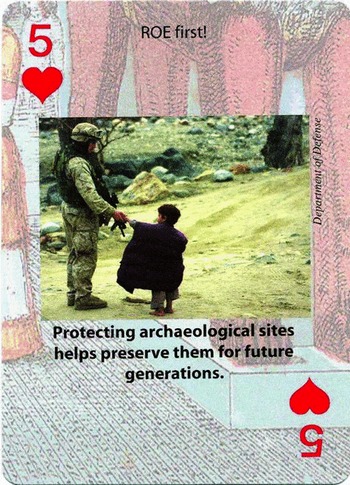
Five of Hearts. Copyright U.S. Army Installation Management Command. Reprinted with permission. [A color version of this figure can be viewed online at journals.cambridge.org/mes]

As the DoD's playing-card initiative reveals, the innocent and sacred aura of archaeology in the cradle of civilization has lost little of its luster. Indeed, the cards abound with emotional appeals to save this childhood from the grown-up realities of war. The Five of Hearts (Figure 5) furnishes a touching and benign image of a soldier leading/being led by a barefoot child lost in an oversized vest: “Protecting archaeological sites helps preserve them for future generations.” The ruins in this statement are coeval with the child, for both are in need of a helping hand from the very forces that are responsible for so much damage to “them” both (the gun points at the child in the flattened perspective).
A genealogical analysis of the imperial archive confronts us with the underlying reality that Layard as the father of British Assyriology is also one of the founding fathers of a long, troubled, and virtually continuous Western occupation of Iraq. The British brought “civilization” and Americans “liberty,” but both gifts demand a heavy exchange in natural resources buried underground—the fossilized remains of antiquity and, of course, fossil fuels. We can see in the playing cards and in the Layard archive that the rhetoric rationalizing the full-scale occupation and ultimate destruction of archaeological sites remains virtually unchanged, the “Eastern Question” merely giving way to the “Islamic Threat.”Footnote 71 Emerging from obscurity and into Western culture, the material remains of Assyria have returned to the East as signs of a new global community, but a community still in (perpetual) need of Western stewardship. In this way, the artifacts reassert the Orientalist paradigm of Eastern despotism and stagnation and continue to serve as poster children for Western modernization.
By unearthing the deep historical roots of Western Orientalism in activities like archaeology, scholars are starting to wake up Assyrian artifacts from the historical amnesia that have given them so much value as figures of symbolic capital in the exchange of Iraqi oil for Western protection. By exhuming Layard's many constitutive identities as traveler, secret agent, archaeologist, and diplomat from the imperial archive, I hope that we may better appreciate just how the DoD's attempt to clean up the physical damage to the material past through playing cards actually reaffirms the mission objectives that began 150 years ago.