This article seeks to gain some insight into the linguistic competence of heritage speakers of Egyptian and Palestinian Arabic. These speakers have been raised in the United States and were exposed to Egyptian or Palestinian Arabic early in childhood in addition to their exposure to the dominant language—namely, English. Whereas heritage speakers do not constitute a monolithic group, the usual linguistic trajectory involves extensive exposure to the heritage language in early childhood, typically at home. However, this extensive exposure gradually lessens later in childhood and adolescence (Montrul, Reference Montrul2008).
From an acquisitional point of view, heritage speakers are in some respects similar to native speakers in having been exposed to the target language early in childhood. However, they differ from native speakers in that their exposure to the native language (L1) may get interrupted and may be limited in its scope and domain—usually confined to the home and immediate family and community. Therefore, this group of speakers does not fit within the traditional L1-versus-second-language (L2) dichotomy, as has been attested in a number of studies that show that the proficiency of heritage speakers is different from that of native and adult L2 speakers (Bolonyai, Reference Bolonyai2007; Fairclough, Reference Fairclough2006; Montrul, Reference Montrul2002; Montrul & Potowski, Reference Montrul and Potowski2007; Polinsky, Reference Polinsky2008a; Toribio, Reference Toribio2001). A number of factors become critical in determining heritage speakers’ overall competence in their heritage language, including quantity of the input, age of acquisition, language use, status of the heritage language, and degree of attachment to the ancestral home.
Previous research on heritage speakers underscores their incomplete acquisition, particularly in the realm of the lexicon, inflectional morphology, morphosyntax, and the syntax-semantics interface (Fairclough, Reference Fairclough2006; Montrul, Reference Montrul2002; Montrul & Potowski, Reference Montrul and Potowski2007; Polinsky, Reference Polinsky2008a). For example, a number of studies show that lexical retrieval and inflectional morphology (such as verbal and nominal agreement) are highly susceptible to attrition or loss in bilingual environments (Bolonyai, 2007; Montrul, Reference Montrul2002; Polinsky, Reference Polinsky1997; Toribio, Reference Toribio2001). Additionally, a number of studies have demonstrated that some syntactic phenomena, such as noun drop through syntactic licensing (Iverson, Reference Iverson, Crawford, Otaki and Takahashi2009), that are typically acquired in early childhood are vulnerable to loss or attrition due to various sociolinguistic factors.
Some of the gaps in the knowledge of heritage speakers are due to transfer from their dominant language. It seems that this influence becomes progressively more visible with age, especially in light of diminishing input or use and more profuse reliance on the dominant language (Domínguez, Reference Domínguez2009; Montrul, Reference Montrul2008). This type of transfer has been attested in a number of studies on bilingual and heritage communities in particular (e.g., Montrul, Reference Montrul2008, Reference Montrul2010; Pavlenko & Jarvis, Reference Pavlenko and Jarvis2002). For example, in a study involving L2 learners and Spanish heritage speakers, Montrul (Reference Montrul2010) found that, unlike the native controls, both L2 learners and heritage speakers show similar effects of transfer from English in the areas of Spanish clitic left dislocations and differential object marking. Thus, they were less accurate than the native controls in recognizing acceptable and unacceptable sentences involving dislocations and differential object marking (both structures are unavailable in English). In a similar manner, Rothman (Reference Rothman2007) found that heritage speakers of Brazilian Portuguese lack the target knowledge of the distribution of inflected versus noninflected infinitives that the native speakers have acquired. He attributes this inaccuracy to the interference of English—the dominant language—which has no inflected infinitives.
Another attested pattern is the use of codeswitching not only to attain some communicative goals but also to make up for certain linguistic gaps. The use of codeswitching as a productive pragmatic strategy has been documented in a number of studies on bilingual and heritage speakers (Potowski, Reference Potowski2004; Reyes, Reference Reyes2004; Zentella, Reference Zentella1997). For example, Zentella found that Puerto Rican children raised in the United States often switch to English and that this codeswitching becomes more apparent with age and advanced English proficiency. Moreover, she found that switching is rule-governed. The results from this and other studies (e.g., Potowski) suggest that codeswitching is an important component of heritage speech and can be a fruitful area of investigation to gain a better picture of the competence of speakers in their heritage language and its interaction with the dominant language.
The current study seeks to explore some of the morphosyntactic gaps in the oral production of heritage speakers, especially in relation to the transfer hypothesis as well as the use of codeswitching as a conversational strategy. In particular, the performance of heritage speakers of Egyptian and Palestinian Arabic is compared with that of native speakers with full command of the language. Additionally, a number of morphological and syntactic features are examined as well as some sociolinguistic factors that may contribute to understanding properties of heritage speech.
STANDARD ARABIC AND THE SPOKEN COLLOQUIAL VARIETIES
In each Arabic-speaking country, there are at least two languages at play—namely, standard or formal Arabic and colloquial or spoken Arabic (Ferguson, Reference Ferguson1959; Versteegh, Reference Versteegh2001; Walters, Reference Walters, Arnold, Blake and Davidson1996). Standard Arabic is to some extent uniform across the area, with variations limited to lexical items, expressions, and borrowings (mostly from French in the case of Maghreb or North Africa, or from English in the case of the Middle East and the Gulf; Van Mol, Reference Van Mol2003). Colloquial or spoken Arabic varies across and within countries, with mutual intelligibility decreasing as the geographical distance increases. The different dialects may share a large number of cognates, but their phonological, morphological, and syntactic systems may display significant variation. Although both varieties may be used in the same speech context, particularly among educated speakers, colloquial Arabic is acquired as a L1, whereas standard Arabic is acquired as a L2—although this term may not accurately reflect the reality of the situation, given that exposure to the two varieties is quite prevalent in the Arabic-speaking world.Footnote 1
This situation reflects the background of the parents and community of the heritage Arabic speakers. Heritage speakers are exposed to their parents’ variety of colloquial Arabic at home. This article focuses on aspects of the syntax and morphology that are similar in Egyptian and Palestinian Arabic. For example, both varieties allow both verb-subject-object (VSO) and subject-verb-object (SVO) order, use null subjects, display rich agreement paradigms, use both perfective and imperfective forms of verbs to express past versus nonpast, and show noun-adjective concord.
HERITAGE ARABIC SPEAKERS IN THE UNITED STATES
Heritage Arabic speakers in the United States are the children of adult immigrants from Arabic-speaking countries with at least one parent who speaks Arabic at home (Shiri, Reference Shiri and Potowski2010). The parents of heritage speakers come from different regions of the Arab world but predominantly from the Middle East and the Gulf region (Ibrahim & Allam, Reference Ibrahim, Allam, Wahba, Taha and England2006; Rouchdy, Reference Rouchdy1992, Reference Rouchdy2002; United States Census Bureau, 2005).Footnote 2 According to the United States Census 2000 report (United States Census Bureau, 2005), over 68% of the people over 5 years of age who claim to be of Arab descent say that another language, presumably Arabic, is spoken at home. Many of the heritage Arabic speakers are Muslim and may have been exposed to standard Arabic at home and in the community, particularly in the mosque, although, for many, such exposure starts in college.
Because not all heritage speakers may have been exposed to standard Arabic, the focus of this investigation is on the variety that the heritage Arabic speakers have been exposed to in a naturalistic setting—namely, the spoken colloquial variety used at home and in the community. The study seeks to provide a general overview of some syntactic and morphological aspects found in the narratives of heritage speakers of Egyptian and Palestinian Arabic. Speakers of these varieties are well represented in the American population (see Shiri, Reference Shiri and Potowski2010) and in the university where this research project was conducted. Moreover, these two dialects converge to a large extent in a number of features of interest in this study. The study focuses on aspects of the language of heritage speakers that could help shed light on issues surrounding Arabic maintenance and loss in the diaspora, and it adds to the growing body of empirical findings about this understudied group of speakers. It is important to stress that this study is preliminary, given the scarcity of research on formal grammatical properties of this Arabic speech community.Footnote 3
Most previous research on Arabic heritage speakers has focused on sociolinguistic and pedagogical issues (Ibrahim & Allam, Reference Ibrahim, Allam, Wahba, Taha and England2006; Rouchdy, Reference Rouchdy1992; Shiri, Reference Shiri and Potowski2010). For example, Shiri (Reference Shiri and Potowski2010) explored the presence, use, and teaching of Arabic as well as the demographics of Arabic speakers in the United States. Ibrahim and Allam (Reference Ibrahim, Allam, Wahba, Taha and England2006) focused mainly on Arabic heritage speakers’ motivations to learn Arabic, their attitudes toward learning this language, the materials they studied, and the attitudes of their parents toward learning Arabic. In general, heritage students wanted to learn Arabic to increase their knowledge of the Arab region and its peoples. Moreover, they were positive about learning Arabic, were happy with the instructional materials, and were urged by their parents to learn and maintain it.
The specific research questions that motivate this study are as follows:
1. What are the general morphosyntactic features of the oral production of heritage speakers of Palestinian and Egyptian Arabic?
2. How do these features compare to those displayed by the native speakers of these dialects?
These questions are examined in the context of three narratives.
THE CURRENT STUDY
Participants
The study involved two groups of heritage speakers of Egyptian and Palestinian Arabic, each containing 10 participants. Seven of the Palestinian heritage speakers were born in the United States to Palestinian parents and the other three participants were born in Jordan, Qatar, and Saudi Arabia to Palestinian parents. They moved to the United States at the ages of 3, 6, and 7. The Palestinian heritage group contained four males and six females. In a similar manner, nine of the Egyptian heritage speakers were also born in the United States to Egyptian parents, and the 10th participant was born in Egypt to Egyptian parents and moved to the United States in the same year she was born. The Egyptian heritage group had six males and four females. Five of the Palestinian heritage participants identified Arabic as their L1, and the other five identified English as their L1. In contrast, only one Egyptian heritage speaker identified Arabic as his L1, compared to eight who identified English as their L1. The 10th Egyptian heritage speaker identified both Arabic and English as her L1s.
According to self-report, all of the Palestinian heritage speakers still speak Arabic at home. In contrast, only eight of the Egyptian heritage speakers still speak Arabic at home. The participants in the two groups were undergraduate college students at the time of the study, with ages that ranged from 19 to 23 (average age = 20.6). Five of the Palestinian heritage speakers reported having limited competence in speaking and understanding Arabic. Four reported having good competence, and one reported excellent competence. In the case of the Egyptian heritage speakers, six of them reported having limited competence and the remaining four reported having good competence.
The comparison groups included 10 native speakers of Egyptian Arabic and 10 native speakers of Palestinian Arabic. All 20 of these native speakers came to the United States as adults after the completion of high school in an Arab country. Arabic was the language of instruction in these schools. The age of the Egyptian native speakers (six males and four females) ranged between 24 and 42 (average age = 28.2) and the age of the Palestine native speakers (four males and six females) ranged between 23 and 34 (average age = 29).
Tasks
The participants completed three elicited oral production tasks. The purpose of these tasks was to elicit naturalistic data that would reflect the overall proficiency of the participants. The first task involved an elicited narrative, based on a frog story (Mayer, Reference Mayer1969). This story has been widely used in a number of studies of child learners (Berman & Slobin, Reference Berman and Slobin1994) and heritage speakers (Polinsky, Reference Polinsky, Brinton, Kagan and Bauckus2008b) for crosslinguistic comparison. The participants were shown 16 pictures from a book that contains 24 pictures of a boy, his dog, and his lost pet frog. These 16 pictures were sufficient for the participants to complete the story. The speakers had to describe what was happening in each picture until they reached the end when the boy finds his lost frog. The participants were given 5 min to look at the pictures before the elicitation.
The second task involved an elicited narrative based on “Aladdin,” a culturally relevant and familiar story. The participants were asked to narrate the story from memory. The experimenters made sure that all of the participants knew the story before the elicitation. The third task was a personal narrative: The participants were asked to talk about themselves and their family in an open-ended format. They were given 10 min to complete each of the tasks. However, most finished the tasks in less time than was allotted. The participants were audio-recorded as they completed the tasks. Additionally, they filled out a questionnaire about their language use and background prior to completing the tasks. They were tested individually in a quiet room and completed the three tasks and the questionnaire in a single session in this order: frog story, Aladdin’s story, and self-narratives. They were instructed to stick to their dialects. However, no specific instructions were given with regard to avoiding the use of English. This flexibility seemed necessary to ensure that the participants could complete the tasks (i.e., resorting to English becomes a survival strategy). At the same time, this technique permitted the examination of their competence in their respective dialects, the extent to which they codeswitch with English, and the appropriateness of their double-coded utterances. All narratives were recorded with a digital recording device.
Data Analysis
The recordings were transcribed and then typed using word processing software. Before coding the data, all of the grammatical features of interest in this study (most of which were determined before the study started) were identified to make sure that they were well represented in the data. Once these features were identified, the tokens and types of these features in obligatory contexts were counted. Each token was assigned 1 point when used correctly in context and 0 when used incorrectly. Additionally, the patterns of errors across token and types were also coded.
RESULTS
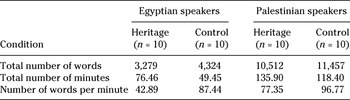
The data obtained from the three narrative forms are summarized in Table 1. As an overall measure of proficiency, words per minute were counted as in Polinksy (Reference Polinsky, Brinton, Kagan and Bauckus2008b), and the codeswitching patterns were also examined. As shown in Table 1, the narratives of the Egyptian speakers, both heritage and native, were similar in terms of number of words. In a similar manner, the oral production of the Palestinian heritage and native speakers was convergent in terms of number of words. However, the speakers in the two control groups were able to perform the same tasks in less time than their heritage counterparts. Thus, the average word production time per minute was about 87 for the Egyptian control group, compared to 43 for the Egyptian heritage speakers. Additionally, the Palestinian native speakers were able to produce about 97 words per minute, compared to the 77 by the Palestinian heritage speakers.
Narrative summary data

The notable difference in the rate of word production between the controls and the heritage Arabic speakers may be a good indicator of differences in fluency and proficiency. What emerges from this analysis is that the Egyptian heritage speakers are less proficient than the Palestinian heritage speakers and the two groups of native speakers. However, to evaluate their mastery of the language, different linguistic patterns in their oral production were also examined. This analysis will focus on a number of features that stand out in the narratives. These include word order and pro drop, verbal and nominal agreement, prepositions, numerals, and possession. Additionally, the structural attributes of the phenomenon of codeswitching within the context of Arabic heritage speech are also examined.
Word Order and Pro Drop
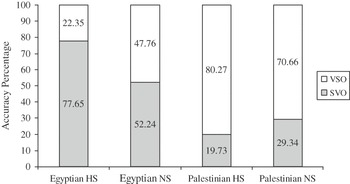
Previous studies of Russian and Spanish heritage speakers have shown that these speakers tend to use SVO order and overuse overt subjects in cases in which null subjects are pragmatically required (Polinsky, Reference Polinsky2007; Silva-Corvalán, Reference Silva-Corvalán1994). One of the most striking features of the narratives of the Egyptian speakers—particularly the heritage group—is the dominant use of the SVO word order. This tendency is apparent in Figure 1 which shows that Egyptian heritage speakers tend to deploy the SVO order more than their Palestinian counterparts. A one-way ANOVA showed a significant difference among the four groups in terms of word order, F(3, 39) = 40.279, p < .001. Post hoc comparisons using Tukey tests showed that the Egyptian heritage and control groups differed significantly from the Palestinian groups and from one another (p < .05). However, no significant difference was found between the two Palestinian groups (p = .98). The prevalence of SVO in the speech of the Egyptian groups versus the Palestinian groups may be attributed to word order differences between the Egyptian and Palestinian dialects of Arabic.Footnote 4 However, this explanation requires further studies based on large Egyptian and Palestinian Arabic corpora.Footnote 5
Distribution of SVO versus VSO word order in Egyptian and Palestinian heritage speakers (HSs) and native speakers (NSs).

Three important patterns arise with respect to the Egyptian heritage group’s dominant use of SVO word order. First, the participants in this group seem to avoid the use of VSO word order in their speech. That may be the reason why they tend to shift to SVO after they have started their sentence with a verb, as the examples in (1) and (2) from Egyptian heritage speakers illustrate.Footnote 6
(1) marra laʔi laʔeit…huwwa laʔi ʔizaz ʔaw ħaga zay kida
once found found.1s. he found bottle or thing like that
“One time he found… found… he found a bottle or something like that.”
(2) w-baʕdein laʔu… ʕalaaʔ eddiin laʔa el-laamp
and-then found.3p.m. … Aladdin found3s.m. the lamp
“And then they found… Aladdin found the lamp.”
Example (1) demonstrates the heritage speaker’s uncertainty about past verb inflections or about subject-verb agreement. The speaker uses the improper verb form, replaces it with another incorrectly inflected verb, and then shifts back, but this time using SVO word order. A similar case appears in (2), where the speaker had to insert the lexical subject ʕalaaʔ Eddiin “Aladdin” to ensure subject-verb agreement. This form of shifting may not be explained by the difficulty of VSO (compared to SVO) word order.
According to Montrul (Reference Montrul2008), bilinguals who fail to acquire the home language completely (i.e., incomplete acquisition) often do not master different aspects of their language with the same accuracy as their monolingual peers. This is particularly true when the dominant language spoken by heritage speakers lacks these aspects. In such a case, it is expected that certain linguistic features will transfer from the dominant and more frequently used language to the less dominant, less frequently used one. This seems to be the case with the Egyptian heritage speakers, whose dominant language (English) lacks VSO order; their shift to SVO may be caused by their predominant use of this word order in the dominant language. In contrast, the Palestinian heritage speakers tend to overuse VSO (even more than the Palestinian native controls). It is possible that because VSO seems to be dominant in Palestinian Arabic, the overuse of VSO by these speakers is caused by overgeneralization rather than by transfer. However, this conclusion must remain tentative awaiting further research on word order in both native Palestinian and heritage speech. Another important pattern concerns the overuse of verbs marked as third-person singular masculine in VSO sentences, as demonstrated by the example in (3) from a Palestinian heritage speaker and in (4) and (5) from Egyptian heritage speakers.
(3) dawwar el-walad fi el-šažara ʕala eDDifDaʕ
searched.3s.m the boy in the tree on the frog
“The boy searched for the frog in the tree.”
(4) Saħa el-walad wi-lkab men en-noom
woke up.3s.m. the boy and the dog from the sleep
“The boy and the dog woke up.”
(5) *Tiliʕ eDDifDaʕa ʔaaʕda ganb DifDaʕa tanya
appear.3s.m. the frog sitting next to frog another
“The frog appeared to be sitting next to another frog.”
In these sentences, the speaker chooses to use the VSO word order with a third-person singular masculine verb, even when it results in grammatically incorrect sentences, as in (5). It is striking that, throughout the narratives of the Egyptian heritage group, there was only one time that a non-third-person singular masculine verb was used in a VSO sentence, as demonstrated by the example in (6) from an Egyptian heritage speaker.
(6) *Tilʕit min el-ʔizaaz žinn
went out from the bottle a genie
“A genie went out of the bottle.”
The speaker starts his VSO sentence with a third-person singular feminine verb, which results in a mismatch between this verb and the third-person singular masculine subject žinn “genie.” The invariable use of third-person singular masculine verbs with subjects of different numbers and genders as well as the erroneous sentence in (6) point to the heritage speakers’ difficulties with the morphosyntax of VSO word order. In a similar manner, the fact that the heritage participants systematically deploy singular verbs in their VSO—but not their SVO—sentences could be due to difficulties with deploying agreement under c-command as opposed to agreement under the specifier-head relation. It seems that the specifier-head form of agreement is stronger than the c-command form of agreement, as seems to be evidenced by agreement asymmetries relative to word order in a number of languages (Frank, Lassi, Frauenfelder, & Rizzi, Reference Frank, Lassi, Frauenfelder and Rizzi2006).Footnote 7
Another possibility suggested by one of the reviewers is that the lack of agreement in VSO order is due to intrusion from Modern Standard Arabic (MSA), which displays only gender agreement in VSO order. However, this might not necessarily be the case because the heritage speakers lack proficiency in standard Arabic. In fact, in the narratives analyzed, these speakers rarely switch to standard Arabic, but they tend to switch to English instead. However, the influence of MSA is worth further investigation.
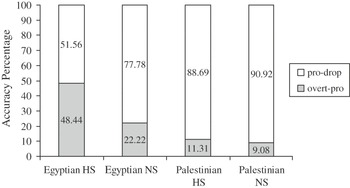
A third important pattern concerns the use of pro drop in verbal sentences.Footnote 8 As a pro-drop language, Arabic allows for the omission of the subject pronoun under specific pragmatic conditions. In general, speakers of Arabic use verbal sentences with a pro-drop subject when the agent has already been introduced in discourse. In this case, dropping the pronoun is more the norm than the exception. This tendency is in fact attested to in the narratives of the Egyptian native speaker group as well as those of the two Palestinian groups. As shown in Figure 2, the two native-speaker groups as well as the Palestinian heritage group demonstrate a tendency to rely on pro drop. The narratives of the Egyptian heritage speakers, however, do not fall within this pattern. An ANOVA showed a significant difference between the groups with regard to the criterion of null versus overt pronouns, F (3, 29) = 8,609, p < .001. Moreover, the post hoc analyses showed a significant main difference between the Egyptian heritage group and the three other groups (p <.05), but no other significant differences were found among the three other groups.
Distribution of sentences with overt and null pronouns in Egyptian and Palestinian native and heritage speakers.

The extensive use of overt pronouns by Egyptian heritage speakers could point to the possibility of language transfer; that is, the speakers could be using overt pronouns under the influence of English—their dominant language—which is an overt-pronoun language. This conclusion is further supported by the fact that the speakers were able to use both pro-drop and overt-pronoun sentences correctly. In other words, the shift to the overt pronoun is not due to incomplete knowledge of this aspect of Arabic morphosyntax but could be due to the influence of English. However, it should not be disregarded that because the heritage speakers have problems with subject-verb agreement, they rely on overt pronouns presumably because agreement cannot reliably identify the subject. In other words, the features of the putative null pronominal cannot be consistently retrieved from overt agreement on the verb.
Nominal and Verbal Agreement
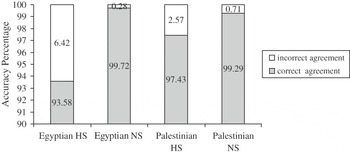
Previous studies point to agreement morphology, especially in terms of gender and number agreement, as highly susceptible to language attrition or loss among heritage speakers (Fairclough, Reference Fairclough2006; Montrul, Foote, & Perpiñán, Reference Montrul, Foote and Perpiñán2008; Montrul & Potowski, Reference Montrul and Potowski2007). The distribution of subject-verb agreement errors among heritage and native speakers is presented in Figure 3. The two heritage groups demonstrated a nativelike command of subject-verb agreement, with the Egyptian heritage group having a 93.58% accuracy rate and the Palestinian heritage group having a 97.43% accuracy rate. The results of the ANOVA revealed a significant difference between the groups with regard to subject-verb agreement, F(3, 39) = 2.917, p < .05.
Distribution of subject-verb agreement errors.

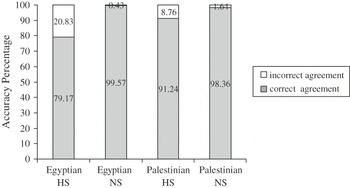
Figure 4 shows the percentage of gender and number agreement errors between nouns and adjectives. With respect to nominal agreement, the heritage speakers were less accurate than the native speakers, who performed almost at ceiling. The Palestinian heritage speakers outperformed their Egyptian counterparts with a 91.24% accuracy rate, compared to an accuracy rate of 79.17% for the Egyptian heritage speakers. The ANOVA revealed that the four groups differed significantly with regard to noun-adjective agreement, F(3, 39) = 4.128, p < .05. Moreover, the post hoc analyses showed that only the Egyptian heritage speakers differed significantly from the two control groups with respect to nominal agreement (p < .05). A close examination of the types of agreement errors made by the Egyptian and Palestinian heritage speakers points to many nonnative trends in their narratives. These trends particularly stood out when plural and feminine nouns were involved. Examples (7)–(9) from Egyptian heritage speakers illustrate this case.Footnote 9
(7) *Elwalad wi-lkalb raaħ barra
the boy and the dog went outside
“The boy and the dog went outside.”
(8) *lamma ʔaamuelwalad wi-lkalb btaaʕu min ennoom…
when got up.3p. the boy and the dog of him from sleep…
“When the boy and his dog woke up…”
(9) *ʔumi miš ba-štaʁal
my mother negasp-work.1s.
“My mother does not work.”
Distribution of noun-adjective agreement errors.

These speakers were unable to create proper agreement between the subject and the verb. In (7) the speaker uses a verb marked as singular masculine (instead of plural) after the plural subject elwalad wi-lkalb “the boy and the dog.” In contrast, in (8) he pluralizes the verb ʔaamu “got up” when it should be singular.Footnote 10 Arabic uses a singular verb in a sentence with an overt conjoined postverbal subject (Lorimor, Reference Lorimor2007).Footnote 11 Such a rule about the agreement asymmetry, which is highly sensitive to word order, may not be readily available for the heritage participants who rely on a one-to-one agreement relationship between the subject and the verb without considering the agreement asymmetry relative to word order. Furthermore, in (9) the participant mismatches the singular feminine subject ʔumi “my mother” to the first-person singular verb ba-štaʁal “work.”
The same pattern also appears in nominal agreement, as the examples in (10) and (11) by Egyptian and Palestinian heritage speaker participants show.
(10) *ʔusriti fi maSr kibiir
my family in Egypt big
“My family in Egypt is big.”
(11) *ʕindu Dafadeeʕ Sʁiriin
at him frogs small
“He has small frogs.”
In (10) the speaker uses the singular masculine adjective kibiir “big” to refer to the singular feminine noun “family,” thus violating number agreement (and gender) rules in this case. In contrast, the participant in (11) uses the plural adjective Sʁiriin “small” after the nonhuman plural noun Dafadeeʕ “frogs.”Footnote 12 In Arabic, nonhuman plurals are often treated grammatically and morphologically as singular feminine.Footnote 13 This example shows that not all the heritage speakers in this study seem able to deploy this rule.
In the case of subject-verb agreement, the agreement errors seem to increase as the distance between the subject and verb increases. The sentences in (12) and (13) produced by Egyptian heritage speaker participants exemplify this case.
(12) *Tilʕit min elʔizaaza žinn
went out from the bottle a genie
“A genie went out from the bottle.”
(13) *Elwalad wi-lkalb fi elmayya wi baSS fi el-šažara
the boy and the dog in the water andlook.3s.m. in the tree
“The boy and the dog in the water and look are in the tree.”
In (12) the speaker starts her sentence with the singular feminine verb tilʕit “went out,” which does not match the singular masculine subject žinn “genie.” Similarly, the participant in (13) uses a plural subject elwalad wi-lkalb “the boy and the dog,” to which he makes reference later in the sentence by using a singular masculine verb. In both examples, the subject and the verb are separated by a prepositional phrase, which might be partly responsible for the speakers breaking the agreement rule.
An important pattern of verbal agreement errors that recurred particularly in the narratives of Palestinian heritage speakers concerns the use of inaccurate verb inflection in participial-verb constructions. Examples (14) and (15) from Palestinian heritage speakers illustrate this case.
(14) *gaaʕed dawwaru ʕala elDifDif
undertaking searched.3p. on the frog
“They are in the process of searching for the frog.”
(15) *ʔana ħaabba biržaʕ ʕala ʕammaan
I liking asp.return on Amman
“I like to return to Amman.”
In Arabic, verbs following participials invariably take bare imperfective morphology. At the same time, they assume the same number of the preceding participials. In (14), however, the singular masculine present participle gaaʕed “undertaking” is followed by a verb that is marked as past and plural. Additionally, the present participial haabba “liking” in (15) is infelicitously followed by a present tense verb starting with the aspectual marker, biržaʕ “return.”
In fact, the use of participials by heritage speakers is particularly interesting because it is quantitatively nativelike but qualitatively nonnative in many respects. The data show that the percentage of the participial use in the narratives, compared to the use of verbs, is similar for all four groups. The use of participials for verbal functions was distributed as follows: Egyptian heritage speakers = 12.75%; Egyptian native speakers = 12.39%; Palestinian heritage speakers = 8.37%; Palestinian native speakers = 9.26%. However, the accuracy of this use is notably different. The focus here is on the agreement issues pertaining to the use of the participials.
Arabic participials—namely, present and past participles—agree both in number and gender with the nouns that they modify. In this respect, they behave like adjectives, even though their meanings can be verbal or nominal, as shown in (16)–(18).Footnote 14
(16) Elwalad naayem
the boy sleeping
“The boy is sleeping.”
(17) Elbint naayma
the girl sleeping.s.f.
“The girl is sleeping.”
(18) Elʔawlaad naaymiin
the kids sleeping.p.m.
“The kids are sleeping.”
The form of participle depends on the gender and number of the noun it modifies. Thus, in (16), the participial naayem “sleeping” is in the default form (masculine singular) because the noun elwalad “the boy” is masculine and singular. In a similar manner, the participles in (17) and (18) carry singular feminine and plural masculine markers, respectively, because the nouns they refer to are singular feminine and plural masculine, respectively.
Examples from the narratives of the heritage speakers regarding the use of participials are shown in (19) for Egyptian and in (20) and (21) for Palestinian.
(19) *Elwalad wi-lkalb naayem ʕala es-sriir
the boy and the dog sleeping on the bed
“The boy and the dog are sleeping on the bed.”
(20) *laʔu elDifDaʕa ʔaaʕdiinžanb baʕD
found.3p the frog sitting next each other
“They found the frog (feminine) sitting next to each other.”
(21) *abuuya mish šaʁliinhalkeit
my father neg working now
“My father is not working now.”
In (19), although its referent is masculine plural, the present participle naayem “sleeping” is in masculine singular. A similar mismatch appears in (20), in which the participle ʔaaʕdeen “sitting” is plural, whereas its referent elDifDaʕa “the frog” is singular feminine. In (21) the participle šaʁliin “working” carries the plural masculine marking, whereas the referent abuuya “my father” is singular masculine. These examples show that noun-participial agreement represents another unstable area in heritage language acquisition.
Finally, it is important to point out that in almost all cases in which a null or an overt pronoun is used, the sentences produced by the participants have correct agreement. In other words, heritage speakers seem to make more agreement errors when an overt noun is used. This suggests that the agreement errors are not entirely due to the lack of knowledge of agreement morphology on the part of the participants but to their lack of knowledge of the gender or number of the noun.Footnote 15
Numerals
The numeral system in Egyptian and Palestinian Arabic is complex; it requires knowledge of the following:
1. The numbers themselves (in their ordinal and cardinal forms).
2. The position of the number with respect to the noun. For example, the numbers one and two are placed after the noun, whereas the other cardinal numbers are typically used before the noun (even though they can come after the noun in some contexts). Ordinal numbers can come before or after the noun, but with a different grammatical function in each position.
3. In some cases, the gender and number of the preceding or following noun.
4. Number-noun agreement rules.
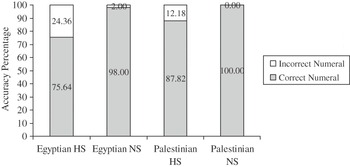
Due to the complexity of the Arabic numeric system, the heritage participants in this study seem to have major gaps in this system. Figure 5 shows the distribution of correctly and incorrectly used numerals in the narratives.
Percentage of correct and incorrect numeral use.

Whereas the two native-speaker groups seem to have no problem with the numerical system in their dialects, the accuracy rate of the heritage speakers (75.64% for the Egyptian group and 87.82% for the Palestinian group) illustrates their partial knowledge of this system. The results of an ANOVA show a significant difference between the groups with regard to their use of numerals, F(3, 39) = 29.476, p < .05. Additionally, post hoc tests showed that each of the four groups differed significantly from the rest (p < .01). The Egyptian heritage speakers seem to have greater difficulty with numbers than their Palestinian counterparts, which may reflect their overall lower proficiency levels compared to the other groups.
Examples (22)–(26) represent some of the main problems that the Egyptian heritage participants seem to have with respect to the numeral system.
(22) *Elwalad wi-lkalb šaaf elDifdaʕ maʕa Difdaʕ taaniya
the boy and the dog saw.3s.m. the frog with frog second
“The boy and the dog saw the frog with a second frog.”
(23) *Elwalad xad waaħid Difdaʕ Saʁiir
the boy took one frog small
“The boy took one small frog.”
(24) *ʔana ʕindi talaata ʔaxawaat wi ʔitnein ʔaxawaan
I at me three sisters and two brothers.dual
“I have three sisters and two brothers.”
(25) *ʔana ʕindi ʔitnein ʔax
I at me two brother
“I have two brothers.”
(26) *yoom waħda huwwa šaaf ʔizaaza
day one he saw bottle
“One day he saw a bottle.”
Example (22) illustrates a case of gender disagreement between the number and the preceding noun; the noun Difdaʕ “frog” is masculine, whereas the number taniya “second” is feminine. In Arabic, both should have the same gender. Example (23) presents a case of erroneously placing a number before a noun. The speaker is treating the number waaħid “one” like other Arabic numbers and maybe like English numbers, which occur before the noun. A similar error is shown in (24), in which the number ʔitneen “two” is placed before the noun. This example is interesting because the speaker makes both the noun and the number dual. It is not similar to (25), in which the speaker not only uses the number ʔitnein “two” before the noun but also leaves the noun ʔax “brother” in the singular form. It is possible that the speaker may have a limited knowledge of the dual form or of dual formation. The last example in this set provides an illustration of the improper use of numbers in idiomatic expressions. In this instance, the speaker uses yoom waħda “day one” as a calque from English in the sense “one day,…” which is often expressed in Arabic by the phrase fi yoom min elʔayyam “in a day of the days.”
In sum, the heritage subjects’ knowledge of the Arabic numeral system has a number of gaps in terms of number formation, agreement, order, and idiomatic uses of numerals. Some of these problems may be due to language transfer (i.e., the misplacement of the numbers one and two before the noun), and some may simply be related to language attrition or loss (i.e., dual formation). In this respect, the heritage speakers are remarkably different from the native speakers, who seem to have no problems with the numeral system.
Prepositions
It is well known that languages differ in the types of prepositions they select in some contexts. Examples (27)–(29) show the differences between Egyptian (a) and Palestinian (b) Arabic.
(27) a. ʔana batfarrag ʕala lmubaara
I watch on the game
b. ʔana betfarraž ʕala lmubaara
I watch on the game
“I watch the game.”
(28) a. huwwa ħa yitbiSiT bi-lfilm
he will enjoy with/in the film
b. huwwi raħ yinbiSiT bi-lfilm
he will enjoy with/in the film
“He will enjoy the film.”
(29) a. hiyya bitdawwar ʕala ʔibnaha
she is searching on her son
b. hiyyi bitdawwir ʕala ʔebnha
she is searching on her son
“She is searching for her son.”
As seen from these examples, the contexts in which Arabic prepositions appear sometimes differ from those in which English prepositions occur. Thus, the verbs batfarrag “watch,” jitbiSiT or jinbiSiT “meet,” and tdawwar “search for” take prepositions that are different from those used with their English counterparts.
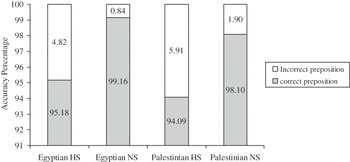
The native speakers’ use of prepositional phrases in the narrative was almost error-free, as seen in Figure 6. The few mistakes made by speakers in this group were mostly due to hesitations, as (30) and (31) from Palestinian heritage speakers demonstrate.
Percentage of correct and incorrect preposition use.

(30) Wi-lkalb kamaan biTlaʕ ʕala al … lalsama
and the dog also ascends on the to the sky
“And the dog also ascends to the sky.”
(31) riħt ʔana ʕal-žaamʕa fi … ʔabl yoom eltakharruy b-yoom
went.1s. I on the university in… before day the graduation with-day
“I went to the university one day before the graduation day.”
In (30) the speaker starts out by using the correct preposition after the verb biTlaʕ “ascend”—namely, ʕala “on” or “onto.” However, his pause and following hesitation created a temporal distance between the verb and the prepositon, which resulted in the choice of the inappropriate preposition li “to.” In a similar manner, after articulating the preposition fi “in” in (31), the speaker decides to use a different phrase that calls for the use of a different preposition. In such contexts, it is not possible to assume that the choice of the inappropriate preposition is due to the lack of knowledge of this linguistic aspect.
Similar performance was displayed by the Egyptian and Palestinian heritage speakers, whose accuracy rates were 95.18% and 94.09%, respectively. This was in fact expected given the overlap in the prepositions used after different Arabic and English verbs (go to, speak to, travel to, live in, etc.). It is only when there is a discrepancy between the two languages in this aspect that heritage speakers’ errors become evident. These errors were of three main types, exemplified in (32) by a Palestinian heritage speaker and in (33)–(36) by Egyptian heritage speakers.
(32) *bidawwir lil frog
search.3s.m. for the frog
“He is searching for the frog.”
(33) *elwalad Tiliʕ ʕan essiriir
the boy left about the bed
“The boy left the bed.”
(34) *yitgawwiz li-yasamin
marry.3s.m. to-Jasmine
“He marries Jasmine.”
(35) *bi-yeštaʁalu maʕa el teknoložiz
asp-work.3p.m. with the technology
“They work in technologies.”
(36) *ʔana waladt ʔamrika
I was born America
“I was born in America.”
The speaker in (32) uses the preposition li– “for” after the verb bidawwar “search”; the correct corresponding version is bidawwar ʕala “search on.” This may be considered a clear example of transfer from English, which uses this particular preposition after the verb search. In (33) the speaker uses the wrong preposition ʕan “about” after the verb Tiliʕ “leave.” In (34) the speaker uses the preposition li “to” after verb yitgawwiz “marry.” This could also be a case of transfer from English, although he uses the preposition with a verb in Arabic, whereas it is used with a participle in English—be married to. Example (35) marks an improper use of the preposition maʕa “with.” Although the speaker seems to realize the need to use a preposition with the same meaning, her choice reflects her inability to differentiate between prepositions with similar meanings but with different uses. The correct choice here would be bi “with,” which is used with nonhumans. In the last example, (36), the speaker drops the preposition altogether, which is not possible in either Arabic or English.
The two groups of heritage speakers seem to have some gaps in their knowledge of the use of prepositions in different contexts. This use was sometimes marked by addition, omission, infelicitous usage, and swapping of prepositions. The data provide grounds for more than one possible explanation for this incomplete knowledge, including learning gaps, loss or attrition, and transfer.
Possession with ʕind “at” and maʕ “with”
Possession can be expressed in Egyptian and Palestinian Arabic in different ways, one of which is through the adverb ʕind “at” (which acts like the prepositions li “to” or “for” and fi “in” in this context) and the preposition maʕ “with,” as in (37) and (38).
(37) ʕind-i sayyaara
at me car
“I have a car.”
(38) maʕ-u talat doolaaraat
with him three dollars
“He has three dollars.”
Although both are used to express possession, ʕind “at” and maʕ “with” have different uses. Whereas ʕind “at” is used to express a general sense of possession of things and humans, maʕ “with” is often used to express possession of things carried at the time of speech, as in (38). The possessor can be mentioned before or after these two words. When it is a pronoun, however, the possessor is typically attached to the two words in the form of an object pronoun: –i “me” and –u “him” in (37) and (38), respectively. Both ʕind and maʕ can be used in the past or future by placing a proper verb before them—typically kaan “was” or raħ ykuun “will be,” as in (39) and (40).
(39) a. kaan ʕind-i sayyaara
was at me car
“I had a car.”
b. raħ ykuun ʕind-i sayyaara
will be at me car
“I will have a car.”
(40) a. kaan maʕu talat doolaaraat
was with him three dollars
“He had three dollars.”
b. raħ ykuun maʕu talat doolaaraat
will be with him three dollars
“He will have three dollars.”
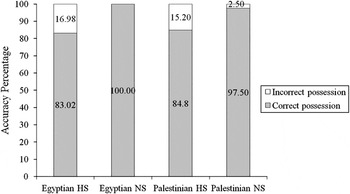
The verb preceding these forms (kaan “was” or raħ ykuun “will be”) determines the tense and aspect of the sentence without affecting the structure of the possessive phrase. What is important here is that the verb, in its unmarked form, should be uninflected for number and gender. That is why the default verb form (i.e., the third-person singular masculine) is typically used in this case. The use of these two possessive forms by both heritage and native speakers is summarized in Figure 7. As seen in Figure 7, the participants in the two heritage groups were less accurate in using the possessive forms ʕind “at” and maʕ “with” than their counterparts in the control groups. Thus, whereas the Egyptian and Palestinian heritage speakers had accuracy rates of 83.02% and 84.80%, respectively, the control groups had accuracy rates of 100% and 97.5%, respectively.
Percentage of correct and incorrect possessive use of ʕind “at” and maʕ “with.”

By looking deeper into the types of errors made by the heritage speakers, it was possible to identify several patterns of semantic and syntactic errors in their usage of these possessives. These are illustrated in (41)–(45).
(41) *huwwa kan ʕayez yebʔa raagel maʕu fluus titiir
he was wanting become man with him money lot
“He wanted to be a man who possesses a lot of money.”
(42) *huwwa maʕu maTʕam hoon
he with him restaurant here
“He has a restaurant here.”
(43) *ʕindi ʔusrti kbiir
at me my family big
“I have my big family.”
(44) *El frog ʕindhum ʔawlaad
The frog at them children
“The frog have children.”
(45) *kaanet ʕindaha talaTTaʕšar sana
was.3s.f. at her thirteen year
“She was thirteen years old.”
The first two examples mark the incorrect usage of maʕ “with” to indicate general possession rather than the more specific meaning of possession. The use of ʕind “at” in (43)–(45) is also infelicitous. For example, this form is followed in (43) by a noun in the possessive form, ʔusrti “my family”; this results in the creation of two possessive forms that refer to the same idea. In (44), the speaker simply fails to observe the semantic agreement between the subject el frog “the frog” and the pronoun attached to ʕind “at” (i.e., –hum “them”), putting el frog in singular and ʕindhum in plural. In (45) the speaker inflects the default past tense kaan “be” for singular feminine—even though verbs placed before ʕind “at” should be in their bare form. Although this is not completely ungrammatical, this sentence is still marked.
Like other aspects analyzed in this investigation, the heritage speakers’ knowledge of possessive forms presents several gaps. For instance, these heritage speakers mixed the contexts of use of maʕ “with” and ʕind “at” and they displayed incomplete knowledge of the more fine- grained details associated with the use of these possessive forms.
Codeswitching
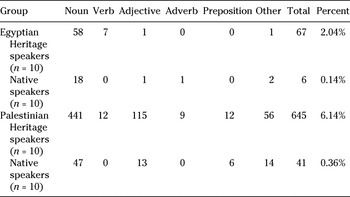
Probably one of the most visible and intriguing aspects of the oral production of the heritage speakers, in comparison to those of the native speakers, concerns the frequency and success with which they switched to English. The phenomenon of codeswitching is interesting not only because it shows some of the gaps in the heritage speakers’ lexical knowledge but also because it demonstrates their command of the basic general principles of the morphosyntax of their dialects. Table 2 shows a distribution of the main categories of the English words used in the narratives.
Frequency of English words by category and percentage of total words

As seen in Table 2, the dominant word category was nouns (540 tokens), followed by adjectives (564 tokens), verbs (19 tokens), prepositions (18 tokens), and adverbs (10 tokens). All of the other categories, such as fillers (e.g., okay, anyway, maybe), connectors (e.g., so), conjunctions (e.g., and, or), pronouns (e.g., I), and auxiliaries (e.g., is) were represented with only 73 tokens. Taking into account the number of words produced by each group, it becomes clear that switching to English was more pervasive in the narratives of the heritage speakers than in those of the native speakers and that the Palestinian heritage speakers used more English words than the Egyptian heritage speakers.
Although the motivations for codeswitching are outside the scope of the current study, it is important to point out that, overall, the heritage speakers shifted to English when they had difficulties retrieving certain words or when such words were missing from their lexicon, as shown in the examples in (46) and (47) provided by Palestinian heritage speakers.
(46) badris el… el…el- biology el-aħyaaʔ
study.1s. the …the …the biology the biology
“I study biology.”
(47) kint baħib el …baħib el high school
was.1s. asp-like.1s. the asp-like.1s. the high school
“I used to like high school.”
The heritage speaker’s repetition of the determiner el “the” in (46) suggests that she had difficulty retrieving the next word—namely, aħyaaʔ “biology.” That is why she had to shift to English to fill in this gap, until she was able to retrieve the word in her Arabic dialect. A similar problem appears in (47), in which the speaker seems to be unable to retrieve the term high school from her lexicon. This explains her shift to English after a failed attempt to retrieve the Arabic word.
The structural aspect of codeswitching is particularly interesting because it did not interfere with the basic sentence structure used by heritage speakers and therefore did not result in awkward utterances. The matrix language framework (MLF; Myers-Scotton, Reference Myers-Scotton1993) is particularly informative in this regard. According to Myers-Scotton (Reference Myers-Scotton1993), it is always the case that, in double-coded utterances, one language would serve as the matrix language (ML) and the other would be the embedded language (EL). All of the system morphemes (e.g., quantifiers, specifiers, inflectional morphemes) should come from the ML, whereas the content morphemes may come from either the ML or the EL. Additionally, the “morpheme order must not violate the ML morpheme order” (Myers-Scotton, p. 7). These predictions of the MLF are in fact validated in the data of the current study, as the examples in (48)–(50) demonstrate.
(48) kint ħabba ʔasaaʕed es students fi el homework taaʕhum
was.1s. liking help.1s. the studentsin the homeworkof theirs
“I liked to help the students in their homework.”
(49) kul ʔusbuuʕ taqriiban kul weekend bi-nruuħ ʕa Chicago
Every week almost every weekend asp-go.1p. on Chicago
“Almost every week, every weekend, we go to Chicago.”
(50) ʔana baruuħ l-Chicago yemkin kul ʔusbuuʕ
I go to-Chicago perhaps every week
“I go to Chicago almost every week.”
In (48) the speaker shifted twice to English to retrieve the nouns students and homework. Both of these words were preceded by the Arabic determiner es or el “the.” As the MLF predicts, the insertion of the two content morphemes did not interfere with the morpheme order of the ML—in this case, Palestinian Arabic. The same can be said about (49), in which the two English nouns weekend and Chicago are not only embedded under the quantifier kul “every” and the preposition ʕa “on,” respectively but their insertion does not violate the morphosyntactic structure of the Palestinian Arabic sentence. In a similar manner, in (50) the English noun Chicago is properly embedded in the prepositional phrase. It is also interesting that in (48) the speaker applies the Arabic rules of allomorphy to select the form of the determiner—that is, es or el “the” (which depends on the place of articulation of the initial consonant of the noun).
In these and other examples, the heritage speakers showed a notable skill in employing codeswitching without influencing the structure of their double-coded sentences. The fact that Arabic is used as the ML strongly suggests significant mastery of it.
DISCUSSION
This study has examined a number of syntactic and morphological patterns in the speech of Arabic heritage speakers in the United States, with specific focus on Egyptian and Palestinian heritage speakers. Overall, the heritage speakers examined were very competent in Arabic. They displayed general mastery of important aspects of Arabic syntax and morphology, such as word order within the clause and phrases and order of inflections on verbs. Nonetheless, their performance on the three narratives revealed clear and occasionally subtle grammatical differences with the native controls. Many of the differences could be attributed to transfer from English. For example, the Egyptian heritage speakers tend to use SVO order more than VSO order. Both orders are available in Arabic, although their distribution is governed by semantic (definiteness) and information structure (old vs. new information).
The tendency of the Egyptian heritage speakers to opt for SVO over VSO order could be due to the influence of their dominant language—in this case, English. However, it could also be due to the complexity of VSO order, which—according to most analyses within the principles and parameters framework (Aoun, Benmamoun, & Choueiri, Reference Aoun, Benmamoun and Choueiri2010; Benmamoun, Reference Benmamoun2000; Fassi Fehri, Reference Fassi Fehri1993; Shlonsky, Reference Shlonsky1997)—may be due to verb movement to a position beyond the subject. Under such an analysis, an underlying SVO order (where the subject could be within the lexical projection of the verb) is subject to verb movement to a functional position higher than the node that dominates the projection(s) that contain the subject and object. It is also difficult to tease apart the effects of language transfer from the effect of the failure to deploy a syntactic process such as verb movement. Nevertheless, the fact that the Arabic heritage speakers used both VSO and SVO may favor the transfer hypothesis because heritage speakers are capable of deploying verb movement in a large number of contexts. Under some analyses of Arabic word order, both VSO and SVO deploy verb movement but VSO applies more than SVO order (Aoun, Benmamoun, & Sportiche, Reference Aoun, Benmamoun and Sportiche1994; Benmamoun).
The word order in the context of numerals, however, clearly favors the transfer hypothesis because, in this instance, the order within the heritage languages (Egyptian and Palestinian Arabic) is different from the order found in their dominant language (English). The fact that in some instances the heritage Arabic speakers resorted to the English pattern strongly favors the hypothesis that they were transferring the word order rules of their dominant language. The narratives did not provide any instances of question formation, an area in which English patterns with Palestinian Arabic but differs from Egyptian Arabic. In Egyptian Arabic, question formation deploys the in situ strategy reported and discussed in detail in Wahba (Reference Wahba1984). It would be interesting to see what question strategy Egyptian heritage speakers opt for, which, in turn, could shed further light on the issue of word order transfer.
Compared to their native-speaker counterparts, Arabic heritage speakers tended to have problems with agreement and tense morphology. The agreement data showed some sporadic cases in which the heritage speakers would use the wrong cell in the paradigm, usually the third-person masculine singular, which is the default unmarked form in Arabic. With respect to tense morphology, the results obtained from the narratives are striking in one important respect: In contexts in which an inflected finite verb would be expected, Arabic heritage speakers instead used the participial form of the verb. One possible explanation is that the finite verb is more complex in that the speaker has to decide which paradigm—the perfective or the imperfective—is appropriate for the intended tense. Additionally, the two verbal paradigms are inflected differently, with the perfective exclusively using suffixal morphology and the imperfective requiring both suffixal and prefixal morphology. In contrast, the participial form is simpler in that there is only one paradigm that takes regular nominal agreement morphology. It is plausible that Arabic heritage speakers treat the participial form as a default. On the contrary, the imperfective is the default form in Arabic, given its wider use in a number of contexts as a base for the present and future tenses, imperatives, and nominal word formation. Further research on this specific issue in Arabic child language and L2 learners of Arabic would be valuable in this regard.
One interesting feature of heritage Arabic speech is the use of codeswitching. In a number of instances when the speakers did not know the Arabic word or could not retrieve it, they used an English word with Arabic functional categories. Thus, they would use an English noun with the Arabic determiner. What is significant is that in this specific context, they applied the Arabic rules of allomorphy to select the form of the determiner (which depends on the place of articulation of the initial consonant of the noun). In that respect, the heritage speakers used their heritage language as a ML in the sense of Myers-Scotton (Reference Myers-Scotton1993) to embed the English word. Again, it would be relevant to see how L2 learners of Arabic perform on codeswitching, but it is clear that heritage Arabic speakers perform on a par with native speakers in how they integrate foreign words into Arabic discourse (Bentahila & Davis, Reference Bentahila and Davie1983).Footnote 16
Related to codeswitching and transfer is the issue of diglossic speech. Unlike that of educated Arabic speakers, the speech of heritage Arabic speakers is almost devoid of diglossic speech in spite of exposure to standard Arabic through television in the home and in community schools (typically in the mosque). Any standard Arabic expressions in their speech tend to be formulaic, which evidences lack of mastery of standard Arabic. This is not surprising because standard Arabic is learned through formal instruction and literacy and therefore occupies a domain that is different from the registers served by the colloquial variety spoken at home and within the community. For heritage speakers, standard Arabic is a true L2. This has important implications for pedagogical research on heritage learners of standard Arabic. A number of language programs have specific tracks for Arabic heritage speakers. However, their true heritage language varieties are different from the type taught in heritage Arabic classes, which is standard Arabic. Although the two languages have a great deal in common, there are significant differences between them that should be taken into account.
Finally, systematic differences were found between Palestinian and Egyptian heritage speakers. The Palestinian group tended to do relatively better than the Egyptian group. The same differences were noticed in an ongoing experimental study of plural formation in the speech of heritage Palestinian and Egyptian speakers. What could explain this difference? In the absence of an in-depth ethnographic and sociolinguistic study, it is impossible to speculate. Nevertheless, a possible reason for the difference may have to do with the Palestinian parents vesting the Arabic language with a greater sense of identity than their Egyptian counterparts, possibly because of the geopolitical context from which the Palestinian parents came. Language may be one of the strongest links to their Palestinian and Arab roots in a world in which many Palestinians feel a strong need to maintain those ties. It is important to stress that these are speculative interpretations of the findings, and a more in-depth investigation with a larger sample is the only way to test whether these tentative interpretations are correct.
In general, these findings are consistent with previous studies of incomplete acquisition as discussed in detail in Montrul (Reference Montrul2008). Whereas Arabic heritage speakers display competence in the many important aspects of the morphosyntax of their spoken heritage dialects, there are also gaps in their knowledge, particularly in areas that are marked. There is a strong case to be made for transfer from English. The goal of this study was to uncover some aspects of the competence of the Arabic heritage speakers so that more in-depth studies can be conducted. Such studies will need to compare Arabic heritage speakers to L2 learners of Arabic. It would be interesting to empirically test to what extent knowledge of an Arabic heritage dialect plays a role in learning standard Arabic. The implicit and prevailing assumption with the Arabic-as-a-L2 field is that heritage speakers have an advantage. However, this needs to be determined empirically. that can be done only by first investigating the knowledge that the heritage speakers bring to standard Arabic classrooms. The present study is a modest contribution toward that goal.