Perceptual-Cognitive individual differences in adult l2 speech learning
Over the past 50 years, many scholars have explored how exposure to and practice with a target language can improve the various dimensions of postpubertal second language (L2) proficiency. An interesting finding emerging from this broad body of research is that the outcomes of L2 acquisition in adulthood are subject to a great deal of individual variation that go beyond mere experience with the L2. In other words, even if the same two individuals engage in the same amount and type of language practice, there is a large chance that they will end up with different levels of L2 proficiency.
To date, there has been a wealth of research examining whether, to what degree, and how the process and product of L2 acquisition can be tied to the individual perceptual and cognitive abilities related to explicit language learning, hereafter referred to as aptitude (Skehan, Reference Skehan, Weng, Skehan, Biedron, Li and Sparks2019; Li, Reference Li2016, for comprehensive overviews). The range of theoretical frameworks and test instruments that have been devised to examine this construct (e.g., Carroll & Sapon, Reference Carroll and Sapon1959, for Modern Language Aptitude Test; Linck et al., Reference Linck, Hughes, Campbell, Silbert, Tare, Jackson and Doughty2013, for Hi-LAB; Meara, Reference Meara2005, for LLAMA Test) have yielded a robust body of research showing that an individual’s aptitude profile can greatly influence, in particular, L2 grammar learning. These aptitude tests generally measure language-specific processing and cognitive abilities, whereas here we focus on domain general processing and perceptual abilities. For instance, certain L2 learners are more cognitively adept at decoding, memorizing, and internalizing grammar rules when they are explicitly asked to do so. These abilities have been shown to be linked to faster and more substantial improvement from explicit language-focused instruction (e.g., VanPatten & Smith, Reference VanPatten and Smith2015; Yalçın & Spada, Reference Yalçın and Spada2016; Yilmaz, Reference Yilmaz2013).
More recently, our research team has begun to examine the role of aptitude in L2 pronunciation learning (e.g., Saito, Reference Saito2019). Drawing on Carroll and Sapon’s (Reference Carroll and Sapon1959) model of foreign language aptitude, our precursor studies have isolated one particular component of explicit phonological awareness, namely, phonemic coding, as particularly predictive of pronunciation attainment. The studies within this paradigm have primarily relied on the LLAMA test (Meara, Reference Meara2005), where participants are given a set of sound strings and corresponding symbols, and asked to memorize the sound–symbol correspondence within 2 min; and are induced to understand what the diacritics of each symbol indicate (e.g., voicing and nasalization). The results of these studies have shown that L2 learners who scored higher in the phonemic coding test had more refined pronunciation skills at the segmental level, in particular, arguably because they are able to better analyze the phonemic characteristics of L2 input.
The problem inherent in this line of work is that phonemic coding is a composite construct that covers a range of different memory and analytical abilities, and only broadly represents phonological awareness (see Skehan, Reference Skehan, Weng, Skehan, Biedron, Li and Sparks2019). Little is known about what specific aspects of phonemic coding contribute to L2 segmental learning. Furthermore, although phonemic coding is somewhat linked to L2 learners’ pronunciation abilities, and individual consonantal and vocalic sounds in particular, it is as of yet unknown which perceptual and cognitive abilities affect the prosodic dimensions of L2 pronunciation development (cf. Li & DeKeyser, Reference Li and DeKeyser2017, for music aptitude). Following the extant literature on the fundamental role of audition in first language (L1) acquisition that is surveyed in the next section of this manuscript, we propose that individual differences in auditory processing may offer a perspective for conceptualizing the segmental, prosodic, and fluency dimensions of L2 pronunciation learning.
Domain-General auditory processing and language learning
A major controversy in the field of cognitive psychology concerns whether and to what degree the neural mechanisms underlying L1 acquisition are specifically devoted to language learning or generalizable across various types of learning behaviors (Campbell & Tyler, Reference Campbell and Tyler2018 vs. Hamrick, Lum, & Ullman, Reference Hamrick, Lum and Ullman2018). One such domain-general ability is auditory processing, defined as encoding, representing, and remembering time and frequency characteristics of sounds. This auditory precision is fundamental to many learning behaviors (e.g., Patel, Gibson, Ratner, Besson, & Holcomb, Reference Patel, Gibson, Ratner, Besson and Holcomb1998, for auditory processing, language, and music learning). Even though any learning resulting from auditory processing takes place on a domain-specific level (e.g., language, speech, music, and emotion), they may essentially draw upon early auditory processing stages, which are domain-general (i.e., precise representation of spectral and temporal details).
To date, there is ample evidence that the capacity to track and translate different acoustic dimensions of speech signals in the brain (i.e., auditory processing) is a significant determinant of L1 learning and language impairment. Within first 6 to 8 months, infants perceptually detect, form, and adjust their speech categories to their native phonetic and phonological systems (Kuhl et al., Reference Kuhl, Stevens, Hayashi, Deguchi, Kiritani and Iverson2006). Then, infants establish lexical and syntactic boundaries in the ambient speech stream by attuning to the prosodic patterns in the language around them (Cutler & Butterfield, Reference Cutler and Butterfield1992; Marslen-Wilson, Tyler, Warren, Grenier, & Lee, Reference Marslen-Wilson, Tyler, Warren, Grenier and Lee1992). As their vocabulary size expands around 18 months (i.e., vocabulary spurt), they attend to not only word sized but phonemic details of speech once again. Mastery of these sound-level units is subsequently used to refine phonetic representations, which in turn enhances the ability to perceive and produce a number of phonologically similar and complex words (e.g., minimal pairs; Werker & Tees, Reference Werker and Tees1999), and perceptually nonsalient morphosyntactic markers (Koester, Gunter, Wagner, & Friederici, Reference Koester, Gunter, Wagner and Friederici2004).
Auditory processing ability is commonly evaluated through the use of behavioral instruments, which explicitly ask subjects to discriminate between sounds that differ in spectral (formant shape), melodic (pitch contor), and temporal cues (patterns in time). Using these behavioral paradigms, researchers have demonstrated that individual learners’ auditory processing profiles predict L1 learning difficulty (Casini, Pech-Georgel, & Ziegler, Reference Casini, Pech-Georgel and Ziegler2018; Goswami et al., Reference Goswami, Wang, Cruz, Fosker, Mead and Huss2011; Won et al., Reference Won, Tremblay, Clinard, Wright, Sagi and Svirsky2016), rate of literacy development (Gibson, Hogben, & Fletcher, Reference Gibson, Hogben and Fletcher2006; White-Schwoch et al., Reference White-Schwoch, Carr, Thompson, Anderson, Nicol, Bradlow and Kraus2015), and individual differences in the impact of age on the perception of speech in noise (Ruggles, Bharadwaj, & Shinn-Cunningham, Reference Ruggles, Bharadwaj and Shinn-Cunningham2012; Schneider, Daneman, & Pichoro-Fuller, Reference Schneider, Daneman and Pichora-Fuller2002).
Overall, there is a consensus that individual differences in auditory processing are linked to individual differences in the speed of L1 acquisition (see Goswami, Reference Goswami2015, for auditory deficit hypothesis). However, whether auditory processing can cause differences in the speed of acquisition is controversial, as many toddlers have been shown to eventually develop normal linguistic proficiency through the use of compensatory mechanisms, despite having different levels of auditory deficiency (Amitay, Ahissar, & Nelken, Reference Amitay, Ahissar and Nelken2002; Rosen, Reference Rosen2003).Footnote 1 It is possible, however, that the link between audition and acquisition is stronger during the initial stages of language learning, when learners begin to encounter, parse, and process a new language (McArthur & Bishop, Reference McArthur and Bishop2005).
Building on the auditory deficit hypothesis in L1 acquisition (Goswami, Reference Goswami2015), we argue that the role of auditory processing may play a more critical role especially in adult L2 speech learning (the main focus of the current study) owing to the quantitative and qualitative differences in L1 and L2 learning experience. During L1 acquisition, the language is practiced intensively and extensively. Even if speakers have poor auditory processing skills, ample practice opportunities may help them overcome auditory deficits by resorting to other strategies. These compensatory mechanisms may either be cognitive (i.e., compensating for poor auditory processing by taxing memory or attention to a greater degree) or perceptual (i.e., compensating for poor auditory processing that is specific to a single perceptual channel by relying to a greater degree on alternative perceptual channels; for an example, see Jasmin, Dick, Holt, & Tierney, Reference Jasmin, Dick, Holt and Tierney2020). When it comes to a second language, however, the amount of input that a learner can access is relatively limited (compared to L1 acquisition), and thus may not be sufficient for those with auditory deficits to establish successful compensatory strategies. Following the aptitude framework in L2 learning (Skehan, Reference Skehan, Weng, Skehan, Biedron, Li and Sparks2019), it is possible that individual differences in language learning aptitude, including auditory processing skills, relate to learning success, especially when learners engage in a relatively difficult task (i.e., speaking the L2) with which a learner has less experience.
Furthermore, we echo and extend McAllister, Flege, and Piske’s (Reference McAllister, Flege and Piske2002) theoretical discussion that learners’ noticing, encoding, and re-fine-tuning to individual acoustic dimensions (i.e., auditory processing) could be a more challenging task, and thus a more critical skill, in L2 compared to L1 speech acquisition. While learning a new language, adult learners process all the input through their already existing auditory representational systems that have been shaped by a great deal of their accumulative L1 experience (Flege, Reference Flege2016). In such contexts, they need not only detect new patterns in spectral and temporal information that they usually do not attend to as a primary cue for discriminating and identifying L1 phonological contrasts (e.g., F3 for Japanese speakers’ English /r/-/l/ acquisition; Saito & Brajot, Reference Saito and Brajot2013) but also adjust and restructure the weights of their perceptual strategies that they are accustomed to (e.g., relying more on durational rather than pitch information for Chinese speakers’ English prosody acquisition; Jasmin, Sun, & Tierney, Reference Jasmin, Sun and Tierney2020).
Though limited in number, some recent studies have begun to explore the domain-generality of the link between auditory processing and L1 acquisition to the paradigm of novel sound and word learning in laboratory settings. In Wong and Perrachione (Reference Wong and Perrachione2007), for example, English-speaking adults were asked to learn an artificial language with unique lexical stress patterns. Learning outcomes were found to be tied to participants’ individual differences in prosodic processing abilities. Other studies have shown that native speakers of English with better nonverbal temporal processing abilities are better able to discriminate novel speech sound contrasts which differ in durational cues (Norwegian vowels; Kempe, Thoresen, Kirk, Schaeffler, & Brooks, Reference Kempe, Thoresen, Kirk, Schaeffler and Brooks2012). When it comes to L2 speech learning, Lengeris and Hazan (Reference Lengeris and Hazan2010) showed that Greek speakers with better formant discrimination abilities not only demonstrated better L2 English segmental proficiency at the outset of the project but also showed greater gains from auditory training on the acquisition of L2 English vowels (see also Chandrasekaran, Kraus, & Wong, Reference Chandrasekaran, Kraus and Wong2011, who used neural methods to demonstrate a link between pitch sensitivity and L2 Mandarin tone learning).
Despite emerging evidence on the relationship between auditory processing and short-term learning of language skills in the laboratory, it remains unclear whether auditory processing ability can help L2 learners acquire new phonetic categories and transfer perceptive to productive skills in immersive naturalistic settings. As a preliminary investigation, our research team (Kachlicka, Saito, & Tierney, Reference Kachlicka, Saito and Tierney2019; Saito, Kachlicka, Sun, & Tierney, Reference Saito, Kachlicka, Sun and Tierney2020) cross-sectionally compared the aptitude profiles of 100 Polish residents in the United Kingdom, their immersion experience, and various dimensions of their L2 English proficiency. The results indicated that participants’ explicit auditory processing abilities (formant and pitch discrimination) significantly predicted their L2 speech perception and production performance (for the generalizability of the findings to various dimensions of L2 proficiency among Polish, Spanish, and Chinese speakers of English, see Saito, Sun, Kachlicka, Robert, Nakata, & Tierney, Reference Saito, Sun, Kachlicka, Robert, Nakata and Tierneyin press). Building on this line of work, the current study takes a very first step toward delving into the extent to which auditory sensitivity can account for the longitudinal development of L2 pronunciation abilities during 8 months of immersion (study abroad) in the United Kingdom. Given the previous longitudinal evidence that adult L2 learners demonstrates much learning (with their pronunciation forms being intelligible/adequately L2-like) within first few months of immersion (e.g., Munro & Derwing, Reference Munro and Derwing2008; Munro, Derwing, & Saito, Reference Munro, Derwing, Saito, Levis and LeVelle2013), we consider the time frame of the current study (i.e., first 8 months) as the initial to mid phase of L2 speech learning.
Research questions and predictions
Drawing on the notion of auditory processing in the cognitive psychology and first language acquisition literature, the primary objective of the current investigation was to propose, test, and validate our new explicit phonetic aptitude framework. As defined in Saito and Plonsky’s (Reference Saito and Plonsky2019) assessment model, L2 pronunciation proficiency is first considered to comprise three overall abilities: (a) the ability to pronounce consonants and vowels accurately (segmental proficiency); (b) the ability to correctly assign stress at both the word and sentence levels (prosodic proficiency); and (c) the ability to deliver speech at an optimal tempo without too many pauses, repetitions, and/or self-corrections (fluency proficiency). A total of three different perceptual–cognitive abilities are assumed to be relevant to these: the ability to capture perceptible differences in (a) higher frequencies (formant discrimination), (b) lower frequencies (pitch discrimination), and (c) sound and silence ratio (duration discrimination). Accordingly, the research question guiding the current study was
-
To what degree does explicit phonetic aptitude, operationalized as three types of auditory processing (formant, pitch, and duration discrimination), relate to the segmental, prosodic, and fluency aspects of L2 pronunciation proficiency development?
While our general prediction is that precise auditory processing facilitates various dimensions of L2 pronunciation development, different dimensions of L2 pronunciation proficiency development may involve different types of auditory processing abilities with different weights. Thus, we aim to explore more specific hypotheses in conjunction with the primary acoustic correlates of L2 segmental, prosodic, and fluency development. For segmental proficiency, the accurate pronunciation of consonants and vowels requires L2 learners to access all the relevant auditory processing strategies (formant, pitch, and duration discrimination). At the same time, however, it has been shown that many L2 learners tend to overly rely on melodic and temporal (rather than spectral) cues to perceive and produce new L2 sounds in the early stage of interlanguage development (e.g., Bohn & Flege, Reference Bohn and Flege1992, for vowels; Saito & Brajot, Reference Saito and Brajot2013, for consonants). Thus, we assume that it is spectral sensitivity (i.e., formant discrimination) that may play a key role in aiding L2 learners in this study to further refine phonetic details with a view of attaining more advanced L2 segmental proficiency.
The acquisition of prosody is highly multidimensional in nature. There are both pitch-based and durational correlates of stress at word and sentence levels alike. Thus, we consider both pitch and duration processing to be equally instrumental to the attainment of high-level prosodic proficiency. Finally, all the fluency phenomena featured in this study—breakdown and speed fluency—are directly related to L2 learners’ sensitivity to the timing of sound and silence in language input. Therefore, participants’ temporal processing abilities (i.e., duration discrimination) could be a primary predictor of participants’ L2 fluency development over time.
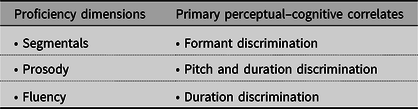
Though admittedly simplified, our specific hypotheses are summarized in Table 1. L2 pronunciation proficiency development is driven by auditory processing abilities related to the primary acoustic correlates of L2 segmental, prosodic, and fluency development: (a) those with greater spectral sensitivity (formant discrimination) will demonstrate more advanced segmental proficiency (consonant and vowel accuracy); (b) those with greater melodic and temporal sensitivity (pitch and duration discrimination) will show better prosodic proficiency (word stress and intonation); and (c) those with greater temporal sensitivity (duration discrimination) will exhibit better fluency proficiency (breakdown and speed fluency).
Predicted relationship between L2 pronunciation proficiency and auditory processing

Method
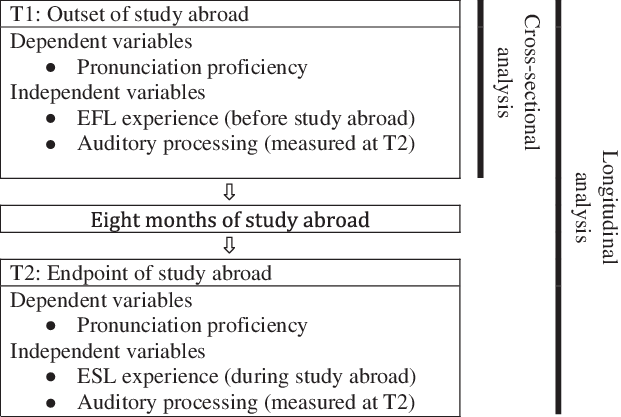
The current study featured a total of 30 Chinese international students during an 8-month period of study abroad in the United Kingdom. The participants’ pronunciation proficiency was assessed at the outset (T1) and endpoint (T2) of their immersion, and their auditory processing was measured at T2 (for details, see below). From a cross-sectional perspective, we explored the degree to which the participants’ L2 pronunciation proficiency was associated with their past English as a second language (EFL) experience profiles (before study abroad) and auditory processing ability. In addition, we conducted a longitudinal investigation of the relationship between participants’ recent English as a second language (ESL) experience, auditory processing, and L2 pronunciation proficiency development over time (T1 → T2). The design of the study is visually summarized in Figure 1.
Design of current study.

Participants
As a part of a larger project, which examined the L2 pronunciation proficiency of 100+ learners with a wide range of L1, experience, age, and aptitude profiles in London, 30 Chinese learners of English (27 females) were recruited at the beginning of an academic year (T1). Their average age was 23.5 years (SD = 2.2, range = 21–34). All of them were graduate students in various areas of sciences, social sciences, and humanities. At the outset of the project, they had resided in the United Kingdom for less than 1 month. Their general L2 English proficiency as measured by IELTS spanned between 6 and 8 out of 9 (M = 7.1, SD = 0.5, range = 6–8), which classifies them as independent and proficient L2 users (i.e., B2 to C2 as per Common European Framework of Reference). All the participants reported normal hearing. Participants participated in a second data collection session 8 months after T1, that is, at the end of their program (T2).
All participants were individually interviewed at T1 to gather information about their past EFL experiences. The participants reported having studied English for an extensive amount of time in China (M = 15.3 years, SD = 2.1, range = 10–22) with different onsets of learning (M = 8.3 years, SD = 1.9, range = 6–13). According to their self-reports, the total number of hours they engaged in EFL education widely varied (M = 3037.5 hr, SD = 1152.1, range = 1520–6840). No participants reported having any extensive immersion experience prior to the project. Because the quantity of L2 use likely differed among the participants during the project, they were interviewed again at T2 to survey their ESL experience (T1 → T2). The results of this interview indicated that their estimated amount of L2 use per week widely varied (M = 8.0 hr, SD = 9.8, range = 1–51).
Speaking task
L2 pronunciation scholars have generally relied on controlled speech tasks (e.g., word and sentence reading) in order to lead their participants to pronounce certain phonological features that they are interested in (for research synthesis, see Saito & Plonsky, Reference Saito and Plonsky2019). However, this task format allows adult L2 learners to monitor their correct pronunciation forms, which may not necessarily index their actual L2 proficiency in communicative settings (Piske, Flege, MacKay, & Meador, Reference Piske, Flege, Meador, Wrembel, Kul and Dziubalska-Kołaczyk2011). In this regard, a timed picture description task was used to elicit participants’ relatively unconscious and unmonitored use of L2 pronunciation forms (i.e., spontaneous L2 pronunciation proficiency). In the task, participants described a series of picture narratives with a primary focus on meaning under time pressure. Four different versions of the task (Versions A, B, C & D) were selected from the Pre-Grade 1 Level of the EIKEN English Test (EIKEN Foundation of Japan, 2016), and administered randomly at each testing point (Version A or B at T1; Version C or D at T2). In this way, we were able to control for the confounding effects of different topics, as well as test–retest effects. In each version, participants were asked to describe a four-frame cartoon with one minute of planning time. To avoid false starts, they were given the first sentence that they had to use in the task (for all the task materials used in the study, see Appendix A).
All of the speech samples were recorded in a quiet room at a university using a Roland-05 audio recorder, set to 44,100 Hz sampling rate and 16-bit quantization, and via a unidirectional condenser microphone. Following the standards in L2 pronunciation research (e.g., Isaacs & Trofimovich, Reference Isaacs and Trofimovich2012) and to reduce the amount of listener fatigue during the L2 speech rating sessions (see below), the first 30 s of each speech sample were cut, normalized for peak intensity, and saved as a WAV file. A total of 60 speech samples (30 participants × 2 data collection points [T1, T2]) were submitted to subjective (rater judgments) analysis and objective acoustic analysis, as described below.
Constructs of L2 pronunciation proficiency
L2 pronunciation proficiency is broadly conceptualized on segmental and suprasegmental levels (Saito & Plonsky, Reference Saito and Plonsky2019). Following Trofimovich and Baker’s (Reference Trofimovich and Baker2006) framework, the latter construct of L2 pronunciation can be further divided into “melody-based” suprasegmentals, defined as acoustic phenomena signaled via fundamental frequency and intensity (word stress and intonation); and “rhythm-based” suprasegmentals, featuring all the temporal characteristics (breakdown and speed fluency). In this paper, therefore we considered L2 pronunciation to be threefold: (a) the ability to pronounce consonants and vowels accurately (segmental proficiency); (b) the ability to correctly assign stress at both the word and sentence levels (prosodic proficiency); and (c) the ability to deliver speech at an optimal tempo without too many pauses, repetitions, and/or self-corrections (fluency proficiency).
L2 pronunciation assessment: Rater judgments
A total of five expert raters were trained to make impressionistic judgments of four different dimensions of L2 pronunciation: (a) segmentals (substitution, omission, or insertion of individual consonants or vowels); (b) word stress (misplaced or missing primary stress in multisyllabic words); (c) intonation (appropriate, varied vs. incorrect and monotonous use of pitch on a sentence level); and (d) perceived tempo (optimal speed of delivery; for development and validation of the procedure, see Saito, Trofimovich & Isaacs, Reference Saito, Trofimovich and Isaacs2017). All of the speech samples were played for the raters in a randomized order via a MATLAB-based software. For each sample, raters used a moving slider to assess the degree of targetlikeness, which was recorded on a 1,000-point scale (0 = not targetlike at all; 1,000 = targetlike). For onscreen labels for each rated category, see Appendix B. The first author administered the rater training and listening sessions.
Raters
As recommended in Saito et al. (Reference Saito, Trofimovich and Isaacs2017), five raters (2 males, 3 females) were carefully selected in light of their experience, familiarity, and expertise with L2 speech judgments of this kind. Four raters were native speakers of British English, while one rater was a native speaker of American English. All of them had obtained an MA in applied linguistics, had extensive English teaching experience (M = 9.6 years, SD = 8.9, range = 3–20 years), and reported high-level familiarity with foreign-accented English (M = 6 out of 6: 1 = not at all; 6 = very much).
Procedure
All the listening sessions took place individually in a quiet room at a university in London. The raters received detailed explanation from the first author about the meanings of each rating category, and how to use the scale. For training scripts, see Appendix C. Next, they familiarized themselves with the rating procedure by using a set of five practice samples (but not included in the main data set). For each sample, they explained and justified their segmental, prosodic (word stress, and intonation) and temporal (perceived tempo) ratings, with the researcher providing feedback to ensure that the raters had clearly understood and differentiated between the four rated categories. The raters then proceeded to rate the main data set of 60 audio samples. The entire session lasted for 2 hr. To avoid listener fatigue, raters were given a break halfway through.
Inter- and intrarater reliabilities
Cronbach’s alpha was calculated to check the agreement among the pronunciation proficiency ratings. In line with previous research (e.g., Saito et al., Reference Saito, Trofimovich and Isaacs2017), the results found relatively high alpha levels for segmentals (α = 0.85), word stress (α = 0.80), intonation (α = 0.78), and speech rate (α = 0.85), indicating that the raters’ judgments were overall consistent across the four different dimensions of L2 pronunciation proficiency. In addition, the raters assessed the extent to which they had understood each pronunciation category (1 = I did not understand at all, 9 = I understand this concept well); and the extent to which they could use/handle the category while listening spontaneous speech samples (1 = very difficult, 9 = very easy and comfortable). The raters reported relatively high level of understanding (M = 9.0) and comfort (M = 8.6) for all linguistic categories. For the subsequent analyses, all the raters’ scores were averaged across for each participant (Participants 1–30) at different time points (T1, T2) for the four L2 pronunciation categories (segmentals, word stress, intonation, and perceived tempo).
L2 pronunciation assessment: Acoustic analyses
Following the assessment framework of L2 utterance fluency (Tavakoli & Skehan, Reference Tavakoli, Skehan and Ellis2005), two linguistically trained coders participated and conducted acoustic analyses of two temporal dimensions of L2 speech: (a) breakdown (the ratio of filled and unfilled pauses); and (b) speed (articulation rate).Footnote 2
To conduct the analysis, all speech samples were first transcribed and separated into clauses using the Analysis of Speech Unit (Foster, Tonkyn, & Wigglesworth, Reference Foster, Tonkyn and Wigglesworth2000). As operationalized in Bosker, Pinget, Quené, Sanders, and De Jong (Reference Bosker, Pinget, Quené, Sanders and de Jong2013), the number of filled (e.g., ah, oh, and eh) and unfilled pauses were combined. The pauses were divided by the total number of words. For speed fluency, the total number of syllables was divided by the total phonation time (without any unfilled pauses; i.e., articulation rate).
Two experienced, trained coders first separately conducted fluency analyses on 20 similar L2 picture narratives (not included in the main data set). Their interrater reliability was relatively high for breakdown (interclass correlations: r = .95 for pause ratio) and speed (r = .96 for articulation rate). Any discrepancies were discussed and solved with the view of obtaining a consistent understanding of the breakdown and speed fluency analyses. Subsequently, the first coder proceeded to the fluency analyses of the main data set (n = 60 speech samples).
Auditory processing measures
In light of the existing literature on auditory individual differences in L1 acquisition, audition abilities were operationalized as one’s sensitivity to perceptual differences in formant frequency, pitch, and duration (e.g., McArthur & Bishop, Reference McArthur and Bishop2005). Adopting the procedure/materials established in our precursor research (e.g., Kachlicka et al., Reference Kachlicka, Saito and Tierney2019), participants took three different types of auditory processing tests: formant, pitch, and duration discrimination. The participants took the tests in the following order: formant discrimination, pitch discrimination, and duration discrimination. For practical reasons, the testing sessions took place at the endpoint of the project. Because domain-general abilities such as auditory processing are thought to be relatively stable for the same individuals over time (Hornickel, Knowles, & Kraus, Reference Hornickel, Knowles and Kraus2012), we do not believe that the timing of the assessment (at the endpoint of the project) significantly affected how well the participants’ explicit perceptual acuity was represented. In the Discussion section, however, we revisited this assumption, providing food for thought for future studies of this kind.
The auditory processing tests were designed to assess the participants’ thresholds for sound discrimination on three dimensions: (a) frequency of spectral peaks, (b) fundamental frequencies, and (c) duration. For each test a total of 100 stimulus levels were created via custom MATLAB scripts. Participants were presented with three tones with an interstimulus interval of 0.5 s and were asked to indicate which of the tones differed from the middle one by pressing the number “1” or “3.” Using an adaptive threshold procedure (Levitt, Reference Levitt1971), the size of the difference varied from trial to trial based on task performance. Initially, the tests started at Level 50. For every incorrect response, the difficulty of the task decreased (with the difference being wider). When participants correctly responded to three consecutive stimuli, task difficulty increased (with the difference being smaller).
The program also tracked which “direction” the threshold had been moving over the last couple of trials. For example, if the current stimulus difference was smaller than the difference in the last trial, then thresholds had been decreasing. It then looked for trials in which there was a “reversal” in direction. This could be due either to a participant getting the answer right after a string of wrong answers, or to a participant getting the answer wrong after a string of correct answers. The step size was initially set at 10 levels. After the first reversal in direction (i.e., an increase in difficulty followed by a decrease or vice versa), the step size decreased to 5 levels, and decreased to 2 and 1 after the second and third reversals. The program stopped after either 50 trials or eight reversals have been reached. Then, to calculate the individual’s threshold, the program averaged the stimulus differences levels that occurred across all reversals from the second on. Thus, this program was designed to calculate the level at which participants could just barely do the task.
For the formant discrimination test, stimuli were complex tones with fundamental frequencies (F0) at 100 Hz and harmonics up to 3000 Hz. Stimuli were 0.5 s in duration with a 0.015-s linear ramp at the beginning and the end. Three formants were created using a parallel formant filter bank (Smith, Reference Smith2007). The first and third formants were kept constant at 500 Hz (F1) and 2500 Hz (F3). The frequency of the second formant (F2) ranged from 1500 Hz to 1700 Hz with an increment of 2 Hz. For example, if a participant stops at Level 50, this means that he can perceive a minimum difference of 100 Hz (2 Hz × 50 levels) when two stimuli differ in F2.
For the pitch and duration discrimination tests, a standard four-harmonic complex tone was created with F0 at 330 Hz. Each stimulus was 0.5 s in duration, beginning and ending with 0.015 s of linear amplitude ramp. While the stimuli in the pitch discrimination test differed on the continuum of F0 between 330 and 360 Hz (with a step of 3 Hz), those in the duration discrimination test ranged from 0.25 to 0.5 s (0.0025-s steps). For example, if a participant ends at Level 50, this means that he can perceive a minimum difference of 150 Hz (3Hz × 50 levels) when two stimuli differ in F0, or a minimum difference of 0.125 s (0.0025 s × 50 levels) when they differ in duration. As such, formant, pitch, and duration processing scores were calculated in terms of how small of a difference participants could perceive on a 100-point continuum. For more methodological details, audio materials, and validation research, see Saito, Sun, and Tierney (Reference Saito, Sun and Tierney2020).
Results
L2 pronunciation proficiency
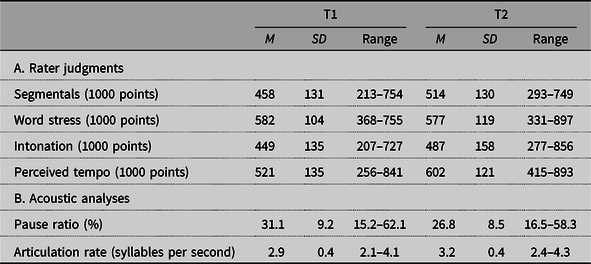
The segmental, prosodic, and fluency dimensions of the participants’ speech were assessed using the four rater judgment measures (segmentals, word stress, intonation, and perceived tempo) and the two acoustic measures (pause ratio and articulation rate). According to Kolmogorov–Smirnov tests, the distribution of the two acoustic measures (pause ratio and articulation rate) were found to be positively skewed (p < .05). Therefore, the log 10 function was used to transform and normalize the data. To check if the four types of picture prompts (Versions A, B, C, vs. D) influenced participants’ L2 pronunciation proficiency, a set of repeated-measure analyses of variance were conducted with each dimension of participants’ pronunciation proficiency scores relative to task prompts at T1 (Versions A vs. B) and T2 (Versions C vs. D). The results did not find any significant relationship between L2 pronunciation proficiency and task prompts in any contexts (p > .05). The descriptive statistics of L2 pronunciation proficiency scores were summarized in Table 2.
Descriptive information of L2 pronunciation proficiency scores at T1 and T2

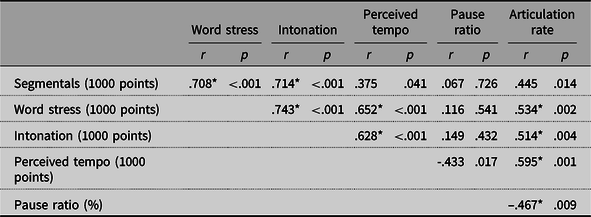
To delve into the relationship among the participants’ pronunciation scores (elicited from the six measures), a set of Pearson correlations were conducted with their T1 scores. Due to multiple comparisons (i.e., each measure was compared against the other five measures), the alpha level was adjusted and set at p < .010 (Bonferroni corrected). As summarized in Table 3, all subcategories of the rater judgments were significantly correlated with each other except for the link between segmentals and perceived tempo (r = .375, p = .041). Interestingly, while one acoustic measure (articulation rate) was significantly associated with raters’ judgments of suprasegmentals in particular (word stress, intonation, and perceived tempo), the other acoustic measures appeared to be rather unrelated and independent (breakdown vs. speed). Thus, a total of six measures were assumed to tap into the following three overall domains of L2 pronunciation proficiency: (a) correct pronunciation of individual sounds and words (segmentals, word stress, and intonation); (b) overall prosody (word stress, intonation, perceived tempo, and articulation rate); and (c) temporal fluency (pause ratio and articulation rate).
Interrelationships between L2 pronunciation proficiency scores (T1)

* For statistically significant (p < .010) (Bonferroni corrected).
L2 auditory processing profiles
Auditory processing scores were recorded on a 100-point scale (smaller values indicating greater spectral, melodic, and rhythmic sensitivity). The raw data were summarized in Table 4. For the sake of interpretation, smaller values indicate more sensitive and better auditory processing abilities. As for formant discrimination, for example, some could perceive very subtle differences when F2 shifted to a very small degree (e.g., 7 Hz), but the formant acuity of others could be much less sensitive (e.g., 117 Hz). As observed in our precursor research (e.g., Kachlicka et al., Reference Kachlicka, Saito and Tierney2019; Saito, Kachlicka, et al., Reference Saito, Kachlicka, Sun and Tierney2020), the results of Kolmogorov–Smirnov tests found the pitch and duration discrimination scores to be positively skewed (p < .001, p = .041). To approximate normal distribution, these auditory scores were thus transformed via the log 10 function. For the purpose of comparisons and subsequent analyses, all the auditory processing scores were converted to z scores.
Summary of raw auditory processing scores

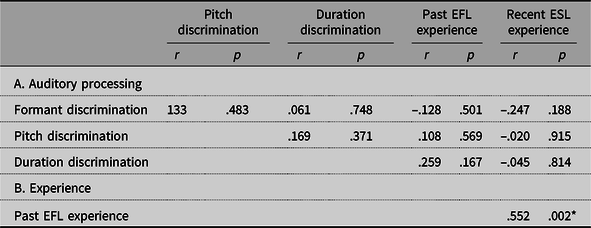
To check the interrelationships between the three auditory processing measures (formant, pitch, and duration) and the two experience factors (past EFL and recent ESL experience), Pearson correlation analyses were performed. Considering the number of comparisons (each independent variable was compared against the other four variables), an α level was set to 0.012 (Bonferroni corrected). As summarized in Table 5, no significant correlations were identified in any contexts, except for the relationship between past and recent experience (total hours of L2 use in ESL settings vs. total hours of L2 education in EFL settings). In terms of the degree of independence of auditory processing factors, these results indicate that (a) formant, pitch, and duration discrimination measures may represent three distinct aspects of auditory processing abilities; and (b) such auditory processing factors may be outside of the influence of past/recent L2 learning experience.
Interrelationships between auditory processing and experience scores

* For statistically significant (p < .012) (Bonferroni corrected).
Cross-sectional investigations (onset of study abroad: T1)
We next examined the relationships between participants’ auditory processing (formant, pitch, and duration discrimination), past experience (the amount of L2 use prior to study abroad) and L2 pronunciation proficiency at the outset of the project. A set of Pearson correlation analyses were performed with an α level set to 0.012 via Bonferroni corrections (each pronunciation measure was compared against three audition measures and one experience measure; see Table 6). Three areas of participants’ L2 pronunciation proficiency (word stress, perceived tempo, and articulation rate) yielded significant associations with the total number of hours they had spent on practicing the target language during 10–20 years of EFL education in China (r = .493–.518). According to Plonsky and Ghanbar’s (Reference Plonsky and Ghanbar2018) field-specific benchmarks, the strength of the correlations could be considered relatively large. The link between auditory processing and any dimension of L2 pronunciation proficiency remains unclear, as none of the contrasts reached statistical significance (p > .012).
Relationship between auditory processing, experience, and L2 pronunciation proficiency at the beginning of study abroad (T1)

* For statistically significant (p < .012) (Bonferroni corrected).
Longitudinal investigations (T1 to T2)
Our final objective was to conduct a longitudinal examination of the extent to which the participants’ diverse aptitude and experience profiles could influence their L2 pronunciation proficiency over a period of 8 months studying abroad in the United Kingdom. To obtain an overall picture of how both aptitude and experience factors as a composite model explained variance in L2 pronunciation development, linear mixed-effects modeling analyses were conducted using the lmer functions from the lme4 package (Version 1.1–21; Bates, Maechler, Bolker, & Walker, Reference Bates, Maechler, Bolker and Walker2015) in the R statistical environment (R Core Team, 2018). While participants’ L2 scores were used as dependent variables, a total of six separate models were constructed for six dimensions of pronunciation: that is, segmentals, word stress, intonation, perceived tempo, pause ratio, and articulation rate.Footnote 3
For each model, participants’ pronunciation scores at T1 and T2 were used as dependent variables. To track their gains over the course of 8 months of immersion, Time was treatment coded by assigning “–.5” to participants’ pronunciation scores at T1, and “.5” to their scores at T2. The fixed effects included five predictor variables: that is, (a) the main effect of time (T1, T2), (b) the interaction of time and three auditory processing measures (formant discrimination, pitch discrimination, and duration discrimination), and (c) the interaction of time and the total amount of L2 use (hours) during study abroad (between T1 and T2). The random effects included participants’ ID (1–30). Due to the size of sample, participants were included as random intercepts only.
To avoid Type 1 errors, the following planned comparison was made for the construction of the most optimal model in response to our research question. The main objective of the longitudinal analyses was to examine not only the extent to which L2 participants’ proficiency significantly changed due to the 8 months of immersion (i.e., main effects of time) but also how such development over time could be associated with auditory processing (interaction effects of time and auditory processing) and with L2 use (interaction effects of time and recent L2 use). Thus, the following model was used to examine the source of variances among the participants’ L2 pronunciation developmental patterns (T1 → T2). For R code, see Appendix D.
 $$\hskip-42pt{\rm{Pronunciation \;proficiency = Intercepts + Time + Time} \hskip-32pt{\rm{\times Formant \;Disctimination + Time \times Pitch \;Disctimination \hskip-22pt{\rm+ \;Time \times {Duration \;Disctimination + Time \times Recent \;L2 \;Use \hskip-135pt{\rm+ \;{Random \;Effects \;of \;Participants}}$$
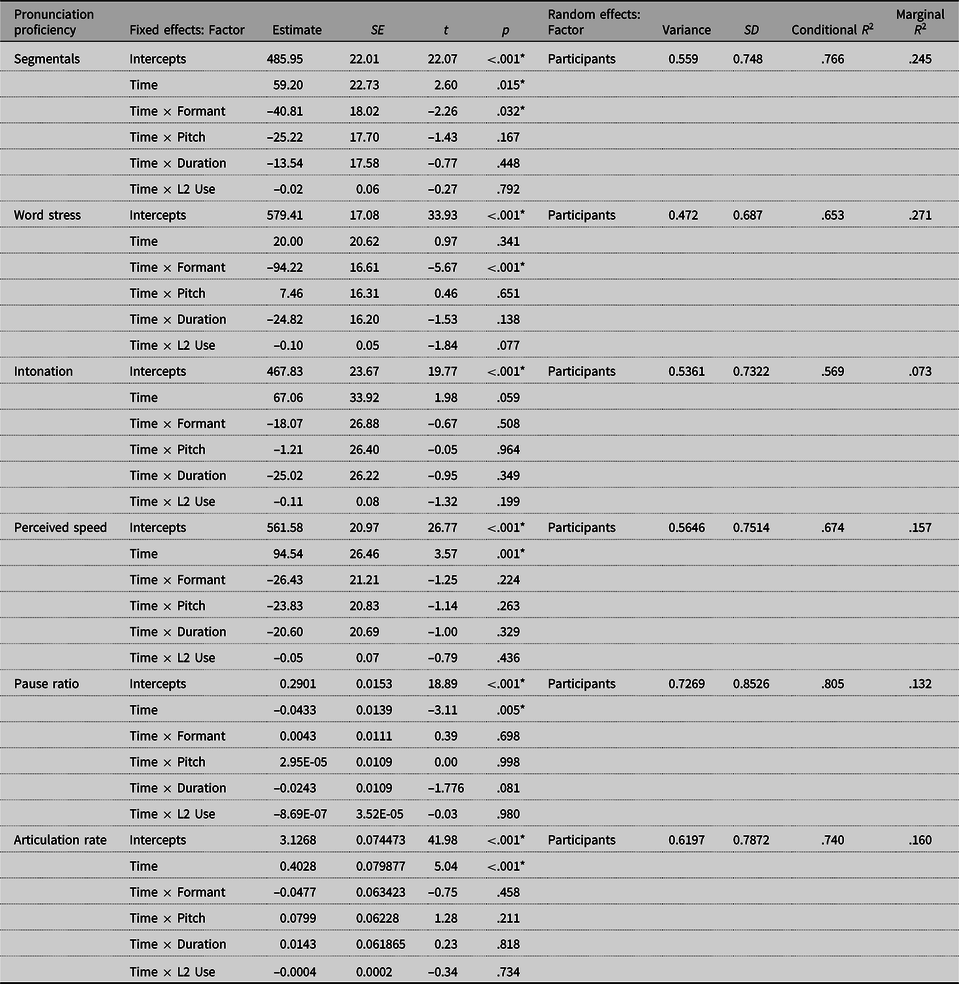
As summarized in Table 7, significant main effects of time were identified for perceived speed, pause ratio, and articulation rate. The findings here imply that the 8 months of study abroad were facilitative of the temporal aspects of L2 pronunciation proficiency development (i.e., more optimal tempo), and the gains were attributable to reduced pause ratio and increased articulation rate. Furthermore, significant interaction effects of time and auditory processing (formant discrimination) were found for segmentals and word stress. The results indicate that auditory processing may play a key role in determining the amount of improvement especially in the accuracy aspects of L2 pronunciation proficiency, and that certain participants with more precise auditory processing could demonstrate not only more fluent but also more accurate L2 pronunciation proficiency development over time. The relationships between participants’ gain (from T1 to T2) and formant discrimination residuals were visually summarized in Figure 2.
Results of mixed-effects modeling analyses on factors affecting L2 pronunciation development

Correlation between L2 pronunciation gain scores and auditory processing residuals with initial proficiency partialled out.

Discussion, Conclusion, and Future Directions
The current study proposed a hypothesis that a perceptual–cognitive foundation of successful L1 acquisition, domain-general auditory processing, can account for some variance in postpubertal L2 pronunciation learning. Specifically, we predicted that learners with greater sensitivity to the formant, pitch, and duration aspects of acoustic information could make the most of L2 input and output opportunities to improve the segmental, prosodic, and fluency aspects of their L2 pronunciation proficiency. To test this hypothesis, we conducted cross-sectional and longitudinal investigations on the pronunciation development of 30 L1 Chinese students with diverse profiles of auditory processing abilities (formant, pitch, and duration discrimination), when they engaged in 8 months of study abroad in the United Kingdom. A total of six pronunciation measures were adopted to tap into three different dimensions of the participants’ L2 pronunciation proficiency: (a) correct pronunciation of sounds and words, (b) overall prosodic accuracy, and (c) temporal fluency.
Results of the analyses revealed that the participants’ L2 pronunciation proficiency was not significantly related to their auditory processing profiles at the outset of the project. Rather, the quality of their suprasegmental performance was significantly tied to the extent to which they had previously practiced the target language in China prior to their arrival in the United Kingdom. Over the course of the 8-month immersion period, however, most learners were able to attain smoother, faster, and more fluent speech (fewer pauses, faster articulation rate, and more optimal perceived tempo). In addition, it was certain learners with high-level auditory processing abilities (i.e., more precise formant discrimination) that further enhance their L2 pronunciation proficiency via greater segmental and word stress accuracy (more correct pronunciation of individual sounds and words), leading to more advanced L2 pronunciation (fluent and accurate).
From a theoretical perspective, our findings lend some support for the claim that auditory processing abilities can act as a bottleneck for postpubertal L2 pronunciation learning especially at the initial to mid stage of immersion, that is, first 8 months of study abroad for L1 Chinese students without any experience overseas. While some studies have noted the relationship between auditory processing and L2 speech perception development through intensive laboratory training (e.g., Lengeris & Hazan, Reference Lengeris and Hazan2010), our study provided the very first empirical evidence from a longitudinal perspective that auditory processing is tied to L2 pronunciation learning in an immersive, naturalistic context.
In line with the multifaceted view of L2 aptitude and acquisition (Li, Reference Li2016; Skehan, Reference Skehan, Weng, Skehan, Biedron, Li and Sparks2019), it is important to point out that different dimensions of L2 learning outcomes were driven by factors related to different aptitude profiles (e.g., auditory processing). Of note, perceptual and cognitive individual differences are thought to play less of a role for relatively learnable features such as better perceived tempo and articulation rate (Lahmann, Steinkrauss, & Schmid, Reference Lahmann, Steinkrauss and Schmid2017). By comparison, individual differences in auditory processing may be more influential in determining the attainment of advanced-level L2 pronunciation accuracy and fluency, characterized as greater segmental and prosodic refinement (Granena & Long, Reference Granena and Long2013; Saito, Reference Saito2019).
On the one hand, participants were able to significantly enhance the speed fluency aspects of their L2 speech (perceived tempo and articulation rate)—relatively salient and learnable features—as a function of increased experience alone (8 months of study abroad). Although the participants’ reported a different amount of L2 use over during study abroad, the significant main effects of time in the mixed effects modeling analyses showed that the speed of their L2 speech became significantly faster on the whole. This finding concurs with a range of previous studies showing that L2 fluency development is highly susceptible to the quantity of L2 experience (e.g., Derwing, Munro, Thomson, & Rossiter, Reference Derwing, Munro, Thomson and Rossiter2009; Saito, Ilkan, Magne, Tran, & Suzuki, Reference Saito, Ilkan, Magne, Tran and Suzuki2018; Trofimovich & Baker, Reference Trofimovich and Baker2006). In other words, as long as L2 learners practice the target language on a regular basis, a great deal of improvement is likely to be observed in various areas of fluency, not only within a short period of study (e.g., Mora & Valls-Ferrer, Reference Mora and Valls-Ferrer2012; Segalowitz & Freed, Reference Segalowitz and Freed2004), but over a longer period of immersion (e.g., Derwing et al., Reference Derwing, Munro, Thomson and Rossiter2009; Saito et al., Reference Saito, Ilkan, Magne, Tran and Suzuki2018; Trofimovich & Baker, Reference Trofimovich and Baker2006).
On the other hand, the findings suggest that learners may require high-level aptitude on top of extensive experience when the target features are relatively complex, nonsalient, or difficult (Doughty, Reference Doughty2019; Li, Reference Li2016; Skehan, Reference Skehan, Weng, Skehan, Biedron, Li and Sparks2019). Our findings suggest that for pronunciation, formant discrimination may anchor the degree of segmental and word stress (rather than perceived tempo and fluency) acquisition. These accuracy dimensions are considered to be relatively complex and difficult aspects of L2 pronunciation proficiency, as we will further discuss and elaborate below (Saito, Reference Saito2015a, Reference Saito2015b).
Previous research has indicated that most L2 segmental learning happens within the first few months of immersion, as learners’ pronunciation becomes readily intelligible with frequent and familiar words. However, this is quickly followed by a plateau (Munro & Derwing, Reference Munro and Derwing2008; Munro et al., Reference Munro, Derwing, Saito, Levis and LeVelle2013), and leads to a degree of foreign accentedness that is highly resistant to change, especially on a segmental level (Muñoz & Llanes, Reference Muñoz and Llanes2014; Saito, Reference Saito2015a). To further refine segmental accuracy, L2 learners may require extensive amounts of explicit instruction (Thomson & Derwing, Reference Thomson and Derwing2015) and/or naturalistic exposure to the L2 (e.g., 10+ years of residence: Flege, Takagi, & Mann, Reference Flege, Takagi and Mann1995; Saito, Reference Saito2015b). Similarly, L2 learners appeared to show tremendous difficulty in the correct assignment of word stress, arguably because it requires the learners to decode the timing and location of vowel reduction by using all spectral, prosodic, and durational cues in speech at the same time (Trofimovich & Baker, Reference Trofimovich and Baker2006). It is in the acquisition of such difficult features that aptitude may make a large difference. Though few in number, there is emerging evidence that those with greater phonemic coding ability likely show more nativelike segmental pronunciation skills on a global (e.g., Granena & Long, Reference Granena and Long2013, for global foreign accentedness) and specific level (e.g., Saito, Reference Saito2019, for English /r/-/l/).
In the current investigation, two auditory processing measure (i.e., pitch and duration discrimination) did not show significant associations with any aspects of L2 pronunciation proficiency development, as opposed to our earlier predictions. The findings here were surprising, because pitch information plays a key role in other instances of L2 speech acquisition (cf. Li & DeKeyser, Reference Li and DeKeyser2017, for American learners of Mandarin Chinese). As one possible interpretation, the findings could be ascribed to the nature of the participants’ L1 background, that is, Mandarin Chinese. In the previous literature, it has been shown that tonal language speakers tend to demonstrate stronger brainstem representation of fundamental frequencies than nontonal language users (Bidelman, Gandour, & Krishnan, Reference Bidelman, Gandour and Krishnan2011) as well as more accurate pitch discrimination (Giuliano, Pforfresher, Stanley, Narayana, & Wicha, Reference Giuliano, Pfordresher, Stanley, Narayana and Wicha2011). As a result, Mandarin L1 speakers may be generally more capable of sufficiently precise pitch perception to extract prosodic structure from speech as compared to speakers of other languages, weakening relationships between pitch perception and prosodic and phonetic processing. This explanation could be tested in future research examining links between auditory processing and pronunciation in speakers of other languages.
To close, the exploratory nature of the project, its design, and findings lead us to suggest a set of intriguing directions for future aptitude research. Drawing on the L1 literature (McArthur & Bishop, Reference McArthur and Bishop2005), we assumed that domain-general auditory processing could be considered as a rather stable trait. The results of the current study found participants’ auditory processing to be unrelated to the influence of any experience factors at least within the time framework of the current study (i.e., first 8 months of study-abroad). However, there is some cross-sectional evidence that experience does play a role in individual differences in auditory processing, especially when researchers compare participants who have substantially different biographical backgrounds, such as total versus nontonal language users (e.g., Bidelman et al., Reference Bidelman, Gandour and Krishnan2011), musicians versus non-musicians (Tierney, Krizman, Kraus, & Tallal, Reference Tierney, Krizman, Kraus and Tallal2015), and sequential versus simultaneous bilinguals (Krizman, Slater, Skoe, Marian, & Kraus, Reference Krizman, Slater, Skoe, Marian and Kraus2015). Whereas we evaluated participants’ audition ability only at the endpoint of the current project, we urge future studies to take a longitudinal look at the extent to which late bilinguals’ linguistic and auditory abilities change over the course of long-term immersion.
To follow up our tentative hypothesis that immersion experience may enhance both auditory and linguistic skills, we recently conducted another longitudinal study with a very similar population (n = 50 Chinese international students in London; Sun, Saito, & Tierney, Reference Sun, Saito and Tierneyin press). In this project, we used both behavioral and neural measures to track their auditory processing ability at the outset and endpoint of their short-term immersion (5 months), finding no significant change over time (despite the fact that some participants with more precise auditory precision demonstrated greater improvement in their L2 skills). Here, our follow-up study concurs with L1 acquisition literature that auditory processing is relatively stable (e.g., Hornickel et al., Reference Hornickel, Knowles and Kraus2012), or that more extensive second language exposure or second language exposure early in life may be needed to enhance auditory processing (e.g., Bidelman et al., Reference Bidelman, Gandour and Krishnan2011). To further test the plasticity of auditory processing, we may need longitudinal studies with a much longer timeframe (e.g., 1–2 years), or training studies, wherein we can investigate the presence and absence of any change in auditory skills when participants receive hours of intensive auditory training (see Hayes, Warrier, Nicol, Zecker, & Kraus, Reference Hayes, Warrier, Nicol, Zecker and Kraus2003, for 35–40 hr of commercial auditory processing training programs).
Another topic worthy of attention concerns different types of auditory processing ability, that is, the explicit–implicit distinction. In the field of L2 acquisition, some scholars have begun to emphasize that certain L2 learners can attain high-level L2 proficiency due to their ability to process language with (explicit learning) and without (implicit learning) awareness (Doughty, Reference Doughty2019). A growing number of studies have indicated that the incidence of high-level L2 grammar attainment is linked to a series of implicit, statistical learning mechanisms (e.g., Link et al., Reference Linck, Hughes, Campbell, Silbert, Tare, Jackson and Doughty2013; Suzuki & DeKeyser, Reference Suzuki and DeKeyser2017). It is interesting to note that L1 acquisition scholars have primarily measured the auditory processing phenomenon using two different methodological paradigms (i.e., behavioral and neurophysiological). Behavioral measures (e.g., formant, pitch, and duration discrimination) are primarily used to tap into explicit auditory processing, while neurophysiological instruments are used to tap into implicit auditory processing. To our knowledge, little empirical investigation has been conducted on the relationship between explicit and implicit auditory processing. In the context of postpubertal L2 speech learning, however, Diaz, Mitterer, Broersma, Escera, and Sebastian-Galles (Reference Diaz, Mitterer, Broersma, Escera and Sebastian-Galles2016) have provided preliminary evidence that behavioral and neurophysiological measures seem to tap into two different constructs of perceptual acuity, and that they can explain independent variance in postpubertal L2 pronunciation learning (see Kachlicka et al., Reference Kachlicka, Saito and Tierney2019; Saito, Sun, & Tierney, Reference Saito, Sun and Tierney2019; Sun et al., Reference Sun, Saito and Tierneyin press).
Given this promising finding, we call for future studies to interface L1 and L2 research perspectives and examine the role of explicit and implicit auditory processing in different types of L2 speech learning. In the present study we have provided evidence to suggest that explicit auditory processing may be instrumental to the initial stage of naturalistic L2 speech learning (8 months of study abroad). It would be intriguing to further this line of inquiry by probing the extent to which explicit and implicit auditory processing can help even highly experienced L2 learners (those with 10+ years of immersion) ultimately improve their L2 pronunciation proficiency (cf. Saito, Kachlicka, et al., Reference Saito, Kachlicka, Sun and Tierney2020).
The independent contribution of explicit and implicit auditory processing to L2 speech leaning can be further tested via the aptitude-interaction paradigm. While learners with explicit aptitude are hypothesized to benefit more from explicit, language-focused instruction, those with implicit aptitude are thought to make better use of implicit, meaning-focused instruction (DeKeyser, Reference DeKeyser2012). By adopting a quasi-experimental design, therefore, future studies could track how L2 learners with different explicit and implicit auditory processing abilities can differentially improve their proficiency when they engage in explicit (e.g., Saito & Plonsky, Reference Saito and Plonsky2019, for articulatory and auditory training) and implicit pronunciation training (e.g., Lee & Lyster, Reference Lee and Lyster2016).
Acknowledgments
This study was funded by Leverhulme Trust Research Grant (RPG-2019-039) and Arnold Bentley New Initiatives Fund. We gratefully acknowledge insightful comments from Yui Suzukida, Shungo Suzuki, and three anonymous Applied Psycholinguistics reviewers on earlier versions of the manuscript.
Appendix A
Speaking Tasks (Versions A, B, C, and D)
Version A
You have one minute to prepare. This is a story about a woman who wanted to stop people from smoking on the street. You have two minutes to narrate the story. Your story should begin with the following sentence: One day, a woman was on her way to work.


Version B
You have one minute to prepare. This is a story about a couple who ran an open-air restaurant on a beach. You have two minutes to narrate the story. Your story should begin with the following sentence: One day, a couple was at their restaurant.
Version C
You have one minute to prepare. This is a story about an elderly couple who lives far away from the nearest supermarket. You have two minutes to narrate the story. Your story should begin with the following sentence: One day, an elderly couple was coming home from the supermarket.
Version D
You have one minute to prepare. This is a story about a girl who wanted a smartphone. You have two minutes to narrate the story. Your story should begin with the following sentence: One day, a girl was at home with her parents.
All the materials adapted from EIKEN Foundation of Japan. (2016). EIKEN Pre-1 level: Complete questions collection. Tokyo: Oubunsha.
Appendix B
Onscreen Labels for Pronunciation Measures
Appendix C
Training Materials for Pronunciation Measures

Adapted from Saito, Trofimovich, & Isaacs. (Reference Saito, Trofimovich and Isaacs2017). Using listener judgments to investigate linguistic influences on L2 comprehensibility and accentedness: A validation and generalization study. Applied Linguistics, 38, 439–462.
Appendix D
R Code for Mixed Effects Modeling Analyses
We constructed a set of linear mixed-effects models using the lmer functions from the lme4 package (Version 1.1–21; Bates, Maechler, Bolker, & Walker, Reference Bates, Maechler, Bolker and Walker2015) in the R statistical environment (R Core Team, 2018). To this end, the following code was used:
 $${\rm{Model \le lmer}}\left( {{\rm{formula = Pronunciation\_Proficiency \;\~ \;\;1 + Time {\rm{+ \;Time: Formant ;Discrimination + Time: \ Pitch \ Disctimination {\rm{+ \;Time: \ Duration \ Disctimination + Time: \ Recent \ L2 \ Use {\rm{+ }}\left( {{\rm{1|ID}}} \right){\rm{, data = data}}} \right)$$
Dependent variables: “Pronunciation_Proficiency” refers to the participants’ pronunciation scores at T1 and T2. A total of six separate models were created for segmentals, word stress, intonation, perceived speed, pause ratio, and articulation rate, respectively.
-
Fixed effects: Each model consists of (a) one main effect of time, (b) three interaction effects of Time and auditory processing scores (“Formant Discrimination,” “Pitch Discrimination,” “Duration Discrimination”), and (c) one interaction effect of Time and the amount of participants’ L2 use throughout the project (“Recent L2 Use”). For Time, “–.5” was given to participants’ pronunciation performance at T1 (the beginning of the project), and “.5” was given to their performance at T2 (the end of the project). When the participants’ increased pronunciation scores were considered as improvement (segmentals, word stress, intonation, optimal speed, and articulation rate), the estimate could be positive. When their decreased pronunciation scores were considered as improvement (pause ratio), the estimate could be negative).
-
Random effects: Participants’ ID (1–30) were entered into the model as random effects.