1. Introduction
Activities to protect and promote minority languages are common throughout Europe and beyond. Theories of language revitalization point to education as a crucial variable, and international legal instruments recognize the right to teach minority languages at school. However, early efforts to secure the survival of minority languages showed that revitalization cannot be achieved by schools alone; society at large is at least as significant. The relationship between education and society is important at a time when both are rapidly changing. Revitalization processes no longer take place in a bilingual context with one minority and one dominant language, but increasingly in a multilingual context in which international and immigrant languages are also present.
In this plenary paper I want to examine the interaction between three or more languages in a number of European regions in which minority languages are already experiencing revitalization. The paper is based on my experience of over 30 years of research into the Frisian language in the Netherlands (Gorter Reference Gorter1987, Reference Gorter and Fishman2001, Reference Gorter2008a), in addition to several years of comparative work on minority languages across the European Union (Sikma & Gorter Reference Sikma and Gorter1990; Extra & Gorter Reference Extra and Gorter2001, Reference Extra and Gorter2008). More recently I have had first-hand experience of investigating the Basque language in education (Cenoz & Gorter Reference Cenoz and Gorter2011). For my discussion I will draw on the results of the long-running project on the ‘Added value of multilingualism and diversity in educational contexts’, in which the teaching of languages in the Basque Autonomous Community in Spain is compared to that in the province of Friesland in the Netherlands (Arocena et al. Reference Arocena, Douwes, Hanenburg, Gorter and Cenoz2010).
For the purpose of this discussion I will think of a language as lying at the intersection of two axes. On the first axis is the relationship between language proficiency and language practices. The extent to which a speaker ‘knows’ a language is considered to be important in language learning. The work of language teachers consists for the most part in trying to improve the proficiency of their students. Teachers of other subjects also contribute to this goal, even if they do not focus on teaching the language per se in the course of, for example, mathematics, history or music lessons. Of course, language learning continues outside the classroom, mainly through language use, so how the different languages are used has great significance. Language practices comprise the routine selections that speakers make from their linguistic repertoire (Spolsky Reference Spolsky2004: 5), which includes all types of linguistic behaviour by individuals in a multilingual context. Pennycook (Reference Pennycook2010: 2) claims that ‘language practices . . . are a central part of daily social organization’. So what speakers do with their languages, how they choose and use them in different contexts, is extremely important.
The second axis represents the relationship between education and society, especially how languages are taught and used in the school setting. Important issues include the selection of languages to be taught or the amount of time to be dedicated to each one. Additional considerations include the aims of language teaching and more complex questions such as how languages are taught, what teaching strategies are used, how the school tries to improve the level of proficiency in each of the languages and the desired outcomes in terms of proficiency. The language usage patterns of teachers and students can be examined under this heading, but it is also important to investigate language use in wider society, asking questions about the development of languages in a specific community of speakers, how speakers use the languages in their repertoire, how languages interact with each other and how different groups of speakers use languages.
I also want to consider the relationships between these two axes. Both in schools and in society at large it is interesting to see what actually happens to the languages. How proficient are the speakers – teachers and students – in their languages? What do they routinely do in school with the languages in their repertoire, and what goes on outside the school?
It is not easy to define a ‘minority language’. The definition in the European Charter for Regional or Minority Languages of the Council of Europe (1992) is frequently quoted in the literature (e.g. Dunbar Reference Dunbar2001: 91; Extra & Gorter Reference Extra and Gorter2001: 19; Hult Reference Hult2004: 192; Darquennes Reference Darquennes, Kortmann and Van der Auwera2011: 549; Nic Craith Reference Nic Craith, Kockel, Nic Craith and Frykman2012: 377). The Charter refers to ‘languages that are traditionally used within a given territory of a state by nationals of that state who form a group numerically smaller than the rest of the state's population and [are] different from the official language(s) of that state’.
Although this definition is widely used, it is not undisputed, because Article 1a of the Charter explicitly excludes ‘dialects of the official language(s) of the State or the languages of migrants’, and such varieties would be described by some as minority languages. The definition contains the word ‘state’ no less than four times, which demonstrates the power of the state authorities to give official recognition to a minority language on its territory (or to deny such recognition). Thus it is not the speakers of a minority language, or activists or language experts, but the state that has the power to determine the status of a minority language, including whether it officially exists at all.
Minority language speakers are multilingual by nature, or by necessity, from a young age. It is often believed that multilingual communities were once monolingual, a misconception also applied to countries as a whole, but in reality regions such as the Basque Country, Friesland or Wales have been bilingual or multilingual at least to some degree for several hundred years.
In this plenary paper I will be looking from a multilingual perspective at these two axes: language practices and proficiency on the one hand and education and society on the other. My emphasis is on European minority languages, in particular Basque and Frisian.
2. Theoretical approach
Work on bilingualism and multilingualism has been inspired in many ways by research in Wales. One of the most creative concepts of recent years is probably translanguaging (‘trawsieithu’ in Welsh): a skill that aids the development of bilingualism. Baker (Reference Baker2001) attributes its origins to Cen Williams, for whom it means (Reference Williams2002: 2) ‘(i) receiving information in one language and (ii) using or applying it in the other language’. It is a skill that bilingual Welsh-English children already use in everyday life, but one that should also be developed systematically at school, because it reinforces not only the two languages, but the relationship between them. Translanguaging, in its original formulation, is a teaching method in which, for example, the listening, singing or reading taking place during a lesson is in one language (Welsh), and further work, such as discussion or writing a summary, is in the other (English). Baker (Reference Baker2007: 2–3) examines the potential advantages of using translanguaging in the classroom to enable the student to develop into a balanced and confident bilingual person. Baker suggests that bilingualism offers communication, cultural, curriculum, cognitive, character and cash advantages. Garcia (Reference Garcia2009: 45), in her book on bilingual education in the twenty-first century, broadens the scope of translanguaging to all ‘multiple discursive practices in which bilinguals engage in order to make sense of their bilingual worlds’. She further asserts that ‘despite curricular arrangements that separate languages, the most prevalent bilingual practice in the bilingual education classrooms is that of translanguaging’ (Garcia Reference Garcia2009: 304). In the Welsh context and for Garcia in the US, translanguaging applies to two languages, but Canagarajah (Reference Canagarajah2011) uses the term for ‘the general communicative competence of multilinguals’. For Li Wei (Reference Wei2011) the concept of translanguaging has a different source because it builds on the notion of ‘languaging’ in psycholinguistics, and the term also links to Becker's (Reference Becker and Tannen1988) attempt to move away from language as a noun to language as a verb. Li Wei (Reference Wei2011: 1223) applies translanguaging to multilinguals in its widest sense, since it includes ‘any going between different linguistic structures, including different modalities’.
2.1 Focus on multilingualism
The ideas of Williams, Baker, Garcia, Canagarajah, Li Wei and others were an inspiration for the studies of multilingualism I have undertaken with my colleague Jasone Cenoz. We have called our approach ‘Focus on Multilingualism’ (Cenoz & Gorter Reference Cenoz and Gorter2011). In this plenary speech I want to apply our ideas to a comparison of Basque and Frisian and other European minority languages. We propose to look at all the languages of a multilingual speaker at once. In the traditional approach, based on a ‘monolingual mindset’ (Clyne Reference Clyne2005: xi), the competence of a multilingual person in one language is compared to that of a native speaker. In contrast, we believe that ‘if multilinguals have some special characteristics when learning and using languages, monolingual native speakers of each of the languages they speak cannot be the appropriate reference’ (Cenoz & Gorter Reference Cenoz and Gorter2011: 367).
Cenoz and I want instead to focus on the whole repertoire of languages and take into consideration the relationships between them. Multilingual speakers learn and use their languages while participating in language practices that are shaped by the social context. They make use of all their linguistic resources and navigate between their languages in interaction (see also Kramsch Reference Kramsch2006). This perspective can be applied to research into the acquisition of languages as well as to the classroom in multilingual education. Our approach also implies that ‘the goal in multilingual education should be to behave as a competent multilingual speaker’ (Cenoz & Gorter Reference Cenoz and Gorter2011: 367) and the school should adopt a ‘flexible bilingual pedagogy’ (Creese & Blackledge Reference Creese and Blackledge2010: 112).
We distinguish three dimensions in the focus on multilingualism: (1) the whole linguistic repertoire, (2) the multilingual speakers and (3) the wider social context. Each of these dimensions can be explained further.
2.1.1 The whole linguistic repertoire
Our focus on multilingualism makes us look again at the concept of repertoire: ‘the totality of linguistic resources available to members of particular communities’ (Gumperz Reference Gumperz, Gumperz and Hymes1986: 21–22). I prefer the view put forward by Blommaert & Backus (Reference Blommaert and Backus2011), for whom repertoire is based in someone's biography and comprises the individual's current language resources, their actual skills and competences. They distinguish four broad categories of competence (2011: 16), which can be read as a sliding scale of language knowledge. ‘Maximum’ competence is comprehensive and refers usually to the mother tongue and to school learning and covers the whole range of language skills. It is clear, however, that there is no absolute maximum because the perfect knowledge of the ideal hearer-speaker does not exist in reality. The second category is ‘partial’ competence which concerns specialized language, registers and genres and also touches on the whole range of language skills, with some limitations. The third category is ‘minimal’ competence, which depends on the kind of encounters a speaker experiences, and may be merely temporary knowledge, such as learning the odd word when visiting a country. The fourth category is competence at the level of ‘recognizing’. This is the ability to identify a word or text as belonging to another language, such as recognizing a different script such as Chinese or Greek. Just as there is no absolute maximum, there is no minimum language knowledge. The repertoire of a multilingual speaker comprises his knowledge of all languages taken together. This way of conceptualizing the idea of repertoire fits with our focus on multilingualism because we also want to take into consideration all the languages in the speaker's repertoire, ranging from the language maximally known, to the languages in which a speaker develops partial or minimal competence or can only recognize a language, even if we are aware that ‘languages’ are constructed entities (Makoni & Pennycook Reference Makoni and Pennycook2007).
2.2.2 Multilingual speakers
The second dimension of our focus on multilingualism is that of ‘multilingual speakers’. How do we characterize them? Multilingual speakers are not different monolingual people when they use each of their two, three or four languages at different times or on different occasions. They can be characterized as ‘speakers who use their resources when communicating with monolingual and multilingual interlocutors’ (Cenoz & Gorter Reference Cenoz and Gorter2011: 367). Cook (Reference Cook1992, Reference Cook2003) and Grosjean (Reference Grosjean1985, Reference Grosjean2008) proposed some time ago that multilingual speakers have different characteristics from monolingual speakers because they have more than one language in their repertoire. Cook (Reference Cook1992) suggested the concept of ‘multicompetence’ to denote a unique form of language competence that cannot be compared to that of monolinguals. Similarly, Grosjean (Reference Grosjean2010: 75) states that the ‘bilingual is not the sum of two (or more) complete or incomplete monolinguals’. He uses an analogy from athletics, in which the high hurdler blends the competences of a high jumper and a sprinter, but it is unfair to compare one type of athlete to the other. A multilingual speaker uses different languages for different purposes, sometimes using one language at a time, and at others mixing languages. The competence of multilingual speakers is fluid, not fixed: difficult to measure, but real (Cenoz, Arocena & Gorter in press).
It is interesting to note that speakers of European minority languages, such as Basque, Frisian, Welsh, Irish, Scottish Gaelic, Breton and Catalan, share certain characteristics that distinguish them from speakers of majority languages, especially the fact that they all become fluent bilingual speakers. Without exception they speak at least two languages, often three or more. For them, being a multilingual speaker is nothing special, it is what they know themselves to be from an early age. Monolingual majority language speakers, in contrast, find only one language in their surroundings and grow up using that language, their ‘mother tongue’. Minority language children cannot avoid becoming proficient in their mother tongue, but also become proficient in the dominant social language. Young minority language speakers may not be aware of concepts such as ‘minority language’, ‘dominant language’ or ‘international language’, but as speakers they soon become aware of the social inequalities of the languages they speak; they pay attention to the significance of language choice and to the role of languages in social relationships.
2.2.3 The wider social context
Today, regions where minority languages are spoken, such as Wales, the Basque Country or Friesland, can no longer be thought of as closed, traditional societies. They are part of an interconnected world, in which the local and the global merge to become the glocal in a networked society (Castells Reference Castells2000; Wellman Reference Wellman, Tanabe, van den Besselaar and Ishida2002) in which people are increasingly ‘always on’ (Baron Reference Baron2008).
Theories and models about revitalization or about loss and maintenance of minority languages are often based on a vision of a society in which only two languages play a role, one being the minority language, such as Basque, Breton, Catalan, Frisian, Irish, Scottish Gaelic or Welsh, and the other the dominant language, such as Spanish, French, Dutch or English. The origins of this vision are based on concepts like diglossia (Ferguson Reference Ferguson1959; Fishman Reference Fishman1967) which take account of only two languages. At the time of these early contributions it was useful to apply a schematic representation of two languages to such societies. However, over the last decades societies have changed, becoming ever more linguistically diverse, so there are several reasons why we can no longer simply talk of ‘bilingual societies’. First of all, there is the unprecedented spread and penetration of English, the global language. English can be encountered in the public space of almost any city or town in Europe. English is followed at some distance by a limited number of widely used languages such as French, German, Italian, Spanish, Portuguese, Japanese, Korean, Arabic and Chinese. The associated language institutes, such as the Alliance Française for French or the Goethe Institut for German, actively promote their languages and cultures to learners in numerous countries across the world, and in part explain their spread. This limited set of languages also appears in many less expected places, such as an option for the operating language of an electronic device in the home, its instruction booklet and guarantee document. Sometimes three or four languages are offered for such a purpose, but on occasions more than twelve can be found. Words from these languages might also be used for the name of an exotic restaurant, a type of food, on a label inside a piece of clothing, or the name of a distant location, habit or product, which reaches us through the daily flow of news from every corner of the world. Today, in Europe, people are confronted with these ‘foreign’ languages almost every day, even if only fleetingly. Thirty years ago, let alone 60 years ago, in our parents’ or grandparents’ generation, people only rarely came across Japanese, Korean or most of the members of this set of ‘international’ languages.
Another factor in increased linguistic diversity is, of course, the spread of numerous ‘migrant’ (or community or heritage) languages. Speakers of Arabic, Turkish, Chinese, as well as those from European Union countries such as Poland, Bulgaria, Romania and many others have migrated to countries all over Europe. When we walk down a shopping street in a European city, we might overhear any of these languages and others, spoken by tourists or other visitors. The number of different languages encountered on public signs in a city is sometimes a surprise for the researcher. Barni (Reference Barni2006: 11) found traces of 24 varieties in the linguistic landscape of one neighbourhood in Rome, a predominantly monolingual Italian city. London, where Baker & Eversley (Reference Baker and Eversley2000) estimated that school children speak over 300 different home languages, has been used to demonstrate the extensive linguistic diversity of modern urban settings (Salverda Reference Salverda2002).
In many cases a monolingual mindset (Clyne Reference Clyne2005) lies behind ideas that go against bilingualism; a similar way of thinking occurs among authors on minority languages when they think in terms of two languages only – the majority and the minority language – ignoring other languages. This way of thinking is common and, following Clyne, I want to label it a ‘bilingual mindset’. Instead, we need improved models to represent complex multilingual societies in which major and minor languages are present.
Policies to promote minority languages are in operation throughout Europe and elsewhere. For example, many studies and governmental reports mention the importance of teaching the minority language at school (Oakes Reference Oakes2001; Coluzzi Reference Coluzzi2007; Kaplan & Baldauf Reference Kaplan and Baldauf2007; Council of Europe 2010; Henn-Reinke Reference Henn-Reinke2012). Education is seen as a crucial variable for the revitalization of minority languages: Fishman (Reference Fishman1991, Reference Fishman2001), in his influential multi-stage model of the GIDS (Graded Intergenerational Disruption Scale), emphasizes the importance of language acquisition, learning and education. But he also warned that a ‘narrow education framework within which language maintenance retrieval and revival activities have been grounded is doomed to failure’ (Fishman Reference Fishman2001: 417).
Several international legal agreements contain provisions for teaching minority languages. An example is the European Charter for Regional or Minority Languages, mentioned earlier, which states in its Explanatory Report (Council of Europe 2010: 43) that ‘A crucial factor in the maintenance and preservation of regional or minority languages is the place they are given in the education system’. Only a few minority language groups control their own fully-fledged school system, or have relatively strong provisions at different levels of education. From our comparative studies of autochthonous minority languages in the European Union (Sikma & Gorter Reference Sikma and Gorter1990; Gorter Reference Gorter2008a) we concluded that the position in education of most minority languages covered by the Charter can at best be characterized as weak or very weak.
It is clear that in areas where a minority language is spoken, the majority language often dominates the educational system. The school as a state institution sees to it that the children become proficient in the majority language, so they may even learn to prefer that language over the minority language. Nelde, Strubell & Williams (Reference Nelde, Strubell and Williams1996: 6) noted that education as social agency may contribute more to endangerment than to revival. In a comparative perspective on European minority languages, the Basque language group comes out as relatively strong and the Frisian language group occupies an intermediate position (Nelde, Strubell & Williams Reference Nelde, Strubell and Williams1996: 65). We apply our focus on multilingualism to the comparison of Basque and Frisian in a research project, to which we turn next.
3. A comparative research project
For the discussion I will draw on the results of the project entitled ‘Added value of multilingualism and diversity in educational contexts’, which has run for several years, and in which the teaching of languages in the Basque Autonomous Community in Spain is compared to what happens in schools in the Province of Friesland in the Netherlands. The project is carried out in collaboration between the Faculty of Education of the University of the Basque Country in Donostia-San Sebastián, the Basque Autonomous Community in Spain and the Mercator Research Centre of the Fryske Akademy in the province of Friesland in the Netherlands. The basic aim of the project is to compare the position of the languages in education in both regions, with a focus on the minority languages Basque and Frisian, but in both regions also looking at the majority languages Spanish and Dutch, as well as English and other languages (such as immigrant languages). This can feel like trying to compare apples and oranges: the situations are very different.
A multi-method approach was used, including questionnaires, classroom observations, student essays, language diaries and photographs, to collect quantitative and qualitative data on such matters as language proficiency, language use and attitudes, in a sample of secondary school students aged from 14 to 16, as well as among their teachers. A number of research reports were produced for the Basque government and are available online (Arocena et al. Reference Arocena, Douwes, Hanenburg, Gorter and Cenoz2010; Douwes, Hanenburg & Lotti Reference Douwes, Hanenburg and Lotti2010; Bangma, Van der Meer & Riemersma Reference Bangma, Van der Meer and Riemersma2011; De Vries & Arocena Reference De Vries and Arocena Egaña2011).
We also collected data about the advantages and disadvantages of multilingualism, as seen by different groups of university students in both regions. To complement this plenary, I will use the outcomes of this sub-project to illustrate the next generation's awareness of the importance of multilingualism. The advantages they mentioned include ‘to understand cultures around the world’; ‘to communicate with other people’; ‘possibilities for travel’; ‘more job opportunities’; ‘access to more information’; ‘making it easier to learn other languages’. The disadvantages mentioned include ‘knowing a word only in one language and borrowing it, polluting the language with that word’; ‘you might reject your native language (Basque in my case) if you learn another one that is more useful’ and even ‘I cannot think of any disadvantages’.
These examples summarize the arguments in favour of and against multilingualism. They are in line with the advantages of bilingualism cited in Baker (Reference Baker2007), mentioned above.
I now move on to some background information on multilingual education, to provide a context for the findings I present later about language use by secondary school students.
3.1 Multilingual education in the Basque Country
One of the most significant developments affecting a European minority language has taken place in the Basque Autonomous Community in the north of Spain, where the main language of instruction in the education system has changed from Spanish (and only Spanish) to predominantly Basque. After the end of the Franco dictatorship in 1975, during the period of transition to democracy, the educational authorities of the Basque Autonomous Community developed three linguistic models: Model A, in which all teaching is through Spanish, and Basque is taught for about three hours per week; Model B, in which all subjects are taught through both languages for more or less equal amounts of time; and Model D, in which all lessons are in Basque, except when Spanish and English are being taught as subjects. Outside the Basque Autonomous Community itself, that is, in the other parts of the Basque Country – the historical province of Navarre in Spain and the area known as Iparralde in the south of France – advances in teaching the minority language have been much weaker (see also Zalbide & Cenoz Reference Zalbide and Cenoz2008; Cenoz Reference Cenoz2009).
Over the past 30 years the position of Basque in education has undergone a drastic and far-reaching change. In the early 1980s Model B and Model D together were offered to less than 25% of all students, the remainder being educated under the Spanish Model A. However, the regional government generously supports and facilitates the teaching of Basque, and parents are free to choose the model they want for their child. These factors have lead to a gradual change in favour of Model D, which now accounts on average for 69% of all students in pre-primary, primary and secondary schools. In the year 2011–2012, 73.6% of young children entering the school system register in Model D and only 3.9% in Model A (Eustat 2012).
In the school timetables the languages are allocated to different slots and are taught separately. For example, in the timetable of the third year of a secondary Model D school there are 20 lessons in Basque (including four hours in which the language is taught as a subject), three hours for teaching Spanish as a subject and six hours for teaching English, half of them devoted to English as a subject and the other half to teaching social science. Because most secondary schools offer one subject through the medium of English, students are exposed to more hours at school in English than in Spanish.
Of course these numbers relate only to the school day, an important but relatively small proportion of the students’ total waking hours. A student may be awake from 7.30 until 23.30: a total of 112 waking hours per week. Of those hours, 27.5 hours are spent in school, including breaks: in other words, only one quarter of a student's waking hours. In a multilingual society this has consequences for language exposure and language use. To get an idea of what this means we have to take into account where the student lives, because the socio-geographic distribution of the Basque language over the territory is unequal. There is no census data, but every five years since 1991 the Basque government has commissioned a major language survey. The most recent full report available relates to 2006 (Gobierno Vasco 2008), although some provisional figures for 2011 have been released (Viceconsejería de Política Lingüística 2012), which show a gradual increase in the number of speakers. For example, in 1991, 24.1% could speak Basque, while the figure for 2011 is 32.0%; an outcome which points to the influence of education. This is confirmed by the differences between the age cohorts: among the 16–24 year olds 60% can speak Basque, while for those over 60 the number is only about 25%.
In the language surveys four different sociolinguistic zones are distinguished in terms of the proportion speaking Basque: (1) less than 20%, (2) 20–50%, (3) 50–80% and (4) over 80%. The areas of lower density are mainly in the southern half of the autonomous community and in the urban areas of Bilbao, Vitoria and San Sebastian. This implies that patterns of multilingualism are different, and depend on the social context. A student in a predominantly Basque-speaking environment (over 80%) naturally has more exposure to Basque than one in a predominantly Spanish-speaking environment (less than 20%). The intermediate mixed environments are the most common, but Spanish dominates everywhere through such media as television, newspapers and the internet.
3.2 Language use inside the school
Based on the data from the interviews and classroom observations I now turn to the schools and describe what goes on inside the classroom. We held interviews with a number of teachers and carried out classroom observation in different schools (see also De Vries & Arocena 2011). In this part of the project we focused on the learning and using of English, because it provides a good opportunity to compare the Basque Autonomous Community and Friesland.
When asked about her approach to teaching the English language, one of the teachers answered: ‘I speak in English 99% of the time, . . . 100%, . . . I try’. She showed her awareness that she does not manage to maintain her own ‘one lesson – one language’ rule. Another teacher answered in a similar way but also added a reason for her lack of success: ‘First I try and try and try in English [but] most of the time the students tend to speak in Basque or Spanish’. So even though teachers impose a rule of one language per lesson, the students do not comply and the teachers occasionally concede. A third teacher made an interesting observation about the differences between the students in different age groups in secondary education: ‘the younger they are, the more they use English . . . I think it is about being teenagers and [later] they say “this is for children speaking to the teacher in English, she is Basque”’. These quotations make clear how hard it is to impose a monolingual norm on multilingual students.
The actual language practices can be illustrated with an example from the observations in an English class.
Example 1:
Teacher: Next week you have a play.
Student: ¿Qué? [in Spanish: What?]
Teacher: Antzerki bat. [in Basque: A play.]
During her English lesson the teacher insists on the use of the target language, but when one of the students asks a question in Spanish, she responds in Basque. Immediately before and after this exchange the teacher and the students used English.
The basic strategy of all teachers in the classroom is to use the target language as much as possible during their lessons. However, from our classroom observations we learned that teachers use short switches to give explanations or for classroom management, and also use a number of stop words (e.g. ‘vale’, a common Spanish loan in Basque, meaning ‘OK’). Although all teachers switch to some extent, we observed quite large individual differences between teachers. Our interim conclusion here is that the official school ideology of ‘one lesson – one language’ is only partly reflected in actual language practices.
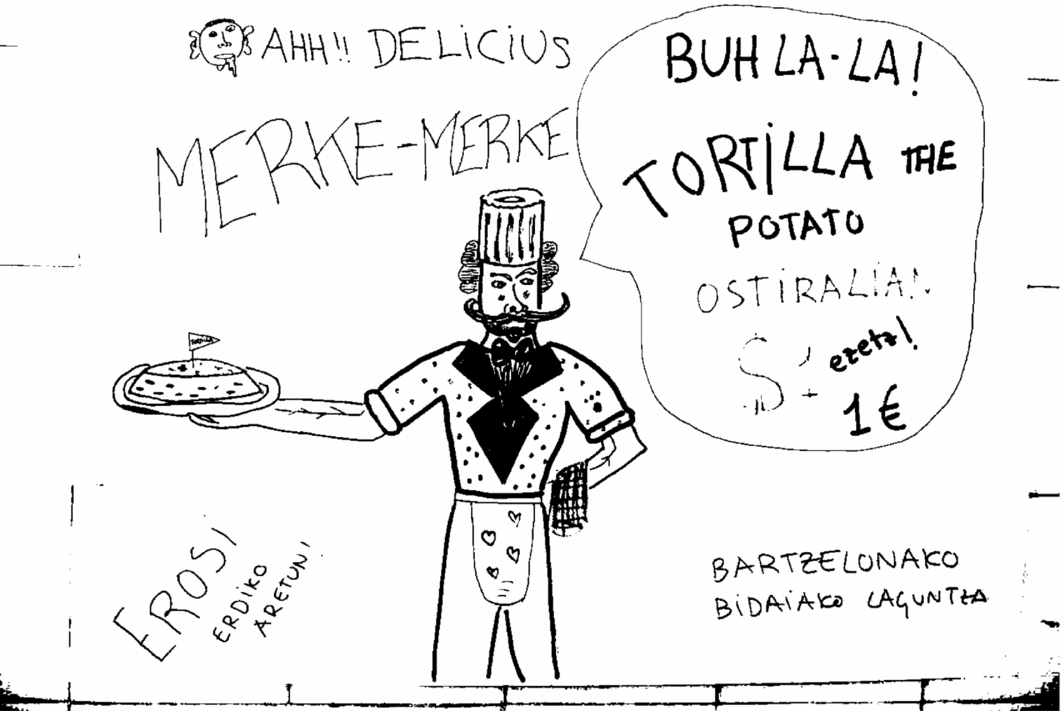
Students’ mixing and hybridization of languages in non-school contexts constitute another important aspect of language use but, as we can see in Figure 1, such practices even occur in the school context, showing that when students are given the opportunity, they make skilful use of these practices.
Example of students’ work

The poster in the figure (which comes from the data collected for the project Added Value of Multilingualism, Corpus Orio ikastola 2011) advertises tortillas prepared by the students for a fair at the school, to raise money for a trip to Barcelona. The students write delicius [note the spelling] and tortilla the potato. The other words are in Basque, although buh la-la! is not easy to classify. The example shows an interesting mixture of languages, which crosses language borders and ignores the ideology of one language per lesson. The students are demonstrating the resources of the languages in their repertoire, by combining the use of Basque and English. In addition, tortilla is a Spanish loan in Basque: although the students would also know the more normative arrautz-opila, this is less likely to be used.
3.3 Comparing education in the Basque Autonomous Community and the province of Friesland
The sociolinguistic situation of the minority languages Basque and Frisian is rather different. As we saw, in the Basque Country, 32% of the population can speak Basque. In contrast, 64% of the population of Friesland is reported as able to speak Frisian (Provincial Government 2011). The geographic distribution of Frisian is different from that of Basque: in Friesland the main contrast is between the smaller towns and the countryside, where more Frisian is spoken, and the larger towns, where less Frisian is spoken. There are a few smaller areas traditionally designated as ‘non-Frisian-speaking’.
The position of the minority language in the school system is also very different. There are no Frisian language models, only an obligation to teach Frisian as a subject in all primary schools. Almost all schools observe this obligation, teaching Frisian for one or two hours per week. However, only about 20% of all 500 primary schools use Frisian as a medium of instruction for other subjects. This includes the ‘trilingual’ primary schools, where in the lower years a consistent bilingual Dutch-Frisian model is followed, English being introduced in the upper three grades for about 20% of school time.
We saw that, in the Basque Country, languages are allocated according to the ‘one lesson – one language’ principle. Teachers teach Spanish as a subject through the medium of Spanish and teach English as a subject through the medium of English – or at least, try to do so as far as possible. This is not the case in Friesland. Dutch is the main language of instruction in all lessons, including those in English as a subject and Frisian as a subject, in which the teachers use English or Frisian as a help-language for specific oral exercises, but not as the base language. This was reported in the teacher interviews and confirmed in the classroom observations. There is substantial variation between individual teachers. One explained during the interview why she does not use English as a medium of instruction by saying that ‘it is too difficult for our pupils’. A second teacher commented that ‘pupils don't understand that much English’; although she tries to get the students to use the target language anyway, she admits ‘I often have to ask “say it in English please”’.
An example from the classroom observations in the English class illustrates this.
Example 2:
Teacher: Pakken jullie even een andere pen? Please take another pen!
The teacher first gives the instruction in Dutch and then repeats herself, giving the same instruction in English, which could be interpreted either as a simple repetition for emphasis or as a self-repair, as she means to use English most of the time and encourages the students to do the same.
So among Frisian teachers and students we can again see that the allocation of one language to one class does not work, even if the ideology about the use of the target language is different. Multilinguals use their language resources when they can and are allowed to do so, even without explicit stimulation.
Our investigation sought a deeper knowledge about the teaching and use of English in the Basque Autonomous Community and in Friesland. In both contexts the learning of English is seen as very important by parents and teachers, especially in the Basque Country, because from the background questionnaire we know that about half of all students go to an English language school for two or three hours per week for additional English instruction (see also ISEI-IVEI 2012: 114). In our study we wanted to gain an impression about students’ exposure to English outside the school. We piloted this research with an English language diary. The students were asked to keep track of the times they heard, read, spoke or wrote English in one week (n = 113 in the Basque Country; n = 156 in Friesland). We found that the Basque and Frisian students reported similar incidences of the passive and active use of English, although there were also significant differences. For example, 36% of the Basque students use English at least once a week watching TV or movies, whereas for Frisian students this figure is 95%, a very different level, due to the fact that the soundtrack of television programmes in Friesland is typically English, with subtitles in Dutch, whereas in the Basque Country, series and movies are dubbed in Spanish. Another striking finding is that only 3% of Frisian students report writing in English outside the school, while 26% of the Basque students did so. The reason for this difference is that the Basque students included the writing they did during the extra-curricular classes they spend in the English language school.
Examining the (self-reported) use of the minority language, we found that this depends to a large extent on the social context. In a more Basque-speaking environment there is more use of Basque, and the result is similar for Frisian. Because the overall percentage for the use of Frisian in society is much higher, there is also more use of Frisian outside school.
In their discussion of the social use of languages inside and outside classrooms in Wales, Thomas & Roberts (Reference Thomas and Roberts2011: 105) refer to the importance of the peer group for the use of Welsh: ‘if one in a group prefers to speak English . . . the group's language will automatically be English’. The same accommodation can also be found in the Basque Country and in Friesland: it is a well-known phenomenon among minority language speakers because the social pressure towards the use of the dominant language is often strong. This type of language practice is hard to change.
4. Conclusions
I want to conclude this plenary by quoting the words of the late Ioan Bowen Rees, a leading Welsh political thinker: ‘We bring up our children to speak Welsh and be bilingual, not for the sake of the language, but for the sake of our children’ (Rees Reference Rees1990: 78). His words are not only valid for Welsh, but also for Basque, Frisian or any other minority language.
To put what I have been saying into perspective I want to come back to that initial intersection between proficiency and language practices on the one hand and society and education on the other. As we know, the accomplishment of proficiency in more than one language is not in itself the end of education. Rather, the ability to use more languages is driven by social values that perceive languages as a resource for establishing and preserving meaningful social relationships. The ideas and ideologies about separate use of languages in the classroom interact with practices of mixing and hybridization in non-school contexts. By applying our focus on multilingualism, which includes the linguistic repertoire, multilingual speakers and the wider social context, we are convinced that the outcomes of research can have implications for bridging the gap between education and society; between what happens with language teaching inside and outside the school. In school there is an emphasis on learning languages separately from each other and in small bits and pieces: a kind of drip-feed of small chunks of language during a limited number of periods each week. On the other hand, there is the home, the peer group and all those other social situations – real and online – where language learning also takes place. However, this occurs in a more fluid way, with less focus on acquisition, is more or less continuous, and includes more repetitions. The main issue is, of course, how we can bridge the gap between those two in a more holistic approach. The school has certain constraints such as timetables and the separation of lesson hours that cannot easily be changed. A researcher might propose three full, continuous months of English teaching to investigate the effects of such a programme on proficiency, but it would be almost impossible to carry out such an experiment.
In my opinion, teachers should try a more encompassing, multilingual approach. One way of implementing this is to bring the society into the school and to do so through issues that raise multilingual awareness. One suggestion I support is to give more attention to activities that enable teaching about language diversity and literacy practices. For example, the linguistic landscape – all the languages the students observe in public space – can be made use of. The linguistic landscape is, in principle, the same for all the children in a specific community, but they themselves and their teachers may not be aware of its usefulness for learning about languages, in particular for raising awareness about language use, attitudes and diversity (Dagenais et al. Reference Dagenais, Moore, Lamarre, Sabatier, Armand, Shohamy and Gorter2009). In socially diverse and politically sensitive minority language areas we need powerful educational tools like this. Children can study multilingualism and language diversity through engaging in projects about their linguistic landscapes to gain a better understanding of the socio-political context in which they live.
In this plenary speech I have tried to demonstrate the complexity of multilingualism in communities where a minority language is in daily use. These languages function alongside a majority language, but English as global language also has a presence and several other languages are used to a greater or lesser degree. Teaching the minority language in combination with the majority language and in most cases English as well, and sometimes yet another foreign language, is a complex issue.
We lack sufficient knowledge about the long-term contribution of education (and lifelong learning) to a sustainable future for minority languages. To learn how to secure the continued existence of minority languages through formal or informal language education policies, we need to investigate the informal learning of the first language compared to the learning of the same or other languages in a formal educational context, as well as the informal learning of other languages in which speakers engage in many other social settings (Gorter Reference Gorter, de Graaf, Ostler and Salverda2008b) that are not defined as learning contexts. If we want to find out more about how to sustain the future of minority languages such as Basque, Frisian and Welsh, we need to investigate more carefully and in more detail how, when and where language learning takes place, as well as issues such as how what has been learned is turned into practice and what variation there is in learning.
Another general problem of language learning can be described as the ‘forward shift’ from proficiency to actual use. Learners of the minority language as a second language use it much less than those who acquire it as a first language. We also need further research into the relationship between the development of language proficiency and language use.
We still know relatively little about the relationship, within schools, between learning languages inside the language class and learning languages during other subjects, and even less about learning languages during breaks in the school yard, on the way home, doing homework, or in the manifold activities students enjoy in their free time: sports, video games, watching TV, squabbling with siblings, arguing with parents, interacting through social media, and so on. In-depth studies can help to develop alternative school curricula in which multilingual language practices are embedded.
Acknowledgements
This research was carried out with the assistance of funding from the Basque Government for the research group ‘Donostia Research on Education and Multilingualism’ (DREAM) and the research grant EDU2009–11601 from the Spanish Ministry of Science and Technology.
Durk Gorter is Ikerbasque research professor at the Faculty of Education of the University of the Basque Country UPV/EHU, Donostia-San Sebastián, Spain. He researches on multilingual education, European minority languages and linguistic landscapes. Until 2008 he was Head of the Department of Social Sciences at the Fryske Akademy in Ljouwert/Leeuwarden, the Netherlands, and also part-time full professor in the sociolinguistics of Frisian at the University of Amsterdam.
His recent publications are Focus on multilingualism in school contexts, a special issue of The Modern Language Journal (2011, co-edited with Jasone Cenoz) and Minority languages in the linguistic landscape (2012, co-edited with Heiko Marten and Luk Van Mensel, Palgrave-Macmillan). He is the leader of DREAM, the Donostia Research Group on Education and Multilingualism.