Introduction
The majority of people in the early and middle stages of dementia are cared for at home, normally by family members (Knapp and Prince, Reference Knapp and Prince2007). Caregiving has traditionally been perceived as an extremely stressful process, and the influential Stress Process Model (Pearlin et al., Reference Pearlin, Mullan, Semple and Skaff1990) proposed that caregivers go through a developmental process in adapting to the stressful events they encounter. The Stress Process Model has, however, been criticized for its emphasis on the negative outcomes of caregiving, and more recent research has started to examine some of the positive aspects of caregiving, such as uplifts or gratification (Kramer, Reference Kramer1997). Since caregiving may be viewed as having both positive and negative aspects – and a wide range of outcomes – it is important to understand the factors which could account for these individual differences in the caregiving experience (Montgomery and Williams, Reference Montgomery and Williams2001). Caregiving is a complex process and there are many factors which may influence how the caregiver adapts to the stresses of caregiving. For instance, Haley et al. (Reference Haley, Levine, Brown and Bartolucci1987) reported that caregiver appraisal of stressors, coping responses and social support and activity were related to caregiving outcomes. Two factors that have received less attention in their role in caregiving outcomes are the caregiver's motivations to provide care and the meaning the carer finds in caregiving. Caregivers’ ability to find meaning in caregiving could potentially impact on whether they will be able to identify positive aspects of caregiving, which may mitigate the impact of caregiving stressors. Caregivers’ motivations to provide care could impact on the establishment of the caregiving relationship and how the caregiver perceives the caregiving role. The aim of this review is to explore the potential impact of both meaning and motivation on caregiving. Published empirical studies are examined to enable further understanding of how a caregiver's motivations to care and the meaning that s/he finds in caregiving can impact on caregiver wellbeing.
Motivations to care
Motivations can explain the reasons why a person engages in a particular behavior, such as helping someone. Motivations can emerge from internal desires or from external pressures. In caregiving, a person may be motivated to provide care for many reasons, such as feelings of duty and responsibility. Caregivers’ motivations may be affected by past reinforcement of helping behavior (Feeney and Collins, Reference Feeney and Collins2003). Emotions such as guilt may also act as strong motivators. Equally, people can experience motivations not to help with caregiving. People may have learned from previous experience that helping has negative consequences, or they may feel that they lack the resources or skills to provide help. Characteristics of the care-recipient can also have an impact; the potential caregiver may feel the care-recipient is too dependent or alternatively that the care-recipient is quite competent and does not require their help (Feeney and Collins, Reference Feeney and Collins2003).
Doty (Reference Doty1986) proposed that family caregiving may be primarily motivated by three factors: love and affection felt towards the individual, a sense of gratitude and desire to reciprocate past caregiving or help, and societal norms of spousal or filial responsibility. However, affection does not necessary have to be a dominant motivation to provide care, since caregiving can take place where affection is absent. Schulz et al. (Reference Schulz, Biegel, Morycz, Visintainer, Light and Lebowitz1989) further proposed that there are three main motives for caregiving: altruism, egotistic motivations, and social norms. Each of these will be considered in turn. Social norms can influence who takes on the role of caregiver, and there is evidence of a caring hierarchy. Recent studies indicate that the person most likely to take on the caregiving role will be the care-recipient's spouse (National Audit Office, 2007). If the care-recipient is widowed or not in a relationship, then an adult child will most likely become the caregiver (Qureshi and Walker, Reference Qureshi and Walker1989). In cases where there is no family member, care may be provided by a friend or neighbor. In some families the choice of caregiver may not be an explicitly negotiated decision, and there are greater expectations for daughters to provide care for their parents than sons (Gatz et al., Reference Gatz, Bengtson, Blum, Birren and Schaie1990). In situations where there is more than one adult child the decision to take on the caregiving role may be affected by family history, geographical proximity, and other role responsibilities; for instance, single daughters are more often expected to provide care than married daughters (Lewis and Meredith, Reference Lewis and Meredith1988). Adult children may be motivated to care through feelings of duty or obligation (Cicirelli, Reference Cicirelli and Mancini1989). This feeling of obligation may arise from a desire to reciprocate past help, or from pressure from societal norms. Traditional cultural norms, such as filial piety, can strongly influence who should provide care to elderly family members (Zhan and Montgomery, Reference Zhan and Montgomery2003). Caregiving may also be motivated by discretionary reasons such as affection, closeness, and compassion (Walker et al., Reference Walker, Pratt, Shin and Jones1990). In addition, filial attachment may serve as a motivation, as caregiving is a protective behavior activated in response to distress in others in order to reduce the risk of them coming to harm (Cicirelli, Reference Cicirelli and Mancini1989).
Altruistic motivations emerge from a desire to benefit the care-recipient, either by reducing his/her distress or by improving his/her welfare. The empathy-altruism hypothesis (Batson et al., Reference Batson, Batson, Slingsby, Harrell, Peekna and Todd1991) hypothesized that feelings of empathy towards a person evoke altruistic motivations. Alternatively, people may be motivated by egotistic motivations, which are more self-serving. A person can be egotistically motivated in order to gain rewards or prevent punishment for not helping (Schulz et al., Reference Schulz, Biegel, Morycz, Visintainer, Light and Lebowitz1989). It is suggested that people who are egotistically motivated may provide poor levels of care (Feeney and Collins, Reference Feeney and Collins2003). The different types of motivations may occur at different times during the caregiving career. Schulz et al. (Reference Schulz, Biegel, Morycz, Visintainer, Light and Lebowitz1989) proposed that in the early stages caregivers may be motivated by altruistic motives as they feel empathy towards care-recipients, whilst in the later stages, when care-recipients’ cognitive functions have declined, caregivers may be more egotistically motivated.
In addition to the motivations identified, Blieszner and Shifflet (Reference Blieszner, Shifflet and Mancini1989) observed that Commitment Theory may also explain caregivers’ commitment to provide care. Commitment theory identifies internal and external factors, which influence a person's commitment to another (Johnson et al., Reference Johnson, Caughlin and Huston1999). The first internal construct, personal commitment, relates to an individual's desire to maintain the relationship, for instance out of love. The second internal construct, moral commitment, reflects feelings that the individual has a moral commitment to continue the relationship, for instance out of marital duty. Structural commitments, which are an external construct, indicate conditions which would constrain a person so that s/he felt s/he had to continue the relationship, for instance social pressures or lack of alternatives. However, structural commitment may have little impact on a relationship until moral or personal commitment is low (Johnson et al., Reference Johnson, Caughlin and Huston1999). These three types of commitment may explain caregivers’ motivations to continue caregiving. Caregivers may provide care out of love and reciprocity; they may also provide care due to family pressures or inability to afford residential care (Blieszner and Shifflet, Reference Blieszner, Shifflet and Mancini1989).
Meaning in caregiving
Whilst a caregiver's motivations to provide care may impact on the maintenance of caregiving, the caregiver's ability to find meaning in caregiving could also influence whether s/he perceives caregiving as a positive experience, which in turn could aid in sustaining caregiving. Klinger (Reference Klinger1977) proposed that meaning is “something very subjective, a persuasive quality of a person's whole inner life”. Finding meaning is an individual process, each individual's experience of meaning may change over time. It is argued that people assign meaning to their experiences, for instance believing that a given experience has made them a better person (Rubinstein, Reference Rubinstein1989). With regards to caregiving, a caregiver's search for meaning may imply that s/he is searching for a greater understanding of the care-recipient's illness. Finding meaning can have a positive role in the management of stress and has been linked to wellbeing (Zika and Chamberlain, Reference Zika and Chamberlain1992). The concept of meaning has been interpreted in different ways by researchers. In relation to dementia caregiving, there is a difference between those who have interpreted meaning as having cognitive and emotional dimensions (e.g. Noonan et al., Reference Noonan, Tennstedt and Rebelsky1996), those who take an existential definition of meaning (e.g. Farran and Keane-Hagerty, Reference Farran, Keane-Hagerty and Chinn1991), and those who interpret finding meaning as a form of coping (Pearlin et al., Reference Pearlin, Mullan, Semple and Skaff1990).
Noonan et al. (Reference Noonan, Tennstedt and Rebelsky1996) suggested that meaning could be interpreted as either having cognitive or emotional dimensions. Cognitive interpretations concern the beliefs that caregivers hold about their experience. Emotional interpretations relate to satisfaction with the caregiving role. In addition, Noonan et al. (Reference Noonan, Tennstedt and Rebelsky1996) proposed that these two definitions can be further interpreted as processes of searching for meaning and finding meaning. Finding meaning has been measured by Giuliano et al. (as cited in Kasten, Reference Kasten1993) using the Meaning in Caregiving Scale, which interpreted meaning as reflecting the positive aspects of providing care. In this context there are three dimensions to meaning: reordering priorities, relationship fidelity, and transcendent beliefs. Through caregiving, caregivers have to reappraise their priorities in life. Relationship fidelity emphasizes the importance of the caregiver being needed and helping the care-recipient. The caregiver's transcendent beliefs enable the caregiver to gain satisfaction through acting on personal values or beliefs.
Farran and Keane-Hagerty (Reference Farran, Keane-Hagerty and Chinn1991) viewed meaning through an existential perspective, based on Frankl's definition of meaning. Frankl (Reference Frankl1971) proposed that people “create” meaning through making choices and “find” meaning through suffering. The Interactive Model for Finding Meaning through Caregiving (Farran and Keane-Hagerty, Reference Farran, Keane-Hagerty and Chinn1991) consists of four major components that can result in a caregiver either finding or not finding meaning. The first stage reflects the antecedents to caregiving, for instance the circumstances in which the person made a choice to take on the caregiving role. In the second component, people then move through a process of becoming caregivers. The third component concerns people's responses to the caregiving experience. This process may involve valuing positive aspects of the caregiving experience and relationship, and may also involve searching for ultimate and/or provisional meaning. Provisional meaning emerges from day-to-day events which give caregivers a sense of purpose, whilst ultimate meaning relates to caregivers deriving a sense of purpose from beliefs in a greater spiritual or philosophical power. The fourth component of the model relates to the potential outcomes of caregiving. A positive outcome for the caregiver would be finding meaning. A failure to find meaning could potentially have negative outcomes for both caregiver and care-recipient. The caregiver could experience feelings of despair or hopelessness, which could in turn impact on the care-recipient's wellbeing.
The Stress Process Model (Pearlin et al., Reference Pearlin, Mullan, Semple and Skaff1990) also indicated that meaning can have an impact on caregiver wellbeing. In the Stress Process Model meaning is conceptualized as a mediator of the stress process, as the “management of the meaning of the situation” is viewed as a coping mechanism. This mechanism involves the reduction of expectations, the use of positive comparisons and a search for a larger sense of the illness. Similarly, Baumeister and Vohs (Reference Baumeister, Vohs, Snyder and Lopez2002) proposed that people may use meaning to help them cope with a misfortune. Folkman and Moskowitz (Reference Folkman and Moskowitz2000) also proposed that meaning can be a form of coping, generating positive affect through interpreting events with positive meaning. Alternatively events can be interpreted through situational meaning whereby the person appraises the significance of the stressful situation (Folkham and Moskowitz, Reference Folkman and Moskowitz2000).
Both a person's motivations to provide care and the meaning s/he finds in caregiving may influence caregiver wellbeing. In addition, it could be argued that there is a connection between these factors. A person's motivations to provide care may influence the meaning s/he derives out of caregiving; similarly, the meaning a person finds in caregiving may reinforce their motivations to provide care. Levine et al. (Reference Levine1984) proposed that caregivers need to find meaning in the choices that they have made, for instance commencing caregiving, and in the choices yet to come. Noonan and Tennstedt (Reference Noonan and Tennstedt1997) discussed how meaning has been linked to motivations for becoming and remaining a caregiver. For instance, people may be strongly motivated to provide care because they feel it is their duty, and in turn they can derive meaning from being able to fulfill this duty. Conversely, a person's ability to find something positive in caregiving can reinforce his/her desire to continue caregiving.
In summary, this overview of the theoretical literature indicates that a caregiver's motivations to provide care and ability to find meaning could potentially impact on his/her wellbeing. There are several different types of motivation that could underlie a caregiver's decision to provide help, and which may be influenced by the relationship of the caregiver to the care-recipient. These could have differential impacts on caregiver wellbeing. Research on meaning in caregiving suggests that caregivers create meaning by making a decision to provide care. Finding meaning in caregiving could have a positive impact on the caregiver's wellbeing, mediating the impact of stress. Given the theoretical rationale and observations made regarding these issues in the literature, it may be important to acknowledge the role of motivation and meaning when considering how to better understand the needs of caregivers and develop more effective ways of supporting caregivers of people with dementia. Therefore, the aim of this review is to explore and examine critically the literature on meaning and motivation to discover how these factors impact on the wellbeing of the dementia caregiver. In order to explore the links between these factors and wellbeing, this review will be restricted to empirical articles published in peer-reviewed journals. In addition, this review will explore individual differences in caregivers’ motivations to provide care.
Methods
A computerized literature search for quantitative studies was conducted in May 2008. The search examined articles from 1960 to the present and utilized the following databases: psycINFO, Social Sciences Citation Index, Medline, and CINAHL. Articles were also identified from reference lists of published papers. The search terms aimed to encapsulate the broad definitions of motivation and meaning. The search terms were: caregiver*, carer*, caregiving, dementia, Alzheimer's, motiv*, drive*, oblig*, duty, filial and meaning*.
The inclusion criteria for this analysis were:
• The care-recipient had a form of dementia.
• The study focused on informal caregivers who were the primary or main caregivers of the care-recipient.
• The care-recipient was residing in the community.
• Studies examined the impact of meaning and motivations on wellbeing, or examined individual differences in caregiving motives.
• The study measured caregivers’ motivations to care rather than hypothesized willingness to care should the need arise in the future.
• Studies using both qualitative and quantitative methods were included if the study presented quantitative data regarding associations between relevant variables.
• The study was published in a peer-reviewed journal.
Twelve possibly eligible studies were identified, of which two were excluded. One was excluded because the information did not come directly from the caregiver (Wells and Kendig, Reference Wells and Kendig1996), and a second was excluded because the findings of the study were not analyzed statistically (Cahill, Reference Cahill1999). This resulted in ten studies being included in the review, four studies concerning motivations to care and six concerning meaning in caregiving.
Results
The results of the review are organized under the two topics of motivation and meaning.
Motivations to care
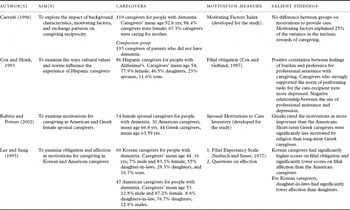
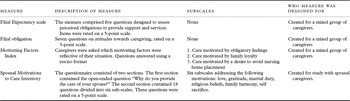
Four studies examined caregivers’ motivations to care. A summary of these studies can be found in Table 1. Each of the studies utilized a different scale to measure motivations, and a summary of these scales can be found in Table 2. These scales explored specific reasons for providing care and did not relate these motivations to a specific theoretical model.
Summary of studies on motivation included in the systematic review

Summary of measures of motivation

The studies examined whether there were any individual differences in caregiving motives. Carruth (Reference *Carruth1996) found no difference between caregivers for people with dementia and a control group of caregivers in their motivations to provide care. However, the caregivers’ culture and kin-relationship to the care-recipient could influence motivations to provide care. Kabitsi and Powers (Reference *Kabitsi and Powers2002) found that Greek caregivers rated motivations to care as more important than American caregivers, and that Greek caregivers who had only been caregiving for a short period were less motivated by religion than Greek caregivers who had been caregiving for log periods. Lee and Sung (Reference *Lee and Sung1997) compared American caregivers with Korean caregivers and found that Korean caregivers had significantly higher filial obligation scores and significantly lower filial affection scores than American caregivers. Lee and Sung (Reference *Lee and Sung1997) found that daughter-in-law caregivers had significantly lower filial affection than daughter caregivers. These studies provide evidence that a person's motivations to provide care can be influenced by their culture and the person's kin-relationship to the care-recipient.
The caregiver's motivations to care could impact on his/her wellbeing. Cox and Monk (Reference *Cox and Monk1993) found that caregivers who strongly supported the norm of personally performing tasks for the care-recipient were more depressed, whilst those who preferred to have professional assistance with caregiving felt more burdened. However, those who had professional assistance were less depressed (Cox and Monk, Reference *Cox and Monk1993). This suggests that there can be various caregiving motivations, and these can have different influences on caregiver wellbeing. Carruth (Reference *Carruth1996) examined the impact of motivations on whether caregivers perceived caregiving to be a rewarding experience, and found that motivating factors explained 25% of the variance in the intrinsic rewards of caregiving. This provides some evidence that caregiving motivations can influence the caregivers’ perception of caregiving.
Meaning in caregiving
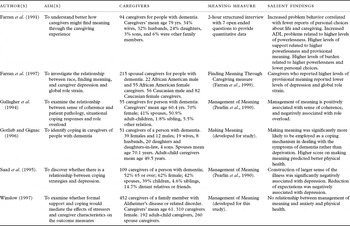
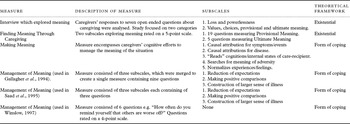
Six studies investigated the meaning caregivers found in caregiving. A summary of these studies can be found in Table 3. The majority of the studies used different measures of meaning, and a summary of these measures can be found in Table 4. Measures were based either on an existential model of meaning or on a model conceptualizing finding meaning as a form of coping.
Summary of studies on meaning included in the systematic review

Summary of measures of meaning

The results indicate that whilst meaning can have a positive effect on the caregiver's wellbeing, feelings of powerlessness can have a negative effect on wellbeing. In the study by Farran et al. (Reference *Farran, Keane-Hagerty, Salloway, Kupferer and Wilken1991), feelings of powerlessness were related to caregivers’ feeling that they had no choice but to provide care. Caregivers who were less likely to report making personal choices about life and caregiving had higher levels of burden (Farran et al., Reference *Farran, Keane-Hagerty, Salloway, Kupferer and Wilken1991). Higher levels of powerlessness also correlated with reports of increased problems with activities of daily living (ADL). Caregivers who made personal choices about caregiving were more likely to find meaning through caregiving (Farran et al., Reference *Farran, Keane-Hagerty, Salloway, Kupferer and Wilken1991). Caregivers who reported higher levels of provisional meaning reported higher levels of support (Farran et al., Reference *Farran, Keane-Hagerty, Salloway, Kupferer and Wilken1991), and lower levels of depression and global role strain (Farran et al., Reference *Farran, Keane-Hagerty, Salloway, Kupferer and Wilken1997).
Four studies conceptualized meaning as a coping strategy, and reported that finding meaning had a positive impact on caregiver wellbeing. Gotlieb and Gignac (Reference *Gottlieb and Gignac1996) found that meaning-making was significantly more likely to be employed as a coping mechanism when dealing with the symptoms of dementia than when dealing with the effects of the caregiver having to give up “something valued or something they looked forward to” because of caregiving. Meaning-making was also positively associated with caregivers having better physical health (Gotlieb and Gignac, Reference *Gottlieb and Gignac1996). Finding meaning was positively associated with a caregiver's sense of coherence, which is considered to be a flexible and adaptive dispositional orientation which has been linked to successful coping (Gallagher et al., Reference *Gallagher, Wagenfeld, Baro and Haepers1994). Finding meaning was also negatively associated with reports of role overload (Gallagher et al., 1996). Saad et al. (Reference *Saad, Hartman, Ballard, Kurian, Graham and Wilcock1995) found that caregivers who coped by reducing their expectations of the care-recipient and constructing a “larger sense of the illness” had lower levels of depression.
These studies suggest that finding meaning can have a positive impact on wellbeing. However, Winslow (Reference *Winslow1997) found no link between meaning and anxiety or physical health. Winslow (Reference *Winslow1997) claimed that finding meaning is not an effective coping style for these conditions, and that different coping styles may have been more successful. Winslow (Reference *Winslow1997) also recognized that the Management of Meaning measure used in this study only had a reliability of α = 0.67, and so it was possible that random measurement error contributed to this finding. It should also be recognized that the six-item Management of Meaning measure used by Winslow (Reference *Winslow1997) was different to the Management of Meaning measure used by Gallagher et al. (Reference *Gallagher, Wagenfeld, Baro and Haepers1994) and Saad et al. (Reference *Saad, Hartman, Ballard, Kurian, Graham and Wilcock1995).
Discussion
Only ten empirical studies were included in this review, which highlights the limited extent of the research that has been conducted in these areas, particularly as regards examining motivations to provide care. Yet the findings of this review indicate that both meaning and motivation can have an impact on a caregiver's wellbeing. In addition, the studies included in this review indicate that the caregivers’ culture and kin-relationship to the care-recipient can influence motivations to provide care. The findings of this review further show that there can be an overlap between motivation and meaning, with religion acting as both a motivation to provide care and a source of ultimate meaning (Farran et al., Reference *Farran, Miller, Kaufman and Davis1997; Kabitisi and Powers, Reference *Kabitsi and Powers2002). In order to explore further the impact of meaning and motivation on caregiving, the findings of the review will now be integrated with the existing literature, and in particular with observations from qualitative studies.
Motivations to care
Little research has been conducted into the way that motivations to care shape the quality of care that the caregiver provides to a person with dementia. This review has focused on caregivers’ actual motivations to care rather than caregivers’ hypothesized willingness to care in the future (e.g. Wells, Reference Wells1999). It was decided not to include studies on willingness to care in this review as it can be argued that many factors can impact on whether a caregiver takes on the caregiving role when the time comes. This is particularly relevant in the case of non-spousal caregivers who may have work or family responsibilities which prevent them from taking on the caregiving role. In addition, factors such as poor health may prevent people from becoming caregivers.
Interestingly, only one study explored the influence of the kin-relationship between the caregiver and care-recipient on the caregivers’ motivations to care. Lee and Sung (Reference *Lee and Sung1997) found that daughter-in-laws had significantly lower affection than daughters. Arber and Gilbert (Reference Arber, Gilbert, Bytheway, Keil, Allatt and Bryman1989) proposed that the history of the relationship between caregiver and care-recipient can affect whether caregiving is perceived as natural or as an obligation. The experience of caregiving could be affected by whether the caregiver resides with the care-recipient and by the length of co-residence. Arber and Gilbert (Reference Arber, Gilbert, Bytheway, Keil, Allatt and Bryman1989) suggested that where co-residence has been lifelong then caring may be a natural transformation from caring about the person to caring for the person, whereas where co-residence arises due to caring there may be more feelings of obligation.
In order to explore further the impact of caregivers’ motivations on their wellbeing it is helpful to consider the qualitative literature on caregivers of people with dementia. Whilst quantitative studies can examine the relationship between caregivers’ motivations and caregiving outcomes, qualitative studies make it possible to identify different caregiving motivations. Qualitative studies have also been conducted as a first step in creating some of the measures described above. Cahill (Reference Cahill1999) examined motivations in an interview study with female caregivers of people with dementia. The majority of the caregivers reported being motivated by concern followed, in descending order, by love, duty, moral obligation, and guilt. The daughters and daughters-in-law tended to perceive that they had no choice but to care, whist the wives felt that caring was part of their relationship with the care-recipient. Globerman (Reference Globerman1996) interviewed daughters-in-law and sons-in-laws about their motivations to care for a relative with Alzheimer's disease, and identified differences between the motivations to care of daughters-in-laws and sons-in-laws. The sons-in-law felt obligated out of duty to help out, whilst for daughters-in-law feelings of obligation were linked to social norms and their relationship with the care-recipient. Blieszner and Shifflet (Reference Blieszner, Shifflet and Mancini1989) explored adult-children's commitment to provide care to their parents with Alzheimer's disease. The findings from interviews with the adult children indicate that care was provided out of feelings of affection, reciprocity, and personal dedication towards the care-recipient. A lack of alternatives to providing care, possibly due to financial reasons, was considered by some to be reasons to keep providing care.
Some qualitative studies have also explored the impact of traditional cultural norms on motivations to provide care. Wallhagen and Yamamoto-Mitani (Reference Wallhagen and Yamamoto-Mitani2006) explored how culture influenced American and Japanese caregivers’ reasons for caregiving. Both American and Japanese caregivers felt they had a moral obligation to provide care, which was derived partly from feelings of reciprocity. Americans were more strongly motivated by feelings of attachment to the care-recipient, and attachment had an important role in the maintenance of caregiving. Japanese caregivers emphasized that it was their role in the family that required them to take on the caregiving task. Ho et al. (Reference Ho, Friedland, Rappolt and Noh2003) furthered explored the role of culture by interviewing Chinese-Canadian female caregivers. The caregivers provided care because of traditional cultural values, which made them feel obligated to provide care to the family member. The majority of the caregivers did not wish to place the care-recipients into full-time care as this would go against their traditional cultural and family values.
The quality of the relationship between the caregiver and care-recipient may influence caregivers’ motivations to provide care. Morgan and Laing (Reference Morgan and Laing1991) found that caregivers who had a good pre-caregiving relationship with the care-recipient were motivated to care for their partners through love and a desire to continue and maintain their relationship. Caregivers who had poor pre-caregiving relationships felt motivated by both duty and responsibility, although unresolved pre-caregiving conflicts resulted in uncertainty about their responsibility to provide care.
This review has illustrated that people can have many different reasons for providing care. These motivations can be influenced by the kin-relationship of the caregiver to the care-recipient and by cultural norms. Although the studies included in this review did not explore the impact of the quality of the relationship on caregiving motivations, it would appear that there is a connection between these factors, which can influence caregiver wellbeing. There is also evidence for a link between motivations to provide care and find meaning. Some of the motivations identified in this review, such as being motivated to care because of religious beliefs or feelings of love/affection towards the care-recipient, may in turn help the caregiver find meaning in the role.
Meaning in caregiving
The findings from this review provide support for the theory that finding meaning can influence the way in which caregiving is interpreted and can have a positive impact on caregiver wellbeing. However, this review also illustrates that there has been little peer-reviewed empirical research on the concept of meaning in dementia caregiving. The lack of studies focusing on meaning in caregiving can be related to the different conceptualizations of meaning in the literature. The majority of studies which have examined meaning have tended to employ a qualitative methodology. These studies tend to use ambiguous definitions of meaning. However, in order to more fully understand the impact of meaning on wellbeing, it is helpful to examine some of these studies.
Some qualitative studies have utilized an existential definition of meaning. Farran et al. (Reference *Saad, Hartman, Ballard, Kurian, Graham and Wilcock1991) interviewed caregivers of people with dementia and identified themes of loss and powerlessness, although the caregivers also acknowledged making personal choices. The caregivers searched for provisional and ultimate meaning, and valued positive aspects of caregiving and relationships. Similarly, in creating the Meaning in Caregiving Scale, Noonan et al. (Reference Noonan, Tennstedt and Rebelsky1996) conducted interviews with caregivers of older people, who described searching for meaning and finding meaning. Caregiving gave the caregivers feelings of gratification and satisfaction from helping the care-recipient and keeping the care-recipient out of a nursing home. For some, caregiving was a reciprocal action, but for others it was viewed as a responsibility that was expected due to societal norms, and as a natural part of life. Caregiving had positive aspects and created friendship and companionship.
Similar to caregivers’ motivations to provide care, meaning can also be influenced by cultural values. Rubinstein (Reference Rubinstein1989) found that the assignment of meaning in caregivers of people with dementia was through interpretation, and was influenced by past experiences, cultural values and ideas. The caregivers seemed to derive some of the framework of meaning in caregiving from religious or cultural traditions. These meanings could change over time as the caregivers’ experiences changed. Lee et al. (Reference Lee, Farran, Tripp-Reimer and Sadler2003) examined the cultural appropriateness of the Finding Meaning through Caregiving Scale with Korean caregivers of people with dementia. Cultural differences were found based on the conceptualization of caregiving in Korea, where it is perceived as a responsibility rather than being linked to past affection. Meaning for Korean caregivers was more related to pride in being able to fulfill caregiving responsibilities.
Finding meaning is an individual process and this process is different for each caregiver and each caregiving situation. Some caregivers may not find any meaning in caregiving. Similar to the evidence regarding motivations to care, finding meaning can be influenced by a person's culture. The findings of the study by Noonan et al. (Reference Noonan, Tennstedt and Rebelsky1996) support the assertion that there is a link between motivation and meaning, as caregivers derived satisfaction from keeping the care-recipient out of a nursing home. This satisfaction in turn strengthened their desire to continue caregiving. Similarly, research by Harris (1993) with male caregivers of people with dementia, indicated that the caregivers were very committed to providing care, feeling their wives would have done the same for them. By providing care, the caregivers were also able to derive meaning out of their experiences as they felt that caregiving had made them become a better person.
Methodological issues
The findings of the review indicate that the involvement of meaning and motivation in dementia caregiving is an under-researched area and that more research is needed to address the methodological limitations of the existing studies. The studies on motivation explored specific reasons for caregiving, but did not classify these motives as egotistic, altruistic, intrinsic, or extrinsic motivations. This grouping of motivations under a theoretical framework is important as it can further illuminate how different motivations can influence wellbeing; for instance, research by Lyonette and Yardley (Reference Lyonette and Yardley2003) on caregivers of older adults found that extrinsic motivations were related to caregiver stress whilst intrinsic motivations were related to caregiving satisfaction. In order to address this, measures need to be developed which categorize the different types of motivations. Only one study in this review explored the influence of the kin-relationship of the caregiver to the care-recipient on the caregivers’ motivations to care. Studies should explore the impact of this kin-relationship, as measures developed to study caregiving motivations may need to be adapted depending on the kin-relationship of the caregiver to the care-recipient. In addition, research should examine whether these measures need to be adapted for different cultures, as the findings of this review indicate that there can be cultural differences in people's motivations to provide care.
Whilst more research has been conducted into meaning, the majority of the studies used different measures; this made comparison of the findings of these studies difficult. Measures developed to explore meaning may need to be adapted for different cultures; for instance, Lee et al. (Reference Lee, Farran, Tripp-Reimer and Sadler2003) found that many items from the Ultimate Meaning subscale of the Finding Meaning through Caregiving Scale were not appropriate for those who claimed to have no religion. The studies also varied as to whether meaning was perceived as a positive outcome of caregiving or a form of coping. Further research is needed to explore these different conceptualizations of meaning and examine whether finding meaning can be classified as both a coping mechanism and an outcome of caregiving.
Conclusion
This review has shown that both meanings and motivations can impact on caregiver wellbeing. Despite the small numbers of studies in this area, the results indicate that meaning can have a positive impact on caregiver wellbeing. The limited evidence currently available indicates that the type of motivation to care can impact on caregiver wellbeing. Cultural norms and caregivers’ kin-relationship to the care-recipient can also influence caregivers’ motivations to provide care. Thus, it appears that both finding meaning and certain types of motivations can have a positive impact on caregiver wellbeing. Further research is needed to explore the role of both meaning and motivation in influencing the wellbeing of caregivers of people with dementia. A better understanding of the role of finding meaning in mitigating the impact of stress could potentially contribute to the development of more effective interventions. Research needs to explore how caregivers’ motivations to provide care and kin-relationship to the care-recipient affect the establishment of the caregiving relationship and the caregivers’ perceptions of the caregiving role. Developing a better understanding of how meanings and motivations can account for differences in the caregiving experience may contribute to the development of enhanced approaches to supporting caregivers and thus improve the wellbeing of both caregivers and care-recipients.
Conflict of interest
None.
Description of authors' roles
Catherine Quinn designed the study, formulated the search strategy, conducted the literature search, and interpreted the findings. Linda Clare contributed to the design of the study, the formation of the search strategy and the interpretation of the findings. Catherine Quinn had primary responsibility for writing and revising the manuscript and Linda Clare assisted in the revising and editing of the manuscript. Robert Woods assisted in the design of the study and in revising the manuscript.
Acknowledgments
Catherine Quinn was supported by an ESRC-CASE PhD studentship in partnership with the charity for dementia.