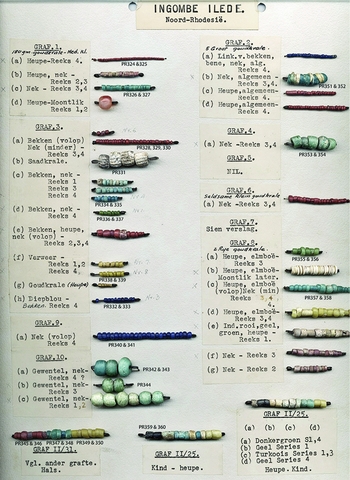
Analysis of glass beads from the Ingombe Ilede burials provides additional information that supports McIntosh and Fagan's new dating of burials 3 and 8, and that also clarifies the chronology of some of the other burials. Following an unsuccessful attempt to locate the Ingombe Ilede beads in the Livingstone Museum, we analysed beads from a card with samples of Ingombe Ilede beads that had been originally prepared by A.P. du Toit (Reference du Toit1965), and later sold to MuseuMAfricA in Johannesburg (Figure 1). The beads were chemically analysed using LA-ICP-MS, as part of a larger project on ancient African glass bead chemistry (Robertshaw et al. Reference Robertshaw, Glascock, Wood and Popelka2003). All analysed beads from burials 3 and 8 belong to the Khami series produced in India and traded into southern and south-central Africa from the mid fifteenth to mid seventeenth centuries. Some beads of an earlier type were present in other graves, and may have been kept as heirlooms.
The glass bead card for Ingombe Ilede prepared by du Toit (text in Afrikaans). The beads with chemical compositions reported in Table S1 are identified on the card by their PR numbers.

Glass beads that were traded into southern Africa between about the eighth and seventeenth centuries have been extensively studied and ordered into discrete series based on morphological attributes and chemical analysis of the glass used to make them (Wood Reference Wood2009, Reference Wood2011; Robertshaw et al. Reference Robertshaw, Wood, Melchiorre, Popelka-Filcoff and Glascock2010; Wood et al. Reference Wood, Dussubieux and Robertshaw2012). Each series has well-defined temporal parameters (Table 1).
The southern African bead series relevant to this discussion.

The glasses used to make the Mapungubwe Oblate and Zimbabwe series are closely related: both are soda-lime glasses fluxed with plant ash (the ‘v’ stands for ‘végétale’ in Table 1) and contain elevated levels of alumina. The origins of these glass types are unclear. The glass from which Khami-series beads were made was fluxed with mineral soda (‘m’ in Table 1) and contains high levels of alumina. This glass type, often referred to as ‘soda-alumina glass’, was made in India (Lankton & Dussubieux Reference Lankton and Dussubieux2006). In addition, early Portuguese records state that the Portuguese were obliged to buy beads for the African trade in India, as Africans refused to accept European-made beads (Theal Reference Theal1898: II, 303).
Du Toit's (1965, 1969) original descriptions of the Ingombe Ilede beads are unusual because of his belief that glass texture equates to quality and that glass quality inevitably improved over time. Unfortunately, he did not provide details of the numbers of beads found during excavations or by grave context.
As has been noted, two basic chemical glass types are present in the Ingombe Ilede assemblage (see Table S1 in online supplementary material). The greatest number of Ingombe Ilede beads belong to the Khami series and are made of mineral-soda-alumina (m-Na-Al) glass of sub-type 2, which is differentiated from other sub-types by high uranium and low barium levels (Dussubieux et al. Reference Dussubieux, Gratuze and Blet-Lemarquand2010). Glass of this sub-type was used to make both Khami-series beads and some beads of earlier series in southern Africa. Khami beads can, however, be distinguished chemically on the basis of several major and trace element concentrations (Wood et al. Reference Wood, Dussubieux and Wadley2009; Robertshaw et al. Reference Robertshaw, Wood, Melchiorre, Popelka-Filcoff and Glascock2010: 1907). These beads are cut from drawn tubes and reheated to round or smooth the cut ends. They started to arrive in southern Africa around the mid fifteenth century and continued to be the only accepted bead type up to the mid seventeenth century, when European beads began to dominate. Khami beads were traded not only by Swahili, Arab or Indian traders, but also by the Portuguese and eventually other Europeans. The Ingombe Ilede examples are typical of this series.
Khami series beads were found not only in burials 3 and 8, but also in burials 1 and 9, as well as in burials 25 and 31 from the southern cemetery, which contained poorer, as yet undated graves. Although sample sizes are admittedly very small, the generally higher magnesia (MgO) concentrations in the Khami-series beads from the southern cemetery are intriguing; in a larger sample of such beads from sites across southern Africa, higher MgO levels characterised beads from sites in Botswana, with lower levels from South African and Zimbabwean sites (Robertshaw et al. Reference Robertshaw, Wood, Melchiorre, Popelka-Filcoff and Glascock2010: 1907–1908). By contrast, the Khami beads from the central cemetery, including those of burials 3 and 8, have MgO levels comparable to those found in South Africa. No explanation has yet been offered for this apparent geographic pattern, if such a pattern exists. Alternatively, the variation in MgO levels may be explained by differential corrosion, a complex process in glass beads (Dussubieux et al. Reference Dussubieux, Robertshaw and Glascock2009). Indeed, most beads from the southern cemetery at Ingombe Ilede visually appear more corroded than those from the central cemetery.
The Ingombe Ilede beads made of plant-ash (v-Na-Al) glass are more unusual. Their chemistry identifies them as belonging to the Zimbabwe series. Only one tested bead, however, fits the standard morphology of the Zimbabwe series, which is drawn, cut-tube beads that have been well rounded by reheating. This bead is a minute, drawn, oblate-shaped, brownish-red bead (PR324) on string (a) from grave 1. It is difficult to know if other beads on the string are also of this type because the second bead tested (PR325) is morphologically similar yet belongs to the Khami series. This string could, of course, be a mixture of both Khami- and Zimbabwe-series beads, or perhaps the Zimbabwe-series bead is a rare heirloom. The other plant-ash beads from Ingombe Ilede were produced differently.
The plant-ash beads from grave 2(b) are most unusual. They are made from large-diameter drawn tubes that were cut into thin wedge-shaped slices and the ends ground flat. They are all blue-green, even though some appear white due to a thick layer of corrosion. This is the first time that we have seen beads cut in this shape. The remaining plant-ash beads, all from graves 4 and 10, were made by winding molten glass onto a mandrel. Sub-oblate-shaped beads similar to PR343 and 344 from grave 10 have been found in small numbers at Mapungubwe- and Zimbabwe-period sites. These beads could, therefore, be heirlooms. The other Ingombe Ilede wound beads, however, have unusual shapes for beads of this glass type: PR342 is a short bicone (a shape common in beads of mineral-soda glass of sub-type 2), while PR353 and 354 are short tubes with large perforations. It is possible that these wound beads were produced somewhere in the region, as reworking glass is much simpler than making raw glass, and wound beads are relatively easy to make.
That Zimbabwe-series beads (chemically defined) were recovered from burials 1, 2, 4 and 10 might be viewed as evidence that these burials are older than burials 3 and 8, given the accepted range of dates for this series (see Table 1). Most beads from burials 1 and 2 shown on du Toit's bead card, however, are Khami-series beads of mineral-soda glass. Thus, the rare plant-ash glass beads were probably kept as heirlooms. For burial 4, du Toit (Reference du Toit1965: 13) lists green, yellow and red drawn beads, which do not appear on the card. These are most probably Khami-series beads, making it again probable that the v-Na-Al beads are heirlooms. Finally, grave 10 contained only wound v-Na-Al beads. Du Toit noted that they, along with the other large wound beads (which are all made of v-Na-Al glass), were found only as necklaces, whereas other beads were also found at the arms, waists/pelvises and legs. He recognised that these wound beads were similar to ones found at Mapungubwe, Great Zimbabwe and Isamu Pati, and surmised, perhaps correctly, that these large wound beads were probably treasured ancestral artefacts that possibly had supernatural qualities. He also noted that amulets and charms were usually worn around the neck, partially because they were less likely to be inadvertently damaged or lost than those worn on the arms and legs.
Other sites with similar beads
Other sites that produced beads that could be compared to Ingombe Ilede include Mankhamba in the southern Lake Malawi area. Mankhamba became a prosperous trading centre between the mid sixteenth and early seventeenth centuries (Juwayeyi Reference Juwayeyi2010). Of the 5335 glass beads excavated, Wood examined 548 (Juwayeyi Reference Juwayeyi2010: 193). All but nine of these belong to the Khami series. Most of the remainder are examples of the earliest European beads that are found in eastern Africa, and postdate 1600. It is interesting to note that the bead assemblage varied little morphologically across the four excavated layers of the site. Just over 70 per cent of the beads came from lower layers 3 and 4, which also produced Chinese ceramics dating to AD 1570–1600 (Juwayeyi Reference Juwayeyi2010: 179). Thus, we can conclude that most of the Mankhamba glass beads post-date the mid sixteenth century. The Mankhamba Khami beads are very similar to those found at Ingombe Ilede. One difference, however, is that none of the examined Mankhamba beads were made of plant-ash glass.
Another site that might aid in placing Ingombe Ilede chronologically through its bead assemblage is Hlamba Mlonga in eastern Zimbabwe (Wood Reference Wood2009). Dating to the tenth to fifteenth centuries, this site is situated in the Save River Valley, which linked the Indian Ocean coast to Great Zimbabwe. Khami-series beads, similar to those at Ingombe Ilede, began to arrive at Hlamba Mlonga not long before the site was abandoned in the fifteenth century. The Hlamba Mlonga bead assemblage also included, in the upper occupation level, at least one wound blue-green bead (PR926) made of plant-ash glass that is similar to those from Ingombe Ilede. Thus, we might suggest that wound v-Na-Al beads and Khami beads are found together in the early stages of the importation of Khami beads—approximately the mid fifteenth century.
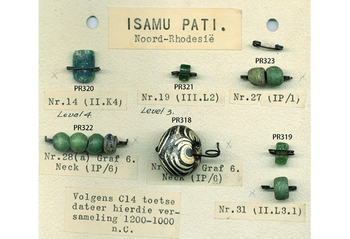
Du Toit also worked on the beads excavated at the southern Zambian site of Isamu Pati, located approximately 300km south-west of Ingombe Ilede. Burials from the latest occupation at Isamu Pati contained glass beads dated to the thirteenth to fourteenth centuries (Fagan Reference Fagan1967; Huffman Reference Huffman1989). As for Ingombe Ilede, du Toit prepared a bead sample card (Figure 2), beads from which we analysed using LA-ICP-MS (Table S1). Two of the beads (PR322 and 323) are morphologically similar to PR342 and 344 from Ingombe Ilede burial 10. Additionally, PR319 from Isamu Pati is similar to PR353 and 354 from Ingombe Ilede burial 4, while PR321, although not wedge-shaped, is a large-diameter drawn bead, perhaps related to Ingombe Ilede's PR351 and 352 from burial 2. Also included among the Isamu Pati card beads were half a garden roller (PR320) and one very large black-and-white decorated bead (PR318). These must have been kept as heirlooms, as the former bead type was made in the eleventh to twelfth centuries (Wood Reference Wood2011), and the latter was probably made in Egypt or the eastern Mediterranean.
The glass bead card for Isamu Pati prepared by du Toit (text in Afrikaans). The beads with chemical compositions reported in Table S1 are identified on the card by their PR numbers.

Conclusion
The chemical composition of the Ingombe Ilede glass beads and their placement within recognised bead series broadly confirm McIntosh and Fagan's new AMS dates for burials 3 and 8. Apart from PR331 in burial 3, which was too corroded to yield reliable compositional data, all of the chemically analysed beads from these and most other burials fit comfortably within the Khami series, which is found in southern and south-central Africa between the mid fifteenth and mid seventeenth centuries. There are marked similarities between the Khami-series beads of Ingombe Ilede and those from Mankhamba in Malawi, where the dating evidence, including Chinese ceramics, suggests a period later than the mid sixteenth century.
The plant-ash glass beads from burials 1, 2, 4 and 10, assigned to the Zimbabwe series based on their chemistry, appear, however, to be older. Some of the Ingombe Ilede plant-ash glass beads are also very similar to thirteenth- or fourteenth-century beads from Isamu Pati. The fact that most beads from burials 1, 2 and probably 4, are of the Khami series nevertheless provides a terminus post quem for these burials of the mid fifteenth century. Moreover, the large size of the plant-ash glass beads, in comparison with the smaller beads of the Khami series, suggests that they were more likely to be kept as heirlooms, rather than being lost. Large beads were also rarer, even in the period of their creation. Thus, they probably had special value and might have been preferentially deposited in graves. Despite the preponderance of evidence favouring a roughly sixteenth-century date for Ingombe Ilede, new AMS dates from other burials (particularly burial 10) would be valuable. Finally, in terms of Ingombe Ilede's trading connections, the similarities with the assemblages from Mankhamba are striking. Yet our observation that none of the plant-ash glass beads (except for PR324 from burial 1) morphologically, rather than chemically, fits within the Zimbabwe series is noteworthy, as beads of this series dominate the assemblage from the site of Great Zimbabwe. Even kept as heirlooms, the Zimbabwe-series beads found at Ingombe Ilede may not have reached the region from Great Zimbabwe.
Acknowledgements
LA-ICP-MS analyses were conducted by Rachel Popelka-Filcoff at the Missouri University Research Reactor facility under the direction of Michael Glascock.
Supplementary material
To view supplementary material for this article, please visit http://doi.org/10.15184/aqy.2017.96