The ability to handle stress is necessary for optimal functioning; however, animal models have demonstrated that prolonged, chronic exposure to stress exerts a negative effect on brain development, particularly the prefrontal cortex and hippocampus—areas that have been implicated in higher level cognitive processes, including learning and memory (for a review, see Lupien, Maheu, Tu, Fiocco & Schrmaek, Reference Lupien, Maheu, Tu, Fiocco and Schramek2007). Yet, research has also demonstrated that despite experiencing high-risk, high-stress environments, some children demonstrate remarkable resilience (e.g., Luthar, Reference Luthar, Cicchetti and Cohen2006; Luthar, Cicchetti & Becker, Reference Luthar, Cicchetti and Becker2000; Masten, Reference Masten2001). This resilience has been attributed to multiple factors including temperament and responsive parenting. This is in line with research that has consistently demonstrated that multiple factors including biology, and the environment, both contextual (e.g., quality and quantity of resources) and social (e.g., parenting), influence subsequent brain and cognitive development (Farah et al., Reference Farah, Shera, Savage, Betancourt, Gianetta and Brodsky2006, Reference Farah, Betancourt, Shera, Savage, Gianetta and Brodksy2008). Building on this multilevel understanding of effects on child development, researchers have called for the necessity of integrating indicators from multiple levels of analysis in order to obtain a more nuanced understanding of the relationships between brain, development, and context (Cicchetti & Curtis, Reference Cicchetti and Curtis2007; Curtis & Cicchetti, Reference Curtis and Cicchetti2003). Particularly, Cicchetti and colleagues have argued that the study of resilience has historically examined behavioral and psychosocial variables, but could benefit greatly from considering biological factors as well. Moreover, the poor predictive significance of any single factor and the large hetereogeneity in developmental outcomes underscores the importance of considering possible moderating variables.
In the current study, we examine allostatic load, a physiological indicator of stress, and its effects on working memory, as well as investigate the potential role of maternal responsiveness in buffering this relationship. A large body of research has demonstrated that responsive parenting plays a crucial role in affecting both children's cognitive development (Bornstein, Reference Bornstein1989; Farah et al., Reference Farah, Betancourt, Shera, Savage, Gianetta and Brodksy2008) as well as stress-regulatory processes (Fish et al., Reference Fish, Shahroky, Bagot, Caldji, Bredy and Szyf2004; Francis & Meaney, Reference Francis and Meaney1999). In line with this research, we test the moderating role of maternal responsiveness on the relation between chronic physiological stress during childhood and subsequent adolescent working memory. Specifically, we hypothesized that the effects of allostatic load on working memory would be attenuated in the context of high maternal responsivity.
Stress and Memory
Inarguably, the most important neuroendocrine system for responding to stress in both animals and humans is the hypothalamic–pituitary–adrenal (HPA) axis (for a review, see Francis & Meaney, Reference Francis and Meaney1999). In moments of physical or psychological stress, activation of the HPA axis leads the hypothalamus to release the corticotropin releasing hormone, which in turn causes the pituitary gland to release adrenocorticotropin. Subsequently, adrenocorticotropin reaches the adrenal glands, triggering the secretion of the stress hormones, glucorticoids (cortisol), and catecholamines (adrenaline and noradrenaline). In a landmark paper, McEwen, Weiss, and Schwartz (Reference McEwen, Weiss and Schwarz1968) not only demonstrated that glucocorticoids were able to access the brain, but also that the hippocampus, the brain structure implicated in declarative memory, contains the largest amount of glucocorticoid receptors. A host of research has since ensued to explore the role of stress on human memory.
Substantial animal evidence demonstrates the complex influences of stress on memory performance (Lupien & Lepage, Reference Lupien and Lepage2001; Lupien et al., Reference Lupien, Maheu, Tu, Fiocco and Schramek2007; Sandi & Pinelo-Nava, Reference Sandi and Pinelo-Nava2007). Converging evidence using rodent models have begun to suggest that stress effects on hippocampus and prefrontal cortex-dependent memory follow a U-shaped inverted function. Specifically, although moderate levels of short-term stress aids memory performance, high levels have deleterious effects (Sandi, Loscertales, & Guaza, Reference Sandi, Loscertales and Guaza1998; Sandi & Pinelo-Nava, Reference Sandi and Pinelo-Nava2007; Selden, Cole, Everitt, & Robbins, Reference Selden, Cole, Everitt and Robbins1990). A much smaller amount of research has examined stress and memory in humans. However, the administration of glucocorticoids in humans reveal that the specific impairment lies in memory retrieval processes (Wolkowitz et al., Reference Wolkowitz, Reus, Weingartner, Thompson, Breier and Doran1990). This effect has been demonstrated for both learned lists (de Quervain, Roozendaal, Nitsch, McGaugh, & Hock, Reference de Quervain, Roozendaal, Nitsch, McGaugh and Hock2000) and autobiographical memories (Buss, Wolf, Witt, & Hellhammer, Reference Buss, Wolf, Witt and Hellhammer2004).
Although substantive work has examined the role of stress on declarative memory, fewer studies have explored the role that stress may play on human working memory. Working memory refers to a temporary storage mechanism where information is maintained, updated and manipulated (Baddeley, Reference Baddeley2003). Working memory is important for a host of cognitive processes including learning, language comprehension, reading, and subsequent long-term storage of information. The prefrontal cortex, an area with a large number of glucorticoid receptors, is the brain area associated with working memory (Fuster, Reference Fuster1980; Petrides, Reference Petrides2000; Muller & Knight, Reference Muller and Knight2006). Empirical studies examining the role of psychosocial stress or cortisol administration on working memory have yielded mixed results. Using the digit span task, in which participants are asked to repeat a series of numbers either in the same order or reverse order, some researchers have found impairment of working memory after inducing stress (Elzinga & Roelofs, Reference Elzinga, Bakker and Brenner2005), however, others have not (Kulhmann, Piel, & Wolf, Reference Kulhmann, Piel and Wolf2005). Similarly, studies using recall of word lists have found mixed results, with some research finding immediate effects (Tops et al., Reference Tops, van der Pompe, Wijers, Den Boer, Meijman and Korf2004) and others finding delayed but not immediate effects (Smeets, Jelicic, & Merckelbach, Reference Smeets, Jelicic and Merckelbach2006). For more complex working memory tasks, such as the Sternberg task or the n-back task, more consistent adverse results have been found (Oei, Everaerd, Elzinga, van Well, & Bermond, Reference Oei, Everaerd, Elzinga, van Well and Bermond2006; Schoofs, Preuss, & Wolf, Reference Schoofs, Preuss and Wolf2008; Young, Sahakian, Robbins, & Cowen, Reference Young, Sahakain, Robbins and Cowen1999). In addition, in both animal (Mizoguchi et al., Reference Mizoguchi, Yuzurihara, Ishige, Sasaki, Chui and Tabira1992) and human (Evans & Shamberg, Reference Evans and Shamberg2009) studies, chronic stress exposure has been shown to be more consistently related to deficits in working memory.
Allostatic Load
Stress hormones give rise to the body's fight or flight response, which, although in the short term may be adaptive, have long-term negative consequences, especially if occurring over extended time intervals (McEwen, Reference McEwen1998). In reconceptualizing chronic stress, McEwen and his colleagues argued that through multiple dynamic and interactive physiological systems, the body continually adjusts in order to maintain allostasis (stability, or homeostasis through change). Allostatic load “refers to the price the body pays for being forced to adapt to adverse psychosocial or physical situations, and it represents either the presence of too much stress or the inefficient operation of the stress hormone system, which must be turned on and then turned off again after the stressful situation is over” (McEwen, Reference McEwen1999, pp. 110–111). Allostatic load may lead to adrenal overactivity or inefficiency of the stress response system; this in turn leads to high glucocorticoid levels in the brain. Allostatic load may then in turn affect memory, because chronically high levels of glucocorticoids are linked to atrophy of the hippocampus, suppression of neurogenesis, elevated neurotoxicity, and disruptions in neurotransmitter activity (Lupien et al., Reference Lupien, Maheu, Tu, Fiocco and Schramek2007; McEwen, Reference McEwen2000; McEwen & Gianaros, Reference McEwen and Gianaros2010). Consistent with this theoretical perspective, individuals who are thought to suffer from prolonged stress exposure, such as those suffering from chronic depression or posttraumatic stress syndrome, have working memory deficits as well as morphological changes in the hippocampus (McEwen et al., Reference McEwen, Conrad, Kuroda, Frankfurt, Margarinos and McKittrick1997; Sapolsky, Reference Sapolsky1996). Furthermore, working memory deficits have been demonstrated in low socioeconomic stress children, who are thought to experience an inordinate amount of stress compared to their middle-class counterparts (Farah et al., Reference Farah, Shera, Savage, Betancourt, Gianetta and Brodsky2006). Particularly germane to the current study, Evans and Shamberg (Reference Evans and Shamberg2009) found that childhood poverty was related to adolescent working memory and that this relationship was mediated by chronic allostatic load.
Maternal Responsiveness
Several researchers have noted that that certain “resilient” children develop into well-functioning adults, despite experiencing a variety of risk factors in early childhood (Luthar, Reference Luthar, Cicchetti and Cohen2006; Luthar et al., Reference Luthar, Cicchetti and Becker2000). Research attempting to identify specific protective factors have keyed in on parenting as an important variable for moderating the effects of risk on children's outcomes (Gramezy, Reference Gramezy and Stevenson1985; Werner, Bierman, & French, Reference Werner, Bierman and French1971; Werner & Smith, Reference Werner and Smith1977, Reference Werner and Smith1982). Bradley and his colleagues have argued that the primary task of parenting is to regulate states and behaviors of children through providing sustenance, stimulation, support, and structure and that positive experiences in the caregiving environment can in essence buffer some of the effects of risks associated with poverty (Bradley, Caldwell, & Rock, Reference Bradley, Caldwell and Rock1990; Bradley et al., Reference Bradley, Whiteside, Mundform, Casey, Kelleher and Pope1994).
Empirical research with rats and human models has shown that maternal behaviors affect the offspring's ability to handle stress as well as improve cognitive outcomes. Maternal behavior influences the HPA system by silencing hippocampal glucocorticoid receptor genes, which is involved in terminating stress responses of the HPA system. High levels mean efficient control of HPA stress response, whereas low levels mean poor regulation, more prolonged stress reactions, and vulnerability to allostatic load (Liu et al., Reference Liu, Diorio, Tannenbaum, Caldji, Francis and Freedman1997; Meaney & Szyf, Reference Meaney and Szyf2005). Variations in maternal care in rodents have also been show to promote hippocampal synaptogenesis and spatial learning and memory (Liu, Diorio, Day, Francis, & Meaney, Reference Liu, Diorio, Day, Francis and Meaney2000).
Research with children has shown that maternal responsiveness can buffer the effects of stressors on children's outcomes. In a recent study, Evans, Kim, Ting, Tesher, and Shannis (Reference Evans, Kim, Ting, Tesher and Shannis2007) demonstrated that maternal responsiveness moderates the relationship between cumulative risk and children's allostatic load, such that cumulative risk was associated with increases in allostatic load only in children with unresponsive mothers. Furthermore, the facilitative role of maternal responsiveness for children's cognitive development is well documented (Bornstein, Reference Bornstein1989; Tamis-Lemonda, Bornstein & Baumwell, Reference Tamis-LeMonda, Bornstein and Baumwell2001). Using a longitudinal design, Farah et al. (Reference Farah, Betancourt, Shera, Savage, Gianetta and Brodksy2008) looked at the role of early childhood environmental stimulation and maternal responsiveness on children's cognitive outcomes. Of interest, results of their study showed that whereas environmental stimulation was associated with language development, maternal responsiveness was associated with working memory.
The Purposes of the Current Study
In the current study we integrate research from physiological stress and memory with the risk and resilience literature to test the hypothesis that maternal responsiveness can moderate the effects of allostatic load on children's outcomes. Specifically, we hypothesized that after controlling for income, the adverse effects of childhood allostatic load on adolescent working memory would be attenuated in the context of high maternal responsivity.
Methods
Participants
Participants in this study are part of a larger longitudinal study on poverty and development. The current study includes data from Wave 1 through Wave 3 of the study. At Wave 1, 342 children (males = 174, mean age = 9.20) participated in the study. At Wave 2, 195 (males = 102, mean age = 13.37) children participated, and at Wave 3 214 (males = 112, mean age = 17.29) participated. Youth and their families were recruited from public schools, New York State Cooperative Extension programs, and antipoverty programs. Low-income families were oversampled (53%). All of the youth lived in rural upstate New York. Reflecting the demographics of the area, 94% of the participants were White. Attrition analyses revealed that participants with higher levels of income at Wave 1 were more likely to stay in the study at Wave 2 and Wave 3.
Measures
Poverty
Poverty was computed as a household income at or below the poverty line (income/needs ratio ≤ 1.0).
Chronic stress
Allostatic load was measured at 9 and 13 years of age (Waves 1 and 2). Our measure of allostatic load was designed to capture a range of physiological responses, including cardiovascular, HPA, sympathetic adrenal medullary system, and metabolic activity. Participants' resting blood pressure was calculated with automated readings (Dinamap Model Pro 100, Critikon) taken every 2 min, while participants sat quietly. The second through seventh readings were averaged and used as an index of basal blood pressure (Kamarck et al., Reference Kamarck, Jennings, Debski, Glicksman-Weis and Eddy1992).
Overnight urine was collected from 8 p.m. on the evening of the experimental protocol to 8 a.m. the next morning. Samples were stored in an ice container with a preservative (metabisulfite). Total volume was recorded, and four 10-ml samples were randomly extracted and deep frozen until assays were completed. Epinephrine and norepinephrine was assayed by high-performance liquid chromatography with electrochemical detection (Riggin & Kissinger, Reference Riggin and Kissinger1977), and cortisol with a radioimmune assay (Contreras, Hane, & Tyrrell, Reference Contreras, Hane and Tyrrell1986). Creatinine was included as a statistical control for the neuroendocrine assays. The technicians were blind to the status of the participants.
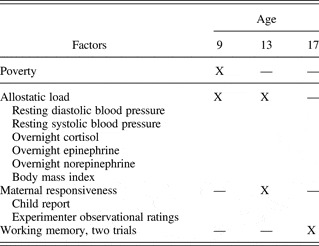
Body mass index was calculated as kilograms per square meter (kg/m2). Following prior studies of allostatic load in adults (Kubzansky, Kawachi, & Sparrow, Reference Kubzansky, Kawachi and Sparrow1999) and children (Evans, Reference Evans2003), the number of physiological parameters (resting diastolic and systolic blood pressure; overnight epinephrine, norepinephrine, and cortisol volumes; and body mass index) in which participants scored above the median was summed. Chronic allostatic load was computed by averaging the allostatic load score for each individual across ages 9 and 13.
Maternal responsiveness
Maternal responsiveness was measured at Wave 2. We used two separate indicators: child report and behavioral observation.
Child report
Children's perception of maternal responsiveness was measured using a scale consisting of 11 items tapping both instrumental (e.g., help with homework) and emotional (e.g., willing to talk to me when needed) behaviors. Youth answered each question using a 5-point scale (never, hardly ever, sometimes, fairly often, and often). The scale has good internal consistency (α = 0.84) and strong test–retest reliability (r = .92).
Behavioral observation
Experimenters also assessed maternal responsiveness during a mother–child interaction task. Mother and child were asked to engage in a game of Jenga (Hasbro, Pawtucket, RI). They took turns building a tower higher by removing blocks from lower parts of the tower and then placing them on top. The game was videotaped and coded for responsiveness. Behavioral and affective indicators of responsiveness were based on Belsky, Crnic, and Wordsworth (Reference Belsky, Crnic and Woodsworth1995). Raters were not aware of the participants' levels of income, working memory, or report of maternal responsiveness scores. Sensitivity was rated on a 5-point scale with 5 being highly sensitive and 1 not at all. The videos were rated every 2.5 min for a total of 15 min. The ratings (α = 0.97) were then averaged to obtain the overall observer ratings. Child perception of maternal responsiveness was significantly correlated with experimenter reports (r = .68); thus, the two measures were then z scored and then summed to compute our index of maternal responsiveness.
Working memory
Working memory was assessed at Wave 3. We measured working memory by tapping into each participant's ability to recall a sequence of stimuli presented on a touch pad divided into four quadrants. The sequence began with one stimulus signal (one of the four monochromatic panels lit up with a corresponding unique tone for 500 ms). The participants were asked to recall the stimulus by tapping on the correct panel on which the stimulus that had been displayed. For each successful trial, an additional stimulus signal was activated randomly. The maximum number of correctly remembered stimuli was used as a measure of working memory. Participants were allowed to complete a practice run in order to ensure they understood the procedures. Working memory was assessed in two separate instances, with a 1-hr interval between sessions. The average performance across the two sessions was then computed. Table 1 summarizes the design and methods of the study.
Study design

Note: Allostatic load is computed based on six variables at the two time points. Maternal responsiveness was computed by summing the z scores of the child and experimenter ratings. Working memory was the mean score based on two separate trials.
Results
Table 2 lists the means and standard deviations for each of the variables. There were no gender differences with regard to maternal responsiveness, poverty, or working memory, and Wave 1 allostatic load. At Wave 2, males (M = 3.05) scored significantly higher than females (M = 2.43) in our measure of allostatic load. Next, zero-order correlations were calculated to examine the interrelations among all study variables. Table 3 reports the zero-order correlations among each variable. Income level was negatively correlated with allostatic load, and positively correlated with maternal responsivity and adolescent's working memory. Gender (males served as the reference group) was negatively correlated with allostatic load, suggesting that males had higher levels of allostatic load. Thus, gender and income served as controls for all analyses.
Means, standard deviations, and correlations across variables

Note: With regards to gender, males served as the reference group (coded as 0). Subscripts indicate measurement wave.
†p < .1. *p < .05. **p < .01. ***p < .001. All significance tests are two tailed.
Hierarchical regression analyses for variables predicting adolescent's working memory

Note: Males were set as the reference group.
*p < .05. **p < .01. ***p < .001.
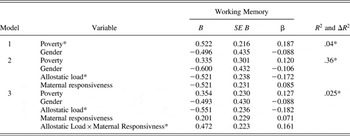
Next, hierarchical regression analyses were conducted to examine the effects of allostatic load (average score from Wave 1 and Wave 2) and maternal responsiveness on adolescent working memory, independent of gender and income at Wave 1. To reduce multicollinearity and to ease interpretation, all control variables, main effects and interaction terms were mean centered (Aiken & West, Reference Aiken and West1991). Table 4 reports the summary of results from the regression analyses. We were interested in whether allostatic load could account for variance in adolescent working memory, independent of income and gender. Therefore, in the first step of the regression, demographic variables, including gender and income, were entered. These variables combined predicted 20% of the variance in adolescent working memory, F (2, 161) = 3.47, p < .05.
In order to see if allostatic load and maternal responsiveness would increase the variance explained beyond these control variables, we added both variables to Step 2 of the model. Allostatic load and maternal responsiveness increased the variance explained to 28%, F (4, 159) = 3.146, p < .05. Allostatic load was negatively associated with working memory. Finally, to test whether maternal responsiveness moderated the effects of allostatic load, we added the interaction terms of Allostatic Load × Maternal Responsiveness to the model. The interaction was significant, suggesting that the effects of allostatic load on memory were moderated by maternal responsiveness.
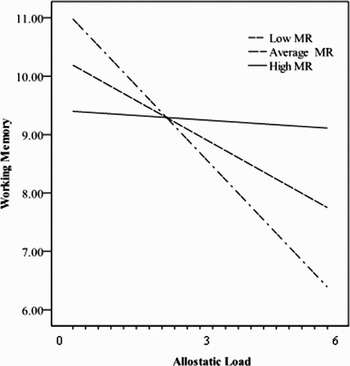
Figure 1 illustrates the relationship. Note that the regression plots calculating maternal responsiveness at 1 SD above and below the mean were done for descriptive purposes only. The ordinal least-squares analysis maintained the continuous nature of all the variables and their interaction terms. Analyses of simple slopes suggest that allostatic load had a negative effect on working memory for those whose maternal responsivity score was at the mean, t (158) = −2285, p < .01, and at 1 SD below the mean, t (158) = −3.063, p < .01, but not for those whose mothers scored high on responsiveness, t (158) = −0.198, p < .05.
The effects of allostatic load on working memory depend on levels of maternal responsiveness.

Discussion
Understanding the impact of chronic stress on children's cognitive development has important implications for both science and policy. Using prospective data, we explored the role of maternal responsiveness as a protective factor for children's working memory in the context of physiological stress. Findings of the current study demonstrate that the effects of early chronic allostatic load on late adolescent working memory are moderated by the maternal responsiveness. Specifically, after controlling for socioeconomic status and gender, allostatic load only affected working memory in the context of medium to low maternal responsiveness. Children with mothers who scored high on maternal responsivity demonstrated no deficits in working memory. Consistent with our hypothesis, maternal responsiveness serves as an important protective factor against the effects of early chronic stress on working memory, a critical aspect of cognitive development.
Findings from the current study are consistent with research using animal models demonstrating that maternal responsiveness influences both physiological and behavioral responses to stress (Fish et al., Reference Fish, Shahroky, Bagot, Caldji, Bredy and Szyf2004; Francis & Meaney, Reference Francis and Meaney1999; Meaney & Szyf, Reference Meaney and Szyf2005). In rats, these studies have demonstrated that mothers who spend more time in activities such as licking/grooming and arched back nursing (LG-ABN), have off spring who as adults show reduced corticosterone responses to stress. In addition, to aiding in the development of efficient and effective stress response systems, maternal care may also have direct effects on the offspring's cognitive development. For example, Liu and his colleagues (Reference Liu, Diorio, Day, Francis and Meaney2000) examined spatial learning and memory among rodents of both low LG-ABN and high LG-ABN mothers using the Morris water maze. Pups of high LG-ABN mothers showed significantly shorter latencies as well as swim paths to locate the target, compared to pups of low LG-ABN mothers. In addition, variations in maternal care seem to cause differential levels of sensory experience and hippocampal synaptic development. Furthermore, using a cross-fostering design in which pups of low LB-AGN dams were reared by high LB-AGN mothers, they find no difference between pups who were born to high LB-AGN mothers, and pups who were born by low LB-AGN mothers but raised by high LB-AGN dams, suggesting a causal relationship.
In human children, maternal sensitivity moves beyond mere tactile stimulation, especially beyond the infant years. Specifically, mothers who are high in maternal responsiveness may also be indirectly affecting children's cognitive development, by providing a more stimulating environment and exhibiting sensitive teaching skills. These types of maternal behaviors may allow children to be able to compensate for the effects of stress on their memory abilities. Several studies with rat models have found that providing an enriched environment during early development can help improve learning and memory (Williams et al., Reference Williams, Luo, Ward, Redd, Gibson and Kuczaj2001) as well as restoring hippocampal synaptic plasticity and reversing the effects of stress on memory and spatial learning (Yang et al. 2006).
Furthermore, research has demonstrated that the way mothers talk to their children affect their memory development. For example, mothers who, in conversations with their children, elaborate and scaffold their children's conversational interactions, have children with better autobiographical memory recall (for a review, see Fivush, Haden, & Reese, Reference Fivush, Haden and Reese2006). In addition, maternal teaching style, incorporating both verbal and physical behaviors, play a role in affecting children's recall (Larkina, Güler, Kleinknecht, & Bauer, Reference Larkina, Güler, Kleinknecht and Bauer2008). Finally, because maternal responsiveness is associated with better self-regulatory processes (Fish et al., Reference Fish, Shahroky, Bagot, Caldji, Bredy and Szyf2004), children of highly responsive mothers may be able to cope better with challenging situations, by regulating their emotions and behaviors, which may in turn aid in the development of cognitive abilities. There is evidence to suggest that the rat offspring of high LG-ABN mothers also respond differentially to novelty compared to the offspring of low LG-ABN mothers (Caldji et al., Reference Caldji, Tannenbaum, Sharma, Francis, Plotsky and Meaney1998). Specifically, offspring of high LG-ABN showed substantially reduced behavioral fearfulness in response to novelty compared with the offspring of low LG-ABN mothers. Perhaps in children, decreased levels of fear and anxiety in a novel situation may affect both general learning abilities as well as task performance.
Future studies using neuroimaging would help shed light on whether maternal responsiveness actually buffers the effects of stress on the brain development, or compensates for the effects of stress through psychological mechanisms, such as coping strategies or better learning skills. In the current study by assessing both individual biological markers and the social environment we contribute to the growing literature arguing for multiple-levels of analysis. Particularly, our work supports the notion that although biological factors influence psychological processes, social and psychological experiences also exert an effect on the brain, perhaps by modifying gene expression, function, and structure (Cicchetti & Tucker, Reference Cicchetti and Tucker1994). In addition, our work may have implications for the development of psychopathology. Although in the current study we look at a specific aspect of neurocognitive functioning, it is likely that our results demonstrating that psychosocial factors moderate biological risk may extend to mental health and adjustment. For example, there is some evidence to suggest that early pyschosocial and biological risk factors have additive effects, and that variables such as maternal responsivity can moderate relationships between biological risk and early behavioral problems (Laucht, Esser, & Schmidt, Reference Laucht, Esser and Schmidt2001). Further research examining the extent that psychosocial, contextual, and biological factors have unique, overlapping, or interactive effects on child outcomes is called for. In sum, the current study provides evidence for the fact that high risk does not necessary entail a certain endpoint. Our study thus emphasizes the importance of policy and intervention that target particularly vulnerable children, such as children from low-income backgrounds, in order to improve outcomes.
There are a few limitations to the current study. The children in our study were predominantly White and living in rural environments, which distinguishes them from a nationally representative sample. We cannot be sure that our findings extend to urban children or children from other racial or ethnic minority groups. For example, there is evidence to suggest that culture influences parenting (Kagan, Reference Kagan2001), memory (Wang & Ross, Reference Wang, Ross, Kitayama and Cohen2007), as well as affecting the relationships between risk factors and outcomes (Feldman & Masalha, Reference Feldman and Masalha2007). Thus, an important line of future research would be to examine the way in which culture may influence the expression of maternal responsiveness as well as moderate its effects. Furthermore, in our study we built upon the animal research literature and focused on the role of mothers; however, examining the effects of fathers and the dyadic interactions between parents and triadic interactions among parents and child would allow us to capture a more nuanced understanding of how caregiving may affect children's outcomes. In addition, maternal responsiveness is a very broad construct incorporating multiple facets of interpersonal interaction including, for example, maternal speech, behaviors, and emotional bonds. Parsing out these specific variables would allow us to identify if an essential element of maternal responsiveness exists as well as the relative impact of each component.
Finally, because working memory was not measured earlier in our study, we were not able to examine residual changes in working memory. Thus, longitudinal studies measuring both working memory and maternal responsiveness at multiple time points would allow us to model trajectories of change over time as well as strengthen causality. Furthermore, such designs would allow us to assess if there were critical periods in development in which stress and maternal responsiveness have more of an impact on children's outcomes. In sum, the current study extends research in stress and human memory development. Our research provides support for animal models that have substantively shown that maternal care plays a powerful role in affecting brain, physiology, and development. Our results demonstrate that maternal responsivity can serve as a protective factor against the effects of childhood stress on subsequent adolescent working memory.