


Black women have long been the most reliable Democratic voters in the United States, yet scholarship has offered limited explanations for why they consistently outpace Black men in Democratic identification. Gender gap research tends to generalize from white women’s issue preferences, while research on Black political behavior emphasizes racialized social constraint, norms enforced through racially homophilous networks that maintain strong Democratic cohesion (Wamble et al. Reference Wamble, Laird, McConnaughy and White2022; White and Laird Reference White and Laird2020). Neither perspective fully explains why a gender gap persists within a racial group characterized by powerful social pressures toward partisan conformity. We locate the source of this gap not in partisanship itself, but in the antecedents that precede it: racial identity salience, perceived discrimination, and racial homophily. These mechanisms, which prior work identifies as the building blocks of Black Democratic loyalty, are typically treated as gender-neutral. We argue instead that the levels and political meaning of these antecedents differ systematically for Black women and men because they emerge from distinct gendered socialization within the racial group.
Across generations, Black women and men have been positioned differently in the work of sustaining the community under conditions of racial subordination. Black women have been socialized into a collective-first, grassroots orientation, in which individual well-being is understood as inseparable from the well-being of the racial group. Black men more often adopt a self-as-group-proxy orientation, in which individual success, autonomy, and visibility are viewed as pathways for racial uplift. Both orientations reflect deep racial consciousness, but they differ in where responsibility for group advancement is located and how racial progress is pursued. These differentiated orientations shape the antecedents of Democratic identification in gendered ways: for Black women, high racial identity salience, acute perceptions of discrimination, and dense same-race networks signal heightened responsibility for community protection and norm adherence; for Black men, these same antecedents more readily intersect with individualized strategies for mobility and representation. The partisan gender gap therefore emerges because the precursors to Democratic partisanship, rather than partisanship itself, carry different weight and meaning across gender.
Using an original national survey of 4,193 Black adults with near-equal numbers of men and women, we show that Black women score higher on these antecedents and that the antecedents exert stronger partisan effects for women than for men. Once these gendered antecedent patterns are taken into account, the partisan gender gap meaningfully attenuates, indicating that differences in socialized responsibility and racial group orientation drive the observed divergence. Our study makes three contributions: it identifies the antecedent-level mechanisms through which gendered socialization produces partisan differences among Black Americans; it refines theories of Black Democratic loyalty by demonstrating that its core precursors operate differently across gender; and it offers practical implications for political mobilization, emphasizing the central role Black women play as civic brokers embedded in dense, norm-enforcing networks.
The Partisan Gender Gap
Research on the partisan gender gap consistently finds that women tend to be more supportive of the Democratic Party than men, with explanations centering on gendered differences in policy preferences, economic vulnerability, and socialization around care and egalitarianism (Alvarez and Nagler Reference Alvarez and Nagler1998; Howell and Day Reference Howell and Day2000; Kaufmann Reference Kaufmann2002; Lizotte Reference Lizotte2017). Yet these frameworks overwhelmingly reflect the political behavior of white women. When applied to Black voters, they offer limited insight: Black women and Black men do not diverge meaningfully on many of the policy domains — such as abortion, gender roles, or government social spending — that typically drive gender gaps among white voters. Moreover, the magnitude of the Black partisan gender gap has been relatively stable for decades despite shifts in political context, suggesting that issue-based explanations alone cannot account for the pattern.
Studies incorporating race find similarly limited differentiation. Black women and Black men tend to hold comparable attitudes on racial policy, group solidarity, and racial equality (Brown Reference Brown2014; Sigelman and Welch Reference Sigelman and Welch1984; Tate Reference Tate2003). Even when minor gender differences in social policy preferences appear (Lizotte and Carey Reference Lizotte and Carey2021), they do not adequately account for divergent patterns in partisanship, especially in a group whose political choices are shaped more strongly by racial considerations than by gendered policy preferences. Thus, while the gender gap literature identifies broad patterns of partisan differences between women and men, it does not explain why a gap persists within a racial group whose politics are anchored in shared racial group positioning.
Racialized Social Dynamics and Black Political Behavior
Scholarship on Black political behavior emphasizes the centrality of racial identity, perceived discrimination, and social networks in shaping Democratic identification. Linked fate (Dawson Reference Dawson1994), group-centric interpretations of discrimination (Masuoka Reference Masuoka2006; Tate Reference Tate and Enl1994), and racially homophilous networks that transmit and reinforce partisan norms (Wamble et al. Reference Wamble, Laird, McConnaughy and White2022; White and Laird Reference White and Laird2020) all play critical roles in maintaining Black Democratic alignment. These studies show that Black political behavior is fundamentally shaped by racialized social life rather than by individual-level ideological or issue-based preferences.
However, this scholarship generally assumes that these racialized social forces operate similarly across gender. Racial identity salience, experiences of discrimination, and the structure of Black social networks are treated as gender-neutral — implicitly assuming that Black women and Black men encounter and interpret these dynamics in similar ways. This assumption rarely receives empirical scrutiny, and its consequences remain unexplored. Meanwhile, research in Black feminist thought and intersectionality highlights robust differences in the social roles, expectations, and responsibilities assigned to Black women and Black men within the racial group (Collins Reference Collins2000, Reference Collins2004; Simien and Hampson Reference Simien and Hampson2020). These differences suggest that the antecedents of Black partisanship may be experienced or interpreted differently across gender. Yet no existing framework systematically applies these insights to the question of partisan identity. Taken together, the existing literature leaves a critical conceptual gap. Gender-gap scholarship identifies no policy-based explanation for intragroup differences, while scholarship on Black political behavior does not account for how racialized social dynamics may be patterned by gendered socialization. As a result, we know that Black women are more consistently Democratic than Black men, but we do not yet understand why this difference emerges in a group characterized by high partisan cohesion.
Our study addresses this gap by integrating insights from Black feminist scholarship, sociology, and political behavior to offer a theory of gendered orientations — collective-first and self-as-group-proxy — that helps explain how Black women and Black men differentially engage with the racialized social antecedents of Democratic identification. In doing so, we extend existing scholarship by demonstrating how racialized social life can produce intragroup variation, even within one of the most politically cohesive racial groups in the United States.
Gendered Orientations within the Black Community
The persistent partisan gap between Black women and Black men presents a challenge for existing scholarship. Prior work demonstrates that Black Democratic identification is patterned by racialized social dynamics, specifically racial identity salience, perceived discrimination, and racially homophilous networks, rather than individual policy preferences (Dawson Reference Dawson1994; Tate Reference Tate and Enl1994; Wamble et al. Reference Wamble, Laird, McConnaughy and White2022; White and Laird Reference White and Laird2020). Yet this work generally treats Black voters as a gender-neutral collective. We instead consider how Black women and Black men may relate differently to the racial group through distinct orientations shaped by long-standing gendered socialization.
We describe these orientations as a collective-first orientation, more commonly adopted by Black women, in which individual well-being is understood as intertwined with the well-being of the racial community; and a self-as-group-proxy orientation, more commonly adopted by Black men, in which individual success, mobility, and visibility are interpreted as meaningful for racial advancement. These orientations do not imply differences in racial consciousness or commitment to the group. Rather, they reflect different ways of situating oneself in relation to the racial collective — patterns that have emerged across generations of gendered experience within Black communities. Our goal is to interpret how these orientations help explain observed differences in the social antecedents of Democratic identification.
Historical Foundations of Gendered Orientations
Historical scholarship across Black studies, labor history, and gender studies documents the distinct roles Black women and Black men occupied within enslaved and post-emancipation communities. Enslaved Black women were often positioned as primary caretakers for both kin and non-kin. Plantation records and Federal Writers’ Project narratives describe women assigned to oversee “plantation nurseries,” tending to children whose development enslavers evaluated alongside livestock (Federal Writers’ Project 1941; Mellon Reference Mellon2001). This caretaking labor embedded women in dense networks of interdependence, generating expectations that they would stabilize and protect the community under conditions of coercion and deprivation (Collins Reference Collins2000; White Reference White1999). These patterns align with a collective-first orientation. Black men’s experiences under slavery were patterned differently. Primary-source accounts describe constant vulnerability to sale and geographic displacement, forced separation from family, and labor obligations that removed men from domestic spaces (Federal Writers’ Project 1941; Gutman Reference Gutman1976). Under these conditions, survival and mobility often depended on individual endurance rather than communal rootedness, contributing to an emergent racialized masculinity in which personal resilience or achievement held symbolic meaning for the racial group. This history corresponds to a self-as-group-proxy orientation.
These patterns persisted, though altered, during Reconstruction and Jim Crow. Despite being denied formal political power, Black women were expected by Black political leaders to help secure political cohesion within the racial group. Historical accounts document figures such as Congressman Robert Smalls urging women to sanction husbands who supported white Democrats, emphasizing their responsibility for maintaining group unity (Sterling Reference Sterling1994). Sarah H. Thompson likewise argued that Black men who opposed Civil Rights legislation deserved public rebuke (Sterling Reference Sterling1994). These expectations reveal a gendered political division of labor: women sustained group solidarity and enforced racial norms even without direct access to the ballot. In the early twentieth century and during the Great Migration, Black women reconstituted communal infrastructures in urban centers through settlement houses, mutual aid societies, YWCA chapters, and church auxiliaries (Giddings Reference Giddings1984; Hunter Reference Hunter1997; Shaw Reference Shaw1996; White Reference White1999). These institutions anchored Black women in dense, interdependent networks that reinforced the collective-first orientation. Meanwhile, migration scholarship shows that Black men often traveled ahead of their families to secure employment, support kin, and signal upward mobility (Federal Writers’ Project 1941; Painter Reference Painter1977), reinforcing understandings of individual success as a contribution to racial uplift consistent with a self-as-group-proxy orientation.
Mid-century dynamics reproduced these distinctions. Black women sustained the organizational infrastructure of the Civil Rights Movement, with scholars documenting the central roles of Ella Baker, Septima Clark, and countless grassroots organizers whose work translated everyday care labor into political mobilization (Crawford, Rouse, and Woods Reference Crawford, Rouse and Woods1993; Ransby Reference Ransby2003; Robnett Reference Robnett1997). Black men, by contrast, were more often positioned as public representatives — figures whose individual leadership or charisma symbolized racial aspiration and advancement (Morris Reference Morris1984). The effects of deindustrialization, declining union access, and structured labor exclusion further shaped gendered expectations: Black women increasingly became primary wage earners and community anchors, while Black men navigated conditions that framed individual mobility as central to fulfilling provider roles (Anderson Reference Anderson1981; Honey Reference Honey2000; Katznelson Reference Katznelson2005; Wilson Reference Wilson1987, Reference Wilson1996).
Contemporary Expressions of the Orientations
Across these eras, scholars consistently document distinct gendered expectations that patterned how Black women and Black men understood their relationship to the racial group. These historically rooted orientations continue to inform contemporary understandings of racial identity, discrimination, and social ties. The distinct orientations Black women and Black men bring to racial group life continue to appear in contemporary political behavior. Slaughter, Crowder, and Greer (Reference Slaughter, Crowder and Greer2024) show that Black women express a heightened sense of civic duty, interpreting political participation as a responsibility owed to the community rather than an individual preference. Crowder (Reference Crowder2025) similarly finds that Black women are often framed as “keepers” of democratic stability, bearing communal expectations that exceed those placed on Black men. These works illustrate contemporary expressions of the collective-first orientation we describe: a long-standing pattern in which Black women understand political action as tied to the well-being of the group.
The Antecedents of Democratic Identification
If Black partisanship is rooted in racialized social dynamics, then gendered social orientations are most likely to appear upstream, in the antecedents that scholarship identifies as foundational to Democratic identification. We focus on three such antecedents: racial identity salience, perceived discrimination, and racial homophily in close friendship networks.
Racial Identity Salience
For individuals adopting a collective-first orientation, racial identity salience often reflects a sense of embeddedness within the racial community and heightened responsibility for its well-being. Black feminist scholars show that Black women frequently articulate racial identity in terms of obligation, interdependence, and group caretaking (Collins Reference Collins2000; Simien and Hampson Reference Simien and Hampson2020). For individuals adopting a self-as-group-proxy orientation, racial identity salience may reflect a belief that one’s conduct or visibility carries representative significance for the racial group. Thus, we expect: H1: Black women will report higher racial identity salience than Black men.
Perceived Discrimination
Perceived discrimination also aligns differently with the two orientations. A collective-first orientation may interpret discrimination as a threat to the community’s collective safety or dignity, while a self-as-group-proxy orientation may interpret discrimination as a constraint on individual mobility or standing. Thus, we expect: H2: Black women will report higher perceptions of discrimination than Black men.
Racial Homophily in Friendship Networks
Gendered orientations also likely shape the racial composition and meaning of close friendship networks. Sociological work shows that Black women often turn to intragroup peer networks as key sites of racial identity coordination, solidarity, and norm formation. Wilkins (Reference Wilkins2012, 173–81) demonstrates that Black women create alliances with other Black women, draw boundaries, and coordinate gendered racial identities through dense peer interactions — processes that generate common dispositions, collective meaning-making, and shared understandings of group membership. Such patterns illustrate how Black women’s friendship circles function as spaces of emotional support, identity affirmation, and communal responsibility. In contrast, research suggests that Black men’s peer interactions may be more heterogeneous in racial composition and more oriented toward autonomy or individual strategies for group representation. Thus, we expect: H3: Black women will be more likely than Black men to have racially homophilous close friendship networks, and these networks will carry stronger political meaning for women consistent with a collective-first orientation.
Methodology
Data
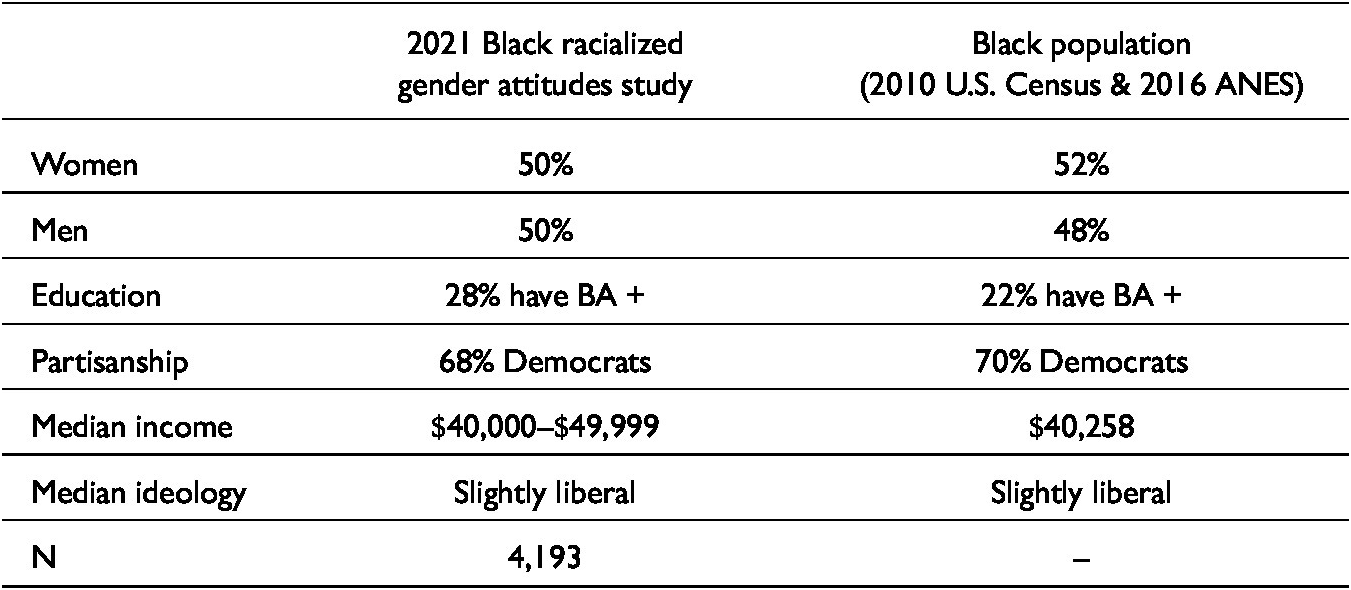
We conduct a national online quota sample survey with Qualtrics LLC of 4,158 Black participants: 2,096 are Black women and 2,062 are Black men. The survey was fielded in December 2020 using a non-probability quota sampling approach designed to approximate the demographic composition of the US Black adult population across gender, age, and region. Respondents were recruited through Qualtrics LLC and received modest incentives in the form of redeemable points or electronic gift cards. The final questionnaire required a median of 22 minutes to complete. The Bowdoin College Institutional Review Board approved the study. The lack of large N datasets with sizable samples of Black men necessitates the creation of a brand-new data sample for our hypothesis testing. 28% of the sample have a college degree or more, 68% are Democrats, median income ranges from $40,000 to $49,999, and the median ideology is slightly liberal. The representation of our sample is comparable to the American National Election Study and U.S. Census (Table 1). The oversample of Black men and Black women allows us to test our gendered expectations more effectively than in previous studies. The collection of data of this size from both Black men and women makes the study a standout.
Summary statistics

Table 1. Long description
The table consists of three columns: Demographic Category, 2021 Black racialized gender attitudes study, and Black population (2010 U. S. Census and 2016 A N E S).
* Women: 50 percent in the study versus 52 percent in the population.
* Men: 50 percent in the study versus 48 percent in the population.
* Education: 28 percent have a B A or higher in the study versus 22 percent in the population.
* Partisanship: 68 percent Democrats in the study versus 70 percent in the population.
* Median income: 40,000 to 49,999 dollars in the study versus 40,258 dollars in the population.
* Median ideology: Both groups are described as slightly liberal.
* Sample size (N): 4,193 for the study; no value provided for the general population.
Measures
To test our hypotheses, we have several measures to capture the precursors of Democratic partisanship for Black people. First, we modify the Huddy, Mason, and Aarøe (Reference Huddy, Mason and Aarøe2015) identity salience scale and create a four-item composite measure to capture racial identity salience for Black people.
The four items are:
-
(1) How important is being Black to you?
-
(2) How well does the term “Black” describe you?
-
(3) When talking about Black people, how often do you use “we” instead of “they”?
-
(4) To what extent do you think of yourself as “Black”?
The alpha coefficient for racial salience is 0.72. This measure offers a more nuanced understanding of the meaningfulness of Black identity to an individual.
Further, instead of relying on one question, the composite measure allows us to measure various aspects of blackness. Perceived discrimination is measured with the conventional question: “How much discrimination is there in the United States today against Black people?” Respondents are then given a 5-point response option ranging from “a little” to “a great deal.” We use the racial composition of close friends as our operationalization of racial-based social dynamics.
Respondents are asked the following question: “Of the five people, you consider your closest friends, how many of them would you say are: Black, White, Asian, Hispanic, or Other?”
Respondents are then able to identify which friends fall into which racial/ethnic category and are limited to only identifying a total of five friends. In addition to the antecedents of Democratic partisanship, we also include conventional controls for age, ideology, educational level, linked fate, and region. All variables are standardized to range from 0 to 1.
Results
One of the major claims we make in this paper is that Black women differ from men on several salient social dimensions per the research on the differences in their social roles. Thus, we begin our analysis of the partisan gender gap by examining the social antecedents of Democratic partisanship, comparing the average effects of these indicators based on the respondent’s gender. Contemporary work explains that for Black people, race plays a large role in how they arrive at their Democratic partisanship; thus, we should not expect any gender differences (Dawson Reference Dawson1994; White and Laird Reference White and Laird2020). Put another way, the differences shown here, regardless of their size, are an indication of the importance of social roles within partisanship for Black people.
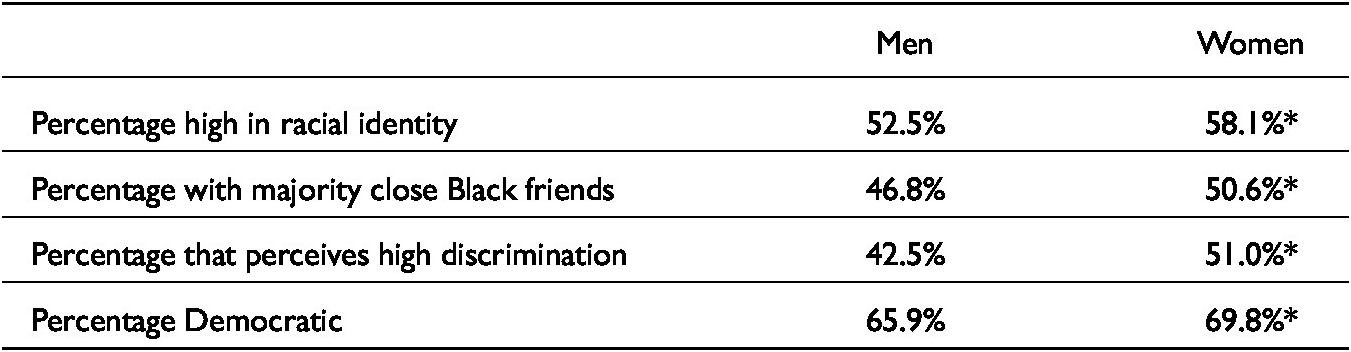
The results presented in the first row of Table 2 show that Black women are higher in their Democratic partisan loyalty than Black men (p < 0.05). On average, racial identity salience is higher for Black women relative to Black men (p < .05). This finding affirms extant research claims that Black women are particularly attuned to their racial identity due to their dual marginalization based on their race and gender. They are more aware of the relevance of their Black identity in their everyday lives as traditional notions of womanhood are often not inclusive of their lived experiences as Black women. Within the racial group, Black women have had a unique role as the ones to uphold the community and to operate with a group-centered positionality. Their racial identity is of such heightened importance because racial identity serves as the thread for fictive familial ties and caregiving for the group. To do the work for or on behalf of the racial group, as historians have shown is the role adopted by many Black women, one must have a strong connection with the group identity itself. The gender gap in the salience of racial identity speaks, in large part, to the heavily researched differences in the socialization of Black women and the likelihood that the social standing among other Black people will be significant for Black women as they are aware of their expected role in the group.
Gender differences on main covariates and Democratic partisanship by percentage

Table 2. Long description
The table consists of three columns and four data rows. The columns are labeled Men and Women.
* Row 1: Percentage high in racial identity. Men are at 52.5 percent and Women are at 58.1 percent.
* Row 2: Percentage with majority close Black friends. Men are at 46.8 percent and Women are at 50.6 percent.
* Row 3: Percentage that perceives high discrimination. Men are at 42.5 percent and Women are at 51.0 percent.
* Row 4: Percentage Democratic. Men are at 65.9 percent and Women are at 69.8 percent.
All values for Women are marked with an asterisk, indicating a p-value less than 0.05.
Note: * p < 0.05
In the third row of Table 2, we also observe a gender gap with respect to the overall perceptions of discrimination against Black people. Black women are more likely to report higher levels of perceived discrimination than Black men. Gendered differences observed speak to the “doubly bound” space where Black women reside. The perception of discrimination that Black women experience is one in which their racialized experiences that are marginalizing are also determined by their gender identity. They are more attuned to the discrimination facing the group due to their own observation and understanding of their marginalization. We also observe significant gender differences in race-based social ties. Black women maintain close friendship groups that are comprised of more Black peers on average than Black men (p < 0.05). This is unsurprising given how much work has been done on the community ties many Black women have had throughout history. Black women’s role within the racial group has been profoundly informed by Black social dynamics as many Black women tend to be active in social spaces as part of their political, social, and civic engagement for Black interests. The differences we observe here between Black women and men may seem negligible due to the size of the effect, but given that little to no work within political science has investigated how social differences between Black men and women’s experiences play a part in their political actions, any movement provides us with meaningful information.
There has been a gap in the Black politics literature in understanding gender differences in partisan behavior. The linked fate/common fate paradigm offers us significant insights into Black political behavior; however, this framework focuses on shared historical experience and overlooks the identities that can alter those experiences considerably, even within a single racial group. The theory of racialized social constraint put forth by White and Laird (Reference White and Laird2020) is parsimonious but does not lend itself to understanding gender differences in partisan behavior. In both theories, scholars assume that Black people, regardless of gender, are going to behave the same. There should be no observable differences. We know from Black feminist literature that Black women lead lives that are substantially different from their Black male peers. If we account for these differences and move away from assuming the same degree of group coalescing for all racial ingroup members, we can decipher the meaningful distinctions that need to be accounted for to understand observed variance in behavior.
We do this by engaging with the lens that Black women are using to inform their politics. The differences we observe are striking but in line with our claim that intersectional marginalizing experiences and socialization for Black women are foundational to their political outlook and decision-making. Further, we can show these gendered differences without using gender-specific measures. Table 2 shows the effect of gender on Democratic partisanship that is commonly found in election cycles. Black men and Black women are clearly both beholden to the partisan norms of the racial group, but a higher percentage of Black women are much more likely to adhere to the norm than Black men. In further analysis, we are able to reduce the effect of gender on partisanship by accounting for the antecedents to Democratic loyalty for Blacks: racial salience, perceptions of discrimination, and social dynamics (close friends). The dominant theory on Black partisanship argues that it is racialized social constraint that maintains Democratic partisan loyalty. Here again, the framework’s contention that this individualized behavior is reliant on social dynamics does not provide an explanation for why Black women are more likely to adhere to the group norm than others. We can show that Black women being the high bar with respect to Democratic partisan loyalty must be informed by other factors.
All of the results presented thus far speak to the broader implications of this work. We must grapple more deeply with the cognitive considerations they are making and what informs them. Knowing that Black women are (1) socialized in a manner that heightens their sense of accountability within the group, (2) expected to be caregivers for the group, and (3) considering their uplift as interchangeably tied to that of the group provides us with insights into the substantive meaning of being “doubly bound.” We have established that, as expected, Black women are more likely than Black men to perceive higher levels of discrimination, have more close Black friends, and have their racial identity be more salient. These meaningful differences culminate in Black women being more likely to identify as Democrats. What these descriptive findings do not explain is whether these social understandings have any influence on the gender gap that exists between Black men and women. To address this, we first seek to understand the factors that lead to the persistence of the gender gap by employing a logit model to assess gender differences between Black men and Black women.
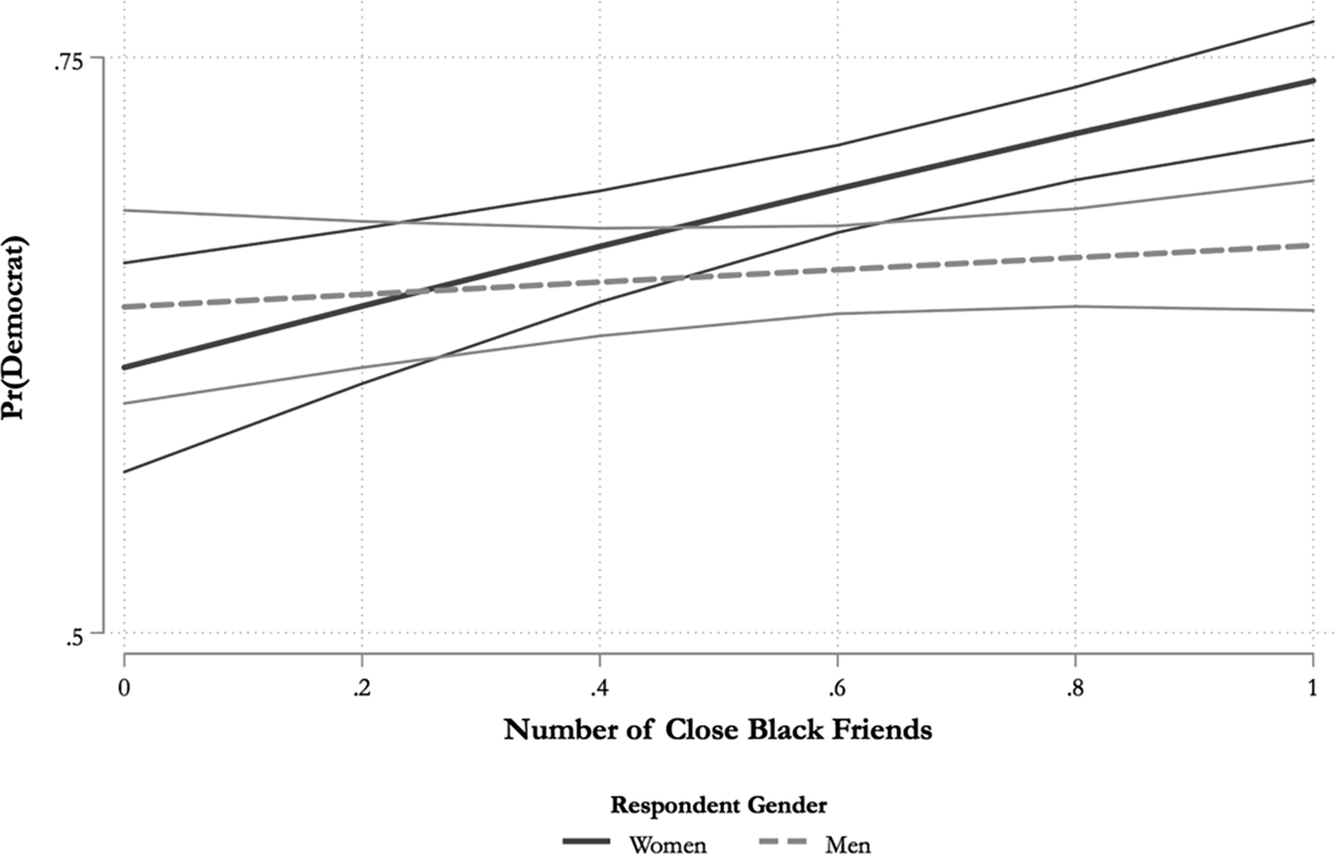
Figure 1 presents the marginal effects of having close Black friends on Black men and women’s Democratic Party affiliation. White and Laird (Reference White and Laird2020) argue that the ability of Black people to leverage social sanctions (or rewards) for partisan loyalty relies on the racial homogeneity of one’s social ties. They note specifically how racial segregation has been foundational to shaping the racial makeup of the social points of contact for Black people. The framework falls short because if Black women and men are both equally likely to be experiencing racial homophily in their everyday lives, why are there observable and significant differences in their partisan loyalty? We argue that the influence of social ties on partisan behavior is different for Black women. Their knowledge of group expectations around partisan norms and around their role in the group makes them much more susceptible to partisan loyalty pressures. Using the close friend measure as one means of identifying social ties allows us to see, even on an incremental level, how social ties are influencing partisan behavior in a gendered way. The close friend measure ranges from 0 (No Black close friends) to 1 (exclusively Black close friends), and as the amount of Black close friends increases for our Black women respondents, their Democratic Party affiliation increases as well (p < 0.01). This is not only about the incremental effect of each additional Black person in a Black woman’s close friend group but is more representative of the collective effect of an all-Black friend group. The racial homogeneity of friend groups strengthens the likelihood that a person will be in line with the Black partisan norm because they are aware that group members will hold them accountable for defecting from the expectation. Black women are more susceptible to the concerns and expectations of their friends than their Black male counterparts because they understand their role in the Black community.
Marginal effect of having close Black friends on Democratic PID for Black women and Black men.

Figure 1. Long description
The X-axis is labeled Number of Close Black Friends, ranging from 0 to 1 in increments of 0.2. The Y-axis is labeled P r (Democrat), ranging from 0.5 to 0.75.
Two main trend lines are shown:
* Women: Represented by a thick solid black line. It starts at a probability of approximately 0.62 at X equals 0 and shows a steady linear increase, reaching approximately 0.74 at X equals 1. This line is flanked by two thinner solid lines representing the confidence interval, which widens as the number of friends increases.
* Men: Represented by a thick dashed gray line. It starts at a probability of approximately 0.65 at X equals 0 and shows a much flatter, slightly positive linear trend, ending at approximately 0.68 at X equals 1. Its confidence interval is represented by two thinner solid gray lines that remain relatively parallel to the main trend line.
The graph indicates that while both groups show a positive correlation, the effect of having close Black friends on Democratic P I D is more pronounced for Black women than for Black men.
Further, friend groups that are comprised of all racial ingroup members for Black women are distinctively different from Black men because their friend group serves as an important resource for Black women to fulfill their ascribed role as protectors and stalwarts for the racial group (Collins Reference Collins2000; Morris Reference Morris1984). In turn, they are more likely to be influenced by the expectations of their close racial ingroup peers. Relative to Black men with all-Black friend groups, Black women with the mono-racial close friend group composition report higher levels of Democratic partisanship (p < 0.05). The collective effect of all-Black peers is a standout for Black women as illustrated in the relative difference of the effect between Black women and men. This is important to note because Black men are more likely than Black women to be in racial homogenous social networks with people that are more likely to step away from the partisan norm. This difference in friend group composition creates room for Black men to be more comfortable defecting from the partisan norm than Black women because the social pressure to conform is lessened.
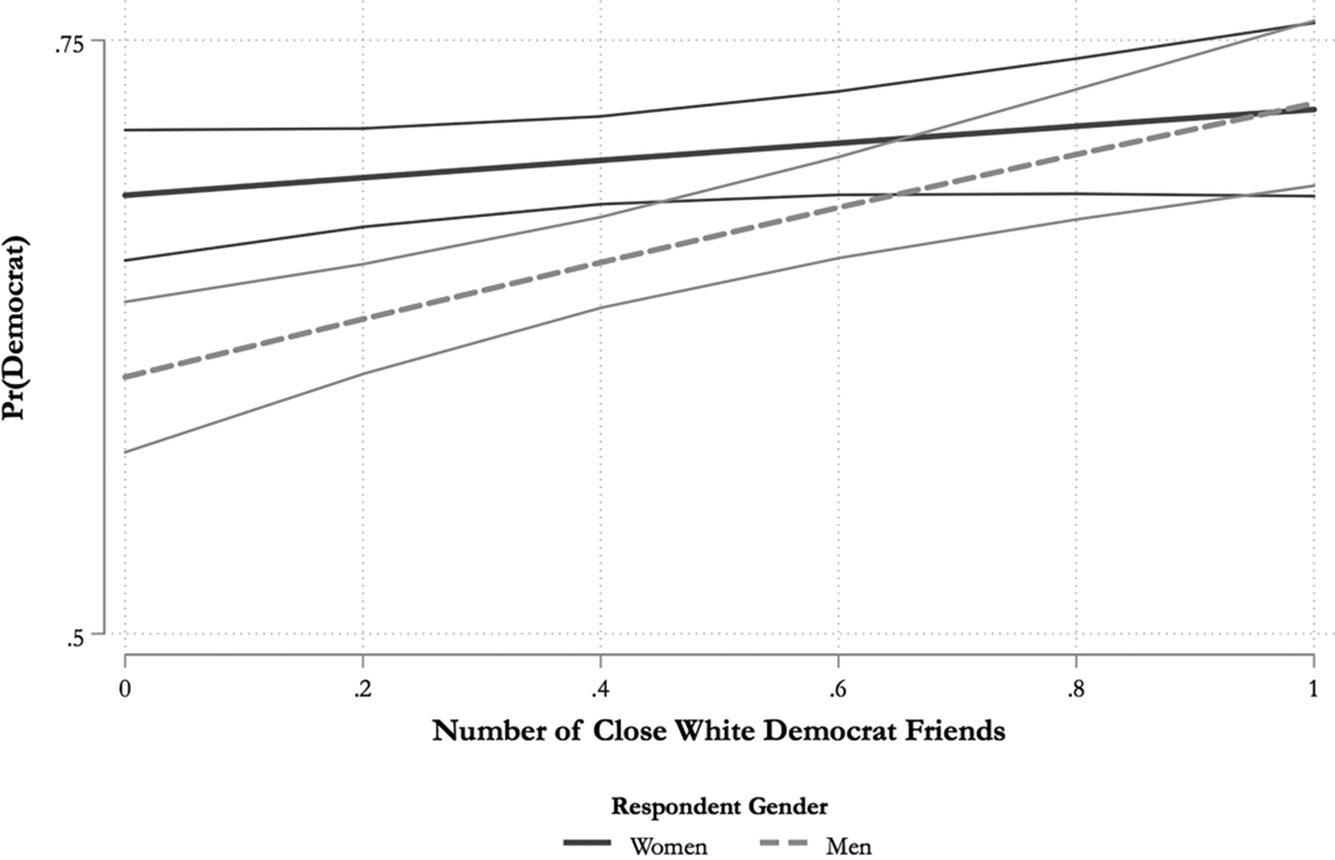
We wanted to determine that the influence of social networks on Black women is unique to having Black friendship networks and that it is not just driven by social networks of non-Black peers or solely partisanship. Figure 3 presents the analysis of Democratic white friendship networks on Black men and Black women. If the effect of friendship networks on partisanship is simply driven by having partisan friends, we would expect to see the same effect for Black women observed in Figure 2. The findings in Figure 2, however, show that the effect of friendship networks is in fact a racial effect. There is no statistically significant change in the strength of Democratic partisanship among Black women regardless of whether they have no close Democratic white friends or if all their close friends are white Democrats. Here the results show that the influence of social networks is race specific and that the same expectations of norm compliance, as well as ingroup expectations about the role of Black women acting on behalf of the group, are not applicable.
The marginal effect of close Democratic white friends on Black women and Black men’s Democratic affiliation.

Figure 2. Long description
The X axis is labeled Number of Close White Democrat Friends and ranges from 0 to 1. The Y axis is labeled P r (Democrat) and ranges from .5 to .75. Two main trend lines are shown with their respective confidence interval bands.
* The line for Women is a solid thick black line. It starts at a high probability of approximately .68 at 0 friends and shows a slight linear increase to approximately .72 at 1 friend. Its confidence interval is relatively narrow and remains stable across the X axis.
* The line for Men is a dashed thick grey line. It starts at a lower probability of approximately .6 at 0 friends and shows a steeper linear increase, crossing the women’s line at approximately .7 friends and ending at approximately .72 at 1 friend. Its confidence interval is wider at the start and narrows as it moves toward 1 friend.
A legend at the bottom identifies the solid line as Women and the dashed line as Men.
Reducing Gender’s Power on Black Democratic Affiliation
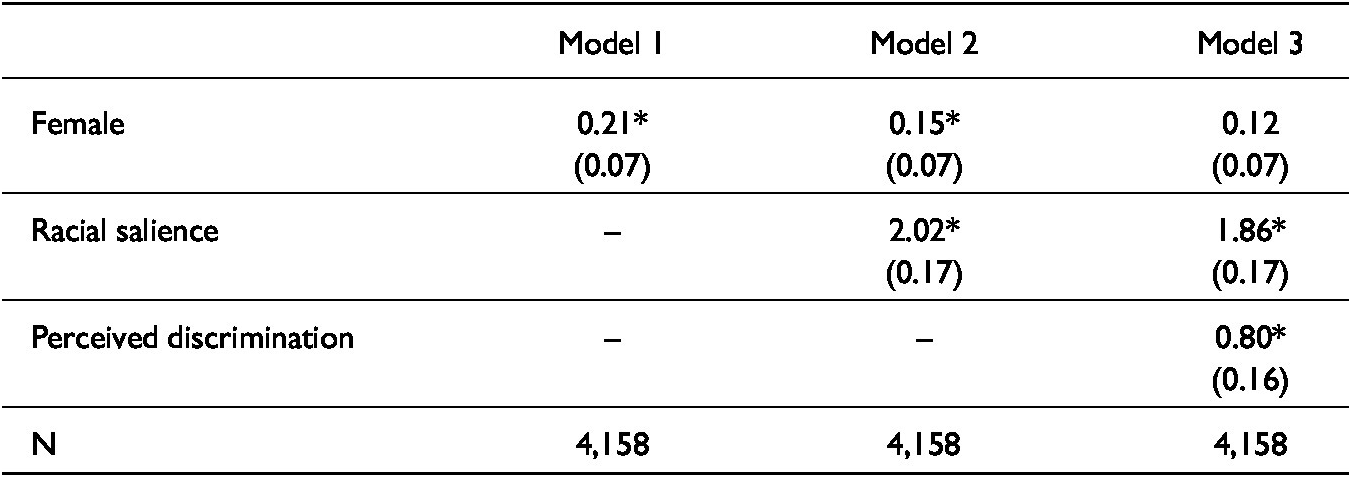
The partisan gender gap between men and women is frequently highlighted in scholarship on political behavior. For Black people, we know that the maintenance of Democratic loyalty operates through a social process that is specific to the group dynamics of the racial group. If we account for these racial factors that are the antecedents to Democratic partisanship for Black people, is it possible to reduce the salience of gender in Black partisanship? We use a series of stepwise logit models to test our hypotheses. Table 3 presents the results of this analysis. Model 1 is a logit showing the gender gap between Black men and women. In Model 2, we account for racial salience. Although the gender gap persists, racial salience is statistically significant. The idea that “to be Black is to be Democrat” bears fruit. The importance of one’s racial identity informs what has typically been considered a non-racial behavior — partisanship. In Model 3, we add in perceived discrimination.
Predicting the effect of gender on Democratic partisanship

Table 3. Long description
The table consists of four columns and five rows. The columns are labeled Model 1, Model 2, and Model 3.
Row 1, Female: Model 1 shows 0.21 asterisk with 0.07 in parentheses. Model 2 shows 0.15 asterisk with 0.07 in parentheses. Model 3 shows 0.12 with 0.07 in parentheses.
Row 2, Racial salience: Model 1 is blank. Model 2 shows 2.02 asterisk with 0.17 in parentheses. Model 3 shows 1.86 asterisk with 0.17 in parentheses.
Row 3, Perceived discrimination: Model 1 and Model 2 are blank. Model 3 shows 0.80 asterisk with 0.16 in parentheses.
Row 4, N: All three models have a sample size of 4,158.
A footer note indicates that the asterisk represents p is less than or equal to 0.01. The models include controls for the South, ideology, education, income, age, and linked fate.
Note: * p ≤ 0.01. Models include controls for the South, ideology, education, income, age, and linked fate. Full models with controls can be found in the Appendix.
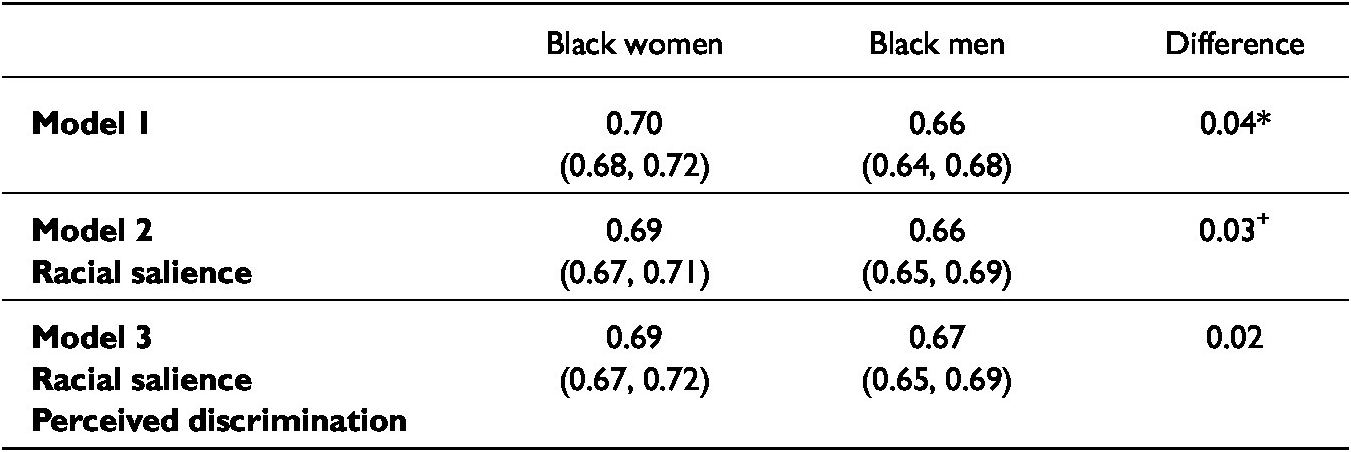
Again, perceived discrimination is not only an antecedent of Democratic partisanship for Black people; it is an indicator of overall racial consciousness. By accounting for both racial salience and perceived discrimination, we can make gender’s power in Black partisanship less prominent between Black men and Black women. Is the influence of gender on partisanship happening because Black women are decreasing in their partisanship, or are Black men becoming stronger partisans? We analyze the marginal effects of reducing gender’s influence in Table 4 and find that Black women consistently remain steadfast in their partisan loyalty and that it is Black men who are becoming more like Black women. Once one accounts for these factors (racial salience and perceived discrimination) that are not explicitly gendered but manifest in a gendered manner due to intersectional experiences, Black women and Black men are more alike in their behavior. Thus, this brings Black men and women closer in their partisan affiliation.
Marginal effects for reducing gender’s effect on Democratic Party affiliation a

Table 4. Long description
The table consists of four columns: Model description, Black women, Black men, and Difference.
* Model 1: Black women show a value of 0.70 with a range of 0.68 to 0.72. Black men show a value of 0.66 with a range of 0.64 to 0.68. The difference is 0.04 asterisk.
* Model 2 (Racial salience): Black women show a value of 0.69 with a range of 0.67 to 0.71. Black men show a value of 0.66 with a range of 0.65 to 0.69. The difference is 0.03 plus.
* Model 3 (Racial salience and Perceived discrimination): Black women show a value of 0.69 with a range of 0.67 to 0.72. Black men show a value of 0.67 with a range of 0.65 to 0.69. The difference is 0.02.
Discussion and Conclusion
As partisanship is such an integral aspect of the American political landscape, understanding the role gender plays in shaping it influences not only electoral outcomes but elite messaging and political behavior (Campbell Reference Campbell2016; Deason, Greenlee, and Langner Reference Deason, Greenlee and Langner2015; Mendoza and DiMaria Reference Mendoza and DiMaria2019). A persistent puzzle within the literature on partisanship is what motivates the meaningful differences in Democratic Party affiliation between men and women. This question becomes even more intriguing within the Black community, where levels of Democratic loyalty are among the highest of any racial group. Traditionally, scholars have turned to policy preferences and issue positions to explain the gender gap, but a growing body of research shows that Black partisanship is also shaped by racialized social expectations enforced within the community (White and Laird Reference White and Laird2020). What remains under-explored is how these socially grounded mechanisms operate through gendered pathways — why Black women remain more consistently and intensely Democratic than Black men. Understanding the motivations of the Black partisan gender gap moves the literature toward a more complete account of how partisanship and gender operate for marginalized groups whose social realities differ from those of the broader electorate.
In this article, we use a large-scale survey of nearly 4,200 self-identified African Americans to examine how the social antecedents of Black Democratic partisanship — racial identity salience, perceived discrimination, and racially homophilous social networks — help explain the gender gap in Democratic affiliation. We operationalize social networks as respondents’ close friends to assess how everyday relational contexts shape the partisan orientations of Black women and men differently. The results illustrate that, despite similarly strong aggregate Democratic loyalty, the pathways to that loyalty vary by gender in ways that reflect deeper socialization patterns. These same mechanisms also reduce the partisan gap: when Black women and men report comparable levels of racial identity, perceive similar levels of group-based discrimination, and inhabit similar networks, the gender difference in Democratic identification is no longer statistically meaningful.
These findings substantively advance existing work by demonstrating that the Black partisan gender gap is not merely a demographic difference, nor a byproduct of distinct policy preferences. Rather, our results show that the gap reflects gendered orientations toward racial group membership, rooted in the long-standing historical and sociological roles assigned to Black women within the community. Black women’s collective-first orientation — developed through centuries of expectations that they hold families and communities together — renders racial identity, discrimination, and intragroup social ties more politically consequential for them than for Black men. In contrast, Black men’s self-as-proxy orientation situates their political identity more through their individual experiences within racialized structures. By empirically linking these orientations to measurable antecedents of partisanship, our study provides a theoretically grounded explanation for why the partisan gender gap emerges in a group with otherwise overwhelming partisan cohesion.
Beyond its implications for the study of Black political behavior, this framework also offers a broader theoretical contribution to the study of gender gaps in partisanship. By moving beyond the conventional emphasis on policy preferences and issue positions, our approach demonstrates how gender gaps can emerge and persist through underlying social orientations that are historically and culturally shaped. The collective-first and self-as-proxy orientations we identify provide a conceptual lens that can be used to investigate gendered partisan divides in other racial and ethnic communities, particularly those in which group membership is socially enforced or deeply embedded in identity. In this way, our work expands the tools available to scholars studying gender gaps by showing that these differences may be rooted as much in socialized roles and community expectations as in policy substance. This reorientation encourages future research to consider how gendered socialization, intragroup norms, and the meaning of group membership shape partisan identity across diverse populations.
More broadly, this work makes an important contribution to scholarship on intersectionality by demonstrating how intersecting identities produce distinct partisan mechanisms, not merely distinct partisan outcomes. Our findings affirm and extend Gay and Tate’s (Reference Gay and Tate1998) claims that Black women’s political behavior cannot be understood through race or gender alone; the political implications of living at their intersection are multiplicative, not additive. As appeals to Black women increase, often positioning them as the “backbone” of the Democratic Party, our results indicate that broad gender-targeted appeals may be less effective if they do not speak to the racialized social obligations that shape Black women’s political commitments. Their gender is always understood through the lens of race, and their politics reflect this lived reality.
This study also highlights new directions for future research. If racialized socialization produces gendered partisan orientations within the Black community, similar dynamics may shape differences in political trust, policy preferences, candidate evaluation, and political efficacy. As both political parties intensify efforts to mobilize or peel away segments of the Black electorate, understanding the gendered dimensions of these social antecedents will be crucial for interpreting future electoral behavior. Additionally, because the mechanisms we identify are rooted in roles and responsibilities within the racial community, these dynamics may have parallels among other marginalized groups whose group cohesion is similarly sustained through gendered social norms.
There is no denying the importance of Black people in the American political landscape and beyond, and, over time, Black women’s role as political leaders, informal and formal, has become clearer. While much research has focused on Black women political elites, our work underscores the importance of understanding Black women voters as political actors whose orientations and motivations help shape the political destiny of the community. The theoretical and empirical contributions of this article highlight how gender and race intersect to structure not just who participates in politics but why, offering a more nuanced and inclusive account of partisan identity in the United States.
Supplementary material
The supplementary material for this article can be found at http://doi.org/10.1017/S1743923X2610110X.


 Open access

