It is in the interest of major powers, such as the United States, to signal support for strategically important client states—or protégés—to deter harm against them and reassure the client's leadership of continued support. But how can a major power signal its support credibly? Existing literature on major power–protégé relations has focused on the role of public signals, particularly formal alliances. Yet, in a number of important cases, the United States has avoided giving alliances or sending other highly public signals of support for protégés that are strategically important, instead opting to show its support through less-visible military signals. For example, the Shah's Iran, Egypt, Jordan, Saudi Arabia, Indonesia, Singapore, Yugoslavia, and Franco's Spain have all received high levels of US military aid and arms sales, signaling their international strategic value to the United States. However, none of these countries have been formal US allies, and the US has also avoided exchanging a large number of leadership visits with most of them.
These examples raise a largely unexplored question: why has the United States sent financially costly military signals of support for these countries, but largely avoided more visible signals? This behavior is puzzling from an international strategic perspective because more visible signals of support engage the sender's reputation more directly, and are also more likely to be noticed by potential challengers. Thus, more visible signals might be expected to be more effective for deterring challengers and reassuring clients. Since these countries are important to the United States, why not signal this in the most effective way possible? What explains the decision of the US to send highly visible signals in some cases, but not in others?
To address this question, we begin by developing a new framework for classifying interstate signals of support. We consider two ideal types of signals: “Frontstage” signals are highly visible to the public domestically and abroad. These signals receive widespread press coverage because they have public ceremonial aspects and/or are the subject of intragovernment debate. Therefore, members of the public have the opportunity to become aware of frontstage signals and draw inferences from them about the relationship between the major power and protégé. In contrast, “offstage” signals, while not secret, lack features that generate high press coverage. Therefore, offstage signals are less likely to enter the public's awareness and more likely to be observed by the intended audience only, which includes regime insiders within the client state and potential international challengers.
Based on this asymmetry in which audiences observe these two types of signals, we develop a theory that explains decision makers’ signaling dilemmas and choices. We theorize that despite an international strategic preference for frontstage signals, domestic political constraints in the US as well as within the protégé country often lead the US to support autocratic protégés using offstage signals alone. In contrast, there are generally no domestic constraints on sending frontstage signals of support for democracies. We highlight three causal mechanisms—hypocrisy costs, credibility concerns, and autocratic regime stability concerns—that explain the relationship between the client's regime type and the supply and demand for frontstage versus offstage signals from the United States. These mechanisms illustrate the dilemmas faced not only by US leaders but also by autocratic recipients in choosing between frontstage and offstage signals. Although our theory is focused on the United States, we conclude by discussing its applicability to signaling by other major powers.
We test our theory in a data set that records various support signals sent by the United States for other countries between 1950 and 2008. We consider defense pacts and leadership visits to be frontstage signals because of the pomp and circumstance surrounding them, while we consider arms sales and military aid to be offstage signals. Our categorization of signals is grounded in theory and supported by an analysis of press reporting frequency. Our statistical results strongly support our expectation that the United States is more likely to send solely offstage signals of support to autocracies than to democracies. We use robustness checks to further explore our causal mechanisms and rule out alternative explanations.
In addition, we include a case study of American leaders’ deliberations and decisions regarding whether to support the Shah's Iran with frontstage or offstage signals. This is a hard test case for our theory because the importance of Iran's geopolitical location and role in resisting communism during the Cold War might be expected to override concerns about Iran's regime type. Yet, consistent with our theory, we find that US policymakers were concerned about domestic backlash against frontstage signals within both the US and Iran, and these concerns led them to support the Shah primarily through offstage signals.
Our theory and findings make several important contributions. First, most studies on major power-protégé relations have focused on formal alliances. By considering other signals of support, such as leadership visits, military aid, and arms sales, we identify a puzzle that has received little recognition: sometimes major powers signal support for strategically important protégés in an “offstage,” but still costly, manner.
Second, we use domestic politics to explain this deviation from the highly visible signals that we would expect to be most effective in deterring potential challengers and reassuring clients. This enables us to provide a compelling answer to the puzzle that Fearon posed regarding why countries make less than the strongest possible commitment in bargaining.Footnote 1 We show that factors emphasized by existing literature—such as a protégé’s international strategic value, the Cold War, and risks of entrapment—cannot account for the pattern of choices between frontstage versus offstage signaling that we observe. Instead, it is the recipient's regime type, through its effect on domestic politics in both the patron and recipient states, that primarily explains this pattern. This leads to the further insight that frontstage signals of support by the United States for its autocratic clients can actually be counterproductive despite the greater commitment typically associated with such signals.
We are also among the first to consider the recipient's role in signaling decisions. Whereas previous research has discussed how major powers fear entrapment, we highlight the fact that some weaker countries—specifically, autocracies with an anti-US opposition—may not even desire alliances or other public signals of support precisely because of their frontstage nature. For these autocratic protégés, receiving frontstage signals from the US might deter external threats but would enhance internal ones. Therefore, both supply-side constraints (on the US side) and demand (on the part of the protégé) influence US signaling decisions.
Finally, we highlight the important but underexplored role offstage signals play in patron–client diplomacy, extended deterrence, and reassurance. Specifically, we discuss how offstage signaling allows leaders to act strategically to accomplish two goals that are sometimes in tension with one another: establishing credible extended deterrence, while also avoiding backlash from domestic constituencies that might oppose the patron–client relationship. On the whole, we provide a more nuanced view of the interaction between international strategic imperatives and domestic political considerations than the current literature on major power–protégé alignment either permits or admits.
Literature Review: Alliances and Other Signals of Support
The method of reassuring protégés and deterring attacks against them that has received the most attention in previous research is alliances. A large literature exists on why alliances form. Realist theories suggest that alliances form to balance against threatening statesFootnote 2 or to “bandwagon” with threatening states.Footnote 3 Several scholars assert that regime type influences alliance formation. Some argue that countries with similar regimes are more likely to ally,Footnote 4 whereas others argue that this relationship is spuriousFootnote 5 or a thing of the past.Footnote 6
However, analyzing alliances alone does not accurately capture major powers’ signaling decisions. When a major power desires to signal support for a protégé, it has a wide menu of policy options available, including giving aid, selling arms, or providing symbolic support by sending its leader to visit the protégé or hosting the protégé’s leader. When a country can substitute among different foreign policy options, research that focuses on just one option is subject to bias.Footnote 7 Accounting for alternate methods of signaling support is crucial to understanding why one signal is chosen over another.
In examining signals of support beyond alliances, we build on a small body of existing work on this topic. Like MorrowFootnote 8 and Barnett and Levy,Footnote 9 we consider alliances and arms as alternate foreign policy options, but we focus on how a state uses these options to ensure a protégé’s security rather than its own security. Like Lake,Footnote 10 our theory explores variation in relationships between patrons and clients. However, we seek to explain differences in the publicity of the asymmetric relationships, rather than the level of control or dependence. Recently, Milner and Tingley have also developed a theory that considers the role of domestic political considerations in choices among various US foreign and economic policies.Footnote 11 We build on their work by delving into the trade-offs among security-related signals in particular, arguing that some are more domestically controversial than others because of higher publicity.
In addition, we take into account not only US domestic constraints, but the domestic constraints of US protégés. The protégé’s perspective on signals of support has been neglected in the alliance literature, which implicitly assumes that a weaker protégé would be lucky to get a major power's alliance commitment and focuses instead on reasons that a major power would be reluctant to give it, such as fears of entrapment, entanglement, or governance costs.Footnote 12 In contrast, our theory suggests that certain protégés may wish to avoid alliances and other frontstage signals, but still desire support through other means.
Finally, we make two broader contributions to the interstate signaling literature. First, while scholars have made the distinction between public and secret signals,Footnote 13 we highlight a new category of signals that are non-secret, but at the same time not highly visible to public audiences. Second, our theory sheds light on a key puzzle raised by Fearon; namely, why do countries deviate from signaling the maximum possible amount of commitment, even if this undercuts the signals’ effectiveness? We build on Fearon's brief speculation about the role of multiple audiencesFootnote 14 and develop a comprehensive theory regarding when domestic constraints restrict the ability to send hand-tying frontstage signals.
Theory: Choosing Frontstage versus Offstage Signals
Major powers typically sit atop networks of protégés. It is in major powers’ interest for their client states to be secure because clients provide major powers with access to resources, military basing rights, political or economic concessions, and greater international legitimacy.Footnote 15 Because military conflict is costly, the most desirable way for a major power to ensure a protégé’s security is through extended deterrence.Footnote 16 Therefore, a major power signals support for its protégés in the hopes of deterring challenges against them and reassuring the protégés of its shared interest in their security. But how do major powers decide which type of signal to send? A crucially important factor in this decision is the level of publicity associated with different signals. While the visibility of a signal cannot be fully controlled by the sender, certain signals are designed in ways that make them more visible to public audiences than others. We consider two ideal types of support signals that a major power can send: “frontstage” and “offstage” signals.Footnote 17
Frontstage signals of support are highly visible to public audiences, domestically and internationally.Footnote 18 High visibility means that the signals receive widespread press coverage so that it is easier for attentive members of the public and opinion leaders to react to them. Two attributes can make signals highly visible. First, the signal is associated with public events that involve widespread media coverage, such as press conferences or ceremonies. Second, the signal is designed to provide an opportunity for intragovernment debate, such as if it requires explicit legislative approval. Since the media often take their cue from elected officials, intragovernment debate will almost automatically lead to more media coverage of a signal. Although many members of the public may not actively follow foreign policy news, the visibility of frontstage signals through the media creates an opening for opinion leaders to rally the public.
In contrast, offstage signals of support are associated with less publicity and therefore less awareness among the publics in the major power and client state. Offstage signals are not secret. Information on them is publicly available, and therefore highly interested parties—such as government officials and intelligence services of potential international challengers—will be able to monitor them. However, because offstage signals lack public ceremony or intragovernment debate, they receive less automatic media coverage, creating a barrier to public awareness and the rallying of public opinion. This asymmetry in the awareness of offstage signals between government officials and the wider domestic audiences allows leaders to overcome the challenges associated with signaling their interests in the presence of multiple audiences.Footnote 19
Both frontstage and offstage signals can be “costly” and credibly convey a major power's interest in the security of a client. The public nature of frontstage signals makes them likely to generate hand-tying costs. Members of the public can infer from frontstage signals that the major power has an interest in the protégé, even if the major power makes no explicit commitment. This raises the prospect that the major power would face audience or reputational costs for abandoning the protégé and thus increases the likelihood that the major power would aid the protégé in time of need, by either intervening militarily or providing other assistance. Offstage signals are less likely to generate hand-tying costs because they are less public. Nonetheless, they can still function as informative signals because of their ex ante costs in the form of resource transfers that government insiders, though not publics, can easily observe. If a major power incurs significant financial, opportunity, or human costs to support a protégé, this signals that the major power cares about the protégé’s security. Since the cost of the signal helps to separate the behavior of a major power that cares about a protégé from one that does not, an offstage signal certainly conveys more support than sending no signal.
However, offstage signals have two significant disadvantages compared to their frontstage counterparts. First, because offstage signals are relatively less visible than frontstage, they have a higher probability of being overlooked by potential adversaries who might need to be deterred. Even though we expect these adversaries to pay closer attention than the public and therefore observe most offstage signals, the signals still face a greater risk of being overlooked or misperceived than frontstage signals. Second, offstage signals are less likely than frontstage ones to create substantial hand-tying costs for the patron. Hand-tying costs have an advantage over sunk costs in conflict bargaining because they do not require up-front investment,Footnote 20 allowing countries to achieve more effective deterrence at a lower expected cost (because costs will be paid only if a bluff is called). Previous research has found that hand-tying alliance commitments are effective for deterrenceFootnote 21 and that sunk-cost signals are less effective.Footnote 22 This suggests that frontstage signals, all else equal, should be more effective for deterring adversaries as well as reassuring protégés.
Given these inherent benefits of frontstage signaling, why do patrons send offstage signals of support alone for some important protégés? To explain this apparently suboptimal behavior, we need to look beyond the strategic international situation and consider the domestic systems of major powers and protégés. While international strategic considerations are important in determining which countries a major power supports, we argue that domestic considerations are more important in determining how a major power signals its support. Because the decision to send a signal of support requires agreement among the sender and recipient, our theory highlights the domestic constraints on both the major power and protégé regimes that can cause a deviation from frontstage signaling. We focus our analysis on signaling by the United States, the leading hegemon and a country with significant domestic constraints. In the conclusion, we discuss the generalizability of our theory to additional powers.
US Domestic Constraints
We begin by considering the US perspective. For the international strategic reasons discussed earlier, we expect the US to generally prefer sending frontstage signals of support for its clients. However, we theorize that when signaling support for autocratic protégés, the US will frequently prefer to send offstage signals instead. Regardless of how important certain autocratic protégés may be to US foreign policy, domestic constraints make it difficult for the US to send frontstage signals of support for countries that do not share US democratic values. Specifically, we identify two related causal mechanisms that make US policymakers more reluctant to offer frontstage signals to support for autocracies than democracies: hypocrisy costs and credibility concerns.
The first mechanism is hypocrisy costs.Footnote 23 Hypocrisy costs consist of public disillusionment with US foreign policy when the US does not uphold the democratic values it preaches. Like audience costs, hypocrisy costs result from a contrast between words and deeds, but hypocrisy costs specifically relate to violations of commitments regarding values. Supporting the existence of hypocrisy costs, studies have found that the US public disapproves of leaders who say one thing and do another in a variety of different contexts.Footnote 24 There is also evidence that the US domestic audience cares about democratic values. Tomz and Weeks find that members of the US and UK publics are less likely to support attacking a country if it is a democracy because they view democracies as less threatening and morally superior.Footnote 25 In some US polls, respondents have ranked freedom and democracy as important foreign policy priorities, above stopping communism during the Cold War or pursuing world leadership.Footnote 26 As Figure 1 shows, more than twice as many US respondents reported a favorable view of democracies than of nondemocracies, across 465 polling questions about forty-two different countries in a survey fielded between 1989 and 2013.Footnote 27
US respondents’ views of democratic and nondemocratic countries

For hypocrisy costs to actually damage a president's political standing, the public must become aware of the hypocrisy and mobilize against it. The attentive portion of the public may automatically mobilize after learning about the hypocrisy through the media, but because many members of the public are inattentive, large-scale mobilization is unlikely to happen spontaneously. Nonetheless, research has shown that public opinion is heavily influenced by “opinion leaders,” elites whom at least a portion of the public trusts to interpret events.Footnote 28 When the US supports authoritarian regimes, certain opinion leaders, such as human rights groups and opposition politicians, have the incentive to rally the public and use this as a political issue. Given the influence of elite framing on public opinion, particularly with regard to foreign policy issues,Footnote 29 these opinion leaders can mobilize the broader public by putting the issue of US support for autocracies on the public agenda and framing it as a betrayal of US values.
It will be easier for opinion leaders to mobilize the public in the case of frontstage signals than in the case of offstage signals. Because offstage signals are more hidden from the domestic public, they can deprive opinion leaders of ammunition for politicizing signals of support and rallying the public to impose hypocrisy costs. Even though opinion leaders themselves may be aware of offstage signals, their ability to mobilize the public depends on media coverage, which they cannot fully control.Footnote 30 Therefore, it would be difficult for them to mobilize the public around an issue that is far outside the public awareness and that may not be deemed “newsworthy” by the media. Footnote 31 In contrast, rallying the public against support for authoritarians is easier in the case of frontstage signals because, as explained above, media coverage of frontstage signals has a natural tendency to be much higher. The fact that information about a frontstage signal is already available in the media and that the attentive public is already aware of it lowers the barriers for opinion leaders to influence the public and mobilize it to act.
Thus, through the influence of opposition politicians, interest groups, and other opinion leaders, hypocrisy costs resulting from frontstage signals of support for autocratic regimes can damage a president's political standing. While this alone may not crucially harm a president's re-election prospects, presidents have the incentive to avoid accusations of hypocrisy because these can undermine their credibility, their ability to push other policies, and their legacy. Therefore, we expect presidents to lean toward minimizing domestic political risks by relying on offstage signals of support for strategically important autocratic protégés rather than frontstage ones.
A second and related reason that the US might not send frontstage signals of support for autocracies is international credibility concerns. For signals of support to be effective, they need to be credible, meaning that international audiences must believe the US is indeed likely to aid the protégé in time of need. The transparency of democratic regimes can potentially be both a blessing and a curse for credible signaling. Schultz argues that if an opposition party supports a democratic leader's threat, it will make the threat more credible; yet if the opposition opposes a threat, it is less likely to be believed.Footnote 32 Similarly, McManus finds that high public approval for a president can enhance the effectiveness of resolved statements, but insufficient approval can render statements ineffective.Footnote 33 This damage to credibility that can result from lack of public support suggests that the United States should avoid sending frontstage signals of support for protégés when frontstage signals are likely to result in significant public opposition.
Based on the logic we outlined, we expect domestic opposition to mobilize when the US visibly signals support for dictators. For example, when the US signaled support for Kuwait and an intention to intervene militarily after Iraq invaded Kuwait in 1990, some US politicians, journalists, and members of the public objected because Kuwait was not a democracy. Congressman Lee Hamilton stated, “I and many of my colleagues are hesitant about lining up with tribal monarchies and identifying our interests with them … That would put us in conflict with the worldwide trend toward democracy, as well as with our own democratic values.”Footnote 34 Although many factors influenced Saddam Hussein's decision not to acquiesce to US demands to withdraw from Kuwait, such domestic discord was unhelpful for US credibility.Footnote 35
Of course, even in the case of offstage signaling, there could be doubt regarding whether the US public would support coming to an autocracy's aid if it were in need. However, frontstage signals can worsen the credibility problem. Whereas the absence of a public reaction to offstage signals allows ambiguity regarding US public opinion toward a client state, frontstage signals have greater potential to generate public outcry and therefore make public opposition to aiding the client less ambiguous and more visible to potential foreign adversaries. Therefore, frontstage signals of support for autocratic protégés may not only be ineffective for deterrence or reassurance, but also counterproductive by raising more doubts about US credibility. Taking into consideration both hypocrisy costs and credibility concerns, we expect that American decision makers are more likely to send only offstage signals of support to autocratic client states than to democratic clients.
The Protégé’s Domestic Constraints and the Demand for Offstage Signals
Thus far, our discussion has focused on the calculus of American policymakers regarding what signals of support to supply. But the demand for signals by protégés constitutes another important part of the equation. Autocratic protégés are more likely to seek solely offstage signals than democratic protégés. One reason is that autocrats might share concerns about credibility. More importantly, while autocratic leaders benefit from external security guarantees,Footnote 36 they may have their own domestic political reasons for keeping US support outside the public view so that it cannot become a rallying point for the political opposition.
In many countries with pro-US authoritarian regimes, anti-Americanism exists among the population and political opposition. While anti-US sentiment is by no means exclusive to autocracies, the combination of a pro-US regime and an opposition movement that plays on widespread anti-American sentiments in the population is most common within autocracies for the simple reason that a democracy could not remain a US protégé for long if the majority of the population opposed this. During the Cold War, pro-US autocrats in Central America and the Caribbean tended to face anti-US opposition movements, as rebellions in Cuba, the Dominican Republic, and Nicaragua made evident.Footnote 37 Today such domestic dynamics primarily exist in Arab autocracies. The vast majority of citizens in countries such as Jordan, Egypt, Saudi Arabia, and the United Arab Emirates view the United States unfavorably.Footnote 38 Such anti-US sentiments have fueled Islamic opposition movements, such as the Jordanian Islamic Action FrontFootnote 39 and threatened the stability of pro-US authoritarian regimes in the Middle East.
In some cases, autocratic leaders actually join in the expression of anti-American sentiment, even if their policies are largely pro-US, to quell domestic opposition. Such a strategy attempts to legitimate the authoritarian regime by making it appear strong and independent of Western influences. Focusing negative attention on an external actor can also distract the public from domestic problems. Rubinstein and Smith argue that during the Cold War, many Third World governments relied on “instrumental anti-Americanism” to provide a scapegoat for domestic difficulties and enhance popular support.Footnote 40 Barnett also describes how many nondemocratic Arab leaders have publicly portrayed themselves as anti-Western Arab nationalists, although privately they were “cynical manipulators,” willing to use any strategy to maintain their political power.Footnote 41 Unfortunately, in what Barnett calls the “sorcerer's apprentice effect,” authoritarian regimes can become constrained by their own rhetoric, limiting the ability of authoritarians who have criticized the US to accept US signals of support.Footnote 42
Thus, authoritarian rulers who follow pro-US policies but face strong anti-US sentiment in the population (which may partially result from their own regime legitimation strategies) are caught in a dilemma. They seek US support against external threats, but cannot receive this support openly without inflaming public opinion and providing the opposition with an opening for criticizing the regime. Authoritarian leaders may calculate that moving US support offstage is the best strategy to remain in power. As Hollyer, Rosendorff, and Vreeland argue, negative information is more dangerous to an authoritarian regime when it is widespread knowledge because it helps domestic actors coordinate to protest.Footnote 43 As is the case in the US, opinion leadership by the opposition is likely to be necessary to rally the public in authoritarian regimes, but such rallying will be much easier when information about US signals of support is already accessible to the public because of the frontstage nature of the signal. For this reason, authoritarian regimes may prefer offstage signals, and the US is likely to share this preference to allow friendly regimes to remain stable and prevent the rise of anti-US opposition groups.
In sum, because of the risk that frontstage signals will provide a rallying point for the anti-American opposition groups that exist in many autocracies, we expect autocrats, on average, to be more reluctant than democrats to seek them. For example, in 1991 Saudi Arabia found itself constrained in its ability to seek a US defense pact, even though it faced a continued security threat after the Gulf War. More than 400 religious officials and political activists petitioned the Saudi king in 1991 to “avoid alliances that run counter to Islamic legitimacy.” Over the following years, public activists continued to call upon the regime to “avoid any kind of alliance or cooperation which serves imperialist goals.”Footnote 44 The presence of domestic opposition prevented Saudi Arabia from pursuing a formal defense pact with the United States and probably also explains why the Saudi king never visited the United States between 1985 and 2008.Footnote 45 However, this public sentiment did not stop the two countries from enjoying close military cooperation offstage.
Hypotheses
Based on the mutual preferences of the United States and its autocratic protégés, we derive the following hypotheses:
H1a
The United States is more likely to send frontstage signals of support for more democratic countries than for more autocratic countries.
H1b
The United States is more likely to send solely offstage signals of support for more autocratic countries than for more democratic countries.
Our hypotheses focus on comparing the relative likelihood of different signals between more and less democratic countries. They do not intend to imply that frontstage signals of support for autocracies are necessarily uncommon, but rather that they are less common than for democracies. Our theoretical starting point is that frontstage signals are, all else equal, more likely to be effective than offstage signals. It is therefore possible that the inherent general advantages of frontstage signaling will outweigh the previously discussed disadvantages of sending frontstage signals for autocratic protégés in some cases. Thus, our expectations are focused on the differences in signals sent for different regime types, not on the overall prevalence of different signals.
Classifying Signals
We now turn to identifying which US signals we view as frontstage or offstage. The signals considered here do not constitute an exhaustive list of signaling methods, but they are among the most common and important methods used by the United States. We focus on signals about which high-quality data are available. Thus, for example, we do not consider troop deployments because Department of Defense deployment data do not distinguish between hostile, peacekeeping, and supportive deployments.Footnote 46 Our categorization of signals is based on the presence or absence of two attributes that affect visibility: public ceremony and intragovernment debate.
Of course, because frontstage and offstage signals are ideal types, there is some variation in the amount of publicity received by different signals in the same category. A type of signal that typically receives little publicity may occasionally receive much higher publicity, and a signal that typically receives high publicity may occasionally avoid attention. However, such rare exceptions are unlikely to undermine our statistical analysis.
We identify two types of signals that we consider to be frontstage. The first is a defense pact. As a binding legal commitment, a defense pact creates the potential for substantial hand-tying costs in the form of public disapproval or reputational damage if the pact is violated. Thus, pacts reassure protégés and threaten potential challengers with the promise of intervention if the protégé is attacked. US defense pacts are frontstage signals because they are usually signed in formal ceremonies that garner substantial press attention and because they require Senate approval, leading to additional press coverage of the Senate debate.
A second frontstage signal of support is leadership visits. These visits can involve travel by the US president to a foreign country or travel by a foreign leader to the United States.Footnote 47 Although leadership visits are a less formal signal than defense pacts, they entail both sunk and hand-tying costs and can serve similar (though perhaps weaker) deterrence and reassurance functions. Aside from their monetary costs, they take time out of the president's busy schedule and require significant preparation by US officials, making them a “scarce resource.”Footnote 48 Leadership visits also create hand-tying costs because—as frontstage signals characterized by public ceremony—they typically feature images of the US president smiling, praising, and shaking hands with a client state's leader. This suggests that the US president cares about the client, creating political and reputational costs for later abandoning the client. For example, after President Bush visited the nation of Georgia once and hosted three Georgian presidential visits between 2004 and 2008, he was criticized for not coming to Georgia's aid when Russia invaded.Footnote 49 It should be noted Leadership visits should be considered signals of support only when granted to a weaker country. Sufficiently powerful countries, such as Russia and China, have received US presidential visits even though the US does not seek to support them.
We further identify two offstage signals of support. The first is military aid. The US gives military aid to many countries, and the amount of yearly aid given to countries between 1950 and 2010 has ranged from around $1,200 to nearly $14 billion.Footnote 50 As explained in more detail below, our analysis considers only high levels of military aid to be signals of support. Giving a high level of military aid does not guarantee that the United States will assist a country if it is attacked. Nonetheless, as a costly signal, it indicates that the US has an interest in the country's security. Thus, in addition to improving a country's ability to defend itself, US military aid should raise expectations that the US will assist the country in some way if it is harmed. Military aid is unlikely to receive high publicity, both because it is not typically awarded in any prominent ceremony and because it is subject to relatively little legislative debate. Military aid is approved by Congress as part of large spending bills, and thus the amount of military aid given to any individual country is rarely the subject of much discussion.
Another offstage signal of support is arms sales. Like military aid, arms sales can be a costly investment in a country's success, and we similarly consider only high levels of arms sales to be signals of support. Many US arms sales are government-to-government, in which the US government negotiates with the arms vendor on behalf of the recipient country. There are also commercial arms sales, which are negotiated directly between a foreign government and US vendor, but the US government must approve both types of sales, meaning that no US arms are sold to countries that the US does not support. Similar to military aid, arms sales carry no guarantee of US assistance to a protégé, but could raise estimates of the probability of US intervention. Yarhi-Milo, Lanoszka, and Cooper show how policymakers intended US arms sales to Taiwan and Israel to serve both deterrence and reassurance functions.Footnote 51 Arms sales also receive little publicity. They require congressional notification if their value is above $14 million,Footnote 52 but the sales go through if Congress simply does nothing. Cases in which Congress has challenged the executive branch on arms sales are rare.Footnote 53 The typical absence of congressional debate or public ceremony associated with arms sales means that they are usually completed with little public awareness.
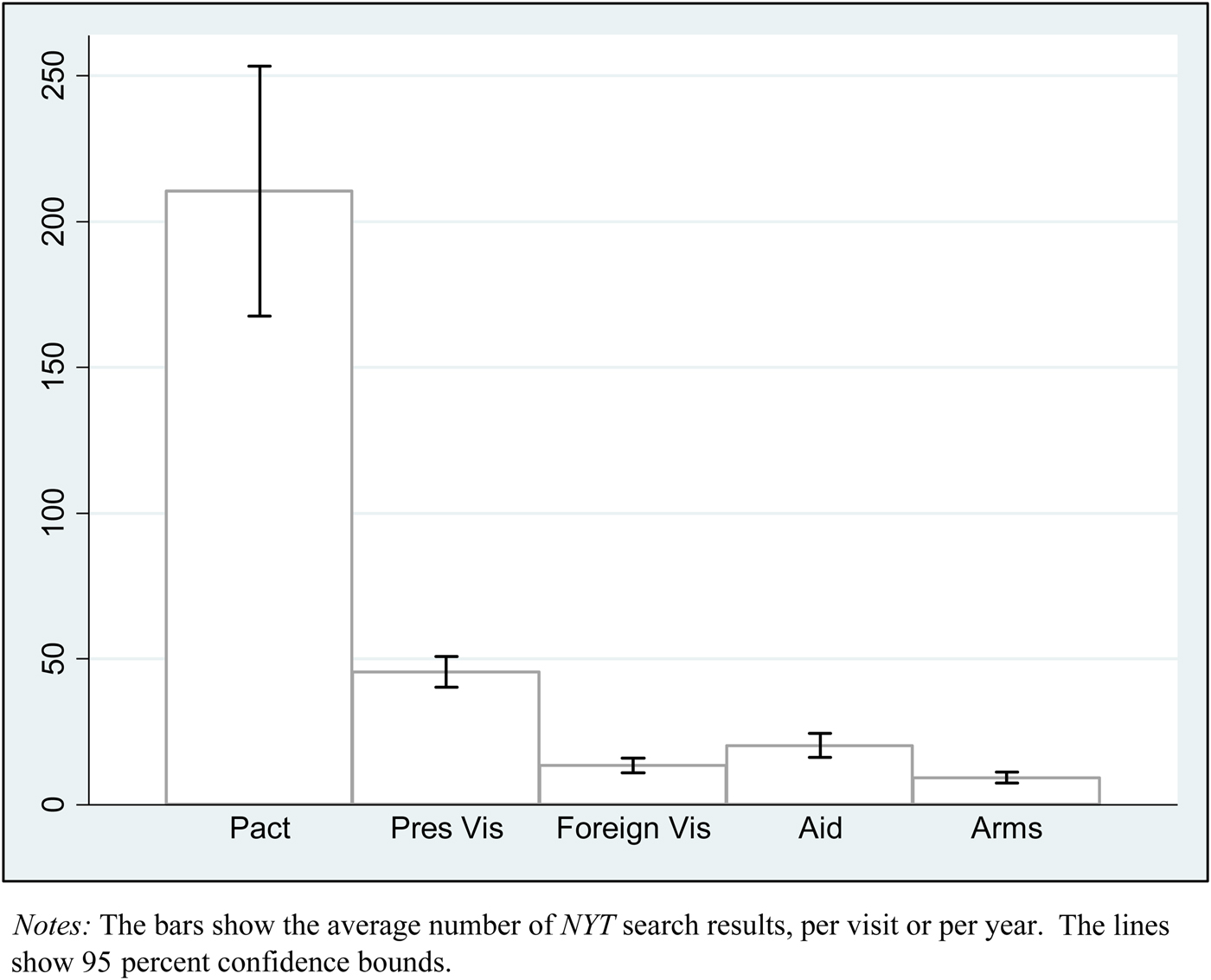
To investigate whether our categorizations are generally accurate, we undertook systematic searches to see how often each type of signal is mentioned in the New York Times. If we can show that even people who read the New York Times—a newspaper with comprehensive international coverage—hear less about offstage than frontstage signals, then we can probably assume that the same pattern holds for the broader public which consumes less news. We searched the New York Times for articles mentioning each type of signal between 1950 and 2008. We searched for defense pacts, military aid, and arms sales by year because data on these signals are recorded yearly.Footnote 54 For defense pacts, we identified all US pacts and drew a random sample of 250 pact-years for searching. For military aid, we identified the top 10 percent of military aid recipients in each year and drew a random sample of 250 military aid-years from this set for searching. For arms sales, we used the same procedure as for military aid. Focusing on the top 10 percent for military aid and arms sales creates a hard test for our expectation that these signals receive less coverage. Since leader visits are discrete events, instead of searching for them by year, we drew random samples of 250 presidential visits abroad and 250 foreign leader visits to the US from lists provided by the Department of StateFootnote 55 and searched for articles mentioning them over a three-month period surrounding each visit. A more detailed explanation of our search procedures is available in the online appendix.
As Figure 2 shows, the search results generally support our expectations. Defense pacts and US presidential travel abroad both receive significantly more press coverage than either military aid or arms sales. T-tests show that the differences in the number of articles covering pacts versus aid, pacts versus arms, presidential visits versus aid, and presidential visits versus arms are all significant at the 99.9 percent confidence level (Table A1). The only aspect of the findings that does not support our expectations is that foreign leader visits generally receive little New York Times coverage. Despite this, we still consider foreign leader visits to be frontstage signals because they are likely to receive much more coverage abroad. For example, a search for articles mentioning German Chancellor Schroeder's 2005 visit to the United States yielded only nine New York Times results, but thirty-five results in Der Spiegel.
New York Times search results

Research Design
We test our hypotheses about how regime type affects the decision to send frontstage versus offstage signals in a data set that records signals of support given by the US to other countries by country-year. The data set includes all countries with a population over 500,000 between 1950 and 2008,Footnote 56 except for the US itself and the competing major powers Russia and China. We assume that all other countries have some potential to receive US support signals, since US military power and interests span the world.Footnote 57 We seek to predict which types of signals, if any, the United States will send to broadcast its support for protégés.
We have two binary dependent variables that are used in a bivariate probit model. The first dependent variable, frontstage, records whether the United States sent a frontstage signal of support for each country in each year. Again, we consider frontstage signals of support to be defense pacts,Footnote 58 presidential visits abroad, and foreign leader visits to the United States.Footnote 59 Thus, if a country had a new or existing defense pact with the United States or was visited by the US president or sent its own leader to visit the United States in a given year, the variable frontstage is coded as 1. Of course, there are important differences between defense pacts and visits, and we explore the implications of these differences elsewhere (Tables A6 and A7). However, since we are primarily concerned with signal visibility, we group these two signals with high visibility together for our main analysis.
Our second dependent variable, offstage alone, records whether the United States sent an offstage signal of support without also sending a frontstage signal. As noted, offstage signals of support include military aid and arms sales.Footnote 60 Again, despite the differences between these signals, we group them together for our main analysis because of their similarly low publicity. These signals are measured on a continuous scale, but we must create a binary dependent variable for our bivariate probit model. Although most countries receive at least some arms or aid from the US in most years, we want to focus on offstage signals that are costly enough to truly denote that a country is important to the US. Therefore, we code a country as having received an offstage signal of support only if it was among the top 10 percent of US arms or military aid recipients in a given year. We put the cutoff at the top 10 percent (in terms of total arms and aid given by the US) because this is the approximate point at which the level of aid and arms given increases dramatically, as Figures A1 and A2 show. The results are robust to varying the cutoff down to the top 50 percent or up to the top 5 percent (Table A12).
It is important to note the asymmetry between our two dependent variables. Our first dependent variable records cases in which frontstage signals are sent either alone or in conjunction with offstage signals, whereas our second dependent variable records only cases in which offstage signals are sent alone. This is because of our theory's focus on signal visibility. Frontstage signals garner a lot of publicity regardless of whether they are sent with or without offstage signals. Offstage signals can avoid publicity only if they are sent alone. Therefore, it is most appropriate for testing our theory to compare the decision to send frontstage signals at all with the decision to send offstage signals alone. (However, we observe substantively similar results if we treat frontstage signals alone and frontstage together with offstage signals as separate categories. Explaining the decision to send frontstage signals alone or together with offstage is beyond the scope of our theory, but in the online appendix we present evidence that this decision is driven by strategic factors.)
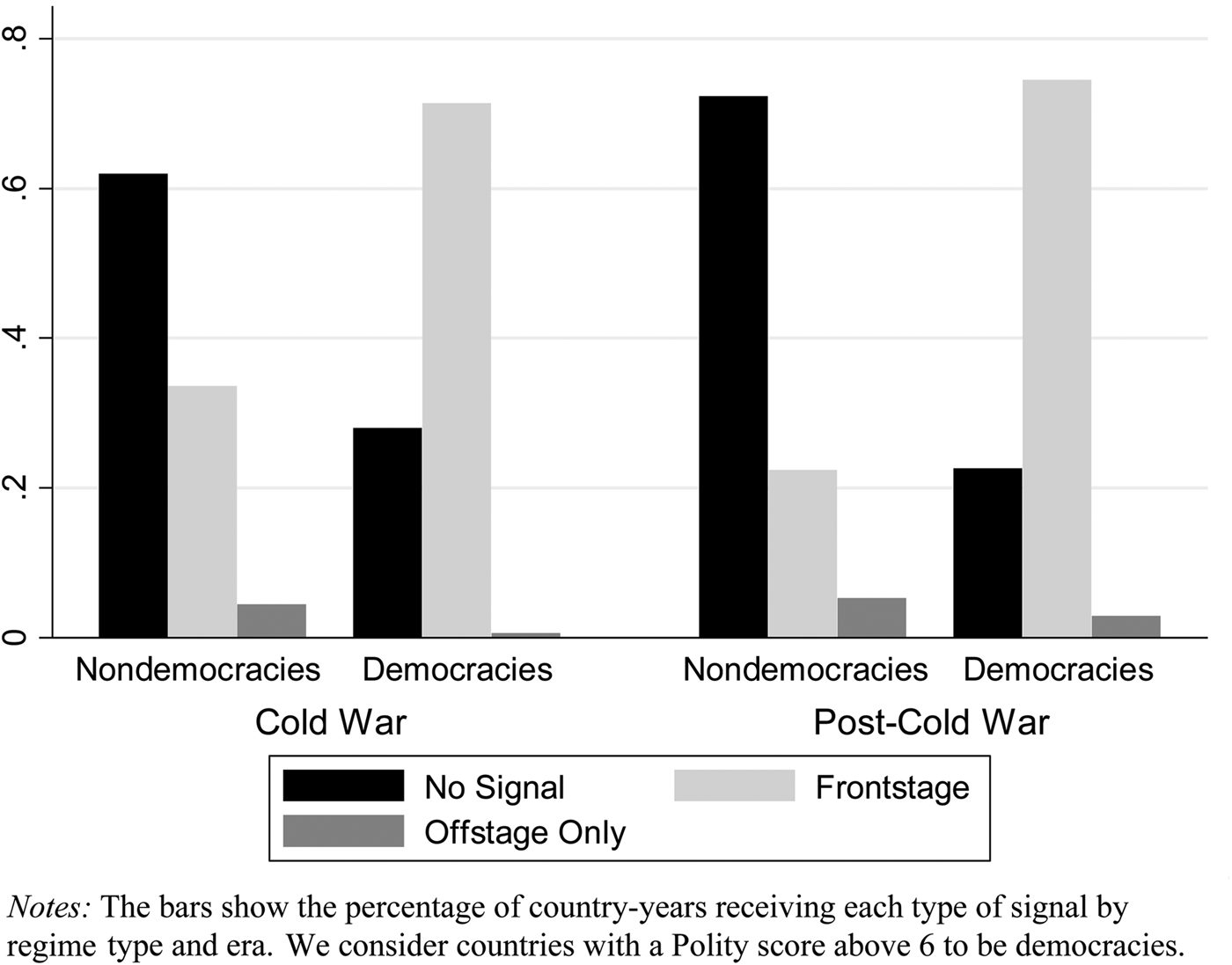
Figure 3 shows the percentages of country-years in our data set that are coded as having received a frontstage signal, an offstage signal alone, or no signal of support at all. The distribution is broken down by regime type and between the Cold War and post-Cold War eras. In both eras, democracies are more likely to receive frontstage signals than nondemocracies. In contrast, nondemocracies are more likely than democracies to receive either no signal or offstage signals only. Therefore, even before estimating a statistical model, we observe patterns in keeping with our expectations.
Dependent variable distribution

Figure 3 also indicates that sending frontstage signals is considerably more common than sending offstage signals alone, in keeping with our argument that frontstage signaling has many advantages. Indeed, there are many countries that received a frontstage signal of support in almost every year in our data set, including NATO and Rio Pact allies. Although offstage signals alone are less common, many of the countries that do commonly receive offstage signals only are of high strategic value to the United States, meaning that this type of signaling is important. The most frequent recipients of offstage signals alone are Thailand, Taiwan, Saudi Arabia, Morocco, Spain (before joining NATO), Tunisia, South Vietnam, Iran (under the Shah), Indonesia, Bahrain, Singapore, Yugoslavia, Kuwait, Oman, Egypt, and the United Arab Emirates.
Our main independent variable is democracy. We employ the polity score to measure democracy to ensure that our results are comparable to previous work.Footnote 61 We use the continuous Polity score rather than a dummy because we expect that the reasons to avoid frontstage signaling for autocracies will operate more strongly when a country is more autocratic. However, the results hold using a dummy measure (Table A8).
We also include control variables to account for countries’ international strategic importance and warmth of relations with the United States. First, we include us rival mids, the average number of militarized interstate disputes (MIDs)Footnote 62 per year with a US rival in which a country was involved over the last five years.Footnote 63 Second, we include us side mids, the average number of MIDs per year in which a country was involved on the same side as the US over the last five years. Third, we include other mids, the average number of MIDs per year outside the previous two categories in which a country was involved over the last five years. This variable controls for the risk of entrapment that might exist if the US signals support for a country that fights a lot of conflicts tangential to US interests.
Fourth, we include each country's un voting similarity with the United States, measured using an S score.Footnote 64 Fifth, we control for Russian ally, an indicator for countries with a Russian or Soviet defense pact.Footnote 65 Sixth, we control for a country's real gdp,Footnote 66 since wealthier countries might be more important to the US. Seventh, we include measures of us exports to each country and us imports from each countryFootnote 67 because US signaling decisions might be influenced by economic interests.Footnote 68 Eighth, we control for distance from the United States.Footnote 69 Finally, we include a cold war indicator and the year of the observation to account for possible changes in US signaling preferences over time.Footnote 70 All of the independent variables except distance, cold war, and year are lagged by one year.Footnote 71
We use a bivariate probit model to estimate seemingly unrelated regressions predicting each of our binary dependent variables. This model takes into account the expected correlation between the error terms of the two regression equations, which results from the fact that the signaling decisions are closely related. One alternate approach would be to use a multinomial logit or probit model and these models produce substantively similar results (Tables A4 and A5). Another alternate approach would be to estimate a separate equation for each of the four individual signals that we consider. As shown in online appendix Tables A6 and A7, this approach also supports the same overarching conclusions.
Results
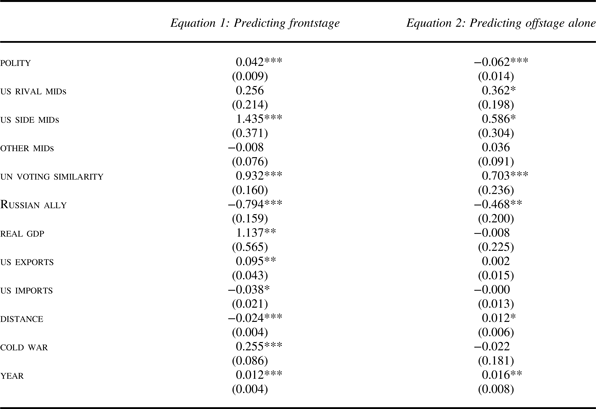
The main results appear in Table 1. As predicted, the effect of the recipient's regime type varies dramatically between predicting frontstage signals and predicting offstage signals alone. For predicting frontstage signals, Polity has a positive and significant coefficient. Thus, consistent with H1a, more democratic countries are more likely to receive frontstage signals, compared to more autocratic countries. Furthermore, consistent with H1b, the Polity coefficient is negative and significant for predicting the probability of offstage signaling alone. This means the US is more likely to send only offstage signals of support to more autocratic countries compared to more democratic countries.
Main model

Notes: This is a bivariate probit model with N = 7,187. All variables except distance, cold war, and year are lagged by one year. The standard errors are clustered by recipient country. *p < .10; **p < .05; ***p < .01.
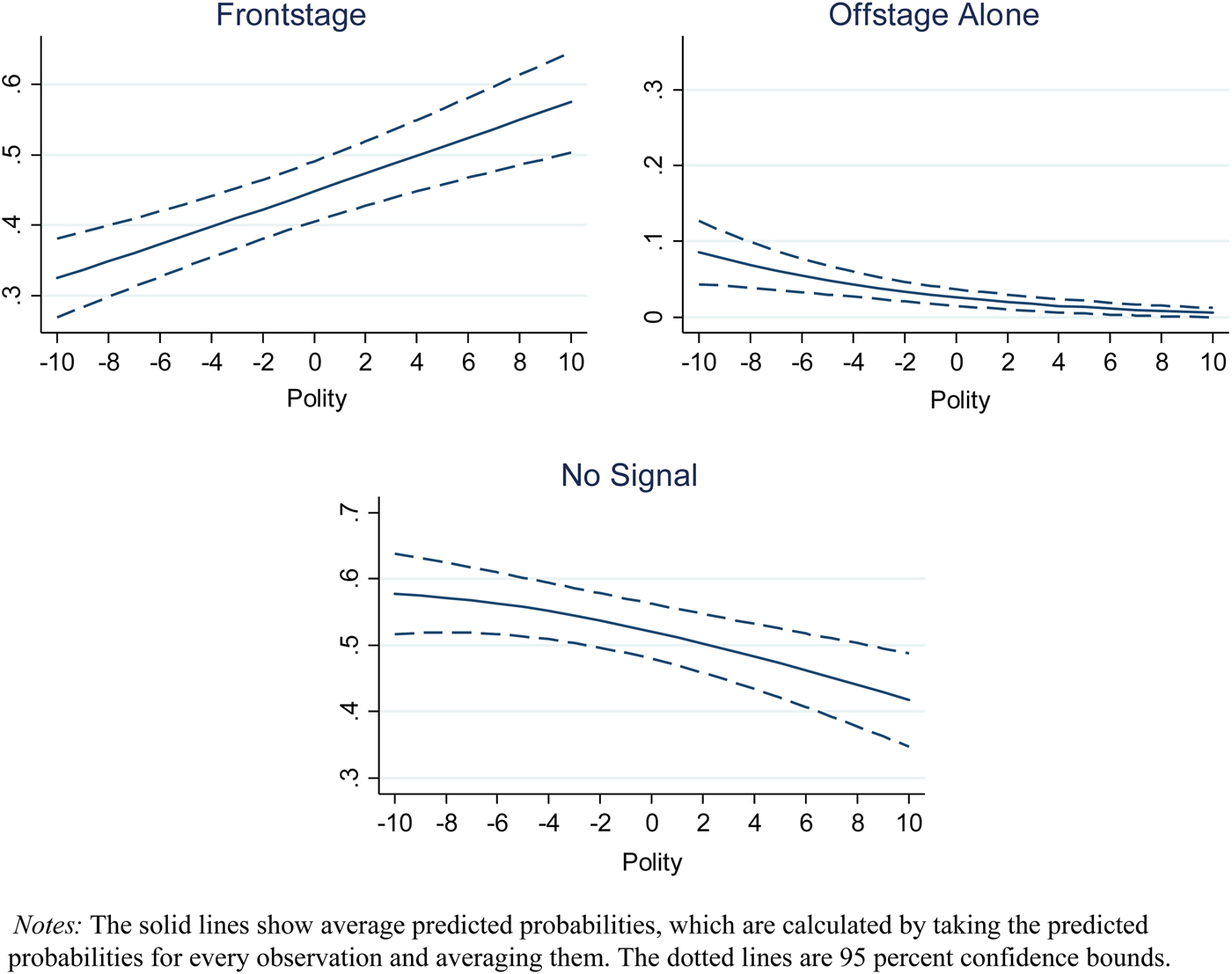
Figure 4 shows the average predicted probabilities of the different signals, based on the model, and how they change with the signal recipient's Polity score. We see that the probability of receiving a frontstage signal of support increases greatly with the recipient's Polity score. In keeping with H1a, it goes from 32 percent to 57 percent as the recipient country moves from the lowest Polity score to the highest. The probability of receiving offstage signals only is generally lower than that of frontstage signals, but—in keeping with H1b—we find that it is significantly higher for more autocratic than for more democratic countries. The most autocratic countries, such as Saudi Arabia or Oman, have a 9 percent probability of receiving offstage signals only, while the most democratic countries, such as Sweden or Costa Rica, have less than a 1 percent probability of receiving solely offstage signals. There is also a substantial portion of countries that receive no signal of support at all, and autocracies are more likely than democracies to fall into this category.
Impact of polity on predicted probabilities

Finally, looking more closely at the control variables, Table 1 suggests that international strategic variables—such as us side mids, Russian ally, and un voting similarity—are important for predicting the decision to send some signal of support versus none, but are not as useful for predicting the decision to send offstage only versus frontstage signals because their coefficients have similar signs and significances for predicting both types of signals. This indicates that the frontstage-offstage signaling decision is driven by the domestic constraints posited by our theory more so than by the international strategic concerns captured by these variables.Footnote 72 Other than polity, the only variable that is significant in different directions in the two equations is distance. The results indicate that closer countries are more likely to receive frontstage signals, whereas farther-away countries are more likely to receive offstage signals alone. This finding could reflect a variety of different strategic considerations, such as not wanting to give destabilizing arms transfers to closer countries, but is weaker than the finding for polity. The final notable result from Table 1 is that the insignificance of the other mids variable suggests that concerns about entrapment do not greatly affect US signaling decisions.
Robustness and Alternative Arguments
We perform robustness tests to address potential concerns about the results. We begin by confirming that our results are consistent when using alternate regime type measures, including the Unified Democracy Score,Footnote 73 the Empowerment Rights Index,Footnote 74 and indicators for personalist and nonpersonalist autocraciesFootnote 75 (Table A8). We also consider whether Muslim autocracies might be unique because of greater anti-US sentiment. To test this, we create separate indicator variables for autocracies with and without substantial Muslim populations.Footnote 76 We find that both types of autocracies are significantly more likely to receive offstage signals only and significantly less likely to receive frontstage signals compared to democracies, although the effect is slightly more significant for autocracies with a substantial Muslim population (Table A8).
Next, we probe alternative explanations for how the United States makes signaling decisions. Some alternate explanations—such as that the US hesitates to make binding commitments to more conflict-prone countries or that the US hesitates to give potentially destabilizing arms transfers to more proximate countries—have already been addressed with control variables in the main model. However, there are still other alternative explanations that are important to consider.
First, some may argue that the United States prefers to give legally binding signals of support to democracies only, perhaps because they are more reliable allies.Footnote 77 Relatedly, some may speculate that it is congressional rather than public opposition that primarily constrains the president's signaling ability, and that the US therefore favors sending signals that do not require explicit congressional approval to nondemocracies. Both of these alternate explanations can be tested by reclassifying presidential trips abroad and foreign leader visits (which make no legal commitment and have no requirement for legislative approval) as offstage signals, leaving defense pacts as the sole frontstage signal of support. If the alternate explanations were correct, this change would be expected to strengthen the results, but in fact it weakens them (Table A9). This suggests that what is key is the visibility of frontstage signals compared to offstage, not which signals are more legally binding or require congressional approval.
Second, we test whether US signaling decisions are driven by the fact that some dictators face more threats and thus seek more arms. While the main model already controls for external threats, it is possible that dictators are more likely to face internal threats and more willing to use force against domestic opponents. Thus, military aid and arms sales may directly aid the regime security of dictators. To rule this out as an alternative explanation, we control for which dictators face the greatest domestic insecurity by including an indicator for civil warFootnote 78 and an indicator for a history of irregular regime transitionsFootnote 79 in our regression. Neither of these variables significantly affects the probability of offstage signals, and the result for democracy holds, suggesting no support for this alternate explanation (Table A9).Footnote 80
Furthermore, we consider the possibility that certain signals by the US may endogenously affect a country's regime type—that is, the US influence indicated by the signals may encourage countries to democratize.Footnote 81 Regressing polity on lagged indicator variables for all of the individual support signals as well as the lagged value of polity itself, we find that leader visits, military aid, and arms sales do not affect regime type, but having a defense pact is a significant predictor of a higher polity score. To rule out the possibility that our results are driven by the endogenous relationship between defense pacts and democracy, we re-estimate our model, dropping all countries that have US defense pacts. polity remains a negative and significant predictor of the decision to send offstage signals only and a positive and significant predictor of the decision to send frontstage signals (Table A9).
Another concern is that defense pacts are difficult to revoke, and other signals of support may be prolonged or repeated because of bureaucratic inertia. We therefore estimate a model that includes a cubic polynomial of the time since the last change in the type of signal sent. We also estimate a separate model that includes lagged versions of both dependent variables on the right-hand side of each equation. Again, our results remain robust (Table A10). Finally, we add fixed effects. We do not use country fixed effects because these would restrict us to examining the impact of regime change only within countries, but we are crucially interested in how differences across countries affect US signaling decisions. However, we estimate a model with fixed effects for region and another model with fixed effects for the identity of the US president. Our results remain robust in both (Table A10).
Further Evidence of Mechanisms
In addition to ruling out alternative causal mechanisms, we seek to provide additional evidence of the mechanisms posited by our theory. We begin by examining the impact of time on US signaling strategies. We believe that the causal mechanisms in our theory have operated throughout the post-World War II era, but we expect that the importance of the mechanisms related to US domestic backlash has increased over time as a result of exogenous events that increased presidential vulnerability to criticism about foreign policy and human rights. These events include the Vietnam War, which ended the “Cold War consensus” that fighting communism was more important than human rights;Footnote 82 the Watergate scandal, which increased distrust of the president and criticism of the president in the media;Footnote 83 Jimmy Carter's rhetorical emphasis on human rights,Footnote 84 which set the tone for future presidents; and the rise of cable news and the Internet. These events produced an environment in which the president became more vulnerable to criticism for making frontstage signals of support for nondemocratic protégés.Footnote 85
Since most of these events occurred in the 1970s or early 1980s, we should expect our causal mechanisms to operate even more strongly after that time. To test whether this is the case, we create a series of dummy variables to divide our sample into different time periods. For every year, we create a dummy variable equal to 1 for all observations after that year, and we interact each dummy individually with the polity score. We find that the dummies for 1975 and 1983 have the most significant interactions, each significant at the 94.6 percent confidence level (Table A11). This suggests that the president's concern about the regime type of frontstage-signal recipients increased significantly in the mid-1970s through the early 1980s, as we would predict based on our causal mechanisms. The marginal effect of Polity as a predictor of frontstage signals is more than 60 percent larger in the post-1983 era than before, a statistically significant difference.Footnote 86
As another way to test our causal mechanisms, we analyze the impact of the US political opposition's strength on US signaling. Given the ability of opposition opinion leaders to rally the public, our theory implies that presidents should be more reluctant to send frontstage signals of support for autocratic regimes when they face a stronger opposition party.Footnote 87 To test this, we interact polity with the percentage of congressional seats held by the party in opposition to the president.Footnote 88 The interaction between polity and opposition seats in Congress is positive and highly significant for predicting frontstage signals (Table A11). The marginal effect of polity on the probability of a frontstage signal increases by 85 percent—a statistically significant change —as the percentage of opposition seats moves from its minimum to its maximum. This indicates that when there is more opposition in Congress, presidents take more consideration of a country's regime when deciding whether to issue a frontstage signal of support.Footnote 89 It might be suspected that this finding is partially attributable to the ability of opposition in Congress to veto defense pacts, but the interaction remains significant after dropping countries with defense pacts, leaving visits as the sole frontstage signal (Table A11). This suggests that presidential signaling decisions are influenced by the concerns about public backlash that underlie our causal mechanisms.Footnote 90
Dilemmas of Reassurance: US–Iran Relations under the Shah
To provide even more direct insight into the causes of US signaling decisions, we use primary source documents and secondary literature to process-trace the considerations that influenced US decisions regarding how to signal support for the Shah's Iran, a strategically important protégé. We find that in deciding whether to offer Iran frontstage or offstage signals of support, US policymakers took into account concerns posited by our theory, including the Shah's need to maintain domestic legitimacy, their own potential hypocrisy costs, and the blow to US deterrent credibility that could result from domestic backlash against a frontstage signal. We do not claim that these were the only considerations at play, but the documents suggest they were central in the deliberations.Footnote 91
From the start of the Cold War, the US considered Iran to be an important country because of its “resources, strategic location, and vulnerability to [Soviet] armed attack” and feared that if “Iran should come under Soviet domination, the independence of all other countries of the Middle East would be threatened.”Footnote 92 In 1953, US Secretary of State John Foster Dulles developed the idea of encouraging Iran and other Middle Eastern countries to form an anti-Soviet alliance.Footnote 93 Iran joined the “Baghdad Pact” along with Iraq, Turkey, Pakistan, and Great Britain in 1955. Because the United States had been a proponent of the pact, Iran and other members expected the US to join as well. Policymakers in the US Department of Defense advocated for the US to join the pact, arguing that failure to join would undermine the credibility of US deterrence.Footnote 94 However, the US did not join because of objections from the State Department, which argued that the US should signal its support for the Baghdad Pact members through security assistance and informal involvement rather than formal membership.Footnote 95
Two of the reasons given for not joining the pact illustrate the causal mechanisms in our theory. The first was that domestic publics in the pact members might object to a visible display of Western support and involvement, which would undermine their authoritarian or semi-authoritarian regimes. A 1956 State Department document notes that “some elements” in Iran, Iraq, and Pakistan viewed the Baghdad Pact as a “vehicle for the extension of UK influence and control in the Middle East.”Footnote 96 The State Department expected that US membership might add to the problematic impression that the pact was being imposed by the West.Footnote 97 Secretary of State Dulles acknowledged most local people in the Middle East would not support a defense pact with the US.Footnote 98 Thus, perceived domestic constraints on Iran's Shah and other autocratic protégés caused the United States to avoid sending a frontstage signal of support by joining the Baghdad Pact.
A second reason that the US did not join the Baghdad Pact is related to the credibility concerns that can arise from frontstage signals to nondemocracies. The State Department feared that an attempt by the US to join the pact could lead to public controversy and Senate rejection of the treaty, which would undermine the pact. In a policy meeting, Secretary of State Dulles stated that asking Congress to consider the Baghdad Pact would create a “major explosion.” Dulles went on to opine, “therefore, to propose joining the Pact and then to have it rejected by the Senate would be a death-blow to the Pact and would have much more serious and detrimental effect [sic] on the Pact at the present time than our not joining.”Footnote 99 Dulles later asked Baghdad Pact ambassadors rhetorically if they would still want the US to join if he could not guarantee Senate passage of the treaty, apparently silencing their requests for the US to join.Footnote 100
At this point, US government fears about domestic and congressional objections to the Baghdad Pact were based much more on concerns raised by the pro-Israeli lobby than on concerns about the pact members’ regime types.Footnote 101 The anti-communist consensus was strong in the 1950s, and any noncommunist country was viewed as part of the “free” world. From the 1960s onward, however, this consensus began to weaken and more criticism of Iran arose within the US.
Despite the fact that the Shah expressed a sense of insecurity and doubts about the US commitment to Iran,Footnote 102 the US sent few frontstage signals of support for Iran in the 1960s and 1970s. In 1970, the US government briefly considered promoting a new regional alliance in the Middle East, but quickly rejected the idea as “impractical.”Footnote 103 Presidential visits were also minimized. The US president visited Iran only twice between 1960 and 1979, no more than he visited strategically unimportant countries such as Uruguay and Costa Rica.Footnote 104 Instead, most US signals of support for Iran were provided offstage. Between 1963 and 1969, Iran was consistently among the top ten recipients of US military aid,Footnote 105 and in every year between 1968 and 1978, Iran was among the top five US arms recipients.Footnote 106
Domestic constraints in both the US and Iran posed barriers to frontstage signals of support during the 1960s and ’70s. Public criticism of Iran within the US began to increase under Kennedy when Iranian students studying in the US raised awareness of human rights violations in Iran.Footnote 107 Criticism intensified in the 1970s. In 1975, Amnesty International said Iran had the worst human rights record in the world.Footnote 108 In 1976, a congressional subcommittee held hearings on Iranian human rights.Footnote 109 When President Carter hosted a visit of the Shah to the White House in 1977, protests were held nearby and turned violent. Demonstrating the existence of hypocrisy costs, a New York Times editorial noted how “awkward” it was for a “president committed to advancing the cause of human rights worldwide” to give “a full honors welcome to a ruler as close to an absolute monarch as exists these days.”Footnote 110 Given the backlash, this relatively rare frontstage signal may actually have been counterproductive in convincing observers of US support for Iran.
At the same time, the Shah faced domestic constraints on cooperating with the US. In 1964, there were protests in Iran over immunity privileges given to US military personnel under a new status-of-forces agreement, which Islamic fundamentalist leader Ayatollah Khomeini called a “document of enslavement.”Footnote 111 As of 1965, the US Ambassador to Iran argued that it would help the Shah's domestic political standing to let the Shah show more public independence from the US on the public stage.Footnote 112 The Shah increasingly played to the anti-American climate domestically, declaring that “Iran cannot surrender its destiny to whims of foreigners even if they are very close friends”Footnote 113 and permitting criticism of US foreign policy in the Iranian press.Footnote 114
In sum, the domestic climates in both Iran and the United States made it difficult for the US to signal support for Iran on the frontstage in the 1960s and ’70s, despite the fact that Iran continued to be viewed as strategically important. Thus, the US opted to signal support for Iran primarily offstage. We therefore find evidence for the causal mechanisms highlighted in our theory: US policymakers sent primarily offstage instead of frontstage signals of support for Iran because of a desire to preserve the Shah's regime security, credibility concerns, and eventually concerns about hypocrisy costs.
Conclusion
Why does the US show support for some regimes that are strategically important to US foreign policy using offstage signals alone, while it chooses to support others with frontstage signals? This puzzle intensifies when we consider that highly visible signals of support should, all else equal, be more effective in deterring potential challengers and reassuring client states. The answer, we argue, is that leaders think strategically about domestic political factors in choosing not only whether, but also how, to signal their foreign policy interests. We have developed and tested a theory that highlights how domestic political factors shape the preferences of both US leaders and their autocratic protégés so that both may prefer for US support to be signaled in an offstage manner. We find strong statistical support for our theoretical expectations and also find evidence in support of our causal mechanisms in the case of US signaling toward the Shah of Iran.
Our findings demonstrate the importance of considering a fuller menu of options available when explaining foreign policy choices. We also highlight the importance of considering factors that influence both the supply (on the part of the major power) and demand (on the part of the protégé) for signals of support. These innovations enable us to more closely approximate how leaders actually think about the tradeoff between different foreign policy tools to explain otherwise puzzling behavior. One practical implication is that it is potentially misleading to rely on information about only highly visible signals such as defense pacts when making inferences about the importance of autocratic protégés to the US.
Our paper suggests several directions for future research. First, it lays important groundwork for testing which types of support signals are most effective in deterring potential challengers or reassuring protégés, since analyzing this without accounting for how signaling decisions are made could lead to bias. Second, it would be possible to expand the frontstage/offstage framework to other foreign policy realms, such as economic relations or counterterrorism, and probe whether regime type continues to have an important effect. Our work might provide insight into another type of signaling—secret signals of support—which are more difficult to observe than offstage signals.Footnote 115 Domestic considerations are likely to have a similar effect on US covert signaling.
Third, scholars could test whether the signaling dynamics we report are also relevant to other democratic major powers, such as Britain and France, which face similar domestic constraints. We should keep in mind that, as second-tier powers that conduct their foreign policies in the shadow of the US, these countries may feel less compelled to support nondemocracies for strategic reasons, which could decrease their reliance on offstage signaling. Our theory, we suspect, is less applicable to explaining the signaling decisions of Russia or China because as nondemocracies, they have little to fear from hypocrisy costs. Therefore, additional research is necessary to determine the extent to which autocratic patrons deviate from frontstage signaling and why.
Our theory and findings also have important policy implications. Some of the most strategically important protégés of the United States are nondemocracies. An argument could be made that those regimes—such as Jordan or Saudi Arabia—would be more capable of deterring challengers or would feel more reassured if the US supported them more visibly. However, our theory and findings caution against such an approach. Taking these relationships onto the frontstage could carry domestic political costs for leaders in the US and/or the client states. This could adversely affect the credibility of these frontstage signals and the political stability of the protégé regimes. Thus, transparency in the realm of international security is not always an asset for signaling.
Supplementary Material
Supplementary material for this article is available at <https://doi.org/10.1017/S0020818317000297>.