Background
Whilst the majority of women in England experience a smoke-free pregnancy, current statistics estimate that the number of women still smoking at the time of delivery in England is around 13.5% (The Health and Social Care Information Centre [HSCIC], 2011a). In 2010 just over a quarter (26%) of mothers in England smoked at some point during the 12 months immediately before or during their pregnancy; however 54% successfully quit at some stage before the birth (HSCIC, 2011b). Smoking during pregnancy is a significant public health issue as women who continue to smoke during this time are not only at risk of smoking-related diseases and maternity complications themselves, but also subject the foetus to risks of perinatal mortality and morbidity such as miscarriage, sudden infant death syndrome, low birth weight, foetal abnormalities, lung disorders and premature birth (Haslam, Draper, & Goyder, Reference Haslam, Draper and Goyder1997; Bull, Burke, Walsh, & Whitehead, Reference Bull, Burke, Walsh and Whitehead2003; cited in Ingall & Cropley Reference Ingall and Cropley2010). The annual cost to the National Health Service (NHS) for treating the resulting problems for mothers is estimated to be between £8.1 and £64 million with an additional £12 to £23.5 million spent treating infants (Godfrey, Pickett, Parrot, Mdege, & Eapen, Reference Godfrey, Pickett, Parrot, Mdege and Eapen2010; cited in National Institute for Health and Clinical Excellence [NICE], 2010). Health risks persist further into childhood due to parental smoking, as passive smoking is associated with a higher risk of sudden infant death, pneumonia, bronchitis, asthma and respiratory symptoms, and middle-ear disease (World Health Organisation [WHO], 2009). In 1998 the UK government set a target of reducing smoking in pregnancy from 23% to 15% by 2010 in their White Paper Smoking Kills (Department of Health [DOH], 1998) and a national decline in rates followed, decreasing from 23% in 1995 (Ash, 2008) to the current 13.5% in 2011 (HSCIC, 2011a). A further government target has now been set to reduce prenatal smoking rates in England to 11% or less by the end of 2015 (HM Government, Reference Government2011).
Smoking cessation support is shown to be effective during pregnancy (Lumley, Oliver, Chamberlain, & Oakley, Reference Lumley, Oliver, Chamberlain and Oakley2004) and is available free of charge in the UK. However, many women continue to smoke throughout pregnancy (Bull, Burke, Walsh, & Whitehead, Reference Bull, Burke, Walsh and Whitehead2008) and the uptake of this type of support remains low. Maternal smoking is a complex behaviour; women are often aware of the health risks smoking poses to the foetus, however, this knowledge is not sufficient to motivate them to quit (Ingall & Cropley, Reference Ingall and Cropley2010). They face numerous barriers to quitting including a biological nicotine addiction coupled with social and psychological factors (Ingall & Cropley, Reference Ingall and Cropley2010). Smoking during pregnancy is strongly associated with poverty, low educational attainment, poor social support, psychological illness (Lumley et al., Reference Lumley, Oliver, Chamberlain and Oakley2004) younger age and a lower socio-economic status (Schneider & Schutz, Reference Schneider and Schutz2008). Pregnant smokers are also likely to report greater psychosocial difficulties such as neuroticism, depression and perceived stress coupled with reduced coping resources, self-efficacy and social support (Maxson, Edwards, Ingram, & Miranda, Reference Maxson, Edwards, Ingram and Miranda2012), which together with a biological addiction may further hinder quit attempts. The low uptake of professional support suggests that these barriers to smoking cessation are not being adequately addressed in current service provision.
Prenatal smoking in Solihull, West Midlands
Solihull's regional health profile demonstrates better health and less deprivation than the England average (Department of Health, 2011). However, there are unequivocal health inequalities between the north and south wards of the borough, as Solihull demonstrates one of the widest gaps in the country between the wealthiest and the poorest communities, with higher deprivation evident in the north (The Solihull Partnership, 2008). This regional difference is also true of prenatal smoking and of those women registered with a north Solihull GP, 30–40% were recorded as smoking-at-the-time-of-delivery during 2009/10, compared to <15% in the south (Trout & Baskerville, Reference Trout and Baskerville2011). This increased rate compares poorly to recent smoking-at-the-time-of-delivery estimates of 15.2% across the Solihull Primary Care Trust; 15.8% in the West Midlands; and 13.5% in England (HSCIC, 2011a) indicating that the national target of reducing prenatal smoking to less than 15% has yet to be achieved for the Solihull PCT, particularly in the north wards.
A large percentage of pregnant women do attempt to quit smoking and recent reports based on 2010/2011 statistics across England state that the number of pregnant women setting a quit date during this time period was: 21,839 in England (with a successful quit rate at 4 weeks of 45% and a CO validated success rate of 27%); 2,642 in the West Midlands (with a successful quit rate at 4 weeks of 44% and a CO validated success rate of 30%); and 71 in the Solihull Primary Care Trust (with a successful quit rate at 4 weeks of 38% and a CO validated success rate of 13%) (HSCIC, 2011c). This indicates that Solihull underperformed in CO validated success rates in comparison to the regional average. Smoking cessation services are available throughout Solihull with specific smoking cessation during pregnancy appointments available to all pregnant smokers at a medical centre, community drop-in session or as a home visit. There are proportionally more of these community services running in the north wards because of the higher rates of smoking. Despite this support, cessation rates remain low in the north wards and to meet current and future targets the existing smoking cessation services in this region need to improve the effectiveness of smoking cessation intervention programmes in this target group. As well as understanding the personal motivators which influence smoking behaviour it is also vital to examine the knowledge and opinion of available services from a service-user perspective.
A systematic review of smoking cessation programmes implemented during pregnancy examined the views of maternity service users and found their involvement beneficial to intervention design (Oliver, Oakley, Lumley, & Waters, Reference Oliver, Oakley, Lumley and Waters2001). This review highlighted that there was little evidence of pregnant smokers being involved in the design or evaluation of cessation interventions, that the potential benefits of involving service users in intervention development were not explored and that service users were able to identify missing outcomes that were important to them such as the psychological impact of smoking cessation and the potential adverse effects of smoking cessation programmes. Consulting the target population allows professionals to learn about the experience of services from a consumer perspective and facilitates the creation of well-informed opinions rather than assumptions of what users require. In 2011 Solihull Primary Care Trust used a public involvement approach to undertake a service development report intended to inform changes to the existing smoking-cessation-in-pregnancy service and emergent topics from this included: smoking behaviour; barriers and enablers to quitting successfully; smoking during pregnancy; family and social attitudes towards smoking; and perception of services. This article specifically reported on the last of these findings; the views held by past and current service users as well as non-users regarding existing smoking cessation services for pregnant women in this area of the West Midlands.
Method
Participants
Based on the regional statistics for smoking and pregnancy, the research targeted pregnant women in the two postcode areas demonstrating the highest rates of smoking-at-the-time-of-delivery in the borough. Participants were recruited by health professionals (seven community midwives, one specialist stop-smoking advisor and two staff at the local stop-smoking service) who invited expectant or recent mothers to take part in the study at the time of their contact with services or by telephone contact taken from community midwife visiting lists. Participants were given a study information sheet and were booked into a research focus group by staff or given a contact number if they wished to consider the study further. Criteria for participation included: women who were pregnant or who had given birth in the past 12 months, who had smoked for part or all of their pregnancy and who lived within one of the two selected postcodes.
Recruitment took place between January and May 2011 and 30 women matching the criteria were booked into a focus group, although not all attended. Nineteen participants were successfully recruited from two postcodes across five groups and non-attendees were contacted again to be offered a place at a future group. Focus groups were conducted across the north Solihull wards and participants received a shopping voucher in return for participation. At the time of interview there were 14 participants currently smoking and five recent ex-smokers. Sixteen women were pregnant and three had given birth within the last ten months. All had smoked during pregnancy.
Design
Qualitative research provides an insight into an individual's view of the world and provides a means for capturing context specific situations, by focusing on human beings within their social and cultural context (Spencer, Reference Spencer2008). Focus groups were deemed the most appropriate design as conversation is more naturalistic than in one-to-one interviews, groups allow facilitation of discussion around key issues (Smith, Reference Smith2009) and this group interaction and debate may produce insights which would not be derived from individual interviews (Shortt, McGorrian, & Kelleher, Reference Shortt, McGorrian and Kelleher2013).
Measures
Demographic data was collected via a questionnaire. The focus groups were guided by a semi-structured interview schedule and questions related to: past quit attempts, smoking during pregnancy, existing smoking cessation services and initiatives operating in other areas. This study specifically reports on data relating to existing service provision and initiatives to encourage service engagement.
Procedures
Each focus group met once for approximately one hour (duration ranged from 43 to 72 minutes). The group was run by the researcher and supported by either a specialist midwife (groups one to four) or a stop-smoking-in-pregnancy advisor (group five) who was able to offer clinical advice on any obstetric or smoking-cessation topics if required. Groups one to four were arranged between two specialist midwives ensuring that all participants were unknown to the attending staff member. In group five two participants were known to the attending stop-smoking-in-pregnancy advisor and this staff member left the room for part of the session to allow full disclosure between participants.
Groups were held at local Children's Centres or a central NHS You + Healthy Lifestyles Shop. The purpose of the study and confidentiality were reiterated, specifically participants were reminded that the purpose of the group was to explore current smoking behaviours and services and was not a group to encourage or support quitting although help could be sought for this after the session if chosen. Participants completed a questionnaire and consent form at the beginning of the session and had the opportunity to ask questions. Warm-up questions relating to children, due dates and baby names were used to engage participants before asking questions on smoking behaviour. All groups were recorded using a dictaphone and transcribed verbatim with names remaining anonymous.
Analysis
Thematic analysis was utilised as a method to identify, analyse and report patterns (themes) within the data. Thematic analysis is a method which is flexible, essentially independent of theory and epistemology, and is compatible with both essentialist and constructionist paradigms within psychology (Braun & Clarke, Reference Braun and Clarke2006). Thematic analysis involves searching across a data set to find repeated patterns of meaning (themes) and these themes are identified in one of two ways: either in an inductive manner or in a theoretical/deductive manner. An inductive, data-driven approach – a process of coding the data without trying to fit it into a pre-existing coding frame, or the researcher's analytic preconceptions – was used here. Furthermore, themes can be identified at different levels (semantic or explicit level, vs. a latent or interpretative level, Boyatzis, Reference Boyatzis1998). This study used a semantic approach; the themes were identified within the explicit meanings of the data and the researcher was not looking for anything beyond what the participant had said. This maps on to the essentialist/ realist framework where the experiences and reality of participants are considered from a realist perspective as opposed to an interpretative framework which would investigate further the surface meaning of reality (Braun & Clarke, Reference Braun and Clarke2006). The researcher took an active role in identifying and describing the reported themes. Themes were then reviewed to ensure they were suitable and a qualitative software program (NVIVO 8) was used as a tool to organise the themes and sub-themes. One researcher conducted data analysis and a second research conducted independent analysis of codes and themes.
Ethical considerations
One ethical consideration was the potential effect of the second staff member on the disclosure of participants. To fulfil duty of care to participants all groups were supported by either a specialist midwife or stop-smoking-in-pregnancy advisor who was able to offer clarification on any clinical topics (such as pregnancy, NRT, child health) that may arise during the group. Groups were arranged so that the attending practitioner was unknown to group participants. However, in group five two participants were known to the attending stop-smoking-in-pregnancy advisor and this staff member left the room for part of the session (after the initial warm-up questions and returning at the end of the session) to allow full disclosure between participants. Another consideration was the purpose of the group and its relationship to continuing care. The participant information sheet included a declaration that taking part in the research would not affect the individual's current care and the script for recruiting practitioners also communicated this. The information sheet, recruiting staff members and researcher all reiterated that it was not a requirement of participation to want to stop smoking or to receive assistance with smoking cessation.
Findings and discussion
This article specifically reports on data relating to existing service provision, evaluation and suggested improvements by participants who had smoked prenatally in Solihull, West Midlands. The following results are based upon 19 completed questionnaires and qualitative data from five focus groups.
Quantitative data
Individual data
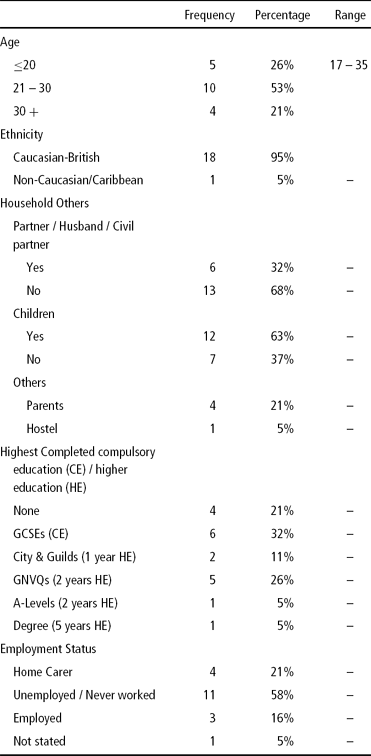
At the time of the focus groups, the age of participants ranged from 17 to 35 years (Mage = 25 years), less than half (32%) lived with their partners and over half (63%) had existing children living with them. Participant educational achievement ranged from incomplete compulsory education to degree-level higher education (21% no completed education; 32% completed compulsory education, 47% 1–5 years higher education) (Table 1). In this sample the ethnic background of participants was Caucasian-British (N = 18, 95%) and Non-Caucasian/Caribbean (N = 1, 5%), which although demonstrates a lack of ethnic diversity it does reflect the regional picture and target population (89% Caucasian-British in Solihull, ONS, 2012). Furthermore the sample was largely unemployed (unemployed / never worked 58%; home carer 21%) which is high compared to the worklessness rate – the number of working age people claiming a key out of work benefit – of 10.4% across Solihull, and 25.5% in the north wards where participants were recruited (Solihull Metropolitan Borough Council, 2012). Again this may not necessarily represent the borough but may reflect the target group as smoking during pregnancy is associated with low educational attainment and poverty (Lumley et al., Reference Lumley, Oliver, Chamberlain and Oakley2004).
Individual demographic data (N = 19)

Smoking behaviour and pregnancy
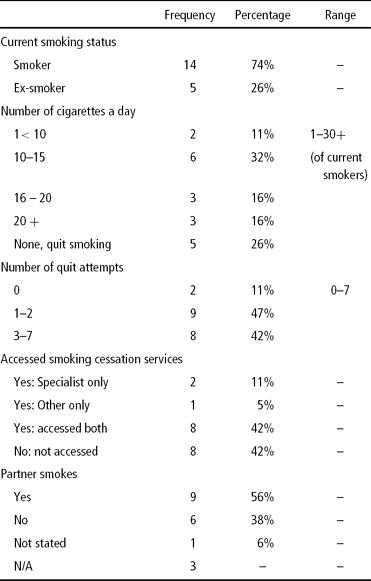
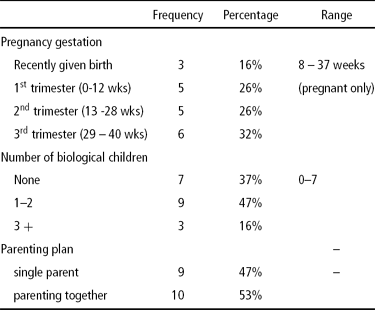
The majority of the sample self-identified as current smokers (74%) smoking 1–30+ cigarettes per day or as ex-smokers (26%) with experience of two weeks to five months cessation. In regards to accessing services, 11 participants had used smoking cessation services (2% had only used the Solihull specialist service; 42% had attended this as well as general smoking cessation services and 5% had only attended others (Table 2). Of the 19 women, three had recently given birth and the remaining 16 women were divided fairly equally into first, second and third trimesters of pregnancy (mean = 21 weeks gestation at the time of interview). Half the sample (53%) described themselves as parenting together and the other half (47%) as parenting alone (Table 3).
Smoking Behaviour
Pregnancy data
Qualitative analysis: Evaluation of current service provision
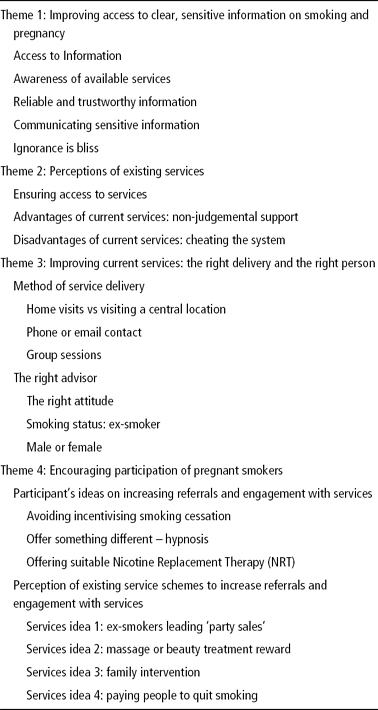
Participants contributed opinions around (1) improving access to clear, sensitive information on smoking and pregnancy; (2) perceptions of existing services; (3) improving current services: the right delivery and the right person; and (4) encouraging participation of pregnant smokers.
Themes from the data
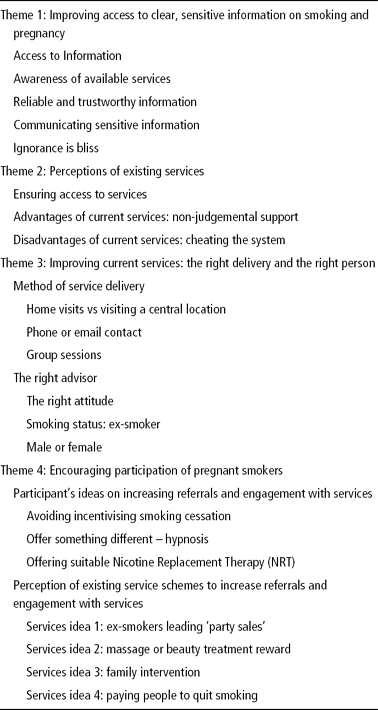
1. Improving access to clear, sensitive information on smoking and pregnancy
Access to Information
Information sources on prenatal smoking were limited. Participants gleaned information from cigarette packaging and from the information package given to expectant mothers. Most did not search for smoking related information on the internet but one respondent made use of online forums and the NHS SmokeFree website. Others reported that their information came from friends and family. This limited information resource highlights the role of information transfer via health professionals with a potential role for complementary health promotion materials. It also highlighted the influence of those in the mother's social remit and the need to consider these individuals when supporting expectant mothers. Information on smoking cessation services could be advertised in places where mothers sought information on pregnancy such as the information package given to expectant mothers.
Awareness of available services
To support pregnant women in quitting smoking successfully NHS Trusts must first raise awareness of available services amongst potential users and healthcare staff. Accessing cessation services was rarely initiated by participants but of those that were signposted by their GP, midwife or community cessation advisor many reported that they had accessed and engaged with services. However, this signposting appeared to lack consistency as not all participants were informed of existing services:
My midwife hasn't really mentioned it, she just asked me if I smoked and I said yeah, and that was that. (D, smoker)
This finding of inconsistent signposting between professionals reflects past research which indicates that not all staff ask all pregnant women about their smoking status during consultations and that smoking cessation advice and management of care can vary between doctors and midwives, for a review see Baxter et al. (Reference Baxter, Blank, Guillaume, Messina, Everson-Hock and Burrows2009). This research suggests that in Solihull health professionals play a central role in both identifying potential clients and facilitating their engagement with suitable services in this area and participants reported being unlikely to help-seek without this prompting.
Reliable and trustworthy information
One barrier to abstinence was uncertainty around information provided by health professionals. Examples included receiving incorrect advice about the use of Nicotine patches in pregnancy, reassurance that tobacco exposure did not endanger a baby's health and unclear advice provided by a midwife regarding smoking and stress relief:
I went in to the midwife and I was all like [gestures panicky]. . .I said like I'm trying to quit smoking . . . and she was like “Is this how stressed it's getting you?” and I said yeah I'm mega stressed and she said “Yeah to be honest, this trying to quit, if this is what it's like you're probably doing yourself more harm than good,” she said, “go out and have a fag if you want.” That's what my midwife said to me! (L, smoker)
The above example reinforces the myth that smoking can aid stress relief which is a common misconception held by participants and one of the main reasons that they continue to smoke. With expectant mothers who are trying to quit smoking but still need reassurance, the above examples served to maintain their smoking behaviour. This finding of variable advice is consistent with past studies which demonstrate that variance in practice exist amongst staff in regard to the type of advice and intervention offered (Baxter et al., Reference Baxter, Blank, Guillaume, Messina, Everson-Hock and Burrows2009). Some proposed explanations of this are a belief held by staff that asking about smoking status may damage their relationship with pregnant women (Abrahamsson, Springett, Karlsson, Hakansson, & Ottosson, Reference Abrahamsson, Springett, Karlsson and Ottosson2005; Katz et al., Reference Katz, Blake, Milligan, Sharps, White, Rodan, Rossi and Murray2008; Lowry, Hardy, Jordan, & Wayman, Reference Lowry, Hardy, Jordan and Wayman2004; McLeod et al., Reference McLeod, Benn, Pullon, Viccars, White, Cookson and Dowell2003) or a lack of policies or procedures, or lack of adherence or knowledge exist (Baxter et al., Reference Baxter, Blank, Guillaume, Messina, Everson-Hock and Burrows2009). There needs to be a sensitive, consistent and considered approach from healthcare professionals towards the risks of smoking in pregnancy to support women. Incorrect or inconsistent advice may be a particular concern for this group of expectant mothers as they have few opportunities to seek advice outside of their interactions with health professionals; they have limited social networks, limited vocational networks and are reluctant to help-seek due to fear of criticism from healthcare staff. In this area where smoking-at-the-time-of-delivery rates are high and life expectancy in the north is almost ten years shorter than the south boroughs this is an important area to succeed in for mothers and their children.
Communicating sensitive information
The content and amount of information provided on the effects of prenatal smoking varied. Some participants denied being informed of the risks and were simply advised to quit smoking because it ‘harmed the baby’ with no elaboration whilst others were informed of some risks but believed they did not ‘take it in’ at the time. Many participants acknowledged they were unaware of the risks associated with smoking and pregnancy but to be aware they needed this information to be delivered in a non-threatening way, ‘without the scare tactics’. One participant shared her views:
if my midwife did that to me, sat down and started talking to me when I didn't want her to talk, I would walk out and I would demand another midwife. . . . When I want to listen, then I will listen, but there's no point someone running off loads of facts to me when I don't want to listen cos I won't listen. . . I'd more like to know who you can go to when you're ready. (L, smoker)
This mirrors Abrahamsson et al.'s (Reference Abrahamsson, Springett, Karlsson, Hakansson and Ottosson2005) findings that it is counter-productive to smoking cessation to give information without the mother's consent, as it may result in a defensive posture and a decrease in her self-efficacy if she does not succeed in stopping smoking. In this study participants also felt that advice aimed at an individual could be interpreted less favourably than advice directed towards pregnant smokers in general and this included face-to-face advice and promotion materials (for example posters could display information indirectly but being given a leaflet would not be accepted). Similarly, group settings could enable information transfer without directing information at mothers personally. Participants advised that a phone number for more information would be useful to contact later if they had felt unable to listen initially:
It's about making you aware, so that I know that day I'm ready to quit I can pick up my phone and go and meet someone that day and arrange to quit. (H, smoker)
Participants considered essential information to include the various types of support available, that support can be accessed at any time and that women will be helped without judgement.
Ignorance is bliss
The majority of participants believed that messages on cigarette packets such as ‘smoking harms your baby’ are ineffective as their constant use desensitises them, they do not see messages as relevant to them and avoid any potential discomfort by turning over the packet. It emerged that there was a sub-group of pregnant smokers who wish to remain ignorant to the risks of smoking to protect against apparent feelings of guilt and inadequacy as a parent and subsequently asked midwives not to communicate risk information, ‘sometimes ignorance is bliss in that kind of way though isn't it?’ (L, ex-smoker) and others avoided literature on risk and encouraged others in the focus groups to do the same:
I got a leaflet, The dangers of smoking when pregnant. I never read them because it makes me feel worse, it's bad enough trying to give up but reading that it makes you feel really bad . . . I'd advise anyone in this room never read them leaflets. . . because I read them leaflets and they really, really, really scared me. (T, smoker)
This illustrates that the use of fear in health promotion campaigns can be ineffective (Soames, Reference Soames1988) and may simply induce a denial response and disengagement if the level of fear created is too high. Cognitive dissonance (Festinger, Reference Festinger1957) was another mechanism used by participants which enabled them to be both aware of prenatal harm and simultaneously minimise the risk to herself or her child as well as optimistic bias (Weinstein, Reference Weinstein1989) as participants denied that smoking risks were relevant to them. These coping mechanisms create a challenging environment for health professionals who must inform expectant mothers about the consequences of smoking when the mother, for that reason, would like to remain unaware of the risks and so continue to put their pregnancies in danger. These mechanisms should be considered when creating smoking cessation materials for this group and it may be more prudent to create resources which focus on encouraging alternative behaviours and coping mechanisms rather than aiming to reduce the harmful behaviour using fear.
2. Perceptions of existing services
Existing service provision was discussed and 11 of the 19 women (53%) reported that they had used a smoking cessation service in the past (both specialist smoking cessation in pregnancy services and general cessation services). The majority of participants had used services based in their local area with one participant having used a general service in neighbouring Birmingham before relocating to Solihull. This raised four points around access to services, types of services, the benefits and the disadvantages of existing services.
Ensuring access to services
One barrier to accessing help and support discussed across groups was the difficulty of arranging appointments with smoking cessation advisors and two participants mentioned that they had tried to contact services without success:
Well I've tried to make appointments with her but she couldn't come and then she didn't get in touch with me again . . . I could have got in touch with her like, but she didn't get in touch with me. (N, smoker)
This lack of availability at the initial contact deterred this participant from pursuing further appointments with the service. Another ex-smoker reported trying several times to contact the service via the GP and midwife but to no avail, but in this case the ex-smoker believed that this lack of contact had further motivated her to quit independently. Secondly, more practical barriers to accessing services included: restricted times conflicting with other commitments; availability of childcare at the groups; transport and location of some drop-ins or groups and whether they were accessible to non-drivers.
Different types of service
Participants had experience of receiving smoking cessation advice from: community midwives, the Healthy Lifestyles Shop, the specialist stop-smoking-in-pregnancy advisor, regular GP contact and the Healthy Lifestyle community bus. Participants often agreed that smoking cessation support should be varied and offered as individually tailored packages of care. They thought that quitting was an individual experience and that a range of options would increase the likelihood of success. Participants mentioned an alternative option of harm reduction; cutting down smoking gradually to receive some health benefits even if they did not manage to stop completely. However, encouraging this option may be inconsistent with the message that smoking in pregnancy is harmful, may create apathy over the need to ultimately change one's smoking behaviour and, within those smokers who reduce smoking, compensatory smoking often occurs (Nichter et al., Reference Nichter, Nichter, Muramoto, Adrian, Goldade, Tesler and Thompson2007).
Advantages of current services: non-judgemental support
Several participants spoke favourably of advice received from midwives, of appropriate NRT guidance, and the importance of support received from cessation advisors. One positive evaluation of existing services was that they were accessible and support was offered in a non-judgemental way. For individuals who may already feel criticised by society (Lumley et al., Reference Lumley, Oliver, Chamberlain and Oakley2004) this is an essential feature to maintain. For one participant her positive perception of services meant that when she failed to abstain from smoking she was able to be honest and return a second time:
I expected to go in and get told off, but I never and I was like, I was quite relieved. . .they was just alright with me, they went through how much I smoke and everything and gave me my patches and that was it, I was on my way, and I thought “Yeah that's alright” but I thought I was going there for an hour, like you're going to be in a lecture and all the rest of it. (L, smoker)
This suggests that the approach of the service and the attitudes of staff are essential factors in an individual's experience of help seeking and may influence their perseverance with smoking cessation. This open support could be an element to advertise in service literature.
Disadvantages of current services: cheating the system
When speaking of existing services, one unsuccessful factor women mentioned was CO monitoring. CO can disappear from expired breath within several hours (NICE, 2010) and participants were aware of this fact; several admitted to smoking throughout the week and stopping only hours before they were due to be monitored by a midwife. Some participants believed that they would ‘get into trouble’ and thought it easier to conceal smoking behaviour than to admit a relapse. A lack of reliable monitoring further demonstrates how important the relationship is between service user and cessation advisor as expectant mothers may be able to conceal their true smoking status during CO monitoring. One alternative suggestion by participants was random monitoring:
then you wouldn't smoke cos you'd think “Well I better not just in case they turn up in ten minutes” – you'd just sit there all night and at midnight you'd light up! [laughs] (N, smoker)
Participants believed that random testing would encourage cessation as it would remove the option of smoking outside of appointment times. However, they did acknowledge the practicalities of this in terms of resources. As well as considering their own motivations participants often spoke of what would motivate other pregnant smokers so these ideas may not reflect what they themselves would do. It is also possible that these answers were a response to what participants believed the researcher wanted to hear and may not represent their true beliefs. One alternative measure of monitoring smoking is cotinine testing, which is more accurate than CO testing and can detect exposure over the past few days rather than hours. However, this is relatively expensive and requires a saliva sample. These discussions with participants showed that whilst low CO readings can be reinforcing, as a long-term monitoring tool it appears that its use is limited and other factors such as willpower and motivation are more central to perseverance than being monitored.
3. Improving current services: the right delivery and the right person
Participants spent significant time discussing service improvements and this theme is divided into the method of services delivery, health professionals delivering the service and innovations to improve existing services.
Method of service delivery
Home visits vs visiting a central location
Participants felt information dissemination was contingent upon individual preference. Some felt that a home visit would be more convenient, time-saving, easily accommodated and more likely to be kept:
The only thing about home visits is the advisor is more likely to come out to you than you definitely come out to them. (E, smoker)
Conversely, several participants stated a preference for a pre-arranged or drop-in appointment, elsewhere as this was less intrusive ‘more on your terms’ (L, smoker).
Phone or email contact
Participants regarded face-to-face contact as the most successful method of communicating advice. One participant suggested that email appointment reminders could be effective and that social networking links or groups may be an option to inform people of group times and as a way of sharing this information with other individuals. Phone contact was viewed either as a great support if extra encouragement was needed during the week or as stigmatising to the person as a helpline may make them ‘feel like a drug addict’ (T, smoker) and would only be used after relapsing.
Group sessions
Participants acknowledged that a group or one-to-one session would suit different individuals and that whilst some may benefit from a group others may find it intimidating or uncomfortable due to the personal nature of smoking in pregnancy. However, the majority of participants in this study showed a preference for a group session run for pregnant smokers. This was mentioned by several individuals ‘like weight watchers’ or ‘alcoholics anonymous’ and several participants talked about quitting alongside other people increasing their motivation:
Yeah cos me sat here talking about it you can get really perked up about things and motivate yourself. (Z, smoker)
Participants stated that success stories motivated them to persevere and that groups running alongside individual support would maximise the chance of quitting successfully. Another role for groups may be to provide role models, as seeing other regular smokers quit successfully could motivate current smokers, which was also reflected in comments of family or friends inspiring quitting through modelling. Peer support and quitting together with someone else was mentioned as an enabler:
You gain friends at the end of it, you gain people going through the same as you and it's always good to have that support cos I haven't really got that really. (S1, smoker)
Another participant mentioned that information delivered in a group setting was less intimidating than focusing on one individual ‘But I think like this kind of thing, where it's not one-on-one’ (H, smoker).
In one systematic review by Oliver et al. (Reference Oliver, Oakley, Lumley and Waters2001) it was found that interventions involving additional group sessions during pregnancy were extremely poorly attended and the authors suggested that it may be time to abandon this form of intervention. However, in the present service user discussions, having a smoking cessation in a pregnancy group for longer-term support was an option that women were enthusiastic about. One action could be the running of a set number of group meetings, with regular attendance being rewarded after completion in ways that individuals suggested. Groups may be successful in this population for a number of reasons: they are an effective way of delivering maternal health information in a cost-effective manner, they enable safe communication of sensitive information, and they may encourage support networks between women, who are often single mothers. Running groups post-natally may also reduce the risk of relapse after pregnancy, which has been reported to be as high as 60% (Hotham, Atkinson, & Gilbert, Reference Hotham, Atkinson and Gilbert2002, cited in Ingall & Cropley, Reference Ingall and Cropley2010).
The right advisor
Having the right attitude
This was one of the strongest themes in this discussion and participants felt whilst staff attitudes were variable, the right person could be central to determining success. Some participants reported feeling criticised, unsupported or guilty during interactions, such as one young mother who felt ‘lectured’ for having several premature babies and dealt with these emotions by smoking more after appointments. Others recalled seeking advice but then refusing support because of the attitude of the health professional and others reported feeling victimised:
It was a horrible look, she actually looked me up and down and said, “That is disgusting” because I'd told her that I'd smoked . . . she asked how many and she was like that, “That's not good” . . . and well I know that's not good, it was actually in the hospital because I was having my baby eight weeks early. (D, ex-smoker)
A successful smoking-cessation advisor was described as able to express understanding and empathy, reserve judgement, be assertive whilst respecting boundaries, able to communicate without using excessive medical language or condescension and without eliciting feelings of guilt or resistance. Indeed, past research using role play has successfully improved health professionals’ communication with women using enthusiasm and without being perceived as ‘nagging’ (Lowry et al., Reference Lowry, Hardy, Jordan and Wayman2004). Many participants were pleasantly surprised to receive non-judgemental support from services, as past experience had taught them to expect ‘a lecture’. The fact that some expectant mothers were willing to approach services despite believing that they would not be supported, may actually demonstrate their commitment to stopping smoking. Praise from others has also been shown to be an important element in a quit attempt (Koshy et al., Reference Koshy, Mackenzie, Tappin and Bauld2010) and participants felt that being praised and encouraged was vital to their self-efficacy in making a quit attempt:
I kept saying I am gonna quit, I will quit, I will quit and she was like “I believe that you will” that sort of thing. Then like when I did quit she praised me so much and it felt really good to be praised for it. (M, ex-smoker)
Participants also felt that being able to praise themselves and acknowledge their own achievements was an important sustaining factor in abstinence. Pregnant women in this area who perceive services as critical may be deterred from accessing support. It is therefore essential to deliver a non-judgemental approach consistently across multidisciplinary teams, including healthcare professionals at screenings and hospitals.
Smoking status: ex-smoker
Whilst attitude appeared to be the most important factor, most participants felt that an ex-smoker would have a better understanding of their reasons for smoking and the difficulty in quitting:
Because they would know what it would be like to try and quit so they are more understanding, rather than a non-smoker who had never smoked in their lives, doing a “Well you shouldn't have started in the first place” (K, smoker)
This was reflected by several participants in group three who stated they felt ‘a lot more comfortable’ when the researcher disclosed her smoking status as an ex-smoker (disclosed at the beginning of the session) because ‘you're not sat their judging’ (S1, smoker). One suggestion from participants was that ex-smoking healthcare professionals would assist them by having first-hand knowledge of smoking and quitting and by acting as a positive role model. This finding echoes qualitative research by Bull et al. (Reference Bull, Burke, Walsh and Whitehead2008) who found that smokers considered a credible smoking cessation advisor as someone with personal experience of smoking and an understanding of the addiction and habitual nature of smoking. An alternative option would be to have ex-smoking expert patients available as mentors for additional support and this idea generated mixed opinions. Some participants even suggested a current smoker attempting to quit would be preferable to a never-smoker.
Female or male
Two participants thought that some people would prefer a female advisor though only one of them preferred this option themselves. Participants showed no preference as to whether or not the person advising was a parent.
4. Initiatives to encourage participation
Participants generated their own ideas and evaluated innovative programmes implemented in other regions.
Participant's ideas to increase referrals and engagement with services
Avoiding incentivising smoking cessation
A previous large scale review of smoking cessation interventions showed that the most effective intervention was providing incentives to women, which reportedly assisted 24% of women to quit smoking during this time (Lumley et al., Reference Lumley, Oliver, Chamberlain and Oakley2004). However, in the present study, all participants felt that incentivising smoking cessation attendance was unhelpful. The majority thought that smokers should not be rewarded to stop, that smokers should not be quitting to receive a reward but for health related reasons and that it would also allow some people to ‘cheat the system’ and be rewarded without abstaining. Participants in group one initially thought that shopping vouchers given after a set time and clear CO readings may encourage recruitment to programmes but decided against this as vouchers were often swapped or sold on the street by friends and neighbours in the area, and are often swapped for cigarettes. Another point raised by this group was that the monetary value of a voucher would be less than would be saved financially by quitting successfully. Some participants felt that if a reward had to be given a special day out would be appropriate, less likely to be sold and was not something mothers would typically buy for themselves. Participants reiterated that self-satisfaction was a much stronger motivation for them than a monetary reward or similar:
You're not doing it for a reward you're just doing it for your own self-worth aren't you? You're doing it for yourself. A pat on the back and someone telling you that you done really good is enough to make you feel good, you know. (Z, smoker)
This view was shared across smokers and ex-smokers, which suggests that reinforcing and supporting their own motivations for quitting would be much more successful than introducing a new motivation to quit in the form of a reward. It also highlights the need for praise and reassurance from professionals as well as enhancing self-satisfaction.
Offer something different – hypnosis
One suggestion was offering something unique that would entice new people to join a service and hypnosis for smoking cessation was a suggestion. However, although such therapies might serve a useful purpose in attracting referrals there is not yet sufficient evidence of their effectiveness in smoking cessation and this would be unlikely to be a recommendation from the NHS.
Offering suitable Nicotine Replacement Therapy (NRT)
Currently there is mixed evidence on the effectiveness of NRT in helping women to stop smoking during pregnancy and the most robust trial to date has found no evidence that it is effective (NICE, 2010) nor that it is as effective as reported in the general population of people who wish to stop smoking (Lumley et al., Reference Lumley, Oliver, Chamberlain and Oakley2004). However, comments were received across groups about the perceived efficacy and choice of products: some felt an advantage of the inhalator was that it allowed participants to continue to socialise with smoking friends, whilst others thought that its appearance and the feeling of inhalation were important factors in discontinuation; chewing gum was a popular choice but was often too distasteful to continue with; nicotine patches were widely reported as effective and easy to use, however, there was a consistent theme that the original patches worked well but that later ‘clear’ patches did not stay stuck to the skin and caused a skin reaction which affected adherence; electronic cigarettes reportedly felt like a real cigarette but they did not produce financial benefits; and microtabs reduced cravings but were distasteful and caused vomiting. Some participants raised concerns around the use of nicotine patches during pregnancy and sustained nicotine in their system.
Perception of existing service schemes to increase referrals and engagement with services
Participants were presented with four concepts based upon existing incentives operating in other areas of the Midlands and asked to give feedback on each.
Services idea 1: ex-smokers leading ‘party sales’
This initiative involved ex-smokers being party hosts, selling items and being rewarded by receiving payment by results. Participants felt this would not be a motivator in the quitting process; some felt that this may be acceptable but disagreed with offering rewards for quitting, others said they would rather be given the money and some felt the idea ‘would not catch on’ in this group of people.
Services idea 2: massage or beauty treatment reward
This incentive was for successful quitters to earn rewards such as massage or beauty treatment after a continuous period of cessation. Participants did not feel incentives were necessary but if they had to be given they believed this could be a possible motivator:
Cos you think, stopping smoking you've got horrible skin haven't you through smoking and if you stop smoking for six months and you go there you go well done go to a spa. Not only does it make you feel better cos you give up smoking, it makes you feel better because you've gone, you've got pampered, you look better and you're not smoking. (T, smoker)
However, participants felt a caveat was needed to implement more reliable monitoring methods. Participants were concerned that others would attend only for the reward and that it was similar to paying a person. They simultaneously acknowledged that personally they were likely to continue smoking (abstaining only for CO readings) and to take the reward also. One participant mentioned that the amount of money saved by quitting would finance weekly beauty treatments without the need for a reward scheme.
Services idea 3: family intervention
A family cessation intervention was judged to be a valuable way of creating smoke-free environments and reducing the social conformity of smoking. Almost half (47%) of women had a partner who smoked and it is known that those with partners who smoke find it more difficult to quit and are more likely to relapse if they do stop smoking (Fang et al., Reference Fang, Goldstein, Butzen, Hartsock, Hartmann, Helton and Lohr2004, cited in NICE, 2010). Participants did recognise that although this was promising in theory, partners and family members may be reluctant to commit to sessions; several participants thought that their partners would not attend and one described her partner's withdrawal from a previously agreed joint intervention. A review of the literature suggests that, at present, there is no conclusive evidence on the impact of partner support on smoking cessation (Park, Schultz, Tudiver, Campbell, & Becker, Reference Park, Schultz, Tudiver, Campbell and Becker2004) and guidance suggests that some interventions which are effective with the general population will not necessarily work with the partners of women who are pregnant (NICE, 2010). One suggestion may be to offer pregnant smokers in the service a partner support and education session to emphasise the partner's role in the cessation success of the mother rather than of the partner quitting.
Services idea 4: paying people to quit smoking
The general consensus on implementing payment by attendance was that it would be unsuccessful with pregnant women. Women voiced that it was wrong to be rewarded for quitting, ‘no one paid them to start smoking’ (S, smoker), and most participants thought that people would attend stop-smoking sessions to receive money without this influencing their quit attempt and several admitted that they themselves would do this:
I'll be honest with you right, if someone said to me now right come to the stop-smoking clinic I'll give you a tenner I'd go and get that tenner and I'd go and buy fags. (L, smoker)
Participants also believe this would encourage attendance from those with no real intention to quit and that this may diminish resources available for those with a genuine intention. They also speculated that if money was used as a reward and monitoring is known to be fallible other people may start to ‘report’ on each other making this difficult to manage in practice. One participant also stated that a financial incentive would make her feel guilty if she later failed in her attempt:
You've got to have that incentive yourself. For somebody doing it with money or things like that I wouldn't feel right going, just for the fact it would make me feel even worse if I failed. (Z, smoker)
Using financial rewards to encourage smoking cessation was unanimously dismissed. This view was shared across smokers and ex-smokers, which suggest that for this group reinforcing and supporting pregnant smoker's own motivations for quitting, would be more valuable. Participants expressed that what they wanted most was effective support and that self-satisfaction was a superior incentive to a monetary reward or similar.
Implications
Smoking cessation interventions are required that consider the psychological motivators behind smoking during pregnancy such as stress-relief and habit together with the smoker's social environment and their socio-economic context. When supporting pregnant smokers services must consider the contexts of their lives, particularly the importance that cigarettes hold on a daily basis in terms of routine and how smoking helps women to cope with their problems, particularly boredom (Lowry et al., Reference Lowry, Hardy, Jordan and Wayman2004). Therefore, services need to be able to tailor the delivery of support to suit each individual, offering alternative coping strategies dependent upon the person's situation. Pregnant smokers in this area denied needing a financial incentive or other reward to attend or remain engaged with cessation services. They expressed a clear need for easily accessible, non-judgemental, empathetic delivery of smoking cessation support in this area of the West Midlands and would like the addition of cessation support groups during pregnancy to deliver sensitive information and offer peer support.
Limitations
Limitations of this study include the sample size, targeted recruitment location and the lack of diversity within the sample. This was a small-scale research study conducted within two specific postcode areas intended to identify need within this specific population and consideration should be given when extending findings to other areas in the UK. Focus groups were conducted in the north of the Solihull borough within the target postcodes which are characterised by high deprivation, high unemployment and a predominantly Caucasian-British population, which is reflected in the research sample.
Conclusion
With national targets to reduce smoking rates in pregnant women remaining unmet in areas of the UK, several healthcare providers are offering innovative ways to encourage referrals to specialist cessation services. Service users are often not consulted in the design of these new initiatives nor offered the chance to feedback on their success. The present study is valuable as it allows an insight into the smoking cessation needs of this specialist group at a local level in one area of the West Midlands. In this area pregnant smokers want non-judgemental and flexible support more than incentives or rewards to quit smoking. They also stated that gaining support from other pregnant smokers trying to quit would be advantageous. Offering service users the opportunity to comment on existing provision has generated many suggestions on service improvement in Solihull which could not have been achieved without consultation of this user group.
Acknowledgements
Carmel O'Gorman (Heart of England NHS Foundation Trust) for the dissemination of study information to midwives and recruitment; Carmen Baskerville and Vicky Masters (Heart of England NHS Foundation Trust) for recruitment and data acquisition.
Funding
This research received no specific grant from any funding agency, commercial or not-for-profit sectors.
Conflict of Interest
None.
Ethical Standards
The authors assert that all procedures contributing to this work comply with the ethical standards of the relevant national and institutional committees on human experimentation and with the Helsinki Declaration of 1975, as revised in 2008.