Ilya Kaminsky’s third collection of poems, Deaf Republic, tells the story of the inhabitants of the small, war-ravaged fictional town of Vasenka and their methods not only of survival but of resistance against the violence of the oppressive, occupying soldiers. In the opening poems, “The Townspeople Tell the Story of Sonya and Alfonso,” a young, deaf boy named Petya is shot and killed by a soldier in the town square while attending a puppet show. The first poem, titled “Gunshot,” reads in part:
The poem then describes how, as the sergeant turns from Petya to watch the puppeteers—named Sonya and Alfonso—the rest of the town watches Petya “lean back, gather all the spit in his throat, and launch it at the Sergeant.”
Though it is the spectacle of the crowd and puppet show that prompts the soldiers’ intervention, it is not what drives the sergeant to violence; that spectacle is Petya. And, similarly, though it is the act of spitting that ultimately undoes Petya, spitting is not what initially singles him out. Petya’s deafness—the prominence of his laughter in a moment that calls for silence—is what stirs enough anger in the sergeant that he eventually opens fire. For the sergeant, the actual spectacle—the puppet show—is rendered banal and is replaced in the end by the spectacle of Petya, suddenly outed in the crowd as “other.” It is not Petya’s deafness, however, that is or that causes the problem. The problem is in the sergeant’s prioritization of and reliance on auditory communication. Kaminsky illustrates this point poignantly in the poem’s final line, in which the gunshot from the title finally happens—marked not by sound, but by sound’s ominous and affecting absence: “The sound we do not hear lifts the gulls off the water” (11).
In a note titled “On Silence” in Deaf Republic’s back matter, Kaminsky writes, “The deaf don’t believe in silence. Silence is the invention of the hearing.” To Petya, then, his laughter is neither silence nor sound—it is simply laughter. But to the hearing—or non-D/deafFootnote 1—sergeant, Petya’s laughter is a rebuke of his command. Silence exists to the sergeant, and it is the existence of silence that makes Petya’s laughter a spectacle—or what I term the “rupture.” For this essay, I define “rupture” as both the moment at which and the circumstance by which invisible disability ceases to be invisible or imperceptible. It is an ontological as well as an epistemological situation: the rupture is how invisible disability is relocated to the exterior and made known to the “normate,” thus externalizing the imperceptibly disabled person’s being.Footnote 2 The rupture is the signification of one’s difference, the moment at and the means by which an imperceptibly disabled person is constituted as “other.” It is the eschewing (whether intentionally or not) of one’s perceived performance that appears to the world as normative. For Deaf Republic, this rupture is manifold, occurring not only in the characters of Vasenka through their D/deafness, but in the literal text of the collection as well. After the death of Petya, the townspeople, in an act of resistance, are deafened; they cease responding to verbal commands from the soldiers and begin communicating in “silence”: an invented sign language (Kaminsky, Deaf Republic 14). Already “other” to the soldiers as the inhabitants of a town under siege, the townspeople further mark themselves as different with their deafness—something that drives the hearing soldiers to increased violence. As for the text itself, Kaminsky instigates a similar “rupture” of hearing and poetic convention by means of his inclusion of printed representations of sign language on the page, forcing readers—especially those who are not deaf—to look at language differently, to face otherness, and, in some ways, to confront the ways they are implicated in the production of otherness.
To that end, this essay asks two primary questions. First, How might a developed theory that privileges sensory encounters of sight and movement revise a hearing understanding of D/deafness and the language of disability? And, second, in terms of the invisibility granted (or enforced) by textuality, what might constitute a text that is D/deaf? My own experience as a person who is hard of hearing and a (conversational, but improving) user of sign language largely informs this question, especially because my degree of hearing or deafness is continuously in flux, and therefore means my sensory priorities are similarly in a state of constant revision.Footnote 3 To put it differently, my perceived “normativity” is always dis- or relocating, throwing me into various states of (in)visibility and otherhood, or what I term “mutability.” In this sense, rupture and mutability are bedfellows: it is the potential for rupture that renders the other’s position tenuous—or “visible,” “perceptible,” or “vulnerable.” For D/deaf users of sign language, then, where communication is located in the body, hands, and facial expressions, their speech—whether visible or audible—locates them in a state of visibility. For example, though it is Petya’s laughter that draws the attention of the sergeant, it is his deafness—the unexpectedness of his vocalization—that causes the rupture. Petya’s deafness in this instance is also in his lungs and throat, and, later in Kaminsky’s collection, in the bodies and hands of the deafened townspeople.
Here I look especially to sign language and “silence” as moments of rupture whereby the other becomes signified. D/deafness as a disability remains imperceptible until a D/deaf individual’s use of sign language or the failure to respond to auditory stimuli renders it visible, a “rupture” of the perceived hearing status quo that makes a spectacle of that which was previously unknown. This rupture locates D/deaf people, and especially D/deaf sign language users, in a state not only of miscommunication but also of mutability.
To expand on the idea of D/deaf spectacle, I turn to an analysis of that which is often understood as an “equalizer” between the D/deaf and non-D/deaf worlds: the written (typed) word. In terms of D/deafness and disability, however, the “equalizing” effects of text can, and often do, more nearly mean that the disability status of the author of the text is erased and, by extent, “normalized.” In Enforcing Normalcy, Lennard J. Davis explains this “equalizing” erasure in terms of electronic communication: “In the space of e-mail, for example, some disabilities disappear… . In ‘talking’ with Deaf colleagues on e-mail … I [have] no way of knowing which of these people [are] disabled, or in which way” (Preface xiii). In a written text, there is no explicit indicator—or spectacle—of disability unless the author intentionally supplies that information; without overtly revealing one’s status or identity, the disabled author is “normalized” by the lack of the spectator’s (or reader’s) gaze. The invisibility of the body in text “equalizes” the body, which is to say that text allows the reader’s assumption of the body of the author as “not disabled.” Important to note here, too, is the genre of Kaminsky’s text. Poetry has been cited by disabled scholars and critics as a form that speaks to disabled embodiment, and disability poetics has emerged as a subgenre that “articulates the resistance of bodies and minds to the erasure … [disabled people] struggle against” (Bartlett and Black). Kaminsky’s collection similarly does that work of confronting D/deaf and disabled erasure. In what follows, I read Kaminsky’s Deaf Republic as both a destabilization of the “normalizing” functionality of text and an example of the “other” reasserting its difference, not only in the actions of the collection’s characters in the war-torn, fictional city of Vasenka, but also in the artifact of the text itself.
Citizen Spectacle
In “Gunshot,” the citizens of Vasenka are rendered deaf by the sergeant’s violence, and it is in deafness that they find the means to resist. The opening lines of a later poem, which takes place the morning after Petya’s death, read, “Our country woke up next morning and refused to hear soldiers. / In the name of Petya, we refuse” (Kaminsky, Deaf Republic 14). The townspeople’s overt resistance to the soldiers begins with their refusal to hear in this poem, fittingly titled “Deafness, an Insurgency, Begins.” The citizens’ deafness, like Petya’s, becomes their spectacle. But it remains unclear in this collection whether the townspeople’s resulting deafness is meant to be interpreted literally or metaphorically, though the most probable assumption is the latter. But as Kaminsky never makes the distinction himself, and given the suffering the townspeople undergo throughout the collection, I suggest that it does not matter if they are actually deaf or not. In US American Deaf culture and community, one is not required to be medically (or lowercase d) deaf to be culturally (or capital D) Deaf. Those who are hearing but involved in Deaf culture by way of shared language, such as children of deaf adults, are still considered members of the Deaf community; in this way, one may be Deaf without being deaf. In Deaf Republic, the medical fact of the Vasenkan citizens’ hearingness or deafness does not matter, because it does not save them. Even if they are hearing and their lowercase d deafness is a metaphor, their capital D Deafness—their refusal to “act” hearing—still places them in the path of the soldiers’ violence. Whether they choose deafness or become deaf, the townspeople are members of Deafness as a community, culture, and means of resistance.
In the same poem, Kaminsky writes, “when soldiers compliment girls in the alleyway, the girls slide by, pointing to their ears … at ten, Momma Galya chalks NO ONE HEARS YOU on the gates of the soldiers’ barracks. By eleven a.m., the arrests begin” (14). The sudden deafness of the townspeople not only defies the soldiers, it unnerves them to the point of imposing a quarantine by arrest and, later, by other means. In the poem “The Map of Bone and Opened Valves,” a few pages after the arrests begin, Kaminsky writes, “This first day / soldiers examine the ears of bartenders, accountants, soldiers— / the wicked things silence does to soldiers” (16). Kaminsky’s use of the word “silence” here points out the soldier’s “audism,” which, as defined by the DeafBlind poet John Lee Clark, is “the belief—imposed by hearing society and internalized by many Deaf people—that people with ‘hearing loss’ are inferior” (6). Silence, as a hearing concept, is only actually silence to the audist soldiers; the townspeople and their language are “silent” only where sound is considered the priority, or default. The word “silence” in this passage, with audism in mind, may be substituted for “signing”—a language that is not silent to those using it but is to the hearing, nonsigning observer. If one reads the silence in this poem with a D/deaf sensibility, then the soldiers’ wickedness—or their anxiety—is produced not just by the lack of audible sound but by the presence and language of the other.
The portrayal of deafness as otherness is further realized in the poem “Checkpoints,” where the soldiers “install hearing checkpoints” in the streets and nail up signs that read, “deafness is a contagious disease. for your own protection all subjects in contaminated areas must surrender to be quarantined within 24 hours!” (Kaminsky, Deaf Republic 22). The sign echoes eugenicist arguments such as those made by Alexander Graham Bell against the intermarrying of deaf and hearing people, because the union may produce more people who are deaf (Bell; Greenwald and Van Cleve). In Vasenka, as in reality, the presence of disability produces nervousness in the nondisabled. “It is a hearing world,” Kristen Harmon writes, quoting a deaf, nonsigning woman in the audience of a conference panel about deafness, sign language, and identity (31). In his book Crip Theory, Robert McRuer foregrounds Harmon’s “compulsory hearing” phenomenon by defining what he calls “compulsory able-bodiedness” (2), which refers to “the culture … [that] assumes in advance that we all agree: able-bodied identities, able-bodied perspectives are preferable and what we all, collectively, are aiming for” (9). This culture, McRuer writes, “repeatedly demands that people with disabilities embody for others an affirmative answer to the unspoken question, ‘Yes, but in the end, wouldn’t you rather be like me?’” (9). For D/deafness in the culture of compulsory able-bodiedness, that translates to the question, “In the end, wouldn’t you rather be hearing?” (8), which, McRuer concludes, is really a “thinly veiled desire for Deafness not to exist” (9). This desire is not veiled, even thinly, in Deaf Republic; the soldiers label deafness a contagion and set up “hearing checkpoints” and quarantine zones in an attempt to contain deafness with the goal, ultimately, of stamping it out.
What is more, those individuals who are “able-bodied” and socialized into the culture of compulsory able-bodiedness either cannot or will not (or both) conceive of the disabled body as a site of celebration. When confronted by this disabled other, the nondisabled expect to see anguish because they cannot imagine the other being, or revealing, anything else; the disabled body is already tenuous in its otherness. It produces nervousness in the normate and “must be explained, or at least tolerate the inquisitive gaze (or the averted glance) of the questioner. The question never has to be put because … it is always already asked” (Davis, Preface xvi). So when this other addresses the spectator in a state of happiness, or when that visibility is embraced rather than hidden away, the other is even more spectacular, more demanding, and in turn the spectators—or in the case of Deaf Republic, the soldiers—grow more apprehensive, unable to make sense of a body that refuses to apologize for its difference.
In terms of D/deafness and D/deaf users of sign language, the enthusiastic refusal of the hearing community’s pity or erasure is best represented by the concept of “Deaf Gain.” Irene W. Leigh, Jean F. Andrews, and Raychelle L. Harris describe this concept in their book, Deaf Culture: Exploring Deaf Communities in the United States, as a perspective that many people in the D/deaf community in America hold: instead of accepting the narrative that they are suffering from a hearing “loss,” they celebrate the “benefits of being deaf” (Leigh et al. 21). A collection of essays, Deaf Gain: Raising the Stakes for Human Diversity, offers multiple interpretations of the concept of “Deaf Gain” across various cultural and environmental contexts, but the editors H-Dirksen L. Bauman and Joseph J. Murray expound on it concisely in their introduction:
Rather than defining their particular sensory orientation in relation to a norm of hearing, deaf individuals live within the plenitude of their particular sensory orientation and languaculture. To many in the deaf community, being deaf has nothing to do with “loss” but is, rather, a distinct way of being in the world, one that opens up perceptions, perspectives, and insights that are less common to the majority of hearing persons. (xv)
The characters and text of Deaf Republic exemplify many of the cultural concepts and enactments of “Deaf Gain.” For example, when the citizens of Vasenka are deafened by the sergeant’s gunshot, they do not lament the “loss” of their hearing; instead, they embrace their newfound vulnerability as a mark of community and solidarity, as well as a means of resisting the occupying soldiers. This deepened sense of unity is another layer of Deaf Gain, a reminder of the kind of community and joy one gains as a member of Deaf culture.
Instead of viewing themselves as disabled, for instance, many D/deaf people consider themselves a “linguistic minority,” more akin to an ethnic group built around shared language and ways of being (Davis, Enforcing 3). Jason Farr refers to this kind of shared-language community as “resonance.” If one considers the townspeople of Vasenka as experiencing—and creating—this kind of resonant community of shared visual and vibrational language, what they gain becomes clearer: not only the solidarity of resistance, but new ways of thinking and being. For example, the poem “A Cigarette” begins,
In this community of deafness that the townspeople have built, in their shared language, they are proof of joy even in times of great struggle, even if they do not immediately realize it. Their language, separate from the language of the soldiers, grants them access to a kind of freedom. And later, many years after the occupation when the country of Vasenka has finally surrendered, after hearing children have been born to the deafened citizens, the townspeople still “dim the lights and teach their children to sign,” not because they have to, but because they understand that deafness is not frightening, is not a curse, but is simply a different—and joyful, fulfilling, wonderful—way of being (71).
To the soldiers, though, deafness still represents a contagion, and serves only as a spectacle in need of quelling. One of the most significant examples comes in the responses to these mandates by Sonya and Alfonso, who are teaching a sign language largely of Vasenka’s own invention in Central Square: “When a patrol walks by, they sit on their hands” (22).Footnote 4 Without having made sound, they “silence” themselves in the eyes of the soldiers. When the patrol walks by, Sonya and Alfonso are freed from the sergeant’s gaze—they are “normalized” without the othering signification of deaf spectacle—and as a result, the sergeant passes them over, instead reacting to those who are more obvious in their deafness. He “stop[s] a woman on her way to the market, but she cannot hear. He loads her into a truck. He stops another. She does not hear. He loads her into a truck. A third points to her ears” (22). But the imperceptibility, as in reality, is only temporary; at some point the other must communicate, and in doing so make their difference known. One day, Sonya is finally taken and made to march naked through Central Square with her “arms raised up” so she cannot sign—so she cannot communicate or make a scene with her deafness. She is posed like this before a firing squad who shoot only when she appeals to their need for sound over silence. In one of the only moments of (audible) deaf vocalization in the collection, she yells, “Ready!” and “The soldiers raise their rifles on her command” (33). This moment serves not only to reinforce the audism of the soldiers but also to subvert the soldiers’ desire for speech in what Michael Davidson calls a “deaf performative,” or “a form of speech that enacts or performs rather than describes—its meaning contained not in the content … but in the results it achieves” (216). For Sonya, that “result” is the same as it would have been had she not audibly spoken anything at all: death at the hands of a firing squad. It highlights the extent of deaf “otherhood” in the view of the soldiers: by vocalizing audibly in this moment, rather than complying with their missive to not be deaf, Sonya further centers herself in that deafness. Her speech, not her “silence,” becomes the spectacle, or what Davidson refers to as a “scandal,” an “eruption of speech” that deaf people may “utilize … to critical ends” (217). Deafness gives Sonya (and the other citizens) a method of reclaiming her agency in a town under military occupation; it becomes a scandal, a spectacle of resistance, a hypervisible signification to the soldiers of her independence.
The (deaf) other’s communication, whether visual or vocal, audible or “silent,” elicits extreme reactions from the hearing soldiers and moves them to violence, first in the murder of Petya, then in the arrests and disappearances of deaf women, and finally in the public execution of Sonya (and others). Her death, like her deafness, is made into a spectacle, a warning to the rest of the townspeople of what their difference will earn them. It is a demand for the citizens to be—or at least act—hearing. Deafness is not a punishment, but in its visibility it becomes punishable, and the only way for the townspeople to ensure their safety is to stop resisting, to erase or “normalize” themselves by abandoning sign language and deafness (if such a thing can be done). For the Vasenkan townspeople, deafness is the opposite of invisibility, and it is invisible—or hearing—that the soldiers would like the deaf citizens to be. In this collection, Kaminsky refuses to allow the erasure of D/deafness, thereby boldly affirming the (deaf) other.
Tenuous Text
When referring to the bulk of a poem or to the poem as a whole—its shape, content, form—critics typically use the word body. If the poem is viewed not only as having a body but as being a body, and if in written poetry the page is viewed as an integral part of the poem and not simply as the poem’s medium, then one could say that the page forms part of the body of the poem. But Kaminsky’s poems in this collection are not simply bodies; these pages are an address, especially to a hearing reader. They are, alongside the characters within the poems, spectacular. Describing “The Persistence of Vision,” a short story by John Varley that depicts a utopian society in which all the inhabitants are blind and deaf, Davis writes that “Varley has to face the dilemma of how to represent signing in a medium that authorizes the scriptable. His narrator must conceptualize a world in which the priority of speech and prose is made irrelevant” (Enforcing 21). In the story, Varley’s narrator—a sighted, hearing man—is unable to depict the inhabitants’ “hand gestures” in his written text, and instead represents them by omission through a parenthetically isolated em dash: “(—).” While I would argue that this is textually a kind of othering, it is also necessarily an erasure. By signifying a hand sign (which, in the specified quotation, refers to a name) with an empty space, the sign itself (and thus the name) disappears. Though this is a visual rupture in the text, the actual rupture of the signer’s language goes unrecognized. None of these observations are intended to criticize Varley’s method of textually representing a signed language (within the context of the story the signification by omission makes sense, because the narrator does not understand the language and is figuratively “drawing a blank” when addressed with it), but to further establish why Kaminsky’s own aesthetics of sign language representation in Deaf Republic are themselves mutable and representative of a text that is D/deaf.
As a textual artifact, the collection’s prefatory poem, “We Lived Happily during the War,” while affecting in content, does not immediately stand out as different in its visible presentation—which is to say it looks the way a printed poem in English typically looks: a title and stanzas left-aligned on an otherwise blank page. The second poem, however, begins the work of disrupting expectations. Titled “Dramatis Personae,” this poem functions less as a poem and more as a character list for the poems in the following “Acts,” signifying difference from what one might consider a typical collection of poetry. The poem—or character list—is further complicated by its content: instead of simply listing and describing the players, the poem instructs readers in the sign language used in the collection. For instance, the character “Momma Galya Armolinskaya” is the owner of the theater where the puppet show takes place, but she also “instigates insurgency,” partially though her employees, the puppeteers, who “teach sign language from the theater balcony” (Kaminsky, Deaf Republic 7).
Instead of describing their sign language through omission, as Varley did, Kaminsky tackles the problem of representing a nonwritten language by describing the physical motions of the hand signs in verse: “for Soldier—finger like a beak pecks one eye. / for Snitch—fingers peck both eyes. / for Army Jeep—clenched fist moves forward” (7). The descriptions read more like instructions, implicitly asking readers to visualize the words not as metaphors but as movements; they serve as translations as well as imagery. Moreover, these instructions implicate readers in an important political context: as learners of this invented language of resistance, readers become participants in that resistance. By including readers in the instructions of this sign language, Kaminsky assumes—rightly so—that readers do not speak Vasenkan sign language, placing us in a position of a linguistic minority. This is similar, too, to Kaminsky’s own positionality as a deaf American immigrant, and it adds a layer of significance to the translation-like aspects of this collection. Born in Ukraine, a bilingual country speaking both Ukrainian and Russian, Kaminsky lost most of his hearing as a child before immigrating to the United States as a teenager, where he began writing poems in what—after sign language(s)—would be his fourth language: English (Armistead). Having been part of a linguistic minority the majority of his life, Kaminsky, by inventing this Vasenkan sign language and setting it alongside English poetry, turns the tables on English-speaking readers, implicating us in the townspeople’s resistance while simultaneously instructing us as learners in a linguistic minority.
For the D/deaf reader of this collection, the inclusion is similarly political, but for the hearing, the participation is also an invitation into a D/deaf sensibility. Davis writes, “Even if you are not Deaf, you are deaf while you are reading. You are in a deafened modality or moment” (Enforcing 4). If hearing readers are “in a deafened modality” during the act of reading, it is especially true for hearing readers of Deaf Republic. This is not to make deafness into a metaphor but to further suggest a kind of linguistic and modal community-making move on the part of Kaminsky. Like the townspeople who are deafened (whether literally or metaphorically) by the gunshot in the collection’s opening poem, hearing readers too are placed in a “deafened … moment” by both the act of reading and Petya’s murder. Silence, like readers, is active in these poems: in reading, hearing readers are actively choosing to be in this deafened moment and are deafened simultaneously by the silence of and after the gunshot. Finally, this deafening is replicated again in Kaminsky’s decision to additionally print representations of sign language, rather than only describe them as Varley did, in the text. First by the act of reading and then by the narrative, hearing readers are affectively placed in a “deafened modality” a third time through this textual rupturing. Engagement with these poems changes from reading the metaphorical “sign language” that is written text to an interaction with an actual “nonverbal, nonauditory mode of sign language” (Davis, Enforcing 4). By asking hearing readers to engage with this literal, textual sign language, Kaminsky yet further “deafens” them, placing them in a state of otherness alongside the townspeople in his book. And by means of instruction in this sign language by Momma Galya’s puppeteers, all readers, hearing or D/deaf, are asked to identify and participate in Vasenkan resistance.
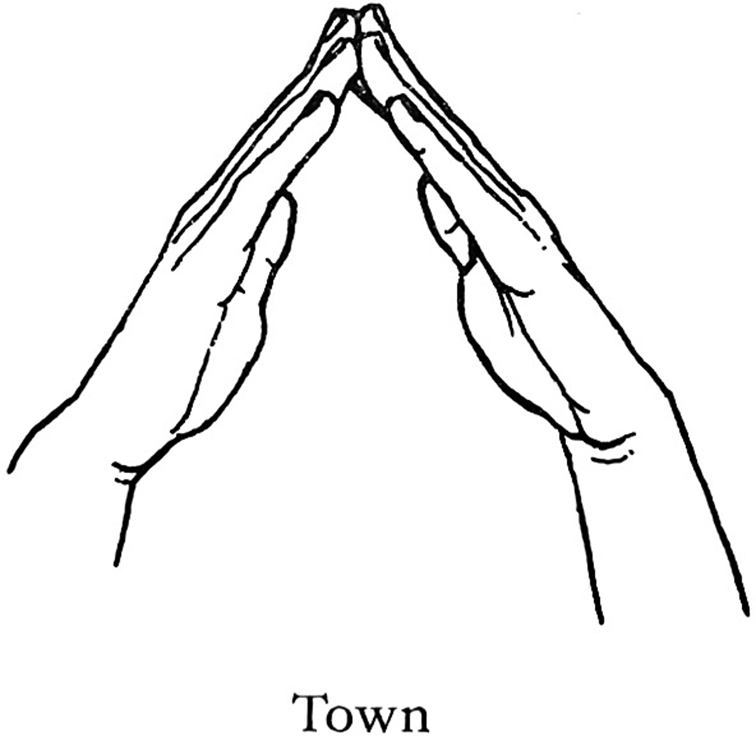
Still, while affecting in their context, these descriptions and instructions are not visually abnormal on the page. The first textual notice readers get of any deviation from the American poetry norm of page presentation occurs on the title page for act 1: “The Townspeople Tell the Story of Sonya and Alfonso” (Kaminsky, Deaf Republic 9). Beneath the title, deafness is represented on the page not only in the text and characters but in the form of an image: a pair of illustrated hands touching at the fingertips, mirroring the shape of a slanted roof. Below the hands, a single word, “Town” (fig. 1). There is a precedent for nonstandard (or nontextual) elements in poetry, as in avant-garde, avant-guerre, and modernist aesthetics. For example, the avant-garde’s “formal principle of collage and montage” feels affectively crip with its artistic processes of tearing, splicing, and reconfiguring (Schulte-Sasse xxxix). Marjorie Perloff even refers to “the cutting and intercalation of collage” as a “rupture” in her book The Futurist Moment (115), and she describes the avant-guerre as “fragmented, dislocated, spliced,” all terms one might use to refer to the disabled body-mind (14). Finally, and perhaps most importantly for Deaf Republic, Perloff describes the avant-garde “rupture” as one that makes space: “there can hardly be rupture without a compensatory addition: to cut out X inevitably means to make room for Y” (115). Peter Bürger makes a similar claim, writing that “[i]f it is true that art is institutionalized as ideology in bourgeois society, then it does not suffice to make the contradictory structure of this ideology transparent; instead, one must also ask what this ideology may conceal” (14).
An illustration from Ilya Kaminsky’s Deaf Republic.

If one replaces Bürger’s “bourgeois” with “nondisabled” and subs in “ableism” and “disability” for Perloff’s “X” and “Y,” then the avant -garde’s relationship to D/deaf and disability poetics becomes especially clear. But it is just that: a relationship, not an analogue. While I find these movements useful in thinking through a poetics of disability, to conflate this poetics with an avant-garde aesthetic movement would risk not only assigning an aesthetic category to a collective that tends to resist categorization but also reducing disability to an aesthetic production. In other words, while the inclusion of an image or a secondary language may not itself constitute a rupture of poetic convention, the significance of Kaminsky’s illustrations lies not only in their presence but in what kind of language and languaging they represent. The nature of these signs as static, two-dimensional representations of a fluid, three-dimensional language sets them apart as unique. Further still, these images are a rupture in that they are a distinctly deaf-disabled injection into an overwhelming ableist and audist literary canon.
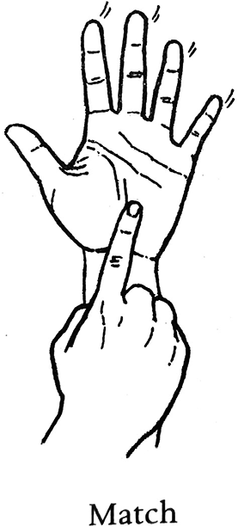
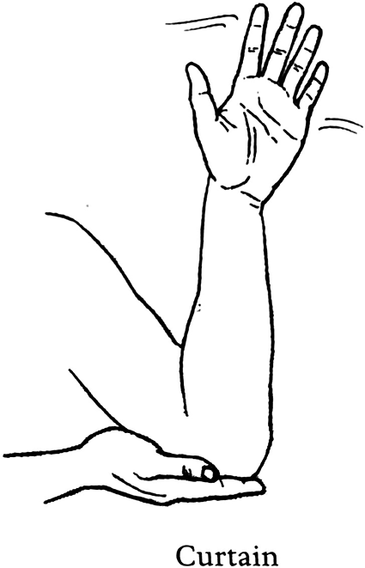
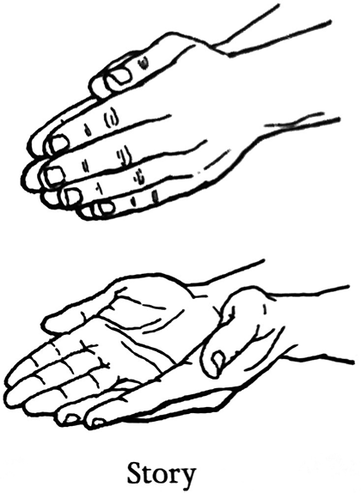
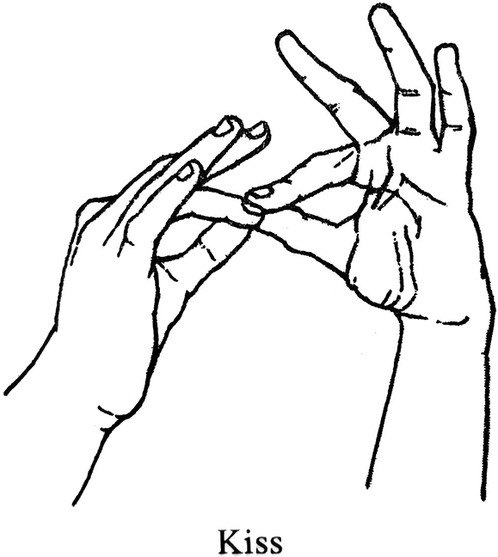
While detailing the relationship of D/deafness and the written word in eighteenth-century Europe, Davis says that “[w]riting is in effect sign language, a language of mute signs” (Enforcing 59). Kaminsky takes this idea a step further by literally writing in a signed language, depicting hand signs not only through textual description and translation but also by picturing the hands themselves in a state of suspended action. The portrayal of the signed word (or concept) is working on the page in the same way as the text, but it both simultaneously is and is not text. While Kaminsky’s inclusion of images alongside text may not in itself serve as a rupture or signifier of difference, the impossibility of fully rendering what the images do—movement, vibration, expression—singles them out as other. This becomes especially clear if one remembers that this collection of poetry is in a sense a closet drama—stylistically written as a performance though intended to be read as a text—something that, like sign language, is done in real time and in three dimensions even though what readers engage with is a flattened, translated version of it. These printed, static signs, then, are to an extent untranslatable: they are not simply images or aesthetics; they are more than what they appear to be.
Just as a written and spoken English word—“town,” for example, from figure 1—is not literally a town but a kind of naming, a signifier that is meant to represent and convey the idea of “town,” so too does a sign signify meaning. By that definition, a signed language can technically be considered textual—and yet, unlike English, sign language is neither audibly spoken nor written and cannot be read within the same parameters as a spoken or written language, meaning it is also not text.Footnote 5 And, while I would argue that in the blank space of a page text is a “rupture,” in that it “erupts” from the page’s emptiness, it is not necessarily othered in that eruption; the idea that text would appear on the pages of a book is unsurprising. The content of the text may be shocking, but the presence of the text itself is normal. But Kaminsky’s textualized signs are tenuous in their rupture, and they other the body of the page in a way that standard, alphabetical text does not. Moreover, the spectacle of the signs is multifaceted: not only are they a visible other when set alongside written English words, they are also conceptually mutable in their duality as both text and not text. In choosing to depict a signed language in his poems, Kaminsky is giving the printed signs their own agency. These text-signs are insistent in their visibility; the reader has no choice but to bear witness to them. In Deaf Republic, before the reader even has the chance to avoid the other, it asserts itself with an unavoidable, and at times untranslatable, address. In addition to more written references to the Vasenkan citizens’ sign language, Kaminsky inserts visual portrayals of signs throughout the book, each related to the poems beneath (or beside) which they appear.
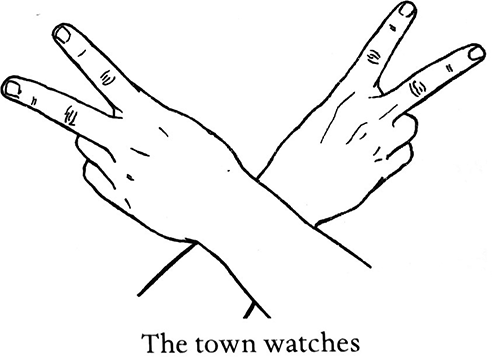
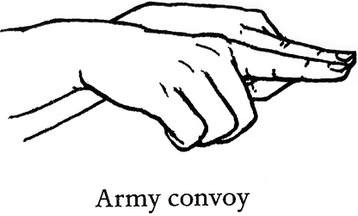
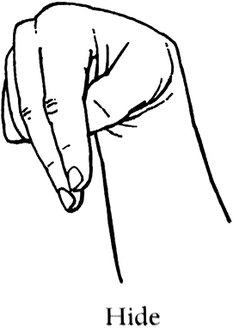
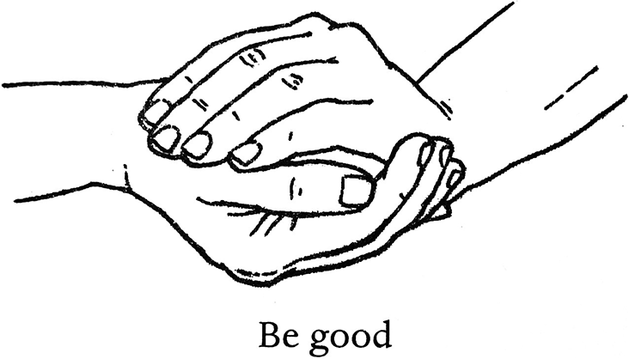
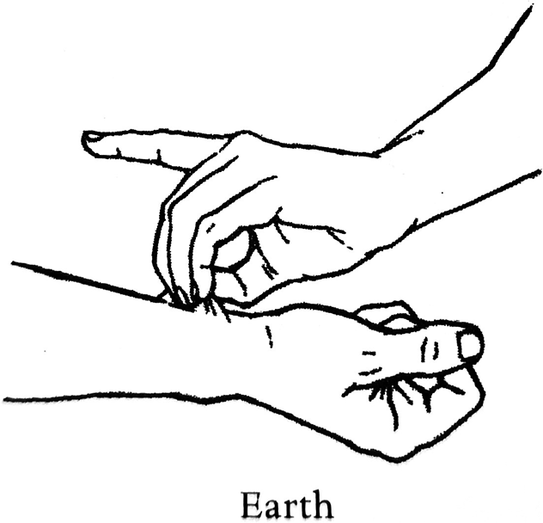
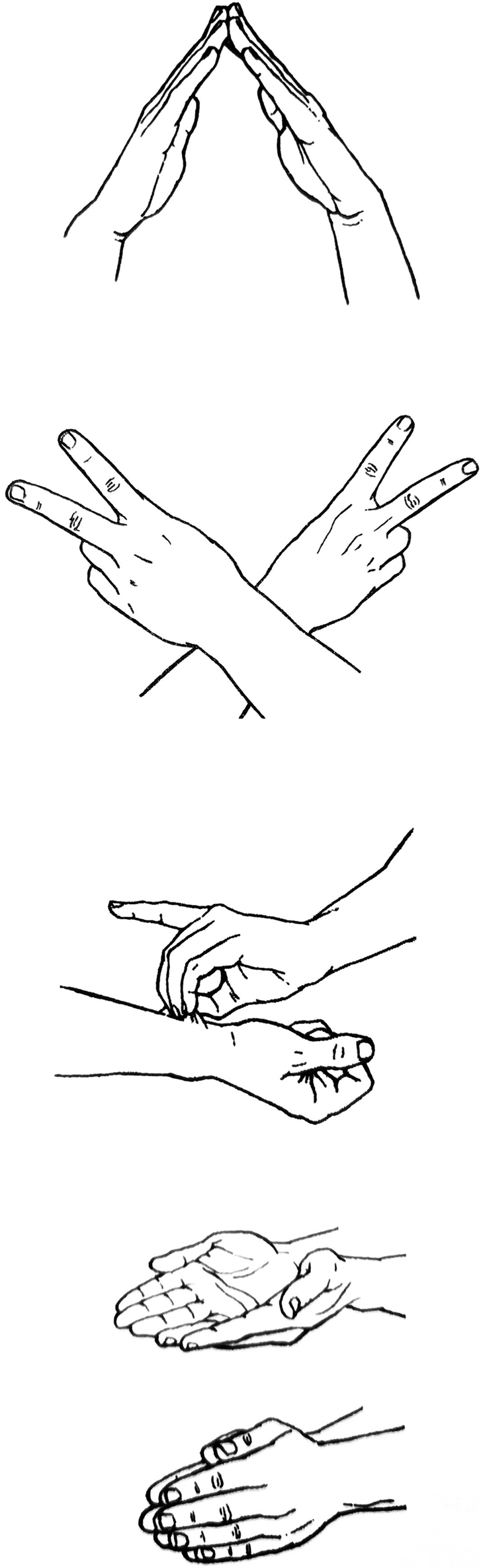
Readers are supplied with other visual representations of the signs’ meanings in addition to “Town”: “The town watches,” “Army convoy,” “Hide,” “Match,” “Curtain,” “Story,” “Kiss,” “Be good,” and “Earth,” always with the signs’ description as a caption underneath (figs. 2–10). However, on the final page of act 2, Kaminsky places four of these signs in a vertical row without the captions (Deaf Republic 73; see fig. 11). Without the captions as signifiers, the signs appear to be functioning as a poem of their own. The physical location in the collection is also noteworthy: the signs are on the right-hand page, and though there is a poem preceding them, the bulk of it is not visibly in concert with them. The page to the left of the signs is blank, save for a single line of poetry stretching across the middle of the page: “We are sitting in the audience, still. Silence, like the bullet that’s missed us, spins” (72). Already a spectacle, and made more so by their lack of captions, the signs are rendered even more spectacular by that single line of verse and its own uncertain positioning. It is unclear whether that line belongs to the poem titled “And Yet, on Some Nights,” on the page before it, if it stands alone as an untitled poem, or if it pairs with the string of signs on the page that follows. In each prior appearance of the signs, not only were they labeled with their respective meanings but they were clearly associated with the text of the poems with which they were paired; for example, the sign for “The town watches” is placed alongside poems in which the townspeople are watching something unfold. In this instance, however, none of the words that the signs signify appear in the text beside which they are placed. Here, the signs make demands of the reader in ways they previously have not. Not only are they insisting on being seen, or perhaps on not being invisible, they are also producing a kind of anxiety in the reader. Without the captions, the disembodied signs are confronting the spectator, demanding that the reader remember their meanings; in other words, they ask the reader to translate.
An illustration from Ilya Kaminsky’s Deaf Republic.

An illustration from Ilya Kaminsky’s Deaf Republic.

An illustration from Ilya Kaminsky’s Deaf Republic.

An illustration from Ilya Kaminsky’s Deaf Republic.

An illustration from Ilya Kaminsky’s Deaf Republic.

An illustration from Ilya Kaminsky’s Deaf Republic.

An illustration from Ilya Kaminsky’s Deaf Republic.

An illustration from Ilya Kaminsky’s Deaf Republic.

An illustration from Ilya Kaminsky’s Deaf Republic.

An illustration from Ilya Kaminsky’s Deaf Republic.

Even if the reader remembers the meanings of the signs, the meaning of the image is still unclear without the text of the poem to use as a foothold. In terms of a reader-text relationship, though, the sense of translation apprehension is perhaps best described as what Ato Quayson terms “aesthetic nervousness.” Quayson explains this “nervousness” as an “issue of subliminal fear and moral panic,” referring to work by disability scholars who have already described the “unease” with which the normate experiences disability (14). The desire to not be disabled collides with the reality that anyone could become disabled at any moment, producing feelings of fear and revulsion in the nondisabled. Quayson extends this fear into the literary realm both in actions between characters and in the relationship between the reader and characters (and in the case of Deaf Republic, the text itself as well). He writes that while the “primary level in which [aesthetic nervousness] may be discerned is in the interaction between a disabled and nondisabled character”—such as the sergeant and Petya, or more generally the deafened Vasenkan townspeople and the occupying soldiers—“in most texts aesthetic nervousness is hardly ever limited to this primary level” (15). Instead, this nervousness is “augmented by tensions refracted across other levels of the text,” such as symbolism, motifs, narrative structure, and other literary devices. But the “final dimension of aesthetic nervousness,” Quayson says, “is that between the reader and the text.” He writes that a reader’s “status within a given text is a function of the several interacting elements” in that text, such as a reader’s identification with a character’s situation or struggles, an “alignment” with the narrator, the “necessary reformulations of the reader’s perspective” in response to plot and narrative changes, and so on (15).
This kind of identification certainly occurs between the reader and characters of Deaf Republic, especially since—while the central backdrop of the collection is war—there are several love poems between and within scenes of struggle. By injecting scenes of intimacy and joy against or into scenes of violence, Kaminsky creates a deeper sense of identification between the reader and the characters. For example, the poem “While the Child Sleeps, Sonya Undresses” is voiced by Alfonso, Sonya’s husband, and is a tender portrait of the couple bathing each other while their infant sleeps (Kaminsky, Deaf Republic 29). Especially because it comes after a poem titled “Question,” which reads in its entirety, “What is a child? / A quiet between two bombardments,” this bathing poem, at the start, feels like that hush between bombings (28). It begins with humor, perhaps even innuendo: “She scrubs me until I spit / soapy water. / Pig, she smiles” (29). The poem likewise ends with a meditation on love and intimacy:
Moments like these reify the humanity of those in Vasenka; these scenes are relatable to us as readers, regardless of our deafness or hearingness. But because these characters are deaf, and because the text itself, too, follows deaf logics, for the hearing reader these moments also produce anxiety. If “silence” is a hearing invention that the deaf do not believe in, then lines such as those that come between more universally recognizable moments of intimacy confront (hearing) readers with their difference, both in content and in textual representation. Those lines read, “A man should smell better than his country— / such is the silence / of a woman who speaks against silence, knowing // silence moves us to speak,” and “I am of deaf people / and I have / no country but a bathtub and an infant and a marriage bed!” (29). If, again, silence exists only for the hearing, then what might it mean to a hearing reader to be confronted by this paradox—this silence that is not silence—and how then might hearing readers interpret the italics used in those lines?
Italicized words in this collection are often used to imply auditory speech, as in the italicized words “Disperse immediately!” and “You!,” spoken by the sergeant in the poem “Gunshot” (11). But in “While the Child Sleeps, Sonya Undresses” and other poems, such as “Before the War, We Made a Child,” these italicized words are dislocated from sound and indicate speech relocated to the movements of bodies, hands, and even hair. Before the war, before the “insurgency” of the townspeople’s deafness begins (temporally, though not sequentially in the collection), Kaminsky inserts D/deaf aesthetics and communicative logics into the world of the poems and asks readers to translate:
When readers get to Sonya and Alfonso in the bath in the collection’s “present,” these logics are in place, but for a hearing reader they are necessarily changed by the townspeople’s deafness. What is actually happening, for example, in the line “Pig, she smiles” (29)? In “Before the War, We Made a Child,” the italics, while signifying communication, carried only implied meaning; “come to bed” was never explicitly spoken or signed—or at least readers may infer as much, given that at the time, Sonya and Alfonso were not yet deaf. But the italics in “While the Child Sleeps, Sonya Undresses,” where Sonya and Alfonso are deaf, are instead used in the same way in which the italics denote auditory speech from the sergeant in “Gunshot.” Sonya is deaf when she “smiles” the words “Pig” and “A man should smell better than his country,” meaning—according to the governing logic of the rest of the collection that says the townspeople are (to a hearing sensibility) “silent”—that she is signing rather than audibly saying them. In fact, readers are outright told by the poem that the line “A man should smell better than his country” is “silence,” and if, again, silence is a hearing invention, then this poem’s paradoxical silence is confronting hearing sensibilities.
The “silence / of a woman who speaks against silence” and the italics that mean both sound and not sound is how Quayson’s “aesthetic nervousness” transcends the character-reader relationship and inflects the (hearing) reader-text relationship with the same kind of mutability. This is also the struggle produced by the text-but-not-text of the signed but unsignified “poem” that concludes act 2 of Kaminsky’s collection (fig. 11). The (presumed hearing) reader addressed by the other finds themself located in a place of apprehension and translation. This reader is apprehensive of the other’s visibility and of translating incorrectly, of missing meaning. In sign languages, the visibility and movement of “silent” speech are the confronting other that draws the spectators’ gaze; D/deafness is the spectacle that the soldiers (or hearing people) want to watch but cannot bear to see.
Deaf Republic is a text that is other in its D/deafness, but it would be irresponsible and would paint an incomplete picture to isolate that otherness from its simultaneous otherness as a text that is also distinctly Ukrainian American. Critically important to this collection is the context of Kaminsky’s own lived reality as a Deaf Ukrainian and Jewish American immigrant. Kaminsky, who was born in 1977 in Soviet Odesa, Ukraine, and has been deaf since the age of four after a misdiagnosed case of the mumps, has discussed how he “grew up watching the collapse of the USSR” before his family left for the United States (qtd. in Kois), where they were granted asylum as they fled the anti-Semitism of post-Soviet Ukraine (Young). In Deaf Republic, Vasenka acts as a stand-in for Kaminsky’s hometown of Odesa, and the occupying soldiers mirror the fascist Russian and Nazi forces that have sought to control Ukraine since World War II (deNiord). At the time in which Kaminsky would have been writing toward Deaf Republic, Ukraine was in the process of strengthening its relationship with the European Union (EU). In what many Ukrainians considered a betrayal, President Viktor Yanukovych bent to Russian pressure and abandoned plans to formalize a closer relationship with the EU, resulting in widespread protests that ultimately forced him from power (Pridham). Russian President Vladimir Putin seized the opportunity to invade Ukraine, framing the protests as a Western-supported coup and his invasion a rescue operation (“Address”). This context especially highlights the resistance at the heart of Deaf Republic. Like Ukrainians, the citizens of Vasenka must constantly reassert their identity, even if it means reinventing it.
Jon Henner and Octavian Robinson write that “[l]anguages are a political category,” and this is especially true in the world of Kaminsky’s Vasenka (4). The political power of the townspeople’s deafness is that it figuratively renders the soldiers speechless, since their orders quite literally fall on deaf ears; the political power of their signed language is that it allows the townspeople to communicate outside the language of the oppressor. Henner and Robinson write that for deaf people in an overwhelmingly hearing world, “translanguaging,” or the use of signed language in addition to spoken and written language, is “often strictly regulated and driven by ideology wherein hearing people try to enforce a very specific way of speaking and writing—one that is not deaf” (4). Though Henner and Robinson’s article refers more to issues of language fluency and education, the hearing soldiers occupying Vasenka certainly try to enforce the use of a language that is distinctly “not deaf.” One sees this in instances like the arrests, killings, and brutalization of the townspeople and the signs hung by soldiers declaring deafness a disease. But instead of driving the townspeople to audibly speak, the violence toward their deafness and language deepens their resolve and affirms the beauty of their linguistic resistance. In “Search Patrols,” for instance, as “soldiers drag a naked man up the staircase” to search him, the poem’s speaker “teach[es] his children’s hands to make of anguish // a language— / see how deafness nails us into our bodies” (Kaminsky, Deaf Republic 63). Even in “anguish,” their sign language, a language by and of the body, is a language that cannot be silenced, because, to the oppressor, it is already silent. In a setting dominated by the sensibilities of the hearing soldiers, silence becomes a paradox. It renders the townspeople simultaneously invisible and visible, subtle and mutable, like Sonya as she marches to her death: her signing, her “silence,” is what prompts the soldiers to require her to hold her hands above her head, rendering her “silent,” and yet it is the positioning of her hands that “loudly” signifies her otherness.
In a note on the Vasenkan signs in the back matter of Deaf Republic, Kaminsky writes that while this is a sign language “invented” by the Vasenkans, some of the signs depicted are derived from other sign language traditions (“Russian, Ukrainian, Belarusian, American Sign Language, etc.”) while others “have been made up by citizens, as they tried to create a language not known to authorities.” That the sign language in Deaf Republic is a language meant to defy an occupying oppressor adds further real-world significance to the collection. First, it locates the work for D/deaf and hearing readers alike as always necessarily in a state of potential mistranslation. For both the soldiers in the poems and the readers, Vasenkan sign language—even with captions—requires a degree of translation. What is more, this translation can never be complete, because the signs are static representations of a language that moves in space and time.
Second, for all (but especially non-Ukrainian) readers, this sign language as resistance signals the very real conditions Ukrainians have been and are currently living under—or, as Kaminsky says of the collection’s prefatory poem, “We Lived Happily during the War,” it “prevent[s] people from reading Deaf Republic as a tragedy of elsewhere. Deaf Republics, with their hopes, protests, and complicities, are everywhere. We live in the Deaf Republic” (qtd. in Kois). The poem itself says as much, while also implicating the non-Ukrainian reader:
The rest of Deaf Republic, though, complicates and reframes that happiness. In the United States and Ukraine, in all these “Deaf Republics,” Kaminsky says that while there is violence and suffering, “at the same time, there is happiness. People fall in love, laugh, make children” (qtd. in Kois). For the nonoppressed, happiness becomes guilt, while in Vasenka these moments of joy represent rebellion, resistance, and perseverance. That happiness is reflected in poems about love, sex, children, and lullabies, but also in the townspeople’s reinvented identity: their community of deafness.
Deaf Republic offers a new way of thinking about disability and D/deafness: not only as a culture or medical “fact” but as an act of resistance and resilience in the face of an overwhelmingly audist and ableist society. This collection is an example of what “Deaf Gain” can look like; it is celebration and affirmation of D/deafness, D/deaf culture, and signed languages. But in this work Kaminsky does more than simply celebrate D/deaf community and language; he affirms for a hearing world the value of prioritizing different ways of being, thinking, and knowing. Rebecca Sanchez writes that “it is still a widely held misconception, even among those who are highly educated, that [sign language] is not fully equivalent to other languages, that it is just … a system of gestural iconography” (8). Kaminsky’s elevation of sign language, both in Deaf Republic’s characters and in its textual renderings of hand signs, issues a challenge to such sentiments and reinforces the need to reeducate the culture of “compulsory hearingness” prevalent in literary communities. Like the deafness and “silence” of the citizens of Vasenka, this collection stands in resistance to the poetic canon that has so often, as Clark notes, shut deaf writers out.
In addition to these frameworks for considering D/deafness, Deaf Republic also comments more broadly on language’s capacity to form and re-form identity, shape community, and serve as a means of political resistance, especially in the context of Ukraine’s ongoing struggle for sovereignty. In his introduction to Words for War: New Poems from Ukraine, Kaminsky quotes from several emails he received from Ukrainian friends and family members during a conflict between Russia and Ukraine in 2013 in which Putin, under the pretext of protecting Russian-speaking populations in Ukrainian territories, occupied Crimea and Donbas (“Barometers” xx). In one of these emails, the Russian-language poet Boris Khersonsky tells Kaminsky he will no longer read his work in Russian, only in Ukrainian, as “a protest action in solidarity with the Ukrainian state” (xxi). Of this statement, Kaminsky asks, “What does it mean for a poet to refuse to speak his own language? Is language a place you can leave? Is language a wall you can cross? What is on the other side of that wall?” (xxii). These are also the questions at the heart of Deaf Republic, in which the townspeople’s deafness and sign language become methods of resistance against an oppressive occupying force, where the ask of translation is a means of both defiance and self-affirmation.