Introduction
Stereotactic ablative radiotherapy (SABR) is proven as an effective non-surgical treatment for inoperable peripheral lung cancer. Reference Murray, Franks and Hanna1 Adherence to the UK SABR Consortium Guidelines 2 risk-based dose fractionations and organ tolerances ensures that side effects from SABR are generally low while tumour control is high. Prior to 2020, when NHS England launched the SABR expansion programme, most UK centres were treating only peripheral lung tumours located away from most potential organs at risk especially those found within the ‘central’ zone, resulting in highly optimal therapeutic ratios. Reference Uzan and Nahum3 Treatments are usually given every other day for 3, 5 or 8 fractions depending on the location of the tumour in relation to the chest wall, as per the guidelines.
Using radiobiological modelling via trading off tumour control probability (TCP) and normal tissue complication probability (NTCP) is one way of assessing theoretical gains from planning technique and delivery improvements. Radiotherapy plans that are more conformal to the planning target volume (PTV) and deliver less dose to normal tissue organs at risk (OAR) will improve this therapeutic ratio. In an ideal radiotherapy plan, one would want the highest possible TCP (approaching 100%) with the lowest possible NTCP. Deviations in lung TCP and NTCP calculated over time (and observed in outcomes) can be large, especially when the period of study includes significant technological improvements in standard of care or where planning techniques are not consistent. Reference Liu, Tai and Lee4 Radiobiological modelling continues to be used in optimisation studies despite controversy. Reference Alaswad, Kleefeld and Foley5
To design quality improvements, baseline values for TCP and NTCP need to be established alongside careful observation of patient outcomes in terms of survival and treatment side effects captured at patient follow-up. In the UK, peripheral lung SABR was, and continues to be, implemented by centres adhering strictly to the SABR Consortium Guidelines due to commissioning requirements, which means centres are well placed to share data and outcomes and expect to see reasonable transferability. Therefore, this study seeks to add to the literature by reporting theoretical benchmark values of NTCP for those organs at risk commonly associated with lung SABR side effects. This study also supplements our previous publication benchmarking TCP values for the same dataset. Reference Marsden6 The data act as starting point for what can be achieved if plans meet the tolerances expressed within the (widely utilised) UK guidance and can also be compared with existing or future data. Reference Alaswad, Kleefeld and Foley5
Recently, the impact of the COVID 19 pandemic has influenced treatment fractionation and increased the use of radiobiological calculation in radiotherapy clinics for individual patients. The reasons for carrying out bespoke radiobiological calculations include reducing radiotherapy outpatient footfall (i.e. with fewer or single fractions), scheduling (i.e. to complete treatment before the start of a self/family isolation period or public transport travel ban) and correcting for breaks in treatment (i.e. following self/family isolation). This research is therefore timely.
Materials and Methods
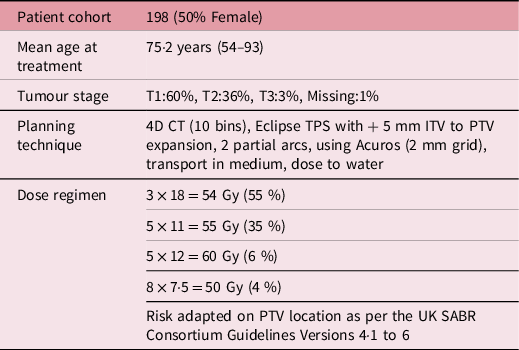
Radiotherapy treatment plans from 198 previously treated patients were analysed from the period 2014 to 2019, with a median follow-up time of 16 months. Planning technique was as per Marsden, 20,201, that is two half arcs at 6 MV or 10 MV FFF (Varian Medical System, Inc., Palo Alto, CA) utilising the Acuros algorithm and reporting absolute dose to water. Patient characteristics are shown in Table 1. All plans met the majority of UK SABR Consortium tolerances required at the time (with some minor deviations) and were approved by a radiation oncologist and subsequently treated.
Patient characteristics and centre data

Dose volume histogram (DVH) data for the chest wall (CW) and the lungs excluding the gross tumour volume (Lungs – GTV) were imported into Biosuite Reference Uzan and Nahum3 to calculate the NTCPCW and NTCPLUNG, chosen to represent the most common toxicities. The volumes created for the chest wall were consistent between patients but not in accordance with the latest guidance as these patients were planned prior to its publication in 2019. The chest wall volumes were created by contouring a rind of the ipsilateral hemi-thorax outside the lungs covering all the ribs approximately 1·5 cm above and below the PTV, which was standard practice during the period. However, neither it did not extend out by 3 cm nor was it contoured the full 5 cm above and below the PTV as stated in the latest guidelines (page 18, SABR Consortium Guidelines, Version 6·1 2 ). Therefore, these volumes were smaller than will be observed for centres following the latest guidelines, but as such conservatively overestimate the NTCPCW. The clinical prescription dose fractionations were used for each patient as treated, covering 54 Gy in 3 fractions (#), 55 and 60 Gy in 5 # and 50 Gy in 8 #. All NTCP were LQ-corrected, taking account of the total treatment time in days and fractionation.
For the lungs-GTV, the end point was radiation pneumonitis (Grade > 2) using the Lyman Kutcher Burman (LKB) model with the parameters as per Nahum et al., Reference Nahum and Uzan7 that is, an α/β = 3 Gy, TD50 = 24·5 Gy, n = 1, m = 0·45.
For the chest wall, the end point was chosen as rib fracture also using the LKB model with the parameters as in Chairmadurai et al. Reference Chairmadurai, Goel, Jain and Kumar8 and Stam et al., Reference Stam, van Der Bijl, Peulen, Rossi, Belderbos and Sonke9 with the parameters α/β = 3 Gy, TD50 = 65·0 Gy, n = 1 (parallel organ), m = 0·3.
For the purposes of this study, the TCP quoted used α/β = 10 Gy rather than α/β = 20 Gy, both of which were investigated in our previous publication Reference Marsden6 .
The data obtained, per patient, for the various recommended lung SABR fractionations were derived, and the mean control and toxicity probabilities were compared with the treated schedule. The schedule with the lowest number of fractions was 54 Gy in 3 #. For patients who were treated with this schedule, recalculations were not performed for more fractions (5 # or 8 #).
Results
The mean calculated NTCPLUNG (radiation pneumonitis) was 2·8% (range 0·6 – 10·6); the median was 1·9%.
The mean calculated NTCPCW (rib fracture) was 1·4% (range 0·0–55·90); the median was 0·6%. The large outliers in NTCPCW were due to PTVs overlapping with the chest wall.
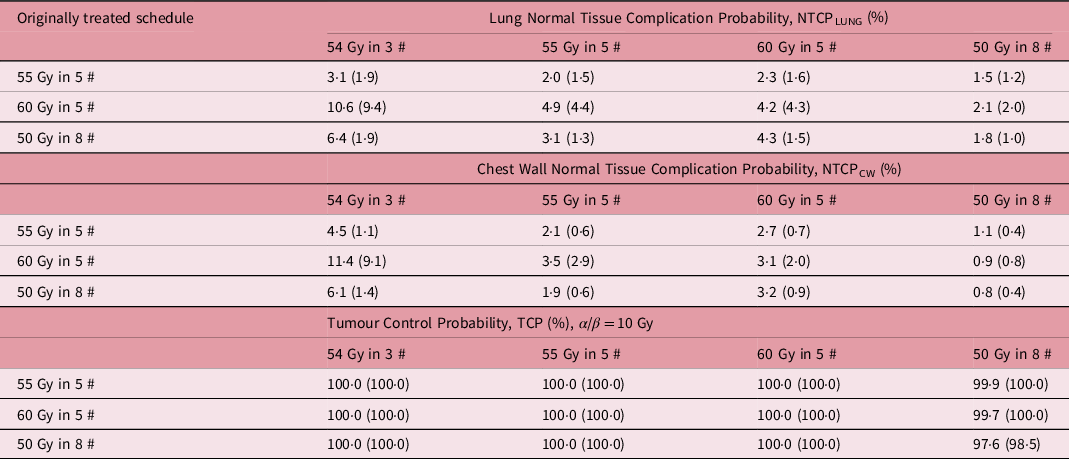
The mean NTCP values are given in Table 2. Overall, the mean NTCP was less than 3·0 % for both NTCPLUNG and NTCPCW. There was no correlation between the chest wall and lung probabilities (Pearson, r = 0·14).
Mean normal tissue complication probabilities with minimum to maximum ranges in round brackets. Median values also given in square brackets

Independent t-tests were performed to compare groups. There was no statistical difference seen in NTCPLUNG or NTCPCW between tumour stage status (grouped generically by T1, T2 and T3 rather than using sub-group categorisation such as T1aN0M0, for example), between male and female groups or by fractionation 2,Reference Liu, Tai and Lee4,Reference Chairmadurai, Goel, Jain and Kumar8 with the exception of the 3 # and 5 # (t-test, t187 = 2·808, p = 0·006) where the mean NTCPLUNG for 3 # was 3·2% compared with the 2·3% for 5 # patients.
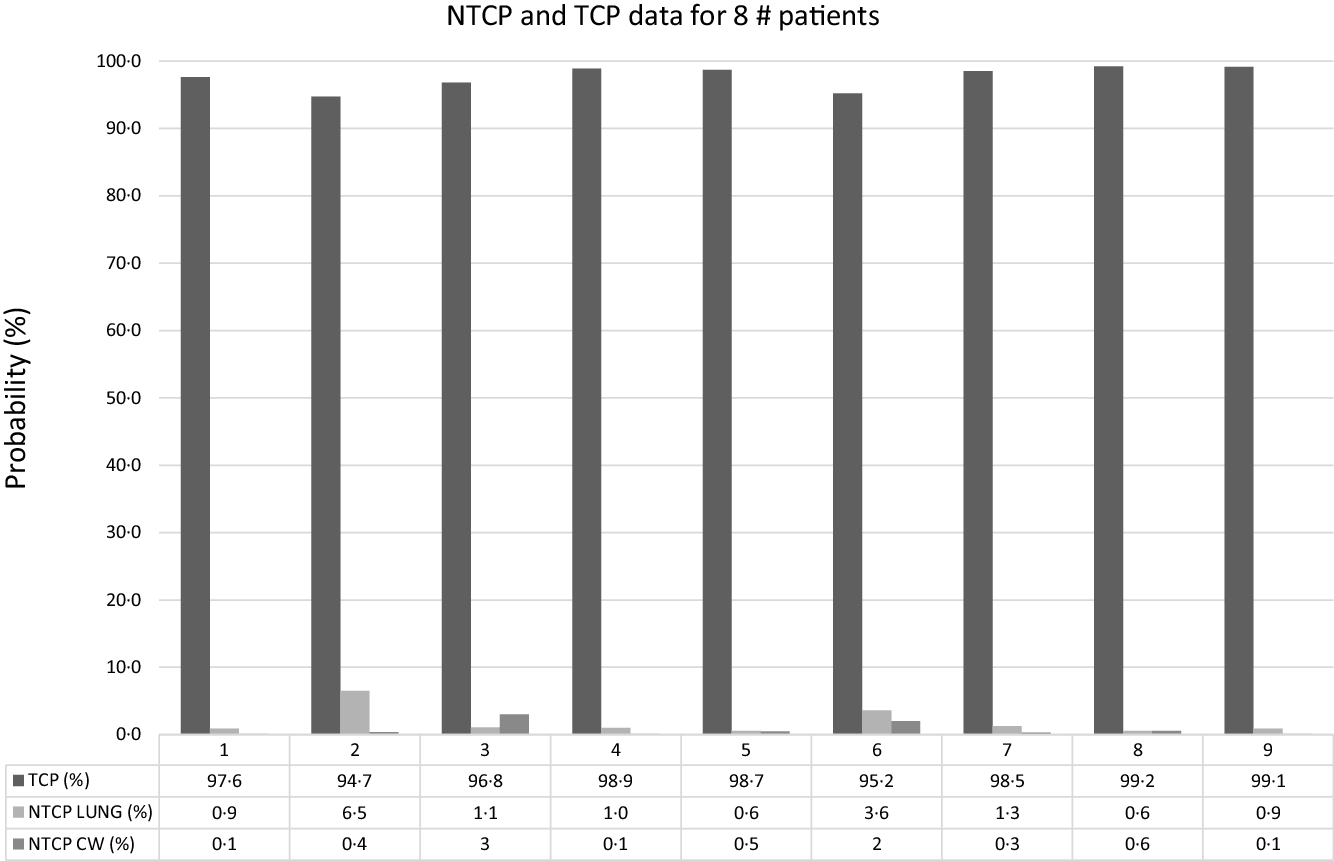
For the per-patient comparisons (see Table 3), paired t-tests showed that there was no statistically significant difference between the mean TCP, NTCPLUNG or NTCPCW, for the 8 # compared with 3 # or 5# indicating that this schedule could be reduced, although the numbers in this group were small (n = 9). Baseline values for these nine patients treated with 8 # are shown in Figure 1.
Same-patient alternative fractionation mean NTCP and TCP data. For each patient within each group originally treated with a dose and fractionation schedule in the first, left hand, column, the mean NTCP (and TCP) were recalculated as if the treatment were given in the alternative fractionations along the rows. The shaded entries show the mean NTCP and TCP values obtained as treated clinically. 54 Gy in 3 # was not recalculated for longer fractionations. Median values also given in brackets

Representative NTCP values for nine 8 # regimen patients, plotted with each patient’s corresponding TCP. The probabilities for each patient are also given in the table below the figure.

For the group of patients treated with 55 Gy in 5 #, there was no statistically significant difference for the mean TCP or the NTCPCW between any of the other groups using an ANOVA test (p < 0·001). For the NTCPLUNG, a statistically significant difference was seen when moving from 55 Gy in 5 # to 60 Gy in 5 # (paired t-test, t68 = –2·3826, p = 0·01) and to 54 Gy in 3# (paired t-test, t68 = –5·284, p < 0·001); however, this change was small with the NTCPLUNG increasing from 2·0 % to 2·3 % and 3·0 %, respectively, which may not have clinical significance.
For the group of patients treated with 60 Gy in 5 #, the 55 Gy in 5 # schedules were statistically equivalent over all metrics (TCP, NTCPLUNG and NTCPCW). In moving from 60 Gy in 5 # to 54 Gy in 3 #, parity remained for the TCP and NTCPLUNG; however, the NTCPCW was significantly different increasing from a mean of 3·1 % to 11·0 % (t-test, t10 = 3·103, p = 0·006). This may be significant clinically and supports some use of risk-adapted fractionation schemes for SABR.
Discussion
NTCP prediction values from a typical UK centre adhering to the UK Consortium Guidelines have been presented. The mean values for both NTCPLUNG and NTCPCW were less than 3% so the theoretical risk of radiation pneumonitis and rib fracture can be considered low compared with radiotherapy in general. Reference Stam, van Der Bijl, Peulen, Rossi, Belderbos and Sonke9,Reference Seppenwoolde, Lebesque and de Jaeger10 Examples of NTCPLUNG for conformal radiotherapy may range from 10 to 30%. Reference Seppenwoolde, Lebesque and de Jaeger10 For both types of complication probabilities, despite some specific patient variations, 99% of the cohort had a theoretical risk of complication much less than 10%. Within the uncertainties of the calculated values, these are comparable with the observed toxicity rates reported in the systematic review by Murray et al.. Reference Murray, Franks and Hanna1 The data reviewed by Murray et al. span the period 2005 to 2016 when SABR was being developed using different platforms and techniques (static beams versus VMAT, treatment planning with and without constraints, gradual implementation of risk-based fractionation). It is important for centres to acquire their own data (theoretical and observed, on toxicity and survival) so that the effects of change in technique can be monitored to see if an improvement in quality has been achieved at a suitable period following change. Biosuite could also be used to create baselines of NTCP for other OAR, including serial as well as parallel architecture organs by means of altering the ‘n’ parameter.
Unlike the restricted size range of PTVs in the TCP data from our previous paper, Reference Marsden6 which use the same patient cohort, the natural variation in normal organ size can be seen in this data. A wider variation of NTCP might have been expected compared with the same patient TCP and the group TCP because the PTVs for SABR treatment are all restricted to less than 5 cm in diameter, whereas the normal organs are not. The volume of normal lung irradiated as a proportion of the total lung can vary depending on technique; however, in this study, all patients were treated with two ipsilateral half arcs reducing the radiation and therefore the risk to the total lung volume. Treatment techniques using a single 360° arc irradiating both lungs would yield worse NTCPLUNG.
Although the Lungs – GTV structure is closely related to the true lung volume of each patient, the chest wall contour structure is less anatomically defined. The current guidelines (v 6·1, 2019) suggest contouring this structure as a ‘3 cm rind of the ipsilateral hemi-thorax outside the lungs’ and to cover ‘at least 5 cm above and below the PTV’. However, the cohort of patients considered in this work were treated during a period (2014–2019) prior to this v 6·1 and so the chest wall structure used is not as strictly defined. It consisted of a rind covering all the ipsilateral ribs beyond the superior and inferior levels of the PTV. However, the consequence of this is that the NTCP values are more conservative than if the volume was larger using the suggested 3 cm rind. For some patients, it is impossible to create a 3 cm rind as this would extend the structure outside of the external body contour.
The data for the two different prescription dose 5 # regimes show equivalence. This evidence also shows that the theoretical increased risk of developing radiation pneumonitis is still small if the majority of these patients were to be treated with 3 #. The mean NTCPLUNG for 3 # was 3·2% compared with the 2·3% for 5 # patients. Individual patients may have higher risks dependent on tumour size.
One patient (50 Gy in 5 #) had a NTCPCW of 55·9%, i.e. the risk of rib fracture from the treatment was over 50%. This patient did not develop a subsequent rib fracture (38 months follow up time). On inspection, a large part of the chest wall structure was included in the PTV when the GTV was expanded and so the structures overlapped. About 15% of the volume of the PTV was within the chest wall; all received 100% of the prescription dose. The chest wall structure was contoured as per local practice above; however, when redrawn according to the current guidelines with a 3 cm rind (although cropped to within the patient surface), the NTCP value reduced significantly to less than 1%. The next largest NTCPCW of 27·6% also occurred where there was large overlap between the PTV and chest wall and re-contouring the chest wall structure had the same effect, reducing the NTCPCW to less than 1%. The reasons behind this are linked to the use of the volumetric equivalent uniform dose (EUD) within the LKB model in Biosuite and demonstrate the sensitivity of NTCP calculations to the accuracy and/or reproducibility between patients of the OAR contouring. Reference Stam, Peulen, Rossi, Belderbos and Sonke11 Automated segmentation of organs at risk, using atlas or Artificial Intelligence (A.I.) methods to improve planning efficiency, may improve the reproducibility of NTCP and other volume-based metrics in the future. Reference Aliotta, Nourzadeh, Choi, Leandro Alves and Siebers12
The values given for the NTCPCW are low, as well as conservative, in respect to the smaller chest wall volumes used in this study. With the exception of the NTCPCW discussed above, the remaining NTCPCW were less than 10% and so these outliers comprised 1% of the sample. For the NTCPLUNG, only 1% of the cohort were over 10%. The values here are consistent with those published by Lu et al., in 2019 Reference Lu, Lin, Lin and Huang13 and the more recent multiple cohort data by Alaswad et al., 2019. Reference Alaswad, Kleefeld and Foley5 Care should be taken when comparing these values as absolute due to their inherent uncertainties.
Together with the high TCP values, Reference Marsden6 the low NTCP values (as compared with conventional radiotherapy Reference Alaswad, Kleefeld and Foley5,Reference Willner, Barier, Caragiani, Tschammler and Flentje14 ) demonstrate why excellent clinical results can be observed for patients undergoing lung SABR despite them so often being elderly, non-operable and presenting with other comorbidities (see Graph 1.). In our previous 2018 study, Reference Marsden and Wieczorek15 74% of patients did not report any grade of toxicity, with only one patient suffering from a rib fracture that was likely due to osteoporosis rather than being radiation induced, according to the patient’s medical review notes. The NTCP values for that particular patient for chest wall and lung were 3·0% and 6·3 %, respectively, giving more weight to the theory that the fracture was not radiation induced. The NTCP models used here for rib fracture do not include metrics to account for co-morbidities such as osteoporosis. The limitations of our previous study were the short follow-up period. Stam et al. Reference Stam, van Der Bijl, Peulen, Rossi, Belderbos and Sonke9 suggested that the median time to rib fracture was 22 (range 5–51) months and so longer follow-up periods need to be reported. However, for very elderly patients, the onset of side effects may be a moot point. Unlike in the UK, all patients in the Stam et al. study were initially planned with no constraints applied to the ribs at treatment planning and treated with no risk adapted fractionation; almost all patients being treated in 3 fractions. Their conclusions led to them changing strategy to a risk adapted scheme based on minimising rib fracture. In the UK, it would be possible to uphold the Consortium suggestions and risk adapt, while also taking into account the patient burden, for instance by completing the treatment within a week and having minimal detriment.
While the majority (55 %) of clinically treated schedules in our institution are 54 Gy in 3 #, the chest wall is contoured and constraints applied at the planning stage for all patients regardless of intended fractionation. The approach taken when the local service was first clinically implemented was to initially plan for a 3 fraction regimen with corresponding organs at risk (OAR) tolerances, and then de-escalate the fractionation where required to 5 # or 8 #. However, it has also given a database from which to interrogate data such as presented here. It was shown in our previous study that the 8 # scheme, latterly reserved for poorer performance status patients and has the effect of slightly reducing the TCP. There may therefore be real practical and clinical advantages for the patient in opting for a 5 # treatment over the 8 # schedule.
Although one might question the need for personalised fractionation with such high control rates and low complications, there are other reasons why personalised regimens might benefit. Given the practical advantages of even shorter fractionation (for example, reduced overall treatment time, reduced patient visits and burden on the elderly patient and possible improved therapeutic gain), alternate schemes could be considered by utilising an individual assessment of the acceptable TCP and NTCP values for a given patient, in addition to the standard assessment of plan dose constraints and tolerances. This may also improve patient compliance in some cases.
Conclusion
Benchmark values for NTCPs for lung and chest wall achievable with current planning techniques used in a typical UK centre have been presented with the mean probabilities being less than 3 %. The data support the observations that many patients tolerate treatment well and few have notable side effects.
Contouring definitions provided in guidance documentation are important for NTCP value consistency and comparability between centres, and studies need to clearly state how contoured structures were created to allow meaningful comparison.
In this study, there was no significant difference in terms of NTCP and TCP means for the 8# regimes as compared with the 5 # regimes, where 60 Gy and 55 Gy were shown to be equivalent. This suggest that patients currently offered 8 # could be treated in 5 # without detriment. Individual personalisation of the number of treatments needs to be discussed with the clinical team and the patient to ensure appropriate consideration of the relevant factors for the individual.
Acknowledgements
The author would like to acknowledge all the local radiotherapy staff involved with SABR radiotherapy and the assistance of Craig Moore and Michael Merchant in preparing this manuscript.
Financial Support
This work was carried out as part of the UK Higher Specialist Scientist Training Scheme, supported by Health Education England.