




No CrossRef data available.
The role of discourse pragmatics in the acquisition of subjects in Italian
Published online by Cambridge University Press: 19 July 2005
Abstract
This longitudinal study investigates the distribution of null and overt subjects in the spontaneous production of six Italian-speaking children between the ages of 1 year, 7 months and 3 years, 3 months. Like their peers acquiring other Romance null-subject languages, the children in this sample produced more overt subjects as their mean length of utterance in words (MLUW) increased. Pronominal subjects, and specifically first person pronouns, accounted for an increasingly larger proportion of the overt subjects used. The distribution of both pronominal and lexical subjects was further investigated as a function of the informativeness value of a number of pragmatically relevant features. The results showed that as early as MLUW 2.0 Italian-speaking children can use null and overt subjects in a pragmatically appropriate way. The relevance of these findings is discussed with reference to performance limitation and syntactic accounts of subject omission, and implications are drawn for a model of language development that incorporates the mastery of pragmatics in the acquisition of syntax.
Information
- Type
- Articles
- Information
- Copyright
- © 2005 Cambridge University Press
One of the necessary requirements to become a competent speaker of a language is the ability to control the relationship between the structural properties of sentences and the linguistic and extralinguistic contexts in which they are used. The linguistic choices made by a speaker in the structural representation of a state of affairs are dependent on a number of factors including the assumed knowledge of the hearer and the accessibility of information in previous discourse (Ariel, 1990, 1996; Chafe, 1994, 1996; Gundel, Hedberg, & Zacharski, 1993). One obvious way in which syntactic and structural aspects of language interact with discourse and pragmatic considerations is the selection and distribution of argumental noun phrases. In the present work, we will be dealing with the distribution of referential subjects in the acquisition of Italian, a language in which the occurrence of null and overt subject arguments is determined by discourse pragmatic constraints.
There is a long and flourishing tradition of theoretical approaches that consider pragmatics as crucial for a comprehensive understanding of how speakers use syntax in discourse (Ariel, 1990, 1996; Chafe, 1976, 1994, 1996; Cornish, 1999; Givón, 1984; Gundel et al., 1993; Halliday & Hasan, 1976; Huang, 1994, 1995, 2000; Kempson, 1996; Lambrecht, 1994; Levinson 1987, 1991; Sperber & Wilson, 1995; van Hoek, 1995). Although it is beyond the scope of the present article to elaborate on the numerous differences that exist between these approaches, we would like to focus on the core assumption shared by most of them. Full justice to the study of discourse anaphora can only be done within a theoretical framework where the study of the formal syntactic properties of sentences takes into due consideration the linguistic and extralinguistic contexts in which they are used.1
In the present work we only consider cases of nominal anaphora and not cases of verb phrase (VP) anaphora such as VP ellipsis, gapping, sluicing, or stripping (see Huang, 2000, pp. 3–5, for relevant examples of VP anaphora).
STUDIES ON THE USE OF REFERRING EXPRESSIONS IN CHILD LANGUAGE
Researchers investigating the interaction between syntax and discourse pragmatics in the use of subject arguments by Italian-speaking children have typically concentrated on referent introduction and maintenance in narrative contexts (Orsolini & Di Giacinto, 1996; Orsolini, Rossi, & Pontecorvo; 1996). Because of the demands associated with the narrative task itself, the youngest children in these studies tended to be around 4 years of age; thus, no information on subject use as a function of discourse pragmatics is provided for the very early stages of language production.
With few exceptions (Austin, Blume, Parkinson, Núnez del Prado, & Lust, 1996; Paradis & Navarro, 2003), research on the distribution of subjects in the acquisition of Romance null-subject languages has not focused on the relationship between syntax and pragmatics, but rather on the impact of performance limitations and the availability of case-assigning functional categories (Grinstead, 2000; Valian, 1991; Valian & Eisenberg, 1996). Nevertheless, regardless of the theoretical explanations proposed for the distribution of overt and null subjects in acquisition, the empirical facts so far indicate that the output of children acquiring null-subject languages is characterized by an initial phase in which subjects are altogether absent, followed by an incremental use of overt arguments, in particular pronominal forms. Bates (1976) reported that the two Italian children in her study went through an initial stage, between mean length of utterance (MLU) 1.7 and 2.3, in which they produced virtually no overt subjects. In Valian's (1991) comparative study of subject use in English and Italian, the Italian-speaking children used overt subjects around 30% of the time between 1 year, 6 months (1;6) and 2;6, and pronominal forms (subject pronouns, demonstrative pronouns, and interrogative pronouns) accounted for 20–35% of overt subjects. Valian also reported that there was no significant increase over time in the proportion of overt subjects used by the children. Another study by Valian and Eisenberg (1996) on the use of subjects in children acquiring Brazilian and European Portuguese reported a significant decrease in the proportion of null subjects between MLU in words (MLUW) 1.7 (72%) and 3.8 (43%). The increased use of overt subjects was mainly due to a trade-off between null and pronominal subjects, whereas the proportion of lexical subjects remained fairly constant.
Additional evidence for the gradual increase in the use of overt subjects in children acquiring a null-subject language comes from a study of four Catalan-speaking children and one Spanish-speaking child (Grinstead, 2000). Grinstead divided the children's production into two stages: an earlier stage in which no overt subjects were produced at all, and a later stage in which overt subjects appeared to reach an average of 20%, thus converging on the adult target (estimated to be between 20 and 30%).2
However, see Aguado–Orea and Pine (2002) for a reanalysis of Grinstead's data and an alternative interpretation of the availability of early overt subjects in Spanish child language.
In sum, researchers who have investigated the acquisition of subjects in a number of null-subject languages agree on the common empirical finding that children start out by subjects virtually 100% of the time. Nevertheless, there is considerable disagreement over what motivates the use of overt subjects in these languages, where the null subject option is indeed grammatical. On the basis of their crosslinguistic findings, Valian and Eisenberg argue against a purely syntactic account of the emergence of subjects such as Hyams' (1986) and Hyams and Wexler's (1993). Instead, they propose a performance limitation account whereby children's output is the result of the interaction of a limited processing capacity and sensitivity to the statistical properties of the adult input. Due to an initial restriction on children's performance resources, early language production is characterized by streamlined output, in which some syntactic information is left out for the sake of economy. Among other things, this results in the ungrammatical, or pragmatically inadequate, omission of sentence subjects. Important differences, however exist in the extent to which such economy considerations are weighed against the information available in the adult input. Although it is reasonable to assume that, regardless of the language to which they are exposed, children will be constrained by the same processing limitations, there are significant differences in the extent to which children acquiring null- and non-null-subject languages omit sentence subjects. English-speaking children reflect the prevalence of overt subjects in the input by omitting subjects considerably less frequently than either Italian- or Portuguese-speaking children, who are exposed to languages where subjects are overt between 30 and 60% of the time on average.3
Valian and Eisenberg (1996) reported that the Portuguese-speaking adults in their sample provided overt subjects an average of 56% of the time. In the absence of accurate estimates for child-directed Italian, we calculated the proportion of overt subjects in a sample of 600 maternal verb utterances from the Calambrone corpus (Cipriani et al., 1989) available on CHILDES (MacWhinney, 2000). Our results showed that mothers used overt referential subjects an average of 32% of the time with a range between 10% in second person singular contexts and 48% in third person singular contexts.
Pursuing a different line of argumentation, Grinstead (2000) argued that the initial absence of overt subjects in two null-subject languages, such as Catalan and Spanish, is due to the unavailability of a position in which the subject argument can receive nominative case. Grinstead sees a cause–effect relationship in the presumed correlation between lack of overt subjects and lack of overt tense and number morphology. If there is no functional projection checking tense and number features, there will be no specifier position where subjects can raise to receive nominative case. Hence, it is only after tense and number morphology have been acquired that a suitable nominative case position becomes available and overt subjects can appear. According to this view, the emergence of tense and number morphology is a necessary and sufficient condition for the appearance of overt subjects in null-subject languages and for the disappearance of ungrammatical null subjects in non-null-subject languages like English and German.
Neither an account based exclusively on performance limitations nor one based purely on the availability of functional categories makes any explicit reference to the role played by discourse pragmatics in the pattern of subject realization in null-subject languages. As a consequence, both proposals fall short of giving an empirically adequate description of the data and fall short of making principled predictions on patterns of subject omission and realization.
THE ROLE OF DISCOURSE PRAGMATICS IN SUBJECT REALIZATION
Research on the distribution of referential expressions in adult speech has shown that speakers' choices are constrained by the referent's discourse status and by person deixis, among other factors. In essence, arguments that can be unambiguously recovered through the linguistic context (e.g., through prior mention), or through the extralinguistic context (e.g., eye gaze and gesture) can be pragmatically presupposed. In null-subject languages these arguments are typically expressed by a zero pronominal form. Conversely, arguments whose referents are ambiguous and/or not highly accessible are more likely to be realized by a maximally explicit form such as a proper name or accented pronoun. Because typically no ambiguity arises as to the identification of first and second person subjects, they tend to be associated with the null option, whereas third person arguments have higher chances of being overtly realized (Aissen, 1999; Dimitriadis, 1995). Greenfield and Smith (1976) synthesized this empirical observation in a principle of informativeness whereby informative arguments (i.e., arguments whose referents are not highly salient and accessible) are more likely to be realized overtly than uninformative arguments (i.e., arguments with highly salient and accessible referents).
In the following three sections we examine how the notion of activation state, the role of person, and referential ambiguity correlate with the selection of null and overt subjects.
Activation state
Two notions are central to the mental representation of referents and to the choice of referring expressions in discourse: identifiability and accessibility (Ariel, 1996; Chafe, 1994, 1996; Cornish, 1999; Gundel et al., 1993; Lambrecht, 1994). The notion of identifiability is strictly related to knowledge, that is, the knowledge, or kinds of knowledge, the speaker can assume to be shared with the hearer. Referents can be identifiable according to a number of pragmatic criteria drawing on different kinds of knowledge. In the most immediate sense, a referent can be uniquely identifiable when it can be referred to deictically or anaphorically. If the referent in question is the simultaneous physical focus of attention of both speaker and hearer, shared knowledge can be assumed. In the absence of joint attention, a referent can be known to the speaker if it has been introduced in the universe of discourse by previous mention. Anaphoric coreference is therefore possible with an antecedent with which the hearer is already familiar.
Discourse referents are also unambiguously identifiable when they are unique for all (e.g., the sun, the sky), unique in a given setting (e.g., the couch, the floor), uniquely salient for a given social group (the teacher, the queen, my boss, John, John Hudson), or specific by entailment (the engine, the roof).
The notion of identifiability through shared knowledge is however too static to serve the dynamic flow of the exchange of information in natural language. Although a referent can be unambiguously identified by the hearer, either through the linguistic or the extralinguistic context, during the unfolding of discourse its accessibility will change as a function of the level of activation in the hearer's memory. This being the case, the choice of a referring expression must simultaneously reflect both the degree of shared knowledge between the participants and the level of accessibility of a given referent at a particular point in time. Chafe (1994, 1996) argues that minimally three activation states are necessary to explain the empirical facts: active, semiactive, and inactive. An active referent is one that is salient in the hearer's consciousness at a particular moment in time, something that is very much the focus of interest for both the speaker and the hearer simultaneously. An active referent is highly accessible either through recent prior mention or through being the focus of the speaker' and hearer's joint attention. A semiactive referent is one that is in the hearer's peripheral consciousness; he or she has a background awareness of it, but it is not currently the focus of attention. Finally, inactive referents are neither introduced linguistically nor are physically present.
For example, in Example 1, both Mary and she identify the same referent. However, as signaled by the choice of referring expressions (proper name vs. personal pronoun), the accessibility status of the referent is different across mentions.

Assuming that neither the speaker nor the listener have mentioned Mary in the conversation prior to the utterance in Example 1, Mary introduces a referent that was previously inactive, that is, one that was not in the consciousness of either participant to the conversation. Once the referent has been introduced linguistically it becomes active, a change in accessibility that is marked by the use of the personal pronoun she.
Previous linguistic introduction is not the only means by which a referent is activated; the extralinguistic context can fulfill the same activation function. Imagine, for example, that two people are looking at a photograph album together and that one of them produces Example 2 while pointing to a picture of a young woman:

Although the young woman in question has not been mentioned previously, joint attention between the speaker, the hearer, and the photograph makes the referent active and the use of the personal pronoun she pragmatically appropriate, even in the absence of prior linguistic introduction.
At any point in a conversation, the number of referents that can be active at the same time is necessarily small. Thus, it follows that the activation state of a referent will decay relatively quickly if there are other competitors for the speaker's and the hearer's focus of interest. Suppose, for example, that after producing Example 1, the speaker moves on to talking about something completely unrelated and then reverts to talking about Mary, as in Example 3:

Although the referent Mary had indeed been introduced prior to Example 3, the shift of topic during the conversation changed its activation status from active to semiactive. Hence, it was no longer possible to use a personal pronoun to refer to it, but it became necessary to use a proper name again.
As shown in Examples 1–3, different activation states have correlates in the choice of referring expressions. The relationship between the pragmatics of identifiability and accessibility, on the one hand, and the morphosyntax of referring expressions, on the other hand, is an extremely strong one. It is so powerful in fact that it can be thought of in correlational terms: the pragmatics of mental states correlates with the morphosyntactic selection of anaphoric devices in a predictable hierarchical system. Pragmatic factors can predict what semantically equivalent, but pragmatically and morphosyntactically different referring expressions are likely to be selected by a speaker in a particular discourse context (Ariel, 1990, 1996; Chafe, 1994; Gundel, 1996; Gundel et al., 1993). When a referent is salient, recent, and in a highly cohesive unit (i.e., active), it will be expressed by a high accessibility marker. In a language like English, where subjects are obligatorily overt in finite clauses, this typically translates into the use of unaccented personal pronouns (e.g., the use of she in Examples 1 and 2). In a language like Italian, where the null subject option is syntactically allowed, salient and recent referents are typically expressed by a zero pronoun, pro, as shown in the translation of Examples 1 and 2:

By contrast, when referents are nonsalient, distant, and in less cohesive units (i.e., either semiactive or inactive), a relatively lower accessibility marker will be selected. A semiactive or inactive status will rule out the possibility of using an unaccented pronominal form in English or a null subject in Italian. Hence, the choice of referring expressions will be restricted to accented personal pronouns, distal and proximal demonstratives, full noun phrases with or without further modification (e.g., adjectives, relative clauses), and proper names.
With respect to the role played by the activation state of a referent in argument realization a performance limitation account would have to make the exact opposite prediction of a discourse-pragmatic approach. Because of processing and working memory limitations, the inactive or semiactive referents should be more difficult to access and therefore ought to be more likely to be omitted than active referents. For a syntactic approach, the activation state of a referent should be irrelevant, case assignment is obligatory regardless of discourse status.
Person
Within the framework of Chafe's (1994, 1996) model, first and second person subject arguments will be more likely than third person referents to be realized as null in Italian. This distinction relates to different levels of activation: first and second person referents are essentially active by default. They identify the speaker and the hearer who are presumably constantly aware of their own existence and of the other participant's. By contrast, the larger the number of third person referents and the more frequently speakers shift topic, the more likely that their activation status will decay and that overt subjects will be required to identify semiactive and inactive referents. Note that in Italian all person/number combinations are unambiguously identified by a verbal ending in the present indicative paradigm. Hence, on the basis of morphology alone, we would not predict any differences in the extent to which first, second, and third person subjects are overtly realized.4
As one reviewer correctly pointed out, even in these richly inflected null-subject languages it is not always the case that each person/number combination is unambiguously identified across the verbal paradigm. In Italian, for example, in the subjunctive mood there is no number distinction in the singular half of the paradigm, and it is in fact often necessary to use a personal pronoun to disambiguate between second and third person singular:
- Non credo che tu/lei abbia voglia di partire,
- I don't think you/she feel like leaving.
The subjunctive mood is however not used until much later in acquisition. In the earlier stages of language development with which we are concerned here, the only relevant verbal inflectional paradigm is the present indicative where there is indeed a one–one mapping between verbal inflection and person/number combination.
Moreover, first and second subjects can be realized overtly only by personal pronouns, whereas third person subjects can be realized by personal pronouns, demonstratives, full noun phrases, and proper nouns. From a processing point of view, third person subjects are more demanding, because they will tend to be longer and structurally more complex than a monosyllabic first or second person pronoun. In terms of a performance limitation account the prediction should therefore be that children will be more likely to omit heavier third person subjects rather than lighter first or second person subjects. By contrast, on pragmatic grounds the prediction is exactly the opposite. First and second person contexts are essentially deictic, the speaker and the hearer are unequivocally identified by the discourse context, hence there is no need to use overt subject pronouns unless the speaker needs to express other pragmatic functions such as sentence or subject focus. In the case of third person contexts the situation is significantly different in that a number of referents may be appropriate antecedents or the referent may be new to the discourse. The search space for relevant antecedents is considerably wider in third person contexts, hence the more frequent need to express a referent overtly.
Regardless of person and number, all overt subjects need to move to a case assigning position. Thus, a syntactic account would not predict a different rate of subject omission in relation to person.
Disambiguation
Throughout the course of a conversation, a situation may arise where two or more referents may qualify as suitable antecedents. In Examples 6a and 6b two referents are activated by the speaker's explicit mention. Precisely because they are both equally active, selective reference to only one of them necessarily requires a referring expression that cannot be either an unstressed personal pronoun in English or a null subject in Italian, as shown in Examples 7a and 7b:

The choice of the referring expression selected to disambiguate between two or more potential antecedents will also depend on other cues that may be available in the linguistic or extralinguistic context, for example, gender.

Because the two most active relevant antecedents are of different gender, the use of a personal pronoun is sufficient to disambiguate between them.
It should be clear from the examples above that only third person referents can be ambiguous; first and second person referents always unambiguously identify the speaker or the hearer. Moreover, it is important to note that there is an interaction between activation and disambiguation. When a referent is ambiguous, we would expect the speaker to use a maximally explicit overt subject, such as, a proper name or an accented personal pronoun. Failure to do so would lead to a breakdown in communication, as exemplified in Example 7. However, when a referent is not ambiguous, the possibility exists that the argument may still be realized overtly if it is informative with respect to activation. For example, in Example 9, Paolo introduces an unambiguous but inactive referent:

The role of disambiguation in predicting subject realization is therefore asymmetrical. Arguments that are informative for disambiguation should be realized overtly, regardless of activation status, whereas arguments that are uninformative with respect to disambiguation might be realized overtly if activation is informative. In the latter case, the informative value of activation would outrank the uninformative value of disambiguation to result in overt argument realization.
With respect to disambiguation, it is not entirely obvious what a performance limitation account would predict. It is possible, that, similarly to what we hypothesized for the role of activation, ambiguous referents might be more difficult to process and therefore more likely to be omitted. For a syntactic account it is clear that, once again, the level of ambiguity of a given referent should have no immediate impact on the realization of the argument.
PREVIOUS STUDIES ON THE ROLE OF INFORMATIVENESS ON CHILDREN'S SUBJECT REALIZATION
Although the discourse-pragmatic approach has only recently started to be applied to the distribution of subjects in the acquisition of Romance (Paradis & Navarro, 2003; Serratrice, 2002), it has been used successfully over the last 10 years in a number of null-subject languages typologically unrelated to Romance such as Korean (Clancy, 1993), Japanese (Guerriero, Cooper, Oshima–Takane, & Kuriyama, 2001), and Inuktitut (Allen, 2000, in press; Allen & Schröder, 2003). The cornerstone of this line of research is the correlation between “informativeness” (Greenfield & Smith, 1976) and argument realization: informative arguments are more likely to be realized overtly than uninformative arguments. Capitalizing on the robust correlation between informativeness and argument distribution, Clancy (1993) was the first to carry out a systematic investigation of the impact of a number of aspects of informativeness, or discourse prominence as she called it, on the realization of argument referents in Korean child language. In addition to person, Clancy identified five other discourse-pragmatic features (newness, contrast, query, absence, and animacy), which she used to classify the children's arguments. Each argument was coded as being either discourse prominent or non-discourse prominent with respect to these features. Her findings corroborated Greenfield and Smith's (1976) prediction and showed that arguments that were third person, new to the discourse, in contrast with other arguments, the focus or response to a question, absent from the immediate physical surroundings, and inanimate (i.e., informative arguments) were significantly more likely to be realized overtly than arguments that were non-discourse prominent, or uninformative.
Allen (2000) and Allen and Schröder (2003) added significantly to this line of inquiry by analyzing a sizeable body of Inuktitut child language data in terms of informativeness features. They showed that the six discourse-pragmatic factors initially identified by Clancy, plus two additional ones introduced by Allen (2000) (differentiation in discourse and differentiation in context), were reliable predictors of argument form, as shown by a series of binary logistic regression analyses where argument form (null=0, overt=1) was the dependent variable and the eight informativeness features were treated as the independent variables. Specifically, Allen (2000) reported that third person arguments were 16 times more likely to be realized overtly than either first or second person arguments.
In a recent study of bilingual and monolingual Spanish acquisition, Paradis and Navarro (2003) also applied the discourse-pragmatic approach to the classification of null and overt subjects in the speech of three Spanish-speaking monolingual children and one Spanish–English bilingual child. In line with the findings in the literature, they also reported that the monolingual children realized overtly those arguments that were most informative as measured by the following features: newness, contrast, query, emphasis, and absence. Unlike the monolingual children, the bilingual child used a significantly larger number of overt subjects in uninformative contexts, a result that Paradis and Navarro interpreted as potential crosslinguistic transfer and/or exposure to a variety of Spanish with a higher proportion of overt subjects than the variety to which the monolingual children were exposed. In another recent study of the acquisition of Italian, Serratrice, Sorace, and Paoli (2004) also reported that informativeness was strongly correlated with argument form in one English–Italian child and in six monolingual Italian-speaking children.
METHOD
The data
The data come from the Calambrone corpus (Cipriani et al., 1989) available on CHILDES (MacWhinney, 2000), a collection of 79 recordings of spontaneous interaction between six children and a number of adults, including mothers, fathers, grandmothers, and investigators.5
The following files from the Calambrone corpus were not included in the analyses: raf11, rosa01, rosa02, rosa04, rosa06, rosa08, rosa10, rosa12, rosa14, rosa16, rosa18, rosa20. In the case of raf11, there were no contextual notes and therefore very limited information on the extralinguistic context, so we thus decided to exclude it because it would have posed problems for our coding scheme. In Rosa's case, we selected a subset of the transcripts at regular intervals to make the size of her corpus comparable to that of the other children in the sample.
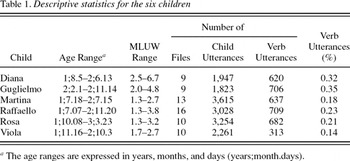
All the fully intelligible utterances containing a nonimperative verb that were neither direct imitations nor immediate self-repetitions were included in the analyses. Sentences included in songs, rhymes, and book reading were excluded. The total number of child utterances was 15,928, and the total number of child utterances containing a verb included in the analyses was 3,667. Table 1 provides information on the six participants, including their age range, the range of their MLUW at the start and at the end of the recordings, the number of files analyzed, the number of intelligible utterances, the number of utterances containing a verb, and the percentage of utterances containing a verb out of the total number of intelligible utterances.

Coding
We divided each child's data into four MLUW stages: Stage I (MLUW 1.5–2.0), Stage II (MLUW 2.0–3.0), Stage III (MLUW 3.0–4.0), and Stage IV (MLUW>4.0).6
Pooling the data into MLUW stages allowed us to compute percentages over a more substantial number of tokens than would have been possible for individual files. Computing percentages over very small sample sizes might generate spurious results: a small difference in the number of tokens can significantly affect the proportional value.

The verb vado [(I) go] is an irregular first person singular verb form; therefore, this was counted as a context for a first person singular subject with informativeness value of person=0. First and second person subjects are by definition always active, thus activation=0; and ambiguity can only arise with respect to third person referents, so disambiguation=0.

The target utterance is the last one in the example. Here, Martina used a null subject for a third person singular referent (person=1) that had been previously identified by the mother in her first utterance, and then again in her second utterance in conjunction with an indexical gesture to the referent in question. Pointing eliminates ambiguity; therefore, the value for disambiguation=0. The child must have attended to the mother's gesture because she correctly identified the action performed by the character. We can thus assume that because of prior discourse mention and the joint attention situation, this referent was highly active (activation=0) and the null subject used by the child was therefore pragmatically appropriate.

In the example above Guglielmo and his mother were looking at a picture book of the 101 Dalmatians story. There were many dogs but only one of them was sleeping. The child correctly used a third person singular masculine pronoun to express a subject that potentially had several ambiguous referents, in this case the subject lui (he) was coded as informative for disambiguation. The argument was also third person; therefore, person was assigned a value of 1. With respect to activation the fact that both the mother and the child were looking at the same picture book together when the child produced the target utterance, we assigned an activation value of 0.
RESULTS
The following sections present the results for the distribution of subjects over time, the role of informativeness features as predictors of argument realization, and a breakdown of overt pronominal and lexical subjects as a function of informativeness.
The distribution of null subjects over time
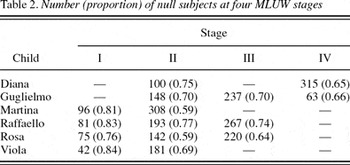
The results for the proportion of null subjects in the children's output are presented in Table 2. For each child we calculated the number and proportion of null subjects at each of the MLUW stages for which data were available.

The largest number of null subjects are found in third person singular contexts, a consequence of the fact that third person singular verb forms are the most frequent forms in the children's speech at all stages. In contrast to what was previously reported in the literature on Romance null-subject languages, the figures in Table 2 do not show a stage at which subjects are null 100% of the time. In fact, as early as an MLUW below 2.0, children use overt subjects in 16.0–23.5% of possible contexts. In sum, like their peers acquiring Portuguese, Spanish, and Catalan, Italian-speaking children use proportionally more overt subjects as their MLUW increases.
Children's null subjects were also typically appropriate as indicated by the low proportion of adult requests for clarification. There is a certain amount of variation in the proportion of the null subjects queried by an adult, with a range between 0.4% for Martina and 8.1% for Raffaello; however, in total, there are only 70 explicit requests for clarification from an adult, 64 of which occur after a null subject. The extracts in Examples 13 and 14 give examples of the children's null subjects with unclear reference:

The informative value of null and overt subjects
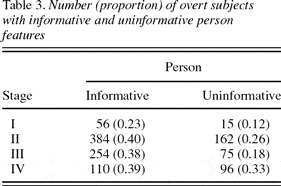
Our aim was to establish whether children acquiring Italian are sensitive to the pragmatics of the distribution of null and overt subjects in their language. Our prediction was that uninformative referents would be associated significantly more often with null subjects, and that informative referents would be associated significantly more often with overt subjects. To test this prediction we proceeded to investigate the impact of informativeness features selectively. First, we tested the hypothesis that person would be a reliable predictor of argument realization, with third person arguments more likely to be realized overtly than first or second person arguments. Table 3 reports the number and proportion of overt subjects associated with informative and uninformative features for person.

The data in Table 3 confirm that Italian-speaking children are sensitive to the informativeness value of person. Except at Stage IV, where there was no significant difference in the proportion of overt subjects between informative and uninformative contexts, overt subjects were used significantly more often when person was informative, that is, with third person subjects (Stage I, χ2=6.65, df=1, p<.01; Stage II, χ2=30.65, df=1, p<.001; Stage III, χ2=44.30, df=1, p<.001; Stage IV, χ2=2.15, df=1, p=.143). At the same time, this also implies that uninformative arguments were more likely to be realized by null rather than overt subjects. It is important to note that, although the children are sensitive to the value of person's informativeness from Stage I, nevertheless there is a significant difference between Stage I and Stage II in the proportion of overt subjects associated with third person arguments (χ2=22.61, df=1, p<.001), an indication that sensitivity to discourse-pragmatic features evolves over time.
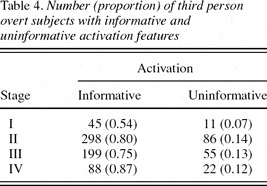
Second, we tested children's sensitivity to the activation state of referents. We performed the analyses only on third person referents as first and person referents are always active by definition. Once again, the prediction was that arguments associated with the informative value of the feature (i.e., inactive or semiactive referents) would be more likely to be realized overtly than uninformative arguments (i.e., active referents). The results of the analysis in Table 4 confirm this prediction: at each MLUW stage, we found a significant difference between the number of overt subjects with informative and with uninformative features (Stage I, χ2=68.12, df=1, p<.01; Stage II, χ2=417.32, df=1, p<.001; Stage III, χ2=256.60, df=1, p<.001; Stage IV, χ2=154.71, df=1, p<.001). These findings also imply that third person null subjects will be significantly more likely to be associated with active than inactive or semiactive referents.

Similarly to what was observed for the transition between Stages I and II, children become increasingly more attuned to the informativeness value of activation. In this case too there was a significant difference between the proportion of overt subjects associated with informative referents between Stage I and Stage II (χ2=25.55, df=1, p<.001).
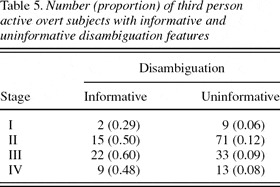
Third, we tested the hypothesis that third person active referents with more than one potential antecedent (disambiguation=1) would be realized overtly significantly more frequently than third person active referents that were unambiguous. The results in Table 5 confirm this prediction, everything else being equal (i.e., person=1 and activation=0), at every MLUW stage disambiguation is a reliable predictor of argument realization (Stage I, χ2=5.30, df=1, p<.05; Stage II, χ2=32.46, df=1, p<.001; Stage III, χ2=73.30, df=1, p<.001; Stage IV, χ2=25.05, df=1, p<.001). At the same time, null subjects will be more likely to be associated with third person active arguments that do not need to be disambiguated rather than with third person active arguments in need of disambiguation.

Unlike in the previous two cases, where we reported a significant difference between Stages I and II in the proportion of overt subjects associated with informative features, in the case of disambiguation the difference was not significant (χ2=1.05, df=1, p=.306).
Overt subjects
The results of the analyses on the impact of informativeness show that Italian-speaking children are sensitive to the subtle discourse-pragmatic constraints of subject argument realization from an early age. As early as MLUW 2.0, they can use null and overt subjects in complementary distribution in pragmatically appropriate ways. The following sections provide more detailed information on the type of overt subjects in the data.
Overt subject types
We first investigated what proportion of overt subjects was represented by personal subject pronouns (e.g., io [I], lei [she]), demonstrative pronouns (e.g., questo [this], quello [that]), proper names (e.g., Luca, Babbo Natale, [Father Christmas]), full noun phrases (determiner phrases [DPs]); (e.g., il cane [the dog], le macchinine [the toy cars]), bare noun phrases (e.g., cane [dog], macchinine [toy cars]), and by an Other category including indefinite pronouns (e.g., qualcuno [someone]) and quantifiers (tutto [everything]).7
In Italian, argumental bare noun phrases are not allowed in subject position (Longobardi, 1994), and the occurrences in the data are therefore to be considered ungrammatical.
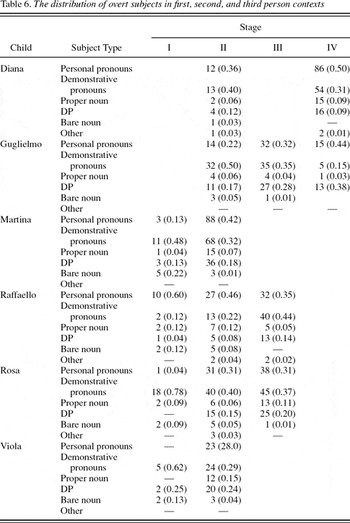
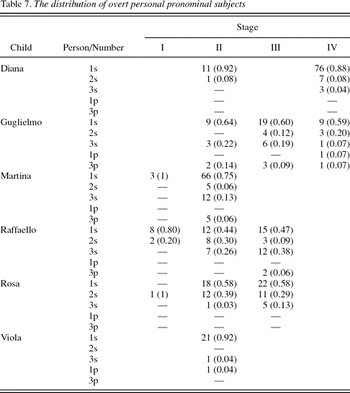
As shown in Table 6, except in Raffaello's case, the most substantial change in the distribution of overt subjects is represented by a larger proportion of pronominal subjects at higher MLUW stages. Because we have previously shown that the proportion of overt subjects overall increases as a function of MLUW, we can conclude that the increase in the use of overt subjects is largely accounted for by a proportionally larger number of personal pronouns. This finding is in line with what Valian and Eisenberg (1996) reported for Portuguese; however, in their study they did not provide figures for individual personal pronouns. To obtain a more accurate picture of the role of person and number in the distribution of subject pronouns, we investigated what proportion of overt personal pronominal arguments was represented by first, second, or third person forms. In Table 7 we present a breakdown of overt pronominal forms by person and number.


The figures highlight the special place of the first person singular subject pronoun io, the most frequent pronominal subject (N=289); followed by the second person singular pronoun te (you; N=57), a colloquial nonaccusative variant of tu; third person singular masculine pronoun lui (he; N=47); third person singular feminine pronoun lei (she; N=4); third person plural loro (they; N=13); and first person plural noi (we; N=2). These data show a revealing discrepancy in the relative proportional frequency of the different forms, with first person pronouns accounting for more than half of all overt subject pronouns at all stages. Because first and second person referents are by default always active and unambiguous, the use of an overt pronoun is typically associated with a wide or narrow focus where the overt realization of the argument is justified by a contrastive function:

We examined all the first person pronominal subjects used by the children to verify the extent to which they signaled wide or narrow focus. Out of 289 io subjects, 213 (74%) were used appropriately:

The remaining 76 overt first person subjects did not serve any obvious contrastive function.

By contrast, we could not find any examples of second person singular pronouns not used contrastively. They were typically found in questions where children requested that the adult do something for them.

Third person subject pronouns, both singular and plural, accounted for a small proportion of pronominal forms and, as we will show in the following section, they also accounted for a small percentage of overt subjects in third person contexts.
Demonstratives and lexical subjects
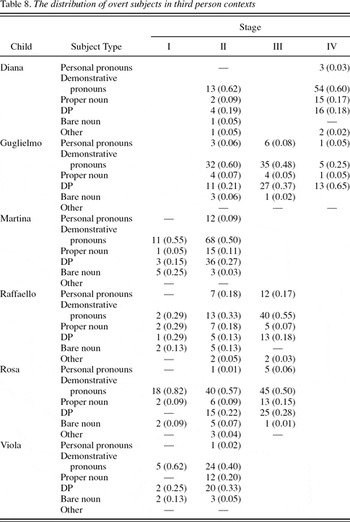
The increased number of overt subjects in third person contexts was due to a larger number of nonpersonal pronominal forms (e.g., demonstratives), DPs, and proper nouns. Table 8 reports the number and the proportion of overt subjects in third person contexts.

At all stages and for all children, the proximal and distal demonstrative pronouns questo (this) and quello (that) were consistently the most frequent overt subjects, followed by definite noun phrases, proper names, bare nouns, and expressions in the Other category, including indefinite pronouns and quantifiers. Although demonstrative pronouns accounted for the largest percentage of overt subjects in third person contexts, only one child (Raffaello) used proportionally more demonstratives over time, two of the children (Rosa and Viola) used fewer, and for the other two children, the proportion remained stable across MLUW stages (Diana and Martina). The large number of demonstratives is to be expected, given the nature of the adult–child interaction in the recording sessions, where most of the conversations revolved around toys or characters in books that were physically present and available to both interlocutors. Moreover, demonstratives were also the prototypical subjects used in labeling, another frequent type of exchange in early adult–child exchanges. Indeed, between 50.0% of all demonstratives at Stage I and 80% at Stage III were used with the copula followed by a noun or an adjective, in labeling contexts in constructions of the type questo/quello è+x (this/that is+x).
Although not as frequent as demonstratives, DPs and proper names featured increasingly more prominently at later MLUW stages. Three of the children (Martina, Rosa, and Viola) used proportionally more DPs and proper names over time, one used relatively more DPs (Guglielmo), one increased her use of proper names relative to other referential expressions in third person contexts (Diana), and the increasing proportion of demonstratives observed earlier in Raffaello's data were a detriment of DPs and proper names.
DISCUSSION
This longitudinal investigation has provided new empirical evidence on subject use in 6 monolingual Italian children between ages 1;7 and 3;3. Our working hypothesis was that children's subject use would conform to a principle of informativeness whereby the arguments that are the most informative would be realized overtly, and conversely those that are the least informative would be null. From as early as MLUW 2.0 there were indications that Italian-speaking children do not omit subjects randomly, but do so following a number of pragmatic constraints. There was also a significant transition from Stage I and Stage II for the role of person and activation indicating that, although children are sensitive to discourse-pragmatic features in their choice of referential expressions, this sensitivity becomes more fine-tuned over time. This developmental shift did however occur early on, and from Stage II onward we did not detect a significant change in the extent to which the children paid attention to discourse pragmatic features.
One of the significant predictors was person: on average, arguments were two times more likely to be realized overtly when they were third person than when they were either first or second person. Activation and disambiguation were also found to be significantly associated with argument realization; referents that needed to be activated and/or disambiguated were significantly more likely to be realized overtly than referents that were uninformative with respect to these two features. This pattern of overt subject use has important implications for the two accounts of subject use in null-subject languages that have been proposed thus far.
Neither a syntactic approach (Grinstead, 2000) nor a performance deficit account (Bloom, 1990; Valian, 1991; Valian & Eisenberg, 1996) can offer a satisfactory explanation for the selective omission of subjects in contexts where the features person, activation, and disambiguation are uninformative. From a syntactic perspective, although the emergence of tense and number morphosyntax may indeed be a necessary requirement for the use of overt subjects, it is not sufficient to explain why a differential omission rate should be found in connection with different persons, or with the status of activation or disambiguation that a referent is in. All subjects must receive abstract case, regardless of whether they are first, second, or third person or whether they are active or inactive, ambiguous or unambiguous. A syntactic approach based on case assignment alone cannot offer an explanation of why subjects are more likely to be realized overtly in third person contexts than in non-third person contexts, or in contexts in which the referent is inactive or ambiguous.
The pattern of subject drop that we observed in our sample also poses a challenge to a developmental account that relies exclusively on a generic performance limitation (Bloom, 1990; Valian, 1991; Valian & Eisenberg, 1996). In particular, if children are constrained by limited processing capacities, we would expect inactive and ambiguous referents to be omitted more frequently than active and unambiguous referents. However, our findings showed exactly the opposite pattern of argument realization, an indication that something other than a pure performance deficit must be at work. With specific reference to person, whereas first and second person subjects are constituted by light subject pronominal forms, third person subjects are overwhelming expressed by heavier nominal forms such as demonstratives, definite noun phrases, and proper nouns. If economy driven by processing limitations was the major reason for the omission of subjects, we would expect that more demanding forms, such as nonpronominal forms, would be more likely to be omitted than lighter forms, such as subject pronouns, whereas the reverse is actually the case. We agree that, in principle, it is reasonable to assume that children's initial linguistic production is the most economical trade-off between high processing costs and the desire to engage in verbal communication. The empirical evidence however shows that these limitations are overridden in cases in which the discourse and pragmatic conditions require the expression of crucial information. In the case of anaphoric relations in Italian this translates into the use of overt subjects.
The fact that Italian-speaking children are sensitive to the pragmatic conditions under which null subjects are acceptable is equally shown by the very low rate of adult requests for clarification. If children were omitting subjects without any regard to their acceptability, we would expect a large proportion of null subjects with unclear reference. Although this was not the case, it must nevertheless be acknowledged that the discourse setting of the adult–child interactions in the sample typically revolved around referents that were physically present and available to all interlocutors, because children mostly participated in joint attentional frames with their adult conversational partners (Tomasello, 2003). The children could therefore exploit the shared context to their advantage through the deictic use of a null subject to pick a referent identified by the extralinguistic context. In addition, the children could count on the adult interlocutors to compensate for their limited expressive abilities. When it comes to introducing a new referent children initially leave the initiative to their adult partners, they limit themselves to adding information on an established topic. As noted by Givón, (1979, p. 87), “this ‘spreading across participants’ is one of the earliest modes of communication… one participant will establish the topic-presupposition and the other will then supply the focus-assertion.” Being aware of children's limited resources, adults tend to shoulder the heavier burden of the conversational exchange by providing relevant new information and inviting children to expand upon it (Ervin–Tripp, 1970). Over development the balance is readdressed, and as children engage more actively in conversation they themselves choose the referents they want to talk about. This gradual transition is marked by an increase in the proportion of overt subjects over time. Growing conversational and pragmatic competence is reflected in the establishment of topic maintenance, whereby reference to the same topic is maintained through the use of anaphoric null subjects in successive utterances and the introduction of new information in the form of overt subjects.
The single most striking fact about the overt subjects used by the children is, however, the frequency of first person subject pronouns. The pronoun io accounted for between 44 and 92% of all pronominal subjects. An investigation of the pragmatic function of the first person subject pronouns revealed that a sizeable proportion of these subjects did not serve an obvious contrastive pragmatic function. The frequent use of the first person subject pronoun was observed previously in the acquisition literature on Italian (Antelmi, 1997; Bates, 1976; Guasti, 2002). Crosslinguistic evidence also indicates that the first person subject pronoun has a privileged status in Spanish and in English. Austin and colleagues (1996) reported that almost 70% of all overt personal pronouns were tokens of yo (I) for 10 Spanish-speaking children between MLUW 1.3 and 5.0. Austin et al. tentatively suggested that their Spanish-speaking subjects did not seem to have mastered the language-specific pragmatic constraints on the distribution of overt pronouns.
First person subjects also accounted for 44–63% of the pronominal subjects used by the American children in Valian (1991), and Pine, Lieven, and Rowland (1998) reported that “I” was the first subject pronoun to emerge in the speech of the English-speaking children in their study.
In addition, it is worth noting that there clearly is a degree of individual variation with only some children in our sample using first person singular subjects at a much higher rate than would be predicted from maternal input frequency. Such a quantitative difference may ultimately be related to a qualitative difference with some children being more inclined to talk about themselves and their own needs using proportionally more first person subjects and others being more interested in commenting about the world around them using more second and third person subjects. Such a qualitative distinction might be somewhat similar in nature to the distinction in vocabulary style between referential and expressive children originally proposed by Nelson (1973).
CONCLUSION
In this longitudinal investigation of subject use in the acquisition of Italian we adopted a pragmatically oriented approach where the use of referential argument forms was studied in connection with their pragmatic function. In line with previous findings for other non-Romance null-subject languages, our results have shown that, from early on, Italian children are sensitive to the discourse pragmatic constraints that regulate the distribution of null and overt subjects in their language. The integration of selected pragmatic informativeness features allowed us to formulate and test a number of predictions that neither a performance limitation account nor a syntactic account could deal with satisfactorily.
As linguistic development takes place, not only do children learn what they can and cannot say, but they also learn how and when they can do so. If we want to do justice to the complexity of the phenomenon, the study of language acquisition cannot be divorced from the study of language use.
Although naturalistic data are extremely valuable to assess children's discourse competence, there is little scope for the manipulation of factors such as presence and ambiguity of referents, joint attention with the hearer, and so on. As a consequence, it is often difficult to assess to what extent children's performance is facilitated by the particular conversational setting and impossible to know how they would behave under different conditions. The careful design of experimental tasks manipulating some of the predictor variables analyzed in this study will be necessary to provide more controlled evidence for children's integration of discourse-pragmatic and syntactic competence.
ACKNOWLEDGMENTS
This research was supported by the UK Economic and Social Research Council (Grant R000223762). A preliminary version of this paper was presented at the 4th Annual Gregynog Conference on Child Language, University of Wales at Bangor, April 2002; at the 32nd Linguistics Symposium on Romance Languages, University of Toronto, April 2002; and at the 9th Meeting of the International Association for the Study of Child Language, University of Madison, July 2002.
Thanks to the audiences at these conferences for helpful comments and advice. I also thank Caroline Rowland and Antonella Sorace for giving me detailed feedback on a draft version. Very special thanks are due to Shanley Allen for sharing her work so generously with me and for providing much inspiration, and to Barbora Skarabela for her inquisitive questions and thought-provoking ideas. The views expressed here, as well as any inaccuracies and mistakes, are, of course, my sole responsibility.
References
Aguado–Orea J., &
Pine J.
2002.
There is no evidence for a “no overt subject” stage in early child Spanish: A note on Grinstead (2000).
Journal of Child Language,
29,
865–
874.Google Scholar
Aissen J.
1999.
Markedness and subject choice in optimality theory.
Natural Language and Linguistic Theory,
17,
673–
711.Google Scholar
Allen S.
2000.
A discourse-pragmatic explanation for argument representation in child Inuktitut.
Linguistics,
38,
483–
521.Google Scholar
Allen S. (in press).
Interacting pragmatic influences on children's argument realization.
In M. Bowerman &
P. Brown (Eds.),
Crosslinguistic perspectives on argument structure: Implications for learnability.
Mahwah, NJ:
Erlbaum.
Allen S., &
Schröder H.
2003.
Preferred argument structure in early Inuktitut spontaneous speech data.
In J. W. Du Bois,
L. Kumpf, &
W. Ashby (Eds.),
Preferred argument structure: Grammar and architecture for function.
Amsterdam:
John Benjamins.
Antelmi D.
1997.
La prima grammatica dell'italiano: Indagine longitudinale sull'acquisizione della morfosintassi italiana.
Bologna:
Il Mulino.
Ariel M.
1990.
Assessing noun-phrases antecedents.
London:
Routledge.
Ariel M.
1996.
Referring expressions and the +/− coreference distinction.
In T. Fretheim &
J. Gundel (Eds.),
Reference and referent accessibility
(pp. 13–
35).
Amsterdam:
John Benjamins.
Austin J.,
Blume M.,
Parkinson D.,
Núnez del Prado Z., &
Lust B.
1996.
Interactions between pragmatic and syntactic knowledge in the first language acquisition of Spanish null and overt pronominals.
In J. Lema &
E. Trevino (Eds.),
Theoretical analyses on Romance languages
(pp. 35–
47).
Amsterdam:
John Benjamins.
Bates E.
1976.
Language and context: The acquisition of pragmatics.
New York:
Academic Press.
Bloom P.
1990.
Subjectless sentences in child language.
Linguistic Inquiry,
21,
491–
504.Google Scholar
Chafe W.
1976.
Givenness, contrastiveness, definiteness, subjects, topics, and point of view.
In C. Li (Ed.),
Subject and topic
(pp. 25–
55).
London:
Academic Press.
Chafe W.
1994.
Discourse, consciousness, and time: The flow and displacement of conscious experience in speaking and writing.
Chicago:
University of Chicago Press.
Chafe W.
1996.
Inferring identifiability and accessibility.
In T. Fretheim &
J. Gundel (Eds.),
Reference and referent accessibility
(pp. 37–
46).
Amsterdam:
John Benjamins.
Cipriani P.,
Pfanner P.,
Chilosi A. M.,
Cittadoni l.,
Ciuti A.,
Maccari A.,
Pantano N.,
Pfanner L.,
Poli P.,
Sarno S.,
Bottari P.,
Cappelli G.,
Colombo C., &
Veneziano E.
1989.
Protocolli diagnostici e terapeutici nello sviluppo e nella patologia del linguaggio (1/84 Ministry of Health).
Pisa, Italy:
Stella Maris Foundation.
Clancy P.
1993.
Preferred argument structure in Korean acquisition.
In E. Clark (Ed.),
The proceedings of the Twenty-Fifth Annual Child Language Research Forum
(pp. 307–
314).
Stanford, CT:
CSLI.
Cornish F.
1999.
Anaphora, discourse, and understanding.
Oxford:
Oxford University Press.
Dimitriadis A.
1995.
When pro-drop languages don't: On overt pronominal subjects in Greek.
Penn Working Papers in Linguistics,
2,
45–
60.Google Scholar
Ervin–Tripp S.
1970.
Discourse agreement: How children answer questions.
In J. Hayes (Ed.),
Cognition and the development of language
(pp. 79–
107).
New York:
Wiley.
Givón T.
1979.
On understanding grammar.
New York:
Academic Press.
Givón T.
1984.
Syntax: A functional-typological introduction (Vol. 1).
Amsterdam:
John Benjamins.
Greenfield P., &
Smith J. H.
1976.
The structure of communication in early language development.
New York:
Academic Press.
Grinstead J.
2000.
Case, inflection and subject licensing in child Catalan and Spanish.
Journal of Child Language,
27,
119–
156.Google Scholar
Guasti M. T.
2002.
Language acquisition. The growth of grammar.
Cambridge, MA:
MIT Press.
Guerriero S.,
Cooper A.,
Oshima–Takane Y., &
Kuriyama Y.
2001.
A discourse-pragmatic explanation for argument realisation and omission in English and Japanese children's speech.
In A. Do (Ed.),
BUCLD 25 Proceedings
(pp. 319–
330).
Somerville, MA:
Cascadilla Press.
Gundel J.
1996.
Relevance theory meets the givenness hierarchy: an account of inferrables.
In T. Fretheim &
J. Gundel (Eds.),
Reference and referent accessibility
(pp. 141–
153).
Amsterdam:
John Benjamins.
Gundel J.,
Hedberg N., &
Zacharski R.
1993.
Cognitive status and the form of referring expressions in discourse.
Language,
69,
274–
307.Google Scholar
Halliday M., &
Hasan R.
1976.
Cohesion in English.
London:
Longman.
Huang Y.
1994.
The syntax and pragmatics of anaphora: A study with special reference to Chinese.
Cambridge:
Cambridge University Press.
Huang Y.
1995.
On null subjects and null objects in generative grammar.
Linguistics,
33,
1081–
1123.Google Scholar
Huang Y.
2000.
Anaphora: A crosslinguistic study.
Oxford:
Oxford University Press.
Hyams N.
1986.
Language acquisition and the theory of parameters.
Dordrecht:
Reidel.
Hyams N., &
Wexler K.
1993.
On the grammatical basis of null subjects in child language.
Linguistic Inquiry,
24,
421–
460.Google Scholar
Kempson R.
1996.
Semantics, pragmatics and interpretation.
In S. Lappin (Ed.),
The handbook of contemporary semantic theory
(pp. 561–
598).
Oxford:
Blackwell.
Lambrecht K.
1994.
Information structure and sentence form: Topic, focus, and the mental representations of discourse referents.
Cambridge:
Cambridge University Press.
Levinson S.
1991.
Pragmatic reduction of the binding conditions revisited.
Journal of Linguistics,
27,
107–
161.Google Scholar
Levinson S. C.
1987.
Pragmatics and the grammar of anaphora: A partial pragmatic reduction of binding and control phenomena.
Journal of Linguistics,
23,
379–
434.Google Scholar
MacWhinney B.
2000.
The CHILDES project: Tools for analyzing talk
(3rd ed.).
Hillsdale, NJ:
Erlbaum.
Nelson K.
1973.
Structure and strategy in learning to talk.
Chicago:
University of Chicago Press.
Orsolini M. &
Di Giacinto P.
1996.
Use of referential expressions in 4-year-old children's narratives: invented versus recalled stories.
In C. Pontecorvo,
M. Orsolini,
B. Burge, &
L. Resnick (Eds.),
Children's early text construction
(pp. 67–
81).
Mahwah, NJ:
Erlbaum.
Orsolini M.,
Rossi F., &
Pontecorvo C.
1996.
Re-introduction of referents in Italian children's narratives.
Journal of Child Language,
23,
465–
486.Google Scholar
Paradis J., &
Navarro S.
2003.
Subject realization and cross-linguistic interference in the bilingual acquisition of Spanish and English: What is the role of the input?
Journal of Child Language,
30,
1–
23.Google Scholar
Pine J.,
Lieven E., &
Rowland C.
1998.
Comparing different models of the development of the English verb category.
Linguistics,
36,
807–
830.Google Scholar
Serratrice L.
(2002, July 16–21).
Syntax and pragmatics in the acquisition of subjects in Italian.
Paper presented at the Ninth meeting of the International Association for the Study of Child Language,
University of Madison.
Serratrice L.,
Sorace A., &
Paoli S.
2004.
Crosslinguistic influence at the syntax-pragma- tics interface: Subjects and objects in English-Italian bilingual and monolingual acquisition.
Bilingualism: Language and Cognition,
7,
183–
205.Google Scholar
Sperber D., &
Wilson D.
1995.
Relevance: Communication and cognition.
Oxford:
Blackwell.
Tomasello M.
2003.
Constructing a language. A usage-based theory of language acquisition.
Cambridge, MA:
Harvard University Press.
Valian V.
1991.
Syntactic subjects in the early speech of American and Italian children.
Cognition,
40,
21–
81.Google Scholar
Valian V., &
Eisenberg Z.
1996.
The development of syntactic subjects in Portuguese-speaking children.
Journal of Child Language,
23,
103–
128.Google Scholar
van Hoek K.
1995.
Conceptual reference points: A cognitive grammar account of pronominal anaphora constraints.
Language,
71,
310–
340.Google Scholar
Descriptive statistics for the six children
Number (proportion) of null subjects at four MLUW stages
Number (proportion) of overt subjects with informative and uninformative person features
Number (proportion) of third person overt subjects with informative and uninformative activation features
Number (proportion) of third person active overt subjects with informative and uninformative disambiguation features
The distribution of overt subjects in first, second, and third person contexts
The distribution of overt personal pronominal subjects
The distribution of overt subjects in third person contexts
 You have
Access
- 84
- Cited by