INTRODUCTION
Richard Arneson has proposed that prioritarianism be adjusted to incorporate considerations of individual desert. This article reaches a different conclusion: desert-modulated prioritarianism is a non-starter.
A large philosophical literature now exists on prioritarianism.Footnote 1 This includes numerous criticisms of the approach. It has been argued that prioritarianism is not meaningfully distinct from utilitarianism;Footnote 2 not meaningfully distinct from egalitarianism;Footnote 3 lacks a justification;Footnote 4 ignores comparative fairness;Footnote 5 gives undue priority to worse-off individuals above a sufficiency threshold;Footnote 6 is inappropriately aggregative;Footnote 7 doesn't respect the separateness of persons;Footnote 8 and has unwelcome implications under risk.Footnote 9 Other philosophers are not persuaded by these criticisms and endorse prioritarianism.Footnote 10
This now-familiar debate about prioritarianism will not be further rehearsed here. Rather, I address an important question for those who endorse prioritarianism, namely: what about desert? Prioritarianism gives extra weight to the well-being of individuals who are worse off. Shouldn't it also give extra weight to the well-being of individuals who are more deserving? Arneson suggests that it should:
The picture then is that increasing human well-being and preventing reductions of it is always morally a good thing, but the moral goal is not to maximize the sum total of well-being but to maximize the total of well-being weighted by distributional factors. One factor is priority [for those at lower well-being levels]. . . . A second is that it is better to obtain a gain for a person who is specifically more deserving than others to whom the same-sized gain might be given. One is specifically more deserving than others who might be accorded the benefit in question if channeling the benefit to one rather than to any of the others would do most to bring it about that the well-being levels these people are at are proportional to their level of desert. Other things being equal, it is better to get a benefit to someone who is more deserving in this sense, and, other things being equal, it is better to get a benefit to someone, the lower her lifetime well-being without this benefit . . .Footnote 11
In short, ‘[t]he position we then arrive at is desert and well-being prioritarianism with extra priority to well-being gains for the comparatively more deserving’.Footnote 12
This article considers the prospects for desert-modulated prioritarianism through the lens of individual ‘claims’. I have elsewhere argued that the concept of claims-across-outcomes (for short, ‘claims’) provides a powerful justification for key axiomatic elements of prioritarianism.Footnote 13
Section I of the article reviews the claim-based argument for prioritarianism in the case of undifferentiated desert. With undifferentiated desert, the claims framework argues for three fundamental clusters of principles: the two well-being Pareto principles (Pareto indifference and strong Pareto); the Pigou–Dalton principle; and the Anonymity principle. Adding additional axioms to the mix, we arrive at prioritarianism and then continuous prioritarianism.
Sections II and III consider the possibility of desert-modulated claims. Individuals differ in some non-well-being attribute (desert) that bears on the strength of their claims. With desert-modulated claims, four fundamental clusters of principles seem very plausible: first, the two well-being Pareto principles (indifference and strong); second, a modified version of the Pigou–Dalton principle; third, a modified version of the Anonymity principle; and, finally, a new principle, Priority for the More Deserving, which says this: as between two individuals at the same well-being level, a given well-being benefit should be conferred upon the more deserving one.
In the case of intrapersonally fixed desert, the four clusters of principles are consistent. Adding further axioms, we arrive at desert-modulated continuous prioritarianism. However, if the set of outcomes being considered is such that a given individual's desert level can vary between outcomes, Priority for the More Deserving may come into conflict with the well-being Pareto principles.
Section IV considers various strategies for rescuing desert-modulated prioritarianism, notwithstanding the conflict between Priority for the More Deserving and the well-being Pareto principles. It concludes that none suffice to do so, at least if the justificatory foundation for prioritarianism lies in individual claims.
There are, to be sure, non-claim-based arguments for prioritarianism. I generally focus on the claim-based approach because I believe that this offers a stronger case for prioritarianism than alternatives. Still, the reader might wonder whether my negative verdict about desert-modulated prioritarianism carries over to these alternative justifications. This question is briefly discussed in section IV.Footnote 14
I. THE CLAIMS FRAMEWORK: UNDIFFERENTIATED DESERT
The formal set-up throughout the article is as follows. There is a set of possible outcomes S = {x, y, . . .}.Footnote 15 The outcomes are ranked with respect to moral goodness. This moral-goodness ranking takes the form of a quasi-ordering of the outcomes.Footnote 16 I'll drop the term ‘moral’, which is henceforth implicit in my discussion of the goodness/betterness of outcomes, and speak simply of one outcome being better than, worse than, equally good as, or incomparably good as a second.
There is a fixed and finite population of N individuals, whose well-being is of moral concern. The well-being levels and differences of these individuals are intra- and interpersonally comparable, perhaps with some incompleteness.Footnote 17 Another semantic point: phrases involving goodness/betterness for an individual (for example, ‘x is better for Sue than y’ or ‘Sue is better off in x than in y’) are here synonymous with talk about her well-being (‘Sue's level of well-being is greater in x than y’).
A claim-across-outcomes (for short, ‘claim’) is a relation between an individual and two outcomes. Given any individual i and any two outcomes x, y, individual i’s claim can have one of four ‘valences’: she has a claim in favour of x over y, or in favour of y over x, or a null claim between the two, or an incomparable claim. The valence of an individual's claim depends upon her well-being: individual i has a claim in favour of x over y if she is better off in x than in y; a claim in favour of y over x if she is better off in y than x; a null claim between x and y if she is equally well off in the two outcomes; and an incomparable claim between the two if she is neither better off in x, nor better off in y, nor equally well off in the two outcomes.
Individual claims also have a strength. This section assumes undifferentiated desert. It is assumed, for now, that individuals are identically situated with respect to all desert factors that may bear upon the strength of claims, apart from well-being. On this assumption, the strength of i’s claim between x and y is just a function of his well-being levels in the two outcomes and his well-being difference between them.
The comparative goodness of any two given outcomes depends on the pattern of individual claims between them: on the valence and strength of each person's claim.Footnote 18 This operationalizes the idea, going back to Thomas Nagel, that morality takes seriously, indeed is built up from, each individual's perspective (‘point of view’).Footnote 19 The set S of outcomes can be evaluated from the perspective of each of the N persons in the population; and the moral ranking of S is determined by the collection of these N individual evaluations. That Sue has a claim to x over y is just to say that x is ranked higher from Sue's perspective; and that she has a null claim, that the two outcomes are ranked equal from her perspective.
A. Fundamental principles: Well-Being Pareto, Pigou–Dalton, Anonymity
With undifferentiated desert, a very strong case can be made for each of the following three clusters of principles. I list the principles, and then summarize the case for each.
The Well-Being Pareto Principles. (a) Well-Being Pareto Indifference. If each person is equally well off in outcome x as she is in outcome y, then x and y are equally good. (b) Well-Being Strong Pareto. If each person is at least as well off in y as she is in x, and at least one person is strictly better off in y, then y is better than x.
Pigou–Dalton. Let outcomes x and y be such that: (1) one individual (‘Higher’) is better off in x than y, while a second (‘Lower’) is better off in y than x; (2) Higher's level of well-being in x is greater than Lower's in x, while Higher's level of well-being in y is at least as high as Lower's in y; (3) the difference between Higher's level of well-being in x and her level of well-being in y is equal to the difference between Lower's level of well-being in y and his level of well-being in x; and (4) everyone else is equally well off in x as he is in y. If so, y is better than x.
Anonymity. Let the well-being levels of the N individuals in outcome y be a permutation (rearrangement) of their well-being levels in outcome x. Then x and y are equally good.Footnote 20
The well-being Pareto principles flow directly from the claims set-up. If each person is equally well off in x as she is in y, then each person has a null claim between the two. It follows that x is neither better than y, nor worse than y. If the moral comparison of x and y is meant to depend upon the collection of rankings from the N individual perspectives, and all of these are indifferent, then there is nothing to make an affirmative moral case for x over y, or vice versa. By a further bit of reasoning, we see that the two outcomes are equally rather than incomparably good.Footnote 21
As for Well-Being Strong Pareto: if at least one person is better off in y than x, and everyone is at least as well off, then there is at least one claim in favour of y, and all other claims either also point this way or are null. Surely, then, y is better than x. If morality supervenes on the collection of individual perspectives, then: (a) the fact that y is ranked higher from at least one individual perspective should surely have pro tanto moral weight in favour of y, and moreover (b) only another such consideration, the fact that y is ranked lower than x from someone else's viewpoint, should be able to override this pro tanto weight.
The chain of reasoning from the claims framework to Pigou–Dalton is, I believe, equally compelling. Why? Higher has a claim in favour of x; Lower has a claim in favour of y; and everyone else has null claims. In this case of two conflicting claims, the outcome favoured by the stronger claim will be, on balance, better. But who does have the stronger claim? Surely it is Lower. Consider the plausible factors that, in general, might affect the strength of an affirmative claim: (a) the claimant's well-being difference between the two outcomes; (b) the claimant's well-being levels in the two outcomes; (c) her desert. We are assuming undifferentiated desert, and so factor (c) drops away. Crucially, by virtue of the antecedent conditions for the Pigou–Dalton principle, factor (a) drops away too. What Lower stands to gain in welfare, were outcome y to obtain rather than x, is exactly what Higher stands to lose. Higher cannot argue (as she might in a different case) that the magnitude of the change in her well-being, between the two outcomes, is larger than the magnitude of the change in Lower's – and thus that her claim is stronger. By the antecedent conditions, these magnitudes are the same.
And so we are left with factor (b). But, surely, this factor cuts for Lower. Lower can say to Higher: ‘The well-being level to which you assert a claim (your level in x) is higher than the well-being level to which I assert a claim (my level in y). Indeed, if my claim rather than yours is honoured, your level (in y) would be no lower than mine. Surely these facts about our well-being levels have some relevance to the comparative strength of our claims.’ And Lower can continue: ‘What can you say, in response, to show that x is on balance better than y? Nothing – not that I am less deserving, nor (as you might in another case) that the difference the x/y choice makes to your life is larger than the difference it makes to mine.’
A parenthetical note: a significant contribution of the claims framework (or so I believe) is to provide a unified defence of the well-being Pareto principles and the Pigou–Dalton principle. Often, these are seen as arising from two distinct moral concerns: efficiency or overall well-being, in the first case, and equity, in the latter case. To be sure, the well-being Pareto principles and the Pigou–Dalton principle are logically distinct: neither implies the other. But the claims framework shows how they are linked as a matter of justification.
The Anonymity axiom is defended as follows. Let's say that two outcomes, x and x*, are related by a ‘two-person permutation’ if there are two individuals who switch well-being levels (the level of one in x is the same as the level of the other in x*, and vice versa), and everyone else has the same well-being level in x as she does in x*. If x and x* are related by a two-person permutation, then only the two ‘switched’ individuals can have non-null claims. By symmetry the two claims are equally strong, and so x and x* are equally good.
Further, it can be shown that whenever the well-being levels in y are a permutation of the well-being levels in x, y can be reached from x by a finite series of two-person permutations.Footnote 22 Denote this series as x, x*, x**, x***, . . ., y. By transitivity, x is equally good as x* is equally good as x** . . . is equally good as y.
B. From the fundamental principles to continuous prioritarianism
What characterizes a prioritarian goodness ranking of outcomes? It is reasonably consistent with the literature to define ‘prioritarianism’ as the class of outcome rankings that satisfy the well-being Pareto principles, the Pigou–Dalton principle, and Anonymity – the three clusters of principles set out above – plus an axiom of separability.Footnote 23 Separability says that if some individuals in the population of concern are ‘unaffected’ by a pair of outcomes, x and y – each such individual has the same well-being level in x as he does in y – then the comparative goodness of x versus y is independent of the specific well-being level of each such individual.Footnote 24
But what justifies the Separability axiom? This axiom can be defended by direct appeal to the concept of claimsFootnote 25 – although that defence is, admittedly, less compelling than the argument from the claims framework to the well-being Pareto principles, Pigou–Dalton, and Anonymity. A second defence of Separability is pragmatic. Dropping Separability would mean that even if the obtaining of one or another outcome in a pair has only a local impact (such that the only individuals affected by this pair are those within some region, or jurisdiction, or those with a certain social role, or living at a particular time), we couldn't ascertain the better outcome without determining the effects of the outcomes on the local group and the well-being levels of unaffected individuals in other regions, jurisdictions, generations, etc.
Let's now add some additional axioms to the mix – the four further axioms of Measurability, Consistency, Completeness, and Continuity.
Measurability. There is a well-being measure w(.), which translates a given outcome into a list (‘vector’) of well-being numbers, one for each individual in the population of concern. Outcome x becomes the vector (w 1x, w 2x, . . ., wNx), with wix the well-being number assigned by w(.) to individual i given outcome x.
These w numbers track individual well-being. Individual i in outcome x is at least as well off as individual j in outcome y iff wix is at least as large as wjy – and similarly for well-being differences.Footnote 26
Consistency. If x and y are in some set S of outcomes, and the goodness ranking of S is such as to rank x at least as good as y, then the goodness ranking of every other set to which x and y both belong must also be such as to rank x at least as good as y.
Completeness. For every two outcomes, either the first is better than the second, or worse than the second, or equally good. In other words, it is never the case that outcomes are incomparably good.
Continuity. If one well-being vector is ranked better than (worse than) a second, then there is some zone around the first vector such that every vector in this zone is also better than (worse than) the second.
These four further axioms can be justified on pragmatic grounds,Footnote 27 and Consistency can also be defended on substantive grounds.Footnote 28
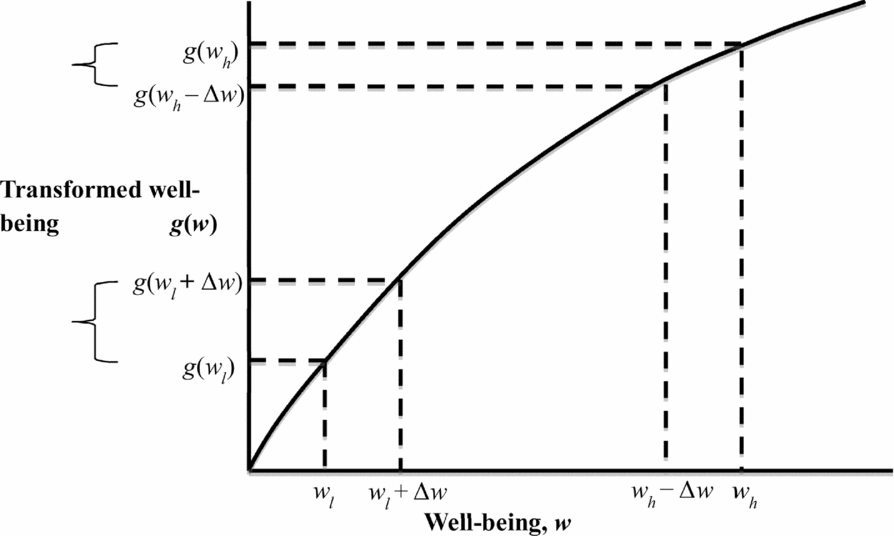
The following can now be demonstrated. (See Appendix.)Footnote 29 The fundamental axioms (the well-being Pareto principles, Pigou–Dalton, and Anonymity), plus Separability, plus the four further axioms, imply the following: the goodness ranking of outcomes is mirrored by the sum of concavely Footnote 30 transformed individual well-being. We start with each individual well-being number in the vector corresponding to a given outcome, and ‘transform’ that well-being number using a strictly increasing and strictly concave function g(.) – as in Figure 1. Outcome x is at least as good as outcome y iff the sum of the concavely transformed well-being numbers corresponding to x is at least as large as the sum of the concavely transformed well-being numbers corresponding to y.
Continuous prioritarianism

For short, let's refer to a goodness ranking of this sort as ‘continuous prioritarianism’, and let's abbreviate the formula for the sum of concavely transformed well-being as ∑g(wi). In so far as the extant literature on prioritarianism employs a mathematical representation, it often does use the formula ∑g(wi). To repeat: this formula is a tractable specification of prioritarianism that emerges by combining the principles that capture the core of prioritarianism (the well-being Pareto principles, Pigou–Dalton, Anonymity, and Separability) with four further axioms.
II. DESERT-MODULATED CLAIMS
A. Fundamental principles: Well-Being Pareto, DM Pigou–Dalton, DM Anonymity, Priority for the More Deserving
Let's now posit that individuals have an attribute, ‘desert’, which works as follows. First, for any person and any outcome, that person has some level of desert in that outcome. Second, these desert levels are intra- and interpersonally comparable, perhaps with some incompleteness. Finally, desert levels figure into the strength of claims, independent of well-being. A higher desert level tends to strengthen an individual's claim.
There are various plausible conceptions of desert, thus understood. Desert might be degree of prudence.Footnote 31 The more carefully I have attended to my own interests, the more powerful my claim, ceteris paribus. Alternatively, desert might be moral conscientiousness: the more I have worked to advance both my well-being and everyone else's, the stronger my claim, ceteris paribus.Footnote 32 Finally, desert might be some hybrid of prudence and moral conscientiousness.Footnote 33
However, the analysis to follow does not rely upon adopting one or another specific conception of desert. Rather, desert is anything about an individual, other than her well-being, that modulates the strength of her claims.
With desert in play, we can use the claims framework to argue for four fundamental clusters of axioms, not three: the well-being Pareto principles, a desert-modulated (DM) Pigou–Dalton principle, desert-modulated (DM) Anonymity, and Priority for the More Deserving. (The well-being Pareto principles are the same as above, but are repeated for convenience.)
The Well-Being Pareto Principles. (a) Well-Being Pareto Indifference. If each person is equally well off in outcome x as she is in outcome y, then x and y are equally good. (b) Well-Being Strong Pareto. If each person is at least as well off in y as she is in x, and at least one person is strictly better off in y, then y is better than x.
DM Pigou–Dalton. Let outcomes x and y be such that: (1) one individual (‘Higher’) is better off in x than y, while a second (‘Lower’) is better off in y than x; (2) Higher's level of well-being in x is greater than Lower's in x, while Higher's level of well-being in y is at least as high as Lower's in y; (3) the difference between Higher's level of well-being in x and her level of well-being in y is equal to the difference between Lower's level of well-being in y and his level of well-being in x; (4) Lower (in either outcome) is at least as deserving as Higher (in either outcome); (5) everyone else is equally well off in x as he is in y. Then y is better than x.
DM Anonymity. Let the desert and well-being levels of the N individuals in outcome y be a permutation (rearrangement) of their desert and well-being levels in outcome x. Then x and y are equally good.Footnote 34
Priority for the More Deserving. Let outcomes x and y be such that: (1) the desert level of one individual (‘Desi’) in either outcome is greater than the desert level of a second individual (‘Lesi’) in either outcome; (2) Desi's level of well-being in y is equal to Lesi's level of well-being in x, and vice versa; (3) Desi is better off in y than x (and thus Lesi is better off in x than y); (4) everyone else has the same well-being level in x as he does in y; (5) everyone has the same desert level in x as he does in y. Then y is better than x.Footnote 35
The argument for the well-being Pareto principles is the same as above.
Above, in arguing for the ordinary Pigou Dalton principle (for the case of undifferentiated desert), we observed that three factors might affect the strength of someone's claim between two outcomes: her well-being levels in the two outcomes, her difference in well-being between the two, and her desert levels in the two. We can use this observation to defend both DM Pigou–Dalton and Priority for the More Deserving. Consider, first, DM Pigou–Dalton. We need to show that Lower's claim to y over x is stronger than Higher's claim to x over y; if so, y will be better than x, since everyone else has null claims. The well-being-level factor tends to give Lower the stronger claim: he is worse off than Higher in at least one of the outcomes, and no better off in either. The well-being-difference factor drops away, since the differences are equal. Finally, the desert factor does not cut in favour of Higher (since Lower's desert level in either outcome is at least as great as Higher's in either), and may affirmatively weigh in favour of Lower (if Lower's desert level is strictly greater). On balance, then, Lower's claim to y over x is stronger than Higher's claim to x over y.
Consider, next, Priority for the More Deserving. We need here to show that Desi's claim to y over x is stronger than Lesi's to x over y. The well-being-level factor, now, does not weigh in favour of either individual with respect to claim strength. (Desi is better off than Lesi in y, but Lesi is better off than Desi in x, and indeed the two just swap well-being levels.) The well-being-difference factor, too, does not favour either individual, since the differences are equal. Finally, since Desi is unambiguously more deserving than Lesi (Desi's desert level in each of the outcomes is higher than Lesi's in each), the desert factor tends to give Desi the stronger claim. On balance, then, Desi's claim to y over x is stronger than Lesi's claim to x over y.
Finally, the argument for DM Anonymity just generalizes the argument above for Anonymity (in the case of undifferentiated desert). Assume that x* is related to x by a two-person permutation of combinations of well-being and desert levels. Call the two individuals Able and Bob. Able's well-being level in x* is the same as Bob's in x, and Able's desert level in x* is the same as Bob's in x. Conversely, Bob's well-being level in x* is the same as Able's in x, and Bob's desert level in x* is the same as Able's in x. Everyone else's well-being level and desert level does not vary between the two outcomes. Then, by symmetry, Able and Bob have equally strong claims between x and x*, and since everyone else has null claims, the two outcomes are equally good. Since every permutation of combinations of desert and well-being levels is a series of two-person permutations, DM Anonymity follows by transitivity.
To be sure, the fact that persuasive arguments can be separately mounted for each of the four clusters of principles does not mean that we should, on balance, endorse all of them. In particular, if the principles turn out to be logically inconsistent with respect to some set of outcomes S – that is, no goodness ranking of S satisfies all of them – then we will be forced to abandon the combination of the principles, at least with respect to S.
However, in the case of intrapersonally fixed desert, the principles are logically consistent. Let's say that a set of outcomes is characterized by ‘intrapersonally fixed desert’ if each individual's desert level in any outcome in the set is the same as her desert level in any other outcome. In any such set (at least if we add a further axiom regarding measurability), there is a ranking that satisfies the well-being Pareto Principles, DM Pigou–Dalton, DM Anonymity, and Priority for the More Deserving.Footnote 36
B. From the fundamental principles to desert-modulated (DM) continuous prioritarianism
Recall that, in the discussion of undifferentiated desert, we defined ‘continuous prioritarianism’ as the ranking of outcomes using the formula ∑g(wi). And we observed that this formula follows from the combination of the well-being Pareto principles, the Pigou–Dalton principle and Anonymity together with Separability and four further axioms.
This discussion generalizes to the case of differentiated desert. Separability and the further axioms are reworked for that case, as follows:
DM Separability. Assume that some individuals are unaffected, in terms of both well-being and desert, by whether outcome x or y obtains. Then the ranking of x versus y is independent of the well-being and desert levels of these individuals.
DM Measurability. There is a measure w(.) and a measure d(.) that track, respectively, individual well-being and individual desert, and that translate each outcome into a vector of pairs of well-being and desert numbers – one pair for each individual in the population of concern. Outcome x becomes the vector ((w 1x, d 1x), (w 2x, d 2x), . . ., (wNx, dNx)). wix and dix are, respectively, the well-being and desert numbers of individual i in outcome x – the numbers assigned to her situation in that outcome by, respectively, the measures w(.) and d(.).
Consistency. If x and y are in some set S of outcomes, and the goodness ranking of S is such as to rank x at least as good as y, then the goodness ranking of every other set to which x and y both belong must also be such as to rank x at least as good as y.
Completeness. For every two outcomes, the first is either better than the second, or worse, or equally good. In other words, it is never the case that outcomes are incomparably good.
DM Continuity. If one well-being/desert vector is ranked better than (worse than) a second, then there is some zone around the first vector such that every vector in this zone is also better than (worse than) the second.
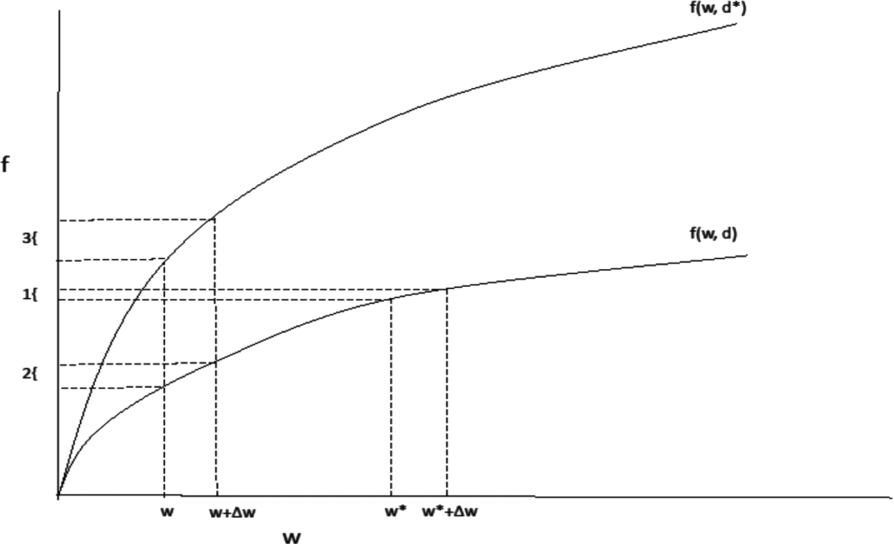
The upshot of the new, expanded group of fundamental axioms (Pareto, DM Pigou–Dalton, DM Anonymity, Priority for the More Deserving), plus DM Separability, plus the reworked additional axioms (DM Measurability, Consistency, Completeness, DM Continuity) is an approach that I'll term ‘desert-modulated continuous prioritarianism’. (See Appendix.) There is a two-place function f(.), which takes as its inputs both an individual well-being number and an individual desert number. This function has the shape displayed in Figure 2. First, holding constant desert, f(.) increases as well-being does, with a strictly concave arc. Second, at a given level of well-being, the rate of increase of f(.) with respect to well-being, i.e. its slope with respect to well-being, increases as the level of desert increases (‘the slope condition’).
Desert-modulated continuous prioritarianism

The goodness ranking of outcomes corresponds to the sum of these f values: outcome x is at least as good as y iff the sum of individual f values for the well-being/desert vector corresponding to x is at least as large as the sum of individual f values for the well-being/desert vector corresponding to y.
Let's use the symbol ∑f(wi, di) to denote desert-modulated continuous prioritarianism. This is indeed an intuitive generalization of continuous prioritarianism, ∑g(wi). If desert is intrapersonally fixed and each person has the same desert level as every other person, the ∑f(wi, di) formula reduces to ∑g(wi) – since f(.) is strictly increasing and strictly concave in well-being, just as g(.) is.
If desert is intrapersonally fixed but there is interpersonal variation in individual desert levels, the axiom Priority for the More Deserving comes into play and ∑f(wi, di) satisfies this axiom by virtue of the slope condition. Further, as long as desert is intrapersonally fixed, ∑f(wi, di) satisfies DM Pigou Dalton (by virtue of the slope condition plus the fact that f(.) is strictly concave in well-being) and the well-being Pareto principles.Footnote 37 It is also straightforward to see that ∑f(wi, di) satisfies DM Anonymity and DM Separability.
III. DESERT-MODULATED CLAIMS AND INTRAPERSONALLY VARIABLE DESERT: THE CONFLICT BETWEEN THE PARETO PRINCIPLES AND PRIORITY FOR THE MORE DESERVING
While desert-modulated continuous prioritarianism, ∑f(wi, di), satisfies the well-being Pareto principles in ranking a set of outcomes S if desert is intrapersonally fixed in S, it does not necessarily do so if desert is intrapersonally variable in S.Footnote 38 If we hold constant an individual's well-being but change her desert, her f value can change. Thus, with intrapersonally variable desert, the sum of f values can change even if everyone's well-being does not change – in violation of Well-Being Pareto Indifference. Similarly, if we reduce an individual's well-being, but change her desert, her f value can increase. Thus, with intrapersonally variable desert, the sum of f values can increase even if some individuals’ well-being levels are reduced and no one's is increased – in violation of Well-Being Strong Pareto.
These effects can be visualized in Figure 2 above, and are illustrated with a specific example in Table 1.
The conflict between desert-modulated continuous prioritarianism and the well-being Pareto principles

Explanation: In this example, f(wi, di) is the desert level di multiplied by the square root of the well-being level wi. The first two numbers in each cell show each individual's well-being and desert level; her f value is in parentheses.
Because Sofia and Gabriel are, each, equally well off in y as in x, Well-Being Pareto Indifference requires that the two outcomes be ranked equally good. But the sum of f values is greater for y than for x.
Because Sofia and Gabriel are, each, worse off in z than in x, Well-Being Strong Pareto requires that z be ranked worse than x. But the sum of f values is greater for z than for x.
Why, more abstractly, can desert-modulated continuous prioritarianism conflict with the well-being Pareto principles in the case of intrapersonally variable desert? The culprit is Priority for the More Deserving. There are two incompatibilities, here, concerning Priority for the More Deserving and, respectively, Well-Being Pareto Indifference and Well-Being Strong Pareto.
Incompatibilities between Priority for the More Deserving and the Well-Being Pareto Principles
Assume that the set of outcomes S is characterized by intrapersonally variable desert.
(1) It is possible that Priority for the More Deserving and Well-Being Pareto Indifference are inconsistent with respect to S. That is, there may be no goodness ranking of S which satisfies both of these axioms.
(2) If we assume, further, that the goodness ranking of S satisfies DM Measurability, DM Anonymity, and DM Continuity, it is possible that Priority for the More Deserving and Well-Being Strong Pareto are inconsistent with respect to S.
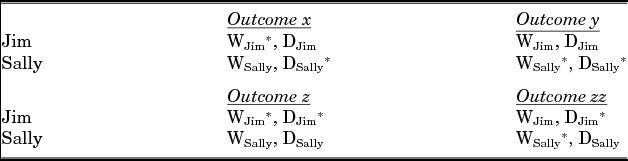
The first incompatibility (between Priority for the More Deserving and Well-Being Pareto Indifference) is illustrated by Table 2. The second is illustrated by Table 3.
The conflict between Priority for the More Deserving and Well-Being Pareto Indifference

Explanation: The symbols WJim and WJim* are not numbers. Rather, each denotes a possible well-being basis for Jim: some possible combination of facts that, if it obtains, suffices to determine how well off Jim is. Similarly, WSally and WSally* are possible well-being bases for Sally. Further, the intra- and interpersonal comparisons to which these well-being bases give rise are as follows. W denotes one and the same level of well-being, whether subscripted to Jim or Sally. (For example, in the above table, Jim in outcome y is equally well off as Jim in outcome zz, and equally well off as Sally in outcomes x and z.) Similarly, W* denotes one and the same level of well-being. Finally, W* denotes a higher level of well-being than W.
Similarly, the symbols DJim, DJim*, DSally, DSally* are not numbers, but denote a possible desert basis for Jim and Sally, respectively. Further, D denotes one and the same level of desert, whether subscripted to Jim or Sally; and D* denotes a higher level of desert, whether subscripted to Jim or Sally.
Well-being Pareto Indifference requires (1) that y be ranked equally good as zz and that x be ranked equally good as z. Priority for the More Deserving requires (2) that y be ranked better than x and that z be ranked better than zz. However, given transitivity of the goodness ranking, (1) and (2) can't both be true.
The conflict between Priority for the More Deserving and Well-Being Strong Pareto

Explanation: w* and w are well-being numbers, with w* > w. d* and d are desert numbers, with d* > d. And ε > 0. These numbers can be used in the table because we are now assuming DM Measurability.
Priority for the More Deserving requires that y be ranked better than x. By DM Continuity, y+ is also better than x for ε sufficiently small. By DM Anonymity, z+ is equally good as y+. By transitivity, then, z+ is better than x. But this contradicts Well-Being Strong Pareto: note that each individual's well-being level with z+ is less than his or her well-being level with x.
What happens if we drop DM Continuity? In that case, at least if we assume DM Measurability, Well-Being Strong Pareto and Priority for the More Deserving are logically consistent in all sets of outcomes (even with intrapersonally variable desert).Footnote 39
However, even with DM Continuity dropped, Well-Being Strong Pareto creates tight constraints on the role of desert in modulating claim strength. Let's say that ‘Minimal Significance for Desert’ holds true if desert functions only as a tiebreaker.
Minimal Significance for Desert. Assume that two outcomes x and y are such that: (1) one individual (‘Able’) is better off in x than y, while a second individual (‘Baker’) is better off in y than x; (2) the difference between Able's well-being level in x and y is larger than the difference between Baker's well-being level in y and x; (3) Able's well-being level in y is equal to Baker's in x; (4) everyone else is equally well off in x as she is in y. Then y is not better than x, regardless of the desert levels of Able and Baker.
As between individuals at the same well-being level, Priority for the More Deserving says that it is morally better to give a fixed benefit to the more deserving individual rather than to the less deserving one. Conversely, Minimal Significance for Desert says that it is not morally better to give a smaller benefit to the more deserving individual in preference to a larger benefit for the less deserving one.
We can now show that (assuming only DM Anonymity), if Minimal Significance for Desert does not hold true, there will be some set of outcomes with intrapersonally variable desert in which Well-Being Strong Pareto is violated. See Table 4.
Dropping Minimal Significance for Desert can yield a violation of Well-Being Strong Pareto

Explanation: W and D are not numbers, but rather indicate the well-being or desert basis of Sally or Jim, depending on the subscript. Let W* denote a greater well-being level than W, and W** a yet greater well-being level. (Thus Jim's well-being difference between outcomes x and y is greater than Sally's well-being difference between outcomes y and x.) D* indicates a higher level of desert than D.
If Minimal Significance is dropped, then it is possible for there to be a pair of outcomes x and y as displayed here such that y is better than x. Consider now a set of outcomes that includes x, y, and z. By DM Anonymity, z is equally good as y. Because y is better than x, it follows by transitivity that z is better than x. But this violates Well-Being Strong Pareto, since one individual (Jim) is worse off with z than x, while the other (Sally) is equally well off.
It is important to be clear about the nature of the conflicts between Priority for the More Deserving and the well-being Pareto principles illustrated by Tables 2 and 3. These tables do not show that Priority for the More Deserving conflicts with the well-being Pareto principles in every set of outcomes that has intrapersonally variable desert. Rather, these tables demonstrate that there are some sets, with intrapersonally variable desert, in which Priority for the More Deserving conflicts with the well-being Pareto principles. Similarly, Table 4 does not show that dropping Minimal Significance yields a conflict with Well-Being Strong Pareto in every set of outcomes with intrapersonally variable desert. Rather, it shows that doing so yields a conflict in some such sets.
IV. CONFLICT-RESOLUTION STRATEGIES
Section III identified what seems to be an internal contradiction in the project of integrating desert considerations into the claims framework. It showed that a conflict between Priority for the More Deserving and the well-being Pareto principles can arise (for short, ‘Conflict’), specifically in the case of intrapersonally variable desert. I now consider various possible strategies for integrating desert considerations into the claims framework, notwithstanding Conflict. Such a strategy might, first, retain well-being as the ‘currency’ for individual claims or, second, shift to a different currency. Neither type of strategy succeeds.
Finally, I introduce non-claim-based arguments for prioritarianism and briefly discuss whether these allow for the integration of desert considerations into the ranking of outcomes.
A. Well-Being retained as the ‘currency’ for individual claims
Assume, first, that the valence of individual claims remains fixed in terms of well-being. For short, well-being remains the ‘currency’ of claims. If an individual is equally well off in x and y, she has a null claim between them. If she is better off in x than y, she has a claim in favour of x over y. If so, the well-being Pareto principles follow immediately.
Might we also endorse Priority for the More Deserving, notwithstanding Conflict? (1) Since Conflict occurs only with intrapersonally variable desert, we might insist on intrapersonally fixed desert. Every set of outcomes should be such that no person's desert varies across outcomes. But this is absurd. Desert, whatever exactly it might be, is surely not ‘built into’ a person's identity. If so, it is possible that any given person might find herself at any one of a plurality of desert levels; and thus a decision-maker should be free to count as possible a set of outcomes in which desert levels vary intrapersonally.
(2) A different thought is that any set of outcomes in which desert varies intrapersonally should be divided into subsets within which desert is intrapersonally fixed; and we should consider outcomes in different such subsets as incomparably good. But a moment's reflection shows that this proposal conflicts with the well-being Pareto principles. If x and y are such that some are better off in x than y, and everyone is at least as well off, then Well-Being Strong Pareto requires that x be ranked better than y – and doesn't allow that they be incomparable.
(3) Yet another strategy is to limit the applicability of Priority for the More Deserving to certain sets. As already emphasized, Priority for the More Deserving does not conflict with the well-being Pareto principles in all sets. Rather, the conflict arises in some (not all) sets of outcomes with intrapersonally variable desert. Thus we might preserve the full force of the well-being Pareto principles, and apply Priority for the More Deserving only in sets of outcomes where no conflict with those principles arises. For example, consider the outcomes described in Table 2. Let the set of outcomes be S = {x, y, z, zz}. As Table 2 illustrates, there is no ranking of this set that satisfies both Priority for the More Deserving and Well-Being Pareto Indifference. But now consider a different set, namely S+ = {x, y, z}. There is a ranking of S+ that satisfies both axioms.Footnote 40
This strategy violates the axiom of Consistency. Assume that two outcomes x and y are as described by Priority for the More Deserving – so that the axiom requires y to be ranked better than x. The strategy now under discussion has the upshot that y is better than x if the further outcomes whose moral goodness is under consideration meet certain conditions.Footnote 41 But shouldn't the goodness comparison of x versus y depend only on what each person's well-being and desert would be if x were to obtain, and what her well-being and desert would be if y were to obtain? These facts about x and y themselves, not the further outcomes, are sufficient to fix the valence and strength of each person's claims between the two outcomes.
B. A non-well-being currency for claims?
Recall that the claims framework is meant to operationalize the idea, originating with Nagel, that the moral comparison of two outcomes depends upon how they compare from the perspective of each of the individuals in the population. I have hitherto assumed that each person-centred comparison is a comparison in terms of well-being. If so, the valence of someone's claims is fixed by her well-being.
However, we might believe that some non-well-being item is the appropriate currency for individual claims. That is, we might think that the pattern of individual comparisons in terms of this non-well-being item is actually the supervenience base for morality. For example, if we believe that each individual, as an autonomous agent, should be entitled to determine what matters from her perspective, then we might adopt all-things-considered preferences, not well-being, as the currency for claims. If we are moved by the ‘luck egalitarian’ insight that individuals cannot complain of a well-being shortfall if they had an adequate opportunity to avoid that shortfall, then we might adopt opportunity-for-well-being, rather than well-being simpliciter, as the currency for claims.
For short, call the new currency (whatever it might be) ‘claimfare’. The valence of an individual's claim between two outcomes will now be fixed by her level of claimfare in the two. And we will now endorse the Claimfare Pareto principles: (a) Claimfare Pareto Indifference (if each person has the same level of claimfare in x as he does in y, the two outcomes are equally good); and (b) Claimfare Strong Pareto (if at least one person has more claimfare in y than he does in x, and everyone else has at least as much claimfare in y as she does in x, then y is better).
Yet the shift from well-being to claimfare hardly salvages the project of desert-modulated claims. Suppose that individual desert is taken as an ingredient in claim strength, apart from an individual's level of claimfare. This yields Priority for the More Deserving*, with the asterisk indicating that the principle is framed now in terms of claimfare rather than well-being. But now Priority for the More Deserving* will come into conflict with the claimfare Pareto principles, in a manner isomorphic to the conflict between Priority for the More Deserving and the well-being Pareto principles.
Perhaps, however, the thought of salvaging the project by shifting currency is meant to be taken in a different way. ‘Let's not use desert as an extra factor that bears on claim strength, above and beyond individual holdings of some currency. Rather, let's incorporate desert into the currency itself.’
In particular, imagine that the currency for claims is a hybrid of well-being and desert. Whether x is ranked more highly than y from the standpoint of i depends both on individual i’s well-being level in each outcome, and on her desert level in each outcome. This posit of a hybrid currency, if sound, would warrant desert-modulated Pareto principles (principles framed in terms of a mixture of desert and well-being). Such principles, if appropriately framed, would not conflict with Priority for the More Deserving even with intrapersonally variable desert.
For example, consider the following principles, ‘DM Pareto Indifference’ and ‘DM Strong Pareto’:
The DM Pareto Principles. (a) DM Pareto Indifference. If everyone has the same desert level in outcome x as she does in outcome y, and everyone is equally well off in x as she is in y, then x and y are equally good. (b) DM Strong Pareto. If everyone has the same desert level in outcome x as she does in outcome y, and everyone is at least as well off in y as in x, and at least one person is strictly better off in y, then y is better than x.
The DM Pareto Principles are consistent with Priority for the More Deserving, even with intrapersonally variable desert. To see this, note that the desert-modulated continuous prioritarian formula, ∑f(wi, di), satisfies both the DM Pareto Principles and Priority for the More Deserving in ranking any set S even if an individual's desert number (di) is not the same in all of the outcomes in S.Footnote 42
However, the strategy of incorporating desert into the currency for claims turns out to be problematic. Consider two possibilities. (1) Desert and well-being are both positive contributors to the hybrid currency. If x and y are such that individual i is equally well off in the two outcomes but has a higher desert level in y than x, y is ranked higher from i’s perspective. Conversely, if x and y are such that individual i is equally deserving in the two outcomes but has a higher well-being level in y than x, y is ranked higher from i’s perspective.
A moment's reflection shows why this variant of the incorporationist strategy misfires. Imagine that Desi and Lesi are equally well off, and Desi has a higher desert level than Lesi. Thus (given the premise that desert makes a positive contribution to currency level) Desi has more of the hybrid currency than Lesi. Imagine, now, that we can increase Desi's holdings of the hybrid currency by Δh, or increase Lesi's holdings of the hybrid currency by the same amount, Δh. Because Desi has more of the hybrid currency, she has a weaker claim to the increase than Lesi. In short, this variant of the incorporationist strategy would not justify the axiom of Priority for the More Deserving, but instead would support a principle of Priority for the Less Deserving! Such a principle is very counterintuitive.
The other possibility is that: (2) Desert is a negative contributor to the hybrid currency, while well-being is a positive contributor. If x and y are such that individual i is equally well off in the two outcomes but has a higher desert level in y, y is ranked lower from i’s perspective. Conversely, if x and y are such that individual i is equally deserving in the two outcomes but has a higher well-being level in y than x, y is ranked higher from i’s perspective.
The negative-contribution proposal has the troubling implication that it is pro tanto morally better to make individuals less deserving. If individual i is less deserving in x than y and equally well off, then (on the negative contribution view) x is ranked higher from i’s perspective; and strong Pareto formulated in terms of the hybrid currency favours x over y if no one else is affected. But surely morality doesn't counsel a lowering of desert. Intuition says just the opposite. For example, Arneson writes: ‘[I]t is better from the moral point of view that persons be more deserving rather than less deserving.’Footnote 43
C. Non-claim-based arguments for prioritarianism
Prioritarianism (here understood as a quasi-ordering of outcomes that satisfies the well-being Pareto principles, Pigou–Dalton, Anonymity, and Separability) and continuous prioritarianism (prioritarianism together with further axioms yielding the ∑g(wi) formula) might well be justifiable without reference to the claims framework. For example, Derek Parfit's original presentation of prioritarianism appeals to two separate ideas that support, respectively, the Well-Being Strong Pareto principle and the Pigou–Dalton principle, namely (1) that ‘benefits are good’ and levelling down is to be avoided (strong Pareto); and (2) that ‘benefits to the worse off matter more’ (Pigou–Dalton).Footnote 44 Arneson's argument for prioritarianism is similar. Unlike the claims framework, this approach offers no unified rationale for the well-being Pareto principles and Pigou–Dalton.
Nils Holtug defends prioritarianism with reference to a certain type of intrinsic value:
[T]he prioritarian ascribes intrinsic value to compound states of affairs, each consisting of the state that a benefit of a certain size befalls an individual and the state that this individual is at a particular welfare level, where this value increases when the size of the benefit increases but decreases when the level of welfare increases.Footnote 45
David McCarthy, in a very different approach, uses axioms regarding the ranking of lotteries to characterize continuous prioritarianism.Footnote 46 The core axioms are ‘Anteriority’, ‘Two-Stage Anonymity’, and the ‘Priority Principle’ – the last requiring a divergence between the moral and individual ranking of lotteries over well-being levels. (McCarthy doesn't accept the ‘Priority Principle’, but his analysis outlines a justificatory route to continuous prioritarianism based upon that principle.)
Space constraints preclude a detailed discussion of whether these rationales for prioritarianism support some kind of desert-modulated prioritarianism where individuals differ in desert. The following brief observations will have to suffice. Assume, first, that the rationale does indeed support the well-being Pareto principles regardless of interpersonal variation in desert, as long as desert is intrapersonally fixed. (This appears to be true, for example, of Arneson, who writes: ‘The position thus taken is that it is morally desirable that everyone, even Hitler (the least deserving person on earth, let's say) should have . . . more rather than less well-being.’Footnote 47) Assume, next, that the rationale supports Priority for the More Deserving. (Again, this is true of Arneson.Footnote 48) The question then will be whether the rationale can justify desert-modulated Pareto principles that are equivalent to the well-being Pareto principles in the case of intrapersonally fixed desert, but are logically consistent with Priority for the More Deserving even with intrapersonally variable desert. This is true, for example, of the DM Pareto principles stated above. (Arneson's position on this issue is not clear.)
I argued above that the claim-based rationale for prioritarianism doesn't justify desert-modulated Pareto principles, since a hybrid well-being/desert currency for claims is implausible. Thus the project of desert-modulated prioritarianism collapses. Whether such a collapse occurs on other rationales for prioritarianism remains to be seen.
CONCLUSION
I have argued that the project of desert-modulated prioritarianism is imperilled by Conflict: the inconsistency between the well-being Pareto principles and Priority for the More Deserving that occurs in the case of intrapersonally variable desert. The social choice literature has already documented various conflicts between candidate moral considerations and the Pareto principles;Footnote 49 this is yet another such clash.
The reader might observe that Conflict is obvious. ‘Of course it's true that introducing a non-well-being element into the goodness ranking will be inconsistent with the focus on well-being that the well-being Pareto principles embody’ – or so the reader might think. But in fact (I submit) the inconsistency is not obvious. The well-being Pareto principles and Priority for the More Deserving are fully consistent in the case of interpersonally differentiated but intrapersonally fixed desert. In particular, the desert-modulated continuous prioritarian formula ∑f(wi, di) with intrapersonally fixed desert makes the well-being benefit to a given person depend upon both her well-being level and a non-well-being consideration, namely her desert. Well-being and desert interact to determine moral value – and the well-being Pareto principles are still satisfied.
The difficulty emerges only if we believe that desert is intrapersonally variable – that one and the same person might be at different desert levels in different outcomes. If someone's desert were fixed by the very characteristics that determine her identity, there would be no difficulty. But it is wildly implausible to think that any attribute which might play the ‘desert’ role in desert-modulated prioritarianism is like this.Footnote 50
APPENDIX
To view the Appendix for this article, please visit https://doi.org/10.1017/S0953820817000164