Improvement in the diagnosis and management of CHD over the past several decades has given rise to an ever-growing population of adult survivors.Reference Moons, Bovijn, Budts, Belmans and Gewillig 1 , Reference Marelli, Ionescu-Ittu, Mackie, Guo, Dendukuri and Kaouache 2 This has resulted in an increasing interest in the assessment of quality of life in adults with CHD,Reference Schroder, Boisen, Reimers, Teilmann and Brok 3 , Reference Bang, Jo and Kim 4 including a recent international multi-centre collaboration project.Reference Apers, Kovacs and Luyckx 5
Malta has a population of around 425,000, with a crude birth rate of 9.5/1000 people in 2013. Perceived quality of life is very good, with Malta scoring 6.488 out of 10 and ranking the 30th out of 156 countries in the latest World Happiness Report. 6 The incidence of CHD is 8/1000 live births, which is comparable with that of other European countries.Reference Grech 7 The Maltese healthcare system is funded through taxation and National Insurance, and specialised services are provided in one main teaching hospital. Provision is free at point of care. Virtually all congenital cardiac surgeries on children and adults are carried out in overseas tertiary referral centres, in the United Kingdom, through a reciprocal healthcare agreement, whereas a number of structural cardiac interventions are carried out locally by visiting specialists. Transfer of care from paediatric to adult services takes place at the age of 14–16 years. A locally based paediatric cardiology service started operating in the early 1990s, with an adult CHD service being instituted a few years later. A formal transition process started operating late in 2015, and access to specialised clinical psychologists is limited.
The Maltese paediatric CHD population was extensively investigated in the 1990s through a series of epidemiological studies,Reference Grech 7 but no specific studies dedicated to adult patients were performed until 2013, when the first large-scale adult CHD research protocol was approved. This protocol set out to investigate the uptake of lifestyle habits, social functioning, and quality of life among Maltese patients compared with the general Maltese population. Findings regarding lifestyle habit uptake were recently published.Reference Caruana and Grech 8 The aims of the present study were to compare quality of life in Maltese adult CHD patients under clinical follow-up with that of general population subjects using quality-of-life tools previously applied to the Maltese population, and to investigate the role that a number of clinical factors could play on these quality-of-life markers within the adult CHD patient cohort.
National data about several health-related aspects in the Maltese population were collected by the Department of Health Information and Research (Gwardamangia, Malta) through face-to-face interviews as part of the 2008 EUROSTAT’s European Health Interview Survey. In all, 72% of the 5500 randomly selected people living in Malta, aged 15 years or over, participated in this survey. 9 This survey included questions assessing mental health and vitality as indicators of quality of life.
Materials and methods
A bespoke bilingual – Maltese and English – self-reporting questionnaire based on the 2008 European Health Interview Survey was designed.Reference Caruana and Grech 8 This included a four-question section aimed at assessing energy and vitality, as an indicator of positive mental health, and a five-question section representing the Mental Health Indicator 5, as an indicator of psychological distress, both of which were taken directly from the widely used 36-item short-form health survey or SF-36.Reference Meltzer 10 Throughout this article, the first indicator will be referred to as “vitality” and the second as “mental health”. The questionnaire was distributed to 162 consecutive adult CHD patients at the time of outpatient clinical encounters during a 1-year period between May, 2013 and May, 2014. Patients were eligible for inclusion if they were Maltese and aged 16 years or over by the end of December, 2013. Foreign patients and those with cognitive impairment or learning difficulties that could have potentially interfered with questionnaire response were excluded. Information on medical aspects for patients in the adult CHD cohort was obtained through review of hospital paper and digital notes. Written informed consent was obtained from each participating patient. The study protocol was approved by the University of Malta Research Ethics Committee and conforms to the ethical guidelines of the 1975 Declaration of Helsinki.
Patient responses to the questions on mental health and vitality were fed back in an anonymised format to the Department of Health Information and Research for score calculation using the same methods applied for the European Health Interview Survey.Reference Meltzer 10 For each of the two parameters, a score of 0–100 was generated on the basis of patient responses to the different questions, with both parameters being positively scored, such that higher scores tallied with a better health state, and subsequently a better quality of life. European Health Interview Survey 2008 data from 372 age-matched and sex-matched responders were provided by the Department of Health Information and Research, and this group of patients constituted the reference group – “general population cohort”.
For each of the two quality-of-life parameters studied, further analysis was carried out based on sex and age category, with mental health and vitality in adult CHD responders being compared with those of general population subjects, matched by sex and then by age. The term “age category” refers to division of patients in each cohort into two groups: a younger sub-group consisting of patients born after 1976 and an older sub-group with patients born before 1976. The rationale for such sub-division was based on the development of paediatric cardiology services in Malta, such that CHD patients in the younger category were more likely to have access to a better-structured service and to have their care transferred to specialist cardiologists for long-term follow-up than those in the older category.Reference Caruana and Grech 8
A third analysis was performed within the ACHD cohort to study the potential impact that five clinical factors – CHD lesion severity, in-patient hospital admissions, ongoing cardiac medications, other unrelated medical and/or surgical conditions, and history of arrhythmias – could have on these quality-of-life parameters. CHD lesion complexity was classified as mild, moderate, or severe in accordance with the 32nd Bethesda Conference guidelines.Reference Warnes, Liberthson and Danielson 11 At the time of statistical analysis, CHD complexity sub-division was limited to two categories – namely, mild and moderate/severe. It was felt that patients with moderately complex CHD lesions were closer to those with CHD of severe complexity in terms of frequency of follow-up and number of past surgical and interventional procedures than those with CHD of simple complexity. In-patient hospital admissions refer to any admission for at least 24 hours, for any reason, both cardiac and non-cardiac, over the preceding 12-month period, but excluding admissions of pregnant female patients at the time of delivery. Cardiac medications included any medications used long term for the management of ventricular systolic and/or diastolic dysfunction, antiarrhythmic agents, antithrombotic medications, and antihypertensive drugs. The arrhythmias included were brady/tachyarrhythmias requiring medical or pacemaker/device therapy or electrical cardioversion. Asymptomatic arrhythmias such as low-grade atrioventricular blocks and ectopy, which were evident only on electrocardiography or 24-hour rhythm monitoring, were excluded. Unrelated medical and surgical conditions included any chronic conditions or those that needed surgery in the past, as well as those not directly related to the congenital heart lesion. The term “cardiac procedures” refers to any cardiac operations or interventions directly related to the congenital heart lesion, including structural catheter interventions, for example, percutaneous ballooning, stenting, or valve deployment, electrophysiological studies and radiofrequency ablation for arrhythmias, and implantation of permanent pacemakers and implantable cardioverter-defibrillators.
Statistical methods
Categorical variables were analysed using χ2 tests. Fisher’s Exact test was applied for smaller sample sizes. All numerical variables were found to have a non-normal distribution upon analysis using the Shapiro–Wilk test, and thus the Mann–Whitney U-test was applied for all analyses involving these variables. All analyses were performed using SPSS 21 (IBM ® SPSS ® 21, SPSS Inc., Chicago, IL, United States of America). Statistical significance was defined as p⩽0.05.
Results
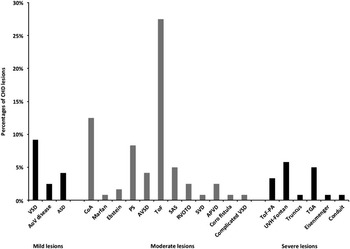
Of the 162 adult CHD patients approached, 125 were enrolled in the present study, but valid responses for the quality-of-life question section were available only for 120 patients (74.07%). Most of the 37 patients who did not participate in the study had defaulted the hospital appointment during which questionnaire delivery was planned. Among all, 63 patients were males, and the overall mean age was 30.53 (SD 12.77) years. Quality-of-life data were available for 371 of the 372 randomly selected general population patients. Among general population subjects, 191 were males, and the mean age was 30.46 (SD 12.95) years. Employment and level of education in the two cohorts were very similar (Table 1). There were less adult CHD patients who were married at the time of data collection (26.70%) compared with patients in the general population cohort (34.80%), but this difference was not statistically significant (p=0.10). In this cohort, 19 patients had simple CHD lesions, 81 had lesions of moderate complexity, and 20 patients had severely complex lesions. The spectrum of CHD lesions in the patient cohort is shown in Figure 1.
Spectrum of CHD lesions within the 120 patient adult CHD cohort. In all, 19 patients had congenital cardiac lesions of simplex complexity (mild lesions), 81 had lesions of moderate complexity (moderate lesions), and 20 patients had lesions of severe complexity (severe lesions). Classification of lesion complexity was based on the 32nd Bethesda conference recommendations.Reference Warnes, Liberthson and Danielson 11 AoV disease=isolated aortic valve disease; APVD=anomalous pulmonary venous drainage; ASD=atrial septal defect; AVSD=atrioventricular septal defect; CoA=coarctation of the aorta; PA=pulmonary atresia; PS=pulmonary stenosis; RVOTO=right ventricular outflow tract obstruction; SAS=subaortic stenosis; SVD=sinus venosus defect; TGA=transposition of the great arteries; ToF=tetralogy of Fallot; UVH = univentricular heart; VSD=ventricular septal defect.

Basic characteristics of the general population and adult CHD (ACHD) cohorts.

There were no significant differences in educational level, employment, and civil status between the two study cohorts
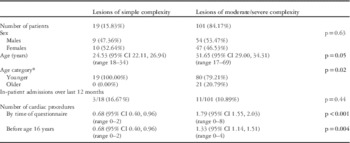
Patients with CHD lesions of moderate/severe complexity were significantly older (mean age 31.65 (95% confidence interval (CI) 29.00, 34.31)) compared with those with simple lesions (mean age 24.53 (95% CI 22.11, 26.94); p=0.05), and there were no representatives of the older-age category among the 19 patients with simple disease. Sex distribution between the two adult CHD sub-categories was similar. As expected, patients with moderately/severely complex lesions had undergone significantly more cardiac procedures, but there were no significant differences in the number of hospital admissions over the preceding 12 months between the two categories (Table 2).
Characteristics of the 120 patients in the adult CHD cohort.

CI=confidence interval
Patients with disease of moderate/severe complexity were significantly older. As expected, they had also undergone more cardiac procedures Statistically significant differences are shown in bold
* Age category: younger=born after 1976; older=born before 1976 (see the Materials and Methods section for details and rationale)
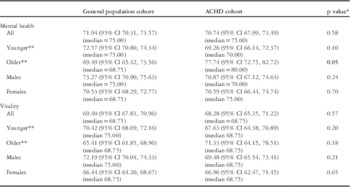
There were no statistically significant differences in mental health and vitality scores when adult CHD patients were compared with the general population, and analysis by sex generated similar findings (Table 3). Although younger patients – born after the mid-1970s – in the two cohorts had similar scores for both quality-of-life parameters, older patients had a significantly higher mental health score (mean 77.74 (95% CI 72.75, 82.72)) compared with older general population patients (mean 69.49 (95% CI 65.42, 73.56); p=0.05). Older adult CHD patients also had a higher vitality score, although this difference was not statistically significant (Table 3).
Comparison of mental health and vitality between patients in the general population and adult CHD (ACHD) cohorts.

CI=confidence interval
Values for the two quality-of-life parameters are expressed as means (with 95% confidence intervals (CI) of the mean) followed by medians. There were no significant differences in mental health and vitality scores between patients and age-matched and sex-matched general population subjects; however, older patients had better mental health scores compared with age-matched Maltese population subjects.
* Statistically significant differences are shown in bold
** Age category: younger=born after 1976; older=born before 1976 (see the Materials and Methods section for details)
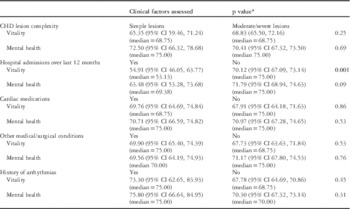
Within the adult CHD cohort, a history of hospitalisation in the previous 12 months was the only clinical factor that had a negative impact on the quality-of-life parameters assessed. Adult CHD patients who required hospitalisation had a significantly lower vitality score (mean 54.91 (95% CI 46.05, 63.77)) compared with those who did not need admission (mean 70.12 (95% CI 67.09, 73.14); p=0.001), as well as displayed a trend towards lower mental health scores (admitted mean 63.48 (95% CI 53.28, 73.68) versus not admitted mean 71.79 (95% CI 68.94, 74.63); p=0.09). All other clinical factors studied, including congenital heart lesion complexity, had no significant impact on the quality-of-life parameters studied (Table 4). Vitality index was similarly affected by hospitalisation among general population subjects. There was a significantly lower vitality index (mean 63.48 (95% CI 57.81, 69.15); median 62.50) among the 32/371 general population subjects who were hospitalised in the previous 12 months compared with that recorded among patients who did not require admission (mean 69.95 (95% CI 68.33, 71.58); median 75.00; p=0.01).
Assessment of the impact of clinical factors on vitality and mental health among the 120 adult CHD patients.

Hospitalisation in the 12 months preceding questionnaire response was the only factor linked to a significantly lower quality of life (expressed as lower vitality) within the adult CHD cohort. Values for the two quality-of-life parameters are expressed as means (with 95% confidence intervals (CI) of the mean) followed by medians
* Statistically significant differences are shown in bold
Discussion
This is the first study to investigate quality of life in adult CHD patients in Malta, and utilises indices previously applied to, and thus validated for, the Maltese population. 9 The two cohorts did not differ significantly in terms of employment, educational achievements, and civil status – factors that could independently impinge on quality of life (Table 1). As a group, our adult CHD patient cohort had mental health and vitality scores comparable with those reported in the general population, with these findings being consistent between sexes. This suggests that, for Maltese patients, living with CHD has no significant impact on quality of life. Similar positive findings have been reported in the literature by other centres. In 2005, Immer et alReference Immer, Althaus, Berdat, Saner and Carrel 12 from Bern, Switzerland, used the SF-36 questionnaire to analyse quality of life among adolescents and young adults who had undergone CHD surgery after the age of 14 years and reported excellent quality of life among these patients, which was on a par with that of age- and sex-matched standard general population. Similarly, a more recent meta-analysis by Schroder et alReference Schroder, Boisen, Reimers, Teilmann and Brok 3 of a number of quality-of-life studies published between 1990 and 2013 demonstrated comparable quality of life between adolescents and young adults with CHD and age-matched controls. Other groups, however, reported poorer quality of life in their equivalent patients – for example, Lane et alReference Lane, Lip and Millane 13 demonstrated lower SF-36 scores in sub-groups of a cohort of 276 adult CHD patients from the specialist service in Birmingham, United Kingdom, when compared with population normative data.
As part of our sub-group analysis, we sub-divided both cohorts into two categories on the basis of age – born before or after the mid-1970s – and thereafter compared mental health and vitality scores of patients in each category with age-matched controls from the general population cohort. This exercise was performed in an attempt to determine whether more rigorous follow-up in childhood and adulthood could have an impact on patient quality of life. Contrary to expectation, although younger patients had very similar scores for both quality-of-life indices when compared with their general population peers, older patients had a significantly better mental health score than control patients of similar age (Table 3). There is no clear explanation for this difference, particularly as older patients were likely to have received less rigorous follow-up through the years, because of local CHD service set-up and less widespread knowledge on CHD. Furthermore, owing to the nature of the data collection process, there was a significantly higher proportion of older patients with CHD of moderate/severe complexity in the older sub-group (100.00%) when compared with the younger sub-group, where 80.80% of patients had moderate/severe disease (p=0.02). This finding could be interpreted as suggesting that quality of care as measured through more regular dedicated follow-up and more prompt specialist CHD surgery or intervention might not be as important a factor in determining quality of life as intuitively expected. It could even be argued that more frequent hospital visits and investigations could make patients, especially younger ones, feel “sicker” compared with their peers, and thus have a less favourable impact on certain aspects of quality of life. Findings of better quality of life among adolescents with CHD when compared with non-CHD controls have been reported in the literature, with one study suggesting a better sense of coherence as an explanation for this difference.Reference Apers, Moons and Goossens 14 Sense of coherence, a concept first put forward by Antonovsky,Reference Antonovsky 15 consists of three components – comprehensibility, manageability, and meaningfulness – and can be assessed by means of a dedicated scale. Unfortunately, our study questionnaire was not designed to assess sense of coherence.
Within our patient cohort, the only clinical factor out of the five studied that was found to have a negative impact on quality of life was hospitalisation in the 12 months preceding questionnaire response. This was represented by a significantly lower vitality score in patients needing hospital admission compared with those who did not and a trend towards lower mental health scores for admitted patients compared with non-admitted ones. Furthermore, a similar negative effect on vitality index was also observed among the general population health survey responders acting as controls in our study. Studies carried out in the last few years suggest an increase in hospitalisation rates among adult CHD patients worldwide,Reference Rodriguez, Moodie and Parekh 16 – Reference Verheugt, Uiterwaal and van der Velde 19 and this is likely to increase as the patient population grows older. Despite these trends, to our knowledge, ours is the first study to investigate the effect of previous hospital admissions on quality of life in this patient population.
All the other factors studied – namely, congenital heart lesion severity, a history of significant brady/tachyarrhythmias requiring treatment, ongoing cardiac medications, and presence of other unrelated medical and/or surgical conditions – had no significant effect on the recorded mental health and vitality scores in our patient cohort. Most of the data available in the literature are related to the effect of congenital heart lesion severity on quality of life, although findings are conflicting, and at times counterintuitive. Indeed, although some studies demonstrated poorer quality of life in patients with more complex CHD lesions,Reference Lane, Lip and Millane 13 , Reference Latal, Helfricht, Fischer, Bauersfeld and Landolt 20 others failed to show a significant difference among lesion severities, sometimes even among groups of patients with particularly complex diseases requiring multiple surgeries or interventions.Reference Apers, Kovacs and Luyckx 5 , Reference Jackson, Hassen, Gerardo, Vannatta and Daniels 21 – Reference Apers, Luyckx and Moons 24 Furthermore, in the study by Lane et alReference Lane, Lip and Millane 13 referred to earlier, patients with surgically cured CHD, which consisted mainly of simple lesions such as atrial and ventricular septal defects and pulmonary valve disease, had poorer mental health scores compared with patients with surgically corrected disease, consisting mainly of moderately complex lesions such as tetralogy of Fallot and coarctation of the aorta – conditions with which patients were more likely to require repeat surgery or intervention.
Data in the literature for the remaining factors investigated in our study are limited. Loup et al found no significant effect on quality of life imposed by arrhythmias in adults operated for tetralogy of Fallot, transposition of the great arteries or ventricular septal defects,Reference Loup, von Weissenfluh, Gahl, Schwerzmann, Carrel and Kadner 25 although it is worth remarking that this study excluded complex procedures for heart disease, such as Fontan-type palliation, where the arrhythmia burden is known to be higher; however, Bedair et alReference Bedair, Babu-Narayan and Dimopoulos 26 reported worse quality of life and higher prevalence of depression among adult CHD patients with arrhythmias who received an implantable cardioverter-defibrillator compared with patients who did not require such a device. Contrary to what we observed, Jackson et alReference Jackson, Hassen, Gerardo, Vannatta and Daniels 21 reported poorer physical quality of life among 218 young adult survivors of CHD who were taking more than one cardiac-related medication, whereas co-morbid conditions had no effect on quality of life; however, patients included in this last study were younger (mean age 25.70, SD 7.10 years) than those in our cohort and included a percentage from a paediatric background.
Limitations
The adult CHD cohort size is one of the limitations of this study, and this is directly related to the small Maltese population. In an effort not to further reduce the number of patients in certain sub-categories, patients were grouped into not more than two groups at all stages of data analysis as elaborated in the Materials and Methods section. Owing to the study design and the nature of the data collection process, the authors had no control on the characteristics of the patients answering the questionnaire. As a consequence, the patient cohort had a much smaller representation of patients with simple disease. This is not unexpected, considering that patients with simple lesions usually require far less frequent clinical follow-ups than those with more complex disease, often every 2–3 years. In addition, this study included only adult CHD patients who were under active clinical follow-up at the time of data collection, which excluded a minority of patients with simple CHD who had been formally discharged from follow-up, being considered treated, and a number of patients who still warranted clinical attention but who had been lost to follow-up. This over-representation of more complex CHD in our study cohort had the potential of skewing the reported quality of life in one direction or the other. Ultimately, the authors feel that, despite a larger representation of complex lesions, our patient cohort had comparable mental health and vitality indices with the general Maltese population, which goes on to affirm the observation that CHD poses no significant effect on quality of life in Maltese patients.
During the data collection process, patients with medical conditions or syndromes resulting in cognitive impairment or learning difficulties were excluded. This could have led to the exclusion of patients with poorer quality of lives due to co-morbidities that often form part of these syndromes. At the same time, psychological problems that can accompany these conditions could have acted as confounding factors by independently contributing to poorer mental health and vitality, and hence the exclusion.
Although SF-36 is one of the more widely known validated tools for the assessment of quality of life with extensive use in several chronic medical conditions,Reference Lane, Lip and Millane 13 several other quality-of-life tools have been applied to patients with CHD.Reference Apers, Kovacs and Luyckx 5 As one of the main aims of our study was to compare patient quality of life with that of the general Maltese population, our choice of assessment tools was restricted to those that had already been applied to Maltese patients. The self-reporting questionnaire thus included only some elements of SF-36 that had originally been incorporated in the European Health Interview Survey 2008, and excluded elements such as physical functioning, physical and emotional role, and general health perception. Although the authors are aware that this limited the breadth of aspects of quality of life assessed in the Maltese patient population, the design ensured that all data collected could be easily compared with equivalent national data sets. Comparison of local data with the international literature was also limited by the wide variety of quality-of-life tools that have been applied in different studies.
Conclusions
Despite its limitations, this first study on quality of life in Maltese adult CHD patients gives useful insight. Overall, Maltese patients appear to have a good quality of life as assessed by mental health and vitality indices and are on a par with general population peers. Hospitalisation had a negative impact on vitality, and thus patients needing frequent hospital admissions might be among the ones who would be the likeliest to benefit from access to dedicated clinical psychologists. Contrary to what might be expected, complexity of congenital defects, arrhythmias, cardiac medications, and co-morbidities do not appear to be important factors in determining quality of life in our patient population. In addition, more rigorous follow-up and medical care might not solely be key factors to improving quality of life in these patients. Further studies utilising different and more comprehensive quality-of-life tools and designed to include patients representative of all lesion complexities could provide more information to help improve quality of care and long-term outcomes in this patient population.
Acknowledgements
The authors thank the following people for their help in the different stages of this study: Dr Neville Calleja (Director) and Dorothy Gauci (Statistician) at the Department of Health Information and Research, Gwardamangia, Malta, for providing national European Health Interview Survey 2008 data and for help with generating the quality-of-life scores; Tania Spiteri, Echocardiographer at the Cardiac Laboratory in Mater Dei Hospital, for help with the data collection process; and Dr Oscar Aquilina and Prof. Jane Somerville for their involvement in the inception and expansion of the clinical adult CHD services in Malta.
Financial Support
This research received no specific grant from any funding agency or from commercial or not-for-profit sectors.
Conflicts of Interest
None.
Ethical Standards
The authors assert that all procedures contributing to this study comply with the ethical standards of the Maltese national guidelines on human experimentation and with the Helsinki Declaration of 1975, as revised in 2008, and have been approved by the University of Malta Research Ethics Committee.