Introduction
Toxocara canis is a widely distributed ascarid nematode that commonly infects domestic dogs and other canids, including foxes, wolves and coyotes (Holland & Smith, Reference Holland and Smith2006). It is also a zoonotic parasite and its capacity to infect humans and produce a range of clinical syndromes contributes to its public health significance (Taylor & Holland, Reference Taylor, Holland, Gillespie and Pearson2001). The epidemiology of toxocariasis in domesticated dogs has received considerable attention due to their proximity to humans and their capacity to contaminate the environment with their faeces (Epe, Reference Epe, Holland and Smith2006). Recently, Wolfe & Wright (2003) found embryonated Toxocara eggs on the fur of a small sample of dogs and questioned whether soil contamination is the major route for infection in human toxocariasis. Roddie et al. (Reference Roddie, Stafford, Holland and Wolfe2008) also recorded Toxocara eggs on the fur of stray dogs, with particularly high densities from puppies.
As mentioned above, foxes are also hosts to Toxocara and are capable of contaminating the environment with the eggs of Toxocara. The biology of the parasite in foxes has received considerably less attention than in dogs. However, due to the increasing urbanization of foxes worldwide, a number of recent studies have focused upon the prevalence and abundance of Toxocara in the fox (Richards et al., Reference Richards, Harris and Lewis1993, Reference Richards, Harris and Lewis1995; Wolfe et al., Reference Wolfe, Hogan, Fitzpatrick, Wall, Hayden and Mulcahy2001; Saeed & Kapel, Reference Saeed and Kapel2006). Dietary differences between domesticated dogs and rural and urban foxes may influence the epidemiology of toxocariasis (Richards et al., Reference Richards, Harris and Lewis1995). Rural foxes may consume more small mammals, which may act as potential paratenic hosts for Toxocara (Dubinsky et al., Reference Dubinsky, Havasiova-Reiterova, Petko, Hovorka and Tomasovicova1995). Willingham et al. (Reference Willingham, Ockens, Kapel and Monrad1996) recorded a prevalence of 81% among foxes from the metropolitan area of Copenhagen and concluded that foxes could act as important reservoirs for Toxocara and could contribute to environmental contamination. So far, these previously mentioned papers on Toxocara in the fox have concentrated upon adult worm burden in the intestine and, in some cases, the relationship with eggs in the faeces (Saeed & Kapel, Reference Saeed and Kapel2006).
In the present paper, our primary aim was determine whether foxes carry Toxocara eggs on their fur as domestic dogs have been shown to do (Wolfe & Wright, 2003; Roddie et al., Reference Roddie, Stafford, Holland and Wolfe2008). Secondary aims included exploring whether host factors, such as age and sex, influence the numbers of eggs recovered, and to explore the relationship between the numbers of eggs on the hair and the worm burden within the intestine of each fox. Finally, we made some preliminary comparisons between data collected from adult foxes and from adult dogs.
Materials and methods
Collection and analysis of hair and intestinal samples from foxes
A total of 87 red foxes (Vulpes vulpes) were collected between March and December 2005 from six counties in Ireland. The majority of animals were from rural locations. Collections were made with the assistance of the National Association of Regional Game Councils (NARGC) and the wardens of Boora Park, Co. Offaly. The age and sex of each animal was recorded, with age being estimated based upon dental maturity and size. Animals were classified as adult (foxes older than 12 months) or juvenile (foxes of approximately 6–12 months).
A sample of hair was removed from the peri-anal region and stored in a labelled container at 4°C until examination. Hair samples (0.5 g per sample) were analysed for the presence of Toxocara eggs by means of a method outlined in Roddie et al. (Reference Roddie, Stafford, Holland and Wolfe2008). Eggs were classified into one of four groups, depending upon the stage of development: non-viable (egg wall disrupted or egg not intact), viable (intact egg with contents), embryonating eggs (egg with two or more cell divisions) and embryonated (containing larvae).
Fox intestines were frozen until examination. At examination, intestines were opened along their lengths and the contents collected over a series of staked sieves with pore sizes of 2 mm, 1 mm and 0.5 mm. All Toxocara worms were removed and fixed in 6% formalin solution and stored at room temperature. Subsequently, worms were sexed, weighed (g) and measured (mm). Worms were also dissected in order to confirm their sex. The maturity status of female worms was assigned as mature (eggs possessing shells) or immature (eggs without shells).
Statistical analysis
Two-way analysis of variance (ANOVA) was performed on log-transformed data in order to explore the relationship between eggs on the hair of foxes and host age and sex. Two-way ANOVA was also used to analyse the relationship between worm burden and fox age and sex. Chi-squared analysis was used to explore the relationship between the prevalence of Toxocara eggs on the hair and within the intestine and fox age and sex. The non-parametric Kendall's rank correlation test was used to analyse the relationship between the numbers of eggs detected on the hair and the total numbers of worms and the number of female worms in the intestine.
When comparisons between the data from dogs and foxes were made, only eggs recovered from around the anus in dogs were compared with the fox data. In the original canine study (see Roddie et al., Reference Roddie, Stafford, Holland and Wolfe2008), hair samples were taken from hair on the back and around the anus. Furthermore, data from only adult dogs and foxes will be analysed as there were very few juveniles in the dog sample and no cubs in the fox sample. Details of the dog collection methods are outlined in Roddie et al. (Reference Roddie, Stafford, Holland and Wolfe2008). It should be noted that all the dogs were sampled from a dog pound in Co. Cork whereas fox samples were collected from six counties in Ireland. However, the majority of foxes were collected from Co. Cavan (n = 62). Chi-squared analysis and t-tests were employed to compare prevalence and mean abundance of eggs on the hair and worms in the intestine for both adult dogs and adult foxes. If the abundance data did not fit the requirements of normality, t-tests were performed on log-transformed data.
Results
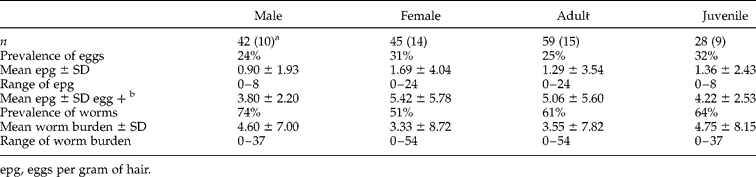
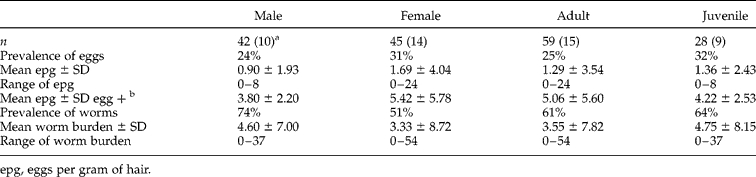
Overall, 24 of the foxes (28%) were found to have Toxocara eggs on their hair, with an average ( ± SD) of 1.31 ± 3.21 eggs per gram of hair (egg-positive animals had an average ( ± SD) of 4.75 ± 4.63 eggs per gram of hair (see table 1)). A total of 57 eggs were recovered from the 87 hair samples and of these 38.5% were non-viable and 61.4% were either viable or embryonating. No embryonated eggs were detected. Two-way analysis of variance revealed that neither age nor sex as main effects had a significant influence upon the numbers of eggs detected on the hair of foxes. Chi-squared analysis revealed no relationship between the prevalence of eggs on the hair and any of the host factors.
The prevalence and mean abundance of Toxocara eggs detected from the hair, and worms recovered from the intestine, of foxes according to age and sex.
epg, eggs per gram of hair.
a Number in parentheses = n for egg positives.
b Egg positives only.
Sixty-one percent of foxes harboured Toxocara worms in their intestines, with a mean worm burden ( ± SD) of 4 ± 8 (range 0–54) (see table 1). Two-way analysis of variance also revealed no significant influence of host age or sex upon the observed worm burden. Furthermore, chi-squared analysis found no relationship between the prevalence of Toxocara in the intestine of the foxes and any of the host factors.
The relationship between the number of eggs detected on the hair and the number of worms recovered in the intestine of the foxes was explored by means of Kendall's rank correlation analysis. There was no correlation between the numbers of worms that a fox harboured and the eggs on the hair for either the total sample (Kendall's rank correlation coefficient = − 0.046, ns) or for adult foxes (Kendall's rank correlation coefficient = − 0.1, ns) or juvenile foxes (Kendall's rank correlation coefficient = 0.02, ns). This lack of significant correlation remained the same when the relationship between eggs on the hair and the numbers of female worms only were explored (total sample: Kendall's rank correlation coefficient = − 0.071, ns; adults only: Kendall's rank correlation coefficient = − 0.147, ns; juveniles only: Kendall's rank correlation coefficient = − 0.064, ns).
Comparison with data collected from stray dogs
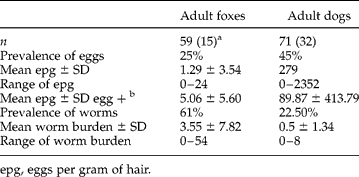
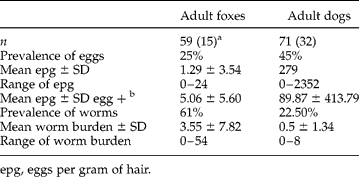
The prevalence and abundance of Toxocara eggs from fox hair was lower than that recorded from stray dogs (table 2). Significantly more adult dogs had eggs on their hair compared to adult foxes (χ2 = 5.38, df = 1; P ≤ 0.0203). Furthermore, the average number of eggs per gram of hair (epg) for adult dogs was higher compared to that of adult foxes (epg: t = 3.102, df = 128, P ≤ 0.0024; egg-positive animals only: t = 2.117, df = 45, P ≤ 0.04).
The prevalence and mean abundance of Toxocara eggs from the hair, and worms from the intestine, of adult dogs and foxes. Samples from around the anus only.
epg, eggs per gram of hair.
a Number in parentheses = n for egg positives.
b Egg positives only.
In contrast to the patterns described for eggs detected on the fur, the prevalence and abundance of Toxocara worms in the intestines of adult foxes were significantly higher than those of adult stray dogs (χ2 = 16.77, df = 1, P ≤ 0.0001; t = 5.164, df = 128, P ≤ 0.0001).
Discussion
To our knowledge, this is the first report to document the presence of Toxocara eggs from the hair of foxes. The prevalence and abundance of Toxocara eggs from fox hair is lower overall than that recorded from stray dogs (see Roddie et al., Reference Roddie, Stafford, Holland and Wolfe2008). However, there are important differences between the two studies – fox cubs were absent from the present study whereas puppies comprised 25% of the canine study. In fact, the vast majority of the eggs detected (95%) on dog hair were from puppies (see Roddie et al., Reference Roddie, Stafford, Holland and Wolfe2008). However, when only data from adult animals were compared, there were still higher numbers of egg-positive dogs and a higher abundance of eggs on these animals compared to foxes.
In contrast to the patterns described for eggs detected on the fur, the prevalence and abundance of Toxocara worms in the intestines of foxes were significantly higher than those of adult stray dogs. However, when the relationship between worms in the intestine and eggs on the fur was explored for foxes it was found to be non-significant, indicating that the number of worms a fox harbours does not influence significantly the egg burden on the hair. This lack of correlation is analogous to that found for adult dogs. In contrast, there is a very significant relationship between worm burden and eggs on the hair in puppies (see Roddie et al., Reference Roddie, Stafford, Holland and Wolfe2008). These differences in egg burden on the fur relative to worm burden between adult foxes and adult dogs pose a number of questions.
Dogs are likely to live in more contaminated environments (due to the presence of other dogs) than foxes, and therefore the higher numbers of eggs on their fur may come from the environment. However, Richards et al. (Reference Richards, Harris and Lewis1993) detected few, if any, eggs from soil samples collected from areas frequented by dogs and foxes. Despite this, the detection of parasite eggs in soil is notoriously problematical, given the variation in methods undertaken and the difficulty in sampling in a representative manner (Mizgajska-Wiktor & Uga, Reference Mizgajska-Wiktor, Uga, Holland and Smith2006). Furthermore, some of these dogs may have received anthelmintic treatment, hence their worm burden may have been reduced, although their stray status does suggest otherwise. Eggs on the fur of foxes may suffer more environmental degradation. Non-viable eggs were found in greater numbers on foxes (38.5%) compared to dogs (18%) and there was a total absence of embryonated eggs on fox hair.
The prevalence and abundance of Toxocara worms is higher in this study compared to a previous Irish study performed by Wolfe et al. (Reference Wolfe, Hogan, Fitzpatrick, Wall, Hayden and Mulcahy2001) (prevalence of 61% versus 37%; mean worm burden of 4 versus 2.4). Most of the foxes in the study by Wolfe et al. (Reference Wolfe, Hogan, Fitzpatrick, Wall, Hayden and Mulcahy2001) were between 1 and 2 years of age. These authors also failed to detect any relationship between worm burden and age and sex, the absence of very young foxes may be the explanation for this observation. A very extensive epidemiological study of over 1000 foxes from Denmark revealed a significantly higher prevalence and intensity of Toxocara in cubs versus young and adult foxes (Saeed & Kapel, Reference Saeed and Kapel2006).
Certainly, the prevalence and abundance of Toxocara in foxes within Europe varies considerably, with high prevalence of 81% (mean abundance of 17.7) in Denmark (Willingham et al., Reference Willingham, Ockens, Kapel and Monrad1996) and a much lower prevalence of 28.6% in Greece (Papadopoulus et al., Reference Papadopoulus, Himonas, Papazahariadou and Antoniadou-Sotiriadou1997). These differences may reflect variations in host and geographical factors.
To conclude, this study has provided evidence that foxes, as in the case of dogs, are capable of carrying Toxocara eggs on their hair. Furthermore, the relationship between Toxocara eggs on the hair and worms in the intestine, for adult foxes, mirrors that of dogs, in demonstrating a non-significant correlation. What we do not know is whether fox cubs carry many eggs on their coats, as observed in puppies.
Acknowledgements
We thank Bayer Healthcare AG for funding the research. We would like to thank Edward Kelly, Frank O'Reilly, Brendan Turbridy, Francis Cullen, Joe Hosey and Stephen Walters of the NARGC, Kieran Buckley and Patrick Kelly of the Grey Partridge Project, and Michael O'Connor for their great help in providing the foxes. Further thanks are extended to Olivia Tracey for all her help in the laboratory.