


Introduction
Mindfulness refers to the self-regulation of attention to current experiences while adopting an accepting, non-judgemental stance towards these experiences (Bishop et al. Reference Bishop, Lau, Shapiro, Carlson, Anderson, Carmody, Segal, Abbey, Speca, Velting and Devins2004). Mindfulness-based Cognitive Therapy (MBCT; Segal et al. Reference Segal, Williams and Teasdale2002) was developed as a relapse prevention intervention for people with a history recurrent depression who are currently well. However, the 30–40 min mindfulness meditation practices in MBCT may be challenging and experienced as distressing for some people who are currently depressed (Finucane & Mercer, Reference Finucane and Mercer2006). Therefore, a therapy that includes briefer mindfulness practices may be warranted, yet it is not clear if an intervention grounded in brief mindfulness practices can be of benefit for people who are currently depressed. This paper presents two studies that enquire whether benefits can be gained through brief mindfulness practices for people who are currently experiencing an episode of major depression.
There is substantial evidence for the effectiveness of MBCT in reducing relapse in people who are currently well but have a history of ≥3 episodes of depression (e.g. Teasdale et al. Reference Teasdale, Segal, Williams, Ridgeway, Soulsby and Lau2000; Ma & Teasdale, Reference Ma and Teasdale2004) with effects equivalent to antidepressant medication (Kuyken et al. Reference Kuyken, Byford, Taylor, Watkins, Holden, White, Barrett, Byng, Evans, Mullan and Teasdale2008). MBCT was originally deemed unsuitable for people experiencing active symptoms of depression. It was thought that factors such as reduced concentration, negative thoughts and negative affect would be barriers to engaging in the mindfulness practices (Segal et al. Reference Segal, Williams and Teasdale2002). Despite these early cautions, a recent meta-analysis found that MBCT, in comparison to control conditions, leads to lower depressive symptom severity for people who are currently depressed (author names removed to preserve anonymity). However, some participants with a current episode of depression find the mindfulness practices in MBCT challenging due to them eliciting difficult experiences related to past traumatic events (Finucane & Mercer, Reference Finucane and Mercer2006).
Person-based Cognitive Therapy (PBCT; Chadwick, Reference Chadwick2006) integrates mindfulness practice and principles with cognitive therapy. Although PBCT foregrounds mindfulness principles and practice, the emphasis is on brief, 10-min practices in and between the sessions rather than the 30- to 40-min practices in MBCT, thereby potentially making the practices more acceptable for people with chronic and debilitating conditions (Dannahy et al. Reference Dannahy, Hayward, Strauss, Turton, Harding and Chadwick2011).
It is possible that 10-min practices are simply too brief for people to acquire mindfulness skills, particularly for people who are diagnosed with a current episode of major depression. However, a randomized controlled trial (RCT) of PBCT for chronic major depressive disorder not only found significant improvements in depressive symptoms for PBCT participants relative to those in the treatment-as-usual (TAU) control group but also found significant improvements in self-reported mindfulness for PBCT participants in comparison to those in the control group (author names withheld to preserve anonymity, these will be added for publication). This indicates, despite the brief length of mindfulness practices in PBCT, that people experiencing current, diagnosable levels of major depression can learn mindfulness through PBCT. However, this initial evaluation of PBCT for people experiencing a current episode of major depression did not examine the potential role of improvements in mindfulness in alleviating symptoms of depression. In particular, as PBCT integrates cognitive therapy with a mindfulness-based approach it is possible that the cognitive therapy elements of the intervention were responsible for improvements in depression and that the mindfulness elements of PBCT did not contribute to outcome.
This paper enquires whether improvements in mindfulness in PBCT for chronic major depression mediate improvements in depressive symptoms and asks whether participants’ accounts regarding the effects of receiving PBCT are similar to those reported in the literature for mindfulness-based interventions (MBIs) containing longer mindfulness practices. The former question will be addressed through mediation analysis on the data collected in the RCT of PBCT for chronic depression (study 1) (Strauss et al. Reference Strauss, Hayward and Chadwick2012). Specifically, it is hypothesized that improvements in mindfulness will mediate the relationship between condition (PBCT or TAU) and improvements in depressive symptoms. The latter question will be addressed by taking a qualitative approach (study 2) and analysing data using thematic analysis.
To our knowledge this is the first paper to examine the issue of whether people who are currently depressed can benefit from learning mindfulness in an intervention that only includes brief mindfulness practices. This is important. If it is possible to benefit from brief practices then the reach of mindfulness-based therapies can be extended to those people who may be unwilling or unsuitable to take part in a therapy that comprises longer practices such as MBCT. Likewise, if mindfulness principles and practice do not emerge as mechanisms of change in PBCT then it would not be necessary to ask participants to engage in daily mindfulness practice or to include mindfulness practice in the group sessions which would allow more time to focus on the cognitive therapy approach.
Method
Ethical considerations
Both studies described here were approved independently by a UK National Health Service Research Ethics Committee.
Design
A mixed-method approach was adopted as the study design a priori, before commencing the studies. The lead researcher for the qualitative analysis (G.L.) was intentionally blind to the therapy protocol. The quantitative findings from the RCT are reported elsewhere (see Strauss et al. Reference Strauss, Hayward and Chadwick2012); however, the current paper includes previously unreported analysis of the role that improvements in mindfulness play in mediating the relationship between therapy condition (PBCT or TAU) and improvements in depressive symptoms. The qualitative findings were analysed using thematic analysis (Braun & Clarke, Reference Braun and Clarke2006).
PBCT intervention
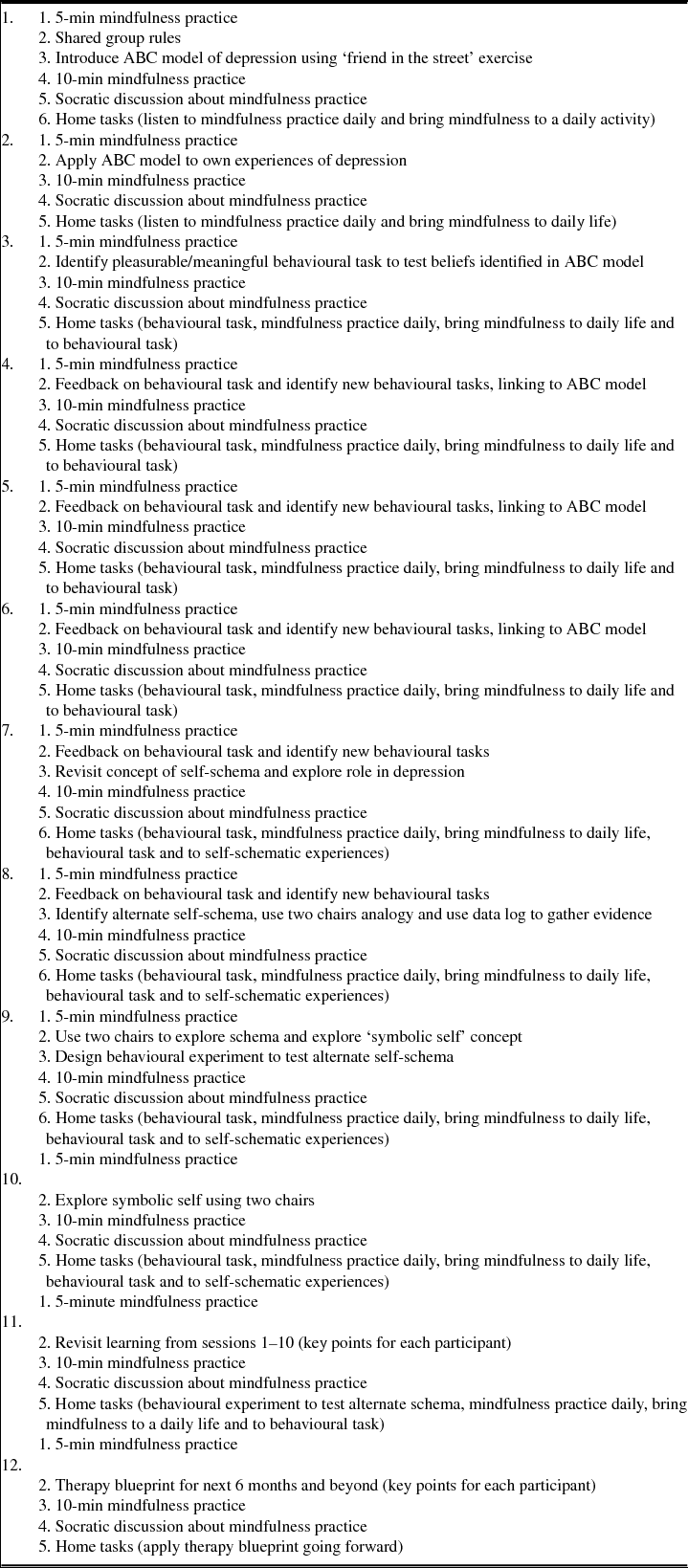
See Table 1 for a session-by-session summary of the PBCT for Depression approach. PBCT groups involved 12 weekly 90-min sessions, facilitated by two clinical psychologists each with experience in delivering PBCT and/or MBCT groups. As with MBCT, the PBCT model integrates mindfulness principles with the cognitive model (Chadwick, Reference Chadwick2006). MBCT typically comprises of eight sessions of between 2 h and 3 h in length so that the total therapy contact time is between 16 h and 24 h. Because of the current distress for people experiencing chronic major depression the length of PBCT sessions is 90 min and in order to cover the therapy protocol 12 sessions are warranted. This gives a total of 18 h of therapy contact time which is towards the lower end of therapy contact time in MBCT.
Summary of group PBCT for Depression Therapy 12-session protocol

The cognitive therapy elements of PBCT involve re-evaluating depression-related thoughts and beliefs and identifying and strengthening positive self-schema. The identification of positive self-schema, and in particular positive self-schematic experiences (i.e. times when the self is experienced in a positive way) is central to PBCT. However, in keeping with the mindfulness-based approach, schematic experiences are viewed as temporary, changing and passing events rather than as defining the self. Negative self-schematic experiences, for example when the self is experienced as wholly bad or worthless, are validated as experiences. However, their literal truth is questioned by drawing out positive self-schematic experiences that are often contradictory in nature to negative self-schema. The notion of ‘symbolic self’ (Chadwick, Reference Chadwick2006) is used to facilitate meta-cognitive change concerning beliefs about self-concept through using two chairs to represent different self-schematic states. A shift in self-concept is supported, moving from viewing the self as fixed and stable to viewing the self as changing, contradictory and flexible (e.g. ‘I view myself in different ways at different times’).
Regular but brief mindfulness practices (never longer than 10 min; Chadwick, et al. Reference Chadwick, Newman-Taylor and Abba2005, Reference Chadwick, Hember, Symes, Peters, Kuipers and Dagnan2009) are included in each session and daily home practice is encouraged through providing audio recordings of the 10-min practice guidance on CD. The verbal guidance for the mindfulness practice encourages participants to decentre from current experience, including depressive thoughts, to notice the transient nature of current experience and to do this without judging experiences and without judging the self. Depressive thoughts are viewed as passing mental events without intrinsic importance or factual value and participants are encouraged to notice what happens as they disengage from rumination. Within the PBCT approach the therapeutic relationship is seen as key to promoting change through the Vyogotskian notion of the zone of proximal development (Vygotsky, Reference Vygotsky1978) and facilitators are encouraged to adopt a radically collaborative stance. The application of the zone of proximal development suggests that participants can learn more when their learning is scaffolded within the therapeutic relationship than when learning on their own.
Sessions began with a 5- to 10-min mindfulness practice, followed by 50- to 60-min cognitive therapy focus and ended with an another 10-min mindfulness practice which was followed by 15–20 min of Socratic discussion supporting insights from mindfulness practice and links with behavioural change and cognitive therapy elements of the session. Therapy adherence was ensured through a detailed therapy protocol and weekly supervision by a PBCT expert.
Study 1
Participants
Findings from the RCT are reported elsewhere and this provides fuller details of the participants (see: author names to be added on publication). In total 42 people were referred by a consultant psychiatrist through secondary-care National Health Service (NHS) mental health teams in the UK. Of these, 28 people met eligibility criteria for the study and agreed to take part. These 28 participants were randomly assigned to either a PBCT group for chronic major depression (n = 14) or to TAU (n = 14). Inclusion criteria required that participants: (a) be aged ≥18 years, (b) met DSM-IV criteria for chronic major depression, (c) had a Beck Depression Inventory – II (BDI-II; Beck et al. Reference Beck, Steer and Brown1996) score of ≥20 (equivalent to ‘moderate depression’ or above), and (d) have been stable on current antidepressant medication for at least 3 months with no planned changes to medication during the course of the study. Exclusion criteria were: (a) to be in psychological therapy at any point during the course of the study, (b) to meet diagnostic criteria for: mania or hypomania, psychosis, obsessive compulsive disorder, eating disorder, pervasive developmental disorder, substance misuse, attention deficit hyperactivity disorder, post-traumatic stress disorder, or learning disability, and (c) to be currently habitually self-harming.
The sample demographics were: a mean age of 43 years [standard deviation (s.d.) = 10.6 years); the mean age at first onset was 20 years (s.d. = 8 years); the mean duration of current episode was 4 years (range 2–10 years); 84% had previously received psychological therapy; and 88% were prescribed antidepressant medication. There were no significant baseline differences between groups on these variables.
Measures
Southampton Mindfulness Questionnaire (SMQ; Chadwick et al. Reference Chadwick, Hember, Symes, Peters, Kuipers and Dagnan2008). This is a 16-item self-report measure of mindful responses to distressing thoughts and images which combines four constructs: decentred awareness, non-avoidance of difficult cognitions, acceptance, and letting go (range 0–96). It has demonstrated good reliability and validity.
Beck Depression Inventory – II (Beck et al. Reference Beck, Steer and Brown1996). This is a 21-item self-report measure of depression severity; mild (14–19), moderate (20–28) and severe (≥29). The BDI-II is a widely used measure with good reliability and validity.
Procedure
Initial assessment (time 1) occurred before block randomization, and within 10 weeks of the PBCT groups starting. Post-group assessment (time 2) occurred within 4 weeks of the final PBCT session. Researchers collecting time 1 and time 2 data were blind to participant treatment group and randomization was conducted blind to participant details.
Data analysis
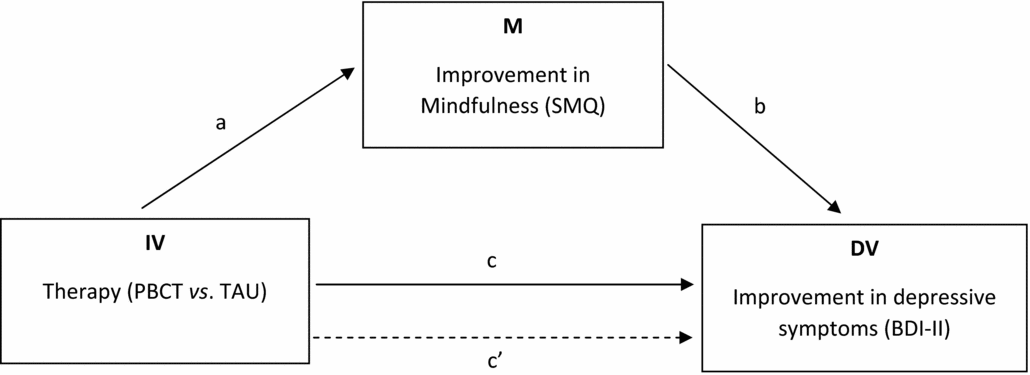
Missing data were replaced using the last observation carried forward method. SPSS v. 20 (SPSS Inc., USA) was used to conduct the mediation analysis using the INDIRECT macro developed by Preacher & Hayes (Reference Preacher and Hayes2008). The INDIRECT mediation macro tests the indirect effect of the independent variable (IV; PBCT vs. TAU) on the dependent variable (DV; BDI-II at time 1 minus BDI-II at time 2) through the proposed mediator (M: SMQ at time 2 minus SMQ at time 1). This is calculated as the product of the a path (the effect of IV on M) and the b path (the effect of M on DV, controlling for IV).
The INDIRECT macro gives the result of a Sobel test on the mediating role of M on the relationship between IV and DV. The Sobel test requires that paths a, b and c are significant (see Fig. 1) and, if these conditions are satisfied, that the strength of path c significantly reduces when M is controlled for (path c’). However, the Sobel test lacks statistical power (Preacher & Hayes, Reference Preacher and Hayes2008) and more powerful bootstrapping methods are now recommended that also make fewer assumptions about the data. Therefore, following the recommendations laid out by Preacher & Hayes (Reference Preacher and Hayes2008) a bootstrapping approach was taken instead using 5000 estimates of the ab indirect effect and giving the bias corrected and accelerated 95% confidence interval (CI) from these 5000 estimates. The indirect effect is considered to be significant when the 95% CI does not cross zero.
Proposed mediation model showing the hypothesized role that improvements in mindfulness (M) play in mediating the relationship between therapy condition (independent variable, IV) and improvements in depressive symptoms (dependent variable, DV).
Study 2
Participants
Interviews were conducted with six graduates of the PBCT groups who, on completion of the group programme volunteered to be interviewed (6/14 or 43% of potential participants). Inclusion criteria for the qualitative study were that the participants had completed a minimum of 8/12 PBCT sessions. Participants were representative of the participants from study 1: they had a mean age of 42 (s.d. = 11.9, range 24–57) years, the mean age at first onset was 20.5 (s.d. = 10.4, range 6–38) years; the mean duration of current episode was 3.8 (range 2–10) years; 83% had previously received psychological therapy; and 83% were prescribed antidepressant medication. These figures are largely identical to those from the overall sample (see study 1 details above), statistical analysis of differences between the interviewed and non-interviewed samples was not possible however due to the small sample sizes involved.
Semi-structured interview
A semi-structured interview schedule was informed by Elliott et al.'s (Reference Elliott, Slatick, Urman, Frommer and Rennie2001) ‘The Change Interview’, as it was deemed important to establish both the positive and negative changes perceived by participants. To foster an environment in which participants felt able to express themselves openly, the interviewer remained independent of the PBCT RCT research team. Interviews lasted for between 25 and 75 min and were audio-recorded. Questions were focused around five areas: introduction and expectations of the group (How did you feel about starting the PBCT group? What did you except the group to be like?); symptom specific changes (Can you tell me what depression means to you? Have you noticed any changes in the way that you recognize and manage your symptoms of depression since participating in the PBCT group? In your view, what led to these changes?); general changes (Have you noticed any changes in the way that you manage difficult situations in your daily life since participating in the PBCT group? In your view, what led to these changes?); perceptions of mindfulness practice (What was your experience of the mindfulness practices that were used within the groups? Have you found these practices, or the ideas behind them useful in your daily life?) and overall perception of the group (Were there any aspects of the group that you found unhelpful or disappointing? Were there any aspects of the group that you found particularly helpful? Is there anything else that you would like me to know about your overall experience of participating in the PBCT group?)
Procedure
At the end of the penultimate PBCT session participants were provided with an information sheet about study 2. Everyone who volunteered was invited to an interview. All interviews were conducted between 3 and 6 weeks of the final PBCT session. Interview recordings were transcribed verbatim. The interviewer (G.L.), a trainee clinical psychologist, remained blind as to the content of the PBCT groups as well as to the results of the quantitative analysis, so as not to influence qualitative analysis. While bracketing their expectations, the lead author conducted an inductive thematic analysis following Braun & Clarke's (Reference Braun and Clarke2006) guidelines. Initial semantic codes were identified and then combined to form overarching and subthemes, which were reviewed to ensure accurate representation. Throughout this study Elliott et al.'s (Reference Elliott, Fischer and Rennie1999) guidelines for qualitative research were adhered to. For example, to facilitate owning own perspective written records were kept throughout the data collection and analysis process for the purpose of bracketing and reflecting on personal assumptions and to detail why particular decisions were reached. Descriptive data for participants was provided as a way of situating the sample and thereby allowing the reader to consider the relevance of this study to other similar studies. Attempts were made to ground the data in examples through the use of extracts in the Results section to facilitate appraisal of the fit between the data and the subsequent interpretation of it. Credibility checks were carried out through the use of supervision to discuss the coherence and plausibility of interpretation and theme development. Superordinate and subthemes were then verified by the two research supervisors (C.S., F.J.), following which the recommended amendments and elaborations were incorporated.
Results
Study 1
Participants attended on average 9/12 sessions (s.d. = 3.6). Full datasets were available for 23 people (PBCT = 11, TAU = 12) as five people dropped out of the study; three from the PBCT condition and two from the control condition. Data met assumptions for parametric analysis and there were no significant between-group differences at baseline on any measured variables and for intention-to-treat analyses, missing time 2 data were replaced with time 1 data. See Strauss et al. (Reference Strauss, Hayward and Chadwick2012) for details of the RCT analyses.
Mediation analysis
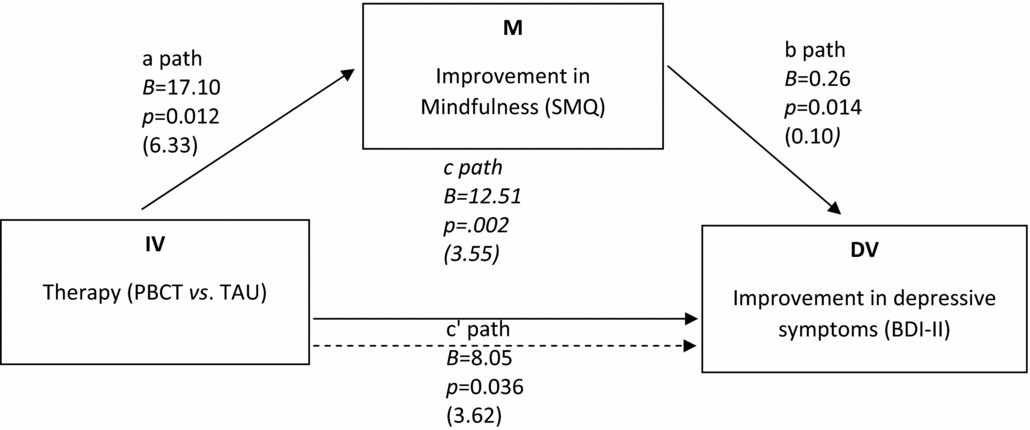
Figure 2 shows the a, b, c and c’ paths for the proposed mediation model. As would be expected from the RCT findings, the effect of IV on DV (path c) is significant with PBCT participants showing significantly greater improvement on the BDI-II than participants in the TAU control group. The effect of IV on M (path a) is also significant with PBCT participants showing significantly greater improvements in SMQ scores than those receiving TAU. Path b (the effect of M on DV while controlling for IV) is also significant which shows that, irrespective of condition, improvements in mindfulness significantly predict improvements in depressive symptoms. Finally, when M is controlled for the relationship between IV and DV reduces (path c’), although this relationship remains significant. However, the 95% confidence interval for the bootstrapping analysis just crosses zero (-0.97 to 14.84). This analysis therefore does not support the hypothesis that improvements in mindfulness mediate the relationship between therapy condition and improvements in depressive symptoms.
Mediation model showing unstandardized beta coefficients (B) and levels of statistical significance (p) for paths a, b, c and c’ with the standard error given in parentheses. M, Proposed mediator; IV, independent variable; DV, dependent variable.
Analysis of effect sizes
Given the finding from the mediation analysis it is worth exploring the effect size on the measure of mindfulness (SMQ in this study). The post-intervention between-group Hedges’ g effect size on the SMQ in the current study is 0.74 (95% CI −0.03 to 1.51). Hedges’ g post-intervention between-group effect sizes on measures of mindfulness from the three published RCTs of MBCT for people meeting diagnostic criteria for a current episode of major depression were 0.64 (95% CI 0.15–1.13) (van Aalderen et al. Reference van Aalderen, Donders, Giommi, Spinhoven, Barendregt and Speckens2012) based on the total score from the Kentucky Inventory of Mindfulness Skills (KIMS; Baer et al. Reference Baer, Smith and Allen2004), 0.19 (95% CI −0.40 to 0.79) (Manicavasgar et al. Reference Manicavasagar, Perich and Parker2012) based on the Mindful Awareness Attention Scale (MAAS; Brown & Ryan, Reference Brown and Ryan2003) and −0.30 (95% CI −1.29 to 0.70) (Chiesa et al. Reference Chiesa, Mandelli and Serretti2012), also based on the MAAS. While these are all small-scale trials, the initial indication from this comparison is that the effect size on learning mindfulness in the current study is not lower than would be expected following MBCT for current major depression.
Study 2
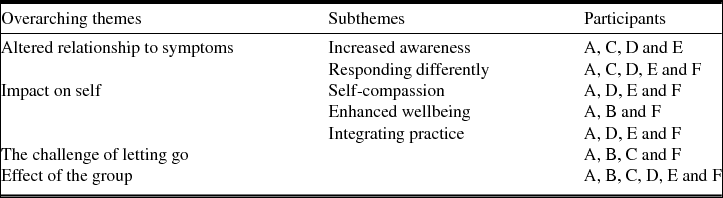
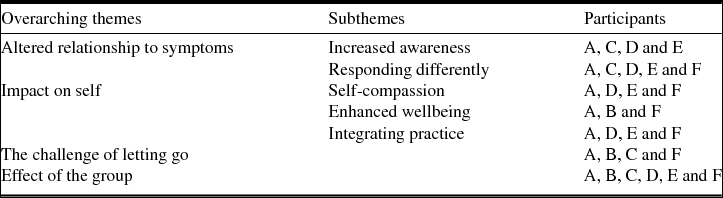
Participants who were interviewed attended an average of 10/12 sessions (s.d. = 1.4). Accounts of the brief mindfulness practice, as experienced as part of group PBCT resulted in three overarching themes, with five subthemes. Table 2 provides an overview of these themes and which participants contributed to them.
Overarching themes and subthemes illustrating participants’ perceptions of the brief mindfulness practices
Altered relationship to symptoms
Five of the six participants reported a shift in the way they related to their symptoms of depression since engaging in PBCT. These shifts are considered under the subthemes ‘Increased awareness’ and ‘Responding differently’.
Increased awareness. Four participants spoke of experiencing increased awareness, with examples including being more conscious of negative thoughts, periods of rumination, and symptom fluctuations:
I’m more aware of when I’m uh . . . uh . . . when I’m going downhill (Participant D).
I’m much more aware now, so I do realize that I feel this way, and it probably is quite irrational and things (Participant E).
Interestingly, one participant was able to directly link her ability be more aware and present in the moment to a change in mood:
I just took the opportunity to sort of, do a Mindfulness exercise as I was strolling along, and found myself noticing, actively noticing things around me that I hadn't noticed for a long time. . . . And that then had a knock on effect, my enjoyment of what I was doing as well (Participant A).
Responding differently. Five participants reported using mindful practice as a new way of coping with their symptoms. Examples ranged from applying practices in the midst of a challenging situation, to a change in their overall approach to maintaining their wellbeing:
if I’m particularly agitated, . . . I can just go and sit in a chair, . . . and ah, listen to the Mindfulness . . . just sort of acknowledging that these are the issues, and, and just acknowledging them more than burying them down (Participant D).
I think I’m much better at not getting pulled along a path where I get very one-track minded (Participant E).
It is a lovely feeling, when you get to that point where . . . [exhales] you just do that, and the air comes out, you just concentrate on your breathing, . . . when you’re focused on that one task, the rest of it just goes away . . . And just for a while, it's peaceful . . . It shuts that pain out (Participant F).
Impact on self
Five of the six participants spoke about the personal impact that PBCT had for them. These were clustered under three subthemes: ‘Self-compassion’, ‘Enhanced wellbeing’ and ‘Integrating practice.’
Self-compassion. Four participants made a link between engaging in mindfulness practice and experiencing an increased sense of self compassion. This included examples such as generally being more accepting of themselves as an individual and no longer holding themselves responsible for having depression.
What I find now is that because I’m more accepting of myself, I, I don't assume that other people are going to be as dismissive of me and critical of me (Participant A).
I often thought it was my fault . . . Yeah, I thought it was my fault, that I should be happier. But it's not all me. . . . I don't blame myself for it as much as I used to do (Participant F).
For some participants, this increased self-compassion appeared to provide a platform for lifestyle changes, which including permitting themselves more personal space with less pressure to always be ‘doing’.
I’ve taken to be putting a little less pressure on myself and taking a bit more space for myself, . . . I do worry less about what people think of me. Um . . . and generally I just make a bit more time for myself, and put myself slightly further forward rather than being at the bottom of the pile, I’m slightly higher (Participant D).
For one participant, the changed relationship with the self was associated with subsequent changes in their interpersonal relationships.
Because I’m feeling better about myself and more accepting of myself . . . it probably matters less to me now, what she thinks, whereas at one point, I was I was effectively setting myself up to fail because I was . . . judging myself by her standards . . . and I’m not judging myself by, you know, by the standards that she would accept as a mum any more. So there’s, that tension is gone, really. So the relationship’s, you know, better (Participant A).
Enhanced wellbeing. During the interviews three participants highlighted additional benefits to their general wellbeing that they attributed to practising mindfulness. These benefits included a general sense of calm and ability to relax, and improved sleep.
Even if it's [meditation] only three minutes or five minutes, and that brings a state of peace to your mind, which then goes into your body (Participant F).
One thing about the Mindfulness is, it does sometimes help me sleep . . . I find it quite useful in that respect (Participant B).
One participant also spoke about how these internal changes improved her ability to experience life events more fully:
Changes that have happened in my life would have improved, um, my situation to an extent, but I don't think I would have got as much out of those things, had it not been for the Mindfulness, um, exercises at all, because, because they . . . they have helped me so much to reflect on things (Participant A).
Integrated practice. In addition to the use of mindfulness practices for specific purposes, as highlighted above, four of the six participants interviewed spoke about having integrated mindfulness into their daily lives. This ranged from regularly engaging in guided practices, to bringing mindful awareness to their daily activities.
Because I spend a lot of hours in a week, probably, doing really boring things . . . that's my Mindfulness time (Participant E).
The challenge of letting go
Another theme identified in four of the six interviews, concerned the challenges experienced in relation to letting go of expectations and not passing judgement on one's own experience during mindfulness practice. For these participants, there appeared to be a continued sense of getting a practice right or wrong.
I kind of listened to what was being said, but then I drifted off to something else, and come back again, and then it would happen again and then suddenly you’d think oh, I’m supposed to be listening to, you know [facilitator's name], but I don't know really, whether . . . it’s, whether I was doing it right or not (Participant C).
I don't think I’ve got the mental self-discipline to stop the mind wandering off on its own yet. (Participant F).
Effects of the group
Participants also spoke about the specific effects of the group-based nature of PBCT. Unsurprisingly, for many this was initially a source of apprehension, but for the majority it was also perceived to have a normalizing and supportive effect, for example supporting participants to adopt a more self-compassionate approach:
I had forgotten to do my daughter's lunch, and I had felt absolutely useless and pathetic, . . . several people [in the group] said, oh, gosh, every parent must do that occasionally, . . . it's not because it's you, it's not because you’re depressed, it's not because you’re useless . . . since then, when a similar sort of thing has happened, I shrug it off, rather than letting myself get into a sort of downward spiral again (Participant A).
Discussion
In study 1 the role of improvements in mindfulness in mediating the relationship between therapy condition (PBCT vs. TAU) and improvements in depressive symptoms, although in the hypothesized direction, just failed to reach statistical significance using bootstrapping methods. Therefore it is not possible to conclude that improvements in mindfulness mediated the relationship between therapy condition and improvements in depressive symptoms. In Study 2, four overarching themes were identified from the thematic analysis: ‘altered relationship to symptoms’, ‘impact on self’, ‘the challenge of letting go’ and ‘effect of the group’. Given the underpowered nature of the mediation analysis (see later), together with findings from the qualitative analysis, these studies provide an initial indication that improvements in mindfulness may have played a role in facilitating improvements in the depression but this suggestion warrants attention in future research studies.
It is important to highlight that the post-intervention between-group effect size on the mindfulness measure in this study (SMQ) was comparable to the effect sizes on measures of mindfulness (KIMS and MAAS) in the three published RCTs of MBCT where all participants met criteria for a current episode of a major depressive disorder (Chiesa et al. Reference Chiesa, Mandelli and Serretti2012; Manicavasgar et al. Reference Manicavasagar, Perich and Parker2012; van Aalderen et al. Reference van Aalderen, Donders, Giommi, Spinhoven, Barendregt and Speckens2012). While these different studies used different self-report measures of mindfulness and all had small sample sizes (resulting in wide confidence intervals), this comparison suggests that PBCT may be no less effective than MBCT at improving self-reported mindfulness for people who are currently depressed. This suggestion should now be tested in a fully powered RCT that directly compares MBCT to PBCT using the same measure of mindfulness.
In study 2 participants reported an increased awareness in relation to fluctuations in internal experiences, and also in relation to bringing mindful awareness to their daily activities. Interestingly, participants spoke of this increased awareness as being central to a variety of subsequent changes. Participants reported a changing experience of depression, not in relation to the presence of symptoms they experienced, but in the way in which they related to and managed their symptoms (a key theme of mindfulness-based approaches). For instance, some participants spoke of the perceived benefits of mindfulness practices in alleviating distress through reducing unhelpful behaviours, such as rumination. Other participants spoke of an improved ability to self-manage in terms of letting go of excessive responsibilities. In addition, improvements in wellbeing were noted in relation to improved sleep and ability to relax. A further important area of perceived change concerned how participants related to the self in terms of being more compassionate and accepting. This appeared to have a subsequent positive impact on their relationships with friends, family and colleagues, which consequently provided greater social support. Finally, the group context emerged as important in fostering change with support from other group members being highlighted as one aspect of group context.
The themes that emerged from the qualitative analysis will be largely unsurprising to those familiar with the qualitative literature in relation to MBIs. For example, Carins & Murray's (Reference Carins and Murray2013) meta-synthesis of qualitative studies of MBCT, with its longer mindfulness practices, included, among others, similar themes relating to increased awareness, changed responding/relationship to experience and self, and the effects of group context. In addition, another recent meta-synthesis of MBIs for people with mental health difficulties (Wyatt et al. Reference Wyatt, Harper and Weatherhead2014) identified similar themes including the normalizing and supportive process of the group, relating differently to thoughts and feelings and the changed relationships with self and others. Most of the studies included in the meta-synthesis by Wyatt and colleagues (Reference Wyatt, Harper and Weatherhead2014) were of MBCT or MBSR (Mindfulness-Based Stress Reduction) and none were of a MBI incorporating brief practices for people experiencing a current episode of major depression. There is also an emerging literature on participants’ experience of brief mindfulness practices within PBCT for psychosis with similar themes (May et al. Reference May, Strauss, Coyle and Hayward2014). However, while the themes that emerged from study 2 are not novel in the context of the broader qualitative MBI literature, the fact that they were derived from people experiencing a current episode of depression who participated in an MBI with brief mindfulness practice, is to the best of our knowledge, novel and of clinical importance.
A further point of discussion raised in study 2 relates to the absence of reported distressing experiences during the mindfulness practices during the interviews. This is in contrast to findings from MBCT studies (Finucane & Mercer, Reference Finucane and Mercer2006; Allen et al. Reference Allen, Bromley, Kuyken and Sonnenberg2009; Barnhofer et al. Reference Barnhofer, Crane, Hargus, Amarasinghe, Winder and Williams2009); however, it is of note that the current study interviewed a smaller proportion of participants than the aforementioned studies and that participants who may have found mindfulness practices difficult may not have come forward to be interviewed.
Although this paper focused on data pertaining to mindfulness, it is important to acknowledge the practices discussed were experienced as part of a 12-week PBCT group. Therefore, it is not possible to ascertain the extent to which the additional components of therapy, or the combination of mindfulness practice with cognitive therapy, contributed to the acquisition of these skills. Nevertheless, the qualitative findings suggest that mindfulness practice was an important, active ingredient, at least in the perception of the participants interviewed, and merits further investigation.
The bootstrapped mediation analysis just failed to reach significance as the 95% confidence intervals just crossed zero. One interpretation of this finding is that the mediation hypothesis is incorrect and should be rejected. That is, that mindfulness learned through PBCT does not facilitate improvements to depressive symptoms. Another interpretation is that the bootstrapped mediation analysis with the 28 people in the current study was underpowered to detect anything other than large effects (Fritz & MacKinnon, Reference Fritz and MacKinnon2007). Fritz & MacKinnon (Reference Fritz and MacKinnon2007) note that a sample size of 71 would be needed to detect the indirect effect of an independent variable on a dependent variable via a proposed mediator if path a and path b are assumed to be medium in size. A larger study powered to detect at least a medium indirect effect size is therefore warranted.
A further limitation of this study relates to sampling for study 2. For the thematic analysis the sample size was relatively small compared to the overall sample, and participants volunteered to be interviewed, raising potential concerns around selection bias. For instance, it is possible that only participants who had a positive experience volunteered to speak about it. Finally, the importance of continued application of principles and practice after the completion of therapy through the development of the ‘self-therapist’ has been discussed in relation to long-term effectiveness of therapies (Glasman et al. Reference Glasman, Finlay and Brock2004). Participants in this study were interviewed between 3 and 6 weeks after completing the group. Therefore, no conclusions can be drawn regarding the longevity of engagement in brief mindfulness practice.
This study is based on an assumption that brief mindfulness practices will be more acceptable and tolerable for people currently experiencing symptoms of major depressive disorder. While this assumption is supported by findings from previous qualitative studies of MBCT for current depression (e.g. Finucane & Mercer, Reference Finucane and Mercer2006) it was not directly explored in this current study. Future research could attend more closely to this issue through exploring experiences of different lengths of mindfulness practices for people who are currently depressed. People with current symptoms of depression and who have experience of participating in mindfulness practices of different lengths could be interviewed about their experiences of these practices and thematic analysis could be used to draw out themes related to length of practice.
This is the first published study, to our knowledge, that explores whether people diagnosed with major depression can gain symptom benefit from an intervention grounded in brief mindfulness practices. While the test of mediation was underpowered to allow definitive conclusions about the role of improvements in mindfulness in mediating the relationship between the therapy condition and improvements to depressive symptoms, findings from the qualitative study show that a number of PBCT participants reported benefits from the brief mindfulness practices that were subjectively related to distress reduction. Given that the lengthier practices in MBCT may pose a challenge for some people who are currently depressed, this current study is of value as it suggests that a therapy (PBCT) based on much briefer mindfulness practices may be of therapeutic benefit for people experiencing a current episode of depression. Effect sizes on self-reported mindfulness in this study compare favourably to effect sizes from RCTs of MBCT for current major depression and suggest that PBCT may be no less effective than MBCT at facilitating the learning of mindfulness. Further research is now needed to extend the current study design to a larger sample. Nevertheless, the current study suggests that the brief mindfulness practices in PBCT for current depression may have the potential to alleviate symptoms of depression and are valued by therapy participants.
Summary of main points
Although MBIs such as MBCT can have benefits for people meeting diagnostic criteria for a current episode of major depressive disorder, some people who are currently depressed find the length and nature of mindfulness practices in MBCT too demanding. This study explored the possibility that mindfulness learned through brief mindfulness practices (<10 min) in PBCT might bring about symptom alleviation for people who are currently depressed.
This was a small, underpowered study and the mediation hypothesis was not supported, although effects were in the hypothesized direction. However, findings from interviews with six therapy participants suggest that at least some participants valued the mindfulness practices and made a connection between practising mindfulness and feeling less depressed. When taken together, findings from the quantitative and qualitative studies suggest that the brief practices in PBCT may be of benefit for people who are currently depressed but further research, with a larger sample size, is now needed in order to provide a robust test of the mediation hypothesis.
Acknowledgements
This study was funded by a grant from the Sussex Partnership NHS Foundation Trust.
Declaration of Interest
None.
(1) To appreciate the rationale for Person-based Cognitive Therapy (PBCT) for depression in the context of other available mindfulness-based interventions.
(2) To gain familiarity with the therapy protocol for PBCT for depression.
(3) To critically appreciate the potential role that brief mindfulness practice may play in helping to alleviate symptoms of depression following PBCT.



Comments
No Comments have been published for this article.