Introduction
The characteristics of water flow at the base of temperate glaciers and, in particular, the existence and properties of subglacial water films have long been central issues in glacier-sliding studies. It is clear that a subglacial water film effectively lubricates the glacier–rock interface by submerging small bed irregularities that impede glacier sliding. The key question that remains to be answered, however, is whether the water film could be thick enough to submerge a large portion of the bed obstacles that contribute significantly to the drag on the glacier. This has led to two areas of current research: one is aimed at determining the size range of bed obstacles that contribute most to the drag on the glacier and are actually present on glaciated surfaces (Reference LliboutryLliboutry, 1975; Reference HalletHallet, 1976[b]; Reference Johnson, Johnson, Melosh and KambJohnson and others, 1976; Reference BenoistBenoist, 1979); the other, which will be one of the main concerns of this paper, is aimed at determining what is the actual thickness of the water film.
Various aspects of glacial hydrology have been the subject of several theoretical studies (Reference WeertmanWeertman, 1964, 1972; Reference LliboutryLliboutry, 1968; Reference RöthlisbergerRöthlisberger, 1972; Reference ShreveShreve, 1972; Reference NyeNye, 1973[b], Reference Nye1976). Two fundamentally different limiting models of subglacial water flow have emerged from these theoretical considerations; intermediate models may be most realistic. In one, water derived at the surface and throughout the glacier flows to the base and drains largely through a subglacial water film (Reference WeertmanWeertman, 1964, Reference Weertman1969). In the other, such waters would tend to be channelized into a system of subglacial cavities and interconnecting channels incised in either or both the bedrock and the basal ice (Reference LliboutryLliboutry, 1968; Reference RöthlisbergerRöthlisberger, 1972; Reference ShreveShreve, 1972; Reference NyeNye, 1973[b]). In the latter model, a subglacial water film would still exist, but it would be very thin, perhaps only microns in thickness, because it would only accommodate the local transport of melt water associated with regelation sliding (Reference NyeNye, 1973[b]). This local water transport in the film from areas of relatively high pressure to adjacent areas of relatively low pressure, where much of the water refreezes, contrasts sharply with the generalized through-flow of water in a thicker film envisioned in the first model. Although there is no clear consensus of opinion, several investigators have pointed out the inherent instability of subglacial film flow due to the tendency of water flowing in a relatively thick film to become channelized (Reference NyeNye, 1976; personal communication from J. Walder, 1978) or to be effectively captured by subglacial cavities (Reference LliboutryLliboutry, 1968). The suggestion that the subglacial film may not be continuous (Reference WeertmanWeertman, 1972; Reference RobinRobin, 1976), together with experimental evidence suggesting that the currently used model of regelation is incomplete (Reference Drake and ShreveDrake and Shreve, 1973; Reference Nye, Whalley, Whalley, Jones and GoldNye, 1973[a]; Reference MorrisMorris, 1976) provide ample additional motivation for obtaining actual data on the subglacial water film as well as on other aspects of glacier sliding.
Direct studies of the ice–rock interface are obviously difficult because they are restricted to small areas, not necessarily representative of the glacier bed, at the base of glacier tunnels (Reference McCallMcCall, 1952; Reference Kamb and LaChapelleKamb and LaChapelle, 1964) and bore holes (Reference HodgeHodge, 1979; Reference Kamb, Kamb, Engelhardt and HarrisonKamb and others, 1979), and in subglacial cavities (Reference CarolCarol, 1947; Reference VivianVivian, 1975). Moreover, a regelation water film is particularly difficult to study because, in addition to being absent within cavities, it would be very susceptible to disturbances of the basal stress and temperature regime induced by artificial bore holes or tunnels. For example, a sudden drop of pressure in a film, which could result when penetrated by a bore hole, could cause a film to rapidly freeze. A final difficulty in studying regelation water films is that, even in experiments simulating the regelation process (Reference NyeNye, 1967), direct examinations of the films have not been possible except in the recent experimental study of Reference Tusima [i.e. Tsushima] and TozukaTusima and Tozuka (1979), presumably because the films are usually very thin (Reference NyeNye, 1973[b]). Hence, it is clear that subglacial regelation water films are not readily amenable to direct studies.
Recent research on subglacial chemical processes, and in particular of carbonate deposits that form by subglacial precipitation of CaCO3, has indirectly provided interesting information about subglacial water films. The intent of this paper is to present recently obtained information that is pertinent to (I) the thickness of the subglacial film, (2) the temporal variability of film flow, and (3) the relative importance of through-flow versus local regelation water flow in the film.
Approach
Through detailed studies of bedrock surfaces recently uncovered by glacial retreat, it is possible to reconstruct in considerable detail the conditions formerly present at the glacier–rock interface, because each subglacial process leaves a diagnostic imprint on the glacier bed. This type of study is particularly attractive because (1) large expanses of the former beds of numerous glaciers can be readily studied with minimal equipment needs, (2) one can decipher without fear of disturbance the conditions formerly existing over the entire glacier bed, and (3) in contrast to studies conducted subglacially that yield data only during the period of observation, one can extract information about former subglacial conditions over a period of time probably on the order of tens of years. Considerable data on the spatial distribution and geometry of subglacial cavities, water channels, and zones of abrasion have been obtained in this way and have been presented by Reference Walder and HalletWalder and Hallet (1979). This paper is largely devoted to the glaciological implications of studies of subglacial carbonate deposits.
Subglacial carbonate deposits
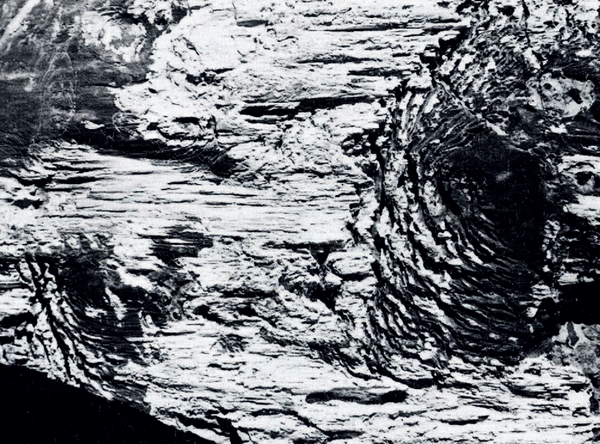
Deposits consisting primarily of subglacially precipitated calcite are relatively common and conspicuous on carbonate-rich rocks near many extant and a few former glaciers worldwide (Reference BauerBauer, 1961; Reference KersKers, 1964; Reference SamuelssonSamuelsson, 1964; Reference Ford, Ford, Fuller and DrakeFord and others, 1970; Reference HalletHallet, 1976[a]). Recently, aragonite has been detected in subglacial carbonate deposits collected near the Castleguard glaciers, Alberta, Canada (independent personal communications from D. C. Ford and B. B. Hanshaw). Very thin silica and ferromanganese deposits are also known to form subglacially but, because they are scarcer and less well-developed than carbonate deposits, they are not nearly as suitable for elucidating former subglacial conditions. The carbonate deposits generally occur as greyish white coatings, several millimeters thick, that partially cover glaciated bedrock. In certain localities, they are often distinctly fluted parallel to striations and may take on distinct columnar forms, frequently resembling centimeter-long stalactites that point in the former local ice-flow direction (Fig. I). They are often associated with solutional features that tend to be transverse to the former ice-flow direction. Whereas the deposits are restricted to former lee surfaces and to bedrock concavities, the solutional furrows tend to be localized on surfaces facing up-glacier.
Subglacially formed calcite deposits with flutes and spicules parallel to the ice-flow direction, from left to right (light areas). Solutional furrows etched into dark-colored bedrock are transverse to the ice flow. Field of view is approximately 13.5 cm wide.

The light color of typical subglacial CaCO3 deposits, which contrasts with the generally dark grey bedrock, as well as their occasional translucence, suggest that they are not made wholly of comminuted bedrock. Rather, these deposits consist primarily of calcite precipitated from subglacial waters, together with varying amounts of fine rock fragments. Microscopic examination of thin sections generally reveals a systematic internal structure with series of distinct lamellae, each of which is made up of individual calcite crystals elongated perpendicular to the lamellae; small rock fragments are easily recognized (Fig. 2). Moreover, oxygen-isotope analyses of subglacial calcites from Blackfoot Glacier, Montana, show that their composition is significantly different from that of the underlying bedrock and confirm that they are not simply comprised of glacial flour (Reference Hanshaw and HalletHanshaw and Hallet, 1978).
I have proposed (Reference HalletHallet, 1976[a]) that the process of regelation, which is essential for glacier sliding, is responsible for the enrichment and eventual precipitation of solutes in the lee of bed obstacles over-ridden by temperate glaciers. The solutes are derived from melting glacier ice and from the dissolution of entrained debris as well as of bedrock. The enrichment results from solutes being selectively rejected into the freezing water by growing ice in much the same way that has been observed in experiments with freezing aqueous solutions of NaCl (Reference Terwilliger and DizioTerwilliger and Dizio, 1970), KOH (Reference Kvajić and BrajovićKvajić and Brajović, 1971), HCl (Reference SeidenstickerSeidensticker, 1972), and CaCO3 (Reference HalletHallet, 1976[a]). Other modes of solute enrichment, or possibly of reductions in solubility are not readily apparent. The occurrence and spatial patterns of subglacial chemical dissolution and precipitation are compatible with modern ideas of glacial sliding. Along stoss surfaces, pressure-melting provides relatively pure water that dissolves bedrock and rock fragments at the glacier base; solutional furrows reflect dissolution of the bedrock. The water flows to areas of reduced pressure along lee surfaces, where regelation tends to concentrate solutes until the waters become supersaturated and precipitation ensues.
Composite micrograph of a thin section of subglacial calcite deposit showing fine lamellae and, in lower center, a layer rich in exceptionally coarse rock fragments. The bar scale represents 1 mm.

Film thickness
Rock fragments in the subglacial deposits
Examination of thin sections shows that subglacial precipitates contain varying amounts of fine rock fragments incorporated during precipitation. They are most likely to originate along stoss surfaces, where they are freed from basal ice as it pressure-melts and where new fragments of all sizes are formed by active abrasion. Many fragments will probably be transported by basal ice; these, however, do not have access to the water film at the lee of obstacles because regelation ice forms there. Therefore, it is very likely that, in order to become incorporated in the aggrading deposit, rock fragments must be transported by water flowing to lee surfaces. It is assumed that all particles with a diameter smaller than the film thickness can be transported through the film; thus, the size distribution of the particles in precipitates and the absence of coarser particles offer a means of estimating the thickness of former subglacial films. This approach is similar to that of Reference VivianVivian (1975), who determined the size distribution of fragments at the ice–rock interface. He observed a deficiency of particles smaller than 200 μm and reasoned that the finer particles had been removed by water flowing through a subglacial film roughly 200 μm thick. Figure 3 shows the cumulative size distribution of fragments seen within individual debris-rich layers in several specimens of subglacial calcite from Blackfoot Glacier, Montana. The majority of the fragments are smaller than 30 μm, and very few exceed 50 μm. It is noteworthy that many of the larger fragments are found within occasional lamellae that are conspicuously rich in coarse debris (Fig. 2). Moreover, occasional lenses of coarse debris occur within single lamellae that contain few or no fragments elsewhere.
Size distribution of rock fragments in 23 individual layers of subglacial carbonate deposit. Bar width (scale in upper left) indicates the number of fragments within each size category along the vertical scale.

The large majority of lamellae in many specimens of subglacial calcite contain few or no rock fragments, suggesting that most of the time the subglacial film is too thin to allow passage of the comminuted debris. On the basis of the size range of fragments in debris-rich layers, it is apparent that in most cases the film must be thinner than several micrometers. Occasionally, however, the film must thicken to several tens of micrometers (even to hundreds of micrometers in exceptional cases) to allow the passage of particles transported to lee surfaces and incorporated in the aggrading precipitate. Lenses of coarse fragments suggest that the thickening of the film may be very localized and may form incipient channels through which water can carry coarser fragments. Therefore, it appears possible that, instead of flowing through a film of uniform thickness, regelation waters flow through irregular micro-channels separated by projections from the glacier sole. This concept is in accord with the idea that a planar regelating interface is inherently unstable and apt to break down to a highly irregular surface (Reference FrankFrank, 1967).
Subglacial carbonate deposit with flow-aligned spicules along the up-glacier side of a former subglacial cavity (on the right). Prominent furrow, directed down-slope, did not form in close contact with basal ice. Pointer shows ice-flow direction; numerals represent 0.1 ft (≈3 cm) intervals.

Morphology of subglacial carbonate deposits
In several areas underlain by limestone, subglacial calcite deposits are often shaped into delicate columnar spicules that invariably parallel the local direction of former ice flow regardless of the substrate surface orientation. Although they often occur at sites that could conceivably correspond to former subglacial cavities, it appears unlikely that aligned spicules could form at such locations. If such cavities were full of water, fluid motion paralleling the ice-flow direction might influence the character of the growing deposits; however, this water flow is not likely to be responsible for the formation of distinct, rectilinear spicules systematically pointing in the local down-glacier direction (Fig. I). Rather, the resulting precipitate would probably consist of coatings with ill-defined surface features, reflecting the local water-flow patterns. On the other hand, if the cavities were partially air-filled, water would flow on the rock surfaces in the down-slope direction, which is often very different from that of the ice flow. Calcite deposits comprised of coatings with distinct furrows aligned down-slope probably formed under such conditions (Fig. 4). Thin sections taken transverse to these furrows show that the fine lamellae characteristic of subglacial deposits are not truncated, hence the furrows cannot result uniquely from dissolution by water trickling down the surface of the previously formed deposits. Rather, the lamellae are locally deflected to conform to the surface, which indicates that the furrows are at least in part depositional features, presumably of subglacial origin.
The orientation of calcite spicules parallel to the ice flow must be controlled by the sliding process and probably requires close proximity of the spicule surfaces to active regelation ice. A simple orienting mechanism can be visualized by assuming that individual calcite spicules form in a thin water sheath, narrowly confined by a closely fitting mold of active regelation ice. Within the thin water film, incipient calcite growth in all directions would be possible. However, once micro-projections form and reach most of the way across the film, their growth direction would be affected by the sliding ice. Pressure melting induced by sliding over fragile, transverse micro-projections, assuming that they did not break off, would tend to locally dilute the solution concentration, thereby inhibiting continued growth and possibly causing dissolution. Flow-aligned rectilinear furrows and flutes, which are closely associated with spicules, also appear to reflect CaCO3 precipitation in a thin water film narrowly confined by actively sliding regelation ice.
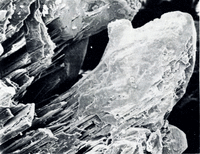
According to the proposed model, the surfaces of spicules ought to be very smooth, devoid of asperities or projections with heights exceeding the thickness of the former basal water film. Scanning electron-micrographs of a spicule (Fig. 5) show that the tip is indeed very smooth with no asperities exceeding micrometers in height. The base of the spicule, however, is much rougher. It has a definite crystalline character, being entirely comprised of well-developed prismatic crystals. The crystalline base and structureless cap of this and other subglacial carbonate spicules suggest that CaCO3 may precipitate as an essentially amorphous phase and subsequently recrystallizes subglacially to form large prismatic crystals. Subaerial recrystallization is possible but it would not account for the cap remaining structureless. Despite the complication apparently related to the recrystallization of the precipitate, the smoothness of the active tip of the spicule corroborates the contention that the spicules were formerly surrounded by regelation ice and that the intervening film was probably very thin, perhaps on the order of micrometers.
Morphology of solutional furrows
Sets of furrows transverse to the former ice-flow direction are ubiquitous on stoss surfaces in deglaciated areas where subglacially precipitated carbonates are abundant (Fig. I). Subglacial calcites often outline the up-glacier side of these furrows. Both the spacing and the depths of furrows are roughly uniform, being on the order of several millimeters. They tend to be systematically oriented perpendicular to the former ice-flow direction. Furrows with this orientation would produce more regelation melt water and have greater dissolution-rates, and thus would tend to grow faster than furrows in other directions. A transverse furrow can continue to grow only if regelation ice occupies much of the furrow and pressure-melting locally produces corrosive water along stoss surfaces. Similarly, the calcite that often outlines the up-glacier side of solutional furrows requires close ice contact, because local regelation is necessary to concentrate and precipitate CaCO3 at those sites from waters that dissolve the carbonate bedrock on immediately adjacent surfaces. Therefore, furrows could not form in a thick sheet of water; the film thickness must not exceed a few tenths of a millimeter—a fraction of the furrow depth. These systematically oriented, elongate solutional furrows contrast sharply with the scalloped surfaces characteristic of soluble substrates exposed to a turbulent flow of reactive water (Reference Blumberg and CurlBlumberg and Curl, 1974).
Scanning electron micrograph showing the crystalline base and very smooth tip of a subglacially formed CaCO3 spicule. The width of the spicule is about 200 µm.

Temporal variability of film flow
Subglacial calcite deposits are usually finely laminated, commonly in concentric patterns. Within a single sample, small domains relatively free of detrital material are often comprised of layers having a rather uniform thickness range on the order of 10–100 µm (Fig. 2). Individual layers probably reflect single episodes of precipitation; the intervening distinct boundaries presumably reflect cessation of precipitation and, possibly, intervals of dissolution. Therefore, it is apparent that the chemical regime in the subglacial film must undergo recurrent changes in state. The rough uniformity in the thickness of the lamellae suggests that each period of precipitation lasts about the same length of time. Accordingly, the precipitation appears to proceed in a roughly periodic manner. The most apparent periodic phenomenon that could alter the subglacial chemical regime is a seasonal variation in melt-water production and/or in glacier sliding. As explained in the water-flux section, precipitation can cease as a result of an increase in the through-flow or dilution of waters in the subglacial film, both of which might tend to occur during the spring or summer season.
Estimates of the amount of subglacial calcite that could form subglacially in one year further support the contention that the layers represent annual cycles of precipitation. Consider, for example, the situation in which glacier sliding occurs by regelation alone over a bedrock bump 10 mm high and wide, and 200 mm long, with a sliding velocity of 20 m a–1. About 2 l of water would be produced per year and would flow to the adjacent lee side. Inasmuch as a reasonable Ca2+ concentration for this water is about 5x10⁻⁴M (Reference HalletHallet, 1976[a]), approximately 10–3 moles of CaCO3 would be transported to the lee surface. Assuming that lee waters are saturated, and neglecting the limited incorporation of solutes into growing regelation ice, 10–3 moles (about 0.1 g) of CaCO3 could precipitate. If CaCO3 precipitates uniformly over the entire lee surface (an area of 10 cm2), a layer of calcite 30 µm thick would form. Inasmuch as the actual lamination thickness is generally on the order of 10–100 µm, it appears quite plausible that the lamellae are annual layers that reflect seasonal variation in the flux and/or composition of water in the basal film.
The relative importance of through-flow in the subglacial film
Despite uncertainties in the effective subglacial pCO2, it is clear that Ca2+ concentrations of subglacial waters from which CaCO3, is precipitated along lee surfaces must generally be on the order of 10–2–10–3 eq/l, about two orders of magnitude more concentrated than glacier ice (Reference Hallet, Hallet, Lorrain and SouchezHallet and others, 1978). Whether such high solute concentrations can be locally attained depends upon the mean Ca2+ concentration in the film, the effective distribution coefficient (the bulk Ca2+ concentration of the ice divided by that of the freezing water), and the proportion of film water that regelates.
The occurrence of subglacially precipitated calcite and adjacent solutional furrows places interesting constraints on the solute distribution, corresponding to the various possible film-flow regimes. If the film primarily accommodates through-flowing waters, precipitation is possible only if the mean solute concentration approaches the saturation value, because only a small proportion of the water flowing along these surfaces would freeze and, hence, the solute enrichment would be slight. On the other hand, if the film primarily accommodates the local water flow associated with glacier sliding, solutes will be greatly concentrated at sites where much of the water is frozen to form regelation ice. In this case, the solute concentration of the film water would be very low except along lee surfaces, where waters would be saturated. Simple mass-balance considerations outlined below deal with these ideas more explicitly.
Consider a small portion of the water film along lee surfaces where CaCO3 is precipitating. Ignoring the slight effective supersaturation, the CaCO3 concentration there has the saturation value C s. Assuming a steady state, conservation of water requires that, over a given time interval, the influx of water, V i, equals the outflux, V o, plus the volume frozen, V f:

All the quantities are taken per unit time and unit width in a direction transverse to the ice flow. Similarly, conservation of solutes requires that

where C i is the solute concentration in water flowing into the lee area; it will generally be representative of the mean solute concentration of film water. C o is the concentration of water flowing from lee areas where CaCO3 precipitates and, hence, should be close to the saturation value, C s. The solute concentration in the aggrading regelation ice is C f, expressed as solute quantity per unit volume of water. The mass loss by precipitation per unit time and unit length perpendicular to the flow direction is P. The last term in Equation (2) roughly accounts for the transport of solutes by diffusion due to the concentration difference (C s–C i) over a length scale L; this is on the order of half the wavelengths of small bed obstacles (< c. 0.5 m), which are dominantly affected by the regelation process and the associated subglacial chemical exchange. D is the solute diffusivity in water and h is the thickness of the basal water film. The regelation ice will be considerably purer than the lee-side water from which it forms, its composition being equal to the product of the saturation concentration and an effective distribution coefficient k, which is probably about 0.01–0.02 (Reference Hallet, Hallet, Lorrain and SouchezHallet and others, 1978). With these considerations and the fact that k ⪡ 1, Equations (1) and (2) can be readily combined to yield an approximate inequality that needs to be satisfied for precipitation to be possible (P > 0):

where α = V o/V i; it is the measure of the degree of through-flow. When none of the water freezes and all of it flows through the film, α = 1, and when all of the water flowing into the lee areas freezes, α = 0. The volume of water that refreezes per unit time and per unit width transverse to the ice-flow direction, V f, can be estimated as in the previous section. For a reasonable rate of bed slip of 20 m a–1 over a bump 10 mm high, V f is on the order of c. 10–2 mm2 s–1. The term hDL –1 ≈ 10–6mm2 s–1 for a reasonable solute diffusion coefficient in water (D = 10–3 mm2 s–1), a film thickness of h = 10–2 mm, and a distance between adjacent sites of dissolution and precipitation of 10 mm. Increasing the film thickness to 10–1 mm and decreasing the effective wavelength of bed irregularities to 1 mm increases this term by a hundredfold, but it would still be two orders of magnitude smaller than V f. Hence, it appears that diffusive transport of solutes is likely to be negligible relative to the advective transport. Equation (3), therefore, effectively reduces to the following condition for precipitation to be possible:

This result clearly shows that if, as pointed out earlier, much of the water is flowing through the film rather than freezing (α ≈ 1), precipitation is possible only when the mean solute concentration is relatively high. It also indicates that variations in subglacial conditions, which increase the through-flow of water or decrease the mean solute concentration in the film, C i, or both, would inhibit or prevent subglacial precipitation.
Chemical analyses of water from streams emerging at the snout of Blackfoot Glacier provide interesting data on the relation between water draining from the glacier and water in the subglacial film. The Ca2+ content of stream water is about 1.5x10⁻⁴ eq/l, and yet the solute concentration in the film water must locally reach values of 10–2–10–3 eq/l for CaCO3 to precipitate subglacially as it formerly did over the portion of the Blackfoot Glacier bed that is presently deglaciated. It is apparent, therefore, that the melt water draining from Blackfoot Glacier did not travel through the subglacial film; instead it must have flowed through an essentially independent hydraulic system. This system is probably a network of channels and cavities as formerly existed under Blackfoot Glacier (Reference Walder and HalletWalder and Hallet, 1979).
Oxygen-isotope analyses of ice and calcite deposits at Blackfoot Glacier further support the idea that the film in which precipitates form primarily accommodates regelation melt waters Reference Hanshaw and Hallet(Hanshaw and Hallet, 1978). As water freezes, the ice tends to preferentially incorporate the heavier isotope 18O, thereby enriching the water in 16O. If most of the water in the subglacial film freezes in connection with the regelation sliding process, lee-side waters would become systematically enriched in the light isotope. This enrichment would in turn be reflected in the oxygen-isotope composition of subglacially precipitated calcite. On the other hand, if the film accommodates a considerable through-flow of water, the proportion of water refreezing would be small, and the associated enrichment of 16O would be slight. The oxygen-isotope composition of film waters would then tend to be fairly uniform with a value close to that of the parent ice in the overlying glacier. Using 18O/16O partitioning coefficients for calcite–water Reference Clayton, Clayton, Jones and Berner(Clayton and others, 1968) and measured isotope compositions of subglacial calcites, Reference Hanshaw and HalletHanshaw and Hallet (1978) have concluded that the oxygen-isotope ratio of water in which CaCO3 precipitates subglacially must be about 3 per mil lighter than that measured for ice and pro-glacial stream melt waters from Blackfoot Glacier. This difference would not exist with considerable through-flow in the film. However, it corresponds precisely with the enrichment of 16O that would result from the isotopic partitioning associated with the freezing Reference O’Neil(O’Neil, 1968) of much of the water in the basal film. Although these analyses have to be conducted elsewhere to verify the validity of the technique, the preliminary results strengthen the concept that, at least under small cirque glaciers, subglacial calcites form in a water film that transports little through-flowing water.
Discussion and conclusions
The occurrence of subglacially precipitated calcite and associated solutional furrows corroborates the widely accepted but poorly confirmed fundamental notion of regelation sliding and the existence of a basal water film. The size distribution of rock fragments in the subglacial carbonate deposits, as well as the flow-aligned surface texture of the deposits and of solution furrows, are suggestive of intimate contact between ice and rock, with an intervening water film generally micrometers thick. Occasionally, the film must thicken, perhaps non-uniformly, to several tens of micrometers and, exceptionally, to about 100 µm in order to allow for the transport of rock fragments to lee areas where they are incorporated in the precipitate.
Thin, featureless carbonate coatings and carbonate deposits with deep furrows aligned down-slope probably reflect CaCO3 precipitation in completely and in partially water-filled subglacial cavities, respectively. The deposits indicate that CaCO3 precipitates from water in direct contact with the bed, which is not in accord with the suggestion of Reference LliboutryLliboutry (1976) that water in subglacial cavities may freeze directly on the bed. Mass-balance considerations of water and solutes in subglacial films suggest that precipitation is possible only when the mean solute concentration in the film is high and/or little water flushes through the film. Recurrent variations in either of these conditions may be responsible for interruptions in precipitation that presumably give rise to the laminated nature of the subglacial deposits.
Elemental analyses of water from a pro-glacial stream and comparative isotopic analysis of these waters, glacier ice, and subgiacial calcite at Blackfoot Glacier, Montana, indicate that the basal film water in which calcite precipitates is distinctly different from melt waters draining from the glacier. This conclusion, together with the evidence suggesting that the film is generally very thin, implies that, under the small cirque glacier studied, the film primarily accommodates the local transport of melt waters associated with regelation sliding. Accordingly, through-flowing waters appear to drain through a different hydraulic system, probably distinct channels, many of which are incised in the bedrock Reference Walder and Hallet(Walder and Hallet, 1979). This model is in accord with Reference NyeNye’s (1973[b]) concept of subgiacial hydrology, and is generally compatible with the notion that subgiacial as well as englacial waters tend to be channelized (Reference RöthlisbergerRöthlisberger, 1972; Reference ShreveShreve, 1972; Reference NyeNye, 1973[b], Reference Nye1976). Moreover, it is in accord with recent studies in which bore holes drilled to the base of temperate glaciers often encounter regions that are not, at least initially, hydraulically connected with large subglacial water conduits Reference Hodge(Hodge, 1979; Kamb and others, 1979). These regions of the glacier-bed interface presumably correspond to those characterized by intimate ice–rock contact and a thin intervening water film largely independent of the channelized water-drainage system.
The deposits also appear to record variations in the film conditions, including occasional thickenings and periodic, probably seasonal, variations in the net water flux through the film or in the solute concentration in the film. Likely causes for such variations include changes in the rates of glacier sliding and in the availability of water at the glacier bed. Variations in sliding-rates could probably not account for appreciable thickening because they do not greatly affect the film thickness, which is proportional to the cube root of the sliding-rate (Reference NyeNye, 1973[b]). Such thickening, as well as periodic interruptions of CaCO3 precipitation, could be due to recurrent temporary increases in the net flux of water through the film. A similar process has been invoked by Reference Iken, Iken, Flotron, Haeberli and RöthlisbergerIken and others (1979) to account for the rapid uplift of Unteraargletscher at the beginning of the melt season.
It must be pointed out that these conclusions are based on studies of calcareous bedrock exposed by retreating cirque glaciers; similar bedrock exposures with abundant subglacial precipitates have not been found near larger glaciers either because they do not exist or because they tend to be covered with debris. Therefore, caution must be exercised in applying these results to larger glaciers.
Acknowledgements
It is a real pleasure to thank A. Heyneman, R. Stein, R. Anderson, J. Walder, B. Aubry, and R. Patrick for their competent and often enthusiastic assistance with the field work and other aspects of this study. I am grateful to J. Walder for reading critically and discussing the manuscript. I wish to thank R. L. Shreve and W. E. Reed for their most valuable guidance and their interest in my initial studies which led to the present work.
The generous co-operation of the National Park Service and the Canadian Bureau of Indian and Northern Affairs was critical to the successful completion of the field work and is gratefully acknowledged.
Research was supported by the Division of Earth Sciences, National Science Foundation, NSF Grant EAR-7713631.
Discussion
D. C. Ford: Calcite (and aragonite?) precipitates of this type are developed excellently upon flat limestone surfaces exposed by recession of neoglacial ice about Mount Castleguard, Alberta. There are the same kinds of micro-drumloid bedforms in the rock that hosts them. I have preferred to see the history of events at a site on the bed in two distinct phases: (1) net glacial abrasion and carbonate solution producing the drumloids, (2) a phase of highly localized solution producing the solutional furrows (or “rillensteine” as they are called in the karst literature) and dominant precipitate deposition. Abrasion tools were supplied by a felsenmeer that occupied these surfaces before the neoglacial period.
B. Hallet: I see no need for distinct phases of subglacial erosion and deposition. Rather, I prefer to view abrasion and chemical dissolution as occurring simultaneously at the glacier bed. If, however, there are periods in which the basal ice is relatively rich in debris, abrasion will tend to be a more important and perhaps dominant erosive process during these times.
M. M. Herron: Are you envisioning the solution to be continually saturated in calcite and no liquid-filled cavities, so that a continuous process is occurring? Or could it be that a non-saturated solution occasionally fills a cavity with precipitation only occurring after a substantial freeze-concentration process? It appeared that the thin sections of calcite might be interpreted as growth rings.
Hallet: The rhythmic lamellae seen in thin sections suggest to me that precipitation is occurring continuously in a film of supersaturated water except for periodic, possibly seasonal, interruptions.
R. J. Rogerson: I have looked at a number of these features and am impressed by their fragility. Is it not unlikely, therefore, that they were surrounded by regelation ice or they would have been very vulnerable to plucking? I would suggest they tend to confirm the existence of cavities rather than an “intimate ice–rock contact”.
Hallet: The morphology of the subglacially formed spicules and in particular their orientation faithfully parallel to the ice flow suggests strongly that they grew in very close proximity to active basal ice. Although they indeed appear to be very fragile, one must consider that the flow parallel to the spicules exerts little stress on them. Furthermore, it is worth noting that they are surrounded by regelation ice because it forms at the base of the spicules by freezing from lee-side waters; the ice does not have to flow around the spicules.