Electoral participation is a central feature of a representative democracy. Increasing voter turnout is appealing because it adheres to norms from traditional democratic theory, such as the notion that participation is an end in itself and the argument that active public engagement is essential for both the quality and the legitimacy of collective decision making.Footnote 1 Low voter turnout is of particular concern when voters are not a representative sample of the full population. Compared to voters, non-voters tend to have lower incomes, lower levels of education, and are more likely to be members of underprivileged groups.Footnote 2 The disparities between voters and non-voters introduce concerns that disadvantaged groups might not be getting equal representation.Footnote 3 Unequal representation can threaten both the legitimacy and the stability of democracy.
Concerns regarding low and unequal turnout have prompted policy makers to consider various methods of increasing political participation. The academic literature on mobilization has exploded in recent years, providing hundreds of randomized trials intended to estimate the effects of various strategies for motivating citizens to participate in politics. Strategies for increasing participation can generally be clustered into one of three categories: (1) decreasing costs of participation (such as introducing automatic registration or vote-by-mail); (2) increasing incentives for participation (such as financial rewards or tax breaks for voting, or voter turnout lotteries); or (3) introducing penalties for non-participation (such as fines levied by compulsory voting systems). Given the strong concerns regarding non-representative and declining participation, mobilization research continues to grow rapidly.
Another important topic in electoral democracy is how well informed the voting population is reckoned to be. Theories of information aggregation find that individuals are often capable of making better decisions collectively than they are on their own. Mathematically, increasing the number of votes increases the probability of an optimal outcome, as long as the participants are sufficiently well informed.Footnote 4 However, adding uninformed or random votes would add noise – or even bias – thereby decreasing the probability that the most-preferred candidate wins.Footnote 5 If the level of political sophistication within a given body is low, the ability for that body of people to elect a good government and hold politicians accountable is diminished.
Concerns about the quality of political information connect directly to concerns about electoral participation. Since non-voters tend to be less politically informed than voters,Footnote 6 there are some worries that increasing turnout will reduce the level of information among the active voting population, damaging the quality of electoral outcomes. Elitist models of democratic participation emphasize the concern that policies which would increase voter turnout will hurt the information quality of political outcomes. This claim is frequently expressed among academics,Footnote 7 as well as within the media, and within legislative debates. For example, when the US Congress debated the National Voter Registration Act (also known as ‘Motor Voter’), the concern that increasing the ease of registration and voting would lead to a decrease in voter competence was raised in debates on the floor of the House of Representatives and also expressed in widely circulated editorials.Footnote 8
The potential conflict between the desire for increased participation and the desire for an informed voting population has implications regarding the quality of government and the stability of democracy. Admittedly, compelling uninformed individuals to cast random votes would not increase representation or improve electoral outcomes. However, the claim that increasing participation would necessarily increase the frequency of uninformed voting treats information levels as fixed, failing to account for the possibility that the acquisition of information is endogenous to participation.Footnote 9 Although, chronologically, individuals choose whether to become informed before the election takes place, the decision to become informed is influenced by whether or not an individual expects to participate. Ceteris paribus, decreasing costs and increasing incentives for participation not only increases voter turnout: such changes also increase incentives for individuals to invest in political information and informed voting. As such, the widely feared tradeoff between representative participation and informed participation is a false dichotomy; increasing participation will also increase political information.
This article presents the results from a field experiment designed to test the hypothesis that decreasing costs and increasing incentives for participation in an electoral setting will give actors a motive to become more informed about the election. A field experiment integrates an intensive mobilization treatment within a panel survey conducted before and after the 2011 San Francisco Municipal Election. The mobilization treatment generates an exogenous shock in incentives to participate, enabling valid causal inferences regarding the downstream effects of exogenously-driven participation. An analysis of post-election data provides compelling evidence that information acquisition is endogenous to participation costs. In summary, subjects who were exposed to the mobilization treatment not only voted more often, but also became more informed about the content of that election.
The first section details the theory motivating the hypothesis. The next section places the theoretical motivation within the existing literature on participation and information. The third section describes the experimental research design. The following section presents the effect of the mobilization treatment on voter turnout. In the fifth section the methods used to assess the effects of the treatment on political information are described, and the concluding section presents the estimated effects of mobilization on political information.
THEORY: INFORMATION IS ENDOGENOUS TO PARTICIPATION
Empirical evidence suggests that individuals with higher levels of political information are more likely to participate in politics.Footnote 10 Previous models demonstrate that decreasing information costs leads to higher information acquisitionFootnote 11 and that decreasing participation costs leads to higher participation.Footnote 12 However, these models vary either information costs or participation costs, but not both. Although, from a chronological standpoint, an actor decides whether or not to become informed before an informed vote can be cast, actors are forward-thinking, and the decision to become informed is endogenous to the costs and incentives to participate. In an earlier paper I provided a model that simultaneously varies both information and participation costs, allowing information acquisition to be endogenous to participation costs.Footnote 13 The results suggest that decreasing costs (or increasing incentives) to participate will also motivate investment in political information and informed voting.
The intuition behind the theoretical argument is as follows: informed participation provides some marginal benefit, both because casting a vote for one’s preferred alternative has a positive (non-zero) effect on the probability of an optimal outcome, and because casting an informed vote for a preferred candidate can provide expressive benefits which are independent of the electoral outcome.Footnote 14 However, in order to cast a vote for one’s preferred alternative (and reap these benefits), an actor must invest in both information (to correctly identify the preferred alternative) and participation (to cast a vote for this alternative). An actor evaluates whether the combined cost of information and participation is outweighed by the expected benefit of informed participation. If the cost of participation decreases – even if the cost of information remains constant – the combined cost of information and participation also decreases, thereby making it more likely that the actor will find informed participation to be a worthwhile investment. Therefore, decreasing participation costs will lead to greater incentives to invest in information acquisition and informed voting.
Similarly, increasing participation incentives or non-participation penalties causes some or all of the cost of participation to become a sunk cost, reducing the considered cost of participation, and thereby also reducing the considered cost of informed participation. As the considered cost of participation decreases, the maximum cost of information that warrants investment in informed participation increases, increasing the likelihood that an actor will invest in informed voting. Therefore, non-participation penalties or increasing incentives for participation should also increase both voter turnout and the acquisition of political information.
In summary, I hypothesize that decreasing costs or increasing incentives to participate will generate an increase in both information acquisition and informed voting. Deconstructing the proposed tradeoff between representative participation and informed participation presents a strong response to elite models of democratic participation.
PREVIOUS EMPIRICAL STUDIES
Previous studies have estimated the relationship between participation and information in different ways. One set of studiesFootnote 15 uses survey data to estimate the characteristics of voters and non-voters, and then simulates voter characteristics and electoral outcomes under situations where non-voters become active voters (or vice versa). Another methodFootnote 16 uses survey responses indicating self-identified hypothetical behavior to estimate and compare counterfactual voting and non-voting populations under alternate electoral rules. The overall conclusion from both sets of studies is that increasing voter turnout would decrease the average quality of information and voter competence among the active voting population – suggesting that democracy would be better off if participation costs were to remain high, and turnout were to be dominated by an elite subset of the population. However, both of these methods treat information levels as fixed, assuming that an actor’s level of information would be the same if the actor voted as it would be if the actor did not vote. Assuming that uninformed non-voters would remain uninformed if they were mobilized to vote is problematic because it neglects to allow for information acquisition to be endogenous to participation.
Another set of studies compares information levels of respondents in voluntary vote (VV) and compulsory vote (CV) areas.Footnote 17 However, mandatory voting rules were not randomly assigned in any of these cases. Endogeneity of institutional selection introduces concerns regarding baseline bias: areas with higher levels of political information might be more likely to pass voting requirements. Furthermore, institutional selection can be driven by strategic and cultural concerns.
The ideal test case would be one that allows information acquisition to respond to random variations in costs and incentives to participate. Loewen, Milner and Hicks executed a field experiment intended to estimate such an effect.Footnote 18 The experimenters surveyed 121 university students at two points in time: immediately after the 2007 Quebec Provincial election was announced, and in the final five days of the campaign. The control group was told they would be paid $25 (Canadian) for their participation, but the treatment group was told they would only be paid $25 if they also voted in the election. The authors intended this treatment to approximate the financial disincentive for non-participation often introduced by compulsory voting. Actual voter turnout records were verified, and the authors compared the post-campaign survey responses of the control and treatment groups. They found no evidence that the treatment increased political knowledge or discussion, but found a small increase in attention to news among subjects who said they already intended to vote before the treatment.
Loewen, Milner and Hicks’s design was clever and the experiment was well implemented. However, the lack of significant results should not be seen as conclusive because the study lacked a critical level of statistical power. The level of voter turnout in the control group was high (77.8 percent) and the treatment only increased voter turnout by 4 percentage points, causing the analysis to yield imprecise estimates. Turnout has an upper bound of 100 percent. Implementing a strong randomized mobilization treatment in an election with low baseline turnout would enable a larger turnout effect, thereby enabling more precise estimates regarding the downstream effects of mobilized turnout.
The next section presents the design for a new field experiment, which improves upon the previous experiment. The goal of the design is to incentivize participation among a random treatment population, in order to estimate the effects of mobilization on information acquisition.
EXPERIMENTAL DESIGN
Overview
The experimental design consisted of an intensive mobilization treatment integrated into a panel survey conducted before and after 8 November 2011 San Francisco Municipal Election. The mobilization treatment reduced the costs of registration and voting, and additionally offered citizens a financial incentive to vote.Footnote 19 The section below provides a summary of the experimental design. Additional details regarding full experimental protocols can be found in the online Appendix A.
In the November 2011 Municipal Election, the citizens of San Francisco voted on eight ballot referendums, and elected three different city-level officers: the mayor, the sheriff, and the district attorney. All three contests were non-partisan, and used ranked choice voting (RCV). This election was an ideal case in which to apply the experimental design for several reasons. First, a municipal election was likely to have lower voter turnout than a higher level election, which enables greater opportunities for increasing participation. Second, the combination of a local-level contest, a lack of partisan cues, and a plethora of viable candidates all contributed to making this case an election both where subjects would have incentives to seek information and an election where relevant increases in information would be easier to estimate.Footnote 20 Third, the San Francisco voter history file is available for scholarly research purposes, which was critical for verifying actual voter turnout. And lastly, San Francisco has remarkably progressive voter turnout laws, which maximized the ability for the mobilization treatment to both reduce the costs of participation (by making subjects aware of resources which were already available to them) and to increase incentives for participation (through a financial incentive). The financial incentive to vote provided in the mobilization treatment would have been illegal in all federal elections and within forty-eight states. However, incentivizing participation is not forbidden in local elections in California – as long as no federal contest is on the ballot.Footnote 21
Subjects were recruited primarily through postings in online job forums, as well as through announcements in classrooms at City College San Francisco. The study was advertised as a money making opportunity, where participants would earn $25 for filling out two surveys about six weeks apart. All subjects completed the first survey in mid-October in person at a private office located in downtown San Francisco.
Half of the sample was randomly assigned to receive an intensive three-stage mobilization treatment intended to simultaneously decrease costs and increase incentives for casting a ballot in the municipal election. The first stage of the mobilization treatment was delivered in-person immediately after the subject completed the first survey. To reduce the cost of voting, each subject received a packet prepared from official government sources, including details on how to register to vote, verify registration, request and submit a vote-by-mail ballot, where and when to vote early, how the voting system (ranked-choice voting) counts the votes, and how to mark a ranked-choice ballot properly (see online Appendix B: Stage 1 – Mobilization Handout). Subjects were offered a voter registration card, so they could register to vote, update their address, or request a vote-by-mail ballot. The researcher offered to return the registration card for the subject. To incentivize participation, the mobilization treatment also provided each subject with a prepaid $25 Visa gift card. In place of a name, the card read ‘THANK YOU FOR VOTING, SAN FRANCISCO 2011’ (see online Appendix C: Stage 1 – Mobilization: Visa Card).
After handing subjects the Visa card and describing it as a ‘gift for you’, the researcher recited a memorized script that explained the following: (1) the $25 is already on the card, and the subject can spend it however he or she would like; (2) the card has not been activated yet; (3) the researcher has the secret activation code; (4) the researcher will activate the card after the upcoming municipal election; (5) however, if for whatever reason, the subject does not cast a ballot in the election, the researcher will cancel the card and ‘take the money back’; and (6) whether or not the subject casts a ballot will be verified through the official voter history file (see online Appendix D: Stage 1 – Mobilization: Visa Verbal Script). The Visa card was intentionally presented as a gift, so that subjects felt like they had extra money already in their possession. Threatening to cancel the card and ‘take the money back’ was intended to capture the feeling of a penalty for not casting a ballot. Characterizing this part of the mobilization treatment as a non-participation penalty was intended to mimic the conditions of compulsory voting, as well as to capitalize on the phenomenon that people respond more to losing money they already have than to prospects of receiving new money.Footnote 22
The second stage of the mobilization treatment was delivered via email on 28 October. An email was sent to all subjects, confirming their participation in the study, and reminding them that the second survey would begin 9 November. For the subjects receiving the mobilization treatment, the 28 October email also included a reminder about the upcoming election, a reminder about the terms of the $25 Visa card, and a list of resources intended to make it easier to vote (see online Appendix E: Stage 2 – Email Content). A second email was sent to all subjects on 7 November 2011, reminding them that the second survey would begin in two days. For the subjects receiving the mobilization treatment, the second email also included a reminder that the election was ‘tomorrow’, information about how and where to vote, and a reminder that the $25 Visa card would be canceled if the subject did not cast a ballot (see online Appendix F: Stage 3 – Email Content).
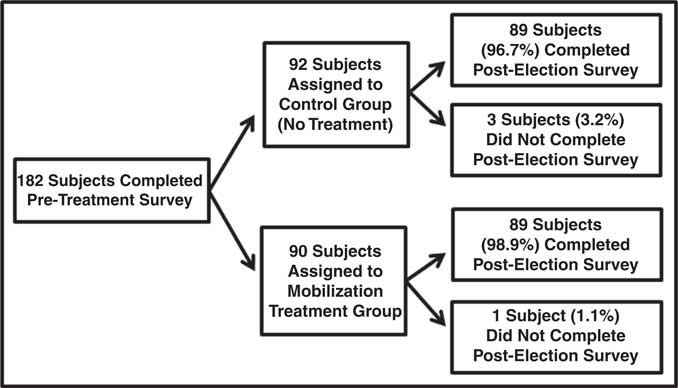
The post-election survey was conducted online through Qualtrics. The San Francisco Municipal Election took place on Tuesday 8 November 2011. An email was sent to all subjects on Wednesday 9 November 2011, including a link to the second survey. Subjects were given one week to finish the survey, and were encouraged to complete the survey within twenty-four hours, in order to be entered into a lottery for a $100 bonus. More than 75 percent of subjects completed the survey within twenty-four hours, and there were no significant differences in response time across treatment groups.Footnote 23 Attrition was very low and also balanced across treatment groups: 97.8 percent of subjects who completed the first survey also completed the second survey. Figure 1 displays the total number of subjects recruited and assigned to each treatment group, as well as the number of subjects who completed the second survey in each treatment group.
Treatment assignment and attrition across treatments

All subjects who completed both surveys were paid $25 for their participation. Subjects in the mobilization treatment received an additional $25 (through the activated Visa card) if they cast a ballot in the election. There was no additional incentive attached to acquiring information or answering information questions correctly.Footnote 24 After the election, each subject’s voter turnout was validated using the Department of Elections’ official Voter History File. Subjects were matched based on name, date of birth, gender, and both home and mailing addresses.
ESTIMATING THE TREATMENT EFFECT ON VOTER TURNOUT
The mobilization treatment was incredibly successful at increasing voter turnout. Table 1 presents the validated voter turnout rate among eligible voters in each treatment group for all elections over the previous five years.
Validated Voter Turnout, by Election and Treatment Group

Notes: Significant effects are emboldened for emphasis. **p≤0.01; *p≤0.05; +p≤0.10.
There is no consistent difference in voter turnout in previous elections, suggesting the two groups were comparable before the experimental intervention. The results suggest that the mobilization treatment substantially increased voter turnout in 2011: compared to 45.6 percent turnout in the control group, 83.3 percent of mobilized subjects cast ballots in the 2011 election, a 37.8 percentage point (or 82.9 percent) increase. With one exception,Footnote 25 this is the largest increase in turnout ever documented in a randomized mobilization treatment.Footnote 26
METHODS FOR ANALYSIS
Twelve estimates of political information are generated, as described below. For each estimate of political information, the effect of the mobilization treatment is estimated by calculating the difference between the average information scores in the control and mobilization treatment groups. In order to consider this difference as the effect of the mobilization treatment, two assumptions are required. The first assumption (Stable Unit Treatment Value Assumption, or SUTVA) requires that a person’s potential outcomes under all treatment assignments are unaffected by the treatment assignments given to all other actors. This experimental design might have violated SUTVA because the recruitment method potentially drew subjects from within common networks. However, the frequency of such interactions should be minimal. Moreover, any spillover effects would increase the information and participation within the control group, suggesting any bias introduced by SUTVA violations would favor the null hypothesis.
The second assumption requires that the assignment to the mobilization treatment is randomly assigned, which it was. Additionally, demonstrating balance across the treatment groups increases confidence in the accuracy of the estimated treatment effects. Information gathered in the pre-treatment survey verifies that subjects between treatment groups were balanced on gender (52 percent female), age (average=37), race (56 percent White, 21 percent Asian, 10 percent Black, 9.4 percent Latino), ideological orientation (3.7 on a scale from 0 to 10), strength of partisan identity (1.7 on a scale from 1to 3), education (39 percent high school graduates, 9 percent with associate degree, 36 percent with college degree, 17 percent with advanced degree), voter registration status (75.6 percent registered pre-treatment), political interest, and previous participation history. A fuller presentation of sample characteristics across treatment groups can be found in online Appendix G, along with comparisons to the San Francisco population where available.Footnote 27 Given random assignment, any imbalance between groups is due to chance.
Dependent Variables
The 2011 San Francisco Municipal Election presented a unique challenge to voters. Information cues and shortcuts that are often available in national competitions were not present. The races were non-partisan, so there were no party cues on the ballot to guide uninformed voters. Given that the incumbent mayor was appointed (not popularly elected) less than a year before, many traditional sources of incumbency advantage were also lacking. There were multiple candidates in each contest: four for sheriff; five for district attorney; and sixteen for mayor. Furthermore, the mayoral election was particularly competitive: the preferential ‘ranked choice’ ballots had to be redistributed in twelve rounds of vote counting before Ed Lee was declared the majority winner. Additionally, the ranked choice voting system asked citizens not only to choose their favorite candidate, but also to indicate their second and third choices. The election provided a rigorous test of information acquisition. Voters had few cues to follow, many candidates to choose from, and were expected to form multiple preferences.
Survey questions were generated to estimate both subjective and objective evaluations of individual-level political information, as well as the existence and intensity of individual political preferences. Twelve dependent variables are calculated from responses to eight categories of questions from the post-election survey. A description of each dependent variable is provided below. Exact question wording and coding procedures are detailed in the online Appendix H.
Accuracy of Left–Right Candidate Evaluations
Municipal elections in San Francisco are non-partisan – no party affiliations are listed on the ballot. The use of ranked-choice voting eliminates concerns about third party ‘spoiler’ candidates, and allows for multiple candidates from the same party to run against each other – without hurting the chance of their ‘side’ winning the election.Footnote 28 More than 90 percent of first-choice votes were cast for one of the ten ‘Democratic’ candidates in the mayoral contest. The media coverage of the candidates included common references to which candidates were more liberal or conservative, much more so than party affiliation. Without being able to use party affiliation as a heuristic, a candidate’s left–right ideology is arguably the best single tool for evaluating candidate-based contests.
The first two dependent variables estimate how accurately subjects were able to identify the ideological positions of the twenty-five candidates across the three contests. Identifying the left–right positions of political actors is a well-established estimate of political information.Footnote 29 A series of expert surveys was distributed in order to estimate the actual ideological position of each candidate, in a similar manner as the expert surveys produced by Hubert and Inglehart, and Laver and Hunt.Footnote 30 Potential experts were identified based on their knowledge and experience with local politics in San Francisco. Each expert was asked to evaluate the left–right position of as many candidates as they felt was appropriate, and could select ‘don’t know’ for the others. In total, evaluations were gathered from ten experts, including academics, reporters, campaign consultants, and politically active community members.
Subjects were asked to identify the ideological position of each candidate. The distance between the position given by each subject and the average position provided by the expert evaluations is calculated for each candidate, and these distances are then combined into an index intended to measure the overall accuracy of each subject’s knowledge regarding the candidate’s ideological positions.Footnote 31 The index is inverted so that higher numbers mean more accurate evaluations (1A: Accuracy of Left–Right Candidate Evaluations – Expert Average).
Out of concern that mass populations might anchor their evaluations on a different scale from political elites, a second variable (1B: Accuracy of Left–Right Candidate Evaluations – Survey Average) estimates the accuracy of the subject’s ideological placements in comparison to the average position given to each candidate from the survey population.
Accuracy Identifying Candidate Party Affiliations
Although party affiliations were not listed on the ballot, candidates do affiliate with political parties privately. Knowing these affiliations could be a valuable type of political information. Subjects were asked to identify the party affiliation for each candidate in the mayoral election.Footnote 32 A variable is calculated as the percentage of candidates each subject was able to match to the correct political party (2: Knows Candidate Party Affiliation).
Accuracy Identifying Democratic Party Endorsements
The Democratic and Republican parties issue endorsements in non-partisan contests, though endorsements from major newspapers and special interest groups are also highly influential. Subjects were asked to identify which candidate(s) were endorsed by the Democratic party across all three contests.Footnote 33 Two variables are constructed to indicate whether subjects could accurately identify the Democratic party’s endorsement for the mayoral election (3A: Knows Democratic Endorsement: Mayor), as well as the number of contests for which subjects could accurately identify the Democratic party’s endorsements (3B: Knows Democratic Endorsement: Index).
Knowledge of Ranked Choice Voting Rule
The next dependent variable capitalizes on San Francisco’s use of ranked-choice voting (RCV) to elect its local offices. The survey asked subjects to identify how many candidates a voter is able to rank in each of the three candidate-based contests on the ballot. A variable is constructed to represent the percentage of contests in which a subject correctly answered ‘three’ (4: Knowledge of Ranked Choice Voting Rule).
Watched Candidate Debates
The survey asked subjects to self-report whether they watched any of the debates between the candidates in each of the three candidate-based contests. An increase in the frequency of debate watching is a good indicator of an increase in effort to seek out political information. A variable is constructed to estimate individual-level attention to candidate debates (5: Watched Candidate Debates).
Developed Preferences Regarding Electoral Contests
Being able to express political preferences indicates positive engagement with the political campaign. The next set of dependent variables estimates political information by whether or not subjects developed and expressed preferences between the candidates and ballot measures. The variables only evaluate whether preferences were expressed, and do not attempt to judge whether reported preferences are informed or ‘correct’. A variable is generated to represent the percentage of referendums for which each subject expressed a preference (6A: Referendums Preferences Exist). A similar variable is generated to capture the level of preferences developed between the candidates in the three electoral contests (6B: Candidate Preferences Exist).
Self-Assessment of Election Information
A series of survey questions asked subjects to self-assess their own level of information about the different contests in the election. Two variables are constructed to represent subjects’ self-assessments regarding their level of information about the referenda (7A: Self-Assessment: Informed about Referendums) and about the candidate-based campaigns (7B: Self-Assessment: Informed about Candidates).
General Engagement in Politics
Several survey questions also assessed whether subjects were engaged with politics in other areas beyond the municipal election. Subjects were asked to identify their political interest, attention to politics, how informed they felt about politics, and how often they discussed politics with three groups of people: family, friends, and classmates or co-workers. For each of these six questions, subjects responded separately with regard to local, national, and international politics. All eighteen responses are combined into an index intended to capture overall engagement with politics beyond the scope of the municipal election (8: Non-Campaign Political Engagement).
Modeling Decisions
The twelve dependent variables estimate different categories of political information and engagement. In order to facilitate comparisons of the magnitude of the effects, all variables are re-scaled to an identical 0–100 index, with higher numbers indicating higher political sophistication. The effect of the mobilization treatment on each of the twelve dependent variables is estimated twice. The first analysis compares the raw average scores in the control and treatment groups, as recorded in the post-election survey. Given the random treatment assignment, a comparison of the raw averages across groups can be used to estimate the effects of the mobilization treatment. For each dependent variable, the average treatment effect is also estimated in a second model that includes an extensive set of covariates.Footnote 34 For nine of the twelve dependent variables, similar or identical questions were also asked in the pre-treatment survey. In those nine cases, the second (covariate) model also includes a control for the information score produced by each subject in the pre-treatment survey.
The primary results estimate the effect of the mobilization treatment on the average level of political information among the full sample. Additional analyses also estimate the effects of mobilization on the level of information among the active voters in each treatment group.
RESULTS
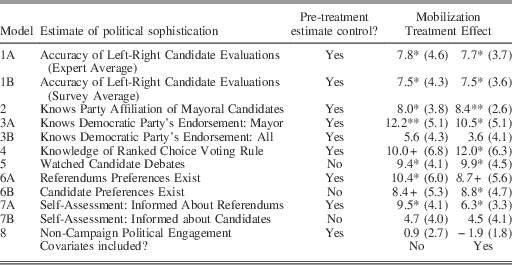
Table 2 displays the estimated effect of the mobilization treatment on each estimate of political information. The raw difference between treatment groups is listed first, followed by the effect estimated in the model including the covariates. Standard errors are in parentheses, and significance thresholds are indicated within each cell. Given the directional nature of the hypothesis, analyses are run using a one-tailed significance test.Footnote 35 All discussion refers to the models including the covariates, which are all estimated using robust standard errors.Footnote 36
Estimated Effects of Mobilization Treatment on Twelve Estimates of Political Information

Notes: p≤0.01, *p≤0.05, +p≤0.10.
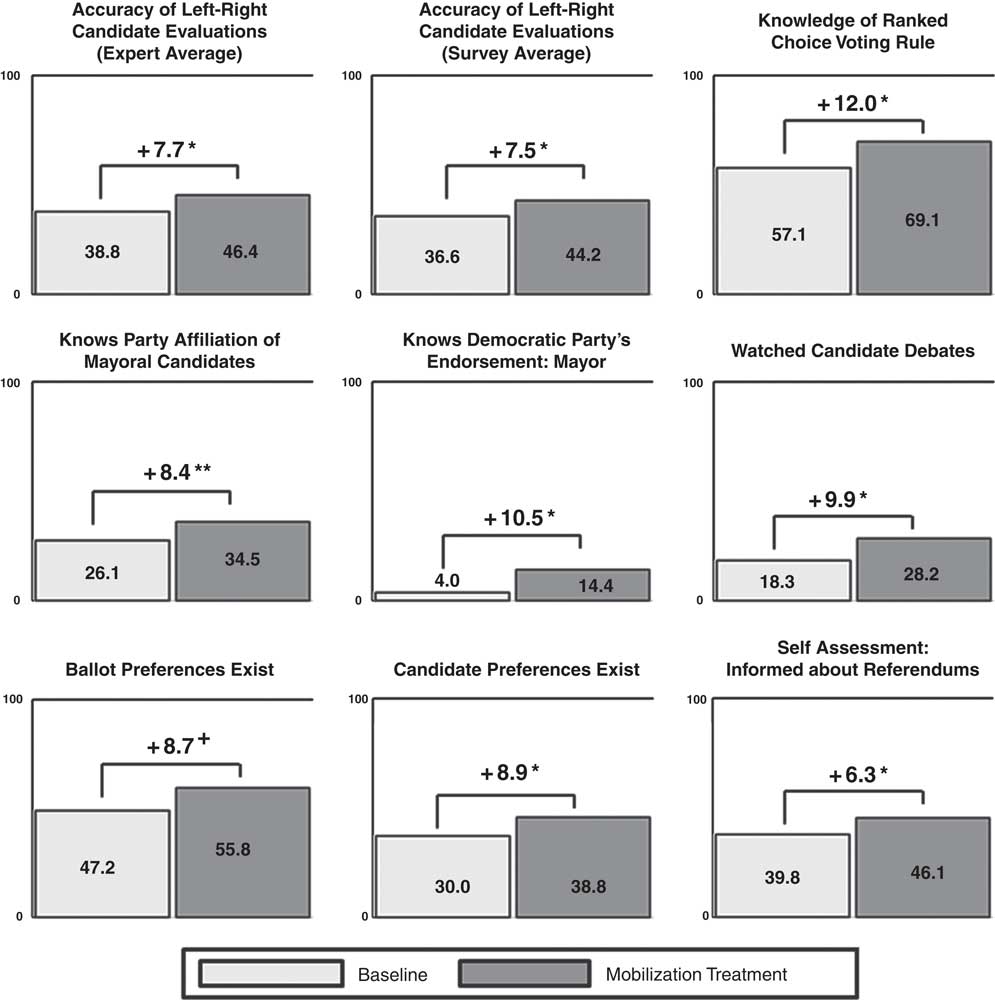
Overall, the results provide strong support for the hypothesis that the mobilization treatment motivated subjects to acquire additional information about the content of the election. The mobilization treatment caused subjects to produce significantly more accurate evaluations of candidate ideological positions, with scores increasing by an average of 7.7 points in Model 1A (expert comparison) and 7.5 points in Model 1B (survey sample comparison). Model 2 estimates that mobilization increased knowledge of candidate partisan affiliations by 8.4 points. Model 3B does not find significant effects on knowledge of endorsements across all three races, but Model 3A finds that mobilization lead to a 10.4 percentage point increase in the number of subjects who knew which candidates the Democratic party endorsed in the mayoral election. Model 4 estimates that the mobilization treatment increased knowledge of ranked-choice voting rules by 12.0 points, and Model 5 estimates that the mobilization treatment increased attention to the candidate debates by 9.9 points. Models 6A and 6B suggest that the mobilization treatment increased the percentage of the referendums in which subjects expressed preferences by 8.7 points, and increased the number of declared preferences regarding the candidate-based contests by 8.8 percentage points. Model 7A finds that the mobilization treatment increased self-perceived information about the referendums by 6.3 points. Model 7B finds that mobilization generated higher self-evaluations of information about the candidates (+4.5), but this effect does not fall within a 95 percent confidence interval. Model 8 suggests that the mobilization treatment did not affect subjects’ engagement with politics outside of the municipal election.Footnote 37
Figure 2 displays the predicted effect of the mobilization treatment on nine estimates of political information. Predicted values are generated by simulating the predicted information score for a typical member of the survey sample within each treatment group.Footnote 38
Predicted post-election political information scores, by treatment group Notes: +p<0.10, *p≤0.05, **p≤0.01.

Analysis
Overall, the results are incredibly supportive of the hypothesis that being mobilized to participate in the 2011 San Francisco election motivated subjects to invest in (or at least to receive) additional political information related to the electoral campaign. The mobilization treatment generated a significant increase in information for nine of the eleven estimates of political information that were directly connected to the election (Models 1A–7B). In comparison to subjects who did not receive any experimental treatments (the control group), subjects who received the mobilization treatment were more accurately able to estimate the ideological positions of the twenty-five candidates (in comparison to both the expert and survey averages), were better able to identify the partisan affiliations of the mayoral candidates, were more likely to know the Democratic party’s endorsements in the mayoral election, had higher knowledge about ranked-choice voting rules, watched more of the debates between the candidates, expressed more preferences on the referendums and between the candidates, and were more likely to evaluate themselves as being informed about the referendums. Mobilizing subjects to cast a ballot motivated them to increase their engagement with multiple types of information, all of which were relevant for making a good vote choice in that election. However, being mobilized to vote did not affect overall engagement with politics outside of the context of the election.
One might worry that subjects who received the mobilization treatment would be inclined to over-report their levels of political interest and attention, in order to appear more responsible in the eyes the experimenter. The significant increases in objective estimates of information (knowledge of candidate ideological positions, partisan affiliations, party endorsements, and details on the voting system) suggest the effects are not purely self-reported differences. Furthermore, the selective nature of the self-reported information estimates (reports of watching debates, reporting of political preferences, and self-assessed information and engagement) also supports the hypothesis. If treated subjects were simply pretending to appear more politically engaged, all of these indicators would have increased. Instead, significant increases are found only among estimates of campaign-specific engagement – but not with political issues beyond the scope of the election. The analyses provide strong support for the hypothesis that information is endogenous to participation costs, and the selective nature of information acquisition supports the mechanism proposed at the beginning of this article.
Who Was Mobilized? Who Became Informed?
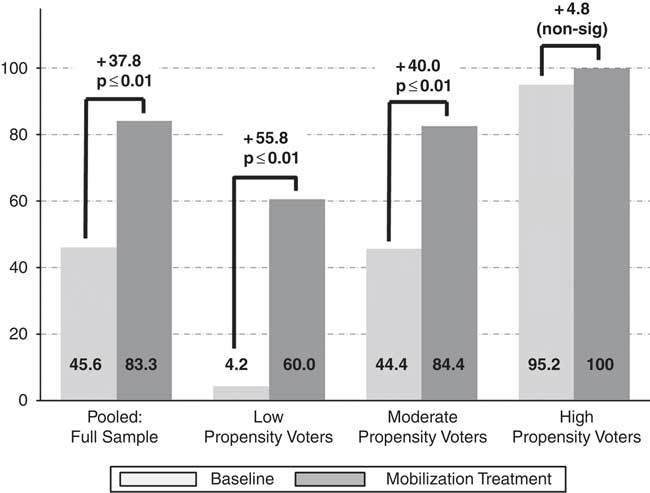
Although average information levels increased in response to the mobilization treatment, the previous analysis is unable to detect which subjects became more informed. Did all subjects become more informed, or were average increases driven by information changes among particular subsets of voters? In order to estimate the effects of the mobilization treatment across subgroups, subjects are divided into three groups based on their pre-treatment propensity to vote. Typical mobilization studies recruit from the voter registration list, and conventional knowledge suggests the biggest ‘bang for the buck’ is mobilizing potential voters who are near their indifference point.Footnote 39 Unlike typical ‘Get-Out-the-Vote’ (GOTV) studies, the SF 2011 experiment intentionally recruited subjects from across the participation spectrum, including regular voters, occasional voters, and eligible citizens who were not registered to vote. Figure 3 displays the rate of voter turnout in the control and treatment groups, sorted by high, moderate, and low propensity voters.Footnote 40
Effect of mobilization treatment on voter turnout, by initial propensity to vote

The largest voter turnout effects are seen among low propensity voters, whose turnout was 4.2 percent in the control group and 60.0 percent in the treatment group (an increase of 55.8 percentage points). The turnout of moderate propensity voters also increased from 44.4 percent to 84.4 percent (a 40.0 percentage point increase). Baseline turnout among high propensity voters was 95.2 percent. Although 100 percent of high propensity voters who received the mobilization treatment voted, the 4.8 percentage point increase in turnout was not significant. The turnout analysis suggests that the mobilization treatment successfully generated substantial increases in turnout among both moderate propensity voters (who were near their indifference point) and among low propensity voters (who were otherwise extremely unlikely to register and vote). The question remains: which of these groups increased their information in response to mobilization?
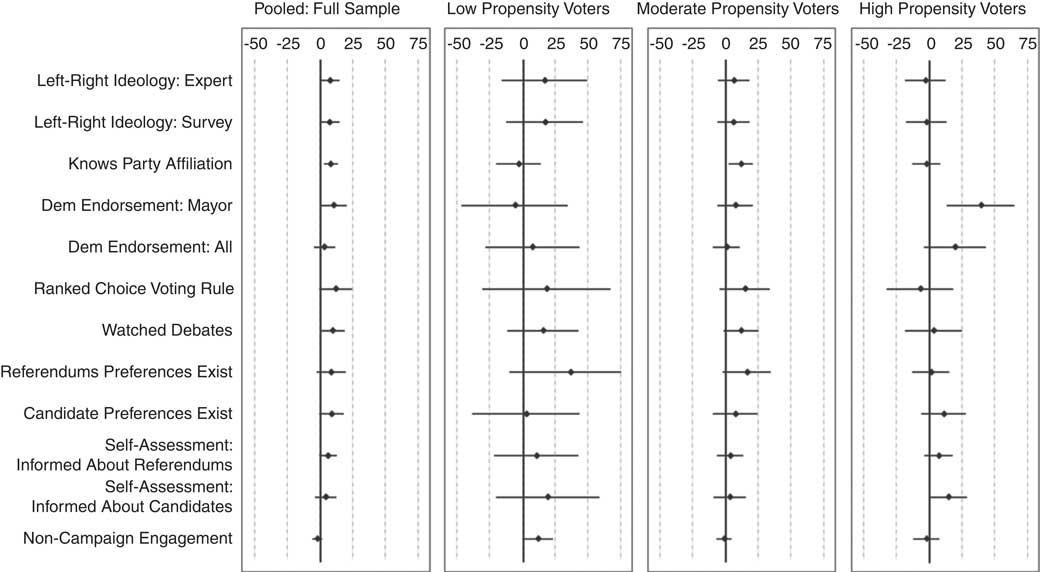
All models from Table 2 were re-run in order to estimate the effects of the mobilization treatment on the level of political information among each subgroup. The estimates for the models including covariates are summarized in Figure 4. Error bars indicate 95 percent confidence intervals. The precision of the subgroup analyses is limited by the reduced sample size in each group. Even so, the data reveal interesting patterns in information acquisition across subgroups.
Estimated effects of mobilization treatment on twelve estimates of political information, by subject’s pre-treatment propensity to vote

The mobilization treatment generated increases in some types of information among all types of voters, but the types of information acquired varied by subgroup. The mobilization treatment generated the most consistent increases in information among moderate propensity voters – subjects who were already registered to vote, but who did not tend to vote in local elections. Moderate propensity voters who received the mobilization treatment were significantly more likely to know the candidate’s party affiliations (+11.9), and were more likely to report watching the candidate debates (+12.0). Moderate propensity voters who were treated also yielded higher scores on average with regard to identifying candidate ideological positions (+6.8 and +6.7), knowing the Democratic party endorsements for mayor (+7.5), knowledge of the ranked-choice voting rule (+14.7), reported preferences between the candidates (+6.4) and on the referendums (+12.8), and to a smaller degree – self-assessed information about the referendums (+3.9) and the candidates (+3.2).
High propensity voters experienced the fewest increases in average information levels. The lack of effects among high propensity voters is likely caused – at least in part – by this group demonstrating higher baseline scores across most categories, giving them fewer opportunities – and less need – to grow. For example, 95.2 percent of high propensity voters in the baseline group knew that they could rank up to three candidates in the mayoral election; whereas 34.8 percent of untreated low propensity voters and 57.8 percent of untreated moderate propensity voters held the same information. However, high propensity voters did increase some types of information in response to the mobilization treatment. Treated high propensity voters demonstrated significantly higher knowledge of Democratic party endorsements in the mayoral contest (+39.2) and the three contests as a whole (+19.6). On average, when treated, they also reported more preferences between the candidates (+14.7) and gave higher self-assessments regarding how informed they were about the referendums (+6.3) and about the candidates (+14.3).
Low propensity voters experienced the largest increases in information on average – but these estimates yielded larger standard errors, causing all but one to fall outside a 95 percent confidence interval. Low propensity voters who received the mobilization treatment performed substantially higher on average with regard to identifying candidate ideological positions (+16.8 and +17.1), knowledge of the ranked-choice voting rule (+18.5), watching the debates (+15.7), declaring preferences regarding the ballot referendums (+36.8), and self-identified information about the referendums (+10.7) and the candidates (+19.4). Low propensity voters did not increase average knowledge of party affiliations or party endorsements in response to the mobilization treatment. The high standard error bars are likely driven both by the low subsample size, and by the fact that only 60 percent of mobilized low propensity voters cast a ballot.Footnote 41 As 40 percent of the low propensity treatment group did not vote, increases in information are likely to be less consistent across those with a low propensity to vote overall.
Interestingly, although the mobilization treatment did not generate an increase in non-campaign related political engagement among the sample overall, low propensity voters who received the mobilization treatment reported significantly higher levels of non-campaign related political engagement (+11.7, p≤0.05). This effect was significantly bigger than the estimated effect of mobilization on non-campaign related political engagement for both moderate and high propensity voters. The mobilization treatment motivated more than 55 percent of low propensity voters to both register to vote, sparking what might have been the first political activity in which these subjects engaged. The last result suggests that mobilizing citizens with a very low propensity to vote might cause those people to become more engaged in the political system more generally speaking. Given that low propensity voters also scored higher on objective estimates of political information (such as knowledge of candidate’s ideological positions), it is likely that increases among the subjective measures reflect genuine increases.
The subgroup analyses are limited by the reduced sample size in each group. However, the data yield interesting patterns overall. The results suggest that all types of mobilized voters increased some types of information. However, the types of information acquired varied across subgroups.Footnote 42 These analyses are exploratory, and the comparative effects suggest that further exploration regarding the types of information most relevant to each subgroup would be a fruitful avenue for future research.
Information among the Active Voting Population
The previous analyses tested whether mobilization affected the level of information within each treatment group. Another important question asks whether mobilization affected the average level of information within the active voting population – those who cast ballots – within each treatment group.
Critics of high turnout express concern that mobilization efforts might add new voters who are less informed than the original voters, thereby damaging the quality of electoral outcomes. Even if new voters increase their information as a part of the mobilization process – as suggested in the previous analysis – these new voters could still be less informed than the original voters who existed before. Therefore, it is possible to increase the average level of information within the aggregate population while simultaneously decreasing the average level of information among the active voting population.Footnote 43
In order to estimate the effect of the mobilization treatment on the level of information among the active voting population, all twelve estimates of political information are re-evaluated, restricting the sample to compare the post-election level of information among only the validated voters within the control and treatment groups.
The data do not suggest that the mobilization treatment decreased the level of information among the active voting population in the sample. Validated voters in the mobilization group had significantly higher scores with regard to watching the candidate debates (+11.7, p≤0.05). For the other eleven estimates of political information, there were no significant differences in the information levels of validated voters across treatment groups. In short, the mobilization treatment generated increases in both aggregate information and voter turnout, without decreasing the quality of information among the active voting population in the sample.
CONCLUSION
This article presented the results of a field experiment designed to isolate the effects of varying costs and incentives to participate on the acquisition of political information. The experimental design intentionally combined several mobilization strategies into a single powerful mobilization treatment intended to dramatically increase voter turnout, in order to generate a test case with strong statistical power. The mobilization treatment increased voter turnout by nearly 38 percentage points, yielding unique opportunities for empirically estimating other effects of exogenously driven increases in participation.
As a whole, this study provides strong evidence in support of the hypothesis that information levels are endogenous to participation costs. The results suggest that electoral policies that increase incentives for participation – by reducing participation costs and by increasing participation incentives – will also motivate an increase in the types of political information that are necessary for making a good vote choice. As predicted, mobilized subjects demonstrated significantly higher levels of information relating to the eight ballot referendums, the three city-wide candidate competitions, and the alternative voting system used to elect these offices. Furthermore, increases in information were generated across high, moderate, and low propensity voters. With treatment effects ranging from 6.3 to 12.0 points on a 100-point scale, the magnitude of these increases is substantively significant.
Although the mobilization treatment increased election-specific information, it did not produce an increase in engagement with political matters that were unrelated to the election. All increases in information were restricted to issues directly related to the candidates, the referendums, and the voting system used for municipal elections. The only exception was among low propensity voters, who increased both with regard to campaign-specific and non-campaign-related assessments of political engagement. The selective spillover effects suggest that motivating low propensity voters to engage in one form of political activity might generate spillover effects into other areas of political participation. Although wider effects on political engagement were not produced among the full sample in this study, continued participation might generate spillover effects that accumulate over time. Future studies can further investigate whether long-term exposure to political mobilization causes an increase in overall political curiosity or engagement, as well as whether these effects vary across subsets of the population.
Finally, the analysis finds that adding new voters did not decrease the information quality of the active voting population – as is widely feared in elite models of democratic participation. Although the mobilization treatment increased voter turnout by nearly 38 percentage points, it also generated an increase in political information, such that the active voting population was equally informed across the control and treatment groups. Considering theories regarding the advantages of information aggregation,Footnote 44 this additional result suggests that encouraging participation can lead to both a more informed population, and better quality electoral outcomes. The increase in the quality of information aggregation is further complimented by an increase in representation for otherwise under-represented groups.
Overall, the data provide strong support for the hypothesis that decreasing participation costs and increasing participation incentives will lead to an increase in political information. The feared tradeoff between increasing participation and maintaining a high level of political information appears to be a false dichotomy. Not only are increased participation and increased information possible at the same time: one actually encourages the other. The mobilization treatment generated a population with higher levels of aggregate information, higher levels of voter turnout, and equal levels of information among the now-larger active voting population – generating better opportunities for successful preference aggregation.
The results suggest that institutions that make voting more costly are causing the population to become less informed; whereas institutions that encourage participation not only increase turnout – mobilizing electoral participation also motivates citizens to become more politically informed. These results are relevant to debates regarding electoral institutions that affect costs and incentives to participate – such as voter identification laws, no excuse vote-by-mail, automatic registration, and compulsory voting laws. Understanding downstream effects of participation is also relevant when evaluating recent innovations in mobilization strategies, which have begun to experiment with more coercive methods of motivating participation.Footnote 45
This experimental design provides a template for isolating the downstream effects of varying costs and incentives to participate. It is hoped that this design will be implemented and expanded in future studies, so we can continue to build our understanding of what motivates citizens to invest in informed participation. The generalizability of the results presented in this article can be further tested across other political systems, sample populations, and electoral contexts. For example, how might mobilization affect information acquisition in a partisan election? Given that partisan labels provide an effective and low-cost heuristic for many voters, newly-mobilized citizens would need to invest less to make competent voting decisions in such contests (compared to the information required among subjects in this experiment). The San Francisco municipal election placed a high information burden on voters, making it a strong test of the hypothesis. In cases where good voting decisions are easier to make – such as partisan elections with party cues on the ballot, or other contests where heuristics are more readily available – increases in informed voting would likely be even higher, and at a lower cost to subjects. On the contrary, in environments where information is more costly, mobilization would likely generate weaker increases in campaign-relevant information.
In addition to varying the electoral context, future studies can also vary the mobilization strategies which are included in each treatment. For example, does participation resulting from reduced costs of voting have different effects from participation resulting from increased incentives to vote? Would a larger or smaller incentive to vote generate different increases in information? As this experiment included only a single super-treatment (including both cost reduction and incentive addition), we cannot answer these questions with the existing data. One might speculate that subjects who decided to cast a ballot for the money felt obligated to seek out information, in a way they would not feel if mobilized through pure cost reduction. Although this might have occurred, subjects who are mobilized without incentives should be even more likely to seek out information about the election. Subjects who receive a monetary incentive to vote might vote only for the money, only for electoral reasons, or for both. Subjects motivated without incentives would only vote for electoral reasons, suggesting the number who would vote without becoming informed would decrease, causing net information acquisition among those mobilized to increase. Furthermore, future studies can explore the downstream effects of mobilization spurred by election-specific appeals, such as references to civic duty or the ability to affect electoral outcomes. The mobilization treatment in this experiment was deliberately designed to include only instrumental content – reduced costs and increased incentives to cast a ballot. Mobilization spurred through appeals to civic duty or the importance of an electoral outcome should generate stronger increases in political information, as these appeals can also directly increase the perceived benefits of information. Therefore, the information effects generated in this experiment can be considered a lower bound of what might be expected in response to more conventional GOTV strategies. Demonstrating that participation driven by purely instrumental (and non-political) appeals leads to an increase in political information is a particularly strong test of the hypothesis. Given that the subgroup analyses suggest that high, moderate, and low propensity voters all increased some types of information, the results suggests that a wide range of mobilization efforts – all of which could target different types of voters – should also be expected to generate increases in information.
Finally, demonstrating that enabling and incentivizing participation causes an increase in information encourages further study regarding other proposed effects of participation. For example, it has been proposed that engaging in participation might affect political trust,Footnote 46 efficacy,Footnote 47 and future prospects for participation.Footnote 48 Previous empirical studies have been limited because of endogeneity: many of the proposed effects of political participation are also among the characteristics which motivate people to participate. By integrating an intensive mobilization treatment within a panel survey, this experimental design provides new opportunities for empirical estimation of the effects of exogenous shifts in the costs and incentives to participate. In addition to enhancing opportunities for further studies on political information, the template of this experimental design can also be applied to estimate other downstream effects of varying costs and incentives to participate.
As a whole, this article provides evidence that increasing the ease of voting will produce higher turnout, a more representative voting population, and a more informed aggregate population. Furthermore, stronger incentives to participate do not decrease the average level of information among the active voting population, suggesting that policies which increase turnout will increase – not decrease – the information quality of electoral outcomes. These results are in stark contrast to elite models of democratic theory. The feared tradeoff between representative participation and informed participation is not only a false dichotomy: these two characteristics are found to encourage each other.