INTRODUCTION
Delirium is a common condition in the course of hospitalization depending on the age of the patient and the severity of their illness (Francis et al., Reference Francis, Martin and Kapoor1990; Voyer et al., Reference Voyer, McCusker and Cole2007). The occurrence of delirium varies depending on its presentation. On admission, in older patients the prevalence rate varies between 14 and 24% and in the course of hospitalization the incidence rate is between 6 and 56% (Bucht et al., Reference Bucht, Gustafson and Sandberg1999; Lipowski, Reference Lipowski1989). In the general hospital setting, the incidence of delirium ranges between 15 and 30% of patients, in the hospitalized elderly 10–40% (Bucht et al., Reference Bucht, Gustafson and Sandberg1999; Lipowski, Reference Lipowski1989), in patients with cancer 57–85%, and in terminal illness up to 85% (Bond et al., Reference Bond, Neelon and Belyea2006; Breitbart & Strout, Reference Breitbart and Strout2000; Massie et al., Reference Massie, Holland and Glass1983). Furthermore, delirium can have long-term consequences and is associated with poor functional outcome, increased morbidity and mortality, and prolonged hospitalization (Inouye, Reference Inouye1998; Reference Inouye2006).
Several medical conditions have been identified as risk factors for delirium relevant to a specific cancer setting: low albumin levels, bone metastases, and the presence of hematological malignancy (Ljubisavljevic & Kelly, Reference Ljubisavljevic and Kelly2003). Medications represent another risk factor for developing delirium, where the administration of benzodiazepines, corticosteroids, and opioids has been associated with incidence of delirium (Gaudreau et al., Reference Gaudreau, Gagnon and Harel2005; Rothberg et al., Reference Rothberg, Herzig and Pekow2013). Another etiology representing a risk factor for delirium is hypoxic illness, which has been recognized to interfere with the reversibility of delirium, whereas the administration of opioids or dehydration has been associated with reversible delirium (Lawlor et al., Reference Lawlor, Gagnon and Mancini2000a ).
In a study on the occurrence and persistence of delirium symptoms (Levkoff et al., Reference Levkoff, Evans and Liptzin1992), advanced age and cognitive impairment have been identified as a risk factor for increased incidence within a population. Persistence of delirium has been documented at three and six months after discharge from the hospital, leading to the conclusion that delirium may be a common disorder during the course of hospitalization and is much less transient than previously thought. Several studies have documented persistent delirium symptoms, some lasting for six months and longer (Kiely et al., Reference Kiely, Jones and Bergmann2006; McCusker et al., Reference McCusker, Cole and Dendukuri2001; Reference McCusker, Cole and Dendukuri2003). Furthermore, an association between length and persistence of delirium symptoms and functional recovery has been documented. Moreover, persistent delirium has been shown to be a predictor of greater mortality (Kiely et al., Reference Kiely, Marcantonio and Inouye2009; Lee et al., Reference Lee, Ha and Lee2011). In contrast, the persistence of delirium symptoms for less than two weeks has been associated with excellent functional recovery (Kiely et al., Reference Kiely, Jones and Bergmann2006), and resolved delirium is associated with decreased mortality (Kiely et al., Reference Kiely, Marcantonio and Inouye2009). Another factor contributing to worse delirium outcomes is the severity of delirium, with more severe episodes leading to more serious outcomes (Marcantonio et al., Reference Marcantonio, Ta and Duthie2002).
Although there is evidence for the persistence of delirium symptoms and consequent functional status, our knowledge of risk factors and persistence of delirium in the more acute setting remains limited. In order to further explore these issues in a hospital setting, we performed an analysis that assessed the sociodemographic and medical variables associated with prolonged and refractory delirium.
METHODS
Subjects
All subjects were referred for delirium management to the Memorial Sloan Kettering Cancer Center (MSKCC) Psychiatry Service from July of 2004 to June of 2006. The MSKCC is a 470-bed, private hospital specializing in the treatment of cancer and has an average of 20,000 admissions annually. Its consultation–liaison psychiatry service performs more than 2,000 consultations each year.
All patients included in our study met the criteria for diagnosis of delirium according to the Diagnostic and Statistical Manual of Mental Disorders (4th ed., text revision) (DSM–IV–TR) (American Psychiatric Association, 2000). Exclusion criteria were an inability to comply with delirium assessment, objections on the part of the patient or family to taking medication or to treatment of delirium with any antipsychotic, and imminent death. All patients and families gave their verbal consent. For patients with a limited capacity to provide consent due to delirium, the primary caregiver provided verbal consent with the patient's present.
Clinical data were recorded in an MSKCC Psychiatry Service clinical database approved by the institutional review board, and a waiver was obtained for future analysis.
Measurements
Sociodemographic and medical variables such as age, sex, cancer diagnosis, stage of cancer (localized, metastatic, or terminal), psychiatric diagnosis, preexisting dementia, presence of brain metastases, and delirium etiology were collected at baseline assessment and reevaluated during the observation period.
Delirium severity was assessed with the Memorial Delirium Assessment Scale (MDAS), a 10-item, 4-point clinician-rated scale (range 0–30) (Breitbart et al., Reference Breitbart, Rosenfeld and Roth1997). MDAS item scores range from 0 to 3 (0 = absent, 1 = mild, 2 = moderate, and 3 = severe in presentation). It provides clear instructions on the rating process and defines the severity of presenting symptoms. Scale items assess such aspects of delirium symptomatology as (1) a disturbance in arousal and level of consciousness, (2) impaired cognitive functioning, (3) weakened psychomotor activity, and (4) disturbed sleep–wake cycle. MDAS scores greater than 10 have been validated to identify the presence of delirium. In contrast, resolution of delirium is identified by MDAS scores equal to or less than 10 (Kazmierski et al., Reference Kazmierski, Kowman and Banach2008; Lawlor et al., Reference Lawlor, Nekolaichuk and Gagnon2000b ).
Level of functioning was assessed with the Karnofsky Performance Status (KPS) scale, which indicates physical performance ability, and was developed particularly for cancer patients (Karnofsky & Burchenal, Reference Karnofsky, Burchenal and Macleod1949). Scale scores range from 10 to 100, and lower scores indicate a higher degree of functional impairment and more severe illness (Appendix 1).
Procedures
In accordance with the guidelines for management of delirium promulgated by the American Psychiatric Association (Trzepacz et al., Reference Trzepacz, Breitbart and Franklin1999), environmental and psychopharmacological interventions were utilized. In addition to such environmental interventions as providing a safe environment and frequent reorientation, antipsychotic medications were also initiated upon diagnosis of delirium and subsequently adjusted, with modifications determined by clinical response. The standard approach is to manage delirium with antipsychotic medication and continue the necessary medical treatment, with the use of medications that can be classified as risk factors for delirium (e.g., opiates and corticosteroids). Underlying reversible causes such as infections were also treated.
The MDAS, KPS scoring, and side-effect rating were performed at baseline (T1), repeated at 2–3 days (T2), and at 4–7 days (T3). The observation periods ended after seven days, and patients were continued on antipsychotic medications as necessary.
Statistical Analysis
Analyses for the trial were performed with the Statistical Package for the Social Sciences (SPSS, v. 20), a statistical software package for Windows. Our primary interest was persistent delirium in contrast to resolved delirium in respect to sociodemographic and medical variables. The secondary interests were delirium severity and the phenomenology of delirium as described by total MDAS score and MDAS subscores. The dataset was defined as subsets representing persistent delirium, resolved delirium at T2, and resolved delirium at T3. Descriptive statistics were run in order to describe the sociodemographic and medical variables.
A number of statistical tests were employed in our analysis. For parametric data on an interval scale (e.g., comparison of age between groups), a t test for independent samples was implemented. For nonparametric data (e.g., MDAS or KPS scores during the observation period), Friedman's test for repeated measures was employed for dependent measures, and the Kruskal–Wallis test was utilized for independent measures (e.g., MDAS or KPS scores between groups). Pearson's chi-square (χ2) was implemented for categorical data (e.g., evaluation of cancer diagnoses and etiologies contributing to delirium). Afterward, alpha (α) was corrected using the Bonferroni method, and the significance level for α was set at p < 0.05.
RESULTS
Baseline Characteristics
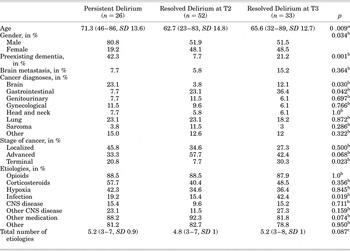
Overall, some 111 patients with delirium were retrieved, and 26 of these (23.4%) had persistent delirium (Table 1). Most patients (52, 47%) achieved delirium resolution within 48 to 72 hours.
Baseline characteristics of persistent and resolved delirium at T2 and T3

SD = standard deviation.
a t test.
b χ2 test.
c Kruskal–Wallis test.
Differences with respect to sociodemographic and medical variables between persistent and resolved delirium at T2 and T3 were as follows. Patients with persistent delirium were predominantly male and older than those with resolved delirium at T2 or T3, and preexisting dementia contributed to persistent delirium. In contrast, the absence of dementia was associated with faster recovery. Furthermore, factors contributing to late response or persistent delirium included the presence of brain cancer and terminal cancer. One fifth of patients with persistent delirium had brain cancer, in contrast to 3.8–12.1% with resolved delirium at T2 or T3. Terminal illness was present in 20% with persistent delirium and about 33% with resolved delirium at one week, in contrast to 3.8% of those with resolved delirium at T2. Thus, the absence of brain cancer or terminal illness were associated with faster recovery with 72 hours of management. Among the etiologies, infection was usually associated with a later response to delirium management within one week.
Description of Delirium Severity and Phenomenology in Persistent and Resolved Delirium at Baseline
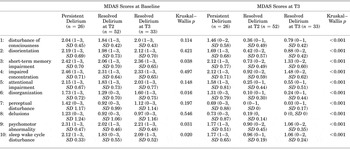
At baseline, delirium was more severe in patients with persistent delirium. The phenomenology of delirium as measured by the MDAS subitems was not much different. Marginal differences existed in the domains of short-term memory, organization, psychomotor behavior, and sleep–wake cycle. Patients with persistent delirium were slightly more impaired than patients with resolved delirium at T2 or T3. There were no differences with respect to the domains of consciousness, orientation, concentration, attention, perception, or delusions (see Table 3).
Management Characteristics and Course of Delirium
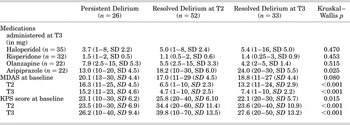
In both persistent and resolved delirium at T2 and T3, MDAS scores improved over the course of management. However, differences existed in MDAS scores at baseline, T2, and T3 (Table 2). Patients with persistent delirium had a more severe condition at baseline and through one week. In persistent delirium, MDAS scores improved from a baseline of 20.1 to 16.3 and 15.2 (p < 0.001) at T3, in resolved delirium at T2 from a baseline of 17.0 to 6.5 and 4.7 at T3 (p < 0.001), and in resolved delirium from a baseline of 18.8 to 13.2 and 7.4 (p < 0.001).
Management characteristics of persistent and resolved delirium at T2 and T3 (medication doses administered at T3, MDAS, KPS scores and delirium resolution at baseline, T2, and T3)

MDAS = Memorial Delirium Assessment Scale; KPS = Karnofsky Performance Status; SD = standard deviation.
MDAS mean subscores at baseline and T3

MDAS = Memorial Delirium Assessment Scale; SD = standard deviation.
Medication doses were comparable between groups and medications. When haloperidol, risperidone, and olanzapine were administered, the mean dose at T3 was not different between the persistent and resolved delirium groups. Only with aripiprazole administration was the dose higher in patients with resolved delirium, particularly for those achieving delirium resolution at T3.
Functional status as measured by KPS score improved in both persistent and resolved delirium; however, persistent delirium caused more severe functional impairment. In persistent delirium at T2, KPS scores improved marginally from 23.1 to 23.5 at T2 and 26.2 at T3 (p < 0.015), in those with resolved delirium at T2 from 25.8 to 34.4 and 39.8 (p < 0.001), and in resolved delirium at T3 from 22.1 to 23.6 at T2 and 27.6 (p < 0.001). At baseline, KPS scores were only marginally different; however, KPS scores at T2 and T3 improved more in patients with resolved delirium, indicating superior functional recovery.
Delirium Phenomenology in Persistent and Resolved Delirium at One Week of Management
At one week, the differences between persistent and resolved delirium were more prominent and existed across MDAS subscores (Table 3). In persistent delirium, the disturbance of consciousness was more pronounced; orientation, short-term memory, concentration, attention, and level of organization were more severely impaired; perceptual disturbances and delusions were more severe; and psychomotor abnormalities and sleep–wake cycle disturbances worsened.
DISCUSSION
These results indicate that advanced age, preexisting dementia, brain cancer, terminal illness, infection, and delirium severity are factors that interfere with the resolution of delirium and contribute to a prolonged and refractory course of the condition, and they can cause functional impairment with up to one week of management with antipsychotic medications.
Previous studies have found contradictory results with respect to the occurrence and persistence of delirium in dementia. While some authors demonstrated an increased occurrence in advanced age as well as cognitive impairment and persistence of delirium symptoms at several months after hospital discharge, and concluded that delirium may be more common during the course of hospitalization and much less transient than formerly accepted (Kiely et al., Reference Kiely, Jones and Bergmann2006; Levkoff et al., Reference Levkoff, Evans and Liptzin1992; Levkoff & Marcantonio, Reference Levkoff and Marcantonio1994; Levkoff et al., Reference Levkoff, Liptzin and Evans1994; McCusker et al., Reference McCusker, Cole and Dendukuri2001; Reference McCusker, Cole and Dendukuri2003), other investigators were not able to find an association between dementia and prolonged delirium (Kelly et al., Reference Kelly, Zisselman and Cutillo-Schmitter2001; Koponen et al., Reference Koponen, Stenback and Mattila1989; Manos & Wu, Reference Manos and Wu1997). However, the absence of dementia was associated with complete reversal of all delirium symptoms and a better outcome (Camus et al., Reference Camus, Gonthier and Dubos2000; Inouye et al., Reference Inouye, Zhang and Jones2007).
Among the studies documenting an interaction between length and persistence of delirium symptoms and functional recovery, the persistence of delirium symptoms for less than two weeks was associated with excellent functional recovery (Kiely et al., Reference Kiely, Jones and Bergmann2006). Advanced age and preexisting dementia. which have also been identified as risk factors for delirium (Ljubisavljevic & Kelly, Reference Ljubisavljevic and Kelly2003) and have been associated with persistence of delirium, may have an impact on the course of delirium and outcome, and can result in a prolonged and refractory course, even when concomitant to active management with antipsychotics. In contrast, the absence of dementia has been associated with complete reversal of delirium symptoms (Camus et al., Reference Camus, Gonthier and Dubos2000; Inouye et al., Reference Inouye, Zhang and Jones2007). Due to the severe consequences that persistent delirium symptoms and unmanaged delirium can have, more awareness of this population and different clinical approaches may be required. For one thing, this population may require more rigorous screening for delirium and more proactive management of the symptoms of delirium until remission.
In addition, not only is dementia a risk factor for persistent delirium, but it has been identified as the leading risk factor for developing delirium. Two thirds of cases with delirium occurred in patients with dementia (Cole, Reference Cole2004), and dementia was found to increase the risk of becoming delirious by 40% (McNicoll et al., Reference McNicoll, Pisani and Zhang2003). Also, delirium has been shown to increase the risk of being diagnosed with dementia in patients with no known premorbid dementia (Rahkonen et al., Reference Rahkonen, Makela and Paanila2000), to accelerate cognitive decline in dementia (Fong et al., Reference Fong, Jones and Shi2009a ), and has been associated with poor functional outcomes, increased morbidity and mortality, as well as prolonged hospitalization (Inouye, Reference Inouye1998).
From this analysis, we found that patients with persistent and resolved delirium were not different with respect to various sociodemographic and medical variables. A higher proportion of male patients had persistent delirium, and an increased proportion of brain cancer or terminal illness was documented in persistent delirium or late response, whereas gastrointestinal cancer was associated with faster delirium resolution. Furthermore, delirium was more severe in those with persistent delirium. By itself, it was not surprising that delirium severity or brain cancer would predict persistent delirium and contribute to persistent delirium, as has previously been indicated (Breitbart et al., Reference Breitbart, Tremblay and Gibson2002; Marcantonio et al., Reference Marcantonio, Ta and Duthie2002).
Among the etiologies contributing to delirium in the cancer setting, opioids, corticosteroids, and benzodiazepines have been identified as risk factors (Gaudreau et al., Reference Gaudreau, Gagnon and Harel2005). This result suggested that they may contribute to the occurrence of delirium, as opiates and corticosteroids were among the most frequent causes of multifactorial delirium in this sample. However, they did not interfere with delirium resolution. In contrast to previous findings indicating that hypoxic illness may be a factor that interferes with the reversibility of delirium (Lawlor et al., Reference Lawlor, Gagnon and Mancini2000a ), hypoxia has not been associated with persistent delirium. However, infection has been found to contribute to a late response at one week of management.
The functional status at baseline was similar between patients with persistent and resolved delirium. In the course of management with antipsychotics, patients with persistent delirium were more functionally impaired throughout, indicating that persistent delirium also has an impact on level of functioning.
Different dosing regimens contributing to persistent delirium in contrast to resolved delirium was not found, except with aripiprazole. Antipsychotic dosing was not different for haloperidol, risperidone, and olanzapine. When aripiprazole was administered, the dose at T3 was higher in patients with resolved delirium. With respect to the greater sensitivity to side effects in patients with advanced age and dementia, this difference may have only a small effect (Alexopoulos et al., Reference Alexopoulos, Streim and Carpenter2004). In particular, the fact that the pharmacodynamics and receptor occupancy for 13- and 20-mg doses of aripiprazole may be similar would render this difference negligible (DeLeon et al., Reference DeLeon, Patel and Crismon2004;Taylor, Reference Taylor2003).
A number of strengths and limitations of this analysis can be noted. The delirium database contains clinical data on the treatment of delirium with haloperidol, risperidone, aripiprazole, and olanzapine. Data collection was prospective. Delirium and contributing etiologies were systematically evaluated and documented. All subjects were assigned naturalistically to a medication, and this assignment was not random. The number of subjects with dementia was rather low. The etiology of dementia was not differentiated due to the limited number of patients with delirium and dementia. It was not possible to obtain a baseline assessment of the level of cognitive dysfunction due to the naturalistic design of the data collection and long-lasting persistence of delirium symptoms in this population. All subjects had cancer diagnoses, and the generalizability of our results to the noncancer population remains to be studied. The use of antipsychotics in the management of delirium is not approved by the regulatory agencies, and the use of antipsychotics in elderly patients with dementia carries a black-box warning of increased risk of death (Jeste et al., Reference Jeste, Blazer and Casey2008; Schneider et al., Reference Schneider, Dagerman and Insel2005). The utilization of antipsychotics in the management of delirium has been debated (Fong et al., Reference Fong, Tulebaev and Inouye2009b ). Considering the finding of lower delirium resolution rates in advanced age and preexisting dementia, a longer observation period would have been favorable. Despite these limitations, our results may provide further insight into advanced age, dementia, and brain pathology with respect to delirium phenomenology and in regard to the course of delirium in patients actively managed with antipsychotics.
In summary, advanced age and preexisting dementia, as well as the presence of brain cancer, terminal illness, infection, and delirium severity were associated with a prolonged and refractory course of delirium or late response and lower functional status at one week of management with antipsychotics.
CONFLICTS OF INTEREST
The authors state that they have no conflicts of interest to declare.
Appendix 1. Karnofsky Performance Status Scale: Definitions, ratings (%), and criteria (Karnofsky & Burchenal, Reference Karnofsky, Burchenal and Macleod1949)