Introduction
Policymakers as well as academics often call for increased transparency in political decision-making in response to the fear of decreasing public trust and unwillingness to accept political decisions (Heald, Reference Heald2006; O'Neill, Reference O'Neill2006; Roberts, Reference Roberts2006; Grimmelikhuijsen, Reference Grimmelikhuijsen2012). This strategy has strong support in the history of political thought and democratic theory (Hood, Reference Hood2006), but empirical research has so far yielded mixed results. Some studies have shown positive effects of transparency on legitimacy beliefs such as trust or political procedure and decision acceptance (Tolbert and Mossberger, Reference Tolbert and Mossberger2006; Grimmelikhuijsen, Reference Grimmelikhuijsen2009; Cook et al., Reference Cook, Jacobs and Kim2010; de Fine Licht et al., Reference de Fine Licht, Naurin, Esaiasson and GilljamForthcoming), whereas others have shown null results or even negative effects (Grimmelikhuijsen, Reference Grimmelikhuijsen2010, Reference Grimmelikhuijsen2012; Worthy, Reference Worthy2010; de Fine Licht, Reference de Fine LichtForthcoming; Bauhr and Grimes, Reference Bauhr and GrimesForthcoming).
While the diverging results of transparency may be interpreted as supporting a skeptical position – that transparency has hardly any effect at all on trust-related measures (Grimmelikhuijsen, Reference Grimmelikhuijsen2012) – researchers have begun to explore in more detail mechanisms connecting transparency with trust and perceptions of legitimacy in order to explain why, how, and when transparency produces different results. A recent example from Grimmelikhuijsen and Meijer (Reference Grimmelikhuijsen and MeijerForthcoming) has, for instance, shown that transparency can affect people differently based on their initial level of trust and knowledge.
In order to get a deeper understanding of transparency effects in public decision-making, this article focuses on how procedural perceptions are shaped. The main focus is on how perceived transparency, that is, a public perception that decision-making is carried out in a transparent way, is developed. Perceived transparency is supposed to be highly valuable for political decision-makers, to some extent a value in itself, but also because it may produce public legitimacy beliefs such as decision acceptance. As transparency is theoretically associated with values such as rightfulness, trustworthiness, and a lack of corruption, it is hypothesized that a feeling that decision-making is transparent will lead to evaluating the decision-making procedure as fair. Perceived procedural fairness is, in its turn, likely to increase public legitimacy beliefs, as indicated by many studies on procedural fairness (Tyler, Reference Tyler2000, Reference Tyler2006b).
In light of normative literature as well as general intuition, the actual degree of transparency is supposed to be the main driver of public perception of transparency. Research on public opinion formation indicates, however, that actual transparency, defined as information about political decisions, justifications, and decision-making processes that is provided or at least publicly available, may not have a great impact on people's perceptions of transparency in decision-making. Although people generally want actors and institutions to be transparent, they may not want to spend time and effort assessing the actual information transparency reforms provide, or even making an evaluation of whether information really is available if they want it. Accordingly, people will instead use transparency cues, such as a journalist's statement, to judge the transparency of a procedure. Partly as a consequence of the loose link between actual transparency and public perceptions of decision-making procedures, the effect of transparency reforms for public decision acceptance may be less strong than democratic theory and policymakers would suggest.
The article presents an experiment in which subjects are provided with descriptions resembling newspaper reports of a political decision with varying degrees of actual transparency and different cues about the transparency in the political process. This design allows us to explore how people form their opinions on the transparency of a decision-making procedure. To what extent do they make an evaluation of the degree of actual transparency and to what extent do they trust informational cues about the decision-making process? Theoretically, the study adds to the growing literature addressing the question of why the often-assumed positive effect of transparency on public legitimacy beliefs has been hard to prove empirically. This can hopefully provide practical insights into the question of why transparency reforms do or do not succeed.
How transparency can influence public perceptions of decision-making
Often presented as a key component or indicator of legitimacy, public acceptance of political decisions is a highly desired value for both political authorities and institutions, as it facilitates political steering (Tyler, Reference Tyler2006b; Esaiasson, Reference Esaiasson2010). Public decision acceptance is, therefore, an important final goal of many democratic reforms; including reforms for greater transparency.
The argument that transparency has beneficial consequences for political decision-making, including increased public trust and decision acceptance, can be traced back to the 18th and 19th century philosopher Jeremy Bentham, who called publicity ‘the fittest law for securing the public confidence’ (Bentham et al., Reference Bentham, James, Blamires and Watkin1999: 29). Nowadays, the argument that transparency should be increased in order to secure or enhance public trust, legitimacy, and decision acceptance is, in different variations, put forward by academics as well as policy makers in different contexts all over the world (EU, 1992; OECD, 2000; Curtin and Meijer, Reference Curtin and Meijer2006; Coglianese, Reference Coglianese2009; Meijer et al., Reference Meijer, Curtin and Hillebrandt2012).
Although transparency in public affairs is superior to secrecy by almost any normative standard or moral perspective (Gutmann and Thompson, Reference Gutmann and Thompson1996: 95), especially in governmental affairs, the question of why and how transparency in decision-making would increase beneficial values like public willingness to accept political decisions has often been treated as a foregone conclusion in the transparency debate. Many texts about transparency more or less assume that transparency will increase other positive values such as decision acceptance, trust, and legitimacy without further elaboration. Empirical research (e.g. Grimmelikhuijsen, Reference Grimmelikhuijsen2012) has, however, shown mixed results on the relationship between transparency and legitimacy beliefs, such as trust in decision-makers or decision acceptance, which means that more research on how and why transparency affects perceptions of public decision-making is needed.
The social psychological theory of procedural fairness (or procedural justice) provides a promising approach to understanding transparency effects. This theory's main argument is that people are more satisfied with authorities and are more likely to accept their decisions when authorities use procedures that are perceived to be fair – even if people do not like the actual outcomes of the procedures (Thibaut and Walker, Reference Thibaut and Walker1975; Tyler, Reference Tyler1997, Reference Tyler2000, Reference Tyler2006a, Reference Tyler2006b; Napier and Tyler, Reference Napier and Tyler2008). The important implication of this argument is that the usage of decision-making procedures that people perceive to be fair can build acceptance in situations when it is not possible to reach consensus on what a good or right decision is.
Transparency is usually not a key factor in procedural fairness theory as it has primarily been concerned with situations of face-to-face interactions rather than political decisions at a general level (Tyler and Rasinski, Reference Tyler and Rasinski1991; Grimes, Reference Grimes2005; Leung et al., Reference Leung, Tong and Lind2007). Incorporating transparency into the procedural fairness framework can, however, give us a potential explanation for how transparency can affect legitimacy beliefs. Intuition and democratic theory generally tell us that we should prefer transparency over secrecy both for normative reasons (it is fairer) and instrumental concerns (e.g. we believe it will increase accountability or efficiency). Thus, people who feel that decision-making is carried out in a transparent manner can presumably report increased perceived procedural fairness. Perceived procedural fairness may, in turn, positively influence their willingness to accept political decisions (Tyler, Reference Tyler2006a for an overview). This effect may occur even if people do not utilize information provided through transparency reforms; the simple belief that information is there if they want it can enhance people's positive perceptions of procedures and decisions (Warren, Reference Warren1996; Grimes, Reference Grimes2005). Building on procedural fairness theory, an argument in favor of increased transparency may, therefore, be: since people think that transparent decision-making is fair, they will be more willing to accept decisions if the decision-making procedure is perceived as transparent.
The argument that perceived transparency increases perceived procedural fairness, and in turn legitimacy beliefs such as decision acceptance, should not be controversial in light of the substantial number of studies showing a clear, positive correlation between perceived procedural fairness and willingness to accept a decision. The main focus in this article is, however, on the previous step: how procedural perceptions are shaped. This means that rather than establishing that peoples’ sense of procedural transparency influences their assessment of the fairness of a decision-making procedure, the article seeks to explore what makes people develop a feeling that decision-making is transparent.
Somewhat surprisingly, the relationship between actual decision-making procedures and procedural perceptions is a rather neglected area in practical policymaking as well as in procedural fairness theory (Grimes, Reference Grimes2005; Esaiasson, Reference Esaiasson2010; Esaiasson et al., Reference Esaiasson, Gilljam, Lindholm and Persson2013). In many cases, policymakers as well as researchers seem to assume that actual procedures almost automatically shape people's perceptions of them; procedures designed to be fair according to normative criteria, like transparent procedures, are assumed to give rise to perceptions of procedural fairness in a direct and uncomplicated manner.
Correspondence between normative criteria and people's subjective beliefs about procedures is not, however, self-evident (e.g. Klosko, Reference Klosko2000; Doherty and Wolak, Reference Doherty and Wolak2012). Within the field of public opinion formation, discrepancies between what seems to be rational to believe and what people actually think are common and unsurprising. Overall, researchers within this field tend to agree that people are generally quite uninterested in and unknowledgeable about politics and forget most of the political information they actually receive (Converse, Reference Converse1964; Page and Shapiro, Reference Page and Shapiro1992; Zaller, Reference Zaller1992; Sniderman et al., Reference Sniderman, Brody and Tetlock1993; Lodge et al., Reference Lodge, Steenbergen and Brau1995; Althaus, Reference Althaus1998; Hibbing and Theiss-Morse, Reference Hibbing and Theiss-Morse2002; Luskin et al., Reference Luskin, Fishkin and Jowell2002). It is also widely known that reported opinions can follow quite unpredictable patterns. For example, opinion statements can vary widely across repeated interviews with the same people, and simple changes in the wordings of the questions or the order in which questions are asked can produce large shifts in aggregate opinion. People may even report opinions about fictional issues or persons if asked about them (Zaller, Reference Zaller1992).
While there is a continuing debate on whether these findings should be interpreted as a sign that people do not hold any true preferences or attitudes at all (Zaller, Reference Zaller1992; Lupia et al., Reference Lupia, McCubbins and Popkin2000; Popkin and Dimock, Reference Popkin and Dimock2000), scholars tend to agree that political information is often considered too time-consuming or irrelevant for large sections of the population. Alternatively, people may think that they are not capable of evaluating the information. Therefore, people generally do not absorb political messages around them to any large extent or engage in any exhaustive, deliberate reasoning about the political messages they actually receive. The implication may be that political information, such as decision-making information provided within a reform for increased transparency, bears the risk of being left unnoticed or not evaluated as intended. Actual transparency may, accordingly, not increase perceived transparency as people will not necessarily base their perceptions on evaluations of information provided through greater transparency.
The rather scant empirical research on transparency effects tends to support this suggestion. Research on transparency in the European Central Bank, for example, indicates that although transparency perception influences trust, the link between actual and perceived transparency is weak and heavily influenced by personal characteristics (van den Cruijsen and Eijffinger, Reference van der Cruijsen and Eijffinger2010). Similarly, Relly and Sabharwal (Reference Relly and Sabharwal2009) have shown empirically that governmental measures such as adoption of access to information laws or introduction of e-government do not necessarily influence perceptions of government transparency. Further, Esaiasson (Reference Esaiasson2010) found in a study of the effect of how public officials treat citizens that individuals based their fairness perceptions on factors that were largely outside the control of the officials, and Doherty and Wolak (Reference Doherty and Wolak2012) showed that even processes that explicitly meet all objective criteria for a fair procedure are not automatically seen as fair. Finally, Esaiasson et al. (Reference Esaiasson, Gilljam, Lindholm and Persson2013) argue, based on a review of several experimental studies, that procedural arrangements are largely inconsequential for peoples’ willingness to accept decisions when the distinction between objective or actual procedural arrangements and subjective procedural fairness assessments are taken into account. Taken together, these findings add considerable doubt to the prediction that an increase in actual transparency will have a large impact on public perceptions of decision-making.
However, people do voice opinions about many issues. They are able to do so because they can use different practical strategies that allow them to bypass the need for careful evaluation of the information at hand. Such strategies may be called informational shortcuts (Popkin, Reference Popkin1991), external cues (Zaller, Reference Zaller1992), or heuristics (Tversky and Kahneman, Reference Tversky and Kahneman1974; Sniderman et al., Reference Sniderman, Brody and Tetlock1993), but all relate to more or less unconscious cognitive or affective operations that people engage in to quickly determine what they think, or which opinion they should report, about an issue, person, or action, without any particularly intense reasoning about the information. A typical practice of this kind is to rely on the source of a message (McGuire, Reference McGuire1969; Zaller, Reference Zaller1992), which means that people, rather than evaluating and reasoning about the information at hand, accept or reject messages depending on whether or not they find the source of a message credible.
What makes a source credible depends, of course, on both the nature of the source and the personal characteristics of the receiver of the information. When discussing transparency, reports about political decision-making in news media are probably the most readily available cue, and generally speaking, news reports are likely to be considered credible. Journalists are often in a good position to follow a decision-making process and one of their main tasks is (at least formally) to scrutinize powerful figures. If a journalist describes a political decision-making process as transparent, people will probably believe that decision-making information is accessible – if they want it – and conclude that they do not need to actually investigate it. In other words, they will develop a perception of transparency without necessarily engaging with the actual information. Likewise, a journalist's statement that decision-making has been carried out in a non-transparent manner will influence people's perceptions of decision-making transparency in a negative way, as most people will probably still not evaluate the available information themselves. The implication is that transparency cues may influence perceived transparency more than actual transparency does.
While few deny that people can, and sometimes do, bypass the need for careful evaluation, public opinion research has not reached consensus on whether the practice is efficient. While some scholars argue that the use of informational cues enables people to come up with opinions that are equal or at least similar to the ones they would have had if they were fully informed (Sniderman et al., Reference Sniderman, Brody and Tetlock1993), others argue that there is scarce evidence that cues really enable people to do that (Althaus, Reference Althaus1998; Kuklinski and Quirk, Reference Kuklinski and Quirk2000). This means that if transparency cues matter more for people's perceptions of transparency than actual transparency, which seems plausible from the perspective of public opinion research, the use of cues can lead people in either the ‘right’ or the ‘wrong’ direction, depending on whether or not the cues are somehow misleading by objective standards. A transparent procedure, by objective standards, may therefore be judged as non-transparent, and a non-transparent procedure as transparent, depending on the journalist's description.
Figure 1 shows the theorized model of how perceptions of transparency are shaped by both actual transparency and transparency cues. The cues are hypothesized to matter more for people's perceptions of transparency than actual procedures (as shown in bold). Furthermore, while perceived transparency is the study's main focus, the figure also shows how perceived transparency is supposed to fit into the larger framework of procedural fairness by influencing perceived procedural fairness and finally decision acceptance.
The influence of actual transparency and transparency cues for decision acceptance.

In sum, the argument of this article is as follows: for both normative and instrumental reasons, people generally like transparency and want decision-making to be transparent. Decision-making perceived to be transparent will, therefore, be judged as more fair, which will have a positive effect on public legitimacy beliefs such as willingness to accept political decisions. As it is difficult, time-consuming and potentially tedious and unpleasant to actually engage with information provided by transparency reforms (i.e. to make use of actual transparency) people will, however, happily defer the evaluation of the actual information to others who are thought to be in a good position to evaluate decision-making processes. Consequently, if people receive a statement from an external source, such as a journalist, that a decision-making procedure is transparent or non-transparent, they will use that information as a cue when assessing the transparency of a decision-making procedure without making a full evaluation of the actual transparency of the procedure. This effect can add understanding to the question of why increased (actual) transparency has not been shown to be as efficient a strategy for increased decision acceptance as normative theory on transparency would suggest.
The main hypothesis to be explored in this study is thus: people are more influenced by transparency cues than by actual transparency when assessing the transparency of a decision-making procedure (arrows 1a and 1b in Figure 1).
To illustrate the role of perceived transparency in the larger framework of procedural fairness as argued in the theoretical section, we will also test whether perceived transparency is positively correlated to perceived procedural fairness (arrow 2 in Figure 1) and whether perceived procedural fairness is positively correlated to decision acceptance (arrow 3 in Figure 1) as the procedural fairness theory would suggest. Finally, the effect of actual transparency on decision acceptance will be tested. As indicated by earlier empirical research (e.g. Esaiasson et al., Reference Esaiasson, Gilljam, Lindholm and Persson2013) on the relationship between actual procedures and decision acceptance, this effect is supposed to be rather weak.
An experimental test
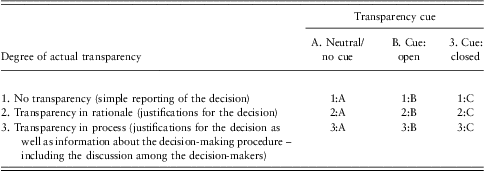
In order to test the argument empirically, an experiment with a three (actual transparency: three degrees) by three (transparency cue: neutral, open, closed) design was set up. Table 1 shows the design.
Experimental design

The experimental treatments consisted of texts containing information about a policy decision relating to a clear and difficult trade-off. In real-world policymaking, decisions are not always – or not even often – about two distinct choices, but for matters of clarity, only two choices were presented. To distinguish between different degrees of actual transparency, Mansbridge's (Reference Mansbridge2009) distinction between ‘transparency in rationale’ and ‘transparency in process’ was used. In the ‘no transparency’ condition, subjects were only informed about the final decision (i.e. the outcome of the process), without any information on how or why the decision was made. In the condition of ‘transparency in rationale’, subjects were provided with justifications for the decision. Finally, in the condition of ‘transparency in process’, the subjects were provided with a description of the formal decision-making procedure as well as a description of the discussion within the decision-making body, including the justifications for the decision. Transparency in process is considered to be more transparent than transparency in rationale as it includes justifications and provides additional procedural information.
To make the information sufficiently realistic to the subjects, the information was presented in the form of newspaper articles written with guidance from professional journalists.Footnote 1 In the no transparency condition, the information resembled a short news telegram; in the condition of transparency in rationale, the information was provided in the form of a news note; and in the condition of transparency in process, subjects were given a full and detailed article about the political decision. The decision was, in all conditions, presented as made in the recent past, which makes the information resemble transparency in retrospect rather than in real time (Heald, Reference Heald2006). To manipulate transparency cues, a straightforward approach of either not mentioning the question of transparency at all (the neutral condition), or including a comment in the text on whether the decision-making process was open or closed was used. This statement is not justified or supported by any particular evidence; it is simply an opinion provided by the writer of the text (presumably a journalist).
As shown in Table 1, the two manipulations’ messages (actual transparency and transparency cues) sometimes coincide and sometimes contrast. This design gives us the opportunity to explore whether people evaluate the information at hand when assessing the transparency of the procedure, or whether they chose to trust the presented cue.
Policy area and decision
The decision presented in the articles referred to allocation of scarce resources in publicly funded healthcare (i.e. political decisions on which medical treatments should be prioritized when society cannot meet all healthcare demands). Because of improved medical technology and an aging population, this has become one of the most pressing issues for many contemporary welfare states. Today the key topic is not whether healthcare is, or should be, rationed, but how it is rationed, and – most importantly – how it should be rationed in a way that is publicly acceptable (Syrett, Reference Syrett2007: 44).
In addition to its clear relevance for society, determining healthcare priority is a suitable case for exploring transparency effects for at least two reasons. First, priority setting is a policy area where fair procedures and especially increased transparency is generally put forward as a potential solution to problems of decreasing legitimacy and trust (Lind and Tyler, Reference Lind and Tyler1988: 213; Daniels and Sabin, Reference Daniels and Sabin2008). Second, it is a policy area that involves questions of life and death or human well-being. As previous research (Calabresi and Bobbitt, Reference Calabresi and Bobbitt1978; Tetlock, Reference Tetlock2000; Skitka, Reference Skitka2002; MacCoun, Reference MacCoun2006; de Fine Licht, Reference de Fine Licht2011) suggests that such questions are especially difficult for people to accept, they represent a rather hard case for the transparency theory. For these reasons, priority-setting in healthcare represents a critical case for testing transparency effects.
The actual political decision presented in the articles concerned a situation in which a county in Sweden decided to stop the use of some exceptionally expensive cancer drugs in order to finance a large investment in psychiatric care. Although cuts like this are generally debated, this particular trade-off has no immediate equivalent in reality. The ambition was, however, to make the decision and decision-making process as realistic as possible. When justifications were provided (in the conditions of transparency in rationale and in process), they were largely based on official statements and publications. Arguments included references to recent investigations concerning the vulnerability of mentally ill people – in particular young women – as well as calculations on how much money could be saved if patients were treated with older, less-expensive cancer drugs. Likewise, the decision-making procedure that was described in the condition of transparency in process was inspired by a procedure that has been used and put forward as a model for priority-setting in Sweden (Waldau, Reference Waldau2010). It includes both a professional stage where physicians rank healthcare treatments according to priority, and a political stage where politicians categorize priorities according to different kinds of needs.
Although wordings and choice of points worth mentioning always affect the framing of the issue, the articles were written to present a rather neutral report of the decision-making process and the arguments presented by decision-makers. This means that the articles did not, for example, include any interviews with affected patients, although such interviews would certainly have been realistic.
Experimental procedure
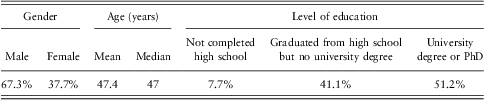
A total of 1099 subjects participated in the experiment. Subjects were randomly drawn from an electronic panel of Swedish citizens that is available through the MOD (Multidisciplinary Opinion and Democracy Research) group at University of Gothenburg, Sweden. The panel is self-selected and therefore not representative of the Swedish population (Martinsson et al., Reference Martinsson, Lindgren, Pettersson and Åsbrink2013). This means that frequencies, such as the actual mean value for decision acceptance, should not be generalized to the larger population. Effects of treatments, on the other hand, can be generalized as subjects are randomly assigned to the different treatment groups. Demographics for the participants are presented in Table 2.Footnote 2
Demographics

Note: ANOVA showed no significant differences between the experimental groups when it comes to gender, age, level of education, political orientation on a left to right scale, trust in Swedish politicians, interest in politics in general, interest in healthcare issues, initial perception of how well Swedish healthcare is doing, how many times subjects had used Swedish healthcare in the last year, or whether subjects were currently employed by the healthcare system.
Subjects were invited to take part in the study by e-mail invitation. After some initial control questions relating to personal experiences with healthcare, subjects were randomly assigned to read one of the nine different conditions presented in Table 1. Thereafter, they answered a series of questions relating to the decision and the decision-making process. As all subjects did not answer all questions, the number of participants differs slightly in the different tables. Subjects were informed that the decision described in the articles was fictive and were invited to write comments and suggestions in open-ended fields. They were thanked for their participation, but did not receive any compensation.
Perceived transparency was measured by the question: To what extent do you feel that the decision was made in an open manner? The answer was provided on a scale from 1 (low extent) to 7 (high extent).
Perceived procedural fairness was measured by an index consisting of three questions (Cronbach's alpha 0.948):
What do you think of how the decision was made?;
How fairly do you think the decision was made?; and
How fair do you think you as a citizen were treated when the decision was made?
Answers were given on a scale from 1 (very bad/not fair) to 7 (very good/very fair).
Decision acceptance was measured by an index consisting of three questions (Cronbach's alpha 0.912):
What do you think about the priority setting decision to stop the use of expensive cancer drugs in order to finance an investment in psychiatry?;
How fair do you think the decision is?; and
How willing are you to accept the decision?
Answers were given on a scale from 1 (very bad/not fair/not willing) to 7 (very good/very fair/willing).
It should be noted that although these measures are theoretically distinct – referring to evaluations of decision-making openness, feelings of the fairness in decision-making procedures, and the acceptability of the outcome – they may be more difficult to separate empirically. As Doherty and Wolak (Reference Doherty and Wolak2012) have shown, people can make rather unbiased judgments of procedural fairness if the procedure is clearly fair or unfair, but are likely to be influenced by their prior preference about the outcome if the process is somewhat ambiguous. This means that although it is possible to evaluate three values one by one, and, for example, judge the procedure to be unfair but the decision to be acceptable, high correlations between the measures might imply that people have made a joint evaluation of the process (including the transparency) and the outcome.
The stimulus control consisted of the question: To what extent do you feel that you were informed about how the decision was made? To control the effect of actual transparency, the answers in the neutral condition (conditions 1:A, 1:B and 1:C in Table 1), where no transparency cues were provided, were compared. Answers were provided on a scale from 1 (to a low extent) to 7 (to a high extent). A one-way ANOVA showed a significant main effect (F 2,340 = 18.013, P < 0.01) of actual transparency. As expected, subjects in the condition of no transparency rated the extent to which they were informed about how the decision was made as lower (mean = 1.81) than subjects in the condition of transparency in rationale (mean = 2.20) and subjects in the condition of transparency in process (mean = 2.90). Further, a one-way ANOVA showed a significant main effect of transparency cue (F 2,1061 = 31.871, P < 0.01). Participants in the open condition felt that they had been informed to a larger extent (mean = 3.03) than participants in the neutral (mean = 2.28) and the closed condition (mean = 2.23). The difference between the neutral and the closed condition was, however, not significant. Taken together, this analysis indicates that the stimuli were received as intended.
Results
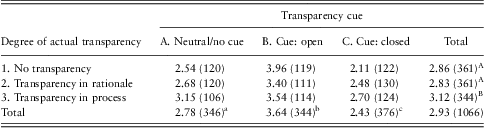
We will start by exploring the study's central question – the effect of actual transparency and transparency cues for perceived transparency (arrows 1a and 1b in Figure 1). Table 3 shows mean values for perceived transparency in the different experimental conditions.
Effect of actual transparency and transparency cues on perceived transparency (mean values from 1 to 7)

Note: Dependent variable: perceived transparency. Measured by the question: To what extent do you perceive that the decision was made in an open manner? Answers are provided on a scale from 1 (low transparency) to 7 (high transparency). N in parentheses. Total values with no letters in common (A and B for comparisons between rows and a, b, and c for comparisons between columns) differ significantly.
A two-way ANOVA showed a significant main effect of both actual transparency (F 2,1057 = 3.618, P < 0.05, partial η2 = 0.007) and transparency cues (F 2,1057 = 58.281, P < 0.01, partial η2 = 0.099).
The main effects both point in the expected direction. To illustrate the effect of actual transparency, it is most illuminating to compare the mean values in the neutral condition (i.e. condition 1:A, 2:A, 3:A). Here we see that subjects provided with no transparency rated the transparency of the procedure as lower (mean = 2.54) than subjects in the condition of transparency in rationale (mean = 2.68), or transparency in process (mean = 3.15). Whereas the difference between no transparency and transparency in rationale is not significant, transparency in process yields a significantly higher evaluation of transparency than both no transparency (P < 0.01) and transparency in rationale (P < 0.05). To illustrate the effect of transparency cues, we look at the mean values in the ‘total’ row (i.e. total A, B, and C). Here we see that subjects provided with a cue that decision-making was conducted in an open manner judged the transparency of the procedure significantly higher (mean = 3.64, P < 0.01) than subjects provided with no cue at all (mean = 2.78) and subjects provided with a statement that decision-making was conducted in a closed manner (mean = 2.43, P < 0.01). These illustrations show that actual transparency and transparency cues both contribute to people's perceptions and assessments of transparency.
In line with hypothesis 1, the results also show that transparency cues matter more than the degree of actual transparency for perceived transparency. The mean values in Table 3 show, for example, that subjects in the condition of no actual transparency who were provided with a cue that decision-making procedure was transparent (condition 1:B) actually rated the transparency of the procedure to be significantly higher (mean = 3.96, P < 0.01) than subjects in the condition of transparency in process but a cue that decision-making was conducted in a closed manner (condition 3:C, mean = 2.70). This indicates that people are more influenced by the cue than by the degree of actual transparency when assessing the transparency of the procedure. People seem to trust the journalist's statement and use it as a cue when judging the transparency of the procedure.
The picture becomes somewhat more nuanced, however, if we consider how actual transparency and transparency cues interact. In the condition of no transparency, where subjects have practically nothing other than the transparency cue on which to base their judgments, they report the highest degree of perceived transparency of all groups (mean = 3.96) when provided with a statement of openness (condition 1:B), and the lowest degree of perceived transparency of all groups (mean = 2.11) when provided with a statement of closedness (condition 1:C). Provided with no statement (condition 1:A), their judgment falls in between (mean = 2.54).
When provided with more information, as in the conditions of transparency in rationale and transparency in process, the cues influence transparency judgments in different directions. In the case of a closedness cue, we see a tendency for increased actual transparency to contribute to increased perceived transparency. Subjects in the no transparency condition (1:C) show the lowest degree of perceived transparency (mean = 2.11), which is significantly lower (P < 0.01) than subjects provided with transparency in process (condition 3:C, mean = 2.70), and close to significantly lower (P = 0.10) than subjects in the condition of transparency in rationale (condition 2:C, mean = 2.48). This indicates that actual transparency can mitigate the effect of a closedness cue.
In the case of an openness cue, however, we see a small tendency for increased transparency causing people to report lower degrees of perceived transparency. Subjects in the no transparency condition (1:B) are significantly more willing to judge the decision-making procedure to be transparent (mean = 3.96) than subjects in the condition of transparency in rationale (condition 2:B, mean = 3.40, P = 0.033). Further, although the difference does not reach standard criteria for significance (P = 0.137), subjects in the no transparency condition even tend to judge the transparency of the process higher than subjects in the condition of transparency in process (3:B, mean = 3.54). The difference between transparency in rationale and transparency in process (2:B and 2:C) is, however, not significant. Increased actual information can, in other words, make people slightly more critical against a statement that decision-making is transparent, indicating that when people have enough information to evaluate, words alone will not produce perceived transparency. Although the main pattern is that people rely more on transparency cues than on actual transparency when assessing the transparency of the procedure, the results thus show that actual transparency slightly moderates the effect of transparency cues.
The road to decision acceptance?
Having established an effect of actual transparency and, to a larger extent, transparency cues, on perceived transparency, we will now explore what this result can add to the larger question of how decision acceptance can be achieved. First, we will evaluate whether perceived transparency, once established, contributes to perceived procedural fairness and decision acceptance as suggested in Figure 1. Second, we will explore if there is a direct effect of actual transparency and transparency cues on decision acceptance.
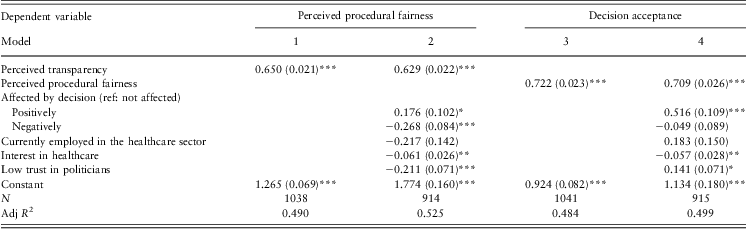
Regression analysis shows that each step in the chain presented in Figure 1 finds empirical support. Table 4 shows regression analysis testing the effect of perceived transparency on perceived procedural fairness and the effect of perceived procedural fairness on decision acceptance with controls for: how the decision affected the subjects; current employment in the healthcare sector; interest in healthcare issues (measured before the experimental stimuli); and general trust in politicians (measured before the experimental stimuli).
Effect of perceived transparency on perceived procedural fairness and perceived procedural fairness on decision acceptance (OLS regression)

Note: Perceived procedural fairness is measured by an index consisting of three questions (Cronbach's alpha 0.948): What do you think of how the decision was made?; How fairly do you think the decision was made?; and How fair do you think you as a citizen were treated when the decision was made? Answers were given on a scale from 1 (very bad/not fair) to 7 (very good/very fair). Decision acceptance is measured by an index consisting of three questions (Cronbach's alpha 0.912): What do you think about the priority setting decision to stop the use of expensive cancer drugs in order to finance an investment in psychiatry?; How fair do you think the decision is?; and How willing are you to accept the decision? Answers were given on a scale from 1 (very bad/not fair/not willing) to 7 (very good/very fair/willing). Perceived transparency is measured by the question To what extent do you perceive that the decision was made in an open manner? Answers are provided on a scale from 1 (low transparency) to 7 (high transparency). Affected by decision was measured by the questions: Would the decision affect you or one of your relatives today? and If yes, how? Alternatives were No, not at all; Yes, to some extent; Yes, to a large extent; and positively, negatively, recoded into yes, positively; yes, negatively; or no. Employed in healthcare was measured by the question Are you currently employed in the healthcare sector? Alternatives were yes, and no. Interest in healthcare was measured by the question How interested are you in healthcare issues? Answers provided on a scale from 1 (not at all interested) to 7 (very interested). Trust in Swedish politicians was measured by the question Generally speaking, how much trust do you have in Swedish politicians? Alternatives were very high trust, fairly high trust, fairly low trust, very low trust, recoded into high trust and low trust.
Standard errors in parentheses.
***P < 0.01, **P < 0.05, *P < 0.10.
In line with the common and intuitive notion of transparency as superior to secrecy, we see a clear, positive, and strong correlation between perceived transparency and perceived procedural fairness; if people perceive the decision-making procedure to be transparent, they also tend to think that the procedure is fair. Similarly, the correlation between perceived procedural fairness and decision acceptance is positive, significant, and very strong. This means, in line with the procedural fairness theory, that if people judge the decision-making procedure to be fair, they are also more inclined to accept the outcome of the procedure.
A two-way ANOVA shows, however, no significant main effect of actual transparency for either procedural fairness (F 2,1044 = 1.861, P > 0.10, partial η2 = 0.004) or decision acceptance (F 2,1069 = 1.613, P > 0.10, partial η2 = 0.003). Although it is possible to influence peoples’ perceptions of transparency by means of increased actual transparency – which in turn is highly correlated with perceived procedural fairness and decision acceptance – perceived procedural fairness and decision acceptance seem to be largely shaped by factors other than actual procedures. This result corresponds with the conclusions presented by Esaiasson (Reference Esaiasson2010) and Esaiasson et al. (Reference Esaiasson, Gilljam, Lindholm and Persson2013): that objective decision-making arrangements are largely inconsequential for decision acceptance.
There is, however, a significant direct effect of transparency cues on perceived procedural fairness (F 2,1044 = 23.264, P < 0.001, partial η2 = 0.043). Subjects provided with an openness cue rated the procedural fairness significantly higher (mean = 3.61) than subjects in the closed (mean = 2.87, P < 0.001) and the neutral (mean = 3.09, P < 0.001) conditions. The difference between the closed and the neutral condition did not, however, reach standard criteria for significance (P = 0.107). This result corresponds with the result on the main hypothesis – that cues matter more than actual procedures for peoples’ perceptions of decision-making procedures. The effect on decision acceptance is, however, not significant (F 2,1069 = 0.189, P > 0.10, partial η2 = 0.000). This result indicates that people can be manipulated by transparency cues to feel that decision-making is transparent or fair, but not to accept decisions.
Taken together, the experiment in this study shows an effect of actual transparency on peoples’ perceptions of decision-making transparency, but not on their perceived procedural fairness or decision acceptance. Furthermore, although there is an effect of actual transparency, transparency cues matter more for perceived transparency. Based on this data, transparency reforms seem to be a less effective way of increasing public legitimacy beliefs than normative theory would suggest. People base their perceptions of decision-making transparency largely on factors other than evaluations of actual transparency, and base their perceptions of decision-making fairness and outcome on considerations other than evaluations of decision-making transparency.
Conclusion and discussion
As transparency is a powerful symbol of democracy, generally associated with positive values such as trustworthiness, rightfulness, and benevolence, people tend to favor transparency over secrecy. From the perspective of social psychology, it is therefore likely that political decision-making perceived to be transparent will increase public perceptions of procedural fairness, which in turn may increase public acceptance of political decisions. This makes transparency reform a democratically appealing approach to overcoming differences in situations of continuing moral disagreement over difficult policy issues.
The study shows – as can be expected from democratic theory – that people who feel that decision-making is carried out in a transparent way perceive procedural fairness to be higher. Furthermore, in line with the procedural fairness theory, people's perceptions of the fairness of a decision-making procedure are highly correlated with their willingness to accept even controversial decisions (such as healthcare priorities) made at a general political level. This means, at a glance, that increasing public perceptions of transparency in political decision-making could be an efficient strategy if decision-makers want to increase public decision acceptance.
The main contribution of this article is, however, that affecting public procedural perceptions by means of actual transparency reforms is more difficult than intuition and normative theory would suggest. The experiment shows that although actual transparency slightly raises public perceptions of transparency, cues matter more: people tend to trust a statement from a presumably credible source (a journalist) and do not make an independent evaluation of the information at hand. This implies, in line with, for example, Esaiasson (Reference Esaiasson2010) and Esaiasson et al. (Reference Esaiasson, Gilljam, Lindholm and Persson2013), that the connection between actual procedures and public perceptions of the same are much less obvious than procedural fairness theory would suggest. Even highly transparent procedures may not be perceived as particularly transparent by the public, thereby lowering the chances that increased transparency will affect public legitimacy beliefs. Accordingly, the study shows no direct effect of actual transparency or transparency cues on decision acceptance, indicating that decision acceptance is largely shaped by factors other than transparency considerations.
Taken together, these results imply that theoretically important tools to raise public decision acceptance are not in the hands of political authorities and decision-makers. They do not seem to be able to make people accept political decisions by means of increased decision-making transparency, partly because people to a large extent base their perceptions of transparency on factors other than evaluations of actual transparency, and partly because people tend to base their perceptions of fairness of treatment on other considerations than evaluations of decision-making transparency.
Experiments offer a very powerful way of examining causal relationships. They come, however, with several drawbacks that should be acknowledged. Most importantly, experiments conducted in laboratories or, as is this case, on-line, cannot catch people's natural behavior. There will always be a question of whether the experimental setting or the particular case caused the results. Furthermore, samples are rarely representative of the population, making it possible that factors other than manipulations drive the results. Although the sample in this study consists of members of the general public and not simply students (as in many other experiments), participants are, for example, highly educated compared with the general population and there is always a possibility that this factor may influence the critical evaluation of the stimuli. In light of these general methodological limitations, three questions regarding the experimental design and results will be addressed.
First, it can be argued that although people are less influenced by actual transparency than by transparency cues when assessing the transparency of the procedure, this does not mean that actual transparency will not affect transparency beliefs in reality. The effect is, however, indirect: actual transparency will influence journalists’ and stakeholders’ perceptions of transparency, which will influence the transparency cues available to the public, which will influence public perceptions of transparency. Put differently, there are compelling reasons to believe that there is a correlation between actual transparency and transparency cues that has not been explored in this study. Although this effect sounds plausible, we should keep in mind that earlier research cited in this article has shown that the link between actual and perceived transparency is also rather weak in non-experimental settings; actual reforms do not seem to result in corresponding increases in perceptions. Considering that journalists and stakeholders are more likely than general members of the public to be in a critical mode when evaluating political decision-making, the argument that actual transparency will have a large impact on transparency cues (especially positive ones) is further called into question.
Second, some might argue that the result of the experiment is mainly a consequence of the transparency stimuli (i.e. how actual transparency was manipulated in the particular articles presented to the subjects). Specifically, one might think that people will demand more continuous reporting, and not a final decision being announced in order to judge a decision-making process as transparent (or fair). This is a valid objection, and part of the answer is that further research is needed. However, before concluding that there is another kind of transparency that will surely deliver the desired results, we should acknowledge that this potential objection may actually reflect that the stimuli are quite realistic. In reality, few people follow the political news in great detail over a long period of time. For example, they might skim the newspaper over breakfast and only a few things might catch their interest. Therefore, it is not unlikely that people will experience information about final decisions as their first impression about a policy, even if there has been a more continuous reporting process. Furthermore, too much information also increases the risk of information overload, and will not necessarily increase perceived transparency among the recipients. For these reasons, even though it can be argued that the articles do not show ‘perfect’ or ‘real’ transparency, the results can give us a sense of how real-world transparency will affect public perceptions of transparency.
Third, the results may reflect that people have another – presumably broader – conception of transparency in decision-making than availability or provision of decision-making information, and that the manipulations of actual transparency therefore yielded small effects. As Meijer et al. (Reference Meijer, Curtin and Hillebrandt2012) argue, ‘open government’ may include both transparency and participation (vision and voice) and only the amount of information (transparency) was manipulated in this experiment. This is certainly an important point and more research – probably not only experimental but also qualitative – exploring what people actually mean by transparency or openness in decision-making would be very valuable to explain in-depth why transparency may not result in theoretically expected effects. It can be noted, however, that although voice (i.e. the opportunity to have a say) is one of the most used manipulations in procedural fairness experiments regarding personal matters, research on different procedural arrangements at a general political level (e.g. Esaiasson et al., Reference Esaiasson, Gilljam, Lindholm and Persson2013) has so far found only weak or null effects for public willingness to accept a given decision. This means that increased participation – in the same way as transparency – might be connected with theoretical expectations that are not easily met empirically. Although many people would probably say that increased participation is valuable, that does not necessarily mean that they will accept outcomes more easily if the public is more involved in the process. It is possible that people, for example, demand more participation because they believe that increased participation would make decisions different (better), but if they do not like the outcome, participation as such has no further legitimizing power.
In sum, this study demonstrates the importance of not neglecting psychological mechanisms, such as how fairness perceptions are produced, when discussing or designing transparency programs and reforms. Just because intuition or democratic theory tells us that transparency is right, fair, or good, we should not expect or assume that public perceptions will adapt accordingly. Further empirical studies are needed to deepen our understanding of how people shape their perceptions of decision-making procedures and outcomes in order to improve both decision-making institutions and public information.
Acknowledgements
The author thanks Daniel Naurin, Marcia Grimes, Peter Esaiasson, Anders Sundell, the participants at the Transatlantic Conference on Transparency Research in Utrecht 2012, the participants at the internal seminar at the National Centre for Priority Setting in Health Care in Sweden, and the QoG Institute's internal seminar for valuable comments and suggestions, and the MOD group at University of Gothenburg for help with data collection.