Background
Cardiac arrest, defined as the sudden cessation of cardiac activity with hemodynamic collapse, is most often due to ventricular tachyarrhythmias in adults. Approximately 80% of all sudden cardiac arrests in adults transpire in patients with underlying coronary artery disease (CAD), occurring as acute coronary events in patients with no prior known history of CAD, and in patients with chronic CAD and previous myocardial infarctions.Reference Schmid, Mould-Millman, Hammes, Kroehl, Quiros García, Umaña McDermott and Lowenstein 1
The chances of survival after cardiac arrest are directly proportional to recognition of an arrest, activation of the emergency response system, prompt initiation of bystander-performed chest compressions within four to six minutes, early defibrillation and access to Advanced Life Support, and post-cardiac-arrest care.Reference Schmid, Mould-Millman, Hammes, Kroehl, Quiros García, Umaña McDermott and Lowenstein 1 - Reference Cummins, Eisenberg, Hallstrom and Litwin 4 The first half of this “chain of survival” occurs in the prehospital environment, where bystander cardiopulmonary resuscitation (CPR) and Emergency Medical Services (EMS) transport to definitive care are of utmost importance.Reference Cummins, Eisenberg, Hallstrom and Litwin 4 The incidence of bystander CPR depends on training level and willingness of a layperson responder to participate when a cardiac arrest occurs, which may vary depending on the particular informational, socioeconomic, and cultural context in which the cardiac arrest occurs. 5
In Costa Rica, a small country in Central America, the incidence of CAD is rising. In 2011, CAD was the leading cause of mortality representing 29.2% of all deaths.Reference Sasson, Haukoos and Bond 6 The risk factors for CAD and cardiac arrest are becoming more prevalent in Costa Rica, including dyslipidemia, hypertension, cigarette smoking, physical inactivity, obesity, and diabetes mellitus.Reference Schmid, Mould-Millman, Hammes, Kroehl, Quiros García, Umaña McDermott and Lowenstein 1 , Reference Benavides 7 Sudden cardiac arrest represents a significant threat to Costa Rican health.
According to local emergency medicine experts in the Grand Metropolitan Area of San José, Costa Rica, bystander CPR is seldom performed, despite the existence of a well-developed EMS medical system consisting of 24 bases of the Cruz Roja (Red Cross; two with 24/7 Advanced Life Support and five with advanced support during certain hours), eight bases of bomberos (firefighters), and 16 bases of private ambulance companies. Further, in-hospital emergency care is sufficiently advanced to provide advanced cardiac life support to victims of cardiac arrest. The pre- and in-hospital emergency care infrastructure exists to provide emergency transport to definitive care, manage cardiac arrest, and, ultimately, reduce mortality. Under the existing infrastructure, managing cardiac arrests would be strengthened greatly if members of the community received CPR training to activate the emergency response system promptly and provide chest compressions. It is therefore logical to recommend that CPR training programs, such as those developed by the American Heart Association (AHA; Dallas, Texas USA), should be implemented in San José. 8 However, little is known about the willingness of laypersons in San José to enroll in CPR training classes or to perform CPR in the event of a cardiac arrest. Knowledge and awareness of cardiac arrest and CPR, and potential social, cultural, and socio-economic barriers to receiving CPR instruction or performing CPR, have yet to be assessed among residents of San José. Determining the barriers, and potential facilitators, to community CPR participation represents a pivotal starting point in developing much-needed community resuscitation programs.
This study sought to identify barriers and facilitators to enrolling in CPR training classes and to performing CPR. Specifically, the study was performed to determine whether demographic attributes, CPR knowledge and beliefs, prior CPR training, having a family member with heart disease, and prior witnessing of a cardiac arrest influenced San José residents’ willingness to register for a CPR class and to perform CPR on a stranger.
Methods
Setting
This study was conducted in San José, Costa Rica. Approximately 2.16 million inhabitants live in the Grand Metropolitan Area of San José, accounting for 50% of the total population of Costa Rica.Reference Sasson, Meischke and Abella 9
This community-based participatory research project included the collaboration of two local community organizations, a San José emergency physician (MUM), local medical students, and two paramedics. Community partners were involved in all aspects of the research process in order to enhance the understanding of existing CPR beliefs within the community and in the hope that the results will be of benefit to future community CPR education initiatives in San José.Reference Molina 10 Approval was obtained from the Colorado Multiple Institutional Review Board (Denver, Colorado USA).
Survey Development
To inform development of the questionnaire used in the study, exploratory individual qualitative interviews were conducted in Spanish with 10 San José community members until saturation of themes was reached. The interview participants, ranging in age from 20 to 67 years, were members of two organizations with direct involvement in the community: Guides and Scouts of Costa Rica in Dulce Nombre, San José; and the Integral Association of Community Development in Fatima, San José. The interviewees were asked open-ended exploratory, then closed-ended probing, questions about existing views and familiarity with CPR among community members, potential barriers and facilitators to attending a community CPR class, and barriers to performing CPR in the event of a witnessed cardiac arrest. Interviews were audiotaped after written consent was obtained from each participant. The audiotapes were transcribed in Spanish and translated into English, themes were identified, and then all responses were coded by theme.
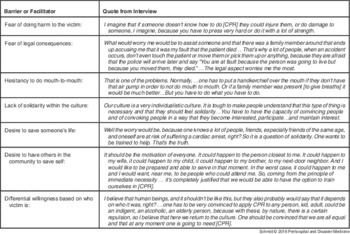
Preliminary interview responses were used to create a questionnaire that included barriers and facilitators to taking CPR classes and performing CPR, as identified from qualitative interviews, as well as barriers and facilitators identified from similar studies performed in the United States (eg, cost, schedules, and competing priorities). 5 As highlighted in Table 1, the cultural barriers identified from interviewees included: fear of causing more harm to the patient; fear of legal consequences; belief that performing CPR was against God’s will (fatalismo); hesitancy to perform mouth-to-mouth ventilation; and a lack of solidarity among people within the community. The facilitators to participating in CPR training and performing CPR identified by community members were: the desire to be able to save someone’s life; ensuring that there would be other members of the community to save one’s own life; and having classes that were affordable financially and conveniently scheduled outside of work hours. The interviews also suggested that willingness to perform CPR might depend on who the cardiac arrest victim was. The interviewees indicated they might be more willing to perform CPR on a family member, child, “adult stranger,” or “geriatric adult stranger,” but they were less willing to perform CPR if the victim was known to be indigent.
Informative Quotes from Initial Interviews

Abbreviation: CPR, cardiopulmonary resuscitation.
In addition to collecting information about barriers and facilitators to attending a CPR class and to performing CPR, the survey collected information on participant demographics, prior exposure to CPR, having a family member with heart disease, and prior witnessing of a cardiac arrest. The survey included a mix of open-ended and multiple-choice questions.
The primary objective of the survey was to ascertain participants’ willingness to enroll in a CPR class and to perform CPR in the event of a cardiac arrest. Survey participants were asked: “Would you attend a CPR class if offered?” and “Would you perform CPR on an adult stranger?”
The survey was pilot-tested among 15 community members in an evangelical church in Tres Ríos, San José. The feedback received from the pilot survey was used to improve the layout, flow, clarity, and face validity of the questions and response options. The final 12-item questionnaire (Appendix 1; available online only) was distributed to a convenience sample of individuals in public gathering places in San José from June through September 2014. Participants received a postcard-consent information sheet before completing the survey.
Data Analysis
This investigation focused on the two main outcomes: likelihood of registering for a CPR class; and willingness to perform CPR on an adult stranger.
The data analysis proceeded in three steps. First, survey responses (demographic characteristics, CPR knowledge, beliefs and experiences, likelihood of enrolling in CPR classes, and willingness to perform CPR on a stranger) were summarized using means and standard deviations for measurement variables, and proportions and 95% confidence limits for categorical variables. Second, odds ratios and 95% CIs were calculated to test for associations between participant characteristics, knowledge and experiences, and the two main outcomes. Third, two separate logistic regression models were developed to identify independent and statistically significant predictors of likelihood of registering for CPR training classes and willingness to perform CPR on an adult stranger. All characteristics and beliefs that were significant in the bivariate analysis (P≤.10) were included as potential independent variables.
Results
Three hundred seventy-six San José residents participated in the survey; of these, six individuals did not answer 10 or more questions and were excluded from the analysis. The final sample size was 370. When compared with the 2011 Costa Rican census, the survey participants were similar with respect to education (65.1% of San José residents reported a secondary education or higher). Compared with the San José population, women were under-represented in the study sample (52% vs 40%).
Demographic Characteristics and Experiences of Participants
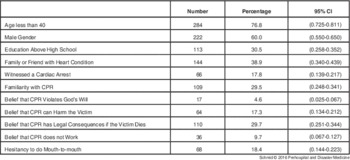
The demographic attributes, attitudes, and experiences of the survey participants are listed in Table 2. Overall, most survey participants were male (60%), and 31% had a college degree. Thirty-six percent had family members with heart disease, 18% had witnessed a cardiac arrest, 36% were trained in CPR, and 70% knew the correct 2008 AHA “hands-only” CPR steps.
Demographic Characteristics, Experiences, and Beliefs of Study Participants

Abbreviation: CPR, cardiopulmonary resuscitation.
Likelihood of Enrolling in a CPR Class
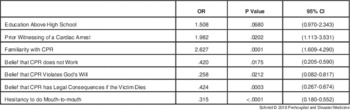
Fifty-five percent (95% CI, 50-60%) of participants said they were likely to enroll in a CPR class. In the bivariate analysis, education above high school (OR: 1.51; 95% CI, 0.97-2.34), prior witnessing of a cardiac arrest (OR: 1.98; 95% CI, 1.11-3.53), and familiarity with CPR (OR: 2.63; 95% CI, 1.61-4.29) were associated with likelihood of attending a CPR training class. Four personal beliefs were associated with not being willing to enroll in a CPR class: belief that CPR does not work (OR: 0.42; 95% CI, 0.21-0.59); belief that CPR is against God’s will (OR: 0.26; 95% CI, 0.08-0.82); concern about legal consequences if the victim dies (OR: 0.42; 95% CI, 0.27-0.67); and hesitancy to do mouth-to-mouth (OR: 0.32; 95% CI, 0.18-0.55; Table 3). In the multivariate logistical regression model, only one characteristic was significantly associated with enrolling in a CPR class; those who had received prior CPR training or identified themselves as familiar with CPR were 2.2 times (95% CI, 1.344-3.764) more likely to say they would enroll in a CPR class. The prevalence of each of these beliefs among the survey participants is shown in Table 2.
Attributes, Experiences, and Beliefs Associated with Likelihood of Attending a CPR Training Class (Bivariate Analysis)

Abbreviation: CPR, cardiopulmonary resuscitation.
Willingness to Perform CPR
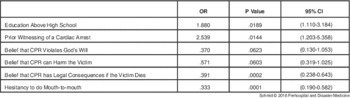
Nearly three-quarters (74%; 95% CI, 70-78%) of participants said that they would perform CPR on an adult stranger. In the bivariate analysis, education above high school (OR: 1.88; 95% CI, 1.11-3.18) and prior witnessing of a cardiac arrest (OR: 2.54; 95% CI, 1.20-5.36) were associated with willingness to perform CPR on an adult stranger. Four characteristics were associated with not wanting to perform CPR on an adult stranger: holding the belief that CPR can harm the victim (OR: 0.57; 95% CI, 0.32-1.03); hesitancy to perform mouth-to-mouth (OR: 0.33; 95% CI, 0.19-0.58); believing that CPR violates God’s will (OR: 0.37; 95% CI, 0.13-1.05); and believing that CPR holds legal consequences if the victim dies (OR: 0.39; 95% CI, 0.24-0.64; Table 4). In the multivariate logistic model, willingness to perform CPR on an adult stranger was associated with prior witnessing of a cardiac arrest (OR: 2.18; 95% CI, 1.00-4.74) and having at least a secondary education (OR: 1.77; 95% CI, 1.02-3.08).
Attributes, Experiences, and Beliefs Associated with Willingness to Perform CPR on an Adult Stranger (Bivariate Analysis)

Abbreviation: CPR, cardiopulmonary resuscitation.
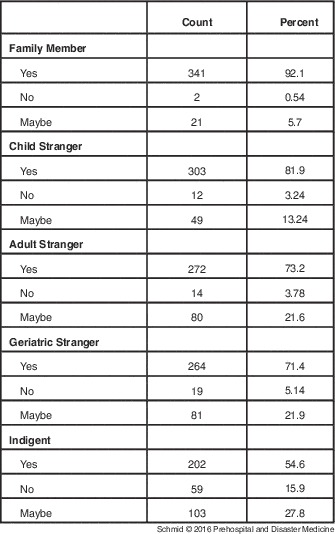
Willingness to perform CPR was greatest if the victim was a family member (92.1%), followed by a child stranger (81.9%), adult stranger (73.2%), or geriatric stranger (71.4%). Willingness to perform CPR was lowest if the victim was felt to be indigent (54.6%; Table 5). In the bivariate analysis, not wanting to do CPR on an indigent victim was significantly associated with hesitancy to perform mouth-to-mouth (OR: 0.47; 95% CI, 0.28-0.82) and fear of legal consequences (OR: 0.50; 95% CI, 0.32-0.79).
Willingness to Perform CPR by Victim Type

Abbreviation: CPR, cardiopulmonary resuscitation.
Discussion
Previous studies have been conducted in communities in the United States, Europe, and Japan to assess the barriers and facilitators to CPR education and to performing CPR in the event of a witnessed cardiac arrest. However, this is the first attempt to characterize the beliefs surrounding CPR in a large community in Central America. With respect to cardiac arrest care, San José, Costa Rica is a unique city given its fairly robust pre- and in-hospital emergency care system capable of Advanced Life Support and post-arrest care. San José theoretically could reduce the morbidity and mortality from out-of-hospital cardiac arrests by increasing the number of laypersons sensitized, willing, and trained to recognize cardiac arrest, activate the emergency response system, and perform effective chest compressions. However, enrollment in CPR classes is uncommon in San José, and bystander CPR seldom is performed according to multiple observations and communications by local emergency physicians, prehospital personnel, and community laypersons. The research team hypothesized that reluctance to attend CPR classes and to perform CPR on a stranger might be due to unique beliefs or fears about the risks, benefits, or appropriateness of performing CPR. The barriers to participating in bystander CPR must be characterized before attempting to implement a community CPR education program, or else the program may fail, wasting valuable resources. 8
Many of the barriers identified from exploratory interviews and questionnaire responses in San José were similar to the barriers characterized in prior studies in the United States, including hesitancy to perform mouth-to-mouth resuscitation and fear of legal consequences if a victim dies. 5 In this study, more than 19% of survey participants listed hesitancy to perform mouth-to-mouth breathing as a barrier to performing CPR on a stranger. However, mouth-to-mouth resuscitation is no longer considered a necessary component of bystander CPR. Community-based CPR programs in the United States increasingly focus on a simplified, 2-component version of CPR: calling 911 and beginning chest compressions until an ambulance arrives. 8 “Hands-only” CPR could be readily taught in San José (which uses 911 as its emergency telephone number) in lieu of the traditional hours-long, costly, Basic Life Support training programs that many citizens would not have the economic resources or time to attend. Similarly, 29.7% of survey participants cited a fear of legal consequences as a reason not to perform CPR in the event of a witnessed cardiac arrest. Education of Costa Rican laypersons regarding the lack of local legal repercussions from failing to resuscitate a cardiac arrest victim will also be important in encouraging bystanders to perform CPR on an adult stranger.
Another belief associated with hesitancy to attend a class or perform CPR is the opinion that “CPR does not work.” Laypersons should be informed, not only in CPR classes but also through public health media campaigns, that timely, effective, bystander CPR may provide a victim an improved chance of survival. According to the Cardiac Arrest Registry to Enhance Survival (CARES), survival to hospital discharge of victims of witnessed cardiac arrest in the US between 2005 and 2010 was 11.2% for those who received bystander CPR, as compared with 7.0% of those who did not receive bystander CPR, for a relative risk reduction of 37.5%.Reference Israel, Schulz, Parker and Becker 11
In the current study, several additional potential barriers to CPR participation were identified. Fatalismo, a widely-studied “culture-bound syndrome” among some Latino individuals, refers to the belief that when illness or death strikes, it is God’s will; hence, individuals need not intervene.Reference McNally, Robb and Mehta 12 In this study, participants who stated that “if a cardiac arrest occurs, it is God’s will” were 3.9 times more likely not to enroll in a CPR class and 2.7 times less likely to perform CPR on a stranger. Importantly, however, this belief was not common among San José residents participating in the survey (only 4.5%). Thus, while the relative risk is significant, the attributable risk may be much less important. Similarly, the prevalence rates of several other common cultural beliefs (for example, that CPR does not work and that CPR can harm the victim) were also relatively low (9.6% and 17.3%, respectively). Since these beliefs are not widely prevalent, their actual significance as barriers to CPR education and performance is unknown.
An interesting finding of the study was the differential willingness to perform CPR based on the characteristics of the victim. The strength of the family unit in Costa Rica may explain the willingness of 92% of people to perform CPR on a family member. The relative hesitancy to perform CPR on an “indigent” (used in Costa Rica to describe someone who is impoverished, uneducated, and often an immigrant) may reflect some deep-seated social prejudices. However, it is important to note that even when the victim was believed to be “indigent,” willingness to perform CPR exceeded 50%.
Limitations
This study has several strengths, including the relatively large study sample representing diverse demographic groups in San José, Costa Rica. In addition, development of the survey instrument was informed by information and insights provided by local laypersons, community leaders, and emergency medicine and prehospital providers. At the same time, several limitations should be acknowledged. The survey was conducted in a single Central American city, which may limit generalizability to other cities, countries, and cultures. The study also relied on a convenience sample, which may introduce non-participation bias. Large proportions of the survey participants were young, college-educated, and already familiar with CPR, which could skew the results toward acceptance of CPR and willingness to intervene when faced with a victim of cardiac arrest. However, with respect to education, the only significant demographic predictor of willingness to perform CPR, the survey participants and the surrounding population were similar; among survey participants, 65.5% reported having at least a secondary education, compared with 65.1% in the San Jose population-at-large.Reference Pérez-Stable, Sabogal, Otero-Sabogal, Hiatt and McPhee 13 Another limitation is that the survey did not ask about the acceptability of non-classroom CPR training methods, such as telephonic CPR, short videos disseminated through social media, and CPR apps on cellphones. This study showed a high level of acceptability of CPR among laypersons in San José, and any of these methods theoretically could be implemented in lieu of formal classes. Finally, all of the data in this survey are based on self-report, and recall, social acceptability, and other forms of bias may be present.
Conclusions
This study reports that a majority of San José residents are willing to take CPR classes and perform CPR on a stranger. However, to successfully implement a community CPR program, barriers must be considered, including differential willingness to perform CPR based on the victim’s demographic characteristics, misgivings about CPR efficacy, legal risk, and hesitancy to perform mouth-to-mouth resuscitation.
Acknowledgments
The research team would like to thank Dilana Zamora Carvajal, Shirley Blanco Saenz, Javier Santana Bonilla, Jose Campabadal Mendez, Luis Diego Quiros Obando, Tannia Quiros Obando, and Manrique Montoya Fernandez for their assistance with project development and data collection. The research team would also like to thank Saul Mora and the Asociación Integral de Desarrollo de Fatima, Desamparados and Jose Campabadal Flores, and the Coronado, San José troupe of the Guides and Scouts of Costa Rica for their assistance with the interviews that informed survey development.
Supplementary Material
For supplementary material/s referred to in this article, please visit http://dx.doi.org/doi:10.1017/S1049023X16000777