Introduction
The early bilingual vocabulary development in minority-majority language contexts
Children acquire a language through exposure to that language. Likewise, bilingual children acquire their two languages through exposure to these two languages. In language contexts with a majority language existing alongside a minority language, the majority language is the societal dominant or omnipresent language and the minority language has a more modest place in society. From the perspective of children this means that although most interactional language input may be in the minority language, e.g., from parents and other family members or friends, there is almost always exposure to the majority language due to its stronger presence in society. On the other hand, children growing up with the majority language at home will generally have little exposure to the minority language due to its modest place in society. The purpose of the current study was to evaluate the effects of early input in a majority language versus a (regional) minority language on the development of a bilingual vocabulary, in this case Dutch and Frisian in Friesland. Friesland is a bilingual province in the north of the Netherlands, where these two languages co-exist at a societal level. Frisian is the minority language and it exists alongside the majority (national) language, Dutch. This study focuses on the effects of home language and exposure from caregivers other than the parents on the development of Frisian and Dutch vocabulary by young bilinguals.
Studies from language contexts with a minority and a majority language show that especially in the development of the minority language, the home languages of children play an important role. Scheele, Leseman and Mayo (Reference Scheele, Leseman and Mayo2010) investigated the role of input factors on receptive vocabulary of preschoolers from monolingual Dutch, Turkish and Moroccan families in the Netherlands. They found that greater usage of the immigrant language (Turkish or Tarafit-Berber) at home generally led to higher results in receptive vocabulary in that home language, and lower results in Dutch receptive vocabulary. Hammer, Davison, Lawrence and Miccio (Reference Hammer, Davison, Lawrence and Miccio2009) demonstrated that the usage of Spanish at home affected the development of Spanish receptive vocabulary development of young bilinguals in the United States. Furthermore, the usage of Spanish at home did not negatively affect the children's receptive vocabulary development in English, the societal dominant language. Further, Duursma, Romero-Contreras, Szuber, Proctor, Snow, August and Calderón (Reference Duursma, Romero-Contreras, Szuber, Proctor, Snow, August and Calderón2007) investigated Spanish and English productive vocabulary in fifth-grade Spanish-speaking children acquiring English in the United States. Children whose parents used more Spanish at home had higher Spanish productive vocabulary scores. However, the more the parents and siblings used English at home, the lower the children's Spanish vocabulary. Dixon, Zhao, Quiroz and Shin (Reference Dixon, Zhao, Quiroz and Shin2012) also confirmed the influence of home language on the minority language. They studied Singaporean kindergartners from Chinese, Malay or Tamil homes who were also learning English. Their study showed that usage of the ethnic language at home had a positive effect on receptive vocabulary development in that ethnic language. Moreover, when parents spoke only English at home this had a negative effect on receptive vocabulary development on the ethnic language. As well as home language, the language community contributed to the children's ethnic vocabulary development. Children growing up in the Chinese community scored higher in their ethnic vocabulary than children from the Malay or Tamil language communities. Further, the Malay receptive vocabulary of children from the Malay community was higher than the Tamil receptive vocabulary of children from the Tamil community. Dixon et al. (Reference Dixon, Zhao, Quiroz and Shin2012) argued that this is due to the lower status of Malay and Tamil, compared to the high status of Chinese.
Similar home language effects were found in studies where the minority language is a European non-immigrant language, for example the regional minority languages Irish (Hickey, Reference Hickey1997) and Welsh (Gathercole & Thomas, Reference Gathercole and Thomas2009). Hickey (Reference Hickey1997) assessed bilingual preschoolers at Irish-medium preschools. Her study demonstrated an effect of home language on Irish receptive and productive vocabulary. This means that children who had more Irish input at home obtained higher scores on the Irish vocabulary tests. In other words, participants growing up in Irish-only homes significantly outperformed children from bilingual Irish-English homes in Irish receptive and productive vocabulary. Participants from bilingual homes scored significantly higher in Irish productive vocabulary compared to their peers from English-only homes. Only in Irish receptive vocabulary were no differences found between participants from bilingual homes and English-only homes. Gathercole and Thomas (Reference Gathercole and Thomas2009) found similar results for Welsh receptive vocabulary. In their paper they discuss six cross-sectional studies among children aged between 3–11;6 years (study 1–4) and adults (study 5–6). These studies concern receptive vocabulary and morphosyntax in Welsh only (study 1–3) and receptive vocabulary in Welsh and English (study 4–6). The Welsh proficiency of the participants in the age group 3–5;6 years with English-only or bilingual input at home lagged behind their peers from Welsh-only homes. This delay was also present in the older age groups (i.e., 6–8 and 8;6–11 years). In other words, participants who received greater amounts of input in the minority language at home had a stronger command of receptive vocabulary in that language, compared to their peers who had less input in the minority language. With respect to the development of the majority language, the influence of home language decreased within the older age groups (Gathercole & Thomas, Reference Gathercole and Thomas2009). Although home language was significant in the age group 3–5;6 years, with children from English-only and bilingual homes outperforming the children from Welsh-only homes, its influence on the development of English receptive vocabulary decreased over time. In the oldest age group (8;6–11 years), no effect of home language was found. Gathercole and Thomas (Reference Gathercole and Thomas2009) argue this might be explained by the fact that the L1-Welsh children reach a critical mass of English input in primary education.
Besides the influence of home language, Hickey (Reference Hickey1997) and Gathercole and Thomas (Reference Gathercole and Thomas2009) also looked at the influence of input outside the home and family. Hickey (Reference Hickey1997) demonstrated that the community language of the children did not play a substantial role in Irish receptive vocabulary, i.e., the children living in districts where Irish was the main community language did not differ significantly in Irish receptive vocabulary from children from English-speaking districts. Regarding productive vocabulary in Irish, an effect was found for the community language, with children from Irish-speaking districts outperforming children from English-speaking districts. In addition, Gathercole and Thomas (Reference Gathercole and Thomas2009) showed that school language, whether children attended a bilingual-medium school or a Welsh-medium school, did not have an effect on Welsh receptive vocabulary in any of the age groups (3–5;6, 6–8; 8;6–11 years). No effect of school language was found in the first two groups (3–5;6 and 6–8 years) for English receptive vocabulary in the Welsh–English context either. However, school language appeared to play a large role in the oldest age group (8;6–11 years), with children from bilingual-medium schools outperforming those from Welsh-medium schools in English receptive vocabulary (Gathercole & Thomas, Reference Gathercole and Thomas2009).
Gathercole and Thomas’ findings on the lack of an effect for home language for English receptive vocabulary were not mirrored in a later study by Rhys and Thomas (Reference Rhys and Thomas2013). Rhys and Thomas investigated receptive vocabulary in both English and Welsh of pupils following Welsh-medium primary education in Wales and compared these with the English performance of a monolingual control group following English-medium education. The participants from Welsh-only and bilingual homes in their study did not show a catch-up in English receptive vocabulary as in the Gathercole and Thomas study. On the contrary, the participants from Welsh-only and bilingual homes (age: 10–11 years) still performed more than one standard deviation below average according to the monolingual norms of the English receptive vocabulary test, while their peers from English-only homes and monolingual English peers scored within the age appropriate ranges. In addition, the bilingual children from Bialystok, Luk, Peets and Yang's study (Reference Bialystok, Luk, Peets and Yang2010) did not catch up in the majority language, English, by the age of ten. The difference between the bilingual and the monolingual children in their study remained constant over the ages three to ten years.
However, in the context of the studies in Wales and Ireland, the question arises as to whether the same trends for home language and additional input also hold for other regional minority language contexts, for example for the Frisian–Dutch language context in Friesland, a bilingual region in the north of the Netherlands. Friesland presents a particularly interesting case for studying bilingualism since two closely related languages are used here alongside each other: the national language Dutch and the regional minority language Frisian. Since Dutch is the national language, it is referred to as the majority language in this paper. This does not necessarily mean that the inhabitants of Friesland speak Dutch more than Frisian. In fact, Frisian has quite a strong position in the rural parts of Friesland, sometimes even stronger than Dutch (Gorter & Jonkman, Reference Gorter and Jonkman1995).
The current paper monitors the Frisian and Dutch vocabulary development of young bilinguals, i.e., preschool children (aged between 2;6–4;0 years) in Friesland. The focus is on the role of language input in the development of a receptive and productive vocabulary in both Frisian and Dutch. The paper complements Gathercole and Thomas’ study (Reference Gathercole and Thomas2009) and Hickey's study (Reference Hickey1997) since the current paper has a longitudinal design instead of a cross-sectional one. Moreover, the current study investigates receptive and productive vocabulary in both the regional minority and majority language, whereas Gathercole and Thomas only looked at receptive vocabulary in both languages and Hickey studied receptive and productive vocabulary in the minority language only.
The Frisian–Dutch language context
In Friesland, approximately 74% of the population speaks Frisian (Gorter & Jonkman, Reference Gorter and Jonkman1995; Provinsje Fryslân, 2011), which is roughly 477,000 speakers. All inhabitants have a strong command of the majority language, Dutch, since it is present in all formal domains, and also taught as a subject and used as the medium of instruction in education. Approximately 48% of the preschool-aged children in Friesland acquire Frisian as their mother tongue (Provinsje Fryslân, 2011). These children grow up in families where one or both parents speak Frisian to their children.
The current study comprised children from families where predominantly only one language was spoken by the parents, i.e., either Frisian or Dutch. It is a matter of debate whether these children are simultaneous or successive language learners, since the second language may be introduced before the age of three. For example, many children with Frisian as their home language are also exposed to Dutch, e.g., through Dutch television and radio, Dutch-speaking relatives or friends, at daycare, etc. They experience an unbalanced bilingual language input, with substantially more input in Frisian than in Dutch. Also young children with Dutch at home who grow up in a mostly Frisian or bilingual language context outside their home and family are likely to experience an unbalanced input in both languages. One might therefore categorize the participants in the present study as ‘early second language learners’ (De Houwer, Reference De Houwer2009). Consequently, L2 mentioned in this paper refers to the participants’ (early) L2-acquisition.
The age group of 2;6–4;0 years forms an interesting target group for research, since this age group has received scarcely any attention in research in the Frisian–Dutch language context. Most studies in Friesland have concentrated primarily on school-aged bilinguals. Only one academic study exists on vocabulary development of Frisian and Dutch of children below six years of age. Ytsma (Reference Ytsma, Huls and Weltens1999) investigated the Frisian and Dutch language proficiency of children in their first year of primary education (age: 4–5 years). The participants were tested at the beginning and at the end of that first year in both languages with respect to phonological knowledge, receptive vocabulary, productive vocabulary, syntax and text comprehension. The standardized Dutch battery of tests Toets Tweetaligheid [Bilingualism Test] (Verhoeven, Narain, Extra, Konak & Zerrouk, Reference Verhoeven, Narain, Extra, Konak and Zerrouk1995) was translated and adapted to Frisian for this purpose. The L1-Frisian children showed significant growth in all Frisian measures. In addition, apart from the Dutch phonological test, they also showed significant growth in the Dutch measures. The L1-Dutch children also showed significant progress in Frisian, with the exception of Frisian productive vocabulary. However, their growth in Frisian was substantially smaller in comparison with the growth in Dutch of the L1-Frisian children. Ytsma (Reference Ytsma, Huls and Weltens1999) therefore concluded that the second language (Dutch) of Frisian-speaking children was further developed than the second language (Frisian) of children with Dutch as their first language. The L1-Frisian participants seemed more balanced bilinguals than their peers with Dutch as their home language. Ytsma (Reference Ytsma1995) also conducted a study on L1-Frisian and L2-Frisian acquisition (of L1-Dutch participants). The participants in this cross-sectional study were aged 8–9 years or 11–12 years. For the purpose of his study, Ytsma developed a Frisian productive vocabulary test. Although Ytsma investigated the effects of age, gender and language environment within the L1-Frisian group and the L2-Frisian group separately without comparing the two groups with each other, it was clear from his results that home language is a factor in Frisian acquisition. The results of the Frisian productive vocabulary test demonstrated that the L1-Frisian children had a mean score of 31.9 points, close to the maximum of 34 points. In contrast, the L2-Frisian children had a mean score of 18.2 points (Ytsma, Reference Ytsma1995). A study among school-aged children (Van Ruijven, Reference van Ruijven2006, based on data from De Jager, Klunder & Ytsma, Reference de Jager, Klunder and Ytsma2002a, Reference de Jager, Klunder and Ytsmab, Reference de Jager, Klunder and Ytsmac) revealed that in the fourth year of primary education (age: 7–8 years), the L1-Frisian children performed similarly in Dutch compared to their L1-Dutch peers in the rest of the Netherlands. These results suggest that in primary school L1-Frisian children had caught up in Dutch proficiency.
To date there is no study investigating bilingual input and vocabulary development among preschool-aged children in Friesland. It is therefore expected that the findings from the current study will extend and deepen existing knowledge on the early vocabulary development of Frisian and Dutch in Friesland. Furthermore, the findings will contribute to a growing body of research exploring the influence of language input in bilingual language proficiency, more specifically within a regional minority language context.
Other important factors in testing children's vocabulary
A bilingual's input in one language might be restricted to certain context-specific lexicons, e.g., at home, while the other language is mainly used in other contexts, e.g., at preschool. Consequently, bilingual children often develop different contextual lexicons in both languages. If some words are part of a bilingual's vocabulary in one language and if these concepts are not yet acquired in the other language, i.e., these words do not have translation equivalents in the other language, this is referred to as the distributed characteristic of the bilingual lexicon (Oller, Reference Oller, Cohen, McAlister, Rolstad and MacSwan2005; Oller & Pearson, Reference Oller, Pearson, Oller and Eilers2002). The existence of this characteristic seemed confirmed by results from Bialystok et al. (Reference Bialystok, Luk, Peets and Yang2010) who compared the means of English receptive vocabulary scores and context of the items of the test (home words vs. school words) between monolingual English children and bilingual children. Their study showed that the bilinguals knew fewer English words than the monolinguals and this difference was confined to the home words, and not the school words. This seems logical, given that these children are less or not exposed to English at home, compared to monolinguals. When testing bilingual children, it is important to keep this distributed characteristic in mind. It might happen that some test items elicited incorrect responses while they would have elicited correct responses in the other language. The distributed characteristic is an important reason why the results of young bilinguals on language tests cannot simply be compared to monolingual norms (Oller, Reference Oller, Cohen, McAlister, Rolstad and MacSwan2005). In the current study we will therefore not compare the test results with the standardized monolingual norms for Dutch. Instead, we will focus primarily on the vocabulary growth in both languages.
Other factors beyond language input that influence (bilingual) language development include the intelligence of children (Genesee & Hamayan, Reference Genesee and Hamayan1980; Hickey, Reference Hickey1997; Paradis, Reference Paradis2011). Non-verbal intelligence of children often acts as a confounding factor in language development. Children with high cognitive skills generally also score higher on vocabulary tests, compared to children with low cognitive abilities. Cognitive skills, such as nonverbal reasoning, were found to be important predictors of individual differences in kindergarten children acquiring French as a second language (Genesee & Hamayan, Reference Genesee and Hamayan1980). Paradis (Reference Paradis2011) confirmed these results in a more recent study among children aged 4;10–7;0 years learning English as a second language. Paradis’ study showed that analytic reasoning was a significant predictor for English vocabulary. Since intelligence is such an important factor in language development, the results in the current study will be controlled for this variable.
Research questions
The research question of the present study is: what is the role of language input, i.e., home language and outside home exposure, in the development of an early bilingual vocabulary in Frisian and Dutch? Children in the Netherlands do not attend preschool for five days per week. Instead, they only go for one to four sessions per week to preschool. Consequently, the outside home exposure variable in the current study did not only include the adult interactional input from the preschool teacher, but also from other caregivers that are not the parents, for example, grandparents, daycare providers, etc.
In line with findings from Gathercole and Thomas (Reference Gathercole and Thomas2009) and Hickey (Reference Hickey1997), home language was expected to affect receptive and productive vocabulary in the regional minority language, Frisian. As for the majority language, Dutch, a decreasing effect over time was expected for home language in receptive vocabulary, comparable with English in the Welsh-English context (Gathercole & Thomas, Reference Gathercole and Thomas2009) and with Ytsma's study (Reference Ytsma, Huls and Weltens1999) among slightly older children in Friesland.
As for outside home language, no additional effect of outside home exposure was expected for Frisian receptive vocabulary, comparable with the absence of a school language effect in Welsh receptive vocabulary (Gathercole & Thomas, Reference Gathercole and Thomas2009) and the absence of a community language effect on Irish receptive vocabulary (Hickey, Reference Hickey1997). For Frisian productive vocabulary, the additional effect of outside home language was expected, as was the case for Irish productive vocabulary (Hickey, Reference Hickey1997). Further, an effect of outside home exposure was expected for Dutch receptive vocabulary, in line with the effect of school language found in the Welsh-English study of Gathercole and Thomas (Reference Gathercole and Thomas2009).
Methodology
The study comprised 93 participants who were monitored in their Frisian and Dutch vocabulary in three successive test rounds during a period of 1.5 years. During each round, parental questionnaires were used to gather information on language input inside and outside the home. This section first describes how the two main variables in this study, home language and outside home exposure, were quantified. Next it describes the participants in the study, followed by a description of the test instruments and the procedure. The section ends by explaining how data were analysed.
Home language and outside home exposure
Language input inside and outside the home and family was investigated through detailed parental questionnaires. The home language is defined as the language that is predominantly spoken by both parents to the participants. Both father and mother were asked in a parental questionnaire to indicate which language(s) they spoke to their child: Frisian only, predominantly Frisian, 50% Frisian and 50% Dutch, predominantly Dutch or Dutch only. The home language was classified as Frisian (HL-Frisian) if both parents indicated they spoke only or predominantly Frisian to their children. Likewise, the home language was classified as Dutch (HL-Dutch) if both parents indicated they spoke only or predominantly Dutch to their children. Two participants whose parents chose other combinations (e.g., 50% Frisian and 50% Dutch and Dutch only, or Dutch only and predominantly Frisian) were excluded from the study. This means that 91 participants took part in the current study.
The outside home exposure was defined as the language input from caregivers other than the parents, e.g., grandparents, preschool teachers, daycare providers and private caregivers, during weekdays. Weekends were not included in this definition for two reasons. Firstly, because weekends are generally less structured than weekdays, due to the parents’ work, preschool visits, etc, during weekdays. And secondly, weekends were excluded for reasons of privacy. Evenings were also excluded since children at this age are asleep most of the evening. In the morning and the afternoon, children are most active and around, and in contact with people other than the parents, e.g., when they are at preschool, daycare, or when their grandparents take care of them while their parents are both at work. The parental questionnaires requested information on the frequency (number of mornings and afternoons) that participants visited other caregivers during weekdays and the caregivers’ language use towards the participants. Since it would be too time-consuming to question all non-parental caregivers of each participant three times during the research period, only the parents were asked to provide (indirect) information about the caregivers’ language use. For each participant, the exposure pattern in Frisian and Dutch was calculated by adding the mornings and afternoons of outside home exposure to Frisian and to Dutch. For example, if the participant was exposed for one morning to Frisian by his/her preschool teacher or by his/her grandparents, this counted as one point. If the caregivers’ exposure was 50% Frisian and 50% Dutch, that morning counted as half a point. This resulted in two outcomes, one for Frisian and one for Dutch. Based on the ratio between these two outcomes, the participants’ outside home exposure was classified as outside home exposure to the same language as the home language (OH-same language), or as outside home exposure to the other language (OH-other language). If the amount of the participants’ outside home exposure to the other language was more or roughly equal (the exposure to the other language is no more than two mornings/afternoons less than the exposure to the home language) to the amount of outside home exposure to the home language, the participant's outside home exposure was classified as OH-other language. Otherwise the outside home exposure was classified as being similar to the home language, or OH-same language. For example, the outside home exposure of an HL-Frisian participant was classified as OH-other language when the participant was exposed to Dutch for three mornings/afternoons outside the home and to Frisian for five mornings/afternoons. In contrast, an HL-Frisian participant with an outside home input of two mornings/afternoons to Dutch and five (or more) to Frisian was classified as OH-same language.
Participants
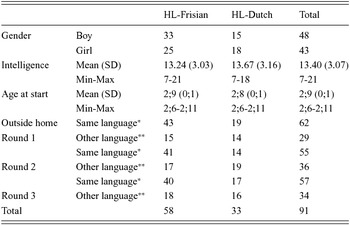
Table 1 displays the characteristics of the participants in the current study. The study comprised 91 participants, i.e., 48 boys and 43 girls. The majority, 58 participants, had Frisian as their home language. Consequently, 33 participants had Dutch as their home language.
The characteristics of the participants per home language group.

Two subtests of non-verbal intelligence test SON-R 2,5-7 (Tellegen et al., Reference Tellegen, Winkel, Wijnberg-Williams and Laros2005).
* Same language input inside and outside the home, e.g., when home language and outside home exposure is Frisian.
** Outside home exposure from the other language than the one used at home, e.g., when home language is Frisian and outside home exposure is Dutch.
Table 1 further shows that the two home language groups did not differ significantly on a test of non-verbal intelligence (t(89) = −.63, p > .05) and in mean age at the start of the project. Intelligence was measured using two subtests of a non-verbal intelligence test (see also the section on Test instruments).
The questions on the languages of both father and mother were repeated in every test round. However, eleven parents did not answer the parental language input question in the follow-up rounds. Even without their responses, the home language turned out to remain constant over time (round 1 x round 2: rho = .91, p < .01; round 2 x round 3: rho = .92, p < .01; round 1 x round 3: rho = .92, p < .01). For practical reasons it was therefore decided to fix the home language variable per child to the classification of round 1: 58 HL-Frisian participants and 33 HL-Dutch participants. In contrast to the questions concerning parental input at home, the parents were more inclined to respond to the questions on outside home exposure. The data shows there was variation in outside home exposure between the three test rounds. There is a significant moderate (round 1 x 2: rho = .71, p < .01; round 1 x 3: rho = .75, p < .01) to strong (round 2 x 3: rho = .91, p < .01) relation between the outside home exposure in the three test rounds. These outcomes suggest that the outside home exposure differed slightly between rounds 1 and 2 and over the entire research period, and it remained most constant between rounds 2 and 3.
The participating families lived in various rural areas of Friesland and had on average 2.23 children. All participants were recruited through preschools. For 42% of the participants this was a Frisian-medium or bilingual preschool. In a Frisian-medium preschool, the teachers use Frisian only with the preschoolers and in preschools with a bilingual language policy, one preschool teacher uses Frisian only and the other preschool teacher speaks Dutch only. The other 58% of the participants attended a preschool without an explicit language policy. Generally, teachers at these preschools use mostly Dutch. Only in individual contact with Frisian-speaking children do these teachers use Frisian if they are able to speak that language. Children in the Netherlands do not attend preschool five days per week. The questionnaires revealed that the participants in the current study attended preschool for one to three sessions per week. Before attending preschool, their language exposure mainly involved their home language, while the exposure to the other language was still limited in most cases. This was especially true for the HL-Dutch participants, since their parents were less inclined to read Frisian books to their children or let them watch Frisian children's programmes on television, for example. This is in contrast to the HL-Frisian participants whose parents tended to read to their children in both languages and exposed them to Dutch television as well.
Test instruments
The test battery consisted of Frisian and Dutch receptive and productive vocabulary tests. For the receptive vocabulary, the Dutch version of the American-English Peabody Picture Vocabulary Test was used (Dunn & Dunn, Reference Dunn and Dunn1997; Dutch version: Schlichting, Reference Schlichting2005). This Dutch vocabulary test uses a set of four pictorial stimuli, arranged in a 2x2 frame per page. The stimulus word matches one of the pictures. Because of the young age of the participants, only the first 108 items, divided over nine sets of twelve items each, were used for this study. According to the standard procedure, the vocabulary test was aborted when the participant made nine or more mistakes in a twelve-item set. The total score of the receptive vocabulary tests was the sum of all correct responses (maximum score = 108). The subtest Woordontwikkeling [Word Development] of the Dutch Schlichting Test voor Taalproductie II [Schlichting Test for Language Production II] (Schlichting & Lutje Spelberg, Reference Schlichting and Lutje Spelberg2010) was used to assess the participants’ productive vocabulary. This Dutch vocabulary test uses one picture per page and the participant has to complete a stimulus sentence, mostly by naming the picture. The vocabulary test consisted of 70 items ranging from easy to difficult and was aborted when the participant gave eight consecutive incorrect responses. The total score of the productive vocabulary tests consisted of the sum of all correct responses in the language tested (maximum score = 70). Correct responses in the language other than the language tested were not counted in the total score. As mentioned above, bilinguals’ vocabulary knowledge tends to be distributed across languages, i.e., they know some words in one language, but not in the other. This phenomenon was accounted for in the termination procedures of the Dutch productive vocabulary test. During the assessments, the productive vocabulary tests were stopped after eight successive responses that were incorrect in both Frisian and Dutch. This means that correct responses in the language other than the language tested did not play a role in the termination procedure.
Since there were no Frisian vocabulary tests available, both Dutch vocabulary tests were adapted to Frisian. First, the items of the Dutch receptive and productive vocabulary tests were translated into Frisian. Frisian (and Dutch) linguists advised on regional varieties in lexemes and pronunciations. For the receptive vocabulary test, the aural stimulus should preferably be equal in pronunciation in all dialects of Frisian. Furthermore, the items in both vocabulary tests should be words commonly used in Frisian (child) language (see also International Test Commission, 2010). Therefore, some items in the receptive vocabulary test were replaced by one of the distractors. None of the items of the productive vocabulary tests was replaced, since regional varieties were simply included in the correct responses. However, the second last item of the Dutch productive vocabulary test, i.e., blozen ‘to blush’, was deleted in the Frisian adaptation, since it has no one-word translation equivalent in Frisian. Consequently, the Frisian adaptation had 69 items. It is beyond the scope of the current paper to discuss the adaptation process in more depth. See Dijkstra (Reference Dijkstra2013) for a more detailed description of the adaptation process. A pilot study was conducted with the adapted Frisian receptive and productive vocabulary test. This pilot study involved 28 participants aged between 2;4 and 4;3 years (mean 3;4, SD 0;5). These participants did not take part in the vocabulary study described in the current paper. The pilot produced information on the test procedure and on item difficulty. Based on the results, one item in each vocabulary test was changed (see also Dijkstra, Reference Dijkstra2013). Both Frisian vocabulary tests are quite similar in internal consistency to the original Dutch vocabulary tests. The internal consistency of the Frisian receptive vocabulary test was high (λ-2 = .91), and equal to that of its Dutch equivalent (Schlichting, Reference Schlichting2005, p. 45). The reliability of the adapted Frisian productive vocabulary test is also high (λ-2 = .80). This result is slightly lower compared to its Dutch equivalent, where the internal consistency is λ-2 = .88 (Schlichting & Lutje Spelberg, Reference Schlichting and Lutje Spelberg2010, p. 28).
As well as vocabulary tests, all participants were assessed once during the research period in their intelligence with the non-verbal intelligence test SON-R 2,5-7 (Tellegen, Winkel, Wijnberg-Williams & Laros, Reference Tellegen, Winkel, Wijnberg-Williams and Laros2005). This non-verbal intelligence test was developed especially for young children within the age range 2.5–7 years. Another advantage of this test is that it is a non-verbal intelligence test. Consequently, the verbal instruction is kept to a minimum, which means that the test should elicit the same results between children of different language backgrounds. Given the short concentration span of the children and the limited test time, it was not possible to administer the whole non-verbal intelligence test to the participants. Only two of the six subtests were selected for the current study. Since the ability to reason is an important characteristic of intelligence (Genesee & Hamayan, Reference Genesee and Hamayan1980; Paradis, Reference Paradis2011), a subtest for abstract reasoning, Categorieën [Categories], and a subtest for concrete reasoning, Situaties [Situations], was used to get an impression of the participants’ intelligence. The reliability of both subtests is relatively high in the ages 2;6, 3;6 and 4;6 years, i.e., respectively .81, .73, .70 for Categorieën, and .79, .66 and .62 for Situaties (Tellegen et al., Reference Tellegen, Winkel, Wijnberg-Williams and Laros2005, p. 53). When assessed with the subtest Categorieën, the participants sorted cards into groups based on a pre-given category or similarity of features of the stimulus cards. In the subtest Situaties, the participants completed four drawings with complementary cards, or chose the correct card that showed the part that was missing on the stimulus picture. Both subtests have 15 items, and are discontinued when the participant makes three mistakes in total. The participants’ non-verbal intelligence score was based on the sum of the raw scores of the two subtests (maximum score = 30). The minimal verbal instruction used in both subtests was given in the home language of the participants, i.e., Frisian or Dutch.
Procedure
Receptive and productive vocabulary was assessed in three successive test rounds over 1.5 years. In each round this was tested in both languages with the same vocabulary tests. Each language was assessed by different test assistants and in separate sessions spaced at least two weeks apart. The language order switched during every round to avoid an order effect. In other words, during the baseline round, when the participants were aged between 2;6–3;0 years, they were tested in Frisian first and in Dutch later. In round 2 (aged between 3;0–3;6 years) they were tested in Dutch first and in Frisian later. Accordingly, in round 3 (aged between 3;6–4;0 years) they were tested in Frisian first and in Dutch later. Counterbalancing was not feasible considering the organizational and financial resources and time planning of the study. The lack of counterbalancing should therefore be kept in mind when interpreting the analyses. The assessments took place at their preschool outside the playgroup and during the morning sessions only. Six different test assistants conducted the assessments. These test assistants used the one person-one language approach (Döpke, Reference Döpke1992). Hence, the Frisian tasks were assessed by (near) native Frisian-speaking test assistants who spoke Frisian only, no matter what language the participant used. Likewise, the Dutch vocabulary tests were administered by test assistants who spoke Dutch only during the assessments.
Since children in this young age range are difficult to test, it was of great importance that the participants felt at ease during the assessments. Consequently, the participants’ trust was first gained by playing with the children and their friends in the playgroup before taking them individually outside the classroom for the assessments. The order of the tests was fixed to receptive vocabulary first, followed by the productive vocabulary test. The receptive vocabulary test only required the participants to point to pictures; consequently, it gave the participants more time to feel at ease. Next, when the participants got used to the situation, they were assessed with the productive vocabulary test where they had to give short verbal responses. Furthermore, it was essential to take the participants’ short attention span into consideration. When the participants showed signs of fatigue, the test assistants included a break by bringing them back to the playgroup and finishing the assessment later that morning. Non-verbal intelligence was individually tested and only once, in round 3. This assessment took also place in a morning session at preschool, however, on a separate occasion to the vocabulary assessments.
Analysis
Multilevel modelling was used to model the individual growth curves of the participants, since the data was not equidistant and nor were participants tested at exactly the same ages. The advantage of multilevel modelling is not only that it increases statistical power, but also that it accounts for missing data (Quené & Van den Bergh, Reference Quené and van den Bergh2008), i.e., if participants missed one vocabulary test, the data from the other two rounds could still be used for estimating the individual growth curves. This is important in the current study since the participants in the current study were very young and did not always cooperate during the assessments. In the analyses, raw scores were used instead of standardized scores because we wanted to examine trends in vocabulary growth in both languages. Moreover, there are no standardized scores available for Frisian. A multilevel model was built for each vocabulary test, i.e., four models in total. Each model treated the participants as Level 1 components and the three test rounds as Level 2 components (Snijders & Bosker, Reference Snijders and Bosker2011). The statistical program SPSS (IBM) was used for the multilevel analysis. The analysis started with an unconditional model (M0) without any variables. One by one, variables and interactions between variables were added to the model to see whether the fit of the new model improved significantly compared to the previous model. The final model (M1) shows the parameter estimates for the significant variables and interactions for the vocabulary test under investigation.
Results
In this section, first the results of the Frisian and Dutch receptive vocabulary tests will be presented, followed by the results of the Frisian and Dutch productive vocabulary tests. The results are presented per vocabulary test, starting with a table displaying the observed mean test scores for both home language groups, followed by the outcomes of the multilevel regression models.
The number of measurements differs per vocabulary test. These differences are caused by missing data points. The majority of these data is missing because the participants were absent at the time of the assessment or failed to cooperate. A minor part of the missing data is missing by design: a few outliers were discarded from the analyses because of substantial underachievement compared to performance in previous or follow-up round(s). This concerned two participants (one participant in round 2 and another participant in round 3) for Frisian receptive vocabulary, and one participant (in round 1) for Dutch receptive vocabulary. In the productive vocabulary, no outliers were found. The Dutch productive vocabulary test had one less participant compared to the other vocabulary tests. This participant refused to cooperate in all three rounds. Four participants were only tested twice since they were too old at the time of the first measurements. Their results were included in rounds 2 and 3 respectively.
Frisian receptive vocabulary
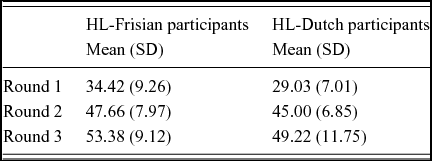
Table 2 displays the observed mean test scores of both home language groups concerning Frisian receptive vocabulary. As Table 2 shows, the HL-Frisian participants outperformed the HL-Dutch participants on this vocabulary test. However, the difference in performance between both home language groups stayed constant over time. Both home language groups showed an increase in Frisian receptive vocabulary over time.
Frisian receptive vocabulary: observed mean test scores (standard deviations) for HL-Frisian participants (max N = 58) and HL-Dutch participants (max N = 33) over the three measurement points (maximum score = 108).

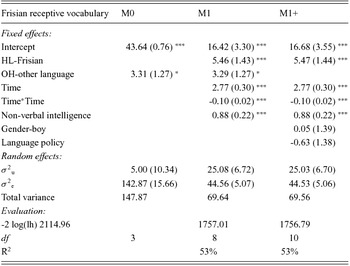
Table 3 gives the parameter estimates for two multilevel regression models: the unconditional model (M0) and the final multilevel regression model (M1). As Table 3 shows, this final model (M1) included the following variables: home language (HL), outside home exposure (OH), a linear and a quadratic time factor, and non-verbal intelligence. Both models were controlled for substantial variance in intercepts across participants, i.e., the intercepts across participants were treated as random effects.
Frisian receptive vocabulary: parameter estimates (standard errors). Nparticipants = 91; three rounds of measurements, Nmeasurements = 252.

* p < .05, **p < .01, ***p < .001.
Note: M0 = unconditional model; M1 = final model; M1+ = final model including variables gender and the use of a language policy at preschool; HL-Frisian = participants with Frisian as home language; OH-other language = outside home exposure to the language other than at home; σ2 u = within-centre variance estimate; σ2 e = between-centre variance estimate; −2 log(lh) = −2 log likelihood statistic; df = degrees of freedom; R2 = explained variance.
Home language was a significant factor. After controlling for the other factors, the HL-Frisian participants scored on average more than five points (this is 0.45 SD, i.e., almost half a standard deviation, see also Table 2) higher than the HL-Dutch group. In other words, the HL-Frisian participants knew on average five words more than their HL-Dutch peers on this vocabulary test. Participants who had a substantial outside home exposure to the other language had on average three correct responses (0.27 SD) more than the participants who had most of their exposure in the same language at home as in contacts with caregivers other than the parents.
The factor time, which represented the age in months of participants at each test moment of Frisian receptive vocabulary, was split up into a linear trend, i.e., time, and a quadratic trend, i.e., time*time. Both trends were significant factors. As explained by the parameter estimate for the linear trend time, for each month the participants gained on average almost three points (0.23 SD) on the Frisian receptive vocabulary test when controlled for all other variables. However, the quadratic trend is negative, which indicates that over time there was a (small) reduction in the Frisian receptive vocabulary score. The two trends combined reflected an initial increase in acquisition rate between rounds 1 and 2, followed by a decline in that rate between rounds 2 and 3. Further, no interaction effects were found. This means that the difference between the two home language groups stayed constant. As model M1+ shows, the inclusion of the variables gender and use of a language policy to the final model M1 did not significantly improve the fit of the final model. Moreover, the two variables were not significant factors in Frisian receptive vocabulary. The final model M1 explained 53% of the total variance.
Dutch receptive vocabulary
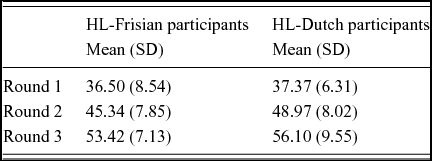
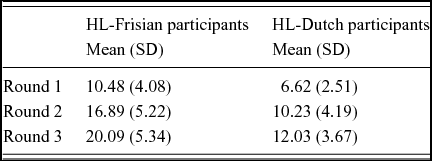
The observed mean test scores for both home language groups for Dutch receptive vocabulary are shown in Table 4. The vocabulary scores increased for both home language groups over time. As Table 4 shows, the HL-Dutch participants scored higher than the HL-Frisian participants on the Dutch receptive vocabulary test. The lag of the HL-Frisian participants was small, but constant.
Dutch receptive vocabulary: observed mean test scores (standard deviations) for HL-Frisian participants (max N = 58) and HL-Dutch participants (max N = 33) over the three measurement points (maximum score = 108).

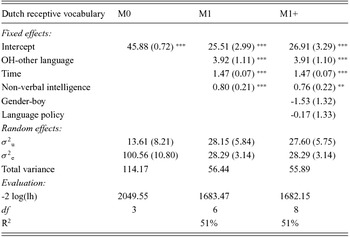
Table 5 gives the analysis for Dutch receptive vocabulary. The table displays the parameter estimates for two models. The first model, M0, is the unconditional model. In the final model, M1, the significant variables are outside home exposure (OH), time and non-verbal intelligence. Both models controlled for the substantial variance in intercepts across participants.
Dutch receptive vocabulary: parameter estimates (standard errors). Nparticipants = 91; three rounds of measurements, Nmeasurements = 253.

* p < .05, **p < .01, ***p < .001.
Note: M0 = unconditional model; M1 = final model; M1+ = final model including variables gender and the use of a language policy at preschool; OH-other language = outside home exposure to the language other than at home; σ2 u = within-centre variance estimate; σ2 e = between-centre variance estimate; −2 log(lh) = −2 log likelihood statistic; df = degrees of freedom; R2 = explained variance.
Home language was not a significant factor. Thus, for Dutch receptive vocabulary it did not seem to matter which of the two home languages the participants were exposed to. In contrast, the outside home exposure was significant. As model M1 in Table 5 shows, the participants who had a substantial outside home exposure to the other language knew on average almost four words (0.36 SD) more than the participants who were exposed to the same language inside and outside the home by caregivers, after controlling for the other variables.
The growth over time showed a linear trend only, since the quadratic trend of time (time*time) was not a significant factor. This means that growth appeared to be constant over time. There was no interaction effect, which suggests that the two home language groups acquired Dutch receptive vocabulary at a similar rate. Model M1+ shows that gender and the use of a language policy were not significant factors in Dutch receptive vocabulary. The final model M1 explained 51% of the variance.
Frisian productive vocabulary
Table 6 presents the observed mean test scores for Frisian productive vocabulary of the two home language groups. Both groups showed an increase in Frisian productive vocabulary over time. The HL-Frisian participants outperformed the HL-Dutch participants on this vocabulary test. Moreover, the gap between the two home language groups widened over time.
Frisian productive vocabulary: observed mean test scores (standard deviations) for HL-Frisian participants (max N = 58) and HL-Dutch participants (max N = 33) over the three measurement points (maximum score = 69).

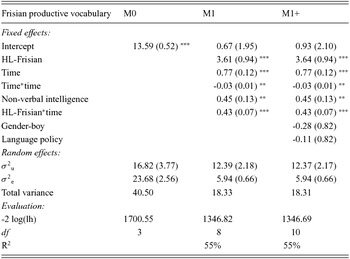
Table 7 presents the parameter estimates for all variables of Frisian productive vocabulary. The final model (M1) has the following significant variables: home language (HL), a linear and a quadratic factor of time, and non-verbal intelligence. An interaction effect of home language and time was also significant. Again, both models controlled for the substantial variance in intercepts across participants.
Frisian productive vocabulary: parameter estimates (standard errors). Nparticipants = 91; three rounds of measurements, Nmeasurements = 248.

* p < .05, **p < .01, ***p < .001.
Note: M0 = unconditional model; M1 = final model; M1+ = final model including variables gender and the use of a language policy at preschool; HL-Frisian = participants with Frisian as home language; σ2 u = within-centre variance estimate; σ2 e = between-centre variance estimate; −2 log(lh) = −2 log likelihood statistic; df = degrees of freedom; R2 = explained variance.
Home language was a significant factor, which means that the HL-Frisian children knew overall almost four words (0.56 SD) more than their HL-Dutch peers, after controlling for the other factors in model M1. Outside home exposure was not a significant factor.
Both the linear trend and the quadratic trend of time were significant. The linear trend of time indicated that for each month the participants gained 0.77 points (0.12 SD) on the Frisian productive vocabulary test, when controlled for the other variables. The quadratic trend is negative, suggesting that over time there was a (small) reduction in the growth rate of Frisian productive vocabulary, i.e., the acquisition rate slightly declined over time. Furthermore, an interaction effect of home language and time was found, i.e., with each month HL-Frisian participants had on average 0.43 items more correct on the Frisian productive vocabulary test than their HL-Dutch peers. In other words, the difference between HL-Frisian and HL-Dutch participants increased by half a point per month. The variables gender and the use of a language policy at preschool were not significant factors in Frisian productive vocabulary, as model M1+ shows. The final model M1 explained 55% of the total variance.
Dutch productive vocabulary
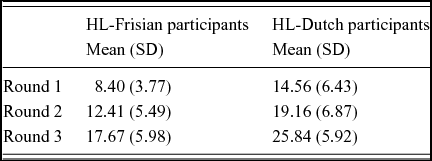
As the observed mean test scores for Dutch productive vocabulary show in Table 8, the HL-Dutch participants outperformed the HL-Frisian participants. However, the difference between the two home language groups seemed constant over time. Furthermore, we see that the Dutch productive vocabulary scores showed an increase for both home language groups over time.
Dutch productive vocabulary: observed mean test scores (standard deviations) for HL-Frisian participants (max N = 57) and HL-Dutch participants (max N = 33) over the three measurement points (maximum score = 70).

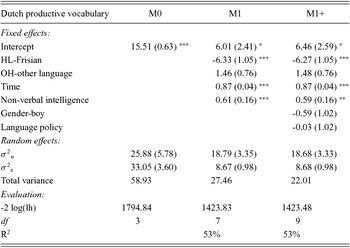
For Dutch productive vocabulary, the parameter estimates for the unconditional model (M0) and the final model (M1) are displayed in Table 9. The final model (M1) has three significant variables: home language (HL), time, and non-verbal intelligence. Both models controlled for the substantial variance in intercepts across participants.
Dutch productive vocabulary: parameter estimates (standard errors). Nparticipants = 90; three rounds of measurements, Nmeasurements = 250.

* p < .05, **p < .01, ***p < .001.
Note: M0 = unconditional model; M1 = final model; M1+ = final model including variables gender and the use of a language policy at preschool; HL-Frisian = participants with Frisian as home language; OH-other language = outside home exposure to the language other than at home; σ2 u = within-centre variance estimate; σ2 e = between-centre variance estimate; −2 log(lh) = −2 log likelihood statistic; df = degrees of freedom; R2 = explained variance.
As said, home language was significant. Overall, the HL-Frisian participants scored more than six points (0.82 SD) lower than their HL-Dutch peers, in other words, they knew six words less. Outside home exposure (OH) was not a significant factor, although its p-value (p = .06) was slightly higher than the cut-off point (p = .05). Adding the outside home exposure to the model substantially improved the fit of the model and this variable was therefore left in the model. The factor time had a linear trend only, which showed that with each month in time, the participants gained on average 0.87 points (0.11 SD), if all other variables were controlled for. Model M1+ shows that the variables gender and the use of a language policy at preschool were not significant factors in Dutch productive vocabulary. The final model M1 explained 53% of the total variance.
Discussion and conclusions
The research question addressed the influence of the language input on the early development of a bilingual vocabulary in Frisian and Dutch. In this study we looked at the relative input of home language and outside home exposure, i.e., the input of caregivers other than the parents. In three successive assessments between 2;6 and 4;0 years, 91 participants were tested in both languages. Results showed that an effect was found for home language on the Frisian receptive and productive vocabulary tests, and on the Dutch productive vocabulary test. These results confirm the outcomes in the Irish–English context where a home language effect was found for Irish receptive and productive vocabulary (Hickey, Reference Hickey1997). They are also consistent with the results from the Welsh–English context where a home language effect was found on the minority language, i.e., Welsh receptive vocabulary. Further, our results concerning the home language effect found on vocabulary development in the minority language are in line with other previous studies (Dixon et al., Reference Dixon, Zhao, Quiroz and Shin2012; Hammer et al., Reference Hammer, Davison, Lawrence and Miccio2009; Scheele et al., Reference Scheele, Leseman and Mayo2010). However, no home language effect was found for Dutch receptive vocabulary. This means that for Dutch receptive vocabulary, the HL-Frisian and the HL-Dutch participants did not show meaningful differences in performance. Gathercole and Thomas (Reference Gathercole and Thomas2009) still found a home language effect on English receptive vocabulary among four-year-olds, although this effect decreased over time. The absence of the home language effect for Dutch receptive vocabulary might be explained by the fact that Frisian and Dutch are closely related languages, while Welsh and English are less closely related. This might facilitate the acquisition of the other language, or second language.
As for outside home exposure, we found an effect for the receptive vocabulary tests in both languages. For the two productive vocabulary tests, the outside home exposure effect was absent. These results suggest that substantial exposure to the other language from caregivers other than the parents is crucial with respect to receptive vocabulary but not for productive vocabulary. This contradicts Hickey's study (Reference Hickey1997) who found an effect on Irish productive vocabulary and not on Irish receptive vocabulary for community language. However, her community language variable referred to the main language used by the community of the participant, which is a broader concept than the quantification of outside home exposure in the current study, i.e., input from caregivers other than the parents. Our results are also in contrast with Gathercole and Thomas’ study (Reference Gathercole and Thomas2009) who found an effect of school language for receptive vocabulary in the majority language, English, but not for Welsh receptive vocabulary. Their variable of school language was restricted to language input at school only, whereas our definition of outside home exposure was broader since it also covered input by caregivers other than preschool teachers. The different quantification of the input outside the home and family explains why our results are not in line with previous studies. Furthermore, the current study only looked at interactional adult input. Had the interactional input of peers and input from television and other media have been taken into consideration in the current study, the outcomes might have been different.
With regard to the growth in both languages, results showed a slightly faster growth between rounds 1 (age range 2;6–3;0 years) and 2 (age range 3;0–3;6 years) compared to rounds 2 and 3 (age range 3;6–4;0 years) for Frisian vocabulary. This seems logical: since the Frisian vocabulary tests were the first tests in round 1 with which the participants were assessed, this elicited a so-called ‘first time’ effect. At the time of round 1, the test situation was new to them and might have caused anxiety, which influenced their performance. The Frisian test results from round 1 should therefore be seen as an underestimation of the participants’ competence. In contrast, Dutch receptive and productive vocabulary both showed a linear growth. So, by the time the participants were assessed in Dutch, it seems that they were already used to the test situation and felt more at ease. To avoid such an underestimation in future research, it is important to counterbalance the order of the languages tested. In the current study this was not feasible because of limited resources and time. Furthermore, non-verbal intelligence was a significant confound in the development of both languages, which confirms previous studies (e.g., Genesee & Hamayan, Reference Genesee and Hamayan1980; Paradis, Reference Paradis2011). In general, a participant with a high non-verbal intelligence score also obtained high scores on the vocabulary tests. In other words, intelligence significantly influenced the vocabulary growth, and therefore the data were controlled for non-verbal intelligence.
The use of an explicit language policy at the preschool was not a significant factor, neither in Frisian receptive and productive vocabulary, nor in Dutch receptive and productive vocabulary. In other words, participants attending Frisian-medium or bilingual preschools did not perform significantly better than participants attending preschools without an explicit language policy. This might be explained by the low frequency of attendance. Nap-Kolhoff, van Schilt-Mol, Simons, Sontag, van Steensel and Vallen (Reference Nap-Kolhoff, van Schilt-Mol, Simons, Sontag, van Steensel and Vallen2008) have demonstrated that a language program used in Dutch preschools has an effect when children attend preschool for at least three but preferably four sessions per week. Overall, the participants went to preschool for two sessions per week (minimum one, maximum three), which is less than required to affect their language proficiency.
The outcomes listed above lead to the conclusion that the acquisition of the other language develops in a different way depending on whether children are learning the majority language as L2 or the minority language. The HL-Dutch participants showed hardly any progress in the development of the minority language, Frisian. This is particularly true for Frisian productive vocabulary and, to a lesser extent, for Dutch receptive vocabulary. Second, in contrast to the HL-Dutch participants, HL-Frisian participants were not hampered by their L1 in the development of the majority language, Dutch. This is especially true for Dutch receptive vocabulary. The statement was not true for Dutch productive vocabulary; however, Dutch productive vocabulary developed at an equal rate compared to Frisian. Following Gathercole and Thomas (Reference Gathercole and Thomas2009), we expect that in primary education, differences in development of Dutch between both home language groups will be neutralized again when all participants reach a certain ‘threshold’ in input in Dutch, which is the main language used in most primary schools in Friesland. In fact, this expectation has already been confirmed by previous research in primary education in Friesland which stated that in the fourth year of primary education (age: 7–8 years), children performed similarly in Dutch language compared to peers in the rest of the Netherlands, irrespective of home language (Van Ruijven, Reference van Ruijven2006).
Furthermore, the results of this study are consistent with findings from other studies, e.g., Ytsma (Reference Ytsma, Huls and Weltens1999) in Friesland and Gathercole and Thomas (Reference Gathercole and Thomas2009) in Wales. This might be explained by the amount of input the participants received in the language other than the one used at home. The HL-Frisian participants were much more exposed to Dutch, for example when read to, when watching television, or from interaction with caregivers, compared to the amount of exposure to Frisian which the HL-Dutch participants received. The study further showed that especially in productive vocabulary the L2-speakers scored significantly lower on the vocabulary tests than their peers who were native speakers. This applies for L2-Dutch, but even more so for L2-Frisian. HL-Dutch participants speak hardly any Frisian. This can be explained by the fact there is no necessity for HL-Dutch participants to speak Frisian, since all Frisian-speaking people are able to speak Dutch as well. In contrast, HL-Frisian participants might need to switch to Dutch, since Dutch-speaking people are not always able to speak Frisian. Children as young as preschoolers are already sensitive to these sociolinguistic factors. Paradis and Nicoladis (Reference Paradis and Nicoladis2007) showed for Canada that bilingual preschoolers with English as home language used mainly English when speaking to a French-speaking adult, while bilingual preschoolers with French as home language used French with a French-speaking adult and English with an English-speaking adult. Paradis and Nicoladis claimed that this might be explained by the fact that French-speaking people are always bilingual in Canada, while this is not always the case with English-speaking people. Since Paradis and Nicoladis’ study concerned a comparable language context with a minority language, in their case French, and a majority language, i.e., English, their explanation might also be applied to the Frisian–Dutch context as a reason why preschoolers in Friesland do not always speak Frisian. An additional factor in explaining why the acquisition of Dutch is more successful in both home language groups might be the higher status of Dutch. Dutch is omnipresent in almost all domains. This might, unconsciously, make children prefer to speak Dutch rather than Frisian, which has a lesser presence compared to Dutch. A previous study of Ytsma (Reference Ytsma1995) among children in primary education indicated that the L1-Frisian children in primary education performed well, while their L1-Dutch peers showed huge differences in their Frisian vocabulary. In line with Ytsma's study, we expect that in future the HL-Dutch participants will continue to show substantial differences with respect to Frisian vocabulary.
The outcomes of our study are relevant, since even nowadays there are Frisian-speaking parents who prefer to speak Dutch to their children because they are concerned that their child will otherwise lag behind in Dutch from the start onwards and will never catch up. This research showed that Frisian-speaking children acquire Dutch without any problems. When they enter primary education they do show a lag in Dutch productive vocabulary. However, it is expected that this lag will soon diminish over time. This information is beneficial to educationalists and policy makers working in the Frisian–Dutch context, e.g., while establishing a (pre)school language policy and/or in the future development of (pre)school curricula or language programmes. Furthermore, language professionals such as speech and language therapists can use these outcomes in interpreting evaluations and assessments, and advise (future) parents thoroughly on bilingualism in the Frisian–Dutch context.