Glutamine (Gln), a di-amino-monocarboxylic amino acid widely present in human tissues, is necessary for the synthesis of glutathione, the main endogenous antioxidant molecule. It is required by high turnover cells in particular, and, therefore, is important for maintaining the integrity of the enteric barrier (Reference Wessner, Strasser, Spittler and Roth22). Gln is also involved in the modulation of the inflammatory response, by means of its inhibiting action on nuclear factor κB, in the synthesis of heat shock proteins, and in the release of incretins. Despite its abundance in healthy subjects—it accounts for approximately 60 percent of the total circulating amino acid pool—Gln can become “conditionally essential” in clinical conditions where requirements exceed endogenous (mainly muscular) synthesizing capacity (e.g., burns, pancreatic necrosis). These conditions, characterized by hypercatabolism and glutathione depletion, define the scope for exogenous Gln supplementation (Reference Oudemans-van Straaten, Bosman, Treskes, van der Spoel and Zandstra16). Nevertheless, Gln has not been added to parenteral nutrition solutions for a long time, for two main reasons: it was widely perceived as non-essential and has low solubility and stability in aqueous solutions. The latter issue has been resolved by conjugating glutathione with alanine to produce the dipeptide alanyl-glutamine (Ala-Gln), which is stable in solution but undergoes hydrolysis in vivo, catalyzed by a circulating peptidase.
Addition of Ala-Gln to total parenteral nutrition (TPN) solutions has been shown to improve clinical outcomes in critically ill patients, the most important benefits being reduced mortality and infection rate in the intensive care unit (ICU), and a shortened ICU and/or total hospital length of stay (LOS) (Reference Cai, Yan, Zhang and Yu2;Reference Dechelotte, Hasselmann and Cynober5–Reference Griffiths, Jones and Palmer11;Reference Luo, Bazargan and Griffith13;Reference Pérez-Bárcena, Regueiro and Marsé17;Reference Powell-Tuck, Jamieson and Bettany18;Reference Sahin, Mercanligil, Inanç and Ok20;Reference Wischmeyer, Lynch and Liedel23–Reference Zhou, Jiang, Sun, He and Shu25). As is common in developed countries, in Italy a substantial proportion of hospital budgets is dedicated to ICU costs, reflecting the technological and personnel resources required (1;Reference Dechelotte, Hasselmann and Cynober5;Reference Orsi, Stefano and Noah15).
We conducted a simulation study to determine whether parenteral Ala-Gln supplementation in critically ill Italian ICU patients has the potential to partially or totally offset its own costs by reducing consumption of other medical resources.
METHODS
The evaluation is based on a discrete-event simulation (DES) pharmacoeconomic model [] that incorporates: (i) baseline outcome rates from the critically ill patient population in Italy, (ii) efficacy data comparing Ala-Gln + standard TPN regimens to TPN alone from a Bayesian meta-analysis of clinical trials, and (iii) national cost data.
Model Structure
The model was designed as a DES with the TreeAge Pro 2009 (TreeAge Software Inc., Williamstown, MA) software package. In a discrete event simulation, the experience of individuals is modeled over time in terms of the events that occur and the consequences of those events. This approach is often preferable to the typical Markov one, which tries to categorize the clinical course into a series of states through which a cohort is successively distributed after transitions that occur after a discrete time range.
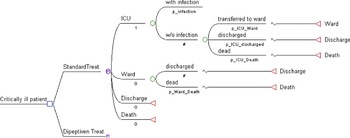
In the present model, the comparison is made between the decision to assign the critically ill patient to standard TPN or to TPN + Ala-Gln. The simulation steps are qualitatively common to both treatment arms, which however differ with regard to the probabilities of the various events considered. In the simulation, every patient starts in ICU, where he/she may, or may not, develop a new nosocomial infection. In either case, the patient admitted to the ICU faces three alternative possibilities: death in the ICU, or recovery and transfer to a general ward, or recovery and discharge home. For those transferred to a general ward, there are two possibilities: recovery and discharge, or death (Figure 1). Consistent with the DES technique, the time is not discretized in cycles, but is handled as a time-to-event.
Simplified model structure.

Probability and Outcomes Distributions: Standard Treatment
Main clinical outcomes monitored during the simulation are: death rate in the ICU, infection rate in the ICU, death rate in the ward, and hospital LOS, which is divided into LOS pre-ICU, LOS in the ICU, and LOS in the ward (post-ICU).
The data source used for estimating the probability distributions of these outcomes is the 2007 edition of the “Progetto Margherita” report, an annual publication on behalf of the Gruppo Italiano per la Valutazione degli Interventi in Terapia Intensiva (GIVITI), that includes data collected in 200 Italian ICUs, from a total of over 60,000 patients (19). The GIVITI is a network of ICUs, coordinated at the Mario Negri Institute of Pharmacology in Milan, which performs a constant monitoring of the activities and outcomes of participating ICUs. These represent over one-third of all ICUs operating on the national ground, both in absolute figures and in number of patients served, and are distributed on the whole territory, reflecting the characteristics of the Italian hospitals in which an ICU is present—from medium to large in scale, university-owned, and not. Data are collected at the patient level by means of a standardized computer software which is freely distributed to all participating centers. The data that were used for the present study derive from the annual report on 2007 results, and are reported for subgroups of patients, with the main distinction being between those patients admitted to the ICU for monitoring and those admitted to the ICU for Intensive Care therapies (n = 20,013 patients). This latter group is the one relevant to our analysis and includes the more severely ill patient population, thus more accurately reflecting the type of patients studied in the trials we relied on to estimate the effectiveness of Ala-Gln. The outcomes after ICU admission for this population are: (a) death in ICU (24.2 percent); (b) transfer to a general ward (74.3 percent); and (c) discharge from the ICU directly at home (1.5 percent). Among those patients transferred to ward after ICU discharge, mortality is 14 percent (Supplementary Figure 1, which can be viewed online at www.journals.cambridge.org/thc2012003). In this patient population, the risk of new infections acquired in the ICU is 18.8 percent (19), and this is the probability we used for the base-case simulation.
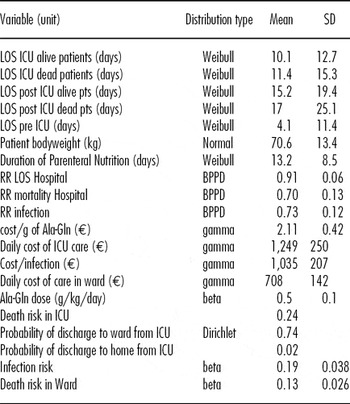
The Progetto Margherita reports detailed information regarding hospital and ICU LOS, with data given for the overall population and for subgroups of ICU/hospital outcomes. To mathematically represent these distributions in the model, a Weibull distribution is fitted to each set of data (Table 1). The times-to-events applied to the simulated patients are drawn from these fitted distributions.
Parameters and Distributions Used for the Simulation
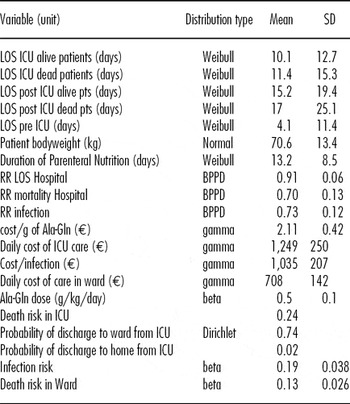
Ala-Gln, alanyl-glutamine dipeptide; BBPD, Bayesian Posterior Probability Distribution (meta-analysis result); ICU, intensive care unit; LOS, length of stay; RR, relative risk.
Efficacy of Ala-Gln: Data Sources
In 2002, Novak et al. published a meta-analysis of available trials evaluating parenteral Ala-Gln supplementation in the critically ill, which indicated that this strategy significantly reduces mortality, infectious complications and ICU LOS (Reference Novak, Heyland, Avenell, Drover and Su14). To identify more recent relevant data, in January 2009 we performed a systematic literature search on EMBASE and Medline databases for clinical trials in critically ill patients with high catabolism/high oxidative stress illnesses (severe burns, pancreatic necrosis, surgical complications) in which parenteral Ala-Gln was compared with TPN regimens without Ala-Gln. Outcomes data were extracted by two independent reviewers; disagreements were discussed until consensus was reached. Considered outcomes were hospital mortality, ICU-incident infection rate (in terms of infected subjects, rather than infective episodes), and hospital LOS.
For each outcome, a Bayesian random effects model was specified in WinBUGS (Reference Novak, Heyland, Avenell, Drover and Su14). Mortality and infection rate reported by every individual trial were modeled as binary outcomes, while LOS was assumed to follow Weibull distributions. For each trial, the outcome in the test group was modeled as the outcome of the control group abated by the trial-specific treatment effect, which the model assumes to be drawn from a distribution common to all trials. Non-informative priors for the mean relative effect (normal distribution with mean 1 and standard deviation 1,000) and its standard error (uniform between 0 and 10) are used. For the simulation model, the full posterior probability distributions of 20,000 post-convergence values are sampled.
Costs
The model includes the cost of Ala-Gln supplementation, ICU and general ward stays, and new infections acquired in the ICU.
The cost of Ala-Gln was calculated for every simulated patient on the basis of his/her body weight and duration of TPN, assuming a dose of 0.5 g/kg/day of TPN and a price of 2.107 €/g (maximum price to Italian hospitals) (12). Bodyweight and TPN duration are drawn for each simulated patient from distributions bootstrapped from the values reported in the trials.
For calculation of parenteral nutrition costs, constraints were applied to TPN duration: all patients in the treatment arm receive at least one full day of TPN; the duration of TPN cannot exceed hospital LOS (pre-ICU LOS excluded) for patients who die, or 2 days less than the hospital LOS (again, pre-ICU LOS excluded) for survivors, on the basis of the assumption that the discharge from the hospital would occur after at least 2 days of stabilization.
To estimate the average daily cost to the hospital of Italian ICUs, we relied on the results of an empirical study published in 2001 by Cavallo et al., who reported a cost of 1,082,000 Italian Lire (1995 value) (Reference Cavallo, Lazzaro and Tabacchi4). This includes variable costs (disposable materials, drugs, blood and hemoderivatives, diagnostics, physiotherapy), fixed ICU ward costs (staff, equipment), and ancillary costs (electricity, water, heating, laundry, etc.). This was actualized to 2008 costs using the index published by ISTAT (Italian Statistical Institute), and resulted in total daily costs of 1,289 €.
The cost for an average day in an Italian hospital ward is taken from the report of the ASSR (National Agency for Regional Health Services) and actualized to a 2008 value of 707.64 € (1).
The literature consistently indicates that infections acquired in the ICU significantly increase overall hospital costs, with pneumonia being the most costly infection, followed by sepsis and urinary tract infections. However, the majority of this cost increase is determined by the increase in hospital LOS. Because the effect of Ala-Gln on the infection rate is already modeled in terms of the reduction of the average LOS (and mortality), we chose not to include an extra effect on the LOS resulting from the reduced infection rate. Thus, we limited the cost of any new infection to costs for extra anti-infective treatments needed. We used the average cost reported by Orsi et al. (Reference Orsi, Stefano and Noah15) for the treatment of ICU-emergent bloodstream infections, actualized to a 2008 value of 1,034.68 €.
Simulation and sensitivity analysis: A two-level Monte Carlo simulation is adopted to take into account the variability in the population (patient-level simulation) as well as the uncertainty on key model parameters (PSA-probabilistic sensitivity analysis). In the inner simulation loop, each iteration represents a unique patient, whose data are run through both arms of the model (standard TPN and TPN + Ala-Gln). The parameters of each patient are drawn from a distribution representing the inter-individual variability in the simulated population.
The patient-level simulation (10,000 iterations) is then averaged and repeated 1,000 times (outer loop), each with a unique set of key model parameters randomly drawn from distributions representing the range of plausible values. In the absence of reliable data regarding the uncertainty surrounding these parameters, we set a standard deviation of 20 percent of mean values, and attributed appropriate distributions according to the type of data (i.e., gamma distributions for costs and beta distributions for probabilities). For conjugate probabilities (i.e., probability of transfer from ICU to ward, discharge and death) we use a Dirichlet distribution. The parameters and their distributions are presented in Table 1.
Robustness of the results was further tested by a series of one-way sensitivity analyses, which tested the sensitivity of the incremental cost effectiveness ratio (ICER) estimate to extreme variations of base-case estimates. Tested ranges spanned between the 2.5th and 97.5th percentiles of the distributions used in the outer loop of the simulation.
Scenario analyses were conducted on patient-level simulation variables and on the probabilities derived from the GIVITI data (19), by shifting distributions to the left and right by 20 percent of the mean value.
RESULTS
Internal Model Validation
To verify the validity of the approach used to reproduce patient outcomes on the basis of reported Progetto Margherita data (19), we run a separate Monte Carlo simulation over 10,000 iterations to calculate the statistics of the overall hospital LOS in the standard treatment arm, and compare it with the overall data reported. The results confirm the internal validity of the model: mean (SD) observed LOS was 26.2 (26.9) days, while simulated LOS was 26.2 (27.2) days (Supplementary Table 1 [www.journals.cambridge.org/thc2012003]).
Literature Search and Meta-analysis
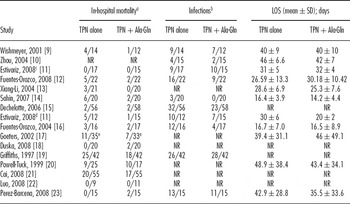
The original search identified seventy-seven potentially relevant citations in Medline and sixty-two in EMBASE. After discarding trials using enterally administered Ala-Gln, not evaluating clinical outcomes or conducted on patients who were not critically ill, as well as reviews and non-human studies, fifteen clinical studies were judged to be relevant. Main outcomes of these are summarized in Table 2.
Studies on Parenteral Ala-Gln Supplementation in Critically Ill Patients: Main Outcomes

Note. Deaths before hospital discharge/total enrolled patients.
b Patients with ICU-emergent infection(s)/total enrolled patients.
c Pancreatic necrosis patients.
d Surgical patients.
e The 30-day mortality data were considered, since no in-hospital mortality data were reported.
NR, not reported.
The results of the meta-analysis (Table 1, marked as BPPD) indicate a highly credible beneficial effect of Ala-Gln on mortality, infection susceptibility, and hospital LOS in critically ill ICU patients (upper 95 percent credible interval limit ≤ 1 for all parameters).
Outcomes of the Simulation
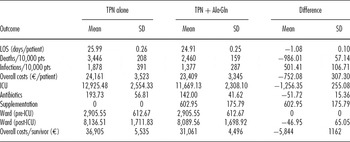
Table 3 shows that on average, Ala-Gln supplementation would prevent more than one-quarter of deaths and infections (mortality rate 24.6 percent ± 1.6 percent versus 34.5 percent ± 2.1 percent; infection rate 13.8 percent ± 2.9 percent versus 18.8 percent ± 3.9 percent), and reduce overall mean LOS by 1.1 day, compared with standard TPN.
Costs, Effectiveness, and Cost-Effectiveness Results for Ala-Gln + TPN Versus TPN Alone in Critically Ill ICU Patients Based on Model Simulation

LOS, length of stay.
Ala-Gln supplementation is also expected to reduce overall costs versus standard TPN alone, with a mean net cost saving of €752 per patient (Table 3).This indicates that treatment costs of Ala-Gln are more than offset by the reduction in ICU costs, and also by reductions in antibiotic costs for the treatment of ICU-emergent infections. Consequently, Ala-Gln is expected to be more cost-effective than standard TPN alone, as it is associated with a lower mean cost per patient discharged alive. Indeed, it is expected to on average dominate standard TPN alone, being associated with better clinical and economic outcomes.
In all 1,000 simulations Ala-Gln was clinically superior to standard TPN alone (i.e., more deaths avoided). The incremental cost per patient is very rarely positive, with Ala-Gln being less costly in over 99 percent of simulations (Supplementary Figures 2 and 3 [www.journals.cambridge.org/thc2012003]).
Sensitivity Analyses
The most influential cost parameters were the average daily cost of the ICU, and the cost of Ala-Gln and the dose administered, while among clinical parameters the mortality rate and the corresponding average survival time in ICU were the most relevant. None of the tested variations led to Ala-Gln losing its dominance over standard TPN.
DISCUSSION
Meta-analyses are one of the most powerful statistical tools used to obtain increased power and precision in evaluating treatment effects based on data derived from individual studies, and have become one of the mainstays of evidence-based medicine. The great majority of meta-analyses published to date are based on a classical (sometimes also called frequentist) approach, which may have difficulty in treating binomial data from small studies, if the event of interest did not occur in one of the two groups. Furthermore, assumptions are required regarding the shape of the distributions of estimated parameters. However, these are not relevant issues in a Bayesian setting (21). Another major advantage of the Bayesian paradigm is that it allows one to directly derive the probability of one treatment being superior to another, whereas classical approaches require a more refined interpretation, which is not always clear to the reader.
In conducting a meta-analysis, the Bayesian approach can be interpreted as the revision of the current opinion on some uncertain parameter in the light of its likelihood in observed data (Reference Spiegelhalter, Abrams and Myles21). The stronger the prior opinion, the less the influence of the likelihood: however, strong likelihood data will eventually overcome the prior opinion, even if rather skeptical. A neutral, or absent, prior opinion, expressed in this study by using a non-informative prior distribution on the relative risk (centered around 1, or 0 on the logarithmic scale, i.e., no difference among treatments), should yield results that are very close to those obtained by a classical approach. We have the opportunity to confirm this relative to the data used for the present analysis since the recent on-line publication of a classic meta-analysis conducted by the Canadian Critical Care Practice Guidelines Committee, which led to a strong recommendation to add Ala-Gln to parenteral nutrition regimens for critically ill patients (3).
As the Canadian group's study selection criteria specified critically ill patients, they included the same trials that we did in our meta-analysis. The reductions in mortality and infection risk with Ala-Gln supplementation are very similar to our own (approximately 30 percent risk reduction for both), although their confidence intervals are narrower than our credible intervals. (Supplementary Table 2 [www.journals.cambridge.org/thc2012003])
It should be noted that classic confidence intervals and Bayesian credible intervals have significantly different interpretations: confidence intervals indicate the range in which the mean would fall if the analysis was repeated over and over again, while credible intervals have the much more intuitive interpretation of indicating the range of values that are plausible (Reference Spiegelhalter, Abrams and Myles21).
The results of our analysis and the recent Canadian meta-analysis, therefore, indicate that there is scope for a strong belief in a beneficial effect of Ala-Gln supplementation on mortality, infection susceptibility, and hospital LOS in critically ill ICU patients.
One possible hurdle to the systematic adoption of Ala-Gln supplementation in the target population is the additional acquisition costs: our simulation predicts an average additional cost of approximately 500 € per hospitalized patient. This cost is not negligible, especially as it is not possible at present to predict which patients will benefit from supplementation. However, there appears to be no relevant risk of harm from systematically adding Ala-Gln to TPN solutions. Such a strategy will clearly increase the budget dedicated to TPN, but this cost represents only a small percentage of the total costs and is more than offset by the savings accruing from the lower infection rate and shorter mean LOS. A shortened LOS suggests that the high technology and personnel resources invested by hospitals in ICUs can be used more efficiently, that is, more patients can be treated over the same timeframe.
The stability of our model results suggests that these findings may to a certain extent also be applicable to other healthcare settings, as long as there are not major and concurrent differences in the critically ill population, and in organization and costs of the ICU, or more generally in tertiary care. We believe that in most European countries, the addition of Ala-Gln to standard TPN will be very cost-effective, if not dominant, as is shown by our model for Italy.
CONCLUSIONS
In conclusion, our results indicate that addition of Ala-Gln to standard TPN in critically ill patients has the potential to significantly improve patient outcomes, while also leading to reduced ICU costs, in Italian hospitals.
SUPPLEMENTARY MATERIAL
Supplementary Figure 1
Supplementary Figure 2
Supplementary Figure 3
Supplementary Table 1
Supplementary Table 2 www.journals.cambridge.org/thc2012003
CONFLICT OF INTEREST
Lorenzo Pradelli, Sergio Iannazzo, Orietta Zaniolo, and Mario Eandi have received grants, consulting fees, and honoraria to their institute from Fresenius Kabi Italia Srl. Maurizio Muscaritoli reports having no potential conflicts of interest.
CONTACT INFORMATION
Lorenzo Pradelli, MD, Sergio Iannazzo, EngD, MBA, Orietta Zaniolo, PharmD, Adres Health Economics, Torino Italy
Maurizio Muscaritoli, MD, PhD, Università di Roma, Dipartimento Medicina Clinica–Sapienza, Roma, Italy
Mario Eandi, MD, PhD, Università di Torino, Anatomia, Farmacologia e Medicina Legale, Torino, Italy