Introduction
Although venericard bivalves are extremely abundant and diverse on the U.S. Coastal Plain throughout the Paleogene, the systematics of the lineage have not been studied in decades and a clear understanding of the phylogenetic relationships among venericard species is lacking. Venericards are so prevalent on the U.S. Coastal Plain that Conrad (Reference Conrad1855) described the genus as the “finger-post of the Eocene” and members of Venericardia have been used as guide fossils for determining the age of Paleogene sediments (Heaslip, Reference Heaslip1968). U.S. Coastal Plain venericards are often well preserved and occasionally specimens are found in life-position (Ivany et al., Reference Ivany, Wilkinson, Lohmann, Johnson, Mcelroy and Cohen2004). However, despite the high abundance, diversity, and exceptional preservation of Venericardia, the evolutionary relationships among major species have never been reconstructed.
Lamarck first described the genus Venericardia based on specimens collected in the Paris Basin in 1801 (Lamarck, Reference Lamarck1801). Over the next century, morphologically diverse specimens were discovered on the U.S. Coastal Plain, but were generally classified according to sharp-ribbed or smooth-ribbed external ornamentation as either Venericardia alticosta or Venericardia planicosta, respectively (Heaslip, Reference Heaslip1968). In 1930, Stewart proposed two subgenera: Venericor, which included all planicostate venericards on the U.S. Coastal Plain, and Glyptoactis, which originally included most alticostates (Stewart, Reference Stewart1930). Currently, almost all U.S. Coastal Plain planicostate venericards are still considered members of Venericor, although the taxon’s status as a monophyletic group has been contested (Heaslip, Reference Heaslip1968). Gardner and Bowles (Reference Gardner and Bowles1939) maintained that Venericor constitutes a monophyletic group, whereas Heaslip (Reference Heaslip1968) argued that Venericor is the polyphyletic product of convergent evolution.
The alticostate species were later subdivided into several additional subgenera, including Baluchicardia Rutsch and Schenck 1941 (in Rutsch, Reference Rutsch1943), Claibornicardia Stenzel and Krause 1957 (in Stenzel et al., Reference Stenzel, Krause and Twining1957), and Rotundicardia Heaslip Reference Heaslip1968. The species included in each proposed clade and the clades’ taxonomic levels have been revised repeatedly throughout the past 50 years and remain controversial today (Palmer and Brann, Reference Palmer and Brann1965; Heaslip, Reference Heaslip1968; Chavan, Reference Chavan1969; Vokes, Reference Vokes1980; Moore, Reference Moore1992; Ward Reference Ward1992; Sepkoski, Reference Sepkoski2002). Currently, Glyptoactis and Venericardia are considered genera belonging to the subfamily Venericardinae Chavan Reference Chavan1969 (Moore, Reference Moore1992; Ward, Reference Ward1992), Claibornicardia and Rotundicardia are subgenera belonging to Glyptoactis (Moore, Reference Moore1992) and Venericardia (Woodring, Reference Woodring1982), respectively, and Baluchicardia is a genus in a separate subfamily, Carditesinae Chavan Reference Chavan1969 (Vokes, Reference Vokes1980). Due to the uncertainty surrounding venericard taxonomy, Claibornicardia, Glyptoactis, Rotundicardia, and Venericor will all be considered original subtaxa within Venericardia for the purposes of this study.
Venericardia were infaunal suspension feeders that lived buried just beneath the sediment-water interface (Heaslip, Reference Heaslip1968). Venericards have sturdy, aragonitic shells that display diverse external ornamentation, including variation in node size and rib shape (Gardner and Bowles, Reference Gardner and Bowles1939; Heaslip, Reference Heaslip1968; Chavan, Reference Chavan1969). Approximately 60 species occurred on the U.S. Coastal Plain during the Paleogene, with the highest diversity during the Eocene (Gardner and Bowles, Reference Gardner and Bowles1939; Heaslip, Reference Heaslip1968). Alticostate venericards appear in the region throughout the Paleogene and into the Neogene (Heaslip, Reference Heaslip1968), whereas planicostate venericards are restricted to the Paleocene and Eocene (Gardner and Bowles, Reference Gardner and Bowles1939). The genus is now extinct and its closest living relatives are believed to belong to Cyclocardia Conrad Reference Conrad1867 (Heaslip, Reference Heaslip1968).
The objective of this study is to reconstruct the evolutionary relationships among selected U. S. Coastal Plain venericard species. The resulting phylogeny will allow the identification of major clades and the exploration of the validity of historical and current venericard classification. Specifically, it will be determined whether external ornamentation types (alticostate and planicostate) and originally proposed subtaxa (Claibornicardia, Glyptoactis, Rotundicardia, and Venericor) represent monophyletic groups within Venericardia.
Methods
Species and specimen selection
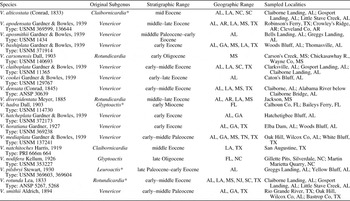
Eighteen ingroup species of venericards (Table 1) were selected for examination, representing approximately 30% of venericard species on the U.S. Coastal Plain during the Paleogene. The ingroup consisted of representatives from four major originally proposed subtaxa: Claibornicardia, Glyptoactis, Rotundicardia, and Venericor (Table 1). Two to 11 species were selected from each original subtaxon, including the type species (if found on the U.S. Coastal Plain) and additional abundant or well-preserved species. The selected species included representatives from across the Paleogene, with the greatest number occurring during the Eocene due to the clade’s high Eocene diversity (Table 1).
Species names, original subgenus placement, stratigraphic range, geographic range, and sampled localities for Venericardia species examined, compiled from over 900 published occurrences.

Stratigraphic range determined from first and last occurrences using Gradstein 2004 time scale (Gradstein et al., Reference Gradstein, Ogg and Smith2004). Type specimens examined are listed, with their repository and museum number information in Species column.
* Type species of subgenera.
Two species closely related to venericards were included as outgroups to polarize characters: Baluchicardia bulla (Dall, Reference Dall1903) and Baluchicardia wilcoxensis (Dall, Reference Dall1903). Both outgroup species have sharp-ribbed external ornamentation and were classified as venericards in the past, but are now considered members of the sister subfamily, Carditesinae Chavan Reference Chavan1969.
When possible, the type specimen of the species and specimens from one to three localities ( $$\bar{x}$$
=2 localities per species) were examined (Table 1). Two to three specimens per locality were examined to sample morphological variation within the species (
 $$\bar{x}$$
=6 specimens per species) and the largest available specimens were selected to ensure only adults were studied. Specimens were obtained from the National Museum of Natural History (Washington, D.C.), the Academy of Natural Sciences in Philadelphia (Philadelphia, PA), the Paleontological Research Institution (Ithaca, NY), the Mississippi Department of Environmental Quality (Jackson, MS), the Virginia Museum of Natural Science (Martinsville, VA), the Geological Survey of Alabama (Tuscaloosa, AL), the University of Texas at Austin (Austin, TX), the Florida Museum of Natural History (Gainesville, FL), and field collection in Mississippi and Alabama.
Phylogenetic methods
Fifty-one characters (Appendix) were used to describe the main differences in conchological morphology among the selected species. Characters included aspects of shell shape, size, external ornament, hinge teeth, adductor muscle scars, and pallial line. Characters were primarily based on qualitative observations of venericard specimens and were differentiated into states that were identifiable by eye, but not easily measured. Quantitative characters based on continuous measurements (characters 1, 12–16) were categorized into character states based on clearly discrete differences, such that gap weighting (Thiele, Reference Thiele1993), analysis of variance and multiple range tests (Guerrero et al., Reference Guerrero, De Luna and Sánchez‐Hernández2003), and finite mixture coding (Strait et al., Reference Strait, Moniz and Strait1996) were not necessary. All character states were unordered.
Analyses were completed using PAUP* 4.0b10 (Swofford, Reference Swofford2002) and validated using TNT v1.1 (Goloboff et al., Reference Goloboff, Farris and Nixon2008; implicit enumeration). All characters were equally weighted and outgroup species were identified for analyses. The most parsimonious trees were determined through a heuristic search using a stepwise random addition sequence (N=1,000) and TBR branch swapping. The search included 1,000 replicates, each started from a randomly determined point, to avoid the misinterpretation of local peaks in tree-space as most parsimonious trees. Increasing the number of replicates to 10,000 did not alter the results.
Robustness was assessed through Bremer support analysis (Bremer, Reference Bremer1994). A Bremer support value is the number of steps beyond the most parsimonious tree that are required to produce a tree without the node. To calculate the values, a heuristic search was performed retaining all trees one step longer than the most parsimonious trees and used to compute a strict consensus tree. The resulting strict consensus tree was compared with the strict consensus of the most parsimonious trees and a Bremer support value of one was assigned to all newly collapsed branches. The process of adding steps and identifying collapsed branches was repeated until all resolution was lost in the strict consensus tree. Bootstrap values (with 1,000 replicates) were also calculated to assess robustness of tree topology. “Fast” bootstrapping approaches (Debry and Olmstead, Reference Debry and Olmstead2000) up to 10,000 replicates produced negligible changes in clade support.
Of the 51 total characters analyzed, 24 characters (characters 23–46) are based on external ornamentation. To verify that the resulting phylogeny was not a product of almost half the characters describing external ornamentation, the data were analyzed with the external ornamentation characters down-weighted relative to the other 27 characters. Heuristic searches (following the specifications described above) were repeated with the external ornamentation characters down-weighted (10%, 25%, and 50%) and excluded completely.
Results
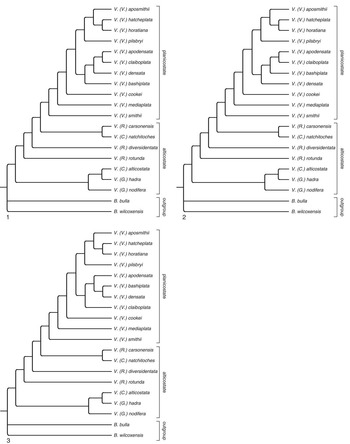
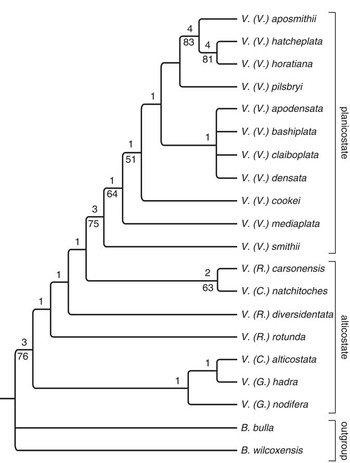
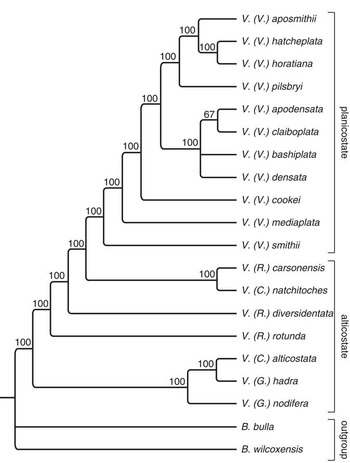
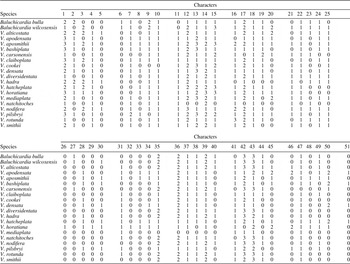
A heuristic search of the data matrix (Table 2) produced three most parsimonious trees (Fig. 1) with tree length 153, a consistency index of 0.503, a rescaled consistency index of 0.316, and a retention index of 0.627. The most parsimonious trees are summarized in a strict consensus (Fig. 2) and a 50% majority rule tree (Fig. 3). When Bremer support values were calculated, 98 trees one step longer than the most parsimonious tree were produced, 1,173 trees two steps longer were produced, 8,254 trees three steps longer were produced, and 39,943 trees four steps longer were produced.
Three most parsimonious trees produced by heuristic analysis of the 51-character matrix. All three trees are identical, except for the arrangement of four planicostate species, Venericardia apodensata, V. bashiplata, V. claiboplata, and V. densata. (1) V. apodensata and V. claiboplata are sister species with a closer evolutionary relationship to V. densata than V. bashiplata. (2) V. apodensata and V. claiboplata are sister species, with a closer relationship to V. bashiplata than V. densata. (3) V. bashiplata and V. densata are sister species with a closer relationship to V. apodensata than V. claiboplata.

Strict consensus of the three most parsimonious trees produced by heuristic analysis of the 51-character matrix. Numbers above branches indicate Bremer support values and numbers below branches indicate bootstrap values. The originally proposed planicostate subgenus Venericor is monophyletic, whereas the original alticostate subgenera (Claibornicardia, Glyptoactis, and Rotundicardia) are non-monophyletic.

Fifty percent majority-rule consensus of the three most parsimonious trees produced by heuristic analysis of the 51-character matrix. Numbers above branches indicate the percentage of the most parsimonious trees supporting that branch.

Character data matrix for Venericardia and outgroup species.
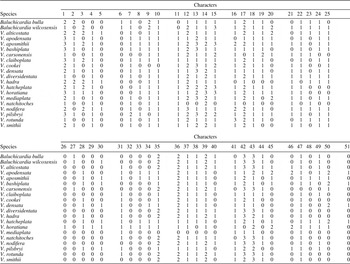
Characters are defined in the Appendix.
The 18 ingroup species constitute a monophyletic group. Within the ingroup, the planicostate venericards (Venericardia apodensata, V. aposmithii, V. bashiplata, V. claiboplata, V. cookei, V. densata, V. hatcheplata, V. horatiana, V. mediaplata, V. pilsbryi, and V. smithii) form a monophyletic group but the alticostate venericards (V. alticostata, V. carsonensis, V. diversidentata, V. hadra, V. natchitoches, V. nodifera, and V. rotunda) form a paraphyletic group. The original planicostate subtaxon Venericor is monophyletic whereas the original alticostate subtaxa Claibornicardia, Glyptoactis, and Rotundicardia are nonmonophyletic.
The planicostate clade is supported by characters 2, 23, 40, and 42. The planicostate venericards were also monophyletic in every most parsimonious tree produced with external ornamentation characters down-weighted 10%, 25%, and 50%. When external ornamentation characters were excluded completely, the planicostates remained monophyletic in 70% of the 69 most parsimonious trees.
Characters describing external ornamentation displayed the same incidence of character state reversals and convergent evolution as characters describing all other conchological features. However, character state reversals occurred more frequently in characters describing dentition (characters 12–22)—54% of dentition characters included character state reversals, compared to 20% of all non-dentition characters. Convergent evolution occurred in the majority of characters (65%) and the frequency of convergence was comparable in characters describing external ornamentation and dentition.
Discussion
The primary goals of the study were to reconstruct evolutionary relationships among venericard species, identify major clades, and determine whether originally proposed subtaxa are monophyletic. The phylogeny indicates that planicostate venericards and the original planicostate subtaxon, Venericor, are monophyletic whereas the alticostate venericards and the original alticostate subtaxa are not.
The planicostate venericards and, therefore, the originally proposed subtaxon Venericor, form a monophyletic group in all three of the most parsimonious trees (Fig. 1), which supports the current classification of Venericor as a subgenus within Venericardia (Moore, Reference Moore1992). This clade is supported by characters 2, 23, 40, and 42, which include characters describing external ornamentation and shell shape. Character 42 (cross-sectional shape of ribs across the middle of the largest specimen) reflects the general morphology of the external ornamentation. The alticostates have sharp “V”-shaped ribs, wherease the planicostates have broader, smoother ribs. Additionally, planicostates are characterized by a trigonal shell shape, whereas alticostates are subcircular or quadrate in shape (character 2). Highly developed ornamentation, including a paracostal cord (character 23) and tripartite ribbing (character 40), is only present in the alticostates.
The planicostate clade is defined by one of the most robust nodes in resulting trees (Bremer support value 3, bootstrap value 75%). Additionally, the planicostates remained monophyletic in every most parsimonious tree produced when external ornamentation characters were down-weighted. When external ornamentation was excluded from analysis, the planicostates formed a monophyletic group in the majority of most parsimonious trees. Eight of the more derived planicostate species (V. apodensata, V. aposmithii, V. bashiplata, V. claiboplata, V. densata, V. hatcheplata, V. horatiana, and V. pilsbryi) were monophyletic in every most parsimonious tree (supported by character 8), whereas the more basal planicostate species (V. cookei, V. mediaplata, and V. smithii) fell outside this clade in 30% of most parsimonious trees. The persistence of the planicostate clade when the external ornamentation characters were given less weight indicates that planicostate venericards are united by similarities beyond their smooth-ribbed ornamentation (e.g., primarily shell shape [2] and size [1]).
Although the monophyletic status of Venericor confirms Gardner and Bowles’ (Reference Gardner and Bowles1939) assumption that the planicostates evolved from a common ancestor, the phylogenetic relationships within the planicostate clade are not consistent with those hypothesized by Gardner and Bowles (Reference Gardner and Bowles1939). They proposed that Venericor on the U.S. Coastal Plain belong to two major clades, originating from V. smithii and V. mediaplata. Our phylogeny indicates that V. smithii is the basal species within Venericor; however, there is no evidence that it and V. mediaplata belong to separate clades. Additionally, some of the best-supported nodes within this clade, such as the close relationship between V. hatcheplata and V. horatiana (Bremer support value 4, bootstrap value 81%), are not predicted by Gardner and Bowles (Reference Gardner and Bowles1939), who placed the species in separate subclades.
Alticostate venericards are paraphyletic to the monophyletic group of planicostates, indicating that smooth-ribbed ornamentation evolved only once from sharp-ribbed ancestors. Smooth-ribbed venericards first appear at the beginning of the Paleocene, which implies that planicostates and alticostates diverged in the Late Cretaceous. Juvenile planicostate venericards display relatively sharp ribs that closely resemble alticostate ornamentation (personal observation). The similarity between juvenile planicostates and adult alticostates suggests that the evolution of the smooth-ribbed ornamentation could be the product of peramorphosis (McNamara, Reference McNamara1986). Peramorphic events can play an important role in the evolution of increased body size (McNamara, Reference McNamara1986), as observed in vertebrates (Gould, Reference Gould1974) and echinoderms (Philip, Reference Philip1963). In venericards, planicostates are typically substantially larger than alticostates (character 1), which is consistent with the hypothesis that planicostates evolved from alticostates through peramorphic processes.
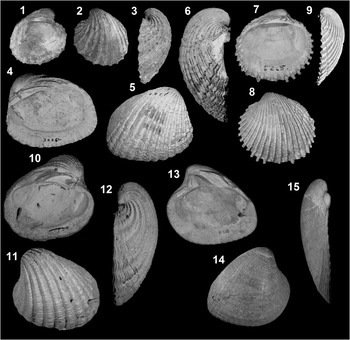
According to current taxonomic groupings, Rotundicardia and Venericor are classified as subgenera within Venericardia (Woodring, Reference Woodring1982; Moore, Reference Moore1992). In our phylogeny, the three Rotundicardia species (V. carsonensis, V. diversidentata, and V. rotunda) are paraphyletic to the planicostate clade, indicating that Venericor shares a closer evolutionary relationship with Rotundicardia species than other alticostate species. However, a member of Claibornicardia, V. natchitoches, also groups with the Rotundicardia species. Heaslip (Reference Heaslip1968) first described the subgenus Rotundicardia and classified V. natchitoches in Claibornicardia based on shell shape and general dentition pattern. Despite Heaslip’s (Reference Heaslip1968) classification, V. natchitoches and Rotundicardia share similarities in shell size, shape, and external ornamentation (characters 1, 2, 3, 5, 45, 46, and 49) that are not shared with the type species of Claibornicardia, V. alticostata. V. natchitoches, and Rotundicardia have small subcircular shells with broad intercostal spaces, whereas V. alticostata display larger trigonal shells with sharp intercostal spaces (Fig. 4).
(1–3) Venericardia natchitoches Harris, 1910, USNM 646148, hypotype, middle Eocene, St. Augustine, Texas, left valve; (1) internal view, 1.6×; (2) external view, 1.5×; (3) anterior view, 2×; (4–6) Venericardia alticostata (Conrad, Reference Conrad1833), ANSP 30562, syntype, middle Eocene, Claiborne Bluff, Alabama, right valve; (4) internal view, 1×; (5) external view, 1×; (6) anterior view, 1.6×; (7–9) Venericardia rotunda Lea, Reference Lea1833, ANSP 5268, paralectotype, middle Eocene, Claiborne Bluff, Alabama, left valve; (7) internal view, 1.6×; (8) external view, 1.6×; (9) anterior view, 1.8×; (10–12), Venericardia hadra Dall, Reference Dall1903, USNM 646157, hypotype, middle Miocene, Chipola River, Florida, left valve; (10) internal view, 1.3×; (11) external view, 1.3×; (12) anterior view, 1.8×; (13–15) Venericardia pilsbryi Stewart, Reference Stewart1930, ANSP 12510, type, Eocene, Yellow Bluff, AL, right valve; (13) internal view, 0.4×; (14) external view, 0.4×; (15), anterior view, 0.7×.

Heaslip (Reference Heaslip1968) proposed that Glyptoactis evolved from Claibornicardia during the Oligocene and Claibornicardia is currently classified as a subgenus within Glyptoactis (Moore, Reference Moore1992). These relationships are not strictly supported by the phylogeny; although, some members of Claibornicardia and Glyptoactis share a close evolutionary relationship. In our phylogeny, the two Glyptoactis species (V. hadra and V. nodifera) and the type species of Claibornicardia, V. alticostata, group together due to similarities in shell size, shape, external ornamentation, and tooth orientation (characters 1, 3, 5, 13, 14, 24, and 41). Although the Claibornicardia species (V. alticostata and V. natchitoches) group with Glyptoactis and Rotundicardia, respectively, too few alticostate species were examined to permit subgeneric reclassification. Our results indicate that alticostate taxonomy should be revised; however, additional species must be analyzed to determine appropriate subgeneric classifications.
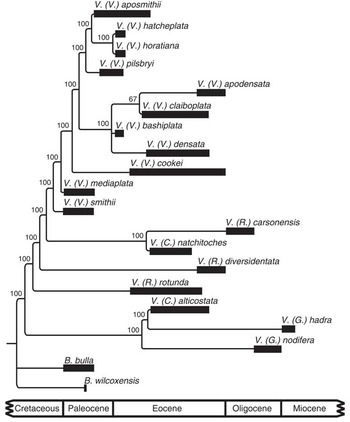
Our phylogeny is somewhat consistent with the species’ stratigraphic ranges (Fig. 5). Within the planicostate clade, all species are restricted to the Paleocene and Eocene. V. mediaplata and V. smithii are basal species in the clade and have the earliest stratigraphic ranges. V. mediaplata and V. smithii occurred during the early and middle Paleocene, whereas more derived species, including V. apodensata, V. bashiplata, V. claiboplata, V. densata, V. hatcheplata, and V. horatiana, occurred after the Paleocene-Eocene Thermal Maximum. More basal species V. cookei originating in the Eocene and derived species V. aposmithii and V. pilsbryi occurring in the Paleocene are exceptions to the pattern.
Fifty percent majority-rule consensus tree with stratigraphic range of each species indicated by bold lines. Stratigraphic ranges determined from first and last occurrences compiled from over 900 published occurrences using the Gradstein 2004 timescale (Gradstein et al., Reference Gradstein, Ogg and Smith2004). Numbers above branches indicate the percentage of the most parsimonious trees supporting that branch.

Although alticostates existed in the Paleocene, they were not selected for study due to their extremely poor preservation and small sample sizes. This explains the apparent chronological discrepancy of planicostates evolving from alticostates, before the latter first occur in the fossil record. The inclusion of earlier alticostates in the phylogeny would resolve this stratigraphic debt.
Within the alticostates, the proposed Rotundicardia species (V. carsonensis, V. diversidentata, and V. rotunda) and Claibornicardia species (V. alticostata and V. natchitoches) all occurred during the Eocene and early Oligocene, whereas the Glyptoactis species (V. hadra and V. nodifera) both occurred during the late Oligocene and early Miocene. The consistency between the species’ stratigraphic ranges and proposed subtaxa is, in part, a function of Heaslip’s (Reference Heaslip1968) use of both morphological observations and stratigraphic ranges in classifying the species. Due to the controversy surrounding the use of stratigraphy in phylogenetic reconstructions (Smith, Reference Smith2000), our phylogeny is based solely on shell morphology, which may account for differences between previously proposed subtaxa and the clades in our phylogeny.
Geographically, this study was restricted to species found on the U.S. Coastal Plain. As a consequence, the selected species display rather similar geographic ranges (Table 1). Venericards lived in shallow marine habitats, so differences among the species’ geographic ranges are generally associated with changes in sea level. All species from the Paleocene and Eocene occurred in Alabama, and frequently occurred in additional nearby states, such as Arkansas, Georgia, Louisiana, Mississippi, and Texas. Species with more recent stratigraphic ranges have slightly different geographic ranges. For example, V. nodifera occurred during the late Oligocene in Florida and North Carolina and V. hadra occurred during the early Miocene in Florida. Although V. hadra and V. nodifera group together in the phylogeny, their similar geographic ranges are most likely a function of outcrop availability (Miller et al., Reference Miller, Kominz, Browning, Wright, Mountain, Katz, Sugarman, Cramer, Christie-Blick and Pekar2005).
Our phylogeny reconstructed the evolutionary relationships among Paleogene venericard species on the U.S. Coastal Plain and indicates that smooth-ribbed planicostate venericards evolved once from alticostate venericards. The phylogeny also suggests that the alticostates are paraphyletic to the planicostates and that venericard taxonomy should be revised to reflect monophyletic groups within the alticostates. Future work should focus on resolving the evolutionary relationships among alticostate venericards by including additional species from each proposed subtaxa and Paleocene species in phylogenetic analyses.
Acknowledgments
We thank G. Dietl, D. Dockery, S. Ebersole, A. Molineux, R. Portell, G. Rosenberg, T. Waller, and L. Ward for the generous use and loan of museum specimens. We also thank W. Allmon, D. Dockery, E. Fenlon, L. Ivany, E. Robinson, J. Sessa, and L. Ward for numerous useful discussions and field support. G. Hunt provided insightful comments that improved the manuscript. K. Ohman assisted with photography and compiled stratigraphic and geographic ranges. E. Fenlon contributed to field collection, specimen identification, and the development of characters. Suggestions from two anonymous reviewers were greatly appreciated. Research was supported by the National Science Foundation (EAR-0718745) and the National Center for Ecological Analysis and Synthesis.
Appendix. Description of characters and character states used in phylogenetic analysis
1. Size: 0=tiny (width <1 cm); 1=small (width 1-3 cm); 2=medium (width 3–6 cm); 3=large (width >6 cm).
2. Shape viewed from outside: 0=subcircular; 1=trigonal; 2=quadrate.
3. Outline of commissure: 0=subcircular; 1=trigonal; 2=quadrate.
4. Beak strongly prosogyrous: 0=absent; 1=present.
5. Truncated posterior (squared off end): 0=absent; 1=present.
6. Very short front: 0=absent; 1=present.
7. Posterior indentation: 0=absent; 1=slight; 2=developed.
8. Flat anterior flare: 0=absent; 1=present.
9. Inflation of umbones: 0=low; 1=intermediate; 2=high.
10. Lunule depth: 0=shallow; 1=deep.
11. Penetrating lunule: 0=absent; 1=present.
Tooth orientation determined by measuring the angle between the plane of the tooth and the plane of the hinge plate:
12. 3a tooth orientation: 0=indeterminate tooth; 1=50°-60°; 2=80°-90°; 3=100°-120°.
13. 3b tooth orientation: 0=0°–10°; 1=20°–30°; 2=30°–40°; 3=40°–50°.
14. 5b tooth orientation: 0=10°–20°; 1=20°–30°; 2=30°–40°.
15. 2 tooth orientation: 0=0°–10°; 1=35°–50°; 2=70°–80°; 3=80°–90°.
16. 4 tooth orientation: 0=0°–10°; 1=20°–30°; 2=30°–40°; 3=40°–50°.
17. Elevation of 3a tooth: 0=absent; 1=level with edge of shell; 2=higher than edge of shell.
18. Elevation of 5b tooth: 0=level with edge of shell; 1=higher than edge of shell.
19. Elevation of 2 tooth: 0=constant elevation; 1=highest elevation at dorsal end of tooth; 2=highest elevation at ventral end of tooth.
20. Elevation of 4 tooth: 0=constant elevation; 1=highest elevation at dorsal end of tooth; 2=highest elevation at ventral end of tooth.
21. Highest tooth on L valve: 0=2 tooth; 1=4 tooth.
22. Striations on posterior side of 3a tooth: 0=absent; 1=present.
23. Paracostal cord: 0=absent; 1=present.
24. Stronger fourth rib on posterior: 0=absent; 1=present.
25. Stronger seventh rib: 0=absent; 1=present.
26. Smooth exterior: 0=absent; 1=present.
27. Sharp, narrow ornament on ribs: 0=absent; 1=present.
28. Radial ornament fades ventrally: 0=absent; 1=present.
29. Radial ornament fades anteriorly: 0=absent; 1=present.
30. Radial ornament fades posteriorly: 0=absent; 1=present.
31. Dominant ornament on dorsal anterior region of shell: 0=radial; 1=concentric.
32. Dominant ornament on dorsal posterior region of shell: 0=radial; 1=concentric.
33. Dominant ornament on ventral anterior region of shell: 0=radial; 1=concentric.
34. Dominant ornament on ventral posterior: 0=radial; 1=concentric.
35. Nodes: 0=absent; 1=partial shell coverage; 2=total shell coverage.
36. Umbone nodes: 0=absent on umbone; 1=umbone partially covered; 2=entire umbone covered.
37. Anterior umbone nodes: 0=absent; 1=present.
38. Posterior umbone nodes: 0=absent; 1=present.
39. Node size: 0=nodes absent; 1=small nodes; 2=large nodes.
40. Tripartite ribbing: 0=absent; 1=present.
41. Lateral ornament on posterior edge: 0=absent; 1=present.
42. Cross section of ribs across middle of largest specimen: 0=flat; 1=square; 2=“U”-shape; 3=“V”-shape.
43. Cross section of ribs on umbone: 0=flat; 1=square; 2=“U” shape; 3=“V”-shape.
44. Intercostal space across middle of largest specimen: 0=narrow groove between costa; 1=wide gap between costa.
45. Intercostal shape across middle of largest specimen: 0=“U”-shape; 1=“V”-shape; 2=flat.
46. Intercostal shape on umbone: 0=“U”-shape; 1=“V”-shape; 2=flat.
47. Adductor muscle scar depth: 0=shallow; 1=deep.
48. Pallial line intersection with anterior adductor muscle scar: 0=intersection at middle of muscle scar; 1=intersection at posterior edge of muscle scar.
49. Pallial line shape: 0=smooth, uniform curve; 1=bends in corner.
50. Hinge size: 0=narrow; 1=wide.
51. Two morphs with differing inflation: 0=observed; 1=not observed.