Background and purpose
Improvisation, in almost all aspects of everyday life, is essential to human existence and a common feature of human experience (Steinsholt & Sommerro, Reference STEINSHOLT and SOMMERRO2006). Improvisation is a distinguished feature of most music practices and children have been shown to benefit from learning to improvise in experientially different ways (Burnard, Reference BURNARD2000a; Azzara, Reference AZZARA, Colwell and Richardson2002; Sawyer, Reference SAWYER2003, Reference SAWYER2006, Reference SAWYER2008; Kanellopoulos & Wright, Reference KANELLOPOULOS, WRIGHT, Karlsen and Väkevä2012; Green, Reference GREEN2014). In addition, music improvisation has even been judged to have a positive influence on empathy in children (Rabinowitch, Cross & Burnard, Reference RABINOVITCH, CROSS and BURNARD2013). Researchers have therefore argued that music education in schools should provide improvisation activities to a much greater extent (Sawyer, Reference SAWYER2003; Brophy, Reference BROPHY2005; Hickey, Reference HICKEY2009, Reference HICKEY2015; Beegle, Reference BEEGLE2010; Burnard, Reference BURNARD2012).
In the US, improvisation has been included in the National standards for Music Education (Consortium of National Arts Education Associations, 1994) since they were formulated 22 years ago. In the revised standards (nafme.org, 2014) improvisation is presented as a creative artistic process and activities that include ‘improvising ideas and patterns as well as a rhythmic, melodic and harmonic improvisation’ are suggested (Yoo, Reference YOO2015, p. 92). Furthermore, recent music education curricula in many European countries – Norway: udir.no, (2006); Scotland: gov.uk, (2008); Denmark: emu.dk, (2009/2014.); Sweden: Skolverket, (2011); England: gov.uk, (2013); Finland: Oph.fi, (2014); Germany: bildungsserver.de, (n.d.); as well as in Australia, ACARA, (2012) – now include improvisation and composition as part of music education's subject content.
The expanding recognition of improvisation and composition in curricula is probably due to the assumption that they improve creativity and innovation. Creative and innovative capacities are stressed as key competences and vital learning outcomes in European educational policies as they are thought to promote attitudes and abilities such as flexibility, entrepreneurship, and to respect others’ values, which in turn can contribute to economic growth and social development (OECD, 2005; European Parliament, 2006).
Historically, research on improvisation has predominantly focused jazz musicians’ improvisations, with seminal works by Pressing (Reference PRESSING and Sloboda1987) and Berliner (Reference BERLINER1994) amongst others. Even though there are differences between novice and expert improvisation, it is argued there are certain elements shared by all improvisatory practices – whether these are carried out by an elementary student or a professional performer. Kratus (Reference KRATUS1995) – whose works have been influential in how improvisation is, and has been, conceived within music education – argues that music educators can use an understanding of these common elements to distinguish whether what a child does musically can be characterised as improvisation or not. These shared characteristics include: purposeful movements to produce sounds over time; that it is not possible to revise or reproduce the resultant musical product; and that melodic and rhythmic decisions, whilst improvising, are made within certain constraints (ibid., p. 27). On the other hand, the differences between expert and novice improvisation – according to Kratus (ibid.) – can be used to identify those elements students must learn in order to progress. References to his seven-stage sequential model of improvisational development (Kratus, Reference KRATUS1991) are common in professional journals. Each of the seven stages – explorative, process-oriented, production-oriented, fluid, structural, stylistic and personal improvisation – builds upon the previous, but also interact with the student's general musical development. As a result, Kratus (ibid.) stresses the importance for teachers to be aware of what level each student is at, in order to be able to properly instruct their students.
In the light of the elevated status of improvisation in many music curricula, as well as its relation to more general education policies and discourses, it is highly relevant to review what interest improvisation in the music classroom has received from recent music education researchers. Such knowledge is an essential foundation for a better scholarly understanding of improvisation in educational contexts, for developing improvisation in music education practice as well as for a deepened understanding of various justifications for incorporating improvisation into music education.
The overall purpose of this literature review is to provide a convenient summary of empirical research on improvisation in general music education and thereby provide guidance to researchers and practitioners. Three research questions have guided this study: (a) What characterizes the research area? (b) How is improvisation conceptualized in general music education research? (c) What implications do these conceptualizations hold for the implementation into practice? The subsequent section describes method used for the review and analyses, and is followed by a substantial findings section. The final sections include conclusions of the main findings, and also some implications of the findings to future research into this area.
Method
Search strategy
In this study, a systematic narrative review was applied, which combines systematic literature searching with narrative syntheses and analyses (Booth, Papaionnou & Sutton Reference BOOTH, PAPAIOANNOU and SUTTON2012). This method is arguably fruitful due to its mix of systematic review principles as transparency and accessibility (Petticrew & Roberts Reference PETTICREW and ROBERTS2006) with qualitative analyses on the basis of author's experience as employed in narrative reviews (Pawson et al., Reference PAWSON, GREENHALGH, HARVEY and WALSHE2005).
A comprehensive search for relevant articles was conducted. Articles written in English and available as full texts, were sought in the databases Web of Science (Arts & Humanities Citation Index), RILM Abstracts of Music Literature, Project MUSE and ERIC as these databases cover most peer-reviewed journals. Using these databases, which are accessible to many online, we allow for the replicability of the study by other researchers.
As a first step, two categories of search terms were sought: music AND improvis* AND education and music AND improvis* AND classroom to identify articles which would qualify. The resulting 226 titles and abstracts were saved using RefWorks and after duplicates were removed, this search recorded only a total of 77 unique hits. Because of the relatively small number of hits, we decided to not refine our searches further.
As a second step, we individually screened each abstract to find articles on improvisation (i) based on empirical studies (interviews, observations, case studies, surveys) conducted in the music classroom within primary or secondary school or, (ii) discussing the concept and phenomena in explicit relation to the music classroom within primary or secondary school or, (iii) drawing upon currently published research with the aim of furthering empirical work in the field or, (iv) drawing on authors’ previous empirical research, but written in a popular scientific style speaking to the field of music teachers.
During the course of this, both authors made blind notes in RefWorks (cf. Booth et al., Reference BOOTH, PAPAIOANNOU and SUTTON2012). We then shared, compared and discussed our respective notes and in certain cases where it was unclear whether the study met our inclusion criteria, we included the article regardless. The first selection yielded 48 articles.
After having imported full texts to RefWorks we then re-read each abstract and the full text. The reference lists in these articles were also scrutinized to identify additional articles that fulfilled our criteria. We did not, however, find any more valid material.
So that we could extract and record information about authors, publication, research objectives, theoretical frameworks, methodologies and findings of each of those studies that met all the inclusion criteria, we created a single word-processing document (Petticrew & Roberts, Reference PETTICREW and ROBERTS2006).
At this point, some clarifying comments on the selection process are needed: firstly, because this review is concerned with examining research on improvisation in the general music classroom, we did not include studies on improvisation in instrumental music education (defined as either one-to-one tuition or learning of music through bands), in the context of teacher education, professional musicians or university students. Similarly, theoretical articles on improvisation were discarded, if they were not based on empirical evidence generated in the music classroom, or if their authors did not express interest in contributing to music teaching or learning. This article is interested in the implications of research on improvisation for practice directly.
Secondly, the field of creativity research is vast, and not considered within the scope of this article. However, our examination exposed that many researchers find creativity as a relatively ‘given’ outcome of improvisation. Also, what some authors describe as ‘composition’ can often be characterised by the qualities that are widely ascribed to ‘improvisation’ (Kanellopoulos, Reference KANELLOPOULOS2007). We therefore decided to include articles aiming at exploring creativity (e.g. Coulson & Burke, Reference COULSON and BURKE2013), creative music education and/or composition (e.g. Sætre, Reference SÆTRE2011) if they contained research questions and significant findings in relation to improvisation in the music classroom.
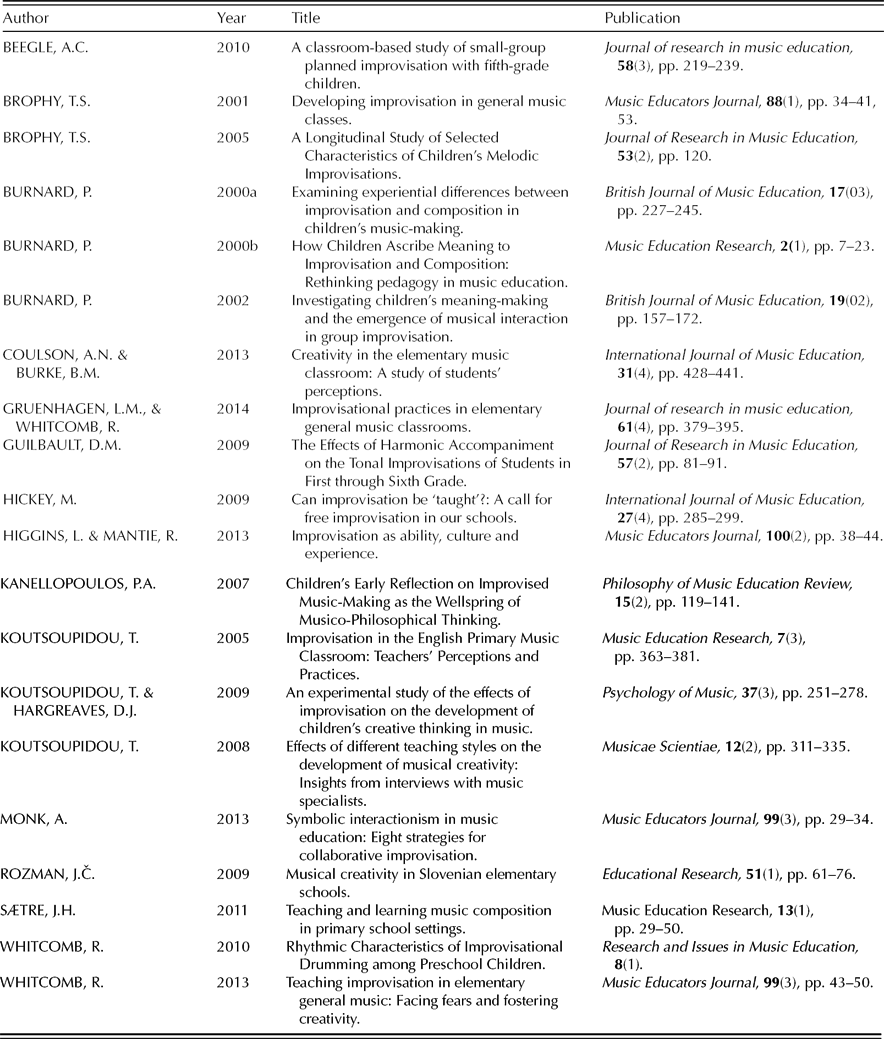
As a result of this process, 20 studies were finally included in the present review (Table 1).
Articles included in review

Analysis
After reading and taking notes from full text we firstly examined, sorted and compared descriptive data, e.g. research topics and recurrent themes, how the studies were performed, and ‘whose’ perspective(s) (teachers’, students’, and/or the improvisation activity in itself) the study covers (Booth et al., Reference BOOTH, PAPAIOANNOU and SUTTON2012). Secondly, we cross-examined the studies, i.e. linking and contrasting research aims, methods, and concepts. At this stage we used a reflective-based method, which means our previous familiarity with the field – relating and/or synonymous concepts, methods and theories – were used to develop search strings for data analyses and coding. Using this knowledge-generating strategy offers possibilities to comprehend the pluralities of understanding around improvisation research (cf. Jones, Reference JONES2004). The subsequent and final stage focused on examining what the literature argues in order to identify critical issues, gaps, and to be able to provide recommendations for further research.
Findings
In this section, a summary of existing knowledge about improvisation in general music education is exhibited, based on findings in the reviewed articles and presented in two sections. The first provides an overview of the key features of the research and the second indicates key findings from the research articles. In the subsequent sections we present our synthesis of the articles’ content in relation to both conceptualisation and implementation.
Summarising the research area
From 226 titles published from 2000 to 2015, 20 studies met the inclusion criteria. Considering the interest in the topic of improvisation, as demonstrated by our initial search, the number of empirical studies published in refereed-journals is relatively small. It is noteworthy that, amongst these 20, two authors refer to their own, previously-published work across multiple articles (Burnard, Reference BURNARD2000a, Reference BURNARD2000b, Reference BURNARD2002; Koutsopidou, Reference KOUTSOUPIDOU2008, Koutsoupidou & Hargreaves, Reference KOUTSOUPIDOU and HARGREAVES2009). This suggests that the number of unique empirical studies on improvisation in the music classroom is actually even smaller.
15 different researchers, almost exclusively from the field of music education, have co/authored the articles in this review. One author is a general education scholar, and one is researcher in music psychology. Research on improvisation has mainly attracted the attention of scholars from the US (Brophy, Reference BROPHY2001, Reference BROPHY2005; Guilbault, Reference GUILBAULT2009; Hickey, Reference HICKEY2009; Beegle, Reference BEEGLE2010; Whitcomb, Reference WHITCOMB2010, Reference WHITCOMB2013; Coulson & Burke, Reference COULSON and BURKE2013; Higgins & Mantie, Reference HIGGINS and MANTIE2013; Gruenhagen & Whitcomb, Reference GRUENHAGEN and WHITCOMB2014) and to some extent from the UK (Burnard, Reference BURNARD2000a, Reference BURNARD2000b, Reference BURNARD2002; Koutsoupidou, Reference KOUTSOUPIDOU2005, Reference KOUTSOUPIDOU2008; Koutsoupidou & Hargreaves, Reference KOUTSOUPIDOU and HARGREAVES2009) while it has received little attention by researchers from other parts of Europe (Kanellopoulos, Reference KANELLOPOULOS2007; Rozman, Reference ROZMAN2009) and Scandinavia (Sætre, Reference SÆTRE2011) as well as from Canada (Monk, Reference MONK2013). In other words, the range of countries in which improvisation has been explored, in English speaking and international journals, is limited. A recurring reference for the North American research, particularly, is the inclusion of improvisation in the National Standards for Music Education (1994). This established support for improvisation in music education may be one reason why improvisation has interested scholars from the US to a greater extent and less so in other parts of the world.
In the following paragraphs we outline the main focuses in existing research. We indicate whether the research question's main perspective is that of teachers, the students or improvisation as an activity per se. We also briefly mention some of the problems dealt with, aims and research methods used.
In total, 12 studies involve children (Burnard, Reference BURNARD2000a, Reference BURNARD2000b, Reference BURNARD2002; Brophy, Reference BROPHY2005; Kanellopoulos, Reference KANELLOPOULOS2007; Guilbault, Reference GUILBAULT2009; Koutsoupidou & Hargreaves, Reference KOUTSOUPIDOU and HARGREAVES2009; Rozman, Reference ROZMAN2009; Beegle, Reference BEEGLE2010; Whitcomb, Reference WHITCOMB2010; Saetre, Reference SÆTRE2011; Coulson and Burke, Reference COULSON and BURKE2013). Most of them mainly focus on improvisation as pedagogical activity and learning. The studies describe children's music improvisations, investigate its observable characteristics (Rozman, Reference ROZMAN2009; Whitcomb, Reference WHITCOMB2010) or examine issues such as how children respond to different prompts (Beegle, Reference BEEGLE2010). Moreover, the research examines age-related musical development (Brophy, Reference BROPHY2001, Reference BROPHY2005; Guilbault, Reference GUILBAULT2009; Koutsoupidou & Hargreaves, Reference KOUTSOUPIDOU and HARGREAVES2009; Coulson & Burke, Reference COULSON and BURKE2013) and discusses whether chronological age or musical age is the determining factor for children's ability to improvise. Work exploring children's or students’ reflections on musical creativity (Coulson & Burke, Reference COULSON and BURKE2013), and on children's experiences of improvising (Burnard, Reference BURNARD2000a, Reference BURNARD2000b, Reference BURNARD2002; Kanellopoulos, Reference KANELLOPOULOS2007; Beegle, Reference BEEGLE2010) are in a minority.
Studies involving teachers as research objects in themselves have explored to what extent improvisational activities are taking place in music classrooms (Koutsoupidou, Reference KOUTSOUPIDOU2005; Gruenhagen & Whitcomb, Reference GRUENHAGEN and WHITCOMB2014) and noted how teachers’ different educational orientations, teaching styles and input affect the development of children's creative thinking via improvisation (Koutsoupidou, Reference KOUTSOUPIDOU2008; Koutsoupidou & Hargreaves, Reference KOUTSOUPIDOU and HARGREAVES2009; Saetre, Reference SÆTRE2011). As with children and students, also studies on teacher's perceptions and practices as well as their views on conditions for musical improvisation (Koutsoupidou, Reference KOUTSOUPIDOU2005; Gruenhagen & Whitcomb, Reference GRUENHAGEN and WHITCOMB2014) are somewhat unnoticed. Researchers points to these gaps and invite more studies considering what improvising mean to both teachers and children (Burnard, Reference BURNARD2000a; Kanellopoulos, Reference KANELLOPOULOS2007; Beegle, Reference BEEGLE2010; Saetre, Reference SÆTRE2011).
In addition, our findings show that music education researchers see it as important to directly contribute to the development of the music teacher profession. Several articles concern pedagogical approaches to teaching improvisation practices. Most of these are popular scholarly writings based on the author's own previous research (Brophy, Reference BROPHY2001; Whitcomb, Reference WHITCOMB2013) or examinations of existing conceptions on improvisation in music education in order to guide teachers and improve current methodologies (Hickey, Reference HICKEY2009; Higgins & Mantie, Reference HIGGINS and MANTIE2013; Monk, Reference MONK2013).
With regards to research methods, ethnographic studies (interviews and observations) equal questionnaires and surveys. In addition, there are several intervention-like studies, ranging from a series of improvisation lessons planned in collaboration between researcher and teacher (Coulson & Burke, Reference COULSON and BURKE2013) to quasi-experimental design with a control group and an experimental group (Guilbault, Reference GUILBAULT2009; Koutsoupidou & Hargreaves, Reference KOUTSOUPIDOU and HARGREAVES2009).
Two evident gaps in existing research must be noted. Firstly, there are few field-studies designed by a researcher operating outside the particular music classroom context. In most studies teachers have been involved in designing (either in shaping the questions or the lessons themselves) and/or conducting the research, which could imply that teacher's perceptions of their own practice will not be reflected in a clear way. Secondly, in most of the orchestrated projects, participants are recruited for the specific study, which commonly take place in school, but separate from regular music lessons. Just four studies were based on activities taking place during weekly music classes (Koutsoupidou & Hargreaves, Reference KOUTSOUPIDOU and HARGREAVES2009; Beegle, Reference BEEGLE2010; Saetre, Reference SÆTRE2011; Coulson & Burke, Reference COULSON and BURKE2013).
To conclude this section; the empirical field of improvisation studies in general music classrooms is restricted. The total number of scholarly studies is few, the geographic spread is limited, only some studies are conducted in the regular music classroom and these are – in different ways – predominantly designed in collaboration with, or by, the teacher.
We can also notice that pedagogical approaches to improvisation as activity hitherto are of greater interest than students’ and teachers’ reflections and experiences.
General findings from empirical research on improvisation
Questions guiding research in improvisation in general music education are closely connected to teacher's educational orientation. This is no surprise as researcher and teacher often are the same person in these studies. To sum up, the purpose and aims for researching and incorporating improvisation can be divided in two categories: (i) improvising to learn about music and developing specific musical knowledge and skills in order to develop for example a sense of rhythm and/or harmony; and (ii) improvising in order to learn about oneself and others through music-making. The first category implies individual improvisation to develop skills in e.g. melodic and/or rhythmical patterns and ability to maintain a steady beat (Brophy, Reference BROPHY2005; Whitcomb, Reference WHITCOMB2010; Coulson & Burke, Reference COULSON and BURKE2013), and adherence to implied harmonic changes and harmonic rhythm in tonal improvisation with harmonic accompaniment (Guilbault, Reference GUILBAULT2009). In this category improvisation is teacher directed and clearly framed. The second category implies group improvisation as a child-directed, socially and musically inclusive activity with an emphasis on interaction, invention and music improvisation as conversation (Burnard, Reference BURNARD2000a; Reference BURNARD2000b; Reference BURNARD2002; Kanellopoulos, Reference KANELLOPOULOS2007; Beegle, Reference BEEGLE2010, Monk, Reference MONK2013).
Concerning the quality of children's improvisations, there is no common agreement, but three issues are discussed in the research as being critical determinants and advocated respectively: chronological age (Brophy, Reference BROPHY2005), previous musical experiences (Guilbault, Reference GUILBAULT2009; Coulson & Burke, Reference COULSON and BURKE2013) and creative intention (Burnard, Reference BURNARD2000b). For instance, children of age nine were found to improvise with more structure and conventional musical expressions than children age seven (Brophy, Reference BROPHY2005), whereas musical experience were found to be more important for children's harmonic improvisations (Guilbault, Reference GUILBAULT2009; Coulson & Burke, Reference COULSON and BURKE2013) and, finally, the creative intention was shown to have more influence than both chronological and musical age on children's experiences of improvisation and composition (Burnard, Reference BURNARD2000b).
When examining children's experiences from improvisation, researchers frequently conclude that children are able to reflect upon and talk about their improvisational practice and by giving children opportunities to articulate their understandings meaning-making is enhanced (Burnard, Reference BURNARD2000b, Kanellopoulos, Reference KANELLOPOULOS2007, Beegle, Reference BEEGLE2010). For example, in open-ended dialogues eight-year old children expressed philosophical thoughts on improvised music making as ‘thinking in sound’ and as verbal communication, which includes risk-taking but where mistakes are regarded as opportunities for the ‘development of musical imagination’ (Kanellopoulos, Reference KANELLOPOULOS2007, p. 128–132). Yet, another example, children (12 years old) who were provided with the opportunity and time to improvise and compose together regarded the activities as 1) different activities which were ends in themselves but differently orientated, 2) interrelated activities where improvisation was used to create and perform a composition and finally 3) as inseparable forms in intention (Burnard, Reference BURNARD2000b).
Investigations of teacher's perceptions of and reflections on improvisation show in some cases that teachers do incorporate improvisation, preferably as movements to music and/or as improvisation on pitched or unpitched percussion, and that teachers regard frames and guidelines as important for children's ability to improvise (Koutsoupidou, Reference KOUTSOUPIDOU2005; Rozman, Reference ROZMAN2009; Gruenhagen & Whitcomb, Reference GRUENHAGEN and WHITCOMB2014).
To support teachers’ abilities to incorporate improvisation most articles provide guidance for practice. Creating an atmosphere built on trust and empathy is emphasised and this means e.g. to accept and ‘say yes, and’ to peers’ initiatives as well as an approach to improvisation where there are no ‘rights’ or ‘wrongs’. Starting with activities close to children's experiences and letting children themselves chose instruments as well as giving children opportunities to reflect on their music-making are also matters to be considered (Burnard, Reference BURNARD2002; Kanellopoulos, Reference KANELLOPOULOS2007; Beegle, Reference BEEGLE2010; Monk, Reference MONK2013). Models, e.g. question and answer, and demonstrations where the teacher gives examples of how to improvise, can help children to start the endeavour to improvise (Saetre, Reference SÆTRE2011, Coulson & Burke, Reference COULSON and BURKE2013; Whitcomb, Reference WHITCOMB2013), and for teachers to overcome fear of improvisation it is often suggested that they improvise as learners together with their students (Kanellopoulos, Reference KANELLOPOULOS2007; Whitcomb, Reference WHITCOMB2013). Methods, preferably built on step-by-step instruction and sequential development, are provided (Brophy, Reference BROPHY2001; Whitcomb, Reference WHITCOMB2013) as well as ideas to support teacher's reflections on improvisation, e.g. the notions of understanding improvisation as ability, culture and/or experience, as interaction and conversation or as a disposition that can be nurtured rather than taught (Hickey, Reference HICKEY2009; Higgins & Mantie, Reference HIGGINS and MANTIE2013; Monk, Reference MONK2013).
These studies are mostly focused on improvisation in elementary school and we found no research on improvisation in secondary school. Furthermore, these studies emphasise that children are competent improvisers, even with no, or very little help from adults, and they can develop musical skills and knowledge of the fundamental musical elements outlined above. In group improvisation they can negotiate musical content as well as roles and rules and communicate verbally and non-verbally in music. However, there are also instances where the imperative demand to incorporate improvisation in music education and the urge to legitimate improvisation in the curricula leads to a compliance with prescribed knowledge criteria and instrumentally-oriented studies. Hence, improvisation is not included as a means in itself but rather as a means to develop skills and knowledge prescribed in curricula. One could argue, following Maud Hickey (Reference HICKEY2009) that this might not be regarded as true creative music-making but rather an ‘educational paradox’ (Saetre, Reference SÆTRE2011) when the activity is meant to enhance creativity but has prescribed predetermined outcomes.
Conceptualizing improvisation: ‘Free’ and ‘structured’ improvisation
In the literature there are two discernibly different conceptualisations which are guiding the research on improvisation in general music education: improvisation as ‘structured’ or improvisation as ‘free’ music-making. Both adopt an understanding of improvisation as a process of spontaneous and expressive music creation in the moment, utilizing previous experiences, without going back to revise and the distinction should be understood as a continuum; structure can appear in free improvisation and vice versa. Yet there are tendencies toward one or the other. As characterised in these texts, from both structured and free standpoints, the potential outcomes of improvisation experiences in the classroom are development of creativity and a sense of self-confidence and empowerment to the students (e.g. Koutsoupidou, Reference KOUTSOUPIDOU2008; Koutsoupidou & Hargreaves, Reference KOUTSOUPIDOU and HARGREAVES2009; Gruenhagen & Whitcomb, Reference GRUENHAGEN and WHITCOMB2014).
Structured music making draws on a perspective with a traditional, teacher-directed, transmission schooling model, where improvisation is described with concepts like control, formal, teachers’ focus, individual and composition (Hickey, Reference HICKEY2009). This is more often instrumentally oriented towards preconceived measurable goals as prescribed in music curricula/syllabuses. For instance, to develop skills in melodic and/or rhythmical patterns and ability to maintain a steady beat (Brophy, Reference BROPHY2005; Whitcomb, Reference WHITCOMB2010; Coulson & Burke, Reference COULSON and BURKE2013), and adherence to implied harmonic changes and harmonic rhythm in tonal improvisation with harmonic accompaniment (Guilbault, Reference GUILBAULT2009). These goals are in most cases following Western music traditions and conventions with musical properties that may not be relevant to children's creative music making (Burnard, Reference BURNARD2000a).
Structured improvisation is mostly teacher-directed and used as a tool to develop musical skills and knowledge, which implies a focus on measuring achievements, such as to what extent children can maintain a steady beat and/or develop melodic and rhythmical patterns (Brophy, Reference BROPHY2005; Whitcomb, Reference WHITCOMB2010) recognise melodic direction and patterns, tempo and metre (Rozman, Reference ROZMAN2009) or adhere to key and tonality (Guilbault, Reference GUILBAULT2009; Coulson & Burke, Reference COULSON and BURKE2013). For example, as Brophy (Reference BROPHY2005) indicates, that nine-year-old children's melodic improvisations are more musically organised in relation to conventional musical expressions than those of seven-year-old children is taken to support Kratus’ developmental stages of improvisation. Similarly, Rozman (Reference ROZMAN2009, p. 62) observes how improvised music differs from ‘freer’ creative music making in that it involves guidelines based on predetermined structures of form, which relates to stylistic rules and conventions. A structured conceptualization of improvisation consequently comes close to an idiomatic perception of improvisation and implies that to be able to improvise one needs specific prerequisites and skills. The focus, and ‘endpoint’, in both is on imparting knowledge of the specific features associated with instrumental playing instead of exploring the extra-musical effects of improvisation.
In several studies, researchers discuss improvisation in relation to composition and the two activities are seen as fundamentally intertwined. Discussions on what differences there are between improvisation and composition often concern innovation versus conservation and the distinguishing factor is usually the intent to revise or not (Brophy, Reference BROPHY2001; Beegle, Reference BEEGLE2010; Saetre, Reference SÆTRE2011). Improvisation is sometimes utilized to produce ideas for students’ compositions, which implies a focus on the product, as does the structured conceptualization of improvisation.
By contrast, in understanding improvisation as about ‘free’ music-making, improvisation includes exploration and the development of critical and creative dispositions, and here improvisation is described as chaos, non-formal, sound focus, group, and improvisation (Hickey, Reference HICKEY2009). Free improvisation is, instead, conceived as being non-idiomatic and inventive, child-directed and focusing on developing an explorative and experimental attitude where learning outcomes are not predetermined (Hickey, Reference HICKEY2009; Higgins & Mantie, Reference HIGGINS and MANTIE2013; Monk, Reference MONK2013). Improvisation regarded as interaction, implies a focus on how students collectively create meaning through verbal and nonverbal dialogue (Monk, Reference MONK2013), interpersonal dynamics and communicative aspects of collaborative musical processes (Burnard, Reference BURNARD2000a; Reference BURNARD2000b; Reference BURNARD2002; Beegle, Reference BEEGLE2010). In improvisational interaction, material emerges from the ‘musical dialogue that occurs among the individuals involved’ (Monk, Reference MONK2013, p. 76). These employ principles of improvised theatre together with interaction theories in order to form strategies for improvisational musical dialogues in music education (Monk, Reference MONK2013). Viewed as interaction and conversation, improvisation here is judged to help students communicate and collectively construct meaning, using the musical vocabulary, the musical experiences and resources they already possess (Monk, Reference MONK2013; Burnard, Reference BURNARD2002).
Researchers within this strand also pay attention to questions of power, trust and friendship, as they are manifest in intergroup dynamics, as these are significant aspects of interpersonal relations and interaction. Following this view, the potential outcomes of free music making in education are developed social competences and creative thinking in music (Hickey, Reference HICKEY2009; Koutsoupidou & Hargreaves, Reference KOUTSOUPIDOU and HARGREAVES2009). Musical activities that focus experimentation and exploration have also been found to result in improved musical flexibility, originality and syntax (Koutsoupidou & Hargreaves, Reference KOUTSOUPIDOU and HARGREAVES2009, p. 262).
Implications for implementation in practice
Different conceptualizations of improvisation hold implications for how improvisation is implemented in music education practice. Whilst there is some overlap between the two, improvised music making as either structured or free leads to distinctly different educational outcomes. Generally speaking, this distinction indicates that teachers have two overall approaches and educational orientations to improvisation in general music education, which affects how they implement improvisation. What differs in the approaches, besides the role of the teacher, are the improvisation tasks and the way they are conducted; how improvisation activities are framed and to what extent the tasks are limited by guidelines, as well as the perceived outcomes. These studies reveal that such approaches are implemented in classrooms in order to, on the one hand, use improvisation as a tool for development of musical competencies, and on the other, to use improvisation as a communicative, expressive and/or an explorative, reflective practice.
When improvisation is implemented as a tool, the focus is on developing specific skills and knowledge, such as in rhythm and pulse adherence (Brophy, Reference BROPHY2005; Whitcomb, Reference WHITCOMB2010), or in harmony and tonality (Guilbault, Reference GUILBAULT2009; Coulson & Burke, Reference COULSON and BURKE2013). In this approach it is the outcomes and results, often seen as leading to an ‘end product’, which are focused on and valued, more than the processes. Improvisation activities are therefore highly structured and teacher-directed. Frames and guidelines such as modelling and demonstrations, imitation and call-and-response models are guiding the improvisation activities and sequencing and step-by-step processes are frequently utilized (Brophy, Reference BROPHY2001, Reference BROPHY2005; Guilbault, Reference GUILBAULT2009, Whitcomb, Reference WHITCOMB2010; Coulson & Burke, Reference COULSON and BURKE2013; Gruenhagen & Whitcomb, Reference GRUENHAGEN and WHITCOMB2014). In practice this implies a focus on developing assessable knowledge and skills, and students are graded according to curricula criteria. Yet this approach to improvisation has been questioned and criticised by some researchers and even depicted as an ‘educational paradox’ as it is directed by predetermined criteria and goals to achieve, which leaves little room for children to explore or develop their own musical ideas (Burnard, Reference BURNARD2000a; Hickey, Reference HICKEY2009; Saetre, Reference SÆTRE2011).
When teachers implement improvisation as a communicative and expressive practice, improvisation is first and foremost implemented through group activities. According to this model, communication and interaction are emphasized and the collective is valued as well as children's perspectives on how they understand the process (Burnard, Reference BURNARD2000a, Reference BURNARD2000b, Reference BURNARD2002; Kanellopoulos, Reference KANELLOPOULOS2007; Beegle, Reference BEEGLE2010). Through group improvisation, learning is understood as the collective creation of meaning; students develop their abilities to negotiate musical decisions, to solve problems in co-operation, and to shift between e.g. a leaders’ and a followers’ role. Such collaboration includes musical social interaction, for example to listen, express and respond to musical ideas and it is viewed as exceeding the individual student's potential when negotiating musical content as well as roles and rules. This approach can be understood as child-directed more than teacher-directed and includes a view of improvisation as a process of discovery where mistakes are seen as new opportunities and possibilities rather than failure. Frames that provide a safe and trusting environment are viewed as important, so that children, without fear of being criticised by peers or teachers, can make mistakes (Burnard, Reference BURNARD2002; Koutsoupidou, Reference KOUTSOUPIDOU2005, Reference KOUTSOUPIDOU2008; Kanellopoulos, Reference KANELLOPOULOS2007; Higgins & Mantie, Reference HIGGINS and MANTIE2013; Monk, Reference MONK2013; Gruenhagen & Whitcomb, Reference GRUENHAGEN and WHITCOMB2014).
When viewed in this way, improvisation can also be regarded as individually beneficial through a stress on explorative and reflective practices. The research claims that improvisation encourages students to experiment, explore and express their own unique ideas. Making musical choices and having opportunities to discuss, explain and reflect upon own musical experiences accordingly stimulates development of identity, relationships and a critical mind (Burnard, Reference BURNARD2000a, Reference BURNARD2000b, Reference BURNARD2002; Kanellopoulos; Reference KANELLOPOULOS2007; Hickey, Reference HICKEY2009; Koutsoupidou & Hargreaves, Reference KOUTSOUPIDOU and HARGREAVES2009; Beegle, Reference BEEGLE2010; Monk, Reference MONK2013).
Hindrances to implementing improvisation in the general music classroom
As noted by much of this research, music teachers find improvisation challenging and they are uncomfortable teaching it (Koutsoupidou, Reference KOUTSOUPIDOU2005; Rozman, Reference ROZMAN2009; Higgins & Mantie, Reference HIGGINS and MANTIE2013). Besides a lack of education and experience on the part of the teachers, these studies make apparent that other factors influence the use of improvisation. These include: teachers’ fear of risk-taking and reduced classroom discipline as well as teachers’ age, and personal and professional maturity, whereas experienced teachers are more inclined to incorporate improvisation (Koutsoupidou, Reference KOUTSOUPIDOU2005). Moreover, studies reveal a shortage of space in the classroom area, adequate equipment and instructional time as potential hindrances. Some have stressed that teachers’ reluctance to incorporate group improvisation is influenced partly by the ‘predominantly functional role improvisation plays for composition activities’ (Burnard, Reference BURNARD2002, p. 168), and partly by a narrow view of improvisation as a ‘domain-specific expertise, generated by adult models’ (ibid.) or expert practice instead of a child-centred orientation. A view of children's improvisations as ‘naïve’ (Brophy, Reference BROPHY2005) displays a top-down perspective where adults do not value children's improvisation and creative music-making, are they not successful according to norms and conventions within a Western music tradition. Some authors in the reviewed articles argue that teachers should take into account the different ways in which children think and create music according to their age and experiences and not force their own preconceptions of improvisation on their students (Burnard, Reference BURNARD2000a, Reference BURNARD2002; Koutsoupidou, Reference KOUTSOUPIDOU2005; Kanellopoulos, Reference KANELLOPOULOS2007; Rozman, Reference ROZMAN2009; Whitcomb, Reference WHITCOMB2013; Gruenhagen & Whitcomb, Reference GRUENHAGEN and WHITCOMB2014).
Discussion
The purpose of improvisation in general music education and research, as well as the aims for improvising, need to be clarified for both researchers and teachers. In some instances, the main purpose seems to be to develop students’ musical knowledge and skills through improvisation, which implies a somewhat instrumentalist approach where the research seemingly aims at finding ‘good’ outcomes from improvisation activities. As noted, improvisation as a key feature of music curricula become reasons in themselves to teach improvisation (e.g. Brophy, Reference BROPHY2005; Whitcomb, Reference WHITCOMB2010; Guilbault, Reference GUILBAULT2009; Rozman, Reference ROZMAN2009; Coulson & Burke, Reference COULSON and BURKE2013). Yet this approach leaves little room for experimentation and exploration and implies relatively given or expected outcomes of the improvisation since student's improvisations in these studies take place within a Western conception of music with certain norms, rules and conventions which means that melodic, rhythmical and/or harmonic improvisations are seen as successful only if they are completed within these norms and conventions. It is relevant to question to what extent children got the opportunity to really improvise since the design in some studies (e.g. Brophy, Reference BROPHY2005; Guilbault, Reference GUILBAULT2009; Whitcomb, Reference WHITCOMB2010; Coulson & Burke, Reference COULSON and BURKE2013) are highly teacher directed and structured with strictly defined limitations and frames which leave little room for exploration and experimentation. Furthermore, time allocated for the improvisations in these studies were short, between 1-measure length (Whitcomb, Reference WHITCOMB2010) to 4- or 8-measure length (Brophy, Reference BROPHY2005; Coulson & Burke, Reference COULSON and BURKE2013), or 5–10 minutes per class period (Guilbault, Reference GUILBAULT2009).
By contrast, other studies take the communicative aspects of group improvisation as a starting point with an open-ended approach where outcomes are not given and the experimental and explorative aspects of improvisation are foregrounded. We would argue, following Burnard (Reference BURNARD2000b) Kanellopoulos (Reference KANELLOPOULOS2007) and Hickey (Reference HICKEY2009), that free improvisation probably generates more critical thinking in music and more ‘true’ creative music-making.
We did not include articles on the philosophy of music education in our review, as we, as indicated previously, were interested in research conducted on music education practice. However, from a Continental/Nordic perspective, education and pedagogy are closely connected to Bildung, which all come together in the concept Didaktik. Hence, issues of a philosophical matter are a vital part of education. In our synthesis of the reviewed articles some philosophical matters emerged, for example improvisation as structured or free and improvisation as a tool, as a communicative and expressive practice, and/or as an explorative and reflective practice.
From the studies included in this review, it is clear that teachers often have limited, personal experience in improvising and, in addition, lack specific, much-needed knowledge in teaching methods. In turn, this may reflect problems in music teacher education. The research also reveals that teachers tend to equate improvisation with jazz praxis. Jazz improvisation is a musical tradition with rather specific competencies. If an individual music teacher, with either specialized knowledge in another genre or with broader musical skills, looks upon improvisation as similar to what is taking place within jazz traditions, it is hardly surprising they become self-critical and fear implementing it in the classroom.
We suggest that improvisation in general music education should be more focused on free music making, understood as allowing a greater space for children's musical exploration. However, existing research provides little support for this, as just a few studies touch upon qualities required to encourage this form of improvisation. It is necessary to understand teachers’ motivations for including or excluding improvisation and how teachers themselves comprehend the overall purpose for including improvisation in music classrooms. In addition, studies are required in order to develop insights around teachers’ reflections on their own improvisation teaching practice, and on the development and progression of improvisation in music classrooms. No studies available are based on qualitative interviews with teachers as to their views and experiences of improvisation in general music education. Given that teachers lack confidence, education and experience in improvisation, one way to overcome this particular issue could be to pursue participatory action research (PAR). Hence, we suggest that research should be carried out whereby a scholar from the ‘outside’ brings to the study of the practice other knowledge and experiences than the teachers themselves have and therefore is able to pose new questions. We think this could also mean that teacher's perceptions of their own practice could be reflected in a clearer way.
In order to develop further research on improvisation in general music education in compulsory schooling, we suggest that the regular weekly music classroom context, with ordinary children/students attending class, should be made the research object. This review demonstrates that there is a need to investigate the ‘everyday’ practices surrounding improvisation in music classrooms and not just special, orchestrated projects. Furthermore, studies adopting a more holistic approach which incorporate both teachers’ and children's perspectives, experiences and reflections, are necessary in order to extend the field. This is not only in order to fully understand how teachers and students perceive improvisation, but also to explore how improvisation practice in general music classrooms could be developed. Hitherto, in the reviewed articles, teachers’ and children's perspectives have mostly been gauged through surveys (Koutsoupidou, Reference KOUTSOUPIDOU2005; Coulson & Burke, Reference COULSON and BURKE2013; Gruenhagen & Whitcomb, Reference GRUENHAGEN and WHITCOMB2014) with three exceptions: Burnard (Reference BURNARD2000a), Kanellopoulos (Reference KANELLOPOULOS2007) and Beegle (Reference BEEGLE2010), who conducted interviews with children, focusing on their experiences of improvisation.
Further research is also needed to clarify the precise relationship between structure and freedom in improvisational activities in music classrooms. As both researchers and teachers point out, structure is needed but it is not often established in existing research when frames and guidelines are helping to enable improvisation and when they are hindering it. For example, too many guidelines might hamper children's ability to improvise as shown in a study where children should improvise questions and answers, and answers should end at the tonic ‘do’ and questions on something other than ‘do’ and above that some of the question phrase should be incorporated into the answer. The latter was perceived as difficult by the children. (Coulson & Burke, Reference COULSON and BURKE2013).
Some articles in this review are directed towards music teachers’ practice (Brophy, Reference BROPHY2001; Whitcomb, Reference WHITCOMB2013) and provide guidance to teachers through several hands-on improvisational techniques and plans for lessons, according to a perspective on improvisation as something which can be learnt through ‘building blocks’, sequential methods like questions and answer, which aims at achieving an improvisational product that is acceptable, both to students and adults, according to conventional terms of expression in Western music. We, however, suggest more research into children's free improvisation activities in music classrooms in order to more deeply understand the foundations for and meaning making in children's open-ended musical actions and improvisations.
Conclusion
From this review, it is apparent that the field of empirical studies on improvisation in general music classrooms is limited. There are only a few empirical studies which look directly at improvisation and none of them deals with improvisation in secondary school. In addition, the geographic spread, at least in key international and English-language journals, is fairly narrow. Moreover, only some studies are conducted in regular weekly music classrooms. Studies are also – in different ways – predominantly designed in collaboration with, or by, the teacher. Different national contexts influence research perspectives as well as education, and the focus on improvisation as pedagogical activity possibly mirror syllabi requirements relating to national educational policies. The result may also suggest that the teacher-researcher creates a dilemma. Among the included studies there are many instances where the researcher is also the teacher in the context under investigation, which is valuable, however, it might also be a potential problem. Notwithstanding the facts that teacher's research on their own practice is of considerable value, and that being a teacher-researcher can support professional development (Newton & Burgess, Reference NEWTON and BURGESS2008), in these circumstances researchers might find it difficult to reflect on their own practice and personal teaching experiences. Taken together, these circumstances are reasonable explanations for why teacher-researchers choose to look at improvisation as a pedagogical activity (i.e. observing what and how the students learn) rather than conducting self-reflexive studies, considering their own views, experiences and rationales for improvisation in practice.
The main scholarly debates on improvisation concern the respective benefits of improvisation as either structured or free music making as well as the relation between these conceptualisations Saetre (Reference SÆTRE2011) notes that the relation between the two in research is an ‘educational paradox’, as the intention behind improvisation is often to let students create their own music; yet research often contests the idea that creativity can be maintained when the activities leave little room for exploration, experimentation or discovery. This suggests that improvisation often leads to conformity because of a focus on imitation. On the other hand, it is clear from this review that striking a balance between structure and freedom is needed from the perspectives of both the teachers and students.
This article indicates that improvisation generally is fairly neglected in general music education. It seems especially difficult to accomplish activities where improvisation is treated as an end in itself, in contrast to benefitting specific knowledge and skills. To complicate the picture further, these results may not only suggest practical and educational shortcomings, but also problems related to current educational policies since measurable goals and assessment criteria are increasingly being accredited a more important role.
Finally, we see a need for more studies on improvisation concerning how improvisation as a pedagogical activity in general music education is affected in an increasingly goal- and result-driven schooling system. Similarly, from an educational theory perspective, studies are needed on what role and function improvisation could have in general music education.