1 Introduction
Seemingly, the property of countability and uncountability of English nouns is based on a simple dependence: when the designations of nouns can be counted, the nouns are count, and when these designations cannot be counted, the nouns are mass (Huddleston & Pullum Reference Huddleston and Pullum2002: 334). What is more, there are several morphological and syntactic properties due to which one can recognise whether or not a noun possesses the given property, e.g. only count nouns are modified by cardinal numbers or quasi-cardinal numbers, the indefinite article, by many and few / a few, or reveal the singular–plural contrast (e.g. Gillon Reference Gillon1999: 51). Mass nouns, by contrast, cannot be pluralised or modified by cardinal or quasi-cardinal numbers, they cannot be preceded by the indefinite article, and they are used with e.g. much and less (e.g. Huddleston & Pullum Reference Huddleston and Pullum2002: 333–4).
There are also nouns that reveal both count and mass properties, e.g. brick (a brick, many bricks – much brick, etc.). While it is difficult to estimate the scale of this phenomenon, we can indicate ‘limiting cases’ of it (Huddleston & Pullum Reference Huddleston and Pullum2002: 335): nouns that have no established count uses (e.g. crockery) or mass uses (e.g. piece). In other words, there are nouns that reveal only one of these properties.
Although this vision of countability and uncountability in English is not sufficient for a proper analysis of this issue, it needs to be evoked to show the discrepancy between the present state of knowledge accumulated in grammar books and the results obtained in the present analysis. It is also useful because it is already from this standpoint that two further issues can be addressed: is it possible that all English nouns can be both count and mass? And is it possible to compile a complete list of the regularities of count-to-mass and mass-to-count changes? (See also Drożdż Reference Drożdż2017.)
To tackle these issues, the article begins with a brief overview of the current state of knowledge. Then, the major claims of Cognitive Grammar – the theoretical foundations of the analysis – are introduced. What follows is a presentation of the methodology of research and the major findings of an analysis of 30 count and 30 mass nouns. The analysis is concluded with a discussion of the results.
2 The state of the art
2.1 Changeability of the grammatical properties of the noun
We begin with the problem of whether or not all nouns can reveal both count and mass properties. While the initial answer is negative (see e.g. Huddleston & Pullum Reference Huddleston and Pullum2002: 335), there are three ‘thought experiments’ (Pelletier Reference Pelletier1975) that put this approach into question: Universal Grinder (Pelletier Reference Pelletier1975), Universal Packager (Pelletier Reference Pelletier2012) and Universal Sorter (Bunt Reference Bunt1985). These are machines that enable a change of count or mass nouns into nouns with the reverse grammatical properties as a result of changing the structure of the noun's designation.
The Universal Grinder works as follows: you put something into one end of it, and the machine grinds it and spews it out from the other end. For instance, after a steak, a primarily countable object, goes through the grinder, what one gets is ‘steak all over the floor’ – a steak mass (Pelletier Reference Pelletier1975: 457). In grammatical terms, this means that the grinder turns referents of count nouns into masses and, as a result, the count nouns designating them also change their property – from count to mass. In other words, any count noun that designates a countable object can change its property into mass when its designation goes through the grinder.
The Universal Packager works differently – it turns an uncountable mass into a possible package of this mass, a measurable amount of it that can be used for some purpose. An example can be beer, which is served e.g. in pubs in a specific package – a mug or glass – and hence it can be called a beer. Similarly, a quantifiable amount of ice cream, e.g. a cone, can be called an ice cream, etc. (Pelletier Reference Pelletier2012: 14). This results in the change of the property of the noun designating the mass from mass to count.
As for the Universal Sorter, it also transforms a mass into a countable unit of it, though it does so differently than the Universal Packager. Based on a property of this mass, the Sorter enables speakers to talk about kinds/sorts of the given mass, e.g. wine approached from the perspective of its taste can be classified as an excellent wine. Talking about sorts of linen, it is possible to highlight one of its properties, strength, and issue a qualification like ‘This is a strong linen’, etc. (Bunt Reference Bunt1985: 10–11). In this way, a mass noun becomes count.
This has become the knowledge that linguists still base their analyses on (e.g. Cheng et al. Reference Cheng, Doetjes and Sybesma2008), and consider it to be valid. An example of such an approach is Chierchia (Reference Chierchia2010: 106), who claims that the Universal Packager and the Universal Sorter ‘seem to pretty much exhaust M→C [mass to count] shifts’, while the Universal Grinder ‘allows us to massify any count noun’. Accepting such machines makes the situation of count and mass nouns more complex, because this creates an additional category of nouns – apart from those that have both count and mass properties, the nouns that are solely count or solely mass can change their grammatical property as long as this remains within the sphere of working of one of the machines.Footnote 1
However, the complexity of the issue does not stop at that. There are also claims that ‘in one way or another, probably every noun can be used in either manner’ (Langacker Reference Langacker2008: 142; see also Gleason Reference Gleason1965: 137; Bauer Reference Bauer1983: 227; Wickens Reference Wickens1992: 22), and this calls into question not only the conclusion that there are nouns that can only be count or mass, but also the sufficiency of the three machines. And it is the plausibility of this last claim that is checked in the present article.
2.2 The regularities of count-to-mass and mass-to-count changes
A number of lexical processes underlying the count-to-mass and mass-to-count changes have been proposed over the years. Some of the most important ones are deferred ostension (Quine Reference Quine1969), regular polysemy (Apresjan Reference Apresjan1973), semantic transfer rules (Leech Reference Leech1974; Reference Leech1981), deferred reference (Nunberg Reference Nunberg1979), sense extensions and logical metonymies (Pustejovsky Reference Pustejovsky1991, Reference Pustejovsky1995; Copestake & Briscoe Reference Copestake and Briscoe1995), lexical implication rules (Ostler & Atkins Reference Ostler and Atkins1991), conversion rules (Gillon Reference Gillon1999) and conceptual metonymies (Radden & Kövecses Reference Radden and Kövecses1999: 32; Peirceman & Geeraerts Reference Peirceman and Geeraerts2006: 307, etc.).Footnote 2 Putting together all the regularities enumerated in the literature on this issue, a list of fourteen regularities can be compiled:
1. mass nouns, for example, tin, can develop the sense ‘a receptacle made of tin’ (Jespersen Reference Jespersen1924: 200), e.g. What can you use so much tin for?
2. countable names of trees develop the sense ‘wood from the tree’ (Jespersen Reference Jespersen1924: 200), e.g. The table is made of oak;
3. names for trees develop also the sense ‘a mass of growing trees’ (Jespersen Reference Jespersen1924: 200), e.g. Oak and beech began to take the place of willow and elm;
4. count nouns for animals that can be hunted or caught (Jespersen Reference Jespersen1924: 200), e.g. They've gone out after elephant;
5. count nouns can develop the sense ‘the substance of which the object is made’ (Gleason Reference Gleason1965: 136), e.g. The termite was living on a diet of book;
6. nouns referring to animals can extend to ‘animal fur’ (Apresjan Reference Apresjan1973: 16), e.g. Jacqueline prefers leopard to fox;
7. count nouns that designate a purpose-built container can be used in the mass sense: ‘the amount that it contains or its contents’ (Ostler & Atkins Reference Ostler and Atkins1991: 78), e.g. Don't drink the whole glass;
8. count nouns for products can be used in reference to parts which contribute to ‘the enlargement or enhancement of the product’ (Gillon Reference Gillon1999: 58), e.g. an area of table;
9. food substances can denote the count ‘unit of fabrication of this food’ (Gillon Reference Gillon1999: 58), e.g. I ordered a pizza, not a slice of pizza;
10. food items (including animals and plants, e.g. egg, salmon, potato) extend to parts of these items ‘that are suitable for human consumption’ (Gillon Reference Gillon1999: 58), e.g. if you eat an egg, you may get egg on your tie; We're having salmon for dinner; mashed potato;
11. count nouns are viewed in terms of ‘a measurable extent’ of the noun (Quirk et al. Reference Quirk, Greenbaum, Leech and Svartvik1985: 1563–4), e.g. an inch of pencil;
12. mass nouns extend to the sense ‘a kind of N’ (Quirk et al. Reference Quirk, Greenbaum, Leech and Svartvik1985: 1563–4), e.g. Some paints are more lasting than others;
13. mass nouns acquire the sense ‘a unit of N’ (Quirk et al. Reference Quirk, Greenbaum, Leech and Svartvik1985: 1563–4), e.g. two (huge) cheeses;
14. mass nouns referring to drink and food substances extend to the sense ‘servings’ (Huddleston & Pullum Reference Huddleston and Pullum2002: 336), e.g. She offered me another beer and That makes five porks and two turkeys, please.
However, these regularities pose quite a number of problems. Probably the most significant one is the fact that they are, for the most part, based on linguists’ intuitions rather than on detailed studies of linguistic corpora. Additionally, they concern a limited number of nouns, that is, nouns that form limited and homogeneous categories: metals that can be used to produce something, animals whose pelt can be used as a garment, or food that is sold in countable units. This entails a serious limitation for the nouns that can undergo this type of change, because the number of such nouns is relatively small in comparison with all nouns of the English language, and because such precise definitions of categories exclude nouns from all other categories.
Another problem is that these regularities concern mainly the nouns with a well-established dual membership, as confirmed by grammar books or dictionaries, e.g. tin, beer or fox. If less common nouns are mentioned, they are classified as ‘somewhat contrived’ (Huddleston & Pullum Reference Huddleston and Pullum2002: 337), which carries a specific implication: nouns that only possess one property do not normally have senses with reverse grammatical properties.
The next issue is the divergence between the levels of schematicity at which these regularities are described. As can be seen, scholars use such diverse notions as product, noun or unit. Because these terms are used without a clear indication of the level of schematicity that they refer to and without a reference to the other notions, it is not possible to establish a precise relationship between the regularities.
Also, the way of defining some of the regularities must be mentioned – it is so general that it is hardly possible to decide whether or not they are in fact different. A good illustration of this problem is ‘a measurable extent’ of N (Quirk et al. Reference Quirk, Greenbaum, Leech and Svartvik1985: 1563–4) and ‘parts which contribute to the enlargement or enhancement of the product’ (Gillon Reference Gillon1999: 58). It is only after examples of the regularities are provided, that is, respectively, an inch of pencil and an area of table, that one can know that in the former case the regularity concerns the substance of the pencil and in the latter, the surface of the table. However, the very formulations did not make it quite clear.
Finally, because the majority of the analyses conducted thus far have dealt with close sets of categories of nouns, it is virtually impossible to state whether these are all the regularities that function in English or, perhaps, there are more of them waiting to be discovered. Taking all this into consideration, the article proposes a new approach to this grammatical issue – one that deals with these problems.
3 The theoretical basis of the research
3.1 The Cognitive Grammar assumptions applied in the analysis
The framework of cognitive linguistics and, in particular, Cognitive Grammar (Langacker Reference Langacker1987, Reference Langacker1990, Reference Langacker1991, Reference Langacker2000a, Reference Langacker2000b, Reference Langacker2007, Reference Langacker2008, etc.) offers a radically different set of assumptions about language and analytical tools for its analysis. Four of these assumptions are of special significance for the analysis.
First of all, in cognitive linguistics meaning is equated with conceptualisation (Langacker Reference Langacker2008: 30; see also Croft & Cruse Reference Croft and Cruse2004: 2; Geeraerts & Cuyckens Reference Geeraerts and Cuyckens2007: 5, etc.). This means that cognitive linguists are not concerned with objective reality, its atomic structure or classifications resulting from this structure (e.g. Chierchia Reference Chierchia1998; Lasersohn Reference Lasersohn2011). Rather, the concern is the vision of reality that is encoded in language, and this vision is to some extent independent of the objective nature of reality.
This entails a reliance on human perception as the source of knowledge about the world. That is why cognitive linguistics rejects speculations concerning the grammatical properties of nouns at birth (e.g. Borer Reference Borer2005, etc.). Cognitive Grammar divides nouns into count and mass because the category of nouns is based on fundamental human experience, with ‘object’ as the prototype for nouns, and the two of its major subtypes, count and mass, as corresponding to the conceptual archetypes ‘object’ and ‘substance’ (Langacker Reference Langacker2008: 128).
The second point about Cognitive Grammar is that it is usage-based (Langacker Reference Langacker1988, Reference Langacker2000b, Reference Langacker2008, etc.). This assumption entails that meanings of linguistic units arise from actual usage events, which is why the analysis is based on actual utterances.
The next point concerns an even more basic issue – the fact that the analysed uses are approached as extended senses of respective nouns. In order to explain the notation used in the analysis, we need to mention the structures involved in extension and the relations that hold between them. There are three such structures: a prototype (the basic sense of a word), an extension (the extended sense) and a schema (the structure representing the commonalities inherent in the prototype and the extension) (Langacker Reference Langacker2008: 17–18; see also Langacker Reference Langacker2000b: 4). We talk about the process of extension when the specifications of the extension are different from those of the prototype. To mark this relation, the following notation is used: [prototype] → [extension].
Finally, we must mention the notion of schematisation: ‘extracting the commonality inherent in multiple experiences’ (Langacker Reference Langacker2008: 17; see also Langacker Reference Langacker1987: 65–76, Reference Langacker1990: 118–19, Reference Langacker2000a: 99–103, etc.). Because the aim of the present analysis is to arrive at the regularities of count-to-mass and mass-to-count changes, these regularities are treated as the schematically formulated generalisations of multiple usage events and, at a higher level of schematicity, of the schemas arising from these events. To mark the process of schematisation, the following notation is used: [prototype] → [extension] => [schema] → [schema].
3.2 The methodology
The methodology assumes going through several stages. First, sixty nouns were selected. Because the category of nouns is far from homogeneous (concrete nouns, abstract nouns, nominalisations) (Quirk et al. Reference Quirk, Greenbaum, Leech and Svartvik1985: 247; Langacker Reference Langacker1990: 97; Brinton Reference Brinton2000: 120; Huddleston & Pullum Reference Huddleston and Pullum2002: 475; Gramley & Pätzold Reference Gramley and Pätzold2004; Chierchia Reference Chierchia2010: 101, etc.), the analysis focuses on one category only – concrete nouns.
In order to achieve a maximally diversified set of them, from different ontological categories and with different frequencies of occurrence in English, a lemmatised frequency list was referred to. The frequency factor is important because an analysis of only rare or only frequent nouns might bias the results. In the analysis, I used the list of 5,000 most frequent words created on the basis of the Corpus of Contemporary American English (www.wordfrequency.info/free.asp). After isolating all the nouns from it (2,546 lemmas), I selected the nouns for analysis by going through the list in established intervals, as a result of which I collected a set of nouns that represent all the frequencies of occurrence in English.
The count nouns are: book, door, star, page, stage, bag, client, guest, classroom, photograph, branch, tie, roof, jacket, belt, clock, telescope, oven, tent, shower, tunnel, elbow, guitar, belly, chin, barn, jar, dam, sleeve and bulb.
The mass nouns are: water, money, food, blood, stuff, equipment, plastic, rain, salt, fat, sugar, snow, cream, sand, butter, mail, furniture, honey, tobacco, cotton, flesh, flour, mud, wildlife, silk, gasoline, jewelry, trash, wheat and timber.
The next step assumes confirming their grammatical properties in several English dictionaries: Longman Dictionary of Contemporary English, Macmillan Dictionary, Collins English Dictionary, Cambridge Dictionary and Oxford Dictionary. On closer inspection, all the count nouns turn out to possess only count senses, whereas most of the selected mass nouns (21 out of 30), despite an unequivocal grammatical classification as mass (e.g. Sinclair Reference Sinclair1990), possess also count senses. Still, their basic senses are mass and this is how they are treated in the analysis.
As the next step, a certain number of contexts have to be found, where the count and mass nouns appear in extended senses that have the reverse grammatical property of the basic sense. This number cannot be too small, for this might not show the complexity of the senses that each noun possesses. At the same time, it cannot be too high because finding a large number of adequate examples might take too long. Based on a pilot study (Drożdż Reference Drożdż2016a), this number is established as 30 contexts for each noun.
Then each context is scrutinised and a definition of each of these senses is formulated. The final stage of the analysis is based on Langacker's notion of schematicity (see also Langacker Reference Langacker2008: 55–7; Taraszka-Drożdż Reference Taraszka-Drożdż2014a, Reference Taraszka-Drożdż2016, etc.) – each sense is characterised at a higher level of abstraction and a schematic categorising relationship is formulated. After several extensions of the given type are detected, it becomes possible to extract an even more abstract schema and categorising relationship for them. Such a procedure enables the formulation, in a clear and consistent manner, of the regularities of extension at increasingly rising levels of schematicity, thus establishing clear relationships between all these levels.
However, to ensure the reliability of the analysis, three additional issues have to be established: how the examples are sought, where they are sought and on what basis they are accepted as adequate. These are discussed respectively.
3.2.1 The grammatical criteria of selection
Because the analysis is usage-based, it assumes finding real-life utterances produced by native speakers of English, in which the collected nouns are used with the reverse grammatical property of what is indicated by the dictionaries. To find such utterances, some morphosyntactic properties of count and mass nouns are made use of. First, constructions characteristic for each category of noun are formed. For mass nouns, this is the construction in which the noun is modified by much: much + nu (as in much tea), and for count nouns these are: a/an + n.sg (a table / an apple), (many) + n.pl (many books) and a/an + adjective + noun.sg (a heavy chair).
Later, the nouns in the constructions are replaced with the nouns with the reverse grammatical properties, which results in seemingly incorrect constructions, e.g.
-
– much + nc: much page, much client, much branch, much roof, etc.
-
– a/an + nu: a plastic, a rain, a salt, a fat, etc.
-
– (many) + nu: (many) sugars, (many) snows, (many) creams, (many) sands, etc.
-
– a/an + adjective + nounu: a fruit butter, a modern furniture, a good honey, a fine tobacco, etc.
However, because English abounds in compound nouns, searching e.g. just the phrase much page may result in cases where much does not refer to page but to the mass noun following it, e.g. ‘much page depth’. As a result, to improve the search both qualitatively and quantitatively, a specific procedure is used to eliminate such cases (see Drożdż Reference Drożdż2014a; Reference Drożdż2016a): the noun phrase is complemented by a preposition, a verb that agrees with the noun in number, an article or a pronoun. This produces such divergent constructions as:
-
– much + nc: much page the, much page on, (as) much page as, etc.
-
– a/an + nu: a plastic for, a plastic is, etc.
-
– (many) + nu: sugars in, sugars and, sugars may, etc.
-
– a/an + adjective + nounu: a fruit butter, a new butter, etc.
3.2.2 The corpus
The next problem concerns the corpus where such constructions can be found. After an introductory analysis, it became apparent that such corpora as British National Corpus or Corpus of Contemporary American English are not adequate, for the majority of the searched expressions cannot be found there. Because numerous scholars (e.g. Blair et al. Reference Blair, Urland and Ma2002; Hundt et al. Reference Hundt, Nesselhauf and Biewer2007; or Lindquist Reference Lindquist2009, to name but a few) claim that the quality of the data found on the Internet is comparable to that of standard corpora or, in some cases, Internet data are more telling than corpus data (e.g. Mondorf Reference Mondorf2007), the World Wide Web was selected.
Soon, two more of its characteristics became apparent for the analysis. First, the diversification of the genres – the texts that appear on the Internet are written by people with very different occupations and interests. In other words, these are people whose utterances are not normally included in linguistic corpora, though their language undisputedly forms a substantial part of what is called the English language.
Second, the Internet is a source of unedited texts, that is, probably most of the writers have not received specialised training in writing: how to express their thoughts eloquently, how to formulate perfect sentences, which words to choose to make an adequate impression, etc. As a result, these people communicate naturally – they write what they feel and what they want to express, independently of what others might expect from them. Also, they focus more on the message than on constructions that they once learnt at school.
3.2.3 The native speaker
Finally, the problem of characterising the native speaker on the Internet has to be solved. The assumption is that the native speaker is someone who speaks one of the varieties of English belonging to the ‘inner circle’ of World Englishes (e.g. Kachru Reference Kachru1988: 5; Mesthrie & Bhatt Reference Mesthrie and Bhatt2008: 27–36; Wolf & Polzenhagen Reference Wolf and Polzenhagen2009: 2–4), that is, British, American, Canadian, Australian or New Zealand English. This means rejecting the utterances of those who come from Malaysia, the Philippines, Singapore, India, South Africa or any other English-speaking country, as they may be influenced by the grammar of the local languages.
However, the information about the country of origin is not necessarily provided directly on the Internet. Naturally, there are cases when users write on Facebook, Twitter or Linkedin that they come from a specific town, city, or area. This, unfortunately, is not frequent. In the case of blogs or Internet shops, to find such information one needs to analyse specific elements of the site: the website address, the content of the blog, or the Contact section. Sometimes the information about the author's nationality needs to be deduced from the content of the texts, where the authors refer to the names of local businesses, events or places.
Another distinguishing feature of native speakers is their name. While English native speakers can come from any country and thus have any possible name, such names as Helen Foster, Wayne Deane, Diana Smith or David Pugh are much more characteristic of speakers from the ‘inner circle’ of World Englishes than, for example, Yen Le Espiritu, NaCee Xyooj, Naomi Larocque or Baba Salam. When no identifying information about such users was available, their utterances were not taken into account. In case of doubt, a native speaker with an academic background was consulted over problematic cases.
4 The analysis
There are two additional background assumptions concerning the selected nouns: they need to designate entities of very different ontological properties and they cannot belong to any of the categories described so far in the literature. As for the corpus of utterances, the analysis is based on 1,709 contextsFootnote 3 for the sixty nouns – 809 for mass senses of count nouns and 900 for count senses of prototypically mass nouns.
4.1 Mass extensions of count nouns
The analysis begins with a close inspection of each of the collected contexts and an attempt to characterise the senses that the nouns have there. For instance, the noun door appears several times in contexts similar to (1) and (2):
(1) Dori naps next to the door. I think I got too much door in this photo.
(2) There's too much paint!! look how much door is uncovered by stripes!
Because in both of these contexts door appeared in the sense ‘surface of the door’, we can postulate the emergence of a schema that encompasses the commonalities inherent in the standards and targets of this extension. This can be formulated as follows: [[door]c → [part of the surface of the door]u].
At the same time, more nouns reveal exactly the same direction of extension, e.g. stage, tie (3)–(4), branch, page, belt or telescope:
(3) – How much stage do you need?
– The ideal stage area should be a hard surface area measuring approx 20’ x 8’ and be level and raised e.g. portable staging. If you have access to a ‘drum riser’ (a mini stage to elevate the drummer) of approx 8 x 5 feet, then Graham will love you forever.
(4) I'm not sure I understand exactly what you're saying, particularly about the 5:1 scale ratio. Are you talking about how much tie is in the picture vs. how much shirt?
(www.styleforum.net/t/310812/while-waiting-for-foo-approval-shirt-tie-braces-combo)
Each of such extensions can be formulated schematically in a similar manner:
-
[[page]c → [part of the surface of the page]u],
-
[[stage]c → [part of the surface of the stage]u],
-
[[branch]c → [part of the surface of the branch]u],
-
[[tie]c → [part of the surface of the tie]u],
-
[[belt]c → [part of the surface of the belt]u],
-
[[telescope]c → [part of the surface of the telescope]u],
-
[[shower]c → [part of the surface of the shower]u].
At a more abstract level, these parallel categorising relationships lead to the emergence of a more schematic structure: [[object]c → [some extent of the object's surface]u].
At the same time, the data show that the collected nouns have extended senses that refer to other dimensions of the object, e.g. capacity, size, length or thickness (5)–(8). As before, there are usually several nouns with relevant extensions:
(5) It's the eternal snack question: Why so much bag for so few chips, food companies? There's nothing like opening up a new bag of chips only to find that half the bag is air.
(6) Americans made these clocks as well, they're called garniture sets sometimes, or fireplace sets, because this would stand up on the mantel of your fireplace […] These can be very imposing, and I think the reason why they get separated is often it's too much stuff, too much clock for people, and they sell off the candelabra separately.
(www.ehow.com/video_4975548_antique-clocks-clock-garniture-sets.html)
(7) – Doesn't the chunnel connect up the UK with France?
– Yes, but I would have that as my last choice of route. Too much tunnel for me!
(www.christianityboard.com/topic/16295-why-you-cant-lose-your-salvation/)
(8) I think a lot of people are getting talked into going 10mm. They get told that 13mm is for heavy guys or big weights, and it's too much belt for their little bodies. Like I said, most girls use 13mm, shorties included (belt is still 4″ wide), so a guy under 181 would have no problem.
Summarising, the extensions discussed so far can be schematically represented as: [[object]c → [some extent of the object's surface]u], [[object]c → [object's capacity]u], [[object]c → [object's size]u], [[object]c → [object's length]u] and [[object]c → [object's thickness]u]. Approached together, a certain higher-level commonality can be established among them: [[object]c → [spatial dimension of the object]u]. This structure can be dubbed our first subpattern.
Besides the spatial dimension of the object, in the analysis there are also extended senses that refer to four other dimensions of objects: a property of the object (e.g. tent → warmth), a capability of the object (e.g. elbow → strength), the substance that the object is made of (e.g. dam) and part of the object (e.g. elbow). These extensions could be formulated at the consecutive levels of schematicity (ending at the level of the subpattern):
-
– [[tent]c → [warmth provided by the tent]u] => [[object]c → [warmth provided by the object]u] => [[object]c → [property of the object]u],
-
– [[elbow]c → [force produced by the elbow]u] => [[object]c → [force produced by the object]u] => [[object]c → [capability of the object]u],
-
– [[dam]c → [substance that the dam is made of]u] => [[object]c → [substance that the object is made of]u],
-
– [[elbow]c → [part of the elbow]u] => [[object]c → [part of the object]u].
Such schematic structures allow me to postulate the presence of a structure at an even higher level of schematicity. From the Cognitive Grammar perspective (Langacker Reference Langacker2000b, Reference Langacker2008; see also Taraszka-Drożdż Reference Taraszka-Drożdż2014a, Reference Taraszka-Drożdż2014b, Reference Taraszka-Drożdż2016; Drożdż Reference Drożdż2016a), this is a structure that can be called a pattern of semantic extension: [[object]c → [mass dimension of the object]u]. What is worth noting about this pattern is that it is very complex, as it has five subpatterns and as many as four levels of schematicity at which the extensions instantiating it can be described, e.g.:
-
[[door]c → [part of the surface of the door]u] =>
-
[[object]c → [some extent of the object's surface]u] =>
-
[[object]c → [spatial dimension of the object]u] =>
-
[[object]c → [mass dimension of the object]u].
The second of the determined patterns of semantic extensions, [[object]c → [mass dimension associated with the object]u], is both less diversified and less complex. It only has three levels of schematicity, and only three more specific subschemas: [[object]c → [action associated with the object]u], [[object]c → [substance contained in the object]u] and [[object]c → [part of an object contiguous to the object]u].
The last of the determined patterns of semantic extension is [[object]c → [aggregate of objects]u]. This is also the simplest of the patterns, as it emerges directly from lowest-level schemas – those arising directly from extensions, as e.g. (9):
(9) Also make sure you check bulb measurments for height. I *think* you can fit ~55mm worth of bulb from base to bulb top in the front turn signal housings. Double check that for yourself though. I'm going to put as much bulb as will fit as they don't generate any heat worthy of mentioning.
4.2 Count extensions of mass nouns
The count senses of originally mass nouns are analysed in a similar fashion. The result is two patterns of semantic extension: [[substance / aggregate of things]u → [bounded amount of the substance / limited number of individual things]c] and [[substance / aggregate of things]u → [kind of the substance / aggregate of things]c].
These patterns are, in general, less complex than those of mass extensions of count nouns. One such subpattern is [[substance]u → [thing made of the substance]c]. It arises from schematically formulated extensions of such nouns as e.g. silk (10), cotton or timber: [[silk]u → [silk exercise band]c], [[cotton]u → [cotton piece of clothing]c] and [[timber]u → [timber building board]c].
(10) A woman exercises on some aerial silks at the Bust a Move event at the Saskatoon Field House on the University of Saskatchewan campus, Saturday.
By contrast, the most complex of the subpatterns, [[substance / aggregate of things]u → [limited amount of the substance / limited number of elements of the aggregate]c], is instantiated by three lower-level schemas. The account should begin with nouns that are classified as aggregates of things, e.g. stuff, equipment, mail, furniture, wildlife or jewelry. What is interesting about these nouns is that they have two distinct paths of extension. On the one hand, in the case of equipment (11) and furniture (12), the categorising relationships can be schematically formulated as: [[equipment]u → [set of equipment]c] and [[furniture]u → [set of furniture]c]. At a higher level of schematicity, the commonalities inherent in them can be captured by means of the schema [[aggregate of things]u → [set of elements of the aggregate]c].
(11) We pride our ability and willingness in providing high quality branded equipments at an honest and competitive price to all our customers, big and small.
CCTV-only system
16-camera system= £2,700 + VAT
(12) Small offices and large offices will certainly find a furniture that will fit their specific office area. An extremely wide selection of furniture pieces are offered for you to ensure that you will definitely find what you're looking for to be placed in your office.
On the other hand, both the two nouns and the other nouns extend to senses that can be abstractly formulated as [[aggregate of things]u → [single element of the aggregate]c]. Taken together, these general schemas lead to the formation of an even higher-level schema: [[aggregate of things]u → [limited number of elements of the aggregate]c].
Apart from nouns designating aggregates of things, there are also nouns designating substances that extend to the sense ‘limited amount of the substance’. These are such nouns as, for instance, mud (13), blood, fat, sugar or butter. Their extensions lead to the formation of the schema [[substance]u → [limited amount of the substance]c].
(13) Do you ever wish that you can just sit and splash in a mud for just five minutes (while your family is not looking, of course)?
A schematic account of the set of elements of the aggregate and limited amount of the substance schemas leads to the formation of the subpattern [[substance / aggregate of things]u → [limited amount of the substance / limited number of elements of the aggregate]c]. Because there are also such subpatterns as, e.g. [[substance]u → [thing for which the substance is a salient component]c], [[substance / aggregate of things]u → [thing that has a property of the substance / the aggregate of things]c] or [[substance / aggregate of things]u → [container that holds a limited amount of the substance / number of the things]c], we can postulate the emergence of an even more general schema – the pattern of semantic extension: [[substance / aggregate of things]u → [bounded amount of the substance / limited number of individual things]c].
The second of the patterns of mass-to-count change, [[substance / aggregate of things]u → [kind of the substance / aggregate of things]c], arises through two levels of schematisation. First, the categorising relationships of such nouns as blood (14), food, equipment or furniture are schematically formulated as [[blood]u → [kind of blood]c], [[food]u → [kind of food]c], [[equipment]u → [kind of equipment]c] and [[furniture]u → [kind of furniture]c]. A generalisation of these schemas leads to the pattern.
(14) The patient's general health will need to be restored. Good digestion must be secured in order to make a good blood.
Because throughout the analysis of count extensions of mass nouns we maintain the distinction between nouns designating substances and aggregates of things, at a higher level of schematicity we can postulate two subpatterns: [[substance]u → [kind of the substance]c] and [[aggregate of things]u → [kind of the aggregate of things]c]. It is at the level of the pattern that these two structures are combined: [[substance / aggregate of things]u → [kind of the substance / aggregate of things]c].
5 Observations and discussion
The major result of the present analysis is detection of a set of five general patterns and sixteen subpatterns of count-to-mass and mass-to-count extensions (and as many as 197 extensions at the lowest level of schematicity). Three of these patterns and eight subpatterns refer to count-to-mass extensions:
-
[[object]c → [mass dimension of the object]u],
-
[[object]c → [spatial dimension of the object]u],
-
[[object]c → [substance that the object is made of]u],
-
[[object]c → [part of the object]u],
-
[[object]c → [property of the object]u],
-
[[object]c → [capability of the object]u],
-
[[object]c → [mass dimension associated with the object]u],
-
[[object]c → [substance contained in the object]u],
-
[[object]c → [part of an object contiguous to the object]u],
-
[[object]c → [action associated with the object]u],
-
[[object]c → [aggregate of objects]u].
At the same time, two patterns and eight subpatterns refer to mass-to-count extensions:
-
[[substance / aggregate of things]u → [bounded amount of the substance / limited number of individual things]c],
-
[[substance]u → [thing made of the substance]c],
-
[[substance]u → [thing for which the substance is a salient component]c],
-
[[substance / aggregate of things]u → [thing that has a property of the substance / the aggregate of things]c],
-
[[substance / aggregate of things]u → [limited amount of the substance / limited number of elements of the aggregate]c],
-
[[substance / aggregate of things]u → [container that holds a limited amount of the substance / a number of the things]c],
-
[[aggregate of things]u → [place that holds a number of things]c],
-
[[substance / aggregate of things]u → [thing associated with the substance / the aggregate of things]c],
-
[[substance / aggregate of things]u → [action associated with the substance / the aggregate of things]c],
-
[[substance / aggregate of things]u → [kind of the substance / aggregate of things]c].
An important observation flowing from the analysis is that all of the sixty nouns have senses whose grammatical property is the reverse of the basic sense, that is, senses that theoretically they should not have. What is more, because the analysed nouns do not come from small and homogeneous groups, but are diversified both ontologically and frequentially, we can expect that possessing senses with the reverse grammatical property of the basic sense is not exclusively the property of the selected nouns, but of the vast majority of concrete nouns. At the same time, Langacker's (Reference Langacker2008: 142) claim that it concerns all nouns is becoming more and more likely.
At the same time, the present approach leads to several novel and important observations that allow us to understand better the regularities of grammatical change. First of all, these regularities are not formed in an intuitive or accidental manner. Quite the contrary, because they are schematic formulations of sense extensions subsequently formulated at progressively higher levels of abstraction, they are determined in a regular and systematic way.
What is more, these patterns both systematise the known regularities and extend them in several profound ways. As for the systematisation, the analysis locates the known regularities at specific and well-defined levels of schematicity, and shows how they are related. An example is Quirk et al.'s (Reference Quirk, Greenbaum, Leech and Svartvik1985: 1563–4) regularity ‘a measurable extent of the object’, parallel to the schema [[object]c → [substance that the object is made of]u]. However, unlike Quirk et al.'s (Reference Quirk, Greenbaum, Leech and Svartvik1985: 1563–4) regularity, the schema is shown to be both an instantiation of a more general pattern, [[object]c → [mass dimension of the object]u], and a schematic formulation of more specific extensions, e.g. [[book]c→ [substance that the book is made of]u] or [[dam]c → [substance that the dam is made of]u].
The analysis also determines a number of new regularities, not mentioned in previous studies. Actually, they constitute a considerable part of the schemas, e.g. [[object]c → [action associated with the object]u], [[object]c → [aggregate of objects]u], [[substance]u → [thing for which the substance is a salient component]c], [[aggregate of things]u → [place that holds a number of things]c] or [[substance / aggregate of things]u → [action associated with the substance / the aggregate of things]c].
It is also shown that count-to-mass and mass-to-count changes of nouns do not result from the workings of such commonly recognised philosophical machines as the Universal Grinder, Packager or Sorter but from a less attractive, simple, but efficient linguistic process: sense extension. Naturally, the proposed regularities are neither ultimate, nor are they formulated in the most perfect manner – anyway, the analysis only focused on sixty English nouns, which is just a fraction of their total number. Still, the point is to show that the proposed methodology provides the necessary theoretical background and guidelines for analysing all of them.
What is more, this research shows a point that has been largely disregarded in previous research of this type: that the senses with the reverse properties are coherent with the conventionalised senses of the nouns, that is, they are results of either direct extensions of the basic senses or extensions of one of their extended senses. This can be seen, among others, in elbow, whose basic sense is ‘the joint between the forearm and the upper arm’ (Oxford English Dictionary (OED)). The analysis discovers that there are as many as three mass senses derived directly from it: ‘part of the surface of the elbow’, ‘part of the elbow’ and ‘the force produced by the elbow’. At the same time, one of the count extended senses of elbow is ‘a thing resembling an elbow, in particular a piece of piping bent through an angle’ (OED). It is also the basis for a mass sense of elbow: ‘a collection of pieces of piping’.
As a result, it is possible to make certain predictions concerning the structure of the semantic pole of probably all nouns: the prototypical sense possesses a specific grammatical property (be it count or mass), which is also possibly the most frequent sense of the noun. At the same time, within the network of senses of this noun, there are also senses that reveal the reverse property. They are usually less conventionalised and possibly less frequent in English than the basic sense, though this latter property is less essential, as uses of such senses can sometimes be counted in thousands.
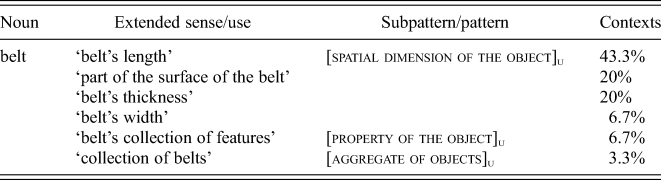
To conclude the discussion of the results of the analysis, I would like to provide distributional information about some of the nouns. As for the count nouns, I will mention three, whose behaviour is maximally distinct: belt, beg and client. Belt is one of the nouns with the highest number of mass extended senses – as many as six (table 1). Still, as shown in the column with the number of contexts, only the first three of these senses seem to be frequent enough to be classifiable as senses. Also, these numbers confirm the intuitive predictions about the most typical dimensions of the belt that people talk about: length, surface (people interested in fashion) and thickness (heavy weight lifters and gun owners). The remaining three senses seem to be just contextual interpretations – cases of a single occurrence in a specific context.
The extended senses/uses of belt and the subpatterns and patterns under which they are classified

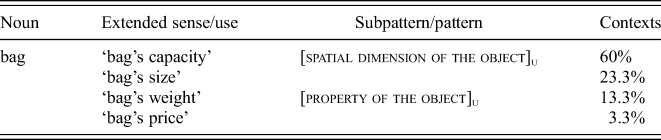
Bag is an average noun (table 2). With four extended senses, it only confirms the general tendency that one of the senses dominates, there are one or two senses with a lower frequency of occurrence and one or two marginal ones.
The extended senses/uses of bag and the subpatterns and patterns under which they are classified

The last of the nouns, client, is quite exceptional (table 3). Among the count nouns, there are only two, client and guest, which only have one extended sense. What is more, it is the same extended sense: ‘an aggregate of’. This seems to be the bottom line of the process of the count-to-mass extension – just one sense. At the same time, it must be stressed that the number of senses has nothing to do with the frequency of occurrence in English: both belt and client belong to frequent nouns, while bag is of average frequency.
The extended sense of client and the pattern under which it is classified

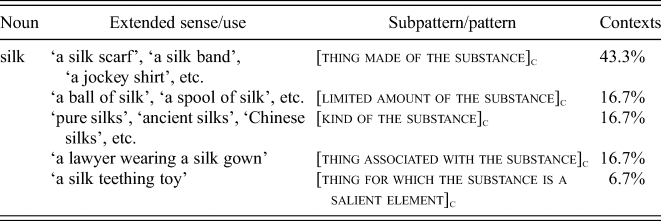
Similar discrepancies can be observed among the count extensions of mass nouns. The noun silk (table 4) has five senses with one of them clearly dominating, ‘a thing made of silk’, three less frequent and one rather rare.
The extended senses/uses of silk and the subpatterns and patterns under which they are classified

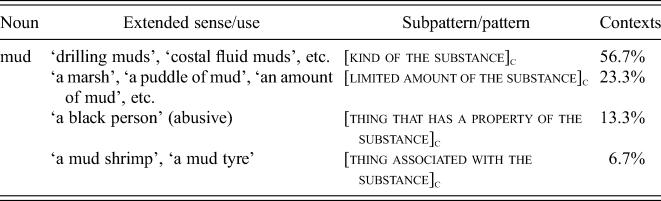
In the case of mud (table 5), the pattern is repeated: the frequency of senses ranges from quite frequent to two occurrences out of thirty.
The extended senses/uses of mud and the subpatterns and patterns under which they are classified

Finally, as among the count nouns, there are also two mass nouns with just one extended sense: salt (table 6) and flour. Again, this is the same sense, though this time it is ‘a kind of’, which possesses a special status among the count senses of mass nouns – it is the only sense that is shared by all the mass nouns. The frequency of these nouns is also irrelevant – salt belongs to the most frequent nouns, while flour – to the least frequent, like mud and silk.
The extended sense of salt and the pattern under which it is classified

There are also two general issues that need to be mentioned. The first of them concerns the universality of the detected regularities – to what extent can we expect to find them in other languages? To answer this question, we should first stress one of the fundamental assumptions of cognitive linguistics – that ‘meaning is language-specific to a considerable extent’ (Langacker Reference Langacker1987: 47), which means that the way people conceptualise reality in one language is largely unpredictable from the perspective of another language. And this is what cross-linguistic data seem to confirm.
First of all, there are languages that are claimed to lack the count–mass distinction, e.g. Halkomelem Salish (Wiltschko Reference Wiltschko2008), Hopi (Whorf Reference Whorf1956 [1941]) or Lillooet Salish (Davis & Matthewson Reference Davis and Matthewson1999). At the same time, among the languages that encode this distinction, considerable differences can be found, e.g. in Chinese nouns are predominantly mass (e.g. Borer Reference Borer2005), so there is basically one direction of change – from mass to count. In Ojibwe, mass-to-count changes are expressed through gender shift from inanimate to animate, while in Breton or Arabic the shift is from masculine to feminine (Mathieu Reference Mathieu2012; Goddard Reference Goddard2002). What is more, count and mass marking requires different mechanisms across languages, which means that any firm cross-linguistic generalisations at this stage of research are, at best, preliminary and require further research.
The other issue that I would like to consider is: why are such uses possible if the majority of them may seem incorrect at first sight? At the same time, why, for the most part, are they overlooked in grammar books?
I think there are several reasons for this. First, it is the wrong vision of the count-mass distinction that is disseminated in grammar books. Nouns are often presented as either count or mass, with a number of exceptions – those with both properties, while linguistic research shows a very different picture of the issue: nouns are flexible in assuming their grammatical property. Even nouns provided as representative examples of the mass category (Sinclair Reference Sinclair1990: 28) in fact possess count senses enumerated in dictionaries, e.g. food, rain, snow, water and money.
A consequence of this mistaken approach is that both ordinary speakers and linguists develop biased folk theories about the language and, although they use the senses themselves, they may believe that such senses are incorrect and that in fact they do not use them (e.g. Dąbrowska Reference Dąbrowska2016: 67–9). As a result, these senses are overlooked in grammatical accounts.
Another point to note is that these senses are not conventionalised and, in many cases, they have a lower frequency of occurrence than more central senses. Part of the answer is also that some senses seem to be more closely associated with specific occupations or social groups, e.g. ‘oven’ in the sense of ‘oven's size’ appears in the discourse of restaurant owners, as it is for them that the size of the oven matters and, consequently, it is something that they are concerned about. Similarly, ‘chin’ in the sense ‘an exercise that requires pulling oneself on a bar up to the chin’ is more familiar to people dealing with fitness.
However, this kind of generalisation cannot be pushed too far because the majority of the discussed senses come from general English. Senses like ‘jacket’ meaning ‘warmth provided by the jacket’ or ‘bag’ in the sense ‘bag's capacity’, etc. are used by speakers independently of their profession, because the only thing that they have in common is being a buyer, which means that this can be virtually anyone. Additionally, it should be noted that a significant part of the collected expressions come from official websites of e.g. government institutions, news agencies, newspapers and magazines, etc., and these are, in principle, available to the general public. As a result, anyone can see and use such senses.
To conclude, although the analysis of English nouns is far from complete, the present results are already quite telling, that is, even at this stage they explain a lot. At the same time, they are promising – due to the proposed methodology, it is possible that one day all nouns will be checked and all regularities determined.