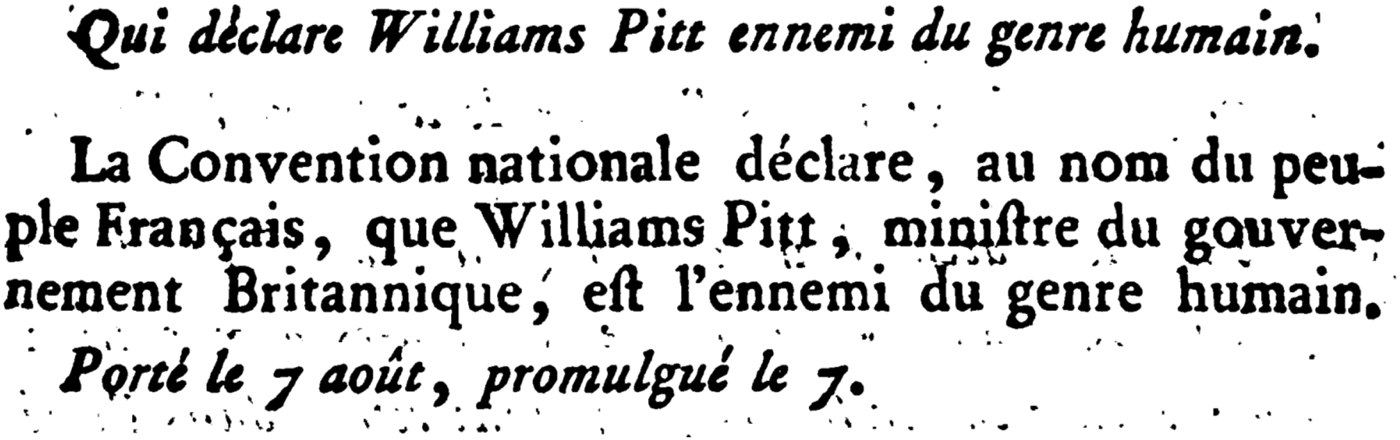
At the close of World War II (WWII), Winston Churchill suggested summarily executing the remaining Nazi leadership. Franklin Delano Roosevelt disagreed, insisting on prosecuting them in an international military tribunal. This is considered the “birth” of International Criminal Law (ICL),Footnote 1 following a consensus that “[t]he Nazi atrocities gave rise to the idea that some crimes are so grave as to concern the international community as a whole.”Footnote 2 A few earlier instances of penal action against violators of the laws of war are acknowledged, but they are dismissed as unrelated to current ICL, because (presumably) these cases are sporadic domestic legal actions that lack a common doctrine.Footnote 3
The present article challenges this construction of ICL history. Pre-WWII penal enforcement of the laws of war had the following features: 1) it was non-negligible; 2) in all instances, the same transnational doctrine (still part of ICL to some extent) was applied; and 3) the forums that tried the perpetrators were not merely domestic organs. Furthermore, “crimes against humanity” and “crimes against peace” (“aggression”) also have a long pre-WWII history. Simply put, notwithstanding the significance of post-WWII trials, ICL history stretches for nearly a millennium.
Part 1 of this article discusses preliminary indications that pre-WWII penal enforcement of the laws of war was doctrinally related to post-WWII ICL, pointing to evidence of “outlawry” as a common doctrinal thread. Parts 2 and 3 discuss methodological issues. Parts 4 and 5 trace the origins of the outlawry doctrine and its relation to ICL. Part 6 discusses the pre-WWII history of crimes against humanity. Part 7 explores key reasons for the predominance of the current narrative about ICL history. Part 8 exposes the harms caused by the current historical misperception.
1. Acknowledged Pre-WWII Cases
When ICL's history is currently described, only six pre-WWII events are typically noted: the medieval trials of Conradin, King of Jerusalem (1268), William Wallace (1305), and Peter von-Hagenbach (1474) for violating the “laws of God and man” (a term used for centuries to describe international law); the proposal to execute Napoleon for starting war in violation of international commitments (1815); the adoption (1863) and enforcement of the Lieber Code (the first modern codification of the laws of war) during the American Civil War (1861–65); and the WWI proposals to prosecute the Kaiser and other German war criminals. However, after being briefly noted, these cases are usually deemed irrelevant to present-day ICL, mainly for being sporadic and lacking a common legal doctrine.Footnote 4
Piracy is the only international crime with a recognized pedigree, because of the application of the same transnational doctrine for centuries across nations. According to this doctrine, universal jurisdiction applies because “a pirate [is] an outlaw [and] a ‘hostis humani generis’ [enemy of mankind]” for violating international law.Footnote 5 That doctrine contained, until recently, additional elements: 1) pirates were referred to by synonymsFootnote 6 of the term “outlaws,” such as “disturbers of the peace”Footnote 7 and “enemies of peace”Footnote 8; and 2) death was the universal maximum sentence for piracy and it was executed summarily or following a military trial.Footnote 9
Currently, universal jurisdiction applies also to perpetrators of “core international crimes” (“war crimes,” “crimes against humanity,” “crimes against peace” [“aggression”], and “genocide”), which, presumably, turns “the power of criminal punishment against the hostis humani generis, the enemy of mankind, the universal outlaw, expressions historically associated with the pirate.”Footnote 10 Namely, the application of universal jurisdiction to such crimes is assumed to be a post-WWII development accomplished by adopting the international outlawry doctrine from piracy law. In-depth examination of the six pre-WWII cases, however, reveals a recurring “outlawry format,” suggesting a centuries-long application of a transnational doctrine, similar to piracy law.
Contemporary jurists depict Conradin's case (1268) as an ancient conviction for “crimes against peace,” as he was tried and punished for instigating an unjust war (because of papal opposition) to become the King of Sicily.Footnote 11 This depiction ignores that Conradin was convicted by a panel of knights (military tribunal) and executed as “a disturber of the public peace [i.e. outlaw] … and the usurper of a kingdom, which the pope had granted to another.”Footnote 12 In some accounts, Conradin was further held “responsible for all the excesses [i.e. war crimes] of [his] German soldiery.”Footnote 13
Conradin's execution
According to fourteenth-century jurist Giovanni da-Legnano, Conradin was beheaded because “disturbance of the peace [was] not feared.”
Sources: Image: Painting by Giovanni Villani (fourteenth century), [Public-domain] via Wikimedia-Commons, http://commons.wikimedia.org/wiki/File%3AKonradin_Poprava.JPG (last accessed 28 March 2016).
Text: Giovanni da-Legnano, trans. J.L. Brierly Tractatus de Bello, de Reprisaliis et de Duellom (New York: Oxford University Press, 1917) (c. fourteenth century), 254, 274.

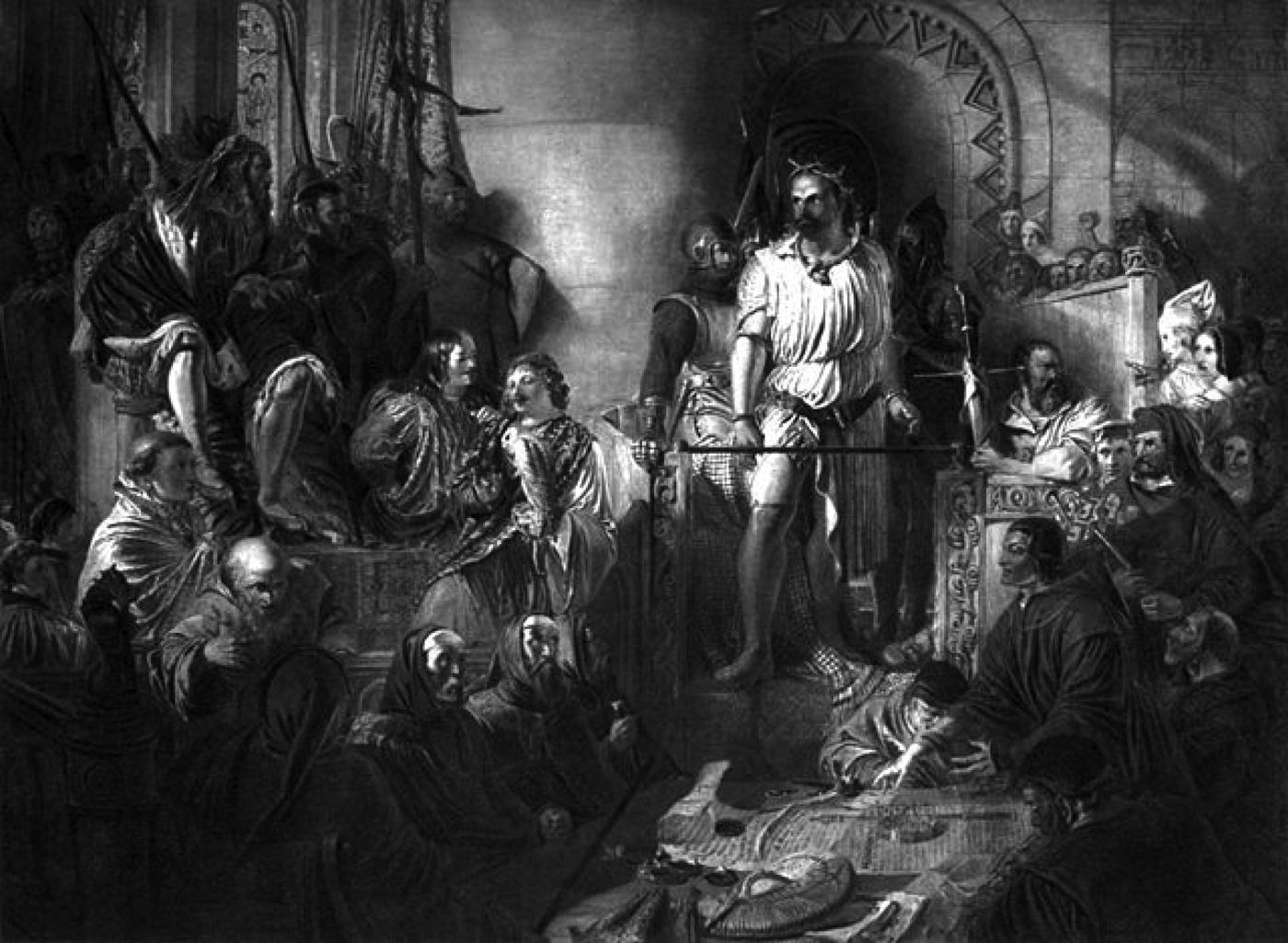
In what jurists commonly describe as “the earliest recorded trial … for war crimes,”Footnote 14 William Wallace was tried in 1305, for “sparing neither age nor sex, monk nor nun” in a Scottish campaign he led against England. Conradin's earlier war crimes conviction refutes this. Moreover, an outlawry format has currently gone unnoticed: “Wallace was drawn for treason, hanged for robbery and homicide, disemboweled for sacrilege, beheaded as an outlaw and quartered for divers[e] depredations,”Footnote 15 after being convicted by a military tribunal.Footnote 16
Wallace's trial
King Edward in a letter to the pope referred to Wallace and his men as “enemies of peace.”
Sources: Image: Painting by Daniel Maclise, [Public-domain] via Wikimedia-Commons, http://commons.wikimedia.org/wiki/File%3ADaniel_Maclise%2C_R.A._-_The_Trial_of_Sir_William_Wallace.jpg (last accessed 28 March 2016).
Text: Joseph Stevenson, “Introductory Notice” to Documents Illustrative of Sir William Wallace, His Life and Times (Glasgow: Maitland Club, 1841), ix, xxi.
Peter von-Hagenbach was appointed governor of Breisach by the Duke of Burgundy, who had conquered it for ransom. As governor, von-Hagenbach orchestrated atrocities against locals. Current ICL scholarship describes that, in 1474, after the occupation ended, he was sentenced to death for murder, rape, and other crimes against the laws of God, by a tribunal composed of judges from several princedoms. Some, therefore, consider this case the earliest trial by a transnational criminal tribunal, and the only one before Nuremberg.Footnote 17 Contemporary jurists rarely mention that von-Hagenbach was tried by a military tribunal and convicted of tyranny.Footnote 18 The tyranny conviction is significant because for centuries, tyranny charges rendered individuals “hostes humani generis—international outlaws—who fall within the scope of ‘universal jurisdiction’ and, as the way of pirates, were ‘to be hanged by the first persons into whose hands they fall.’”Footnote 19
Von-Hagenbach's beheading
Von-Hagenbach is still remembered as a tyrant. For example, the French Moments tourism site states that “a focal point [in Colmar's Unterlinden Museum] is the mummified head of local tyrant, Peter von-Hagenbach.”
Sources: Image: Painting from the Chronicle of Christoph Silberysen (1572), [Public-domain], via Wikimedia-Commons; http://commons.wikimedia.org/wiki/File%3AHagenbach_aarau.jpg (last accessed 28 March 2016).
Text: “Colmar Old Town,” at http://www.frenchmoments.eu/colmar-old-town/ (last accessed 28 March 2016).
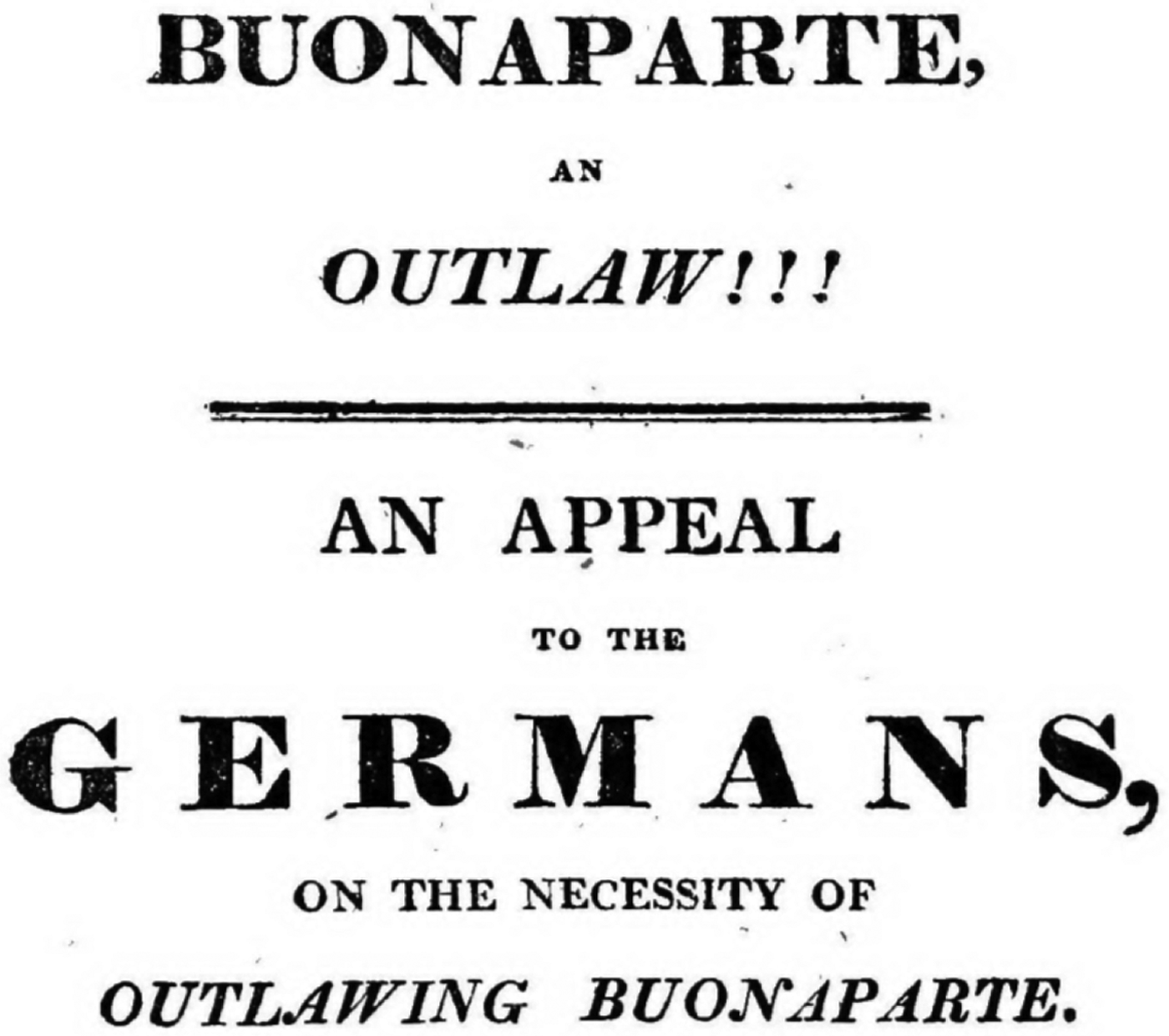
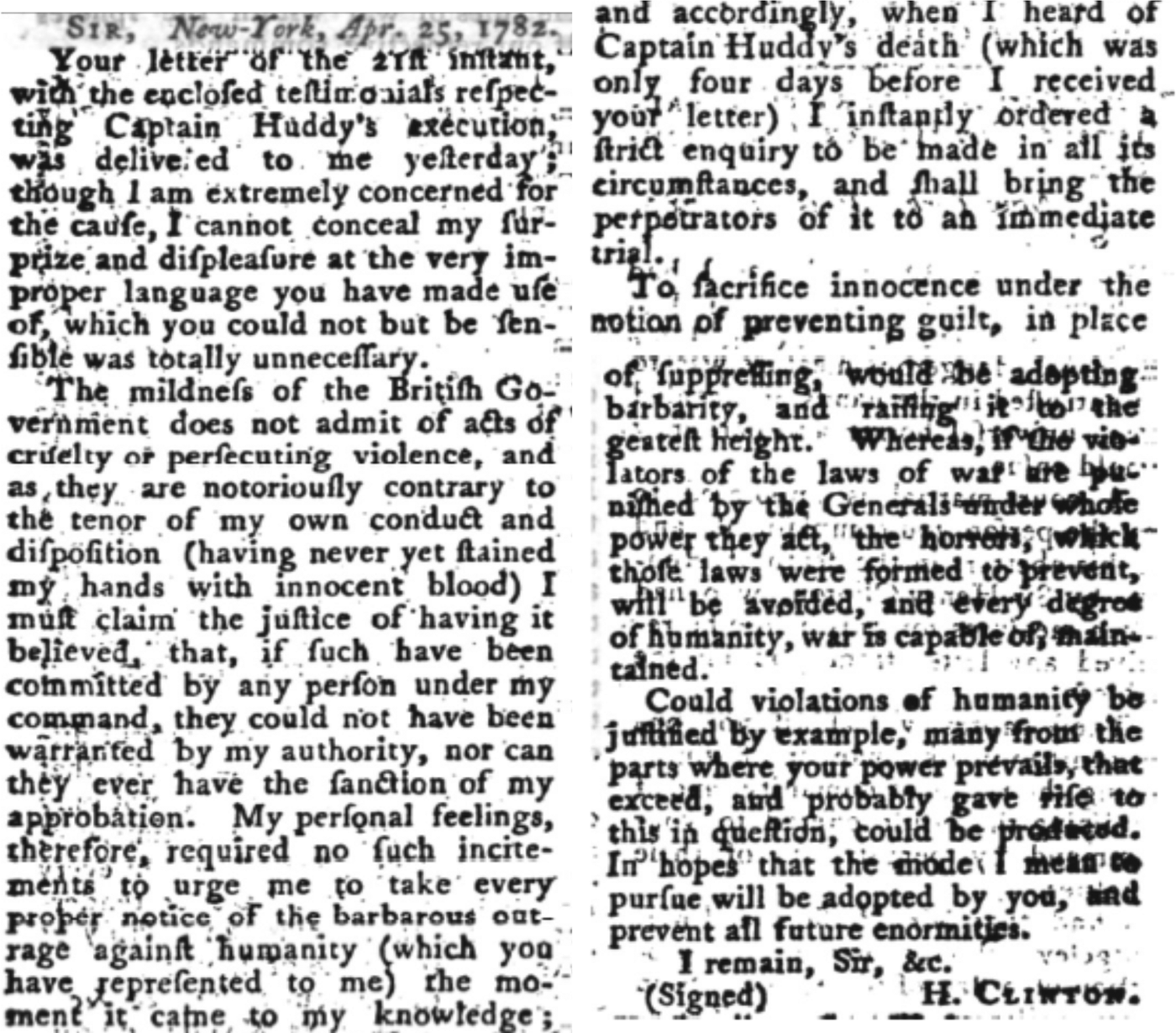
Napoleon's case (1815) is often presented as a failed attempt to punish a perpetrator of “crimes against peace.” The reality was more complex. In 1815, the Congress of Vienna, an international body representing most European countries, declared Napoleon “an Enemy and Disturber of the Tranquility of the World [i.e. outlaw], that he has incurred public vengeance,” for “violating the convention which established him in the Island of Elba” and “reappearing in France with projects of disorder and destruction.”Footnote 20 The British prime minister argued that Napoleon could be considered a “captain of freebooters or banditti and consequently out of the pale of protection of nations [that] headed his expedition as an outlaw and an outcast; hostis humani generis.”Footnote 21 Prussian Field-Marshal Blucher declared Napoleon an “outlaw,” wanted dead or alive.Footnote 22 Eventually, Napoleon was captured and perpetually detained without trial “for the Preservation of the Tranquility of Europe.”Footnote 23
Napoleon's outlawry
An 1813 pamphlet, asserting, based on international law, that Napoleon should be declared an outlaw.
Source: Lewis Goldsmith, Buonaparte, an Outlaw!!! An Appeal to the Germans, on the Necessity of Outlawing Buonaparte (London: R. Juigne, 1813) http://google.co.il/books?id=8J5TAAAAcAAJ (last accessed 28 March 2016).
It is of note that the British prime minister equated Napoleon to a pirate (“freebooter”) more than a century before WWII. This contradicts the premise that the link between core international crimes and piracy is a recent development. Furthermore, by comparing Napoleon to a bandit, he was using a term then applied, together with “brigands” and “bush-whackers,” to unlawful combatants, toward whom an international outlawry doctrine had also been employed for centuries.Footnote 24 During the American Civil War, for example, the Union routinely deemed Southern unlawful combatants “outlaws”/“enemies of mankind” and executed them summarily or following a military trial.Footnote 25
The Union's outlawry of Confederate irregulars A Union military decree, referring to Confederate irregulars as the “common foe of mankind” and declaring that they would be hanged upon capture as they are “entitled to none of the rights accorded by the laws of war to honorable belligerents.”
Source: The original document is archived at Wofford College's Sandor Teszler Library (Attribution-Noncommercial-No Derivatives Creative-Commons license)
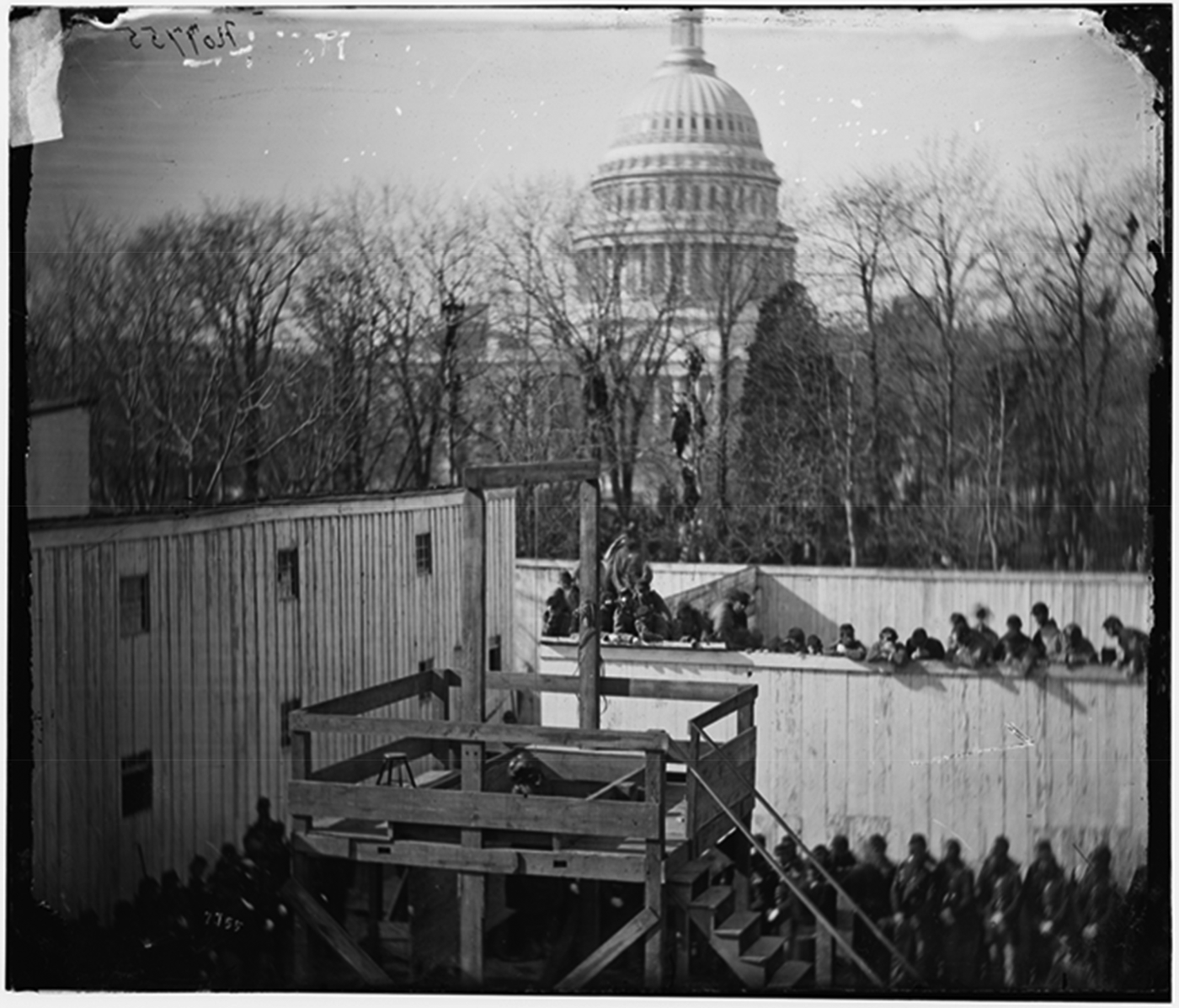
Outlawry was invoked by the Union also with regard to regular Southern soldiers who had violated the laws of war, as in the case of Confederate Captain Henry Wirz. Horrific atrocities were committed during Wirz's command of the Andersonville prisoner of war (POW) camp. After the war, he was sentenced to death by a military commission for conspiring with others “to injure the health and destroy the lives of … prisoners of war … in violation of the law of war.”Footnote 26 At trial, the judge-advocate declared that the conspirators had “forfeited all rights … they are outlaws and criminals.”Footnote 27
Wirz's execution It is difficult to dismiss something as insignificant when it is carried out on Capitol Hill.
Source: Picture by Alexander Gardner [Public-domain], via Wikimedia-Commons; http://commons.wikimedia.org/wiki/File%3AHooded_body_of_captain_wirz.tif (last accessed 28 March 2016).
Similarly, the Confederates deemed Northern soldiers they accused of war crimes outlaws. For example, Confederate President, Jefferson Davis, accused Union General, Benjamin Butler, of violating the laws of war by executing certain Southern civilians, and declared that Butler would be summarily executed if captured, as “an outlaw and common enemy of mankind.”Footnote 28
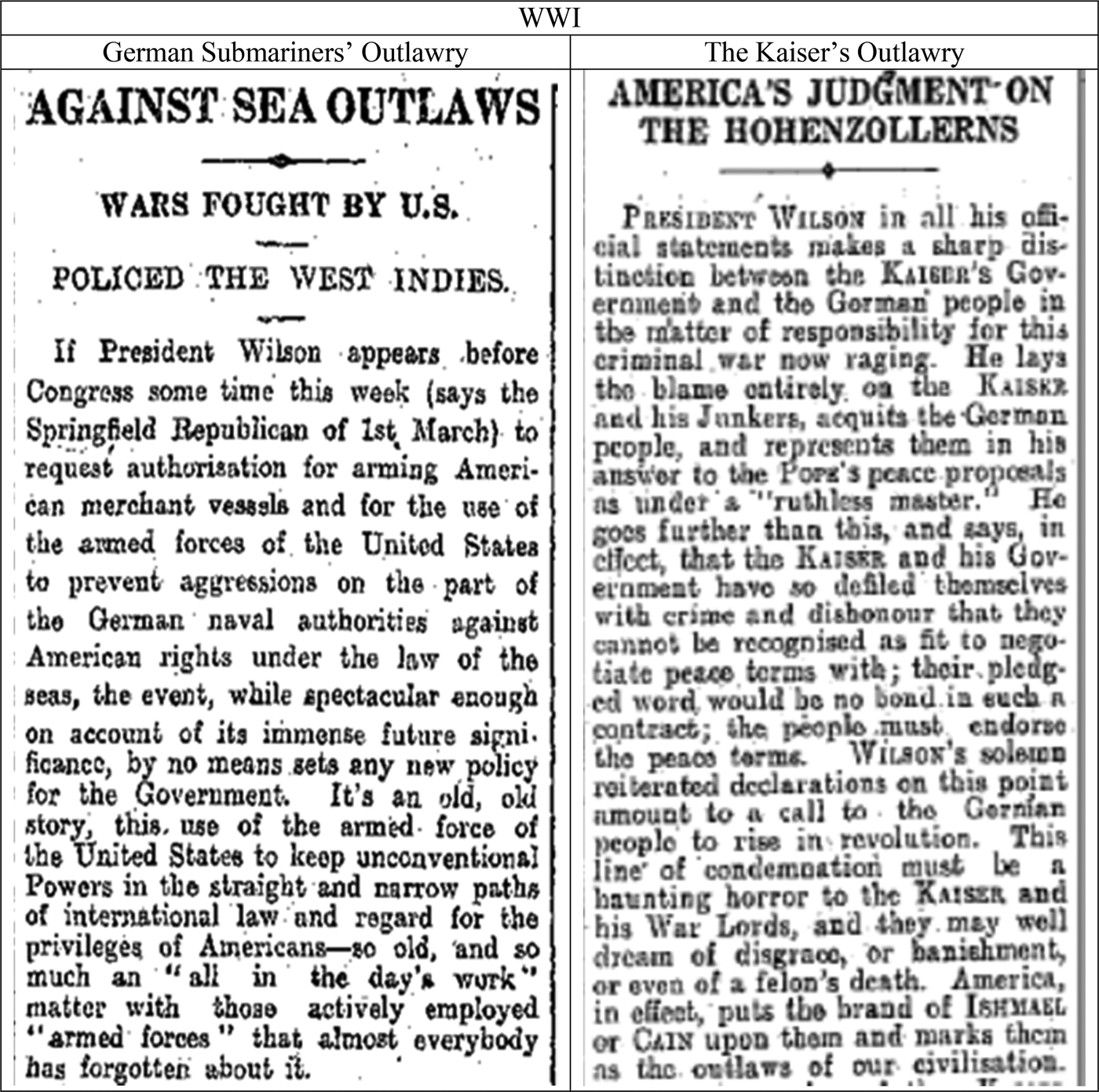
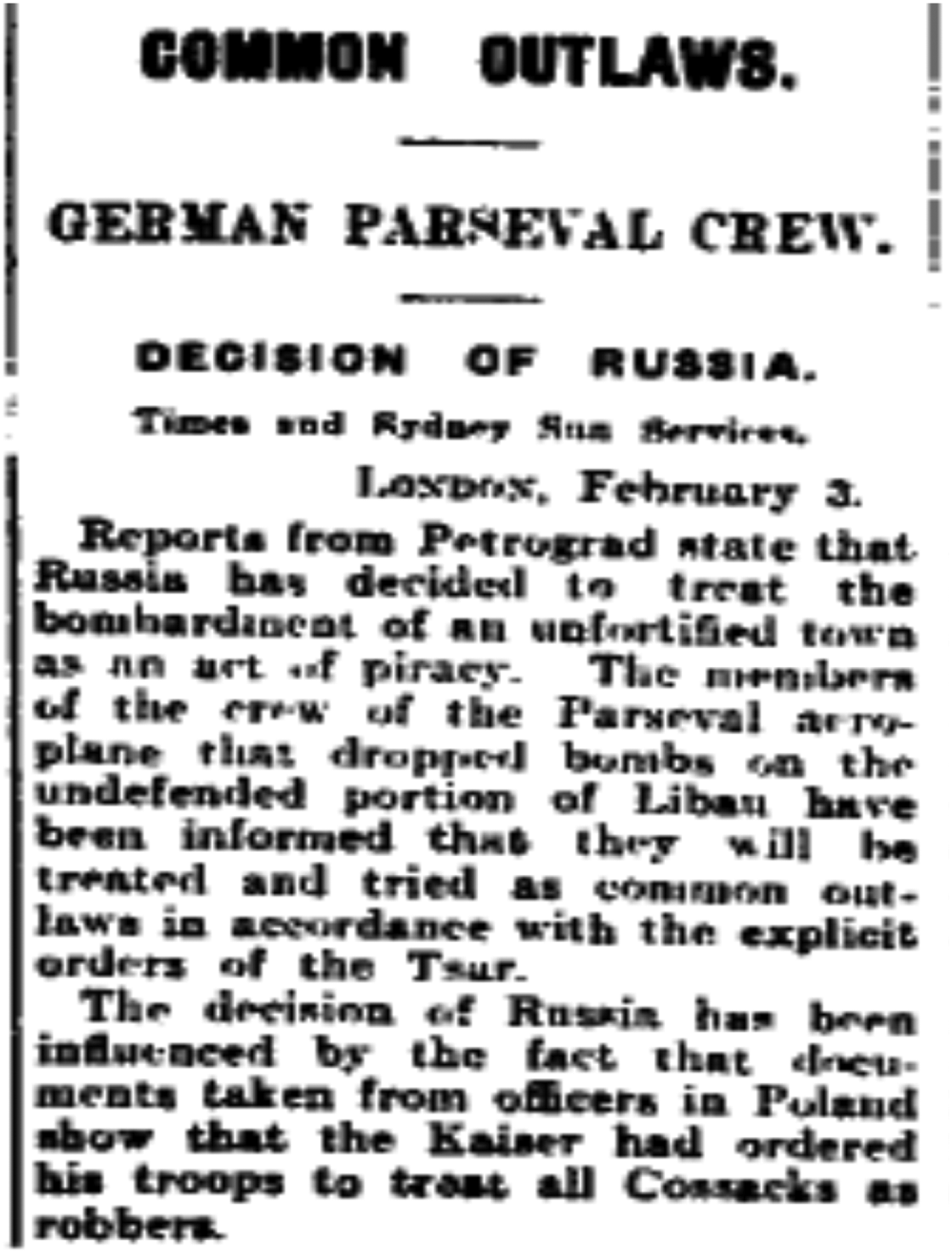
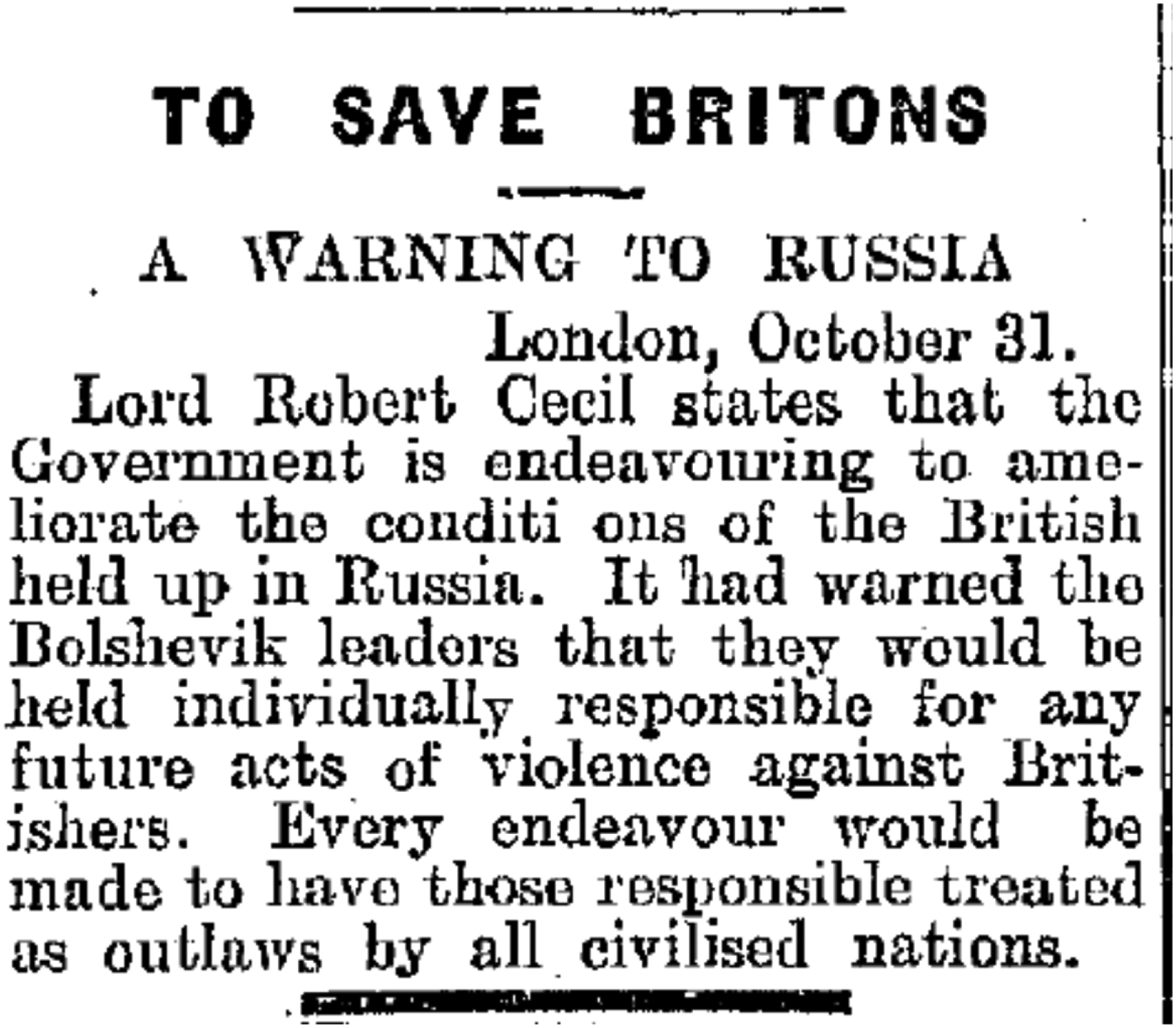
Outlawry was often invoked in reference to German WWI submariners for their attacks on civilian ships. For example, in his congressional declaration of war, President Woodrow Wilson stated that because of their “wanton and wholesale destruction of the lives of non-combatants … [t]he present German submarine warfare against commerce is a warfare against mankind” and “[b]ecause [German] submarines are in effect outlaws… [i]t is… necessity indeed, to endeavour to destroy them before they have shown their own intention.”Footnote 29
Outlawry was also applied in reference to the Kaiser. During a British War Cabinet meeting, in 1918, Lord Curzon reported that French Prime Minister Clemenceau had suggested “treating the Kaiser as a universal outlaw [for violating international law] so that there should be no land in which he could set his foot.”Footnote 30 Subsequently, the Cabinet appointed a legal commission, which concluded that international law authorized punishing the Kaiser either by trial or summarily “as Napoleon was treated.”Footnote 31
Outlawry in WWI
Left: Part of a report from The Evening Post 13 (April 14, 1917).
Right: Part of a report from The Dominion 6 (September 8, 1917), stating that “the Kaiser and his War lords … may well dream of disgrace, or banishment, or even a felon's death. America … marks them as the outlaws of our civilization.”
Source: All images of news-reports in this Article are from “PapersPast”, http://paperspast.natlib.govt.nz/cgi-bin/paperspast (last accessed 28 March 2016).
It is important to recall the event commonly described as the “birth” of ICL: Roosevelt's opposition to Churchill's summary execution proposal. The legal basis of Churchill's proposal was “the old-fashioned idea of the ‘outlaw.’”Footnote 32 He suggested that a committee of jurists compile a list of arch-war-criminals who would be deemed international outlaws by solemn joint decree of the Allies, and if one of them were to fall into Allied hands, the nearest major-general would convene a court of inquiry, not to determine guilt but “to establish the fact of identification [after which the] officer will have the outlaw or outlaws shot to death within six hours and without reference to higher authority.”Footnote 33 Churchill's idea of summarily executing war criminals within 6 hours from capture “became the policy of the British government from 1943 until the very end of the war.”Footnote 34
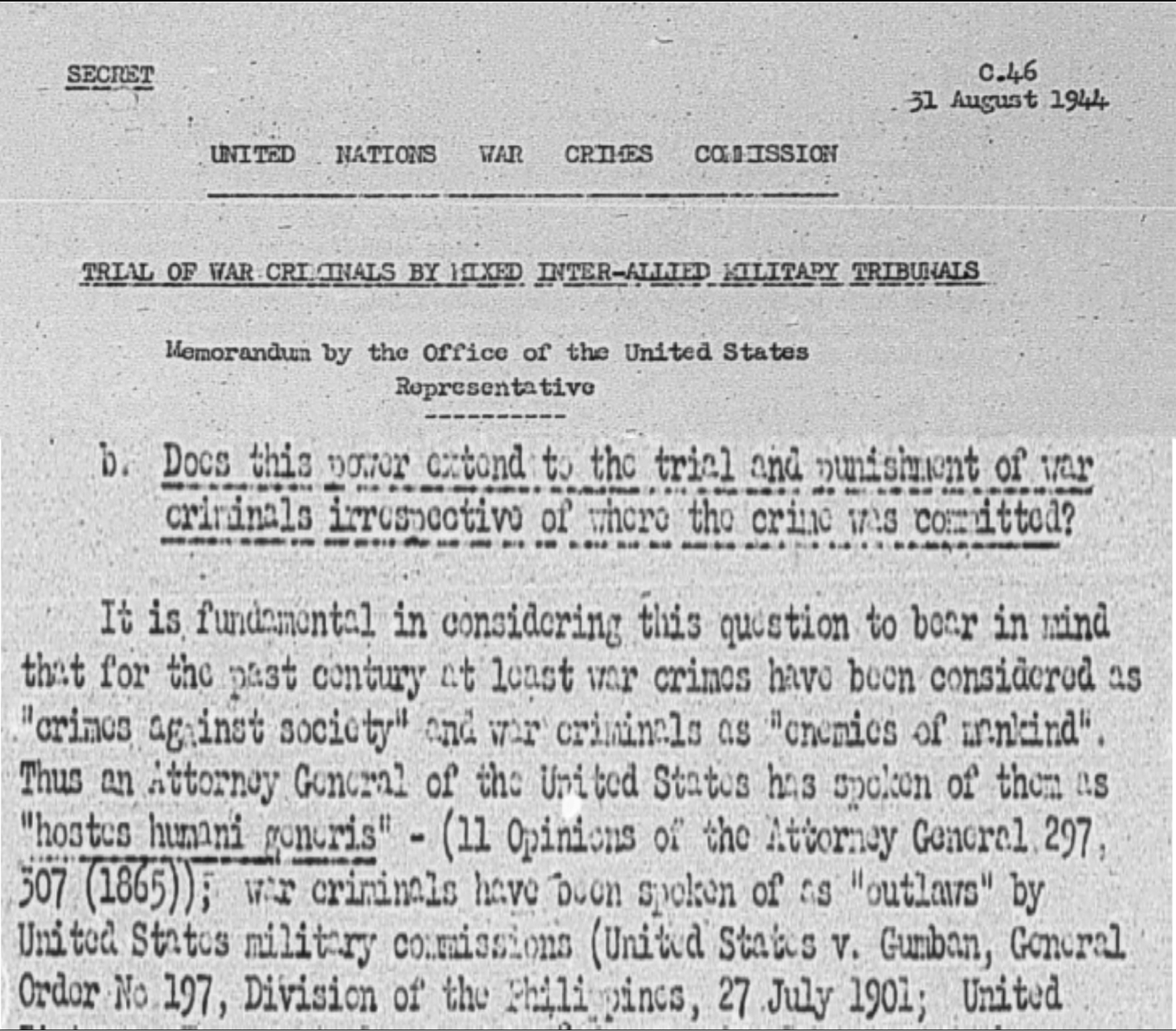
Supporters of Roosevelt's tribunal proposition also relied on outlawry. An American memorandum from 1944 on the “Trial of War Criminal by Mixed Inter-Allied Military Tribunals” stated that “[i]t is fundamental in considering th[e] question [of universal jurisdiction] to bear in mind that for the past century at least war crim[inals] … have been considered … ‘enemies of mankind’ … ‘hostis humani generis’ … ‘outlaws.’”Footnote 35
WWII: Parts of the American Memorandum
In sum, an outlawry format similar to that of piracy cases is present in all commonly recognized pre-WWII war crimes cases, challenging the premise that these were not part of the doctrinal evolution that produced current ICL.
2. The “Modern State Conception” and Nineteenth Century Positivism
It is intuitively assumed that criminal justice systems must have a centralized law enforcement structure, because no such system “execute[s] the penal laws of another.”Footnote 36 Penal laws are also assumed to be generally aimed at protecting the interests of the legal system's local community, which often places jurisdictional (usually territorial) limits on their enforcement. These laws are further expected to be formally legislated by an official body.Footnote 37 Put differently, it is intuitively assumed that: “Criminal justice presupposes sovereign States.”Footnote 38
As Hathaway and Shapiro pointed out, however, this “Modern State Conception is both an excessively narrow and historically incomplete account of law. Legal systems can and have existed despite lacking the capacities of a modern state.”Footnote 39 In pre-state Germanic tribes, for example, penal law was unlegislated and law enforcement was outsourced by entitling everyone to extrajudicially kill criminals.Footnote 40 Moreover, not only obsolete legal systems are characterized by decentralization. Contemporary international law shares considerable attributes of decentralization with pre-state Germanic legal systems. Scholars have pointed out this fact to refute the claim of international law's opponents that it is not truly a legal system because of dissimilarities between it and modern domestic legal systems.Footnote 41 Support for this unjustified delegitimation of international law is largely the result of the intuitive endorsement of the “modern state conception.”
The inaccuracy of this conception is further evident in the fact that even some contemporary domestic systems exhibit elements of decentralization. In Scotland, the legislative function is somewhat decentralized, as some crimes are unlegislated and judges have inherent “declaratory power” to “find” additional conduct to be criminal.Footnote 42 Many Continental European systems support some decentralization of law enforcement through judex loci deprehensionis, a doctrine that allows, under certain conditions, prosecuting foreigners for committing acts defined as crimes by the foreign law of their place of commission, even if the prosecuting state and its citizens were not affected by these acts.Footnote 43
It is not completely coincidental that these domestic systems exhibit attributes that partially resemble Germanic systems, as they have originated from such systems. Interestingly, the Germanic doctrine that served as the basis for the outsourcing of law enforcement was outlawry, which originally permitted killing on sight anyone deemed an “outlaw” for having committed a grave crime.Footnote 44 This doctrine's conflation, during the late Middle Ages, with somewhat similar Roman-Christian doctrines is recognized as pivotal to the development of domestic criminal justice, and more generally, to the rise of the modern state.Footnote 45 As this article reveals, international law's resemblance to Germanic systems is similarly noncoincidental; ICL's history, which is much longer than assumed, is also bound to the outlawry doctrine.
The intuitive endorsement of the “modern state conception” is a main cause for the disregard of ICL's long history. Nineteenth century positivism has propagated this flawed conception of legal systems, as many positivists maintained that penal law is “necessarily of a positive, local existence.”Footnote 46 Nineteenth century positivism has motivated considerable reforms in domestic law. As a result, most criminal justice systems came to resemble the model that many positivists supported, and they still maintain these qualities, despite the fact that positivism itself no longer supports the narrow perception of legal systems that nineteenth century positivists commonly supported.Footnote 47 Individuals unconsciously tend to generalize from personal experiences and prevailing paradigms, and, presently, “the legal systems … most familiar [to us] are domestic [and] modern state regimes are the paradigm instances of law.”Footnote 48 This unconscious tendency and the contribution of nineteenth century positivism to the shaping of contemporary domestic systems jointly lead to the intuitive reliance on the “modern state conception.” Uncovering ICL's long, outlawry-related history demands confronting this flawed conception. Therefore, I mention and refute various nineteenth century positivist propositions throughout the article.
To clarify, nineteenth century positivism was a diverse jurisprudential school, whose proponents’ positions regarding international law considerably varied.Footnote 49 This article is bound to fail to do full justice to this diversity because of space constraints, which necessitate focusing on anti-ICL, nineteenth century positivist views, as these played a significant role in the pretermission of ICL history. Interestingly, even these positions varied in their attitude toward international law. Austin, the period's leading positivist, defined “law” as a command backed by threats of sanctions issued by a sovereign. Based on this definition, he concluded that international law (not only ICL) is not “law” but mere “positive international morality.”Footnote 50 Others adopted a dualistic position that perceived domestic and international law as two substantially different legal systems, the former regulating individuals and the latter coordinating between states. This perspective still rejects ICL, because ICL is addressed to individuals.Footnote 51
3. Genealogical Accounts
This article gradually presents ICL's long history and uncovers its persistent reliance on outlawry. However, some international legal historians are averse to such genealogical accounts of the origins of contemporary international norms and institutions, because of the teleological and anachronistic tendencies of such accounts.Footnote 52 Genealogical accounts also tend to mistakenly regard the original application of a doctrine as the explanation for each of its iterations, even though tracing back a doctrine's iterations up to the first application does not provide such an explanation. It only raises the question: why was the same doctrine applied in all of the different instances?Footnote 53
Some argue that in each instance a legal doctrine is applied because of the case-specific, nonlegal interests of the powerful, and the pretense of applying a long-standing legal doctrine is used to conceal these nonlegal interests.Footnote 54 Others argue that even if domestic law can affect the behavior of the powerful, international law cannot.Footnote 55 If one of these views is correct, a genealogical account of ICL is uninteresting because each application of ICL is “truly” determined by the case-specific power balance.Footnote 56
However, there is nothing necessarily anachronistic or teleological about a genealogical account,Footnote 57 especially when it concludes that “we are looking at a continuum, albeit not a linear one. While there have been important discontinuities along the way these do not lead to what might be termed a dis-continuum.”Footnote 58 As Bourdieu further pointed out, “[t]he social practices of the law are … the product of the functioning of a ‘field’ whose specific logic is determined by two factors: … the specific power relations [and] the internal logic of juridical functioning which constantly constrains the range of possible actions and, thereby, limits the realm of specifically juridical solutions.”Footnote 59 Although the pre-existence of a legal doctrine is usually not the sole reason for any of its iterations, it may provide a partial explanation for each such iteration, because such “past gives us vocabulary, and that vocabulary in turn shapes the very way we think of a problem.”Footnote 60 In the case of ICL, the relevant vocabulary depicts violators of certain international laws as enemies of humanity/outlaws. Laws, therefore, often have effects that go beyond concealing nonlegal motivations, and even the powerful are susceptible to such effects. This is true for both domestic and international law.Footnote 61 Therefore, the history of the independent effect of international laws should be researched, and genealogical accounts are crucial for such research because the internal logic of the law relies “upon precedent, customs and patterns of argument stretching back [in time].”Footnote 62
Admittedly, during power struggles, legal uncertainty often exists, as opponents tend to disagree on the interpretation of the relevant law. However, the law still has some influence, forcing the sides to structure their claims in a certain manner and limiting the legitimate interpretational possibilities.Footnote 63Jus ad bellum, for example, because of the strategic issues it addresses, has always been more exposed to power struggles than most other laws of war. Its norms, therefore, often suffer from uncertainty and political “abuse,” but historical research of various centuries has shown that even jus ad bellum often has independent influence.Footnote 64
According to the genealogical account that will be discussed, ICL continuously existed since the late Middle Ages. This could raise another inaccuracy concern, because many international legal historians consider international law to be a late nineteenth century innovation, pointing to several points of discontinuity with earlier transnational law.Footnote 65
One such claimed point of discontinuity is the transition from the European jus gentium to the contemporary global system of international law,Footnote 66 but, this transition, in the context of ICL, did not occur in the form of a rupture. Originally, the European jus gentium (ICL included) was a trans-Christian/European/Western system whose members (egocentrically) regarded themselves as “mankind”/“humanity,”Footnote 67 and it was prescribed to wage total war, without any jus in bello restrictions, against non-Christian nations, which were referred to as “uncivilized”/“barbarians”/“savages” (and for several centuries “infidels”).Footnote 68
In practice, however, during the late Middle Ages and Early Modern Times, in some wars between Christians/Europeans/Westerners and non-Christians/Europeans/Westerners, jus in bello restrictions were applied.Footnote 69 There are even such cross-cultural wars in which certain mutely accepted applications of ICL can be detected.Footnote 70
Case-specific political considerations explain, in part, the variation in conduct between different cross-cultural wars.Footnote 71 Determining that an enemy belonged to a category that justified waging total war was an ad bellum legal matter, and, therefore, especially susceptible in its application to the influence of such considerations.
Nevertheless, the law itself also had an influence in constraining wartime conduct in such cross-cultural wars. “European thought about the law governing interactions among states and peoples—ius gentium, law of nations, international law—has … always existed in a space of tension between the European and the universal.”Footnote 72 Because of this incoherent duality, throughout the history of international law, both sources that conceptualized it as universally applicable and sources that regarded it as only applicable to Christians/Europeans/Westerners existed; although, the extent of support for each position (universalist or exclusionary) varied between different periods.Footnote 73 The likelihood that a decision to wage total war would be made, was, mostly likely, influenced by the fluctuating support for universalist positions.Footnote 74 It should also be noted that, because of the influence of certain universalist positions, already before the late nineteenth century there were some cases in which ICL was applied on the basis of a universalist, human-rights-oriented perspective.Footnote 75
A comparison of different accounts that depict the coming into being of the current global system as resulting from a rupture reveals considerable discrepancy regarding the time in which globalization has presumably occurred, with various dates, ranging from the late nineteenth century to the 1970s, being suggested.Footnote 76 As these issues are closely related,Footnote 77 it is unsurprising that a difficulty similarly exists in pinpointing the time in which the ad bellum doctrine permitting waging total war against non-Christians/Europeans/Westerners was abandoned.Footnote 78 These difficulties result, at least in part, from the fact that throughout this century-long period (as in previous times), in some conflicts, all parties—Westerners and non-Westerners alike—recognized the applicability of the (originally European) laws of war,Footnote 79 whereas in others, Western belligerents waged total war against their non-Western opponents (some of them, up until WWII, even explicitly justified their actions based on the ugly ad bellum doctrine regarding “uncivilized” nations).Footnote 80 Hence, the abandonment of the ad bellum doctrine regarding “uncivilized” nations was clearly not the result of a rupture, but of an extremely nonlinear, protracted process.
Not only jus ad bellum influenced decisions whether or not to wage total war. At times, the conventional (originally European) jus in bello also had a moderating influence. Humanitarian considerations embedded in these norms influenced the decision of at least some commanders not to wage total war.Footnote 81 Furthermore, once a decision was made not to wage total war (for whatever reason), European forces often turned to the wartime legal code of conduct familiar to them; although, because of the reciprocal nature of warfare, often, the norms familiar to the other side also had an influence on the mutually adopted legal code of conduct.Footnote 82 Since the eighteenth century, however, as the power gap between European/Western forces and non-European/Western forces grew, increasingly, the European norms were simply imposed upon non-European forces.Footnote 83 The signing by non-Western countries in the nineteenth and twentieth centuries codifying treaties of the laws of war further contributed to these norms’ globalization.Footnote 84
The increasing adoption of the originally European jus in bello was not a linear process.Footnote 85 Also, contrary to the way many Western jurists still wrongly imagine it to be, this process was not the result of “civilization‘s” progression,Footnote 86 but of various factors, many of them coercive, such as: 1) forced acculturation, 2) the use of non-Western forces by Western/European colonialist nations, and 3) the adoption of these laws by non-Western/European nations as means to reduce Western/European nations’ ability to justify waging total war against them.Footnote 87 The adoption of these originally European in bello laws by non-Western/European nations was further influenced by the fact that “military culture [is] possessed of its own imitative dynamics,”Footnote 88 because “[w]ar is a competitive and reciprocal activity … [t]he common culture of armed forces … has a function, whose robustness frequently prevails over national and political differences.”Footnote 89 As a result of the expanding adoption of these laws, most contemporary laws of war are identical to, or gradually developed from, the past European laws of war.Footnote 90 Therefore, in the context of jus in bello as well, globalization did not occur in the form of a rupture.
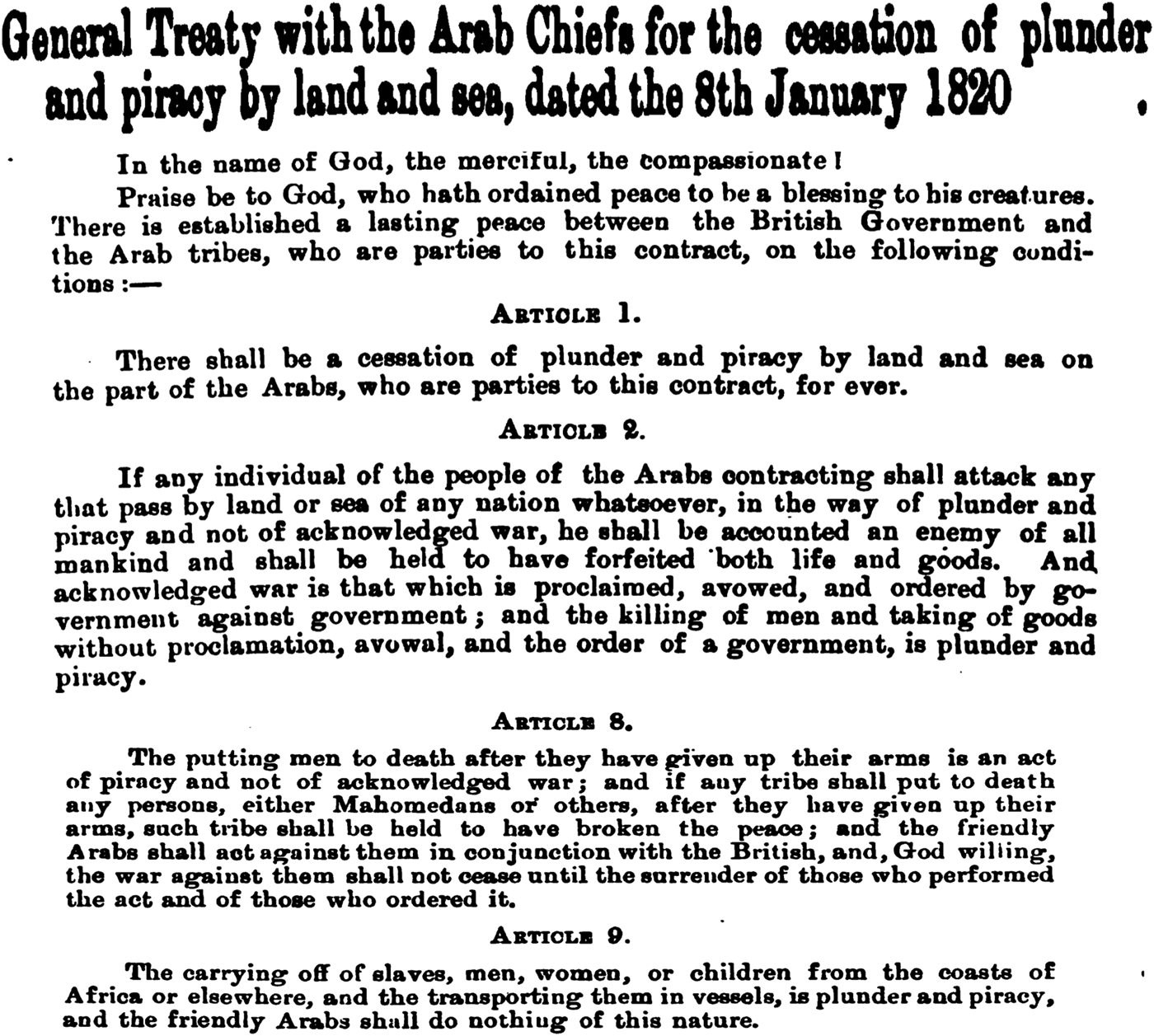
Example of the Outlawry Doctrine's spread through coerced acculturation
The treaty does not merely prohibit piracy (art. 1–2), brigandage (art. 2 [piracy on land]), killing hors de combat (art. 8), and slave trading (art. 9). It is agreed in it that perpetrators “shall be accounted … enem[ies] of all mankind” (explicitly in the case of piracy/brigandage and implicitly with regard to killing hors de combat and slave trading [by deeming them forms of piracy]).
Source: The treaty is reproduced in Charles Umpherston Aitchison, ed., A Collection of Treaties, Engagements, and Sanads Relating to India and Neighboring Countries, 11 vols. (Calcutta: Office of the Superintendent of Government Printing, 1892), 10:127–128.
Some international legal historians argue that international law was only born in the nineteenth century as a result of the shift from natural law jurisprudence to positivism, which, presumably, rationalized international law.Footnote 91 This claim is inaccurate. Positivism was not the first jurisprudential school to claim to rationalize international law; secular natural law preceded it, albeit claiming to attain this aim in a different manner.Footnote 92 Furthermore, during nearly all periods, including the nineteenth century, various jurisprudential schools existed, as well as many positions within each school regarding obedience to international law. Moreover, jurists who mainly followed certain jurisprudential positions often accepted elements of other schools.Footnote 93
Because of the absence of jurisprudential uniformity, many international legal historians no longer focus on theories of law to characterize different periods but examine each “period's legal consciousness, understood as the ensemble of categories, concepts, typical arguments, argumentative techniques, and so forth, that characterize the work of [practitioners] and scholars of that period.”Footnote 94 Interestingly, many legal historians who adopt such a basis for periodization still conclude that a rupture occurred during the nineteenth century; according to their position, it occurred because of the rise of the modern international legal profession.Footnote 95 In this aspect, however, the laws of war, including ICL, differ from other areas of international law. For centuries, this body of law was enforced predominantly by a discrete military subculture,Footnote 96 which moderated the effect of nineteenth century transformations (as well as earlier ones).Footnote 97
The exact extent of penal enforcement of the laws of war (ICL) is unverifiable, because the relevant historical evidence is partial and usually in the form of brief secondary reports.Footnote 98 However, the abundance of such reports leads many historians that examine military practices to conclude that during the late Middle Ages, penal enforcement of the laws of war was not negligible and at least in some aspects “the laws of war in the Age of Chivalry are the direct ancestors of the Geneva Conventions.”Footnote 99 Regarding subsequent periods, Parker explains, historical evidence leads many historians to conclude:Footnote 100
The rules of war followed by most European societies both at home and abroad have thus displayed a remarkable continuity since the sixteenth century. This stems in part from the relative stability of human nature—the advantages of cooperation and the danger of total collapse were apparent to Renaissance soldiers as they are today—in part from the lasting influence of the Bible, the Church Fathers and Roman Law on Western Civilization. But both of these considerations received reinforcement from the weight of practice and precedent—by frequent appeal to custom in assessing military conduct. It is true that the theoretical restrictions of the jus in bello have multiplied; it is also true that those restrictions have been breached at regular intervals. But almost every excess, from the sixteenth century onward, has been subject by contemporaries to detailed scrutiny … And if no excuses were available, moral condemnation and then legal sanctions ensued. Most of the actions today outlawed by the Geneva Conventions have been condemned in the West for at least four centuries; only the degree and the extent of enforcement has changed over time.
AndFootnote 101 “[I]n most of the wars waged in Europe since the sixteenth century, breaches of the norms for military conduct laid down in treatises … have been condemned and chastised with increasing rigor. Individual soldiers faced trial and punishment by special military tribunals for crimes committed against either fellow soldiers or civilians.”
Furthermore, “modern armies (perhaps from as early as the late 18th century) shared a culture of war that gave their formal wars an intercultural character even when the broader cultures were different.”Footnote 102 Hence, “many aspects of the eighteenth-century norm also survived the two world wars of the twentieth century [and are currently shared] not only [by] those which have eighteenth-century antecedents but also [by] more recent creations [that were] persuaded that such patterns of behavior are the foundations of military culture … modern armies behave as though they are bound by a common culture.”Footnote 103
Therefore, despite the undeniable elements of discontinuity (militaries, norms, and jurisprudence changed; the spatial applicability of the law varied; and enforcement levels fluctuated), considerable continuity exists both in the content of the laws of war and in their social acceptance and penal enforcement (ICL).
The disparity between the aforementioned continuity findings and the prevalent rupture depiction among international legal historians may also be resulting from another issue. According to Randall Lesaffer, “[o]ften international legal historians consider [jurisprudential writing] to be convenient shorthand of what the international law of a certain period was.”Footnote 104 This is problematic. Such sources are often biased and “[i]n most eras of history … practices and customary law constituted a more important source for the law of nations.”Footnote 105 Trying to determine the continued existence of a legal system by examining jurisprudential writings may also result, as hereinafter explained, in misdirected research.
No consensual definition exists for a “legal system.”Footnote 106 Still, many believe that a legal system exists, in the sociological sense, when the bulk of community members or officials have come to accept, as a social convention, certain norms as obligatory.Footnote 107 Such acceptance can exist even when individuals disagree about the jurisprudential basis for their duty to abide by these laws.Footnote 108 Disagreements may also exist on whether specific norms are part of the system.Footnote 109 Also, often, the contours of the community are undefined and changing.Footnote 110 The normative force of a legal system can, therefore, fluctuate across time, places, and issues.
Such normative force should be distinguished from adherence and enforcement because even individuals who recognize a certain norm as binding may nevertheless decide not to follow it.Footnote 111 Admittedly, a legal system cannot exist over time if it continuously fails to have behavioral effects. But occasional unpunished violations do not render it meaningless. Indeed, the core “function of the legal system may be defined as producing and maintaining counter-factual expectations in spite of disappointments.”Footnote 112
This sociological definition of a legal system helps identify a dis-continuum in its history. Considerable aspects of discontinuity are bound to be experienced by a legal system over time in: 1) community contours, 2) the number and identity of community members or officials committed to its norms, 3) acceptance level and content of various norms, 4) members’ jurisprudential beliefs, and 5) obedience and enforcement levels. Nevertheless, a dis-continuum should not be declared, as long as a social convention—generally regarding the system's norms as obligatory—persists among most community-members/officials.Footnote 113
This definition of a dis-continuum lends support to historians’ conclusion that evidence regarding military practices indicates a centuries-long continuity in ICL history. International jurists, however, impose additional conditions for acknowledging such continuity, holding pre-WWII cases of penal enforcement of the laws of war to be irrelevant to present-day ICL, for presumably being: 1) rare (and, therefore, insignificant), 2) domestic, and 3) bereft of a common doctrine.Footnote 114 The aforementioned abundant historical evidence refutes the rarity presumption. The two other presumptions are refuted subsequently.
Two brief clarifications are in order. First, this article exposes the continuous reliance of ICL cases over the centuries on the international outlawry doctrine to refute the premise that past cases lack a shared doctrine. There is no intent here to imply that other factors (such as political interests) did not also influence the parties’ actions. Second, because of the pivotal role war crime prosecutions played in ICL history, the terms “penal enforcement of the laws of war” and “ICL” are often used interchangeably. Such use does not suggest that all other core international crimes are post-WWII innovations; their pre-WWII history is addressed subsequently.
4. Outlawry's Origins
a. Germanic Law
Under Germanic law, individuals were deemed outlaws for wronging the entire community, making it “the right … of every man … to hunt [them] down … and slay [them].”Footnote 115 Outlaws were not necessarily executed. Society was granted control over their lives and this perspective gradually gave rise to additional forms of punishment, such as indefinite imprisonment and exile. Individuals referred to as “banned”/“exiled”/“banished” were, from a legal perspective, outlaws whose lives had been spared.Footnote 116 This evolution of punishments, which occurred during the late Middle Ages, played a pivotal role in the development of criminal law: “many of the pure punishments… have their root in outlawry.”Footnote 117
Originally, two forms of outlawry existed: “decreed” outlawry and outlawry of “manifest criminality.” The former refers to actions requiring a semijudicial decree after their commission, declaring the perpetrators “outlaws.” This procedure was applied primarily to individuals who had prevented the administration of justice.Footnote 118 Manifest criminality refers to acts that instantly reveal individuals’ “true” outlaw nature, allowing immediate execution without a prior decree when such an outlaw is caught red-handed. Insidious stealing and killing (at night or using poison), as well as arson, were regarded as exhibiting manifest criminality.Footnote 119 Few acts, however, were considered as exhibiting manifest criminality; even robbery and diurnal murder were not considered as such.Footnote 120
Infractions that were not outlawry-deeming were considered wrongs inflicted strictly on the victims and their kin, who alone could seek justice, mostly through “blood feud,” which was the (bloody) equivalent of a civil suit.Footnote 121 Although each side could harm any individual or property belonging to the other side, “rather than complete destruction of the enemy, the goal of the feud was to get the other party to accept the challenger's view of what was right thus restoring the peaceful state.”Footnote 122 Hence, in contrast to the legal treatment of outlaws: 1) procedural regulations governed conduct in feuds, 2) the wrongdoing was regarded as unverified, and 3) only the victims and their kin were considered to have been (allegedly) wronged.Footnote 123
Germanic jurisprudence described a social obligation as “peace” and many “peaces” existed. “Personal” wrongs were regarded as breaches of the peace between the wrongdoers’ and the victims’ kin, whereas outlaws were enemies/disturbers of the peace of the entire community.Footnote 124
b. Roman Law
In Roman jurisprudence, the three main categories of law were the laws of nature, laws of men, and customary laws. Some laws of men were regarded as universally applicable (jus gentium or “law of nations”), as were some laws of nature.Footnote 125
Roman law also sanctioned extrajudicial execution of certain wrongdoers. For example, the Romans believed that the laws of nature required rulers to act for the benefit of their public's good (commonwealth). The term “tyrant” was attached to a ruler who violated this duty, and Roman law deemed tyrants “enemies of mankind,” to be killed by anyone. In fact, the phrase hostis humani generis was first used in reference to tyrants, not pirates.Footnote 126
The extrajudicial execution of violators of certain laws of nations was also permitted. Notably, armed forces operating within the boundaries of the Roman Empire that refused to submit to Roman rule—that is, brigands and pirates—were deemed enemies of all nations, executable by anyone, for violating (according to the Romans) a law of nations that prohibited warring without legitimate authorization.Footnote 127 Somewhat similar legal treatment applied to “barbarians,” external enemies considered “uncivilized” because they were beyond the pale of Roman influence.Footnote 128
Roman legislation also permitted the extrajudicial execution of “nocturnal” thieves/murderers and regular soldiers who attacked civilians or pillaged without authorization, by equating them to “latrones,” a term that became understood (by late-medieval times) as referring to both brigands and robbers.Footnote 129 This permission had limits. If the person's identity or wrongdoing were in doubt, certain summary proceedings had to be conducted before execution, and extrajudicial execution was prohibited when judicial recourse was available.Footnote 130
Roman law maintained two notions of treason, both of which allowed extrajudicial execution. The first referred to treason committed against the Roman people, whose perpetrators were “public enemies.” The second related to treason against the ruler (lèse-majesté).Footnote 131
Roman law did not treat all wrongdoers whose extrajudicial execution it allowed as regulated by a single doctrine.Footnote 132 This began to change in the fourth century when Christianity became the empire's official religion, causing Christian and Roman jurisprudence to gradually merge. Consequently (through a process that culminated only during the late Middle Ages), the status of the church's internal and external enemies (heretics and infidels) became equated with that of the empire's enemies (pirates, brigands, rebels, traitors, and barbarians), and perpetrators of other acts considered grave crimes by Christian or Roman law (e.g., robbers). All these categories of wrongdoers were regarded equally as enemies of the church, the Roman public, and even humanity (to be killed by anyone).Footnote 133
Despite some similarities between Roman-Christian and Germanic extrajudicial execution doctrines, there were considerable differences. Notably, whereas Germanic law relied heavily on self-enforcement, Roman-Christian jurisprudence considered it an exception.Footnote 134 Formally, Roman-Christian jurisprudence, generally regarded harming even enemies and criminals as a grave crime and permitted doing so only when it was aimed at enforcing justice. Furthermore, the enforcement of justice (namely, both war-making and the punishment of criminals) was the prerogative of rulers (originally, Roman emperors), because they were divinely chosen. Others were primarily permitted to kill criminals and enemies under the direction of a ruler or God. Gradually, the extrajudicial killings of criminals without such directions became permissible only when recourse to the ruler's courts was unavailable.Footnote 135
c. The Medieval Jurisprudential Revolution
At the turn of the first millennium, different authorities competed to fill the power void created by the decline of the Carolingian Empire.Footnote 136 Despite Europe's institutional fragmentation, medieval jurisprudence adhered to a broad transnational concept of “public good” rooted in Roman law, redefining the “Roman public” to include “all who obeyed the mother church.”Footnote 137 This public was referred to as republica Christiana and even as “humanity”/“mankind.”Footnote 138 In its quest for dominance, the church revived the Roman-Christian doctrines that centuries earlier centralized war-making and criminal justice authorities in the hands of divinely chosen rulers, claiming dominance over all Christian rulers by asserting that the pope inherited the Roman emperors’ supreme authority to enforce justice and protect the commonwealth of Christendom/humanity.Footnote 139
Papal dominance was also propounded based on Germanic jurisprudence, mainly based on the tenets of the Peace of God movement, which held that infringement of certain norms violated a universal peace that superseded all localized peaces.Footnote 140 Such violations authorized the church to decree the religious version of outlawry: excommunication.Footnote 141
Use of both Germanic and Roman-Christian doctrines caused these bodies of law to gradually merge.Footnote 142 Evidence of this conflation is found in the various terms, some Roman-Christian in origin and others Germanic, that became synonymous with “outlaw,” including “enemy of peace,” “disturber of peace,” “enemy of mankind,” “common criminal,” “banned,” “exiled,” “banished,” and “public enemy.”Footnote 143
Several European rulers who, for historical reasons (e.g. being Charlemagne's descendants), had competing claims to the title of Emperor—notably, the head of the entity known as the “Holy Roman Empire”—also advanced transnational jurisprudential positions similar to that taken by popes. But, each claimed that he—not the pope (or anyone else)—was the true heir of Roman imperial authority.Footnote 144
The rise of modern states was a slow process that began in the late Middle Ages, when European kings gradually centralized lawmaking and judicial powers in royal hands by subordinating local lords and judicial systems, and by freeing themselves from subordination to popes and “emperors”.Footnote 145 Ironically, these kings, originally, made their bid for power and autonomy based on the same doctrines as the church, simply interpreting them differently: 1) they declared that “every king is an emperor within his kingdom” and 2) they reconstructed the Germanic communal peace notion into the “King's peace” doctrine.Footnote 146 Moreover, the jurisprudence (originally advanced by the church) that merged Roman-Christian and Germanic law, by equating disturbances of the “Peace of God” with threats to the “Roman” (Christian) “public good,” enabled kings to apply Roman doctrines restricting extrajudicial executions so as to limit the Germanic authorization of self-enforcement against outlaws and assert their courts’ exclusive authority to punish breaches of their subjects’ communal “peace”/“public good.” This jurisprudence also enabled kings to expand their courts’ substantive jurisdiction by adding to the acts considered communal wrongs those prohibited under Roman-Christian jurisprudence, even though not originally outlawry-deeming in Germanic law.Footnote 147 The name given to the class of acts criminalized based on this “expanded” outlawry jurisprudence was “felonies”; the prototypical felonies were murder, robbery, theft, treason, arson, and rape.Footnote 148
Royal consolidation of judicial powers was incomplete in the late Middle Ages. Three types of penal proceedings still existed. 1) General permission to extrajudicially execute the perpetrator was authorized in certain cases of manifest criminality or when the perpetrator had been decreed an outlaw. 2) Semijudicial, summary proceedings were conducted by local, nonjurist officials for some felons. 3) Full-fledged judicial proceedings were conducted by the king's judges for others.Footnote 149
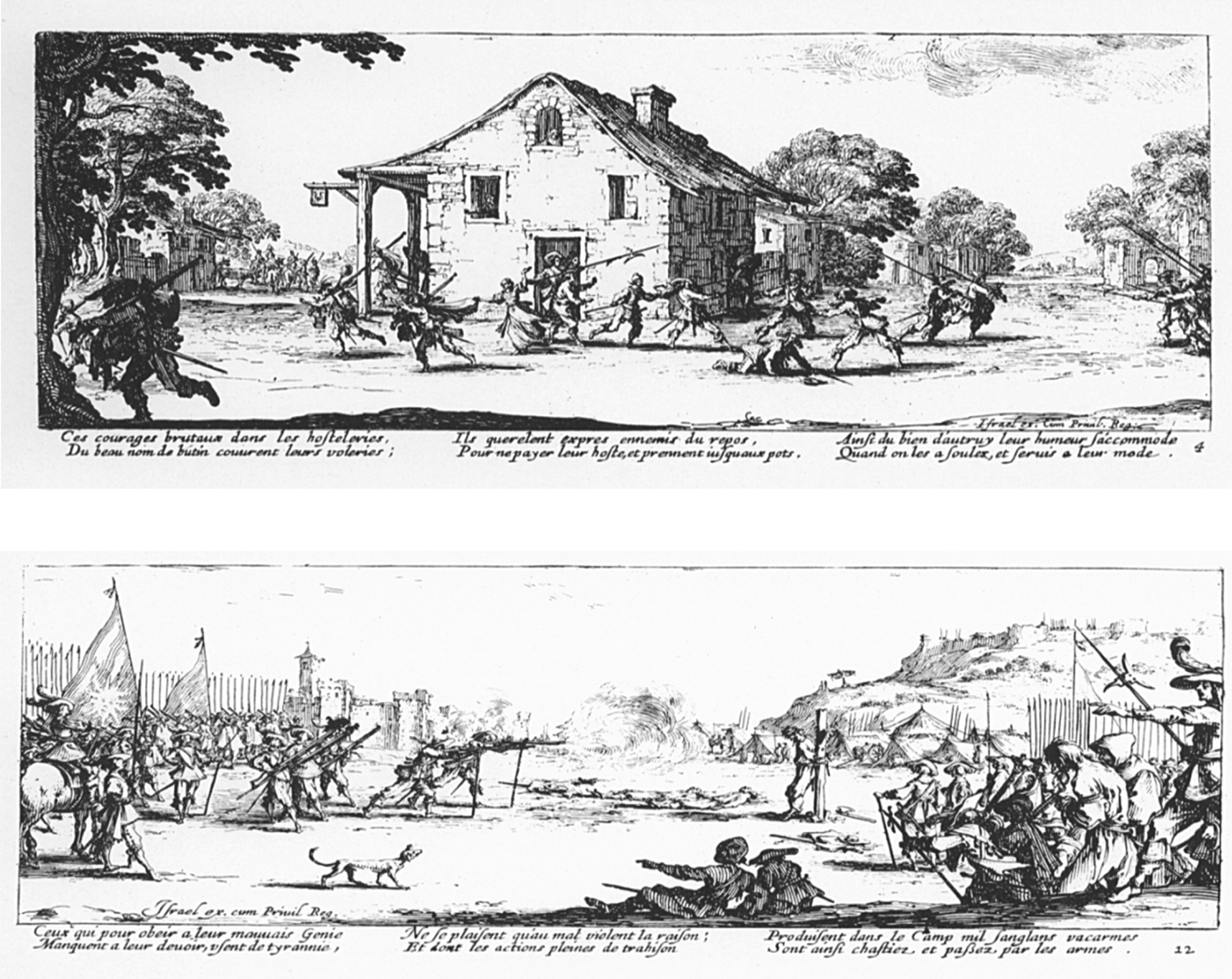
A similar enforcement structure existed in the military justice system for violators of the laws of war (and other war-related international law). 1) Enemy and compatriot soldiers caught red-handed were often punished extrajudicially. 2) Most other cases were handled by “courts martial”/“military commissions” (semijudicial, summary proceedings conducted by nonjurists). 3) Some cases were tried by full-fledged judicial tribunals with expert judges.Footnote 150
The correlation between that enforcement structure and the enforcement structure of medieval domestic penal enforcement is compelling evidence of the outlawry origins of ICL, given the accepted outlawry origins of domestic criminal law. One of the types of penal proceedings used (commonly) to enforce the laws of war, extrajudicial executions, is in itself strongly indicative of the outlawry pedigree, given outlawry's original implication (permission to extrajudicially execute perpetrators). The connection between ICL and the medieval outlawry doctrine was still recognized in the early twentieth century.Footnote 151 Only sometime after WWII was this connection completely forgotten, and past summary executions of war criminals inaccurately interpreted as acts of vengeance or reprisal, not the enforcement of criminal justice.Footnote 152 Even if occasionally abused, a legal authority to summarily execute war criminals was invoked throughout the centuries. Furthermore, it was utilized against both enemy and compatriot soldiers, which supports the conclusion that it was not mere vengeance or reprisal.Footnote 153
In the context of domestic legal history, the outlawry doctrine's normative power has also been questioned by claims that outlawry is not a juridical concept. Agamben argues that the outlawry-based prerogative to place a person beyond the pale of the law is still embedded in state sovereignty, in the mechanisms that grant the state control over individuals’ lives. Agamben claims that acknowledging that persistent embedding reveals the falsehood of the belief that the law can constrain those in power.Footnote 154 Butler agrees with Agamben regarding the inaptitude of law, but criticizes him for making overly general claims about the persistent use of outlawry by those in power, which “do not yet tell us how this power functions differently” in different times and contexts.Footnote 155
If Agamben's position is applicable to ICL, it must be concluded that ICL's outlawry doctrine has always been a mere disguise for oppression. If Butler's position is true, a genealogical account of that doctrine is uninteresting. However, as many have noted, Agamben's and Butler's positions are based on inaccurate understanding of the law.Footnote 156 Laws can constrain the use of power.Footnote 157
It should be noted that a common response to claims that outlawry was not a juridical concept underestimates outlawry's contribution to criminal law. In most Western domestic legal systems, over time, the concept of outlawry drastically changed and subsequently faded. This is especially true for outlawry decreeing, after that authority passed from royal to judicial hands. Therefore, it has been argued that, with the exception of the name, the original outlawry and the later, judicial outlawry are patently distinct, and whereas the former was not a juridical concept the latter was,Footnote 158 which means that the elements of discontinuity overshadow those of continuity.Footnote 159
However, the claim that the original outlawry doctrine was not a juridical concept is actually an expression of the flawed “modern state conception,” which disregards the means used by criminal justice systems that lack centralized law enforcement organs. Also, in most domestic systems, the concept of outlawry changed gradually, making rupture claims inaccurate.Footnote 160 More importantly, this reasoning fails to acknowledge the concept of outlawry's full influence on domestic criminal law. As noted, the original basis for the penalization of felonies was their perception as grave wrongs, whose perpetrators were outlaws. That legal perception had various long-lasting effects (one of them is discussed in the next section).
The elements of continuity in ICL regarding outlawry are even greater. Unlike its long-abolished domestic counterpart,Footnote 161 the outlawry-based authority to extrajudicially execute war criminals remained part of the law until 1949.Footnote 162 Moreover, even today, considering wrongdoers enemies of humanity constitutes the conceptual basis for universal jurisdiction.Footnote 163
d. Military Justice as a Transnational System
It can be intuitively assumed that states and their laws (criminal and otherwise) came first, followed by international law that was developed by the states as a means of coordinating their interactions, and, moreover, ICL was created only very recently. However, this description is inaccurate.
Kings originally relied on the same transnational doctrines as did popes and “emperors” and although a localized notion of public/peace began to emerge already during medieval times, the process that detached it from its transnational origins was extremely drawn out.Footnote 164 As late as the nineteenth century, in most European domestic criminal justice systems the prevailing jurisprudential basis for the criminalization of many felonies classified today as domestic (e.g., murder, robbery, arson, theft, and rape) continued to be perceived as infringement of universal natural law. “[C]ase law and especially doctrine [had thus remained] of an international character.”Footnote 165 Such felonies were deemed “crime[s] … contra jus gentium … against the law of nations,”Footnote 166 and their perpetrators were deemed “enemies of mankind.”Footnote 167 Many but not all European judicial systems even applied the universal jurisdiction doctrine to such felonies.Footnote 168 Moreover, in judicial systems that did not apply that doctrine (e.g., English common law) the perception of such felonies as violations of universal law also remained. Their courts were simply perceived as having jurisdiction only when the universal natural law was violated in a manner that breached the relevant king's “peace”.Footnote 169
Domestic crimes—namely, acts considered crimes only in a specific kingdom—existed alongside universal crimes.Footnote 170 The distinction between the two was not always clear, as certain domestic crimes came into existence through a local interpretation of a universal crime.Footnote 171
Only in the nineteenth century, under the influence of positivism, did support for the application of universal jurisdiction to felonies diminish considerably.Footnote 172 In some countries it transformed into the judex loci deprehensionis doctrine, which permits the prosecution of certain foreign-domestic criminals.Footnote 173
Currently, many jurists characterize pre-WWII cases of war crime prosecution as purely domestic legal measures, and, therefore, not ICL precedent, because they were adjudicated by the military tribunals of various European powers and not by transnational tribunals.Footnote 174 This position is mistaken because, as explained, in the past “there was no sharp distinction between international and national law.”Footnote 175
This position is further mistaken because until the nineteenth century, military and civilian justice systems were not branches of a single (domestic) system, and military justice had considerable transnational attributes. In medieval times, knightly issues, including the laws of war, were outside the jurisdiction of royal civilian courts and were adjudicated by a separate judicial system. Other guild-oriented transnational judicial systems also existed.Footnote 176 Members of the knightly guild considered themselves defenders of all “Romans” (Christians),Footnote 177 and “[t]he law of arms was [regarded as an] extension of the natural law and the law of nations.”Footnote 178 When it came to enforcing such laws, all medieval military judicial forums regarded themselves as belonging to a single transnational network aimed at regulating a given social sphere (war), monopolized by a specific transnational guild (knights). Therefore, the same law was “applied and enforced by all military tribunals in Christendom, whether of the enemy prince or of the prince upon whom a knight or man-at-arms depended.”Footnote 179 That transnational soldierly ethos persisted far beyond the Middle Ages.Footnote 180 Therefore, legal doctrines adjudicated in military forums were even less susceptible to “domestication” pressures than those adjudicated in civilian courts.Footnote 181
Because the same transnational doctrines were applied in military forums of various armies, individuals were often tried for infringing norms not enshrined in any formal domestic legislation.Footnote 182 The current understanding of the principle of nullum crimen sine lege was adopted by domestic law only in the nineteenth century as part of a positivism-driven codification trend that swept across Europe.Footnote 183 Moreover, ICL, which was not influenced as much as domestic penal law by nineteenth century positivism, never fully accepted this principle.Footnote 184
Admittedly, the codification trend did have some influence on ICL, contributing to the treaty codification of the laws of war. Some contemporary jurists even posit that the “rules of war became laws of war” only following that treaty codification, as gradually, penalties were explicitly assigned in such treaties to violations of codified norms.Footnote 185 However, this is inaccurate. In the past, the terms “rules of war” and “laws of war” were often used interchangeably.Footnote 186 Moreover, these norms were not mere professional rules of ethics before their codification, just as the prohibitions against rape and theft are not merely ethical recommendations in contemporary Scotland because they are unlegislated crimes. As discussed, most laws of war were considerably enforced against both enemy and compatriot soldiers (with the maximum penalty being death). The misleading depiction of the uncodified laws of war as ineffective can be traced back to attempts by some nineteenth century positivists to undermine that international law.Footnote 187
Military tribunals always had a mixed domestic–transnational function. Their chief “municipal” role was to enforce norms currently considered domestic military law (e.g., disobeying an order). These norms were often enshrined in positive military legislation known as “Articles of War,” which also included provisions forbidding compatriot soldiers from committing certain acts barred under the laws of war.Footnote 188 But even such positive war crime prohibitions should not be viewed as entirely domestic legal norms. First, until the nineteenth century, European military penal codes were usually not acts of Parliament, but rather executive decrees issued by kings or military commanders based on an inherent prerogative. That prerogative was originally anchored in the convention that kings and commanders were not only domestic agents but also high-ranking members of the transnational guild of warriors, duty-bound, as such, to enforce international law and maintain their forces’ discipline.Footnote 189 Second, pre-nineteenth-century European jurisprudence commonly viewed unwritten natural law as obligatory. Domestic legislations were generally expected to reflect that law and they were often considered written clarifications of it.Footnote 190 Third, for centuries, even when a certain war crime was not explicitly noted in the Articles of War, soldiers could still be punished for violating the unlegislated, transnational laws of war.Footnote 191 As the 1643 Scottish Articles of War stated, “[m]atters, that are clear by the light and law of nature, are presupposed … other things may be judged by the common customs and constitutions of war; or may, upon new emergents, be expressed afterward.”Footnote 192
During the nineteenth century, many European states began to rely on conscription-based national armies, which weakened combatants’ commitment to the transnational soldierly ethos.Footnote 193 Legislative reforms further increased military courts’ subordination to domestic/civilian legislative and judicial bodies,Footnote 194 but even through this period, ICL considerably resisted domestication pressures.Footnote 195
The gradual rise of modern states and the transnational nature of military justice are illustrated subsequently in two contexts: the Holy Roman Empire's princedoms, and England.
e. When Did the Holy Roman Empire's Princedoms Become States?
Until recently, the Peace of Westphalia (1648), which ended the Thirty Years’ War, was commonly viewed as the inception of the modern state, mainly because as a result of it the princedoms of the Holy Roman Empire—the predecessors of most European States—attained autonomy over the key functions associated with sovereignty: law-, war-, and peacemaking.Footnote 196 International law's birth presumably followed: “The idea of authority or organization above the states [was] no longer [and the] new system reste[d] on international law … operating between, rather than above states.”Footnote 197 It is of note that this narrative undermines international law by depicting it as a more recent creation than states, which does not supersede state authority and was only created by the states to aid in coordinating their interactions.
This Westphalian narrative has been refuted in recent decades.Footnote 198 The rise of modern states in Europe was a gradual process that began in the late Middle Ages and peaked only during the nineteenth century. The lengthiness of this process is evident in the context of the Holy Roman Empire's princedoms. Although these princedoms were already considerably autonomous centuries before 1648, the Peace of Westphalia significantly constrained their sovereignty, imposing restrictions that remained in force until the empire's abolishment in 1806. According to these restrictions, in exercising their law-, war-, and peacemaking powers, the princedoms were prohibited from infringing various transnational legal norms, including certain unwritten norms considered to be universal natural law.Footnote 199 Two imperial tribunals, the Imperial Chamber Court and the Aulic Council, were further authorized to void laws, domestic court decisions, treaties signed by princedoms, and other government actions of the princedoms if they violated these transnational norms.Footnote 200 As the princedoms gained sovereign powers, the empire's “structure transformed … into a relationship of international law,”Footnote 201 which gradually transformed these tribunals into “international court[s].”Footnote 202 Therefore, contrary to the “Westphalian Myth,” even after 1648, and until the nineteenth century, both transnational organs and international law remained superior these emerging states.
As exposed in recent decades, the Westphalian Myth was created in the nineteenth century and there is considerable convergence between central catalysts of it and some catalysts of modern positivism. First, a jurisprudential turn to the social sciences contributed to the rise of both. Gradually, the claim of secular natural law jurisprudence to rationalize jurisprudential thinking by drawing analogies from the natural sciences and logical reasoning lost its appeal. Instead, much of jurisprudential thinking turned to attempting to draw analogies from the social sciences. Positivism was among the most prominent of these attempts.Footnote 203 Also as part of this transition, many turned to “what amounted to some kind of historical sociology,” which gave rise to the Westphalian Myth.Footnote 204 Second, neither legal positivism nor the Westphalian Myth merely reflected the culmination of modern states’ rise; these views were considerably advanced by those attempting to strengthen state sovereignty.Footnote 205 Positivists, accordingly, were among those that strongly contributed to the propagation of the Westphalian Myth. Although positivist conceptualizations of states and of international law were “doctrinally consolidated [only] in the final decades of the nineteenth century,”Footnote 206 soon thereafter, with the aid of the Westphalian Myth, such conceptualizations were “projected back as the screen memory over an otherwise forgotten past.”Footnote 207 The Westphalian Myth was especially advanced by positivist opponents of international law. Some such opponents eventually broke off from international jurists to create a new discipline: international relations.Footnote 208 That discipline was premised, originally, on the belief that power and politics, not law, regulated behavior at the international level. It was also premised on the Westphalian Myth, holding that a world order consisting of fully autonomous states is a longstanding social construct.Footnote 209
International law is, sometimes, said to have been born not subsequent to the Westphalian inception of states, but as a result of Hugo Grotius's jurisprudence, written during the Thirty Years’ War. This is false. Continuity exists between Grotius's work and earlier jurisprudence.Footnote 210 This narrative also has its origin in the nineteenth century, as a person-oriented version of the Westphalian Myth.Footnote 211
f. England
The English kings were among the first rulers to free themselves from papal and imperial rule. Furthermore, already by the twelfth century or thereabouts, England started developing a distinct domestic legal system: the common law.Footnote 212 However, for many centuries, the common law was not the only legal system in England, and it vied for jurisdiction and predominance with other systems such as the military, admiralty, and equity systems. Unlike common law courts, most competing judicial systems adjudicated cases mainly based on the norms considered universal, natural law across Europe.Footnote 213
Because prohibitions in military and civilian European legal systems shared their jurisprudential origin, it was common to find two different crimes—transnational (adjudicated in military courts, English military courts included) versus domestic (adjudicated in civilian courts, such as the common law courts)—bearing the same name.Footnote 214 For example, as demonstrated subsequently, two different crimes of treason existed.
Today treason is considered the archetypical domestic crime, which should never fall under the jurisdiction of ICL.Footnote 215 In the late Middle Ages and later, however, because Christian kings were believed to be divinely anointed, “rebellion [was] a breach of the faith that held Christian society together [and rebels were, accordingly, viewed as having] placed themselves beyond the pale of peaceful Christian society and were now no more than brigands and thieves.”Footnote 216 Put differently, treason was considered an international crime, and traitors/rebels were considered international outlaws.
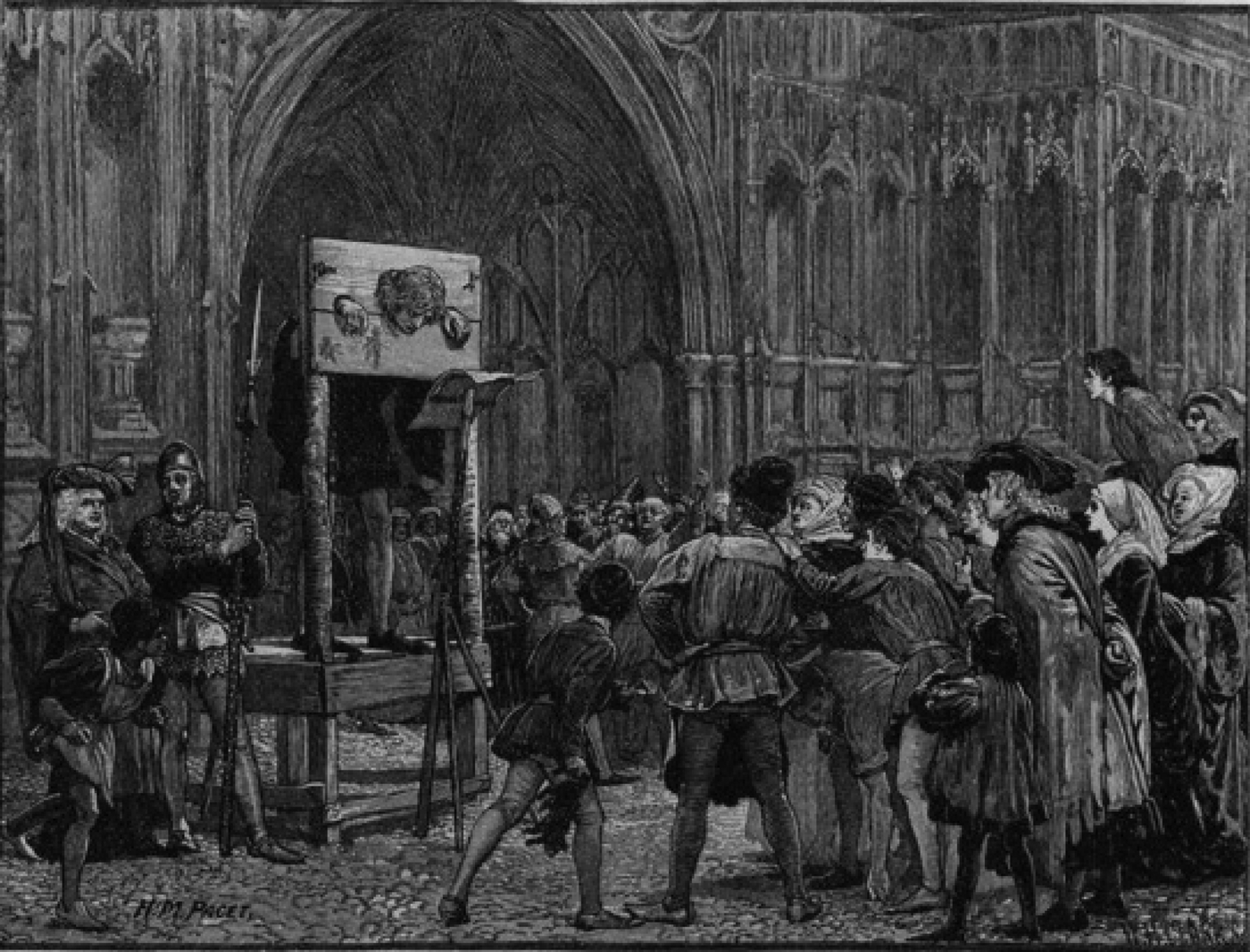
Although kings benefited from this transnational doctrine, they preferred to vest much of the authority to adjudicate treason against them in their civilian (domestic) courts. Consequently, for centuries, the military and civilian systems had parallel authority to try combat-related treason.Footnote 217 Gradually, the (transnational) military and (domestic) civilian crimes of treason became distinct, as illustrated by the case of Perkin Warbeck (1499). Warbeck, a Fleming, invaded England, laying claim to the English throne by pretending to be the son of Edward IV. After failing, he was prosecuted for treason in a common law court, which ruled that it lacked jurisdiction because enemy aliens acting in the course of war were not bound to uphold the king's peace. Warbeck was then retried by a military tribunal, which convicted him of treason (by many accounts) and sentenced him to death. The military tribunal's jurisdiction and ruling was, most likely, based on a contemporaneous law of war that deemed usurpation to be a tyrannical, traitorous act.Footnote 218 Other medieval cases reveal that, unlike domestic courts, military tribunals prosecuted even foreigners for certain wartime acts of betrayal of allegiance (treason) owed to their (foreign) king.Footnote 219 Therefore, the jurisprudence of military justice diverged considerably from domestic jurisprudence.
Perkin Warbeck in the Pillory
According to eighteenth century historian John Barrow, when Warbeck was (prior to his capture) under Archduke Philip's protection, the English king sent ambassadors to the Archduke “and demanded that Perkin might be delivered into their hands as a pirate, or common enemy to mankind, who ought not be protected by the law of nations.”
Sources: Image: Painting by Henry Marriott Paget (1884) [Public-domain], via Wikimedia-Commons, http://commons.wikimedia.org/wiki/File%3APerkin_Warbeck_in_the_pillory.jpg (last accessed 28 March 2016).
Text: John Barrow, A New and Impartial History of England, 10 vols. (London: J. Coote, 1763), 5:23 (emphasis added).
The military and other legal systems continued to exist in England long after the Middle Ages. Only in the seventeenth century did common law jurists effectively try to abolish the competing systems, with partial success.Footnote 220 Many systems, including the military system, however, survived. They remained relatively autonomous well into the nineteenth century, when, owing to a cultural trend that led to the eventual merger of common law and equity, common law doctrines began to enjoy broad application in the courts of the other systems.Footnote 221
Reliance on the unwritten laws of war for trying both compatriot and captured enemy soldiers continued even later, and regarding the latter it remained the main legal basis for prosecutions of war crimes even after WWII. These unlegislated norms and the military tribunals that apply them still regulate some war crimes cases in England regarding both kinds of soldiers,Footnote 222 and, even today, these military tribunals stand “wholly outside the [English] civilian court system, in the same way that the regular courts-martial … stand outside it; and the law they appl[y] [is] not English law but … the customary international laws of war, as a sui generis applicable law.”Footnote 223
In sum, as both the cases of England and the Holy Roman Empire's princedoms demonstrate, it is a mistake to assume that states predated or created international law. State sovereignty is the result of a protracted process that has peaked only in recent times. Additionally, the military and civilian justice systems have distinct institutional and normative histories, and throughout the centuries, reliance on transnational jurisprudence persisted more strongly in the military justice forums. For these reasons, pre-WWII war crime prosecution cases should rightfully be regarded as precedents of ICL.
5. The Outlawry Basis of ICL
a. Medieval ICL
Medieval jus ad bellum divided armed conflicts into several categories that mirrored those of contemporaneous criminal law. The two primary categories were feud-like wars and wars intended to punish enemies deemed international outlaws by jus ad bellum.Footnote 224
The law applicable in wars waged against outlawed enemies conceptually mimicked the municipal process of punishing outlaws: the unjust nature of the enemies’ actions was predetermined, and because the wrong was against universal peace (the commonwealth of Christendom/mankind/humanity) all were duty bound to join in the war and punish the international outlaws. “Total War” could be waged against outlawed enemies (no jus in bello restrictions applied). Therefore, all captured enemy combatants—not only war criminals—could be executed.Footnote 225
Influenced by Roman-Christian jurisprudence, medieval jus ad bellum considered the following belligerents to be outlawed enemies: pirates, brigands, rebels, traitors, tyrants, barbarians/savages, infidels, and heretics.Footnote 226 Otherwise-legitimate belligerents (Christian rulers) fighting without just cause were also outlawed enemies.Footnote 227 Based on the last category, contemporary jurists presume that each side generally declared the other to lack just cause, so that all medieval wars were fought without jus in bello restrictions and, therefore, cases in which individuals were held personally responsible for violating jus in bello (i.e., war crime prosecutions), were rare.Footnote 228 Many historians, however, consider this an exaggeration, because “war to the death [between Christian rulers] was uncommon.”Footnote 229
Wars between Christian rulers were mostly limited conflicts, equivalent to large-scale blood feuds. Similarly to feuds, 1) opponents were considered the enemies of only a given community, 2) the identity of the wrongdoer was to be determined by the war, and 3) in bello conduct was subject to legal restrictions (including a duty to grant POW status to captured enemy knights).Footnote 230 As will be demonstrated subsequently, otherwise-legitimate combatants who violated jus in bello in feud-like wars were individually considered international outlaws.
The shaping of medieval ICL was influenced by the aforementioned Roman-Christian doctrine, which permitted harming even enemies and criminals only for the enforcement of justice, and granted rulers the primary justice enforcement authority. Based on this doctrine, acts generally considered outlawry deeming, such as harming lives or property, were considered legal when committed by rulers or combatants acting under their authority during feud-like wars.Footnote 231 But because the wartime legality of such acts depended upon royal authorization, committing them without such license remained outlawry deeming; as Jamieson explained:Footnote 232
serious persistent crimes could result in an individual being branded as an outlaw. Offences of murder … arson and theft were regarded as heinous crimes which would put a person beyond the laws of society [However,] soldiers were given, in effect, a license to commit them … provided they fought with the sanctions of an appropriate authority. Problems arose when that authority was absent and soldiers were seen to be fighting illegitimately for their own interests. In such a situation … [t]hey could find themselves treated as outlaws, against whom lethal force could be legitimately used by those in authority.
War criminals were often referred to as “robbers,” “murderers,” or “arsonists.”Footnote 233 These were not references to domestic crimes, as was evident by the fact that the combatants who committed them were “regarded as criminals … who were beyond the normal laws of God and men” (i.e., as international outlaws for violating international law).Footnote 234 These references were, most likely, a way to convey these combatants’ international outlaw status, an alternative to referring to them as “outlaws.” The prohibitions against harming property and lives (felonies such as arson, robbery, murder) were outlawry-deeming natural laws to which the permission given to combatants to take lives and property by royal authorization was a legal exception.
The view of regular combatants who violated the laws of war as international outlaws is also evident in the practice of equating such war criminals with pirates and brigands. Sohmer-Tai uncovered hundreds of cases that were adjudicated in various courts around the Mediterranean between approximately 1200 and 1410, in which soldiers of conventional navy forces were accused “of robbing … in modo piratico (in a piratical fashion or manner) despite conditions of … pre-existing treaty, or alliance.”Footnote 235 Similarly, Rowe reported that in 1431, during a war in France, a captured (otherwise-legitimate) enemy combatant was executed for violating the laws of war, and his captor was paid “as though he had caught a brigand.”Footnote 236
The prohibition against deceitful taking of life/property (originating from both Germanic and Roman-Christian law) was also adapted to feud-like wars, serving as the basis for various in bello laws. The main wartime acts criminalized under this prohibition were breaches of obligations toward an enemy, including violations of truce/peace agreements, terms of surrender, and POW parole conditions.Footnote 237
Although medieval sources are secondary and brief, they nonetheless contain reports explicitly referring to perpetrators of such acts as outlaws. A twelfth century chronicle of a case from 1098 describes how enemy knights captured as POWs by King Rufus of England were granted, upon their request, parole every evening. In response to his courtiers’ concerns that the prisoners might escape, Rufus answered: “Far be it from me to think that a brave knight will forfeit his word! If he did so, he would become a contemptible outlaw all his life.”Footnote 238
Cases related to the assassination, in 1419, of John the Fearless, Duke of Burgundy, also prove that perfidious violations of the laws of war were outlawry deeming. During Charles VI's reign in France, a baron war erupted between his son (the Dauphin) and John the Fearless. The Dauphin requested a meeting with John to negotiate a truce, but at the meeting, he and his men assassinated John, violating safe-conduct assurances he had given John.Footnote 239 This assassination (an act considered a war crime to this dayFootnote 240) was explicitly described at the time as an act “against … the law of nations” (“contra … jus gentium”),Footnote 241 and its perpetrators were declared “disturbers of the peace” (“les infracteurs de la paix”) and “enemies of the peace” (“des ennemis de la paix”).Footnote 242 Charles even disowned his son and signed a treaty with Henry V, King of England (a supporter of the Duke of Burgundy), whereby the French throne would pass to Henry after his death.Footnote 243 Although the Dauphin escaped further punishment, many of his accessories were sentenced to death, some by a French military tribunal and others by King Henry.Footnote 244 Because the crime was committed before Henry's active involvement in the war and because Henry punished perpetrators when Charles ruled France, these cases can be seen as early instances of reliance on universal jurisdiction in prosecuting war crimes.Footnote 245
The Assassination of John the Fearless Similarly to how a Latin chronicler (Titus Livius) referred to the act as “contra fidem & jus gentium” (“against the faith and the law of nations”), an English chronicler (“The Translator of Livius”) called it a cruel murder in violation of a promise and “against both God's lawes and man's lawes.”
Sources: Image: Painting by Louis de-Gruuthuse (1470–80) [Public-domain], via Wikimedia-Commons, http://commons.wikimedia.org/wiki/File%3AAssassinat_de_Jean_sans_Peur.jpg (last accessed 28 March 2016); Texts: Titus Livius, ed. Thomas Hearne, Vita Henrici Quinti, Regis Angliae (Oxford: Thomas Hearne, 1716), 78 (written in the fifteenth century); and Anonymous (The Translator of Livius), ed. C.L. Kinsford, First English Life of Henry V (Oxford: Clarendon Press, 1911) 151 (written in 1513).
Occasionally, perfidious violations of the laws of war were referred to as treason.Footnote 246 That was because the international crime of treason was much broader than its contemporary domestic successor: in addition to betrayal of one's sovereign, violations of many other obligations and acts of deceitful taking of life or property were also considered treason. All these forms of treason were regarded as outlawry-deeming violations of universal, natural law.Footnote 247 Hence, such treason references were probably intended to convey the perpetrators’ outlaw status. Some of these acts are still described as “treacherous” in modern ICL.Footnote 248
Attempts were also made to incorporate noncombatant protections into medieval jus in bello. Although not all noncombatants were legally protected, pillage, rape, and harming of women, children, the elderly, priests, churches, and members of several professions were considered violations of universal, natural law.Footnote 249 Reliance on the international outlawry doctrine to this end exists in the “Truce of God” decreed by Holy Roman Emperor, Henry IV, in 1085. In addition to placing those fighting during certain religious dates under a ban as “violators of the holy peace” (deeming them outlaws), Henry decreed that: “Merchants … rustics … other similar occupations … [w]omen … and all those ordained to sacred orders, shall enjoy continual peace” (namely, harming them was always outlawry deeming).Footnote 250
Similarly, Canon 27 of the Third Lateran Council (1179), excommunicated (outlawed) members of six mercenary forces because they: “practice[d] such cruelty upon Christians that they respect[ed] neither churches nor monasteries, and spare[d] neither widows, orphans, old or young nor any age or sex.”Footnote 251 These mercenaries were internationally outlawed, as the Canon called “on all the faithful [to] oppose [them] with all their might and by arms protect the Christian people against them.”Footnote 252
Some claim that these medieval noncombatant protections were not enforced because knights, who generally practiced and enforced the laws of war, cared only about themselves.Footnote 253 This is an exaggeration.Footnote 254 A knight could be stripped of his honors (chivalry's unique expression of outlawry) for the “sacking of churches … rape [or] arson”, because these were “breaches of the knightly faith”.Footnote 255 As the cases of Conradin and von-Hagenbach demonstrate, even some high-ranking knights were punished by their adversaries for violating noncombatant protections. Some lower-ranking knights are known to have been punished even by their own side for violating these prohibitions.Footnote 256 Furthermore, certain noncombatant protections were more adhered to than others; particularly, the law protecting priestsFootnote 257 and women.Footnote 258 Additionally, noncombatant legal protections were more strictly enforced against non-knightly soldiers.Footnote 259
The “tyranny” doctrine was also used to protect civilians. In Roman law, sovereigns who violated their duty to act for the “public good” were deemed tyrants. Because all Christians were regarded as belonging to the Roman public, in the late Middle Ages and centuries thereafter, a ruler could be deemed a tyrant for acting against the commonwealth of his subjects or of foreign Christians.Footnote 260 Four main subcategories of tyrants existed: 1) rulers who committed atrocities against their subjects; 2) rulers who conducted aggressive wars, in which extensive atrocities were committed against Christians; 3) rulers who systematically failed to punish their subjects who committed atrocities against compatriot or foreign Christians; and 4) individuals who usurped a throne (because God determines such entitlements).Footnote 261
The tyranny doctrine was originally an ad bellum law, allowing total war to be waged against all those on the tyrant's side.Footnote 262 However, despite the original permission to kill not only the tyrant, this doctrine is strongly related to ICL history. Because medieval thought shifted with great ease from individual culpability to collective responsibility and vice versa, the tyranny doctrine not only regulated interactions between collective entities, but was also a penal norm that treated the relevant individual ruler and his close associates as international outlaws. This is demonstrated by the prosecution of von-Hagenbach for tyranny and of King Conradin, along with a few of his men, for usurpation (a subcategory of tyranny). Gradually, the doctrine's ICL element became increasingly pronounced: the masses were no longer executed and only culpable high-ranking individuals, including rulers, were prosecuted for tyranny.Footnote 263
Because tyranny authorized deposing the ruler, when a king was accused of tyranny, the accusation was usually made by those wishing to depose him.Footnote 264 Tyranny was also commonly cited by rulers to justify intervention in foreign conflicts.Footnote 265 These two politically motivated applications of the doctrine are neither surprising (as tyranny was an ad bellum legal concept), nor should they lead us to disregard the tyranny doctrine (because even ad bellum laws often have normative force).Footnote 266
Especially noteworthy is the application of tyranny in the context of baron wars. Kings held that only rulers not subservient to other rulers were authorized to wage war; however, local lords claimed to have autonomous authority to make war. During much of late-medieval times, a legal compromise was reached that permitted baron wars, but with uniquely restrictive jus in bello. Notably, causing extensive harm to noncombatants was considered a war crime in baron wars.Footnote 267 Local lords who violated these wars’ jus in bello were considered tyrants (and also murderers, robbers, traitors, and outlaws).Footnote 268
The case of Thomas of Marle (1111–14), which occurred during King Louis VI's reign in France, demonstrates this issue. The chronicler Abbot Suger of Saint-Denis (1081–1151) accused Thomas of “ferocious tyranny” for unjustly warring with neighboring lords.Footnote 269 After King Louis intervened, Thomas promised to cease fighting but reneged on his promise and committed acts of massacre, rapine, and arson, “not [even] spar[ing] the clergy out of fear of excommunication nor the people out of any humanity.”Footnote 270 In response, church leaders condemned him as an “enem[y] of Christ's true bride,” and “struck at Thomas's tyranny [by] strip[ping] him of all honours as an infamous criminal, enemy to the name of Christian.”Footnote 271 The King thenFootnote 272
gathered an army against Thomas [and] turned towards … castle of Crécy … seized [it and] confounded the criminals; piously massacred the impious and mercilessly beheaded those who had showed no mercy … the king then set out against [the] wicked castle [of Nouvions] in pardoning the innocent and severely punishing the guilty … Thirsting for justice, he condemned all the detestable murderers he found to be hanged on the gibbet [and] abolished in perpetuity the lordship of that infamous Thomas and his heirs over that city.
The transition from medieval to Early Modern Times is marked by royal triumph in the debate concerning the illegality of baron wars. Participants in such wars were henceforth considered rebels/traitors/brigands.Footnote 273 At approximately the same time, various prohibitions that first applied only to baron wars became applicable to wars between sovereigns.Footnote 274
The execution of Thomas of Marle
Source: Painting (Fourteenth century), [Public-domain], via Wikimedia-Commons, http://commons.wikimedia.org/wiki/File%3AThomas_de_Marle.jpg (last accessed 28 March 2016).
b. Early Modern Times (Approximately 1500–1799)
When contemporary jurists outline ICL history, cases from Early Modern Times of penal enforcement of the laws of war are hardly ever acknowledged (unlike medieval and nineteenth century cases, of which, at least a few are mentioned and only then dismissed as unrelated to contemporary ICL),Footnote 275 but historians have uncovered many such cases from Early Modern Times.Footnote 276 The discrepancy is caused by two misconceptions.
First, many sixteenth and seventeenth century wars were either conflicts between Catholics and Protestants (who considered each other heretics) or rebellions, and jus ad bellum still permitted waging total war against heretics and rebels. Therefore, jurists assume that wartime conduct was not legally regulated. The most horrific of these conflicts was the Thirty Years’ War (1618–48). Its trauma is credited for motivating Grotius (and subsequent jurists) to develop doctrines mandating belligerents to abide by jus in bello regardless of their views about their opponent's cause. Therefore, jus in bello is considered to be predominantly a post-1648 development.Footnote 277
Second, in the second half of Early Modern Times, most conflicts were interstate wars in which a total war policy was generally prohibited. Still, jurists do not consider war crime prosecution cases from these wars to be precedents of ICL, but rather purely domestic measures—each taken by the state whose military tribunal adjudicated it—because there is “difficulty in grounding an international criminal law in a decentralized legal order.”Footnote 278
This account is incorrect. Undeniably many sixteenth and seventeenth century conflicts were religious wars and rebellions in which, during the initial period of conflict, at least one side adopted a total war approach, usually reciprocated by the adversary. Counterintuitively, however, the adversary's total war reprisal often did not precipitate the war into unrestrained bloodshed. The harm suffered by the first side from such reprisal often caused it to renounce its total war approach, and both sides would agree to conduct themselves as if they considered the other side a legitimate belligerent. This meant that the sides obligated themselves to adhere to jus in bello, to punish violators of these laws, and to accord POW status to captured enemy soldiers who had not committed such violations. Although many wartime atrocities went unpunished during these times, there was far more ICL enforcement than the non-enforcement that jurists assume.Footnote 279
Depiction of late-seventeenth and eighteenth century cases of war crime prosecution as merely domestic measures is also inaccurate. First, as explained, the conclusion that a legal system did not exist only because it relied on a decentralized enforcement mechanism is based on an overly narrow and historically incomplete conception of legal systems. Second, the various European military judicial forums continued to regard themselves as part of a single transnational network, obligated to uphold the international laws of war.Footnote 280 Third, during this period, pirates were also punished mainly by the military tribunals of European forces, and still, jurists acknowledge that piracy was already an international crime at the time because of the application of a similar transnational doctrine in all piracy cases. The same reasoning should apply also to war crime prosecutions.
Based on the aforementioned misconceptions, the narrative of the history of the laws of war prevalent among contemporary jurists is that: 1) before the second half of Early Modern Times there was no effective international law regulating wartime conduct and 2) although such a body of law did subsequently exist, it addressed only states and not individuals until the end of WWII.Footnote 281 This account is simply the application of the Westphalian Myth to the laws of war. Historians, by contrast, have shown that the laws of war existed throughout the period, and although they were occasionally violated, “legal sanctions [often] ensued” in the form of “trial and punishment by special military tribunals” (scilicet, ICL also existed).Footnote 282 Therefore, current ICL proponents unknowingly support an inaccurate narrative, originally commonly propagated to delegitimize international law, although a more accurate account serves their cause better.
Jurists’ historical account of public international law in general also divides Early Modern Times in half, although the declared guiding rationale here usually has to do with jurisprudential shifts. First, the transition from the Middle Ages to Early Modern Times is said to be marked by the triumph of the “Divine Right of Kings” jurisprudence, which proclaimed kings to be superior princes, unsubordinated to anyone, who alone had authority to make war and punish criminals. A second transition allegedly began with Grotius's jurisprudence. That transition gradually changed the presumed foundation of the duty to abide by international law, from a belief in its divineness to a secular belief that natural law can be deduced through logical reasoning. This secular perspective induced the premise that certain natural laws, including core human rights, existed even in a “state of nature,” before the formation of a social-contract-based society. Because belligerents are in a state of nature in relation to one another, they must abide by these natural laws.Footnote 283
This is, however, an oversimplified account. First, early social contract jurisprudence existed, and was already influential, in the sixteenth century,Footnote 284 and divine right jurisprudence still had support in the eighteenth and early nineteenth century.Footnote 285 Second, each of these two schools included scholars both dismissive and supportive of international law.Footnote 286 Third, many more schools existed throughout Early Modern Times, a plurality resulting from the Reformation, which shattered earlier jurisprudential consensus.Footnote 287
The lack of consensus further caused jurisprudential writings to lose much of their authority. Although they still exercised some influence (divine right jurisprudence helped kings to triumph in the struggle over sovereign power, and social contract jurisprudence contributed to international law's secularization), customary law and practices were more important legal sources. As a result, actual international law exhibited greater continuity than is conveyed by early-modern jurisprudential works.Footnote 288 Accordingly, although armies, wars, and jurisprudence experienced considerable changes during these centuries, the laws of war and their penal enforcement “displayed a remarkable continuity [because of, among other reasons] the weight [of] practice and precedent.”Footnote 289 Therefore, the current tendency in jurists’ historical accounts to divide Early Modern Times is inaccurate, and is probably a lingering effect of the Westphalian Myth. The remainder of this part examines cases from various early-modern wars, to demonstrate that despite considerable jurisprudential and societal changes, ICL continued to be enforced and its doctrinal reliance on the international outlawry doctrine persisted.
i. The French Wars of Religion (1562–98)
In addition to the period's religious wars, jurists also consider the “end of chivalry” as a cause for discontinuity between medieval and early-modern laws of war, because the community to which the laws of war applied changed to mercenaries who presumably disregarded these laws.Footnote 290 The French Wars of Religion were civil wars between Catholics and Protestants in which all sides relied on mercenaries. Therefore, had the Reformation or the end of chivalry caused a discontinuity in the laws of war, conduct during these wars would have exhibited that rupture.Footnote 291 This is not the case.
Penal enforcement of jus in bello during these religious civil wars is illustrated in a case described in the autobiography of Marshal Blaise de-Monluc, who served in the French military from 1521 to 1574. After a victory near a certain town, two commissioners (military judges) were appointed, but additional commissioners soon had to be assigned because the first two “execute[d] Justice upon the Catholics only.”Footnote 292 Meanwhile, Monluc arrived in town and after failing to convince the commissioners to punish two prisoners, despite strong evidence that they committed infinite “Rapines and Violations,” he directly ordered these prisoners’ hanging.Footnote 293 For such actions, Monluc was described by some as an unbiased commander who “hung disturbers of the peace from either side.”Footnote 294
The transition from knight-led to mercenary forces also did not result in complete disregard of the laws of war, among other reasons, because it was gradual.Footnote 295 French noblemen, accordingly “continued to exhibit chivalric courtesy on the battlefield during both the Wars of Religion and the Thirty Years’ War.”Footnote 296 Moreover, describing early-modern mercenaries as lacking commitment to the laws of war is an exaggeration. Mercenaries generally upheld POW-related prohibitions.Footnote 297 This signifies an important legal development. Originally, only knights were eligible for POW status, and other captured enemy combatants could be executed even without committing a crime. Only in Early Modern Times was eligibility for POW status expanded.Footnote 298 Therefore, the transformation that armies experienced caused “[t]he knightly practices of warfare … to spread out and bec[o]me … the customs of the ordinary soldier, even if a mercenary and un-mounted.”Footnote 299 Even violations of civilian protections were often not motivated by disregard of the laws of war. Because of the rapid increase in the size of armies, belligerents were unable to properly fund and supply their troops. Many atrocities were perpetrated by hungry soldiers who rampaged for survival.Footnote 300
To prevent such atrocities, European rulers attempted to improve military law enforcement, often adopting new, extensive articles of war.Footnote 301 Currently, the Swedish articles of war from 1621, issued during the Thirty Years’ War, are often marked as the turning point in this regard and therefore revered as “the basis of … modern international humanitarian law.”Footnote 302 In truth, many such attempts and articles have been drafted earlier, including during the French Wars of Religion.Footnote 303 Neither 1621 nor 1648 were turning points, because although penal enforcement of the laws of war gradually improved during Early Modern Times, “amelioration was not linear and even.”Footnote 304 The current marking of a Thirty Years’ War-related event as the watershed is simply another example of the Westphalian Myth's lingering effect.
The French Wars of Religion ended with the regal Edict of Nantes, which referenced the international crime of truce/peace breaching, in declaring that whoever resumed fighting would be punished as “disturbers of peace” (“infracteurs de paix”).Footnote 305 It further decreed certain “disturbanc[es]” committed during the wars as being too grave for amnesty. These included “rape, burning, murder, theft committed by treachery, ambuscade out of the line of regular warfare to gratify private revenge, contrary to the laws of war” (“contre le devoir de la guerre”).Footnote 306 War crime trials were subsequently conducted in accordance with the Edict.Footnote 307
Similar legislation can be found elsewhere. “The Act for the Pacification between England and Scotland of 1640” decreed that those who would resume fighting “ought to be punished as breakers of the peace” and that amnesty “shall not … extend to … theeves, robbers, murtherers, broaken-men [and] outlawers.”Footnote 308 Seventeenth century Scottish jurist George Mackenzie, explained that “the Pacification only secure[d] against acts of hostility which were done in furore belli [in the fury of war]”, therefore its amnesty applied to killings “warrantable by the Law of Arms,” but not to “privet murder” (such as, unauthorized execution of POWs) or “Rap[e] upon a Woman.”Footnote 309
ii. The Eighty Years’ War (1568–1648) and the Thirty Years’ War (1618–48)
The Eighty Years’ War was a rebellion of the Protestant Dutch against Catholic Spain, culminating in Dutch independence. Its later period blended with the Thirty Years’ War. In the initial stages of the Eighty Years’ War, Spain waged total war against the Dutch, but Dutch reprisals led the Spanish to recant and most of the conflict was conducted as between legitimate belligerents.Footnote 310 Spain's adherence to jus in bello was evident in King Philip II's appointment, in 1574, of a judicial inquiry into accusations that the Duke of Alba, commander of the Spanish forces, and his soldiers had violated the laws of war by causing disproportionate harm to the civilian population. The Duke was acquitted, but “several of his senior officials were banished.”Footnote 311 The fact that the Spanish officers’ punishment took the form of banishment indicates that the legal basis was outlawry related, because the “banished” were outlaws whose lives had been spared.Footnote 312
Because the Eighty Years’ War was a religious rebellion, however, it is not surprising that when a Dutchman was accused of war crimes by Spain (and thereby deemed an international outlaw), his status as an ad bellum outlawed enemy was also claimed. This was the case with King Philip's 1580 decree outlawing William of Orange. Philip's decree accused William of treason, as William had originally served Spain. But William had switched sides 14 years before the decree, and, therefore, this was probably not Spain's primary reason for the decree. The decree also accused William of more recent war-related wrongs, such as “persecuting all the good pastors, preachers, monks, and upright persons [and having] a number massacred.”Footnote 313 Philip condemned William: “[F]or his evil doing: as chief disturber of the public peace … outlaw[ed] him forever [and] declare[d] him an enemy of the human race” and “to remove … his tyranny and oppression” promised a reward to anyone who would kill him.Footnote 314 William was subsequently assassinated by a Catholic Frenchman.Footnote 315
The following statement by contemporaneous Dutch jurist Johannes Voet reveals that the Dutch also enforced ICL during that war:Footnote 316
[Soldiers sometimes] deprive [enemy soldiers] who surrendered of their lives in an abominable, spontaneous act against the accepted laws of war. Since today's wars between civilized peoples do not permit such bestial conduct, and universal Christian charity and the gentleness due to the other oppose it, it was decreed that whoever committed an infamous act of this kind was to be banished from the allied provinces, after having been expelled from [military] service. Indeed, a soldier was [even] executed on July 10, 1638, because he had wounded two enemies, whom he knew well to be captives, to the extent that they both died, not long after, from the injuries. Almost the same punishment is set for those who, after a captive has paid off the ransom due according to the laws of war, release him without the permission of the commander of the camp. For it may happen, that such captives are … guilty of [a grave] crime, whose punishment with adequate sanctions is of interest to the Republic and is amongst the duties of the commander …
This brief report is extremely telling. First, although most of the passage refers to penal actions taken by the Dutch against their own soldiers, these soldiers’ wrong is described as an “act against the accepted laws of war [and] universal Christian charity.” This indicates that the Dutch applied a transnational doctrine (i.e., these penal actions should not be regarded as purely domestic measures). Second, as explained, the fact that the punishment was either banishment or death indicates that the wrong was considered outlawry deeming. Third, there are not many historical records of proceedings against low-ranking soldiers that reveal the doctrinal basis for the punishment they received, because these were usually dispatched summarily. The case mentioned by Voet is, therefore, rare evidence of the application of the outlawry doctrine in such cases, suggesting that treating war criminals as outlaws was not simply political propaganda. Fourth, the last sentence refers to the duty of commanders to punish captured belligerent soldiers, pointing to a practice of also punishing enemy war criminals.
Finally, the case mentioned by Voet was from 1638, during the Thirty Years’ War. Jurists currently regard that war as the archetypical total war.Footnote 317 But despite the many unpunished atrocities of that war, current historical research shows that portraying it as entirely lawless is an exaggeration.Footnote 318 Some enemy and compatriot war criminals were even prosecuted during that war.Footnote 319 The period's leading international jurist, Dutchmen Hugo Grotius, accordingly noted that it is “the usage of all Nations” to punish, on the basis of unwritten natural law, wartime enemy violators of such law.Footnote 320 This statement is further evidence for ICL's existence at the time. It also aids to refute the depiction of Grotius as the father of jus in bello, strengthening the conclusion that that depiction is a lingering effect of the Westphalian Myth.
The Thirty Years' War: Crime & Punishment
In 1633, during the Thirty Years' War, French artist Jacques Callot made a series of etchings (each accompanied by a short poem) entitled The Miseries and Misfortunes of War. Callot attempted to realistically depict the war, describing first the descent of a group of soldiers into a life of (war) crime and, then, surprisingly, their punishment. Top: The poem accompanying the first etching depicting war crimes (etching four) describes, “The pretty name of booty their thieveries carry/They start fights intentionally as enemies of tranquility.” Namely, immediately after they had committed their first war crime (theft/pillage), they were deemed “enemies of tranquility” (outlaws). The poem accompanying etching thirteen (not shown herein) further refers to them as “enemies of the Heavens who sinned [a] thousand times/Against the secret ordinances and divine laws.” Bottom: Etching twelve, depicts the execution by firing squad of the war criminals. Four other etchings also depict their execution, each depicting a different method (“Strappado”, hanging, burning at the stake, and the “Breaking Wheel”).
Source: [Public domain], via Wikimedia Commons, http://commons.wikimedia.org/wiki/File%3ALes_mis%C3%A8res_et_les_malheurs_de_la_guerre_-_04_-La_maraude.png (last accessed 28 March 2016). The poems were translated for this article by Benedikt Pirker. I intend to further discuss these etchings in a future article.
iii. The English Civil War (1642–51)
The English Civil War was a religious war. Still, ICL was enforced during much of it: “[i]ntra-army offenses were governed by processes of trial and punishment set out in articles of war, while treatment of soldiers who fell into enemy hands was regulated by the [unwritten] laws of war [and] an enemy who had offended against them was liable to punishment.”Footnote 321
The trial of King Charles I (1649), following his defeat in this war, is another example of ICL's pervasive reliance on the international outlawry doctrine. It also illustrates the reasons for the mistaken characterization of many past ICL cases as domestic legal measures. Because this was a non-international conflict, and Charles was tried for treason against his own country, it is clear why the ruling in his matter could be mistaken for a domestic case.
However, the legal ground for trying Charles, advanced by the parliamentary army, was an authority to prosecute “public officers [for] offence[s] … against the [unwritten] general law of reason or nations.”Footnote 322 He was tried not by a common-law court, but by a special tribunal of commissioners from the army and Parliament,Footnote 323 which “adjudge[d], That the said Charles Stuart, as a Tyrant, Traitor, Murderer, and a Public Enemy, shall be put to Death.”Footnote 324 At trial, he was also declared a “grand Disturber of the Peace.”Footnote 325
Charles was convicted of international crimes. Even his conviction for treason cannot be construed as the domestic form of treason because “king [Charles,] though imprisoned, was still nominally sovereign.”Footnote 326 Two international norms underpinned the accusations that Charles had “traitorously and maliciously levied war against the present Parliament and the people therein represented.”Footnote 327 The first was a nonmonarchical variation of the transnational predecessor of the current domestic crime of treason.Footnote 328 The second was the perfidious international crime of reinitiating fighting in violation of a truce/peace treaty (in Charles's case, with Parliament).Footnote 329
Charles's murder conviction could not have been based on the common law crime of murder, because breaching the “king's peace” was an element of that domestic crime, and Charles was king during the war.Footnote 330 Charles was accused of murder for having engaged in “unnatural, cruel and bloody wars”Footnote 331 and convicted on the grounds that the prohibition against murder “is universal … God's law forbids it; Man's law forbids it.”Footnote 332
Charles's tyranny conviction was a manifestation of postmedieval reinterpretation of this international crime, reinstating the original Roman understanding of it as allowing the tyrant's subjects to rebel against him, but maintaining tyranny's perception as an international crime (fully consolidated only in late-medieval times).Footnote 333 The tribunal's lord president, accordingly, ruled that Roman law (regarded as international law) was the basis for the tyranny charge against Charles, together with “precedents almost of all nations.”Footnote 334
King Charles’ execution
Thomas Wilson lamented in a sermon, 32 years after Charles’ execution, that as a result of the trial, “much more then hath the Seven Years’ War, not Deposed him only, but Outlawed him, and defined him as an Alien, a Rebel to Law, an Enemy to the State.”
Sources: Image: Contemporaneous German print, [public-domain], via Wikimedia-Commons; http://commons.wikimedia.org/wiki/File%3AThe_execution_of_King_Charles_I_from_NPG.jpg (last accessed 28 March 2016); Text: Thomas Wilson, A Sermon on the Martyrdom of King Charles I Preached January 30, 1681 (London: Walter Davis, 1682), 20–21.
iv. The Seven Years’ War (1756–63) and Crimes Against Peace
Jus in bello was generally honored in eighteenth-century Western wars, mainly because of: reforms in military justice (which, as discussed, had begun earlier), the trauma of the Thirty Years’ War (whose horrors were exaggerated in the collective memory already in the seventeenth century), and the formation of properly funded, professional, standing armies (which gradually replaced the poorly supplied mercenary forces). “The officer class of these armies largely comprised [of] nobility [that] saw themselves as the heirs of the knightly tradition and [thus] generally conducted warfare … in accordance with the … law of warfare.”Footnote 335 “There were, of course, instances of crime, rioting, rape, and pillage … but military codes provided harsh sanctions for these abuses [and] they were enforced.”Footnote 336
The transnational nature of the period's penal enforcement of the laws of war is apparent in the common practice of contemporaneous belligerents to sign, during wars, treaties with their enemies, whereby, if soldiers unaccompanied by an officer and less than an agreed-upon number were captured, they could be “refused the treatment due to lawful enemies, and … punished as … banditti”Footnote 337 and “freebooters. By such steps [they] prevented a multitude of disorders and enormities which entail ruin on the people.”Footnote 338 It is of note that the above-quoted, eighteenth century sources equated suspected war criminals to pirates (“freebooters”) and brigands (“banditti”), demonstrating reliance on the international outlawry doctrine.
The Seven Years’ War (1756–63) was a large-scale conflict. Because most European powers participated in it, and because it was fought across the globe (in Europe, America, Africa, and Southeast Asia), it is sometimes referred to as truly the “first world war.”Footnote 339 Despite its large scale, jus in bello was considerably enforced. For example, the military regulations of the Prussian King, Fredrick II, considered to be the model handbook of European officers at the time, prescribed corporeal punishment for “all [illegal] acts of violence, on whomsoever they are committed, by soldiers” and as soon “as a complaint of this kind is made against any soldier, he must be confined, examined, tried by a court-martial and sentenced.”Footnote 340 Many war crime trials were conducted during this war.Footnote 341 Furthermore, this war is a significant event in ICL's gradual transformation into a global system, because the resources invested into it enabled imposing “European norms of military conduct on North-American warfare.”Footnote 342
It is currently often claimed that, unlike jus in bello, jus ad bellum was paid no more than lip service in the eighteenth century, and that rulers were considered to have unrestrained war-making discretion.Footnote 343 It is also claimed that during that century the doctrine of absolute sovereign immunity had solidified.Footnote 344 However, these are oversimplifications that fail to account for opposite eighteenth century views and actions,Footnote 345 and most notably, disregard the wide contemporaneous perception of Prussian King Fredrick II as an aggressor for invading Saxony in 1756.Footnote 346 Nineteenth century historian Thomas Carlyle, used a noncoincidental vocabulary to describe this consensus, which existed “over all Europe, England alone excepted,” stating that “[t]he extent of [Fredrick's] sin … was at that time considered to transcend all computation, and to mark him out for partition, for suppression and enchainment, as the general enemy of mankind.”Footnote 347
Before that invasion, Fredrick drafted a manifesto listing several pretexts, but did not even wait for the ultimatum he gave the Saxons to expire before attacking. In response, Fredrick was declared an outlaw by the Protestant and Catholic princedoms of the Holy Roman Empire (who rarely agreed), with the support of other European powers.Footnote 348 Although the coalition against Fredrick disintegrated before punishing him (because of the Russian Empress’ sudden death), the consensus regarding his culpability shows that sovereigns did not enjoy immunity from prosecution or unlimited discretion to initiate war.
Fredrick's outlawry was not a domestic measure, because the Holy Roman Empire was not a single state. Moreover, as Emmerich de Vattel (the leading contemporaneous international jurist) elucidated, the law of nations was the basis for that outlawry, issued by the Holy Roman Empire's princedoms with the support of “the most respectable powers of Europe,” as an action “recommended for the interest and safety of nations to repress he who tramples on rules [i.e., rules of the law of nations] which constitute the unique foundation of their tranquility.”Footnote 349
Note that Vattel referred to Fredrick as a disturber of international peace. Indeed, throughout his work, synonyms of “international outlaws” (such as, enemies of mankind) are used in reference to violators of international laws including war criminals,Footnote 350 career felons,Footnote 351 and rulers who violate ad bellum laws.Footnote 352
The following are among the rulers Vattel considered enemies of mankind for violating jus ad bellum: 1) warmongersFootnote 353 and rulers who otherwise “tak[e] up arms without a lawful cause”Footnote 354 or “without necessity,”Footnote 355 2) rulers who conduct a war of destruction or commit atrocities on a large scale,Footnote 356 and 3) rulers who violate their treaty commitments.Footnote 357 All three categories were raised as the basis for Fredrick's outlawry.Footnote 358
As will be briefly demonstrated, this combined accusation format has likely played a significant role in the history of the international crime of “aggression” (“crime against peace”).Footnote 359 In jurisprudential writing, as Vattel's work demonstrates, these were considered three distinct international crimes. The first is currently considered the origin of the contemporary crime of aggression. The second, rooted in tyranny, is what post-WWII jurists usually referred to by “aggression.”Footnote 360 The third originated from the medieval war crime of breaching a truce/peace treaty.Footnote 361
It is currently assumed that all three charges, when made prior to Nuremberg, were political cheap talk, but Lesaffer, based on an examination of early-modern state practice related to peace treaties, rejected this account, at least regarding the third charge: “loyalty towards … treaties was based on natural law and therefore offered a strong basis for positive international law.”Footnote 362 For early-modern jurists, “natural law was far more ‘law’ than natural law or even the law of nations was to the nineteenth century deniers of the legal character of international law,”Footnote 363 to the extent that violations of some natural laws were “punishable by sovereigns, even if not committed against themselves.”Footnote 364 Lesaffer concluded that the Westphalian Myth's lingering effect was the cause of the false contemporary historical account.Footnote 365
The charge of warring without a “just cause” already had become unreliable in medieval times.Footnote 366 It is likely that those wishing to make a more credible “unjust cause” charge began using the two other, more credible, charges. As a result, although in jurisprudential writing the three charges remained distinct, in practice they had merged considerably. Such a combined accusation is already found in the case of Thomas of Marle's (1111–14), who was accused of 1) violating his commitment to cease fighting, 2) provoking wars, and 3) “massacring and destroying everything.”Footnote 367 It was present in King Charles's case in which 1) the treason charge was partly for reinitiating fighting in violation of his treaty commitment, and 2) the murder charge was for engaging in cruel and bloody wars.Footnote 368 It was present, as mentioned, in King Fredrick's case. It was also present in subsequent cases. Napoleon, for example, was accused of “violating the convention which established him in the Island of Elba” and of “reappearing in France with projects of disorder and destruction.”Footnote 369 A similar format was initially advanced against the Kaiser,Footnote 370 but because of opposition by positivist jurists,Footnote 371 the Treaty of Versailles accused him only of “a supreme offence against international morality and the sanctity of treaties.”Footnote 372 In the wake of WWII, the combined format was readopted; the Nuremberg Charter defined “Crimes Against Peace [as] planning, preparation, initiation or waging of a war of aggression, or a war in violation of international treaties, agreements or assurances”Footnote 373 and the Nuremberg tribunal amalgamated these charges.Footnote 374 Furthermore, in “the Ministries Trial,” Frederick's and Napoleon's cases were explicitly regarded as precedents:Footnote 375
Is there personal responsibility for those who plan, prepare, and initiate aggressive wars and invasions? The defendants have ably and earnestly urged that heads of states and officials thereof cannot be held personally responsible for initiating or waging aggressive wars and invasions because no penalty had been previously prescribed for such acts. History, however, reveals that this view is fallacious. Frederick the Great was summoned by the Imperial Council to appear at Regensburg and answer, under threat of banishment, for his alleged breach of the public peace in invading Saxony. When Napoleon, in alleged violation of his international agreement, sailed from Elba to regain by force the Imperial Crown of France, the nations of Europe, including many German princes in solemn conclave, denounced him, outlawing him as an enemy and disturber of the peace, mustered their armies, and on the battlefield of Waterloo, enforced their decree, and applied the sentence by banishing him to St. Helena. By these actions they recognized and declared that personal punishment could be properly inflicted upon a head of state who violated an international agreement and resorted to aggressive war.
Additional “cases [exist in which] chiefs, or other high officers, of state were tried … for initiating … aggressive war [both] in the middle-ages [and] in modern times.”Footnote 376 Other criminal cases, not against rulers, also demonstrate that it was “assumed, wrongly, that crimes against the peace were not recognized violations of international law until the post-World War II trials.”Footnote 377
Lesaffer concluded: “The continuity between the [early] modern era and the twentieth century seems to be greater than is normally accepted … Of course, the eighteenth and nineteenth centuries saw the high days of State voluntarism in practice and of positivism in doctrine, but that does not mean that there was no countercurrent.”Footnote 378 This conclusion applies to the history of crimes against peace.
v. The American Revolution (1775–83)
In the initial stages of the American Revolution, the British deemed the American forces outlaws (as rebels) and waged total war against them.Footnote 379 In response, the American Founding Fathers framed the Declaration of Independence as an indictment against King George III for tyranny. The legal basis of the declaration was the “Laws of Nature and of Nature's God,” and George was declared a tyrant for “refus[ing] [his] Assent to Laws, the most wholesome and necessary for the public good.”Footnote 380 He was also accused of tyranny for waging a war of destruction, as he “plundered our seas, ravaged our coasts, burned our towns [and] transport[ed] large armies of foreign mercenaries to complete the works of death, desolation and tyranny, already begun with circumstances of cruelty and perfidy … totally unworthy of the head of a civilized nation.”Footnote 381 Although these statements are of a political nature, they demonstrate a contemporaneous legal and political mindset, and should not be dismissed.
After the initial stages of the revolution, the belligerents agreed to treat each other as civilized nations. Subsequently, actions “against prisoners of war and enemy civilians were … regarded as crimes, and were often punished, sometimes quite severely [and these practices] were too consistent and far too frequently repeated not to have some significance beyond internal control of one's troops.”Footnote 382
The American Revolution
Captain Lippincott was an American Royalist who executed an American POW (Captain Huddy). In response, George Washington sent a letter to British General Henry Clinton, implicitly threatening to execute British POWs in reprisal if Lippincott were not turned over to be tried by the Americans. Clinton replied (in his letter shown here) by referring to Lippincott's act as an “outrage against humanity” and to similar acts as “violations of humanity.” Furthermore, it seems that he did not deny the Americans’ authority to prosecute Lippincott, but simply thought it preferable that “the violators of the law of war [were to be] punished by the Generals under whose power they act.”
Source: Reproduced in The Remembrancer: Or Impartial Repository of Public Events for the Year 1782, 2 parts (London: J. Debrett, 1782), 2:155.
vi. The French Revolution (1789–99)
The French and American revolutions are commonly depicted as marking the end of the eighteenth century era of limited warfare, because armed forces became conscripted national armies with diminished commitment to the laws of war,Footnote 383 but the effect of this transition should not be exaggerated; military characteristics changed gradually, and the commitment to the laws of war was not abandoned.Footnote 384 Accordingly, cases of penal enforcement of the laws of war can be found during the French RevolutionFootnote 385 and subsequent wars.Footnote 386
The French Revolution was not merely an internal conflict; British and other European forces fought alongside the French king. The Revolutionary Convention declared the British Prime Minister, William Pitt, “an enemy of mankind”, so that “everyone [would] have the right to assassinate him” because he was a “tyrant.”Footnote 387 Specifically, the revolutionists contended that Pitt was responsible for the persistent violation of the laws of nations by British forces.Footnote 388 This declaration and similar actions indicate reliance on the international outlawry doctrine.Footnote 389
French King Louis XVI was tried by the convention for tyranny and treason, and was convicted of treason. The basis for that trial was the law of nations and not domestic French law.Footnote 390 During his trial, based on the “state of nature” conception, many revolutionaries advocated that human rights are inherent in the law of nature.Footnote 391 They later abused this lofty idea, erecting upon it a doctrine whereby all who opposed equal rights—namely, all Royalists and their foreign and domestic supporters—were “enemies of humanity,” and outlaws (“hors-la-loi”), who could be tried and executed by summary military proceedings.Footnote 392
The French Revolution Source: The Declaration was published in IV Collection Complette des Décrets de la Convention Nationale (1794), 233
c. The Nineteenth and Twentieth Centuries
In the nineteenth century, ICL's legitimacy was challenged by the rise of modern positivism. As discussed, many positivists opposed punishment for violating norms not formally prescribed by domestic legislation. Some further rejected ICL either because they considered international law inapplicable to individuals or because they altogether dismissed the validity of international law.Footnote 393 Despite such challenges, ICL persevered.
One reason for positivism's limited effect is its tendency to attribute significance to prevailing legal practice.Footnote 394 For centuries, captured enemy violators of the laws of war were predominantly prosecuted by military tribunals. Because of that state practice, many nineteenth century positivists—while asserting that domestic civilian courts did not have authority to prosecute enemy war criminals—acknowledged, as customary law, the military tribunals’ authority to do so.Footnote 395 For example, in Coleman v. Tennessee—concerning a Union soldier who had murdered a Southern civilian during the American Civil War—the American Supreme Court ruled that, although the enemy's domestic courts lacked jurisdiction, had that Union soldier “been caught by the forces of the enemy, after committing the offence, he might have been subjected to a summary trial and punishment by order of their commander, and there would have been no just ground of complaint, for the marauder and the assassin are not protected by any usages of civilized warfare.”Footnote 396 This position indicates an ICL-related practice before and during the nineteenth century. Other jurists, one should note, opposed this position, arguing that any court (military or civilian) is authorized to punish war criminals.Footnote 397
Another reason for nineteenth century positivism's limited impact on ICL was the persistence of a divide between military and civilian societies. As a result of the codification of domestic law, by the end of the nineteenth century, positivism had supplanted natural law jurisprudence in domestic legal discourse.Footnote 398 In contrast, throughout the nineteenth century and in the first half of the twentieth century, the laws of war remained predominantly the domain of the military subculture and of its autonomous justice system.Footnote 399 This subculture was conservative, and tended to resist legal reform.Footnote 400 Hence, the unwritten laws of war continued serving as its predominant basis for punishing war criminals.Footnote 401
Arguably, the main influence of nineteenth century positivism on the laws of war was the role it played in advancing their codification.Footnote 402 Codifying treaties were not, however, premised exclusively on positivism. The Martens Clause of the Hague Convention even implied that states and their agents were subordinate to unwritten, universal natural law.Footnote 403
In many respects, ICL expanded in the nineteenth century. Notably, slave trading became an international crime, following an international effort to declare it “a form of piracy in the hopes of making slave traders, like pirates, hostis humani generis… subject to capture and trial in the court of any nation.”Footnote 404 Slave traders were also referred to as “piratical outlaws.”Footnote 405 The analogy with piracy was not attributed only to similar practical difficulties of condemning the perpetrators’ ships; rather, it also derived considerably from viewing slave traders as the enemies of humanity because of their violation of natural law (natural human rights).Footnote 406
Cases of penal enforcement of the laws of war existed not only from the first half of the nineteenth century,Footnote 407 but also from conflicts during its second half and at the turn of the century, including the Crimean War (1853–56);Footnote 408 American Civil War (1861–65),Footnote 409 Franco-German War (1870–71),Footnote 410 Russian–Turkish War (1877–78),Footnote 411 Boer Wars (1880–81, 1899–1902),Footnote 412 Spanish/Philippines–American Wars (1898–1902),Footnote 413 and Russian–Japanese War (1904–5).Footnote 414 Ergo, the practice of punishing individual violators of the laws of war clearly persisted long after the rise of positivism.
Evidence suggests that ICL continued to rest on an outlawry doctrine. This emerges from the rationale underlying the outlawing of slave trading, from the attempt to punish Napoleon, from the war crime prosecutions of the American Civil War, and from additional nineteenth century cases.Footnote 415
Only at the turn of the twentieth century did ICL begin to be compromised because of growing endorsement, even within the armed forces, of doctrines aimed at nullifying it. The Kriegsraison doctrine, whereby a state could disregard the laws of war if mandated by national necessity, gained increasing support, particularly in Germany.Footnote 416 Support for the “Act of State” and “Respondeat Superior” doctrines also grew; the former barred the prosecution of war criminals if their crime had been endorsed by their state, and the latter prohibited prosecution when their crime was ordered by their commanders.Footnote 417 British and American military law manuals adopted both doctrines shortly before WWI, and they remained there until nearly the end of WWII, sparking claims that they had become customary law.Footnote 418
Closer examination of state practice reveals that although weakened, ICL was never abandoned. Admittedly, during WWI, some German submariners who had participated in attacks against civilian ships were not tried by their British captors, and some British officials argued that international law demanded refraining from such prosecution.Footnote 419 After deliberation, however, the British government adopted an opposite positionFootnote 420 and punished other German soldiers for their war crimes.Footnote 421 France, Russia, and Austria-Hungary also punished enemy war criminals, without applying the Act of State and Respondeat Superior doctrines.Footnote 422 Even Germany, after initial reluctance, punished enemy war criminals.Footnote 423
Outlawry was often explicitly cited as the basis for punishing war criminals during WWI. Phillipson, for example, reported: “captured soldiers or sailors who have violated the laws of war are not entitled to be treated as prisoners of war; they are, on the contrary, liable to be tried by court-martial as war criminals [Accordingly, in 1915, a] number of German airmen, who fell into the hands of the Russians after they had dropped bombs on the open town of Libau … were informed that on account of their illegitimate conduct they would be treated as common outlaws.”Footnote 424
WWIThe New-Zealand Herald 8 (February 5, 1915).
Germans were not the only nationals to be declared international outlaws. In response to an attack against the British Embassy in Petrograd, in 1918, the British government sent an official dispatch to the Soviet government stating that unless those responsible for the attack were punished, Britain would hold the Bolshevik leaders individually responsible and “use every endeavour to have them treated as outlaws by the Governments of all civilized nations, and that no place of refuge shall be left to them.”Footnote 425 In his legal analysis of this case, Lefroy stated: “[i]n the absence of any international court with power at its disposal to hale offending members of foreign governments before it, and administer punishment, the last resort is outlawry, just as outlawry was the last weapon of ancient law … To pursue the outlaw, to knock him on the head … is the right and duty of every law-abiding man.”Footnote 426
WWI sources also reveal that “conventional” war criminals were equated with pirates and brigands. The underlying rationale was that soldiers who violate the laws of war place themselves “on a level with bandits and outlaws,” and therefore can “be summarily tried, condemned, and shot” or punished “by judicial tribunals.”Footnote 427
WWIThe Fielding Star (November 2, 1918).
ICL was, therefore, not abandoned. The legal upheavals at the turn of the twentieth century should be more accurately understood as the product of a struggle between supporters of certain brands of positivism, seeking to restrict or abolish ICL, and ICL supporters.
Admittedly, the Kaiser was ultimately not prosecuted (Holland refused to extradite him) and after the war, German soldiers were prosecuted by a German tribunal for violating domestic German law in Leipzig,Footnote 428 but by signing the Treaty of Versailles, the “German Government recogni[zed] the right of the Allied and Associated Powers to bring before military tribunals persons accused of having committed acts in violation of the laws and customs of war,”Footnote 429 and the authority of an international tribunal to prosecute the Kaiser “for a supreme offence against international morality and the sanctity of treaties.”Footnote 430 Similar provisions existed in the treaties of surrender signed with other states, and, in some of these states, war crimes trials were conducted.Footnote 431 Also, as a compromise between the allies and Holland, “Queen Wilhelmina interned the Kaiser in the province of Utrecht as ‘alien dangerous to the public tranquility’.”Footnote 432 Therefore, formally, the Kaiser was treated summarily like Napoleon.Footnote 433
The outlawry doctrine was also applied during WWII and, in its aftermath, supporters of both summary executions and judicial proceedings invoked that doctrine.Footnote 434 Furthermore, in truth, the contrast between the two positions was not as sharp as currently portrayed, as seen in a report from 1945 by United States Supreme Court Justice Robert Jackson to President Harry Truman, “on the legal basis for the trial of war criminals.” Although Jackson supported the trial of arch-war-criminals (deeming them “international brigands” for violating international law), regarding low-ranking enemy war criminals, he argued that “field forces from time immemorial have dealt with such offenses on the spot” and suggested the “prompt resumption of summary dealing with this type of case.”Footnote 435
Understandably, many regarded the atrocities of the two world wars as proof that international law had always been ineffective and, therefore, had never been truly positive law.Footnote 436 From a historical perspective, however, this conclusion is wrong: “Any normative body of rules will invariably be broken, perhaps on a small scale or perhaps even on a much larger one, but this does not stop it from being a law in the sense of a prescription towards adopting a particular mode of behaviour, or an articulation of accepted values.”Footnote 437 Many of those involved in post-WWII war crime prosecutions did not consider them to be a break with the past. The Nuremberg Tribunal, for example, rejected defendant claims (echoing positivist opponents of ICL) that it lacked authority to prosecute them for violating the Hague Regulations because these addressed only states,Footnote 438 by stating that: “For many years past … military tribunals have tried and punished individuals guilty of violating the rules of land warfare … The law of war is to be found not only in treaties, but in the customs and practices of states which gradually obtained universal recognition, and from the general principles of justice applied by jurists and practiced by military courts.”Footnote 439 It is of note that this ruling reveals that the contemporary narrative, which views ICL as a post-WWII creation, gained complete acceptance only sometime after WWII.
6. Crimes against Humanity
Some contemporary jurists acknowledge that war crimes were prosecuted even before WWII, usually assuming that this “category of international crimes gradually emerged in the second half of the nineteenth century,”Footnote 440 but they still regard Nuremberg as a “crucial turning point [because] two new categories of crimes were envisioned: crimes against peace and crimes against humanity.”Footnote 441 As has been shown, crimes against peace were already recognized before Nuremberg. Subsequently, I will briefly show that the concept of crimes against humanity was not a post-WWII innovation, either.Footnote 442
Jurists assume that the term “crimes against humanity” was first used in its current meaning in 1915, in an official joint protest by France, Britain, and Russia to Turkey, against the Armenian massacre, which these states called the “new crimes of Turkey against humanity [and] announce[d] … that they will hold personally responsible [for] these crimes all members of the Ottoman Government … implicated in such massacres.”Footnote 443 In 1919, the majority in a post-WWI allied legal commission employed synonyms of the term “crimes against humanity” when recommending criminal responsibility for “offenses,” “outrages,” “violations,” and “breaches” of “the laws of humanity.”Footnote 444 These two failed initiatives to internationally criminalize “crimes against humanity” presumably inspired the post-WWII success.
Earlier “references to ‘humanity’” are acknowledged with regard to violations of the laws of war. But they are dismissed for lacking the intention to indicate “a set of norms different from ‘the laws and customs of war.’”Footnote 445 References to humanity are also acknowledged in the context of nineteenth century humanitarian interventions. However, it is claimed to be “a leap of faith to take from such interventions evidence of an international crime [because] the doctrine of humanitarian intervention was … not any rule for trying foreign nationals.”Footnote 446
Even pre-1915, uses of the explicit term “crimes against humanity” are acknowledged. Presumably “Voltaire coined the term,” in the late-eighteenth century, in reference to crimes such as murder, and it was used, subsequently, in such a context. However, a clear explanation for the connection between the term's contemporary meaning and its use in reference to seemingly domestic crimes is currently not provided.Footnote 447 The term “crimes against humanity” is also known to have been used in nineteenth century statements condemning war crimes, slave trading, and colonial atrocities, but these statements are considered mere moral condemnations.Footnote 448
ICL's long history helps to connect the dots. The term “law of humanity” originally indicated international law, and “crimes against humanity,” and similar terms, meant international crimes. Accordingly, it was stated that: war crimes were acts “trampl[ing] on the laws of humanity,”Footnote 449 “pirates … have for ages defied the laws of … humanity,Footnote 450 and slavery was a “crime against humanity.”Footnote 451 Felonies, such as murder, as they were considered international crimes, were referred to as “crimes contre l'humanité” long before Voltaire.Footnote 452 Felonies were also called “common law crimes,” in the sense of crimes common to the laws of all states.Footnote 453
Atrocities had been referred to as “crimes against humanity” before 1915. Although the Boxer War (1900–1901) is rightly infamous for its colonial undertones, it was also a humanitarian intervention by a joint military force from Germany, Austria-Hungary, the United States, France, Britain, Italy, Japan, and Russia in response to atrocities in which “more than 200 foreign missionaries and 30,000 Chinese Christians were killed.”Footnote 454 In 1900, a “Joint Note” to China, signed by eleven states (the states of the joint force, Belgium, Spain, and Holland), demanded the punishment of the principal perpetrators, whose actions were deemed “crimes against the law of nations, against the laws of humanity.”Footnote 455 Subsequently, unlike in the Armenian case, many perpetrators were tried and punished, including by the Allies.Footnote 456
The Boxer War
Segments of the 1900 “Joint Note,” as published in The Oamaru Mail (February 13, 1901).
In various nineteenth century interventions, we also find contemporaneous references to atrocities as crimes against humanity.Footnote 457 Contrary to present-day belief, during such interventions the perpetrators of the atrocities were often prosecuted,Footnote 458 occasionally by military tribunals of the intervening powers.Footnote 459 Some such interventions and subsequent trials were even in response to “peacetime” atrocities, which contradicts the Nuremberg Tribunal's premise that such prosecutions were unprecedented.Footnote 460 That ruling of the Nuremberg tribunal was probably influenced by a popular moderate positivist position that recognized only the authority to prosecute foreigners for wartime violations of international law (and for piracy).Footnote 461
Perpetrators of Boxer atrocities were referred to as “disturbers of the peace.”Footnote 462 Likewise, in a list from 1918, the principal perpetrators of the Armenian massacre were referred to as “outlaws of civilization.”Footnote 463 Such references demonstrate that the international outlawry doctrine was applied in such cases. The outlawry of those committing acts considered crimes against humanity is further demonstrated in the following 1865 statement that Union General “Benjamin Franklin Butler … for his crimes against humanity had been outlawed by the Confederate Government.”Footnote 464
Until the nineteenth century, the legal basis for military intervention was tyranny. As an ad bellum doctrine, it granted universal permission to fight the tyrant and his men. In the context of such interventions, rulers were, usually, declared tyrants for committing or condoning atrocities (namely, mass war crimes or felonies).Footnote 465
From the nineteenth century onward, the legal basis justifying military interventions was usually protecting humanity, not tyranny.Footnote 466 However, the transition was not abrupt: there are pre-nineteenth century sources referencing commitment to humanityFootnote 467 and nineteenth century sources citing tyrannyFootnote 468 to justify intervention.
In the nineteenth century, under the influence of positivism, support for universal jurisdiction diminished, together with support for prosecution based on unlegislated norms and for considering felonies international crimes.Footnote 469 Some even opposed the prosecution of war crimes because they were unlegislated prohibitions.Footnote 470 However, even among continental civilian jurists, a minority still supported universal jurisdiction for “common law crimes” (felonies).Footnote 471 Many more jurists asserted that states had authority to prosecute war crimes, despite these prohibitions being unlegislated. Their legal reasoning was that the different acts of war “contain all the essentials of criminal acts” such as “pillage, theft, incendiarism, violence, rape, robbery, assassination, maltreatment of prisoners and the like” and “[w]hat deprives [them] of the element of criminality is their conformity to the rules of international law”; therefore, when they are committed in violation of “the law of nations, they are analogous to ordinary crimes and may be punished as such”; namely, as “crimes under the common criminal law.”Footnote 472 This position echoes the medieval doctrine that considered unauthorized wartime taking of life or property (war crimes) as felonies.
After WWII, a nearly identical doctrine was advanced to justify prosecuting crimes against humanity. According to that doctrine, the prosecution of such crimes was not punishment based on retroactive law, because the acts listed as crimes against humanity were “common law crimes such as theft, looting, ill-treatment, enslavement, murders and assassinations, crimes provided for and punishable under the penal laws of all civilized States” (including Germany).Footnote 473 In proceedings after Nuremberg, this doctrine became the basis for the post-WWII criminalization of both peacetime and wartime crimes against humanity.Footnote 474
Therefore, the contemporary prohibition of crimes against humanity is not a post-WWII innovation. It gradually emerged, in the context of military interventions, based on the historical perception of the wrongs that comprise atrocities (murder, theft, robbery, arson, and rape) as international crimes, or crimes against humanity.Footnote 475
Nevertheless, there have been changes. Currently, a connection between the prohibition of crimes against humanity and human rights is considered essential.Footnote 476 This connection did not always exist, but neither was it invented at Nuremberg. Post-WWII proceedings “had little to do with individual human rights,” and only the current human rights orientation of ICL has led to a “retrospective reinterpretation of [these proceedings’] impetus.”Footnote 477 The difference between post-WWII and contemporary ICL is most evident when the corresponding colloquial definitions of crimes against humanity are compared. According to their post-WWII colloquial definition, crimes against humanity were “common crime[s], punishable under municipal law [that transformed] into … crime[s] against humanity, [because] either by their magnitude [or] savagery [they] shocked the conscience of mankind.”Footnote 478 By contrast, according to the current colloquial definition, “[c]rimes against humanity are extreme, systematic or widespread violations of international human rights law that shock the human conscience.”Footnote 479
Three additional factors must be mentioned. First, unlike their colloquial definition, the formal definition of crimes against humanity (the acts listed as prohibited crimes against humanity), based on which individuals have been prosecuted, has not changed dramatically since the Nuremberg Charter.Footnote 480 This means that the continuity is greater than the aforementioned compression of colloquial definitions conveys.
Second, although most ICL applications even in the nineteenth and early-twentieth centuries were not human rights oriented,Footnote 481 human-rights-oriented conceptualizations of crimes against humanity had been applied already during the French Revolution,Footnote 482 in nineteenth century interventions,Footnote 483 and regarding the slave trade.Footnote 484 Namely, that change was the result of a nonlinear process.
Third, contemporary jurists, when referring to the joint protest against the Armenian massacre, usually make it a point to mention that the Russians initially offered using the term “crimes against Christianity,” but that the French proposed the more inclusive term “crimes against humanity” instead. Such jurists wish through this mentioning to allude to international law's globalization (which presumably occurred only in recent times).Footnote 485 However, this occurrence actually demonstrates something else. Originally, ICL was a trans-Christian criminal justice system, whose community viewed itself as “mankind”/“humanity”. Therefore, cases such as that of Thomas of Marle, exist in which the terms “humanity” and “Christians” were used interchangeably and the term “enemy to the name of Christian” was used as a synonym of “enemy of mankind.”Footnote 486 As ICL secularized during Early Modern Times, the term “Europe” gradually replaced “Christendom” as the term used—alongside “mankind”/“humanity”—in reference to the transnational community addressed by international law.Footnote 487 Cases, accordingly, exist, such as Napoleon's case, in which both the term “the Tranquility of the World”Footnote 488 and the term “the Tranquility of Europe”Footnote 489 were used. However, the Russian suggestion to use the term “crimes against Christianity” reveals that that substitution was not fully adopted even in 1915. Therefore, it only demonstrates the protracted nature of ICL's transition into a global system. This transition was also nonlinear, as evident in the existence of several pre-1915 references to atrocities committed against non-Christians as crimes against humanity.Footnote 490 In sum, over the course of the legal history of crimes against humanity, changes often occurred in a protracted and nonlinear manner, and recollection of that history differs considerably from reality.
7. Current Historical Narrative
Several factors that contributed to the pretermission of ICL's long history have been mentioned thus far. First, the horrors of the Thirty Years’ War were exaggerated. Second, the Peace of Westphalia was an important milestone in the history of modern states. Third, the two preceding occurrences were relied upon in the nineteenth century to construct the Westphalian Myth, and with its aid, positivist conceptualizations of states and of international law were retroactively committed to memory. Fourth, by the turn of the twentieth century, anti-ICL positivist positions were accepted even within armed forces. Fifth, the horrors of the world wars led many opponents and supporters of ICL alike to the exaggerated conclusion that international law had never been effective positive law.
Two more recent factors also contributed to that pretermission. One was the Cold War, during which there was considerable loss of confidence in international law and a near-termination of its application, including that of ICL.Footnote 491 Another is the change in the legal background of jurists engaging in ICL. Western military law has been undergoing a process of “civilianization” since WWII.Footnote 492 Also, when ICL resurfaced in the 1990s, it was no longer dominated by military jurists. Civilian human-rights-oriented lawyers took the lead.Footnote 493 Therefore, the legal background of most military and civilian jurists currently engaged in ICL is primarily domestic jurisprudence. Individuals have an unconscious tendency to extrapolate from personal experience and prevailing paradigms. This tendency, as mentioned, has led to the “modern state conception,” resulting in the misguided assumption that criminal justice is by nature a state function. This tendency also often leads individuals to project current paradigms and personal experiences onto the past.Footnote 494 Contemporary jurists, accordingly, mistakenly assume that: 1) non-domestic criminal law has long been an exceptional or nonexistent phenomenon, 2) military justice was always a branch of the domestic legal system, and 3) a clear jurisprudential divide has long separated domestic from international law. Therefore, although ICL emerged triumphant at the end of the Cold War, the pre-WWII historical narrative of its opponents became the consensus.
One clarification is in order, however. The change in jurists’ legal background was gradual. The horrors of modern warfare led to some civilian involvement in the development of the laws of war already during the late nineteenth century,Footnote 495 and civilian involvement intensified with each world war.Footnote 496 This involvement was influenced by the nineteenth century rise of the modern international legal profession. By the early twentieth century, this mostly civilian profession held predominantly positivist views. However, unlike supporters of previously discussed brands of positivism, many members of this profession reinterpreted positivist premises, or incorporated natural law elements into their positions, to reclaim international law.Footnote 497 Accordingly, although some such jurists accepted the positivist account of international law unquestioningly, unlike positivist opponents of ICL, they argued that the horrors of war affirmed the need to reform this law, to include individual responsibility for violations of the laws of war. Therefore, already in the nineteenth century, some pro-ICL jurists considered it nonexistent.Footnote 498 Other pro-ICL jurists, by contrast, who more aware of military practices, acknowledged ICL's long history even after WWII.Footnote 499 In sum, the rise of the contemporary narrative was a long, disorderly process, resulting from the actions of both opponents and proponents of ICL.
8. The Harms of the Current Narrative
Contemporary jurists do not blindly accept all nineteenth century positivist narratives. Although historical inaccuracy alone warrants the debunking of the Westphalian Myth, it is no coincidence that this occurred in parallel with the post-Cold War reawakening of international law. Those refuting the myth sought to strengthen the legitimacy of international law by showing that adherence to transnational legal norms and institutions was a longstanding social practice, and that a state with unlimited sovereignty never existed.Footnote 500
Nevertheless, ICL's pre-Nuremberg history remains unacknowledged, and both opponents and supporters of ICL continue to assume that it was created only after WWII to punish individuals based on retroactive law, and thereby in violation of core principles of justice. ICL supporters are, therefore, forced to justify ICL's supposed past injustices and persuade skeptics that today ICL is far more just than it was at its “birth.”Footnote 501 But legitimizing a system with an allegedly questionable track record is a difficult task,Footnote 502 especially when opponents exploit the accepted narrative to assert that what was “born in sin” can never become just.Footnote 503
Two misguided assumptions with positivist origins explain why debunking the Westphalian myth has had little effect on ICL. One is the premise that criminal justice is by nature a state function; the other the belief that there is a long-standing clear jurisprudential divide between domestic and international law. Based on these assumptions, jurists tend to focus on the actions of international tribunals.Footnote 504 Many even adopt an institution-oriented definition of ICL, as opposed to a broader, norms-oriented one. Under the broader definition, any case in which ICL norms are enforced should be regarded as an action of the international criminal justice system, even if adjudicated by a municipal court. By contrast, under the narrower institution-oriented definition, war crimes prosecuted in municipal courts are considered to be domestic actions. Only rulings rendered by tribunals that cannot be considered domestic organs (e.g., because judges are not all subject to a single sovereign) are regarded as ICL actions.Footnote 505 Based on the institution-oriented definition, many jurists conclude that, regardless of any pre-WWII war crimes prosecution, ICL was born at Nuremberg, supposedly the first transnational criminal tribunal (or the second, for those who remember von-Hagenbach).Footnote 506 ICL opponents further point to such tribunals’ alleged novelty to support their claim that these tribunals, and ICL in general, are anomalies, placing on ICL supporters the heavy burden of justifying what is considered a deviation from the general norm.Footnote 507
However, the institution-oriented definition of ICL is flawed, because its rests on false premises (already refuted in this article). First, until the nineteenth century, there was generally no sharp distinction between international and domestic criminal law. Second, for centuries, when enforcing international laws, armed forces considered their penal forums to be organs of a transnational criminal justice network.Footnote 508 Therefore, pre-WWII cases adjudicated by these military forums should be regarded as ICL precedents.
An overlooked expression of the transnational network ethos is the fairly common, centuries-long practice of military powers to form transnational criminal tribunals to punish war-related and intervention-related violations of international law. Scilicet, Nuremberg was not the first, nor only the second, transnational criminal tribunal. Prominent examples of such overlooked tribunals are the Imperial Chamber Court and Aulic Council (1490s–1806), which gradually transformed into international tribunals, as princedoms of the Holy Roman Empire became sovereign states.Footnote 509 Their jurisdiction went beyond the nonpenal, post-Westphalian authority, previously mentioned. These tribunals were originally created to punish “disturbers of the peace,” in the sense of individuals who initiated illegal wars (committed aggression) within the Holy Roman Empire's realm, and they also had jurisdiction over the international crime of tyranny when it was committed by rulers of the Holy Roman Empire's princedoms.Footnote 510 Prussian King Fredrick's outlawry was, actually, a sentence rendered by the Aulic Council, subsequently confirmed by the empire's princedoms and supported by other European powers.Footnote 511 Although efforts to punish Fredrick failed, other sentences were successfully enforced, as Trim notes:Footnote 512
[T]he Imperial Aulic Council … had its composition altered at Westphalia, making it both a more representative and a far more consensual body. In consequence, in the late seventeenth century and throughout the eighteenth century it was more active and assertive, intervening [to] constrain tyrannical rulers. On numerous occasions over the century following Westphalia, ruling princes were deposed, or suspended from power, by the Council, “for … disturbing the peace… and abuse of power.” They included … William-Hyacinth of Nassau-Siegen [who] “was sanctioned in 1709 for mistreating his Protestant subjects” [and] [t]he “tyrannical Duke Karl Leopold of Mecklenburg” [who was] “eventually deposed in 1728” on the grounds of his repeated attempts, using harsh measures, to deprive his subjects “of their age-old privileges, freedoms and rights.” … [T]hese interventions … show that the notion … that some types of princely behavior were simply too extreme to be countenanced by other princes was widely accepted. Despite the Westphalian “myth,” this remained true in the century after Westphalia.
The Imperial Chamber Court and Aulic Council are only two examples of transnational criminal tribunals. Such (usually ad hoc) tribunals existed in every century, from the late Middle Ages onward.Footnote 513 I avoided discussing the history of such tribunals at length, mainly because focusing on them would lend legitimacy to the flawed institution-oriented definition of ICL, which this article challenges.
The narrow, institution-oriented definition reflects jurisprudential shortsightedness, even regarding current ICL. Even contemporary positivists acknowledge that occasionally more than one legal system applies to the same group of people. In these situations, the competing legal systems often reach a compromise, whereby both systems agree on the content of the legal arrangement to be applied, but “agree to disagree” on the origins of individuals’ duty to abide by this legal arrangement, each one asserting that the obligatory force of its own laws is the source of that duty.Footnote 514 A quintessential example of such a compromise is the relationship between the European Union (EU) legal system and domestic European legal systems. Are the rulings of domestic courts enforcing EU directives considered the judicial action of the domestic legal system, or of the transnational (EU) system? The answer depends upon who is being asked. Constitutional courts of member states insist that domestic courts’ duty to apply EU law derives from domestic law that gives force to EU norms. The European Court of Justice maintains that these courts are duty bound to apply EU law because that transnational law supersedes the members’ domestic laws.Footnote 515 Domestic rulings enforcing EU law should, therefore, be objectively labeled as simultaneously the case law of both the transnational and domestic legal systems. The same observation applies to ICL. Namely, even today, prosecution of core international crimes conducted at the state level should be considered the case law of both the domestic and international criminal justice systems.
The myopic view of ICL that overemphasizes the proceedings of international tribunals not only reinforces the disregard for its pre-WWII history, but also leads to the underestimation of ICL's current effectiveness, in discounting the majority of ICL cases for not having been tried by international tribunals. For example, the prosecution of a few high-ranking officials at Nuremberg and Tokyo is a minor chapter in the saga of post-WWII prosecutions, but the subsequent prosecution, in various countries, of tens of thousands of WWII perpetrators of core international crimes is simply usually overlooked.Footnote 516 Similarly, current criticism of ICL's effectiveness is often based on the fact that only a few cases have been prosecuted in recent decades by international tribunals.Footnote 517 However, a survey revealed that the international pressure applied during 1993–2008 to involved states to end impunity—through the conviction of 112 perpetrators of core international crimes, based on universal jurisdiction, mainly by international tribunals—resulted in, “[m]ore than 10,000 perpetrators [being] brought to justice in [involved] countries.”Footnote 518 Therefore, the excessive attention directed at international tribunals leads to an underestimation of ICL's effectiveness, resulting, again, in an unjustified questioning of its legitimacy.
Conclusion
Myths are a powerful, persistent social force. Some can even be harmful, as they shape our outlook on important issues based on false information. Because myths can subconsciously affect even the behavior of those who are aware of their falsehood, it is often necessary to consciously combat their effect.Footnote 519
In recent decades, scholars showed that international law had suffered from the harmful effect of the Westphalian Myth. Exposing its fallacy aided to legitimize the now-flourishing international law: state sovereignty has ceased to be conceived as a long-standing social fact, and international law is no longer viewed as a recent assault on that sovereignty.
However, the Westphalian Myth has had stronger ramifications than commonly acknowledged. Aided by other factors, it generated the “Nuremberg Myth,” according to which ICL is a post-WWII creation, dismissing the relevance of pre-WWII cases to present-day ICL. This article has refuted the claims currently presented as bases for that dismissal. It has shown that ICL has developed in a process spanning centuries, continuously anchored in the same transnational doctrine, and that throughout its long history, ICL enforcement was far from negligible. The current fixation on international tribunals was also shown to be misguided.
The article does not intend to belittle the significance of the international criminal tribunals created since WWII. Nevertheless, the Nuremberg Myth's harmful effects cannot be ignored. It leads to the disregard of most ICL cases (those adjudicated at the state level), which results in a grave underestimation of ICL's effectiveness, past and present. Furthermore, the related mistaken view that ICL was born in sin cast doubt on its capacity for justice. For all these reasons, and for historical accuracy, the Nuremberg Myth must be set aside and the true, centuries-long history of ICL acknowledged.