INTRODUCTION
The aging population and medical advances in the Western countries are increasing the number of older people living with incurable cancer, receiving palliative care from specialized healthcare contexts (Norwegian Directorate of Health, 2013; Hall et al., Reference Hall, Petkova and Tsouros2011). The situation represents a future public health challenge (Piers et al., Reference Piers, Pautex and Curale2010). In Norway, about half of all cancers are diagnosed in people aged 70 and older (Cancer Registry of Norway, 2014). This group comprises the largest segment of hospitalized patients, and cancer is the second most frequent cause of hospitalization between the ages of 70 and 79 (Mundal & Thonstad, Reference Mundal, Thonstad and Ramm2013). Nevertheless, the amount of research done on older people in palliative care is quite limited (Andersson et al., Reference Andersson, Hallberg and Edberg2008; Goldstein & Morrison, Reference Goldstein and Morrison2005; Hammond et al., Reference Hammond, Teucher and Duggleby2012). This is also the case when it comes to the areas of: existential meaning-making and spirituality (Rykkje et al., Reference Rykkje, Eriksson and Raholm2013); the application of a life-span approach (Gagliese et al., Reference Gagliese, Jovellanos and Zimmermann2009; Rose et al., Reference Rose, Radziewicz and Bowman2008); and resilience within the same group (Haug et al., Reference Haug, Danbolt and Kvigne2014; Nakashima & Canda, Reference Nakashima and Canda2005; Pentz, Reference Pentz2008).
Resilience in Aging
Increasing attention in gerontology research has been given to growth, resilience, and subjective well-being in aging, in coordination with decline (Allen et al., Reference Allen, Haley, Harris and Resnick2011; Baltes et al., Reference Baltes, Lindenberger, Staudinger, Damon and Lerner2006; Clark et al., Reference Clark, Burbank, Greene and Resnick2011). Resilience in older people with incurable cancer has been examined in some palliative care studies from the United States (Nakashima & Canda, Reference Nakashima and Canda2005; Pentz, Reference Pentz2008). However, to define resilience is difficult, as different understandings are employed (Allen et al., Reference Allen, Haley, Harris and Resnick2011). The process-oriented framework “resilience repertoire” is understood as a “supply of skills and resources” (Clark et al., Reference Clark, Burbank, Greene and Resnick2011, p. 53) focusing on reducing the negative consequences of difficult events, and facilitating a dynamic interacting relationship between contextual factors and the individual over time. Identification of responses to the stressful life events of older persons has shown a variation in response and the resulting consequences for their lives, perhaps indicating different degrees of resilience (Hardy et al., Reference Hardy, Concato and Gill2002). The variation in the individual usage of the “repertoire” may be influenced by specific challenges, such as a chronic illness, influences from one's life story, and meaning in life. Thus, the activation of the “resilience repertoire” might lead to a furthering of growth and development. In studying the daily life experiences of older people with incurable cancer (Haug et al., Reference Haug, Danbolt and Kvigne2014), activation of the “resilience repertoire” leading to growth and development has been linked to the ability to adjust existential meaning-making patterns or to create new patterns in relation to daily-life function and also meaning in and of life concerns. Based on the finding that older people with incurable cancer use their resources for the benefit of others, Pentz (Reference Pentz2008) recommends adding growth to the understanding of resilience. Nakashima and Canda (Reference Nakashima and Canda2005) argue that a comprehensive understanding of resilience is needed for a holistic overview of the process in older people living in a hospice context. A common feature here is to consider the existential dimension, sometimes referred to as spirituality, as a central factor in the resilience process.
Resilience has also been explored in life-span developmental psychology as evolved by P.B. Baltes and M.M. Baltes with colleagues (Baltes & Carstensen, Reference Baltes and Carstensen1996; Baltes & Baltes, Reference Baltes, Baltes, Baltes and Baltes1990; Baltes et al., Reference Baltes, Lindenberger, Staudinger, Damon and Lerner2006). We selected their metatheory “selective optimization with compensation” (SOC) as the psychological perspective and approach in our study. SOC is based on an understanding of three interrelated functions of individual development: growth, resilience, and, loss. The main focus is on the adaptive challenges the individual faces throughout their life-span, limited to how the three functions or behaviors are involved in regulating available resources (Baltes et al., Reference Baltes, Lindenberger, Staudinger, Damon and Lerner2006). Growth, which dominates in childhood, includes behaviors that are directed toward higher levels of functioning. Behaviors regulating loss become increasingly noticeable and dominant in old age, especially when biological resilience is no longer possible. Due to biological weakening in aging over time, fewer resources are available for growth. In this model, resilience is approached as a set of behaviors regulating maintenance and recovery to previous levels after loss of functioning. Resilience is linked to a biocultural model for understanding function and process. This refers to the unavoidable and increasing biological weakening in development. Culture and cultural activities have developed in interaction with this condition by compensating with different types of resources. Based on the understanding of growth, resilience, and loss, focus is upon “goal attainment and successful aging” interpreted as “minimization of losses and maximization of gains” (Baltes & Carstensen, Reference Baltes and Carstensen1996, p. 405). In aging, resilience is involved in the dynamic between losses and gains, in close interaction with the available cultural resources. In this respect, the more holistic approach of the “resilience repertoire” is filtered through aging's functional decline, as even wisdom's content needs to include the recognition and mastery of the decline and losses in life (Baltes et al., Reference Baltes, Lindenberger, Staudinger, Damon and Lerner2006, p. 379).
Selective Optimization with Compensation (SOC)
P.B. Baltes defines SOC as
a life-span model of psychological management that describes how individuals can deal with the dual-faced nature of human aging and the ubiquitous, age-related shift toward a less positive balance of gains and losses. (Baltes, Reference Baltes1993, p. 590)
The framework is action-theoretical, meaning that the SOC strategies are fundamental in the life management of limitations in resources provoked by the biological processes in aging and illnesses (Baltes et al., Reference Baltes, Baltes and Freund1999; Freund & Baltes, Reference Freund and Baltes1998). With aging, the dynamic between gains and losses becomes increasingly more intense, noticeable, and complicated due to age-related factors—more specifically, increased levels of multiple and life-threatening illnesses; loss of social influence and close relationships (Allen et al., Reference Allen, Haley, Harris and Resnick2011); and changes due to the aging process itself (Baltes et al., Reference Baltes, Lindenberger, Staudinger, Damon and Lerner2006).
In application of SOC to daily living, adaptiveness to challenges and demands is enhanced when people set clear goals (selection), invest means and resources for reaching them (optimization), and act persistently in the face of constraints (compensation) (Freund & Baltes, Reference Freund and Baltes2002). Selection in daily living involves two types of behavioral processes, which either actively or passively aim at reducing the number of goals and activities for maximizing focus on the most important ones (Lang et al., Reference Lang, Rieckmann and Baltes2002). Elective selection is the process that regulates the selection from the vast number of alternative developmental pathways, including specification and contextualization of goals. Loss-based selection regulates responses to loss and decline in resources, involving prioritizing the most important goals and reconstructing the goal hierarchy. Optimization is the allocation and refinement of means and resources for achieving selected goals. Plasticity is a part of optimization, a posture that recognizes a “pool of potentialities” at every developmental stage (Baltes et al., Reference Baltes, Lindenberger, Staudinger, Damon and Lerner2006, p. 585). Compensation involves recovery after loss and maintenance of functioning, finding alternative ways to counteract loss of resources in optimization. When considering a lifespan sample, the importance of SOC-related behavior had increased during adulthood and into old age, contributing to subjective well-being (Baltes et al., Reference Baltes, Lindenberger, Staudinger, Damon and Lerner2006). Such behavior concentrated on a few selected goals in the midst of health constraints, which helped to maintain levels of subjective well-being.
The SOC Model in Chronic Illness Research
The SOC model has been applied in several studies on chronic illness. Gignac and colleagues (Reference Gignac, Cott and Badley2002), in a Canadian quantitative study, examined how people with arthritis aged 55 and older adapted to disability. Most participants reported all three SOC strategies, indicating that variability was central for managing disability. In a Spanish study, the efficacy of a treatment program was assessed for older people with chronic pain living in nursing care homes (Alonso et al., Reference Alonso, López and Losada2013). Training in the SOC strategies was a part of the program. Among other findings, older people had increased their functional performance. Two Irish studies by Donnellan and colleagues (Reference Donnellan, Hevey and Hickey2012; Reference Donnellan and O'Neill2014) concerned stroke rehabilitation patients. The 15-item SOC questionnaire (measuring how often people used the SOC strategies in order to adapt to difficulties) (Baltes et al., Reference Baltes, Baltes and Freund1999; Freund & Baltes, Reference Freund and Baltes1998) was employed in the first study (2012). The findings revealed that the patients made use of these strategies. However, the SOC questionnaire was considered as too generic to measure the onset of acute disability since functional ability, levels of depression and health-related quality of life were not measured in this way. The SOC model, it was suggested, when employed as an action-theoretical framework, might be more suitable for health professionals to support and guide patients in identifying adaptive goals and behaviors. This was the main focus in the second study by Donnellan and colleagues (Reference Donnellan and O'Neill2014), who recommended the integration of the SOC model in approaches and interventions because of its potential to facilitate the complexities of the adaptation process after stroke. In a German quantitative study, Weiland and coworkers (Reference Weiland, Dammermann and Stoppe2011) examined how SOC strategies and depressive symptoms were associated for people aged 21 to 73. The participants suffered from depression and were interviewed during inpatient treatment. The SOC questionnaire was applied together with a depression scale, finding that SOC scores were influenced by level of depression. Considering the high level of depression in older people, the inclusion of depression in studies on SOC was suggested.
In a Norwegian quantitative study that included people aged 75 and older receiving home nursing care, activation of the SOC strategies was seen as a possible explanation for low levels of psychological distress (Thygesen et al., Reference Thygesen, Saevareid and Lindstrom2009). Older people seemed to accept physical and functional shortcomings and changes in goal priorities in accordance with the SOC model.
Finally, an intervention study from the United States by Rose and colleagues (Reference Rose, Radziewicz and Bowman2008) compared older and middle-aged people with late-stage cancer. The intervention was called “coping and communication support” (CCS), and SOC was integrated as one of five conceptual components. SOC was found to be central for facilitating older people's engagement and access to their preferences when covering a broad range of issues, including: symptom management, psychological distress, communication with family and friends, and, existential issues. The middle-aged group had more problems in communicating within close relationships about practical and existential concerns than the older group at the first follow-up point. The existential concerns were not further elaborated. The SOC strategies were found valid for older people with incurable cancer from early treatment through to the end of life (Rose et al., Reference Rose, Radziewicz and Bowman2008).
The SOC Model in Qualitative Studies
The SOC model has been applied as an analytical tool in some qualitative studies. Wilhite and coworkers (Reference Wilhite, Keller and Hodges2004) elaborated on how people with multiple sclerosis aged 27 to 70 in the United States improved their development and optimized their health and well-being. Relationships were found to be one of the most important life domains. Spirituality was included in relationships both to God and fellow believers. This aspect was not further elaborated. The analysis involved two main steps: (1) the most important life domains (themes) were presented, and (2) these domains were further organized and explored in line with each SOC component. The SOC model was found to be a useful framework for conceptualizing practice when investigating how these patients secured optimal health and well-being.
Janke and colleagues (Reference Janke, Jones and Payne2011) conducted a focus group study in the United States among people with arthritis aged 55 and older, investigating how they used valued leisure activities. The same two-step analysis process was used here. Insight related to the SOC model was seen as central for supporting people in finding ways to maintain valued activities despite functional limitations.
Mobility adaptations of people aged 65 and older living at home were investigated in a Canadian study by Rush and colleagues (Reference Rush, Watts and Stanbury2011a; Reference Rush, Watts and Stanbury2011b). The initial study findings (2011a) revealed that the participants employed adaptive strategies to counter the experiences of being weak. In a subsequent article (2011b), the SOC model was applied as an analytic lens to explore the descriptive adaptive strategies in relation to mobility challenges. Line-by-line interview coding of each of the SOC strategies were undertaken. The SOC model was seen as useful for healthcare workers in identifying patterns and guiding interventions that can reverse mobility declines.
The Norwegian Context
Norwegian palliative care is included in the national public healthcare system (Haugen et al., Reference Haugen, Jordhøy and Engstrand2006; Norwegian Directorate of Health, 2013). This system, which is free of cost for all citizens, has three levels: (1) primary healthcare, community-based; (2) specialized healthcare, through somatic hospitals in the 19 national counties; and (3) highly specialized healthcare, organized in each of the 5 health regions.
In Scandinavian contexts, largely secular though with a Christian Lutheran cultural background, there is a clear need to approach the category “spirituality” in a way that can be suitable for a broad spectrum of existential meaning expressions, ranging from traditional religiosity and personal belief-based spirituality, to agnostic and atheistic expressions (DeMarinis, Reference DeMarinis2008). A culturally appropriate way of understanding existential information is to consider it as an applied framework. Everyone has some way of making meaning that goes to the core of what is, for that person, most central, valuable, and meaningful in life. Existential meaning-making is therefore how we have operationalized the term “spirituality” in our study (DeMarinis et al., Reference DeMarinis, Ulland and Karlsen2011; Ulland & DeMarinis, Reference Ulland and DeMarinis2014).
Research in gerontology and on various chronic illnesses has found that the selective optimization with compensation (SOC) model functions as a framework for understanding the life-oriented adaptive strategies and processes on a psychological level. In addition, the SOC model has been applied as an analytic tool in qualitative studies, thus indicating that it is applicable in this type of research. However, existential meaning-making has not been elaborated in this research. The aim of the current study has been to contribute to addressing this gap through exploring how older people with incurable cancer experience the existential meaning-making function in daily living from a life-span perspective.
METHOD
We applied the selective optimization with compensation (SOC) model from life-span developmental psychology in a deductive way to explore the participants' life-oriented adaptive strategies. Based on the fact that the data contained existential meaning-making functions and resilience processes not accounted for in SOC theory, we considered it as appropriate to make a modification of the SOC model by adding an existential meaning component. The decision to add this component was derived from the findings of the initial qualitative semistructured interview study of 21 participants aged 70–88 with incurable cancer receiving palliative care from specialized healthcare contexts (Haug et al., Reference Haug, Danbolt and Kvigne2014). The overall finding was that existential meaning-making and resilience were the overarching and interrelated key functions for these older people. Two concerns of existential meaning-making in particular were identified: a belief frame, and value in and meaning in life. In addition, continuity in the life story was a common feature in the subthemes. These three concerns appeared to influence the other themes in such a way that the search for a life-span analysis model and a more theory-directed, deductive analysis for the present article led us to the SOC model.
The Semistructured Interview Guide for Initial Data Collection
The semistructured interview (Haug et al., Reference Haug, Danbolt and Kvigne2014) covered participants' reflections retrospectively and prospectively regarding four life periods: life before illness, becoming sick, life at present, and future aspects. In this way, a life-span perspective structured the data-gathering process and the initial analysis. However, as we mainly applied an inductive approach, this excluded an exploration of the life-span perspective from a psychological/theoretical point of departure. Through the psychological SOC model in the present article, our concentration is on this type of elaboration.
Data Analysis
The application of the SOC model within an action-theoretical framework consists of goal-oriented and prototypical behaviors categorized under each of the three SOC strategies (Freund & Baltes, Reference Freund and Baltes1998). Selection involves both specification and contextualization of goals, focusing on the most important goals, and on reconstruction of goal hierarchy due to loss of functioning and decline. Behaviors regulating goal-relevant means and resources in optimization are several: modeling others that optimize, attentional focus, acquiring new skills and resources, practice of skills, seizing the right moment, persistence, effort and energy, and time allocation. In the compensation strategy, which includes the responses to loss of goal-relevant means, some behaviors are identical to those in optimization, such as modeling others and acquiring new skills and resources. In addition, there are behaviors regulating the substitution of means, making use of external help and aid from others, and behaviors providing increased effort and energy for achieving the most important goals.
To the SOC model we added an existential meaning-making framework. This included the two concerns identified in the initial study (Haug et al., Reference Haug, Danbolt and Kvigne2014): a belief frame, and value in and meaning in life. In addition, we added two concerns: life attitude and the relation to future and death. These were viewed as central to how the participants understood their ways of dealing with decline and loss, hope, and possible growth. Resilience was a main concept, and we defined it as a comprehensive process, including the understandings described in the SOC model and in the “resilience repertoire” framework from gerontology research (Clark et al., Reference Clark, Burbank, Greene and Resnick2011). This allowed for both restoration and growth dimensions to be identified.
All 21 interviews were analyzed in two steps. First, each interview was reviewed line by line for each of the three SOC strategies. Quotes and descriptions were placed under the strategies, and also grouped under the prototypical behaviors described above, thereby obtaining a general overview of the type of behaviors, including the patterns of employment of SOC strategies. Second, we explored existential meaning-making function, identifying patterns, themes, and variations. Interrater reliability for both of these categorizing processes was very high.
Ethics
The study was approved by the Regional Ethical Committee for Medical and Health Research Ethics, South-Eastern Norway (reference number 2011/920) and the Privacy Protection Department at Oslo University Hospital. Recruitment site staff was responsible for follow-up of any participant who might need to receive psychological support for any aftereffects of being interviewed. None of the participants indicated such a need. Written consent was obtained prior to the interviews.
Demographic Information
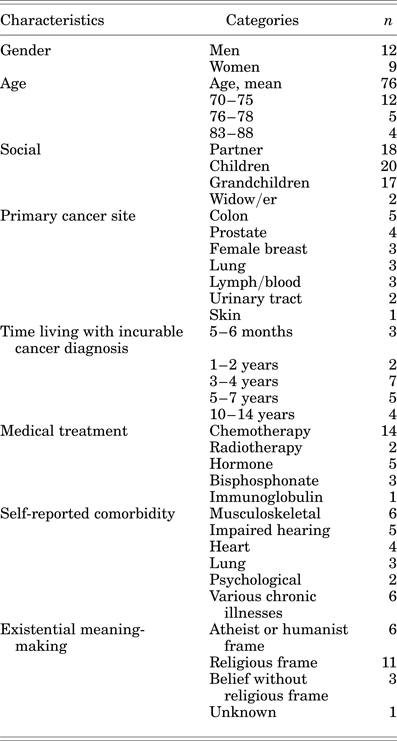
Table 1 provides an overview of the 21 participants in the study (12 men and 9 women). The participants represented an age range, though the majority was between 70 and 75. There was a broad range of primary cancer sites, as well as timespan living with incurable cancer, ranging from 5 months to 14 years. Some 14 participants were receiving chemotherapy. Some 13 reported primarily somatic-related comorbidities, and 6 of these reported two or more additional illnesses. The social factor was very important. A total of 18 were in a partnered relationship, and only one was without children. The existential meaning-making expressions (spiritual component) in relation to belief frames ranged from traditional Christian to atheist.
Demographic data (N = 21)

RESULTS
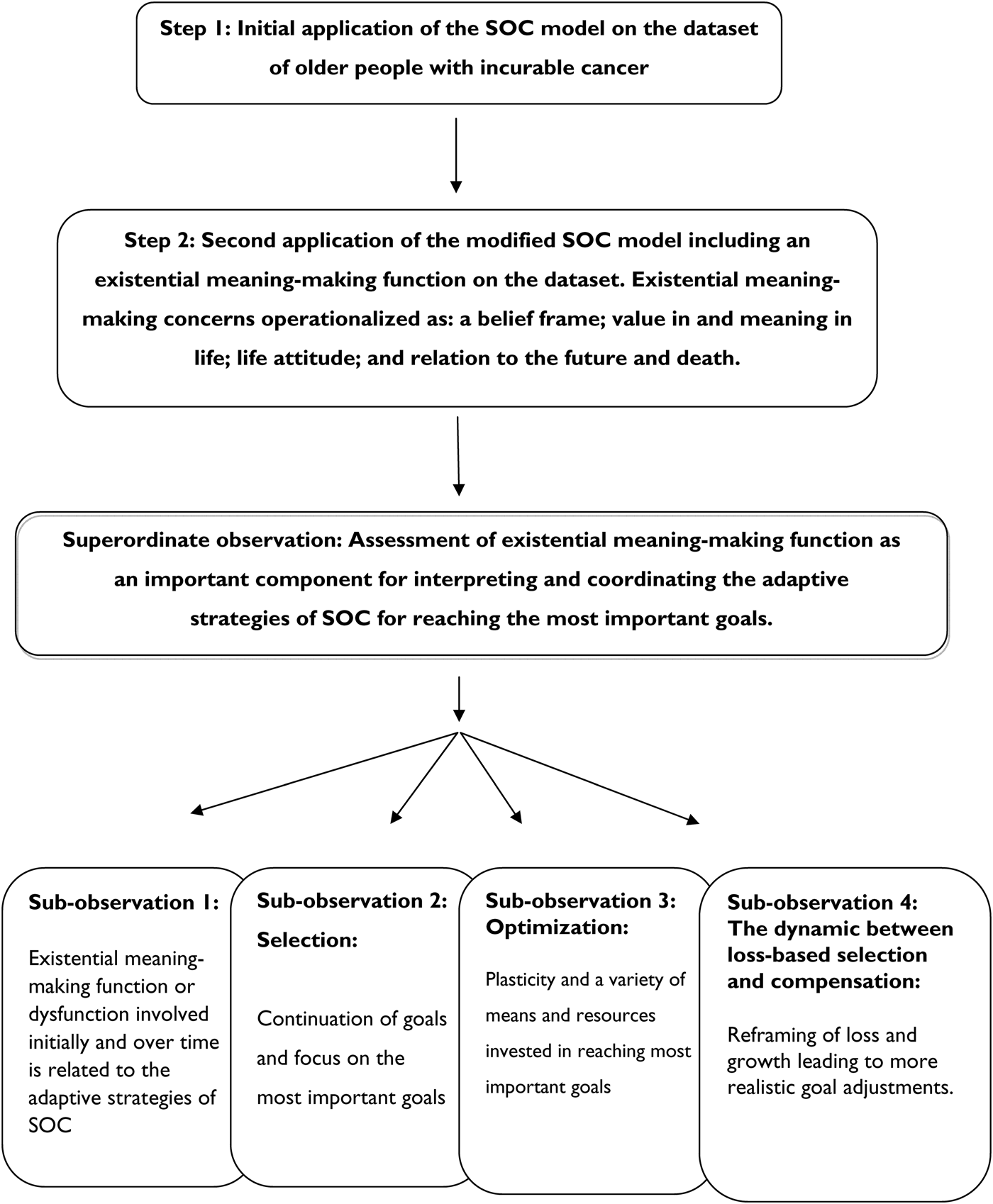
The results are depicted by the thematic map in Figure 1, containing the two analytic steps, grouped under one superordinate observation, and four sub-observations. The use of observations reflects the analytic process leading to the main considerations and characteristics of the sample. The existential meaning-making concerns are operationalized here as: a belief frame, value in and meaning in life, life attitude, and relation to the future and death. This is referred to as the existential framework in the presentation.
A modified SOC model with assessment of existential meaning-making function.
Superordinate Observation: Assessment of Existential Meaning-Making Function as an Important Component for Interpreting and Coordinating the Adaptive SOC Strategies for Reaching the Most Important Goals
The theme “superordinate observation” indicates that existential meaning-making played a central role in interpreting and coordinating the adaptive SOC strategies for reaching the most important goals in this population. There were two main patterns found. First, the existential framework was related to an understanding of resilience as a comprehensive process, allowing for both restoration as well as growth dimensions to be identified. Second, there was great diversity in the content as well as the function of the existential frameworks among the participants, as well as the dynamic processes underway for each participant.
One participant described his existential meaning-making function in an explicit manner:
If you live in a good environment and find life worth living, then you recover faster when you are sick. I want to live longer, I haven't laid down the oars yet. (man, 74)
This description of the recovery process is in line with an understanding of resilience in the SOC model. In this way, his most important goal—“to live longer”—could be sustained and strengthened.
Another way to describe the existential meaning-making function was to emphasize the belief frame: “We cannot go anywhere, nor speak, walk, or think without God. If God will end my life, then it will be over” (woman, 78). The participant ascribed to God the main source of functioning in life. The frame was closely connected to normal activities in daily living, representing her reasoning and basis for the resilience process, this including losses since God was in charge of her future and time of death.
A participant with a quite different type of belief frame referred to it as decisive for his interpretation of the present and for his relation to the future and death. He described how he had experienced new feelings of attachment to his family during the last couple of years. This was in line with growth in the “resilience repertoire”:
I am an atheist, and I consider fellowship and compassion to be the most important dimensions in life. Now, I insist on living each moment as best as I can together with my family, not spending time on fights and quarrels. I can feel that my wife really is my wife. In fact, these feelings of belonging are quite new for me. We shall all die, both you and I, so death is nothing to worry about. (man, 88)
Some expressed how specialized healthcare contexts represented one of the most important domains, facilitating the adaptive process and strategies of SOC for dealing with daily demands and also contributing to hope in relation to the future:
What has been most important after I got lung cancer is that my doctor hasn't given up on me yet. Hence, I still have hope for the future. In addition, she makes me feel safe when I can talk with her about small things.” (woman, 83)
Sub-Observation 1: Existential Meaning-Making Function (Including Dysfunction) Involved Initially and Over Time Is Related to The Adaptive SOC Strategies
The majority of participants (19) gave examples of existential meaning-making function that could be categorized under each of the SOC strategies. Within each strategy, all four operationalized concerns in the existential framework were involved together with various types of prototypical behaviors. This indicated a complex variation both on the individual and group levels: in the content of existential meaning-making, in how the four operationalized concerns were interrelated, in the use of prototypical behaviors, and in the comprehensive process of resilience.
Most participants (16) described difficult initial reactions to the incurable cancer diagnosis, including: shock, threat of imminent death, a big downturn, and disappointment. Mainly, they remembered this as lasting for a short period, about a couple of days. They then adjusted to the new situation, creating new patterns of existential meaning-making. The following citation illustrates how the existential meaning-making function was involved both initially and over time and related to the SOC strategies:
I was kind of shocked from the beginning, but gradually I withstood bad news from the doctors. This is based on the fact that the treatment has had a life-prolonging effect. Now I have lived with incurable cancer for more than eight years. I handle things better than before, and I believe I have a strong resilience. In fact, I have lived quite a normal life in all those years with cancer, allowing myself all the good things. (man, 76)
Another man also described a difficult initial period. Over time, he experienced the cancer illness as a “devilry,” thus leading to a quite different way of describing the resilience process:
The brain is working with the devilry all the time, so the illness is always in the back of my head. Therefore, and I have thought a lot about this, I have come to the conclusion that I need a certain capacity for dealing with the illness. If you bury yourself in the illness, then life is over. What saves us is our ability to adapt, and this I have managed. (man, 74)
In contrast, a few gave examples of existential meaning-making dysfunction in relation to one of the concerns in the existential framework. A woman (78) described how her life attitude—”I have lived for others all my life”—had caused serious problems for her health condition. Despite signs of a tumor in her breast, she postponed health examinations. She was afraid that her grandchild would quit his studies if she became seriously ill. Consequently, she had cancer with metastasis when she was diagnosed the first time. This led to several restrictions in her daily living, such as not carrying heavy weights. A couple of participants (2) seemed to be too sick to make use of, or could not adjust their existential meaning-making to the situation. One described an almost abrupt loss of her ability to make meaning from the moment she was informed about the diagnosis:
I had a nervous breakdown when I was diagnosed with lung cancer. If my family hadn't been there, I don't know what I would have done. I have lost my zest for life. I have no more to give. (woman, 75)
Sub-Observation 2: Selection: Continuation of Goals and Focus on the Most Important Goals
The main pattern here was that elective selection and loss-based selection were linked together in the behavioral types “specification of goals and focus on the most important goals.” The main feature in both types was continuation—the new goals were in line with their goals prior to the cancer. The continuity perspective was identified in relation to all the concerns in the existential framework. Several referred to their belief frame as formed by childhood or adolescent experiences: “I learned about my Christian faith from my grandparents” (woman, 72); “I became an atheist in my early twenties” (man, 88). No participants reported significant changes in this area after the cancer diagnosis. The most dominating theme was the significance of close relations. A typical statement was “My family is most important to me, both in the present and when looking back” (man, 83). Another expressed a comprehensive and continued existential framework, where the dimension of loss was emphasized:
I don't know how long I will live—maybe one more year. I have accepted it. I am not afraid of dying because I don't believe in heaven or hell. I have a fatalistic life attitude. I think I inherited my faith and the equanimity from my father, He also died of cancer. The sad part is my grandchildren; I really want to follow them much longer. (man, 72)
Life attitudes were mostly positively oriented, characterized by continuity in a life-span perspective: “I have always been positive and satisfied with life” (three men, 70, 73, 76), or “have taken things easy” (man, 73); “I have always been a person with great engagement, both all the years in different jobs and later in aid-work” (woman, 73). Only one stated an opposite attitude characterized by worries before he got sick:
That is the wrong thing—to be healthy and always think about what happens when you become sick. Then, when it first came, everything came at the same time. I can't remember it all. (man, 83)
Sub-Observation 3: Optimization: Plasticity and a Variety of Means and Resources Invested in Reaching the Most Important Goals
The participants activated a “pool of potentialities” (Baltes et al., Reference Baltes, Lindenberger, Staudinger, Damon and Lerner2006, p. 585) for reaching the most important goals, thus indicating plasticity and that a variety of means and resources were invested in optimization. In relation to resilience, both restoration and growth dimensions were identified. There were two main patterns found in relation to the existential meaning-making function. First, there were descriptions of self-transcendent behavior, reaching outside oneself and giving help to others. This type of behavior was identified in relation to all four operationalized concerns in the existential framework. The involvement included most of the prototypical behaviors of optimization: practice of skills, attentional focus, time allocation, persistence, effort and energy, and seizing the right moment. These were not easily distinguished from each other. Predominantly, the content of self-transcendent behavior was engagement in close relationships, taking care of a sick partner, and following grandchildren. In addition, some (5) were involved in volunteer employment—such as aid and social or political work. Two examples of such involvement were typical:
I will soon write a newspaper article in order to throw light on a social problem in my community. (man, 75)
I am involved in an aid project in India. Although I probably won't see it completed, I still feel very inspired and engaged. (woman, 73)
The participants referred to various motivations for this type of engagement: to prevent health decline, to be active and engaged for its own sake, to help people in need, and to receive reward in the afterlife.
The second pattern was that the belief frame stimulated the behaviors “persistence, energy, and attentional focus” along with experiencing great difficulties. Thus, these behaviors positively influenced the comprehensive resilience process, leading to both growth and restoration. There were two common features in these experiences. First, the participants experienced their belief frame as something positive: “a handle to hold onto in difficulties,” “a help,” “a special feeling of being taken care of,” “contributes to resilience,” and “reduces anxiety about the last period of life.” Second, the belief frame was something deeply personal and private: “I have prayed to God for many years but haven't dared to tell anybody until last year when my husband died. Now I am so old, so it doesn't matter anymore” (woman, 71). A concrete description about the significance of a belief frame in a life-span perspective was given by one participant:
I am a patient human being despite my big problems in childhood and health problems. How have I learned patience? My faith has prevented me from giving up, from wanting just to die. I have kept my faith for myself. It has not been trampled on like so much else in my life; thus, it is good for me. (woman, 72)
Sub-Observation 4: The Dynamic Between Loss-Based Selection and Compensation: Reframing of Loss and Growth Leading to More Realistic Goal Adjustments
The participants shared comprehensive narratives related to the process of decline and loss, and 15 of the 21 participants had experienced a discernible worsening in his/her health condition during the previous year. As can be seen in Table 1, most of the participants (16) had lived with cancer for more than three years, implying that they had gone through several stressful treatment periods. The theme “enduring tough treatment periods in order to have a life-prolonging effect” ran as a common thread through these narratives. The participants experienced that the dynamic between loss-based selection and compensation was increasingly dominant in daily living. This meant that their life became, simultaneously, both more restricted and more effective in reaching the most important goals. We noticed two ways in which the existential framework was functioning. First, it facilitated a reframing of loss of their personal goals to achieving more realistic goal adjustments. This was found in relation to resilience as accounted for in the SOC model. Second, the reframing was identified in relation to growth and to the framework “resilience repertoire,” also contributing with more realistic goal adjustments in daily living.
In the reframing of loss, a woman (aged 83) described an absorbing experience: “The cancer disease requires all of me.” The disease had caused major changes in daily living and that her belief frame was a key factor in handling loss and decline: “My faith is a handle to hold onto in difficulties.” In the sample in general, the aspect of the future and death represented the biggest challenge. For the majority of participants, the importance of taking one day at a time and not making future plans too far ahead were stated as ways of handling the unpredictability of their health situation. Some (5) expressed that they considered parts of their health constraints as normal, taking their age into account. For half the participants (11), dealing with this aspect was experienced as difficult. The concerns included close relationships and the terminal phase:
I had to take care of my mother before she died; thus, I am afraid of becoming a burden to my family. (woman, 71)
What I am deeply concerned about is whether or not I can stay at this hospital toward the end, and also receiving morphine if I get pain. I will ask the oncologist about this in our next appointment. (man, 74).
The behavioral type “modeling others who compensate” was identified as an expression of life attitudes, also contributing with adjustments of goals in relation to loss: “My attitude has been to make the best out of it, to try to recover. I learned this from my mother, who lived with pain for many years” (woman, 71).
In the reframing in relation to growth, several participants referred to the maintenance of a normal daily life as the most important theme, being aware of the significance of accomplishing selected activities:
The most important aspect in my life is to live as normally as possible. I learned this in a crisis many years ago. It functioned then, and it functions now. I hope I can live as I do now for many years; be together with my partner and family. (man, 74)
Examples of more realistic goal adjustments were also given in relation to self-transcendent behaviors. Engagement for others was still seen as important. Simultaneously, the responsibility had either been passed on to the next generation or modified:
I have always supported my family. Now I can just enjoy life and let go of the responsibility. (man, 82)
I have entrusted the aid work to someone else. Now I support it with money. (man, 73)
As already accounted for, the belief frames seemed to represent for many a factor in the “resilience repertoire,” being helpful when handling decline and loss.
DISCUSSION
The aim of the present article was to understand how older people with incurable cancer experience the existential meaning-making function in daily living from a life-span perspective. We applied an existential meaning-making framework derived from the findings of an initial study (Haug et al., Reference Haug, Danbolt and Kvigne2014) and the specific analysis in the present article. This framework was operationalized into the following concerns: a belief frame, a value in and meaning in life, life attitude, and relation to the future and death. By adding this existential meaning component to the selective optimization with compensation (SOC) model, we found that these older people experienced meaning-making function on two levels. On a superordinate level, it was an important component for interpreting and coordinating the adaptive strategies of SOC in order to reach the most important goals in daily living. The existential framework provided for a comprehensive understanding of resilience, allowing for both restoration and growth dimensions.
The second level was a strategy-related level, in that existential meaning-making function was involved in a complex interaction with behavioral resources and resilience for continuation of life goals and more realistic goal adjustments. A few experienced existential meaning-making dysfunction, causing problems in both coordinating the SOC strategies and reaching the most important goals in daily living. The findings supported and extended our initial findings in this population (Haug et al., Reference Haug, Danbolt and Kvigne2014)—that existential meaning-making and resilience are the overarching and interrelated functions for these older people.
As seen in several studies on chronic illnesses, the SOC model was found to be a basic framework for investigating how people adapt and manage certain difficulties, useful for healthcare professionals in order to guide people with chronic illnesses in finding ways to identify, select, maintain, and maximize certain behaviors and personal goals. This model was found useful in relation to patient populations with multiple sclerosis (Wilhite et al., Reference Wilhite, Keller and Hodges2004, p. 185), with arthritis (Janke et al., Reference Janke, Jones and Payne2011), and in stroke rehabilitation (Donnellan et al., Reference Donnellan, Hevey and Hickey2012; Donnellan & O'Neill, Reference Donnellan and O'Neill2014). In addition, two studies had taken this a step further, integrating SOC in a treatment program for older patients with chronic pain (Alonso et al., Reference Alonso, López and Losada2013) and in coping and communication support interventions for older people with late-stage cancer (Rose et al., Reference Rose, Radziewicz and Bowman2008). Both studies evaluated the programs positively for patient outcomes. However, except for the study on people with multiple sclerosis, which found spirituality to be a part of the theme “relationships” (Wilhite et al., Reference Wilhite, Keller and Hodges2004), existential meaning-making was not elaborated in this research.
The results of the present article show that the function of existential meaning-making in a daily reality framework is related to the behavioral functions of growth, resilience, and loss in the SOC theory and model. These types of developmental processes are regulated by the goal-oriented behaviors in the SOC model across the life-span (Baltes et al., Reference Baltes, Lindenberger, Staudinger, Damon and Lerner2006; Freund & Baltes, Reference Freund and Baltes1998). They are seen as fundamental in the management of the limitations and losses concomitant with illness and aging. For older people with incurable cancer, this type of management becomes increasingly more complicated, demanding, and noticeable, with “less positive balance of gains and losses” (Baltes, Reference Baltes1993, p. 590). Research has shown that the importance of the SOC strategies increases in aging and contributes positively to subjective well-being (Baltes et al., Reference Baltes, Lindenberger, Staudinger, Damon and Lerner2006). These strategies might also contribute to low psychological distress (Thygesen et al., Reference Thygesen, Saevareid and Lindstrom2009).
On a superordinate level, we found that for the majority of participants the existential meaning-making function was an important component for interpreting and coordinating the adaptive strategies of SOC for reaching the most important goals. Also, the important role of culture and cultural activities in the Norwegian context, in agreement with the biocultural framework of the SOC model, assisted the function of existential meaning-making and thereby the adaptive strategies. Resilience as a comprehensive process, incorporating both restoration and a more holistic growth dimension, was important for increasing an understanding of life-oriented adaptive strategies in older people. Therefore, the findings here support the two approaches to resilience as necessary and complementary in order to accurately map the complexity and diversity in the experiences of this population of older people with incurable cancer. More specifically, the existential framework information appears to provide a comprehensive means for both tracking and understanding the ongoing adjustments made in the meaning narrative in relation to resilience, including both new areas of growth for the adaptation process as incurably sick and for the realization of loss and decline.
We also found that the existential level of function of meaning-making, including dysfunction, was involved both initially and over time in each of the strategies in the SOC model. The combination of alternation between the strategies together with diversity in the content of the existential framework and the comprehensive process of resilience contributed to this variation. Variability in SOC strategies was also found in some studies on chronic illness: in older people with arthritis (Gignac et al., Reference Gignac, Cott and Badley2002) and those with mobility adaptations (Rush et al., Reference Rush, Watts and Stanbury2011a; Reference Rush, Watts and Stanbury2011b). The variability seemed to be central for minimizing difficulties with disability and weakness.
For older people with incurable cancer, continuation was part of the selection strategy, involving all four operationalized concerns in the existential framework. Thus, existential meaning-making seemed to be involved in the process of enabling continuity and constancy across the life-span. This fits with findings from gerontology research that previous life experiences are ascribed to adversities and incorporated in the lifelong development of self-identity (Clark et al., Reference Clark, Burbank, Greene and Resnick2011). By developing narratives in this way, older people strengthened the resources in the “resilience repertoire” in ways that were helpful for dealing with loss and decline.
In relation to optimization, we found that participants employed self-transcendent behavior, especially in close relationships and in certain meaningful activities. The content was comprehensive and diverse, including all aspects in the existential framework and most of the prototypical behaviors in optimization. In addition, the supportive and personal side of a belief frame, facilitating persistence and focusing, was also central. These findings might be an illustration of the plasticity in the participants, pointing to a core assumption in SOC theory that throughout the life-span human development is open and not fixed (Baltes et al., Reference Baltes, Lindenberger, Staudinger, Damon and Lerner2006).
Regarding the dynamic between loss-based selection and compensation, the existential framework facilitated a reframing of personal goals to have more realistic goal adjustments. The aspect called “the relation to future and death” represented the biggest challenge. In this connection, resilience analysis in relation to the SOC model identified the losses and insights in the dynamic between loss-based selection and compensation.
A few participants experienced existential meaning-making dysfunction. This was either seen in relation to one of the concerns in the existential framework or in the interpretation and coordination of SOC strategies on the superordinate level. In the first case, the dysfunction exacerbated a serious health condition that was followed by severe restrictions in daily living. In the latter, the dysfunction was related to a reduced ability to coordinate SOC strategies.
Understood as an area with a broad variety of individual expressions, our study showed that existential meaning-making was not only important as a domain of information in its own right, but also a vital resource for providing culturally sensitive information for how meaning is conceived and expressed. This type of information, well-documented in cultural psychology (DeMarinis, Reference DeMarinis2008), provides important information for understanding psychological processes and psychosocial interactions related to meaning and counterreactions against meaninglessness, or the identification of dysfunctional meaning processes.
In research on chronic illnesses, the SOC model was seen as a useful tool for healthcare professionals in order to guide people toward identifying and maximizing their personal goals and resources. We suggest the same approach for palliative care in the domain of existential meaning-making. Employing existential framework analysis and a complementary understanding of resilience integrated into or coordinated with the SOC model can help older people in palliative care to identify how they make meaning and how this influences their adaptation process to being incurably sick. As cultural contexts and their palliative care systems differ greatly, to include a cultural analysis dimension in research would increase both the accuracy and comprehensibility of research findings. Due to the increasing proportion of older people needing palliative care from specialized healthcare contexts, future research should pay more attention to this age group in general. More specifically, investigation of the complex processes of existential meaning-making and resilience in older people is needed, in order to identify and strengthen their own life resources.
Methodological Considerations
An advantage of the SOC model is that it is seen as a broad theory conceptually and that it can be applied to develop psychological insight into adaptation processes on a diverse range of conditions (Baltes et al., Reference Baltes, Lindenberger, Staudinger, Damon and Lerner2006; Donnellan & O'Neill, Reference Donnellan and O'Neill2014). In a review of successful aging models, SOC was evaluated as an important, useful, and promising model for empirical studies (Ouwehand et al., Reference Ouwehand, de Ridder and Bensing2007). Further, it has been applied as an analytic tool in some qualitative studies, indicating that it is applicable in this type of research (Janke et al., Reference Janke, Jones and Payne2011; Rush et al., Reference Rush, Watts and Stanbury2011b; Wilhite et al., Reference Wilhite, Keller and Hodges2004).
Our study represents one of the first attempts to apply the SOC model as a qualitative analytic tool in palliative care research. As such, it is regarded as tentative. Taking the complexity of life-span theory into consideration, the application here is also a simplification. According to life-span theory, there are facets of plurality in the course of development, consisting of multidimensional and multidirectional factors. These include influences from culture and history. In addition, early childhood is seen as more influential on any developmental process than later age periods. As stated in life-span theory, each age period has its own agenda (Baltes et al., Reference Baltes, Lindenberger, Staudinger, Damon and Lerner2006). Hence, insight into age-related patterns in the oldest group is of great relevance.
A multi-method design, applying both qualitative interviews and the short version of the SOC questionnaire (Freund & Baltes, Reference Freund and Baltes1998), would probably contribute to a better basis for the development of SOC in palliative care. To apply this questionnaire in future research is worth considering. However, the importance of also including a growth aspect of resilience and an existential meaning-making component in this study point to the need for consideration of the addition of these components when using the SOC model for a palliative care population.
CONCLUSION
An analysis of the existential meaning-making function of older people with incurable cancer who are receiving palliative care in specialized healthcare contexts provided a comprehensive means for understanding their adaptation process for reaching the most important goals in daily living from a life-span perspective through the SOC model. The existential meaning-making function was operationalized here as a framework that permitted both restoration and growth dimensions of resilience to be identified. In addition, the framework was involved in a complex interaction with behavioral resources and resilience strategies, leading to continuation of life goals and more realistic goal adjustments. The ways of accomplishing the most important goals in their daily living were as diverse as the participants in the study. Most experienced a high level of existential meaning-making function.
We find that the modified SOC model used here—to include an existential meaning-making framework and function, and to include growth as well as a restoration approach to resilience—is applicable for palliative care in specialized healthcare contexts. The modified SOC model would permit older people to have an active voice in how meaning is made and shared throughout the adaptation process to being incurably sick. The combination of the SOC model and the existential meaning framework, with the resulting more comprehensive approach to resilience, might provide a fruitful next step in both theoretical and clinical developments for palliative care populations.
ACKNOWLEDGMENTS
This study was funded by the Innlandet Hospital Trust in Norway. The hospital assisted with recruitment. Kari Kjønsberg took part in the interviews. We are grateful to the study participants. This research was partially supported by the Health and Wellbeing Research Area of the IMPACT Research Program at Uppsala University in Sweden.