Introduction
A patient's desire to die (DD) is common in individuals with a life-threatening illness: a study of Wilson et al. (Reference Wilson, Dalgleish and Chochinov2016) showed that of 377 participating oncological patients, 18.3% occasionally had these kinds of thoughts and 12.2% had experienced a serious DD. A DD (or wish to die) can be differentiated into three categories: patients who express a DD without having a desire for hastened death (DHD), patients who express a DHD without being proactive, and patients who plan or commit suicide (Ohnsorge et al., Reference Ohnsorge, Gudat and Rehmann-Sutter2014b). Thus, a DHD can be part of a DD and represents a wish to die sooner than it might occur by natural disease progression; it is connected with physical, psychological, and existential distress (Rodin et al., Reference Rodin, Lo and Mikulincer2009). Health professionals (HPs) from specialist palliative care (SPC) and generalist PC (GPC) feel underprepared when confronted with a DHD (Udo et al., Reference Udo, Melin-Johansson and Henoch2014). A study of HPs responding to DHD (Galushko et al., Reference Galushko, Frerich and Perrar2015) in PC identified numerous strategies but also burden; while some physicians and nurses experienced distress in the face of a DHD discussion, existing recommendations (Hudson et al., Reference Hudson, Schofield and Kelly2006; Royal College of Nursing, 2011; Nauck et al., Reference Nauck, Ostgathe and Radbruch2014) were unknown. On the other hand, patients expect HPs to initiate communication on death and dying (Smucker et al., Reference Smucker, Ditto and Moore1993; Fallowfield et al., Reference Fallowfield, Jenkins and Beveridge2002; Galushko et al., Reference Galushko, Romotzky and Voltz2012) and experience relief from DHD discussions (Ohnsorge et al., Reference Ohnsorge, Gudat and Rehmann-Sutter2014a). It should be noted that in suicidality research, there is no evidence that talking about suicide increases suicide risk (Harris Keith and Goh Melissa, Reference Harris Keith and Goh Melissa2016).
The aim of this study was to develop and evaluate a training course to increase HPs’ self-confidence in order to be better prepared for responding professionally to a patient's DD and to assess the feasibility of this approach.
Methods
Curriculum development
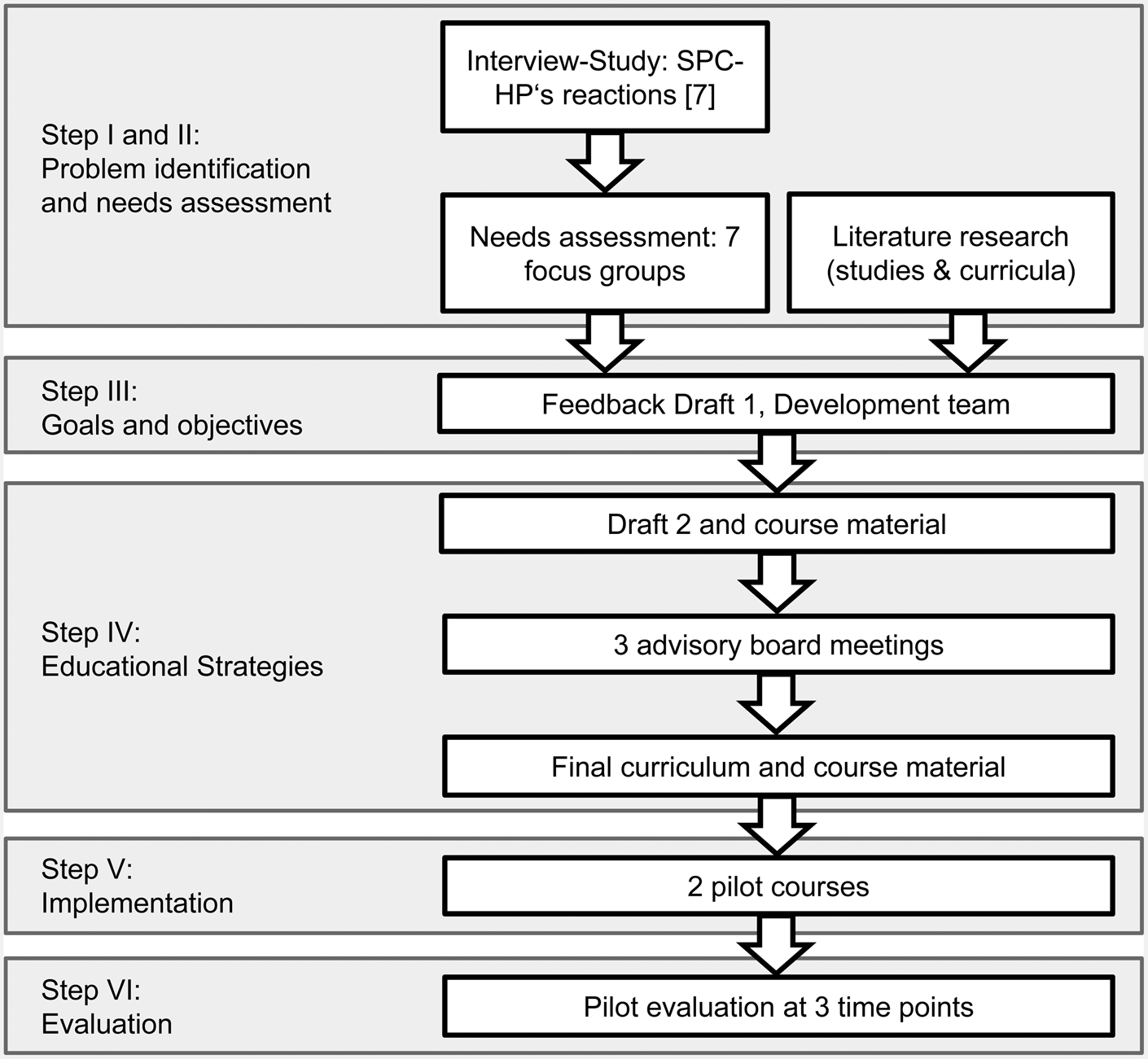
To develop the staff training program, the Kern six-step curriculum development approach (Kern et al., Reference Kern, Thomas and Hughes2008) was used (see Figure 1).
Flowchart of the course development (figure in accordance with: Kern et al., Reference Kern, Thomas and Hughes2008).

Problem identification and general needs assessment (step I)
In our previous study (Galushko et al., Reference Galushko, Frerich and Perrar2015), HPs’ current approaches on dealing with patient's DHD were identified but also related burden (step I). To identify what best to include into the curriculum, a literature search was carried out on relevant course concepts as indicated by Kern et al. (Reference Kern, Thomas and Hughes2008), using PubMed to scan for learning objectives, teaching methods, and evaluation design: “(Training OR education OR educational intervention) AND (Palliativ* OR oncolog*) AND (existential OR spiritual OR dhd OR wthd OR wish to hasten death OR desire for hastened death)” (20 August 2015). German PC curricula were scrutinized to avoid overlaps.
Targeted needs assessment (step II)
Focus groups were conducted in four German university hospitals separately with SPC and GPC HPs to analyze the potential different needs (see Supplementary Appendix for the interview guideline). Sixty HPs agreed to participate and gave written consent. At the beginning of the group discussion, results from our previous study (Galushko et al., Reference Galushko, Frerich and Perrar2015) were outlined. The discussion about the training course included content, didactical structure, and teaching methods. Focus groups were moderated by two researchers (M.G./G.F. and G.F./V.R.), lasted an average of 60 min and were recorded, transcribed, and interpreted using the descriptive content analysis (Flick et al., Reference Flick, von Kardoff and Steinke2004). Results were intensively discussed within the development team, consisting of researchers and lecturers (all authors).
Goals and objectives (step III)
Intended learning outcomes were defined (Biggs and Tang, Reference Biggs and Tang2011). Goals and intended learning objectives based on results of the needs assessment were operationalized and subsequently discussed with lecturers and the advisory board (experts in ethics, law, spiritual care, pedagogy, social sciences, palliative medicine, and psychiatry).
Educational strategies and implementation (steps IV and V)
Educational strategies were defined. A mixture of multi-disciplinary participants, including GPC and SPC HPs, was chosen as the target group, following the holistic team approach in PC. To create a trusting atmosphere, there was a maximum of about 13 participants per training session. Due to practical considerations and the study being a pilot, only two courses were planned. The multi-disciplinary lecturers (nursing, palliative medicine, and psychiatry) were all well experienced in PC teaching.
Evaluation (step VI)
An evaluation design to elucidate the feasibility of the concept for future research was created based on similar studies found in the literature search and discussed with lecturers and the advisory board. Therefore, the created evaluation design and instruments are reported as part of the results. Data were analyzed using SPSS 25 (IBM Corp., Armonk, NY, USA). Means with standard deviation (SD) were calculated for all time points (Ts). To show the development of self-confidence over time from the baseline, means of differences between T1 and T2 and between T1 and T3 were calculated. Items with the reverse response direction were recoded to make means comparable. Differences were data based defined as major changes (|mean| ≥ 1 on a 5-point Likert scale or ≥ 1.4 on a 7-point Likert scale) and minor changes (|mean| ≥ 0.5 on a 5-point Likert scale or ≥ 0.7 on a 7-point Likert scale). For all items, negative values in differences illustrate improvements, and positive values show decreases in self-evaluation. Pre–post differences (between T1 and T2, respectively, T3) were analyzed with the Wilcoxon signed-rank test. Non-parametric methods were used due to the small sample. Presented p-values are two-sided and of explorative character considering the multiple testing of 32 items (resulting in a p-value of 0.001).
The ethics committee of the University Hospital of Cologne gave its approval (11–239, 15–169).
Results
Curriculum development
A novel training concept to respond to DD was developed collaboratively by researchers and lecturers at the University Hospital of Cologne with support of the advisory board.
Problem identification and general needs assessment (step I)
In our previous study concerning current approaches (Galushko et al., Reference Galushko, Frerich and Perrar2015), the importance of self-protection and perceived professional expertize was highlighted. The additional conducted literature search showed that a main aim of the reported trainings was the ability to communicate confidently with the patients about existential issues, which might include a DD (Frommelt, Reference Frommelt1991; Morita et al., Reference Morita, Tamura and Kusajima2014; Udo et al., Reference Udo, Melin-Johansson and Henoch2014; Henoch et al., Reference Henoch, Strang and Browall2015). Other important learning outcomes were the ability to communicate attentively and compassionately, to explore factors fostering a DHD, to share solutions, to honor patients’ perceptions, to reflect one's attitudes toward existential issues (Strang et al., Reference Strang, Henoch and Danielson2014; Henoch et al., Reference Henoch, Strang and Browall2015), and to cope with own emotions (Strang et al., Reference Strang, Henoch and Danielson2014; Henoch et al., Reference Henoch, Strang and Browall2015). The importance of self-care was highlighted as knowing, accepting, and maintaining one's own boundaries (Müller et al., Reference Müller, Kern and Nauck1997; Kern et al., Reference Kern, Müller and Aurnhammer2007; Browall et al., Reference Browall, Henoch and Melin-Johansson2014; Gratz et al., Reference Gratz, Paal and Emmelmann2015). Recommendations on responding to DHD included how to establish a relationship, addressing DHD, stabilizing the patient, and activating resources (Hudson et al., Reference Hudson, Schofield and Kelly2006; Royal College of Nursing, 2011; Nauck et al., Reference Nauck, Ostgathe and Radbruch2014). These aims were achieved by interactive lectures, self-reflection, group discussion (Fillion et al., Reference Fillion, Duval and Dumont2009; Udo et al., Reference Udo, Melin-Johansson and Henoch2014; Gratz et al., Reference Gratz, Paal and Emmelmann2015; Henoch et al., Reference Henoch, Strang and Browall2015), case work (Müller et al., Reference Müller, Kern and Nauck1997; Hagen et al., Reference Hagen, Roser and Reigber2011; Gratz et al., Reference Gratz, Paal and Emmelmann2015), and role-play (Morita et al., Reference Morita, Tamura and Kusajima2014).
Targeted needs assessment (step II)
For the targeted needs assessment, seven focus groups were conducted: four with 45 SPC HPs (18 nurses, 14 physicians, and 13 members of psycho-social-spiritual occupational groups) and three with 15 GPC HPs (six physicians, five nurses, and four members of psycho-social-spiritual occupational groups; see Supplementary Appendix for quotes).
To better deal with patients’ requests, participants inquired about reasons for and manifestations of DD, including suicide assessment. Legal, ethical, and intercultural knowledge concerning euthanasia, assisted suicide, and withdrawal of life-sustaining measures should be raised. Participants found training in skills, like establishing a helpful relationship, dealing with one's emotions, and self-care, important. Training should contribute to the ability of professionally discussing patients’ DD and distress within the team. Favored methods were lectures to provide knowledge, reflection exercises, and role-plays. Multi-disciplinarity and a two-day length were regarded as beneficial. A trusting atmosphere should be ensured.
Goals and objectives (step III)
The training aimed to raise self-confidence in knowledge, skills, and attitudes. Intended learning outcomes were defined (see Table 1).
Intended learning outcomes

Educational strategies (step IV)
A mixture of lectures, experiential exercises, self- and group reflection (Fillion et al., Reference Fillion, Duval and Dumont2009; Gratz et al., Reference Gratz, Paal and Emmelmann2015; Henoch et al., Reference Henoch, Strang and Browall2015), self-studies (Udo et al., Reference Udo, Melin-Johansson and Henoch2014), case work, and role-playing was used. As the course material, a pocket card consisting of recommendations regarding action (how to deal with DHD) and personal reflection (HP–patient relationship, HPs’ emotional responses, and self-care) summarizing the training was provided, based on DHD studies (Rodin et al., Reference Rodin, Lo and Mikulincer2009; Monforte-Royo et al., Reference Monforte-Royo, Villavicencio-Chavez and Tomas-Sabado2012; Ohnsorge et al., Reference Ohnsorge, Gudat and Rehmann-Sutter2014b; Galushko et al., Reference Galushko, Frerich and Perrar2015) and recommendations (Hudson et al., Reference Hudson, Schofield and Kelly2006; Royal College of Nursing, 2011; Nauck et al., Reference Nauck, Ostgathe and Radbruch2014).
Implementation (step V)
Training course
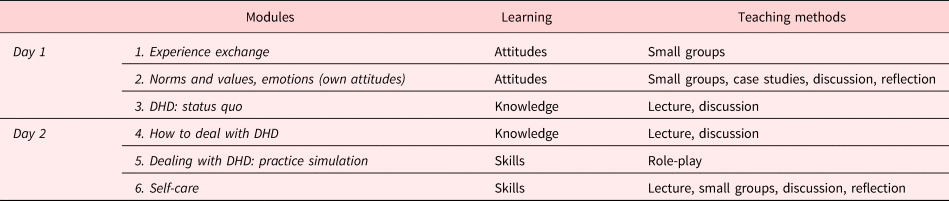
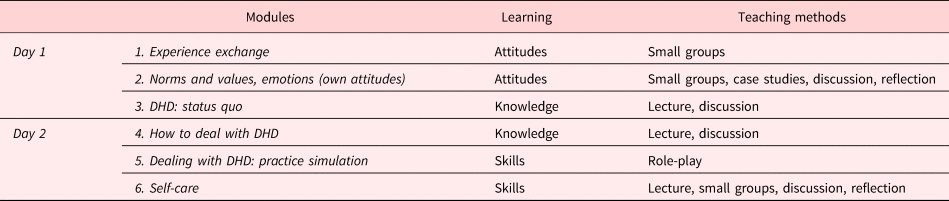
The curriculum development resulted in a two-day course (16 h) comprising six modules.
Module 1 focused on experience exchange to generate a trusting atmosphere. For a reflection on attitudes and their possible influence on one's own behavior, HPs shared in module 2 their norms, values, and emotions in dealing with DD and DHD using case vignettes in small group discussions. In module 3, knowledge and terminology about DD and DHD were presented, including DHD prevalence, types and classification, and predictors. Suicide assessment, duties of care, and legal issues were discussed. Module 4 focused on recommended key points for supporting patients with DHD. The main aspects were the recognition of DHD and proactively address DD. Reflections on the patient–HP relationship, including acceptance of the patient's distress, encouragement to express emotions, and listening actively were highlighted. In module 5, participants practiced communicative strategies to address DHD proactively via role-playing, integrating their specific challenges with DD. Peer feedback and coaching by the tutors supported the reflection about helpful approaches. Module 6's aim was to enhance HPs’ resilience and reflection on their boundaries (see Table 2 for the course structure and Supplementary Appendix for a detailed description of the modules).
Structure of the two-day training course
The training courses were conducted at the Center for Palliative Medicine of the University Hospital Cologne in April and June 2016.
Evaluation (step VI)
An evaluation was designed to examine the feasibility for future research, without a control group. A pilot questionnaire was developed based on validated instruments used in similar studies (for validation and psychometric properties, see Frommelt (Reference Frommelt1991) and Morita et al. (Reference Morita, Murata and Hirai2007, Reference Morita, Murata and Kishi2009)) plus the adapted single-item confidence scale (Morita et al., Reference Morita, Murata and Hirai2007) for three time points: before the training (baseline, T1), directly after the training (T2), and 3 months later (T3). Qualitative data were collected at the end of the training via oral and written feedback (T2). At T3, open questions were included about any noted changes that participants attributed to their training. Feedback was summarized afterward.
The literature search identified evaluation studies on trainings for nurses concerning caring for patients' feeling meaningless or attitudes about death and dying. For questionnaire development, the FatCod (30 items) (Frommelt, Reference Frommelt1991, Reference Frommelt2003), the confidence scale (1 item) (Morita et al., Reference Morita, Murata and Hirai2007), the attitudes toward caring for patients' feeling meaninglessness scale (8 items) (Morita et al., Reference Morita, Murata and Kishi2009), and the self-reported practice scale (6 items) (Morita et al., Reference Morita, Murata and Hirai2007) were chosen, as they were originally designed to evaluate the effects of educational programs comparable to our training aims. Suitable content items were reformulated using DD instead of meaninglessness or attitudes toward dying, changing as few words as possible. The developed adapted tool, composed from different scales, was not validated for DD. The 32 items of the new instrument (see Table 4) were assigned to four areas by content: self-confidence, knowledge, skills, and attitudes. For the principal aim of overall self-confidence (item 1; 7-point Likert scale, with 1 = lowest value and 7 = highest value), we adapted the confidence scale of Morita et al. (Reference Morita, Murata and Hirai2007). Items 2–32 were measured on a 5-point Likert scale (from 1, which applies fully, to 5, which does not apply at all). Items 2–11 were based on the FatCod Frommelt's (Reference Frommelt1991, Reference Frommelt2003); items 26, 27, and 29–32 were based on the Attitudes Toward Caring for Patients Feeling Meaninglessness scale (Morita et al., Reference Morita, Murata and Kishi2009); and item 28 was inspired by the six-item self-reported practice scale (Morita et al., Reference Morita, Murata and Hirai2007). Items 12–25 were developed in the research group. Items had different response directions to avoid response bias. Two pretests with SPC HPs were conducted.
Sample
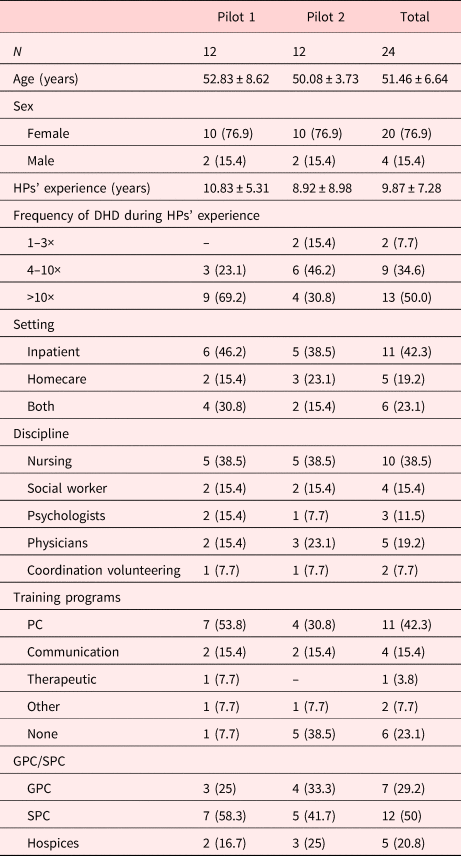
Sixty persons were interested in participating. Since only two trainings with a maximum of 13 each could be conducted, participants were selected to compose a heterogeneous group regarding GPC/SPC professions and experience. Only 24 participants completed the training. All 24 questionnaires at T2 were returned; at T3, only 13 returned, despite agreement and reminders. For the distribution of demographic and clinical setting of the participants, see Table 3.
Socio-demographics of training participants
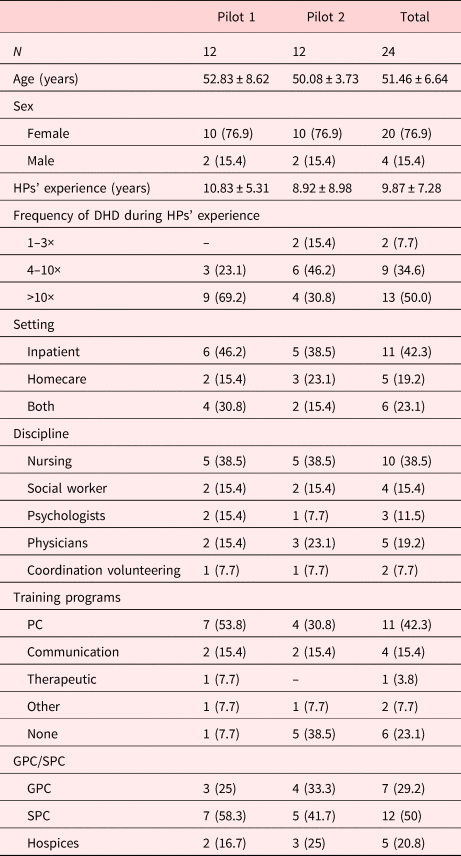
Data are presented as count (frequency) or mean ± SD.
Baseline
Items (in the following shown as “i” plus the item number) with the lowest positive self-evaluation scores (see Table 4) were: for knowledge — knowing recommendations (i18); for skills — feeling able to address a DHD proactively (i9); using different approaches to respond to DHD (i13); enduring patients’ emotions (i9); and for attitudes — confrontation with one's own helplessness (i31).
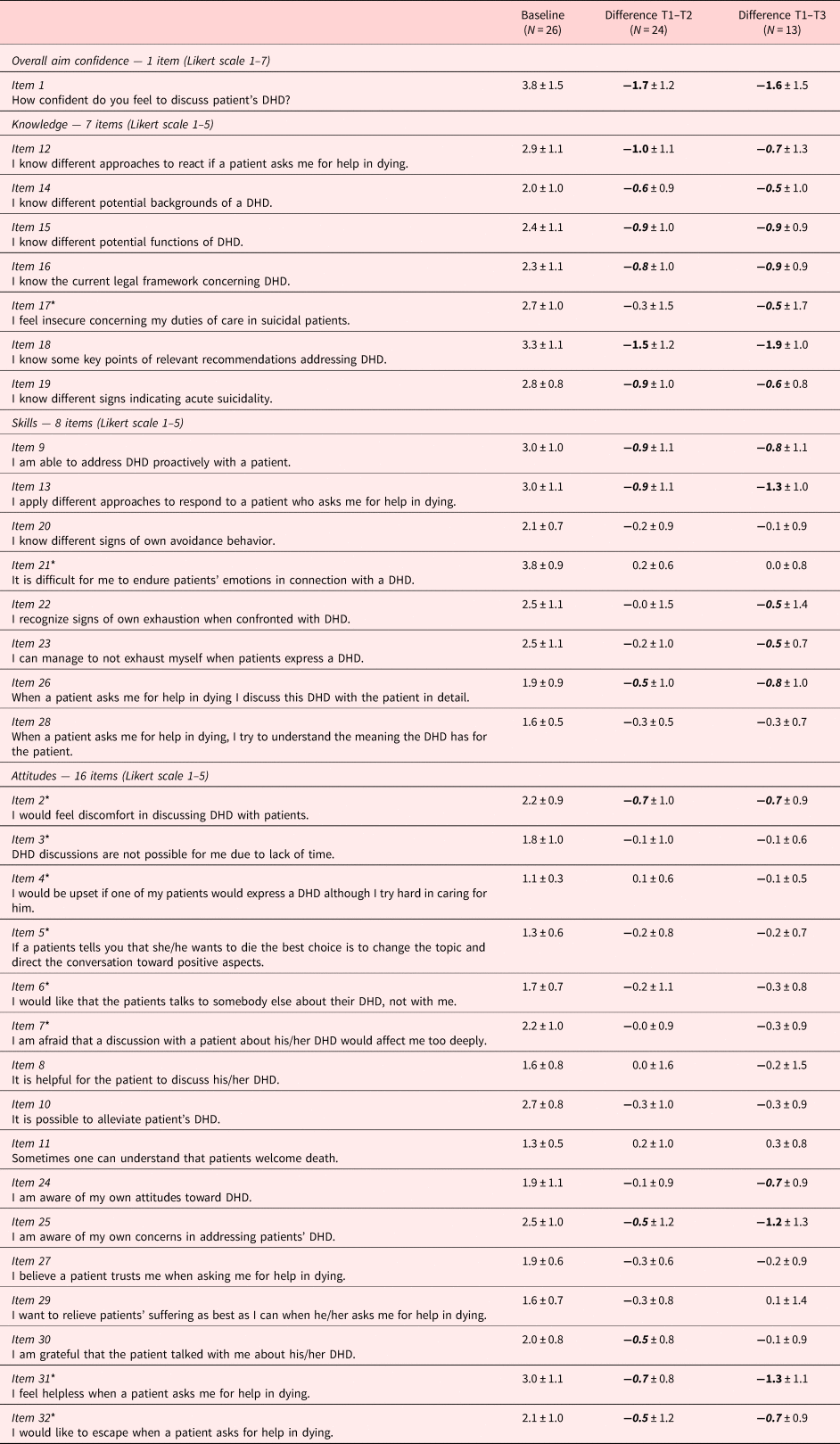
Items of confidence questionnaire with baseline and means of differences T1–T2 and T1–T3

Data are presented as mean ± SD, Likert scale 1–7 (1 — lowest self-confidence; 7 — highest self-confidence), Likert scale 1–5 (1 — applies fully, 5 — does not at all apply). Major changes in bold and minor in bold italics. In the text, we use abbreviations for item formulations, e.g., “when asked for help in dying” is often summarized as “DHD.”
* Recoded items.
Changes directly after training (T1–T2)
All changes are reported in Table 4. The p-value is referred to only if the p-level is p ≤ 0.001. Improvements above the significance level were found in 5 out of 32 items (p ≤ 0.001, adjusted for multiple testing).
Self-confidence: Major change with −1.7 ± 1.2 (p = 0.001)
Knowledge: Item 12, knowing different approaches to react to DHD, showed a difference of −1.0 ± 1.1 (p = 0.001). Item 18, knowing recommendations addressing DHD, showed an improvement of −1.5 ± 1.2 (p < 0.001). Minor changes were shown for items 14, 15, 16, and 19 (knowing backgrounds, the function of DHD, legal framework, and signs of suicidality, respectively), the last showing p = 0.001.
Skills: Only minor changes in items 9, 13, and 26 (addressing DHD proactively, applying different approaches, and discussing DHD in detail, respectively).
Attitudes: Only minor changes in items 2, 25, 30, 31, and 32 (comfort in discussing DHD, awareness of one's own concerns, feel grateful for being trusted, feeling helpless (p = 0.001), and trying to escape a DHD discussion, respectively).
Oral feedback after the course
The trustful atmosphere, multi-disciplinary group composition, teaching methods, and the pocket card were highlighted as especially beneficial. Role-playing was perceived as most helpful, and more role-play was requested. Reflections on one's own attitudes could also be intensified.
Changes after 3 months (T1–T3)
Data from 13 participants were available for T3. One improvement (out of 32 items) was significant (p ≤ 0.001).
Self-confidence maintained a change from the baseline with a major improvement of −1.6 ± 1.5.
Knowledge: The major change at T2 in knowledge of recommendations addressing DHD (i18) intensified even at T3 (p = 0.001). Minor changes were found in knowledge of backgrounds and the function of DHD and the legal framework (items 14, 15, and 16, respectively), maintaining the changes from T2. Knowing different approaches to address DHD (i12) and knowing signs of suicidality (i19) decreased slightly over time, whereas participants were slightly more confident about their duties of care (i17) at T3.
Skills: One major change (an improvement from T2 to T3) was found for item 13, applying different approaches to respond to DHD. Minor changes from T2 were identified for addressing DHD proactively and discussing DHD in detail (i9 and i26, respectively). For recognizing signs of one's own exhaustion and managing not to overburden (i22 and i23, respectively), there seemed to be a slight improvement over time, with minor changes at T3.
Attitudes: The improvement in the awareness of one's own concerns in addressing DHD and helplessness (i25 and i31) at T2 improved even further at T3 (a major change). Minor improvements from T2 to T3 were found in comfort in discussing DHD, being aware of one's own attitudes toward DHD, and trying to escape a DHD discussion (i2, i24, and i32, respectively).
Answers to open questions at T3
Participants described changes in attitudes and confidence and reported acting even more consciously and feeling more comfortable in proactively addressing DHD. The pocket card reportedly supported confidence.
Discussion
During our study, the first training to address patients’ DHD in Germany was developed. The pilot evaluation showed a modest positive impact within its methodological limitations.
Training course
To increase self-confidence was the main aim of the training. Increased self-confidence may lead to better professional performance (Bandura, Reference Bandura1977). The lack of confidence may be rooted in a fear of strong emotions, questioning one's ability to effectively address emotional topics (Hudson et al., Reference Hudson, Schofield and Kelly2006), the feeling of lack of time or being in fear of destroying hope (Sheahan and Wein, Reference Sheahan, Wein, Kissane, Bultz, Butow and Finlay2010). A study (Oordt et al., Reference Oordt, Jobes and Fonseca2009) showed that training for HPs on patients’ suicidality can change providers’ attitude, improving clinician confidence regarding suicide care, which also can be assumed for DD.
Our training focused on initiating conversations on DD since DD can mark the beginning of a suicidal process (Lapierre et al., Reference Lapierre, Boyer and Desjardins2012). Communication concerning treatment options can prevent suicide (Lindner et al., Reference Lindner, Foerster and von Renteln-Kruse2013). HPs’ breaking the silence and offering recommendable PC interventions (Hudson et al., Reference Hudson, Schofield and Kelly2006; Dean and Street, Reference Dean and Street2014; Nissim et al., Reference Nissim, Emmerson and O'Neill2016) can relieve patients’ suffering. Besides, patients want HPs to initiate a conversation on end-of-life issues (Smucker et al., Reference Smucker, Ditto and Moore1993; Fallowfield et al., Reference Fallowfield, Jenkins and Beveridge2002; Galushko et al., Reference Galushko, Romotzky and Voltz2012).
Because DD reflects mostly a patient's momentary feeling and not a final decision, HPs should be aware of concealed topics and address patient's actual fears (Monforte-Royo et al., Reference Monforte-Royo, Villavicencio-Chavez and Tomas-Sabado2012; Ohnsorge et al., Reference Ohnsorge, Gudat and Rehmann-Sutter2014b). Therefore, our training took a broad variety of DDs and their context into account. The training also contributed to recognizing HPs’ own limits, providing opportunities to strengthen personal resilience and learning when to seek support (Strang et al., Reference Strang, Henoch and Danielson2014). The abilities to set boundaries and resilience are important in ensuring self-protection and establishing a relationship between professionals and patients as a key element in clinical care (Sanders et al., Reference Sanders, Bullock and Broussard2012).
HPs’ attitudes toward DHD impact DHD discussions (Royal College of Nursing, 2011). Contact barriers or conflicts as shown in a previous study (Galushko et al., Reference Galushko, Frerich and Perrar2015) may be caused by unreflected differences between HP and patient norms and values. How HPs deal with their professional role affects clinical practice and their own well-being (Sorensen and Iedema, Reference Sorensen and Iedema2009). Therefore, participants’ reflections on their underlying norms and values toward DHD within the training course were included.
We aimed to train SPC and GPC HPs from multi-disciplinary backgrounds, allowing beneficial exchange between different perspectives. PC is based on multi-disciplinary approaches (Dean and Street, Reference Dean and Street2014); and this approach, approved in focus groups, was consequently implemented into the training (lecturers and participants).
Pilot evaluation
First of all, because of the use of single items of several scales within the developed questionnaire, the results of our pilot study are limited and have to be seen in the light of using non-validated instruments. Despite this main limitation, the pilot study indicates feasibility for the main study. Positive but modest results concerning training impact and transfer to practice were revealed; participants perceived the training to be of added value. Some of the reported major and minor changes reached the defined significance level. The p-values give some initial ideas for statistically relevant improvements, whereas changes beyond the p-value might be considered improvements that also need to be tested in further research with a larger sample. Only two pilot trainings were conducted, resulting in a considerably small N, especially at T3. The sample of the pilot evaluation consisted of already highly skilled participants which makes the results not generalizable for HP in GPC/SPC.
Direct change
Self-confidence when confronted with a DHD increased significantly. This supports the usefulness of the training.
The significant changes in knowledge about different approaches of addressing DHD are relevant, since this may lead to better individualized reactions toward patients’ DHD. The area of self-reported knowledge mostly improved, which may support the idea that increased knowledge already strengthens overall confidence.
One reason for generally little change in attitudes may be that changing attitudes and developing confidence in one's own actions require personal development and time (Udo et al., Reference Udo, Melin-Johansson and Henoch2014). Lower self-assessment was shown regarding skills, possibly because there was still potential for improvement with practice.
Changes after 3 months
The low number of participants at T3 (13 out of 24) limits the identified major changes. Nevertheless, results provide initial hints of long-term training effects. Similar training approaches have also had 13 participants in the intervention group (Udo et al., Reference Udo, Melin-Johansson and Henoch2014).
The overall aim of improving self-confidence was pertained at T3; although it missed the significance level, it supports the long-term usefulness of the developed training.
The fact that only self-reported knowledge (of recommendations) showed a significant major change illustrates the difficulty in reaching statistically relevant sustainable changes in skills and attitudes. Improved knowledge of recommendations may lead to better practices because it enhances HPs’ confidence, although the present study cannot confirm these effects. The intensified improvement in attitudes (one's own concerns regarding DHD and helplessness) toward T3, although not significant, suggests that the time in between experience and reflection was essential. Reflecting on one's own concerns regarding DHD is crucial to find adequate reactions toward patients (Favre et al., Reference Favre, Despland and de Roten2007) and ways for better coping (Henoch et al., Reference Henoch, Danielson and Strang2013). As helplessness continuously decreases, one can hypothesize that enhanced self-confidence can ease the feeling of helplessness by having a greater repertoire of responses or becoming calmer in challenging situations (Hoffer and Buie, Reference Hoffer and Buie2016).
Although the open answers showed that more participants felt more comfortable in addressing DHD proactively, this skill showed only minor, non-significant improvements. This might be due to the difficult nature of the proactive approach, which might require more exercise along with supervised repeated practice. Nevertheless, the self-reported skill of discussing DHD improved, despite already high baseline values; participants seemed to be more attentive in daily practice, which is also shown by another study (Morita et al., Reference Morita, Tamura and Kusajima2014).
Conclusions
First of all, the design to evaluate future training courses should include a suitable validated instrument. The developed instrument of the pilot study can serve as a foundation for a validation study. Further, the intended learning outcomes could be evaluated more objectively by observation of DD discussions. Measuring HPs’ distress could be included to see the effect of enhanced self-care. Patient-oriented outcomes could also be gained in future research.
To see the training effect, future trainings should include variant participant groups (including less experienced) plus a control group. The initial recruitment yielded more interested participants than could actually take part. Thus, there seems to be a need for trainings on this topic.
As the high rate of missing data at T3 limits the interpretation of improvement over time, the main study has to care for a larger sample and give incentives to motivate participants to take part in a long-term evaluation process, limiting panel mortality. A greater N and a control group would be needed to reach more robust results.
The curriculum of future training courses should consider intensified reflection on attitudes and HPs’ emotions, with a focus on a proactive discussion of DD and role-plays. Trainings could be more beneficial by conducting them with more time for reflection and practice. The multi-disciplinary approach and the size of the group seem to be recommendable for course conduction and further research. All in all, a main study to improve HP's confidence in addressing DD is needed and feasible. The recommended adaptations for training and evaluation should be considered.
Supplementary material
The supplementary material for this article can be found at https://doi.org/10.1017/S1478951520000097.
Acknowledgments
We thank Köln Fortune (108/2010; 113/2012) and the Wilhelm Sander-Stiftung (2014.085.1) for financing these studies and all participants of the study. We thank our advisory board members Prof. Gunnar Duttge (University Göttingen), Dr. Margit Gratz (University Münster), Prof. Frank Jessen (University Hospital Cologne), Dr. Klaus Kobert (Bethel Bielefeld), Prof. Dr. Reinhard Lindner (University Kassel), Vera Lux (University Hospital Cologne), Prof. Barbara Schneider (LVR Cologne), and Prof. Kirsten Schlüter (University Cologne). We also thank Kathleen Boström, Denise Doetsch, Thomas Dojan, and Jana Schneider for support with data management.
Conflict of interest
The authors declare no conflicts of interest.