In a lecture on citizenship in the 21st century, Harry Boyte,
co-director of the University of Minnesota's Center for Democracy and
Citizenship, argued that politics is the way people with different values
and from different backgrounds can “work together to solve problems and
create common things of value” (2002, 11). Politics, in this view, is the
process by which citizens with varied interests and opinions can negotiate
differences and clarify places where values conflict. He cited Bernard
Crick's work In Defense of Politics in calling politics “a great
and civilizing activity.” For Boyte then, to recognize politics is to strive
for deliberation and a plurality of views rather than a unified perspective
on history, foreign policy, or domestic affairs.
It is precisely this aspect of politics, however, with which civic education
advocates wrestle. While many, like Boyte, define civic education as a means
to teach the critical and deliberative skills necessary to participate
effectively in contentious public debates, others are uncomfortable with
approaches to civic education that encourage dissent and critique of current
policies. The events of the Iraq war, for example, and ongoing
“reconstruction” have led policymakers and educators comprising this latter
group to shun the notion of bringing “politics” into our classrooms,
preferring instead an emphasis on patriotism and the celebration of what
President George W. Bush has repeatedly called “the rightness of our
cause.”
Indeed a year after September 11, 2001 and six months before the Iraq war,
President Bush announced a new set of history and civic education
initiatives that he hoped will “improve students' knowledge of American
history, increase their civic involvement, and deepen their love for our
great country” (Bush 2002, 1). We must, he
emphasized, teach our children that “America is a force for good in the
world, bringing hope and freedom to other people” (2). Related legislation
soon followed. On March 4, 2003, Senator Lamar Alexander (former U.S.
secretary of education under President Ronald Reagan) introduced the
American History and Civics Education Act to teach “key persons, the key
events, the key ideas, and the key documents that shape [our] democratic
heritage” (National Coalition for History 2003).
According to Alexander, this legislation puts civics back in its “rightful
place in our schools, so our children can grow up learning what it means to
be an American” (Alexander 2003a). For proponents
of this view of history and civic education, “what it means to be an
American” is more answer than question.
But, as noted above, for many educators current events have had the opposite
effect. Terrorism, war, and the threat of fundamentalist intolerance have
renewed their commitments to teaching for democratic citizenship, the kind
of citizenship that recognizes ambiguity and conflict, that sees human
conditions and aspirations as complex and contested, and that embraces
debate and deliberation as a cornerstone of democratic societies. For these
educators, “being political” is a good thing. It is about embracing
the kind of controversy and ideological sparring that is the engine of
progress in a democracy and that gives education social meaning.
Politics On Trial
The efforts of the Bush administration have been applauded by those who
view civic education as primarily a means of conveying knowledge of
important historical facts and a sense of civic unity, duty, and
national pride to the Nation's youth and young adults. Reaching back to
a 1950s understanding of the American past and the workings of American
society, Alexander and likeminded politicians suggest that Americans,
while representing diverse backgrounds and cultures, are all part of a
unified American creed or a common set of beliefs, and that these
beliefs are easily identifiable. Explicitly borrowing from consensus
historian Richard Hofstadter, Senator Alexander believes that “it has
been our fate as a nation not to have ideologies but to be one”
(Hofstadter quoted in Alexander 2003b).
However, many educators view civic education differently. As E. Wayne
Ross points out in this symposium, many others view civic education as
an opportunity to teach critical thinking, social analysis, and skills
of deliberation. Not surprisingly, politicians and educators on both
sides of the debate argue that their understanding is better suited for
preparing students to be responsible, civically engaged members of a
democratic society. But while both sides proclaim their support for
civic education, classroom dramas that merit careful attention are
rapidly unfolding in schools across the country. Regardless of one's
views on the goals of civic education, these incidents highlight both
the inevitability and the challenge of engaging the politics of teaching
about democracy and political participation.
In New Mexico, five teachers were recently suspended or disciplined for
promoting discussion among students about the Iraq war and for
expressing antiwar views. Two of the teachers, Rio Grande High School's
Carmelita Royal and Albuquerque High School's Ken Tabish, posted signs
that were in opposition to the war. A teacher at Highland Hills School
was placed on administrative leave because she refused to remove a flyer
from her wall advertising a peace rally. A fourth teacher refused to
remove art posters created by students that reflected the students'
views on the war and was suspended without pay. And Albuquerque teacher
Alan Cooper was suspended for refusing to remove student-designed
posters that his principal labeled “not sufficiently pro-war.” Each of
these schools posts military recruitment posters and photographs of
soldiers in Iraq. At least two of the schools have had students write
letters to soldiers (see American Civil Liberties Union 2003; Irwin 2003; Manzo 2003).
In West Virginia, high school student Katie Sierra was suspended for
distributing leaflets inviting students to join an anti-war club. In
Maryland, a ninth-grade student was suspended for joining an anti-war
march during school time. And in Broomfield, Colorado, 17-year old David
Dial was suspended for posting flyers advertising an “International
Student Anti-War Day of Action.” “It's just a peaceful protest against
the war in Iraq,” Dial noted, adding that his suspension is hypocritical
given a great deal of fanfare at the school around new curricula that
promote student civic and political involvement (Student Press Law
Center 2002; Frates 2003; Sartwell 2003).
Much of the rationale behind these cases rests on the idea that civic
education can remain above partisan politics. Dissent, rather than being
an essential component of democratic deliberation, is seen as a threat
to patriotism. Indeed, “politics,” in this view, is something unseemly
and best left to mud-slinging candidates for public office: being
political is tantamount to devaluing the public good for personal or
party gain. Education, in this way if thinking, should not advance
“politics” but rather some unified notion of truth that supports—without
dissent—officially accepted positions. Teaching patriotism, therefore,
especially in the wake of the September 11, 2001 attacks, is rarely
viewed as being political. “Being political” is an accusation most often
reserved for exploring views that are unpopular. In many schools
throughout the United States, this tendency to cast patriotism and
politics as opposites runs especially deep. So strong are the
anti-politics politics of schooling that even mundane efforts at civic
education which aim to encourage discussion around controversial topics
are often deemed indoctrination. After a teacher allowed students to
recite an anti-war poem they had written during a school assembly, one
parent argued in a parents' forum that “We live in the USA, so singing a
patriotic song isn't inappropriate. But politics has no place in the
school” (Southern Maryland Online 2003).
Similarly, after the National Education Association developed lessons
plans about the events of September 11, politicians, policymakers, and
some parents worried that the curriculum, titled “Tolerance in Times of
Trial” did not paint a positive enough picture of United States
involvement in world affairs. Conservative political commentator and
talk show host Laura Ingraham attacked the curriculum as indoctrination,
warning that the lessons encourage students to “discuss instances of
American intolerance.” Curricular materials developed by the Los
Angeles-based Center for Civic Education that included discussion of
controversial issues in multiculturalism, diversity, and protection of
the environment drew similar criticism.
But perhaps two of the most interesting cases involve the recently
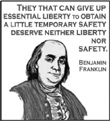
enacted Patriot Act. In the first case, a Florida teacher handed out to
his students copies of a quotation: “They that can give up essential
liberty to obtain a little temporary safety deserve neither liberty nor
safety.” He asked students to interpret this statement in light of
current events. (The class had previously studied the circumstances
surrounding the internment of Japanese Americans during World War II.)
After discussing the implications of this quotation, the teacher asked
the class whether anyone knew who wrote the quotation. When no student
guessed correctly, he showed the class an overhead slide that included
the name and a drawing of its author (see Figure
1). They then discussed the intentions of the Nation's
founders, constitutional protections, and so on. This teacher was
supported by parents, but was disciplined by the principal for straying
from the mandated civics curriculum standards.
The second case has proven difficult to verify. Perhaps apocryphal,
perhaps real, this story (and many others like it) have, in the wake of
more heavily documented cases, circulated among teachers, professors of
education, and concerned parents. I have been unable to find adequate
documentation to vouch for the truth of this particular case, but I
include it here to demonstrate the degree to which these stories invoke
teachers' and the public's sense that, in the current climate of
intimidation, dissent in the context of civic education is subject to
repression and regulation. The story is roughly thus: A New York state
high school teacher was reprimanded for raising with students historical
comparisons of crisis times in United States history. He introduced
students to the Alien and Sedition acts of 1798 and the Sedition Act of
1918. The former two acts allowed President John Adams to arrest,
imprison, and deport “dangerous” immigrants on suspicion of “treasonable
or secret machinations against the government” and to suppress freedom
of the press. The latter act restricted criticism of the government, the
Constitution, and the military. Pairing these acts with the text of the
Patriot Act, this teacher asked students to assess the three different
time periods and argue for the justice or injustice of each law. Several
parents complained that the teacher was not encouraging patriotism, and
the principal instructed the teacher to discontinue the lesson.
Engaging Politics in Civic Education
At the same time that the above examples illustrate the intensity with
which battles against controversial issues in the classroom can be
waged, there are dozens, perhaps hundreds, of curricular efforts that
deliberately engage “politics” as a healthy embodiment of the diversity
of opinions, motivations, and goals that comprise a democratic society.
Many valuable debates in civic education do not take as their starting
point the question “Should civic education be apolitical or political,
patriotic or critical?” but rather begin with “Whose politics do civic
education programs reflect and why?” It is to this latter question that
the articles in this special section of PS attend.
Larry Cuban's “Making Public Schools Business-Like … Again” begins the
section by demonstrating recent declines in commitments to civic
education as a legitimate goal for public schooling. Although the
rhetoric supporting civic education abounds, educating democratic
citizens remains a low priority in relation to other educational
concerns. (For example, federal expenditures by the Department of
Education on civic education in 2003 totaled less than half of one
percent of the overall department budget [U.S. Department of Education
2004]). Where has all the commitment gone? Business-inspired reforms,
Cuban argues, fueled by a strong belief in connections between schooling
and a strong economy have resulted in the constricting of public school
goals from broadly democratic to narrowly economic. Traditional public
school goals of building literate citizens able to participate in
democratic affairs of the community and the state have been supplanted
by near exclusive concern for producing workers for the labor market.
Cuban asserts that linking test scores to worker productivity or the
national economy is a flawed calculus of school goals. Yet historically
and today, business leaders, politicians, and policymakers concur with
the recent statement by Deputy Assistant Secretary of Education Ken
Meyer that “American schools need to improve so that workers can compete
for jobs in a globalized economy.” Cuban's article calls for educators
to ensure that democratic civic education remains a goal for public
schools.
Where civic education is practiced, there is little agreement as
to its intended outcomes. In “Educating the ‘Good’ Citizen,” my
colleague Joe Kahne and I call attention to the spectrum of ideas
represented in civic education programs about what good citizenship
is and what good citizens do. Our arguments derive
from an analysis of both democratic theory and a two-year study of civic
education programs that aim to promote democracy. We detail three
conceptions of the “good” citizen—personally responsible,
participatory, and justice-oriented—that
underscore political implications of education for democracy. This
article suggests that the narrow and often ideologically conservative
conception of citizenship embedded in many current efforts at teaching
for democracy reflects not arbitrary choices but rather political
choices with political consequences.
Next, E. Wayne Ross examines long-standing debates between those
proponents of civic education and social studies who hope to reproduce
the dominant society by emphasizing its cultural heritage and those who
emphasize critical thought and social reconstruction. Careful not to
dichotomize the various ideological positions in the social studies and
civic education debates, Ross explores the belief structures that
influence advocates of particular curriculum reforms on a continuum. He
argues for deliberation as an important unifying goal among those
educators who value a plurality of views. Deliberation, Ross asserts,
allows pluralism to be beneficial and not divisive and destructive.
In “Diversity, Immigration, and the Politics of Civic Education” Jane
Junn addresses how in increasingly diverse classrooms it makes little
sense to expect uniform outcomes from civic education programs among
diverse groups of students. Multiculturalism challenges the notion that
some “true” narrative of American democracy will resonate equally with
all citizens. Conflating political efficacy measures with program
success, Junn argues, makes some groups of minority students look like
less desirable citizens because they—quite legitimately—do not trust
civic institutions in the same way as their white counterparts.
Political institutions respond more readily to the concerns of
advantaged citizens than to those of the resource-poor, leading Junn to
observe that “In politics as in economy, the rich get richer.” She
suggests that developing civic education programs that will enhance
equality requires educators to explicitly acknowledge the “extent to
which American democracy in its current state may be part of the
problem.”
Building further on these notions of plurality, politics, and contested
notions of the “good,” Diana Hess explores “Controversies About
Controversial Issues in Democratic Education.” The ability to discuss
controversial political issues, Hess suggests, is fundamental to living
an active civic life in a democratic society. Yet schools so often run
from controversy like cats from water. Hess reports on studies of middle
and high school social studies teachers and offers a typology of
approaches these teachers take in incorporating controversial political
issues into their lessons: denial, privilege, avoidance, and balance. It
is foolish to expect students to be well-versed in the democratic skills
of deliberation and debate if they do not gain experience in these
activities in school.
Closing the section, William Galston, in “Civic Education and Political
Participation,” acknowledges the substantial evidence of declining
levels of civic engagement among youth and young adults. But he remains
optimistic about the promise and possibilities of civic education to
reverse this trend. Although conventional wisdom for decades has been
that civic education is largely ineffective, recent studies show
promising results. And despite all the controversies expounded in the
articles that precede, Galston argues that “we are not obliged to agree
on a single conception of civic education.” The decentralized nature of
education policy in the United States provides sufficient flexibility to
implement a range of programs.
Together, these articles explore the multitude of values and ideologies
that underlie various civic education policies, trends, and curricular
goals. The authors share an affection for education that embraces rather
than denies controversy. Progressive era educator Harold Rugg conveyed
this view eloquently:
To guarantee maximum understanding, the
very foundation of education must be the study of the actual
problems and controversial issues of our people. There is no way
by which the democratic principle of consent can be carried on
other than that of the parliamentary discussion of issues. But
consent based upon knowledge of only one aspect or side of a
problem, upon the avoidance of controversy, is a travesty of
both knowledge and democracy. To keep issues out of the school,
therefore, is to keep thought out of it; it is to keep life out
of it (Rugg, 1941).
The articles contained in this PS symposium on the politics of
civic education aim to ensure that, in the classrooms and corridors of
school, thought and life are kept in.
Research for this article and editorial assistance for this symposium was
generously supported by a grant from the Social Sciences and Humanities
Research Council of Canada (SSHRC) as well as by Democratic
Dialogue: Inquiry into Democracy, Education, and
Society at the Faculty of Education, University of Ottawa. The
author thanks Michael Berkowitz, Barbara Leckie, and Gordon Lafer for
thoughtful feedback, Gina Bottamini for research assistance, and Joe
Kahne for 15 years of collaboration and friendship (so far). The author
can be reached at joelw@uottawa.ca.
SYMPOSIUM AUTHORS' BIOS
Joel Westheimer
is associate professor in the social foundations of education at
University of Ottawa where he co-directs Democratic Dialogue,
a research collaboration for inquiry into democracy,
education, and society. A former New York City
public schools teacher, he writes on democracy,
social justice, service learning, and
community. He is author of Among Schoolteachers:
Community, Autonomy, and Ideology in Teachers' Work (Teachers
College Press, 1998). Westheimer and Kahne are currently
writing a book on what schools and colleges can do to renew
democracy in North America. Westheimer can be reached
at
joelw@uottawa.ca.
Larry Cuban
is professor emeritus in the department of education at Stanford
University. His forthcoming book is The Blackboard and
The Bottom Line: Why Schools Can't Be Businesses (Harvard University
Press).
Joseph Kahne
is the Kathryn P. Hannam Professor of American Studies and professor
of education at Mills College, Oakland, CA. A
former New York City public schools teacher, he studies
urban school reform and the democratic purposes of schooling,
directs the doctoral program in educational leadership,
and codirects the Institute for Civic Leadership at Mills.
He is the author of Reframing Educational Policy:
Democracy, Community, and the Individual, published by Teachers
College Press (1996). He can be reached at
jkahne@mills.edu.
E. Wayne Ross
is professor in the department of curriculum studies at the
University of British Columbia. He is the co-author (with
Kevin D. Vinson) of Image and Education: Teaching in the Face
of the New Disciplinarity and co-editor of the journals
Cultural Logic and Workplace: A Journal for Academic Labor.
Jane Junn
is associate professor of political science at Rutgers
University. She has written about education and democratic
citizenship, civic education, and is currently
writing about immigration and political participation in the
U.S.
Diana E. Hess
is assistant professor of curriculum and instruction at the
University of Wisconsin-Madison. She researches how young
people learn how to deliberate controversial political issues,
teachers who are especially skillful at teaching controversial
issues, and the political ideologies embedded in social
studies curricula. She is currently studying the ideology
of curricula developed in response to the attacks of September 11,
2001.
William A. Galston
is Saul I. Stern Professor, School of Public Affairs,
University of Maryland, director of the University's
Institute for Philosophy and Public Policy, and founding
director of the Center for Information and Research on Civic
Learning and Engagement (CIRCLE), which focuses on the
civic life of America's young people. He is the author of
six books and numerous articles in political theory,
American politics, and public policy. His most
recent publication is Liberal Pluralism: The Implications of
Value Pluralism for Political Theory and Practice (Cambridge,
2002). From 1993 until 1995 he was on leave from the
University of Maryland serving as Deputy Assistant to President
Clinton for Domestic Policy.