Introduction
Grinstead (Reference Grinstead1998, Reference Grinstead2004) proposes that a cause of slower developmental trajectories in child syntax can result from subdomains of language having to interface with non-linguistic domains of cognition that manage discourse prominence and assumptions about the perspective of interlocutors, perhaps the closely related constructs of executive function and theory of mind. This Interface Delay claim points to the comparatively early emergence of morphosyntactic competence in the form of local, non-anaphoric relationships, such as nominal plural marking and noun-adjective agreement as evidence that morphosyntax itself is not delayed. Similarly, the theory points to early non-linguistic cognitive abilities thought to relate to, or to perhaps constitute, Theory of Mind – including belief and intention tracking (together with children's ability to manage old vs. new information in discourse) as evidence that there is nothing inherent in discourse-pragmatic ability that is late to emerge. On this account, the prominent other logical option for explaining why there exists a set of morphosyntactic constructions that are delayed in their emergence is that the link or interface itself between discourse-pragmatics and morphosyntax is what takes time to emerge.
If two domains are developing quickly, why should the links between them not also develop quickly? Notice that many people in the world are multi-lingual, without actually being interpreters of the languages they speak. To manage multiple linguistic systems, within each system, is very different than it is to respond to the demands of interpreting to constantly and efficiently linking the broad range of structures, cultural norms and other cognitive systems that must be differently configured among languages. The point of the interpreter analogy is that interpreters do what other multilinguals could probably eventually also do, but much more quickly and efficiently. Syntax and discourse pragmatics appear able to interact with each other in development, but not in a way that appears adult-like. Perhaps it is a question of quantity and not quality. On this account, the links between and among aspects of cognition that must interface in order for adult-like discourse pragmatic considerations to govern syntax are susceptible to their own developmental trajectory. These links could simply be relationships (as in Jackendoff, Reference Jackendoff2002) or they could be a type of representation that is readable in both domains (as in Jackendoff, Reference Jackendoff1997). For the moment, this is more a conceptual than an empirical question, but perhaps future research will make empirical substantiation of the nature of these representations tractable.
In what follows, a review is presented of how this theory plays out in the domain of null vs. overt subject development in child Spanish-speakers. Following this, we turn to the contingency between the development of morphosyntactic tense, which is claimed to be subject to Interface Delay, and structural case checking in child English. On this account, Interface Delay does not directly, but rather indirectly, cause some part of the development of adult-like case marking in English to be delayed. Finally, we will review another causal relationship, again with delayed tense as the Interface Delay cause, and this time, English subject-auxiliary inversion as the resulting delayed syntactic construction – this time more in the domain of phrasal syntax.
In two of the three cases, lexical development also plays an important role. Tense morphemes themselves, along with nominal plural marking, are logically learned as are all other lexical items. Exactly what such learning consists of is not entirely clear, but the lexical raw material from which morphemes are created and the concepts expressed semantically by them must surely be available a priori, such that the degrees of freedom for the learning task are manageable by children. Matthew Rispoli's work, especially (Rispoli, Reference Rispoli1994, Reference Rispoli1999, Reference Rispoli2005, inter alia), makes it clear both that there is a strong lexical dimension to child English-speakers’ mastery of nominative case subject pronouns and that such pronouns appear as a function of the tense-case contingency, and not because of lexical development, once tense marking reaches a 60% adult-like threshold. To the degree that the construction requires tense marking to be adult-like, independently of lexicon, Interface Delay is implicated. In the domain of subject-auxiliary inversion, lexical development is visible in the array of morphemes used to mark tense. Inversion appears to be most adult-like when tense markers are most regular and uniform, forming a cline from modals, which are morphologically invariant and uniform, and third singular -s, which is entirely productive, to auxiliary be and do support, which are most irregular and least uniform. This connection between morphological uniformity and subject-auxiliary inversion appears in the work of Santelmann, Berk, Austin, Someshankar, Lambert and Lust (Reference Santelmann, Berk, Austin, Someshankar, Lambert and Lust2002) for subject-auxiliary inversion in yes-no questions.
For the non-lexical, syntactic dimension of the Tense-Case relationship, we review work in our lab showing that children's grammaticality judgments of nominative vs. non-nominative case subject pronouns are predictable from their tense knowledge. For the Tense-Inversion relationship, we show that children's tense judgments predict their inversion judgments. For both sets of experiments, we use the Grammaticality Choice Task, which presents children with both variants of the construction – the adult-like version and the version that has been attested in child spontaneous production – and is therefore an experimentally valid option to ask them to consider.
In the case of null vs. overt subjects, there is less of a lexical dimension to consider. Rather, there appears to be a very general, early understanding on the part of Spanish-speaking children that they are learning a language that uses overt subjects primarily for discourse purposes, and not obligatorily in all finite clauses, as in English or French. On our hypothesis, children over-assume that their interlocutors share their familiarity with antecedents in the Conversational Common Ground and therefore limit themselves to using null subjects. It is exactly this type of over-assumption of familiarity in the Common Ground that leads them to over-use definites of all kinds, which is of course the category that null subjects fall into. Though each construction has its specific properties, Interface Delay claims, at its core, that over-use by over-assumption of familiarity plays an important role in children's over-use of all nominal definite constructions: including definite articles, as in the work of Maratsos (Reference Maratsos1974, Reference Maratsos1976), and direct object pronouns (including clitics), as in the work of Avrutin (Reference Avrutin1994) and others. Verbal definiteness, in the case of tense, is argued to be entirely parallel, following the work of Bittner (Reference Bittner, Musan and Rathert2011), who conceives of tense as fundamentally anaphoric, which means keeping track of the speech time-event time relationship in discourse, as one would with the antecedents of nominal anaphora. In short, null vs. overt subjects in Spanish have a syntactic basis that appears less susceptible to obvious influences of lexical item-particular considerations than does case, inversion or tense. With this brief orientation, we now turn to the example of null vs. overt subjects in greater detail.
Null vs. overt subjects in child Spanish
There are two fundamental dimensions to understanding the relationship of Interface Delay to the development of subjects in child Spanish. The first relates to the syntactic machinery that licenses the presence of an overt vs. a null subject. On our account, the lexical learning of the morphemes that express tense, mood and aspect on Spanish verbs takes place relatively quickly; but the interface of these lexical items with discourse pragmatics takes substantially longer. This situation gives rise to the appearance of children being delayed in learning verbal morphosyntax, when in reality, our claim is that it is the connection of verbal morphosyntax to discourse pragmatics and children's resulting over-use of bare stem (root + theme vowel, e.g., cant-a) forms that makes this appear non-adult-like. The second dimension is the application of probabilistic constraints to the use of overt subjects, which has been studied in adult Spanish morphosyntax extensively (see Otheguy & Zentella, Reference Otheguy and Zentella2012 for review). The very excellent work on this topic of Naomi Shin (Shin & Cairns, Reference Shin and Cairns2012; Shin & Erker, Reference Shin, Erker, Carvalho, Orozco and Shin2015; Shin, Reference Shin2016) and Hannah Forsythe (Forsythe, Reference Forsythe2018) makes it abundantly clear that children are well into elementary school before they begin using overt subjects in the way that adult Spanish-speakers do.
Licensing null subjects in Spanish
There have been many theoretical accounts of null subject licensing since Rizzi's (Reference Rizzi1986) proposal. The hypothesis adopted in Grinstead (Reference Grinstead1998, Reference Grinstead2004) is Ordóñez's (Reference Ordóñez1997) claim that subjects in Spanish are in fact incorporated pronouns. That is, what is considered to be an inflection affix, e.g., the -mos in cant-a-mos in 1, is in fact the subject, which checks nominative case and receives a theta role. On this view, what is called the overt subject, nosotros in 1., is actually a kind of clitic double, analogous to the indirect object clitic double in 2.
1. Nosotros cantamos primero.
“We sing first.”
2. Le cantamos Las Mañanitas a Gabriela.
to her we Las Mañanitas to Gabriela
“We sing Las Mañanitas to Gabriela.”
This is sensible inasmuch as it is far more grammatically acceptable to omit the indirect object clitic double in 3 and the subject clitic double in 4 than it is to omit the indirect object clitic in 5 or the subject clitic (“agreement”) in 6, in the terms of this analysis.
3. Le cantamos Las Mañanitas.
to her we sing Las Mañanitas
“We sing her Las Mañanitas.”
4. Cantamos primero.
sing – 1st pl. pres. First
“We sing first.”
5. #/*Cantamos Las Mañanitas a Graciela.
Sing – 1st pl. pres. Las Mañanitas to Graciela
“We sing Las Mañanitas to Graciela.”
6. *Nosotros canta primero.
We sing-bare stem first.
“We sing first.”
The Ordóñez incorporated pronoun analysis derives from earlier proposals for Arabic (Jelinek, Reference Jelinek1984; Fassi-Fehri, Reference Fassi-Fehri1993) and Mohawk (Baker, Reference Baker1996). It is thus not particularly far-fetched to conceive of Spanish subjects in this way, though they may be different from the much more widely-cited case of Italian in this dimension. That is, agreement in Spanish, on this account, is not really agreement, but a pronoun. There are good empirical reasons to think that Italian subject-verb agreement is simply agreement, which may be best represented syntactically as a feature to be checked, a functional projection carrying a morpheme or as a relation between constituents, depending on one's theory of how actual agreement works. On any of these accounts of Italian, it seems clear that Spanish is empirically different. Concretely, “Unagreement” is possible in Spanish, but not Italian.
7. Las niñas corremos en el jardín.
the girls run – 1st pl. pres. in the garden
“(We) the girls are running in the garden.”
8. *Le ragazze corriamo in giardino.
the girls run – 1st pl. pres. in the garden
“(We) the girls are running in the garden.”
Fascinatingly, the Spanish sentence is 7, with a 3rd person subject and a 1st person verb, is as acceptable as the sentence in 9, which includes a 3rd person subject and 3rd person verb. The Italian version of 7, given in 8, is flatly ungrammatical.
9. Las niñas corren en los jardines.
the girls run – 3rd pl. pres in the gardens
“The girls are running in the gardens.”
Deepening the intrigue, but consistent with the Ordóñez (Reference Ordóñez1997) account, Unagreement sentences, such as 7, produce an N400 event-related potential signature (Mancini, Molinaro, Rizzi & Carreiras, Reference Mancini, Molinaro, Rizzi and Carreiras2011a; Reference Mancini, Molinaro, Rizzi and Carreiras2011b). N400 is characteristic of semantic anomaly, and not of morphosyntactic feature clash, which is generally associated with either a left anterior negativity (LAN), a P600 or both. Thus, the acceptability of sentences such as 7 to adult Spanish-speakers and its association with an N400 is entirely mysterious if we assume that Spanish subject agreement is as in Italian and other languages, but straightforwardly explicable if we assume that agreement is an incorporated pronominal.
The consequence of assuming the Ordóñez account for Spanish is that development of overt subjects is really the development of clitic doubles. Further, if subject agreement is an incorporated subject pronoun, that subject pronoun must be, at least some of the time, a portmanteau morpheme that also includes tense. That is, in the “imperfect” tense, as in 10, it is possible to identify an independent subject-verb agreement morpheme that expresses person and number, while there is also an affix associated with tense, grammatical aspect and perhaps indicative mood.
10. Nosotros cant á ba mos primero.
we sing- theme vowel – past tense/imp. asp./indic. mood – 1st per./pl. first
“We would sing first.”
In contrast, in the present tense, there is only one affix, the use of which must represent 1st person and plural number, in addition to present tense, progressive grammatical aspect and indicative mood.
11. Nosotros cant- a- mos primero.
we sing – theme vowel – present tense/prog. asp./indic. mood – 1st per./pl. first
“We are singing first.”
This implies that to learn agreement, and thus expression of the real subject, in Spanish is to simultaneously learn to mark tense, because they are expressed by the same morpheme.
What, then, is the status of the clitic double? First, we consider its syntactic licensing and then we turn to probabilistic constraints on its use. Grinstead (Reference Grinstead1998, Reference Grinstead2004) argued that one, or possibly two, of the syntactic positions that house the clitic double subject in Spanish and Catalan is generally unavailable to children, because of Interface Delay. That is, though their clause structures may include these positions, they are unable to take advantage of them to express subjects and the other constituents that adults use in those positions because their phrasal syntax cannot interface with discourse. In particular, Grinstead (Reference Grinstead1998, Reference Grinstead2004) argues that fronted objects and wh- questions use clause-external syntactic positions (the specifier of the Topic Phrase for topicalized objects and the specifier of the Focus Phrase for wh- questions, in the terms of Rizzi, Reference Rizzi and Haegeman1997) that are also used by discourse-sensitive subjects. The claim allows that not all overt subjects in Spanish are discourse-sensitive, a fact recognized in generative syntactic accounts (e.g., Zubizarreta, Reference Zubizarreta1998), but those that do have this property cannot be expressed by children if they are not able to make use of the Topic Phrase and the Focus Phrase. To support this hypothesis, Grinstead (Reference Grinstead2004) and Grinstead and Spinner (Reference Grinstead and Spinner2009) show in longitudinally-collected child Spanish and Catalan corpora that there are rarely significant differences (using a binomial test, as in Snyder & Stromswold, Reference Snyder and Stromswold1997) between the onset of overt subject use, on the one hand, and wh- questions and fronted objects, on the other. Villa-García and Snyder (Reference Villa-García, Snyder, Castro, Costa, Lobo and Pratas2009) similarly show, in different child Spanish corpora, that overt subjects and fronted objects are not significantly different in their onsets. Table 1 summarizes the findings for these 11 children. The cells with significant p-values (< .05) are cases in which a child first used either a wh- question or a fronted object significantly later than their first overt subject.
Results of a Binomial Test of the Hypothesis that Overt Subject Onset and Onset of Wh- Questions or Fronted Objects Are Significantly Different, from Villa-García and Snyder (Reference Villa-García, Snyder, Castro, Costa, Lobo and Pratas2009)a, Grinstead (Reference Grinstead1998, Reference Grinstead2004)b and Grinstead and Spinner (Reference Grinstead and Spinner2009)c.

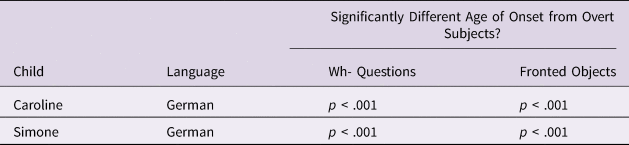
While the predominant pattern in Spanish and Catalan, particularly for overt subjects vis-à-vis fronted objects, is that they appear at the same time, overt subjects emerge significantly earlier than both fronted objects or wh- questions in the longitudinal child German data of Simone and Caroline, as illustrated in the following table from Grinstead and Spinner (Reference Grinstead and Spinner2009).
Results of a Binomial Test of the Hypothesis that Overt Subject Onset and Onset of Wh- Questions or Fronted Objects Are Significantly Different, from Grinstead and Spinner (Reference Grinstead and Spinner2009).

This cross-linguistic difference between child German, on the one hand, and child Spanish and Catalan, on the other, is critical in the sense that overt subjects in German must occur overtly in every finite clause, though their precise syntactic position may vary by discourse-pragmatic considerations. The comparison supports the argument that (at least most) overt subjects in Spanish and Catalan occur in a left-peripheral syntactic position that also houses fronted objects and wh- constituents, based on the fact that their development is contemporary, when not exactly simultaneous; while in German, where subjects must always be overt, subjects appear significantly earlier than do fronted objects or wh- questions, at least in the corpora examined.
Overt subject use
Chomsky (Reference Chomsky1965) famously distinguished between linguistic competence and performance. If the licensing of subjects is matter determined by syntactic competence, then performance could be thought of as the interface of syntax and discourse-pragmatics determining when an overt subject is pragmatically appropriate. The emergence of this interface appears to allow the generalized use of not only overt subjects, but also of fronted (topicalized direct objects) and wh- questions. If this early emergence of overt subject use, at around 2 years of age and MLU 1.5 (following Grinstead & Spinner, Reference Grinstead and Spinner2009), then when is it adult-like? This endpoint of adult-like competence may not yet be known. Perhaps surprisingly to those who assume that children know most everything language-related immediately, it appears to take into at least early adolescence. Specifically Shin and Cairns (Reference Shin and Cairns2012) show that child Spanish-speakers, as old as 14 years of age, are not adult-like on a task designed to measure the use of overt subjects in what variationist morphosyntax refers to as “switch-reference” contexts, in which the intended referent of a predicate is not the same as the referent of the previously mentioned subject of the previous predicate. Under these circumstances, adult Spanish-speakers tend to use an overt subject. It is important to emphasize that this a tendency because the claims of variationist morphosyntax are expressed as probabilistic constraints that influence subject use and not as grammatical rules that are invariant. It is important to mention that in more recent work, using receptive measures, Forsythe (Reference Forsythe2018) shows that children have an understanding, if not spontaneous productive use, of this distinction at much earlier ages (4 or 5 years-old).
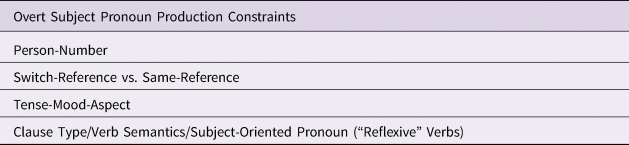
Further, in more ecological, sociolinguistic interview tasks, Frog Story retell tasks and spontaneous production data, Shin and Erker (Reference Shin, Erker, Carvalho, Orozco and Shin2015) and Shin (Reference Shin2016) show that child Spanish-speakers show the same ranking of constraints as adults in their samples, which go up to 12 years of age. In particular, adult Spanish-speakers produce overt subject pronouns as a function of the constraints given in Table 3, in the order given in Table 3.
Hierarchy of Constraints Predicting Overt Subject Pronouns in Adult Spanish-Speakers (from Otheguy & Zentella, Reference Otheguy and Zentella2012, p. 160)

The 24 six to eight year-old child Spanish-speakers in Shin and Erker (Reference Shin, Erker, Carvalho, Orozco and Shin2015) showed Person-Number and Reference to be significant predictors of overt subject pronoun use, and, in that order, showing an incomplete, but faithful, grasp of the adult constraint hierarchy. In Shin (Reference Shin2016), the 154 six to sixteen year-old child Spanish speakers again showed Person-Number and Reference to be grasped by the youngest children (6 to 7 year-olds), along with a verb semantics factor for cognitive verbs. The 8 to 9 year-old children also managed Tense-Mood-Aspect as a predictive factor and the children who were 10 years-old and older also grasped clause type, approximating adult-like application of probabilistic constraints.
In summary, only the oldest children in her sample (10–12 years and older) have mastered all of the constraints that adult Spanish-speakers use, while younger children obey a subset of these constraints, and do so in the same relative order of predictive power that adult do.
Discussion and predictions
To summarize, overt subject licensing appears to emerge in child Spanish and child Catalan when the phrasal syntax of the syntactic positions at the left edge of the clause (Focus Phrase and Topic Phrase) become able to interface with discourse-pragmatics. If this were only the result of phrasal syntax alone, we might expect overt subject use to occur earlier, perhaps when article-noun order or preposition-object of a preposition order are learned – which is to say, from the first expressions of these constituents. If overt subject expression were a function of theory of mind components only, we might expect overt subject use by 15 months, when sensitivity to belief tracking has been argued to emerge (Onishi & Baillargeon, Reference Onishi and Baillargeon2005) or when intention reading has been argued to emerge (Woodward et al., Reference Woodward, Sommerville, Gerson, Henderson and Buresh2009) at 12 months. In contrast, if there is an independent developmental trajectory for the development of the ability of syntax to interact with discourse-pragmatics, or its cognitive underpinnings, then asynchrony between the development of aspects of syntax that are not discourse-sensitive and those that are, such as overt subject use, is expected.
How might we expect this rather language-particular set of facts to play out in other languages? Essentially any language that has a null-overt subject opposition, of the kind Spanish shows, should show a similarity in emergence of overt subjects and other discourse-sensitive, left-edge constituents, including topicalized objects and/or wh- questions. There are perhaps other left-edge constructions, or constructions that occur elsewhere in the phrase structure of a different language that nonetheless depend on discourse-pragmatics for their adult-like use. Interface Delay would predict similar moments of emergence, within individual children. With respect to probabilistic constraints, Interface Delay would appear to be silent on the relative ranking of these constraints, at least as currently conceived, but it does predict that constraints that require the interaction of syntax with discourse-pragmatics, such as person-number, tense-mood-aspect and switch-reference, should be difficult to learn.
Tense and case
Turning to child English, we find two phenomena that were historically viewed as unrelated: namely, the slow development of tense marking and the occasional production of non-nominative case pronouns in subject position (as in 12 and 13, respectively) from the speech of Mackie, between the ages of 2;2 and 2;5 (Gruber, Reference Gruber1967, p. 53).
12. He take the wheel, fire engine.
13. Me take the wheel.
But are these two phenomena unrelated? In 1980, Jean-Roger Vergnaud proposed, on the basis of adult patterns of case marking and tense, that all noun phrases in natural languages must be marked for, in fact licensed by, what he termed “abstract case”, which may or may not be reflected as morphological case (Rouveret & Vergnaud, Reference Rouveret and Vergnaud1980). He distinguished between structural case that is required as a function of syntactic position, by verbs to direct objects and by verbal inflection to the subject, and inherent case, which is lexically determined. The structural case component of this hypothesis permitted the two previously unrelated child language phenomena of non-adult-like tense marking and non-adult-like case marking on subjects to be viewed as related, and in fact predicted a contingency between the two. This contingency was observed by Loeb and Leonard (Reference Loeb and Leonard1988) in the typically-developing child English-speakers in their study, summarized in Table 4.
Finiteness Versus Case for 7 of Loeb and Leonard's (Reference Loeb and Leonard1988) Typically-Developing Children

A debate as to the nature of these non-nominative case subject pronouns ensued. Initially, Rispoli (Reference Rispoli1994) observed that the non-nominative subjects used by children were asymmetrically feminine in their grammatical gender, suggesting that lexical-learning was at the root of the phenomenon. Schütze and Wexler (Reference Schütze and Wexler1996) responded by claiming that the phenomenon was better explained with a specific version of Rouveret & Vergnaud's Case Filter, cast in Minimalist syntactic theory (Chomsky, Reference Chomsky1995), in its morphological expression through Distributed Morphology (Halle & Marantz, Reference Halle, Marantz, Hale and Keyser1993). Usage-Based theorists also responded by claiming that grammar was not responsible for the phenomenon, but grammatical schemata created by exemplar input frequency were. Among the Usage-Based accounts, there were computational implementations that claimed first, that a type of serial position effect was directing children's attention to the end of the sentence (Freudenthal, Pine & Gobet, Reference Freudenthal, Pine and Gobet2006). Subsequent computation accounts modified the claim to say that children selectively attended to the beginning and the end of the sentence (Freudenthal, Pine & Gobet, Reference Freudenthal, Pine and Gobet2010). Problems for these accounts included that Rispoli's initial work ignored the contingency between tense and case, illustrated in Table 4; while Schütze and Wexler's very specific morphological account ruled out non-nominative subjects, occurring with third singular -s, which Usage Based developmentalists showed to be false (Pine, Rowland, Lieven & Theakston, Reference Pine, Rowland, Lieven and Theakston2005); and the empiricist serial position accounts predicted an array of error types that do not occur: namely, that paying attention to only the beginnings and the ends of sentences should produce verbless utterances with only subjects and objects (e.g., He caught the ball. should become He ball.). Further, the core empiricist idea that compound tenses are reduced to children's non-finite verb forms (e.g., such that Does he go there? becomes He go there) is even more problematic in child languages that do not use non-finite forms that could be reduced from adult compound forms, including Spanish and Swahili, as in 14 and 15.
14. Carlos - 3;3.28 (Grinstead, Reference Grinstead1998)
Yo pone.
I-nom put (root + “e” theme vowel)
“I puts.”
15. Mus, from Ud Deen and Hyams (Reference Deen and Hyams2006, p. 92, ex. 18).
*ADU: u – na – tak – a ku – shuk – a ?
SA2s–pres–want–IND INF– alight–IND
‘You want to get down?’
*CHI: ruk – e
jump – SUBJ
‘Jump (down).’
Each theory made specific, falsifiable claims that could be shown to be wrong, and from which insight could be gleaned, and gleaned it was. Rispoli followed up his initial work with carefully controlled spontaneous production studies with large samples of children to show that – as his earlier hypothesis had claimed – children indeed do show a bias towards input-influenced lexical learning of the English pronoun paradigm. That is, up to a certain threshold of verbal tense marking proficiency, child English-speakers indeed show an asymmetry of her non-nominative subject pronouns over him non-nominative subject pronouns, because, on Rispoli's account, her is more frequent in the input by occupying both the genitive and the accusative cells in the pronoun paradigm, while him only occupies the accusative cell, and is therefore less frequently heard by children. Rispoli (Reference Rispoli2005), however, further shows that this input bias disappears once children are at least 60% adult-like at their tense marking. At that point, in his multiple regression models, tense marking comes to be most-predictive of children's non-nominative Case errors. Donnellan (Reference Donnellan2010) and Grinstead, Donnellan, Barajas and Johnson (Reference Grinstead, Donnellan, Barajas and Johnson2014) show, with children who are above the 60% finiteness marking threshold, that their verbal tense grammaticality judgments significantly predict their case grammaticality judgments (r2 = .30, p < .001). These authors also show, consistent with Usage-Based claims, that children will accept non-nominative subjects with verbs marked with 3rd singular -s. The fundamental nativist claim of Schütze and Wexler (Reference Schütze and Wexler1996) that Rouveret and Vergnaud's Case Filter was an active, abstract constraint on child grammars of tense and case, even before children have adult-like tense marking, is confirmed by the expressive, spontaneous production data analysis of Rispoli (Reference Rispoli2005) and by the receptive, grammaticality judgment study of Grinstead, Donnellan, Barajas and Johnson (Reference Grinstead, Donnellan, Barajas and Johnson2014).
Discussion and predictions
Interface Delay relates to this phenomenon because it is hypothetically what causes children to overuse nonfinite verbs. The hypothesis claims that children assume that their interlocutors know what speech time-event time relationship they are referring to – and so do not explicitly state it. This is claimed to be analogous to when a child uses an “unheralded” pronoun, a name that has not been previously mentioned or any other definite noun phrase that infelicitously presupposes that interlocutors are familiar with the identity of the antecedent of these nominal and verbal anaphoric constructions. On the Case Theoretic account this finite verbal tense is what causes structural nominative case to occur on subject NPs; thus, in its absence, a cross-linguistically variable default case (which happens to be accusative in English) will step in to mark the subject pronoun as accusative. According to the account, this will furthermore save the derivation from crashing, by virtue of running afoul of the Case Filter (which has of course been re-implemented in numerous ways, including the checking of a Case feature in Minimalism).
An extension of this precise hypothesis to other languages has proven elusive. Default case in German and Spanish, for example, is nominative, as illustrated by the pronouns that occur outside of structures, within which they could be assigned structural case, in 16, which contrasts with the English translation in 17.
16. ¿Quién se comió las galletas? ¡Yo! (nominative)
17. Who ate the cookies? Me! (accusative)
What this means is that when structural nominative case cannot be assigned by tense to the subject, because children's tense is not yet adult-like, default case will nonetheless yield nominative case, which is indistinguishable from structural case in these languages. Confirming the overall form of the hypothesis, in child German, children over-use nominative case in object positions until accusative and dative are learned (Eisenbeiss, Bartke & Clahsen, Reference Eisenbeiss, Bartke and Clahsen2006). What must be developing here, however, is the lexical knowledge that the verb is transitive and takes a direct object, which is very different from the kind of knowledge underlying tense marking. In Spanish, nominative case does not show up in either (in-)direct object position or in object of a preposition position, which both take accusative case (accusative and oblique case are neutralized in Spanish). In the direct object situation, this is likely because pronouns are verbal clitics, which do not have a nominative form. In the case of object of a preposition forms, the combinations are highly likely to constitute what Culicover and Jackendoff (Reference Culicover and Jackendoff2005) refer to as constructional idioms (Cummerow, Reference Cummerow2009), inasmuch as they are always the same items occurring in the same order. In fact, several of them are even orthographically represented as single words, by convention in Spanish (e.g., conmigo, contigo, consigo, etc.).
Thus, a falsifiable prediction of Interface Delay for other child languages is that we should expect non-nominative case errors in proportion to children's tense errors: where the adult language, like English, has accusative default case, but nominative structural case for subject position (driven by tense). Stated somewhat differently, we should be able to predict adult-like usage of subject pronoun case from adult-like tense marking. These statistical relationships should be possible to express using both expressive (e.g., Rispoli, Reference Rispoli2005) and receptive (e.g., Grinstead, Donnellan, Barajas & Johnson, Reference Grinstead, Donnellan, Barajas and Johnson2014) measures.
Tense and inversion
Now we turn to a phenomenon that bears much similarity to the tense-case phenomenon just reviewed: namely, two apparently unrelated observations about child English relating to the use of nonfinite verbs and the use of uninverted wh- questions. We have already discussed nonfinite verbs. However, there was much interest during the 1960s in the work of Brown, Bellugi and others, in the development of wh- question formation and subject-verb inversion. This interest was likely due to the focus on the adult analysis of this construction by Chomsky, starting with Syntactic Structures (Chomsky, Reference Chomsky1957).
The particularly non-adult-like property of these constructions appears to have less to do with actual movement of wh- constituents to the left edge of the clause and more to do with the movement of finite verbs to second position in the sentence. Stating the observation in this way purposefully calls to mind the term “Verb-Second” because this connection between tensed verbs and the second position in main clauses seems very likely to be what underlies the connection between un-tensed verbs and un-inverted questions. The structural connection between syntactic tense and the complementizer position at the left edge of the clause in Germanic languages, including English, is attributed to den Besten and Edmondson (Reference den Besten, Edmondson and Abraham1983). Exactly what one would assume to occur – that, if verbs are un-tensed in adult language; namely, they are not able to raise to the left edge of the clause – appears to be what children are doing in the following examples from Ingram and Tyack (Reference Ingram and Tyack1979):
18. Where the raisins is?
19. What I can eat?
20. How this piece could go in?
21. How this thing could go in?
22. Where he is?
23. Where you did go?
24. What he is going to do?
25. How much I do weigh?
This relates to Interface Delay – perhaps by now obviously – by virtue of the fact that un-tensed verbs may not move out of the clause to the syntactic position hosting V2, the head of the Complementizer Phrase. If a verb, or a verb's tense features in the case of do-support, does not, in Minimalist terms, check the tense features of the Inflection Phrase (which sits below the Complementizer Phrase) because it is nonfinite, we might not expect it to continue its path to the head of the Complementizer Phrase – but rather get “stuck” in the head of the Inflection Phrase, as illustrated in Figure 1.
Partial Movement of a Verb from V-to-I-to-C in Child English

An account of these two seemingly unrelated phenomena is presented in Warren (Reference Warren2007), Ricci (Reference Ricci2009) and Grinstead, Warren, Ricci and Sanderson (Reference Grinstead, Warren, Ricci and Sanderson2009), who argue that if the V-to-I-to-C claim is correct and if its failure in child English is fundamentally due to nonfinite tense not being able to raise syntactically to the head of the Complementizer Phrase, then we should be able to predict children's grammaticality judgments of un-inverted wh- questions from their grammaticality judgments of un-tensed verbs. The authors, in fact, show that children's grammaticality judgments of tensed vs. un-tensed verbs predict their grammaticality judgments of inverted vs. un-inverted wh- questions (r 2 = 0.438, p < .001, n = 62).
A falsifiable extension of this account for child English to child Spanish is explored in Vega-Mendoza (Reference Vega-Mendoza2010). Specifically, in another child language that is characterized by the use of non-tensed utterances, and which has subject-verb inversion in its adult state, we should find a similar contingency between tense marking and inversion. This was not found, however. Rather, the author found that though children passed through an Optional Infinitive Stage, very much along the lines of other child languages (and to the contrary of work claiming that Spanish does not undergo such a stage, e.g., Wexler, Reference Wexler1998), she found, first of all, that adults did not have categorical judgments of un-inverted sentences as ungrammatical, in the same way that they did of un-tensed sentences. Second, she showed that children's judgments of un-inverted wh- questions were statistically unrelated to their tense judgments.
These observations are further elucidated in Grinstead, Vega-Mendoza and Goodall (Reference Grinstead, Vega-Mendoza and Goodall2018) in the following ways. There had always been an adult syntactic literature that argued that V-to-I-to-C, or subject-auxiliary inversion, was typologically particular to Germanic languages, and not characteristic of Romance languages, making Rizzi's (Reference Rizzi1992) extension of construction to Romance a mistake. An array of facts supported this alternative position, including the fact that un-inverted wh- questions are subject to the “satiation” phenomenon, whereby constructions that are awkward by virtue of language processing, but not ungrammatical, become more acceptable with repetition; while constructions that are simply ungrammatical do not. Goodall (Reference Goodall, Ashby, Mithun, Perissinotto and Raposo1991) shows that exactly this contrast obtains between un-inverted Spanish and English wh- questions. The un-inverted Spanish questions become more acceptable, but the un-inverted English questions do not. Further, subject-auxiliary inversion is obligatory in main clauses in English and disallowed in subordinate clauses, which is true of all Germanic languages, as illustrated in 26 and 27. This asymmetry does not obtain in Spanish, in which inversion occurs in both main and subordinate clause questions, as illustrated in 28 and 29.
26. I don't know who John had visited.
27. *I don't know who had John visited. (Ordóñez & Olarrea, Reference Ordóñez and Olarrea2006: 11)
28. No sabía qué querían esos dos.
“I didn't know what those two wanted.”
29. *No sabía qué esos dos querían.
“I didn't know what those two wanted.” (Torrego, Reference Torrego1984: 104)
This fact further degrades the plausibility of subject-verb inversion in Spanish following the same syntax as subject-auxiliary inversion in English. Further, post-verbal subjects are allowed not only in interrogatives in Spanish, but also in declaratives, making it clear that movement of a verb to the left edge of the clause to change illocutionary force is not the pattern of Spanish. Finally, searches in spontaneous production data for un-inverted wh- questions in child Spanish, though complicated by the fact that there are not many overt subjects to help judge the position of verbs, yield no examples (Grinstead, Reig, Hernández & Culicover, Reference Grinstead, Reig-Alamillo, Hernández and Culicover2007).Footnote 1 These facts led to the conclusion not only that the child analysis was not correctly extended from English to Spanish, but to the conclusion that the adult V-to-I-to-C analysis of “subject-verb inversion” for Spanish was not correct, as argued in Grinstead et al. (Reference Grinstead, Vega-Mendoza and Goodall2018). In this way, child language data was made relevant to adult linguistic theory (or perhaps just “linguistic theory”).
Discussion and predictions
There are several predictions that can be drawn from this project. The first is that, ceteris paribus, all child Germanic languages, many of which have not been studied for this connection, should show predictive relationship between subject-verb inversion in questions and verb finiteness. Obviously, unlike English, other Germanic languages show V2 not just in interrogatives, but in declaratives as well. Consequently, thinking about the exact constructions that would be useful to examine this connection in would be critical, and it might not be possible to separate V2 syntactic position and finite verb tense morphology into independently measurable variables. With respect to verb tense in child language, the prediction is that a gradual development of verb finiteness – that is more extended than, say, plural marking on nouns – is universal. There are, to my knowledge, no child languages that have been studied, in which children do not pass through something like this extended developmental trajectory of tense, though obviously the regularity and uniformity of language-particular verb morphology will speed up or slow down development.
Conclusion
In the overview we have given of Interface Delay, the inability of syntax to interact with discourse-pragmatics drives non-adult-like behavior. In the case of null vs. overt subjects, Interface Delay causes left peripheral functional projections in syntax to be unable to house the constituents that move there in the adult language. The fact that this includes subjects makes the difference with adult languages prominent or noteworthy. Later, when children become able to more productively produce overt subjects, their ability to discern when to use them undergoes its own developmental trajectory, with substantial change taking place between 6 and 10 years of age.
Moving to English, we see a single cause, un-tensed verbs, as the driver of two superficially unrelated phenomena: non-nominative case subject pronoun use and the use of un-inverted wh- questions. Both of these are “down-stream” cases, in which Interface Delay indirectly causes the phenomenon, through tense. To be clear, what we think children are doing is the same thing that adults frequently do, as in the following (Grinstead, Reference Grinstead, Lidz, Snyder and Pater2016, p. 356, ex. 29–34):
30. What is Wallace doing, Gromit?
31. Eating cheese!
32. What does Wallace do every day after work, Gromit?
33. Eat cheese!
34. What has Wallace done since he got home, Gromit?
35. Eaten cheese!
These examples illustrate that although the three root nonfinite forms (31, 33, 35) have absolute tense interpretations in the present, these interpretations do not arise from their own morphological markings, but rather from the morphological markings of the tense of the immediately preceding questions. Note as well that all of the present tense interpretations of 31, 33 and 35 may be shifted to past tense, without changing their own morphology, but rather by changing the morphology of the verb in the preceding questions.
36. What was Wallace doing, Gromit?
37. Eating cheese!
38. What did Wallace do every day after work, Gromit?
39. Eat cheese!
40. What had Wallace done since he got home, Gromit?
41. Eaten cheese!
It is in this sense that a verb form may have morphology that does not convey its temporal specification unambiguously. Rather, what the speaker assumes that the interlocutor thinks (is the prominent speech time-event time relationship in discourse) will determine the form that the speaker uses. Along these lines, if children assume that their speech time-event time representations are familiar to their interlocutors – ‘egocentric’ behavior, as Piaget famously claimed – then it is sensible that they would use verb forms that lack overt tense specifications.
To be clear, Interface Delay, at least its linguistic version, is primarily about syntax and discourse-pragmatics. This is of course only a small part of the language acquisition puzzle, and at its most ambitious can only be about the part of syntactic development that is problematic, which comprises a small number of cases. They are prominent and seem worthy of explanation precisely because they are not learned immediately and exceptionlessly, as so much syntactic structure seems to be. Article-noun order, for example, or preposition-object of a preposition order, for another example, seem to be entirely error free, even in a language such as Spanish, which allows verbs and their direct objects to occur in a variety of orders and which allows other noun modifiers such as adjectives to occur both pre- and post-nominally.
Furthermore, other aspects of cognition are critical to having a complete picture. Syntax does nothing without lexical items to join together into larger constituents, but where to draw the line between syntax and lexicon? A vibrant literature considering the ontological statuses of elements (other than freely combining phrase structure rules and free morpheme lexical items) – including inheritance hierarchies, constructional idioms and full constructions – has evolved in the adult linguistic literature: and it has obvious consequences for thinking about how children develop the array of linguistic abilities they come to possess. Future work will need to take into account complex systems of cognitive abilities, including linguistic abilities, to give fuller accounts of adult linguistic cognition and of the development of children's language-relevant cognitive systems. The asynchronous nature of development in these distinct domains may hopefully show us something about the mind that we could not have discerned by studying adult cognition alone.
Acknowledgements
The author is grateful for discussion of these ideas with Laura Wagner, Peter Culicover, Mary Beckman, Ana Teresa Pérez-Leroux, Allison Bean, Micha Elsner, Blanca Flores, Ramón Padilla-Reyes, Melissa Nieves-Rivera and Amy Pratt. This work is supported by a grant from the National Science Foundation (NSF-1551903).