I. INTRODUCTION
Carbon nanotubes (CNTs) are an interesting class of materials due to their quasi-one-dimensional structure coupled to novel electronic and mechanical properties.Reference Jorio, Dresselhaus and Dresselhaus1 They have been proposed as an active material for a number of applications.Reference Jorio, Dresselhaus and Dresselhaus1, Reference Meyyappan2 In spite of this promise, there are very few applications which have been realized commercially.Reference O’connell3 An important step toward this direction is the ability to tune the physical and chemical properties of the nanotube material in a versatile manner. Depending on the application in mind, the functionality presented by the interface between the CNT and its environment needs to be modified in a controlled manner. For example, to realize chemical sensors, it is vital to have the capability to modify the nanotube surface with a range of functional groups that are specific to the analyte to be detected.Reference Merkoci4, Reference Wang and Lin5
The chemistry of CNTs plays a key role in rendering the nanotube surface with such functionalities.Reference Kurkina and Balasubramanian6–Reference Niyogi, Hamon, Hu, Zhao, Bhowmik, Sen, Itkis and Haddon8 The chemical reactivity of CNTs due to their increased curvature is higher than their layered counterparts such as graphite or graphene.Reference Balasubramanian and Burghard9 Through a range of chemical functionalization routes, the interface of the CNTs can be prepared appropriately for the application in question.Reference Davis, Coleman, Azamian, Bagshaw and Green10, Reference Georgakilas, Kordatos, Prato, Guldi, Holzinger and Hirsch11 The methods used for functionalizing CNTs can be classified into thermally activated chemistry, photochemistry, and electrochemistry.Reference Balasubramanian and Burghard9 Thermally activated chemistry includes oxidation and addition reactions that are used to attach functional groups covalently to the sidewalls of the CNTs.Reference Kurkina and Balasubramanian6 The ends of the nanotubes are in general more reactive.Reference Banks, Davies, Wildgoose and Compton12 However, for most applications it is necessary to functionalize the sidewalls to obtain a sufficient density of functional groups on the CNT surface. Non-covalent functionalization is mainly achieved by utilizing π–π or hydrophobic interactions of the functional moieties with the CNT surface.Reference Burghard13 Photochemistry involves the activation of precursor molecules by light, resulting in the sidewall covalent addition of the generated reactive species.Reference Cui, Burghard and Kern14, Reference Moghaddam, Taylor, Gao, Huang, Dai and McCall15
In electrochemical methods the functional moieties are attached to the CNT surface through the application of a voltage or a current in an appropriate precursor solution.Reference Bahr and Tour16–Reference Peng and Wong19 Due to the simplicity of this technique coupled to the ability to have a good control over the degree of functionalization, electrochemistry serves as a generic route to tune the functional interface of CNTs with a range of chemical and biological moeities.Reference Balasubramanian and Burghard18, Reference Maroto, Balasubramanian, Burghard and Kern20 In this overview article, we will review the various strategies we have adopted utilizing electrochemical functionalization (ECF) toward one specific application namely chemical and biological sensing. The scope of this review is limited to single-walled CNTs (SWCNTs) that form an electronic transport channel between two electrodes and devices that are realized in a field-effect transistor (FET) configuration.
The review is organized as follows. We start with the fabrication of SWCNT devices to be used as chemiresistors or field-effect sensors. Following this, the general protocols used for ECF are outlined. The effect of nanotube electronic structure on the extent of ECF is discussed next. ECF not only allows control over the density of functional groups but also can be used to address metallic nanotubes selectively. The rest of the article is devoted to the use of such functionalization techniques for the realization of nanoscale chemical sensors and biosensors. Following a summary of the principle, this section discusses ways of achieving selectivity and methods for improving sensitivity when using ECF. ECF has the unique capability that a specific functional motif can be attached either in a covalent or non-covalent manner. This enables a comparison of the sensor response in the two cases and helps in deciphering the sensing mechanisms. Finally the real advantage of using CNTs as sensor elements is illustrated, where we demonstrate deoxyribonucleic acid (DNA) sensors that show attomolar detection limit for sensing oligonucleotides. The review concludes with a summary and perspectives along with the challenges that need to be overcome when using electrochemically functionalized CNTs.
II. CNT DEVICES
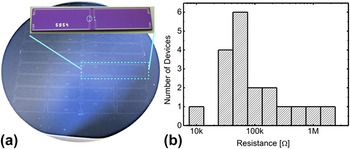
The first step toward realizing chemical sensors is the fabrication of devices based on SWCNTs. The device layout generally comprises two or four electrodes bridged by individual tubes or CNT bundles or nanotube networks (see Fig. 1). For this purpose, a range of strategies has been pursued, which can be mainly classified under two categories: direct growth of SWCNTs on device substrates and deposition of presynthesized SWCNTs. In the former case, catalyst particles are deposited at predefined locations and the substrate is placed in a growth chamber containing a carbonaceous precursor at an appropriately high temperature.Reference Kong, Soh, Cassell, Quate and Dai21 In a subsequent lithography step, the electrodes are fabricated on top of the nanotubes.Reference Soh, Quate, Morpurgo, Marcus, Kong and Dai22 Despite the versatility of this approach, it is very difficult to obtain a high throughput since the growth of CNTs is rather random and it cannot be assured that every gap is bridged by at least a single CNT.Reference Rispal and Schwalke23 Alternatively the CNTs can be grown using various synthesis procedures such as arc discharge,Reference Ebbesen and Ajayan24 chemical vapor deposition,Reference Terrones, Grobert, Zhang, Terrones, Olivares, Hsu, Hare, Cheetham, Kroto and Walton25 laser ablation,Reference Guo, Nikolaev, Thess, Colbert and Smalley26 or the HiPco (high pressure pyrolysis of carbon monoxide) process.Reference Bronikowski, Willis, Colbert, Smith and Smalley27 Subsequently they are dispersed in an appropriate solvent with or without surfactants.Reference Hersam28 At the initial stages of CNT research, such dispersions were deployed to deposit CNTs randomly on a substrate. The deposited nanotubes were then contacted by tedious electron beam lithography (EBL) procedures.Reference Tans, Verscheueren and Dekker29, Reference Martel, Schmidt, Shea, Hertel and Avouris30 EBL is a serial technique and hence not easily amenable for applications. Recently, alternating current dielectrophoresis has been combined with scalable photolithography approaches to realize CNT devices at desired locations.Reference Vlandas, Kurkina, Ahmad, Kern and Balasubramanian31Figure 2(a) shows a typical 3″ wafer with electrodes written by photolithography. The wafer is diced into 10 chips each containing two positions. Of the 20 positions the dielectrophoretic trapping yielded CNT devices in 19 positions, whose resistances are summarized in the histogram of Fig. 2(b). The trapping of CNTs can also be monitored to ensure that at least one tube is trapped in every gap.Reference An and Friedrich32, Reference Monica, Papadakis, Osiander and Paranjape33
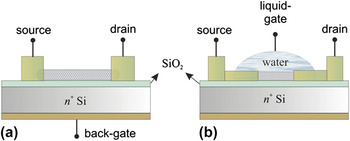
Schematic of the setup for measuring the field-effect electrical characteristics. (a) Back-gated configuration—the resistance of the nanotube (between source and drain) is measured as a function of the back gate voltage. (b) Liquid-gated configuration—the resistance of the nanotube is measured as a function of the voltage applied to the reference electrode. Adapted with permission from Ref. Reference Balasubramanian, Lee, Weitz, Burghard and Kern42.

Wafer-scale fabrication of single-walled carbon nanotube (SWCNT) devices. (a) A 3″ Si/SiO2 wafer with electrode structures fabricated by photolithography. The wafer is diced into 10 samples each containing two positions in the middle. The inset shows a zoomed-in version of one of the diced chips. Typical atomic force microscopic (AFM) images of carbon nanotubes (CNTs) trapped in the electrode gaps (marked with the cyan circle) can be found in Fig. 3. (b) Histogram of resistances after dicing the wafer and trapping SWCNTs on each of the positions. A solution of HiPco SWCNTs in an aqueous surfactant (Triton X-100) was used to trap the nanotubes. See Ref. Reference Vlandas, Kurkina, Ahmad, Kern and Balasubramanian31 for more details on fabrication. Please note that the x-axis shows the measured resistance of the device in log scale.

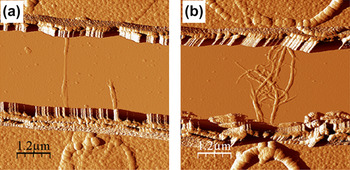
In both approaches a major challenge is the complexity of the physical and the electronic structure of the CNTs that are grown or trapped in the electrode gaps on wafers. Unlike many chemical compounds the synthesis procedures for CNTs result inevitably in a range of tube diameters and chiralities.Reference Saito, Dresselhaus and Dresselhaus34 This leads to a broad variation in the electronic structure of the tubes, with band gaps spanning from zero to around 1.5 eV.Reference Saito, Dresselhaus and Dresselhaus34 When working with dispersed CNTs, it is possible to fractionate them through chromatographyReference Zheng, Jagota, Semke, Diner, Mclean, Lustig, Richardson and Tassi35, Reference Tanaka, Urabe, Nishide and Kataura36 or ultracentrifugation.Reference Green and Hersam37 Purified SWCNTs are available even commercially from companies.38 However, such SWCNTs are usually quite short (several hundreds of a nanometer long), forcing the need for serial techniques such as EBL.Reference Ganzhorn, Vijayaraghavan, Dehm, Hennrich, Green, Fichtner, Voigt, Rapp, von Loehneysen, Hersam, Kappes and Krupke39 One possibility of overcoming this problem is to use CNT networks containing a mixture of tubes of varying chiralities.Reference Monica, Papadakis, Osiander and Paranjape33 Although this helps in attaining similar electrical properties from one device to another, it has some disadvantages such as the reduction in sensitivity due to the increased surface. Our current strategy involves the use of few bundles of CNTs, which invariably contain metallic SWCNTs. This results in up to 80% of our devices exhibiting resistances lower than 200 kΩ [see Fig. 2(b)]. Typical atomic force microscopic (AFM) images of such samples are shown in Fig. 3. As is discussed later, through ECF of such CNT bundles we have been able to design highly sensitive field-effect sensors avoiding the need for semiconducting CNTs or purification steps. Optionally, the electrodes are passivated by silicon oxide to ensure that only the CNTs are in contact with the solution.Reference Vlandas, Kurkina, Ahmad, Kern and Balasubramanian31, Reference Kurkina, Vlandas, Ahmad, Kern and Balasubramanian40
AFM images of trapped SWCNTs showing (a) one bridging bundle and (b) many bridging bundles. The electrodes were passivated with silicon oxide.

The fabricated devices are characterized subsequently by electronic transport measurements, which also serve as the detection signal in sensor trials. In the simplest case, the resistance of the device is recorded. It may also serve as a sensor signal when hysteresis effectsReference Kim, Javey, Vermesh, Wang, Li and Dai41 and sensor drifts are minimal in comparison to the changes caused by the binding of the analyte. In many cases this condition is not guaranteed and a gate electrode is required to maintain a stable reference potential. Here, the complete field-effect characteristic of the device is recorded. A schematic for measuring the gate dependence of conductance in such a configuration is shown in Fig. 1(a). The conductance of the nanotube is measured as a function of the back gate voltage applied to the highly doped (n +) silicon substrate. Metallic nanotubes (m-SWCNTs) show almost no changes, whereas semiconducting nanotubes (s-SWCNTs) show a resistance modulation of up to five orders of magnitude. SWCNT bundles and networks show a moderate gate modulation up to around one order of magnitude.
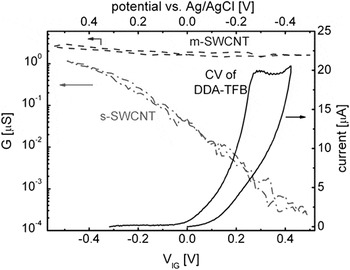
When working in liquids, as is common for chemical sensors and biosensors, it is advantageous and in many cases necessary to use a reference electrode as a gate electrode. This electrode is immersed in the liquid surrounding the sensor surface as shown in Fig. 1(b).Reference Balasubramanian, Lee, Weitz, Burghard and Kern42 In this case, the electrical double layer formed at the interface between the CNT and the liquid serves as the gate capacitor. This is in effect an identical setup as is normally used in electrochemistry, where the potential at a working electrode is tuned with respect to a reference electrode to probe redox-active molecules in solution. The difference lies in the measurement of the current. For a liquid-gated FET, the current is measured through the CNT, but in an electrochemical setup, the current flowing through the solution (due to charge transfer occurring at the interface) is recorded. The coupling between electrolyte gating and electrochemical charge transferReference Heller, Kong, Williams, Dekker and Lemay43, Reference Balasubramanian, Burghard and Kern44 is illustrated in Fig. 4. The dashed lines show the modulation of the nanotube conductance (plotted on the left axis, for both m- and s-SWCNTs) as a function of the gate voltage (V lG—bottom axis) at the reference electrode. The same Ag/AgCl electrode is used as a reference for electrochemical measurements, enabling the direct comparison of the electrochemical behavior of redox-active molecules with the field-effect characteristics. For example, the irreversible reduction of a diazonium salt [4-diazo-N,N-diethylaniline tetrafluoroborate (DDA-TFB)] is plotted additionally in Fig. 4 in the form of a cyclic voltammogram (top and right axes).Reference Balasubramanian, Burghard and Kern44
Comparison of liquid-gated field effect and electrochemistry (dashed line and dash-dotted lines). Liquid-gate dependence of conductance for a metallic and semiconducting SWCNTs, respectively, in a water droplet. The gate voltage is applied to an Ag/AgCl reference electrode that is in contact with the droplet. The voltage applied to the Ag/AgCl electrode with respect to the nanotube is plotted in the lower x-axis (solid line). Cyclic voltammogram of 10-mM 4-diazo,-N,N-diethylaniline tetrafluoroborate with 0.1-M lithium perchlorate at a gold electrode in water. Ag/AgCl is used as the reference electrode. The voltage applied to the gold working electrode with respect to the reference is plotted in the upper x-axis. Adapted with permission from Ref. Reference Balasubramanian, Burghard and Kern44.

III. ELECTROCHEMICAL FUNCTIONALIZATION
ECF involves the oxidation or the reduction of redox-active molecules in the vicinity of CNTs leading to the creation of a radical or ionic species that attaches itself covalently or non-covalently to the nanotube surface. ECF of contacted SWCNTs is performed in two ways. In the first method that is commonly used in the field of electrochemistry, the nanotube electrode (individual CNT or CNT bundle or CNT network) serves as the working electrode in an electrochemical cell.Reference Bahr and Tour16, Reference Bard and Faulkner45 The cell is laid out in a standard three-electrode configuration (counter electrode—platinum, reference electrode—Ag/AgCl, and quasi reference—platinum).Reference Bard and Faulkner45 Alternatively, the functionalization can also be carried out in the liquid-gated configuration (see Fig. 4) as discussed earlier. Using any of the two strategies, the interface of the SWCNTs can be provided with inorganic or organic species.
A. Inorganic functionalities
SWCNTs can be decorated with metal nanoparticles in a facile manner using ECF. Toward this goal, a metal salt in an electrolyte solution is used as the precursor. The metal salt can be reduced at negative overpotentials leading to the formation of corresponding nanoparticles on the surface of CNTs. The nanoparticles on the CNT surface are preferably formed at defect sites due to the presence of high electric fields.Reference Fan, Goldsmith and Collins46, Reference Scolari, Mews, Fu, Myalitsin, Assmus, Balasubramanian, Burghard and Kern47 The size and density of the nanoparticles can be controlled by varying the temporal profile of the potential applied in addition to the concentration of the metal salt, the magnitude of the overpotential, and the time for which the potential is applied.Reference Day, Unwin, Wilson and Macpherson48 In this manner, decoration of SWCNTs with Au, Pd, Pt, Ni, Co, and Ag nanoparticles has been demonstrated.Reference Balasubramanian and Burghard18, Reference Fan, Goldsmith and Collins46, Reference Day, Unwin, Wilson and Macpherson48, Reference Wildgoose, Banks and Compton49 In some cases, it is required to use a stabilizer to control the rate of formation of the nanoparticles. In comparison to sputtering or evaporation, electrochemistry ensures that an intimate contact is achieved between the nanoparticles and the CNTs.Reference Scolari, Mews, Fu, Myalitsin, Assmus, Balasubramanian, Burghard and Kern47, Reference Assmus, Balasubramanian, Burghard, Kern, Scolari, Fu, Myalitsin and Mews50, Reference Schlecht, Balasubramanian, Burghard and Kern51 The degree of functionalization can be estimated in a facile manner with the help of AFM images.Reference Day, Unwin, Wilson and Macpherson48
B. Organic moieties
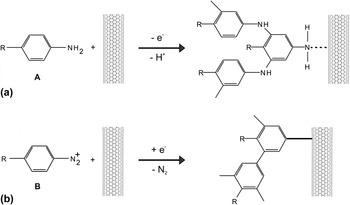
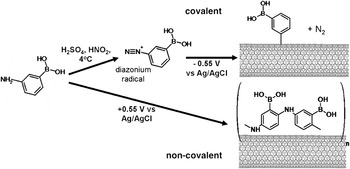
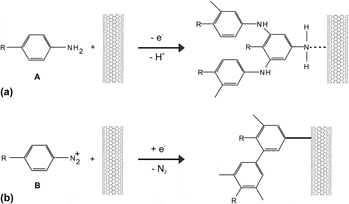
Organic moieties can be coupled either in a covalent or non-covalent manner by an appropriate choice of the end-groups of the precursor molecule. Non-covalent functionalization is achieved for example with substituted aromatic amines that can be readily oxidized at CNT surfaces. Figure 5(a) shows the principle of non-covalent ECF. The precursors we have used include 4-aminobenzylamine,Reference Kooi, Schlecht, Burghard and Kern17, Reference Balasubramanian, Friedrich, Jiang, Fan, Mews, Burghard and Kern52 4-aminobenzoic acid,Reference Kurkina, Vlandas, Ahmad, Kern and Balasubramanian40 and 4-aminophenylboronic acid.Reference Vlandas, Kurkina, Ahmad, Kern and Balasubramanian31 Other common molecules used for electropolymerization include anilineReference Gao, Huang, Dai, Wallace, Gao and Wang53 and pyrrole.Reference Balasubramanian and Burghard18 The application of positive overpotentials leads to the electropolymerization of the aminophenyl moieties on or in the vicinity of the CNT surface. The thickness of the coatings can be controlled by varying the concentration of the precursor and the time of ECF. The increase in thickness has been confirmed with the help of AFM images, whereas the formation of non-covalent bonds has been established by Raman spectroscopy.Reference Balasubramanian, Friedrich, Jiang, Fan, Mews, Burghard and Kern52
Scheme for the electrochemical functionalization (ECF) of SWCNTs with organic moieties. (a) Non-covalent functionalization using a substituted aromatic amine. (b) Covalent functionalization using an aryl diazonium salt. Adapted with permission from Ref. Reference Balasubramanian, Friedrich, Jiang, Fan, Mews, Burghard and Kern52.

Covalent functionalization of the CNT surface is achieved by using aryl diazonium salts as shown in Fig. 5(b). Examples include 4-nitrobenzenediazonium,Reference Kooi, Schlecht, Burghard and Kern17, Reference Balasubramanian, Friedrich, Jiang, Fan, Mews, Burghard and Kern52 4-chlorobenzenediazonium, 4-bromobenzenediazonium,Reference Balasubramanian, Burghard and Kern44 4-diazo-N,N-diethylaniline,Reference Maroto, Balasubramanian, Burghard and Kern20 and 4-diazophenylboronicacid salts.Reference Vlandas, Kurkina, Ahmad, Kern and Balasubramanian31 Diazonium salts are in general very reactive and induce sidewall additions to the CNTs upon application of an appropriate negative overpotential.Reference Bahr and Tour16, Reference Kooi, Schlecht, Burghard and Kern17 This leads to highly reactive phenyl radicals that couple covalently to the CNT surface. The result is a partial disruption of the conjugated π-bonded network of the nanotube walls, as has been confirmed by electrical transport and Raman measurements.Reference Balasubramanian, Burghard and Kern44, Reference Balasubramanian, Friedrich, Jiang, Fan, Mews, Burghard and Kern52 The resistance and the Raman D-band intensity (relative to the G-band intensity) of the CNTs are found to increase upon covalent binding. By contrast in the case of non-covalent modification only subtle changes in the resistance are observed upon attachment of the organic moieties. Since the covalent functionalization leads to an increase in resistance, the degree of functionalization can be controlled by simultaneously monitoring the device resistance.Reference Vlandas, Kurkina, Ahmad, Kern and Balasubramanian31, Reference Burghard, Maroto, Balasubramanian, Assmus, Forment-Aliaga, Lee, Weitz, Scolari, Nan, Mews and Kern54 This gives us a handle on controlling the density of functional moieties on the CNT surface. Although it is difficult to estimate the exact amount of functional groups on the CNT surface, the use of resistance monitoring has proved to be an effective method to obtain a reproducible density of receptors from one sample to another. This leads to a subnanometer coverage of the substituted phenyl moieties on the CNT surface. A high coverage of more than 5 nm leads to a strong increase in the resistance after which the devices are practically unusable.Reference Balasubramanian, Friedrich, Jiang, Fan, Mews, Burghard and Kern52 Apart from diazonium salts, ECF with aniline also leads to the formation of covalent bonds under certain conditions.Reference Baibarac, Baltog, Godon, Lefrant and Chauvet55
The density of attached functional groups on the sidewalls can be estimated by techniques such as thermogravimetric analysis,Reference Bahr, Yang, Kosynkin, Bronikowski, Smalley and Tour56 vibrational spectroscopy,Reference Bahr, Yang, Kosynkin, Bronikowski, Smalley and Tour56, Reference Kuznetsova, Popova, Yates, Bronikowski, Huffmann, Liu, Smalley, Hwu and Chen57 electron microprobe analysis,Reference Bahr, Yang, Kosynkin, Bronikowski, Smalley and Tour56 and x-ray absorption.Reference Kuznetsova, Popova, Yates, Bronikowski, Huffmann, Liu, Smalley, Hwu and Chen57 The general strategy is to measure the elemental composition or a characteristic chemical signature of the functionalization and use it to estimate the degree of functionalization.Reference Hirsch58 Alternatively, spectroscopic signatures of the attached chemical groups can also be utilized.Reference Georgakilas, Kordatos, Prato, Guldi, Holzinger and Hirsch11
The versatility of the electrochemical approach together with the simplicity of the experimental setup offers a number of advantages for the efficient surface functionalization of SWCNTs. It is only required to add the desired redox species with or without the electrolyte in an appropriate solvent.Reference Balasubramanian, Burghard and Kern44 Using the simple liquid-gating or electrochemical setup it is possible to attain a reproducible functionalization of the CNT surface with a given set of experimental parameters. Another major advantage of ECF lies in the fact that the moieties are directly attached to the CNT surface, leaving the surrounding substrate as well as the non-contacted SWCNTs unaffected, which is key to design efficient sensors.Reference Balasubramanian59 Furthermore, in contrast to other bulk chemical functionalization methods, this technique ensures a functionalization yield of 100%. In other words, it can be confirmed that every contacted tube/bundle is indeed functionalized with the help of AFM and Raman measurements.
IV. SELECTIVITY TO ELECTRONIC STRUCTURE
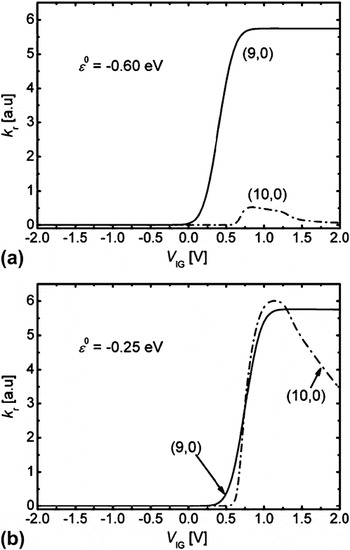
The liquid-gating setup allows the tuning of the electronic band filling of the contacted SWCNTs by varying the gate voltage.Reference Heller, Kong, Williams, Dekker and Lemay43 At the same time, it can be used to probe the redox potential of a redox-active molecule in solution. This suggests that this setup is ideally suited to probe the effect of electronic structure on the charge transfer occurring at the CNT–liquid interface, motivating the study of the dependence of electrochemical reactivity on the electronic structure of the CNT under investigation. While m-SWCNTs exhibit continuously filled states with the possibility of charge transfer at any filling level, the s-SWCNTs posses energy gaps where the rate of charge transfer is expected to be lower than that of m-SWCNTs. We have investigated this aspect in detail using the covalent functionalization scheme with the help of both theory and experiments.Reference Balasubramanian, Burghard and Kern44 Toward this goal, we have calculated the reaction rate separately for m- and s-SWCNTs. We have observed that for some diazonium salts with an appropriate redox potential, the electrochemical reaction rate at s-SWCNTs is strongly reduced in comparison to that at m-SWCNTs. Experiments involving covalent ECF of individual m- and s-SWCNTs with diazonium salts of varying redox potential (ε 0) confirm this prediction. Figure 6 shows calculated reaction rates at a metallic (9,0) SWCNT and a semiconducting (10,0) SWCNT for two diazonium salts of differing reduction potential (−0.6 V, −0.2 V) obtained by using the Gerischer–Marcus model. It is apparent that with the former diazonium salt [Fig. 6(a)], the reaction rate at the m-SWCNT is much higher than that at the s-SWCNT. However with a diazonium salt of a less negative reduction potential, the reaction rates are almost the same [Fig. 6(b)]. By choosing an appropriate diazonium salt and by astute control of the experimental conditions (time and profile of voltage applied, concentration of the diazonium salt, and the background electrolyte), the functionalization is carried out exclusively on m-SWCNTs.
Calculated electrochemical reaction rates at metallic (9,0) and semiconducting (10,0) SWCNTs with prototype diazonium salts of differing reduction potentials: (a) −0.60 V and (b) −0.25 V. It is apparent that the reaction rate at an m-SWCNT is much higher than that at an s-SWCNT in (a), whereas in (b) the reaction rates are similar. Adapted with permission from Ref. Reference Balasubramanian, Burghard and Kern44.

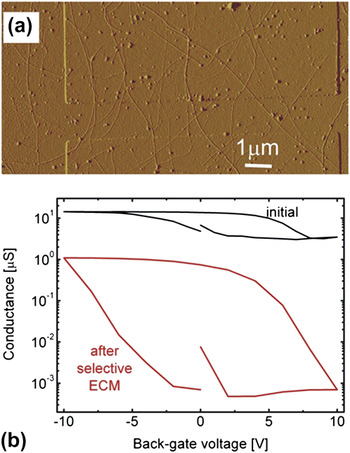
A direct consequence of the selectivity of ECF is that the metallic tubes in a CNT network can be selectively addressed and covalently modified. The resistance of the m-SWCNTs increases as a result of this modification, whereas that of s-SWCNTs remains almost unaffected. When the ECF is carried out for a sufficient amount of time, the metallic tubes can be virtually eliminated from the conduction paths of such a network. Figure 7(a) presents a typical SWCNT network, whereas Fig. 7(b) shows the field-effect behavior in air before and after such an electrochemical modification. It is apparent that the gate modulation of conductance has increased dramatically after the ECF, confirming that the semiconducting tubes exclusively constitute the conducting pathway in this device. Devices fabricated in this manner show good performance characteristics comparable to their individual semiconducting CNT counterparts.Reference Balasubramanian, Lee, Weitz, Burghard and Kern42, Reference Balasubramaniann, Sordan, Burghard and Kern60
Selective electrochemical modification of metallic SWCNTs. (a) SWCNT network grown by chemical vapor deposition and contacted by electrodes. Catalyst particles used for the nanotube growth are still visible. (b) Field-effect characteristics of the device before and after selective ECF with a diazonium salt. The ON/OFF ratio has increased signifying that the metallic tubes in the network have been successfully eliminated. Adapted with permission from Ref. Reference Balasubramanian, Lee, Weitz, Burghard and Kern42.

V. CHEMICAL SENSORS AND BIOSENSORS
A. Principle
Tailoring the functional interface of CNTs by electrochemistry provides a versatile method for realizing highly selective chemical sensors and biosensors. The principle of electrical detection is based on the changes in physical properties (mainly electrical characteristics) of the SWCNTs upon binding of the analyte molecules on their surface. Sensitivity in electrical sensors is related to the surface-to-volume ratio of the active element. Due to their high surface-to-volume ratio, CNTs are expected to exhibit higher sensitivity than their micro- or macroscale counterparts. In contrast to optical detection methods, electrical detection poses the advantage that a bulky reading instrument is not necessary. Electrical sensors are portable and are hence easily deployable for applications at the point-of-care.Reference Kurkina and Balasubramanian61 To make the sensor selective to a specific analyte, the CNT surface needs to be modified with an appropriate functional group serving as a chemical receptor or bioreceptor. Using the electrochemical methods outlined earlier, a range of receptors can be brought onto the surface of individual CNTs in a very controllable manner, allowing for a rational design of sensing paradigms. In this section, we outline the sensors that we have demonstrated using ECF of SWCNT-FETs.
B. Imparting selectivity
The electrical properties of SWCNTs are rather sensitive to their environment. As a result, pristine SWCNTs can be directly deployed to detect molecules such as NH3 or NO2.Reference Kong, Franklin, Zhou, Chapline, Peng, Cho and Dai62, Reference Bradley, Gabriel, Briman, Star and Gruener63 The main requirement here is that the analytes have a capability to induce charge transfer onto the CNTs, which can be detected through a shift in the gate voltage characteristics.Reference Kong, Franklin, Zhou, Chapline, Peng, Cho and Dai62, Reference Bradley, Gabriel, Briman, Star and Gruener63 While NH3 donates electrons, NO2 accepts electrons leading to a doping of the semiconducting CNTs that can be sensitively detected with the help of gate-dependent transport measurements. This, however, does not provide any selectivity for the detection of analytes. Any electron donor would induce a threshold voltage shift toward more negative gate voltages, whereas any electron acceptor would shift the transfer curve in the opposite direction.
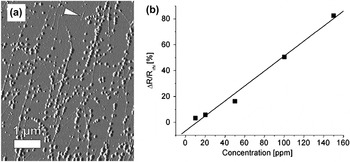
ECF is ideally suited to provide SWCNT sensors with selectivity toward a certain analyte. Furthermore, molecular species that normally do not undergo any charge transfer can be detected using functionalized CNT surfaces. For example, hydrogen does not possess the capability to induce direct charge transfer onto SWCNTs. Palladium serves as a selective mediator for hydrogen, by dissolving molecular hydrogen, which dissociates and changes the work function of the metal.Reference Lewis64 SWCNTs electrochemically decorated with palladium nanoparticles [see Fig. 8(a)] can thus be used as hydrogen sensors.Reference Schlecht, Balasubramanian, Burghard and Kern51 In comparison to other metal deposition methods, electrochemistry brings in the advantage that only those locations that dominate the resistive pathways are decorated with palladium. In this manner, one can attain a high sensitivity in the low parts per million range as shown in Fig. 8(b).
Hydrogen sensors based on electrochemically functionalized SWCNTs. (a) SWCNT network decorated with palladium nanoparticles. (b) Sensor response of palladium nanoparticle-decorated SWCNT network showing sensitivity down to the low parts per million range. Adapted with permission from Ref. Reference Schlecht, Balasubramanian, Burghard and Kern51.

C. Controlling sensitivity
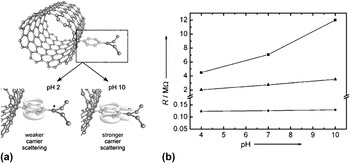
From the foregoing discussion it is apparent that the use of semiconducting SWCNTs is necessary to observe a charge transfer from analytes. We have proposed a novel strategy to overcome this restriction, which allows the use of metallic SWCNTsReference Maroto, Balasubramanian, Burghard and Kern20 or bundles of SWCNTs with an overall semimetallic electrical behavior.Reference Vlandas, Kurkina, Ahmad, Kern and Balasubramanian31 The principle is based on the covalent electrochemical attachment of receptors onto the CNT surface. As mentioned above, covalent attachment leads to an increase in the tube resistance. The attached receptors function as charge-scattering sites, whose strength is modulated by the analyte concentration.Reference Maroto, Balasubramanian, Burghard and Kern20 Due to the increase in resistance, it is important to optimize the density of the receptors. To keep the disruption of the conjugated π-system to a minimal amount we monitor the resistance during ECF and ensure that it does not increase by more than an order of magnitude. In the presence of the analyte, the resistance of the CNT increases further since the scattering sites provide an increased scattering cross section for the transport of electrons, as shown in the schematic in Fig. 9(a) for a pH sensor. The presence of analyte-induced charge scattering is detected by measuring the conductance that shows a marked decrease at all gate voltages. By contrast, the charge transfer mechanism results in a shift of the transfer characteristics along the gate voltage axis. Based on the charge-scattering strategy, we have demonstrated pH sensors, wherein individually contacted metallic SWCNTs were covalently functionalized with DDA-TFB [Fig. 9(a)]. Unmodified metallic SWCNTs showed almost no sensitivity to the pH of the solution. Upon functionalization, a clear correlation between the pH of the solution and the resistance or gate characteristics of the sensor could be observed, confirming the proposed sensing mechanism.
pH sensors based on covalently functionalized metallic SWCNTs. (a) Schematic showing the attachment of diethylaniline groups onto the SWCNT sidewalls and the sensor mechanism. At low pH, the aniline groups are protonated and hence the functionalized sites act as weak scattering centers. With increasing pH, the electron density on the attached diethylaniline moieties increases leading to a resistance increase as a function of pH. (b) Sensor response to solutions of varying pH for a pristine SWCNT (stars); the same tube modified once electrochemically with 4-diazo-N,N-diethylaniline tetrafluoroborate (triangles) and the same tube modified a second time under the same conditions (squares). After every modification, the pH response is found to improve signifying an increase in the density of attached receptors. In this manner electrochemistry can be used to improve the sensitivity of SWCNT-based sensors. Adapted with permission from Ref. Reference Maroto, Balasubramanian, Burghard and Kern20.

A unique aspect of the ECF route is that by varying the density of the attached receptors we can improve the sensitivity of the realized sensor. The density of the receptors on the CNT surface can be increased with every subsequent electrochemical modification. Figure 9(b) presents calibration curves for the pH sensor at various receptor densities. Initially, the metallic SWCNT shows almost no pH dependence due to the absence of receptors. However, after every ECF cycle, which attaches new pH-sensitive receptor molecules on the same CNT surface, the sensitivity (slope of the calibration curve) is found to increase.Reference Maroto, Balasubramanian, Burghard and Kern20 This possibility is unlike other bulk chemical functionalization protocols, where it is quite difficult or impossible to have such a control over the receptor density. In this manner, ECF can be used to obtain direct control over the sensitivity and selectivity of the realized chemical sensors.
D. Deciphering sensor mechanisms
Since it is possible to tune the functional interface of the CNTs in a very fine manner, the ECF strategy helps in deciphering the mechanisms of the realized sensors. Specifically, the question arises as to how the nature of coupling (covalent versus non-covalent) between the receptor and the nanotube affects the sensing response. Toward this end, sugars (e.g., glucose and fructose) were chosen as model analytes and phenylboronic acid moieties selected as the corresponding receptors.Reference Vlandas, Kurkina, Ahmad, Kern and Balasubramanian31 Boronic acids bind to cis-1,2- or cis-1,3-diols at neutral pH leading to a change in the charge density at appropriate pH.Reference James, Phillips and Shinkai65 The binding is reversible at low pH. Since the focus here is on the study of the sensing mechanism upon binding, the absence of selectivity toward a specific sugar is not of concern here.Reference Vlandas, Kurkina, Ahmad, Kern and Balasubramanian31 Based on a functionalization scheme as shown in Fig. 10, phenylboronic acid moieties were attached either covalently or non-covalently onto the CNT surface. Subsequently the sensor responses for both cases were examined in detail.
Schematic showing the attachment of phenylboronic acid moieties onto the SWCNTs through covalent or non-covalent attachment. For non-covalent attachment, aminophenylboronic acid is directly electropolymerized on the SWCNT surface. Covalent attachment is achieved by creating a reactive diazonium intermediate, which can subsequently be reduced on the CNT surface. Adapted with permission from Ref. Reference Vlandas, Kurkina, Ahmad, Kern and Balasubramanian31.

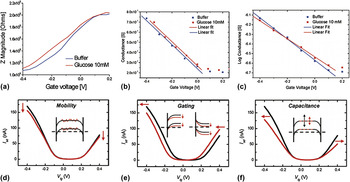
Figure 11 summarizes the results obtained with the two types of sensors and compares them with theoretical predictions for the behavior of generic CNT-based biosensors from Ref. Reference Heller, Janssens, Mannik, Minot, Lemay and Dekker66. The covalently functionalized SWCNT devices upon introduction of glucose show an increase in resistance [at all gate voltages, Fig. 11(a)] signifying the occurrence of the charge-scattering mechanism discussed above for the case of pH sensors. This is consistent with theory demonstrating that the changes in mobility lead to a suppression of conductance [see Fig. 11(d)]. On the other hand, the non-covalently modified CNTs show a shift in the transfer characteristics [Fig. 11(b)] as well as a change in the slope of the transfer curve [Fig. 11(c)]. The threshold shift is attributed to the change in surface charge (arising due to the binding of glucose onto phenylboronic acid moieties) consistent with the gating model in Fig. 11(e). Moreover, in contrast to covalent attachment, the non-covalent attachment can be used to attach a high density of receptors without affecting the device resistance. As a result, changes in the surface charge also lead to a difference in the gating efficiency due to variations in the gate capacitance [see Fig. 11(f)]. It is worth mentioning here that the Schottky barriers play only a minor role in the sensing mechanism since the contacts have been passivated. These results substantiate the fact that by controlling the nature of coupling between the receptor and the CNT surface, we can influence the underlying sensing mechanism. Furthermore it provides a good rationale and a generic pathway for the design of SWCNT-based biosensors.
Sensor mechanism of SWCNT field-effect transistor sensors. Experiment: Sensor response to glucose of (a) covalently and (b, c) non-covalently functionalized SWCNT sensors. Theory: Predicted sensor response based on various sensing mechanisms: (d) charge scattering/mobility, (e) surface charge/gating, and (f) screening/capacitance. In (d) the binding of analytes onto the sensor surface leads to changes in the strength of charge scattering, resulting in an increase of resistance at all gate voltages. Experimentally this condition is observed for the SWCNT devices covalently functionalized with phenylboronic acid moieties (a). In (e) the occurrence of or a change in the surface charge leads to a shift in the gate voltage characteristics, whereas in (f) a change in capacitance is observed due to screening of the gate potential by the analytes bound onto the CNT surface. These two cases are observed in experiments where the SWCNTs are non-covalently functionalized with the phenylboronic acid moieties. A shift in the threshold voltage (b) and a change in the slope (c) is observed in the experiments. (a)–(c) Adapted with permission from Ref. Reference Vlandas, Kurkina, Ahmad, Kern and Balasubramanian31 and (d)–(f) adapted with permission from Ref. Reference Heller, Janssens, Mannik, Minot, Lemay and Dekker66.

E. Achieving low detection limit
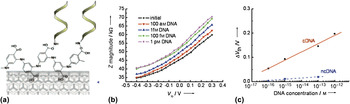
From the foregoing discussions it is apparent that ECF allows the realization of SWCNT sensors with astute control over selectivity and sensitivity. Furthermore, the sensor responses could be explained with the help of a qualitative model. However, the fundamental purpose of deploying SWCNTs namely the ability to detect very small amounts of analytes has not yet been demonstrated. Analytes such as nucleic acids, proteins, and peptides are present in miniscule amounts in bodily fluids, whose detection requires very high sensitivity. Toward this purpose, we have designed nucleic acid biosensors by functionalizing the SWCNTs with probe DNA that are complementary to the target analyte DNA.Reference Kurkina, Vlandas, Ahmad, Kern and Balasubramanian40 Here we have followed the non-covalent functionalization strategy. The nanotube surface is highly hydrophobic, and nucleic acids bind to the surface through hydrophobic interaction with the nucleobases.Reference Zheng, Jagota, Semke, Diner, Mclean, Lustig, Richardson and Tassi35 To avoid this, the contacted SWCNTs are functionalized with 4-aminobenzoic acid, resulting in a polymer coating that is rich in carboxyl groups. At a working pH of 7.4, these groups are negatively charged and thereby help in avoiding non-specific binding through electrostatic interactions. Subsequently the probe DNA is coupled to the carboxyl groups through carbodiimide chemistry as shown in Fig. 12(a). Upon addition of target DNA the transfer curves shift to negative voltages [see Fig. 12(b)] consistent with the sensor mechanism for non-covalent ECF as discussed earlier. Such SWCNT DNA sensors are sensitive over a broad range of DNA concentrations and present a detection limit as low as 100 aM [see Fig. 12(c)]. This corresponds to less than 2000 molecules in our sample volume of 30 μL. Furthermore, the sensors showed a detection limit of 200 aM in a heterogeneous solution where the target DNA was mixed with three different non-complementary sequences. The target DNA amounted to just 2% of the total nucleic acids present in the sample solution. This is the lowest detection limit achieved so far for label-free direct nucleic acid biosensors based on electrical detection without the use of sandwich protocols.Reference Kurkina and Balasubramanian61
SWCNT deoxyribonucleic acid (DNA) sensors with low detection limit. (a) Schematic showing the SWCNT functionalized electrochemically (non-covalent) with aminophenylboronic acid followed by coupling of aminofunctionalized probe DNA to the attached carboxyl groups. (b) Liquid-gated field-effect characteristics of the sensor for different concentrations of target DNA. (c) Calibration curve showing the shift in the gate characteristics as a function of DNA concentration. cDNA: complementary DNA—specific binding; ncDNA: non-complementary DNA—non-specific binding. Adapted with permission from Ref. Reference Kurkina, Vlandas, Ahmad, Kern and Balasubramanian40.

F. Challenges
In spite of the various advantages guaranteed by the use of ECF for CNT-based sensors, a number of challenges still need to be overcome before the widespread use of this strategy. The first aspect relates to the differences in the diameter and the electronic structure of the tubes trapped, which leads to a variation in the chemical reactivity of the tubes. Furthermore, the density of tubes in a bundle is difficult to control as shown in Fig. 3, where two different CNT morphologies are observed under similar fabrication conditions. The challenge here is the estimation of the density of functional groups on the CNT surface at a single tube level. These aspects could be handled to some extent by monitoring the device resistance during functionalization. The inability to accurately estimate the exact density of functional groups complicates calibration of such sensors for routine use. Finally, the need for a suitable reference electrode on-chip requires elaborate fabrication procedures.Reference Balasubramanian59
VI. CONCLUSION AND PERSPECTIVES
In conclusion we have demonstrated that the functional interface of CNTs can be tailored in a highly versatile manner using electrochemistry. This versatility enables a rational design of chemical sensors and biosensors by deploying SWCNT-based FETs. Through ECF routes, the nanotubes were decorated with inorganic or organic species in a covalent or non-covalent manner. The covalent ECF allowed for online monitoring of the apparent density of receptors immobilized on the CNT surface. At the same time, by an appropriate choice of the precursors, the covalent ECF could be performed almost exclusively on metallic SWCNTs. When realizing SWCNT-based sensors, the ECF allowed for imparting high selectivity, while simultaneously ensuring control over sensitivity. Furthermore, the underlying sensing mechanisms could be established by varying the coupling of the receptor to the nanotube surface. Finally, bringing all these concepts together we could demonstrate attomolar detection limit for direct nucleic acid biosensors. With the ability to tune and control their physicochemical properties, CNTs are expected to open new avenues in the area of medical diagnostics.
ACKNOWLEDGMENTS
This project was funded by the German Federal Ministry of Education and Research (BMBF) under the NanoFutur Programme with project ID O3X5516. Funding from the priority programme (DFG-SPP 1121) of the German Research Foundation is acknowledged.