INTRODUCTION
In southern Britain, the first centuries b.c. and a.d. are well known as a time of drastic technological change in terms of ceramic production. Novelties such as wheel-turned pottery, new tempering materials, kiln firing and new styles and functional vessel types evidence a greater pace of innovation, as well as an increasing intensity of contact between communities living either side of the English Channel. While the basic nature and sequence of ceramic technological change in this period is fairly well understood,Footnote 1 our understanding of the significance of technological continuity is in relative infancy. It is well known, for example, that handmade wares continue to characterise pottery assemblages throughout this period in East Sussex;Footnote 2 while in Cambridgeshire the coarse handmade ‘scored ware’ (and related plain wares) continued throughout the currency of the first wheel-made wares, well into the first century a.d.Footnote 3 A small number of studies have incorporated consideration of technological continuity into discussion of this period,Footnote 4 but as a general rule this aspect of later Iron Age and early Roman material culture remains underappreciated and poorly understood within the context of changing social structures and relationships with material culture. Essentially, while we have an understanding of when and where certain novel ceramic technologies appeared in Britain – and an increasingly specific appreciation of the regional and social variability of the uptake of these technologies – the significance of resistance to technological change and the role of locally specific socio-economic conditions in this has yet to be the subject of explicit study. Why some craftspeople chose to maintain traditional ways of doing things at a time when many of their contemporaries seem to have been energetically engaging with technological and stylistic novelty is a question with important implications for our understanding of differential experiences of life in late Iron Age (henceforth ‘LIA’) and early Roman Britain.
SILCHESTER WARE
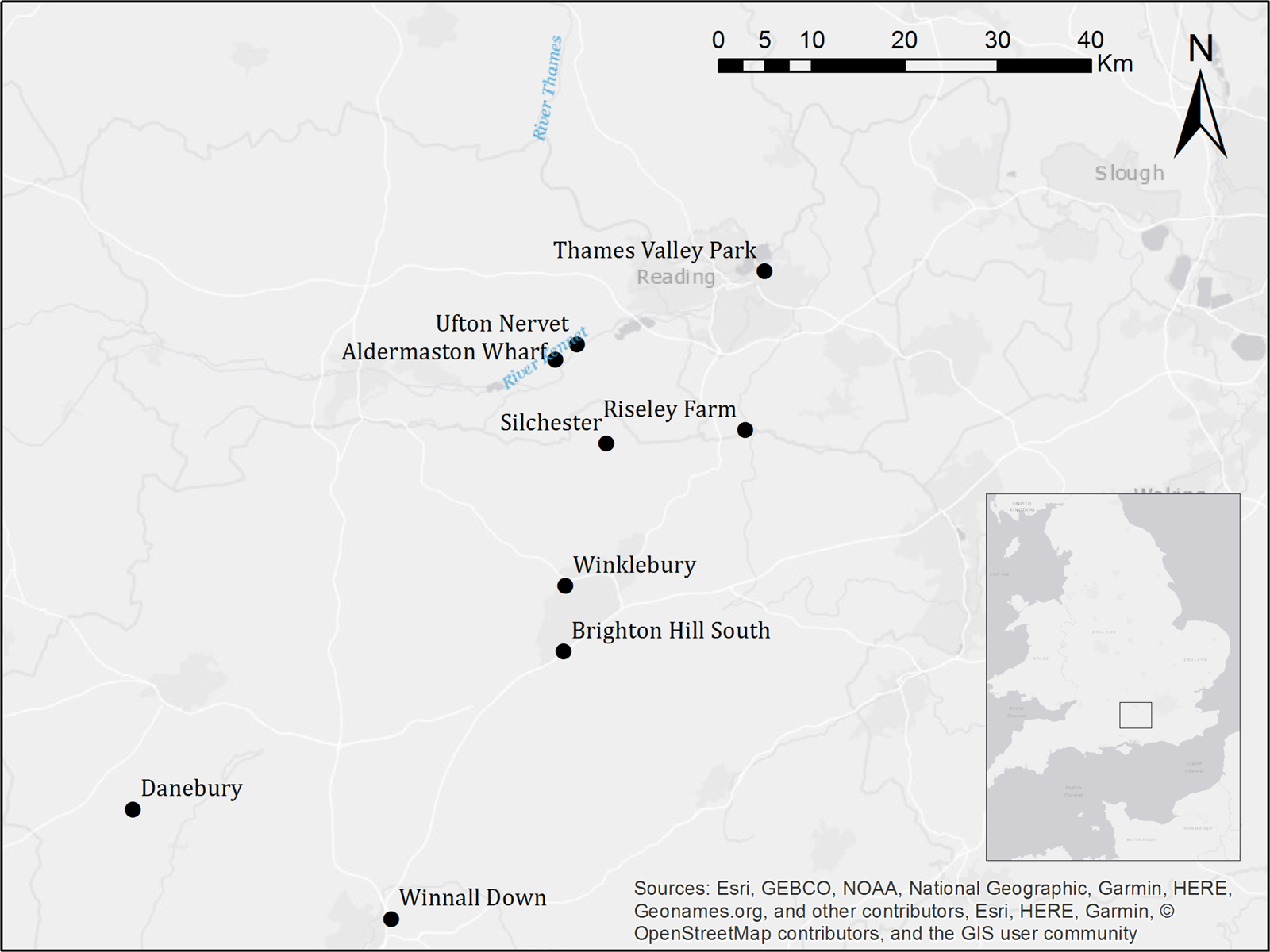
Silchester ware is a well-defined category of ceramic, albeit one with a fairly limited geographical distribution within the areas of the modern counties of Berkshire and northern Hampshire (see fig. 1 for locations of major sites referred to in the text). It is characterised as a distinctive type of flint-tempered ceramic of highly anachronistic traits, being conspicuously crude in its execution, made in a limited array of forms and incorporating none of the technological, stylistic or functional diversity of contemporary grog-tempered and sandy wares made in the late La Tène (so-called ‘Belgic’) and incipient Roman greyware traditions. While these latter wares exhibit characteristics that serve to associate their producers with ideas of innovation, novelty and continental interaction, Silchester ware exhibits overt insularity in so far as its characteristics not only stand out against a backdrop of increasing technological sophistication, but also by adherence to fabrics and – in some cases – forms that seem to have remained substantially unchanged since perhaps as early as 400/300 b.c. Nevertheless, Silchester ware proper emerges as a specialised component of the LIA ceramic repertoire, signifying changes to the socio-economic background within which such pottery was produced and consumed.
Major sites mentioned in the text.

First published under the name ‘British Gritted Ware’,Footnote 5 Silchester ware did not receive full characterisation until the publication of the large pre-conquest assemblage from the Silchester Forum-Basilica,Footnote 6 which established the broad parameters of the chronology and typology of the ware. While the typology is extremely limited – being confined to bead-rim and everted-rim jars, and lids apparently specifically designed to fit these typesFootnote 7 – difficulties have existed in defining the chronology in detail. While the Forum-Basilica and subsequent pre-conquest Insula IX assemblages have served to establish the relative popularity of Silchester ware at Calleva at different points in the early decades of the settlement,Footnote 8 precisely defining the beginning and end of production of the ware has proven problematic. The earliest known contexts at Silchester – Well F423 at the Forum-Basilica and Ditch 11631 at Insula IX – both contained Silchester ware in their primary fills, and although the proportions of the ware found in these contexts are lower than they are in stratigraphically later groups, these finds serve to show that Silchester ware was being produced by the time the oppidum was founded, c. 20/10 b.c. Flint-tempered coarsewares occur commonly throughout the middle to LIA sequences at sites in the region of Basingstoke, but these sequences are of little use in establishing precisely when the ware emerged from its middle Iron Age (MIA) antecedents. Coming from predominantly ‘rural’ sites, the assemblages of this area are jar-dominated and contain few imports or imitations thereof with which to date contexts more precisely than to broad phases.Footnote 9 The only feature of any potential help in this is Pit H at Ufton Nervet,Footnote 10 the assemblage from which contains MIA type bead-rim and saucepan pot forms (some in flint-tempered fabrics) alongside LIA-type wheel-made necked jars, but no Silchester ware. This feature has for some time been acknowledged as of regional significance for the emergence of LIA potting traditions;Footnote 11 the fact that this apparently transitional middle to LIA group contains wheel-made types but no Silchester ware suggests that the former began being made in this area before the latter. The size of this group in terms of sherd count or weight has, however, not been published, and it is therefore difficult to judge the statistical significance of the absence of Silchester ware. Additionally, the group produced no independent or absolute dating evidence; as such, while we may tentatively say that Silchester ware emerged at a date later than the introduction of wheel-made types to this area – and that this certainly occurred sometime prior to 20/10 b.c. – the precise date at which it appeared remains a matter for speculation.
Following the establishment of Silchester ware as a distinct ceramic category by the later first century b.c., the ware appears to have seen a fairly rapid rise in popularity throughout the first decades b.c./a.d., before attaining massive predominance during the conquest period. The sequence from the Silchester Forum-Basilica is most instructive. Here, Silchester ware is present but rare in Period 1 (pre-c. 15 b.c.) contexts, jumps to nearly ten percent (by count, weight and EVE) in Period 2 (c. 15 b.c. to a.d. 40/50) and then peaks in Period 3 (c. a.d. 40–50/60) at around 50 per cent (also by all measures) of the assemblage from this period.Footnote 12 In the pre-conquest Period 0 key groups from Insula IX, Silchester ware levels are consistently higher than at the Forum-Basilica, ranging between 51.8 per cent (Pit Group 14) and 84.1 per cent (Pit Group 7) by weight.Footnote 13 These consistently high levels may be partially attributable to the slightly later start date of the Insula IX occupation, there being little evidence of any material being deposited in this part of the oppidum prior to c. 10 b.c.,Footnote 14 although such a discrepancy may also suggest differences in consumption/deposition patterns between the two areas of the settlement.
Establishing the end-point of the ware is equally problematic. Returning to the sequence from Silchester, while independent dating evidence is plentiful here the situation is frustrated by the problems of the site's shallow urban stratigraphy. Despite a proposed end to production at some point during the first century, Silchester ware still accounts for 6 per cent of the Period 3 (a.d. 125/50–200) and Period 4 (a.d. 200–50) assemblages from Insula IX, this likely being entirely attributable to residuality.Footnote 15 Recent work at Insula XXX, however, has produced a significant assemblage immediately predating the construction of the temple complex in this part of the town, as well as a smaller assemblage contemporary with temple use.Footnote 16 Temple construction is dated to the early Flavian period, with the underlying features given Neronian to early Flavian dates on the basis of Samian and other finewares. Silchester ware seems to have been in decline during this period. The pre-temple assemblages contain 25 per cent Silchester ware, and the temple-use phase just 15 per cent. Even the 25 per cent figure contrasts markedly with levels from many of the key group assemblages from Insula IX and the Forum-Basilica cited above, particularly those from Forum-Basilica Period 3, which may only date to c. 10–30 years previous. Decline seems to have come in tandem with the establishment of Alice Holt as the predominant coarseware supplier to Calleva, and there is therefore an argument to say that production of Silchester ware was largely – if not entirely – confined to the pre-Flavian period.
Technological continuity in this circumstance is conspicuous. While Silchester ware seems to have emerged as a specialised ceramic type, its persistent co-occurrence with wares of more functionally diverse and ‘high-tech’ characteristics seems to signify the existence of separate potting traditions, with distinct trajectories of technological and stylistic development playing out over the course of no less than 80 years. The relative proximity of two or more so apparently divergent systems of craft knowledge begs the investigation of precisely why and how these traditions developed along the trajectories they did, as well as consideration of the locally specific processes of socio-economic change that they reflect. Additionally, by focusing on potters, this study serves as an example of how the experiences of non-élites can be considered fruitfully in the context of later Iron Age Britain.
TECHNIQUES: AT THE INTERFACE OF MAKERS, MATTER AND MATERIAL CULTURE
The approach taken here is indebted to a large and varied literature dealing with the social aspects of technologies within and beyond archaeology and anthropology. It is therefore appropriate to begin by detailing this theoretical background before discussing how it helps structure the analysis.
The argument that technologies and crafts are thoroughly embedded within the societies in which they take place has been well made both generally and in British Iron Age studies, in particular by J.D. Hill.Footnote 17 Such approaches have in past decades developed into several distinct schools of thought. Among the earliest of these is the Social Construction of Technology (SCOT) movement,Footnote 18 particularly relevant for its introduction of the concept of the ‘seamless web’ intertwining technology and society, and for that of ‘interpretive flexibility’ as a founding principle of the meaningful relationship between a craftsperson and the tools/technologies they engage with. Specifically within anthropology and archaeology – and related to the idea of interpretive flexibility – the concept of ‘technological choice’Footnote 19 has been particularly influential in espousing the notion that the past technologies for which we have archaeological evidence always come down to us as a result of decision-making: almost all basic productive outcomes have more than one method by which they may be attained. As such, an analysis of technology may consider why a given method was chosen for a particular job, rather than any available alternatives, and what this may tell us about the kinds of socio-economic conditions that influenced the contextually specific internal logics of the craftsperson/craftspeople making the decision.
Heather Lechtman's earlier notion of ‘technological style’, indeed, adhered to certain principles in her analyses of the specific ways in which groups chose to produce material culture.Footnote 20 Lechtman's interpretations, though, were based more on the notion that technological decision-making is also a correlate of the cultural backgrounds within which production takes place. In terms that will be more familiar to adherents of practice theory, Lechtman appears to have been more concerned with ‘structure’, while proponents of technological choice emphasise the roles of ‘agency’ in technological behaviour. Most recently, advocates of materiality theoryFootnote 21 have served to unpack the traditional notion of ‘agency’ as originally formulated by Pierre Bourdieu,Footnote 22 with interesting implications for technology studies. Specifically, a post-Cartesian reading of agency can be seen as forcing us to rethink the nature of interactions between craftspeople, the object types they desired to produce and the materials with which they worked. In relation to the concept of technological choice/style, this has the effect of (while not invalidating the original ideas on which these concepts were founded) increasing the complexity of the ways in which we think about how technological decision-making and learning must have been undertaken in the past. Cognitive materiality studiesFootnote 23 have served to emphasise the conscious and subconscious elements of these dynamics; while ‘design theory’Footnote 24 presents a unified set of concepts which are both tailored as an approach to material culture and also establish technological decision-making processes as part of an unfolding sequence of interaction between human actors (craftspeople), their social worlds and the materials with which they interact.
The methodology adopted here takes into account elements of all of these schools of thought as founding principles upon which it is based. However, the crucial component that unifies the approach taken here is the notion of ‘technique’ as the nexus of technological action. The concept of technique presented here is structured on the basic premise of practice theory in relation to technology: that technologies are fundamentally about ‘doing’, and not simply about ‘being’.Footnote 25 Although at first glance an abstract concept, this simply means that technologies/techniques are not justifiably described as such when they cannot be seen to be ‘doing’ anything: in these cases, they are better described as ‘tools’, ‘machines’, ‘bodies’, ‘artefacts’, etc. It is therefore practice that animates these technical entities and renders them technologies by virtue of their capacity for productive action. By centring on these practices – the techniques used in production – the act of production is rendered separately to the tools used to undertake it (and also to the material products of the act), thus allowing for the archaeological recognition of the SCOT principle of interpretive flexibility (within which a given technical artefact might be used/interacted with differently by different groups/individuals, each utilising distinct internal logics), as well as the related concerns expressed in the principles of technological choice and style.
Similarly, the work of proponents of practice theory in relation to technology – most prominently Marcia-Anne DobresFootnote 26 – demonstrates the admirable methodological utility that practice theory has when considering technologies as components of the societies in which they are found. In particular, establishing technique as the object of analysis allows the construction of an evidence-base that is conceptually separate from any particular category of actor, be they human or non-human. In this sense, practice/technique occupies a neutral space between the human agent/craftsperson and the material and social agencies that may influence their behaviour; no one of these need necessarily take precedence in interpretation, but the involvement of all is required in order to consider properly the dynamics behind craft. Analysis of techniques should therefore take us beyond the relatively simplistic notion of the ‘introduction’ of a technology, to a situation where we are more fully capable of appreciating how that technology was applied within a pre-existing technological system. The nuance that this can potentially introduce to a discussion, as is argued below, can expand our understanding of technological change past basic ideas of ‘transition’, ‘change/continuity’ or even ‘innovation’. Beyond this, we may begin to understand more thoroughly the roles of technologies within the lives of past craftspeople, and why these roles developed in such a way as to provoke behavioural change, indifference and/or active resistance to certain forms of novelty.
In all these approaches, context is crucial. The SCOT principle of the ‘seamless web’ of technology and societyFootnote 27 is a founding principle here, finding echoes in, for example, Dobres’ arguments against the perceived sociocultural neutrality of technology,Footnote 28 and more recently in formulations of design theory, entanglement and other more materially oriented schools of thought, in which technologies are part of unfolding relationships between people and the material world.Footnote 29 Essentially, the argument is that technology is as much a part of society and culture as it is of, for example, economics. Technologies are entrenched in subjective and socially mediated understandings of the world. Craftspeople learn from other craftspeople, and produce their wares in peopled worlds in which pre-existing values, customs and ideas serve to influence action. It is therefore important to consider the potential social and material agencies which may have affected technological action in past contexts. This is particularly the case, when, as here, a localised circumstance of technological continuity/change is the subject of analysis.
ANALYTICAL METHODS
A far less abstract point pertaining to the analytical utility of ‘technique’ also exists in the sense that the concept provides a tangible medium that can be examined through numerous empirical methods. Rather than being a study of ‘technologies’ (i.e. the objects associated with production) in which analysis is anchored to a fixed set of artefact types and/or structural remains that can be directly associated with production, or to certain traits of the manufactured objects that are effectively secondary to the technical acts (e.g. using rim diameters or other metrics as evidence of standardisation), analysis of techniques yields direct evidence of the interactions between craftspeople and their material worlds. Indeed, this is beneficial in studying a period in which archaeological evidence of production sites is very rare until the appearance of kiln technology renders such evidence visible.
For this study, the application of the concept of technique has been structured by the ceramic chaîne opératoire. Clay is a plastic medium upon which numerous traces of technological practices can leave their mark, and analytical methods are becoming increasingly effective in the identification of these traces. Here, thin-section petrography is used to conduct ceramic fabric analysis capable of informing on the nature of raw material procurement, processing and combination. Additionally, ceramic radiography is used in conjunction with conventional hand-specimen interrogation to collect data on the forming techniques in evidence through the multiple forms of identifiable manipulation and stress applied to the clay body while plastic. Data on surface treatment and decoration are also reported, with these focusing – in line with the theoretical emphasis on practice – on the methods of decoration and surface modification, rather than the motifs being produced (although the latter are commented upon in passing). Firing is also commented upon, although no detailed archaeometric analysis has investigated specifically this part of the chaîne opératoire.
THIN-SECTION PETROGRAPHY
Thin-section petrography has been used in the study of Iron Age ceramics for half a century now.Footnote 30 While its principal use has been in the provenancing of ceramic fabrics through geological analysis, thin sectioning is also useful as a way of assessing in detail the character of the raw materials used in pottery production.Footnote 31 Thin sectioning was conducted at the Department of Archaeology, University of Reading. In total, 15 thin sections of flint-tempered pottery (both MIA and LIA/early Roman varieties) were prepared as part of a larger study of ceramic fabrics of this period from Berkshire and northern Hampshire.Footnote 32 Although this may seem a small number, it was deemed adequate to encompass the strikingly limited variation found in the flint-tempered fabrics when they were assessed macroscopically as part of the sampling procedure. Details of the sections and their archaeological provenances can be found in appendix 1.
CERAMIC RADIOGRAPHY
Ceramic radiography is a somewhat less well-known technique. Its utility lies in its ability to image the entire structure of a ceramic body, including the density and orientation of voids and inclusions (indicative of variables to do with paste preparation as well as of stresses applied to the clay body during the forming of the artefact), and the relative thickness/thinness of certain components or areas of the object under examination. While the radiographic analysis of ceramic artefacts is not new, the technique has received increased attention since the work of Ina Berg brought the technique back to the attention of ceramics specialists around a decade ago.Footnote 33 Building on the earlier work of Owen Rye,Footnote 34 analysts now have a developed and improving understanding of the radiographic features by which numerous different forming techniques may be identified.
The process of radiographic analysis may be best described as being analogous to conventional medical radiography. An object is exposed to a limited dose of X-ray radiation; the resulting ‘shadow’ formed by the partial and variable absorption of X-ray by different components/phases of the artefact is recorded on film before being developed and converted into a digital image. Such digital images can be enhanced, modified and/or subjected to quantitative analysis as the analyst desires.Footnote 35 In the current study, complete, semi-complete and fragmented vessels were radiographed using a Hewlett-Packard Faxitron cabinet X-ray system (model 43855A) with a 0.5 mm focal spot and 60 cm focus-to-film distance. Each exposure was conducted for three seconds at an energy level between 40 and 80 Kv with a 3mA current. Images were recorded on CareStream CR cassettes and digitised though a CareStream Vita CR system. Due to the speed with which images could be produced and digitised with this setup, trial-and-error could be used to ascertain the optimal Kv for each sample, judged on the basis of image clarity following enhancement with the CareStream Image Suite software.
As well as the qualitative analysis of radiographs, each vessel was also assessed as a hand-specimen (i.e. by eye and without the aid of any equipment other than a standard ×10 hand lens) in order to gather further qualitative data on the forming techniques used in the production of each object. This also allowed corroborative evidence for radiographic determinations to be gained in some cases.Footnote 36
Data collected from the analysis of radiographs and hand-specimens pertained entirely to pottery forming, and were recorded in a dedicated Microsoft Excel spreadsheet. Analysis of forming techniques in the manner described is essentially interpretative; each analysis is therefore subjective. Effort has been made to be as transparent as possible where radiograph/hand-specimen interpretations have been provided, with interpretations being made on the basis of the findings of the studies cited above, which often have used experimental techniques to validate the association of a given feature in a ceramic artefact with a given production technique. Because of the relative subjectivity of the method, a summarised version of the data, interpretations and the original radiographs can be found in online appendix 2, for purposes of accountability and scrutiny. In total, 67 vessels of MIA and LIA/early Roman flint-tempered wares were analysed. Samples were chosen so that a full and representative range of the broad vessel types found in each period would be analysed. Samples were typically selected from the illustrated collections from a given site (these often being the most complete), but in some cases unillustrated vessels were selected (where these were found to be substantially complete and/or of types underrepresented in the database). Effort was also made to sample a variety of different parts of vessels – sampling from illustrated material created a bias towards rim sherds, and this was deliberately countered by the selection of a number of base sherds (ideally with parts of their lower bodies attached). Preference was also shown for rim sherds with substantial portions of their bodies still attached. Plain body sherds were not analysed, as these are typically difficult to orient as a component of a parent vessel.
OTHER DATA
For each of the 67 vessels analysed for traces of forming techniques, data were also collected on decorative techniques and motifs, surface treatments and firing patterns. These are discussed alongside the more detailed analysis of fabric and forming presented below.
CHARACTERISING TECHNIQUES: MIDDLE IRON AGE FLINT-TEMPERED WARESFootnote 37
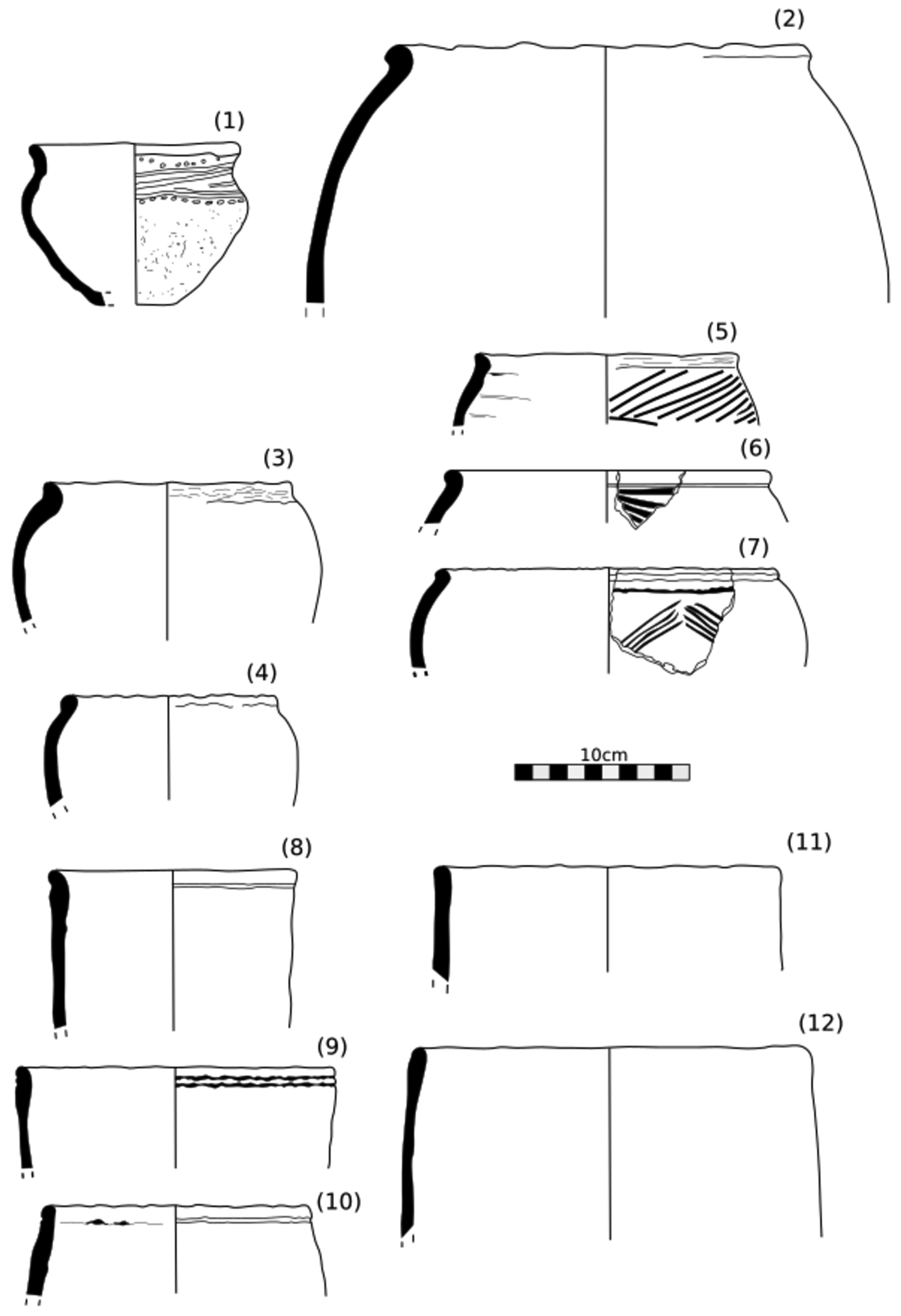
Silchester ware is directly preceded in the local context of Hampshire and Berkshire by MIA wares in very similar, flint-tempered fabrics. At Danebury, for example, such flint-tempered pottery is characteristic of the period from about 400/300 b.c. onwards (ceramic phases 6 and 7).Footnote 38 The Danebury flint-tempered wares fall into three broad vessel classes: jars and bowls with ovoid or shouldered bodies and upright or everted rims; jars and bowls with ovoid or shouldered bodies and beaded rims; and the distinctive flat-bottomed and straight-sided ‘saucepan pots’ (fig. 2). Other contemporary assemblages from the region do little to expand this limited repertoire, which seems – aside from some rare types – to incorporate the full functional range of MIA pottery types used in this area.
MIA flint-tempered ware forms: 1 everted-rim bowl; 2–7 bead-rim jars and bowls; 8–12 saucepan pots (no. 1 after Rees Reference Rees, Fasham and Keevill1995, fig. 25 no. 47; nos 2–12 by the author). (no. 1 © Trust for Wessex Archaeology)

The distribution of flint-tempered wares has a stark northern boundary, running through the area of the Hampshire Downs. While flint-tempered pottery of the kind described is known in Berkshire, it is far less common than in Hampshire, where assemblages such as those from WinkleburyFootnote 39, Brighton Hill SouthFootnote 40 and Winnall DownFootnote 41 (as well as that from Danebury) are dominated by flint-tempered fabrics at this time. Sandy wares in near identical vessel forms are relative minorities on Hampshire sites, whereas the reverse is true for Berkshire, where these fabrics predominate. The distinction of the calcareous geology of Hampshire, contrasted against the clay geology of Berkshire, may go part way to an explanation. However, differences in rim forms between vessels in the two fabrics (a preference for everted rims in sandy fabrics, versus beaded rims in flint-tempered fabrics) suggests that geological determinism was not the sole factor defining the technological choices made in fabric preparation.
TECHNIQUES: RAW MATERIALS, PROCESSING AND TEMPERING
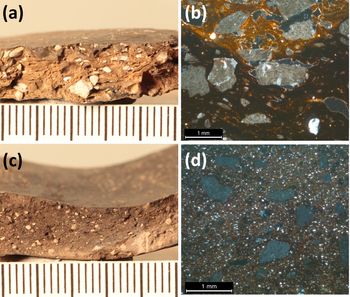
Petrographic analysis has permitted the identification of two fabrics among the MIA samples (fig. 3). The first (fabric F1a) is largely devoid of aplastic inclusions aside from the ubiquitous calcined flint temper, present as coarse angular grains throughout. Its clay matrix also shows a distinctively fine-grained appearance which other contemporary ceramics rarely exhibit. The second fabric (F1b) is very similar, being distinguished only by a minor fraction of fine quartz silt, certainly natural to the clay. While the distinction between the two fabrics may be significant of distinct clay sources, in the absence of any firm grounds for geological distinction, any difference in clay source must be assumed to be minor, and it is possible that both fabrics derived from the same source in geological terms. Crucial in this regard is a lack of calcareous matter in any of the samples; this is unusual given the association between the distribution of flint-tempered fabrics and Hampshire's chalk geology. This, in conjunction with the fine-grained nature of the ceramic, suggests the clay-with-flints as the most likely geological origin for these fabrics, being itself a fine-grained clay with a history of association with later, non-calcareous strata, rather than with the chalk which it overlies.Footnote 42
MIA flint-tempered/Silchester ware fabrics: F1a in (a) hand-specimen and (b) photomicrograph; F1b in (a) hand-specimen and (b) photomicrograph.

The vast majority of the observed flint inclusions are calcined, rendering them bright white in the hand-specimen and similar shades when viewed in thin section under reflected light. This signifies that these inclusions were a deliberate addition to the clay in order to prepare it for potting, rather than an incidental opening material that was found in the raw clay. Any flint (or other inclusions down to a very fine-size grade, for that matter) will have had to have been filtered out by processes such as sieving or levigation in order to render the clay as inclusion-free as it is found in the ceramics. The calcined flint will then had to have been crushed and (re?)incorporated into the clay, as well as being thoroughly mixed in order to ensure even distribution of the inclusions. This all implies a relatively complex process of refinement followed by several stages of raw material preparation and combination.
TECHNIQUES: FORMING
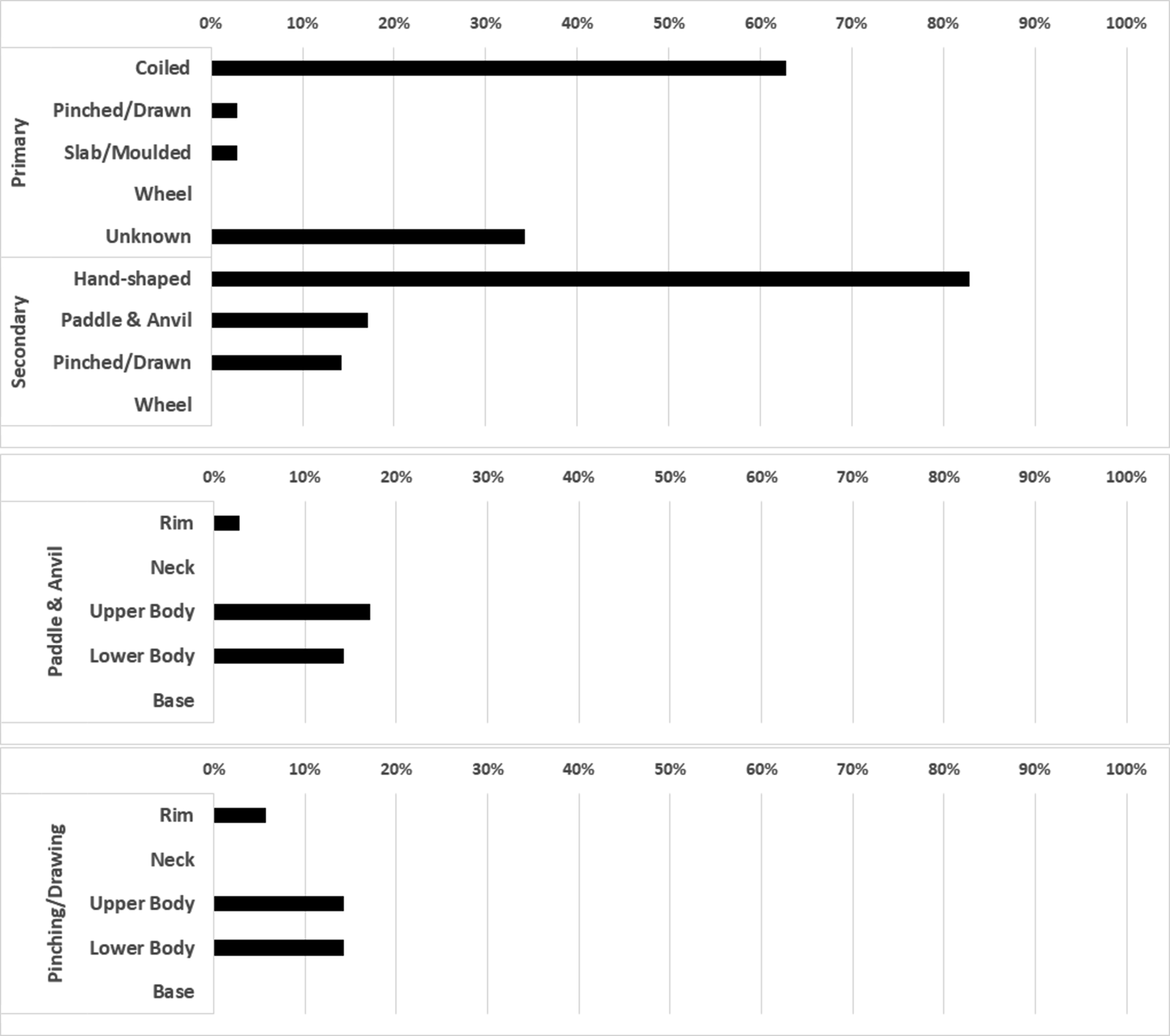
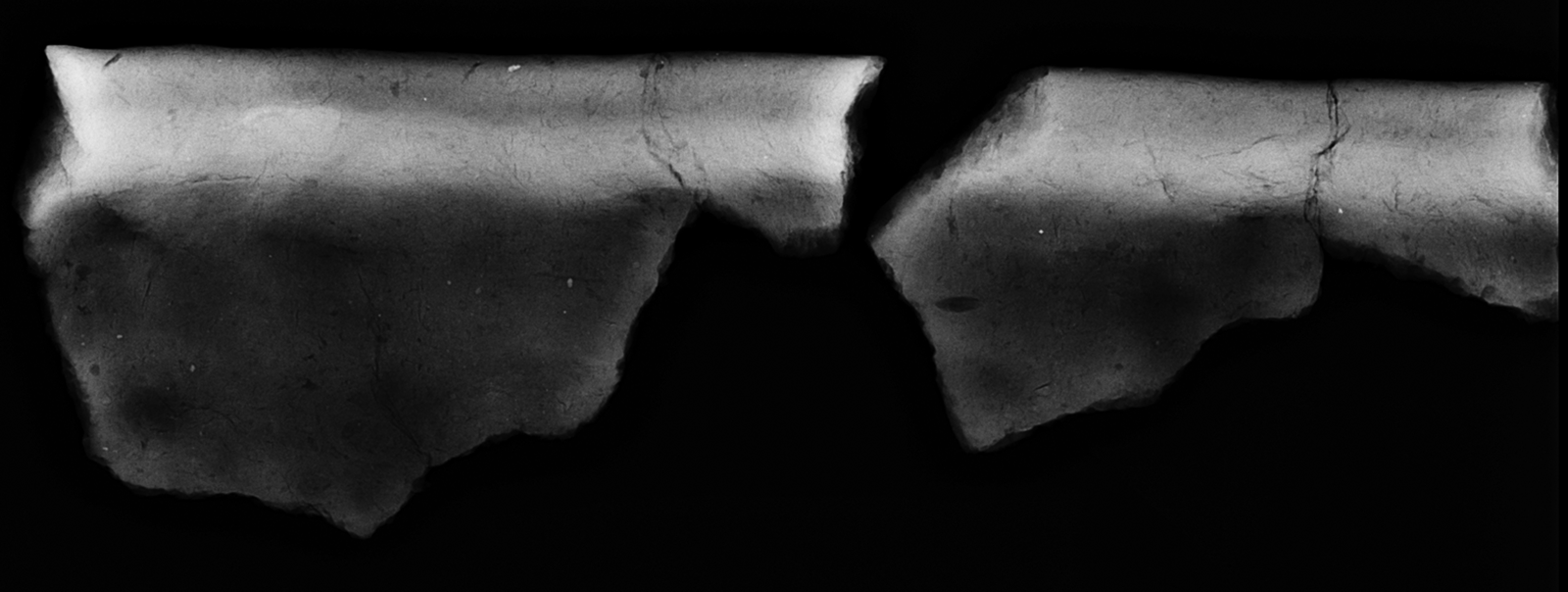
Fig. 4 presents the forming techniques identified through combined radiography and hand-specimen analysis. Statistics refer to the proportions of the total sample of MIA vessels that were found to have been produced at least in part by each technique. Coiling was identified as the predominant primary forming technique, with few other primary techniques being identified. This suggests that most – if not all – MIA vessels of this kind were initially crafted as coil-built preforms. In terms of secondary forming, though, there is more variety. Pinching/drawing and paddle-and-anvil are both represented as significant minorities of vessels (figs 5 and 6). The former technique, in particular, presents as a distinctive ‘vertical stripe’ pattern, illustrated in fig. 6, this resulting from a vertical motion applied while bonding coils and shaping the preform. Neither technique demonstrates a particular association with a given vessel type, although, based on a study of rim diameters, it appears that pinching/drawing and paddle-and-anvil were used in the production of smaller and larger vessels respectively, thus evidencing a certain form of technical specialisation.
Forming techniques identified in MIA flint-tempered ware vessels: basic occurrence of techniques as proportions of vessels in sample (top) and details of vessel parts identified as having been formed by paddle-and-anvil (middle) and pinching/drawing (bottom).

Radiograph of MIA flint-tempered ware vessel showing broad dark (thin) patches on the upper body. These are concavities in the vessel wall, probably representative of paddle strikes.

Radiograph of MIA flint-tempered ware vessel with ‘vertical stripe’ pattern of alternating thicker and thinner zones on the lower body.

A new technique that could be described as rim-folding was identified in the case of 11 vessels of saucepan-pot and beaded-rim types. The process seems to have involved thinning or drawing up a flap of clay from the top of the vessel wall, this was then folded back on itself and stuck down against one of the surfaces of the pot wall to form a rounded rim. Though not referred to in previous experimental studies, rim-folding is evidenced by the occurrence of clear seams around the rim of a pot as well as a distinctive ‘folded’ texture to the clay when viewed in the break. It appears to have been used to craft at least some examples of those rim types with characteristically rounded morphologies.
TECHNIQUES: SURFACE TREATMENT, DECORATION AND FIRING
Burnishing was applied to over half of the vessels analysed, and about half of these have both their interior and exterior (as opposed to just their exterior) surfaces burnished. Such surface treatment is likely to have assisted in waterproofing the porous earthenware, as well as making vessels easier to clean and perhaps more aesthetically pleasing. Pots of all sizes and types received burnishes, suggesting that this was not an attribute of any particular intended functional specialisation.
Decorative schemes were applied to almost half the sample, most often using a blunt tool that was perhaps similar to that used in burnishing. The designs produced are matched by those of the Cunliffe's St Catherine's Hill-Worthy Down and Southcote-Blewburton Hill styles.
Firings appear to have been predominantly reducing. While some vessels exhibit fire-clouding, the consistently dark colouration of most vessels suggests that some effort was made to achieve an even colour. Prudence RiceFootnote 43 refers to the process of ‘smudging’, whereby pots are covered in carbonaceous matter such as sawdust immediately after firing in order to achieve thoroughly blackened surfaces; a similar process may have been undertaken here.
CHARACTERISING TECHNIQUES: SILCHESTER WARE
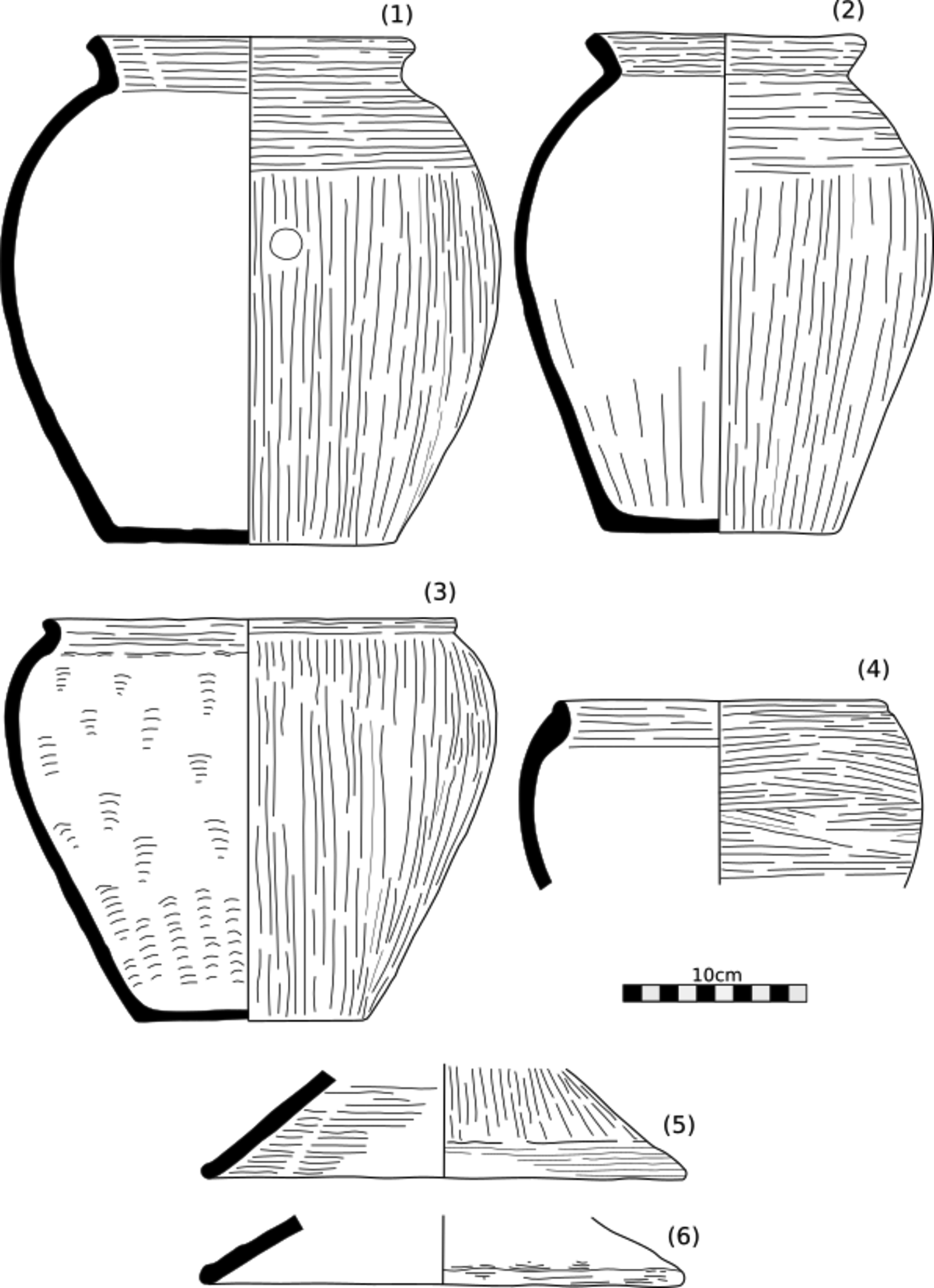
The forms of LIA/early Roman Silchester ware are almost all derived from the MIA repertoire, with seemingly no influence from the novel technological or stylistic ideas that were in circulation at this time. Typological differences are essentially limited to the cessation of production of saucepan pots and an increase in the number of everted-rim forms – principally a new type of large jar with an ovoid body and prominent everted or flared rim (henceforth referred to as type X1; fig. 7 nos 1 and 2). Lids were also added to the repertoire. Bead-rim jars remain a key component of the output throughout the lifespan of Silchester ware, and it is these that most clearly demonstrate the close lineage with the MIA flint-tempered wares.
Silchester ware vessels: 1–2 everted-rim ‘X1’ jars; 3–4 bead-rim jars; 5–6 lids (after Timby Reference Timby2000, nos 496, 497, 478, 484, 507, 508 respectively). (© The Society for the Promotion of Roman Studies)

The vessels produced in Silchester ware give the impression of being a more specialised component of the ceramic repertoire during the LIA. As the range of ceramic containers and their functional classes expanded in the first century b.c. with the introduction of late La Tène (‘Belgic type’) and Gallo-Roman types, the few vessel types in which Silchester ware is found give the impression of it being a distinct subcategory of ceramic, rather than the relatively complete service that the MIA wares encompassed. Jane Timby and Joanna Bird suggest that Silchester wares, being often large and very robust, may have been valued as storage containers or as vessels used in brewing or fermenting, but that many were also likely used/reused as cookpots on the basis of finds of carbonised residues on some jars.Footnote 44 While patterns are currently unclear, it seems fair to say that the role of Silchester ware within the LIA ceramic repertoire at large was different from, and potentially more specialised than, the role of MIA flint-tempered wares within the overall range of MIA ceramic types produced, of which they encompass a far larger proportion.
The representation of flint-tempered wares of all kinds drops off at sites throughout Hampshire and Berkshire during the first century b.c. At Winnall Down, flint-tempered wares are almost non-existent in LIA contexts.Footnote 45 At Danebury, they continue to be represented but are greatly subordinate to other wares throughout Ceramic Phases 8 and 9.Footnote 46 Similarly, in the earliest known contexts at Silchester (c. 20/10 b.c.) flint-tempered wares are only known in relatively small amounts.Footnote 47 Key exceptions are sites around modern Basingstoke, where flint-tempered pottery seems to have continuously dominated throughout the first centuries b.c. and a.d.; the best example is the quantified ceramic sequence from Brighton Hill South.Footnote 48
By the time of the Roman conquest this trend had reversed; Silchester ware became the most common ceramic type at sites ranging up from Basingstoke towards the Thames Valley near modern Reading. This sequence is evident in numerous assemblages from this area, most prominently that of Silchester itselfFootnote 49 as well those from Ufton NervetFootnote 50 and Aldermaston Wharf.Footnote 51 This popularity, coupled with the apparent reversal in fortunes experienced by the producers of Silchester ware, is perhaps the most striking attribute of this distinctly anachronistic and functionally limited artefact category.
TECHNIQUES: RAW MATERIALS, PROCESSING AND TEMPERING
At the level of petrographic analysis, the LIA ‘Silchester ware’ fabrics are indistinguishable from samples dated to the MIA. This strongly suggests continuity of raw material procurement (i.e. use of the clay-with-flints), knowledge of the distinctive method of raw material preparation identified in the MIA analysis and (likely) the location of production proximal to the clay-with-flints. The fact that the Basingstoke area – host to a number of clay-with-flints outcrops – appears to have been a ‘heartland’ for Silchester ware is good corroborating evidence for this provenance.
TECHNIQUES: FORMING (fig. 8)
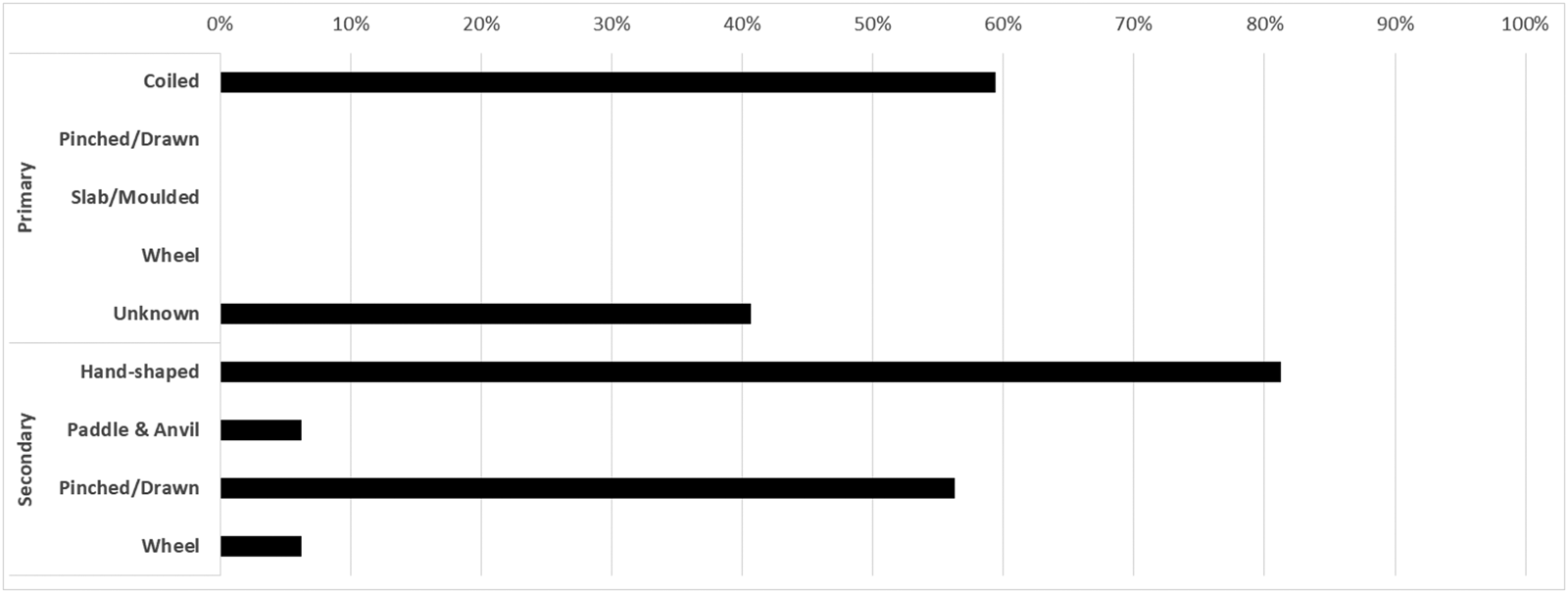
In Silchester ware, primary forming continued to be dominated by coiling. Secondary forming was, other than the broad catch-all ‘hand-shaped’ category, dominated by pinching/drawing of the kind found in the MIA vessels and evidenced by the ‘vertical stripe’ pattern visible in radiograph. Unlike in the MIA, there is no clear association between this technique and any given size category of vessel, although a variant of a pinching technique appears to have been used to craft the majority of the vessel necks that were analysed. This likely represents the repurposing of an existing technique for the production of a vessel class (constricted-neck and everted-rim jars) that was becoming a more significant part of the output of the industry. By contrast, paddle-and-anvil has been identified only twice, this seeming to be related to the upsurge in use of techniques based around pinching/drawing.
Forming techniques identified in Silchester ware vessels.

Rim-folding was also subject to a change in the mode of its use. In Silchester ware production this technique is associated with everted rims as well as with the sorts of beaded rims it was used to craft in the MIA. Again, this suggests a pre-existing technique, repurposed to make a new vessel type.
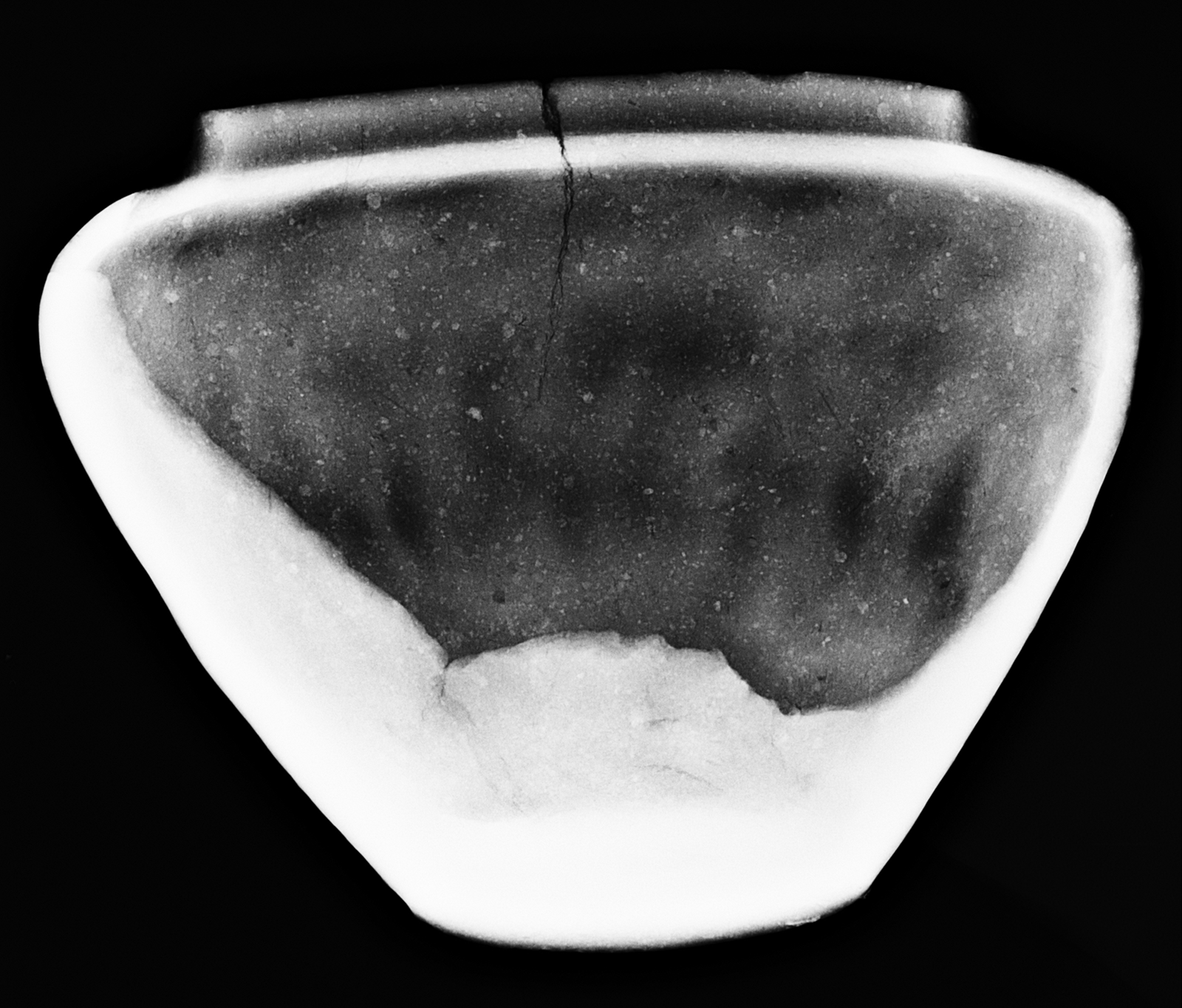
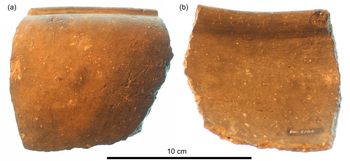
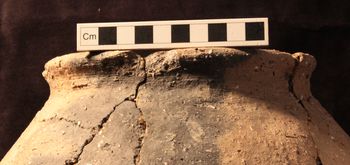
Importantly, two vessels among the Silchester ware sample show evidence for the use of a wheel. One, a Thompson C1-1 bead-rim jar, appears to have been competently shaped with the aid of a turntable or wheel (fig. 9). The other is an X1 jar, which exhibits broad horizontal striations around the rim that are strongly suggestive of the finishing of this area of the pot using a coarse cloth while the vessel was turning (fig. 10). Such an operation may only have required the vessel to have been turned while resting on a mat rather than on any more complex apparatus. This, along with the suggestion of the use of a cloth in manipulating the coarse, gritty clay body as it turned, is highly significant (see below).
Silchester ware vessel 1/BHS-043, a C1-1 bead-rim jar. The vessel has a thin, smooth body and evenly crafted rim, strongly suggesting that the vessel was made using a wheel by a very competent potter. (a) Exterior view; (b) interior view.

Detail view of Silchester ware vessel 1/SIX-015, an X1 jar. Note striations around the exterior of the rim, suggesting that this part of the vessel was finished while it was under the influence of rotary motion.

TECHNIQUES: SURFACE TREATMENT, DECORATION AND FIRING
Similar modes of surface treatment are found on Silchester ware as in the MIA – around half of the vessels were burnished and there is again no suggestion (in the form of association with particular vessel sizes and/or types) of any intended functional specialisation to this. Decoration is, however, rare on Silchester ware, contrasting with the high incidence of decorated pottery in the MIA. Only simple techniques and motifs, such as individual burnished lines and rows of finger impressions, are to be found on Silchester ware. Additionally, while firing continued to be predominantly reducing, the consistent blackening that characterises MIA pottery is rarer. Silchester ware vessels are typically fired to mottled greys, blacks and browns, suggesting that any procedures used in the MIA to create consistently blackened surfaces had been abandoned by the LIA. Decreasing frequencies of consistent firing colours and complex decoration suggest that by the LIA technical emphasis had shifted away from the decorative, aesthetic qualities of flint-tempered pottery towards simply creating a set of utilitarian ‘ceramic tools’. In this context, burnishing is likely to have continued as an all-purpose response to the need to waterproof better at least a proportion of Silchester ware vessels.
CHARACTERISING TECHNOLOGICAL CHANGE
The case of Silchester ware illustrates clearly the problems inherent with judging artefact types as representative of either continuity or change. The technological analysis presented here highlights the complexity of continuity/change when considering the production of artefacts across broad spans of time. While clay preparation techniques and certain vessel designs are clearly echoed from one period to the other, and the majority of forming techniques are of kinds known from the MIA, there is nevertheless evidence that these techniques were employed in different ways and combinations during the LIA, and that this was probably related to the changes in vessel types being produced. The same may be said of surface treatment, decoration and firing, which while conducted using similar techniques in both periods, become generally less common and/or elaborate going into the first century a.d., seeming to suggest a changing role for the pottery as well as for the material/aesthetic outcomes of certain techniques.
SOCIALISING THE POTTER
Having established the development of the techniques involved in the production of Silchester ware and contextualised this in terms of the function and distribution of the pottery, the wider context within which production was situated stands to be examined. Underlying this analysis is the assertion that technological change and social change are intertwined in terms of implicating the expressions of internalised logics specific to the context of production in each instance. Essentially, the experiences of potters will have been bound up with the wider social, economic, material and political worlds they inhabited, these factors influencing their decision-making processes when learning and undertaking craft activities. By analysing these decisions and if/how they changed through time we may reveal hitherto unappreciated aspects of how people experienced turbulent periods of change.
Potters were likely pivotal members of MIA societies. Regardless of whether they were operating on a specialised, semi-professional basis or at the level of purely household production, the potters who made flint-tempered wares in MIA Berkshire and Hampshire produced more or less the full range of domestic ceramics. These ceramics will have been fundamental parts of the material culture deployed on a day-to-day basis within the home. Vessels in other materials are likely to have been largely peripheral to everyday household use: Paola Pugsley,Footnote 52 for example, is pessimistic regarding the potential centrality of wooden vessels in households earlier than the medieval period; while vessels in metal, shale and other materials are sufficiently rare that we should regard these as only very occasionally used for purposes of food and drink preparation/storage/service. Potters, regardless of whether they were members of the households in which their products were used, were therefore directly implicated in the everyday fulfilment of some very basic human needs: those of hunger and thirst. They were also crucially involved in the creation of the material worlds inhabited by the population at large, in particular, of forms of material culture very commonly encountered in everyday life. The importance of potters in MIA societies is therefore difficult to overestimate. From the viewpoint of the potter, the techniques they used to create pottery will have been fundamental in establishing and maintaining their role within society. The evidence also suggests that these techniques played a part in the construction of the localised and communal forms of person- and group-hood that appear to have been so important to the ways in which MIA societies were constituted (see above, regarding the notional ‘boundary’ between assemblages dominated by sandy- and flint-tempered wares).Footnote 53
Going into the LIA, the centrality of flint-tempered pottery was evidently challenged. This type of ceramic disappeared entirely from some localities and persisted in greatly reduced quantities in others. Only in the area immediately around modern Basingstoke is there evidence to indicate that such wares maintained their centrality to daily practices. While of course having implications for pottery consumption, such upheaval will have also been significant to the roles of producers, who will no doubt have found their positions within their communities challenged by changes in pottery supply and specifically by new technologies such as the potter's wheel. Social and political changes were probably playing out alongside this. In the Basingstoke area, the once-focal hillfort at WinkleburyFootnote 54 went out of use sometime during the first century b.c., with the oppidum at Silchester being established by the end of the century some distance away and thus not necessarily easily accessible to groups living in the hinterland of the hillfort. At the same time, some sectors of society – particularly those living in the south-eastern counties – appear to have developed a version of social relations that privileged the role of the individual to a greater extent than previously, and this signifies fundamental changes in the ways in which people interacted with one another.Footnote 55 At least some elements of the communities living in Berkshire/northern Hampshire evidently shared some ties with these ‘individualising’ groups, and may have considered themselves a part of them: wheel-made late La Tène pottery, Aylesford-Swarling-type cremationsFootnote 56, continental imports and the layout of the Silchester oppidum are all elements that can be paralleled further east. There is also the potential for actual demographic change to have been a feature of these changes in social behaviour. The idea has long been mooted that Silchester was founded by Gaulish immigrants,Footnote 57 and thus the introduction of certain novelties such as those described above (including the potter's wheel and the ‘Belgic’ ceramic styleFootnote 58) may be attributable to a Gaulish presence of one form or another. If this was the case, then the threat to indigenous potters’ traditional crafts will not only have come from abstractly changing ‘traditions’ and economic factors, but also from a newly settled (if only seasonally presentFootnote 59) subset of the population. While of course unverifiable, association with Gaulish settlers/colonists/traders may have been part of the way in which certain indigenous groups perceived the potter's wheel and other novelties, making interpersonal tensions a distinct possibility in the context of a perceived threat to traditional ways. Silchester ware may have been a reflection of these tensions.
In sum, this all signifies change in terms of the ways in which communities constituted themselves and interacted with one another, and indeed where the focus of communal activity was situated geographically. Actual formal political change was very conceivably a component of this shift, as may have been a change in the value structures associated with certain forms of communal interaction. Establishment of a ‘foreign’ settlement (Calleva) may have only exacerbated the difficulties being faced by local communities, either as an actual contributing factor to socio-economic change or perhaps only as a matter of indigenous communities’ perceptions of such change. Within these dynamics it is easy to perceive the communities living in the Basingstoke area – where apart from the cessation of activity at the Winklebury hillfort there is little evidence for change – as being somewhat marginalised. In terms of the roles of potters, the first century b.c. is likely to have seen a key focus of activity move from within the local community to a newly established site elsewhere, the inhabitants of which were – initially, at least – mostly uninterested in the kinds of pottery that had been produced for generations. It may also have seen the rise of a new kind of pottery producer – using the wheel, more sophisticated kinds of firing apparatus and making different types of pot – who learned their skills from different sources and potentially adhered to a different kind of value structure to those localised communal mores that had been customary previously.
The technological, functional and stylistic changes that resulted in Silchester ware must therefore be seen as part of these unfolding dynamics. The evidence presented above shows that technological change was a feature of the distinction between MIA flint-tempered pottery and LIA/early Roman Silchester ware. This change did not come in the form of the widespread use of novel techniques, but in the repurposing of existing techniques and design precedents. This reformation took place in the context of an increasingly specialised ceramic ‘ecosystem’ wherein the repertoire of pottery types diversified and the technology used in pottery production became increasingly varied and complex. Similarly, an increased range of stylistic influences made themselves felt, including designs with lineages traceable back to late La Tène and Gallo-Roman vessel types, as well as designs inspired predominantly by indigenous local types (wheel-made bead-rim jars, for example). It is notable that the full range of contemporary functional types is not found in LIA/early Roman Silchester ware, as it was in flint-tempered fabrics in the MIA. Instead, flint-tempered fabrics were almost entirely used to make large, coarse jars and lids: vessel types best conceived of as a specialised component of the LIA ceramic repertoire as a whole. It is beyond the scope of this paper to discuss the economic/consumption aspects of why such a component of the ceramic repertoire became so popular, and suffice to say that by the 40s a.d. Silchester ware had established itself as a niche part of the ceramic types in use, allowing it to become an incredibly important part of the pottery in circulation in Berkshire and northern Hampshire. This was no doubt in part due to the particular qualities of the vessels being made, as well as other social and economic factors influencing consumption/use habits.
TECHNIQUES AND VALUES
The potters making Silchester ware therefore evidently changed the nature of their products to fit better a changing material-cultural setting. However, the details of the technical and design choices they made are revealing of the internal logics and priorities structuring how they regarded their craft as an element of personhood and society. Evidence for interaction of the Silchester ware potters with the new ideas embodied by the novel ceramics is evident, but very rare. Instead, the techniques and design elements in play in Silchester ware were probably almost entirely passed ‘down the line’, from generation to generation of craftsperson, substantially unchanged. These techniques were only subject to slight modification or repurposing relative to their employment in MIA wares, in order to achieve a slightly ‘tweaked’ material outcome in the form of a changed repertoire of ceramics that fitted better into LIA/early Roman consumption and use practices. The implication of this is that, rather than adopt new elements of technological and stylistic novelty that were evidently revolutionising production elsewhere in the pottery-producing community, the potters making Silchester ware preferred to continue using the techniques to which they were accustomed and that had been passed down to them through numerous generations of craftspeople. There is no better example of this than the persistent use of the distinctive clean, flint-tempered fabric, which remained largely unchanged throughout the periods in question. The continued use of crushed, calcined flint as an opening material effectively renders wheel-potting inappropriate, as the qualities of the flint – the broken grains being very sharp – make the manipulation of such fabrics at rotary speeds an undesirable prospect. As wheel-made grog-tempered pottery is commonly found alongside Silchester ware even in those assemblages from sites within the Basingstoke ‘heartland’ where flint-tempered wares never lost predominance, it was probably the case that the persistence of traditional techniques in the case of Silchester ware was the result of the active rejection of novelties such as wheel technology, rather than the lack of availability of the requisite skills to certain producers. This is also corroborated by the examples of rotary-crafted Silchester ware, one of which, indeed, evidences very competent use of wheel technology by a potter using flint-tempered clays (see below).
This technological conservatism is indeed the hallmark of Silchester ware. It is likely that this was as perceptible while the vessels were in circulation as it is to us as archaeologists. Silchester ware stands out when compared to contemporary grog-tempered or sandy wares, often being unevenly made, coarsely gritted, undecorated and of designs that were based on very different stylistic precedents. Similarly, the process of producing Silchester ware will have been both materially and performatively very different from that of producing more ‘high-tech’ contemporary ceramics. In essence, the deliberate deployment of traditional techniques and design principles in making Silchester ware represents a very different response to technological change than do the active efforts to incorporate new technologies by potters making late La Tène and Gallo-Roman-type vessels. Whereas the emphasis in the latter case is conspicuously on engagement with wider processes of increasing connectivity, curiosity around new production methods and changing forms of consumption, the technological choices made in producing Silchester ware embody concerns with the insular and the survival of traditional craft practices, and an overt contrast with more novel forms of material culture.
There may also have been an element of preservation of group-hood in the maintenance of the system of technical knowledge within which Silchester ware was made. It is worthwhile reiterating that Silchester ware is a highly localised phenomenon, being known in significant quantities only in the area of the northern Hampshire Downs and parts of southern Berkshire. Such a small-scale network for the sharing of technical knowledge stands in stark contrast to the super-regional and highly novel potting traditions that grew up in the first centuries b.c. and a.d. Use of Silchester ware will therefore have been a specifically local form of engagement with material culture, while its production may well have been significantly more localised still, potentially characterising only those potters working close to the clay-with-flints deposits argued to be the clay source. The exchange of distinctively anachronistic forms of technical know-how over the several generations during which Silchester ware was produced (a period of 80 years or more) will have helped to maintain a community of practice in the face of challenging historical processes. This will have been particularly relevant in the context of threats to general communal cohesion such as the abandonment of Winklebury and the cessation of any social functions that this hillfort served.
AGENCY AND ‘PARALLEL’ TRADITIONS
This is not, however, to say that each act of pottery production in the Silchester ware ‘tradition’ was a conscious and deliberate act of rebellion against a perceived threat of change. It is at this point in the discussion that the utility of the concept of technological choice breaks down. Systems of craft knowledge and skill are learned over extended periods and are often cognitively embedded within their practitioners in the form of motor skills. Potters therefore always approach their craft with a set of abilities, assumptions and predispositions that they will have gained when learning and honing their skills. While of course possible, it may therefore be unlikely that a potter, at each instance of making a pot, will have regarded all the elements of the chaîne opératoire as open to question or outside influence. Indeed, the fact that we are now left with pottery assemblages that coalesce into coherent categories of object, such as ‘Silchester ware’, ‘Belgic wares’ or ‘saucepan pottery’, suggests that this statement is true to a large degree. The alternative would be a form of creative anarchy and the infinite frustration of typology.
Instead, design theory potentially offers a better model with which to consider the development of what can be argued to be parallel traditions. Under this reading, technological trajectories unfold through time as a result of interaction between producers, existing forms of material culture, techniques and materials, combined with occasional exposure to novel influences within these domains, and the incremental accumulation of innovations as a result of human agency and decision-making. As such, Silchester ware is perhaps best seen as a parallel development to the wheel-made, grog-tempered and sandy wares that appeared in this area in the first century b.c., and which are close relatives of the developing and expanding ‘Belgic’/‘Aylesford-Swarling’/‘Atrebatic’ complex found across much of southern Britain. The key argument of this paper is that this parallel tradition resulted from strictly localised processes of change, which prompted particular responses from potters that in turn evidence their attitudes towards novelty, the preservation of tradition and the maintenance of the social structures within which pottery played a part. Importantly, this tradition will not have manifested solely from the individual agencies of producers in each and every instance of production, but from the accumulated attitudes and technical decisions made by mounting generations of producers and heavily tempered by material and socio-economic influences.
Nevertheless, tension between individual agency and overarching structure is evident in the dataset. The two examples of the use of rotary techniques in the production of Silchester ware are both rare and heterogeneous in character. This strongly suggests that there was a small subset of individual potters with a background knowledge of the production of Silchester ware who experimented with new ideas of forming pottery using rotary motion. The simpler of the two cases is 1/SIX-015: the rim of this X1-type jar has coarse horizontal striations suggestive of the superficial shaping and smoothing of this part of the pot by holding a cloth against the clay as it turned, potentially on nothing more elaborate than a mat or rested between the potter's legs. In this case, we can envisage a potter inspired by contemporary wheel-made wares attempting to produce a vessel with a flat, even rim form, such as is commonly found on the Thompson C6-1 storage jars (the closest analogue to X1 in the late La Tène repertoire); this is a fairly clear example of novel materiality impacting upon the agency of an individual producer. The other case, 1/BHS-043, meanwhile, was extensively shaped on the wheel in a manner proposed to be similar to the method known as ‘wheel-coiling’,Footnote 60 which is known to have been popular in the production of contemporary grog-tempered wares.Footnote 61 This vessel is thus more of a ‘hybrid’: the fabric of Silchester ware coupled with the forming of a grog-tempered pot, used to make a vessel type equally associated with both categories. It is difficult to disentangle where the innovation lies in this case: the technical knowledge associated with the raw materials, their processing and combination into the vessel's distinctive fabric is as likely to have been the result of strict learned behaviour as are the hard-won skills associated with competent wheel use. Many scenarios are possible, but in all cases there is a necessity to consider this unique combination as highly creative and thus the result of individual agency within one or more systems of – ordinarily coherent and mutually exclusive – technical knowledge.
The implication of these two vessels is that individual agency was at play – and indeed is detectable – in the production of later Iron Age ceramics. Various traditions developed alongside one another as responses to the widely varying experiences of change that potters and their communities were exposed to. However, within these broader traditions individual craftspeople found themselves with differing attitudes towards novelty, with these examples evidencing how certain potters, who had evidently been educated (to a greater or lesser extent) in the material and practical background associated with Silchester ware, found themselves creatively influenced by exposure to new forms of object and/or technique. The fact that these examples are so rare is indeed as revealing as the fact of their existence. Whereas experimentation, novelty and (potentially) the exhibition of individual skill and creativity are the hallmarks of the increasingly diverse late La Tène repertoire both in terms of vessel types and production techniques, the fact that examples of innovation are so rare in Silchester ware highlights the predominant value structures (which evidently prioritised the maintenance of traditional techniques over the opportunities afforded by novelty) of the tradition that had been built up around this type of pottery.
CONCLUSIONS
This paper argues that potters were integral components of the changing societies of the first centuries b.c. and a.d. The choices made by potters during this period of upheaval are an important and highly archaeologically accessible aspect of the experience of social change during this period. Importantly, these choices are one part of the ‘everyday’ experiences of people living through this time. Whereas much past research has focused on the roles of élites (e.g. in the study of oppida or of archaeologically distinctive burial rites),Footnote 62 by focusing on potters we are more likely examining the kinds of attitudes and dispositions held by low-status members of communities, who will nevertheless have found themselves as much part of a period of change as anyone else. More specifically, in the case of Silchester ware, this paper argues that we are observing choices made in resistance to certain elements of the process of change. Potters producing Silchester ware were part of a technological system that emphasised the passing-on of traditional techniques and the shunning of more up-to-date technologies, designs and vessel types. While the extent to which individual agency is implicated in this dynamic is unclear, the only very occasional use of rotary techniques in producing Silchester ware suggests that these were the experiments of individual craftspeople – or small collectives – who had been exposed to technological novelties while being part of a larger socio-technical system with its own distinct internal logics and values. Overall, the resistance to change evident in Silchester ware appears characteristic of a group of craftspeople who were not only staunch in their rejection of those new techniques (which threatened their traditional ways of doing things and their personal roles within society), but who also desired to maintain a distinctive regional identity at a time when this cohesion was under threat. Crucially, this analysis credits these groups with an active role in their responses to the prospect of change. It is clear from the technological characterisation that the MIA flint-tempered wares and LIA Silchester ware are distinct entities, but that one developed from the other as a response to specific localised processes of change. These processes included not only the introduction of more technologically advanced competitors and economic shifts of various kinds, but also a desire on the part of craftspeople to remain economically and socially relevant. We should not shy away from the idea that this is likely to have been a very value-laden and potentially emotional process. In the context of changing social relations, the establishment of new forms of group-hood and the decline of others, and threats to traditional roles and values, we should not be surprised to encounter instances of resistance being expressed through the media of material culture. The argument here is that such resistance requires more interpretation than simple notions of ‘continuity’ or ‘conservatism’ can allow. Nor should resistance/anachronism be conceived of as the binary opposite to innovation or change. The distinction between MIA flint-tempered wares and LIA Silchester ware implies that innovation was a component of the technological trajectory in play, and that this resulted in the specialisation of the industry. Within this, potters were implicitly aware of the utility of persistently referencing the past in how they practised their craft. This served to set them apart from their contemporaries, thus establishing a form of group-hood anchored in traditional values and thereby situating their experiences within the wider landscape of later Iron Age social change.
The changes evident in the production of Silchester ware are also a cautionary tale for considering just what exactly ‘technological change’ means. On a methodological level, the data presented here demonstrate that ‘continuity’ and ‘change’ are not part of a simplistic duality when observing a given artefact type, but that by disassembling the artefacts in terms of their constituent materials and practices it is possible to perceive blended elements of the two in a highly nuanced way. The format of this blending tells much about how socio-technical systems were constituted through periods of change, and should form an important part of future investigations into how processes of technological change, and resistance to it, unfolded.
In briefly considering the wider implications of this approach, it is clear that, even if we remain confined to the arena of pottery production in this period, there is ample scope for much further study. The introduction to this paper cites East Sussex handmade grog-tempered wares and East Midlands scored ware as other examples of locally specific and conspicuous anachronism. Many other examples exist of pottery types that persisted into or throughout this period, alongside which we see the emergence of conspicuous technological advances. It is hoped that this paper serves as a catalyst for the consideration of these myriad parallel technological trajectories in new ways, in line with their local specificity and as features of wider economic and social processes.
Continuity and change were therefore tightly bound and yet highly nuanced in how they found expression in Silchester ware. Social attitudes, concerns with the maintenance of group-hood and traditional forms of craft knowledge, economic interactions, consumption habits and potentially political dynamics can all be seen to have been parts of the experiences of potters whose adherence to traditional forms of crafts allowed them to navigate this turbulent period in a way that was meaningful to them.
SUPPLEMENTARY MATERIAL
For supplementary material for this article, please visit https://doi.org/10.1017/S0068113X20000355.
The supplementary material comprises online appendix 1 (Characterising the chaînes opératoires of Silchester ware and its middle Iron Age antecedents) and online appendix 2 (Radiographic analysis).
APPENDIX 1: THIN-SECTION RECORDS
ID: LLR-04
Site: Little London Road, near Silchester. Context: (67). Published date: first century b.c./a.d. Vessel type: unknown (body sherd). Fabric: F1a. Reference: Moore Reference Moore and Preston2011.
ID: LLR-10
Site: Little London Road, near Silchester. Context: (168). Published date: first century b.c./a.d. Vessel type: unknown (body sherd). Fabric: F1a. Reference: Moore Reference Moore and Preston2011.
ID: MPP-04
Site: Marnel Park, Popley. Context: (254). Published date: first century b.c./a.d. Vessel type: unknown (body sherd). Fabric: F1a. Reference: Wright et al. Reference Wright, Powell and Barclay2009.
ID: RST-06
Site: Ructstall's Hill, Basingstoke. Context: [125](4). Published date: MIA. Vessel type: saucepan pot. Fabric: F1a. Reference: Oliver and Applin Reference Oliver and Applin1979, no. 51.
ID: RST-07
Site: Ructstall's Hill, Basingstoke. Context: [97](5). Published date: MIA. Vessel type: bead-rim jar/bowl. Fabric: F1b. Reference: Oliver and Applin Reference Oliver and Applin1979, no. 47.
ID: RST-09
Site: Ructstall's Hill, Basingstoke. Context: [83](2). Published date: MIA. Vessel type: saucepan pot. Fabric: F1a. Reference: Oliver and Applin Reference Oliver and Applin1979, no. 19.
ID: RST-10
Site: Ructstall's Hill, Basingstoke. Context: [83](2). Published date: MIA. Vessel type: bead-rim jar/bowl. Fabric: F1a. Reference: Oliver and Applin Reference Oliver and Applin1979, no. 20.
ID: SIX-05
Site: Silchester, Insula IX. Context: (12055). Published date: Claudio-Neronian. Vessel type: unknown (body sherd). Fabric: F1b. Reference: Timby and Bird Reference Timby, Bird, Fulford, Clarke, Durham and Pankhurst2018.
ID: SIX-06
Site: Silchester, Insula IX. Context: (12055). Published date: Claudio-Neronian. Vessel type: unknown (body sherd). Fabric: F1a. Reference: Timby and Bird Reference Timby, Bird, Fulford, Clarke, Durham and Pankhurst2018.
ID: SIX-07
Site: Silchester, Insula IX. Context: (12055). Published date: Claudio-Neronian. Vessel type: unknown (body sherd). Fabric: F1a. Reference: Timby and Bird Reference Timby, Bird, Fulford, Clarke, Durham and Pankhurst2018.
ID: TLB-09
Site: Temple Lane, Bisham. Context: (455). Published date: LIA/early Roman. Vessel type: unknown (body sherd). Fabric: F1a. Reference: Pine Reference Pine and Preston2013.
ID: WBC-01
Site: Winklebury Camp, Basingstoke. Context: (2522). Published date: MIA. Vessel type: unknown (body sherd). Fabric: F1a. Reference: Smith Reference Smith1977.
ID: WBC-03
Site: Winklebury Camp, Basingstoke. Context: (3048). Published date: MIA. Vessel type: unknown (body sherd). Fabric: F1a. Reference: Smith Reference Smith1977.
ID: WBC-05
Site: Winklebury Camp, Basingstoke. Context: (2794). Published date: MIA. Vessel type: unknown (body sherd). Fabric: F1a. Reference: Smith Reference Smith1977.
ID: WBC-07
Site: Winklebury Camp, Basingstoke. Context: (2730). Published date: MIA. Vessel type: unknown (body sherd). Fabric: F1a. Reference: Smith Reference Smith1977.
ACKNOWLEDGEMENTS
The research on which this paper is based was conducted as part of my PhD at the Department of Archaeology, University of Reading. Thanks go to my supervisors, Mike Fulford and Jane Timby, for their comments on this work, and also to Ann and the late Hamish Orr-Ewing, who very generously funded this research. I am grateful to my examiners, Colin Haselgrove and Duncan Garrow, for their advice and for commenting on drafts of this paper. David Allen (Hampshire County Museums Service), Angela Houghton (Reading Museum) and Emma Durham (University of Reading) all facilitated access to pottery collections. I also owe thanks to Hella Eckardt for first recommending to me the work of Weibe Bijker, which played no small part in shaping the theoretical approach taken in this paper. Finally, I thank the two anonymous reviewers for their insightful and constructive comments on a draft of this paper.