Introduction
The ageing workforce is increasingly seen as a demographic challenge to society (Aaltio et al., Reference Aaltio, Mills and Helms Mills2018). Societal policy discourse has changed from favouring early retirement to promoting later retirement (König et al., Reference König, Hess, Hofäcker, Hofäcker, Hess and König2016). From the1990s to around 2012, the employment rate for employees aged 55–64 initially returned in many Organisation for Economic Co-operation and Development (OECD) countries to the level of the early 1970s (OECD, 2017). This trend reversal is primarily explained by the fact that pension benefits have been decreasing, thereby increasing retirement age (Hofäcker and Radl, Reference Hofäcker, Radl, Hofäcker, Hess and König2016). However, since 2012 there has been little change in the retirement age in several Western countries (Denmark, the Netherlands, Sweden and the United Kingdom (UK)). A further increase in the retirement age is due to effects on the employers’ readiness to work to the statutory upper pension-age limit. In order to achieve such effects, politicians, citizens and employees have expressed expectations about organisational measures and believe that organisations have a responsibility to transform working life and construct working conditions that support an ageing workforce (Ilmarinen, Reference Ilmarinen2001; Brooke and Taylor, Reference Brooke and Taylor2005; Henkens and Leenders, Reference Henkens and Leenders2010). An employer's motives for retaining older workers beyond the default retirement age is often based on a current or predicted future involving lack of skilled labour, and a higher retirement age is seen as a way of maintaining and developing competence within the workplace and being socially responsible (Brooke and Taylor, Reference Brooke and Taylor2005).
Despite societal policies aimed at increasing the retirement age, people are still retiring before the default retirement age, defined as the age at which employers can force the employee to retire. Besides individual push and pull factors such as health, financial situations and social reasons, there are at least three possible organisational explanations behind the retirement patterns: managers prefer that ageing workers retire early, employers hid discriminatory practices behind policy and managers are reluctant to change human resource (HR) routines. As Taylor (Reference Taylor2006) noted, managers and employers often prefer the early out option, making ageing workers redundant, regardless of policy-level discourse on the importance of retaining the skills of an ageing labour force. In a comparative study of 3,638 organisations in Denmark, Germany, Italy, the Netherlands, Poland and Sweden, Van Dalen et al. (Reference Van Dalen, Henkens and Wang2014: 815) noted: ‘European employers are not yet formulating strategies that promote active aging, often still opting for the easy way out, via exit strategies’.
Loretto and White (Reference Loretto and White2006: 326) have suggested that employers may hide their negative attitudes towards older workers ‘behind apparently neutral, institutional barriers, using them as a pretext to justify their discriminatory practices’. Furthermore, first-line managers in decentralised organisations who have operational responsibilities, including short-term economic responsibilities, are reluctant to change age-management and HR routines such as internal recruitment, training and development if it requires measures and aspects that result in increased costs (Dickens, Reference Dickens1999). A similar explanation concerning the relevance of existing routines comes from experiences in the UK and Germany, indicating that ‘the scope of change in company-level practices is small’, and there is a high degree of continuity in employers’ age-management methods (Muller-Camen et al., Reference Muller-Camen, Croucher, Flynn and Schröder2011: 524).
Our intention in this study is to provide further investigation into the ways in which organisational HR routines affect retirement age. Previous studies indicate that in order to promote increased retirement age, pension reforms must be supported by more effective measures at the organisational level (Dickens, Reference Dickens1999; Loretto and White, Reference Loretto and White2006; Taylor, Reference Taylor2006; Muller-Camen et al., Reference Muller-Camen, Croucher, Flynn and Schröder2011). How HR routines applied by employers can alter opinions about appropriate retirement age has received little attention compared to research on macro-conditions and individual circumstances (Flynn, Reference Flynn2010). There are a few studies, however, on the way first-line managers apply HR routines designed by senior HR managers. Taylor and Walker (Reference Taylor and Walker1998) have proposed a framework of implementation, highlighting the vertical relationship between government policy and employers’ management of older workers, for example, focused on whether senior management is active or passive in implementing HR policies towards older workers. They also analysed the extent to which policy implementation is partial or extensive. Their approach is frequently used in studies of age management (see Flynn, Reference Flynn2010), but the integration or operative use of such HR routines horizontally (i.e. the interplay between line managers’ applications of these HR routines) has received less research attention. Of special interest here is how the HR routines applied by line managers create an integrated set of routines that may collectively prolong or preserve retirement age. We use the word ‘preserve’ advisedly, as it appeals to the sense of an unconscious process guiding actors invisibly. The purpose is to gain deeper understanding of how the embedded taken-for-granted assumptions and norms in routines and embedded relationships among routines affect retirement decisions.
We studied organisational HR routines, defined as ‘repetitive, recognisable patterns of interdependent actions, carried out by multiple actors’ (Feldman and Pentland, Reference Feldman and Pentland2003: 95), which promote or inhibit prolonged working life in an old, large, strongly institutionalised bureaucracy in the Swedish public sector. We assume that formal and informal rules – taken for granted by the actors within an organisation – are the intra-organisational institutions that express themselves in organisational structures, routines, standards and habits, and that these institutions have a normative regulatory character (Elsbach, Reference Elsbach and Baum2002). We focus particularly on internal recruitment and on promotion and staff appraisal as major HR routines that can strongly affect retirement decisions. Based on our results, we argue that taken-for-granted HR routines and mutual influence on these routines stabilise and preserve retirement rather than change the employers’ readiness to work until the statutory upper age limit.
The relevance of organisational conditions for delayed retirement
Previous researchers have proposed work-environment management and age-awareness HR routines as ways of increasing the working ability and productivity of older workers (Ilmarinen, Reference Ilmarinen2001; Brooke and Taylor, Reference Brooke and Taylor2005; Henkens and Leenders, Reference Henkens and Leenders2010). These researchers have considered two sets of factors affecting employees’ retirement decisions: (a) managers’ attitudes towards older employees and (b) HR routines.
Several studies have shown that managers’ negative managerial attitudes towards older employees create obstacles to the prolonging of working life (Ilmarinen, Reference Ilmarinen2006; Furunes et al., Reference Furunes, Mykletun and Solem2011) and may, in fact, determine whether age-management policies are even implemented (Brooke and Taylor, Reference Brooke and Taylor2005). Employers commonly believe that older workers do not like to participate in new learning experiences and that they have difficulty learning new things and accepting organisational change (Henkens, Reference Henkens2005). Managers may conclude that it is necessary to reduce the variety and complexity of tasks for employees with three to five years until their default retirement age.
Henkens (Reference Henkens2005: 363) reports that managers’ stereotypes of older workers are difficult to change; because it begins early and is unconscious, managers can be ‘trapped in the self-fulfilling prophecy of creating the circumstances under which older workers are gradually transformed into the stereotype the employer imagines them to be’. Employers who believe that older workers have too few years to provide a return on the investment of training may fall into belief-confirming behaviours (Taylor and Urwin, Reference Taylor and Urwin2001). This may be why older workers who are not offered training experiences receive smaller wage increases than their younger colleagues (Brooke, Reference Brooke2003).
The prolonging of working lives cannot be understood entirely via employer attitudes; in fact, their importance may be overestimated. According to Duncan (Reference Duncan2003), policy makers and advocates of older persons have overemphasised the discriminatory attitudes of employers in explaining older workers’ early exits and lower levels of labour-market participation, and Marshall (Reference Marshall, Schaie and Schooler1998: 200) has argued that ‘age is rarely explicitly considered by corporate management or by unions’. The belief that older employees resist innovation and change may have to do with the organisational conditions (Henkens, Reference Henkens2005) – the belief that the same training, such as computer training, should be presented in the same way regardless of the employee's age (Maurer, Reference Maurer2001), thereby confirming existing stereotypes. Biased attitudes and discriminatory HR routines that manifest ageism may be preserved by institutional habits and create reasons for early retirement (i.e. Dickens, Reference Dickens1999; Loretto and White, Reference Loretto and White2006).
As for retirement decisions being affected by HR routines, managers’ attitudes may be regarded as institutionalised habits that help to preserve retirement age and prepare employees for default-age retirement. Organisations have avoided trying to persuade employees to consider prolonging their working lives (Henkens et al., Reference Henkens, Van Solinge and Cozijnsen2009), and institutional habits have caused employers to see retirement as a private decision. Negotiating in individual cases to offer tailored solutions to older workers may be regarded as breaking the rules of organisational justice. Furthermore, as Furunes et al. (Reference Furunes, Mykletun and Solem2011) argue, operational managers often do not believe that they possess the decision latitude to retain older workers, and the business logic with decentralised business units seems to impede that attitude change.
The Truxillo et al. (Reference Truxillo, Cadiz and Hammer2015) review of various types of organisational routines suggests that some routines could impact prolonged working life: age-specific work redesign and flexible HR routines, tailored job characteristics for tasks and work environment for older workers, and changes in lifespan work–life balance issues. In addition, as Ilmarinen (Reference Ilmarinen2006) suggests, age-adjusted and flexible work could prolong working life.
Studies of age management and older workers’ retirement intentions demonstrate that workplace attitudes and managers’ routines, resources and functions form a dynamic pattern (Furunes et al., Reference Furunes, Mykletun and Solem2011). Factors that influence when employees retire are related in complex interactions – not merely in simple cause-and-effect relationships. It may be assumed that HR routines play a significant role in promoting prolonged working life, as the organisations that employ people are central to shaping retirement decisions (Ainsworth and Hardy, Reference Ainsworth and Hardy2004).
Theoretical framework: intra-organisational institutions of retirement
Based on Elsbach's (Reference Elsbach and Baum2002) theory of organisational institutions, we suggest that employers’, managers’ and employees’ perceptions of appropriate action – their choice of intra-organisational institutionalised HR routines – can affect aspects of retirement and age-management processes. These institutions govern stakeholders’ retirement plans and their strategies regarding what they influence and who they perceive as influencing retirement decisions (Thornton et al., Reference Thornton, Ocasio and Lounsbury2012).
The theoretical framework used in this study highlights intra-organisational institutions embedded in HR routines, and the impact of those routines on retirement decisions. Building on Elsbach (Reference Elsbach and Baum2002), the framework focuses on three central dimensions of routines: the embeddedness of (a) norms in routines, (b) taken-for-granted mind sets in routines, and (c) interrelated routines.
First, to emphasise the importance of norms indicating appropriate action in a workplace, it is vital to study routines and their underlying institutional conditions: what institutions, such as norms, affect the actors’ actions? Institutions can be said to conform to formal and informal rules for appropriate actor behaviour (Thornton and Ocasio, Reference Thornton and Ocasio1999). These institutions of retirement can be expressed in such legal texts as collective agreements between social partners that establish working-life exit frameworks. They can provide a company-oriented institutionalised routine or practices and routines that govern an employer's actions. Organisational actors may relate to these exogenous institutions – whether laws or recommendations or simply cultural norms – and they help actors choose how to address and process the organisational principles governed by intra-institutional arrangements (Friedland and Alford, Reference Friedland, Alford, Powell and DiMaggio1991). Processing or translation of the rules applied by these exogenous institutions is necessary, because several partially contradictory institutional frameworks govern the organisational environment. In order to choose among varying degrees of compliance to the various institutions, organisational actors must be able to interpret the consequences for the organisation (Peters, Reference Peters2005). Thus, some institutions are confirmed and others ignored (Oliver, Reference Oliver1992), and new field norms are established in organisations (Diermeier and Krehbiel, Reference Diermeier and Krehbiel2003).
The creation of specific work routines within the organisation – routines called intra-organisational institutions (Granovetter, Reference Granovetter1985; Elsbach, Reference Elsbach and Baum2002) – is a result of this process, by which several institutions need to be fused. Standards, habits and routines involve both knowledge and cognitive structures with a normative and regulative character, which becomes visible in organisational procedures (Elsbach, Reference Elsbach and Baum2002).
Second, Elsbach stresses the importance of the taken-for-grantedness of intra-organisational institutions and their impact on what is considered acceptable organisational behaviour. These institutions indicate what should be done. When rules are used over long periods, actors tend to take them for granted and forget that rules are merely created (Berger and Luckmann, Reference Berger and Luckmann1966). Taken-for-grantedness may cause co-operation difficulties when new norms are introduced and new professionals join a team. Elsbach (Reference Elsbach and Baum2002) discusses the difficulty of replacing established institutional processes given the power structures and values in institutional structures.
Third, it may be assumed that institutionalised routines create the internal decision context for each other in an enforcing interrelatedness. Feldman et al. (2016: 506) state that action in routines is situated and mutually embedded. Thus, observations of institutionalised routines need to focus on ‘tracing actions and associations between actions, emphasising the way actions constitute social order’, analysing mutual embeddedness and constructing patterns of observed situated routines.
This study focused on embeddedness of norms, embeddedness of taken-for-granted mind-sets and embedded interrelatedness among HR routines, all of which may impact on retirement decisions and should be analysed in terms of those three dimensions.
Research context: a voluntary approach to delayed retirement
A recent Swedish reform continues the tradition of voluntary retirement, with the compromise that the default retirement age changes from 67 to 68 in 2020 and to 69 in 2023. The official retirement age or current statutory benchmark age for the pension system is 65 years, meaning that social service systems and some pension benefits are oriented towards 65 years. However, a new concept has been introduced, namely the ‘target age of retirement’, which will serve as a benchmark age in the future and will be calculated in relation to the average life expectancy and is thus expected to be raised to 69 in 2023 (Halvorsen, Reference Halvorsen2019). The target age may be further changed, depending on the development of the average life expectancy. The target age indicates the necessary average retirement age to make it possible to uphold the economic levels in the pension system and indicates the necessary aspiration to get more and more employees to prolong their working life after 65 years age (Halvorsen, Reference Halvorsen2019). This means that as a first step, in 2020, the employee may ask permission to remain at work beyond the age of 68 years. In a second step, in 2023, the employee may ask permission to remain beyond the age of 69 years, but the employers may decline their requests (Lain, Reference Lain2012; OECD, 2017).
Average effective retirement age across all OECD countries from 1970 to 2015 increased slowly (OECD, 2017). The average effective age of retirement in Sweden among people aged 50–69 was 64 years in 2012, while the European Union average was 59 years. In the age group 50–64 years, Sweden had the third lowest percentage of retirees among European countries, 13.8 per cent in Sweden compared to the European Union average of 27.9 per cent (Statistics Sweden, 2014). This development is true for the UK, the Netherlands and Denmark, which have smaller increases in retirement age than the OECD countries’ average when Germany is excluded.
According to the OECD (2017: 44, table 2.1; 49), an explanation for the increased retirement age in Sweden, the UK and Germany (letting these countries represent the Western European policy context) is ‘due to the tightening of early-retirement rules’. Thus, changes in state policy regarding the pension system, which affected the lower retirement age, also affected the average effective retirement age. The difference between (a) Sweden and the UK and (b) Germany is that reforms reducing early retirement incentives were introduced later in Germany than in Sweden and the UK but led to a steep rise in their employment rates (Hess, Reference Hess, Hofäcker, Hess and König2016). Consequently, Germany came closer to Sweden and the UK by almost two years during 2000–2016 and is now ranked among the late-exit countries (König et al., Reference König, Hess, Hofäcker, Hofäcker, Hess and König2016).
Although the default retirement age in Sweden has been 67 since 2000, by 2013 the average retirement age was still 63.9 years, with more than 80 per cent of the workforce leaving by age 65 (Nilsson et al., Reference Nilsson, Östergren, Kadefors and Albin2016). The total percentage of those taking early statutory pension increased by 3 per cent between 2004 and 2011 (Nilsson et al., Reference Nilsson, Östergren, Kadefors and Albin2016). From 2013 onwards, there was little change in Sweden – with an even earlier retirement age for men during that period – an unexpected observation, not least because older workers are at least as productive as younger workers, even in skill- and speed-demanding jobs (Ilmarinen, Reference Ilmarinen2001).
Legislation regulating the upper pension age is similar; specifically, all three countries have a voluntary approach, with a default retirement age. In the UK, the State Pension age is 66. However, Flynn (Reference Flynn2010) highlight how the UKgovernment in the Employment Equality (Age) Regulations 2006 set "a 'default' retirement age of 65 years can compulsorily retire workers,and made it obligatory for employers to consider the ‘business case’ for any employees' requests to continue in work after the default age." (p. 421). In 2007, Germany introduced a gradual pension entitlement increase from age 65 to 67 (Hofäcker et al., Reference Hofäcker, Radl, Hofäcker, Hess and König2016). In these three countries and other late-exit countries, still striving for an increased average effective retirement age depends on how employers and employees act to get more employees to stay longer and at least use the opportunity to stay until the statuary upper age limit. Thus, results from a Swedish case setting, as addressed in this study, seem relevant to several late-exit OECD countries.
Methodology
The case setting
The public organisation reported in this study is the Prison and Probation Services (PPS), which is part of the Swedish legal system. Its main objective is to implement prison and probation sentences, supervise conditionally released persons, implement community service instructions and conduct pre-sentence investigations in criminal cases. Other responsibilities include remand prisons, providing transportation, increasing safety and security in society, providing secure custody and encouraging clients to live better lives after release. PPS is organised into a headquarters, six regional offices and a transport service. It has approximately 12,000 full-time employees, including prison officers, inspectors, office workers, nurses, and staff for transport, kitchen duties and cleaning – totalling over 200 job descriptions – but the majority of employees are prison officers. The number of those who work beyond the default retirement age is 602, including 219 between 65 and 67 years as permanent employed and 383 between 65 and 78 as hourly paid employees. Less than 20 per cent worked beyond the default retirement age, which is in accordance with what Nilsson et al. (Reference Nilsson, Östergren, Kadefors and Albin2016) reported as the average for the Swedish labour market.
It is possible to combine work and gradual retirement. The main reason for part-time work after age 65 is that the pension is too low for normal living.
PPS is a public organisation under heavy external institutional pressure and is replete with highly institutionalised intra-organisational routines. It also comprises performance units, in which operational managers are responsible for services and safety. PPS managers have responsibility for personnel budgets, but results are difficult to measure and are defined as soft outcomes expressed in such terms as safety, security and social responsibility in relation to clients and society. PPS is a large state authority under strong vertical HR management for policies of age-management routines to promote prolonged working life. Its first-line managers have considerable decision-making power but some productivity measurement difficulties in budgeting. Accordingly, the organisational conditions supporting vertical age management are positive in PPS. This large, old bureaucracy has been characterised by strong intra-organisational institutions since long before the notion of age management appeared on the scene. Thus, the ingredients exist in the Swedish PPS to study what promotes or inhibits prolonged working life.
Design, participants and data collection
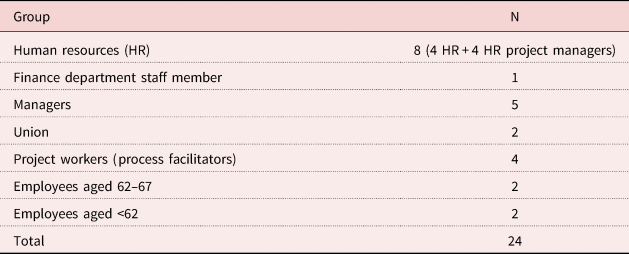
Because the goal was to gain deeper understanding of the embeddedness of taken-for-granted assumptions and norms in routines and embedded relationships among routines affecting retirement decisions, a qualitative case study design was chosen (Silverman, Reference Silverman2013; Czarniawska, Reference Czarniawska2014). The study involved 24 interviews with first- and second-line managers, HR specialists, trade union representatives (all of whom have formal responsibilities for age-management routines), and other older and younger employees at their workplaces in units from two specific regions (see Table 1).
Public organisation interviewees

Interviews were semi-structured, to capture the variety of individual experiences (Kvale, Reference Kvale2006; Silverman, Reference Silverman2013). The interview guide comprised such themes as the interviewees’ routines and views on age management and prolonged versus preserved working life. To determine questions for forthcoming interviews, notes on unclear issues were taken immediately after each interview (Czarniawska, Reference Czarniawska2014). Interviews lasted between 45 and 60 minutes and were recorded, transcribed and labelled A, B, C, etc.
Data analysis
The analysis was an iterative process of interpretation and sense-making, beginning with a transcription of the interviews. We then read and reread the transcripts, using the selected theoretical framework in our search for themes to categorise age management, particularly regarding routines. Statements in the interview transcripts were initially labelled, using patterns and connections in their descriptive content (Kvale, Reference Kvale2006; Corbin and Strauss, Reference Corbin and Strauss2008). First-order empirical categories were given labels like ‘descriptions of the routines’, ‘how the routines were understood’ and perceptions of ‘the consequences of the routines’, according to these three first-order categories.
The theoretical framework emerged from the empirical data, which guided the categorisation of second-order theoretical categories and was used to analyse and expand the main theoretical categories – specifically the embeddedness of norms and taken-for-granted mind-sets, and embedded interrelatedness among routines. The analysis section was structured according to these second-order categories. Finally, we performed an iterative analysis of the data coded into the empirical categories, producing illustrative quotations of opinions about age-management routines and routines in general (Charmaz, Reference Charmaz2006; Denzin and Lincoln, Reference Denzin and Lincoln2011).
Findings
The major HR routines impacting retirement decisions
We identified three routines that govern the actions of employers, managers and employees regarding preserved retirement or the prolonging of working life, specifically concerning development talks; salary talks and decisions; and internal recruitment, including employees’ work abilities evaluations.
For each of these routines, we considered (a) descriptions of the routines as understood by managers and employees and (b) perceptions of consequences of the routines.
Development talks
Development talks are used as an annual HR routine between managers and employees; they concern educational programmes and activities. During the formal development talks, development plans are summarised, notes taken and forms completed. Not every development talk follows a default procedure, however; the content may change depending on the employee's age. These talks were described as a routine, including five-year cycles or a five-year work perspective of employee development. Managers perceive the routine development talks as an aid in their decision-making regarding educational investments, and therefore emphasise the return on investment by calculating the employee's working lifespan. Managers may assess whether the employee constitutes an investment that would be profitable for operations or if the employee is still beneficial to the organisation. Interviewees perceived that this discussion was introduced at about age 60. Employees were critical that 60 was considered too old for training activities:
You can then feel that as you start approaching 60 or passing 60 that you are older. (Employee D)
Other interviewees were critical about how old they were before these conversations about retirement occurred in the development talks:
It's not until you're somewhere over 60 that you more definitely start talking about retirement. It should be a lot earlier. (Employee E)
Employees expressed a desire for an alternative approach to the development talk routine, adding that talks should be held much earlier in the development tracks:
If you talk about prolonging working life with your employees, you should introduce it in the development talks quite early, so that you've opened that dialogue and discussion early. Because once you get into these last years, you're pretty clear how you want it. (Manager C)
The proper, formal, procedure for the development dialogue between manager and employee before age 67 does not seem to be related to the individual's capabilities; age seems to be the only criterion:
Usually you work to 67, and then it's over. There are individuals who can imagine working longer, but it's normally not possible to do so. There should be very specific reasons to be able to extend after the age of 67. (Employee E)
The formality of the development talks near the default retirement age may result from the thinking that negative messages are easier to proffer than a positive message, because colleagues may view positive messages as favouring a certain individual instead of looking to a more urgent need to open up a job for young people. It is also a difficult question [to allow someone to stay longer]. First, if you look at the individual level. If you feel that you feel healthy and capable of working after 67, you may think that you should be given the opportunity to do so. At the same time, we have young people who should also be able to enter the labour market in a good way. (Manager D)
The formality may also result from the employer and the employee regarding retirement decisions as private matters, in which not even such trusted persons as local labour union representatives are involved:
It has happened over these years, a handful of times that I get questions from people who are [reaching] the age of retirement soon. (Employee D, who is also a local labour union representative)
Many of the interviewed described most employees retiring at 65 – or 67 at the latest.
Salary talks and decisions
Salary talks and decisions are routines that set individual salaries and manage salary spread. Both managers and employees stated that around age 60 is a critical period in salary development; others suggested that salary slowdown began around age 40 or even earlier. As one manager explained:
The problem today is that many of those we employ come in at equally high wages, or perhaps more than anyone who has worked five to ten years. (Manager B)
The idea of working against a spread in the salary range also leads to stagnated salary progress for the older employees:
One might have had a few years where one has had a good pay rise. But today, as we have an individual payroll, it requires so much more for people who have worked ten years to be able to get a good raise. You do a great job, say, and we are very happy with you, and you get 500 SEK [~€50] because you have such a high salary. (Manager A)
Employees perceive salary talks and decisions as a way of communicating negative interest in retaining older workers, thereby decreasing older workers’ motivation to make any effort on the job:
There will be no good signals. So why should I make an effort? It's enough that I do what I should do and nothing more, because I no longer get into wage development anyway. One loses this incentive with [lack of] wage development, and retaining people becomes a problem. (Employee C)
Younger employees are also critical of the managers’ way of handling salary decisions and the development of older workers:
I hear from many colleagues the employer is stupid for not increasing the final salary, because they won't have to pay for many years – just after 62 or 63. (Employee B)
As another younger employee said:
It's sad that I'm not much lower in salary than some who have been working here for 30 or 40 years. (Employee D)
This way of understanding salary talks and decisions is confirmed by managers in their description of older workers who do not benefit from salary setting and increases:
You are losing the older workers as a group in payroll talks. At these talks, you fixate on formal education, and you lose the weight of life experience. (Manager C)
Employers probably assume that older workers have fewer job prospects than younger workers do, so they can, with impunity, give younger employees larger pay increases than they give older workers. A salary structure that provides positive salary prospects for younger employees cannot be maintained, however, if they stay until retirement. Also some of the interviewees described that a consequence of salary talks is the demotivation of older workers – which runs against the idea of postponement of retirement.
Internal recruitment – including evaluation of employees’ work abilities
Internal recruitment is described as a routine by which work ability is evaluated, either by exposing the applicant to tests or real-life work situations – what is seen as an objective assessment of work ability and competence. (Do the employee's skills match recruitment criteria?) As interviewees described, information technology (IT) is moving quickly, and workers must be up to date in order to fulfil internal recruitment criteria. Managers noted that young workers are recruited for surveillance using IT and computers – a task that could be well suited to older workers who may no longer be fast enough or strong enough to intervene in operations. They also said that the test assessments provide objective feedback about older workers’ suitability for prolonged working life by comparing current skills with predefined descriptions of the job requirement. Is the employee able to continue in the current position or in another job?
Managers described the consequences of this routine as having a negative impact on prolonged working life. When older workers’ capabilities are assessed in a real-life work situation for a short period, they say, negative results have been reported. One frequently mentioned example relates to IT:
They [older workers] do not have the same computer skills at all as the young ones. In our monitoring centre, where we monitor the operations, there's a lot of work with screens and cameras and stuff. Before a recruitment process, we've tried a few times to bring in older people, but they don't do well. Instead, we have taken in younger ones. Technology is going too fast for the older workers. (Manager A)
Job demands are an obvious constant in the assessment process, leaving little room to consider how job adjustments could match the capabilities of older workers; rather, the assessment provides rationale for requiring that the worker leaves before the default retirement age. Some managers even stated that older workers who are functioning well and accomplishing what is expected of their function are still considered non-participants in development processes:
Even if older workers work well in the services, in my experience, when you are going to retire, you lose a lot of power to participate in development and change. They may not be what we want: part of a working group that drives the work forward. (Manager C)
Summary
HR routines, development talks, salary talks and internal recruitment procedures constitute the most important formalised interaction between employers and employees throughout the employees’ lifelong working life in an organisation. All these routines have features that result in mutual decisions and actions from employers and employees that lead to retirement around the age of 65. Several of the findings in this study coincide with the findings from other studies, but what is most interesting here is the consistency in the routines, consequentially leading to ‘natural’ retirement age. The consequences of routines, which seem motivated at the individual level from business logic but without intention to impact on the retirement age, result at the collective, organisational level precisely with the kind of effects as a sort of market failure (Dickens, Reference Dickens1999). For example, the early stagnating salary development (Brooke, Reference Brooke2003), the gradually declining level of in-service training (Taylor and Urwin, Reference Taylor and Urwin2001) and the difficulties in getting new internal jobs due to the job demands that cannot be adjusted to the older employees’ capabilities all form a career curve that peaks long before 65 years and aim at 65 years as retirement age (Loretto and White, Reference Loretto and White2006). The finer adjustments of the career curve take place in the development talks around 60 years, often too late for more than marginal adjustment of the retirement age. However, not even such marginal adjustments are sought after. Since the employees’ retirement plans are regarded as a private matter (Henkens et al., Reference Henkens, Van Solinge and Cozijnsen2009), the employer is careful not to ask questions about these plans in order not to be perceived as questioning the employees’ private life decisions; therefore, the employer tries not to suggest job opportunities that may require a rescheduling of the retirement period. In addition, it seems to be a delicate matter because of the need to be impartial in HR management, i.e. offering someone special arrangements due to age and especially allowing someone to work after the default retirement age.
Analysis: the role of norms and taken-for-granted mind-set embedded in routines and interrelatedness among routines
The routines described here could be interpreted as intra-organisational institutions (Elsbach, Reference Elsbach and Baum2002) that are underpinned by patterns of taken-for-granted mind-sets and norms. The routines were evident in a setting in which stereotypical conceptions of older workers and taken-for-granted assumptions implied a great deal of structuring of development pathways, salary patterns, internal recruitment and work-ability assessment criteria. Consequently, these intra-organisational institutions, the HR routines, preserve rather than prolong working life.
The managers we interviewed commonly perceived that employees will retire no later than age 65. This perception is the result of both norms and taken-for-granted assumptions – the assumption that older workers lose their drive as they approach their expected retirement age. These assumptions help to define a normative approach (or set of rules) on how to determine the educational activities and the annual salary differentiation between younger and older workers.
The analysis of the development talk routine suggests that there seems to be a taken-for-granted mind-set among the managers – that the payoff time for training and educational activities must occur before the age of 65, like in an investment calculation. Furthermore, older workers are not supposed to be interested in making an effort to be involved in such activities. The norm is that the allocation of education and training resources should provide maximum return on investment and that participation is a mutual decision between employer and employee. Consequently, if employees are a few years before the default retirement age, the employer is not eager to offer them educational and training activities or encourage them to participate. Thus, the older worker's knowledge is not up to date as age 65 approaches, thereby confirming the perception that retirement time has arrived.
Regarding the salary-setting routine, there is a taken-for-granted assumption that the organisation's best strategy is to have competitive market-adapted salaries for recruitment. Also salary setting for individual accomplishments is assumed to be the most efficient way to motivate greater employee efforts. The norm guiding this routine relates to the way wages should develop and spread throughout the workforce. The norm is that the wage spread should not be so large that it is perceived as unfair. Because intra-organisational institutions are embedded in the salary routine, younger workers’ knowledge is valued more highly than that of older workers. Older workers’ knowledge is gradually devalued more and more, and the value of their experience-based knowing steadily declines over their careers.
There are also taken-for-granted assumptions regarding performance measurement of older workers in the routine of internal recruitment. The assumption is that the most efficient approach for the organisation is to define job descriptions as objectively as possible in relation to identified job demands. The job description is regarded as the constant. The norm is that all applicants should have the same opportunity to be given the job according to the norm that the demands of the job are paramount – that the aspirant should comply with these demands and not that the job could be adjusted. The criteria for evaluation should be objective; formal credentials, such as certificates, are relevant to the job description. Consequently, the older worker's competitive advantages can be rejected because one of several qualifications is not fulfilled or is neglected because it is difficult to define and measure. To be fair, the formal correctness in internal promotion matters and reassignment matters reduces the possibility for an overall, qualitative judgement of applicant qualifications, which will probably be harmful for older workers. At a certain age, then – well before 65 years – educational and wage development and internal recruitment should stop in order to optimise the organisation's return on investment.
These three routines – development talks, salary talks and internal recruitment – follow the same planning two- to five-year cycle regarding the employees’ professional development. They are founded on the same taken-for-granted mind-set and norms regarding the older worker's decreasing capabilities and the assumption that older workers should adapt to job descriptions and the presumed age of retirement. The routines in this study were seen as neutral in relation to age when performed in standardised ways and viewed as expressions of fairness. The intra-organisational institutions were given primacy, thereby pre-structuring the individual possibilities of retirement. Thus, this study also demonstrated that HR routines are interrelated in networks embedding the same integrated intra-organisational institutions. They create a decision context for each other and reinforce each other (Feldman et al., Reference Feldman, Pentland, D'Adderio and Lazaric2016), operating in a horizontally integrated pattern of embedded interrelatedness.
Discussion and conclusions
Overall, we found that existing patterns of voluntary retirement and organisational perspectives on the conditions delaying retirement have stopped short of offering a strong understanding of the ways in which a network of managerial HR routines may contribute to the prolonging or predetermining of working life. We therefore introduced the concept of intra-organisational institutions as mechanisms embedded in managerial routines to aid in an understanding of the HR routines involved in retirement.
Our analysis highlights the ongoing routines present in institutions of retirement and the intra-organisational institutions embedded in all three HR routines. Rather than a transformation process that would prolong working life, we found that taken-for-granted assumptions and norms that are embedded in HR routines and in ongoing network dynamics between the routines serve to stabilise and preserve retirement. The HR routines preserve, in the sense that they, at early stages of working life, determine a working lifecourse ending around the time the employee turns 65 years old. Since the intra-organisational institutions are taken for granted, neither the employer nor the employees see any realistic alternative to retirement at the age of 65. The intra-organisational institutions underpinning these routines are influenced, maybe since a century ago, and are functional as long as the age of 65 years is the desired age of retirement in society. The preservation character is problematic when the external norms, in this case emanating from the policy level in the society, are changing. An understanding of intra-organisational institutions of retirement hopefully offers new ways of approaching and understanding retirement.
Theoretical implications
Previous studies on first-line managers’ decision-making about age management have highlighted the vertical aspect of their interactions with senior HR managers (Taylor and Walker, Reference Taylor and Walker1998; Loretto and White, Reference Loretto and White2006; Flynn, Reference Flynn2010). This study highlights the horizontal integration of HR routines in the interactions among first-line managers in their decision-making, by applying intra-organisational institutions. Unlike Loretto and White's (Reference Loretto and White2006) conclusion, our study indicates that this is not necessarily due to employers’ attempts to hide their true intentions behind institutional barriers, as the informal and formal rules guiding the age-management routines may rest on taken-for-granted assumptions. The mechanisms at work seem rational and appropriate: job demands must have superiority over employees’ capabilities during recruitment routines, and it is economically rational to prioritise younger employees’ salary demands over those of the older employees and appropriate to make decisions based on such neutral, objective criteria as age, rather than making individual exceptions. All these mechanisms of rational and appropriate behaviour are embedded in the main institutionalised HR routines affecting a prolonged versus a preserved working life.
It is not necessarily obvious to the actors in situ how the organisation's rational and appropriate actions contribute to a predetermination of working life in individual cases, and certainly not that it has an aggregate effect on the average retirement age of the workforce. However, our results do not preclude managers’ stereotypical opinions about older employees’ contributions to the construction of intra-organisational institutions and the continuous preservation of taken-for-grantedness in the underpinning assumptions. Altogether, we agree with other researchers that attitudes and managers’ HR routines form a dynamic pattern (Furunes et al., Reference Furunes, Mykletun and Solem2011). The HR routines are interlinked, and the decisions produced from their mechanisms create the cumulative effect of predestined working life. Our study demonstrates how taken-for-grantedness in this dynamic pattern can explain the inertia behind interlinked HR routines; the length of working life is due to the intra-organisational institutions being deemed preserved rather than prolonged.
Furthermore, our study confirms previous findings that institutionalised habits among managers are important organisational conditions in determining the actual retirement age (Henkens et al., Reference Henkens, Van Solinge and Cozijnsen2009). Nonetheless, our study demonstrates that managers do not perceive the importance of their regular annual HR routines in relation to the institution of retirement. Our conclusion contradicts that of Furunes et al. (Reference Furunes, Mykletun and Solem2011), who documented operational managers’ perceptions that they lack the decision latitude to delay retirement.
Intra-organisational institutions are central to understanding the interplay between line managers’ applications of these HR routines. Given the way line managers apply the intra-organisational institutions embedded in HR routines, they are creating horizontally integrated HR routines by pre-structuring or predestining retirement age. The vertical approach (Taylor and Walker, Reference Taylor and Walker1998) highlights how active or passive first-line managers are in the integration of centrally decided age-management aspects in their decision-making. The first-line managers are admittedly active in applying HR routines, but they are, in fact, being passive, in that the intra-organisational institutions in HR practitioners are taken for granted, are not up for discussion or reassessment, and are therefore not actively adapted to the needs or wishes of individual employees.
Practical implications
As Dickens (Reference Dickens1999) mentioned, if senior managers really intend to prolong working life, there is a market failure when age management-related decisions are decentralised to operative managers guided by business logic. The remedy would be to redesign the intra-organisational institutions that now cause market failure and to guide operating managers into age-friendly decisions to prolong working life. HR routines that redesign work age-specifically, tailored job characteristics in line with the recommendations of Truxillo et al. (Reference Truxillo, Cadiz and Hammer2015), and age-adjusted and flexible work as recommended by Ilmarinen (Reference Ilmarinen2006), would influence HR routines in prolonging working life. There is reason to be pessimistic about HR routines changing, however, given the UK and German experiences, indicating that employers are inclined to preserve old HR routines (Flynn, Reference Flynn2010; Muller-Camen et al., Reference Muller-Camen, Croucher, Flynn and Schröder2011). The incentives for top managers to change HR routines are weak.
In a regime of voluntary, ‘age-diversity’ commitments, it seems that age diversity needs to be addressed under the umbrella of corporate social responsibility, similar to natural resources. Removal of a default retirement age may have marginal effects if the employer and employees agree that the retirement age is 65, merely because it has always been so. A more forceful national strategy would institute new regulations and new exogenous institutions, move the dysfunctional intra-organisational institutions away from standardised HR routines whereby younger people's ways of learning and working are the norm, and establish age-specific and age-adaptive HR routines.
Future research
Despite the strong vertical HR control that one can expect in an organisation under strong institutional pressure against sustainable HR routines (as in the Swedish context), working life is not prolonged. The explanation provided here makes it necessary to influence the intra-organisational institutions to bring about change.
It is therefore beneficial to investigate the way managers use different routines in their daily work – HR routines that may impact retirement decisions and the significance of intra-organisational institutions in supporting both managerial routines and individuals. This type of research should be conducted in various public and private organisations, in various industries and geographical locations.
Financial support
This work was supported by the Swedish Research Council for Health, Working Life and Welfare (Forte) (dnr 2015–01006); the Forte-Centre Aging and Health: Centre for Capability in Ageing (AGECAP) (dnr 2013–2300); and the University of Gothenburg, UGOT Challenges.
Ethical review
The study reported in the paper was part of a larger research project “Organizational capability for delayed retirement” and has been approved by the Regional Ethics Review Committee in Gothenburg, Sweden. The approval decision number is Dnr 251-16, exp 2016-04-14.