Introduction
The rice leaf roller, Cnaphalocrocis medinalis (Guenée) (Lepidoptera: Crambidae), one of the most important pests of rice, is distributed widely in the humid tropical and temperate regions of Asia, Oceania and Africa between 48°N and 24°S latitude (Pathak & Khan, Reference Pathak and Khan1994; Kawazu et al., Reference Kawazu, Setokuchi, Kohno, Takahashi, Yoshiyasu and Tatsuki2001). C. medinalis has a broad host range, including rice, corn, sugarcane, wheat and sorghum, as well as some graminaceous weed species (Luo, Reference Luo2010); rice is the most preferred host plant (Yadava et al., Reference Yadava, Santaram, Israel and Kalode1972). The larvae damage the rice plant by folding leaves and scraping green leaf tissues within the fold during the tillering to heading stage, causing great yield losses by reducing photosynthetic activity (Wang et al., Reference Wang, Hu, Zhou, Cheng and Lou2011).
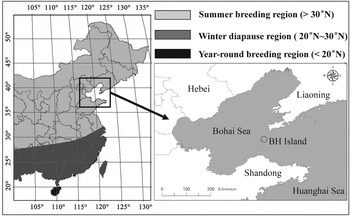
‘Migration’ is a movement which involves the temporary suppression of an animal's station-keeping responses – responses which would otherwise retain the animal within its current habitat patch – thus allowing displacements of much longer duration and typically over much greater distances than those arising from normal foraging activities (Dingle & Drake, Reference Dingle and Drake2007). Long-distance migration plays a key role in the life-history of C. medinalis by enhancing its opportunities to use favourable resources across huge areas; this, in turn, leads to severe area-wide damage to crops. In recent decades, a series of major outbreaks of C. medinalis has been reported in Asian paddy fields, and severe infestations commonly reduce yields by 30–80% (Yang et al., Reference Yang, Zhu, Diao and Zhang2004; Nathan et al., Reference Nathan, Kalaivani, Murugan and Chung2005; Nathan, Reference Nathan2006; Zhai & Cheng, Reference Zhai and Cheng2006; Padmavathi et al., Reference Padmavathi, Katti, Padmakumari, Voleti and Subba Rao2012). In China, C. medinalis has 1–11 generations from north to south each year, and the species’ range can be divided into three zones: the ‘year-round breeding region’, ‘winter diapause region’ and ‘summer breeding region’ (fig. 1) (Zhang et al., Reference Zhang, Geng and Zhou1981; Zhang & Tang, Reference Zhang and Tang1984; Luo, Reference Luo2010). Evidence from capture–mark–recapture studies and from light-traps on ships in the East China Sea suggest that C. medinalis moths make long-distance migration from the tropics towards the northeast in a series of five northward mass migrations from March to August, and possibly three southward ‘return’ migrations from September to November each year in the eastern part of China (Chang et al., Reference Chang, Lo, Keng, Li, Chen and Wu1980; Zhang et al., Reference Zhang, Geng and Zhou1981). The Chinese populations of C. medinalis are also able to migrate over water, reaching Japan every year in the East Asian rainy season (June to July) (Mochida, Reference Mochida1974; Miyahara et al., Reference Miyahara, Wada and Kobayashi1981; National Coordinated Research Team on Rice Leafroller, 1981; Oya & Hirao, Reference Oya and Hirao1982; Liu et al., Reference Liu, Liu and Zhu1983; Kisimoto, Reference Kisimoto1984; Geng et al., Reference Geng, Zhang, Zhang, Magor and Pender1990), and such movements are similar to those of the rice planthoppers, Sogatella furcifera (Horváth) and Nilaparvata lugens (Stål) (Otuka et al., Reference Otuka, Dudhia, Watanabe and Furuno2005a, Reference Otuka, Watanabe, Suzuki, Matsumura, Furuno and Chinob, Reference Otuka, Watanabe, Suzuki, Matsumura, Furuno, Chino, Kondo and Kamimuro2006, Reference Otuka, Matsumura, Watanabe and Dinh2008, Reference Otuka, Huang, Sanada-Morimura and Matsumura2012; Syobu & Otuka, Reference Syobu and Otuka2012).
Maps showing the district distribution of C. medinalis in China (left-hand map) and the position of BH Island, the searchlight trap site (right-hand map), relative to the Bohai and Huanghai (Yellow) Sea.

Previous studies on the migration of C. medinalis have been mostly carried out in tropical or subtropical rice planting regions. However, whether the migration of C. medinalis in Northern China, where they cannot overwinter (National Coordinated Research Team on Rice Leafroller, 1981; Zhang et al., Reference Zhang, Geng and Zhou1981; Riley et al., Reference Riley, Reynolds, Smith, Edwards, Zhang, Cheng, Wang, Cheng and Zhai1995; Luo, Reference Luo2010), is a regular ecological event remains unknown. Considering the poleward expansion of many insect species under current global warming scenarios (Wilson et al., Reference Wilson, Gutiérrez, Gutiérrez, Martínez, Aguado and Montserrat2005; Pöyry et al., Reference Pöyry, Luoto, Heikkinen, Kuussaari and Saarinen2009; Robertson et al., Reference Robertson, Nelson, Jelinski, Wulder and Boots2009; Pateman et al., Reference Pateman, Hill, Roy, Fox and Thomas2012), and the increasing areas of rice planting in Northeastern China (China Agricultural Yearbook Editing Committee, 2012), it is critical to enhance our understanding of the migration patterns of this species in such regions. In the present study, long-term (11 years) observations on the seasonal migration of C. medinalis over the Bohai Sea were carried out by means of searchlight trapping on a small island located in the centre of the Bohai Strait. Although it cannot illuminate the backgrounds and evolution process of the population fluctuations of C. medinalis on the mainland, this study provides direct evidence that this species regularly migrates across the sea into northeastern agricultural region of China, and to take advantage of the abundant food resources there during the summer season. These findings will improve our knowledge of the migration pattern and outbreaks of C. medinalis in Eastern Asia, and will help us develop more effective management strategies against this pest.
Materials and methods
Light-trapping and field observation
The searchlight trapping studies were carried out from 2003 to 2013 at Beihuang (BH, 38°24′N, 120°55′E), the northernmost island of Changdao county in Shandong province (fig. 1). This small (∼2.5 km2) island is located in the centre of the Bohai Strait at a distance of ∼ 40 km from the mainland to the north and ∼ 60 km to the south. A vertical-pointing searchlight trap (model DK.Z.J1000B/t, 65.2 cm in diameter, 70.6 cm in height and ∼30° in spread angle; Shanghai Yaming Lighting Co. Ltd, Shanghai, China) (Feng & Wu, Reference Feng and Wu2010) was placed on a platform ∼8 m above sea level, and used to attract and capture high-altitude migrants (up to ∼500 m above ground level) (Feng et al., Reference Feng, Wu, Wu and Wu2009). The trap was equipped with a 1000-W metal halide lamp (model JLZ1000BT; Shanghai Yaming Lighting Co. Ltd, Shanghai, China), which produces a vertical beam of light with a luminous flux of 105,000 lm, a colour temperature of 4000 K; and a colour rendering index of 65.
The searchlight trap was turned on at sunset and turned off at sunrise on all nights from April to October during 2003–2013. Incomplete data sets that resulted from power cuts or heavy rains were excluded from the analysis. Trapped insects were collected with a nylon net bag (60 mesh) beneath the trap, which was changed manually every 2 h each night. The trapped insects were kept in a freezer at −20 °C for 4 h before being identified and the female C. medinalis dissected.
There are some pine trees and graminaceous weeds on BH, but no arable lands and host crops of C. medinalis. To investigate whether any C. medinalis moths were produced on BH itself, visual observations were carried out daily to detect larvae of this species on any potential wild hosts from spring through autumn during 2003–2013.
Ovarian dissection
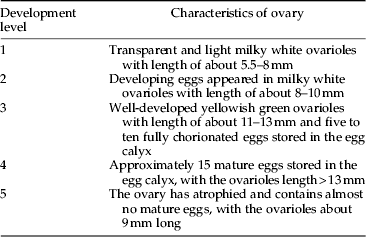
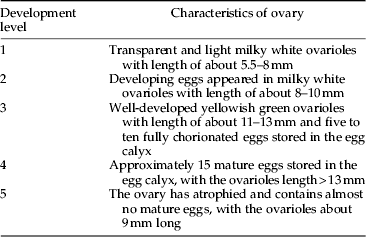
From 2010 to 2013, a subsample of 20 females (or all individuals if the total capture of females was <20) was randomly taken from adults trapped each night, and dissected under a stereomicroscope (model JNOEC-Jsz4; Motic China Group Co. Ltd, Xiamen, China). The level of ovarian development was estimated according to the criteria described in table 1 (Zhang et al., Reference Zhang, Lu and Geng1979). Females with ovarian development level 1–2 were regarded as ‘sexually immature individuals’ and others with level 3–5 were regarded as ‘sexually mature individuals’ (Zhang et al., Reference Zhang, Lu and Geng1979; Zhu et al., Reference Zhu, Gu, Yao, Zhang and Jing2009). These data were used to generate an average monthly level of ovarian development (i.e. the sum of individual levels of ovarian development divided by the number of females dissected). Mating rate and mating frequency of C. medinalis were determined by the number of spermatophores in the female spermatheca.
Criteria of ovarian development level of C. medinalis moths.
Data analysis
All data obtained from these studies are presented as means±SEM. Population size of C. medinalis captured in the searchlight trap varied in different years and months, so the inter-year and inter-month variations in the number of trapped C. medinalis, and the proportion of females, mated females and sexually mature females were analysed by two-way analysis of variance (ANOVA) with month and year as the variables (Zhao et al., Reference Zhao, Feng, Wu, Wu, Liu, Wu and McNeil2009). If the ANOVA indicated a significant difference, Tukey's Honestly Significant Difference (HSD) tests were followed to separate the means. All the proportion data were arcsine transformed before ANOVA to meet the assumptions of normality. Differences of the sex ratio (females:males) in each month were analysed by chi-squared test. All statistical analyses were carried out with SAS software (SAS Institute, 1990).
The index of occurrence (O) was calculated by the formula: O=(p/n)×100%, where p is the number of nights in which C. medinalis were trapped in a month and n is the number of nights in which all insect species were trapped in a month (Zanuncio et al., Reference Zanuncio, Mezzomo, Guedes and Oliveira1998). Occurrence status of C. medinalis captured in the searchlight trap was divided by the following criteria (Serafim et al., Reference Serafim, Lansac-Tôha, Paggi, Velho and Robertson2003): as an accidental species with O=0–25%, as an accessory species with O=25–50% and as a constant species with O=50–100%.
Results
Annual and seasonal pattern of migration
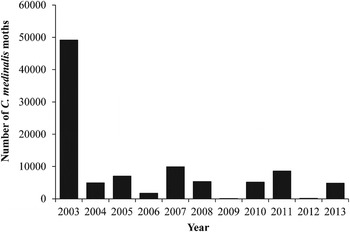
No C. medinalis larvae were found on BH by daily field investigations although some graminaceous weeds were available as potential wild hosts. However, C. medinalis were regularly captured in the searchlight trap during the period from 2003 to 2013 (fig. 2). This means C. medinalis moths migrated at least 40–60 km (and probably much greater distances) across the Bohai Strait waters. The strength of this oversea migration varied annually. Mass migrations took place in 2003, 2005, 2007 and 2011, with the annual total catches reaching 49,187, 7032, 9918 and 8560 individuals, respectively. Very weak migrations took place in 2009 and 2012, with the annual total catches falling to 72 and 133 individuals, respectively. In other years, the annual total catches of C. medinalis ranged between 1000 and 5000 individuals (fig. 2).
Annual catch of C. medinalis in the searchlight trap on BH from 2003 to 2013.

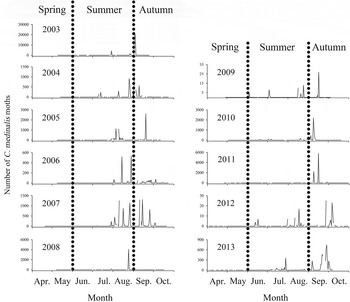
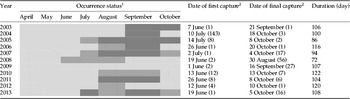
The number of C. medinalis captured in the searchlight trap varied monthly (F=2.63, df=4, P=0.048) during 2003–2013. The 53.9±9.3 and 46.1±9.3% of C. medinalis were trapped in autumn (September to October) and summer (June to August), respectively, while none were trapped in spring (April to May) (fig. 3). During 2003–2013, C. medinalis were captured frequently in the searchlight trap and considered as a constant species in September. In July, August and October, C. medinalis were captured occasionally and considered as an accessory species, while in other months this species occurred as an accidental species. The migration period of C. medinalis over the Bohai Strait during 2003–2013 ranged from 72 to 122 days, with the earliest and latest trapping on 1 June 2009 and 20 October 2006, respectively (table 2).
Nightly catch of C. medinalis in the searchlight trap on BH from April to October.

Duration and occurrence status of C. medinalis captured in the searchlight trap on BH Island from April to October during 2003–2013.

1  Occurrence index between 50 and 100%,
 occurrence index between 25 and 50%, and
 occurrence index between 0 and 25%.
2 The numbers of C. medinalis captured are given in parentheses next to name of the months.
Sex ratio, mating rate, mating frequency and ovarian development
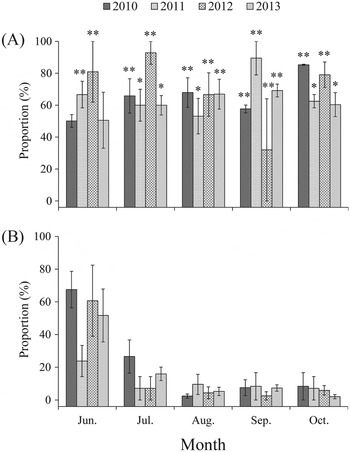
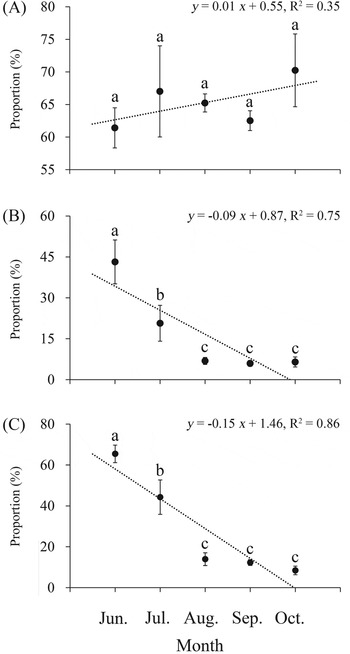
From June to October during 2010–2013, the vast majority of trapped C. medinalis were females. Chi-squared tests showed that the sex ratio (females:males) was significantly greater than 1:1 in all months, except in June 2010 (χ2=0.39; df=1; P=0.528) and June 2013 (χ2=0.89; df=1; P=0.346) (fig. 4A). There were no significant inter-month differences in the proportion of females, which ranged from 61.4±3.1% (June) to 70.2±5.6% (October) (linear model, y=0.01x +0.55, R 2=0.35, n=5, F=1.58, P=0.298) (fig. 6A). Most of the trapped females were virgins (fig. 4B), and there were significant inter-month differences in the proportion of mated females (mating rate), which ranged from 6.0±1.0% (September) to 43.2±8.0% (June) (fig. 6B). The seasonal variation in the proportion of mated females showed a weak downward trend from June to October (linear model, y=−0.09x+0.87, R 2=0.75, n=5, F=9.06, P=0.057) (fig. 6B). There was a significant difference in the mating frequency among the mated females, the vast majority (82.6±6.9%) had mated once, the 17.4±6.9% had mated twice, and no individuals mated ≥3 times.
Proportion of C. medinalis females (A) and mated females (B) captured in the searchlight trap on BH during 2010–2013. The histogram indicates mean proportion that were combined by averaging the daily proportions in each month, and the bar represents standard error between different days in that month. Single asterisk (*) or double asterisks (**) above a bar indicates the proportion of females was significantly greater than that of males in that month at the 5 or 1% level as determined by a chi-squared test.

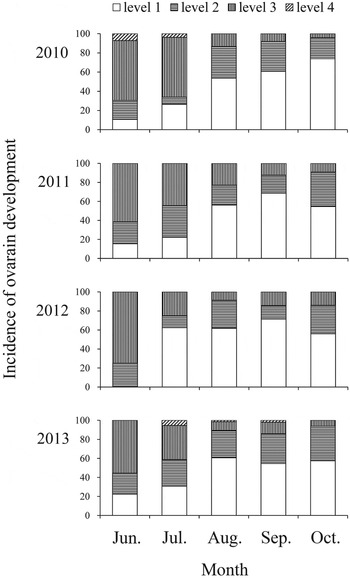
In all years, no C. medinalis females with ovarian development level 5 were found on BH (fig. 5). The vast majority of the early-summer migrants (June) had a certain degree of ovarian development, and the proportion of sexually mature females reached 65.4±4.3%, which was significantly higher (χ2=11.00; df=1; P=0.001) than the proportion of sexually immature females (figs 5 and 6C). However, there was no significant difference (χ2=2.47; df=1; P=0.116) between the proportion of sexually mature females and immature females in mid-summer migrants (July) (fig. 6C). In other months, the proportion of sexually mature females was significantly lower than that of sexually immature females (fig. 5). Overall, the seasonal variation in the proportion of sexually mature females showed a significant downward trend from June to October (linear model, y=−0.15x+1.46, R 2=0.86, n=5, F=17.81, P=0.024) (fig. 6C).
Incidence of ovarian development in C. medinalis females captured in the searchlight trap on BH during 2010–2013.

Seasonal variation of the proportion of C. medinalis females (A), mated females (B) and sexually mature females (C) captured in the searchlight trap on BH during 2010–2013. The dot indicates mean proportion that were combined by averaging the yearly numbers in each month and the bar represents standard error between different years in that month. Dots sharing the same letter mean that there were no significant inter-month differences at the 5% level by Tukey's HSD tests.

Discussion
The long-term (11 years) searchlight trapping study on BH Island provided direct evidence that both male and female C. medinalis moths regularly migrate across the sea into Northeastern China, because no host crops or larvae of this species were found on this small island. The long-range movements of C. medinalis observed in this study were similar to previous observations of other insects in the orders Lepidoptera, Odonata and Coleoptera migrating over the Bohai Sea (Feng et al., Reference Feng, Wu, Ni, Cheng and Guo2005, Reference Feng, Wu, Ni, Cheng and Guo2006, Reference Feng, Wu, Wu and Wu2009).
In June and July, C. medinalis mainly migrate from the northern part of their winter diapause region (25°N–30°N) (fig. 1) into Northern China (Zhang et al., Reference Zhang, Geng and Zhou1981). Our data clearly show that the mating rate and the index of ovarian development of C. medinalis females during this period are significantly higher than in other months. This may be due to these moths emigrating from sites far from the trapping site and therefore having several successive nights of migratory flight. It is clear from flight-mill studies (Wang et al., Reference Wang, Zhang and Zhai2010) that both male and female C. medinalis have a strong remigration capacity and more than 50% of the tested moths could fly for four to five successive nights. Active flight results in a significant increase in body temperature (Heinrich, Reference Heinrich1993) and juvenile hormone (JH) biosynthesis (Bühler et al., Reference Bühler, Lanzrein and Wille1983; Cusson et al., Reference Cusson, Mcneil and Tobe1990); for example, when C. medinalis females were transferred from 10 to 15 °C there was a significant increase in JH biosynthesis within 24 h, which significantly accelerated female's reproduction by shortened the period of first egg-laying, and increased mating rate, mating frequency and the total fecundity (Sun et al., Reference Sun, Zhang, Jiang and Luo2013). Thus, just considering these points alone it is to be expected that some degree of sexual maturation would occur within several days of initiating migration, and this onset of maturation would be advantageous for immigrant females, allowing them to mate and initiate oviposition as soon as possible after finding a suitable habitat (Wada et al., Reference Wada, Ogawa and Nakasuga1988). The relatively higher mating rate and more advanced ovarian development in this period suggests that the migratory behaviour in this species is not inhibited by the onset of ovarian development and/or mating, as might be expected from the oogenesis-flight syndrome (Kennedy, Reference Kennedy1961; Johnson, Reference Johnson1963).
However, it is clear that C. medinalis females undertaking the northward migration in August (mainly migrating from 30° to 35°N; fig. 1; Zhang et al., Reference Zhang, Geng and Zhou1981) and the return migration in early autumn (mainly migrating from 40 to 45°N; fig. 1; Zhang et al., Reference Zhang, Geng and Zhou1981) have little or no ovarian development, supporting the idea that the onset of migration is initiated mainly by sexually immature individuals. These findings are consistent with the autumn migration of C. medinalis in Eastern China studied by Riley et al. (Reference Riley, Reynolds, Smith, Edwards, Zhang, Cheng, Wang, Cheng and Zhai1995) between 1988 and 1991. In this study, more than 90% of female moths caught by hand-net near the radar site at Dongxiang county (28°N, 121°E) in Northern Jiangxi province in late October 1991, were in stage Ⅰ or early stage Ⅱ. At the same time and place, females caught by aerial netting during the actual process of high-altitude southwards migration were also immature. The sexual immaturity of the moths caught later in the season at BH may be accentuated because individuals are emigrating from sites not too far from the trapping site (Fu et al., unpublished data).
The relationship between long-duration flight and the state of oogenesis appears to be similar to that of Agrotis ipsilon (Rottemberg) (the black cutworm) in North America (Showers, Reference Showers1997). Here the northward-moving spring migrants developed reproductively, and it was suggested (Showers, Reference Showers1997) that there was no need to shut down reproductive development because the movement takes place rapidly, aided by the low-level jet stream. The southward movement in late summer and autumn is generally much slower (8–15 nights) due to the lighter winds, and in this case the moths did enter reproductive diapause. Cases such as these where there is a partial or limited suppression of reproductive development/behaviour until late in the migration period are distinct from those where the oogenesis-flight syndrome clearly does not apply, such as the tortricid Choristoneura fumiferana (Clem.) (the spruce budworm), the females of which typically lay about 50% of their eggs around their natal site, before they ascend above the forest canopy and engage in windborne migration (Greenbank et al., Reference Greenbank, Schaefer and Rainey1980; Rhainds & Kettela, Reference Rhainds and Kettela2013).
Migratory insect pests have been studied for many years because of their economic and ecological importance, and a good understanding of the migratory behaviour is essential for the development of forecasting systems and Integrated Pest Management (IPM) strategies for management of such pest species (Irwin, Reference Irwin1999; Wu & Guo, Reference Wu and Guo2005; Wu et al., Reference Wu, Price, Isenegger, Fischlin, Allgöwer and Nuesch2006). For example, real-time prediction systems have been developed for migratory rice planthoppers, S. furcifera and N. lugens, in recent years based on a comprehensive knowledge of their flight parameters (Tang et al., Reference Tang, Cheng and Norton1994; Otuka et al., Reference Otuka, Watanabe, Suzuki, Matsumura, Furuno and Chino2005b, Reference Otuka, Huang, Sanada-Morimura and Matsumura2012). The current study provides direct evidence that C. medinalis make regular long-distance migrations across the Bohai Strait, in order to exploit the abundant but transient resources that develop over vast areas of Northeast Asia during spring and summer. The fact that many of the moths were flying at high altitude before their capture, as well as other evidences (e.g. the radar studies of Riley et al., Reference Riley, Reynolds, Smith, Edwards, Zhang, Cheng, Wang, Cheng and Zhai1995) strongly suggest that the flights are windborne and occur over a broad front. Nonetheless, further studies are needed to better understand the migration trajectories and high-altitude flying characteristics of this species.
Acknowledgements
The authors thank Yongqiang Liu, Zhenlong Xing, Xiaoyang Zhao and Bingtang Xie (Institute of Plant Protection, Chinese Academy of Agricultural Sciences) and also Kai Xiong, Yu Cui, Congzheng Yuan and Shengyuan Zhao (College of Agronomy and Plant Protection, Qingdao Agricultural University) for their contributions to the field investigation. The comments of Dr V.A. Drake and two anonymous referees helped to improve the paper. Rothamsted Research is a National Institute of Bioscience strategically funded by the UK Biotechnology and Biological Sciences Research Council (BBSRC). This research was supported by Special Fund for Agro-scientific Research in the Public Interest of China (grant number 200903051) and the National Natural Science Foundation of China (grant number 31321004).