INTRODUCTION
Ecological theory predicts a trade-off between niche breadth and efficiency of resource exploitation (Futuyma and Moreno, Reference Futuyma and Moreno1988). Among parasites and other symbionts, niche breadth may be assessed as the number and relatedness of hosts utilized (i.e. host specificity), and it is a key characteristic to understand the distribution and abundance of parasites as well as their evolutionary history (Poulin, Reference Poulin2007). Unfortunately, host specificity and its determinants remain unknown for most parasites, although those measures would indicate how parasite communities and the ecological role of those are affected if hosts disappear or potential new hosts establish in an ecosystem. According to ecological theory, specialization towards the physiology and immune response of one host should involve a diminishing performance on other and more distantly related host species (Ward, Reference Ward1992; Poulin, Reference Poulin2005; Schmid-Hempel, Reference Schmid-Hempel2011; Antonovics et al. Reference Antonovics, Boots, Ebert, Koskella, Poss and Sadd2012), which has been empirically demonstrated (Ebert, Reference Ebert1998; Perlman and Jaenike, Reference Perlman and Jaenike2003; Straub et al. Reference Straub, Ives and Gratton2011) and supported by field evidence (Poulin, Reference Poulin1992).
Parasites that manipulate host behaviour to increase their transmission are common across parasite taxa and have been reported from several ecosystems (Moore, Reference Moore2002). Those manipulators that increase trophic transmission may play a disproportionate role in the structure of food webs and perpetuate energy flow to higher trophic levels by greatly increasing rates of predation on infected intermediate hosts by the definitive host (Lafferty and Morris, Reference Lafferty and Morris1996; Lafferty et al. Reference Lafferty, Dobson and Kuris2006; Lefevre et al. Reference Lefevre, Lebarbenchon, Gautier-Clerc, Misse, Poulin and Thomas2009).
The means by which parasites manipulate host behaviour to increase trophic transmission range from physiological debilitation reducing an anti-predator response to mechanisms involving the alteration of specific neuromodulatory pathways (Moore, Reference Moore2002; Lafferty and Shaw, Reference Lafferty and Shaw2013). Despite many reports of host behaviour manipulation the underlying mechanisms causing behavioural manipulation are still poorly described, and their complexity and specificity have been debated (Perrot-Minnot and Cézilly, Reference Perrot-Minnot and Cezilly2013). A recent review found that location of the parasite was a significant predictor of host- specificity among behaviour-manipulating parasites where the most specific manipulators were located on the host brain (Fredensborg, Reference Fredensborg2014). This could imply that parasite manipulators associated with the brain of their host rely on specialized mechanisms of migration and/or neuromodulation indicative of a long co-evolutionary relationship between host and parasite (Hurd, Reference Hurd1990).
Parasite migration has been studied in detail for trematode cercariae migrating to the brain and eye of fish and from arthropod intermediate hosts. In species of Diplostomum cercariae are carried by the blood stream to the brain or eye of their host (Sukhdeo and Sukhdeo, Reference Sukhdeo and Sukhdeo2004; Haas et al. Reference Haas, Wulff, Grabe, Meyer and Haeberlein2007) suggesting that little specificity may be needed to reach the general area of the central nervous system of a host. Ornithodiplostomum ptychocheilus cercariae migrate along the peripheral and central nerve cords to reach the brain of fathead minnows (Pimephales promelas) (Hendrickson, Reference Hendrickson1979; Matisz et al. Reference Matisz, Goater and Bray2010b ). In that species undeveloped metacercariae migrate between specific portions of the brain during the course of development (Matisz et al. Reference Matisz, Goater and Bray2010b ) indicative of specialized recognition of specific brain regions. Among parasites of arthropods, the lancet fluke Dicrocoelium dendriticum manipulates ant host geotaxis and biting behaviour by encysting at the sub-esophageal ganglion (SEG). The infection of this species involves presumably complex reversible migration behaviour where invading cercariae initially travel towards the head of the ant. After the successful establishment of one or two individuals at the SEG the remaining cercariae migrate back to the abdomen where they encyst as metacercariae (Schneider and Hohorst, Reference Schneider and Hohorst1971). Thus, it seems that parasite migration towards the central nervous system may rely on relatively non-specific and passive transportation by the host vascular system, but that site selectivity within the brain requires a greater degree of specialization.
Evidence to support specificity of neuromodulatory brain parasites is provided by a study on the fungal parasite Orphiocordyceps unilateralis sensu lato, which makes an ant host climb to a high position in the vegetation and bite unto a leaf preceding the release of its spores. Experimental infections of potential host species demonstrated that behavioural modification and the metabolites involved in the manipulation of biting behaviour of this species are strictly host specific (de Bekker et al. Reference de Bekker, Quevillon, Smith, Fleming, Ghosh, Patterson and Hughes2014). Other brain-inhabiting parasites where neuromodulation is involved may be infective to a large range on phylogenetically independent hosts, but behaviour manipulation is species specific (e.g. rabies, Mollentze et al. Reference Mollentze, Biek and Streicker2014) or has only been documented in a few closely related taxa (e.g. Toxoplasma gondii, Webster, Reference Webster1994, Reference Webster2001). Evidence of specialization was also found in diplostomatid trematodes where species occupying eye and brain tissue of their fish intermediate host were much more host specific than congenerics found in the eye lens (Locke et al. Reference Locke, McLaughlin and Marcogliese2010). However, the reduced host specificity of diplostomatids of the eye lens could potentially be explained by a reduced selection pressure to evolve specific mechanisms to avoid an immune response in the immunologically less active eye lens compared with other host tissues (Locke et al. Reference Locke, McLaughlin and Marcogliese2010).
Several studies challenge the idea that behavioural modification of host behaviour via neuromodulation requires a host-parasite specific mechanism because bi-directional communication between the nervous system and the immune system may provide parasites with an indirect and simpler way to alter host behaviour (the neuro-immune hypothesis) (Adamo, Reference Adamo2002; Helluy, Reference Helluy2013; Perrot-Minnot and Cezilly, Reference Perrot-Minnot and Cezilly2013).
One way to indirectly assess the specificity of the underlying mechanisms is to evaluate the level of host specificity as a proxy for parasite specialization. Thus, the number and phylogenetic relatedness of species that a parasite is able to infect and manipulate would indicate whether behaviour manipulation relies on host specific mechanisms, or if behaviour manipulation is attained by mechanisms general to a wide spectrum of phylogenetically independent host species. Tests of host specificity preferably involves controlled experimental infections where the parasite is exposed to progressively more phylogenetically distant host species (Poulin and Keeney, Reference Poulin and Keeney2008; Schmid-Hempel, Reference Schmid-Hempel2011; Desneux et al. Reference Desneux, Blahnik, Delebecque and Heimpel2012). Ideally, those should be accompanied by an assessment of parasite performance in each host measured as the abilily to successfully establish, develop to infectivity, and transmit to a new host. Unfortunately, host specificity of behaviour-manipulating parasites has only once undergone the scrutiny of experimentally testing parasite performance across host phylogeny (Moore and Gotelli, Reference Moore and Gotelli1996), and has not before been conducted on parasites of the central nervous system.
In this study we experimentally exposed a number of fish species within the Order of Cyprinodontiformes to the manipulating and brain-encysting trematode Euhaplorchis sp. A. This was used to examine if the ability to infect and manipulate host behaviour was associated with phylogenetic relatedness of the host serving as a proxy for physiological and immunological similarity.
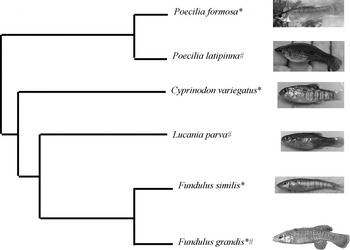
Trematodes of the genus Euhaplorchis are widespread and abundant parasites of estuarine ecosystems on the American Pacific and Gulf of Mexico coasts infecting intertidal snails of the genus Cerithidea, killifish and fish-eating birds (McNeff, Reference McNeff1978; Smith, Reference Smith2001; Shaw et al. Reference Shaw, Hechinger, Lafferty and Kuris2010; Fredensborg and Longoria, Reference Fredensborg and Longoria2012). Euhaplorchis californiensis provides one of the best described model systems for parasite increased trophic transmission, and the host use, mechanism of behaviour alteration and transmission to the definitive bird host are well studied (Lafferty and Morris, Reference Lafferty and Morris1996; Shaw et al. Reference Shaw, Korzan, Carpenter, Kuris, Lafferty, Summers and Overli2009; Shaw and Overli, Reference Shaw and Overli2012). In South Texas, Euhaplorchis sp. A, a phylogenetically close relative to E. californiensis, is a common parasite that infects plicate horn snails, Cerithidea pliculosa as first intermediate host, longnose killifish (Fundulus similis) as second intermediate host and fish-eating birds as definitive hosts. In the fish host they penetrate the skin or gills and migrate to the brain case where they encyst as metacercariae. There, Euhaplorchis sp. A changes the behaviour of its fish host by increasing the time and frequency at which the infected fish visits the water surface (Fredensborg and Longoria, Reference Fredensborg and Longoria2012). This behavioural change makes it more conspicuous to the definitive host presumably to increase the trophic transmission to the bird host similar to the well-studied, E. californiensis in Southern California estuaries (Lafferty and Morris, Reference Lafferty and Morris1996). Fundulus similis lives in the shallow sublittoral zone associated with mangrove and salt marsh habitats along the Mexican Gulf where it co-occurs with four other cyprinids that differ in their relatedness to F. similis (Fig. 1). One of those, Fundulus grandis belongs to the same genus as F. similis, one of them, Lucania parva belongs to a different genus but the same family (Fundulidae). Cyprinodon variegatus (Cyprinodontidae) forms an outgroup to the previous three species, while Poecilia latipinna, and Poecilia formosa (Poecilidae), are the most phylogenetically distantly related species to the known host that we examined (Fig. 1). This system may be suitable to test if an ecologically important behaviour-manipulating parasite successfully infects and manipulates the behaviour of species that share the same ecological niche but differ in their phylogenetic relatedness to a known suitable host.
Representation of the phylogenetic relationship among fish examined for and/or experimentally infected with Euhaplorchis sp. A. The symbol * indicates species naturally infected with Euhaplorchis sp. A, # indicates species included in the experimental infection study. The phylogeny was constructed based on Ghedotti and Davis (Reference Ghedotti and Davis2013).

First, we examined field-collected specimens for naturally-obtained infections with Euhaplorchis sp. A. Secondly, we conducted experimental infections followed by observational studies in the laboratory on three species that represent three levels of taxonomic relatedness to the known host (i.e. within Genus, within Family, and within Order) to test whether: (1) susceptibility to infection by Euhaplorchis sp. A decreased with decreasing phylogenetic relatedness from the known host, and (2) infections caused similar behavioural changes independently of phylogenetic relatedness to the known host.
We hypothesized that Euhaplorchis sp. A would only be able to infect and manipulate the behaviour of hosts most closely related to the known host (F. similis), and that more distantly related fish (e.g. from different families) would not be susceptible to Euhaplorchis infections or, if infection would take place, they would not be able to manipulate host behaviour.
MATERIALS AND METHODS
Naturally infected fish
On the 13th of June 2011, a 15 m beach seine was dragged at a depth of 0·25–0·75 m along the shoreline adjacent to a stand of black mangrove (Avicennia germinans) to collect five fish species: Longnose Killifish (F. similis), Gulf Killifish (F. grandis), Rainwater Killifish (L. parva), Amazon Molly (P. formosa) and the Sheepshead Minnow (C. variegatus) in the lower Laguna Madre at the South Padre Island Convention Centre (26°8′22·76″N, 97°10′37·30″V). The fish were placed on ice and transported to the University of Texas-Pan American where dissections were conducted to confirm the presence/absence of infection and to count the number of Euhaplorchis sp. A metacercariae lodged on the brain of each fish.
Experimental infections
Based on the naturally infected fish, a representative of the genus Fundulus (F. grandis), a representative of the genus Lucania (L. parva) (Family Fundulidae), and a representative of the Family Poecilidae (P. latipinna)(Order Cyprinidontiformes) were selected for experimental infections and behavioural observations (Fig. 1). Poecilia latipinna was collected rather than the closely related P. formosa because not enough specimens of the latter could be found at the time of collection. On the 18th of June 25 F. grandis and 29 female P. latipinna were collected with a cast net from an adjacent brackish water inlet (South Padre Island Nature and Birding Center (salinity = 4 ppt)) to obtain fish with no prior Euhaplorchis infections to be used in the experimental infections. Thirty-three L. parva were collected from a seagrass bed approximately 50 m offshore from where the first intermediate snail host is found, and where preliminary studies had found no infections with Euhaplorchis sp. A.
The collected fish were kept in 12 L buckets containing seawater from the site and provided with an aerator during transfer to the laboratory. In the laboratory, all individuals of each species were transferred to a 110 L (76 × 45 × 31 cm3) tank with seawater, an aerator, a filter, and a heater keeping the temperature at approximately 25 °C. The bottom of the tank was covered with approximately 3 cm of dark gravel and three artificial plants were placed in the substrate in the middle of the tank. Light fixtures were placed 30 cm above the tank. Fish were fed twice daily with Tetra Min® flakes released from an automatic feeder. One-third of the water was replaced once a week, and the salinity was measured with a hand-held refractometer and adjusted to field conditions (33 ppt). The salinity in the tank housing F. grandis was increased by 2 ppt every 2 days until a salinity of 33 ppt was reached to match the salinity usually experienced by the snail host and Euhaplorchis sp. Both of F. grandis and P. latipinna are euryhaline species that are found in both freshwater and hypersaline conditions, and the fish showed no signs of distress due to the gradual increment in salinity.
On the 26th of June 400 hundred plicate horn snails (C. pliculosa) were collected from nearby mud flats just south of the Port Isabel causeway on South Padre Island (26°4′46″N, 97°10′10·01″W). In the lab, the snails were placed individually in well plates with 20 mL of sea water from the site of collection. The snails were incubated at 25 °C for 4 h under a light source to stimulate cercarial shedding. Cerithidea pliculosa releasing Euhaplorchis sp. A were isolated and distributed evenly between two plastic tubs (30 × 40 cm2) which were tilted to allow one end of the tub to be inundated and the other end to be exposed to air to mimic the intertidal habitat of the snails. The snails were fed Tetra® Veggie Xtreme Algae Wafers, and water was replaced daily. Held under those conditions C. pliculosa continues to provide a steady supply of cercariae for at least 3 months (B. L. Fredensborg, personal observation).
The experimental infections started on 31st of July. During the experimental infection of each species, 30 infected snails were evenly distributed among three plastic mesh cages (7·6 × 3·8 cm2) that were pushed into the gravel for 6 h every day for 7 consecutive days. This set up allowed cercariae emerged from the snails to leave the mesh cages and seek out a fish host while standardizing the distribution of the source of infection and hindering the snails in crawling out of the water. Following the 7 days of experimental infection, the fish were left in the tanks for an additional 4 weeks to allow the newly acquired metacercariae time to mature. The same batch of infected snails was used to experimentally infect the three host species in the order L. parva, F. grandis and P. latipinna, for a total experimental period of 21 days.
One F. grandis which died 8 days after the experimental infection was dissected to confirm the successful infection by encysted but immature metacercariae lodged on the brain case of the fish.
Behavioural observations
Pre-infection behavioural observations
After an acclimitation period of 14 days the behaviour of each species was observed for a minimum of 30 min on multiple separate occasions to identify and classify behaviours which appeared to make the fish more conspicuous to an observer (and thus a bird definitive host). Surfacing, flashing, scratching, jerking, shimmying and contorting were all conspicuous and quantifiable behaviours displayed during the pre-infection observations, and those behaviours were therefore included in the subsequent behavioural assays.
Initial studies combining observations supplemented by video recordings were used to verify the feasibility of tracking individuals in a school of fish using their natural individual markings in all three species similar to a previous study on F. similis (Fredensborg and Longoria, Reference Fredensborg and Longoria2012).
Prior to experimental infection a behavioural assay was performed on all individuals of each species (described below) after which each fish was randomly assigned to a treatment group (experimental infection or control), each of which was housed in a 110 L tank as described above.
Post-infection behavioural assays
Four weeks after the experimental infection each fish of each species was observed for 15 min and a record was kept of the number of surfacing, flashing, scratching, jerking, shimmying and contorting behaviours that were exhibited. The behavioural sessions took place during a 15 min period between 1 and 5 pm with approximately six fish per session. The observer was positioned 3 m from the tank focusing on the behaviour of one fish at a time similar to (Fredensborg and Longoria, Reference Fredensborg and Longoria2012). In addition to an observer, a video camera mounted on a tripod recorded the behaviour to later verify the behaviours noted by the observer. Immediately following the observation period, the fish was transferred to a plastic container with 0·2 L of seawater and euthanized by adding CO2 to the water followed by decapitation. Each fish was subsequently measured, weighed and dissected to identify the sex and infection status and quantify metacercariae of Euhaplorchis sp. A on the brain case. Fish that were removed from the tank were not replaced and fish density therefore decreased during the course of the behavioural assays. The number of fish in the tank at the time of the behavioural assay was therefore recorded for each fish and the effect of fish density on the number of conspicuous behaviours was subsequently tested (see below). Laboratory housing and all animal handling procedures followed the National Research Council Guide for the Care and Use of Laboratory Animals and were approved by the University of Texas-Pan American Institutional Animal Use and Care Committee (#0409). The experimental infections involved a minimum number of fish to produce statistically reproducible results based on Fredensborg and Longoria (Reference Fredensborg and Longoria2012).
Statistical analyses
All data were tested for the assumptions for parametric tests, and the number of conspicuous behaviours was log-transformed to meet assumptions on homoscedasticity and normality. For each fish species the effects of fish density (the number of fish in the tank at the time of the behavioural assay) and weight on the mean number of conspicuous behaviours displayed were tested with a linear regression. For F. grandis a General Linear Model with a normal distribution was performed with the mean number of conspicuous behaviours as the dependent variable, and infection status (uninfected (control) or experimentally infected) and sex as independent variables. Since all P. latipinna were females the difference in the mean number of conspicuous behaviours for this species was compared using a Student's t-test. A correlation analysis was used to test the relationship between the number of metacercariae on the brain of infected fish and the number of conspicuous behaviours. For the correlation analyses one-tailed tests were used because the tests were directional. In all other cases two-tailed tests were applied. Parasite abundance is presented as the mean ± s.e. followed by the range. Statistical analyses were conducted using the SPSS® 17·0 software package.
RESULTS
Naturally infected fish
Fifteen F. similis, 46 C. variegatus, 44 L. parva, two P. formosa, and one F. grandis were collected and examined for metacercariae of Euhaplorchis sp. A. Of the five species examined, L. parva and C. variegatus contained no metacercariae of Euhaplorchis sp. A. The mean abundance of Euhaplorchis sp. A in the other species was: F. similis = 140·53 ± (0–512), F. grandis = 594 ± 0 and P. formosa = 56 ± 19·80 (28–84).
Experimental infections
A total of six F. grandis and two P. latipinna died during the course of the study. In experimentally infected F. grandis, the mean abundance of live Euhaplorchis sp. A metacercariae lodged on the brain case of experimentally infected F. grandis was 249·5 ± 44·0 (11–503) (n = 11), while the mean abundance of melanized metacercariae was 53·5 ± 33·1 (0–286) (n = 11). In experimentally infected P. latipinna, the mean abundance of live Euhaplorchis sp. A metacercariae was 217·7 ± 36·2 (37–683) (n = 21), while the mean abundance of melanized metacercariae was 0·7 ± 0·5 (0–10) (n = 21). None of the fish in the control groups were infected with Euhaplorchis sp. A. None of the L. parva in the experimental infection group obtained any infections of Euhaplorchis sp. A.
Behavioural observations
Surfacing, flashing, scratching, jerking, shimmying and contorting behaviours were all recorded in the behavioural observations for both F. grandis and P. latipinna. Jerking was the most commonly observed behaviour (76 and 86% of all behaviours in F. grandis and P. latipinna, respectively). Lucania parva, which did not get infected with Euhaplorchis sp. A, displayed a very low number of surfacing and scratching behaviours (mean = 1·1 ± 0·37) (n = 33) while no jerking behaviour was observed in this species.
Fundulus grandis
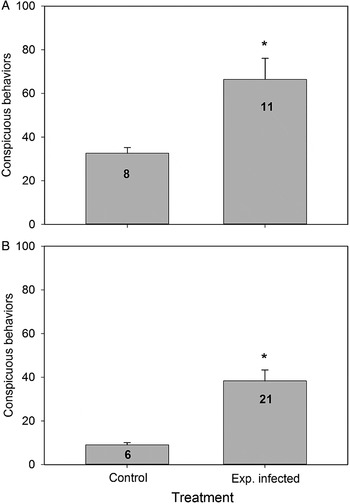
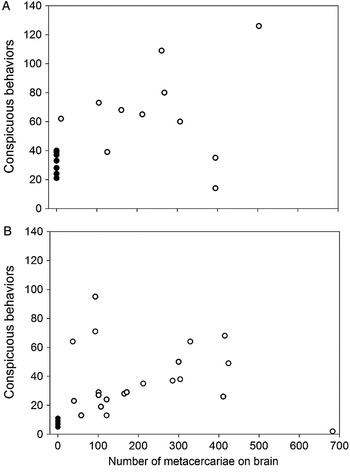
The mean number of conspicuous behaviours displayed in 15 min was significantly higher in experimentally infected individuals (n = 11) compared with the control (uninfected) fish (n = 8) (F = 6·94, d.f. = 1, P = 0·019) (Fig. 2A). Sex had no effect on the mean number of conspicuous behaviours displayed (F = 0·57, d.f. = 1, P = 0·46), and no interaction was found between infection status and sex (F = 0·05, d.f. = 1, P = 0·82). Neither weight (F = 2·05, d.f. = 1, P = 0·17, R 2 = 0·11) nor density (F = 1·26, d.f. = 1, P = 0·28, R 2 = 0·11) had any significant effect on the behaviour of the fish. Among the infected fish there was a large amount of variation in the number of conspicuous behaviours, and no significant intensity-dependent effect of infection on the number of conspicuous behaviours could be detected (Pearson's one-tailed test: r = −0·10, P = 0·39, n = 11, Fig. 3B).
Mean ± s.e. number of conspicuous behaviours that may attract the attention of a fish-eating bird after experimental infection with Euhaplorchis sp. A. The control group was housed under identical conditions to the experimental infected group, but it was not exposed to cercariae. The asterisk (*) above the bar indicates a significantly different mean value of the experimentally infected group compared with the control (P < 0·05), and the number inside each bar indicates the sample size. (A) Fundulus grandis. (B) Poecilia latipinna.

Relationship between the number of Euhaplorchis sp. A on the brain of experimentally infected fish and the number of conspicuous behaviours displayed (open circles). Control fish were included for comparison (closed circles). (A) Fundulus grandis (experimentally infected: n = 11, control: n = 8). (B) Poecilia latipinna (experimentally infected: n = 21, control: n = 6).

Poecilia latipinna
Similar to F. grandis, the total number of conspicuous behaviours displayed in 15 min was significantly higher in experimentally infected fish (n = 21) compared with the control (uninfected) group (n = 6) (t = 3·60, d.f. = 25, P = 0·001) (Fig. 2B). Neither weight (F = 0·59, d.f. = 1, R 2 = 0·02, P = 0·45) nor density (F = 0·04, d.f. = 1, R 2 = 0·002, P = 0·84) had a significant effect on the behaviour of the fish. Similar to F. grandis there was a large amount of variation among infected individuals in the number of conspicuous behaviours, and there was therefore no significant intensity-dependent effect of infection on the number of conspicuous behaviours (Pearson's one-tailed test: r = −0·328, P = 0·073, n = 21, Fig. 3B).
DISCUSSION
Despite the importance of host behaviour-manipulating parasites to animal community structure and ecosystem functioning, their host specificity is poorly understood and rarely experimentally verified. We investigated host specificity of the brain-encysting Euhaplorchis sp. A by performing experimental infections of potential host species with progressively distant phylogenetic distance to a known host. Host specificity was evaluated through parasite establishment and performance measured as the ability to change key host behaviours as a proxy for transmission success to a definitive host.
Contrary to our expectations, we did not observe a decrease in the ability of Euhaplorchis sp. A to infect and change host behaviour in hosts progressively distantly related to the known host as generally predicted for brain-encysting manipulators (Fredensborg, Reference Fredensborg2014) (Fig. 1). Rather, we observed successful infections and behaviour manipulation in representatives of the two families Fundulidae and Poecilidae, while representatives of the two sister taxa, Lucania and Cyprinodon were not infected. Our results therefore indicate that the migration of cercariae and the subsequent behavioural changes induced by Euhaplorchis sp. A relies on relatively non-specific pathways. The migration pathway for Euhaplorchis sp. A is not known, but the dissection of one F. grandis 8 days post infection showed that already then metacercariae were distributed on the dorsal side covering several brain regions similar to mature infections. Thus, our results suggest that cercariae may reach the site of encystment by use of the vascular system without subsequent migration to specific brain regions as observed in O. ptychocheilus (Matisz et al. Reference Matisz, Goater and Bray2010b ).
The close relative E. californiensis reduces the concentration of serotonin and elevates the concentration of dopamine in the brain stem of California killifish documented in both naturally and experimentally infected fish (Shaw et al. Reference Shaw, Korzan, Carpenter, Kuris, Lafferty, Summers and Overli2009; Shaw and Overli, Reference Shaw and Overli2012). Serotonin is an important neuromodulator responsible for stress responses in fish, while high dopamine concentration is often associated with increased level of locomotion and aggressive behaviour (Winberg and Nilsson, Reference Winberg and Nilsson1993). Infected killifish display more erratic behaviours and are more active during stress making them more conspicuous to avian predators (Lafferty and Morris, Reference Lafferty and Morris1996). We assume that the underlying mechanisms of behaviour manipulation of Euhaplorchis sp. A are the same as those discovered for E. californiensis because: (1) the changes in host behaviour are similar to E. californiensis (Lafferty and Morris, Reference Lafferty and Morris1996), (2) their site of infection is the same, and (3) they appear to be closely related species (Fredensborg and Longoria, Reference Fredensborg and Longoria2012) likely to have evolved similar mechanisms of host behaviour manipulation.
The lack of high host specificity of Euhaplorchis sp. A suggests that parasite-induced neuromodulation in this species may not be as specific as hypothesized, and alternative explanations should be pursued in future studies. An interesting avenue of future research on this model would be to examine possible links between the host immune response to infection and the observed behavioural changes. Cross-communication between the immune system and the nervous system is common-place (Mossner and Lesch, Reference Mossner and Lesch1998; Maier and Watkins, Reference Maier and Watkins1999) and a parasite-induced inflammatory response in the brain may represent a relatively inexpensive and non-specific means to indirectly modify host neuromodulation (Adamo, Reference Adamo2002). In another brain-encysting trematode, Microphallus papillorobustus behaviour manipulation of its gammarid host is presumably linked to changes in serotonergic activity caused by neuroinflammation (Helluy and Thomas, Reference Helluy and Thomas2003, Reference Helluy and Thomas2010; Helluy, Reference Helluy2013). The exact mechanisms involved in the modification of neuromodulators in killifish remain unknown, but an inflammatory immune response has been observed in fresh water minnows infected with a different brain-encysting trematode (Matisz et al. Reference Matisz, Goater and Bray2010a ), and fibroblast growth factors often associated with inflammation was observed in California killifish infected with E. californiensis (Shaw et al. Reference Shaw, Korzan, Carpenter, Kuris, Lafferty, Summers and Overli2009).
If the mechanisms of host behaviour manipulation are not host-parasite specific then host specificity of Euhaplorchis sp. A is likely driven by restrictions related to cercarial transmission to the potential fish host, the host immune response to infection, and the successful predation by a suitable definitive host. Lucania parva and C. variegatus showed no infections although they co-occur with the fundulids and the poeciliids. The former species was more active during the times of experimental infections (R. N. Hernandez, personal observation), and it is possible that their lack of infection could be due to behavioural resistance to infection. Cercariae generally do not rely on chemoattraction to encounter mobile hosts (Sukhdeo and Sukhdeo, Reference Sukhdeo and Sukhdeo2004), but penetration of host skin is chemically induced (Haas et al. Reference Haas, Granzer and Brockelman1990). It is possible that the correct host signal to initiate penetration was lacking or that they were killed by the host immune response prior to establishment. The fundulids and the poeciliids share morphological and ecological characteristics. They are equal in body size and their ecological niche (e.g. position in water column and diet) appears to be very similar. Our data also indicate that they share a similar set of behaviours which are modified by the presence of Euhaplorchis sp. A. It is therefore likely that the similar ecological niche of the representatives of the two families expose them to a similar suite of suitable bird definitive hosts.
Although F. grandis and P. latipinna displayed a similar infection load, infected F. grandis displayed, on average, almost twice as many conspicuous behaviours compared with P. latipinna (Fig. 2). It remains to be tested whether the difference in the frequency of conspicuous behaviours between the two hosts is reflected in the transmission rate to a suitable definitive host. That would be a necessary measure to be able to conclude if all species susceptible to Euhaplorchis sp. A infection are equally good hosts.
In conclusion, experimental infections of potential fish hosts demonstrated that the behavioral manipulation in Euhaplorchis sp. A is not specific to phylogenetically closely related taxa. Rather, we suggest that host specificity to the fish second intermediate host primarily is driven by opportunities for transmission to a suitable definitive host and thus the ecological niche of the fish host. Other host-parasite systems where host behaviour manipulation exists, and in particular brain-encysting parasites, should be tested to verify the generality of our findings.
ACKNOWLEDGEMENTS
We thank E. Quintero, H. Arredondo, A. Silva, and L. Garza for help with field collections, and the University of Texas-Pan American (UTPA) Coastal Studies Laboratory for technical assistance. All fish were collected on a scientific collection permit from the Texas Parks & Wildlife (SPR-1008-342). This is contribution #CSS 2015-01 from the Center for Subtropical Studies at UTPA.
FINANCIAL SUPPORT
This study received support from NSF Research Experience for Undergraduates (DBI-0649273 awarded to R. N. H.), NSF Luis Stokes Alliance for Minority students Program (DBI-0703584 to R. N. H.), and US Department of Defense Center for Excellence in Science, Technology, Engineering, and Mathematics (C-STEM to R. N. H.).