Introduction
Cyclic recombinase (Cre)-loxP isolated from the bacteriophage P1 is one of the well known site-specific recombination systems. loxP is 34 bp in length, which includes an 8-bp asymmetric core region enclosed by two 13-bp inverted repeat regions (Anastassiadis et al., Reference Anastassiadis, Fu, Patsch, Hu, Weidlich, Duerschke, Buchholz, Edenhofer and Stewart2009). The 38 kD Cre protein specifically recognizes loxP sites to cause excision, insertion, inversion and translocation (Branda & Dymecki, Reference Branda and Dymecki2004; Nagy, Reference Nagy2000; Nagy et al., Reference Nagy, Mar and Watts2009). Cre-loxP recombination was originally described in prokaryotes, but this system has been developed to delete loxP-flanked chromosomal DNA sequences at high efficiency in eukaryotes (Sauer, Reference Sauer1987). This system has been applied mainly in small animals such as mice (Brault et al., Reference Brault, Besson, Magnol, Duchon and Herault2007), and to date its application in large animals has been very limited.
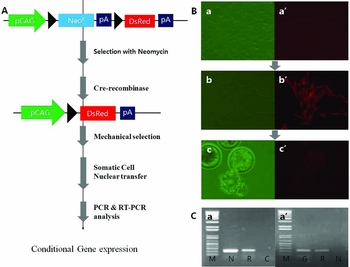
(A) Flow chart of experimental design. (B) Transfected donor fibroblasts and embryo. Cells (B-a) were selected with neomycin for around 2 weeks and did not express the red fluorescent protein (RFP) (B-a′). After transient Cre transfection (B-b), the cells expressed RFP due to deletion of the floxed neomycin-resistance gene and polyA sequences (B-b′). After mechanical selection, RFP-expressing cells (B-b′) developed into cloned blastocysts (B-c) and expressed RFP (B-c′). (C) Polymerase chain reaction (PCR), reverse transcription (RT)-PCR analysis. Gene insertion into cells and deletion in a blastocyst were confirmed by PCR (C-a) and RT-PCR (C-a′), respectively. M, DNA ladder; N, neomycin resistance gene (235 bp); R, DsRed (250 bp); G, glutaraldehyde phosphate 3-dehydrogenase (GAPDH) (252 bp); C, control. (See online for a colour version of this figure.)

Pigs are popular as human disease model animals because humans and pigs have many genetic similarities (Li et al., Reference Li, Pang, Chen, Wang, Nie, Yan and Ouyang2009) and their organ sizes are similar to that of humans. This factor, and the fewer ethical considerations related to organ extraction, make this approach the best animal option for xeno-transplantation (Ahn et al., Reference Ahn, Kim, Lee, Kang, Lee and Hwang2004). Removal or insertion of specific genes is required to alleviate immunological reaction and to establish xeno-transplantation. However, the process of removal or insertion of some genes may cause early embryonic lethality (Li et al., Reference Li, Pang, Chen, Wang, Nie, Yan and Ouyang2009). The application of Cre-loxP recombination to these early embryonic lethal genes enables the production of live offspring (Li et al., Reference Li, Pang, Chen, Wang, Nie, Yan and Ouyang2009). Furthermore, Cre-loxP recombination enables verification of specific gene functions. The aim of this study was to determine if the Cre-loxP system is applicable in porcine fibroblasts and if sequentially transfected cells can be used as donor cells for somatic cell nuclear transfer (SCNT).
Materials and methods
Cell culture, transfection and selection
Fetal fibroblasts from a miniature pig were used for transfection and as donor cells. The DNA, floxed neomycin-resistance gene that included a red fluorescent protein (RFP) plasmid system, designated pCALNL-DsRed (from Addgene, http://www.addgene.org), was transfected into the fibroblasts with Fugene HD (Roche, Germany). One day before transfection, the fibroblasts were plated at a density of 5 × 10⁴ cells/ml in a 35-mm culture dish and cultured overnight to achieve 50–70% confluency. Two days after transfection 750 μg/ml neomycin (G418, Invitrogen, USA) was added, transfected cells were then cultured for about 2 weeks to isolate stable cell lines. Further transfection with transient Cre was performed in order to remove floxed genes by Cre recombination. Following Cre expression, RFP-expressing cells were isolated mechanically and cultured for use in SCNT.
Somatic cell nuclear transfer (SCNT)
RFP-expressing cells were subjected to SCNT, which was carried out in accordance with the protocol established previously in our laboratory (Koo et al., Reference Koo, Jang, Kwon, Kang, Kwon, Park, Kang and Lee2008). In brief, in vitro matured (IVM) pig oocytes were enucleated using an aspiration pipette, then microinjected with a transfected donor cell, fused by electrical stimulation and activated. The activated embryos that resulted were cultured for 7 days. Cleavage and blastocyst stages were observed on days 2 and 7 after culture, respectively. Deletion of the neomycin-resistance gene was confirmed in cloned blastocysts by reverse transcription polymerase chain reaction (RT-PCR).
Results and Discussion
Colonized pCALNL-DsRed cells were observed after 2 weeks of neomycin selection, and the cells were then cultured further. RFP could not be seen (Fig. 1) in these cells under ultraviolet light exposure. However, RFP was detected under ultraviolet light after transfection with the transiently expressed Cre gene (Fig. 1). Out of a total of 121 SCNT embryos (SCNT Replication number; 4) that had RFP-expressing cells, 76 embryos (62.8%) were observed to have cleaved and six (5.0%) had developed to the blastocyst stage. Developed blastocysts were confirmed to express RFP by fluorescence microscopy (Fig. 1). In addition, excision of the neomycin-resistance gene in genomic DNA of cloned blastocysts was confirmed by RT-PCR (Fig. 1).
In this experiment we found that, following insertion and excision of the floxed target gene, donor fibroblasts were reprogrammed in enucleated oocytes and developed into pre-implantation stage embryos. The need to employ two sequential transfection steps for gene insertion and then excision, made it more difficult for the donor fibroblasts to produce the embryonic cell numbers and, therefore, the number of resulting SCNT blastocysts was lower compared with our previous studies (Koo et al., Reference Koo, Jang, Kwon, Kang, Kwon, Park, Kang and Lee2008). To overcome this issue in vitro, it would be necessary, therefore, to make immortalized cell lines. One approach would be to use the telomerase catalytic subunit TERT (Garcia-Escudero et al., Reference Garcia-Escudero, Garcia-Gomez, Gargini, Martin-Bermejo, Langa, de Yebenes, Delicado, Avila, Moreno-Flores and Lim2010) and test the Cre-loxP system on various target genes in vitro. In addition, the gene of a floxed target and Cre could be transfected into female or male cells, as determined by PCR or karyotyping before SCNT, and cloned offspring could be bred for conditioned gene deletion.
In conclusion, we demonstrated that Cre-loxP recombination was a successful procedure in pig fibroblasts and that successfully transformed cells could develop into blastocysts. Retention of the transformed traits was also confirmed. In the future, the use of a floxed endogenous gene for Cre-loxP recombination could be applied for the production of conditional gene knock-out pigs for xeno-transplantation.
Acknowledgements
We thank Dr Barry Bavister for editing the manuscript. This study was supported by MKE (#2009-67-10033839, #2009-67-10033805), NRF (#M10625030005-508-10N25), BK21 for Veterinary Science, and IPET (#109023-05-1-CG000).